

Submitted:
27 April 2023
Posted:
28 April 2023
You are already at the latest version
Abstract
Using flexible AC transmission system (FACTS) devices in power systems while adhering to some equality and inequality constraints, researchers around the world sought to address this issue with the objectives of improving the voltage profile, reducing power losses in transmission lines, and increasing system reliability and safety. The recent development of FACTS controllers opens up new perspectives for safer and more efficient operation of electrical power networks by continuous and rapid action on power systems parameters, such as phase angle shifting, voltage injection and line impedance compensation. Thus, an improvement on voltage profile and enhancement of power transfer capability can be obtained. It is for that, the idea behind the FACTS concept is to enable the transmission system to be an active element in increasing the flexibility of power transfer requirements and in securing stability of integrated power system. It may also be effective in transient stability improvement, power oscillations damping and balancing power flow in parallel lines. The primary issue that has significantly piqued the interest of a number of researchers working in this field is the FACTS optimization problem, which involves determining the optimal type, location, and size of FACTS devices in electrical power systems. For solving this mixed integer, nonlinear and non-convex optimization problem, this paper provides an in-depth and comprehensive review of the various optimization techniques covered in published works in the field. In this review, a classification of optimization techniques in five main groups that are widely used, such as classical optimization techniques or conventional optimization approaches, Meta heuristic methods, analytic methods or sensitive index methods and mixed or hybrid methods, is summarized. In addition, a performance descriptions and comparison of these different optimization techniques are discussed in this study. Finally, some advice is offered for future research in this field.
Keywords:
FACTS devices
; FACTS optimization problem
; conventional optimization techniques
; Meta heuristic methods
; sensitive index methods
; mixed methods
1. Introduction
In recent years, the security of transport networks will become one of the major challenges of the future considering the economic and societal impacts of major incidents. The competitive aspect linked to deregulation as well as the difficulty of building new structures will lead operators to optimize infrastructure and architectural equipment, optimal management of energy transfers, effective real-time monitoring and control, etc. [1,2,3,4]. In addition, liberalization will impose defining a division of responsibilities as clear as possible between the different actors who will use this same resource. To ensure or even improve this security, FACTS devices based on power electronics, make it possible to operate the electrical network in a safer and more efficient manner [5,6,7,8].
FACTS devices are used in the transmission system, and are named D-FACTS when used in distribution system. They offer different performances depending on their types, placements and sizes. in view of this it is necessary to solve the FACTS allocation problem, in other words to finding the optimal type, location and size of FACTS devices in electrical power systems [9].
Over the last years, the integration of power electronics into the electrical network has developed considerably. Among the various advantages provided by the FACTS devices, we can highlight: the increase of the transmission capacity by enhancement of power transfer capability using the control of the flow of active and reactive power, the stabilization of the voltage and the suppression of the oscillations in the electrical system, among others.
The principal inspirations and novelties for this survey study are presented below:
- The elements or limits that should be considered the best execution with respect to the accuracy of the solution, the speed of convergence and the effectiveness, with the most elevated achievement rate, while supporting the FACTS devices optimization issue are explored.
To take care of the FACTS devices optimization issue, a synopsis for various enhancement strategies that have been broadly utilized, like classical optimization techniques, meta heuristic methods, sensitive index methods and hybrid methods is viewed as in this work.
- This concentrate additionally presents the benefits and drawbacks of numerous advancement procedures which have been utilized for solving FACTS devices optimization issue.
- Outline tables including the strategies applied, the test systems utilized, the types of FACTS devices examined and the helpful goals of each revised document.
- A discussion is investigated toward the finish of this work about the qualities and shortcomings of numerous enhancement strategies have been utilized for solving FACTS devices optimization issue.
- All of the questions that follow: Which FACTS devices ought to be utilized? How much ought to be used? Where would be best for them? What parameters ought to they use? How much will it cost to install them? find their answers in this review Based on different studies reported in the literature.
Nowadays, FACTS devices, based on power electronics, enables tighter continuous control of power flows with the following benefits: maintaining a voltage that is within acceptable ranges at load buses, controlling the flow of active and reactive electrical power in thermally constrained lines, improving safety measures, and operating electrical systems close to their capacity limits are some of the other improvements. Developing tools that enable us to successfully operate electrical networks, including the use of FACTS controllers, is crucial for all of these reasons. Therefore, many different techniques based on evolutionary algorithms (EA), swarm intelligence (SI), sensitivities index and their combination have been applied for solving this FACTS devices optimization issue.
ACTS optimization problem methods can be classified in four main groups that are widely used in the literature as shown in Figure 1, which are classical optimization techniques, Meta heuristic methods, sensitive index methods and mixed techniques.
Mathematic equations serve as the foundation for traditional optimization techniques leading to the system’s solution, usually an iterative process and can be solved by linear Programming (LP) [10], nonlinear programming (NLP) [11], integer programming (IP) [10], mixed integer linear programming (MILP) [10], mixed integer nonlinear programming (MINLP) [12,13], mixed discrete continuous programming (MDCP) [14], dynamic programming (DP) [10], Sequential Quadratic Programming (SQP) [10], Newton-Raphson (NR) [15], Min Cut Algorithm (MCA) [16], mixed integer programming (MIP) [17], etc.
Metaheuristic optimization techniques are now the most common method to determine the best location, type, and size for FACTS units. These methods are easier to find the best solution to problems than traditional methods. This group can be classified into four categories [18], (i) Evolutionary algorithms like Genetic Algorithms (GA) [19], Evolution Strategy (ES) [20], Evolutionary Programming (EP) [21], Genetic Programming (GP) [22], (ii) Physics-based algorithms contain Ant Lion Optimization (ALO) technique [23], Biogeography Based Optimizer (BBO) [24], Curved Space Optimization (CuSO) [25], Flower Pollination Algorithm (FPA) [26], Galaxy-based Search Algorithm (GBSA) [27], Gravitational Search Algorithm (GSA) [28], Harmony Search Algorithm (HAS) [29], Multi-Verse Optimization (MVO) Algorithm [30], Simulated Annealing (SA) [31], Atom Search Optimization (ASO) Algorithm [32], etc. (iii) Swarm Based algorithms such as Particle Swarm Optimization (PSO) [33], Whale optimization algorithm (WOA) [34], Artificial Bee Colony (ABC) [35], Chemical Reaction Optimization (CRO) algorithm [36], Crow Search Algorithm (CSA) [37], Cat Swarm Optimization (CaSO) algorithm [38], Cuckoo search (CS) [39], Dragonfly Algorithm (DA) [40], Bats Algorithm (BA) [41], Firefly algorithm (FFA) [42], Grasshopper optimization algorithm (GOA) [43], Grey Wolf Optimizer (GWO) [44], Honey-Bee Mating Optimization (HBMO) [45], Moth-Flame Optimization (MFO) algorithm [46], Bacterial Swarm Optimization (BSO) [47], Immune Algorithm (IA) [48], Symbiotic Organism Search (SOS) Algorithm [49], etc. And (iv) Other Population base algorithms which are Black Hole (BH) algorithm [50], Parallel Seeker Optimization algorithm (PSOA) [51], Imperialistic competitive algorithm (ICA) [52], Sine Cosine Algorithm (SCA) [53], Teaching Learning Based Optimization (TLBO) algorithm [54], Water Cycle Algorithm (WCA) [55], Bacterial Foraging Algorithm (BFA) [56], Coyote Optimization Algorithm (COA) [57], Tabu Search (TS) algorithm [58,59]. etc.
This paper includes seven sections. Section 1, underlines the brief introduction, Section 2, includes a fundamental rules of operations in electrical power systems. Section 3 explains the different types of FACTS devices such as series, shunt, and combination types with their modeling, control and placement in electrical power system. Section 4, portrays the mathematic formulation for FACTS allocation issue accompanied by all constraints of the system. the Section 5, it is applied to review the different optimization approaches for solving FACTS allocation issue. A discussion will be reported in the Section 6. Finally, the conclusion and recommendations for future studies are given in Section 7.
2. FACTS Devices
2.1. Classification of FACTS devices
FACTS systems are classified into three categories [60,61]. The first class is based on conventional control systems (transformer with load-adjustable tap, phase-shifting transformer, bank of capacitors or inductors) controlled by conventional thyristors. The other two classes use static converters based on power semiconductors controllable by the GTO. They are distinguished by their structures. For instance, the alternating current dimmer or reactance controlled by a thyristor valve, including SVC and TCSC, and the voltage source converters which can supply an alternating voltage of adjustable amplitude, frequency and phase including series compensation SSSC, shunt compensation STATCOM, hybrid compensation (series-parallel) UPFC, (series-series) IPFC. Another hybrid a hybrid configuration of FACTS devices combining UPFC with the phase shifting transformer (PST), referred to as OUPFC, has been developed in [62] for the optimal power flow (OPF) problem. In this configuration, minimization of fuel cost and total system losses have been considered. Then, this problem has been solved with general algebraic modeling system (GAMS) and Matlab where the decision variables have been locations, settings and number of the OUPFCs. Kavuturu et al. [63] have proposed the generalized UPFC (GUPFC), also called multi-line UPFC, to control the bus voltage and power flows of multiple lines in a power grid. The strong control capability of the GUPFC with bus voltage and multi-line power control offers great potential to solve many problems faced by power utilities in a competitive environment. In fact, by incorporating these devices, voltage stability, reactive power loss, reactive power generation, and reactive power flow in lines have been improved. A classification of FACTS devices has been shown in Figure 2.
2.2. Utility of FACTS Devices for power system enhancement
2.2.1. FACTS devices operations in electrical power systems
Permanently ensuring equality between production and consumption to maintain the frequency at a constant value and respecting the admissible limits of the lines, the stability limit for the power, the thermal limit for the heating of the conductors and keeping the voltages of all nodes within acceptable limits are the main fundamental rules [60] for proper operation of the electrical network.
- Control of line’s power flow
The primary role of a line is to transport active power. If the power being transmitted is reactive power, in comparison to the active power, it must be minimal. The transmission line must verify the following conditions [61]: The voltage should be fairly constant along the length of the line regardless of the load. Losses must be low for the line to perform well. Joule losses should not overheat the conductors. If the transmission line does not satisfy these conditions, then additional equipment must be added to fulfill all these requirements.
- Voltage drop regulation
To maintain the voltage at an acceptable level and minimize the voltage drop, it is therefore sufficient to avoid transporting the reactive power and it is therefore necessary to produce it at the place of its consumption. This action is carried out by the use of compensation devices (capacitor bank, rotary or static compensators, FACTS) [61].
- FACTS shunt devices compensation
The purpose of shunt compensation is to consume or produce reactive power through the connection point. In steady state, the shunt compensators make it possible to maintain the tensions at the nodes. In dynamic conditions, they improve transient stability and dampen power oscillations [64]. Increasing the power transmitted in a long transmission line requires sectioning it into several portions followed by the installation of shunt compensators to adjust the voltage at the midpoints. The best placement of the shunt compensation device is in the middle of the transmission line [60,65].
- FACTS series devices compensation
These compensators are connected in series in the network. Generally, these devices are used to modify the transmission line impedance by introducing an adjustable voltage source, either a variable impedance (inductive or capacitive) [66].
2.2.2. Power transfer capability improvement
The installation of the optimal FACTS devices in the transmission network allow the system to work very near to its stability and the thermal limits. The AC power system have inherent power stability as the power flow between the lines are dependent on the receiving and the sending end voltages. For a lossless line, which has the sending end voltage Vk, receiving end voltage Vm, δk and δm are the phase angles of the sending and receiving end respectively.Where X is the reactance of the line. Each type of FACTS controller will be used according to well-defined control objectives. Figure 3 below presents the possible actions for controlling the transited active power in a transmission line.
3. Modeling of FACTS devices
The models developed are integrated into calculation in load flow programs in order to be able to simulate their effects throughout the system. The integration method used is based on the modification of the admittance matrix.
The FACTS are considered as elements that directly modify the nodal admittance matrix of the network [67]. They are inserted into the line as shown in Figure 4. Depending on the type of FACTS modeled, the device can be placed in the middle or at one end of the line.
The parameters of an equivalent line are determined and substituted for those of the line without FACTS in the nodal admittance matrix. This is modified as follows:

Depending on the type of FACTS and its position in the line, only part of the coefficients of the Y matrix may have modifications. A symbolic representation of an electrical power network shown in Figure 5, containing several loads, several generators and some main FACTS devices. The different constituents are interconnected through the transmission network modeled by its nodal matrix Y. The latter does not contain the admittances of the devices and the loads. It presents only the admittances of the transmission network [68,69,70,71,72,73]. The SVC, TCSC, STATCOM, SSSC and UPFC are the most thoroughly studied devices in most of the research work in the literature.
4. Objectives and constraints of placement of FACTS Devices
4.1. Objective functions
The optimal allocation of the FACTS device is an important issue while the installation of the FACTS devices is considered [74,75,76,77]. The important factors that are considered while its placement in the power system are.
- Minimization of power loss in the transmission system.
- Minimization of reactive power loss.
- Congestion management.
- Improved Power transfer capability.
4.2. Constraints of the problem
The constraints of the optimal placement of FACTS devices are represented by the energy balance, the network security constraints and the constraints related to the FACTS devices [78,79,80,81], such as:
- Bus voltage and line flow
- Power flow constraints
- FACTS devices Parameters Limit Values
5. Reviews for Various Optimization Techniques in FACTS allocation problem
The suitable location of the FACTS controller with soft computer approaches makes it possible, with their flexibility, able to provide solutions to major power system operation problems like voltage control, transmission loss minimization, line overloads and grid congestion, system stability issues, contingencies and economic problems. Finding their location in power grids is therefore another step towards a more secure and efficient reliable system. This step is an extremely constrained, multimodal, and difficult optimization problem [82]. Thus, a classification of optimization techniques in four main groups that are widely used, such as classical optimization techniques, Meta heuristic methods, analytic methods or sensitive index methods and mixed or hybrid methods is summarized in this section.
5.1. Summary of classical optimization techniques related to FACTS Devices optimization problem
Many classical techniques or Arithmetic programming approaches were applied for solving the FACTS Devices optimization issue. These approaches although they have effective convergence characteristics, their application presents difficulties when dealing with multi-constrained optimization issue. In reference [15], a NR algorithm was employed to obtain the suitable placement of SVC to find its best operating point for the enhancement of system security. A MILP was developed for optimal location of TCSC and SVC with their operating limits in IEEE 30 bus, to operate at a lower cost and maintaining the existing level of system security [83]. The same technique has been illustrated in [84] for optimal location of TCPAR and TCSC to increase the load capacity of electrical grid, a test network IEEE 24 bus has been utilized to demonstrate this selected technique. Reference [85] has been investigated similarly the same problem via MINLP in order to obtain reduction of line overloads and improvement of bus voltage magnitudes, to prove the robustness of this applied technique, simulations results are performed on the IEEE 9 bus system. A classical approach called MCA was used by Thanhlong Duong et al. [16] for an optimal placement of TCSC to achieving the maximum loadability of the system and minimum cost of installation for FACTS device. The robustness of this proposed method was proved on three regular IEEE 6, 30 and 118-bus test networks. A NLP optimization based on automatic differentiation (AD) and Lagrange method (LM) has been introduced by Tina Orfanogianni et al. [86] to give the appropriate location of TCSC and UPFC. The optimization results on network model 37 buses help assesses the effectiveness of FACTS Series devices in maximizing network forwarding capacity and provide a measure of FACTS ratings. A MIP optimization technique has been developed in [17] for transmission lines congestion management, a suitable position of TCSC and SCV has been considered reduce congestion and/or enhance network voltage security. A contextual investigation in view of the changed IEEE 30 transport framework has been used to validate this proposed approach. SVC and TCSC, have been also considered in [87] for loadability improvement. To find the proper allocations for FACTS controller installation and their parameter settings, the issue has been formulated as a MDCP. A new approach called SQP has been employed by authors [88] to enhance the voltage profile and security margin of the system by installing of ten optimally located TCSCs and SVCs in a test system with IEEE 14-bus.
Table 1 presents an outline of classical optimization techniques utilized in research works and related to the FACTS Devices optimization problem. Some approaches, objectives, test systems and FACTS devices considered for solving the cited problem, have been included in this summary. Some approaches, objectives, test systems and FACTS devices considered for solving the cited problem, have been included in this summary.
5.2. Summary of meta heuristic methods related to FACTS Devices optimization problem
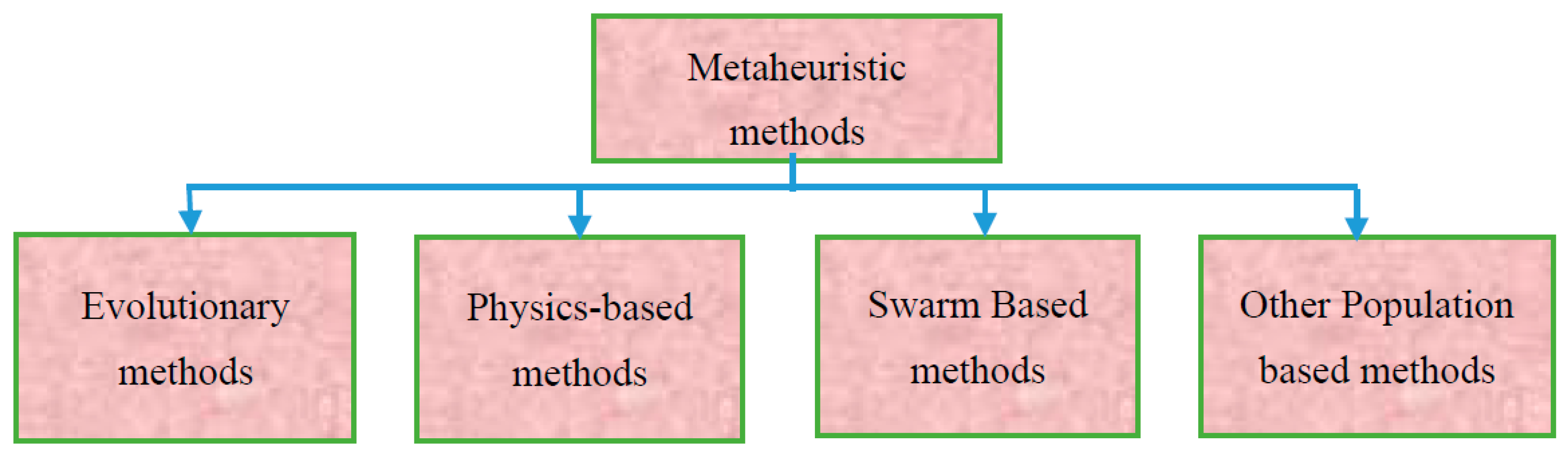
The basic concept of most metaheuristic techniques draws inspiration from nature, animal behavior or physical phenomena. Figure 6 shown a classification of metaheuristic methods in four main classes [89].
These methods of optimization are adaptable and effective. These metaheuristic approaches make it simple to solve constrained and complex discrete optimization problems [90]. These methods can also be used to solve issues with multimodal and multipurpose functions, such as with FACTS devices optimization issues.
Figure 6.
Metaheuristic methods classification.
5.2.1. Evolutionary algorithms
Generally classical evolutionary algorithms can be subdivided into four classes: GA, EP, GP, and ES [91] as shown in Figure 7. These techniques mimic the evolution process in nature to carry out optimization.
Biplab Bhattacharyya et al. [19] have proposed a GA for the proper position of multi-type FACTS controller such as UPFC, TCSC and SVC in order to obtain reduction in transmission loss and operating cost, flexible control of reactive power and also an improvement on voltage profile. A test system IEEE 30-bus has been used as a validation of this proposed method. The same algorithm has been illustrated in [92] for finding the appropriate placements, the optimal number and the optimal sizing of multiple TCSCs to maximizing system loadability with minimum installation cost of these devices in the power system. Simulations results have been performed on a test networks with IEEE 14-bus and 6-bus. The references [93] and [94] have been exhibited the same strategy for the suitable location of UPFC and SSSC respectively to guaranty a reduction on power generation and transmission losses, improvement for voltages profile and treatment of power flow in overloaded transmission lines and maximization social welfare in electrical power systems. In [95], The IEEE 118-bus system security margin was increased using multi-types of FACTS controller such are TCSC, SVC, TCVR, TCPST and UPFC via GA. These given FACTS controllers have been modeled and their optimizations have been analyzed on location, type and size setting parameters as a measure of performance for power systems. A graphical user interface (GUI) based on a GA which was shown able to give the suitable positions and sizing of multi-type FACTS controller such as TCSC, SVC, TCPST, TCVR and UPFC in large power systems. All these FACTS devices have been employed in different scenarios for maximizing the system loadability under security constraints and reducing the losses simultaneously. Simulation results demonstrate that UPFC is the most effective FACTS if we want to increase the loadability while reducing the losses at the same time [96]. An optimal location of UPFC has been obtained in reference [97] by using an elitist MOEA based on NSGAII for finding the simultaneous optimization of three objective functions, voltage deviation at load buses, transmission line losses and the active production generation cost. The robustness of this applied technique has been validated on test system with IEEE 14-bus. Somasundarm Alamelu et al. [98] have been investigated similarly the same problem via CMAES algorithm and NSGAII, in order to minimize the total costs containing the UPFC’s installation cost and to enhance the loadability system. These propose techniques have been applied on test network with IEEE 14-bus and 30-bus. To justify the ability and robustness of NSGAII approach for large system, a test network IEEE 118-bus has been utilized. In [99], a multi-objective SPEA was employed for determining the appropriate placements and settings of TCSC and SVC for improving voltage stability, minimizing transmission losses and congestion in branch loading. The simulations results have been obtained for the IEEE-30 bus network showed the applicability of this applied technique. RCGA was utilized by [100] to know the proper placements of TCSC, SVC and UPFC for reducing the transmission losses in the IEEE 30-bus test system. However, in [101], The proper location of FACTS devices has been based on practical considerations, such as the estimated annual load curve in order to increase the accuracy of this placement. A GA Has been used in this work for finding reduction in transmission losses and investment cost with improvement on profile voltage and margin security for Fars Regional Electric Company (FREC) network. An IPC and SVC have been discussed in [102] using GA algorithm to minimizing the power losses and improving the voltage profile in order to guaranty an enhancement on stability and loadability system. Simulation results have been carried out on IEEE 30-bus test network to performed the ability and efficiency of this applied strategy. For optimal position and parameters sizing of FACTS controllers containing TCSC, SVC and UPFC, a GA was used by [103]. This algorithm was implemented on the test system with IEEE 30-bus, to reduce the power losses and improve the voltage profile under different loading conditions. In [20] ES was utilized to select the suitable location of UPFC, TCSC, and SVC, respectively. Simulations results were performed on IEEE 30-bus test network showed an increase significantly in the loadability system. An ES algorithm was also employed by [104] for sizing and proper locations of FACTS controllers, like SVC, STATCOM, SSSC and UPFC respectively. This Evolutionary strategy was developed for this FACTS devices optimization problem with a way of the coordination of this given number of FACTS not only to significantly improve the capacity of power transmission but also to enhance stability in power systems. The OPF problem was analyzed by [21] for optimal placement of TCSC via Evolutionary Programming (EP). This emerging FACTS controller has been used to eliminate transmission line congestion in deregulated power system and also relieving the congestion. An IEEE 14 bus system was used to demonstrate the suitability of this approach and its effectiveness for the practical implementation in electrical power systems. Weerakorn Ongsakul et al. [105] have been evaluated using FACTs controllers like TCSC, SVC, TCPS and UPFC to take full benefit of total transfer capability (TTC) power. Simulation results on test network with IEEE 30-bus have been indicated that optimally regulated with FACTS controllers by EP was able to improve the TTC value far more than optimal power flow without FACTS devices. FACTS device’s performance was also analyzed under contingency cases by [106], both authors use TCSC such that to improve the power system network condition. In this study EP has been presented to identify the best location of TCSC to minimize power loss and improve voltage profile for the network under contingencies. The implementation of this applied approach was performed on IEEE 30-bus test network. Similarly, a TCSC FACTS device has been integrated in power system to controlling the power flow in specific lines and improving the transmission line security [107] via EP-Critical contingency cases have been used to deciding the suitable position and sizing of TCSC. A test system IEEE 30-bus has been considered for this study. In addition, for solving FACTS devices optimization problem, Md Shafiullah et al. [22] have displayed an approach namely MGGP algorithm to optimize the PSS parameters combined with UPFC to improve power system stability by damping out low-frequency oscillations (LFO). Simulation results for responses with SGGP, MGGP and fixed values of PSS-UPFC parameters indicated that MGGP tuned model exhibits quicker response compared to the conventional and the SGGP tuned models. Even more, an ensemble method has been proposed in [108] incorporating MGGP with two other approaches such as neurogenetic (NG) system and extreme learning machine (ELM) for estimating the PSS parameters in real-time to damp out the unwanted oscillations of electrical power system stability. Two single-machine power system models, one with PSS only and one with PSS-UPFC to verify the robustness of this selected ensemble method. In [109], optimal placement and setting of TCSC, SVC and UPFC FACTS controllers were determined to increasing power system loadability, minimize power losses and total cost generation including FACTS controller’s installation costs. Using an evolutionary approach called DE algorithm that it has been performed on IEEE 30-bus. Similarly, in [110], optimal type, location and setting of multi-type FACTS controllers like SVC, TCSC, UPFC were found to maximize power transfer capability, reduce the total number of overloads and minimize energy losses. The efficiency and robustness of this proposed methodology has been illustrate on 24-bus EHV southern region of Indian grid and sample four-bus system. DE was also used in order to obtain the perfect placement of numerous FACTS controllers like TCSC and TCPST by M. Basu [111] to minimizing the total fuel cost production on regular IEEE 30-bus test system.
5.2.2. Physics-based algorithms
Algorithms based on the principles of various natural phenomena exist in addition to those based on evolutionary and swarm intelligence. Thereby, Physics-based algorithms perform optimization using the rules of physics in the universe Some of them are: ALO, BBO, CSO, FPA, GBSA, GSA, HAS, MVO, SA, ASO, etc.
- ALO technique
A suitable position and parameters setting of FACTS controllers like TCSC and SVC have been determinated by R. Brindha et al. [23] via another methodology called ALO technique. This study has been executed on IEEE 30-bus to achieve different objectives which are the minimization of the fuel cost, loss reduction, voltage profile, improvement and voltage stability enhancement. Similarly, the authors in [112] have been investigated the same methodology by selecting the best setting and appropriate location of TCSC for achieving the maximum system loadability as well as reduction of both losses and production costs. In this work, the effectiveness and ability of this ALO technique was performed on IEEE 14-bus test network while complying with all market-imposed restrictions on equality and inequality.
- BBO technique
Due to attain the maximum benefit of multi-type FACTS controllers, the proper positions of various FACTS devices including SVC, TCSC, and UPFC was confirmed by conducting case studies on standard IEEE test networks by applying BBO technique [24]. Analyses of simulation results have shown that the optimal FACTS device reduced both line loads and load bus voltage deviations, thereby improving system security. Further, a comparison with PSO and WIPSO method was finished to display the predominance, heartiness, and adequacy of this employed BBO technique. In addition, the same strategy was used by K. Kavitha et al. [113], where also a significant decrease in the load on the lines and voltage deviation at load buses has been declared. In this work three cases (only TCSC, only SVC, TCSC & SVC) have been analyzed for the proper location of the devices on test networks with IEEE 14, 30 and 57-buses. In [114], the best TCSC and SVC unit locations and sizes have been determined using BBO to reduce transmission power losses and FACTS device installation costs. This developed strategy was executed on test network with IEEE 30-bus. BBO was also utilized in [115] to find the best positions and settings for IPFC and UPFC in the power system to relive overloads and voltage deviations at load buses during a single line contingency. The security system has significantly improved as a result of the optimal UPFC and IPFC settings for voltage sourced converter magnitude and angle. The superiority of this BBO method has been justified on IEEE14-bus system. A STATCOM FACTS device has been optimally located in [116] via the same methodology in order to enhance a multi-machine system’s transient stability.
- CuSO Algorithm
A new heuristic optimization method known as CSO has been employed by [25] for determining the most effective allocation and sizing of SVC to enhance voltage profile. A simulation results have been obtained from A 5-area-16-machine system and proved that CSO was quickly for finding the high-quality optimal solution of the location and size of SVC compared it to PSO algorithm.
- FPA technique
Reference [26] has been projected a new methodology such as FPA to identify the suitable position and parameters setting of TCSC based on FVSI sensitivity in order to obtain a minimization of transmission losses and an improvement of voltage profiles in electrical network. The results of the simulation were realized on IEEE 14-bus, both with and without TCSC, indicated the robustness of this applied FPA technique. Even more, this FPA strategy has been successfully implemented in [117] for finding the appropriate location and parameters setting of TCSC to improve voltage stability system under contingencies. Simulation results have been analyzed and can be justified the ability of this newly introduced FPA technique for solving the voltage stability problem under contingency conditions. A look at FPA’s applications in FACTS devices optimization problem [118] also reveals improvements to FPA’s performance that have been highlighted.
- GBSA technique
The authors in [27] have been explored a new heuristic optimization algorithm which has the name GBSA for the appropriate location and setting of the IPFC based on the DLUF index to optimize a multi-objective functions containing the reduction of total voltage deviations at load buses, the minimization of transmission loss and the security margin. A test system IEEE 30-bus has been applied to ascertain the ability and accuracy of this employed technique compared to GA under different loading conditions. It was observed that the IPFC can be reduced the congestion in the system by about 15% using GBSA approach. B. Sravan Kumar et al. [119] have been investigated the same strategy for identifying the appropriate location and parameters setting of SVC base on L-index in order to obtain a reduction on transmission losses and also on production cost and also enhancement on voltage profile. Therefor a test system IEEE 14 bus with and without SVC has been used to justify the robustness of this BGSA proposed when compared to GA.
- GSA technique
In [28], a GSA technique for the proper position of multiple UPFC in a power system to decrease transmission losses and operating costs. Therefore, three cases have been studied which are without UPFC, single UPFC and three UPFCs on various standard IEEE test networks 14-bus, 30-bus and 57-bus. a comparison to other currently available algorithms like BBO, Stud GA, GA, ACO and Probability-Based Incremental Learning (PBIL), has been finished to display the predominance, heartiness, and adequacy of the proposed GSA approach. The same technique has been also used in [120,121] for the suitable location and sizing of the IPFC based on DLUF to improve loadability and stability system with reduction on transmission losses. In addition, authors [122,123] have verified that multiple FACTs devices, such as SVCs, TCSCs, and UPFC, are being used to get the most out of power transfer capability for improving loadability system and minimizing total operating cost. A simulation results has been proved that the GSA has more effectiveness for the FACTS optimization issue, since it can get surmised or best solutions in comparison to other strategies like GA, DE and PSO. Another novel algorithm known as Cumulative Gravitational Search algorithm CGSA was applied successfully by [124] To selecting the best position and parameters setting of STATCOM for reactive power compensation and effective real power improvement.
- HAS technique
The electrical power network’s operation and management depend heavily on reactive power compensation (RPC). In this context, D. Karthikaikannan et al. [29] have displayed an approach named HSA for selecting the best placement and sizing of TCSC and SVC for achieving minimization of voltage deviation and reduction on active power losses. An examination with other optimization approaches like Simple Genetic Algorithm (SGA), PSO and DE has been completed to exhibit the vigor of the proposed strategy. In [125,126], to enhance voltage profile and minimize transmission losses considering Non-smooth cost function, an improved HS algorithm was applied for finding the suitable position and sizing respectively of SVC and SSSC.This applied methodology was performed on IEEE 30-bus and IEEE 57-bus, where the simulation results compared with conventional HSA has been done and indicated its robustness and superiority. Furthermore, in [127] a GHS has been explained for finding the buses most suitable for STATCOM installation and its rating power. Thus, an improvement of voltage profile and minimization on transmission losses have been obtained in this work. a new multi-objective planning framework, namely Non-Dominated Sorting Improved Harmony Search (NSIHS), has been proposed and successfully implemented in [128], where TCSC and SVC have been optimally placed for enhancing voltage stability system, minimizing power losses and increasing loadability system. In this work, the advantage of this applied method was highlighted on IEEE 14-bus and compared on terms of better distributed Pareto optimal solutions than MOPSO method.
- MVO Algorithm
The primary threat to the stability of a modern power system, which is interconnected and operates close to its transient and steady-state stability limits, are power system oscillations. In view of this, a recent meta-heuristic algorithm, MVO has been suggested in [30] for selecting optimal parameters setting of the coordinated system based on PSS and STATCOM to enhance the stability system under a variety of multi-machine power system loading conditions. In this work, optimization results for the designed control model system have been illustrated and compared to others meta-heuristic methods like GWO, WOA, GWO and PSO-TVAC, can be demonstrated the effectiveness of this applied MVO algorithm. K. Karthikeyan et al. [129] have been developed the same methodology for best location and sizing of SVC to get maximum load ability and voltage stability. In this study, the robustness of this MVO algorithm was examined on IEEE 57-bus test systems with and without SVC. A new multi-objective optimization algorithm known as the Multi-Objective Multi-Verse Optimizer (MOMVO) has been successfully explored in [130] by locating SVC and TCSC in the best possible location and setting their parameters to achieve multiple goals at once, such as reducing transmission line losses, reducing voltage deviation, and reducing the cost of installing FACTS devices. The accuracy, ability and robustness of this MOMVO has been performed on test system with IEEE 57-bus.
- SA algorithm
A novel optimization-based methodology for FACTS devices optimization problem called SA has been investigated in [31] for optimal setting and locations for SVC and TCSC to improve voltage profile and static security margin. First, its optimal location is found by SQP, and in the next stage the problem has also been solved by SA. The IEEE 14-bus test network has been applied to performed this proposed technique. In [131], this SA has been used with two other heuristic methods TS and GA for finding the optimal parameters (type, location and size) of FACTS controllers containing SVC, TCVR, TCPST, TCSC and UPFC to improve system security. Optimization results have been analyzed on IEEE 118-bus test systems. Unfortunately, TS and GA converge faster than SA to an optimal solution.
- ASO algorithm
A Amarendra et al. [32] have been presented a novel physics-inspired metaheuristic optimization algorithm, namely ASO for efficiently predicting the optimal placements of FACTS controllers containing TCSC, SVC, UPFC and IPFC. In order to obtain minimization in investment costs, fuel costs, real power loss, voltage deviation, severity index, Line Overload Sensitivity Index (LOSI), a regular standard IEEE test system such as 30-bus,118-bus and 300-bus have been considered in this work. To demonstrated this applied strategy, a simulation results have been obtained and compared with others techniques like, Jaya, JA-FPA, DA, FPA, GWA, and WOA.
5.2.3. Swarm Based algorithms
- PSO technique
Because of its advantages in computation, PSO is the method that has attracted the attention of several researchers when solving FACTS devices optimization problem in power supply systems among metaheuristics algorithms [33,132]. To solve this issue, the proper location and the best setting of SSSC is a key for achieving an improvement in voltage profile and reduction on transmission losses when using a PSO, that has been checked on the IEEE- 9bus and the Iraqi national grid [133]. In [134], PSO has been adopted for finding optimal type, location and setting of multi-type FACTS controllers containing SVC, TCSC and UPFC to maximize the system loadability (SL) and reduce the total installation cost (IC) of FACTS controllers. This PSO algorithm was examined on IEEE 6-bus, IEEE 30-bus, IEEE 118-bus and Tamil Nadu Electricity Board (TNEB) 69 bus test system. When the objective is simply Management of Power Flow, the same approach has been used in [135] by locating the SVC and TCSC FACTS devices. An improvement of Power flow was tested on a IEEE 14 bus test system. A PSO has been also used for optimal allocation of SVC in [136] via PSO, in order to obtain improvement in voltage stability and system loadability and minimization on transmission line losses. The robustness of this applied algorithmic was performed on IEEE-30 Bus test network. Siti Amely Jumaat et al. [137] have been investigated similarly the same problem via sigma-multi-objective evolutionary PSO (σ-MOEPSO) approach for to minimizing the power losses in the system and the cost of investment FACTS controller. This approach was applied on IEEE standard test networks 30 bus and 118 bus. A novel version of PSO, the coordinated aggregation-based PSO (CAPSO) algorithm, was developed in [138] to identify the proper location and size of SSSC in power systems to minimize total production costs, including generator VPLE. Practically, because we make for more precision, the (VPLE) should be added to the quadratic equation of the generation cost. In [139], an improved PSO called IPSO has been utilized for determining the best placement and sizing of STATCOM in order to enhance the voltage profile by minimizing voltage deviations at load buses on regular IEEE 30-bus that has been used as an example to illustrate this approach. In [140], a new model of PSO, called as WIPSO has been employed to find optimal placement and setting of FACTS devices containing TCSC, SVC, TCSC-SVC and UPFC in power system to enhance the system security. This approach was validated on IEEE 14-bus, IEEE 30-bus and IEEE 57-bus test systems. A review of PSO-based approaches to the FACTS device optimization problem is provided in [141]. In several research works, PSO has been hybridized with others metaheuristics techniques to enjoy more than advantages in order to strengthen its exploration capacity for determining the best FACTS controller’s settings and locations. A new model of PSO known as ELPSO was presented in [142] for the purpose of determining the most effective locations and sizes for the TCSC’s FACTS controllers in power systems for minimizing the voltage deviations, overloads, and transmission losses in the event of a line outage.
- WOA technique
In reference [34], the power flow analysis technique was utilized to locate the TCSC, and the VCPI approach was used to place the SVC in electrical power system. Further, WOA, DE, GWO, QOGWO and QODE algorithms have been developed for finding the best setting of all control variables containing TCSC and SVC, in the power test system to minimizing transmission losses and operating cost while respecting voltage profile within permissible limit. A comparison of simulation results of WOA with all other used techniques has been discussed and demonstrated the superiority, applicability and effectiveness of this employed WOA technique. Two test networks IEEE 30 and 57 bus were applied for this work. Similarly, Muhammad Nadeem et al. [143] have been inspected the WOA for optimal areas, parameters setting of FACTS devices including TCSCs, SVCs and UPFCs. In this present work, the WOA technique has been introduced not only for finding an ideal rating of these FACTS devices but also the best way for SVC, TCSC, and UPFC to work together with the reactive power sources already in the electrical power network. To obtain a significantly and considerably reduction on total system operating costs and transmission line losses, this employed WOA method was performed on IEEE standard test networks 14 and 30 bus and also has been compared to GA and PSO. It was also noted its effectiveness for all loading conditions.
- ABC algorithm
The ability of the appropriate location of UPFC for minimizing transmission loss in electrical network has been examined by Bairu Vijay Kumar [35] using ABC algorithm. Power flow analysis and power losses have been analyzed for single and double generator outage condition during normal condition, during double generator outage condition and After UPFC placed at best position. It has been observed that power flows have been improved and power losses have been minimized after connecting the UPFC at the suitable position. The comparison results at different conditions on IEEE 30-bus test network, can be indicated the superiority of this employed ABC algorithm and confirm its potential for solving the FACTS devices optimization issue. In [144], the ABC technique has been used for finding the proper placement and the best sizing of IPFC in power system in order to demonstrate the capability of IPFC to control the real and reactive power in multiple transmission lines simultaneously. The optimal setting of IPFC has been significantly improved the voltage profile and decreased the transmission line losses. To proving its performances, by validating on test networks such as IEEE 118-bus, 5-bus, and 30-bus systems, this non-conventional ABC method is compared to the conventional LR method. SVC device’s performance was also analyzed under normal conditions and under contingency conditions by [145] via ABC, both authors use SVC such that to make the voltage profile better and also to reduce active and reactive power losses in electrical network. This applied ABC technique was performed on IEEE 30-bus. The utilization of FACTs devices like SVC and STATCOM, as tested by Kadir Abac et al. [146], to get the most out of the power transfer system by enhancing Voltage stability, improving voltage profile and minimizing transmission losses. These objectives have been defined via ABC methodology by using minimum number of FACTS controllers and compensation sizing on IEEE 30-bus. Simulation results has been illustrated to proving the robustness of ABC when comparing it with DE. A recent work [147] for solving FACTS devices optimization problem, which has been explained un optimal placement of FACTS controllers like SVC, STATCOM, TCSC and SSSC in order to obtain simultaneously an improvement on power losses and stability margin by using ABC algorithm. A comparison of simulation results has been made between ABC, PSO and GA indicated the fast convergence and high accuracy of ABC when conducting FACTS devices allocation study. The compensation of reactive power is one of the practical ways that can be utilized to obtain improvement on electrical power systems and reduce total production cost, in this regard, a modified version of the ABC (MABC) algorithm has been presented in [148] for solve FACTS devices optimization problems. Thus, an optimal position and setting of multi-type FACTS controller containing SVC and TCSC have been examined in order to optimize reactive power management. Also, optimization results have been executed on IEEE 30-bus test system for several scenarios using many other techniques prove that, this employed MABC approach has been a lower transmission loss, reactive power cost and better voltage profile than the PSO, GA and ABC techniques when comparison of simulation results. Another application of ABC algorithmic based OPF Solution was developed to obtaining the perfect location of SVC, STATCOM, TCSC for an improvement of voltage profile and minimization of transmissions loss in the electrical power system. The ideal location for FACTS devices has been endeavored via the ABC calculation. This proposed ABC technique was approved on IEEE standard test networks 14-bus and 30 bus [149].
- CRO algorithm
Authors [36] have been employed the CRO algorithm to allocate STATCOM FACTS devices to solve the ORPD issue. Thus, active power losses have been minimized and voltage profile and voltage stability Have been improved. the robustness of this proposed method was validated on test systems with IEEE 57-bus and 30-bus. Susanta Dutta et al. [150] have been investigated similarly the same problem via an efficient QOCRO algorithm. Simulation results on IEEE standard test networks 14-bus and 30-bus were illustrated to validate the ability and robustness of this employed QOCRO algorithm when compared with BBO and conventional CRO algorithm. In [151], a SSSC has been optimally placed on IEEE standard test networks 30 bus and 57 bus via the same methodology that is the CRO approach. In this study a comparison of simulation results of CRO with other literature methods like GA, teaching learning, based optimization (TLBO), quasi-oppositional TLBO (QOTLBO) and strength pareto evolutionary algorithm (SPEA) prove its robustness and efficiency to generate true and well-distributed optimal solutions.
- CSA technique
In [37], the best position and sizing of STATCOM have been identified via CSA technique to enhance voltage stability limits and to reduce the power losses. To validate this applied CSA method, standard IEEE test network 14, 30, and 57 bus were used. In [152], CSA has been implemented and successfully has been executed to obtain the suitable location and parameters setting of SVC for improving the dynamic stability of studied model. In this work, harmonized model of PSS with SVC based controllers have been discussed. A comparison of simulation results between CSA and others techniques like PSO and TLBO confirmed an improvement on stability performance with coordinated control of CSA tuned SVC and PSS.
- CaSO algorithm
In [38], a CSO algorithm has been developed for Selection of multiple UPFC Suitable Locations in electrical networks to improve voltage stability and loadability in the event of a line outage. That’s why, N-1 contingency for 16 lines on IEEE 14-bus test network was studied to demonstrate the operational benefits of UPFC and to prove the robustness of this CSO approach compared to PSO approach. T. Nireekshana et al. [153] have been investigate the same methodology to find optimal type, placement and sizing of multi-type FACTS controllers like SVC and TCSC to obtain an improvement of Available Transfer Capability (ATC) Under Normal and Network Contingencies. This CSO technique has been implemented for normal and different contingency situations on test networks with IEEE 14 and 24-bus. Similarly, the CSO algorithm has been suggested in [154] for the proper location of UPFC to give a solution for the voltage instability system using IEEE 14 bus test system under contingency conditions.
- CS algorithm
A new metaheuristic technique based on swarm intelligence algorithms, namely CS algorithm has been presented in [39] for obtaining the proper position and sizing of STATCOM for achieving maximum system loadability. The robustness of this proposed methodology has been performed with comparison to GA open loop STATCOM under different conditions of operations and disturbances. A new version of CS approach called adaptive CS (ACS) algorithm has been also used by [155] for TCSC’s optimal size and placement to reduce the total transmission losses and therefore an improvement on voltage profile. A modified test network IEEE 9 bus was applied to validate the efficiency and the ability of ACS proposed to giving a best solution when compared with GA and PSO.
- DA technique
In [40], the system voltage stability has been enhanced by the installation of STATCOM in the suitable position and with its best setting via DA. Simulation results on 52-Bus Nigerian transmission test system indicated 11.26% voltage stability improvement as compared to the case without FACTS. To reduce the transmission loss and to enhance the voltage profiles in the electrical power system, a Firing angle of TCSC and size of the TCSC have been selected in [156] by using DA. To prove the validity of this applied approach and for comparison with other metaheuristics approaches such GA and PSO, a simulation results have been carried out on a test network with IEEE-14 bus.
- BA approach
Another approach called BA was adopted in [41], Where FACTS devices containing TCSC, STATCOM and UPFC have been optimally positioned on IEEE 30-bus test network to improve power quality. Simulation results of load flow calculation with/without FACTS can be proved the importance of implementation for combined optimal selection and best setting of FACTS controllers. An appropriate location and sizing of shunt FACTS device SVC has been considered in [157] via the same methodology to improve voltage stability. The effectiveness and ability of this implemented approach have been validated on IEEE 30 bus test network.
- FFA technique
FFA has been developed in [42] for the best position and setting of IPFC to obtain reduction in transmission line losses. This adopted technique was examined on IEEE 30 bus and NTPS 23 bus test networks and the simulation results have been showered. It can be observed that this implemented approach can be provided best results in terms of transmission losses with reasonable calculation time in [158], the maximum loadability system limit obtaining and its improvement have been resolved with the FFA by determination of the suitable allocation of the SVC and TCSC as well as the most loading factor for each load. The speed and flexibility of given FACTS devices in enhancing the controllability and the TTC using this FFA methodology have been implemented on regular IEEE test networks with 30, 57 and 118 bus. Also, a comparison of simulation results of FFA with other given by PSO and DE has been effected and indicate effectiveness of this proposed FFA in terms on better search capability with faster convergence characteristic. Ch. Vasavi et al. [159] have been exploited the same technique in the presence of SSSC to provide a reduction in total generation cost and transmission losses with enhancement on voltage profile. This applied technique was performed with/without SSSC on IEEE 30- bus test network to shown its effectiveness and robustness. A FFA has been explored in [160] for identifying the suitable location of FACTS controller containing STATCOM and IPFC in order to increase power factor, minimize power losses, enhance transmitted power and improve voltage profile.
- GOA technique
In [43], a GOA was introduced for an extensive modulation of controller gains for an Automatic generation control in a 3-area thermal plant system including FACTS devices, has been introduced. The proper locations and the best settings of IPFC, SSSC, TCPS and TCSC have been optimized to provide superior responses to those of other controllers in terms of settling time and peak deviations. For frequency regulation, a comparison of IPFC’s performance to that of SSSC, TCPS, and TCSC has been established. Simulation results of the GOA compared with other research works has been included in this study. In [161], the same methodology for simultaneously tuning the FACTS controller and PSS taking into account time delays has been proposed to improve Power System Stability. A new version of GOA technique called additive GOA (AGOA) has been also used by [162] with sizing and optimal placement of Center-node (C-UPFC) controller for minimizing total fuel cost with VPLE and reduction of emission function, in order to provide the power flow control together with independent voltage control.
- GWO algorithm
The functioning of series and shunt compensators are integrated in a device known as UPQC. It was employed on the one hand to reduce the transmission losses and On the other hand to maintain the voltage profile with admissible limits. In this context, an optimal location and rating of UPQC have been determined by GWO method [44]. A recent work [163] has been investigate the same strategy for the best placement and sizing of UPFC to provide a promising solution for the high power loss and voltage deviation at load buses on 31-bus, 330 kV Nigeria National Grid (NNG). To solve the ORPD, GWO algorithm has been also presented in [164] after optimal placement of SSSC FACTS device. Thus, an IEEE 30-bus test network has been applied to illustrated the ability and robustness of this employed GWO technique compared it with PSO method. In [165], a novel version of GWO, named as Modified GWO (MGWO) has been used for the suitable allocation and sizing of FACTS controllers containing SVC and TCSC. An OPF based Congestion Management (CM) method has been considered in this work.
- HBMO algorithm
Another technique called HBMO algorithm has been employed by [45] for improving Power System Stability. In this work, the appropriate placement and parameters setting of STATCOM have been considered to improve the damping of LFO system. A Simulation results have been compared to other of GA for examining the effectiveness of this applied HBMO technique. The same approach has been used to solve the same issue successfully in [166], but this time, by the best position of other FACTS controllers such as TCSC and SVC. The effectiveness of this developed strategy was examined even with a 16-machine 68-bus test network. It can be observed in terms on the rate of convergence, best accuracy and without computational complexity.
- MFO algorithm
The authors in [46] have presented a MFO approach to obtain the appropriate placement and sizing of UPQC to giving a solution for providing reactive power compensation in electrical network. Thus, the load flow program now includes both the voltage that is injected by the series compensator and the reactive power that is injected by the shunt compensator. A comparison elaborated on test systems considered with and without UPQC has been realized to justify the efficiency, ability and robustness of this applied MFO algorithm. Moreover, the same technique has been discussed by [167] for finding the appropriate allocation and parameters setting of STATCOM to improve voltage stability system and minimize transmission losses in electrical power network. The advantage of the applied technique was highlighted on a test network with IEEE 30-bus. Additionally, a comparison with the PSO method has shown that the MFO algorithm is more effective when using a simplified STATCOM model.
- BSO method
In [47], a robust design approach named BSO algorithm for the simultaneous coordinated tuning of the TCSC damping controller and PSS in a multimachine electrical network has been developed. In this study, the model and parameters of the PSS and TCSC have been considered in order to minimize the stability performance index, that is based on the Integral of Time multiple Absolute Error (ITAE). Otherwise, three cases of optimizations have been considered which are optimized PSS, optimized TCSC and coordinated optimization, where the simulation results have confirmed that BSOA with coordinated design is capable of producing comparable results to BF and PSO techniques. In addition, this BSOA approach has been also used by Z. Lu et al. [168] for identifying the suitable placements and setting of FACTS controllers with multiple types, like TCSC, SVC, TCPST and TCVR to decrease the transmission loss and also to improve voltage profile. On both IEEE 30-bus and 118-bus test systems, the simulation results were compared to those of other known algorithms like GA and PSO to demonstrate the proposed algorithm’s superiority, robustness, and effectiveness.
- IA approach
The deregulation and reorganization of electricity markets present new challenges to modern electrical systems. Hence, to achieve high operational efficiency and network security, large interconnected systems have been developed. In this regard, a new approach namely IA [48] has been scrutinized the competence of the optimal location of UPFC for minimizing the overall cost functions, which includes the total active and reactive production cost function of the generators and installation cost of UPFCs. In this work, the robustness of this IA technique was tested on the 4-bus, IEEE 14-bus and IEEE 30-bus test systems with equality and inequality constraints. Milad Khaleghi et al. [169] have been investigated a modified Artificial Immune Network Algorithm (MAINetA) for suitable allocation of SVC to obtain reduction of voltage deviation at load buses, minimization on transmission losses and reduction of installation cost. A comparison with GCPSO, PSO, GA, and BIA, among other optimization methods. has been done to show that the proposed MAINetA approach is reliable.
- SOS Algorithm
Generally, it is desirable that a power system operation is in a normal operating condition. However, forced it to operate near to its stability limit, FACTS device can be considered as an alternative to this issue. Thus it is important to choose the suitable device to reach the required goals. In this context a SVC has been optimally used in [49] via a SOS algorithm that is a well-established swarm intelligence-based, for voltage security enhancement. In this work, the robustness of this SOS method was verified on the IEEE 26-bus test systems when compared to EP and POS methods. Similarly, the same strategy has been investigated in [170] for solving a ORPD problem. However, a FACTS devices containing TCSC and TCPS have been optimally placed in order to obtain a minimization on transmission losses and reduction in voltage deviation. the perfect placement of numerous FACTS devices and robustness of proposed method have been authenticated by performing case research on standard IEEE 30-bus test system.
5.2.4. Other Population based algorithms
- BH algorithm
The TCSC has a low cost of Series FACTS device, hence it’s widely used for congestion relief. In [50], to attaining Congestion Management (CM), a TCSC has been optimally located by using a BH algorithm. In this recent research, this TC has been achieved by considering two cases, reduction of reactive power in transmission lines when the TCSC optimal position has been taken, and power flow PI in the second situation. This employed BH strategy was performed on test system with IEEE 30-bus. R. Ramachandran et al. [171] have been investigated the same BH strategy for the proper locations of FACTS controllers in order to reduce the total congestion cost Under Line outage contingency conditions. a comparison to other methods of optimization like BBBC and PSO was outperformed on IEEE-30 bus and Modified IEEE-57 bus test network to justify the robustness of this employed BH algorithm.
- PSOA technique
An adaptive APSOA has been also adopted in [51] for selecting the proper position and size of TCSC’s in electrical network to minimize active and reactive power losses, increase the transited power in transmission lines and enhance the voltage profile while keeping the system’s total generation cost slightly lower than in the single-objective base case. The robustness of this method was proved on regular IEEE test networks such as 9-bus,30-bus,57-bus and also a large system IEEE 118-bus. Similarly, an optimal installation of TCSC has been integrated in [172] via the same strategy to improve simultaneously the performance system and its controllability. A simulation results have been illustrated to demonstrated the robustness and ability of this applied approach when compared it with other literature techniques.
- ICA method
ICA has been used in [52] for the best positions of FACTS controllers including TCPST and TCSC to alleviate voltage deviations and overloads under line outages contingency and demand growth conditions. Two scenarios have been considered in this work, in the first, for various line outages in IEEE 14-bus test network, overload metrics has been mitigated by the power flow control capability of TCPST device. In the second, for different values of load growth in IEEE 39-bus test system, overload and voltage deviation metrics have been relieved by the strong control capability of TCSCs devices. A comparison with the other existing algorithms which are GSA, ABC, BSO, EP, PS, NLP, BSA and ARO has been done to demonstrate the proposed ICA’s superiority, durability, and efficacy. An optimal design of STATCOM base PV curves, has been introduced by [173] via the ICA technique for relieving damping oscillations and improving voltage profile under various operating conditions and disturbances in a multimachine environment. The results of the simulations have been elaborated, and they have shown that, in comparison to GA, ICA can deliver comparable results in terms of settling time and overshoots.
- SCA approach
R. Ravisekar et al. [53] have been utilized SCA for choosing the perfect position and sizing of UPFC, that has been added to conventional ORPD problem to reduce the total transmission loss and enhance the voltage profile. Two regular IEEE test systems 57-bus and 118-bus were applied to attain these objectives, and validated the effectiveness of this employed strategy. Also simulation results have been illustrated to indicate the high quality and accuracy of the SCA comparing with existing literatures. A simplified SCA (SSCA) has progressed in [174] for resolving the same issue by locating the appropriate TCSC and SVC device placements and setting their parameters under demand growth conditions. On IEEE 57-bus and 118-bus test networks, this applied methodology was examined by a comparison of simulation results to those of conventional SCA and other known methods. It can have observed the efficiency and robustness of SSCA in term on minimum operating cost and maximum net savings.
- TLBO method
This TLBO approach has gained wide acceptance among the optimization researchers, especially in FACTS devices optimization problems [175]. A TLBO algorithm has been adopted in [54] to minimize transmission loss, reduce total installation cost and improving voltage profile by identifying the suitable location and sizing of TCSC device. Three test networks which are IEEE 14-bus, IEEE 30-bus Indian grid 75-bus have been applied to validate the viability and superiority of this developped TLBO algorithm compared to ABC and PSO techniques. Rahul Agrawal et al. [176] have ben investigate the same methodology for finding the suitable position and rating size of SVC device to obtain a reduction on transmission loss and improvement on voltage profile. For the justification of the effectiveness and capability of this proposed method, IEEE 14-bus test systems have to be considered. The TLBO technique has been also discussed by Anurag Gautam et al. [177] for proving an enhancement on ATC using an optimized TCSC device. A simulation results have been elaborated on IEEE 30-bus under different contingency conditions to shown its validity and effectiveness when compared to GWO and PSO heuristic methods. Similarly, in [178], a SVC device has been optimally placed on IEEE 30-bus test system via TLBO approach, where one of the main contributions has been the improvement of voltage stability system. The application of TLBO has been also presented in [179] for the coordinated tuning of the SVC and PSSs damping controllers to enhance the LFO in a multimachine electrical network. In this study, an eigenvalue analysis and nonlinear time-domain simulation were used to shown the robustness of this employed technique. The obtained results can be proved that the coordinated controller TLBO-PSS-SVC has an excellent capability in LFO damping compared to TLBO based PSS (TLBO-PSS) and the TLBO based SVC (TLBO-SVC).
- WCA method
As an example of the applications optimization schemes of Other Population based algorithms, in [55], WCA that it is based on the water cycle and the observation of how rivers and streams in the real world flow downhill toward the sea. It has been used to reduce the weighted sum of the voltage deviations and losses by optimal allocation of SVC for solving the Reactive power planning (RPP). Amin Khodabakhshian et al. [180] have been also present the WCA method to known the optimal design for simultaneously locating UPFC and PSS0. In this work, the coordination of these two controllers was utilized to improve the system stability. The effectiveness and applicability of this selected strategy were performed on IEEE 39-bus test network when compared with other algorithms.
- BFA technique
BFA is one of the population based evolutionary computation techniques which is developed by Passino. This original BFA algorithm is utilized by many experts in different fields, especially in FACTS controller’s optimization issue. It was applied by [56] to find the optimal controller parameters of UPFC for damping LFO in a power system and also to obtain an improvement on the transient stability under different operating conditions. In [181], a new model of BFA, namely Enhanced BFA (EBFA), was proposed to determining the suitable allocation and sizing of TCSC and SVC in electrical network to increase voltage stability limits and reduce the total generation cost. These objectives have been solving using IEEE 30-bus test network under normal loading and with increased loading for some buses. A comparison with conventional BFA and GA has been illustrated to proving the robustness of this selected EBFA methodology on terms of computational time and convergence characteristic. In [182], a modified BFA called Modified Bacterial Foraging Optimization Algorithm (MBFOA) was used for determining the proper position and sizing of SVC in order to optimize multi-objectives function such as security system, voltage deviation at load buses, active power losses and system overload. An IEEE 30-bus was applied to prove the robustness and the better performance of this applied MBFOA when compared it with GA. Similarly, in [183] to improve system security, stability and reliability, an improved version of BFA namely Refined Bacterial Foraging Optimization (RBFA) algorithm was used for the best placement of UPFC. The benefits of this developed RBFA algorithm was highlighted in the solving of the ORPD problem using IEEE 6 and 30-bus test networks.
- COA method
Tawfik Guesmi et al. [57] have been investigated a novel approach for the simultaneous coordinated design of PSSs and SVC controllers in multimachine electrical network, using the COA to improve the system stability. In this work, a nonlinear time domain based objective function has been employed, where, simulation results under different load conditions and configuration of the system, have been elaborated. It can have observed the efficiency and applicability of this proposed strategy in term of time responses of the speeds’ deviations of machines. In [184], the recently COA approach has been also explored to simultaneously design PSS and TCSC-POD in order to eliminated the unbalances between electrical and mechanical torques in synchronous generators caused by the LFO damping. Simulation results have been illustrated for the South Brazilian power system to validated the effectiveness of this applied methodology.
- TS algorithm
A TS algorithm has been addressed in [185,186] for finding the suitable placements and parameters setting of FACTS controllers like TCPST, TCSC, UPFC, and SVC in electrical networks. A 6 bus test network was utilized to demonstrated the robustness of this developed technique to reduce the total production cost with different loading conditions.
5.3. Summary of sensitive index methods related to FACTS Devices optimization problem
The computation for various potential locations of FACTS controllers is obtained based on different indices in analytic approaches. Typically, various types of indices are utilized in this area, like PLI, PI, VSI, CSI, NSCPF sensitivity, MLP index, LFI index, FVSI, TSLSI, OVL index, VLB index, LMP index, TCI, CCI, VCPI, LQP, VPSI, EVPA, etc.
In [187], a SVC device has been parameterized based on a nodal order and the analysis of repetitive power flows using IEEE 9-bus test system. It can have observed that once the SVC has been installed in the best location (bus 5), power losses, voltage stability and power factor have been optimized. Marouani Ismail et al. [188] have been introduced a sensitivity method based on the CSI described by a real power flow PI for placing a diverse FACTS controller containing TCSC and UPFC to decrease the FACTS installation cost and overloads for 9-bus WSCC (Western System Coordinating Council). Also three cases have been considered which are without FACTS and with FACTS for simple and double contingencies. Simulation results have been analyzed to prove the competence and effect of these FACTS devices to achieve target objectives. A suitable position of FACTS controller containing TCSC and UPFC, based on another sensitivity manner namely NSCPF has been obtained in [189]. The effectiveness of this NSCPF approach on terms of production cost function minimization and computational time, was examined on IEEE 14-bus when compared to GA. The authors in [190] have been implemented a sensitivity-based screening technique for the proper location of UPFC device to reduce the total generation cost in electrical network. In this work, a new UPFC model called UPFC ideal transformer model has been proposed the UPFC sensitivity analysis. As a result, this model does not require the addition of additional buses for the UPFC input and output terminals. The robustness of this proposed method has been demonstrated through simulation results on a regular IEEE test networks 5bus, 14-bus, and 30-bus. The PFC analysis base on PV curve and Loading parameter LP (λ) has been used in [191] for the appropriate locations of SVC and TCSC to improve voltage stability system. Accordingly, the critical buses and lines that has the weakest voltage profile and higher load value respectively have been identified by application of this PFC approach. Simulation results on IEEE 6-bus has been confirmed that the SVC gives the best voltage profile and transmission loss compared to TCSC. Similarly, to enhance voltage stability system under contingency conditions, Farbod Larki et al. [192] have been explored the PFC strategy based on MLP and its corresponding Mega Watt Margin (MWM) decrease percent in each contingency by selecting the suitable placements of FACTS controllers like SVC, TCSC and STATCOM. From obtained results for Khouzestan power network, Tt can be concluded that the STATCOM device provide higher voltage stability margin than SVC at weakest bus. Other work for FACTS devices optimization problem has been employed in [193], where a TCSCs device have been optimally located to minimize total production cost including installation FACTS cost, using two sensitivity index methods which are the active power PI and reduction of total system VAR power losses. Simulation results on IEEE 5-bus have been obtained under line outage conditions. It can be observed that that PI sensitivity with TCSC cost could be effectively utilized for selecting optimal placement of TCSC. Likewise, Sunil N. Malival et al. [194] have been also adopted the same strategy to decide the optimal allotment of TCSC using IEEE 6-bus test system. Because the voltage stability is mainly affected by reactive power balance in the system., Muhammad Nurdin et al. [195] have been investigated a new technique base on three indexes like voltage index, VSI and ASI sensitivities, for choosing The proper locations and the best setting of SVC and STATCOM to achieve an enhancement on voltage stability systems. A 14-generator model of The SE Australian and Sumatera electrical networks in Indonesia have been applied for these proposed techniques. Similarly, to solve the same problem, a new method termed EVPA has been discussed in [196] for placing optimally three FACTS devices like SVC, TCSC and STATCOM in three test systems which are nine-bus test system (WSCC), ten-machine, 39-bus system and Sixteen-machine, 68-bus system, where the simulation results demonstrate that the EVPA approach can produce comparable results to the LFI sensitivity method [197]. Esmaeil Ghahremani et al. [198] have been displayed a graphical user interface (GUI) based on two analytic sensitivities related respectively to lines, named OVL and VLB for the appropriate positions of FACTS controllers containing TCSC, SVC, TCPST, TCVR and UPFC to improve the system loadability under security constraints. Simulation results have been realized on standard IEEE test systems that are 24-bus, 30-bus, 57-bus, 118-bus, and 300-bus, and declared that the UPFC is the most effective FACTS for increasing loadability while reducing the losses at the same time. Two techniques namely LMP difference sensitivity technique and CRC sensitivity approach, were successfully proposed to solve FACTS devices optimization issue in [199] to obtain congestion management in deregulated electrical power systems. Based on the observed result for the three regular IEEE test networks 14, 30 and 57 bus, it can be recommended that CRC sensitivity approach provides more promising result than LMP difference sensitivity technique. Mutegi A. M et al. [200] have been projected a voltage stability indices based on the FVSI and the LSI for the proper allotment of FACTS to improve voltage stability network. In this work, an IEEE 39-bus was considered as a test network to justify the ability and robustness of the employed methods. In [201], a Generalized technique based on TSLSI has been developed for knowing the suitable position of STATCOM in the first step, and its parameters setting in the second step by NR to enhance power system static security. A simulation results have been implemented on IEEE 14-bus demonstrated a considerable improvement in voltage profile and reduction on transmission losses after placement of STATCOM device. Identically, for solving the same problem, Lu, Y et al. [202] have been explained an index named the SCS index to choosing the most suitable location of TCSC for elimination line overloads under a single contingency. A regular IEEE 14-bus and 118-bus test network highlighted this developed technique’s advantages. As an example of the applications of sensitive index methods, in [203] two indices termed TCI and CCI have been tended for installing a TCSC FACTS device at appropriate allocation respectively under normal and network contingency conditions, in order to obtain an improvement on power system performances. On test network with IEEE 14-bus and 118-bus, the efficacy of this employed methodology has been demonstrated. For the security system improvement, sensitivity-based approach that is the active power flow PI has been used in [204] for selecting the best locations of TCSC and UPFC under critical contingencies and different loading Cases. In this study, the obtaining of optimal PI sensitivity with taken into account of equality and inequality constraints, a Generalized Algebraic Modeling of System (GAMS) has been employed. The ability and efficiency of this applied strategy was illustrated on IEEE 30 bus and Northern Regional Electricity Board (NREB) 246 bus practical Indian test systems. Ikram Ullah et al. [205] have been investigated the same strategy to identifying the best position of TCSC to obtain an improvement on the Available Transfer Capability (ATC). In this work, once the TCSC, it has been located, the TTC has been computed using the Repeated Power Flow (RPF) method with taken into account of all equality and inequality constraints of the system. Simulations results have been verified on three IEEE test systems IEEE 24, 30 and 39 bus to demonstrated the effectiveness of this PI technique. In reference [206], (PI) sensitivity based approach and LODFs index were presented for The proper location of SSSC and TCSC FACTS devices to obtain an improvement on power system security. Simulation results have been elaborated on modified IEEE 30 bus test network by utilizing power world simulator software, where it can have observed the superiority of these selected approaches. To selecting the best positions of FACTS controllers containing TCSC and STATCOM, VCPI and LQP have been discussed in [207] by determining the critical line with respect to a bus. A simulation results have been analyzed on IEEE 14-bus, where it can be observed clearly that the suitable locations of the given FACTS devices can be offer us a good control of the transited power, an improvement of the levels of the tensions and consequently a permanent stability of the studied system. In [208], Power system voltage stability indices (VSIs) including the LQP, the VCPI, and the LSI have been introduced for finding the most appropriate positions UPFCs in order to obtain enhancement on voltage stability system. To demonstrate the robustness of this applied approach, simulation results for voltage stability, have been elaborated on IEEE 14-bus and 39-bus, and compared with other techniques of optimization like DE and PSO. To obtain an enhancement of voltage profile, improvement of ATC and an increase of the efficiency for the overall power transmission, power stability index (PSI) and FVSI have been explored in [209], which can be also used for placement of SVC. A test system IEEE 14-bus has been considered in this work, where it can be noted that the PSI technique can be offer a better result than the FVSI technique. Likewise, Mohammed Amroune et al. [210] have investigated the FVSI sensitivity to solve the same issue by determining the best allotment of TCSC and SVC. This sensitivity index has been executed on modified IEEE 30-bus to either decrease the load on reactive power or increase the load until voltage collapse is reached in order to eliminate voltage instability. A new technique based on VPSI was considered in [211] for identifying the most allocation of TCSC in first stage Taguchi Method (TM) has been used in second stage to determine the parameters setting of TCSCs to enhance voltage profile and voltage stability margin. The effectiveness and applicability of this technique was applied on test network with IEEE 14-bus. Authors of [212] have been presented the Structure Preserving Energy Margin (SPEM) sensitivity to enhance transient stability under various contingency conditions of an electrical network, using FACTS devices. In this research work, the improvement in CCT has been taken into a compte for examination of this sensitivity method for the improvement in PTC and sizing of compensation for shunt and series FACTS devices. The effectiveness of this applied approach has been performed on 10-bus system (4-machine) and 39-bus New England system (10-machine).
5.4. Summary of mixed methods related to FACTS Devices optimization problem
In some research works, conventional techniques, sensitivity index approaches and meta-heuristic methods have been hybridized in pairs or all together and applied to find better solutions to FACTS device optimization problems than individual techniques. As a result, hybrid or mixed methods have proven effective in locating global optimal solutions for FACTS devices optimization issue with a variety of constraints because they combine the strengths and weaknesses of two or more approaches to solve complex issue. In the following of this section, different hybrid methods reported in the literature will be presented. A new HCRO approach based on CRO and DE, have been exploited in [213] for identifying the best locations and sizing of UPFC device to ameliorate performances system which are reduction on power losses, voltage deviation and production cost. In this suggested hybrid technique, mutation and crossover operation of DE have been introduced to increase the quality of CRO’s solutions and accelerate its convergence. test networks with IEEE 14-bus and 30-bus were taken into consideration in order to assess this method’s capability and efficiency, where a comparison of obtained results with others given by explored literature techniques like GA, IGA, PSO and HIA, has been elaborated. Because, it’s easy operation, simplicity integration into electrical network and as a one of the most commonly utilized shunt FACTS controllers due to its low cost compared to others, the appropriate location and parameters setting of SVC have been selected to improve the ATC and to give more flexible voltage control.by another hybrid algorithm based on hybridizing the CS and ALO known as CS-ALO [214]. The ability and efficiency of this hybrid methodology has been examined on IEEE 57-bus, and Simulation results was indicated that CS-ALO is more effective than other techniques in terms of its convergence characteristics and robustness in solving FACTS devices optimization problems. For selecting the appropriate location and parameters setting of UPFC to get an improvement on the dynamic stability in electrical network, B. Vijay Kumar et al. [215] have been employed a hybrid method combining FA with CS named FA-CS to achieve global best results for the FACTS devices optimization problems. Thus, optimal position of UPFC has been found by FA technique, however, its sizing has been identified by CS algorithm. The FA-CS performance has been evaluated by comparison with those of various approaches like Bat-FA, GSA-Bat, ABC-GSA and CS techniques. The results of the comparison consistently demonstrate the robustness of this applied approach and confirm its potential for solving related issue. In [216], a hybrid technique with a combination of EP and DE algorithm, namely EP-DE has been developed for determining the appropriate placement and sizing of FACTS controllers like TCSC, SVC and UPFC to minimize the total number of overloads, excess power flow, overloading severity and production cost. The obtained results on 5-bus test network with and without FACTS have been demonstrated the superiority of this EP-DE strategy. Biplab Bhattacharyya et al. [217] have been employed a new hybrid combination of fuzzy logic and DE algorithm namely Fuzzy-DE method for the planning and coordination of FACTS controller in electrical network under different loading conditions. Therefore, the suitable placements of TCSC and SVC have been found to take the advantages of fuzzy logic, whereas their parameters setting have been determinate using DE. A results of simulation on IEEE 30-bus have been obtained and compared with simple DE (SDE), where a significance of this proposed approach is clearly observed in term on operating cost minimization. In [218] the authors have been used the HLSI, that a combination of Lmn and FVSI for computing the proper placement and sizing for FACTS devices to obtain an improvement on voltage stability system. The robustness of this applied methodology has been verified on IEEE 9-bus under multiple contingencies. Similarly, to solve the same problem, Sai Ram Inkollu et al. [219] have been investigated a hybrid PSO-GSA optimization technique to obtain the most suitable locations and parameters setting of UPFC and IPFC. Once these two FACTS devices have been optimized, the voltage stability has been ameliorated while respecting a given set of operating and physical constraints. The robustness and applicability of this applied technique have been implemented on IEEE 30-bus test system. In addition, a GSA has been also combined with GA, constituting a GA-GSA technique [220] for optimizing an IPFC FACTS device to enhance also the voltage stability system. In this study, the optimal positions of IPFC installation have been determined by GA. Among the suitable positions, the maximum transmission line combinations of the corresponding buses have been examined. After that, the IPFC’s injecting voltage magnitude and angle have been found by GSA approach. A test system IEEE 30-bus with and without IPFC has been applied to demonstrated the robustness of this strategy in terms of quick solution for the best IPFC setting and enhancement of voltage stability. It is observed from [221], that active power loss has been decreased and voltage stability system has been improved when TCSC, SVC and UPFC were used in IEEE 30 bus. In effect, a combination of KGMO has been combined with PSO, namely KGMO-PSO methodology has been developed as an efficient optimization technique for solving FACTS devices optimization problem in this research. The main benefit of using this hybrid method is that it does not need more time for tuning optimal locations and parameters setting of FACTS controllers when compared to others existent techniques like PSO, ABC, TLBO, CRO and QOCRO. It is vital to take note that occasionally, shunt compensation in the lower buses level does not provide ideal response power for the improvement of voltage stability. In this regard, authors [222] Have been addressed a hybrid method combining FL with RCGA termed fuzzy-GA formulation for the best position and sizing for SVC and STATCOM to get a strongly bonded bus with many weak buses, whose reactive power support on this bus can ensure a sufficient increase in the load margin and a good voltage profile. Two test systems IEEE 14-bus and IEEE 57-bus have been considered to shown the effectiveness and ability of this applied approach. In [223], the application of hybrid IA (HIA) like immune GA (IGA) and immune PSO (IPSO) was used for finding the appropriate location and sizing of UPFC to minimize transmission losses and operating cost. Simulation results compared with other of GA, PSO, IPSO, and IA techniques was done on a regular IEEE 14-bus and 30-bus test networks in order to assess this method’s capability and efficiency. A hybrid TSSA technique has been introduced in [224] for most suitable locations of FACTS controllers containing TCPS, TCSC, SVC and UPFC to decrease the total production cost of all levels of loading. A comparison with the other existing algorithms like quadratic programming (QP) and the sensitivity index approach, has been carried out to prove the superiority, ability, and effectiveness of this applied method. An improved (TSSA) approach for solving the FACTS devices problem has been developed by Suppakarn Chansareewittaya [225]. In this reference, the suitable placement and sizing of SVC have been obtained to enhance the TTC on the IEEE 118-bus system and the practical Electricity Generating Authority of Thailand (EGAT) 58-bus test systems and the results reveal that the employed method is simple, reliable and able for the SVC practical implementation compared to EP and original hybrid TSSA. In [226], hybrid technique based Optimized FACTS devices has been presented, where the ABC algorithm has been hybridized with GSA to ameliorate the dynamic stability in power systems. Here, the most favorable position of UPFC has been fixed using ABC algorithm after identification of the maximum power loss bus. Once the UPFC has been optimally placed, the GSA has been participated to known the required capacity of the UPFC. A simulation results have been implemented on IEEE 14-bus and IEEE 30-bus to demonstrated the ability and robustness of this ABC-GSA technique and its potentiality for solving FACTS optimization issue compared to ABC and GSA separately applicated. In order to develop an efficient optimization strategy, Hybrid GACO approach combining the properties of ACO and GA algorithms was introduced in [227] for selecting the suitable location and parameters setting of STATCOM with Equivalent - current Injection (ECI) to improve voltage stability system. In this work, the performance of the ACO technique ameliorated when coupled with GA has been studied. Simulation results on IEEE 30-bus have been analyzed, indicated the significantly voltage stability improvement and confirmed that this GACO proposed approach can not only ameliorate the neighborhood search, but can also search the optimum solution quickly to advance convergence. In [228], it is observed that UPFC has been used to improve the dynamic stability in power system. A CKH and RRA have been combined forming a new hybrid approach called CKHRA technique. The optimal placement of UPFC has been determinated by CKHRA technique based on maximal power loss line, however, its size has been found by RRA algorithm based on minimal voltage deviation. The effectiveness of CKHRA method has been linked with a standard IEEE 14 bus, 30 bus and 57 bus bench mark system, whereas the efficiency has been tested against various generator fault conditions. Ahmad Abubakar SADIQ et al. [229] have been projected a hybrid of real power flow (∂P I) sensitivity and PSO (PI-PSO) to maximize the ATC and minimize FACTS sizes such as TCSC and SSSC using CPF strategy. In this study, some high-potential positions with improved ATC at minimum FACTS size have been obtained by PI sensitivity to giving a reduced search space for the PSO technique. A comparative result with PSO technique has been carried out on IEEE 9-bus to demonstrate the effectiveness of this developed technique on terms of convergence characteristics, avoidance of local optima, and superior ATC values. In [230], three optimization techniques GA-PSO, DA-PSO and GA-DA have been employed for choosing the optimum placement and firing angle of SVC. In that, the location of the device has been optimized by GA or DA and the optimized firing angle has been done with PSO. A simulation results have been implemented on IEEE 57-bus with and without SVC to prove the superiority and applicability of these proposed approaches. A comparative study has been effected and indicated more efficiency of GA-PSO than GA, PSO and DA-PSO. A modified PSO called adaptive PSO (APSO), has been mixed with SA and has been described in [231] and referred to as APSO-SA. This methodology has been incorporated a APSO to increase the convergence rate in original PSO and SA approach for obtaining the proper placement, type and size of SVC and TCSC. These two FACTS controllers have considered in this research for improving voltage stability index, minimizing transmission losses and decreasing the cost of investment with single and multi-type FACTS devices. This APSO-SA strategy was performed on IEEE 14-bus test network and numerical results have been illustrated to shown its effectiveness and applicability when compared with conventional PSO in terms of better accuracy and fast convergence to solve FACTS controller’s optimization problems. Production fuel cost, voltage deviation and transmission loss have been formulated as a multi objectives function problem, that has been solved under line contingency condition by a new approach for the suitable position and sizing of FACTS controllers in electrical power system. This new technique based on hybridizing the Krill Herd (KH) algorithm and Combined index having LUF and FVSI sensitivity, has been presented in [232]. Therefore, an optimal affectation of TCSC has been obtained by LUF and FVSI for contingency analysis base on Rapid Contingency Ranking Technique (RCRT) and also, Krill Herd (KH) algorithm has been used to optimize TCSC tuning. This employed strategy was implemented on IEEE 30-bus test network and a line contingency has been considered to performed its applicability and robustness. In [233], a combination of GSA with VSI and LSI has been endeavored for finding the most suitable allotment and parameters setting of FACTS devices (SVC, TCSC, UPFC). The main aim is to minimize transmission loss with improvement on system security. The validation of this employed methodology has examined on a regular IEEE 30 and 57 bus test network. Parizad et al. [234] have been presented heuristic techniques and sensitivity index for the best allocations and tuning of FACTS controllers. A hybrid HAS-GA have been combined with VSI and PLI index to selecting the suitable allocation and sizing of SVC, UPFC and TCPAR devices. For system analysis, three different situations have been studied such as individual placement, two devices placed randomly and simultaneously placement. In all situations, VSI and PLI have been calculated to choosing the better locations for the devices. Simulation results have been obtained from 14-bus test system, where, it can have noted an improvement on voltage profile, reduction on transmission line losses, increase of ATC and maximization loading and voltage stability margin. Divya Gupta et al. [235] presented an approach of calculation for Enhanced ATC, using TCSC FACTS device by controlling the transmission line reactance. In this research work, the Power loss-based Congestion Reduction (SPCR) index and the Metaheuristic Evolutionary Particle Swarm Optimization (MEEPSO) technique have been combined successfully to finding the appropriate placement of TCSC and the augmentation of ATC respectively. Simulation results have been illustrated in IEEE 6-bus and IEEE 30-bus test systems for validated the robustness of this applied strategy. The combination of the NSGAII technique with PI and SI sensitivity respectively in [236] and [237] for finding the proper placement and parameters setting of TCSC FACTS device to minimize transmission losses and total production cost including installation cost of FACTS device.
6. Discussion
In this comprehensive review, after having presented a detailed modeling of the FACTS devices, their basic concepts and their classification, we have tried to emphasize their objectives, the main fields of application, their advantages, their best adaptation to variations in operating conditions of electrical systems and the provided improvement in their use of existing installations, as the main motivations for the integration of FACTS devices into the electrical system based not only on past and recent research articles on FACTS devices and their applications, but also on the real state of the market.
Based on research published in the literature, several parameters of electrical networks can be controlled by different FACTS systems, in fact, UPFC and IPFC is the most suitable FACTS controller for active and reactive power control of bus voltages. However, SVC and STATCOM are the most used for reactive power compensation. While TCSC is the most suitable controller for transmission line impedance variation and SSSC controller provides active power control. According to the literature review, the benefits provided by FACTS devices, their various power system parameters that can be controlled and their main applications are shown in Figure 8. It can be observed that that the UPFC is the most efficient, but its high cost constitutes its major drawback.
A technical contribution of FACTS devices of more than 254 references has been analyzed and evaluated in this modest work, and has been able to show that FACTS devices, if they installed in the suitable location and with proper size, are capable by their dynamic characteristics of offering fast control of active and reactive power, realizing continuous compensation, controlling voltage profile and power loss, minimizing or eliminating line overloads, reducing network congestion management and improving transient stability in power networks as a possible benefits of the main FACTS Devices. However, not all of these many benefits are noticeable. In the same way, the cost of FACTS controllers is also huge. In all cases, the cost must be weighed against the expected benefits. This is why better placement with the appropriate size is required, especially when dealing with multiple types of FACTS devices.
Several techniques-based conventional optimization methods like NR, MILP, MINLP, MCA, NLP, LM, MIP, MDCP, SQP, etc. have been used successfully in the last two or three decades for solving FACTS devices optimization problems. They are adaptable, flexible and easy to use for the problem analysis. Although classical optimization techniques have relatively efficient convergence characteristics, handling constrained optimization problems is difficult [82]. However, these conventional methods have some drawbacks. They have weak convergence characteristics and are heavily dependent on the initial solutions. They either completely diverge or converge to some local optima. Unfortunately, they are unable to solve nonlinear and nonconvex problems or the problem with multiple variables. Conventional techniques based on calculation are not able for delivering satisfactory results due to the non linearity of the FACTS devices’ optimization problems with certain constraints. Therefore, there is a pressing need to develop more dependable and improved strategies to overcome the limitations.
Analytical techniques or approaches by sensitivity bases have the benefits of being computationally efficient; they are simple and best suited to the location problem, but only one objective problem is considered [238,239]. Any sensitivity technique is designed for finding the suitable placement of FACTS controller, and it is difficult for considering more constraints in the problem, however, the accuracy of the calculations may suffer if the power flow model’s nonlinearity is not taken into account [82]. Moreover, the proper location and sizing of FACTS controllers cannot be addressed simultaneously by these methods.
The Meta heuristic methods were used to get the better convergence to improve the computational time and the optimization benefits of FACTS devices optimization problems. These techniques are stochastic and very efficient with optimized multi-objective and multi-constraint approaches. Metaheuristic optimization methods are the most commonly utilized strategy to obtain the suitable placement of FACTS controllers. These are population-based stochastic optimization approaches that are very efficient in dealing with a multimodal, strongly constrained, multi-objective and discrete system [240,241].
Metaheuristic optimization methods are simple and make it easier to obtain an optimal solution to problems. Compared to sensitive techniques and conventional algorithms, metaheuristic approaches are easy to define and utilized for a multi-objective function taking into account several constraints. But this approach suffers from early convergence and a lack of accuracy [242,243].
Despite the fact that these metaheuristic methods produce the best possible solution to the FACTS devices optimization problem, none of them would guarantee the most effective one. Nevertheless, these approaches have in their application too many numerical iterations to perform, the majority of them lack some local search capabilities and suffer from a low convergence rate and require huge computation times in large-scale problems.
Within this context, some advantages and disadvantages for several metaheuristic optimization approaches can be cited in the following of this discussion like GA that its use is easy, which makes it flexible and powerful in an acceptable computation time, trapping in the local optimum can be avoided by the right diversity of solutions. But on the other hand, it is strongly dependent on the rate of crossing and mutation which makes its convergence a little slow with no guarantee of finding the global optimum [92,103,244]. The PSO approach is easy to use, has a simple implementation, is not strongly dependent on initial points and does not have a large number of parameters to tune and has a high chance of convergence. It is superior in terms of placement and parameters setting of Facts devices as well as computation time. Unfortunately, this technique exhibits relatively slow convergence speed in its iterative process and has a poor local search capability [133,142,245]. GSA algorithm presents a better global exploration by its high randomness of the individual movements. But, it has poor local search capability [120,124,246]. ACO is easy to be adapted for any environment by an implementation under parallel numerical calculation and presents more reliability to solve the FACTS optimization problem. However, it may present a difficulty during simulation analysis [247]. By its coding which is relatively easy, SA can statistically guarantee the search for the optimal solution. On the other hand, its repeated annealing is very slow and it does not explicitly specify when the solution is found, and it is better to be hybridized with other techniques to get an optimal solution [31,131,248]. CSO is able to easily change trace and search modes to balance exploration and exploitation and is characterized by its rapid convergence. However, it has a premature convergence and therefore it has the chance to fall in the local optima [38,153,154,249]. TS is characterized by an intensification or diversification of the search, capable of escaping local optima and avoiding the return to old solutions and applicable to discrete and continuous solutions. But it suffers from a very high number of iterations and has several parameters to adjust [185,186,250]. CRO has the ability to generate true and well-distributed optimal solutions. Furthermore, it suffers from weak local search capability which often involves traps in local optima. One of the advantages of CS over other optimization algorithms is that only one parameter needs to be adjusted. This means that CS can simultaneously find all optima in a design space and the method has proven to perform well compared to other algorithms. However, it is difficult to solve multi-objective problems. Although it is able to generate a uniformly distributed initial population and its wider use by many experts in different fields. Unfortunately, the BFA has difficulty in selecting the optimal parameters and is characterized by delay in finding the global solution. FFA is indeed much simpler both in concept and implementation. Its main advantage is that it mainly uses real random numbers. However, it suffers from slow convergence and the possibility of trapping in the local domains. The ICA provides appropriate exploration and exploitation capabilities when searching for global optima. But, it requires more adjustment time. Concerning IA, its way of execution allowing a wider exploration of the search space with more diversity, makes it able to find the optimal solution. Nevertheless, it can lead to a longer computational time. The fact that the HS algorithm can take into account both continuous and discontinuous functions and does not necessitate a variable’s initial value setting is one of its advantages. The main drawback of this method appears in the greater number of iterations to find an optimal solution, which requires more computation time. The BH algorithm is simple, with fewer parameters to tune, and can be easily coded in Matlab language. But, it is characterized by slow convergence. WCA has few parameters to control, which makes it simple and easy to use with good exploration features. On the other hand, it suffers from a weak local search capacity, because it is often trapped in local optima and it needs to be reinforced for its robustness and its consistency [55].
As a result, a number of studies have focused on the hybridization of these methods to improve the quality of large-scale problem solutions and the efficiency of optimization approaches [251,252]. It has been noted that hybrid optimization approaches are more efficient, more robust and faster to find the optimal solution. The hybrid of sensitivity methods and metaheuristic techniques are mainly utilized for solving problems. In order to reduce the size of the issue, sensitivity techniques are used to locate the busses that are most critical. The buses can be optimized using optimization techniques to select the few buses that work best with FACTS devices of the appropriate size. This method achieves a balance between speed and accuracy, enables multipurpose functions, and takes into account numerous constraints.
In addition, hybrid methods play a significant role in enhancing the search capabilities of various approaches. Hybridization aims to combine the benefits of two or more approaches while simultaneously attempting to reduce any significant drawbacks [253]. In general, there are some improvements in computational speed and accuracy as a result of hybridization [254]. However, a number of authors favor the hybrid approach, employing numerous open-source hybrid methods Sai Ram Inkollu et al. [219], Ahmad Abubakar SADIQ et al. [229], Parizad et al. [234], Divya Gupta et al. [235], etc. For the time being, it outperforms other heuristic, sensitive, and classical methods when it comes to finding the optimal solution for FACTS device optimization problems in a hyper search space with stable convergence characteristics and high computational efficiency. It is capable of avoiding being trapped by local optima to some extent. In addition, it smoothly converges toward the optimal state. The hybridization of two or more algorithms, on the other hand, quickly converges. Indeed, it unites all of the associated algorithms’ strengths. While adhering to some equality and inequality constraints in electrical power systems, it is computationally more efficient and offers a superior solution to the FACTS devices optimization problem.
Some criticisms can be pointed out for a very few research works which do not consider the same objective function when comparing these different FACTS devices. Thus, further work is required to provide a clear and sufficient comparison that can be adopted as a reference for finding the correct information. Another thing is that most of the works interested in their research in the minimization of the production cost, but the reduction of the cost for the consumer is not taken into account. This is why advanced algorithms that reduce both production and consumption costs are needed.
Generally, the recent research works based the optimal allocation of FACTS devices have used metaheuristic optimization techniques where the problem has been considered as multi-objective optimization problems. To solve this kind of problems, Pareto multi-objective optimization techniques have been suggested. However, several optimization problems are highly complex even using single objective versions, and their multiple-objective version is often even more difficult. Thus, converting multiple objective functions into single objective functions using the weighted sum approach has been shown to be more applicable by most recent research works. In this section, recent research works are discussed in detail, including the proposed and compared methods, whether they are single or multiple metaheuristic optimization techniques, the objective functions, the utilized FACTS devices, the studied cases and the applied contingency conditions.
Concerning hybrid metaheuristic optimization techniques, a new HCRO approach based on CRO and DE, has been exploited in [213] for identifying the best locations and sizing of UPFC device to ameliorate performances system which are reduction on power losses, voltage deviation and production cost. Test networks with IEEE 14-bus and 30-bus have been taken into consideration in order to assess the method’s capability and efficiency in term of voltage profile and lowest overall cost where a comparison of obtained results with others given by explored literature techniques like GA, IGA, PSO and HIA has been discussed. In reference [215], for selecting the appropriate location and parameters setting of UPFC to get an improvement on the dynamic stability in electrical network, a hybrid method combining FA with CS named FA-CS has been employed to achieve global best results for the FACTS devices optimization problems. Thus, optimal position of UPFC has been found by FA technique, however, its sizing has been identified by CS algorithm. The FA-CS performance has been evaluated by comparison with those of various approaches like Bat-FA, GSA-Bat, ABC-GSA and CS techniques. The comparison results have consistently demonstrated the robustness of this developed approach and confirmed its potential for solving related issue. Similarly, to solve the same problem, Inkollu et al. [219] have been investigated a hybrid PSO-GSA optimization technique to obtain the most suitable locations and parameters setting of UPFC and IPFC. Once these two FACTS devices have been optimized, the voltage stability has been ameliorated while respecting a given set of operating and physical constraints. The robustness and applicability of this applied technique have been implemented on the IEEE 30-bus test system. By investigating comparison results, it has been shown that PSO-GSA has provided better results compared to the GA-GSA thanks to its fast convergence and better performance in identifying the best global solution with less computational efforts. In [223], the application of hybrid IA (HIA) like immune GA (IGA) and immune PSO (IPSO) have been used for finding the appropriate location and sizing of UPFC to minimize transmission losses and operating cost. Simulation results performed on the IEEE 14-bus and 30-bus test have been compared with those of GA, PSO, IPSO, and IA techniques in order to assess the suggested method’s capability and efficiency. In [226], hybrid technique based optimized FACTS devices has been presented, where the ABC algorithm has been hybridized with GSA to ameliorate the dynamic stability in power systems. Here, the most favorable position of UPFC has been fixed using ABC algorithm after identification of the maximum power loss bus. Once the UPFC has been optimally placed, the GSA has been participated to know the required capacity of the UPFC. Simulation results have been implemented on IEEE 14-bus and IEEE 30-bus to demonstrate the ability and robustness of this ABC-GSA technique and its potentiality for solving FACTS optimization issue compared to ABC and GSA separately applied.
Other hybrid techniques combining multiple metaheuristic optimization techniques for optimal allocation of FACTS devices. For instance, in [216], EP and DE techniques have been combined for determining the appropriate placement and sizing of FACTS controllers like TCSC, SVC and UPFC where the objectives nave been the minimization of the total number of overloads, excess power flow, overloading severity and production cost. The obtained results performed on the 5-bus test network with and without FACTS have demonstrated that the DE approach is more effective than EA approach in terms of a global optimum solution and computational time. In reference [217], the incorporation of a fuzzy logic system with DE algorithm has been proposed for the planning and coordination of FACTS controller in electrical network under different loading conditions. The suitable placements of TCSC and SVC have been found to take the advantages of fuzzy logic, whereas their parameters setting have been determinate using DE. Results of simulation on IEEE 30-bus have been obtained and compared with simple DE (SDE), where a significance of this proposed approach has been clearly observed in term on operating cost minimization. A TLBO, ABC and PSO evolutionary optimization techniques have been proposed in [54] to minimize transmission loss, reduce total installation cost and improving voltage profile by identifying the suitable location and sizing of TCSC device. Three test networks which are IEEE 14-bus, IEEE 30-bus Indian grid 75-bus have been applied to examine the performance of the applied techniques with and without TCSC device. Lower losses, minimum TCSC installation costs, a superior voltage profile and a lower power flow obtained by using TLBO have been compared with those obtained using ABC, PSO, GA, DE, EP, GSA and NSPSO.
7. Conclusion
In this paper, a modeling, advantages, applications and classifications of FACTS devices are also incorporated in this work. The FACTS devices optimization problem becomes a more complex, delicate, and difficult optimization problem for this field’s researchers. Therefore, a review of different optimization methods for the FACTS devices optimization problem, through the result of a bibliographical study on the different techniques used in the literature is presented. It compares and categorizes these methods based on a variety of criteria, including the best location of FACTS devices, the type of FACTS device taken into consideration, the parameter setting, the precise function of the FACTS device in the electrical power system, and the optimization method used in the proposed methodology. In this study, a summary of recent research works on the FACTS devices optimization problem is taken into consideration with a description of the optimization strategy, the objectives, the FACTS devices used, the test system applied and their benefits and drawbacks. Optimization techniques were classified into four types, such as classical optimization techniques, Meta heuristic methods, analytic methods and hybrid methods are summarized and discussed in this paper. It is clear from this limited but thorough work and the examined discussion that metaheuristic and hybrid approaches, despite these limitations in some cases on terms of convergence and computational time, are safer and more effective for solving the FACTS devices optimization problem.
According to this updated literature review of the optimal location and sizing of multi-type FACTS devices in power systems utilizing different optimization techniques, we can conclude in this regard that the recently developed FACTS devices can be used for electric transmission networks since it plays an important role in enhancing the static and dynamic performance of power systems. However, location, type and capacity of FACTS devices should be optimized to maximize the resulting benefits. Thus, an improvement on voltage profile and enhancement of power transfer capability can be obtained. It is for that, the idea behind the FACTS concept is to enable the transmission system to be an active element in increasing the flexibility of power transfer requirements and in securing stability of integrated power system. It may be also effective in transient stability improvement, power oscillations damping and balancing power flow in parallel lines.
The best methods that researchers can use to solve FACTS device optimization problems in power system will be learned from this review in the future. This work might be extended in the future, especially for integrating of FACTS devices in Distribution Systems-D-FACTS with renewable energy sources such as solar, wind and hydropower to mitigate congestion problems on the one hand, and on the other hand to alleviate the cost of installation of FACTS which is initially high. In addition, it has also been observed that FACTS controllers are less explored in the smart utility grid with more advanced algorithms.
Author Contributions
Conceptualization, I.M., T.G. and B.M.A.; methodology, I.M. and T.G.; software, I.M., A.S.A. and H.H.A.; validation, K.A. and S.A.; formal analysis, B.M.A., A.S.A. and S.R.; investigation, T.G. and H.H.A.; resources, S.A., H.H.A. and S.R.; writing—original draft preparation, I.M., T.G. and K.A.; supervision, H.H.A.; project administration, B.M.A.; funding acquisition, T.G. All authors have read and agreed to the published version of the manuscript.
Funding
This research has been funded by Scientific Research Deanship at University of Ha’il - Saudi Arabia through project number RG-21 155.
Data Availability Statement
Not applicable.
Conflicts of Interest
The authors declare no conflict of interest.
List of abbreviations
| FACTS | flexible AC transmission system | WOA | Whale Optimization Algorithm |
| TCSC | Thyristors Controlled Series Capacitor | ABC | Artificial Bee Colony |
| TCPS | Thyristor-controlled phase shifter | CRO | Chemical Reaction Optimization |
| SVC | Static var compensator | CSA | Crow Search Algorithm |
| TSC | Thyristor Switched Capacitor | CaSO | Cat Swarm Optimization |
| TCR | Thyristor controlled reactor | CS | Cuckoo search |
| TCSR | Thyristor Controlled Series Reactor | DA | Dragonfly Algorithm |
| TCPST | Thyristor Controlled Phase Shifting Transformer | BA | Bats Algorithm |
| TCPAR | Thyristor Controlled Phase Angle Regulator | FFA | Firefly algorithm |
| SSSC | Static Synchronous Series Compensator | GOA | Grasshopper optimization algorithm |
| IPC | Interphase Power Controller | GWO | Grey Wolf Optimizer |
| STATCOM | Static Synchronous Compensator | HBMO | Honey-Bee Mating Optimization |
| UPFC | Unified Power Flow Controller | MFO | Moth-Flame Optimization |
| IPFC | Interline power flow controller | BSO | Bacterial Swarm Optimization |
| UPQC | Unified Power Quality Conditioner | IA | Immune Algorithm |
| LP | linear programming | SOS | Symbiotic Organism Search |
| NLP | nonlinear programming | BH | Black Hole |
| IP | integer programming | PSOA | Parallel Seeker Optimization algorithm |
| MILP | mixed integer linear programming | ICA | Imperialistic competitive algorithm |
| MINLP | mixed integer nonlinear programming | SCA | Sine Cosine Algorithm |
| MDCP | mixed discrete continuous programming | TLBO | Teaching Learning Based Optimization |
| DP | dynamic programming | WCA | Water Cycle Algorithm |
| SQP | Sequential Quadratic Programming | BFA | Bacterial Foraging Algorithm |
| NR | Newton-Raphson | COA | Coyote Optimization Algorithm |
| MCA | Min Cut Algorithm | TS | Tabu Search |
| MIP | mixed integer programming | DLUF | Disparity Line Utilization Factor |
| DE | differential evolution | PLI | power loss index |
| GA | Genetic Algorithms | VSI | voltage sensitivity index |
| ES | Evolution Strategy | CSI | contingency severity index |
| EP | Evolutionary Programming | NSCPF | Network Structural Characteristic Participation Factor |
| GP | Genetic Programming | MLP | Maximum Loading Point |
| ALO | Ant Lion Optimization | LFI | line flow index |
| BBO | Biogeography Based Optimizer | FVSI | Fast Voltage Stability Index |
| CuSO | Curved Space Optimization | TSLSI | Total System Loss Sensitivity Indices |
| FPA | Flower Pollination Algorithm | OVL | branch overloading line |
| GBSA | Galaxy-based Search Algorithm | VLB | voltage violations buses |
| GSA | Gravitational Search Algorithm | LMP | Locational Marginal Price |
| HSA | Harmony Search Algorithm | TCI | Thermal Capacity Index |
| MVO | Multi-Verse Optimization | CCI | Contingency Capacity Index |
| SA | Simulated Annealing | VCPI | Voltage Collapse Proximity Index |
| ASO | Atom Search Optimization | LQP | Line Stability Index |
| PSO | Particle Swarm Optimization | VPSI | Voltage Power Sensitivity Index |
| WIPSO | Weight Improved PSO | CMAES | Covariance matrix adapted evolution strategy |
| HCRO | hybrid chemical reaction optimization | SPEA | Strength Pareto Evolutionary Algorithms |
| HIA | hybrid immune algorithm | MGGP | multi-gene genetic programming |
| HLSI | hybrid line Stability Index | ELPSO | Enhanced leader PSO |
| KGMO | Kinetic Gas Molecule Optimization | ||
| RCGA | Real Coded Genetic Algorithm | TTC | Total transfer capability |
| FL | Fuzzy logic | PSS | Power system stabilizer |
| CKH | chaotic krill herd | LFO | Low-frequency oscillations |
| RRA | runner root algorithm | SGGP | Single-gene genetic programming |
| VSC | Voltage Source Converter | RPC | Reactive power compensation |
| NSGAII | non-dominated sorting genetic algorithm II | VPLE | valve-point loading effects |
| MOEA | Multi-objective evolutionary algorithm | QOGWO | Quasi-opposition based Grey wolf optimization |
| OPF | Optimal Power Flow | QODE | Quasi-opposition based Differential Evolution |
| ORPD | Optimal reactive power dispatch | QOCRO | Quasi-oppositional chemical reaction optimization |
| BBBC | Big Bang Big Crunch | PS | pattern search |
| ARO | asexual reproduction optimization | BSA | backtracking search algorithm |
| GTO | Gate turn off | SCSI | single contingency sensitivity index |
| PFC | Power flow Continuation | ASI | Angle sensitivity index |
| CRC | Congestion Rent Contribution | LODFs | Line outage distribution factors |
| CCT | Critical Clearing Time | TSSA) | Tabu search and simulated annealing |
| FC-TCR | Fixed Capacitor Thyristor Controlled Reactor | POD | Power oscillation damping |
| PSB | Power System Blockset | RTDS | Real Time Digital Simulator |
References
- Hingorani, N.G.; Gyugyi, L. Understanding FACTS: Concepts and Technology of Flexible AC transmission Systems. IEEE Press: New-York, 2000. [Google Scholar]
- Marouani, I.; Guesmi, T.; Hadj Abdallah, H.; Ouali, A. Optimal Reactive Power Dispatch with SSSC Device Using NSGAII Approach. IJCSNS International Journal of Computer Science and Network Security 2010, 10. [Google Scholar]
- Radman, G.; Raje, R.S. Power flow model/calculation for power systems with multiple FACTS controllers. Electric Power Systems Research 2007, 77, 1521–1531. [Google Scholar] [CrossRef]
- Marouani, I.; Guesmi, T.; Hadj Abdallah, H.; Ouali, A. Optimal Reactive Power Dispatch Incorporating UPFC Devices using NSGA II Approach. Science Academy Transactions on Renewable Energy Systems Engineering and Technology 2011, 1. [Google Scholar]
- Marouani, I.; Guesmi, T.; Hadj Abdallah, H.; Ouali, A. Optimal cost and allocation for UPFC using HRGAPSO to improve power system security and load ability. INTERNATIONAL JOURNAL OF ENERGY AND ENVIRONMENT 2011, 2, 802–813. [Google Scholar]
- Glanzmann, G. FACTS Flexible Alternating Current Transmission Systems. EEH-Power Systems Laboratory, ETH Zürich, 2005. [Google Scholar]
- Marouani, I.; Guesmi, T.; Hadj Abdallah, H.; Ouali, A. Optimal location of multi type FACTS devices for multiple contingencies using genetic algorithm. In Proceedings of the 8th International Multi-Conference on System and Devices, (SSD’2011), Sousse Tunisia; 2011. [Google Scholar]
- Marouani, I.; Guesmi, T.; Hadj Abdallah, H.; Ouali, A. Optimal Reactive Power Dispatch Considering FACTS Devices. Leonardo Journal of Sciences (LJS) 2011, 97–114. [Google Scholar]
- Hingorani, N.G. FACTS Technology and Opportunities. IEE FCATS Colloquium 1994, 1–10. [Google Scholar]
- Rezaee Jordehi, A.; Jasni, J. Approaches for FACTS Optimization Problem in Power Systems. In Proceedings of the IEEE International Power Engineering and Optimization Conference (PEOCO2012), Melaka, Malaysia, 6–7 June 2012. [Google Scholar]
- Momoh, J.A. Electric power system applications of optimization. CRC: Newyork, 2008. [Google Scholar]
- Minguez, R.; Milano, F.; Minano, R.Z.; Conejo, A.J. Optimal network placement of SVC devices. IEEE Trans. Power Syst. 2007, 22, 1851–1860. [Google Scholar] [CrossRef]
- Gitizadeh, M.; Kalantar, M. A new approach for congestion management via optimal location of FACTS devices in deregulated power systems. In Proceedings of the 2008 third international conference on electric utility deregulation and restructuring and power technologies (DRPT), April 2008; pp. 1592–1597. [Google Scholar]
- Chang, Y.C.; Chang, R.F.; Hsiao, T.Y.; Lu, C.N. Transmission system loadability enhancement study by ordinal optimization method. IEEE Trans. Power Syst. 2011, 26, 451–459. [Google Scholar] [CrossRef]
- Venkata Padmavathi, S.; Sarat, K.; Sahu, A. Modeling and Simulation of Static Var Compensator to Enhance the Power System Security. IEEE Asia Pacific Conference on Postgraduate Reseach in Microelectronics and Electronics (PrimeAsia) 2013. [Google Scholar]
- ThanhLong, D.; Yao, J.; VietAnh, T. Application of min cut algorithm for optimal location of FACTS devices considering system loadability and cost of installation. Electrical Power and Energy Systems 2014, 63, 979–987. [Google Scholar]
- Yousefi, A.; Nguyen, T.T.; Zareipour, H.; Malik, O.P. Congestion management using demand response and FACTS devices. Electrical Power and Energy Systems 2012, 37, 78–85. [Google Scholar] [CrossRef]
- Khalilpourazari, S.; Khalilpourazary, S. An efficient hybrid algorithm based on Water Cycle and Moth-Flame Optimization algorithms for solving numerical and constrained engineering optimization problems. Soft Computing 2019. [Google Scholar] [CrossRef]
- Bhattacharyya, B.; Kumar, V.G.; Kumar, S. UPFC with series and shunt FACTS controllers for the economic operation of a power system. Ain Shams Engineering Journal 2014, 5, 775–787. [Google Scholar] [CrossRef]
- Rezaee Jordehi, A.; Joorabian, M. Optimal Placement of Multi-Type FACTS Devices in Power Systems Using Evolution Strategies. In Proceedings of the 5th International Power Engineering and Optimization Conference, Shah Alam, Selangor, Malaysia, 6–7 June 2011. [Google Scholar]
- Ramasubramanian, P.; Uma Prasana, G.; Sumathi, K. Optimal Location of FACTS Devices by Evolutionary Programming Based OPF in Deregulated Power Systems. British Journal of Mathematics & Computer Science 2012, 2, 21–30. [Google Scholar]
- Shafiullah, M.; Juel Rana, M.; Shahriar, M.S.; Hasan Zahir, M.H. Low-frequency oscillation damping in the electric network through the optimal design of UPFC coordinated PSS employing MGGP. Measurement 2019, 138, 118–131. [Google Scholar] [CrossRef]
- Brindha, R.; Christy, A.A.; Kumar, A.S.; Mittal, A. Antilion optimization based placement of FACTS devices in power systems. International Journal of Pure and Applied Mathematics 2018, 118, 333–341. [Google Scholar]
- Kavitha, K.; Neela, R. Optimal allocation of multi-type FACTS devices and its effect inenhancing system security using BBO, WIPSO & PSO. Journal of Electrical Systems and Information Technology 2018, 5, 777–793. [Google Scholar]
- Farrahi-Moghaddam, F.; Nezamabadi-pour, H.; Malihe, M.F. Curved Space Optimization for Allocation of SVC in a Large Power. In Proceedings of the 6th WSEAS International Conference on Applications of Electrical Engineering, Istanbul, Turkey, 27–29 May 2007. [Google Scholar]
- Pravallika, D.L.; Rao, B.V. Flower Pollination Algorithm based optimal setting of TCSC to minimize the Transmission line losses in the Power System. Procedia Computer Science 2016, 92, 30–35. [Google Scholar] [CrossRef]
- Mishra, A.; Nagesh, V.; Kumar, G. DISPARITY LINE UTILIZATION FACTOR AND GALAXY-BASED SEARCH ALGORITHM FOR ADVANCED CONGESTION MANAGEMENT IN POWER SYSTEMS. International Journal of Technology 2016, 1, 88–96. [Google Scholar] [CrossRef]
- Sarker, J.; Goswami, S.K. Solution of multiple UPFC placement problems using Gravitational Search Algorithm. Electrical Power and Energy Systems 2014, 55, 531–541. [Google Scholar] [CrossRef]
- Dharmaraj, K.; Ravi, G. Optimal Location and Setting of FACTS Devices for Reactive Power Compensation Using Harmony Search Algorithm. Automatika 2016, 57, 881–892. [Google Scholar]
- Devarapalli, R.; Bhattacharyya, B. Power and energy system oscillation damping using multi verse optimization. SN Applied Sciences 2021, 3, 383. [Google Scholar] [CrossRef]
- Gitizadeh, M.; Kalantar, M. A New Approach for Congestion Management via Optimal Location of FACTS Devices in Deregulated Power Systems. DRPT, Nanjing, China, 6–9 April 2008. [Google Scholar]
- Amarendra, A.; Srinivas, L.R.; Rao, R.S. Security Enhancement in Power System Using FACTS Devices and Atom Search Optimization Algorithm. EAI Endorsed Transactions on Energy Web. 2021, 8, e9. [Google Scholar] [CrossRef]
- Rezaee, J.A.; Jasni, J. Parameter selection in particle swarm optimisation: a survey. J Exp Theor Artif Intell. 2013, 25, 527–542. [Google Scholar] [CrossRef]
- Raj, S.; Bhattacharyya, B. Optimal placement of TCSC and SVC for reactive power planning using Whale optimization algorithm. Swarm and Evolutionary Computation BASE DATA 2017, SWEVO 339, 12-008. [Google Scholar] [CrossRef]
- Bairu, V.; Kumar, B.V. Power System Loss Minimization by Using UPFC Placed at Optimal Location Given by Artificial Bee Colony Algorithm. International Journal of Research in Advent Technology 2019, 7. [Google Scholar] [CrossRef]
- Dutta, S. Optimal location of STATCOM using chemical reaction optimization for reactive power dispatch problem. Ain Shams Eng J 2015. [Google Scholar] [CrossRef]
- Choudhary, G.; Singhal, N.; Sajan, K.S. Optimal placement of STATCOM for improving voltage profile and reducing losses using crow search algorithm. IEEE International Conference on Control, Computing, Communication and Materials (ICCCCM) 2016. [Google Scholar]
- Kumar, G.N.; Kalavathi, M.S. Cat Swarm Optimization for placement of multiples UPFCs in voltage stability under contingency. Electrical Power and Engineering Systems 2014, 57, 97–104. [Google Scholar] [CrossRef]
- Abd-Elazim, S.M.; Ali, E.S. Optimal location of STATCOM in multimachine power system for increasing loadability by Cuckoo Search algorithm. Electrical Power and Energy Systems 2016, 80, 240–251. [Google Scholar] [CrossRef]
- Abubakar, J.; Jibri, Y.; Jimoh, B. VOLTAGE STABILITY ENHANCEMENT BY OPTIMAL SIZING AND SITING OF STATIC SYNCHRONOUS COMPENSATOR USING DRAGONFLY ALGORITHM. In Zaria Journal of Electrical Engineering Technology; Department of Electrical Engineering, Ahmadu Bello University: Zaria, Nigeria, September 2021; Volume 10, No. 2. [Google Scholar]
- Selvaganapathy, R.; Kannan, R.; Ravi, A. ALLOCATION OF FACTS DEVICES FOR POWER QUALITY IMPROVEMENT. International Journal of Electrical Engineering and Technology (IJEET) 2021, 12, 154–162. [Google Scholar]
- Vishnu, C.T.; Alivelu, M.P.; Chandram, K. Placement of IPFC for Power Loss Reduction in Transmission lines using Firefly Algorithm. IEEE, 2020; 978-1-7281-6916-3/20. [Google Scholar]
- Pratap, C.N.; Ramesh, C.P.; Sidhartha, P. Grasshopper optimization algorithm optimized multistage controller for automatic generation control of a power system with FACTS devices. Protection and Control of Modern Power Systems 2021, 6, 8. [Google Scholar]
- Ramanaiah, M.L.; Reddy, M.D. Optimal Unified Power Quality Conditioner Allocation in Distribution Systems for Loss Minimization using Grey Wolf Optimization. Int. Journal of Engineering Research and Application 2017, 7, 48–53. [Google Scholar]
- Safari, A.; Ahmadian, A.; Golkar, M.A.A. Controller Design of STATCOM for Power System Stability Improvement Using Honey Bee Mating Optimization. Journal of Applied Research and Technology 2013, 11. [Google Scholar] [CrossRef]
- Ramanaiah, M.L.; Reddy, M.D. Moth Flame Optimization Method for Unified Power Quality Conditioner Allocation. International Journal of Electrical and Computer Engineering (IJECE) 2018, 8, 530–537. [Google Scholar] [CrossRef]
- Ali, E.S.; Abd-Elazim, S.M. Coordinated design of PSSs and TCSC via bacterial swarm optimization algorithm in a multimachine power system. Electrical Power and Energy Systems 2012, 36, 84–92. [Google Scholar] [CrossRef]
- Seyed, A.B.; Amooshahi, M.K. Optimal placement of UPFC in power systems using immune algorithm. Simulation Modelling Practice and Theory 2011, 19, 1399–1412. [Google Scholar]
- Zamani, M.K.; Musirin, I.; Mustaffa, S.A.; Suliman, S.L. Optimal SVC allocation via symbiotic organisms search for voltage security improvement. TELKOMNIKA 2019, 17, 1267–1274. [Google Scholar] [CrossRef]
- Ramachandran, R.; Prakash, P.S. BHA based Optimal Transformer Tap Settings and TCSC Size in Deregulated Power Market for Transmission Congestion. IJAREEIE 2017, 6. [Google Scholar]
- Shafik, M.B.; Chen, H.; Rashed, G.I.; El-Sehiemy, R.A. Adaptive multi objective parallel seeker optimization algorithm for incorporating TCSC devices into optimal power flow framework. IEEE Access 2019. [Google Scholar] [CrossRef]
- Jordehi, A.R. Optimal allocation of FACTS devices for static security enhancement in power systems via imperialistic competitive algorithm (ICA). Appl. Soft. Comput J. 2016. [Google Scholar] [CrossRef]
- Ravisekar, R.; Srinivasan, K. OPTIMAL REACTIVE POWER DISPATCH WITH SERIES AND SHUNT FACTS DEVICES USING SINE COSINE ALGORITHM. International Journal of Advanced Research in Engineering and Technology (IJARET) 2020, 11, 90–109. [Google Scholar] [CrossRef]
- Agrawal, R.; Bharadwaji, S.K.; Kothari, D.P. Population based evolutionary optimization techniques for optimal allocation and sizing of thyristor controlled series capacitor. Journal of Electrical Systems and information technology 2018, 5, 484–501. [Google Scholar] [CrossRef]
- Lenin, K.; Reddy, B.R.; Kalavathi, M.S. Water cycle algorithm for solving optimal reactive power dispatch problem. J Eng Technol Res 2014, 2, 1–11. [Google Scholar]
- Jalilzadeh, S.; Jalilvand, A. Optimal Design of UPFC Controller for Damping Power System Oscillations by Using Bacterial Foraging Algorithm. Australian Journal of Basic and Applied Sciences 2011, 5, 457–465. [Google Scholar]
- Guesmi, T.; Alshammari, B.M.; Almalaq, Y.; Alateeq, A.; Alqunun, K. New Coordinated Tuning of SVC and PSSs in Multimachine Power System Using Coyote Optimization Algorithm. Sustainability 2021, 13, 3131. [Google Scholar] [CrossRef]
- Coronado, D.K.; Koster, O.A.; Domínguez-Navarro, J.A. Multi-objective tabu search for the location and sizing of multiple types of FACTS and DG in electrical networks. Energies 2020, 13, 2722. [Google Scholar] [CrossRef]
- Abido, M.A. Optimal power flow using tabu search algorithm. Electr. Power Compon. Syst. 2002, 30, 469–483. [Google Scholar] [CrossRef]
- Stéphane, G. Métaheuristique appliquées au placement optimal de dispositif FACTS dans un réseau électrique. Thèse de doctorat 2003. Ecole polytechnique fédérale de Lausanne. [Google Scholar]
- Balamurugan, K.; Muralisachithanandam, R.; Dharmalingam, V. Performance comparison of evolutionary programming and differential evolution approaches for social welfare maximization by placement of multi type FACTS devices in pool electricity market. Int J Electr Power Energy Syst 2015, 67, 517–528. [Google Scholar] [CrossRef]
- Lashkar Ara, A.; Kazemi, A.; Nabavi Niaki, S.A. Modelling of Optimal Unified Power Flow Controller (OUPFC) for optimal steady-state performance of power systems. Energy Convers Manag 2011, 52, 1325–1333. [Google Scholar] [CrossRef]
- Kumar Kavuturu, K.V.; Sai Tejaswi, K.N.V.; Janamala, V. Performance and security enhancement using generalized optimal unified power flow controller under contingency conditions and renewable energy penetrations. J. Electr. Syst. Inf. Technol. 2022, 9, 2–24. [Google Scholar] [CrossRef]
- Eskandar, G.S. Apport de l’UPFC à l’amélioration de la stabilité transitoire des réseaux électriques. Thèse de doctorat 2003. Université Henri Poincaré, Nancy-I, Octobre. [Google Scholar]
- Glanzmann, G. FACTS Flexible Alternating Current Transmission Systems. EEH-Power Systems Laboratory 2005. ETH Zürich, Janvier. [Google Scholar]
- Catz, E. Evolutions techniques du système de transport et de distribution d’électricité. J3eA 2006, 5, 002, France. [Google Scholar] [CrossRef]
- Duan, X.; Chen, J.; Luo, F.; Huang, H. Power Flow Control with FACTS Devices. Power Engineering Society Winter Meeting 2000, 3, 1585–1589. [Google Scholar]
- Radman, G.; Raje, R.S. Dynamic model for power systems with multiple FACTS controllers. Electric Power Systems Research 2008, 78, 361–371. [Google Scholar] [CrossRef]
- Acha, E.; Claodio, R.; Esquivel, F.; Ambbriz-Prez, H.; Angeles-Camacho, C. FACTS: Modelling and Simulation in Power Networks. Wiley, 2004. [Google Scholar]
- Mohammed, O.H.; Cheng, S.J.; Zakaria, A.Z. Steady-State Modeling of SVC and TCSC for Power Flow Analysis. In Proceedings of the International MultiConference of Engineers and Computer Scientists, IMECS, Hong Kong, 18–20 March 2009; Volume 2. [Google Scholar]
- Fuerte-Esquivel, C.R.; Acha, E.; Ambriz-Pérez, H. A thyristor controlled series compensator model for the power flow solution of practical power networks. IEEE Transactions on power systems 2000, 15, 58–64. [Google Scholar] [CrossRef]
- Zhang, X.P. Modelling of the interline power flow controller and the generalised unified power flow controller in Newton power flow. IEEE Proceedings, Generation, Transmission and Distribution 2003, 150, 268–274. [Google Scholar] [CrossRef]
- Thippana, V.C.; Alivelu, M.P.; Chandram, K. Placement of IPFC for Power Loss Reduction in Transmission lines using Firefly Algorithm. In Proceedings of the IEEE 17th India Council International Conference (INDICON); 2020. 978-1-7281-6916-3/20. [Google Scholar]
- Guesmi, T. Stabilisation et dispatching économique/environnemental des réseaux d’énergie électrique. Thèse de doctorat 2007. École Nationale d’Ingénieurs de Sfax. [Google Scholar]
- Fraga, E.S.; Yang, L.; Papageorgiou, L.G. On the modelling of valve point loadings for power electricity dispatch. Appl. Energy 2012, 91, 301–303. [Google Scholar] [CrossRef]
- Cai, L.J.; Erlich, I. Optimal choice and allocation of FACTS devices using genetic algorithms. In Proceedings of the Twelfth Intelligent Systems Application to Power Systems Conference; 2003; pp. 1–6. [Google Scholar]
- Cai, L.J.; Erlich, I. Optimal choice and allocation of FACTS devices in deregulated electricity market using genetic algorithms. In IEEE PES Power Systems Conference and Exposition; 2004; 0-7803-8718-X/04. [Google Scholar]
- Saravanan, M.; Mary, S.; Slochanal, R.; Venkatesh, P.; Prince, J.; Stephen, A. Application of particle swarm optimization technique for optimal location of FACTS devices considering cost of installation and system loadability. Electric Power Systems Research 2007, 77, 276–283. [Google Scholar] [CrossRef]
- Safdarian, A.; Firuzabad, M.F.; Aminifar, F. A novel efficient model for the power flow analysis of power systems. Turk. J. Electr. Eng. Comput. Sci. 2015, 23, 52–66. [Google Scholar] [CrossRef]
- Amarendra, A.; Srinivas, L.R.; Rao, R.S. Security Enhancement in Power System Using FACTS Devices and Atom Search Optimization Algorithm. EAI Endorsed Transactions on Energy Web 2021, 8, e9. [Google Scholar] [CrossRef]
- Seyed, M.H.; Nabavi, K.K.; Aidin Sakhavati, A.; Nahi, S. Optimal Locating and Sizing of SSSC using Genetic Algorithm in Deregulated Power Market. International Journal of Computer Applications 2011, 22, 37–41. [Google Scholar]
- Kang, T.; Yao, J.; Duong, T.; Yang, S.; Zhu, X. A hybrid approach for power system security enhancement via optimal installation of flexible AC transmission system (FACTS) devices. Energies 2017, 10, 1305. [Google Scholar] [CrossRef]
- Xiao, Y.; Song, Y.H.; Liu, C.C.; Sun, Y. Available Transfer Capability Enhancement Using FACTS Devices. IEEE Transactions on Power Systems 2003, 18, 305–312. [Google Scholar] [CrossRef]
- Ashwani, S.; Saurabh, C.; Sanjoy, P. Combined Optimal Location of FACTS Controllers and Loadability Enhancement in Competitive Electricity Markets Using MILP. IEEE, 2005. [Google Scholar]
- Bahiense, L.; Oliveira, G.; Pereira, M.; Granville, S. A mixed integer disjunctive model for transmission network expansion. IEEE Trans. Power Systems 2011, 16, 560–565. [Google Scholar] [CrossRef]
- Orfanogianni, T.; Bacher, R. Steady-State Optimization in Power Systems With Series FACTS Devices. IEEE transactions on power systems 2003, 18, 19–26. [Google Scholar] [CrossRef]
- Chang, Y.C.; Rung-Fang, C.; Tsun-Yu, H.; Lu, C.; Fellow, F. Transmission System Loadability Enhancement Study by Ordinal Optimization Method. IEEE Transactions on Power Systems 2010, 26, 451–459. [Google Scholar] [CrossRef]
- Ajami, A.; Aghajani, G.; Pourmahmood, M. Optimal Location of FACTS Devices Using Adaptive Particle Swarm Optimization Hybrid with Simulated Annealing. Journal of Electrical Engineering & Technology 2010, 5, 179–190. [Google Scholar]
- Mirjalili, S.; Lewis, A. The Whale Optimization Algorithm. Adv Eng Soft 2016, 95, 51–67. [Google Scholar] [CrossRef]
- Marouani, I.; Guesmi, T.; Hadj Abdallah, H.; Badr, M.; Alshammari, B.M.; Alqunun, K.; Alshammari, A.S.; Rahmani, S. Combined Economic Emission Dispatch with and without Consideration of PV and Wind Energy by Using Various Optimization Techniques: A Review. Energies 2022, 15, 4472. [Google Scholar] [CrossRef]
- Drezewski, R.; Dziuban, G.; Karol Pajak, K. The Bio-Inspired Optimization of Trading Strategies and Its Impact on the Efficient Market Hypothesis and Sustainable Development Strategies. Sustainability 2018, 10, 1460. [Google Scholar] [CrossRef]
- Rashed, G.I.; Shaheen, H.I.; Cheng, S.J. Optimal Location and Parameter Settings of Multiple TCSCs for Increasing Power System Loadability Based on GA and PSO Techniques. In Proceedings of the Third International Conference on Natural Computation (ICNC); 2007. [Google Scholar]
- Salman, G.A.; Ali, M.H.; Ali, N.A. Implementation Optimal Location and Sizing of UPFC on Iraqi Power System Grid (132 kV) Using Genetic Algorithm. International Journal of Power Electronics and Drive System (IJPEDS) 2018, 9, 1607–1615. [Google Scholar] [CrossRef]
- Seyed, M.H.; Nabavi, K.K.; Aidin, S.; Saeid, N. Optimal Locating and Sizing of SSSC using Genetic Algorithm in Deregulated Power Market. International Journal of Computer Applications 2011, 22, 37–41. [Google Scholar]
- Gerbex, S.; Cherkaoui, R.; Germond, A.J. Optimal Location of FACTS Devices to Enhance Power System Security. In Proceedings of the IEEE Bologna PowerTech Conference, Bologna, Italy, 23–26 June 2003. [Google Scholar]
- Esmaeil Ghahremani, E.; Kamwa, I. Optimal Placement of Multiple-Type FACTS Devices to Maximize Power System Loadability Using a Generic Graphical User Interface. IEEE transactions on power systems 2012, 28, 764–778. [Google Scholar] [CrossRef]
- Marouani, I.; Guesmi, T.; Hadj Abdallah, H.; Ouali, A. Application of NSGAII Approach to Optimal Location of UPFC Devices in Electrical Power Systems. Middle-East Journal of Scientific Research 2011, 10, 592–603. [Google Scholar]
- Somasundaram, A.; Baskar, S.; Babulal, C.K.; Jeyadevi, S. Optimal siting and sizing of UPFC using evolutionary algorithms. Electrical Power and Energy Systems 2015, 69, 222–231. [Google Scholar]
- Reddy, S.S.; Kumari, M.S.; Sydulu, M. Congestion Management in Deregulated Power System by Optimal Choice and Allocation of FACTS Controllers Using Multi-Objective Genetic Algorithm. IEEE, 2010; 978-1-4244-6547-7/10. [Google Scholar]
- Shah, I.; Neha Srivastava, N.; Sarda, J. Optimal Placement of Multi-Type Facts Controllers Using Real Coded Genetic Algorithm. International Conference on Electrical, Electronics, and Optimization Techniques (ICEEOT) 2016, 482–487. [Google Scholar]
- Gitizadeh, M.; Kalantar, M. Optimum allocation of FACTS devices in Fars Regional Electric Network using genetic algorithm based goal attainment. Journal of Zhejiang University SCIENCEA 2009, 10, 478–487. [Google Scholar] [CrossRef]
- Behrouz, N. Optimal Location and Sizing of IPC and SVC in Power Systems by Genetic Algorithm (GA) For Power Losses Minimization. Journal of Science and Engineering Elites 2017, 2, 102–111. [Google Scholar]
- Jigar, S.S.; Chauhan, M.J.; Pandya, V.B.; Patel, D.G. OPTIMAL LOCATION OF MULTI-TYPES OF FACTS DEVICES USING GENETIC ALGORITHM. International Journal of Research in Computer Science 2012, 2, 11–15. [Google Scholar]
- Jose, A.; Navarro, D.; Jose, L.; Bernal, A.; Alexis, D.; Requena, D.; Emilio, P.V. Optimal parameters of FACTS devices in electric power systems applying evolutionary strategies. Electrical Power and Energy Systems 2007, 29, 83–90. [Google Scholar]
- Weerakorn, O.; Peerapol, J. Optimal Allocation of FACTS Devices to Enhance Total Transfer Capability Using Evolutionary Programming. IEEE, 2005; pp. 4175–4178, 0-7803-8834-8/05. [Google Scholar]
- Nor, R.A.; Musirin, I.; Othman, M.M. Thyristor Controlled Series Compensator Planning Using Evolutionary Programming for Transmission Loss Minimization for System under Contingencies. In Proceedings of the International Conference: Electrical Energy and Industrial Electronic Systems EEIES, Penang, Malaysia, 7–8 December 2009. [Google Scholar]
- Nor, R.A.; Musirin, I.; Othman, M.M. Transmission Loss Minimization and TCSC Installation Cost using Evolutionary Programming. In Proceedings of the International Conference: Electrical Energy and Industrial Electronic Systems EEIES, Penang, Malaysia, 7–8 December 2009. [Google Scholar]
- Shahriar, M.S.; Shafiullah, M.; Pathan, M.I.H.; Sha’aban, Y.A.; Houssem, R.E.H.; Bouchekara, H.; Makbul, A.M.; Ramli, A.M.; Rahman, M.M. Stability improvement of the PSS-connected power system network with ensemble machine learning tool. Energy Reports 2022, 8, 11122–11138. [Google Scholar] [CrossRef]
- Zarkani, M.K.; Tukkee, A.S.; Alali, M.J. Optimal placement of facts devices to reduce power system losses using evolutionary algorithm. Indonesian Journal of Electrical Engineering and Computer Science 2021, 21, 1271–1278. [Google Scholar] [CrossRef]
- Balamurugan, K.; Muthukumar, K. Differential Evolution algorithm for contingency analysis-based optimal location of FACTS controllers in deregulated electricity market. Springer-Verlag GmbH Germany 2018. part of Springer Nature. [Google Scholar] [CrossRef]
- Basu, M. Optimal power flow with FACTS devices using differential evolution. Electrical Power and Energy Systems 2008, 30, 150–156. [Google Scholar] [CrossRef]
- Moazzami, M.; Shahinzadeh, H.; Gharehpetian, G.B.; Shafiei, A. Optimal TCSC placement for congestion management in deregulated power systems using antlion optimization algorithm. International Journal of Robotics and Automation (IJRA) 2009, 8, 77–88. [Google Scholar] [CrossRef]
- Kavitha, K.; Neela, R. Comparison of BBO, WIPSO & PSO techniques for the optimal placement of FACTS devices to enhance system security. Procedia Technology 2016, 25, 824–837. [Google Scholar]
- Kumar, B.R.; Kumar, S.; Kumar, L. Transmission congestion management with FACTS devices using BBO Algorithm. IEEE, 2018; 978-1-5386-7339-3/18. [Google Scholar]
- Devi, H.A.; Padma, S. Power System Security Enhancement Using Optimal Placement and Parameter Setting of Multi-FACTS devices with BBO Algorithm. International Journal of Pure and Applied Mathematics 2018, 118, 785–804. [Google Scholar]
- Karthikeyan, K.; Dhal, P.K. Transient Stability Enhancement by Optimal Location and Tuning of STATCOM using Biogeography based Optimization Technique. Indian Journal of Science and Technology 2017, 10. [Google Scholar] [CrossRef]
- Zulffli, A.; Musirin, I.; Nan, M.A.A.; Zulffli, O. Optimal voltage stability improvement under contingencies using Dlower Pollination Algorithm and thyristor controlled series capacitor. Indonisian Journal of Electrical Engineering and Computer Science 2015, 12, 2502–4752. [Google Scholar]
- Lalljith, S.; Fleming, I.; Pillay, U.; Naicker, K.; Naidoo, Z.J.; Saha, A.K. Applications of Flower Pollination Algorithm in Electrical Power Systems: A Review. IEEE Access 2021, 10, 8924–8947. [Google Scholar] [CrossRef]
- Kumara, B.S.; Suryakalavathib, M.; Kumar, G.V.N. Optimal Power Flow with Static VAR Compensator Using Galaxy based Search Algorithm to minimize Real Power Losses. Procedia Computer Science 2016, 92, 42–47. [Google Scholar] [CrossRef]
- Mishra, A.; Venkata, G.; Kumar, N. Congestion management of deregulated power systems by optimal setting of Interline Power Flow Controller using Gravitational Search algorithm. Journal of Electrical Systems and Information Technology 2017, 4, 198–212. [Google Scholar] [CrossRef]
- Akanksha Mishra, A.; Kumar, G.V.N. Congestion Management of Deregulated Power Systems by Optimal Setting of Interline Power Flow Controller using Gravitational Search Algorithm. JESIT 2016, 118, 198–212. [Google Scholar]
- Bhattacharyya, B.; Kumar, S. Loadability enhancement with FACTS devices using gravitational search algorithm. Electrical Power and Energy Systems 2016, 78, 470–479. [Google Scholar] [CrossRef]
- Bhattacharyya, B.; Kumar, S. Approach for the solution of transmission congestion with multi-type FACTS devices. IET Generation Transmission & Distribution 2016, 1–8. [Google Scholar]
- Packiasudha, M.; Suja, S.; Jerome, J. A new Cumulative Gravitational Search algorithm for optimal placement of FACT device to minimize system loss in the deregulated electrical power environment. Electrical Power and Energy Systems 2017, 84, 34–46. [Google Scholar] [CrossRef]
- Sirjani, R.; Mohamed, A.; Shareef, H. Optimal placement and sizing of Static Var Compensators in power systems using Improved Harmony Search Algorithm. Przeglad Elektrotechniczny 2011, 87, 214–218. [Google Scholar] [CrossRef]
- Ebeed, M.; Kamel, S.; Nasrat, L.S. Optimal siting and sizing of SSSC Using Improved Harmony Search Algorithm Considering Non-smooth Cost Functions. In Proceedings of the 2017 Nineteenth International Middle East Power Systems Conference (MEPCON), Menoufia University, Egypt, 19–21 December 2017. [Google Scholar]
- Koltun, M.; Raahemifar, K. Optimal Placement and Sizing of STATCOMs in Power Systems using GHS Algorithm. In Proceedings of the IEEE 30th Canadian Conference on Electrical and Computer Engineering (CCECE); 2017. [Google Scholar]
- Laifa, A.; Medoued, A. Optimal FACTS Location to Enhance Voltage Stability Using Multi-Objective Harmony Search. In Proceedings of the 3rd International Conference on Electric Power and Energy Conversion Systems, Yildiz Technical University, Istanbul, Turkey, 2–4 October 2013. [Google Scholar]
- Karthikeyan, K.; Dhal, P.K. Multi verse optimizatiom (MVO) technique based voltage stability analysis through continuation power flow in IEEE 57 bus. Energy Procedia. 2017, 117, 583–591. [Google Scholar] [CrossRef]
- Shehata, A.A.; Refaat, A.; Korovkin, N.V. Optimal Allocation of FACTS Devices based onMulti-Objective Multi-Verse Optimizer Algorithm for Multi-Objective Power System Optimization Problems. International Multi-Conference on Industrial Engineering and Modern Technologies (FarEastCon); 2020. [Google Scholar]
- Gerbex, S.; Cherkaoui, R.; Germond, A.J. Optimal Location of FACTS Devices to Enhance Power System Security. In Proceedings of the IEEE Bologna PowerTech Conference, Bologna, Italy, 23–26 June 2003. [Google Scholar]
- Jordehi, A.R. Enhanced leader PSO (ELPSO): a new PSO variant for solving global optimisation problems. Appl Soft Comput 2015, 26, 401–417. [Google Scholar] [CrossRef]
- Ali, I.I. Optimal Location of SSSC Based on PSO to Improve Voltage Profile and Reduce Iraqi Grid System Losses. Engineering and Technology Journal 2017, 35. [Google Scholar] [CrossRef]
- Saravanan, M.; Slochanal, S.M.R.; Venkatesh, P.; Abraham, J.P.S. Application of particle swarm optimization technique for optimal location of FACTS devices considering cost of installation and system loadability. Electric Power Systems Research 2007, 77, 276–283. [Google Scholar] [CrossRef]
- Jammani, J.G.; Pandya, M. Coordination of SVC and TCSC for management of power flow by Particule swarm optimization. Energy Procedia 2019, 156, 321–326. [Google Scholar] [CrossRef]
- Chandra, B.S.; Visali, N. Optimal Placement of SVC with Cost Effective Function Using Particle Swarm Optimization. International Journal of Emerging Trends in Engineering Research 2013, 1. [Google Scholar]
- Jumaat, S.A.; Musirin, I. Σ-MULTI-OBJECTIVE EVOLUTIONARY PARTICLE SWARM OPTIMIZATION APPROACH FOR TRANSMISSION LOSS AND COST MINIMIZATION WITH SVC INSTALLATION. Journal of Fundamental and Applied Sciences 2018, 10, 715–728. [Google Scholar]
- Hajforoosh, S.; Seyed, M.; Nabavi, H.; Masoum, M.A.S. Optimal Particle Swarm Based Placement and Sizing of Static Synchronous Series Compensator to Maximize Social Welfare. Journal of Electrical Engineering & Technology 2012, 7, 501–512. [Google Scholar]
- Ravi, K.; Rajaram, M. Optimal location of FACTS devices using Improved Particle Swarm Optimization. Electrical Power and Energy Systems 2013, 49, 333–338. [Google Scholar] [CrossRef]
- Kavitha, K.; Neela, R. Optimal allocation of multi-type FACTS devices and its effect inenhancing system security using BBO, WIPSO & PSO. Journal of Electrical Systems and Information Technology 2018, 5, 777–793. [Google Scholar]
- Jordehi, A.R. Particle swarm optimisation (PSO) for allocation of FACTS devices in electric transmission systems: A review. Renewable and Sustainable Energy Reviews 2015, 52, 1260–1267. [Google Scholar] [CrossRef]
- Jordehi, A.R.; Jasni, J.; AbdWahab, N.; Kadir, M.Z.; Javadi, M.S. Enhanced leader PSO (ELPSO): A new algorithm for allocating distributed TCSC’s in power systems. Electrical Power and Energy Systems 2015, 64, 771–784. [Google Scholar] [CrossRef]
- Nadeem, M.; Imran, K.; Khattak, A.; Ulasyar, A.; Pal, A.; Zeb, M.Z.; Khan, A.N.; Padhee, M. Optimal Placement, Sizing and Coordination of FACTS Devices in Transmission Network Using Whale Optimization Algorithm. Energies 2020, 13, 753. [Google Scholar] [CrossRef]
- Sreejith, S.; Psimon, S.; Selvan, M.P. Optimal location of interline power flow controller in a power system network using ABC algorithm. Archives of electrical engineering 2013, 62, 91–110. [Google Scholar] [CrossRef]
- Shaik, M.R.; Reddy, A.S. Optimal Placement and sizing of FACTS Device to Overcome Contingencies in Power Systems. International conference on Signal Processing Communication, Power and Embedded System (SCOPES) 2016. [Google Scholar]
- Abac, K.; Yamaçl, V. A NEW METHOD BASED ON ARTIFICIAL BEE COLONY ALGORITHM FOR THE OPTIMAL LOCATION OF SHUNT CONNECTED FACTS DEVICES. Journal of Engineering Technology and Applied Sciences 2018, 3, 17–34. [Google Scholar]
- Kamarposhti, M.A.; Kamarposhti, K.; Shokouhandeh, H.; Colak, I.; Band, S.S.; Eguchi, K. Optimal location of FACTS devicesin order to simultaneously improving transmission losses and stability margin using Artificial bee colony Algorithm. IEEE Access 2021, 9, 125920–125929. [Google Scholar]
- Shokouhandeh, H.; Latif, S.; Sadaf Irshad, S.; Kamarposhti, M.A.; Colak, I.; Eguchi, K. Optimal Management of Reactive Power Considering Voltage and Location of Control Devices Using Artificial Bee Algorithm. Appl. Sci. 2022, 12, 27. [Google Scholar] [CrossRef]
- Rafee, S.M.; Reddy, A.S. Enhancing system loadability with multiple FACTS devices using Artificial Bee Colony Algorithm. EasyChair Preprint 2019, (No. 2069). [Google Scholar]
- Dutta, S.; Paul, S.; Roy, P.K. Optimal allocation of SVC and TCSC using quasi-oppositional chemical reaction optimization for solving multi-objective ORPD problem. Journal of Electrical Systems and Information Technology 2018, 5, 83–98. [Google Scholar] [CrossRef]
- Dutta, S.; Roy, P.K.; Nandi, D. Optimal Allocation of Static Synchronous Series Compensator Controllers using Chemical Reaction Optimization for Reactive Power Dispatch. International Journal of Energy Optimization and Engineering 2016, 5. [Google Scholar] [CrossRef]
- Kumar, S.; Kumar, A.; Shankar, G. Crow search algorithm based optimal dynamic performance control of SVC assisted SMIB system. In Proceedings of the National Power Systems Conference (NPSC), NIT Tiruchirappalli, India, 14–16 December 2018. [Google Scholar]
- Nireekshana, T.; Rao, G.K.; Raju, S.S. Available transfer capability enhancement with FACTS devices using Cat Swarm Optimization. Ain Shams Engineering Journal 2016, 7, 159–167. [Google Scholar] [CrossRef]
- Kumar, G.N. Application of Cat Swarm Optimization in testing Static Load Models for Voltage Stability. Med. J. Model. Simul. 2016, 5, 1–16. [Google Scholar]
- Taleb, M.; Salem, A.; Ayman, A.; Azma, M.A. Optimal Allocation of TCSC Using Adaptive Cuckoo Search Algorithm. IEEE, 2016; 978-1-4673-9063-7/16. [Google Scholar]
- Sekhar, A.H.; Devi, A.L. Improvement of Voltage Profile and Reducing Power System Losses in Transmission System with Multiple TCSC Firing Angle Control Model with Dragonfly Algorithm. IOSR Journal of Electrical and Electronics Engineering (IOSR-JEEE). 2016, 11, 10–21. [Google Scholar] [CrossRef]
- Venugopal, D.; Jayalaxmi, A. Optimal Location of Static Var Compensator Using Bat Algorithm for the Improvement of Voltage Profile. Int. Journal of Engineering Research and Applications 2015, 5, 77–81. [Google Scholar]
- Rajasekaran, S.; Muralidharan, S. Firefly Algorithm in Determining Maximum Load Utilization Point and Its Enhancement through Optimal Placement of FACTS Device. Circuits and Systems 2016, 7, 3081–3094. [Google Scholar] [CrossRef]
- Vasavi, C.; Babu, A.N.; Sivanagaraju, S. Use of firefly algorithm for solving optimal power flow problem with static synchronous series compensator. Int. J. Innov. Res. Electr. Electron. Instrum. Control. Eng. 2014, 2, 2298–2301. [Google Scholar]
- Kaur, G.D.; Singh, H. Power Transmission Fault Analysis using the concept of Firefly Optimization Algorithm along with FACTS Devices. International Journal of Advanced Computronics and Management Studies (IJACMS) 2021, 11, 24–32. [Google Scholar]
- Sahu, P.R.; Lenka, R.K.; Khadanga, R.K.; Hota, P.K.; Panda, S.; Ustun, T.S. Power System Stability Improvement of FACTS Controller and PSS Design: A Time-Delay Approach. Sustainability 2022, 14, 14649. [Google Scholar] [CrossRef]
- Ayman Alhajji, A.; Hssein, M.E.; Kamel, S.; Alyami, S. Optimal power flow solution with embedded center-node Unified Power Flow Controller using an adaptive Grasshopper Optimization Algorithm. IEEE Access 2020, 8. [Google Scholar]
- Sunday, Y.S.; Ubeh, O.P.; Saidu, A.A.; Fahad, A. Grey wolf optimizer based optimal placement of multiple facts devices in the transmission system under dynamic loading system. Journal of Engineering Studies and Research 2021, 27, 132–143. [Google Scholar] [CrossRef]
- Amin, A.; Kamel, S.; Ebeed, M. Optimal Reactive Power Dispatch Considering SSSC Using Grey Wolf Algorithm. IEEE, 2016; 978-1-4673-9063-7/16. [Google Scholar]
- Retnamony, R.; Raglend, J.; Kumari, K.; Nadu, T. Modified Grey Wolf Optimizer Used for Congestion Management in a Deregulated Power Systems. International Journal of Pure and Applied Mathematics 2017, 116, 315–326. [Google Scholar]
- Shayeghi, H.; Moradzadeh, M.; Ghasemi, A.; Vandevelde, L. Simultaneous Optimal Placement and ParameterTuning of SVC, TCSC and PSS Using Honey-Bee Mating Optimization. IEEE, 2013; 978-1-4799-2522-3/13. [Google Scholar]
- Ebeed, M.; Kamel, S.; Youssef, H. Optimal Setting of STATCOM Based on Voltage Stability Improvement and Power Loss Minimization Using Moth-flame Algorithm. IEEE, 2016; 978-1-4673-9063-7/16. [Google Scholar]
- Lu, Z.; Li, M.S.; Tang, W.J.; Wu, Q.H. Optimal Location of FACTS Devices by A Bacterial Swarming Algorithm for Reactive Power Planning. IEEE, 2007; 1-4244-1340-0/07. [Google Scholar]
- Khaleghi, M.; Farsangi, M.M.; Nezamabadi-pour, H.; Lee, K.Y. Voltage Stability Improvement by Multiobjective Placement of SVC using Modified Artificial Immune Network Algorithm. IEEE, 2009; 978-1-4244-4241-6/09. [Google Scholar]
- Prasad, D.; Vivekananda Mukherjee, V. Solution of Optimal Reactive Power Dispatch by Symbiotic Organism Search Algorithm Incorporating FACTS Devices. IETE Journal of Research 2017. [Google Scholar] [CrossRef]
- Ramachandran, R.; Arun, M. Black Hole Algorithm Implemented for Congestion Management in a Competitive Power Market. International Journal of Computer Applications 2016, 150. [Google Scholar] [CrossRef]
- Shafik, M.B.; Rashed, G.G.; El-Sehiemy, R.A.; Chen, H. Optimal sizing and setting of TCSC FACTS devices of multi-objective operational power systems using Seeker Optimization algorithm. IEEE Region Ten Symposium (Tensymp) 2018. [Google Scholar]
- Abd-Elazim, S.M.; Ali, E.S. Imperialist competitive algorithm for optimal STATCOM design in a multimachine power system. Electrical Power and Energy Systems 2016, 76, 136–146. [Google Scholar] [CrossRef]
- Kumar, S.G.; Kumar, M.K.; Kumar, L.; Kumar, S. A Simplified Sine Cosine Algorithm for the Solution of Optimal Reactive Power Dispatch. Hindawi. International Transactions on Electrical Energy Systems 2022, 2165966. [Google Scholar]
- Ravipudi, H.; Rao, V. Teaching-Learning-Based Optimization (TLBO) Algorithm And Its Engineering Applications. Springer International Publishing: Switzerland, 2016. [Google Scholar] [CrossRef]
- Agrawal, R.; Bharadwaj, S.K.; Kothari, D.P. Optimal location and Sizing of SVC considering Transmission loss and Installation cost using TLBO. IEEE, 2015; 978-1-4673-6540-6/15. [Google Scholar]
- Gautam, A.; Ibraheem, I.; Sharma, G.; Bokoro, P.N.; Ahmer, M.F. Available Transfer Capability Enhancement in Deregulated Power System through TLBO Optimised TCSC. Energies 2022, 15, 4448. [Google Scholar] [CrossRef]
- Verma, R.; Rathore, A. Optimal Placement of Facts Device Considering Voltage Stability and Losses using Teaching Learning based Optimization. J. Inst. Eng. India Ser. 2021, 102, 771–776. [Google Scholar] [CrossRef]
- Welhazi, Y.; Guesmi, T.; Abdallah, H.H. Coordinated Tuning of SVC and PSSs in Power System using Teaching Learning Based Algorithm. In Proceedings of the 2019 10th International Renewable Energy Congress (IREC); 2019. [Google Scholar]
- Khodabakhshian, A.; Esmaili, M.R.; Bornapour, M. Optimal coordinated design of UPFC and PSS for improving power system performance by using multi-objective water cycle algorithm. Electrical Power and Energy Systems 2016, 83, 124–133. [Google Scholar] [CrossRef]
- Belwin Edward, B.J. An enhanced bacterial foraging algorithm approach for optimal power flow problem including FACTS devices considering system loadability. ISA Transactions 2013. [Google Scholar] [CrossRef] [PubMed]
- TNVLN Kumar, T.; Satyanara, R.V.S. Enhancing Power System Security: A multi-Objective Optimal Approach to identify the location and size of SVC. IUP Journal of Electrical and Electronics Engineering 2018, 11, 45–58. [Google Scholar]
- Jaganathan, S.; Palaniswami, S. Optimal Power Dispatch Incorporating UPFC Devices Using Foraging Algorithms Voltage Stability and Reliability Analysis. International Journal of Scientific & Engineering Research 2012, 3. [Google Scholar]
- Matheus, A.G.; Peres, C.W. Projeto Coordenado de Estabilizadores Controladores TCSC-POD usando o Coyote Optimization Algorithm. Automatoca 2020. [Google Scholar] [CrossRef]
- Bhasaputra, P.; Ongsakul, W. Optimal Placement of Multi-Type FACTS Devices by Hybrid TS/SA Approach. In Proceedings of the 2003 International Symposium on Circuits and Systems, ISCAS’03, 25–28 May 2003; Volume 3, pp. 375–378. [Google Scholar]
- Mori, H.; Goto, Y. A Parallel Tabu Search Based Method for Determining Optimal Allocation of FACTS in Power Systems. In Proceedings of the PowerCon 2000. 2000 International Conference on Power System Technology. Proceedings (Cat. No. 00EX409); 2000; pp. 1077–1082. [Google Scholar]
- Garrido, V.M.; Montoya, O.D.; Alba, L.F.; Jimenez, D. Location of FACTS Devices in Power Systems: Application to the IEEE 9 bus System. IEEE, 2019; 978-1-7281-3646-2/19. [Google Scholar]
- Marouani, I.; Guesmi, T.; Hadj Abdallah, H. Optimal Location of Multi Type FACTS Devices for Multiple Contingencies Using Genetic Algorithms. International Journal of Energy Engineering 2012, 2, 29–35. [Google Scholar]
- Adebayo, I.G.; Bhaskhar, M.A.; Yussiff, A.A.; Jomoh, A.A. Optimal location identification of FACTS devices through Genetic Algorithm and the network Structural Characteristics Techniques. In Proceedings of the 5th International Conference on Renewable Energy Reseach and Application, Birmingham, UK, 20–23 November 2016. [Google Scholar]
- An, S.; Condren, J.; Gedra, T.W. An Ideal Transformer UPFC Model, OPF First-Order Sensitivities, and Application to Screening for Optimal UPFC Locations. IEEE Transactions on Power Systems 2007, 22, 68–75. [Google Scholar] [CrossRef]
- Bekri, O.L.; Fellah, M.K. Optimal Location of SVC and TCSC for Voltage Stability Enhancement. In Proceedings of the 4th International Power Engineering and Optimization Conference (PEOCO), Shah Alam, Selangor, Malaysia, 23–24 June 2010. [Google Scholar]
- Larki, F.; Kelk, H.M.; Pishvaei, M.; Johar, A. Optimal Location of STATCOM and SVC Based on Contingency Voltage Stability by Using Continuation Power Flow: Case Studies of Khouzestan Power Networks in Iran. In Proceedings of the Second International Conference on Computer and Electrical Engineering; 2009. 978-0-7695-3925-6/09. [Google Scholar]
- Hedi Besharat, H.; Tahar, S.A. Congestion management by determining optimal location of TCSC in deregulated power systems. Electrical Power and Energy Systems 2008, 30, 563–568. [Google Scholar] [CrossRef]
- Malival, S.N.; Chande, K.C.; Parikh, R.S. Optimal Placement of TCSC by Sensitivity Methods Using PSAT. IJSRD-International Journal for Scientific Research & Development 2014, 1. [Google Scholar]
- Nurdin, M.; Rahman, F.S.; Rahmani, R.; Hariyanto, N. Placement of Shunt VAR Compensator Based on Sensitivity Analysis. International Journal on Electrical Engineering and Informatics 2014, 6, 2. [Google Scholar] [CrossRef]
- Kumar, N.S.; Ghosh, A.; Kumar, R.V. A Novel Placement Strategy for Facts Controllers. IEEE Transactions on Power Delivery 2003, 18, 982–987. [Google Scholar]
- Mohamed, A.; Jasmon, G.B. Determining the weak segment of a power system with voltage stability considerations. Electric machines and power systems 1996, 24, 555–568. [Google Scholar] [CrossRef]
- Ghahremani, E.; Kamwa, I. Optimal Placement of Multiple-Type FACTS Devices to Maximize Power System Loadability Using a Generic Graphical User Interface. IEEE transactions on power systems 2012, 28, 764–778. [Google Scholar] [CrossRef]
- Acharya, N.; Mithulananthan, N. Locating series FACTS devices for congestion management in deregulated electricity markets. Electric Power Systems Research 2007, 77, 352–360. [Google Scholar] [CrossRef]
- Mutegi, A.M.; Kihato, P.K.; Muriithi, C.M.; Saulo, M.J. Optimal Placement of FACTS Devices using Voltage Stability Indices. In Proceedings of the Annual Conference on Sustainable Research and Innovation, 4–6 May 2016. [Google Scholar]
- Rao, V.S.; Rao, R.S. Optimal Placement of STATCOM using two stage Algorithm for Enhancing Power System Static Security. Energy Procedia 2017, 117, 575–582. [Google Scholar] [CrossRef]
- Lu, Y.; Abur, A. Static Security Enhancement via Optimal Utilization of Thyristor Controlled Series Capacitors. IEEE Power Engineering Review 2002. [Google Scholar] [CrossRef]
- Sunda, K.S.; Ravikumar, H.M. Selection of TCSC location for secured optimal power flow under normal network contingencies. Electrical Power and Energy Systems 2012, 34, 29–37. [Google Scholar]
- Singh, J.G.; Singh, S.N.; Srivastava, S.C. Enhancement of Power System Security through Optimal Placement of TCSC and UPFC. IEEE, 2007; 1-4244-1298-6/07. [Google Scholar]
- Ullah, I.; Gawlik, W.; Palensky, P. Analysis of Power Network for Line Reactance Variation to Improve Total Transmission Capacity. Energies 2016, 9, 936. [Google Scholar] [CrossRef]
- Vaidya, P.S.; Rajderkar, V.P. Optimal Location of Series FACTS Devices for Enhancing Power System Security. In Proceedings of the Fourth International Conference on Emerging Trends in Engineering & Technology; 2011. 978-0-7695-4561-5/11. [Google Scholar]
- Rani, M.; Gupta, A. Steady State Voltage Stability Enhancement of Power System Using Facts Devices. IEEE, 2014; 978-1-4799-6042-2/14. [Google Scholar]
- Albatsh, F.M.; Ahmad, S.; Mekhilef, S.; Mokhlis, H.; Hassan, M.A. Optimal Placement of Unified Power Flow Controllers to Improve Dynamic Voltage Stability Using Power System Variable Based Voltage Stability Indices. PLOS ONE 2015. [Google Scholar] [CrossRef]
- Roshan, R.; Samal, P.; Sinha, P. Optimal placement of FACTS devices in power transmission network using power stability index and fast voltage stability index. In Proceedings of the 2020 International Conference on Electrical and Electronics Engineering (ICE3); 2020. [Google Scholar]
- Amroune, M.; Sebaa, H.; Bouktir, T. Static Voltage Stability Margin Enhancement Using SVC and TCSC. World Academy of Science. Engineering and Technology International Journal of Electrical and Computer Engineering 2013, 7. [Google Scholar]
- Ratra, S.; Singh, P.; Tiwari, R. Optimal Placement of Thyristor Controlled Series Compensators for Sensitive Nodes in Transmission System Using Voltage Power Sensitivity Index. International Journal of Electrical Energy 2016, 4. [Google Scholar] [CrossRef]
- Shubhanga, K.N.; Kulkarni, A.M. Application of Structure Preserving Energy MarginSensitivity to Determine the Effectiveness of Shunt and Series FACTS Devices. IEEE Transactions on Power Systems 2002, 17, 730–738. [Google Scholar] [CrossRef]
- Dutta, S.; Kumar, P.R.; Nandi, D. Optimal location of UPFC controller in transmission network using hybrid Chemical reaction Optimization Algorithm. Electrical Power and Energy Systems 2015, 64, 194–211. [Google Scholar] [CrossRef]
- Merah, H.; Gacem, A.; Attous, D.P.; Lashab, A.; Jurado, F.; Sameh, M.A. Sizing and Sitting of Static VAR Compensator (SVC) Using Hybrid Optimization of Combined Cuckoo Search (CS) and Antlion Optimization (ALO) Algorithms. Energies 2022, 15, 4852. [Google Scholar] [CrossRef]
- Kumar, B.V.; Srikanth, N.V. A hybrid approach for optimal location and capacity of UPFC to improve the dynamic stability of the power system. Appl. Soft Comput. J. 2016. [Google Scholar] [CrossRef]
- Balamurugana, K.; Muralisachithanandama, R.; Dharmalingam, V. Performance comparison of evolutionary programming and differential evolution approaches for social welfare maximization by placement of multi type FACTS devices in pool electricity market. International Journal of Electrical Power & Energy Systems Volume 2015, 67, 517–528. [Google Scholar]
- Biplab Bhattacharyya, B.; Kumar, V.G.; Kumar, S. Fuzzy-DE approach for the optimal placement of FACTS devices to relief Congestion in a power system. International Conference on Control, Instrumentation, Energy & Communication 2014. [Google Scholar]
- Luay, G.; Ibrahim, L.G.; AL-Rubayi, R.H. Optimal placement of FACTS devices using hybrid line stability index. Journal of Engineering and Applied Sciences 2019, 14, 2739–2744. [Google Scholar]
- Inkollu, S.R.; Kota, V.R. Optimal setting of FACTS devices for voltage stability improvement using PSO adaptive GSA hybrid algorithm. Engineering Science and Technology 2016. an International Journal. [Google Scholar] [CrossRef]
- Ram, S.; Amarnath, J. Optimal Setting of IPFC for Voltage Stability Improvement using (GA-GSA) Hybrid Algorithm. Nirma University International Conference on Engineering (NUiCONE) 2013. [Google Scholar]
- Reddy, H.K.; Reddy, P.R.K.; Ganesh, V. Optimal Allocation of Multiple Facts Devices with Hybrid Techniques for Improving Voltage Stability. International Journal on Emerging Technologies 2019, 10, 76–84. [Google Scholar]
- Phadke, A.R.; Fozdar, M.; Niazi, K.R. A new multi-objective fuzzy-GA formulation for optimal placement and sizing of shunt FACTS controller. International Journal of Electrical Power & Energy Systems 2012, 40, 46–53. [Google Scholar]
- Taher, S.A.; Amooshahi, M.K. New approach for optimal UPFC placement using hybrid immune algorithm in electric power systems. International Journal of Electrical Power & Energy Systems 2012, 43, 899–909. [Google Scholar]
- Bhasaputra, P.; Ongsakul, W. OPTIMAL PLACEMENT OF MULTI-TYPE FACTS DEVICES BY HYBRID TSlSA APPROACH. IEEE, 2003; 0-7803-7761-31031. [Google Scholar]
- Chansareewittaya, S. Optimal Power Flow for Enhanced TTC with Optimal Number of SVC by using Improved Hybrid TSSA. ECTI Transactions on Computer and Information Technology (ECTI-CIT) 2019, 13, 37–48. [Google Scholar] [CrossRef]
- Kumar, B.V.; Srikanth, N.V. Optimal location and sizing of Unified Power Flow Controller (UPFC) to improve dynamic stability: A hybrid technique. International Journal of Electrical Power & Energy Systems 2015, 64, 429–438. [Google Scholar]
- Lin, W.M.; Lu, K.H.; Huang, C.H.; Ou, T.C.; Li, Y.H. Optimal Location and Capacity of STATCOM for Voltage stability Enhancement using ACO plus GA. In Proceedings of the 2009 IEEE/ASME International Conference on Advanced Intelligent Mechatronics Suntec Convention and Exhibition Center Singapore, 14–17 July 2009. [Google Scholar]
- Vijayakumar, B.; Rajendar, G.; Ramaiah, V. Optimal location and capacity of Unified Power Flow Controller based on chaotic krill herd blended runner root algorithm for dynamic stability improvement in power system. Int J Numer Model El. 2020, e2828. [Google Scholar]
- Sadiq, A.A.; Adamu, S.S.; Muhammad Buhari, M. Available transfer capability enhancement with FACTS using hybrid PI-PSO. Turk J Elec Eng & Comp Sci 2019, 27, 2881–2897. [Google Scholar]
- Sekhar, A.H.; Haritha, A.; Vandana, A. Hybrid Optimization Methods for Analyzing the performance of Advanced FACTS Device in Transmission System. International Journal of Scientific & Engineering Research 2020, 11. [Google Scholar]
- Ajami, A.; Aghajani, G.; Pourmahmood, M. Optimal Location of FACTS Devices Using Adaptive Particle Swarm Optimization Hybrid with Simulated Annealing. Journal of Electrical Engineering & Technology 2010, 5, 179–190. [Google Scholar]
- Kumar, B.S.; Suryakalavathi, M.; Kumar, G.V.N. Thyristor controlled series compensator based optimal reallocation of generators for contingency management. ECTI 2018, 16. [Google Scholar] [CrossRef]
- Padmavathi, V.S.; Kumar, S.S.; Jayalaxmi, A. Application of Gravitational Search Algorithm to Improve Power System Security by Optimal Placement of FACTS Devices. J. Electrical Systems. 2015, 11-3, 326–342. [Google Scholar]
- Parizad, A.; Khazali, A.; Kalantar, M. Application of HAS and GA in optimal placement of FACTS devices considering voltage stability and losses. Word Academy of Sciences Engineering Technology 2009, 32. [Google Scholar]
- Gupta, D.; Kumar, S.J. Available Transfer Capability Enhancement by FACTS Devices Using Metaheuristic Evolutionary Particle Swarm Optimization (MEEPSO) Technique. Energies 2021, 14, 869. [Google Scholar] [CrossRef]
- Tlijani, K.; Guesmi, T.; Abdallah, H.H.; Ouali, A. 0ptimal location and parameter setting of TCSC based on Sensitivity analysis. IEEE, 2012; 978-1-4673-1170-0/12. [Google Scholar]
- Tlijani, K.; Guesmi, T.; Abdallah, H.H. 0ptimal number, location and parameter setting of multiple TCSCs for security and system loadability enhancement. In Proceedings of the 10th International Multi-Conference on Systems, Signals & Devices (SSD), Hammamet, Tunisia, 18–21 March 2013. [Google Scholar]
- Kanwar, N.; Gupta, N.; Swarnkar, A. New sensitivity based approach for optimal allocation of shunt capacitors in distribution networks using PSO. Energy Procedia 2015, 75, 1153–1158. [Google Scholar] [CrossRef]
- Lu, Z.; Liu, J.; Liu, Y. The interval sensitivity analysis and optimization of the distribution network parameters considering the load uncertainty. Int J Electr Power Energy Syst 2015, 64, 931–936. [Google Scholar] [CrossRef]
- Jordehi, A.R.; Jasni, J.; Wahab, N.; Kadir, M.Z.; Javadi, M.S. Enhanced leader PSO (ELPSO): a new algorithm for allocating distributed TCSC’s in power systems. Int J Electr Power Energy Syst 2015, 64, 771–784. [Google Scholar] [CrossRef]
- Jordehi, R.A.; Jasni, J. Parameter selection in particle swarm optimisation: a survey. J Exp Theor Artif Intell 2013, 25, 527–542. [Google Scholar] [CrossRef]
- Elsisi, M.; Soliman, M.; Aboelela, M. Bat inspired algorithm based optimal design of model predictive load frequency control. Int J Electr Power Energy Syst 2016, 83, 426–433. [Google Scholar] [CrossRef]
- Sirjani, R.; Mohamed, A.; Shareef, H. Optimal allocation of shunt Var compensators in power systems using a novel global harmony search algorithm. Int J Electr Power Energy Syst 2012, 43, 562–572. [Google Scholar] [CrossRef]
- Pal, B.B.; Biswas, P.; Mukhopadhyay, A. GA based FGP approach for optimal reactive power dispatch. In Proceedings of the first international conference on computational intelligence: modeling techniques and applications (CIMTA); 2013; pp. 464–473. [Google Scholar]
- Sutha, S.; Kamaraj, N. Optimal location of multi type facts devices for multiple contingencies using particle swarm optimization. World Acad Sci. Eng Technol 2008, 22, 791–797. [Google Scholar]
- Shaw, B.; Mukherjee, V.; Ghoshal, S.P. Solution of reactive power dispatch of power systems by an opposition-based gravitational search algorithm. Int J Electr Power Energy Syst 2014, 55, 29–40. [Google Scholar] [CrossRef]
- Abou El-Ela, A.A.; Kinawy, A.M.; El-Sehiemy, R.A.; Mouwafi, M.T. Optimal reactive power dispatch using ant colony optimization algorithm. Electr Eng 2011, 93, 103–116. [Google Scholar] [CrossRef]
- Kirkpatrick, S.; Gelatt, C.D., Jr.; Vecchi, M.P. Optimization by Simulated Annealing. Science 1983, 220, 671–680. [Google Scholar] [CrossRef] [PubMed]
- Kumar, G.N.; Kalavathi, M.S. Cat swarm optimization for optimal placement of multiple UPFC’s in voltage stability enhancement under contingency. Int J Electr Power Energy Syst 2014, 57, 97–104. [Google Scholar] [CrossRef]
- Mori, H.; Goto, Y. Parallel Tabu Search Based Method for Determining Optimal Allocation of FACTS in Power Systems. In Proceedings of the PowerCon 2000. 2000 International Conference on Power System Technology. Proceedings (Cat. No. 00EX409); 2000; pp. 1077–1082. [Google Scholar]
- Mohammad, J.M.; Taher, N.; Jamshid, A.; Miadreza, S.K.; Joao, P.S.; Catal, A. Hybrid Optimization Algorithm to Solve the Nonconvex Multiarea Economic Dispatch Problem. IEEE Syst. J. 2018, 10, 1109. [Google Scholar]
- Soheil, D.B.; Hamdi, A.; Massimo, L.S. Hybrid Gravitational Search Algorithm-Particle Swarm Optimization with Time Varying Acceleration Coefficients for Large Scale CHPED Problem. Energy 2017, 3, 54. [Google Scholar]
- Fister, I.; Strnad, D.; Yang, X.S.; Fister, J.I. Adaptation and hybridization in nature inspired algorithms. In Adaptation and Hybridization in Computational Intelligence; Springer: Cham, Switzerland, 2015; pp. 3–50. [Google Scholar]
- Ting, T.; Yang, X.S.; Cheng, S.; Huang, K. Hybrid metaheuristic algorithms: Past, present, and future. In Recent Advances in Swarm Intelligence and Evolutionary Computation; Springer: Cham, Switzerland, 2015; pp. 71–83. [Google Scholar]
Figure 1.
Classification of FACTS optimization problem techniques.
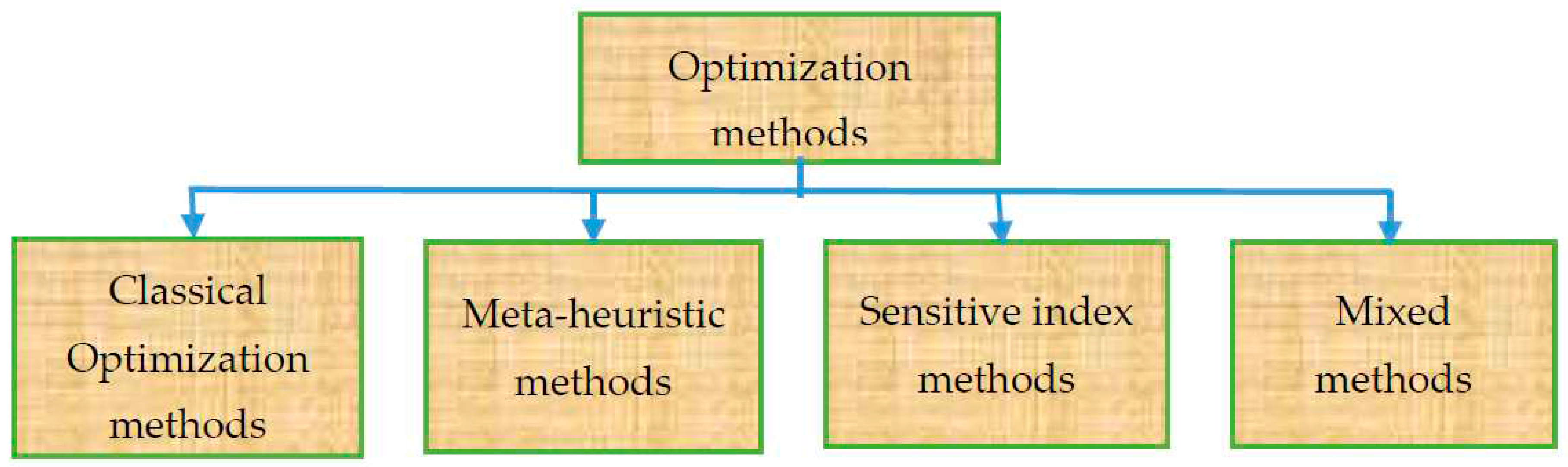
Figure 2.
Classification of FACTS devices.
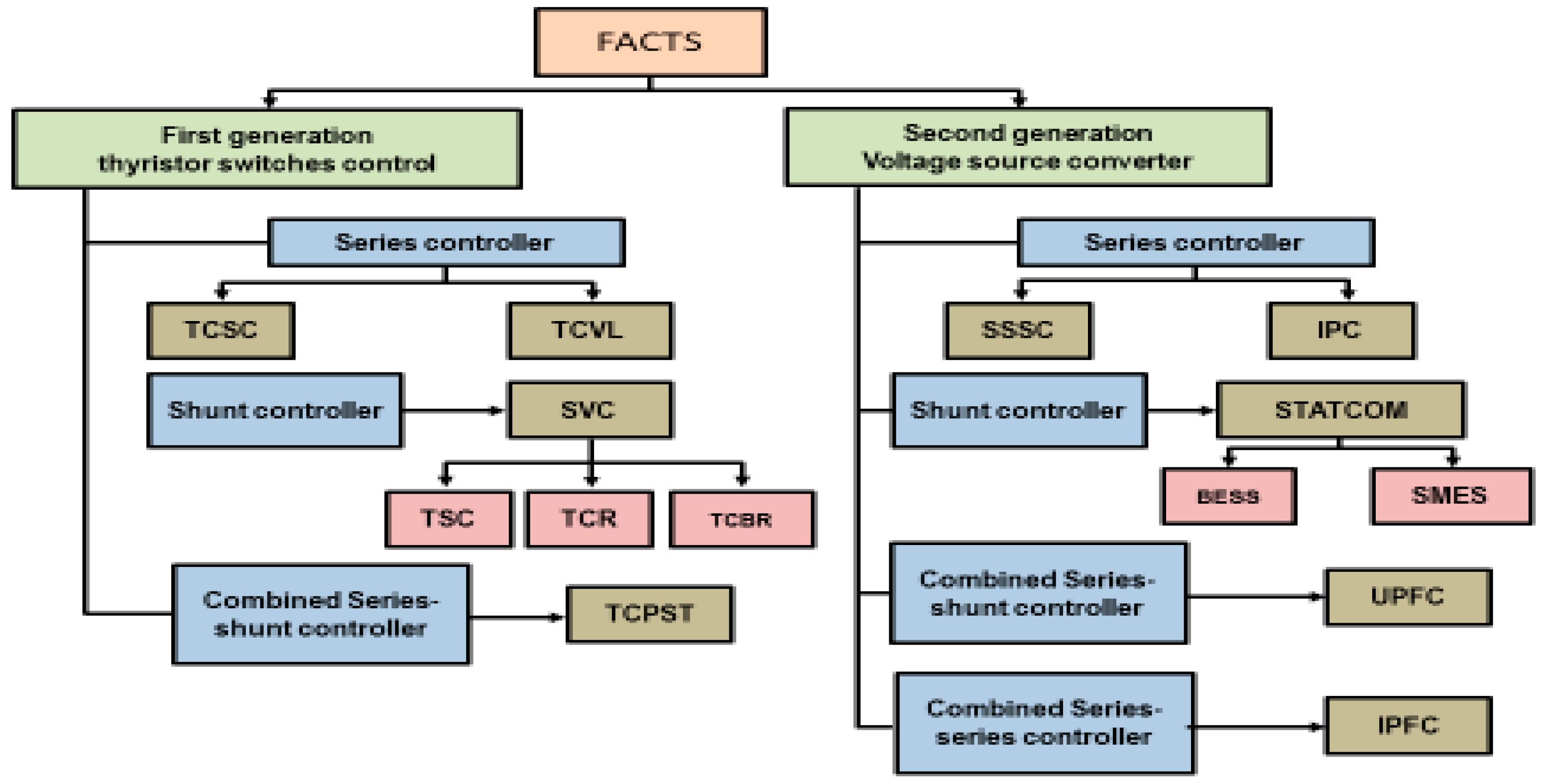
Figure 3.
Adjustment of the power transmitted for the different FACTS.
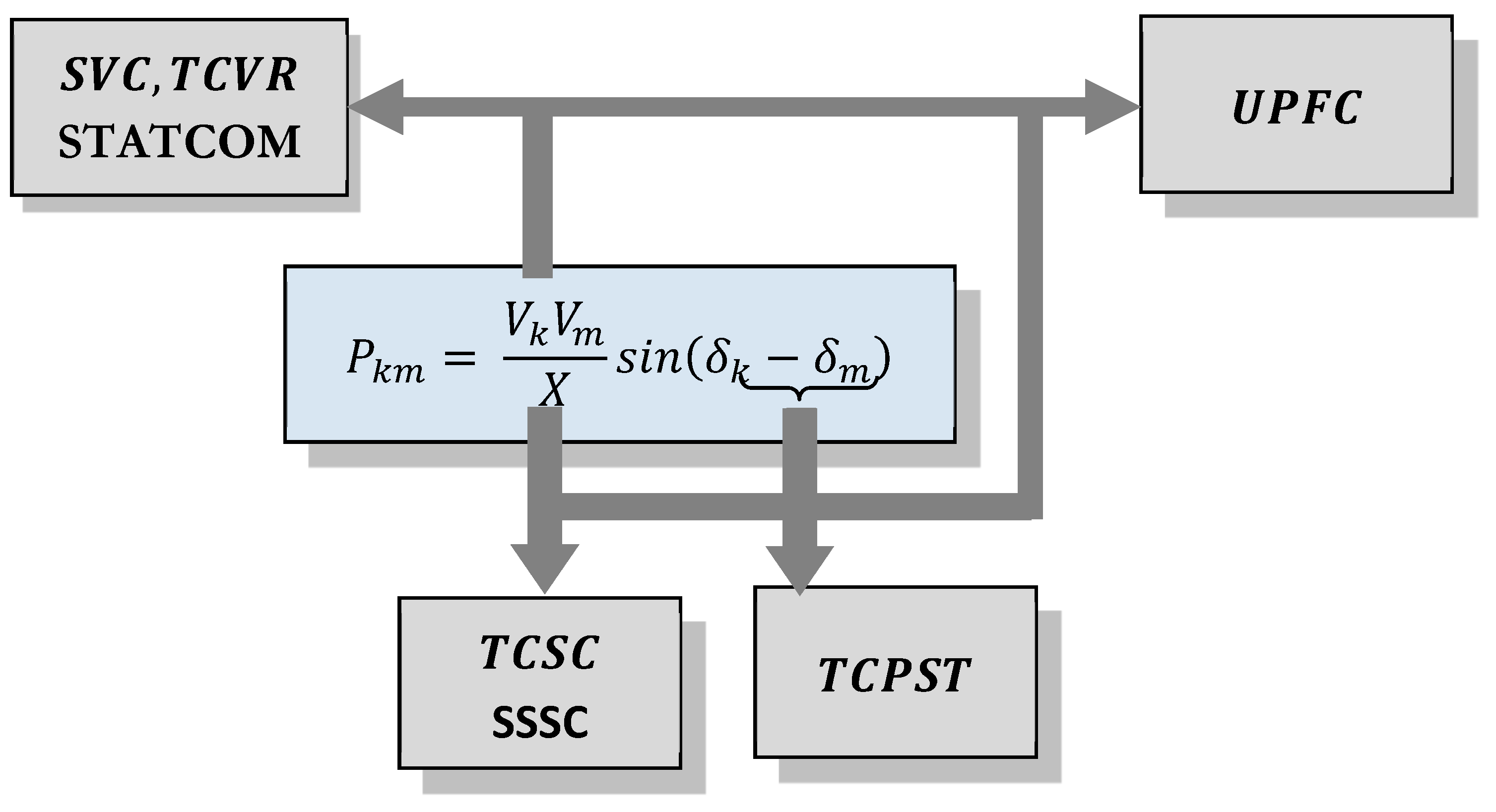
Figure 4.
Integration of the FACTS device in a line.
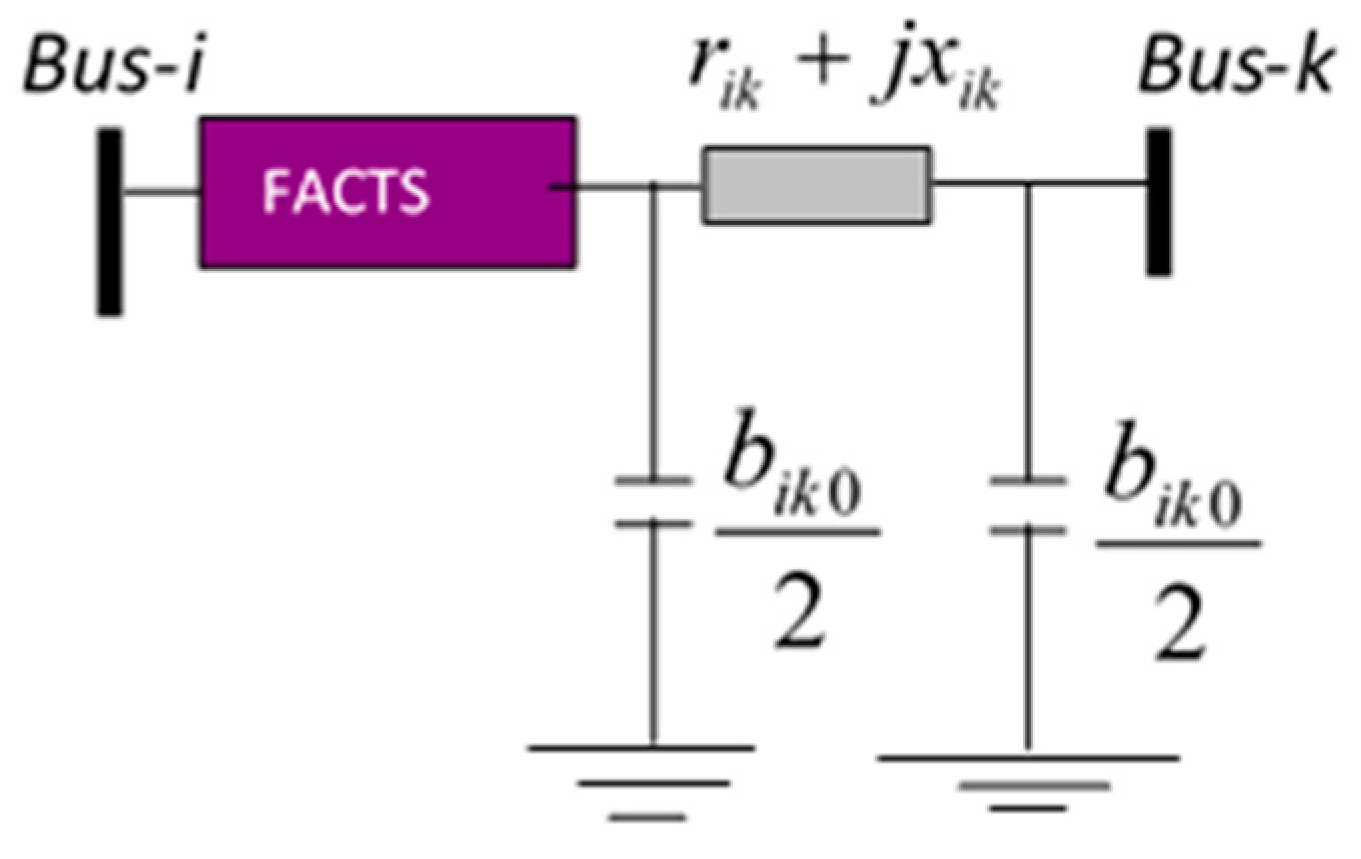
Figure 5.
Symbolic representation of the electrical network with FACTS devices.
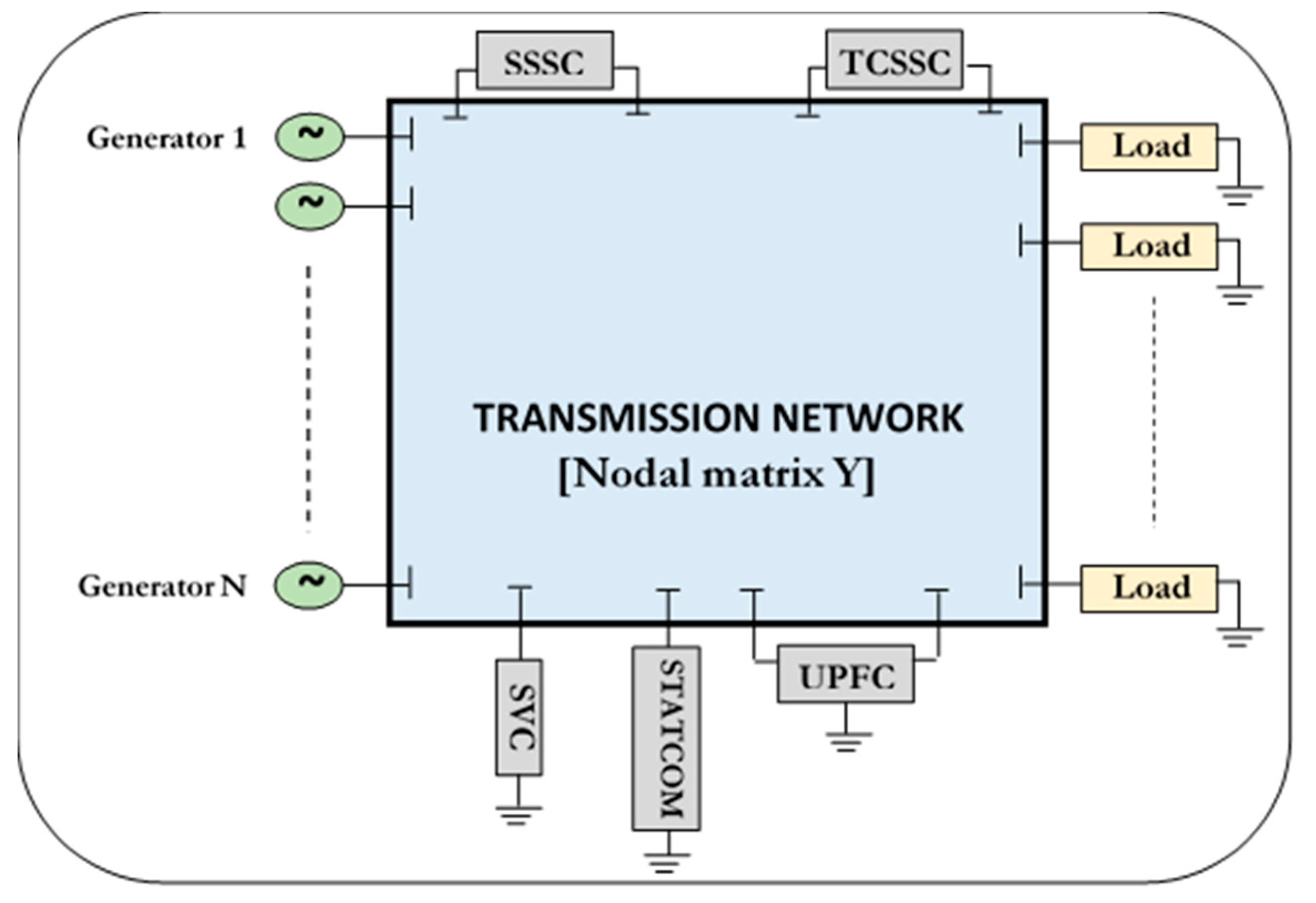
Figure 7.
Evolutionary Algorithms classification.
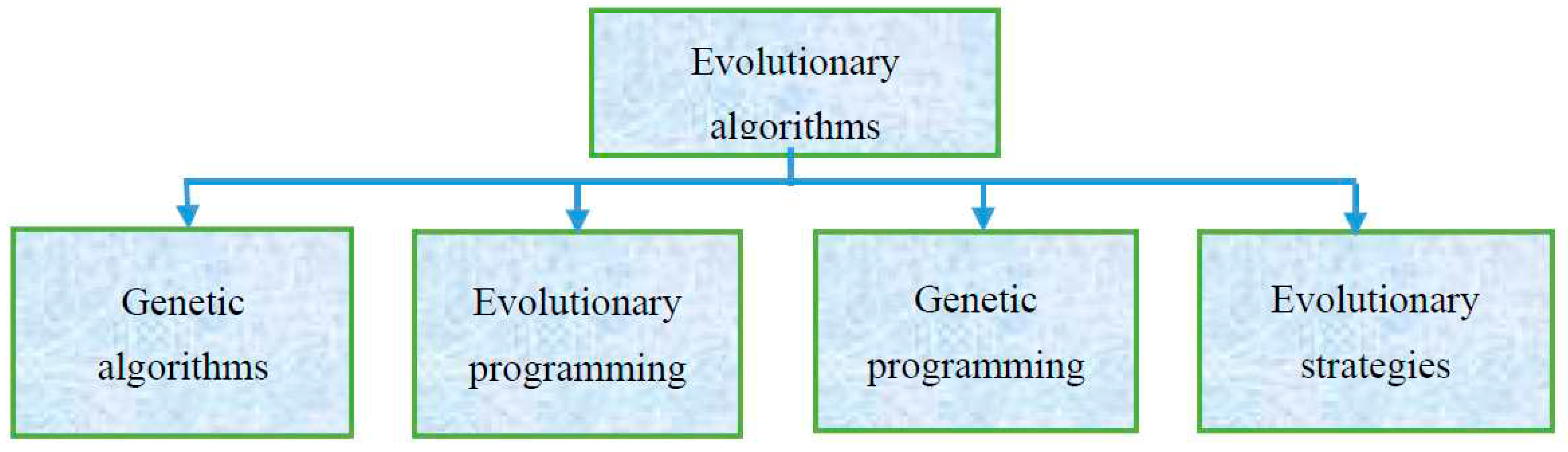
Figure 8.
FACTS devices benefits, controlled parameters and most applications.
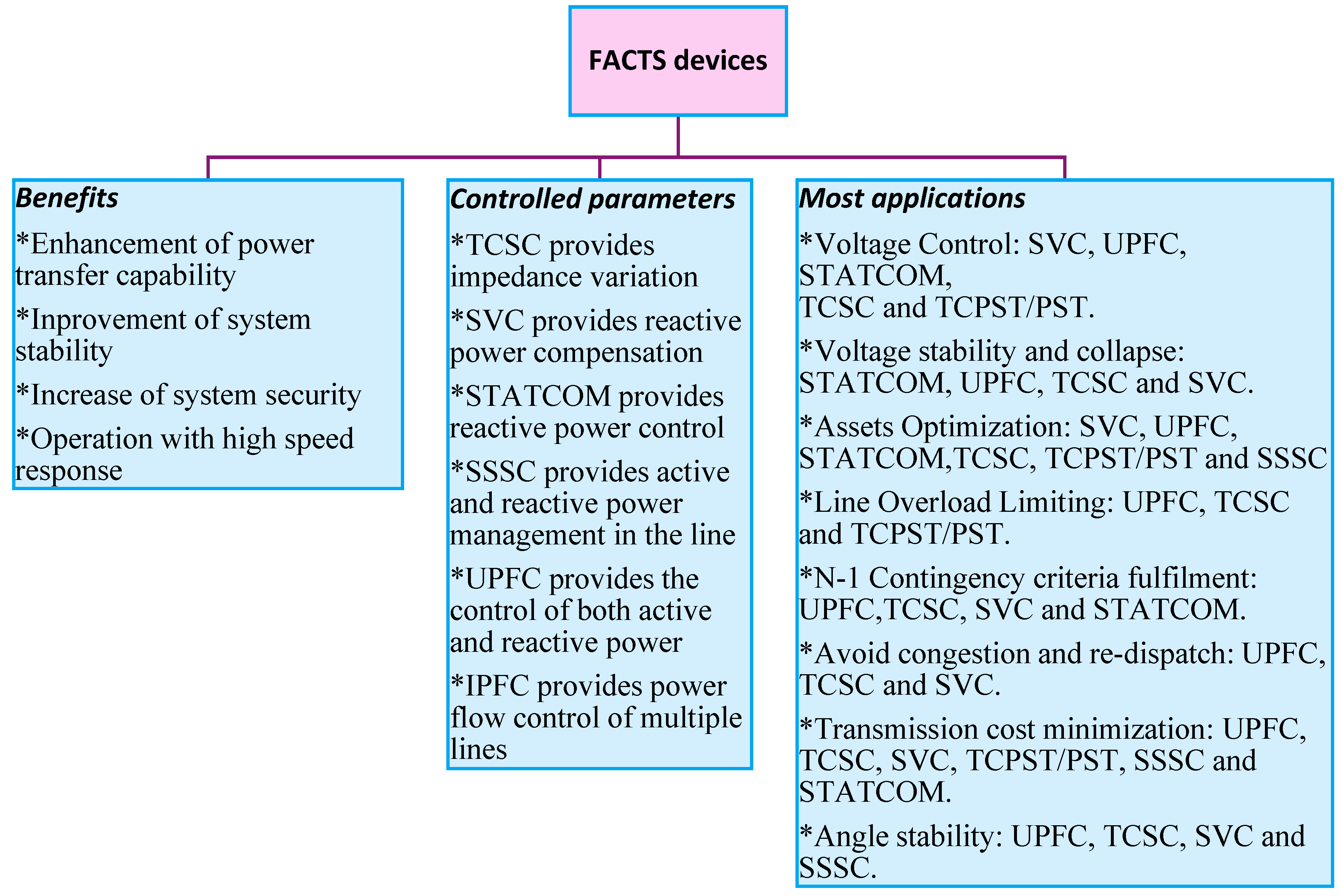

Table 1.
Summary of classical optimization techniques related to FACTS Devices optimization problem.
Table 1.
Summary of classical optimization techniques related to FACTS Devices optimization problem.
| Refs | Objectives | Devices | Methods | Test Case |
|---|---|---|---|---|
| [15] | Power system security | SVC | NR | A Standard 5-Bus Network:2G |
| [83] | To operating at a lower cost and system security | SVC, TCSC | MILP | IEEE-30 Bus |
| [84] | To increase the load capacity of the system | TCPAR, TCSC | MILP | IEEE 24 bus |
| [16] | To achieving the maximum system loadability and minimum FACTS installation cost | TCSC | MCA | IEEE 6, 30 and 118-bus. |
| [85] | Reduction of line overloads and improvement of bus voltage magnitudes | TCSC | MINLP | IEEE 9 bus system |
| [86] | Maximizing network forwarding capacity and provide a measure of FACTS ratings | TCSC, UPFC | NLP | network model consists of 37 buses |
| [17] | Reduce congestion and/or enhance network voltage security | SVC, TCSC | MIP | IEEE 30 bus system |
| [88] | Enhance the voltage profile and system security margin | SVCs, TCSCs | SQP | IEEE 14-bus |
Disclaimer/Publisher’s Note: The statements, opinions and data contained in all publications are solely those of the individual author(s) and contributor(s) and not of MDPI and/or the editor(s). MDPI and/or the editor(s) disclaim responsibility for any injury to people or property resulting from any ideas, methods, instructions or products referred to in the content. |
© 2023 by the authors. Licensee MDPI, Basel, Switzerland. This article is an open access article distributed under the terms and conditions of the Creative Commons Attribution (CC BY) license (http://creativecommons.org/licenses/by/4.0/).
Copyright: This open access article is published under a Creative Commons CC BY 4.0 license, which permit the free download, distribution, and reuse, provided that the author and preprint are cited in any reuse.


