

Submitted:
25 April 2023
Posted:
25 April 2023
You are already at the latest version
Abstract
The prediction of wind power output is part of the basic work of power grid dispatching and energy distribution. At present, the output power prediction is mainly obtained by fitting and regressing the historical data. The medium- and long-term power prediction results exhibit large deviations due to the uncertainty of wind power generation. In order to meet the demand for accessing large-scale wind power into the electricity grid and to further improve the accuracy of short-term wind power prediction, it is necessary to develop models for accurate and precise short-term wind power prediction based on advanced algorithms for studying the output power of a wind power generation system. This paper summarizes the contribution of the current advanced wind power forecasting technology and delineates the key advantages and disadvantages of various wind power forecasting models. These models have different forecasting capabilities, update the weights of each model in real time, improve the comprehensive forecasting capability of the model, and have good application prospects in wind power generation forecasting. Furthermore, the case studies and examples in the literature for accurately predicting ultra-short-term and short-term wind power generation with uncertainty and randomness are reviewed and analyzed. Finally, we present prospects for future studies that can serve as useful directions for other researchers planning to conduct similar experiments and investigations.
Keywords:
Predictive models
; Weather research and forecasting (WRF)
; Uncertainty
; Wind forecasting
; Ultra short term and Short term
; Wind power generation
1. Introduction
Of the various sources of renewable energy, wind energy is one of the main types and is growing in use. Worldwide, wind energy reserves are very abundant, and the annual energy that can be developed is about 5.3×10⁷ GWh. The wind power industry is mature, and the methods for renewable energy generation are easy to apply. Wind energy accounted for 6% of global power generation by the end of 2020, with an installed capacity of 743 GW [1]. However, compared with traditional power sources, wind power generation is affected by weather and adjacent terrain environment and is extremely unstable, random, intermittent, and inflexible. Various factors such as wind speed, wind direction, temperature, humidity, atmospheric pressure, and altitude will affect wind power generation. These variables are also interrelated, leading to large fluctuations in wind power, which ultimately makes it difficult to achieve satisfactory results in wind power forecasting. Wind power prediction involves applying state-of-the-art algorithms to the field of wind power generation, such that wind power generation can be better connected to the electricity grid, and key technologies have developed rapidly. In the study of wind power forecasting, wind power has volatility and discontinuity due to the instability of wind itself, which will cause serious difficulties in the scheduling optimization of wind power generation by the electricity grid. Therefore, many efforts and methods have been introduced to solve the wind forecasting problem. Wind power forecasting can be divided into physical methods, statistical methods, artificial intelligence (AI)-based, and deep learning-based methods. Of these methods, the artificial intelligence method can be adaptive and self-learning (e.g., BNN, knowledge graph) in various industries [2,3,4], smart grids [5,6,7], and railway transportation [8], so it is suitable for dealing with the dynamic, nonlinear, and complex characteristics of wind power. Accurate short-term forecasting of wind power is of great significance for alleviating the pressure of power system peak voltage and frequency regulation and wind power connected to the electricity grid.
In order to further improve the accuracy of short-term wind power forecasting, kernel density estimation is used to estimate the probability density function of the random variables required for predictive models to avoid the density leakage problem estimated for probabilistic wind power forecasting (WPF) of a region at both the wind farm and regional levels [9,10,11]. Quantile regression (QR) approximates the conditional probability distribution of a random variable by quantiles. Numerical weather prediction (NWP) data are often used as explanatory variables. Various QR models have been developed for WPPF, such as quantile passive–aggressive regression, regression [12] and curve fitting by weather research and forecasting (WRF), and wind farm parameterization (WFP) as well as quantile regression neural network (QRNN) for regional wind power forecasting (RWPF) [13,14]. In recent years, spatiotemporal forecasting models have been increasingly researched due to their success in improving forecasting accuracy [13]. Given the use of data from different farms and sites to improve the performance of predictive models, spatiotemporal forecasting methods require large amounts of data, which in turn require advanced methods to address the high dimensionality of such situations. A convolution operation to capture the spatial–temporal correlation between neighboring wind farms was based on the novel spatial–temporal wind power predictor (CSTWPP) [15] and a spatiotemporal convolutional network (STCN), each developed separately [16]. New ANN model predictive control-based models [14,17,18,19,20,21,22] have been developed and offered for wind power prediction in microgrid application and use air density and wind speed as input parameters.
The main advantage of ensemble models is their diversity, which allows providing a set of multiple forecasts of the same quantity based on different estimates of initial atmospheric conditions in the WPPF, and ensemble approaches such as the CEEMDAN-IBA-GPR model, multi-feature fusion/self-attention mechanism/graph convolutional network (MFF-SAM-GCN), weighted multivariate time series motifs (WMTSM), and conditional LP (CLP) have been combined with adaptive boundary quantiles (ABQs), wavelet neural network (WNN) trained by the five algorithms [24,25,26,27], data preprocessing (EMD and ICEEMDAN) with parameter optimization [28], and enhanced bee swarm optimization (EBSO) to perform parameter optimization for least squares support vector machine [29] toward probabilistic wind power forecasting, taking full advantage of the most recent information and leveraging the strengths of multiple forecasting models. More recently developed are machine learning methods, which are powerful training algorithms based on artificial intelligence (i.e., neural networks). Due to their high computation intelligence and accuracy, such methods have been widely used in the past few years to improve the accuracy and performance of traditional WPPF models. The machine learning-based wind speed predictions for k-NN and conditional KDE, Adaboost-PSO-ELM, and enhanced bee swarm optimization (EBSO), to perform parameter optimization for least squares support vector machine (LSSVM) [11,26,27,28,30,31] models, were proposed to identify meaningful training data to reduce the volume of modeling data and improve the computing efficiency. They have good generalization ability and robustness and can provide more accurate wind power forecasting. In addition, deep learning is a machine learning concept that provides superior computation performance and flexibility by directly learning the best possible features of raw time series data; for example, the authors of [32,33,34,35,36,37,38,39,40,41,42,43,44] proposed novel data-driven models based on the concepts of deep learning-based convolutional-long short term memory (CLSTM), mutual information, evolutionary algorithm, neural architectural search procedure, and ensemble-based deep reinforcement learning (RL) strategies. The intention of hybrid model forecasting methods [20,24,36,45,46] is to combine different forecasting models to increase the accuracy and precision of forecasts, with their main advantage being that they combine the advantages of each model used to provide the best forecast output. Other statistical analysis methods, such as five minute-ahead wind power forecasts in terms of point forecast skill scores and calibration, 1% point analysis RL-based ESS operation strategy, empirical dynamic modeling (EDM)-based probabilistic forecast, etc. [9,47,48,49,50,51,52,53], were introduced to improve the accuracy of ultra-short-term and short-term wind power forecasts and provide a more reliable basis for wind power grid integration.
To date, several review papers have examined wind power prediction. Wang et al. [54,55] gave an overview of wind power forecasting based on short-term and long-term methods. However, hybrid methods for AI-based wind forecasting have not been studied in detail. A survey by Hanifi et al. [56] was mainly conducted on physical, statistical, and hybrid methods to predict wind power generation. However, the authors explored some AI neural network methods for predicting wind power forecasts, although critical issues and challenges were not explicitly explored. Dhiman and Deb [57] delivered wind speed and wind force forecasting techniques, although deep learning algorithmic methods and their implementation are not covered. Chang [58] proposed a classification of wind power forecasts based on different horizons. Nevertheless, survey of hybrid AI methods and their implementation and limitations were not discussed in detail. Bazionis, I.K. et al. [59] reviewed wind power generation forecasts using various parametric and nonparametric approaches. A classification of wind forecasting methods is given according to timescales, forecasting models, and output data. Hybrid machine learning and deep learning methods have not been fully studied. Furthermore, implementation factors, optimization integration, and hybridization, which are critical issues for hybrid machine learning and deep learning methods, were not outlined. Lipu, M. S. Hossain et al. [60] presented an in-depth investigation of wind power forecasting using artificial intelligence-based hybrid forecasting approaches. Furthermore, various combinations of hybrid AI methods, influencing factors, issues, limitations, and recommendations for achieving wind power forecasting are presented.
In order to meet the needs of large-scale wind power grid integration and further improve the accuracy of short-term wind power forecasting, it is necessary to develop a short-term wind power forecasting model based on advanced hybrid AI algorithms to accomplish accurate, robust, and efficient wind power forecasting. This was achieved here through the following process:
1. This paper begins by summarizing the time resolution, model type, accuracy, and parameters of current advanced wind power forecasting technologies and determines the classifications, advantages and disadvantages, and contributions of the various wind power forecasting models.
2. These models have different predictive capabilities, and the weights of each model are updated in real time to improve the comprehensive predictive capabilities of the models, which have good application prospects in wind power forecasting.
3. Case studies and examples in the literature of accurate ultra-short-term and short-term wind power forecasting predictions with uncertainty and stochasticity are reviewed and analyzed.
Finally, the conclusion is drawn, and existing issues in the methodologies outlined. Future prospective research directions are presented.
2. Review of research status
European and American countries, such as Denmark, the United States, and Spain, have developed relatively early in terms of studying wind power generation, and many advanced results have been obtained as the basis for the maturation of research on wind power forecasting systems [61,62]. Based on meteorological information, they have built a relatively complete wind power forecasting system with the NWP system as the core. Prediktor is a prediction system developed by Denmark's Risø DTU National Laboratory for Sustainable Energy and put into use in 1994 [63]. Denmark is in a leading position in the development of wind power forecasting. For example, the WPPT forecasting system uses a combination of adaptive least squares and exponential forgetting algorithms (least squares and exponential forgetting algorithms), which can provide forecasts ranging from 0.5 to 36 hours [64]. The Zephyr forecasting software developed by the Risø DTU National Laboratory is very popular in Denmark. It combines physical models with adaptive least squares and exponential forgetting algorithms to provide forecasts from 0 to 9 hours and 36 to 48 hours [65]. It uses a physical model and considers the impact of wind turbine wakes. By combining statistical methods with physical methods, the eWind system developed by American Truewind Company adopts a combination of physical and statistical forecasting methods, which can upload real-time information and online in-depth analysis and has the ability to accurately predict the next 48 hours [66]. The WPMS forecasting system developed in Germany is the most widely used forecasting software at present [67]. The system is combined with neural network on the basis of NWP forecasting, and further improves the forecasting accuracy of wind power. Also in Germany, ISET has developed the forecasting system AWPT [68], which was put into operation in 2001 and uses the method of combining NWP and neural networks mainly in 1- to 8-hour forecasting. The following year, the University of Oldenburg in Germany developed the Previento system, which added typical physical models to the prediction system and could accurately obtain 2-day prediction results [69]. The Siperolico forecasting software developed by Carlos III University in Spain, HIRPOM [70] in Ireland, and the LocalPred model of the Renewable Energy Operation Centre (CORE) in Spain use both statistical and physical models [71]. The ANEMOS project has a total of 23 institutions from 7 countries, including Ireland, France, and Spain, participating in the research and development, which can predict the wind power of large-scale offshore and land wind farms. Multiple NWP models are used in the ANEMOS project, so the local meteorological department is required to provide numerical weather prediction data [72]. After processing, physical methods and statistical methods are used to make predictions, whose accuracy can reach about 10%.
Different prediction algorithms are selected for prediction according to differences in regions, weather, and climate types. In addition to using physical methods for prediction, the system can perform statistical analysis of historical wind power data, further improving the prediction accuracy. In November 2008, the WPFS system was developed by China [73]. After a series of successful test experiments, the system became the first mature wind power forecasting system in China. The system can effectively predict the short-term wind power within three days and the ultra-short-term wind power within four hours. The wind power generation forecasting systems currently used around the world are summarized as shown in Table 1.
2.1. Reviews for technologies and applications
In recent years, relevant scholars have conducted theoretical research and practical simulation. The prediction type of wind speed has different definitions according to the length of the cycle, and different researchers have different classifications as shown in Table 2, mainly including ultra-short-term, short-term, medium-term, and long-term prediction.
Long-term forecasting based on "month" and "year" is mainly used in the design of wind farm operation plans and the evaluation of wind power resources for the planning of wind farms. The medium-term forecast is usually used to predict the sampling points in the next few days or "week" and is mainly used for troubleshooting and maintenance of wind power equipment in the power grid. Short-term and ultra-short-term forecasting is based on "hour" or "minute", which is mainly used to adjust the reserve capacity of the power system and economic dispatching to reduce the instability of the system caused by wind power connected to the electricity grid, so as to conduct effective grid dispatching. According to different modeling methods, wind power generation forecasting can be divided into physical methods, statistical methods, artificial intelligence methods, and deep learning methods. Depending on the different prediction objects, it can be divided into indirect corresponding wind speed prediction and direct corresponding power prediction, as shown in Figure 1. According to the forecasting model, wind power forecasting can be divided into direct forecasting and indirect forecasting. Direct prediction refers to the establishment of a corresponding mathematical model based on the historical wind power time series of the wind farm to predict the future wind power [74].
According to the prediction principles, wind power prediction can be divided into physical methods, statistical analysis methods, artificial intelligence methods, methods based on deep learning, and combined prediction models. In physical methods, the relatively rough forecast value output by the numerical weather forecast system is analyzed for making predictions based on the physical information around the wind farm and meteorological information such as weather and temperature. The advantage of physical methods is the lack of requirement for supporting historical wind farm power data. The disadvantage is that they are very sensitive to initial parameters, such as terrain description information. Inaccuracy in the initial parameters are inaccurate will cause large prediction errors. Statistical analysis requires a large amount of history of wind power or wind speed for statistical analysis, such as using Markov chain [12,15,75], regression analysis [29,30,35,41,47,76], Kalman filtering [77], and ARMA [29,78] models to find the laws contained in historical data for prediction. The advantage of the statistical method is that under the premise of sufficient historical data, the forecast error can be minimized in theory, and the forecast accuracy is high, but the disadvantage is that a large amount of historical data is required for support. The deep learning method is an emerging prediction method that can use artificial intelligence to establish an accurate model describing the nonlinear relationship between input and output. It can predict from the essence of wind energy, thereby improving the prediction accuracy. Common methods include neural network [79], wavelet analysis [44,80], and support vector machine [73,78,79,81]. Hybrid predictive models of artificial intelligence methods are becoming increasingly popular, not only increasing the complexity of algorithms but also enhancing the forecasting of wind power generation. Typically, hybrid predictive models are designed by combining two or three deep learning techniques or combining optimization algorithms with AI methods. This addresses the aforementioned shortcomings of a single predictive model by finding optimal features, hyperparameters, and training algorithms. The review focuses on wind power generation forecasting for time resolution, and the model type, accuracy, and parameters used are presented in Table 3, which shows that over 70% of wind power prediction literature uses RMSE and MAE methods to evaluate errors. These results indicate that when wind speed changes rapidly and there is a slight error, even if the wind speed value is small, the error value will be amplified and thus, there are many methods for error determination in wind power prediction. In accuracy of Table 3, we have compiled and proposed many methods for computing errors, such as RMSE, MAE, MASE, NRMSE, MAD, MRE etc. and try to present the error values as fully as possible in this review paper, where future wind power prediction research needs to improve and evaluate.
2.2. Problem
In order to using physical models for calculation or statistical methods for simulation, the wind speed and wind direction of the wind farm in a short period of time in the future are predicted. These are the highly relevant meteorological parameters with wind power to predict the ultra-short-term or short-term performance of the wind farm in the future. The output power provides a basis for the power sector to execute power generation scheduling, modeling, and expansion planning. The fluctuation of the wind is relatively large, and there are often jumps in time to cause high probability of random uncertainty. As the capacity of newly installed and operated wind turbines continues to grow, they will occupy an increasing proportion in the electrical grid. However, the penetration power of wind power generation cannot exceed its limit value. If exceeded, the wind turbine units connected to the power grid will pose a huge threat to the power grid, making the power system unable to perform normal, stable, and safe operation. In order to solve the above problems, it is necessary to scientifically predict the power output of wind farms according to the changing trend of wind, wind speed, and wind direction, so as to improve the controllability of wind power generation. If the output power of wind power generation can be more accurately predicted through parameters such as wind change trends, wind speed, and wind direction, then the predicted data will be uploaded to the power dispatching center. The power dispatch center can scientifically and efficiently control power generation and distribution based on these data. Reasonable arrangements can fundamentally reduce the impact of wind power generation on the electrical grid and greatly increase the grid connection rate of wind power generation. Accurate wind power prediction solves the problem of grid connection to reduce the operating cost of wind farms. Therefore, wind power prediction technology has attracted the global attention of wind power fields, scholars, enterprises, and departments and is of great significance to the development of wind power.
Most prediction systems combine physical and statistical concepts, and their accuracy is limited by the numerical weather prediction model (NWP). When the forecast time exceeds 6 hours, the numerical weather prediction (NWP) should reduce the temporal and spatial scale of the wind field to convert the local wind speed into electrical energy and then estimate the power of the entire region for a single wind field. The prediction error is about 10-15% of the root mean square error (RMSE) for the capacity of the whole wind farm. However, with the increasing capacity of wind turbines, the requirements for the accuracy of wind power generation prediction will be stricter. The traditional math equation for calculating power generation cannot directly reflect the rapid change of wind speed, and there is always a great error between the calculated value and the actual value.
2.3. Comparative study of the reviewed WPPF models and methodologies
In the past decade, the research on wind power generation prediction has become increasingly popular. Most models use numerical weather prediction (NWP) and on-site measurement data (SCADA) as the basis, read the data of monitoring points, and then use the obtained wind speed and output data to predict wind power. However, due to the confidentiality of data sources, most prediction models rarely have complete theoretical basis and historical data; therefore, the research is limited to a single site and region. A single prediction may be reflected by higher forecast accuracy. Once considering multiple regions or large-scale spatial prediction in scattered meteorological stations, the results must be questionable. In addition to the increase in offshore wind turbines and the large amount of investment in private wind farms, persuading private wind farms to provide substantial wind turbine information (wind power generation, operating conditions, etc.) is a major challenge. Therefore, it is necessary to devote efforts to the prediction of large spatial scales. In this paper, the contribution of the current advanced wind power forecasting technology is summarized, outlining the distinct advantages and disadvantages of the various wind power forecasting models. These forecasting models have different forecasting capabilities, update the weights of each model in real time, improve the comprehensive forecasting capability of the model, and have good application prospects in wind power load forecasting. Finally, this paper remarks on the contributions, advantages, disadvantages and approaches of reviewed works in terms of wind power forecasting in Table 4. In previous wind power prediction studies, most researchers used past meteorological data for evaluation. However, we were able to obtain more data such as satellite data, future meteorological data, etc. due to the advanced information techniques. In Table 4, more than 50% of the literature on wind power prediction used more input data than previous studies, without optimal feature based data preprocessing; Meanwhile, the prediction structure methods used are becoming increasingly complex, resulting in longer computation times. Some papers in the review literature also propose to preprocess historical wind data to reduce training times, thereby achieving effective data screening and improving the accuracy of wind power prediction.
3. Opportunities and Challenges
Our research team used statistical methods to predict wind power generation in the past and achieved the purpose of predicting wind power generation through wind speed prediction. Due to the large amount of historical data, we currently use the analysis and selection of data features to reduce the training sample space and improve the extraction of more useful data from the database, thereby reducing the amount of data, shortening the running time, and obtaining good prediction results; then, a wind power generation model is established based on support vector machines as a predictive method suitable for nonlinear regression analysis. Its internal parameters will affect the accuracy of regression analysis. Therefore, the bee colony algorithm is used to better solve the parameter values. In order to reduce the prediction error, we aim to minimize the error and use the bee colony optimization algorithm to solve the parameter setting problem of the support vector machine, which not only increases the integrity of the prediction model but also improves the prediction accuracy. We use meteorological observation stations for long-term recording and monitoring to obtain relevant wind speed and power generation data, and data regression technology is used to preprocess the input data to remove parameters that reduce the predicted value, thereby reducing network input parameters. The test results validate the effectiveness and accuracy of the proposed prediction method.
3.1. Bee Colony Algorithm Combined with Data Regression Support Vector Machine
Support vector machine is a pattern identification algorithm of artificial intelligence. It is a new machine learning method based on statistical learning theory and shows many unique advantages in solving small sample, nonlinear, and high-dimensional pattern recognition problems. It has been applied to practical problems such as wind power prediction, handwriting recognition software, face recognition, and image classification. In addition, the bee colony algorithm is a new optimization algorithm that can accurately and quickly solve numerical optimization problems. It has the advantages of simple concept, easy implementation, and fewer control parameters.
The wind power forecasting process is mainly divided into three parts, and the flow chart is shown in Figure 2(a).
Part I: Apply data regression analysis to select modeling data.
Part II: Applying the bee colony algorithm to solve the optimal setting parameters of the support vector machine, the EBSO_LSSVM system architecture is shown in Figure 2(a).
Part III: Performing wind speed prediction using EBSO_LSSVM.
As support vector machine parameter selection has a great influence on the regression analysis, the parameter selection will often vary in different cases; therefore, the proposed method uses data regression support vector machine as the main body combined with the enhanced bee swarm algorithm, which is referred to as EBSO_LSSVM. The enhanced bee swarm algorithm was used to find better setting parameters for γ and σ in the support vector machine resulting in better training parameters, thus improving on the traditional shortcomings of unclear support vector machine parameter selection. EBSO_LSSVM optimization algorithm has unique advantages in dealing with small sample problems as follows:
(a) Use the algorithm to find the best modeling parameters: EBSO_ LSSVM uses EBSO to adjust parameters to achieve the best modeling of LSSVM. This method effectively improves the accuracy of LSSVM prediction. However, EBSO uses to select LSSVM parameters for each prediction. Each prediction of a time interval requires the construction of an LSSVM, which will lead to excessively long modeling operation time, so DR-SVM is proposed.
(b) The method of characterizing the training data is modeling: DR-SVM is a self-organizing map (SOM), in which a database is first used to cluster and quantify the relevant data (feature clustering), and the whole clustered data are drawn in a normal way to avoid influences from differences in too large or small data values. Because modeling after clustering and quantification will have strong resilience to prediction, the performance will be better than that of the untreated [82].
(c) Modeling method combining algorithm and data characteristics: The research team recommends DR_EBSO_Combining LSSVM, where it is not necessary to build a prediction model every time resolution, because DR has greater flexibility, which means DR_EBSO_LSSVM can continuously predict for long prediction times.
Figure 2(a) presents the SVM by using the radial basis function (RBF) kernel. DR is a self-organizing map (SOM), as shown in Figure 2(b), and the algorithm of SOM can be self-defined according to the use environment and meet the purpose of data visualization. The sample dataset containing n-dimensional vector is taken as the matrix structure in two-dimensional space. Under the condition that the topological structure between the sample points of the original dataset remains unchanged, a spatial structure with a dimension of no more than n by correspondence is obtained. Each point in the spatial structure contains a weight vector, and SOM can be regarded as a sample point in the dataset. The spatial structure obtained by nonlinear regression. In this paper, the layer Z1 of the four main datasets, wind, temperature, humidity, and rainfall, is constructed in the first layer (constructed in the two-dimensional topological structure space 2x3), and the secondary topological structure of the four main datasets (layer Z21~layer Z24, constructed in the two-dimensional topological structure space 2x3) is constructed in the second layer, as shown in the following figure. For the Z21-Z24 topology of the second layer, T and N3, are the prediction time and time interval, respectively. T-N3 represents the historical meteorological data value in the past T-N3, and T+N3 represents the weather forecast data value in the future T+N3.
3.2. Wind Data Diversity
The challenge of wind power forecasting models is the variability in wind data and the datasets from different historical or meteorological data. The fluctuation and intermittency of wind energy lead to uncertainty in the output power of wind farms, which will have an adverse impact on the power system. In particular, the large-scale grid connection of wind power will inevitably bring difficulties to grid dispatching, thereby reducing the reliability of the grid. Accurate wind power forecasting is crucial for wind power grid integration and the stable operation of power systems. Therefore, the wind power forecasting models should be verified under various data preprocessing techniques in further research.
- (1)
- Wind speed prediction process
The wind is highly intermittent, so forecasting is an extremely difficult issue, but this is inseparable from the preliminary work of wind power forecasting modeling. Its input variables are temperature, humidity, and wind speed, the output variable is the wind speed value in the next period, and support vector machine is used to make one-hour wind speed prediction and one-day wind speed prediction. Figure 3 shows the establishment of the wind speed prediction process in this paper.
- (2)
- Establishment of power generation model
In the value of actual power generation, there are often points with large fluctuations in power generation, or points with abnormal values caused by improper instrument measurement. This "noise" power generation will be subjected to two rounds of regression data analysis in this study. In exploration, the first step is to establish cluster points for all historical data, and the second is to filter data based on the first cluster point, deleting the 20% data that deviates from cluster power generation in each interval. They will be excluded in the reference data for data regression analysis, and a more complete cluster point is appropriately modeled using 80% of the data. The process is shown in Figure 4.
3.3. The state-of-the-art approaches for short-term wind power forecasting
The prediction effects of different predictive models have their own advantages and disadvantages. The hybrid prediction method involves optimizing and combining the results of data processing of different models according to a specific strategy, so as to obtain the better wind power prediction results and ultimately achieve the purpose of improving the accuracy of wind power prediction. In the final analysis, the combined forecasting method is used to optimize the forecasting results, and as long as the time series scale of the power forecasting output corresponds to the combined forecasting of the model, there is no limit to the relevant algorithms used for each forecast. At present, due to the large amount of data that can provided by wind farm numerical weather prediction (NWP), combining NWP information to improve the accuracy of wind power forecasting has become the main research direction in hybrid wind power forecasting.
The work described in this paper is shown in Figure 5, and the short-term wind power forecasting model is discussed in depth. The latest approaches of short-term wind power forecasting in the past three years are reviewed to provide an important reference in wind power grid integration. In order to improve the accuracy of wind power forecasting, this paper gives a detailed overview of the contributions, advantages, and disadvantages of various delivered wind power forecasting models and future research works. These advanced forecasting methods can be approximately classified into kernel density estimation, quantile regression methods (QR), artificial intelligence/neural networks (NN), ensemble methods, spatiotemporal forecasting, machine learning, deep learning, hybrid model forecasting, and other statistical analysis methods. These proposed novel short-term wind power forecasting models provide very useful information for power system operation and control with high renewable energy penetration.
In recent years, various research institutions and scholars have adopted different state-of-the-art approaches to improve the problems of power fluctuation and randomness in wind power forecasting as well as possible errors and omissions in original data, and certain advancements have been made, but there are still some issues that need to be urgently solved. First of all, in the future, the sample space can be further expanded, and the dimension of data samples can be increased to predict wind data diversity. According to the wind power data with different characteristics, the prediction model is further optimized to increase the applicability of the model. Secondly, according to the characteristics of the existing hybrid model, the parameter optimization method is further improved to ensure that the prediction model has high prediction accuracy at different time sampling rates, making it suitable for different prediction occasions.
Future studies and development
Various advanced wind power forecasting methods have been developed over the past years to help plan and use wind power as efficiently as possible. These methods are used for experiments, and relevant results have been obtained for solving the issues of power fluctuation and randomness in wind power forecasting and the possible errors and omissions of original data. Based on the latest advances in artificial intelligence, machine learning, and deep learning methods, this paper conducts a comparative analysis in terms of the time resolution, parameters used, accuracy, and research limitations and reviews the contributions to development, advantages, and disadvantages of the latest hybrid wind power forecasting models. However, there are still some issues that need to be improved. The following are the main aspects that can be further studied:
(1) In terms of wind speed prediction, the current study only selects a walrus station for research based on historical data. However, wind speeds are necessarily different in different regions. The geographical environment, weather, or climate-related factors (wind direction, humidity, etc.) where the weather station is located are not included in the forecast. Studying the influence of the physical environment will definitely improve the accuracy of wind speed prediction; in addition, the time period is also a factor affecting the prediction. The impact of different time solutions on the forecast results is explored, and they may even be incorporated into the future meteorological data of the meteorological bureau as an input factor, thereby improving the forecast accuracy.
(2) In terms of wind power modeling, wind power generation models will perform differently in different regions. The same wind speed corresponds to different wind field settings, setting directions, and even the structure of wind turbines (generator speed, blade angle, etc.), resulting in differences in power generation. Most studies only build the relationship between wind speed and wind power. If the influence of the wind turbine itself can be further considered, the power generation model will be more complete.
(3) In terms of wind power forecasting, weather forecasts are selected in combination with data characteristics, and wind power generation is indirectly predicted using power generation models. We wonder if it is possible to directly sample power generation and effectively find its own characteristics for prediction, which requires further development; in addition, according to the characteristics of different wind fields, more suitable functions for identification and even other artificial intelligence methods such as neural networks or deep learning methods may be applied for prediction [83,84,85,86]. Whether adaptability can improve prediction accuracy is also a very important issue.
(4) The present forecasting methods for short-term wind power of wind farms generally only consider the data of normal wind speed and normal operation of wind turbines, and it is difficult to achieve high accuracy for short-term wind power when the wind speed drops. Therefore, it will be of practical significance to consider short-term wind power forecasting under the actual operation scenarios of wind farms.
(5) Weather research and forecasting (WRF) based on other initialization times and longer ahead-time. The error transfer mechanism from wind speed forecasting (WSF) to wind power forecasting (WPF) is applied for the improvement of WPF. The forecasting accuracy for short-term WPF is enhanced by correcting NWP data. Various data preprocessing methods for a WPG system model have been investigated, such as singular value decomposition, from the system perspective [87,88]. Real-time WTP measurements are added into the reconstructed state space during the forecasting process, making the forecast more flexible.
(6) The accuracy and speed of prediction of the characteristics of big data in wind power are improved by parallel modeling of the prediction algorithm. Next, the spatial correlation features are incorporated into the classification and prediction, and the feasibility of the model is verified using different datasets, with the development of new or integration of multiple optimization algorithms [89,90,91,92] for use in the forecasting model to improve the interpretability of the combined models for further enhancement of accuracy.
(7) Wind power generation is very important for dispatching and regulation of the power system when connected to the grid. Due to the influence of the change of wind power generation on the voltage and frequency of the power system at any time, based on the basic view of large-scale or decentralized wind power system, combined with pumped-storage power stations, adjustable biomass power stations or energy storage battery systems, wind power can be stably transmitted to improve the flexibility of power dispatching.
(8) The robust optimization of the grid integration issues of wind power and distribution networks is applied using WindGMMN. Wind power prediction technique with integration to the electricity grid should consider load scheduling and demand side management, etc. In addition, optimal dispatching of isolated or grid-connected MG considering economic cost, net pollutant emission, and operational security objectives will be focus in future research work.
Conclusion
Wind energy is inexhaustible. Wind power generation can effectively reduce the consumption of energy resources and has good development prospects. However, uncontrollable factors such as wind intermittency and random fluctuation represent great challenges. Large-scale grid-connected wind power will inevitably affect the stability of the power system, so accurately predicting wind power generation is an urgent matter. The accuracy of wind power generation prediction depends on the way in which the prediction model is built, which in turn affects the accuracy of weather prediction. In the face of the advent of big data, the limited use of effective data can allow us to reduce resource consumption. Therefore, in this paper, many state-of-the-art predictive models of wind power generation based on artificial intelligence (AI)-based and deep learning-based algorithms were reviewed. Among the many artificial intelligence methods, support vector machines with good results when processing nonlinear features were selected for regression analysis as they can not only effectively analyze data but can also improve the prediction accuracy. This paper mainly expounds the research background and significance of papers published in recent years. Secondly, the status of this research is explained from a global perspective. Next, the research content of the reviewed literature is described. Finally, conclusions are drawn and prospects for future research are presented.
This review evaluates the latest studies on international wind power forecasting models over the past three years, categorizing wind power forecasting according to time scale, model type, and forecasting principle and comparing them in terms of their wind power forecasting errors and evaluation indicators. Key recent research efforts [9,10,11,12,13,14,15,16,17,18,19,20,21,22,23,24,25,26,27,28,29,30,31,32,33,34,35,36,37,38,39,40,41,42,43,44,45,46,47,48,49,50,51,52,53] published between 2020 and 2023 are reviewed. Most of these works aim to cover the field of ultra-short-term and short-term wind power forecasting, which has grown significantly in the past few years. Second, this paper reviews recent advances in AI-based wind hybrid methods published from 2020 to the present, highlighting their contributions to model development and advantages and disadvantages. Furthermore, these advanced algorithmic hybrid models are classified, compared, and analyzed accordingly in terms of temporal resolution, parameters used, accuracy, and study limitations. Therefore, the research reviewed in this work covers state-of-the-art algorithms and recent advances in wind power forecasting. The contributions of this review article are as follows:
This review (a) focuses on ultra-short-term and short-term forecasting models; (b) evaluates the state-of-the-art algorithms in WPPF; (c) evaluates the accuracy, advantages, and disadvantages of various novel hybrid models; (d) explores existing challenges and issues such as wind data diversity, algorithm structure, implementation, hyperparameter tuning, optimization ensemble problems, and AI hybrid problems; and (e) describes the development of efficient AI-based hybrid ultra-short-term and short-term wind power forecasting methods and future possibilities. It provides future research directions and presents the challenges of the existing wind power forecasting methods, and addressing these challenges is the focus in the further development of AI-based wind power hybrid models, including focusing on improving the accuracy of existing models, improving spatiotemporal forecasting models, effectively utilizing deep learning models, and improving the selection and analysis of input data.
Author Contributions
W.-C.T., writing—original draft preparation, review, and prepared the revised version. C.-M.H. contributed to the project administration, modeling investigation, methodology, and prepared the original draft of the manuscript. C.-S.T., the modeling investigation, conceptualization, and application of methodology. W.-M.L., supervision and project administration. C.-H.C. verified the prediction results. All authors have read and agreed to the published version of the manuscript.
Funding
The project was funded by Natural Science Foundation of Xiamen, China (project No. 3502Z20227325)
Institutional Review Board Statement
Not applicable.
Informed Consent Statement
Not applicable.
Data Availability Statement
Data are contained within the article.
Conflicts of Interest
The authors declare no conflict of interest.
Abbreviations
| ANN | Artificial Neural Network |
| BNN | Backpropagation Neural Network |
| QR | Quantile Regression |
| NWP | Numerical Weather Prediction |
| WPF | Wind Power Forecasting |
| WPPF | Wind Power Probabilistic Forecasting |
| WSF | Wind Speed Forecasting |
| WRF | Weather Research and Forecasting |
| WPG | Wind Power Generation |
| WFP | Wind Farm Parameterization |
| RWPF | Regional Wind Power Forecasting |
| QRNN | Quantile Regression Neural Network |
| CSTWPP | Convolutional Spatial-temporal Wind Power Predictor |
| STCN | Spatio-temporal Convolutional Network |
| CEEMDAN | Complete Ensemble Empirical Mode Decomposition with Adaptive Noise |
| IBA | Improved Backfill Algorithm |
| GPR | Gaussian Process Regression |
| MFF-SAM-GCN | Multi-Feature Fusion/Self-Attention Mechanism/Graph Convolutional Network |
| WMTSM | Weighted Multivariate Time Series Motifs |
| CLP | Conditional Linear Programming |
| ABQs | Adaptive Boundary Quantiles |
| WNN | Wavelet Neural Network |
| EMD | Empirical Mode Decomposition |
| EBSO | Enhanced Bee Swarm Optimization |
| LSTM | Long-Short Term Memory |
| CLSTM | Convolutional-Long Short Term Memory |
| DOCLER | Deep Optimized Convolutional LSTM-Based Ensemble Reinforcement Learning |
| SVM | Support Vector Machine |
| DR-SVM | Distributionally-Robust Support Vector Machines |
| SOM | Self-Organizing Map |
| k-NN | k-Nearest Neighbors |
| KNNR | K-Nearest Neighbour Based Routing Protocol |
| KDE | Kernel Density Estimation |
| ELM | Extreme Learning Machine |
| KELM | Kernel Based Extreme Learning Machine |
| Adaboost | Adaptive Boosting |
| PSO | Particle Swarm Optimization |
| LSSVM | Least Squares Support Vector Machine |
| GMMN | Generative Moment Matching Network |
| WindGMMN | Wind Power Using Generative Moment Matching Networks |
| MSIN | Multi-Step Informer Network |
| WPD | Wavelet Packet Decomposition |
| VMD | Variational Mode Decomposition |
| SSA | Salp Swarm Algorithms/Singular Spectrum Analysis |
| IGWO | Improved Grey Wolf Optimization |
| GRNN | Generalized Regression Neural Network |
| SVR | Support Vector Regression |
| HMMC | Higher-Order Multivariate Markov Chain |
| MSTAN | Multi-Source and Temporal Attention Network |
| ARMA | Auto-Regression Moving Average |
| ARIMA | Autoregressive Integrated Moving Average |
| MRE | Mean Relative Error |
| MAE | Mean Absolute Error |
| MBE | Mean Bias Error |
| RMSE | Root Mean Squared Error |
| MAPE | Mean Absolute Percent Error |
| nMBE | Normalized Mean Bias Error |
| nRMSE | Normalized Root Mean Squared Error |
| R2 | Coefficient of Determination |
| MG | Microgrid |
References
- WindEurope: Wind energy in Europe–2020 statistics and the outlook for 2021-2025. https://s1.eestatic.com/2021/02/24/actualidad/210224_windeurope_combined_2020_stats.pdf. Accessed 2 October 2021.
- Song, R.; Yang, L.; Chen, L.; Dong, Z. Capacity estimation method of lithium-ion batteries based on deep convolution neural network. Int. J. Bio-Inspired Comput. 2022, 1. [Google Scholar] [CrossRef]
- Wang, J.; Wang, X.; Ma, C.; Kou, L. A survey on the development status and application prospects of knowledge graph in smart grids. IET Gener. Transm. Distrib. 2020, 15, 383–407. [Google Scholar] [CrossRef]
- Kou, L.; Li, Y.; Zhang, F.; Gong, X.; Hu, Y.; Yuan, Q.; Ke, W. Review on Monitoring, Operation and Maintenance of Smart Offshore Wind Farms. Sensors 2022, 22, 2822. [Google Scholar] [CrossRef] [PubMed]
- Yang, Y.; Li, W.; Gulliver, T.A.; Li, S. Bayesian Deep Learning-Based Probabilistic Load Forecasting in Smart Grids. IEEE Trans. Ind. Informatics 2020, 16, 4703–4713. [Google Scholar] [CrossRef]
- Su, Z.; Wang, Y.; Luan, T.H.; Zhang, N.; Li, F.; Chen, T.; Cao, H. Secure and Efficient Federated Learning for Smart Grid With Edge-Cloud Collaboration. IEEE Trans. Ind. Informatics 2021, 18, 1333–1344. [Google Scholar] [CrossRef]
- Kou, L.; Liu, C.; Cai, G.; Wei, Zhang, Z.; Zhou, J.; Wang, X. Fault Diagnosis for Three-phase PWM Rectifier Based on Deep Feedforward Network with Transient Synthetic Features. ISA Trans, 2020, 101, 399-407. [CrossRef]
- Wang, J.; Gao, S.; Yu, L.; Zhang, D.; Xie, C.; Chen, K.; Kou, L. Data-driven Lightning-related Failure Risk Prediction of Overhead Contact Lines Based on Bayesian Network with Spatiotemporal Fragility Model. Reliab. Eng. Syst. Saf. 2023, 231, 109016. [Google Scholar] [CrossRef]
- Li, M.; Yang, M.; Yu, Y.; Lee, W.-J. A Wind Speed Correction Method Based on Modified Hidden Markov Model for Enhancing Wind Power Forecast. IEEE Transactions on Industry Applications 2022, 58, 656–666. [Google Scholar] [CrossRef]
- Wang, Z.; Wang, W.; Liu, C.; Wang, B. Forecasted Scenarios of Regional Wind Farms Based on Regular Vine Copulas. J. Mod. Power Syst. Clean Energy 2020, 8, 77–85. [Google Scholar] [CrossRef]
- Mararakanye, N.; Dalton, A.; Bekker, B. Incorporating Spatial and Temporal Correlations to Improve Aggregation of Decentralized Day-Ahead Wind Power Forecasts. IEEE Access 2022, 10, 116182–116195. [Google Scholar] [CrossRef]
- Von Von Krannichfeldt, L.; Wang, Y.; Zufferey, T.; Hug, G. Online Ensemble Approach for Probabilistic Wind Power Forecasting. IEEE Trans. Sustain. Energy 2021, 13, 1221–1233. [Google Scholar] [CrossRef]
- Yu, Y.; Han, X.; Yang, M.; Yang, J. Probabilistic Prediction of Regional Wind Power Based on Spatiotemporal Quantile Regression. IEEE Trans. Ind. Appl. 2020, 56, 6117–6127. [Google Scholar] [CrossRef]
- Yu, Y.; Yang, M.; Han, X.; Zhang, Y.; Ye, P. A Regional Wind Power Probabilistic Forecast Method Based on Deep Quantile Regression. IEEE Trans. Ind. Appl. 2021, 57, 4420–4427. [Google Scholar] [CrossRef]
- Hu, T.; Wu, W.; Guo, Q.; Sun, H.; Shi, L.; Shen, X. Very Short-Term Spatial and Temporal Wind Power Forecasting: A Deep Learning Approach. CSEE Journal of Power and Energy Systems 2020, 6, 434–443. [Google Scholar]
- Dong, X.; Sun, Y.; Li, Y.; Wang, X.; Pu, T. Spatio-temporal Convolutional Network Based Power Forecasting of Multiple Wind Farms. J. Mod. Power Syst. Clean Energy 2022, 10, 388–398. [Google Scholar] [CrossRef]
- Zhang, H.; Liu, Y.; Yan, J.; Han, S.; Li, L.; Long, Q. Improved Deep Mixture Density Network for Regional Wind Power Probabilistic Forecasting. IEEE Trans. Power Syst. 2020, 35, 2549–2560. [Google Scholar] [CrossRef]
- Medina, S.V.; Ajenjo, U.P. Performance Improvement of Artificial Neural Network Model in Short-term Forecasting of Wind Farm Power Output. J. Mod. Power Syst. Clean Energy 2020, 8, 484–490. [Google Scholar] [CrossRef]
- Akhtar, I.; Kirmani, S.; Ahmad, M.; Ahmad, S. Average Monthly Wind Power Forecasting Using Fuzzy Approach. IEEE Access 2021, 9, 30426–30440. [Google Scholar] [CrossRef]
- Akram, U.; Mithulananthan, N.; Raza, M.Q.; Shah, R.; Milano, F. RoCoF Restrictive Planning Framework and Wind Speed Forecast Informed Operation Strategy of Energy Storage System. IEEE Trans. Power Syst. 2020, 36, 224–234. [Google Scholar] [CrossRef]
- Sun, Y.; Li, Z.; Yu, X.; Li, B.; Yang, M. Research on Ultra-Short-Term Wind Power Prediction Considering Source Relevance. IEEE Access 2020, 8, 147703–147710. [Google Scholar] [CrossRef]
- Hao, J.; Zhu, C.; Guo, X. Wind Power Short-Term Forecasting Model Based on the Hierarchical Output Power and Poisson Re-Sampling Random Forest Algorithm. IEEE Access 2020, 9, 6478–6487. [Google Scholar] [CrossRef]
- Sun, S.; Fu, J.; Wei, L.; Li, A. Multi-Objective Optimal Dispatching for a Grid-Connected Micro-Grid Considering Wind Power Forecasting Probability. IEEE Access 2020, 8, 46981–46997. [Google Scholar] [CrossRef]
- Zou, Y.; Feng, W.; Zhang, J.; Li, J. Forecasting of Short-Term Load Using the MFF-SAM-GCN Model. Energies 2022, 15, 3140. [Google Scholar] [CrossRef]
- Zhou, Y.; Sun, Y.; Wang, S.; Mahfoud, R.J.; Alhelou, H.H.; Hatziargyriou, N.; Siano, P. Performance Improvement of Very Short-term Prediction Intervals for Regional Wind Power Based on Composite Conditional Nonlinear Quantile Regression. J. Mod. Power Syst. Clean Energy 2022, 10, 60–70. [Google Scholar] [CrossRef]
- Lee, J.; Wang, W.; Harrou, F.; Sun, Y. Wind Power Prediction Using Ensemble Learning-Based Models. IEEE Access 2020, 8, 61517–61527. [Google Scholar] [CrossRef]
- Abbasipour, M.; Igder, M. A.; Liang, X. A Novel Hybrid Neural Network-Based Day-Ahead Wind Speed Forecasting Technique. IEEE Access 2021, 9, 151142–151154. [Google Scholar] [CrossRef]
- Tu, C.-S.; Hong, C.-M.; Huang, H.-S.; Chen, C.-H. Short Term Wind Power Prediction Based on Data Regression and Enhanced Support Vector Machine. Energies 2020, 13, 6319. [Google Scholar] [CrossRef]
- Lagos, A.; Caicedo, J.E.; Coria, G.; Quete, A.R.; Martínez, M.; Suvire, G.; Riquelme, J. State-of-the-Art Using Bibliometric Analysis of Wind-Speed and -Power Forecasting Methods Applied in Power Systems. Energies 2022, 15, 6545. [Google Scholar] [CrossRef]
- An, G.; Jiang, Z.; Cao, X.; Liang, Y.; Zhao, Y.; Li, Z.; Dong, W.; Sun, H. Short-Term Wind Power Prediction Based On Particle Swarm Optimization-Extreme Learning Machine Model Combined With Adaboost Algorithm. IEEE Access 2021, 9, 94040–94052. [Google Scholar] [CrossRef]
- Tan, L.; Han, J.; Zhang, H. Ultra-Short-Term Wind Power Prediction by Salp Swarm Algorithm-Based Optimizing Extreme Learning Machine. IEEE Access 2020, 8, 44470–44484. [Google Scholar] [CrossRef]
- alali, S.M.J. et al. New Hybrid Deep Neural Architectural Search-Based Ensemble Reinforcement Learning Strategy for Wind Power Forecasting. IEEE Trans. Ind. Appl. 2022, 58, 15-27.
- Jalali, S. M. J. et al. New Hybrid Deep Neural Architectural Search-Based Ensemble Reinforcement Learning Strategy for Wind Power Forecasting. IEEE Trans. Ind. Appl. 2022, 58, 15-27.
- Abedinia, O.; Bagheri, M.; Naderi, M.S.; Ghadimi, N. A New Combinatory Approach for Wind Power Forecasting. IEEE Syst. J. 2020, 14, 4614–4625. [Google Scholar] [CrossRef]
- Ye, L.; Dai, B.; Pei, M.; Lu, P.; Zhao, J.; Chen, M.; Wang, B. Combined Approach for Short-Term Wind Power Forecasting Based on Wave Division and Seq2Seq Model Using Deep Learning. IEEE Trans. Ind. Appl. 2022, 58, 2586–2596. [Google Scholar] [CrossRef]
- Zhang, H.; Yan, J.; Liu, Y.; Gao, Y.; Han, S.; Li, L. Multi-Source and Temporal Attention Network for Probabilistic Wind Power Prediction. IEEE Trans. Sustain. Energy 2021, 12, 2205–2218. [Google Scholar] [CrossRef]
- Piotrowski, P.; Baczyński, D.; Kopyt, M.; Gulczyński, T. Advanced Ensemble Methods Using Machine Learning and Deep Learning for One-Day-Ahead Forecasts of Electric Energy Production in Wind Farms. Energies 2022, 15, 1252. [Google Scholar] [CrossRef]
- Sun, Y.; Wang, X.; Yang, J. Modified Particle Swarm Optimization with Attention-Based LSTM for Wind Power Prediction. Energies 2022, 15, 4334. [Google Scholar] [CrossRef]
- Blazakis, K.; Katsigiannis, Y.; Stavrakakis, G. One-Day-Ahead Solar Irradiation and Windspeed Forecasting with Advanced Deep Learning Techniques. Energies 2022, 15, 4361. [Google Scholar] [CrossRef]
- Miao, C.; Li, H.; Wang, X.; Li, H. Ultra-Short-Term Prediction of Wind Power Based on Sample Similarity Analysis. IEEE Access 2021, 9, 72730–72742. [Google Scholar] [CrossRef]
- Liao, W.; Yang, Z.; Chen, X.; Li, Y. WindGMMN: Scenario Forecasting for Wind Power Using Generative Moment Matching Networks. IEEE Trans. Artif. Intell. 2022, 3, 843–850. [Google Scholar] [CrossRef]
- Ko, M.-S.; Lee, K.; Kim, J.-K.; Hong, C.W.; Dong, Z.Y.; Hur, K. Deep Concatenated Residual Network With Bidirectional LSTM for One-Hour-Ahead Wind Power Forecasting. IEEE Trans. Sustain. Energy 2020, 12, 1321–1335. [Google Scholar] [CrossRef]
- Huang, X.; Jiang, A. Wind Power Generation Forecast Based on Multi-Step Informer Network. Energies 2022, 15, 6642. [Google Scholar] [CrossRef]
- Wu, X.; Jiang, S.; Lai, C.S.; Zhao, Z.; Lai, L.L. Short-Term Wind Power Prediction Based on Data Decomposition and Combined Deep Neural Network. Energies 2022, 15, 6734. [Google Scholar] [CrossRef]
- Aisyah, S.; Simaremare, A.A.; Adytia, D.; Aditya, I.A.; Alamsyah, A. Exploratory Weather Data Analysis for Electricity Load Forecasting Using SVM and GRNN, Case Study in Bali, Indonesia. Energies 2022, 15, 3566. [Google Scholar] [CrossRef]
- Han, Y.; Tong, X. Multi-Step Short-Term Wind Power Prediction Based on Three-level Decomposition and Improved Grey Wolf Optimization. IEEE Access 2020, 8, 67124–67136. [Google Scholar] [CrossRef]
- Sanjari, M. J.; Gooi, H. B.; Nair, N. -K. C. Power Generation Forecast of Hybrid PV–Wind System. IEEE Transactions on Sustainable Energy 2020, 11, 703-712.
- Bezerra, E.C.; Pinson, P.; Leao, R.P.S.; Braga, A.P.S. A Self-Adaptive Multikernel Machine Based on Recursive Least-Squares Applied to Very Short-Term Wind Power Forecasting. IEEE Access 2021, 9, 104761–104772. [Google Scholar] [CrossRef]
- Oh, E.; Wang, H. Reinforcement-Learning-Based Energy Storage System Operation Strategies to Manage Wind Power Forecast Uncertainty. IEEE Access 2020, 8, 20965–20976. [Google Scholar] [CrossRef]
- Zhao, Y.; Xue, Y.; Gao, S.; Wang, J.; Cao, Q.; Sun, T.; Liu, Y. Computation and Analysis of an Offshore Wind Power Forecast: Towards a Better Assessment of Offshore Wind Power Plant Aerodynamics. Energies 2022, 15, 4223. [Google Scholar] [CrossRef]
- Ma, J.; Yang, M.; Lin, Y.; Wang, C. Ultra-Short-Term Probabilistic Wind Turbine Power Forecast Based on Empirical Dynamic Modeling. IEEE Trans. Sustain. Energy 2019, 11, 906–915. [Google Scholar] [CrossRef]
- Dong, Y.; Ma, S.; Zhang, H.; Yang, G. Wind Power Prediction Based on Multi-class Autoregressive Moving Average Model with Logistic Function. J. Mod. Power Syst. Clean Energy 2022, 10, 1184–1193. [Google Scholar] [CrossRef]
- Shavolkin, O.; Gerlici, J.; Shvedchykova, I.; Kravchenko, K. Solar–Wind System for the Remote Objects of Railway Transport Infrastructure. Energies 2022, 15, 6546. [Google Scholar] [CrossRef]
- Gu, X.; Wang, X. A Review on Wind Power Forecast Technologies. Power Syst. Technol. 2007, 31, 335–338. [Google Scholar]
- Wang, L.; Yang, G.; Gao, S. A Review on Modeling and Forecasting of Wind Power. Proc. Control Power Syst. 2009, 37, 118–121. [Google Scholar]
- Hanifi, S.; Liu, X.; Lin, Z.; Lotfian, S. A Critical Review of Wind Power Forecasting Methods—Past, Present and Future. Energies 2020, 13, 3764. [Google Scholar] [CrossRef]
- Dhiman, H. S.; Deb, D. A Review of Wind Speed and Wind Power Forecasting Techniques. Proc. North Amer. Power Symp. 2020, 1–11. [Google Scholar]
- Lu, P.; Ye, L.; Zhao, Y.; Dai, B.; Pei, M.; Tang, Y. Review of meta-heuristic algorithms for wind power prediction: Methodologies, applications and challenges. Appl. Energy 2021, 301. [Google Scholar] [CrossRef]
- Bazionis, I.K.; Karafotis, P.A.; Georgilakis, P.S. A review of short-term wind power probabilistic forecasting and a taxonomy focused on input data. IET Renew. Power Gener. 2021, 16, 77–91. [Google Scholar] [CrossRef]
- Lipu, M.S.H.; Miah, S.; Hannan, M.A.; Hussain, A.; Sarker, M.R.; Ayob, A.; Saad, M.H.M.; Mahmud, S. Artificial Intelligence Based Hybrid Forecasting Approaches for Wind Power Generation: Progress, Challenges and Prospects. IEEE Access 2021, 9, 102460–102489. [Google Scholar] [CrossRef]
- Landberg, L. Short-term prediction of the power production from wind farms. J. Wind Eng. Ind. Aerodyn. 1999, 80, 207–220. [Google Scholar] [CrossRef]
- Nielsen, T.S.; Tofting, John; Madsen, H. Experiences with Statistical Methods for Wind Power Prediction. 1999.
- Beyer, H.D.; Mellinghoff, H.; Monnich, K.; Waldl, H.P. Forecast of Regional Power Output of Wind Turbines. In Proceedings of the European Wind Energy Conference, Nice, France, 1–5 March 1999; p. 1073. [Google Scholar]
- Landberg, L. Short-term prediction of local wind conditions. J. Wind. Eng. Ind. Aerodyn. 2001, 89, 235–245. [Google Scholar] [CrossRef]
- Giebel, G.; Landberg, L.; Nielsen, T.S.; Madsen, H. The Zephyr-project. In The Next Generation Prediction System (Poster). In Proceedings of the CD-ROM European Wind Energy Association (EWEA) 2002, Paris, France, 2–5 April 2002. [Google Scholar]
- Landberg, L; Giebel, G.; Nielsen, H. A. et al. Short¬term Prediction¬An Overview. Wind Energy 2003, 6, 273–280.
- Xu, Q.; He, D.; Zhang, N.; Kang, C.; Xia, Q.; Bai, J.; Huang, J. A Short-Term Wind Power Forecasting Approach With Adjustment of Numerical Weather Prediction Input by Data Mining. IEEE Trans. Sustain. Energy 2015, 6, 1283–1291. [Google Scholar] [CrossRef]
- Bernhard, L.; Kurt, R.; Bernhard, E. et al. Wind Power Prediction in Germany-Recent Advances and Future Challenges. European Wind Energy Conference, Athens, 2006.
- Focken, U.; Lange, M.; Waldl, H.P. Previento–A Wind Power Prediction System with an Innovative Upscaling Algorithm. In Proceedings of the 2001 EuropeanWind Energy Association Conference, EWEC’01, Copenhagen, Danmark, 2 July 2001; pp. 826–829. [Google Scholar]
- Jorgensen, J.; Moehrlen, C.; Gallaghoir, B.O.; Mckeogh, E. HIRPOM: Description of An Operational Numerical Wind Power Prediction Model for Large Scale Integration of On-and Offshore Wind Power in Denmark. In Proceedings of the Poster on the Global Wind Power Conference and Exhibition, London, UK, 1 January–30 September 2002. [Google Scholar]
- Soman, S.S.; Zareipour, H.; Malik, O.; Mandal, P. A review of wind power and wind speed forecasting methods with different timehorizons. In Proceedings of the North-American Power Symposium (NAPS) 2010, Arlington, TX, USA, 26–28 September 2010; pp. 1–7. [Google Scholar] [CrossRef]
- Costa, A.; Crespo, A.; Navarro, J.; Lizcano, G.; Madsen, H.; Feitosa, E. A review on the young history of the wind power short-term prediction. Renew. Sustain. Energy Rev. 2007, 12, 1725–1744. [Google Scholar] [CrossRef]
- Yang, X.Q. Research on Ultra-short-term Wind Power Combination Forecasting Model Based on Least Squares Support Vector Machine, Thesis, 2017, Hunan University.
- Gong, W.; Meyer, F.J.; Liu, S.; Hanssen, R.F. Temporal Filtering of InSAR Data Using Statistical Parameters From NWP Models. IEEE Trans. Geosci. Remote. Sens. 2015, 53, 4033–4044. [Google Scholar] [CrossRef]
- Carpinone, A.; Giorgio, M.; Langella, R.; Testa, A. Markov chain modeling for very-short-term wind power forecasting. Electr. Power Syst. Res. 2015, 122, 152–158. [Google Scholar] [CrossRef]
- Karadas, M.; Celik, H.M.; Serpen, U.; Toksoy, M. Multiple regression analysis of performance parameters of a binary cycle geothermal power plant. Geothermics 2015, 54, 68–75. [Google Scholar] [CrossRef]
- Babazadeh, H.; Gao, W.; Cheng, L.; Lin, J. An Hour Ahead Wind Speed Prediction by Kalman Filter. In Proceedings of the 2012 IEEE Power Electronics and Machines in Wind Applications, Denver, CO, USA, 16–18 July 2012. [Google Scholar]
- Zhang, J.; Wang, C. Application of ARMA Model in Ultra-Short Term Prediction of Wind Power. In Proceedings of the International Conference on Computer Sciences and Applications, San Francisco, CA, USA, 23–25 October 2013. [Google Scholar]
- Tagliaferri, F.; Viola, I.; Flay, R. Wind direction forecasting with artificial neural networks and support vector machines. Ocean Eng. 2015, 97, 65–73. [Google Scholar] [CrossRef]
- Wang, X.; Zheng, Y.; Li, L.; Zhou, L.; Yao, G.; Huang, T. Short-term Wind Power Prediction Based on Wavelet Decomposition and Extreme Learning Machine. In Proceedings of the Advances in Neural Networks 9th International Symposium on Neural Networks, Shenyang, China, 645-653., 11–14 July 2012. [Google Scholar]
- Zhang, Q.; Lai, K.K.; Niu, D.; Wang, Q.; Zhang, X. A Fuzzy Group Forecasting Model Based on Least Squares Support Vector Machine (LS-SVM) for Short-Term Wind Power. Energies 2012, 5, 3329–3346. [Google Scholar] [CrossRef]
- Tu, C.-S.; Tsai, W.-C.; Hong, C.-M.; Lin, W.-M. Short-Term Solar Power Forecasting via General Regression Neural Network with Grey Wolf Optimization. Energies 2022, 15, 6624. [Google Scholar] [CrossRef]
- Shi, C.; Zhang, X. Recurrent neural network wind power prediction based on variational modal decomposition improvement. AIP Adv. 2023, 13, 025027. [Google Scholar] [CrossRef]
- Xiong, Jinlin; Peng, Tian; Tao, Zihan; Zhang, Chu; Song, Shihao; Nazir, Muhammad Shahzad A Dual-Scale Deep Learning Model Based on Elm-Bilstm and Improved Reptile Search Algorithm for Wind Power Prediction, Energy, 2023, 266, 126419. [CrossRef]
- Tarek, Z.; Shams, M.Y.; Elshewey, A.M.; El-Kenawy, E.-S.M.; Ibrahim, A.; Abdelhamid, A.A.; El-Dosuky, M.A. Wind Power Prediction Based on Machine Learning and Deep Learning Models. Comput. Mater. Contin. 2023, 74, 715–732. [Google Scholar] [CrossRef]
- Wang, Jianing; Zhu, Hongqiu; Zhang, Yingjie; Cheng, Fei; Zhou, Can A Novel Prediction Model for Wind Power Based on Improved Long Short-Term Memory Neural Network, Energy, 2023, v 265. [CrossRef]
- Yu, Min; Niu, Dongxiao; Gao, Tian; Wang, Keke; Sun, Lijie; Li, Mingyu; Xu, Xiaomin A Novel Framework for Ultra-Short-Term Interval Wind Power Prediction Based on RF-WOA-VMD and BiGRU Optimized By The Attention Mechanism, Energy, 2023, v 269. [CrossRef]
- Qin, Bin; Huang, Xun; Wang, Xin; Guo, Lingzhong Ultra-Short-Term Wind Power Prediction Based on Double Decomposition and LSSVM, Transactions of the Institute of Measurement and Control, 2023. [CrossRef]
- Wei, Hui; Wang, Wen-sheng; Kao, Xiao-xuan A Novel Approach to Ultra-Short-Term Wind Power Prediction Based on Feature Engineering and Informer, Energy Reports, 2023, 9, p 1236-1250. [CrossRef]
- Han, Yuchao; Tong, Xiangqian; Shi, Shuyan; Li, Feng; Deng, Yaping Ultra-short-term Wind Power Interval Prediction Based on Hybrid Temporal Inception Convolutional Network Model, Electric Power Systems Research, 2023, 217, 109159. [CrossRef]
- Sheng, Yiwei; Wang, Han; Yan, Jie; Liu, Yongqian; Han, Shuang Short-Term Wind Power Prediction Method Based on Deep Clustering-Improved Temporal Convolutional Network, 2023, Energy Reports, 9, p 2118-2129. [CrossRef]
- Hossain, A.; Gray, E.; Lu, J.; Islam, R.; Alam, S.; Chakrabortty, R.; Pota, H.R. Optimized Forecasting Model to Improve the Accuracy of Very Short-Term Wind Power Prediction. IEEE Trans. Ind. Informatics 2023, 19, 10145–10159. [Google Scholar] [CrossRef]
Figure 1.
Short-term wind power generation forecast.
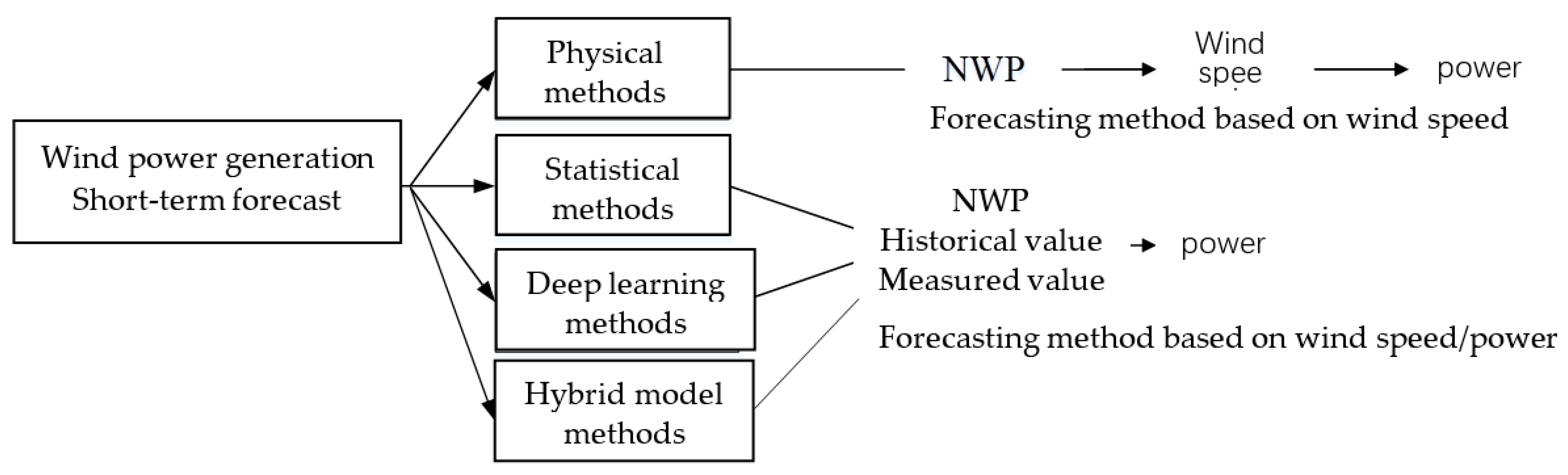
Figure 2.
(a) EBSO_LSSVM system configuration diagram. (b). Data group analysis.
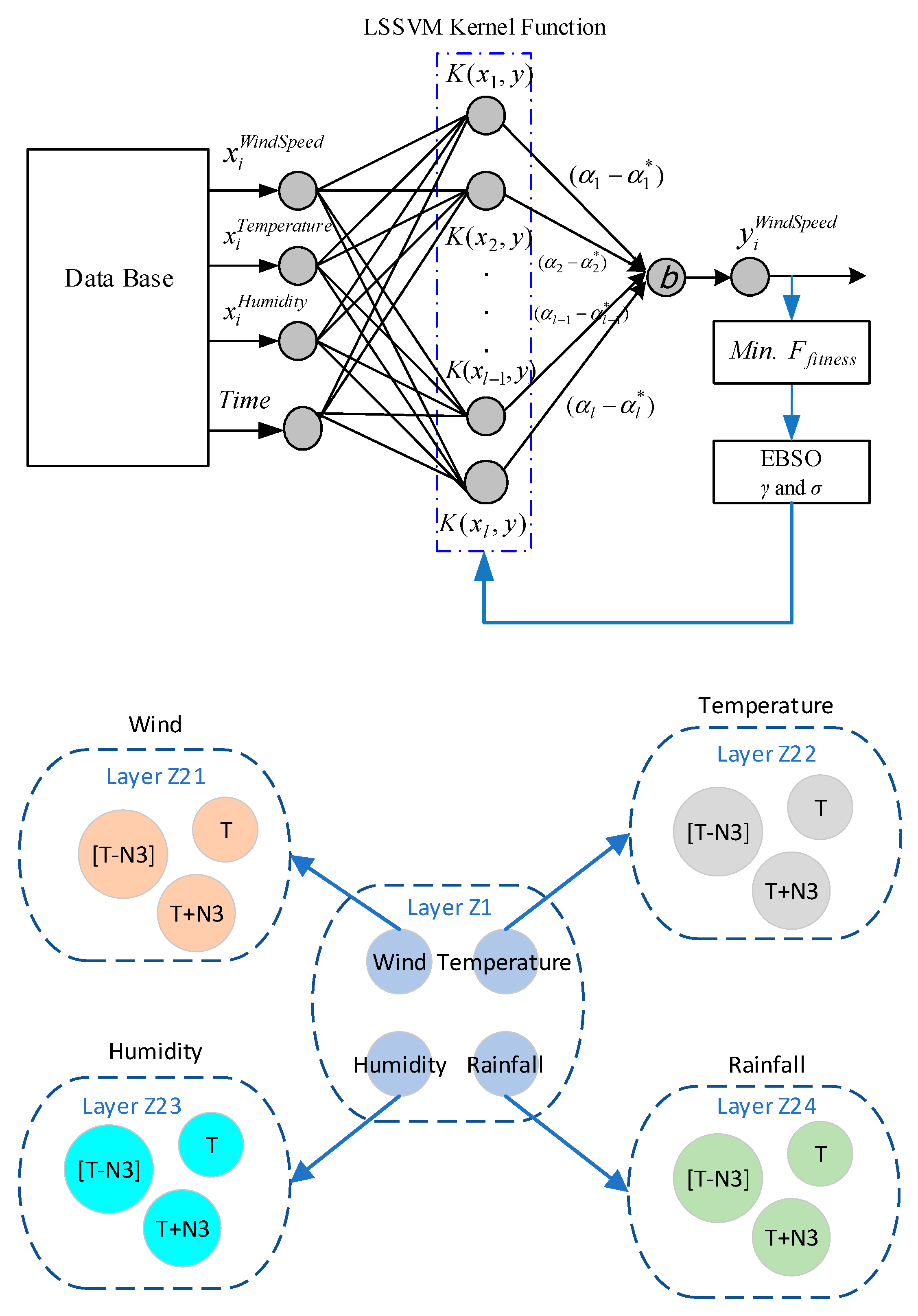
Figure 3.
Wind speed prediction model.
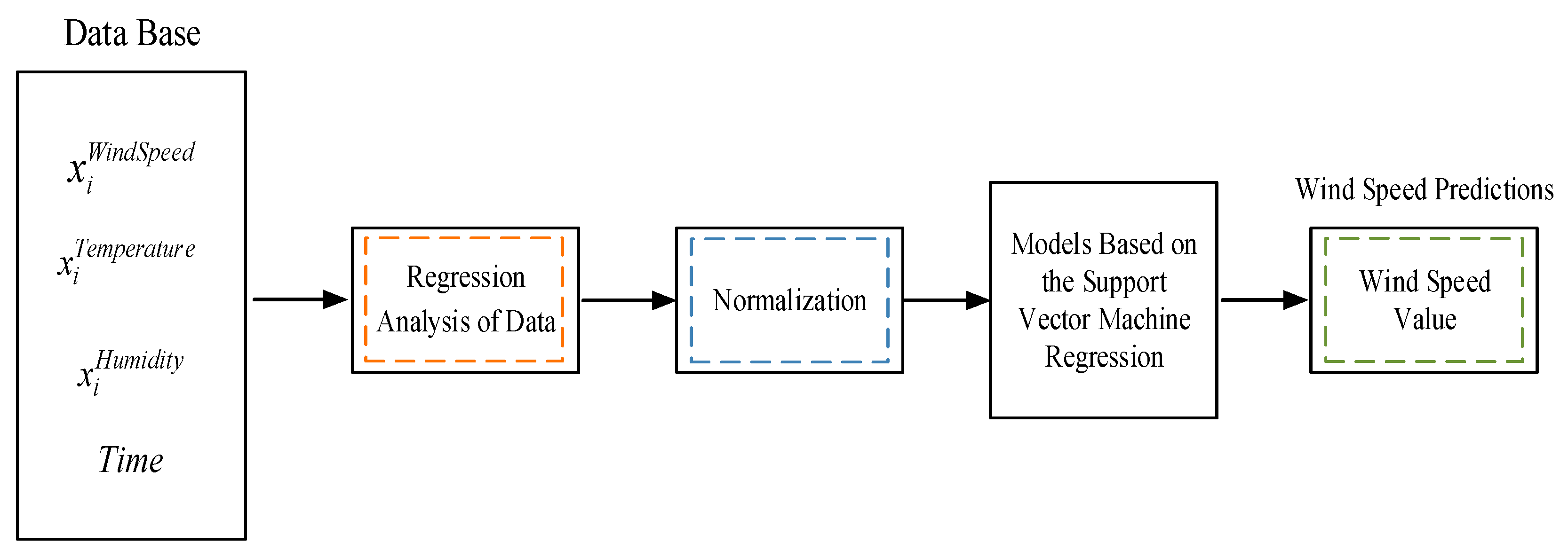
Figure 4.
Wind power modeling process.
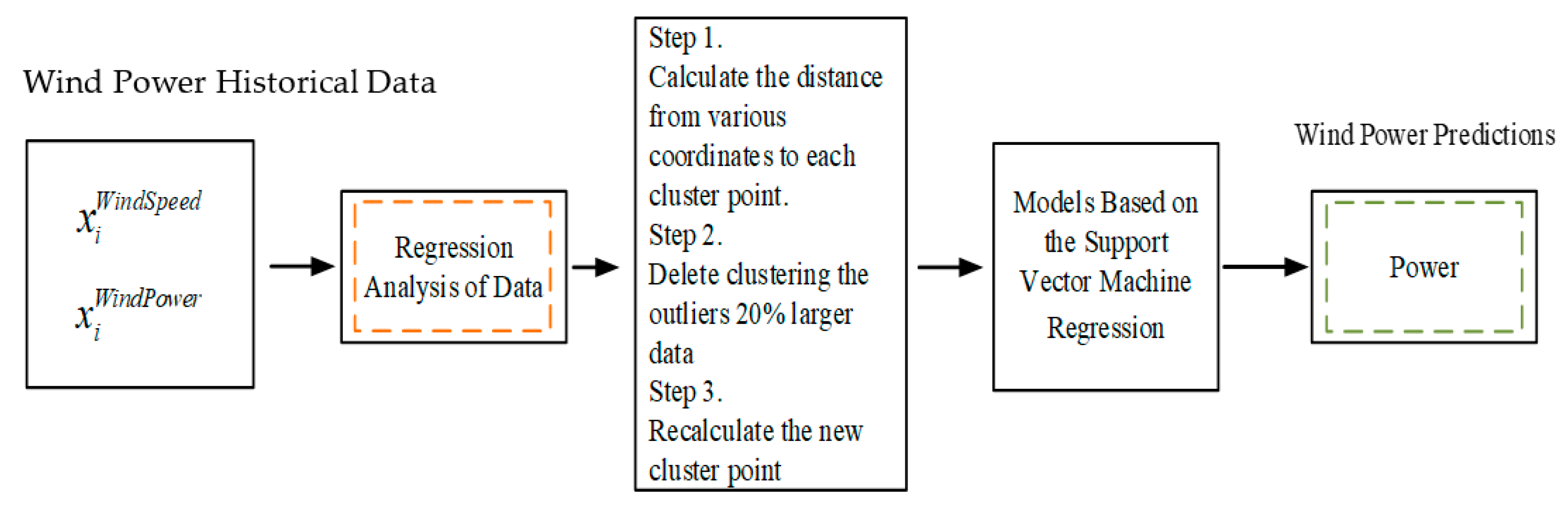
Figure 5.
Classification of the state-of-the-art approaches for short-term wind power forecasting.
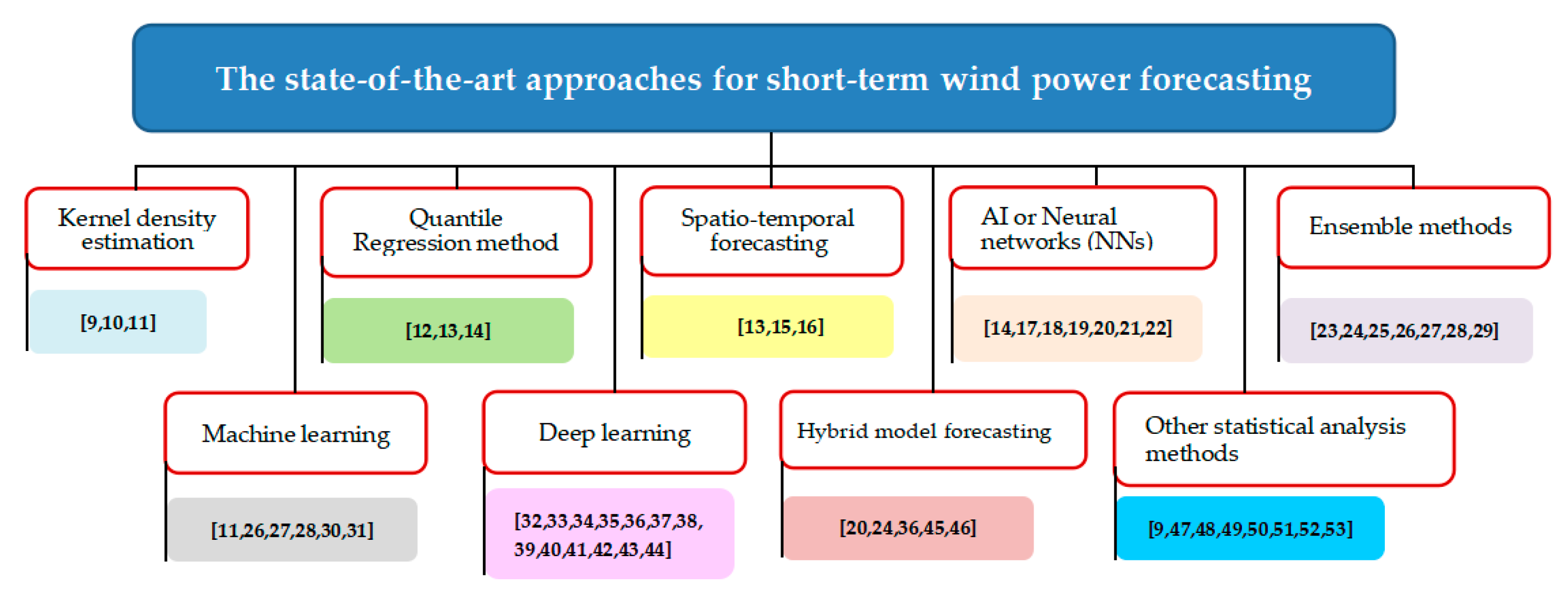

Table 1.
Wind power generation forecasting systems around the world.
| Name of forecasting system | R&D institutions | Methods |
|---|---|---|
| Prediktor | Danish National Laboratory | Physical methods |
| SIPREÓLICO | University of Carlos III, Madrid, Spain | Physical methods |
| HIRPOM | University College Cork, Ireland | Physical methods |
| Previnto | University of Oldenburg, Germany | Physical methods |
| WPFS Ver 1.0 system | China Electric Power Research Institute | Physical methods/ Meta-heuristic |
| WPPT | Copenhagen University, Denmark | Statistical methods |
| AWPPS | MINES ParisTech | Statistical methods, Fuzzy ANN |
| RAL | Appleton Laboratory, Rutherford, UK | Statistical methods |
| GH Forecaster | Garrad Hassan, UK | Statistical methods |
| WPMS | Germany-ISET | Statistical methods, ANN |
| Zephry | Risø National Laboratory | Statistical /Physical methods |
| LocalPred-RegioPred | Spanish National Energy Center | Statistical /Physical methods |
| ANEMOS | 23 scientific research institutions in 7 EU countries | Statistical /Physical methods |
| eWind | True Wind USA, Inc. | Statistical /Physical methods |
| WEPROG | University College Cork, Ireland | Statistical /Physical methods |
Table 2.
Classification of the review works based on the forecasting time scale.
| Time resolution | Reviewed works | Forecasting time scale |
|---|---|---|
| 1 min | [22,29] | Ultra short term |
| 5 min | [15,16,29,48,50] | Ultra short term |
| 10 min | [15,28,30,43,50] | Ultra short term |
| 15 min | [12,15,20,21,23,30,40,41,44,47,50] | Ultra short term |
| 30 min | [15,16,23,26,30,50,51,52] | Ultra short term |
| 1 hr | [14,16,18,23,24,27,30,33,35,36,37,38,39,42,45,49,53] | Short term |
| 2 hr | [16,25,30] | Short term |
| 3 hr | [16,30] | Short term |
| 4 hr | [25,30] | Short term |
| 24 hr | [9,11,17,29,41] | Short term |
| 48 hr | [31,33] | Short term |
| 72 hr-1 week | [13,29] | Medium term |
| 1 month-years | [19] | Long term |
Table 3.
The model type, accuracy, and parameters of the reviewed works.
| Ref | Method | Model Type | Parameters Used | Accuracy |
|---|---|---|---|---|
| [9] | -Other statistical analysis methods -Kernel density estimation |
Modified hidden Markov model | Wind speed, wind direction, wind power | RMSE=3.093 MAE=2.451 |
| [10] | -Kernel density estimation | Distance weighted kernel density estimation (KDE) and regular vine (R-vine) copula | Wind power output, wind speed | RMSE=0.1089 MAE=0.075 |
| [11] | -Kernel density estimation -Machine learning |
The k-NN and conditional KDE models | Historical wind power | MAE=3.18; RMSE=4.63; R2=0.94 |
| [12] | -Quantile regression method | A quantile passive–aggressive regression model for online convex optimization problems | Wind power | Pinball loss (PBL)=13.3 Average coverage error (ACE)=4.86%, Winkler score (WKS)=78.71 and Continuous ranked probability score (CRPS) =26.21 |
| [13] | -Spatiotemporal forecasting -Quantile regression method |
Spatiotemporal quantile regression (SQR) | Wind power data | RMSE=16.62%; MAE=11.23% |
| [14] | -Quantile regression method -AI or neural networks (NNs) |
A quantile regression neural network (QRNN) for regional wind power forecasting (RWPF) | Enhancing the abilities of nonlinear mapping and dealing with massive data | NMAE: DQR:9.086; QRNN:9.479 SBL:13.451; IFPA:13.967 NRMSE: DQR:10.917; QRNN:10.227 SBL:14.185; IFPA:14.538 |
| [15] | -Spatiotemporal forecasting | A convolution-based spatial–temporal wind power predictor (CSTWPP) | Historical wind power | MASE= 190.02 RMSE=7.49 |
| [16] | -Spatiotemporal forecasting | The spatiotemporal convolutional network (STCN) with a directed graph convolutional structure. | -Historical power data -STCN parameters selected by oneself |
MAEs =3.17% RMSEs =2.88%, |
| [17] | -AI or neural networks (NNs) | Improved deep mixture density network model | Wind speed, wind direction, wind vector, wind power | NRMSE=0.138 |
| [18] | -AI or neural networks (NNs) | New artificial neural network (ANN) models | Wind speed, wind direction, wind power output | Mean absolute relative error (MARE)=7.5%; Rj=5.4% (mean value of the Pearson correlation coefficient) |
| [19] | -AI or neural networks (NNs) | A fuzzy logic approach for prediction of wind power output | Wind speed, air density | RMSE=1.04%; MAD=0.91% MSE=1.05% |
| [20] | -AI or neural networks (NNs) -Hybrid model forecasting |
An ensemble neural forecast framework (ENFF) with three neural predictors for wind speed forecasting below. Elman neural network (ELM) Feedforward neural network (FNN) Radial basis function (RBF) neural network |
Wind speed, meteorological | Errors around 0.6 m/s |
| [21] | -AI or Neural networks (NNs) | Day-ahead numerical weather prediction (NWP) with neural network |
The persistence method with BP three rolling prediction effect | The model accuracy improved by 7.61% and the RMSE reduced by 8.76% |
| [22] | -AI or Neural networks (NNs) | -A classification model with the output wind power as the classification target -Use of Poisson re-sampling to replace the bootstrap method of the random forest to improve the training speed |
The random forest with Poisson re-sampling and set the parameters by oneself |
Mean square error (MSE) GBRT: 0.224; MLP: 0.117 Random forest with Bootstrap sampling: 0.111 Random forest with Poisson re-sampling: 0.096 |
| [23] | -Ensemble methods | The CEEMDAN-IBA-GPR model | Historical wind power data | Stand deviation =10.42 |
| [24] | -Ensemble methods -Hybrid model forecasting |
A multi-feature fusion self-attention mechanism graph convolutional network (MFF- SAM-GCN) forecasting model | Hyperparameter optimization of the predictive model by Bayesian optimization (BO) | RMSE of proposed (MFF-SAM- GCN) model is 0.0284, while the SMAPE is 9.453%, the MBE is 0.025, and R2 is 0.989. |
| [25] | -Ensemble methods | Weighted multivariate time series motifs (WMTSM) and conditional LP (CLP) combined with the adaptive boundary quantiles (ABQs) | Wind speed, wind power | Both MAE and RMSE of less than 10% |
| [26] | -Ensemble methods -Machine learning |
Ensemble learning models (GRF, RF, XGB) | Wind power, wind speed, gearbox bearing temperatures | R2 =98.9; RMSE=50.36 ; MAE=23.63 |
| [27] | -Ensemble methods -Machine learning |
The five algorithms include wavelet neural network (WNN) trained by improved clonal selection algorithm (ICSA), WNN trained by PSO, and extreme learning machine (ELM)-based neural network, etc. The best performing models are the WNN trained by ICSA and ELM-based NN models. | Selecting parameters by using particle swarm optimization | The average nRMSE for WNN trained by ISCA, ELM, RBF, MLP, WNN trained by PSO are 5.4059%, 6.925%, 10.294%, 12.407%, and 17.038%. The average nMAE for WNN trained by ISCA, ELM, RBF, MLP, and WNN trained by PSO, are 4.2893%, 5.4787%, 8.2527%, 9.5773%, and 13.4847%. |
| [28] | -Ensemble methods -Machine learning |
Enhanced bee swarm optimization (EBSO) to perform the parameter optimization for least squares support vector machine (LSSVM) | Picking parameters for LSSVM by enhanced bee swarm optimization (EBSO) | DR-SVM VMED(m/s): 6.895 MAE (m/s) : 0.723 RMSE(m/s): 0.932 MAPE(%): 11.87 CPU time(s): 148.15 |
| [29] | -Ensemble methods | An exhaustive review of the state of the art of wind speed and power forecasting models for wind turbines located in different segments of power systems | Data preprocessing (EMD and ICEEMDAN) and parameter optimization | No description |
| [30] | -Machine learning | The Adaboost-PSO-ELM method | Wind speed, wind direction, wind power | MAPE=0.0372; NBE=0.4621 RMBE=0.2950; R2=0.9857 |
| [31] | -Machine learning | Salp swarm algorithms–extreme learning machine (SSA-ELM) | Wind speed, wind direction, temperature, atmospheric pressure, and other data are sampled every 10 minutes | MAPE=1.2677 RMSE=0.2576 |
| [32] | -Deep learning | A deep optimized convolutional LSTM-based ensemble reinforcement learning strategy (DOCLER) | Wind power | RMSE=7.1322% MAE=4.6713% |
| [33] | -Deep learning | A variational mode decomposition (VMD) and convolutional long short-term memory network (Conv LSTM) model | Wind power | MRE(KW)=0.016 (should be %) MAE(KW)=792 (should be %) MSE(KW)=1568305.38 RMSE(KW)=1252.32 (should be %) |
| [34] | -Deep learning | A multi-source and temporal attention network (MSTAN) | Wind speed, pressure, temperature, humidity, and wind direction | NRMSE=0.154 NMAE=0.110 |
| [35] | -Deep learning | Two-dimensional convolution neural network trained by improved accidental floater PSO | Fine-tuning the weights of TDCNN by proposed AFPSO |
Average error of four seasons MAPE:3.76 NMAE:2.46 NRMSE:3.12 |
| [36] | -Deep learning -Hybrid model forecasting |
The WD-IGFCM-LSTMS model for the accuracy of short-term wind power forecasting (WPF) approach | The best parameters determined by IGWO algorithm | Case A: NMAE 10.32%; NRMSE 14.59% CR: 85.41%; QR: 91.53% Case B: NMAE 10.18%; NRMSE 13.52% CR: 86.48%; QR: 91.53% |
| [37] | -Deep learning | Deep neural network: LSTM method (best); MLP (second best) while using SVR, KNNR, and physical model with an expert correction |
More LSTM parameters and set these parameters by oneself | INT_OUT_EXT[GBT, RF, PHYS(v1&v2)→KNNR, MLP, LSTM] with additional expert SS:0.5925; nMAE[%]:11.3055 nRMSE:0.1618; nMBE:0.0146 |
| [38] | -Deep learning | -Optimizing the hyperparameters of the LSTM network by the modified PSO algorithm -A PSO_LSTM model |
Selecting parameters by PSO | MPSO_ATT_LSTM MAPE: 4.6%; MAE: 211.5 kW Device capacity > 20000kW |
| [39] | -Deep learning | Advanced deep learning techniques Encoder–Decoder LSTM |
Setting parameters by oneself | Annual and monthly errors |
| [40] | -Deep learning | The CNN-MLSTMs-T Model | Wind power | RMSE=0.1998; MAE=0.1523 |
| [41] | -Deep learning | Generative moment matching network (GMMN) | Historical wind power | PINAW=8.66MW; PICP=84% RMSE=127.10; MAE=0.6855MW |
| [42] | -Deep learning | Bidirectional long short-term memory (Bi-LSTM) | Manual adjustment layers | Error can be divided into training, test and validation errors |
| [43] | -Deep learning | Multi-step informer network (MSIN) | Manual selection of parameters | Multi-step informer network (MSIN) improves forecast accuracy by 29% compared with informer network for RMSE |
| [44] | -Deep learning | Long short-term memory neural network (LSTM) with the improved particle swarm optimization algorithm (IPSO) | Determining the LSTM and DENSE layers, the number of neurons | VMD-CNN-IPSO-LSTM MAE:2.92668; RMSE:3.59604 MAPE:0.20147; adj-R2:0.96639 |
| [45] | -Hybrid model forecasting |
Generalized regression neural network (GRNN) and support vector machine (SVM) |
Turning GRNN and SVM parameters by oneself | The GRNN model gives the CC value of 0.956, RMSE of 28.82, and the SVR model gives the CC value of 0.965 and RMSE value of 44.40. |
| [46] | -Hybrid model forecasting | The WPD-VMD-SSA-IGWO-KELM model | Wind speed |
NMAE=11.2% MAPE=4.2% |
| [47] | -Other statistical analysis methods | Higher-order multivariate Markov chain (HMMC) | Wind power; PV power, Heat index |
NRMSE=2.59 |
| [48] | -Other statistical analysis methods | Five minute-ahead wind power forecasts in terms of point forecast skill scores and calibration | To deduce the value of kernel methods for parameter adjustment | The error value is represented by a picture rather than a simple number. |
| [49] | -Other statistical analysis methods | RL-Based ESS operation strategy | No description | 1% point analysis gap to the optimal solution, which requires complete information, including future values |
| [50] | -Other statistical analysis methods | Regression and curve fitting by weather research and forecasting (WRF) and wind farm parameterization (WFP) | No description | No description |
| [51] | -Other statistical analysis methods | Empirical dynamic modeling (EDM)-based probabilistic forecast | Historical wind turbine power | CRPS (%)=5.12 |
| [52] | -Other statistical analysis methods | Multi-class autoregressive moving average (ARMA) | Historical wind power | RMSE=127.10 MAPE=1.25% |
| [53] | -Other statistical analysis methods | Renewable energy is directly distributed to power dispatch | Incorporating renewable energy into the power flow | With an increase in power by 1.6 times, there is a decrease in energy of RES by 15-19. |
Table 4.
Main contributions, advantages, and disadvantages of reviewed works in wind power forecasting.
Table 4.
Main contributions, advantages, and disadvantages of reviewed works in wind power forecasting.
| Work | Date of publication | Main contributions | Advantages | Disadvantages | Approaches |
|---|---|---|---|---|---|
| [9] | Jan./Feb. 2022 |
A wind power forecasting (WPF) system including WRF-based wind forecasting, modified HMM-based wind speed correction, and a kernel distribution estimation (KDE)-based WPF module | Enhancing the WPF accuracy from deterministic and probabilistic forecast | -Very time-consuming in huge computational burden -Complex configuration |
Classification and regression algorithms |
| [10] | January 2020 |
The model is more accurate and flexible than the Gaussian copula model | Abundant bi-variate copula functions are available to make the model more accurate | -Complex structure and hardware requirement | Classification and regression algorithms |
| [11] | November 2022 | Simple to improve the accuracy of aggregated point and wind power forecasts that can be derived from decentralized point forecasts | Providing system operators with a way of aggregating these forecasts while taking into account spatial and temporal correlations of wind power | -Being difficult in selecting good bandwidths in the presence of large datasets and high dimensionality | Classification and regression algorithms |
| [12] | April 2022 |
Online ensemble learning framework for wind power forecasting that utilizes solid individual forecasting models and new information | Higher accuracy and lower computation complexity | -Time-consuming computation process -Excessive parameter adjustment |
Classification and regression algorithms |
| [13] | Nov./Dec. 2020 |
An SQR model is proposed, which is a new nonparametric probabilistic prediction method | Providing an efficient framework for regional wind power probabilistic prediction with highly reliable performance | Complex nonlinear and high dimensional structure | Classification and regression algorithms |
| [14] | October 2021 |
On basis of the QRNN, the structure of the DNN is improved to adapt regional wind power forecasting as well as constructing the DQR | -The deep quantile regression is proposed to improve the performance of the QRNN -The local-connected method is applied to the input layer of the neural network for tackling the challenge of the massive data |
Each test takes 72 hours, so it is impossible to clearly determine its effects with no parameters and time | Classification and regression algorithms |
| [15] | June 2020 |
The deep architecture and nonlinearity of CSTWPP, spatial–temporal features inside the power of multiple wind farms can be effectively extracted. The accuracy of this short-term forecasting approach is significantly higher than existing models. | -The powerful ability of CSTWPP to extract spatial–temporal features from multiple wind farms -Superiority over other competing methods |
- Time-consuming computation process -Graphics processing units (GPU) is used to speed up the training process | Deep Learning algorithms |
| [16] | March 2022 |
-A deep learning architecture STCN based on a graph model for spatiotemporal wind power forecasting -A novel directed graph model and the corresponding GCN structure |
Fewer input time steps cause the STCN model to learn temporal features insufficiently, affecting the forecasting results | The STCN model exhibit certain interpret-ability, which is not available in traditional deep learning models |
Deep Learning algorithms |
| [17] | July 2020 |
The improved deep mixture density network (IDMDN) has better function approximation and density estimation ability than conventional shallow MDN | It is not necessary to obtain the deterministic prediction result firstly and acquire the probabilistic result by post-processing | -Slow convergence speed | Feed-forward neural network algorithms |
| [18] | May 2020 |
Improvement in the efficiency and stability of ANN models by varying the number of prior 1 h periods | Improvement of model performance, efficiency and stability for the performance of ANN- based WPF models | -Possible disadvantages of ANN Model in short term prediction of wind power generation | Feed-forward neural network algorithms |
| [19] | February 2021 |
Developing fuzzy model and model predictive control for prediction of wind power for the particularly selected location in India | The proposed models can be employed for the estimation of wind speed and wind power generation of any location in the world with having the complete information | -The time for calculating the wind power is 1 second. It is difficult to estimate the wind power during the summer period in which wind speed is very low. | Rule-based algorithms |
| [20] | January 2021 |
Development of a new ensemble neural forecast framework (ENFF) to accurately forecast the wind speed | -Enhancing the utilization of super-capacitor energy storage (SCES) as the N-1 contingency events -Being easily extended to N-1-1 contingency |
It is not economical to deploy energy storage only for VIS as these events are less frequent in power systems | Feed-forward neural network algorithms |
| [21] | August 2020 |
Located by the NWP information and time windows to improve the low forecasting accuracy of rolling WPP | The hybrid approach combined with neural network and persistence method | -The relevance of the day ahead is doubted due to the great change of wind -The setting of neural network parameters is a big issue |
Feed-forward neural network algorithms |
| [22] | January 2021 |
An improved random forest short-term prediction model based on the hierarchical output power | -Discretizing the power data to divide the large- scale training data and remove abnormal data -Fewer regression trees -Better performance |
The tree size has a great impact. -It is slow to run if there are more trees -It is not accurate if there are fewer trees |
Classification and regression algorithms |
| [23] | March 2020 |
The probabilistic wind power forecasting (WPF) results are utilized as one part in the micro-grid (MG) system for optimal dispatching | Automatically generate optimal compromise solutions for decision makers | Longer training duration | Classification and regression algorithms |
| [24] | April 2022 |
-A Bi-LSTM network and1D-CNN in parallel connection to form a multi-feature fusion (MFF) framework, which can extract spatiotemporal correlation features of the load data -The eigenvalue can be found to reduce the data |
-Enhancing the feature extraction capability of the 1D-CNN network by a self- attention mechanism | More LSTM parameter settings require to be adjusted |
Deep Learning algorithms |
| [25] | January 2022 |
-A hierarchical clustering method based on weighted multivariate time series motifs (WMTSM) is used to analyze the static, dynamic, and meteorological characteristics of regional wind power -Based on the clustering analysis, the correlation coefficients are formulated as the weights for the accuracy of samples to optimize the cost function of conditional LP (CLP) |
The result of clustering, the CLP for each cluster is quantified, which can improve the accuracy of sample utilization, and further enhance the performance of CNQR | -Highly affected by the accuracy of NWP and the static relationship between the wind power and speed | Feed-forward neural network algorithms |
| [26] | April 2020 |
Ensemble learning models provide a better prediction of wind power | Better performance of wind power prediction by the ensemble models considering lagged data | Spatiotemporal dependencies are not considered in ensemble learning models and machine learning models | Classification and regression algorithms |
| [27] | August 2020 |
-A novel hybrid neural network (NN)-based day-ahead (24 hour horizon) wind speed forecasting is proposed -Single- and multi-features and their effect on the accuracy of wind speed prediction are analyzed |
-Very effective for day-ahead wind speed prediction - Only need wind speed as a feature |
It is not clear how to select the eigenvalues of historical data | Feed-forward neural network algorithms |
| [28] | November 2020 |
The data regression (DR) algorithm gets meaningful training data to reduce the number of modeling data and improve the computing efficiency | Effectively reduce computing time by data regression algorithm | It is difficult to assess errors for wind speed forecasts due to large variations | Classification and regression algorithms |
| [29] | September 2022 | A comprehensive review of the state of the art of wind speed and power forecasting models is presented for wind turbines located in different segments of power systems | Due to the variable nature of wind speed and its relationship to meteorological variables, it is possible to study the accuracy of integrating physical forecasting methods into hybrid models | Individual forecasting algorithm has been replaced by hybrid algorithms combining mainly AI-based and statistical methods | Feed-forward neural network algorithms |
| [30] | July 2021 |
-This model has good generalization ability and robustness -Providing a more reliable basis for power grid dispatch |
Higher accuracy and better generalization ability by Adaboost-PSO-ELM wind power prediction model | The training samples are selected based on experience | Feed-forward neural network algorithms |
| [31] | March 2020 |
Improving the accuracy of ultra-short-term wind power prediction | Better performance based on SSA analog integrated circuit design | Longer training time | Feed-forward neural network algorithms |
| [32] | February 2022 |
A combined deep neural network model by integrating the advantages of the CNN and LSTM neural network | Excellent performance of the proposed algorithm in comparison to several state of-the-art WPF models | Low computational ability of the algorithm in selecting CLSTM hyperparameters | Deep Learning algorithms |
| [33] | July 2020 |
A short-term wind power forecasting model including VMD decomposition, ConvLSTM predictor and error series modeling | Removing the nonstationary features of the raw wind power series |
A large computational cost to obtain the optimal parameters | Deep Learning algorithms |
| [34] | October 2021 |
Multi-source NWP is used in WPPF, and its long-term temporal error pattern is discussed | -Higher deterministic prediction accuracy -Better probabilistic evaluation score |
-Time-consuming computation process -Complex configuration |
Deep Learning algorithms |
| [35] | September 2020 |
-The proposed forecasting engine composed two-dimensional convolution neural network (TDCNN) -Trained by improved optimization algorithm based on particle swarm optimization |
Fine-tuning the weights of TDCNN to increase the prediction accuracy of the forecast engine | Longer time for model training due to high requirement of data quality | Deep Learning algorithms |
| [36] | March/April 2022 | -The WD-IGFCM-LSTMS model -Six fluctuation features that reflect the shape characteristics are extracted to quantify the partitioned waves |
Improving the global searching ability of the GWO to select the initial clustering center of fuzzy C-means more effectively | -Longer time to calculate the parameters of fuzzy C-means, modeling and prediction of LSTM | Deep Learning algorithms |
| [37] | February 2022 |
Using meteorological forecasts from two NWP models (ECMWF and GFS) as input data yields better results than using a single NWP model | -Presenting real wind speed data and obtain higher accuracy of models with more numerical weather prediction (NWP) points | -We have tested it to find that too much input data will result in slow operation -Only one hour can be predicted | Deep Learning algorithms |
| [38] | June 2022 |
-Speeding up the convergence of the model dramatically to avoids falling into local optima. -Reducing the influence of man-made random selection of LSTM network hyperparameters on the prediction results | Lower influence of parameters | - LSTM has more parameters than SVM, GRMM, RBF, and other modeling methods, so it will become a big issue in computation process - The computation times will increase significantly when the amount of training data is large -The accuracy needs to be confirmed |
Deep Learning algorithms |
| [39] | June 2022 |
The encoder–decoder LSTM for medium-term wind speed based on a real-time measurement dataset, which were compared with two well- known conventional methods | Easy to determine the eigenvalue by using encoder–decoder | Improper correlation and weight ratio of coded data | Deep Learning algorithms |
| [40] | May 2021 |
The sample classification features mined by the CNN are submitted to the numerical prediction task as supplementary knowledge to help the training of the LSTM prediction models | -Effectively improve the accuracy of WPF based on sample similarity analysis | Exploring whether mode classification task can provide valuable knowledge for numerical prediction | Deep Learning algorithms |
| [41] | October 2022 |
-Based on historical observations, combined with deterministic point forecasts, WindGMMN is developed to generate a large number of realistic wind power scenarios with similar characteristics to real wind power -The proposed WindGMMN is unbound from statistical hypotheses -Producing a series of possible forecasting scenarios without a time horizon and number restrictions by simply adjusting parameters |
-Capturing the probability distribution characteristics of actual wind power scenarios -Reflecting the temporal correlations of wind power scenarios |
It is difficult to distinguish which prediction interval is better | Deep Learning algorithms |
| [42] | April 2021 |
Significant improvements in the peak value forecasting have been observed by using the fused network of short and long Bi-LSTM networks with DRNets | Bi-LSTM network can improve performance by eliminating propagated errors | -The test for bidirectional long short-term memory (Bi-LSTM) layers will be more troublesome -The LSTM prone to overfitting due to the increasing depth of DNN, which degrades the performance of the deep learning model |
Deep Learning algorithms |
| [43] | September 2022 | -Accurate mid- and long-term wind power forecasting can provide an important basis for power distribution and energy storage configuration after wind power grid-connected -A dynamic pressure model is introduced in MSIN to modify wind power generation forecast with having highly correlated physical characteristics |
-Multi-step informer network improves forecast accuracy by 29% compared with informer network -The multi-step process is beneficial to the anti-risk ability and security of the network |
In the case of ignoring meteorological factors such as surface temperature and relative humidity, the coupling factors between multiple wind turbines need to be considered in the research | Deep Learning algorithms |
| [44] | September 2022 | Considering the nonlinear and fluctuating characteristics of wind speed and wind power series, a hybrid short-term wind power forecasting model based on data decomposition (VMD) and joint deep neural network (CNN-LSTM) is proposed | The wind speed and wind power sequences in the input data are decomposed by variational mode decomposition to reduce the noise in the raw signal | Using IPSO to select the layers and neurons of LSTM would cause the issue of too long calculation time | Deep Learning algorithms |
| [45] | May 2022 |
-The GRNN model is better than the SVR model regarding the RMSE value -The inclusion of average electrical load data is possible when the forecasting system can obtain near real-time observation data of electricity load |
Which weather parameters affect the electricity load? Primary impact is temperature; secondary impact is wind speed. |
The temperature affects the power demand in terms of load forecasting | Feed-forward neural network algorithms |
| [46] | April 2020 |
Significantly increase the accuracy in short term wind power prediction | -Greatly extract the trend information of wind power -Better accuracy in short-term wind power prediction |
The structure of proposed nonlinear combination model | Feed-forward neural network algorithms |
| [47] | April 2020 |
A flexible framework for forecasting wind generated power in the case of disjointed batch of historical data to enhance the accuracy of wind power output modeling | Reaching better performance of the forecast algorithm | -Complex computation process -Increasing dimensions of the input vector |
Classification and regression algorithms |
| [48] | August 2021 |
Identifying changes in the time series, avoiding abrupt loss of information, and maintaining a controlled number of examples, since there is adaptive selection of the active kernel | Dealing with the increasing kernel matrix size associated with time and memory complexities, and the overfitting problem | -An accurate very-short term forecasts for one or multiple wind farms | Classification and regression algorithms |
| [49] | February 2020 |
-Improving learning performance by reducing the variance of the WPG forecast uncertainty -Extensive simulations based on practical WPG generation data and forecasting |
Managing the wind power generation (WPG) forecast uncertainty by a reinforcement leaning-based ESS operation strategy | -Requiring complete information, including future values, to achieve cross period prediction | Rule-based algorithms |
| [50] | June 2022 |
The weather research and forecasting (WRF) model is utilized with the wind farm parameterization (WFP) method for short-range wind power forecasting simulation | -The horizontal downsize method can prolong more than 10 km in the velocity field, especially for higher incoming wind velocity -Improving the accuracy of the power forecast for higher wind speed simulations | -Adding some complexity of the correlation works -There may be time and space difference between real-time data and geographical location. -Leading to uncertainty of data |
Classification and regression algorithms |
| [51] | April 2020 |
The proposed approach is effective on achieving probabilistic WTPF with high reliability as well as satisfactory sharpness | -Developed for the wind power forecasting by the EDM method -Applied to estimate the uncertain behavior of WTP |
-Obtaining the highest CRPS values -The poorest performance. |
Classification and regression algorithms |
| [52] | September 2022 | Lower training complexity in the proposed model to ensure prediction accuracy compared with traditional models | -Tackling seasonality and randomness of wind power with moderate model complexity -Effectively guarantees the convergence speed and efficiency of the training process |
If the input data are nonstationary so that the proposed data preprocessing fails, the proposed model may not be able to obtain accurate prediction results | Classification and regression algorithms |
| [53] | September 2022 | The load schedule, electricity consumption, use of installed power, boundary conditions of generation, and ensuring energy balance were taken into account | For the average monthly values of renewable energy sources generation with an increase in power by 1.6 times, there was a decrease in electricity consumption by 1.57–4 times. | The selection of the WG installation location for load object is difficult to comprehensively take into account, since the system load will vary from day to day | Rule-based algorithms |
Disclaimer/Publisher’s Note: The statements, opinions and data contained in all publications are solely those of the individual author(s) and contributor(s) and not of MDPI and/or the editor(s). MDPI and/or the editor(s) disclaim responsibility for any injury to people or property resulting from any ideas, methods, instructions or products referred to in the content. |
© 2023 by the authors. Licensee MDPI, Basel, Switzerland. This article is an open access article distributed under the terms and conditions of the Creative Commons Attribution (CC BY) license (http://creativecommons.org/licenses/by/4.0/).
Copyright: This open access article is published under a Creative Commons CC BY 4.0 license, which permit the free download, distribution, and reuse, provided that the author and preprint are cited in any reuse.


