

Submitted:
24 April 2023
Posted:
25 April 2023
You are already at the latest version
Abstract
The purpose of this paper is to explore the effect of corporate social responsibility (CSR) on brand image in the apparel industry in Jordan, using the moderating variable of customer consciousness. The current research uses a quantitative, descriptive, cause-effect, and cross-sectional approach, and also it uses a convenience sampling method. Data was collected from 440 respondents. Results indicate that Jordanian Apparel organizations have medium to highly implementing of all items and constructs of CSR, brand image items, and consciousness items. Moreover, there is a strong relationship between CSR dimensions, a medium relationship be-tween each CSR dimension and brand image, a medium relationship between each CSR dimension and consciousness, a medium relationship between total CSR and brand image, a medium relationship between total CSR and consciousness, and the medium relationship between brand image and consciousness. Results of the first model show that total CSR affects the brand image. Where social responsibility has the highest positive effect, followed by ethical responsibility, then economic responsibility, however, environmental responsibility negatively affects the brand image. The second model shows consciousness moderates the effect of CSR on the brand image. The study recommends longitudinal research on the Jordanian Apparel industry, especially to test the effect of environmental responsibility on the brand image. Moreover, the re-search uses customers’ consciousness as a moderating variable, which improves the effect of CSR on brand image. The Apparel industry organizations in Jordan should revise their daily practices particularly environmental responsibility and/or increase their customers’ awareness of their practices. Finally, the current research contributes to existing studies by using consciousness as a moderating variable.
Keywords:
Corporate Social Responsibility
; Social Responsibility
; Economic Responsibility
; Environmental Responsibility
; Ethical Responsibility
; Brand Image
; Consciousness
; Apparel Industry
; Jordan
1. Introduction
Nowadays, the interest in corporate social responsibility (CSR) is increasing, and it is almost present in all countries; it is a notion of extreme significance in business. ISO 26000 has defined CSR as how an organization's activities affect the society where it performs its business and how these activities affect the environment. Therefore, CSR is very important for measuring an organization’s overall performance and its ability to sustain its operations effectively [1]. CSR has changed from pure philanthropy practices to being included within businesses' core operations and overall business strategy [2]. Recently, businesses are shifting toward creating shared value to establish a competitive advantage and differentiate from competitors. In the shared value model, the business exists to solve social and environmental problems while creating economic value and generating profits. However, the degree of CSR presence differs between countries and depends on the existence of policies and regulations that support or enforce the practice of CSR in businesses. Some businesses in developing countries consider philanthropy the heart of CSR, undermining the importance of formulating a CSR strategy and embedding it in their operations [3]. They view CSR as a cost center, disregarding its role in improving business brand equity, performance, and profitability. They also disregard the importance it has in developing the company’s brand image that, as a result, helps to improve business performance.
Organizations must implement strategies of CSR (social, ethical, environmental, and economic) to reach their target audience. Suppose these strategies are incorporated into the business. In that case, they will have a higher reach because consumers are not only interested in the product and its benefits but the process that led to making it as well. When companies are more aware of the responsibility they have in front of nature and society and they strive to do better, which facilitates their brand image. Therefore, the current study aims to investigate the role of CSR on brand image, one aspect of brand equity, for the apparel industry in Jordan using consumer consciousness to act as moderating the correlation between CSR and brand image. Consumers, who are aware, pay extra attention to their purchasing decisions. They familiarize themselves with companies that implement CSR and hold on to a good brand image; hence, when purchasing, they tend to stick with ethical companies. This research paper focuses on how CSR benefits companies and explores four components that help boost a company’s ability to recognize these responsibilities: social, ethical, environmental, and economic.
In the last few decades, CSR has become to be an important issue for all organizations whatever they are doing and wherever they are performing their business, and the reasons why the researchers have recognized CSR to be adopted within organizations' strategies. They include strategies for improving business reputation, laws of government, stressful situations from stakeholders as well as senior managers, significant events, and winning points a company has over its rivals. Other strategies include taking part in creative projects related to administration and the offerings a business may introduce contributions in environment-friendly prospects and policies that integrate economic and social strategies. In a world of high competition, such studies demonstrate why it is crucial to incorporate strategies like these into the business [4]. Methods such as these facilitate the brand image of a business because consumers are aware of their actions; they also help boost this image by spreading positive words to their network. Limited research has been conducted as to incorporating CSR strategies in Jordanian companies; they must understand the significance of CSR and how it can strengthen their brand image once implemented correctly. In the field of apparel and fashion, research indicates that although the industry is being pressured to execute approaches that consider social and environmental matters, it is not incorporating strategies of CSR thoughtfully because not many businesses are hiring professionals in this field [5]. Applying CSR can make communities stronger [6]. Companies striving to strengthen their bonds with communities understand that they need to hold themselves accountable for their actions and be transparent about what they do and in what ways they commit to this responsibility.
In general, there are limited research papers on the impact of CSR on brand image in the Jordanian market. However, in this study, the researchers would like to develop a further understanding of the impact of CSR’s different dimensions (social, environmental, ethical, and economic) on brand image. Therefore, the current research objective is to investigate the relationship between the different components of CSR (social, environmental, ethical, and economic) and brand image, specifically in the apparel industry in the Jordanian context. Another objective is to investigate if the conscious consumer plays a role in moderating the correlation between CSR and brand image.
The importance of the study lies in understanding the maturity of CSR within consumers in Jordan, in the apparel industry in particular. If CSR was a mature concept, companies could utilize it to create a competitive advantage. If not, Jordan shall take the initiatives to raise awareness about CSR practices and educate its citizens on the subject, as it will positively influence the country and society. It will also enable companies to look for more sustainable solutions to meet customers’ demands without leaving a negative impact.
2. Literature Review and Hypotheses Development
Corporate Social Responsibility (CSR)
The notion of CSR is one of the main early concepts that appeared in the area of relations between business and society [7]. Despite CSR being a practiced notion in business, it lacks a universally agreed definition [8,9,10,11]. It details how business and the broader society connect internally. Bowen views CSR as an obligation towards society, the sort of commitment that businesses have for supporting procedures made by management that follow societal ideas and principles [12]. Business strategies are adopting CSR as the main element because it is considered a useful asset to companies striving to improve their performance and support the community at the same time [13]. The concept of CSR and its application are receiving recognition on a global level due to its importance [14]. CSR has been the topic of discussion by scholars who study the role of companies and their responsibilities towards society. Not only do companies need to prioritize meeting shareholder interests, but also recognize their role in society [15]. Organizations must hold themselves accountable in front of society as this helps them with improving their image; thus, their success increases. This is where brand equity emerges as the result of a good sense of CSR. Debates around the emergence of CSR or also known as Social Responsibility (SR), have suggested that the concept initially appeared in the 1950s. However, to provide some context into the root of the concept, it is necessary to go back to the industrial revolution in the 18th century. Factories in the United States of America and Great Britain at that time were only concerned about increasing workforce productivity while drawing no attention to the effects it might have on their employees. This raised debates and arguments within societies about the practices used in terms of hiring women and children and not taking the right measures to ensure workforce safety. These actions led to a movement that made factories consider employees’ and society’s welfare through the implementation of healthcare schemes and others. Nowadays, the concept of CSR cannot simply be ignored by managers of organizations for the importance it holds, and there has been a growing debate on the connection between CSR and the performance of organizations [12].
CSR in Jordan
Jordan, as a developing country, is facing many economic and environmental challenges. Jordan had a high unemployment rate of 22.6% in Q2 of 2022 [16]. It requires humanitarian aid to be able to host refugees from neighboring countries [17]. Environmentally, Jordan has limited natural resources; it is among the top ten for water scarcity [18]. Despite the environmental and economic challenges that Jordan faces, it does not deploy CSR fully to help solve some of the challenges. In 2021 Jordan was ranked number 131 out of 180 countries in Sustainability 2022 [19]. However, Jordan is taking initiatives to improve the situation by taking country-level as well as corporate-level initiatives. In 1998 – 2008 Jordan gradually privatized so 14 state-owned enterprises, which had a positive impact on society through microeconomic improvements, innovation, and employment [20]. Today, Jordan’s economic modernization vision focuses on both economic growth and the quality of life by drawing focus to education, the environment, and the standards of living for Jordanians. Lastly, Jordan is reinforcing laws and regulations to reinforce companies to think about the society they operate. Some industries are forced to disclose environmental issues in their annual reports [21]. Finally, there is a debate about the effect of CSR components on Jordanian organizations' performance, customer engagement, purchase intentions, and others. This variation may be related to industry one study stated that there is an effect for each CSR component on Jordanian Pharmaceutical manufacturing organizations' business performance, where environmental responsibility rated highest effect, followed by economic responsibility, and then social responsibility [10]. Another study in Jordan concluded that ethical responsibility and environmental responsibility affect customer engagement and purchase intentions, while philanthropic responsibility and economic responsibility insignificantly affect customer engagement and purchase intentions [22]. Hence, Jordan is taking the right steps toward social responsibility despite its mediocre ranking amongst countries.
CSR and Brand Image
Due to globalization and intense competition, companies are no longer focusing solely on acquiring market share through product innovation but on strengthening their intangible assets like brand equity. Businesses that have strong brand equity have a higher market capitalization in financial terms [23]. One component of brand equity is a brand image which is crucial for professionals in the field of marketing as they spend a considerable period protecting their brand image so they can get the most value out of their target market [24]. Hence, exploring the effect of CSR on the brand image might be a new way for businesses to differentiate themselves from the competition in a market with low product differentiation. Any company would consider its brand as its most valued asset as it reflects the consumer’s choice of purchase. Consumers trust these brands, which, in turn, aids in their ability to purchase from them [25]. Knowing well how powerful they stand in the market. Consumers relate to brands when they feel a sense of connection to them that stems from prior personal experience with the brand itself or from what they heard about it from other people [26]. Brand image is an integral part of the brand; it is how people perceive the brand in the market and speaks of the company’s success. If the brand is doing well in the market, it has a good brand image. Companies do their best to make this image stand out and reflect their effort. Moreover, utilizing CSR strengthens the reputation of a brand and creates a feeling of confidence and devotion for it in customers. Once consumers are aware that brands are heading toward ethical means and speaking of crucial topics that they find significant, then purchasing their products will be a continuous activity. Consumers will feel emotionally connected with the brand based on the business’s sense of social responsibility which facilitates positive feedback for the brand and the image it holds in society [27]. CSR helps companies to engage in environmental, societal, and economic parts of the business, thus encouraging consumers to think positively of the brand, which, overall, creates a positive image for the business[28]. The first null hypothesis assumes the following:
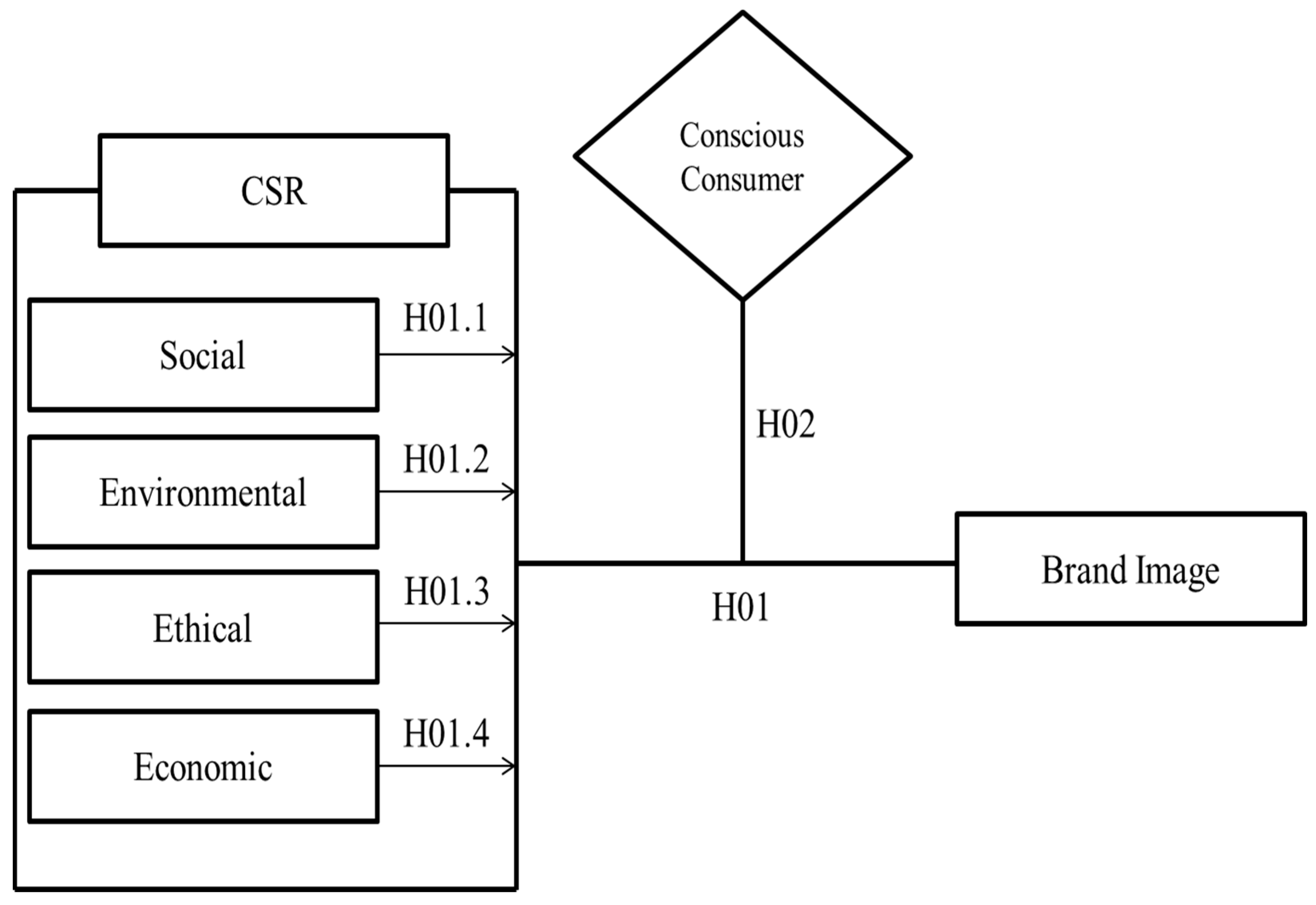
H01: There is no statistically significant impact of Corporate Social Responsibility (Economic, Ethical, Environmental, and Social) on the brand image at α ≤ 0.05.
The Social Factor and Brand Image
The majority, Jordan is a Muslim country, driven by a Muslim belief system, which means it maintains its valuable set of principles from Muslim teachings and Arabic traditions. What is considered appropriate in other countries may not necessarily be considered so in another country. Recently, Western countries have been attempting to enforce their set of social values and norms on developing countries [29]. However, culture is a crucial variable affected by the environment to which it belongs; it helps us understand how businesses prosper throughout different cultures. Complicated networks of social interactions between family connections can impact entrepreneurship [30]. The existence of ten different cultural groups, each owning a unique set of values, norms, and a belief system of its own. They further argue the lack of a universally shared social system. This conveys that social beliefs around the world are not the same and each culture has a unique set of values and norms that govern how society members act; Jordan has a unique set of values as well which govern how members of the society act. Companies in Jordan adhere to these norms and traditions; they run their businesses according to what is socially acceptable and if they choose to go against societal norms, they will be facing rejection from the community [31]. CSR was conceptualized by Bowen as an obligation to society, one that requires organizations to abide by management protocols conforming to societal values [12]. When discussing the concept of CSR, it is crucial to note that it refers to the aspect that deals with concerns regarding how communities influence others whether they are internal or external parts of the organization in matters such as the problem of many individuals being unemployed, poverty-stricken societies, and diversity in organizations [32]. Conducting relations with stakeholders of different backgrounds including consumers and distributors of goods and services leads to building ties with society [33]. Social enterprises that focus on solving social or environmental problems while generating profits tend to have a positive impact on service quality and brand image [34]. Thus, the first sub-null hypothesis states that:
H01.1: There is no statistically significant impact of Social on the brand image at α ≤ 0.05.
The Environmental Factor and Brand Image
The United Nations has developed the 2030 Agenda for Sustainable Development to solve the challenges that are facing the globe. The environment is an aspect of concern, as there are initiatives toward clean water as well as sanitation, at the same time toward clean and affordable energy, climate, underwater life, and on-land life. By 2022, 193 countries joined the mission of sustainable development. Hence, many countries have enforced different regulations in different industries to meet the goals outlined in the agenda [35,36]. On the other spectrum, consumers are having more knowledge about environmental challenges and how an industry practice has an impact on the environment which would determine their purchasing intentions [37]. Country regulations and consumer knowledge about the challenges lead companies to adopt sustainable practices within their core business operations to create a competitive advantage and enhance their position and brand image in the market [38,39,40].
Different industries are adapting green practices within their core operation to convey the green image in the mind of their customers [38,40]. Green practices refer to any action that a company undertakes to reduce its negative effect on the environment. This includes practices such as recycling initiatives conducted by retailers and fast-food restaurant chains, the eco-friendly lighting system in corporations as well as restaurants, and many more. While the green image is the range of perceptions of the brand in the consumers’ mindset related to the environment and environmental issues [38].
In some industries, the perception of green practices and their influence on the brand image can vary depending on the green practice type as well as the segment it targets. The café/restaurant industry can adopt green practices in terms of food quality and other practices focused on the environment. However, it has been found that green practices related to food such as serving organic food, and low-sugar recipes were more valued in upscale restaurants. While the casual dinners valued environment-related practices more than the practices related to food [39]. Green supply chain practices affect the competitive advantage of the Jordanian Pharmaceutical Manufacturing Industry [41]. This indicates that companies need to understand the type of green practices to adapt to enhance their brand image in the market, as different segments react positively to a certain type of practice compared to others.
Customers' awareness regarding environmental issues plays a significant role in the influence of green practices on the company's brand image. Consumers who are aware of environmental issues tend to react positively, hence green practices would have a positive impact on brand image, while customers who don’t view environmental issues as important might be indifferent toward green practices, hence the green practices won’t have an impact on the brand image [38]. Hence, the second sub-hypothesis indicates the following:
H01.2: There is no statistically significant impact of the Environmental on the brand image at α ≤ 0.05.
Ethics Factor and Brand Image
When studying the concept of CSR, ethics must be included in the discussion [42]. Ethics can be viewed as basic manners that affect and/or control individuals’ behavior or a system of moral rules that dominate behavior [43]. CSR maintained an integral role in the practices of ethically responsible businesses for a long time; it functions in the process of acting responsibly in the face of a broad variety of stakeholders rather than only shareholders [44]. The term ethics is connected to business and originated in the 1970s. Over time, an approach to business ethics comprised two branches: the philosophical branch, which was prescriptive, and the empirical one, which was descriptive, and the two somewhat merged. The latter was established from actual social issues of administration and CSR in business approaches. While the former is derived from departments of philosophy and focuses on the field of ethics, put into application. A developed approach to business ethics now considers six varying concerns in the ethical business field. The level of the individual is the first one. It considers the individual’s ability to manage challenging situations of ethical nature, improving one’s personality and personal growth at work, familiarizing oneself with work morals, as well as combining ethics learned at the job with ones that need to be practiced outside the business world, namely as a member of a family and society. The second deals with the level of the firm, which involves the inner business structure and how they contribute to the promotion of morality among workers and the business itself. The third deals with certain industries; each industry poses moral problems of its own, which cannot be resolved on any level but the industrial one. The following is the national level, and it includes legal problems, preventive rules against child labor, and protective measures for employees as well as consumers. Then, at the international level, dealing with ethical issues brought up by corporations on a global level. Last, of all, the global level manages the moral accountability of big companies to provide their help in resolving global problems. One example of this is global warming; such issues can be addressed on a universal level, and countries, as well as businesses, hold accountability for them [45]. Companies must hire managers who strongly value ethics; they will incorporate morality as a rule for every component of the business and make sure of the application of the company’s views. Moreover, some characteristics form a good manager, such as a strong personality, the impulse to act ethically and take charge of matters, consideration for stakeholders’ concerns, implementation of the business’s moral values, transparency and active role in making decisions, and comprehensive perspective of the business’s culture [46]. Conducting businesses ethically has a positive impact on brand equity as brand image improves the relationship between both variables [47,48]. Hence, the sub-null hypothesis states that:
H01.3: There is no statistically significant impact of Ethical ethics on the brand image at α ≤ 0.05.
Economic Factors and Brand Image
The economic dimension of CSR is the base of Caroll’s CSR pyramid. Any firm that looks forward to achieving other dimensions of CSR, it needs first to fulfill the economic need. The firm can fulfill its economic need by being profitable while delivering its product/service [49]. The firm then provides shareholders with adequate returns, pays their employees fair wages, as well as sourcing the right materials to meet customer demands and requirements [50]. Once a company can achieve those objectives, it can expand to include other CSR activities that require capital such as philanthropy.
There are limited studies regarding the impact of the economic dimension of CSR and brand image. A study in the hotel industry excluded the economic dimension of CSR in studying the correlation between CSR and brand image as well as loyalty. This is due to customer perception that the economic dimension is crucial for a firm existence and can conflict with other dimensions such as the environment and social [51]. However, another study conducted in the gaming industry had a different finding. The study found that the economic dimension of CSR positively influenced the corporate brand image, while the legal did not affect the company brand image [50]. Hence, the sub-hypothesis indicates the following:
H01.4: There is no statistically significant impact of Economics on the brand image at α ≤ 0.05.
Consumer Consciousness, CSR, and Brand Image
The current research paper aims to highlight the importance of CSR and brand image in corporations’ practices. This is because awareness needs to be raised in certain aspects, such as going green for the environment. When people purchase products knowing well that they are eco-friendly, they are likely to develop brand loyalty later on because of the organization’s sense of responsibility towards not only society but nature as well. Conscious consumers demand authentic answers regarding companies’ practices as well as a sense of duty towards people and the planet that we live on [52]. Transparent companies that do not hide their background and ways of operating attract conscious consumers. Five factors drive consumer consciousness: “honesty, health and safety, relationships, convenience, and doing well. Health and safety motivate customers to look for organic products free of pesticides and chemicals and promote good quality. They stay away from modified products to sustain their health and make sure that nothing they consume could harm them or the planet. This factor could be attributed to the social aspect of CSR, as businesses need to look at the impact their products would have on their consumer’s health. While honesty refers to demanding companies to detail the features of their products and what benefits they provide to consumers, at the same time being mindful of the effect they have on society and the environment. The second factor could be attributed to social and environmental aspects of CSR, as it is concerned with companies being transparent regarding their impact socially and environmentally. Convenience is about consumers making decisions that save money; people require affordable offerings of quality that meet their needs and wants. Relationships are also a valuable factor for conscious consumers who want to integrate their favorite brands into their lives, being knowledgeable about the most trivial details of the brand. Questions regarding the source of the product and its manufacturer are always likely to come up. The last factor is related to the ethical aspect of CSR, as ethical businesses should look at the ethics of their suppliers as well. Finally, doing well discusses the consumers’ need to do something good for the environment. They want to feel as if they made a change to the world by purchasing eco-friendly goods from responsible companies [52]. Since the factors that affect consumer consciousness and buying behavior are linked to the different dimensions of CSR, and as discussed earlier in the brand image section, CSR influences brand image. This means that consumer consciousness can play a moderating role in the correlation between CSR and brand image; thus, the second null hypothesis is as follows:
H02: Conscious consumers do not moderate the impact of corporate social responsibility (Economic, Ethical, Environmental, and Social) on the brand image at α ≤ 0.05.
The Model
Although philanthropy is considered an important component in CSR, businesses should focus on other categories to drive business success. However, this research will focus on the categories identified in the CSR 2.0 double helix model that focuses on Economic Development, Ethical conduct, Society, and the Environment [49].
Figure 1.
Study Model.
3. Methodology
Research Design
A quantitative, descriptive, and cause-effect approach is used in the study to generate numerical results, which can be used to test the hypotheses developed. An online survey (questionnaire) was developed as the research instrument to collect the data to be used in understanding the relationship between CSR and brand image and how consumer consciousness would moderate the relationship. A convenience cross-sectional sampling was used, and the survey was distributed through different social media platforms such as Instagram and Facebook. All participants were asked if they would like to answer the questionnaire voluntarily. Furthermore, participants were notified in the survey introduction that their identities are entirely anonymous to ensure information confidentiality.
The survey included five segments. The first segment was devoted to demographic dimensions; the second and third segments addressed the independent variables; the fourth segment addressed the dependent variable; finally, the fifth segment addressed the moderating variable. To ensure language is not a barrier to filling out the survey, each question and its answers were translated into Arabic. Demographic dimensions included respondents' gender, respondents’ age, and respondents’ educational level. To measure the independent variable, 12 items were divided into four sets to cover the four independent sub-variables in this study. Three items measured each CSR sub-variable. In addition, brand image was measured using three items. Lastly, consumer consciousness, the moderating variable, was measured by six items. The researchers adopted a Likert scale for all statements in the survey other than the demographic section. The Likert scale consists of five points, with scores ranging from 1-5. 1 is used for Strongly Disagree, 2 for Disagree, 3 for Neutral, 4 for Agree, and 5 for Strongly Agree.
The target audience of the study includes all people living in Jordan above the age of 18 years old. The study included all nationalities residing in Jordan and excluded Jordanian nationals living abroad. To ensure participants' eligibility to fill out the online survey, participants were required to answer the filtering question, "Do you live in Jordan?” If the participants answered "Yes," then they would be allowed to complete the survey, while respondents who answered "No" could not proceed to the following sections of the survey. Out of 455 respondents, 440 answered the filtering question with "Yes." A total of 440 respondents who filled out the questionnaire were used for the analysis.
4. Data Analysis and Results
Authors should discuss the results and how they can be interpreted from the perspective of previous studies and the working hypotheses. The findings and their implications should be discussed in the broadest context possible. Future research directions may also be highlighted.
Demographics
In the demographic section of the questionnaire, participants were required to specify their gender, age, and earned academic degree. Table 1 indicates that 440 individuals responded to the survey; 250 (56.8%) of them are males, and 190 (43.2%) are females, meaning that the number of males outweighed that of females. As for age, the respondents’ majority are above the age of thirty years old, precisely 309 (70.2%) respondents. Other age groups constructed 131(nearly 30%) of the total participants in the survey. Finally, individuals holding a bachelor’s degree accounted for the highest percentage of respondents, which was equivalent to 243 (55.2%) of respondents.
Validity:
Principal Component Analysis with Kaiser-Meyer-Olkin (KMO) measure has been used to test the validity of constructs. Some previous studies stated that factor loading more than 0.40 is accepted, while other studies indicated that factor loading more than 0.50 is accepted, anyway table 2 shows that factor loading for all constructs and items is more than 0.50 [53,54,55]. KMO indicates the sampling adequacy, homogeneity, harmony, and inter-relationships among items KMO between 0.80 to 1 shows high inter-correlation, between 0.60 to 0.80 shows medium inter-correlation, and above 0.60 is accepted [54,56,57,58]. Table 2 indicates that all KMO values are accepted, where the lowest value for Brand Image is 0.598 about 0.60. Chi2 values support these results. The variance shows the explanation power of the items, some previous studies said that a variance value above 0.50 is accepted while others said that 0.40 is accepted [54,57,58], anyway, all constructs show variance values above 0.50, except Consciousness shows 42.317. Finally, the significance of Bartlett's Test of Sphericity at 0.05 (95% confidence) shows that using factor analysis is suitable [53,57].
Reliability
To test the accuracy and reliability of the internal consistency of this survey, the researchers used Cronbach’s Alpha coefficients. Cronbach’s Alpha is among the most used instruments to measure reliability [59]. It is crucial to detail the outcome of gauging Cronbach’s Alpha when applying Likert Scale questions in surveys [60]. Reliability illustrates the extent to which a questionnaire, for example, will generate consistent outcomes in different situations, if we do not change anything else (Roberts and Priest, 2006). Cronbach’s Alpha coefficient of more than 0.60 is accepted [53,54]. Table 2 shows that all values exceed the threshold of 0.6.
Descriptive Statistics
Descriptive statistics describe the attributes of a specific sample [61] and characterize how variables are related in the sample [62]. The researchers used standard deviations and mean for this paper. Means is a measurement of the location while standard deviation is a measurement of the dispersion in data concerning the mean [63]. Table 2 demonstrates that all means and standard deviation show that the respondents agree on medium to high implementation of all items and constructs.
Relationships among Variables and Sub-Variables:
The Pearson correlation (the square root of their variances) is the most widely used to measure the relationship between two quantitative constructs, it measures the strength of the linear relationship between two variables [64,65,66]. Table 3 indicates that the relationships among CSR sub-variables are strong, where r between 0.621 and 0.817, and the relationships between each CSR sub-variable and brand image are medium rated between 0.435 and 0.635, and the relationships between each CSR sub-variable and consciousness is medium rated between 0.506 and 0.594. Moreover, the relationship between CSR and brand image is medium where r equals 0.616 and with consciousness is medium rated 0.626. Finally, the relationship between brand image and consciousness is medium, where r equals 0.619.
Hypotheses Testing:
Before using regression the following assumptions should be not violated Validity, Reliability, Relationships between Variables, Normality, Linearity, Heteroscedasticity, and Multi-Collinearity [67,68,69,70].
Normality: Figure 2 shows that the data is normally distributed, so the normality assumption is not violated.
Linearity: Figure 3 shows that there is a linear relationship between variables, then the linearity assumption is ensured.
Heteroscedasticity Test: Figure 4 indicates that there is an equality of variance and errors are not related to each other, hence Heteroscedasticity assumption is confirmed.
Multi-Collinearity Test: Table 4 suggests that tolerance values are more than 10% and the VIF is less than 10, the independent variables are not highly correlated to each other, therefore Multi-Collinearity assumption is not violated.
Regressions
H01: There is no statistically significant impact of Corporate Social Responsibility (Economic, Ethical, Environmental, and Social) on the brand image at α ≤ 0.05.
When regressing CSR sub-variables against the brand image, model 1 in Table 5 shows that the relationship between them is 66.3% and the CSR explains 44.0% of the brand image variation, where R2=0.440, f=85.446, sig.=0.000. Therefore, the null hypothesis is ignored and the opposite hypothesis is confirmed which suggests that there is a statistically significant impact of CSR (Economic, Ethical, Environmental, and Social) on the brand image at α ≤ 0.05.
H01.1: There is no statistically significant impact of Social on the brand image at α ≤ 0.05.
The first model in Table 6 suggests that social responsibility positively affects the brand image, where β=0.353, t=5.073, sig.0.000, so the null hypothesis is denied and the opposite hypothesis is confirmed which suggests that there is a positive significant impact of social on the brand image at α ≤ 0.05.
H01.2: There is no statistically significant impact of the Environmental on the brand image at α ≤ 0.05.
The first model in Table 6 suggests that environmental responsibility negatively affects the brand image, where β=-0.187, t=-2.931, sig.0.004, so the null hypothesis is denied and the opposite hypothesis is confirmed which suggests that there is a negative significant impact of environmental responsibility on the brand image at α ≤ 0.05.
H01.3: There is no statistically significant impact of Ethical ethics on the brand image at α ≤ 0.05.
The first model in Table 6 suggests that ethical responsibility positively affects the brand image, where β=0.332, t=4.126, sig.0.000, so the null hypothesis is denied and the opposite hypothesis is confirmed which suggests that there is a positive significant impact of ethical responsibility on the brand image at α ≤ 0.05.
H01.4: There is no statistically significant impact of Economics on the brand image at α ≤ 0.05.
The first model in Table 6 suggests that economic responsibility positively affects the brand image, where β=0.187, t=3.452, sig.0.001, so the null hypothesis is denied and the opposite hypothesis is confirmed which suggests that there is a positive significant impact of economic responsibility on the brand image at α ≤ 0.05.
H02: Conscious consumers do not moderate the impact of corporate social responsibility (Economic, Ethical, Environmental, and Social) on the brand image at α ≤ 0.05.
Moreover, model 2 in Table 5 shows that consciousness moderates the effect of CSR on the brand image so CSR explains 51.3% of brand image variation, where R2=0.513, f=91.602, sig.=0.000. R2 has been increased from 0.440 to 0.513 i.e. 0.073 about 7.3%. Table 6 Model 2 shows the details of the consciousness moderation effect on each CSR sub-variable. Therefore, the null hypothesis is ignored and the opposite is accepted, which confirms that conscious consumers moderate the impact of CSR (Economic, Ethical, Environmental, and Social) on the brand image at α ≤ 0.05.
5. Discussion
Results demonstrate that the Jordanian Apparel Industry is moderately to high implementation of all items and constructs of CSR. Moreover, there are strong relationships among CSR sub-variables are strong, with a medium relationship between each CSR sub-variable and brand image, a medium relationship between each CSR sub-variable and consciousness, a medium relationship between CSR and brand image, a medium relationship with consciousness, and the medium relationship between brand image and consciousness is medium.
The result shows that there is a positive significant impact of CSR (Economic, Ethical, Environmental, and Social) on the brand image at α ≤ 0.05. This result is matching with previous studies such as organizations with higher brand equity having a higher financial position [23]. Brand image affects most target markets [24]. The brand is a valuable asset that affects purchase decisions [25]. Consumers relate the brand to their experience or other people's experience [26]. CSR improves the reputation, which affects the brand image and customers' purchases [27]. CSR encourages consumers to think positively about the brand, which creates a positive brand image [28].
The results show that there is a positive significant impact of social on the brand image at α ≤ 0.05. Cultural and social interactions between family impact entrepreneurship [30]. This conveys that social beliefs, norms, and traditions affect reputation [31]. Concern about society, which is a part of CSR, is important to organizations [12]. The concept of CSR includes social responsibility related to unemployment, poverty, and diversity in organizations [32]. Good relations with stakeholders affect organizations and brand image [33]. Social organizations concerned about social or environmental problems generate more profit and have a positive impact on service quality and brand image [34].
The results suggest that there is a positive significant impact of ethical responsibility on the brand image at α ≤ 0.05. This result is going online with previous studies which indicate that ethics should be considered within organizations' practices [42]. Ethics control individuals’ behaviors [43]. Ethics is an integral part of CSR [44]. The developed models of CSR include ethical business behavior and morality among workers and the business itself. It also includes legal problems, child labor, employees as well as consumers. This affects international business at the global level [45]. organizations should select managers who value ethics and implement the business’s moral values, transparency, and business’s culture when making decisions [46]. Ethical business performance positively affects brand equity and brand image [47,48].
The results suggest that there is a positive significant impact of economic responsibility on the brand image at α ≤ 0.05, this result has been proved by previous literature such as organizations having to fulfill their economic need for society as well as for the organizations [49]. They should consider the economic benefits of all shareholders i.e. owners, employees, customers, and society [50]. The economic dimension is very important for an organization’s existence [51]. The economic dimension of CSR positively affects the corporate brand image [50]
An unexpected result shows that there is a negative significant impact of environmental responsibility on the brand image at α ≤ 0.05. The result is contradicting previous studies' results such as the United Nations enforcing different regulations that concern environmental protection [35,36]. Consumers are having more knowledge about environmental challenges and how organization practice, which affect their purchasing intentions [37]. The right dealing with environmental challenges creates a competitive advantage and enhances brand image [38,39,40]. Green practices in operations convey the green image, which affects the mind of customers [38,40]. Green practices mean reducing the negative effect on the environment, which creates a green image and affects the perception of customers about the brand image [38]. The perception of green practices influences the brand image [39]. Customers' awareness regarding environmental issues plays a significant role in the influence of green practices on the company's brand image [38]. This may be related to the industry for example, in Jordanian Pharmaceuticals manufacturing organizations all CSR components affect organizational business performance, and environmental responsibility was having the highest effect, followed by economic responsibility, and then social responsibility [10]. Ethical responsibility and environmental responsibility affect customer engagement and purchase intentions, while philanthropic responsibility and economic responsibility have an insignificant effect on customer engagement and purchase intentions [22].
Finally, the results confirm that conscious consumers moderate the impact of CSR (Economic, Ethical, Environmental, and Social) on the brand image at α ≤ 0.05. Customer awareness about green challenges is increasing, especially related to the green environment and eco-friendly practices, which affect brand loyalty [52]. Transparency influences the customers’ consciousness. Customers are concerned about their health. Honest and transparent organizations provide details about their product features and their effect on society and the environment. This affects consumers’ decision-making. Customers’ consciousness influences brand image. Also, the ethical aspect of CSR should be considered in business practices, which affects purchasing eco-friendly products [52]. Finally, customers' awareness of green practices positively influences brand image [38].
6. Conclusions
This study aims to understand the relationship between CSR and brand image and how consumer consciousness would moderate the relationship. This study uses a quantitative, descriptive, cause-effect, and cross-sectional approach, Conducted online to a convenience sample. It includes Jordanian participants who are more than 18 years old. Out of 455 respondents, 440 questionnaires were suitable for further analysis. The independent variable CSR was measured by 12 items. which were divided into four sets (social, economic, environmental, and ethical responsibilities), each set includes 3 items, the brand image is used as a dependent variable and was measured by three items, and consumer consciousness, as a moderating variable, was measured by six items. The majority of respondents are males, thirty years old, and holding a bachelor’s degree.
Results demonstrate that the Jordanian Apparel Industry is moderately to high implementation of all items and constructs of CSR. Moreover, there are strong relationships among CSR sub-variables, a medium relationship between each CSR sub-variable and brand image, a medium relationship between each CSR sub-variable and consciousness, a medium relationship between CSR and brand image, a medium relationship with consciousness, and the medium relationship between brand image and consciousness. Results of the first model show that CSR (Economic, Ethical, Environmental, Social) affects the brand image. Where social responsibility has the highest positive effect, followed by ethical responsibility, then economic responsibility, however, environmental responsibility negatively affects the brand image. The second model shows consciousness moderates the effect of CSR on the brand. The negative significant effect of environmental responsibility may be related to the apparel industry in Jordan, which is not concerned too much about the environment because they believe that this industry does not use operations that affect the environment like other manufacturing industries. For example, in Jordanian Pharmaceuticals manufacturing organizations environmental responsibility was having the highest effect among CSR components on competitive advantage [10]. Ethical responsibility and environmental responsibility influence customer engagement and purchase intentions, while philanthropic responsibility and economic responsibility have an insignificant impact on customer engagement and purchase intentions [22].
Limitations, Recommendations, and Future Studies: Since the current research was conducted on Apparel Industry in Jordan, therefore, it has many limitations related to the generalizability of the results, especially the negative effect of environmental responsibility on the brand image even in the presence of consciousness. Therefore, there is a need for longitudinal research on the Jordanian Apparel industry, as well as the need to test the effect of CSR on other Jordanian industries. In addition, there is a need to conduct studies related to the effect of CSR on the same industry in other countries, especially in Arab Countries because they are similar in social and cultural aspects, and then compare the results with Western countries.
Theoretical Implications: The study uses the four dimensions of CSR, which were developed by several authors, and shows the importance of these dimensions for daily business practices, while many previous studies used only three dimensions social, economic, and environmental responsibilities. The current study also uses customers’ consciousness as a moderation variable, which improves the effect of CSR on brand image. The results show that other dimensions may be added to the model based on the industry such as considering local culture and industry norms.
Practical Implications: Owners and managers of organizations have to apply all CSR within their daily business practices, which affects the reputation and image of the organization and its brands. The Apparel industry organizations in Jordan should revise their daily practices to include environmental responsibility and/or increase their customers’ awareness of their practices and be more transparent in disclosing information regarding CSR dimensions, which affect brand image. Moreover, CSR dimensions have to be included within their strategy, and daily practices, as well as, training about CSR should be continuously conducted.
Social Contribution: The current research theoretically contributes to existing studies by adding a new research paper regarding the effect of CSR dimensions on brand image and using consciousness as a moderating variable. Practically it increases the awareness of owners, managers, and customers regarding the importance of CSR dimensions to increase organizations' social and economic contributions, as well as protect the environment from any not eco-friendly activities.
Research Originality: The current research is one of the few studies, which investigates the effect of CSR dimensions on brand image, and it may be the first research that uses consciousness as a moderation variable of the effect of CSR on brand image in the Apparel industry in Jordan.
Author Contributions
For research articles with several authors, a short paragraph specifying their individual contributions must be provided. The following statements should be used “Conceptualization, Shafig Haddad, Razan Abu Naba, and Diana Hijazat.; methodology, Abdel-Aziz Ahmad Sharabati and Shafig Haddad, software, Abdel-Aziz Ahmad Sharabati; validation, Shafig Haddad and Ali Abdallah Alalwan; formal analysis, Abdel-Aziz Ahmad Sharabati; investigation, Razan Abu Naba, Diana Hijazat; resources, Shafig Haddad.; data curation Abdel-Aziz Ahmad Sharabati; writing—original draft preparation, Razan Abu Naba, Diana Hijazat; writing—review and editing, Shafig Haddad and Ali Abdallah Alalwan.; visualization, Ali Abdallah Alalwan; supervision, Shafig Haddad; project administration, Shafig Haddad; funding acquisition, Abdel-Aziz Ahmad Sharabati. All authors have read and agreed to the published version of the manuscript. Authorship must be limited to those who have contributed substantially to the work reported.
Acknowledgments
Thanks to Middle East University for its continuous support.
Conflicts of Interest
The authors declare no conflict of interest.
References
- Moratis, L. Standardizing a Better World? Essays and Critical Reflections on the ISO 26000 Standard for Corporate Social Responsibility. Doctoral Thesis, Open Universiteit, 2015. [Google Scholar]
- Carroll, A.B. A History of Corporate Social Responsibility: Concepts and Practices. 2009; ISBN 9780191576997. [Google Scholar]
- Jamali, D. CSR in Developing Countries Through an Institutional Lens. Corp. Soc. Responsib. Sustain. Emerg. Trends Dev. Econ. 2014, Online, 22–44. [Google Scholar] [CrossRef]
- Hung Chen, C. The Major Components of Corporate Social Responsibility. J. Glob. Responsib. 2011, 2, 85–99. [Google Scholar] [CrossRef]
- Thorisdottir, T.S.; Johannsdottir, L. Corporate Social Responsibility Influencing Sustainability within the Fashion Industry. A Systematic Review. Sustain. 2020, 12, 1–64. [Google Scholar] [CrossRef]
- Ahmad, A.M.K.; Alsharqi, O.Z.; Al-Borie, H.M.; Ashoor, M.M.; Al-Orige, A.S. Corporate Social Responsibility and Brand Image: An Empirical Investigation of Private Sector Hospitals in Saudi Arabia. Int. Bus. Res. 2016, 9, 91–97. [Google Scholar] [CrossRef]
- Windsor, D. The Future of Corporate Social Responsibility. Int. J. Organ. Anal. 2001, 9, 225–256. [Google Scholar] [CrossRef]
- Asiaei, K.; O’Connor, N.G.; Moghaddam, M.; Bontis, N.; Sidhu, J. Corporate Social Responsibility and Performance Measurement Systems in Iran: A Levers of Control Perspective. Corp. Soc. Responsib. Environ. Manag. 2023, 30, 574–588. [Google Scholar] [CrossRef]
- Dahlsrud, A. How Corporate Social Responsibility Is Defined: An Analysis of 37 Definitions. Corp. Soc. Responsib. Environ. Manag. 2008, 15, 1–13. [Google Scholar] [CrossRef]
- Sharabati, A.A. Effect of Corporate Social Responsibility on Jordan Pharmaceutical Industry’s Business Performance. Soc. Responsib. J. 2018, 14, 566–583. [Google Scholar] [CrossRef]
- Wan-Jan, W.S. Defining Corporate Social Responsibility. J. Public Aff. 2006, 6, 176–184. [Google Scholar] [CrossRef]
- Frizon, J.A.; Eugénio, T.; Falcão, A.S. Is It Worthwhile for Organizations To Have Socially Responsible Management Practices? Rev. Adm. Empres. 2022, 62, 1–21. [Google Scholar] [CrossRef]
- Guzmán, F.; Davis, D. The Impact of Corporate Social Responsibility on Brand Equity: Consumer Responses to Two Types of Fit. J. Prod. Brand Manag. 2017, 26, 435–446. [Google Scholar] [CrossRef]
- Davidson, D.K.; Tanimoto, K.; Jun, L.G.; Taneja, S.; Taneja, P.K.; Yin, J. Corporate Social Responsibility across Asia: A Review of Four Countries. Corporate Social Responsibility 2018, 360, 73–132. [Google Scholar]
- Tuan, L.T. Corporate Social Responsibility, Leadership, and Brand Equity in Healthcare Service. Soc. Responsib. J. 2012, 8, 347–362. [Google Scholar] [CrossRef]
- Department of Statistics Unemployment Report - Q2. 2022. Available online: http://dos.gov.jo/dos_home_e/main/archive/Unemp/2022/Emp_Q2_2022.pdf.
- European Commission European Civil Protection and Humanitarian Aid Operations: Jordan Factsheet. Available online: https://civil-protection-humanitarian-aid.ec.europa.eu/where/middle-east/jordan_en.
- Irshaid, Y.A.A. Consequences of the Israeli Hydro-Hegemony on the Jordanian Water Security. Rev. Econ. Polit. Sci. 2021, 6, 252–273. [Google Scholar] [CrossRef]
- Solability The Sustainable Competitiveness Index 2022. Available online: https://solability.com/the-global-sustainable-competitiveness-index/the-index.
- Mako, W.P. Privatization: Lessons from Jordan. World Bank MENA Knowl. Learn. 2012, 1–4. [Google Scholar]
- Joudeh, A.H.M.; Almubaideen, H.I.M.; Alroud, S.F. Environmental Disclosure in the Annual Reports of the Jordanian Mining and Extraction Companies. J. Econ. Financ. Account. 2018, 5, 18–25. [Google Scholar] [CrossRef]
- Al-Haddad, S.; Sharabati, A.-A.A.; Al-Khasawneh, M.; Maraqa, R.; Hashem, R. The Influence of Corporate Social Responsibility on Consumer Purchase Intention: The Mediating Role of Consumer Engagement via Social Media. Sustain. 2022, 14, 1–17. [Google Scholar] [CrossRef]
- R. K. Srivastava The Role of Brand Equity on Mergers and Acquisition in the Pharmaceutical Industry. J. Strateg. Manag. 2012, 5, 266–283. [Google Scholar] [CrossRef]
- Powell, B.; Zwolinski, M. The Ethical and Economic Case Against Sweatshop Labor: A Critical Assessment. J. Bus. Ethics 2012, 107, 449–472. [Google Scholar] [CrossRef]
- Sasmita, J.; Mohd Suki, N. Young Consumers’ Insights on Brand Equity. Int. J. Retail Distrib. Manag. 2015, 43, 276–292. [Google Scholar] [CrossRef]
- Littler, D. Brand Image. Wiley Encycl. Manag. 2015, 1–1. [Google Scholar]
- Kaur, M.; Agrawal, S. Corporate Social Responsibility: A Tool to Create a Positive Brand Image. ASBBS Annu. Conf. 2011, 18, 681–688. [Google Scholar]
- Naqvi, S.M.M.R.; Ishtiaq, M.; Kanwal, N.; Ali, M.; Inderyas, S. Impact of Corporate Social Responsibility on Brand Image in Different FMCGs of Pakistan. Interdiscip. J. Contemp. Res. Bus. 2013, 5, 79–93. [Google Scholar]
- Abdulrazak, S.R.; Ahmad, F. The Basis for Corporate Social Responsibility in Malaysia. Glob. Bus. Manag. Res. An Int. J. 2014, 6, 210–218. [Google Scholar]
- Pistrui, D.; Fahed-Sreih, J. Islam, Entrepreneurship and Business Values in the Middle East. Int. J. Entrep. Innov. Manag. 2010, 12, 107–118. [Google Scholar] [CrossRef]
- Abdulrazak, S.R.; Ahmad, F.S. Sustainable Development: A Malaysian Perspective. Procedia - Soc. Behav. Sci. 2014, 164, 237–241. [Google Scholar] [CrossRef]
- Madime, E.; Gonçalves, T.C. DETERMINING FACTORS FOR SOCIAL AND ENVIRONMENTAL PRACTICES OF CORPORATE RESPONSIBILITY IN MOZAMBIQUE. Rev. Gest. Cocial E Amniental 2022, 16, 1–23. [Google Scholar] [CrossRef]
- Stuebs, M.; Sun, L. Corporate Governance and Social Responsibility. Int. J. Law Manag. 2015, 57, 38–52. [Google Scholar] [CrossRef]
- Lin, Y.H.; Lin, F.J.; Wang, K.H. The Effect of Social Mission on Service Quality and Brand Image. J. Bus. Res. 2021, 132, 744–752. [Google Scholar] [CrossRef]
- Carlsen, L.; Bruggemann, R. The 17 United Nations’ Sustainable Development Goals: A Status by 2020. Int. J. Sustain. Dev. World Ecol. 2022, 29, 219–229. [Google Scholar] [CrossRef]
- United Nations The 17 Goals. Available online: https://sdgs.un.org/goals.
- Huang, Y.C.; Yang, M.; Wang, Y.C. Effects of Green Brand on Green Purchase Intention. Mark. Intell. Plan. 2014, 32, 250–268. [Google Scholar] [CrossRef]
- Jeong, E.H.; Jang, S.C.; Day, J.; Ha, S. The Impact of Eco-Friendly Practices on Green Image and Customer Attitudes: An Investigation in a Café Setting. Int. J. Hosp. Manag. 2014, 41, 10–20. [Google Scholar] [CrossRef]
- Namkung, Y.; Jang, S.C.S. Effects of Restaurant Green Practices on Brand Equity Formation: Do Green Practices Really Matter? Int. J. Hosp. Manag. 2013, 33, 85–95. [Google Scholar] [CrossRef]
- Namkung, Y.; Jang, S. (Shawn) Are Consumers Willing to Pay More for Green Practices at Restaurants? J. Hosp. Tour. Res. 2014, XX, 1–28. [Google Scholar] [CrossRef]
- Sharabati, A.A.A. Green Supply Chain Management and Competitive Advantage of Jordanian Pharmaceutical Industry. Sustainability 2021, 13, 1–17. [Google Scholar] [CrossRef]
- Torelli, R. Sustainability, Responsibility, and Ethics: Different Concepts for a Single Path. Soc. Responsib. J. 2020, 17, 719–739. [Google Scholar] [CrossRef]
- OED Oxford English Dictionary; Oxford University Press, 2023.
- Goel, M.; Ramanathan, M.P.E. Business Ethics and Corporate Social Responsibility – Is There a Dividing Line? Procedia Econ. Financ. 2014, 11, 49–59. [Google Scholar] [CrossRef]
- De George, R.T. 2005.
- Rashid, M.M. Corporate Social Responsibility (CSR): Evaluating/Auditing Corporate Social Responsibility (CSR) Practices. J. Econ. Soc. Thought 2022, 8, 141–156. [Google Scholar]
- Iglesias, O.; Markovic, S.; Singh, J.J.; Sierra, V. Do Customer Perceptions of Corporate Services Brand Ethicality Improve Brand Equity? Considering the Roles of Brand Heritage, Brand Image, and Recognition Benefits. J. Bus. Ethics 2019, 154, 441–459. [Google Scholar] [CrossRef]
- Sierra, V.; Iglesias, O.; Markovic, S.; Singh, J.J. Does Ethical Image Build Equity in Corporate Services Brands? The Influence of Customer Perceived Ethicality on Affect, Perceived Quality, and Equity. J. Bus. Ethics 2017, 144, 661–676. [Google Scholar] [CrossRef]
- Claydon, J. A New Direction for CSR: The Shortcomings of Previous CSR Models and the Rationale for a New Model. Soc. Responsib. J. 2011, 7, 405–420. [Google Scholar] [CrossRef]
- Kim, J. (Sunny); Song, H.J.; Lee, C.K.; Lee, J.Y. The Impact of Four CSR Dimensions on a Gaming Company’s Image and Customers’ Revisit Intentions. Int. J. Hosp. Manag. 2017, 61, 73–81. [Google Scholar] [CrossRef]
- Martínez, P.; Pérez, A.; del Bosque, I.R. CSR Influence on Hotel Brand Image and Loyalty. Acad. Rev. Latinoam. Adm. 2014, 27, 267–283. [Google Scholar] [CrossRef]
- Bemporad, R.; Baranowski, M. Conscious Consumers Are Changing the Rules of Marketing. Are You Ready? Highlights from the BBMG Conscious Consumer Report; 2007.
- Hair Jr, J.F.; Sarstedt, M.; Ringle, C.M.; Gudergan, S.P. Advanced Issues in Partial Least Squares Structural Equation Modeling.; Sage Publications Ltd. 2018. [Google Scholar]
- Sharabati, A.-A.A.; Al-Atrash, S.A.; Dalbah, I.Y. The Use of Supply Chain Control-Tower in Pharmaceutical Industry to Create a Competitive Advantage. Int. J. Pharm. Healthc. Mark. 2022, 16, 354–375. [Google Scholar] [CrossRef]
- Sekaran, U.; Bougie, R. Research Methods For Business: A Skill-Building Approach; John Willey: UK, 2016; ISBN 9781119942252. [Google Scholar]
- Stephanie Glen Kaiser-Meyer-Olkin (KMO) Test for Sampling Adequacy. Available online: statisticshowto.com.
- Cerny, B.A.; Kaiser, H.F. A Study of a Measure of Sampling Adequacy for Factor-Analytic Correlation Matrices. Multivariate Behav. Res. 1977, 12, 43–47. [Google Scholar] [CrossRef]
- Kaiser, H.F.; Rice, J.; Little, J.; Mark, I. Educational and Psychological Measurement. Am. Psychol. Assoc. 1974, 34, 111–117. [Google Scholar] [CrossRef]
- Bonett, D.; Wright, T. Determinación Del Tamaño de Muestra Para La Correlación Múltiple: Respuesta a Shieh (2013). Psicothema 2014, 26, 391–394. [Google Scholar] [CrossRef]
- Gliem, J.A.; Gliem, R.R. Calculating, Interpreting, and Reporting Cronbach’s Alpha Reliability Coefficient for Likert-Type Scales. In Proceedings of the 2003 Midwest Research to Practice Conference in Adult; 1992; pp. 82–88. [Google Scholar]
- Fisher, M.J.; Marshall, A.P. Understanding Descriptive Statistics. Aust. Crit. Care 2009, 22, 93–97. [Google Scholar] [CrossRef]
- Kaur, P.; Stoltzfus, J.; Statistics. , V.Y. Descriptive Statistics. Int. J. Acad. Med. 2018, 4, 60–63. [Google Scholar] [CrossRef]
- Martinez, M.N.; Bartholomew, M.J. What Does It “Mean”? A Review of Interpreting and Calculating Different Types of Means and Standard Deviations. Pharmaceutics 2017, 9, 1–23. [Google Scholar] [CrossRef]
- Lee Rodgers, J.; Alan Nice Wander, W. Thirteen Ways to Look at the Correlation Coefficient. Am. Stat. 1988, 42, 59–66. [Google Scholar] [CrossRef]
- Kosorok, M.R. On Brownian Distance Covariance and High Dimensional Data. Ann. Appl. Stat. 2009, 3, 1266–1269. [Google Scholar] [CrossRef] [PubMed]
- Hair, J.F. Multivariate Data Analysis; Kennesaw State University, Ed.; 7th ed.; Kennesaw State University: Englewood Cliffs, NJ, 2009. ISBN 9780138132637.
- Brooks, C. Classical Linear Regression Model Assumptions and Diagnostic Tests. In Introductory Econometrics for Finance; Cambridge University Press, 2019; pp. 182–245.
- Casson, R.J.; Farmer, L.D.M. Understanding and Checking the Assumptions of Linear Regression: A Primer for Medical Researchers. Clin. Exp. Ophthalmol. 2014, 42, 590–596. [Google Scholar] [CrossRef] [PubMed]
- Poole, M.A.; O’Farrell, P.N. The Assumptions of the Linear Regression Model. Trans. Inst. Br. Geogr. 1971, 145. [Google Scholar] [CrossRef]
- Al-Marshadi, A.H. Collaboration of Statistical Methods in Selecting the Correct Multiple Linear Regressions. Am. J. Biostat. 2014, 4, 29–33. [Google Scholar] [CrossRef]
Figure 2.
Normality Test.
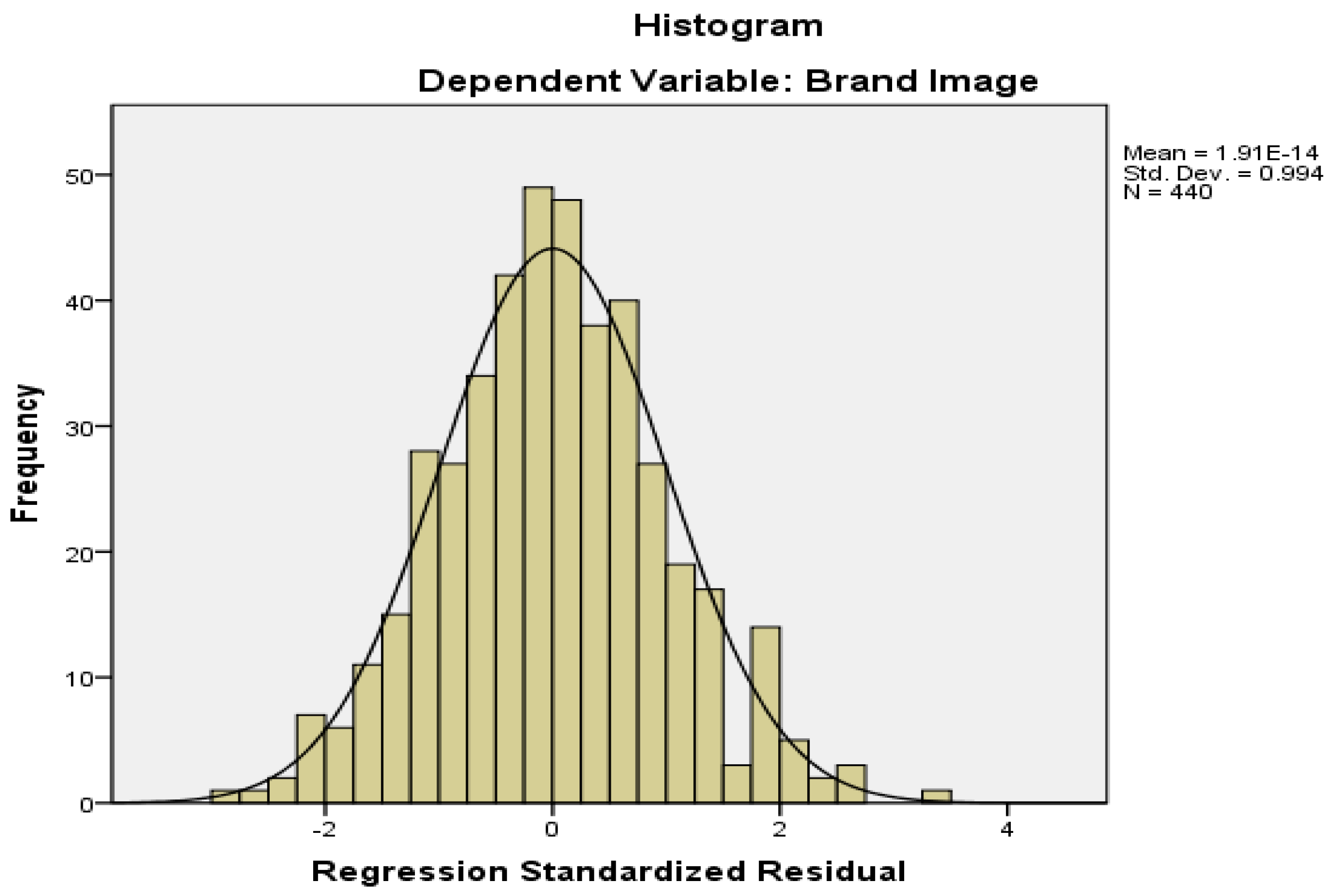
Figure 3.
Linearity Test.
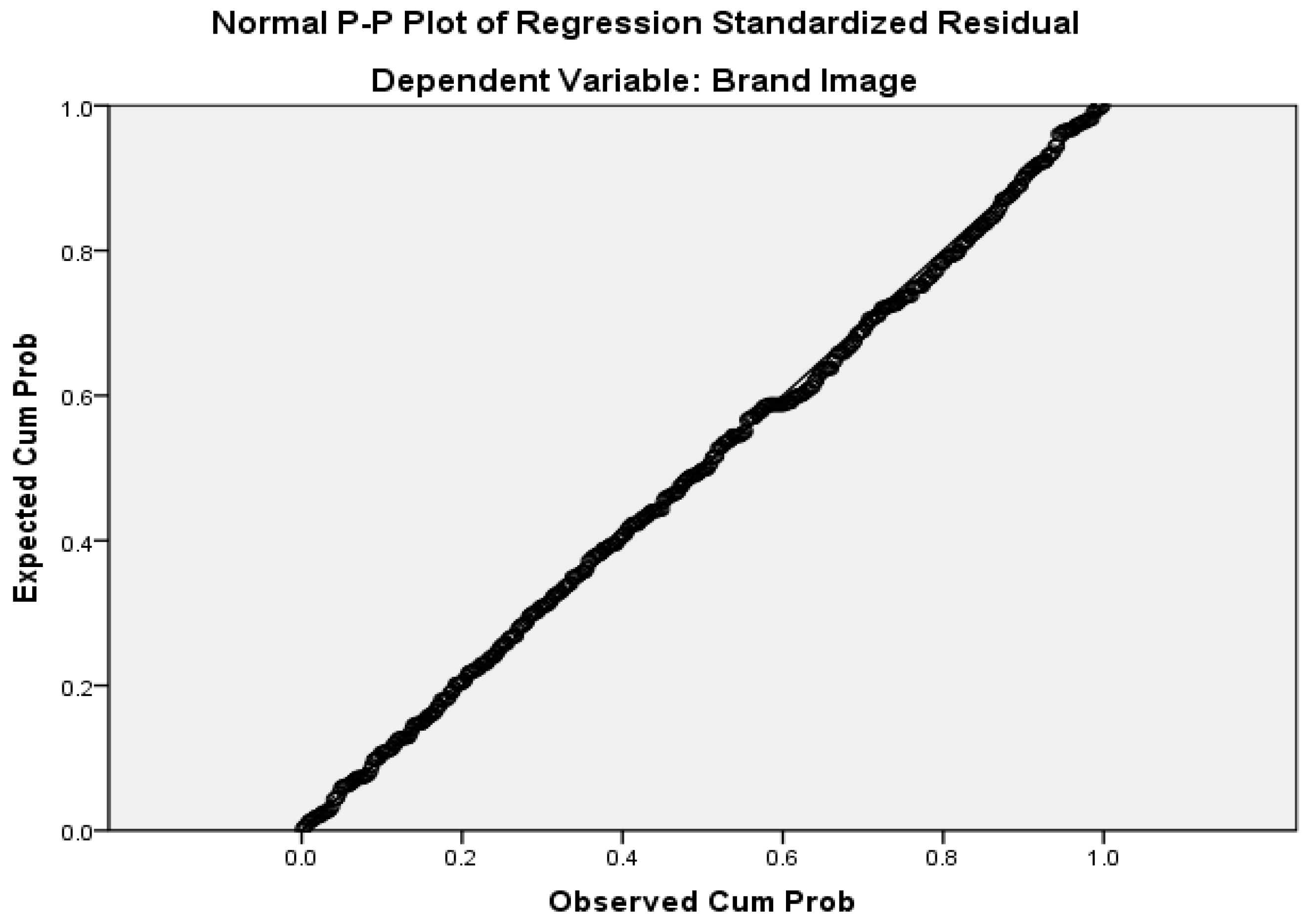
Figure 4.
Heteroscedasticity Test.
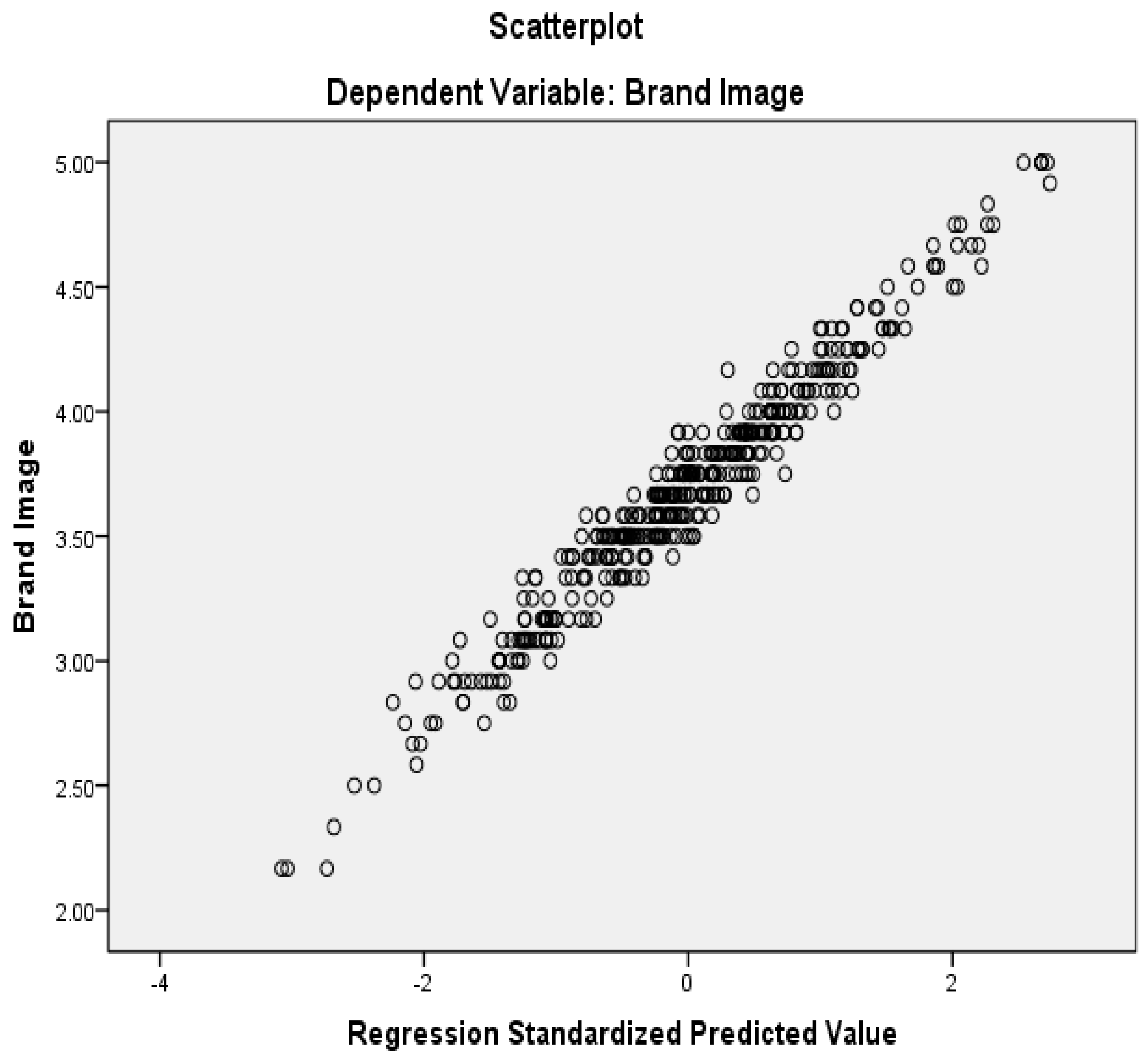

Table 1.
Demographic Frequency Table.
| Frequency | Percent | ||
|---|---|---|---|
| Gender | Male | 250 | 56.8 |
| Female | 190 | 43.2 | |
| Total | 440 | 100.0 | |
| Age | Less than 20 years | 17 | 3.9 |
| 20 to 24 years | 76 | 17.3 | |
| 25 to 30 years | 38 | 8.6 | |
| More than 30 years | 309 | 70.2 | |
| Total | 440 | 100.0 | |
| Education | Less than Diploma | 30 | 6.8 |
| Bachelor | 243 | 55.2 | |
| Post-graduate | 167 | 38.0 | |
| Total | 440 | 100.0 | |
Table 2.
Descriptive, Validity, and Reliability Analysis.
| Item | Mean | S.D. | F1 | KMO | Chi2 | df | Sig. | Var. | Alpha |
|---|---|---|---|---|---|---|---|---|---|
| Social1 | 3.67 | .698 | .806 | 0.616 | 202.330 | 3 | 0.000 | 59.292 | .651 |
| Social2 | 3.73 | .623 | .663 | ||||||
| Social3 | 3.66 | .608 | .830 | ||||||
| Environmental1 | 3.55 | .741 | .787 | 0.638 | 151.907 | 3 | 0.000 | 56.959 | .622 |
| Environmental2 | 3.69 | .702 | .761 | ||||||
| Environmental3 | 3.63 | .672 | .714 | ||||||
| Economic1 | 3.96 | .757 | .722 | 0.621 | 166.356 | 3 | 0.000 | 57.551 | .625 |
| Economic2 | 4.20 | .818 | .819 | ||||||
| Economic3 | 3.86 | .934 | .732 | ||||||
| Ethical1 | 3.65 | .849 | .802 | 0.619 | 194.021 | 3 | 0.000 | 58.927 | .648 |
| Ethical2 | 3.48 | .859 | .824 | ||||||
| Ethical3 | 3.89 | .838 | .667 | ||||||
| BrandImage1 | 3.55 | .750 | .683 | 0.598 | 170.571 | 3 | 0.000 | 57.215 | .616 |
| BrandImage2 | 3.90 | .671 | .833 | ||||||
| BrandImage3 | 3.85 | .755 | .745 | ||||||
| Consciousness1 | 3.94 | .727 | .668 | 0.770 | 459.090 | 15 | 0.000 | 42.317 | .715 |
| Consciousness2 | 3.81 | .947 | .566 | ||||||
| Consciousness3 | 4.11 | .676 | .565 | ||||||
| Consciousness4 | 3.93 | .876 | .628 | ||||||
| Consciousness5 | 3.99 | .705 | .759 | ||||||
| Consciousness6 | 3.85 | .806 | .696 | ||||||
| Social | 3.69 | .494 | .906 | 0.760 | 1319.041 | 6 | 0.000 | 78.826 | .903 |
| Economic | 4.01 | .635 | .839 | ||||||
| Environment | 3.62 | .533 | .874 | ||||||
| Ethical | 3.67 | .650 | .930 | ||||||
| CSR | 3.69 | .505 | |||||||
| Brand Image | 3.77 | .546 | |||||||
| Consciousness | 3.94 | .511 |
Principal Component Analysis, Sig. ≤0.05.
Table 3.
Correlations among Variables and Sub-Variables.
| No. | Variables | 1 | 2 | 3 | 4 | 5 | 6 | 7 |
|---|---|---|---|---|---|---|---|---|
| 1 | Social | |||||||
| 2 | Economic | .725** | ||||||
| 3 | Environment | .666** | .621** | |||||
| 4 | Ethical | .817** | .653** | .816** | ||||
| 5 | CSR | .893** | .857** | .879** | .919** | |||
| 6 | Brand Image | .635** | .543** | .435** | .590** | .616** | ||
| 7 | Consciousness | .581** | .546** | .506** | .594** | .626** | .619** | 1 |
**. Correlation is significant at the 0.01 level (2-tailed).
Table 4.
Multi-Collinearity Test.
| Model | Collinearity Statistics | ||
|---|---|---|---|
| Tolerance | VIF | ||
| 1 | (Constant) | ||
| Social | .266 | 3.762 | |
| Economic | .440 | 2.274 | |
| Environment | .317 | 3.156 | |
| Ethical | .199 | 5.019 | |
| 2 | (Constant) | ||
| Social | .263 | 3.806 | |
| Economic | .424 | 2.357 | |
| Environment | .317 | 3.156 | |
| Ethical | .193 | 5.181 | |
| Consciousness | .597 | 1.676 | |
Table 5.
Regression Analysis (ANOVA).
| Model | r | R2 | Adjusted R2 | f | Sig. |
|---|---|---|---|---|---|
| 1 | .663a | .440 | .435 | 85.446 | .000a |
| 2 | .717b | .513 | .508 | 91.602 | .000b |
a. Predictors: (Constant), Ethical, Economic, Environment, Social; b. Predictors: (Constant), Ethical, Economic, Environment, Social, Consciousness; c. Dependent Variable: Brand Image.
Table 6.
Regression Analysis.
| Model | Unstandardized Coefficients | Standardized Coefficients | t | Sig. | ||
|---|---|---|---|---|---|---|
| B | Std. Error | Beta | ||||
| 1 | (Constant) | 1.099 | .148 | 7.411 | .000 | |
| Social | .387 | .076 | .353 | 5.073 | .000 | |
| Economic | .158 | .046 | .187 | 3.452 | .001 | |
| Environment | -.166 | .057 | -.187 | -2.931 | .004 | |
| Ethical | .340 | .082 | .332 | 4.126 | .000 | |
| 2 | (Constant) | .505 | .157 | 3.223 | .001 | |
| Social | .325 | .072 | .297 | 4.541 | .000 | |
| Economic | .092 | .043 | .109 | 2.119 | .035 | |
| Environment | -.169 | .053 | -.190 | -3.187 | .002 | |
| Ethical | .228 | .078 | .223 | 2.920 | .004 | |
| Consciousness | .375 | .046 | .351 | 8.095 | .000 | |
a. Dependent Variable: Brand Image, T-Tabulated=1.960.
Disclaimer/Publisher’s Note: The statements, opinions and data contained in all publications are solely those of the individual author(s) and contributor(s) and not of MDPI and/or the editor(s). MDPI and/or the editor(s) disclaim responsibility for any injury to people or property resulting from any ideas, methods, instructions or products referred to in the content. |
© 2023 by the authors. Licensee MDPI, Basel, Switzerland. This article is an open access article distributed under the terms and conditions of the Creative Commons Attribution (CC BY) license (https://creativecommons.org/licenses/by/4.0/).
Copyright: This open access article is published under a Creative Commons CC BY 4.0 license, which permit the free download, distribution, and reuse, provided that the author and preprint are cited in any reuse.


