1. Introduction
In the dynamic and evolving landscape of contemporary business, the concept of the circular economy (CE) has emerged as a transformative paradigm, addressing pressing environmental challenges while fostering economic growth (Geissdoerfer et al., 2017; Kirchherr et al., 2017). Unlike the traditional linear economic model, the circular economy aims to decouple economic progress from resource consumption and waste generation by advocating for the principles of reduce, reuse, and recycle (Geissdoerfer et al., 2017; Kirchherr et al., 2017). This paradigm necessitates a fundamental redesign of organizational business models, products, and services, creating value through enhanced resource efficiency, waste minimization, and closed-loop systems (Bocken et al., 2016; Ghisellini et al., 2016). By shifting focus from a “take-make-dispose” model to a regenerative system, the circular economy not only addresses environmental sustainability but also fosters long-term economic resilience.
While the adoption of circular economy principles continues to expand, understanding their broader implications beyond environmental sustainability remains critical. One particularly underexplored area of research concerns the impact of circular economy practices on brand-related outcomes, notably brand value. Brand value, encompassing elements such as brand equity, reputation, and perception, serves as a key indicator of a brand’s financial worth, market position, and competitive advantage (Aaker, 1996; Kapferer, 2012; Keller, 1993). Brand value reflects not only the tangible benefits offered by a company but also its intangible assets, such as trust, loyalty, and customer perception. While prior research has highlighted the relationship between sustainability initiatives and brand value (Sen et al., 2006), the specific influence of circular economy practices remains insufficiently explored.
Service quality is a critical determinant of customer perceptions and experiences and is essential for organizations seeking to enhance brand value. Defined as the organization’s ability to deliver services that meet or exceed customer expectations, service quality forms a foundation for successful customer engagement (Parasuraman et al., 1988; Grönroos, 1982). In the context of the circular economy, service quality goes beyond conventional measures to incorporate principles of sustainability and resource efficiency. For example, organizations aligning their service delivery with circular economy principles often focus on delivering environmentally responsible and efficient services, reflecting both the Nordic model (Grönroos, 1984) and the SERVQUAL framework (Parasuraman et al., 1988). The circular economy service quality thus encompasses the organization’s commitment to providing value while adhering to principles of environmental and social responsibility (Wijaya et al., 2020; Lubis & Andayani, 2017).
A key mechanism through which service quality influences brand value is customer satisfaction. Customer satisfaction, defined as the extent to which customers perceive their expectations to be met or exceeded, is fundamental to building strong customer relationships (Oliver, 1997). Research consistently highlights that satisfied customers exhibit higher levels of brand loyalty, engage in positive word-of-mouth communication, and contribute to enhanced brand image (Anderson et al., 1994; Fornell et al., 1996). In the circular economy context, customer satisfaction is influenced not only by product and service quality but also by the perception of contributing to environmental preservation (Salem et al., 2016; Irfan et al., 2016). Satisfied customers often feel a sense of pride and fulfillment when their purchases align with their values, reinforcing their commitment to the brand (Azizan & Yusr, 2019).
The brand image, another vital component of brand value, refers to the perceptions, associations, and reputational attributes a brand holds in the minds of consumers (Aaker, 1996; Keller, 1993). A positive brand image fosters credibility, attractiveness, and differentiation in competitive markets, ultimately enhancing brand loyalty and customer retention (Bernarto et al., 2020; Lee et al., 2014). For organizations embracing circular economy principles, a strong brand image often resonates with environmentally conscious consumers who prioritize sustainability. Such perceptions not only strengthen brand credibility but also drive customers’ willingness to pay premium prices (Ries, 2002; Išoraitė, 2018). Sustaining a positive brand image, however, is a long-term process that requires consistent effort and alignment with customer values.
Customer loyalty, defined as the consistent preference and patronage customers exhibit toward a brand, plays a central role in driving brand value (Reichheld & Sasser, 1990; Zeithaml et al., 1996). Loyal customers not only generate consistent revenue streams but also exhibit reduced sensitivity to price changes and resistance to competitive offerings (Mellens et al., 1996; Cheng et al., 2011). For organizations operating within a circular economy framework, loyalty is often influenced by customers’ alignment with the brand’s environmental values and practices (Menaga et al., 2024; Moisescu, 2018). This alignment reinforces customer commitment and positions the organization as a leader in sustainable practices.
Finally, brand value represents the culmination of these interrelated factors. As the financial worth of a brand, brand value is shaped by attributes such as awareness, association, loyalty, and perceived quality (Aaker, 1991; Keller, 1993). For companies adopting circular economy principles, brand value is further enhanced by operational cost reductions, improved environmental performance, and strengthened consumer trust (Abedi & Azma, 2019). Moreover, the alignment between circular economy practices and consumer values creates a competitive edge, differentiating these organizations from traditional market players.
This study investigates the relationship between circular economy service quality and brand value, focusing on the mediating roles of customer satisfaction, brand image, and customer loyalty. By integrating these constructs into a comprehensive framework, the research seeks to address the gap in understanding how circular economy initiatives influence brand performance. The findings aim to contribute both theoretically and practically by providing actionable insights for organizations leveraging circular economy practices to enhance their competitive advantage and market presence.
2. Hypothesis Development
The hypotheses in this study are developed to examine the intricate relationships between circular economy service quality, customer satisfaction, customer loyalty, brand image, and brand value. Circular economy service quality is posited as a central driver that influences customer satisfaction, loyalty, and brand image, ultimately contributing to enhanced brand value. The hypotheses also explore the mediating roles of customer satisfaction, loyalty, and brand image, along with their serial mediation effects. Additionally, the potential moderating effect of gender on the relationship between circular economy service quality and brand value is incorporated to account for individual differences in consumer responses to circular economy practices. The following hypotheses outline these relationships and mediating or moderating dynamics comprehensively:
2.1. Circular Economy Service Quality and Customer Satisfaction
Circular business models emphasizing closed loops, slowed loops, intensified loops, narrowed loops, and dematerialized loops can significantly improve service quality by reducing waste, enhancing resource efficiency, and improving the overall customer experience. Such models align with circular economy principles, which aim to balance environmental sustainability and customer satisfaction (van Boerdonk et al., 2021). Empirical evidence demonstrates a positive relationship between service quality and customer satisfaction (Chao et al., 2015; Dam & Dam, 2021; Sivadas & Baker-Prewitt, 2000). However, the social dimensions of circular economy adoption remain underexplored, necessitating further research into how these transitions impact customer perceptions and satisfaction (Padilla-Rivera et al., 2020).
Hypothesis 1: Circular Economy Service Quality positively influences Customer Satisfaction levels.
2.2. Circular Economy Service Quality and Customer Loyalty
The circular economy has garnered increasing attention as a sustainable approach to business operations. Service quality, a core aspect of the circular economy, has been shown to directly influence customer loyalty (Wijaya et al., 2020). Studies across various industries, such as restaurants, travel agencies, and airlines, underscore that superior service quality drives loyalty by enhancing customer experiences and satisfaction (Virappan & Chan, 2020). For example, high-quality services under circular economy principles have been linked to increased profitability, cost savings, and market share for organizations (van Boerdonk et al., 2021).
Hypothesis 2: Circular Economy Service Quality positively and significantly influences Customer Loyalty.
2.3. Circular Economy Service Quality and Brand Image
Organizations implementing circular economy principles often enjoy an enhanced brand image due to their focus on sustainability and customer-centric practices. These companies design products for longevity, reuse, and recyclability while engaging stakeholders across the value chain, reflecting their commitment to environmental and social responsibility (Adam et al., 2017; Xu & Wang, 2008). By transparently communicating the benefits of their circular practices, they can position themselves as leaders in sustainable innovation and reinforce their brand image.
Hypothesis 3: Circular Economy Service Quality contributes positively to the formation of Brand Image.
2.4. Circular Economy Service Quality and Brand Value
Circular economy principles, when integrated into organizational practices, foster brand differentiation and enhance brand value. By emphasizing resource efficiency, environmental responsibility, and customer-centric solutions, companies strengthen trust and loyalty, which are key contributors to brand value (Chirumalla, 2021; Centobelli et al., 2020). Effective communication of the quality and environmental benefits of circular products reinforces this value proposition and bolsters brand reputation.
Hypothesis 4: Circular Economy Service Quality positively and significantly influences Brand Value.
2.5. Customer Satisfaction and Customer Loyalty
Customer satisfaction and loyalty are interdependent constructs that play pivotal roles in marketing and customer relationship management. Satisfied customers are more likely to remain loyal, repurchase products, and advocate for a brand, which, in turn, drives profitability and market share (Pinem et al., 2019; Tjahjaningsih et al., 2021). Studies confirm that customer satisfaction serves as a strong predictor of loyalty (Kumar et al., 2013), making it an essential focus for businesses pursuing sustainable growth.
Hypothesis 5: Customer Satisfaction is positively linked to Customer Loyalty.
2.6. Customer Loyalty and Brand Image
Loyal customers significantly contribute to building a positive brand image by reinforcing perceptions of trust and reliability. This relationship is particularly relevant in the circular economy, where customers prioritize brands that align with their values of sustainability and responsible consumption (Kim et al., 2021; Tanveer et al., 2021). Research shows that loyal customers influence brand reputation through advocacy and repeat purchases, thereby strengthening the brand’s image (Cretu & Brodie, 2009).
Hypothesis 6: Customer Loyalty is positively associated with Brand Image.
2.7. Customer Satisfaction and Brand Image
Customer satisfaction serves as a foundation for a strong brand image. Positive customer experiences foster favorable perceptions of the brand, influencing its reputation and emotional appeal (Maheshwari & Kumar, 2013; Neupane, 2015). Satisfied customers often advocate for the brand, amplifying its visibility and strengthening its image, especially in sustainability-focused contexts (Kim et al., 2021; Liu et al., 2011).
Hypothesis 7: Customer Satisfaction is positively correlated with Brand Image.
2.8. Customer Loyalty and Brand Value
Customer loyalty is a critical driver of brand value, as loyal customers consistently support the brand through repeat purchases and advocacy. Studies highlight that customer loyalty programs significantly enhance brand revenue and profitability (Zhang et al., 2010; Chinomona, 2016). In the circular economy, loyalty gains further importance as environmentally conscious consumers prefer sustainable brands, reinforcing brand value through trust and sustained engagement.
Hypothesis 8: Customer Loyalty is positively linked to Brand Value.
2.9. Brand Image and Brand Value
A strong brand image is integral to building brand value. Positive consumer perceptions foster recognition, differentiation, and trust, which translate into higher market share, customer loyalty, and price premiums (Išoraitė, 2018; Gong et al., 2023). By cultivating a compelling brand image, companies can enhance their brand value and maintain a competitive edge (Agung et al., 2019).
Hypothesis 9: Brand Image has a significantly positive effect on Brand Value.
2.10. Customer Satisfaction and Brand Value
Customer satisfaction directly contributes to brand value by shaping consumers’ perceptions of the brand’s worth. Research demonstrates that satisfied customers perceive brands as more valuable, particularly when sustainability is a core aspect of the brand’s identity (Suresh et al., 2011; Paetz, 2021).
Hypothesis 10: Customer Satisfaction is positively and significantly correlated with Brand Value.
2.11. Mediating Roles and Moderating Effects
Customer satisfaction, customer loyalty, and brand image are critical mediators that shape the relationship between circular economy service quality and brand value. For instance, high-quality circular economy services, such as closed-loop recycling programs and repair services, can elevate customer satisfaction by meeting both functional and emotional needs. This satisfaction, in turn, fosters a positive brand image and strengthens customer loyalty, thereby enhancing brand value. Loyal customers recognize and appreciate the brand’s commitment to sustainability, further contributing to its market reputation and financial worth. Given the interconnected nature of these constructs, it is essential to investigate their individual and combined mediating roles. Furthermore, the role of individual characteristics, such as gender, may also influence these relationships. Research has shown that female consumers tend to exhibit higher sensitivity toward ethical and sustainable practices, potentially moderating their perceptions of circular economy service quality and its impact on brand value (Marín-García et al., 2021; Yang et al., 2022).
The following hypotheses are therefore formulated to address these relationships comprehensively:
Hypothesis 11: Customer Satisfaction mediates the relationship between Circular Economy Service Quality and Brand Value.
Hypothesis 12: Customer Loyalty mediates the relationship between Circular Economy Service Quality and Brand Value.
Hypothesis 13: Customer Satisfaction and Customer Loyalty serially mediate the relationship between Circular Economy Service Quality and Brand Value.
Hypothesis 14: Brand Image mediates the relationship between Circular Economy Service Quality and Brand Value.
Hypothesis 15: Customer Satisfaction and Brand Image serially mediate the relationship between Circular Economy Service Quality and Brand Value.
Hypothesis 16: Customer Loyalty and Brand Image serially mediate the relationship between Circular Economy Service Quality and Brand Value.
Hypothesis 17: Customer Satisfaction, Customer Loyalty, and Brand Image serially mediate the relationship between Circular Economy Service Quality and Brand Value.
Hypothesis 18: The relationship between Circular Economy Service Quality and Brand Value is moderated by gender.
The hypotheses comprehensively address the direct, mediating, serial mediating, and moderating effects of these constructs, offering a robust framework for understanding the interplay between circular economy practices and brand value. The inclusion of gender as a moderator highlights the nuanced ways in which individual differences may influence consumer perceptions and responses to circular economy initiatives.
3. Circular Economy Service Quality Framework and Data Measuremen
3.1. Data Collection and Sampling
This study aims to investigate the role of circular economy service quality (CESQ) in creating brand value, while also examining how customer satisfaction, customer loyalty, and brand image contribute to achieving this goal. To fulfill the study's objectives, a quantitative approach was employed to test the hypotheses developed. Data were collected through a structured questionnaire administered to customers. The questionnaire design adhered to ethical standards, minimizing potential concerns (Regmi et al., 2016). Participants were carefully selected based on their use of products or services from companies integrating circular economy principles. A multi-channel approach was used to reach potential participants. Customers visiting shopping centers to purchase products aligned with circular economy practices were invited to complete the survey. Additionally, some participants were approached via online messaging platforms and email. Participation in the survey was voluntary, and respondents were assured of anonymity and confidentiality. They were instructed to reflect on the company products or services they had used while responding to the questionnaire items. After excluding incomplete responses, a total of 232 valid responses were included in the final analysis.
3.2. Conceptual Framework
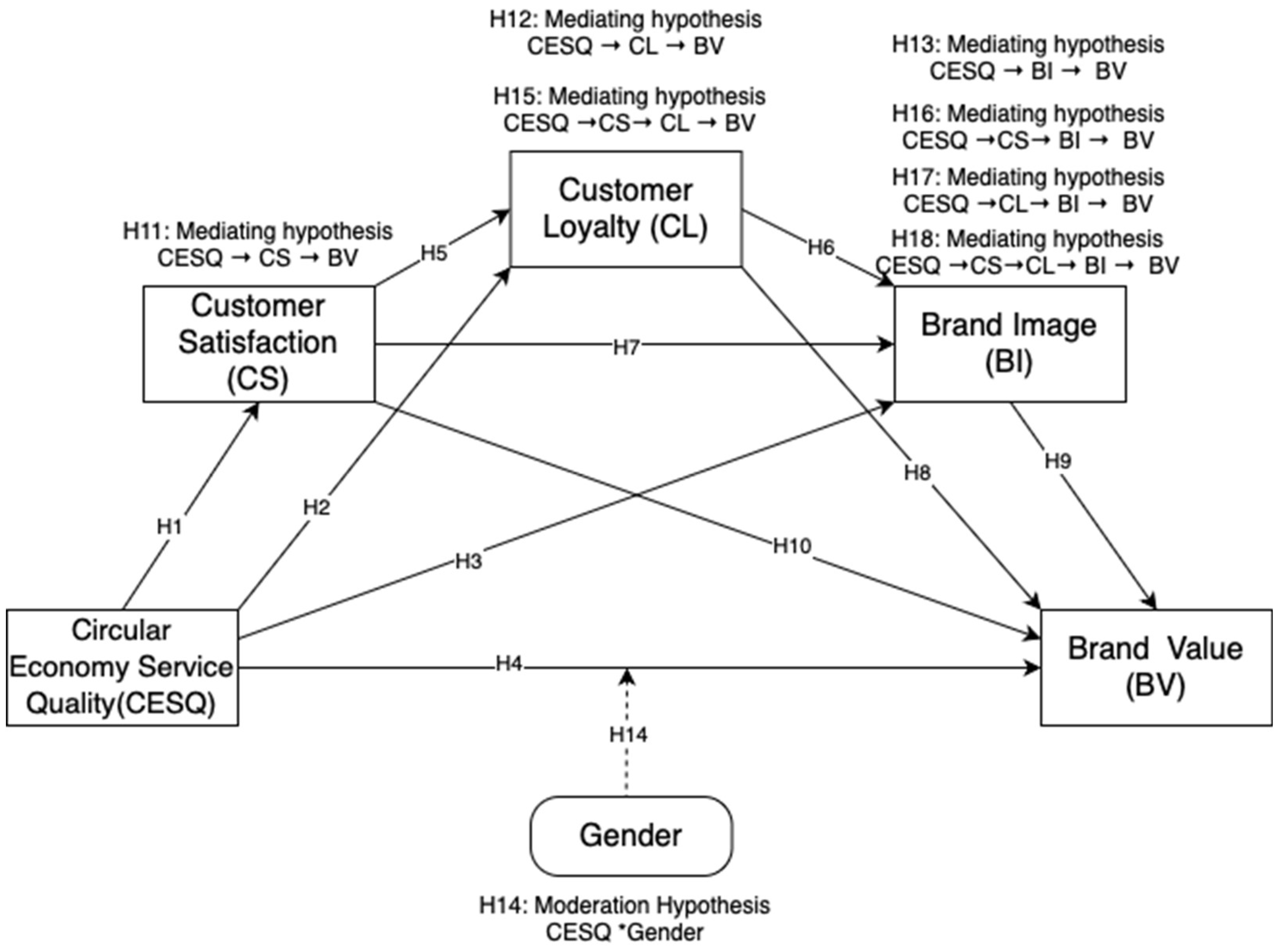
The conceptual framework of this study explores the relationships among Circular Economy Service Quality (CESQ), Customer Satisfaction (CS), Customer Loyalty (CL), Brand Image (BI), and Brand Value (BV). The model incorporates ten direct hypotheses (H1 to H10) to examine the effects of CESQ on CS, CL, BI, and BV, as well as the interrelationships among CS, CL, BI, and BV. Furthermore, the framework includes hypotheses to test the mediating roles of CS, CL, and BI in the relationship between CESQ and BV (H11 to H13). The moderating role of gender in the relationship between CESQ and BV is also analyzed (H14). This comprehensive framework seeks to provide a deeper understanding of how CESQ impacts customer perceptions and brand outcomes, addressing both direct and indirect effects.
Figure 1 displays the conceptual framework of this research.
3.3. Data Measurement
To measure the variables in this study, several parts of the questionnaire were adapted from established scales and modified to align with the research objectives. For instance, items measuring Customer Satisfaction and Brand Image were adopted and refined from scales developed by Bernarto and Purwanto (2022) and Rosanti and Salam (2021). Customer Loyalty items were adapted from Twum et al. (2021), and Brand Value was assessed using a five-item scale, partially derived from Diallo et al. (2021). The items measuring Circular Economy Service Quality were developed by the authors, drawing on prior research on service quality constructs, particularly those of Rosanti and Salam (2021). Each questionnaire item utilized a five-point Likert scale, where 1 indicated "Strongly Disagree" and 5 indicated "Strongly Agree." Statistical analyses were conducted using IBM SPSS Statistics 25, which facilitated the calculation and examination of the data.
4. Data Analysis and Key Findings
4.1. Demographic Characteristics of the Sample
A frequency analysis was conducted to examine the gender distribution within the sample. As detailed in
Table 1, male participants constituted the majority, accounting for 53.4% (n = 124) of the sample, while female participants represented 46.6% (n = 108).
Descriptive statistical analysis was utilized to summarize the age distribution of respondents.
Table 2 illustrates that the largest proportion of participants fell within the 30-45 years age group, comprising 53.0% of the sample (n = 123). This was followed by participants aged 15-30 years, accounting for 25.9% (n = 60), and those aged 45 years and older, who constituted 14.7% (n = 34). A smaller subset of respondents belonged to the 0-15 years age group, making up 5.6% (n = 13), while 0.9% (n = 2) of participants chose not to disclose their age.
Note. N: Sample Size.
The descriptive statistics for the duration of using products or services from circular economy-based companies revealed that most respondents had been using such products or services for less than 5 years (n = 97, 41.8%). This was followed by respondents with a usage duration of more than 5 years (n = 55, 23.7%), less than 3 years (n = 46, 19.8%), and less than 1 year (n = 18, 7.8%). Additionally, a small portion of respondents (n = 16, 6.9%) were uncertain about the duration.
Table 3 displays the frequency distribution for duration.
4.2. Measurement Results for Relevant Research Variables
A. Circular Economy Service Quality
Descriptive statistics for Circular Economy Service Quality indicate an overall mean score of 3.779 (SD = 0.665), reflecting a generally positive perception of service quality among customers. Among the items, SQ5 recorded the highest mean value, suggesting that customers strongly agree that the company’s products appear to be sustainable.
Table 4 shows the descriptive analysis for circular economy service quality variable.
B. Customer satisfaction
Descriptive statistics for customer satisfaction indicate an overall mean score of 3.814 (SD = 0.683), reflecting a positive perception of service quality among customers. Among the items, CS5 achieved the highest mean value, suggesting that customers feel reassured in their decision to be associated with this company.
Table 5 displays the descriptive analysis for customer Satisfaction variable.
C. Brand Image
Descriptive statistics for Brand Image indicate an overall mean score of 3.879 (SD = 0.661), reflecting a positive perception of service quality among customers. BI1 recorded the highest mean value, suggesting that customers perceive the company as well-known both nationally and globally.
Table 6 displays the descriptive analysis for brand image variable.
D. Customer Loyalty
Descriptive statistics for Customer Loyalty indicate an overall mean score of 3.934 (SD = 0.72), reflecting a positive perception of service quality among customers. CL1 achieved the highest mean value, suggesting that customers are more likely to use the company’s circular products in the future.
Table 7 shows the descriptive analysis for customer loyalty variable.
E. Brand Value
Descriptive statistics for Brand Value indicate an overall mean score of 3.816 (SD = 0.677), reflecting a positive perception of service quality among customers. BV5 recorded the highest mean value, suggesting that customers feel strongly attracted to this company.
Table 8 displays the descriptive analysis for brand value variable.
4.3. Factor Analysis and Reliability Tests
For dimensionality reduction, data exploration, and construct validation, this study employed factor analysis, correlation analysis, and Cronbach’s α analysis. Exploratory factor analysis was initially conducted using principal component analysis for each research construct to determine its dimensionality. Following this, Cronbach’s α and the correlation matrix were analyzed to assess internal consistency and construct reliability. Several measurement criteria were applied to ensure robust results. For factor analysis, the eigenvalue was required to exceed 1, and the minimum factor loading was set at 0.6. The Kaiser-Meyer-Olkin (KMO) Measure of Sampling Adequacy needed to surpass 0.5 for suitability. Bartlett’s test of sphericity was performed to evaluate the statistical significance of the correlation matrix components. For reliability analysis, item-to-total correlation values had to exceed 0.3, and Cronbach’s α was required to be greater than 0.7 to confirm construct reliability (Hair et al., 2013).
A. Circular Economy Service Quality
The circular economy service quality construct was measured using five items, with the results of the factor analysis and reliability test presented in
Table 9. Bartlett’s test of sphericity yielded a significant result, x
2(n=232) =412.004 (p<0.001), indicating that the data was suitable for factor analysis. The Kaiser-Meyer-Olkin (KMO) measure of sampling adequacy was 0.931, exceeding the threshold of 0.5 and confirming the appropriateness of the data for factor analysis. Additionally, the total variance explained by the items was 60.613%. Construct validity was assessed using Cronbach’s α, which revealed that the circular economy service quality scale with five items was reliable (α= 0.837).
B. Customer satisfaction
The customer satisfaction construct was measured using five items, and the results of the factor analysis and reliability test are presented in
Table 10. Bartlett’s test of sphericity was significant, x
2(n=232) =473.173 (p<0.001), confirming the data’s suitability for factor analysis. The Kaiser-Meyer-Olkin (KMO) measure of sampling adequacy was 0.835, exceeding the minimum threshold of 0.5 and validating the data’s appropriateness for factor analysis. The total variance explained by the items was 63.459%. Construct validity was assessed using Cronbach’s α, which demonstrated that the customer satisfaction scale with five items was reliable (α= 0.855).
C. Brand Image
The brand image construct was measured using three items, and the results of the factor analysis and reliability test are presented in
Table 11. Bartlett’s test of sphericity was significant, x
2(n=232) =149.415 (p<0.001), indicating the data's suitability for factor analysis. The Kaiser-Meyer-Olkin (KMO) measure of sampling adequacy was 0.685, exceeding the threshold of 0.5, confirming the appropriateness of the data for factor analysis. The total variance explained by the items was 65.634%. Construct validity was evaluated using Cronbach’s α, and the results demonstrated that the brand image scale was reliable (α= 0.738).
D. Customer Loyalty
The customer loyalty construct was measured using three items, and the results of the factor analysis and reliability test are presented in
Table 12. Bartlett’s test of sphericity was significant, x
2(n=232) =190.087 (p<0.001), confirming the data’s suitability for factor analysis. The Kaiser-Meyer-Olkin (KMO) measure of sampling adequacy was 0.701, exceeding the threshold of 0.5, thereby validating the data’s appropriateness for factor analysis. The total variance explained by the items was 69.403%. Construct validity was evaluated using Cronbach’s α, and the results indicated that the customer loyalty scale was reliable (α= 0.779).
E. Brand Value
The brand value construct was measured using five items, with the results of the factor analysis and reliability test shown in
Table 13. Bartlett’s test of sphericity was significant, x
2(n=232) =437.901 (p<0.001), confirming the data's suitability for factor analysis. The Kaiser-Meyer-Olkin (KMO) measure of sampling adequacy was 0.852, exceeding the acceptable threshold of 0.5, thus validating the data for factor analysis. The items collectively explained 62.060% of the total variance. Construct validity was assessed using Cronbach’s α, and the results indicated that the brand value scale was reliable (α= 0.846).
F. Structural Model Assessment
The results of the structural model assessment (
Table 14) indicate that all ten hypotheses (H1 to H10) are supported, as each association is statistically significant, with p-values of 0.000. The β coefficients range from 0.674 (H6: CL → BI) to 0.821 (H5: CS → CL), indicating strong relationships between the constructs. The R-square values, representing the variance explained by the independent variables, range from 0.480 (H4: CESQ → BV) to 0.635 (H10: CS → BV). These results suggest that customer satisfaction accounts for 63.5% of the variation in brand value, while circular economy service quality explains 48%. Additionally, the model demonstrates stability through significant F-statistics and T-statistics. Overall, these findings underscore the importance of circular economy service quality, customer satisfaction, customer loyalty, and brand image in influencing brand value and highlight their interactions within the context of this study.
4.4. Mediation Analysis
The study examined the mediating roles of customer satisfaction, customer loyalty, and brand image in the relationship between circular economy service quality (CESQ) and brand value (BV) using the Hayes Process Macro Model 6 in SPSS. The findings revealed significant indirect effects of CESQ on BV through:
Customer satisfaction (β = 0.279, p < 0.005), supporting H11.
Customer loyalty (β = 0.094, p < 0.005), supporting H12.
Customer satisfaction and customer loyalty (β = 0.136, p < 0.005), supporting H13.
Brand image (β = 0.038, p < 0.005), supporting H14.
Customer satisfaction and brand image (β = 0.048, p < 0.005), supporting H15.
Customer loyalty and brand image (β = 0.012, p < 0.005), supporting H16.
Customer satisfaction, customer loyalty, and brand image (β = 0.018, p < 0.005), supporting H17.
However, the direct effect of CESQ on BV in the presence of mediators was not significant (β = 0.077, t = 1.312) as the t-value was less than 1.96. The analysis results are presented in
Table 15. The mediation analysis demonstrated that circular economy service quality (CESQ) significantly enhances brand value (BV), primarily through indirect effects mediated by customer satisfaction (CS), customer loyalty (CL), and brand image (BI). All proposed mediation models were fully mediated, indicating that the impact of CESQ on BV is entirely channeled through these mediating factors. These findings emphasize the importance of customer-centric factors in assessing the effectiveness of circular economy initiatives. By improving customer satisfaction, fostering loyalty, and enhancing brand perception, organizations can leverage circular economy strategies to strengthen their brand reputation and drive long-term success.
4.5. Moderation Analysis
The moderation test, conducted using the Hayes Process Macro Model 1 in SPSS, revealed that Circular Economy Service Quality (CESQ) has a strong and positive impact on the dependent variable, likely brand value (BV), as shown by a significant β coefficient of 0.705 (p < 0.005) with a confidence interval that excludes zero. However, gender alone does not significantly affect the dependent variable, with a β coefficient of -0.036 (p = 0.579) and a confidence interval that includes zero. Furthermore, the interaction term between CESQ and gender is also not significant (β coefficient = 0.713, p = 0.465). The results of the analysis are summarized in
Table 16.
The findings indicate that CESQ has a significant positive impact on BV, independent of gender. While gender alone does not significantly influence brand value, it also does not moderate the relationship between CESQ and BV. This suggests that the positive effect of CESQ on brand value is consistent across genders. These results highlight the importance of implementing robust circular economy practices to enhance brand value, irrespective of the demographic characteristics of the target audience.
5. Discussion
The findings of this study provide substantial evidence supporting the proposed hypotheses, highlighting the critical role of Circular Economy Service Quality (CESQ) in enhancing customer satisfaction, loyalty, brand image, and ultimately, brand value. The structural model assessment reveals that CESQ significantly and positively influences customer satisfaction (H1), customer loyalty (H2), brand image (H3), and brand value (H4), with all associations being statistically significant. These results align with existing literature emphasizing the importance of service quality in driving customer-related outcomes and brand perceptions (Grönroos, 2007; Zeithaml, 2000).
5.1. Key Relationships and Mediation Effects
Customer satisfaction emerged as a pivotal mediator in this study. The significant direct relationship between customer satisfaction and customer loyalty (H5) underscores the notion that satisfied customers are more likely to remain loyal to the brand (Oliver, 1999). Furthermore, the positive association between customer loyalty and brand image (H6), along with the direct link between customer satisfaction and brand image (H7), emphasizes the interconnectedness of these constructs in building a strong brand reputation (Aaker, 1991). The strong β coefficients observed in these relationships indicate robust connections, reinforcing the idea that satisfied and loyal customers contribute significantly to the formation and enhancement of the brand image.
The direct effects observed between customer loyalty and brand value (H8) and brand image and brand value (H9) further validate the significance of these constructs in driving brand equity. The R-square values suggest that customer satisfaction alone accounts for 63.5% of the variance in brand value, highlighting its dominant role. Additionally, CESQ accounts for 48% of the variance in brand value, indicating that nearly half of the brand's value can be attributed to the quality of circular economy services provided.
5.2. Mediation Analysis
Mediation analysis results confirm the mediating roles of customer satisfaction, customer loyalty, and brand image in the relationship between CESQ and brand value. The significant indirect effects through customer satisfaction (H11), customer loyalty (H12), and brand image (H13) suggest that CESQ enhances brand value not only directly but also indirectly by improving these mediators. This finding aligns with the conceptual framework proposed in previous studies, which suggests that service quality impacts brand equity through intermediate variables such as customer satisfaction and loyalty (Parasuraman, Zeithaml, & Berry, 1988).
5.3. Moderation Analysis
Interestingly, the moderation analysis reveals that gender does not significantly moderate the relationship between CESQ and brand value (H18). This indicates that the positive impact of CESQ on brand value is consistent across genders, suggesting that circular economy initiatives resonate equally well with male and female customers. This consistency can be attributed to the growing awareness and value placed on sustainability and environmental responsibility among consumers, regardless of gender (Haws, Winterich, & Naylor, 2014).
5.4. Implications, Limitations and Future Research
In conclusion, this study provides compelling evidence that CESQ plays a crucial role in enhancing brand value through its positive effects on customer satisfaction, loyalty, and brand image. The results underscore the importance for brands to invest in high-quality circular economy services as a strategic approach to building strong customer relationships and enhancing brand equity.
Despite the valuable insights provided by this study, several limitations should be acknowledged. First, the research is cross-sectional, which limits the ability to establish causality among the studied variables. Longitudinal studies are needed to confirm the direction of these relationships over time. Second, the study relies on self-reported data, which may be subject to response biases such as social desirability bias. Future research could incorporate objective measures of CESQ and brand value to validate these findings. Third, the study's sample may not be representative of all industries or geographic regions, limiting the generalizability of the results. Replicating this study in different contexts could provide a more comprehensive understanding of the relationships among CESQ, customer satisfaction, loyalty, brand image, and brand value.
Building on the findings and limitations of this study, several avenues for future research are suggested. First, future studies could explore additional moderating variables, such as cultural differences, age, and income levels, to understand how different customer segments perceive and respond to CESQ. This could provide more tailored insights for companies targeting diverse customer bases. Second, examining the long-term effects of CESQ on brand value through longitudinal studies could offer a deeper understanding of how sustainable practices contribute to brand equity over time. Third, researchers could investigate the impact of specific circular economy practices, such as product take-back schemes or recycling programs, on customer satisfaction and brand loyalty. This would help identify the most effective practices for enhancing brand value. Lastly, expanding the research to different industries and regions could provide a more comprehensive perspective on the generalizability of the findings and the unique challenges and opportunities faced by various sectors in implementing circular economy initiatives.
6. Conclusions
This study comprehensively investigates the impact of Circular Economy Service Quality (CESQ) on brand value, incorporating key constructs such as customer satisfaction, customer loyalty, and brand image. The findings strongly support the proposed hypotheses, demonstrating that CESQ significantly enhances customer satisfaction, loyalty, brand image, and ultimately, brand value. The mediating roles of customer satisfaction, loyalty, and brand image underscore the indirect pathways through which CESQ contributes to brand value, highlighting the importance of adopting a holistic approach to sustainability and customer relationship management.
Additionally, the moderation analysis reveals that the positive effect of CESQ on brand value is consistent across genders, indicating a universal consumer appreciation for circular economy practices. This consistency aligns with the growing trend of consumer preference for sustainable brands, emphasizing the strategic importance of integrating circular economy principles into business operations.
In conclusion, this study provides compelling evidence that investing in high-quality circular economy services is an effective strategy for enhancing brand equity. By fostering customer satisfaction, loyalty, and a positive brand image, companies can significantly improve their brand value. These findings offer practical guidance for businesses and policymakers seeking to leverage sustainability as a competitive advantage in today's market. Future research should explore additional moderating variables and examine diverse industry contexts to further validate and expand upon these insights.
References
- Aaker, D. A. (1991). Managing brand equity: Capitalizing on the value of a brand name. New York, 28(1), 35–37.
- Aaker, D. A. (1996). Building strong brands. 1. Painos. London: Simon & Schuster UK Ltd.
- Abedi, R., & Azma, F. (2019). Relationship between the Brand Identity with Brand Loyalty due to the Mediating Role of Perceived Value. Dutch Journal of Finance and Management, 3(1). https://www.djfm-journal.com/download/relationship-between-the-brand-identity-with-brand-loyalty-due-to-the-mediating-role-of-perceived-5876.pdf.
- Adam, S., Bucker, C., Desguin, S., Vaage, N., & Saebi, T. (2017). Taking Part in the Circular Economy: Four Ways to Designing Circular Business Models (SSRN Scholarly Paper 2908107). [CrossRef]
- Agung, L., Rahmat, S. T. Y., & Angga, N. D. (2019). The relationship of brand communication, brand image, and brand trust to brand loyalty of samsung cellular phone product. Russian Journal of Agricultural and Socio-Economic Sciences, 88(4), 138–143.
- Anderson, E. W., Fornell, C., & Lehmann, D. R. (1994). Customer satisfaction, market share, and profitability: Findings from Sweden. Journal of Marketing, 58(3), 53–66.
- Azizan, N. S., & Yusr, M. M. (2019). The influence of customer satisfaction, brand trust, and brand image towards customer loyalty. International Journal of Entrepreneurship and Management Practices, 2(7), 93–108.
- Bernarto, I., Berlianto, M. P., Meilani, Y. F. C. P., Masman, R. R., & Suryawan, I. N. (2020). The influence of brand awareness, brand image, and brand trust on brand loyalty. Jurnal Manajemen, 24(3), 412–426.
- Bernarto, I., & Purwanto, A. (2022). The effect of perceived risk, brand image and perceived price fairness on customer satisfaction. Brand Image and Perceived Price Fairness on Customer Satisfaction (March 1, 2022).
- Bocken, N. M. P., de Pauw, I., Bakker, C., & van der Grinten, B. (2016). Product design and business model strategies for a circular economy. Journal of Industrial and Production Engineering, 33(5), 308–320. [CrossRef]
- Bocken, N. M., Short, S. W., Rana, P., & Evans, S. (2014). A literature and practice review to develop sustainable business model archetypes. Journal of Cleaner Production, 65, 42–56. [CrossRef]
- Bowen, J. T., & Chen, S. (2001). The relationship between customer loyalty and customer satisfaction. International Journal of Contemporary Hospitality Management, 13(5), 213–217. [CrossRef]
- Chandon, P. (2003). Note on measuring brand awareness, brand image, brand equity and brand value. Insead Fontainebleau. https://courseware.cutm.ac.in/wp-content/uploads/2020/06/2003-19.pdf.
- Chao, R.-F., Wu, T.-C., & Yen, W.-T. (2015). The influence of service quality, brand image, and customer satisfaction on customer loyalty for private karaoke Roomsin Taiwan. The Journal of Global Business Management, 11(1), 59–67.
- Cheng, C. C., Chiu, S.-I., Hu, H.-Y., & Chang, Y.-Y. (2011). A study on exploring the relationship between customer satisfaction and loyalty in the fast food industry: With relationship inertia as a mediator. African Journal of Business Management, 5(13), 5118.
- Chinomona, R. (2016). Brand communication, brand image and brand trust as antecedents of brand loyalty in Gauteng Province of South Africa. African Journal of Economic and Management Studies, 7(1), 124–139. [CrossRef]
- Cretu, A. E., & Brodie, R. J. (2009). Chapter 7 Brand image, corporate reputation, and customer value. In M. S. Glynn & A. G. Woodside (Eds.), Business-To-Business Brand Management: Theory, Research and Executivecase Study Exercises (Vol. 15, pp. 263–387). Emerald Group Publishing Limited. [CrossRef]
- DAM, S. M., & DAM, T. C. (2021). Relationships between Service Quality, Brand Image, Customer Satisfaction, and Customer Loyalty. The Journal of Asian Finance, Economics and Business, 8(3), 585–593. [CrossRef]
- Diallo, M. F., Ben Dahmane Mouelhi, N., Gadekar, M., & Schill, M. (2021). CSR actions, brand value, and willingness to pay a premium price for luxury brands: Does long-term orientation matter? Journal of Business Ethics, 169, 241–260. [CrossRef]
- Fornell, C. (1992). A National Customer Satisfaction Barometer: The Swedish Experience. Journal of Marketing, 56(1), 6–21. [CrossRef]
- Fornell, C., Gardner, B. B., & Levy, S. J. (1955). The Product and the Brand. Harvard Business Review, 33, 33–39. [CrossRef]
- Fornell, C., Johnson, M. D., Anderson, E. W., Cha, J., & Bryant, B. E. (1996). The American customer satisfaction index: Nature, purpose, and findings. Journal of Marketing, 60(4), 7–18.
- Geissdoerfer, M., Savaget, P., Bocken, N. M. P., & Hultink, E. J. (2017). The Circular Economy – A new sustainability paradigm? Journal of Cleaner Production, 143, 757–768. [CrossRef]
- Ghisellini, P., Cialani, C., & Ulgiati, S. (2016). A review on circular economy: The expected transition to a balanced interplay of environmental and economic systems. Journal of Cleaner Production, 114, 11–32. [CrossRef]
- Gong, Y., Xiao, J., Tang, X., & Li, J. (2023). How sustainable marketing influences the customer engagement and sustainable purchase intention? The moderating role of corporate social responsibility. Frontiers in Psychology, 14, 1128686. [CrossRef]
- Grönroos, C. (1982). An applied service marketing theory. European Journal of Marketing, 16(7), 30–41.
- Grönroos, C. (1984). A service quality model and its marketing implications. European Journal of Marketing, 18(4), 36–44.
- Guyader, H., Ponsignon, F., Salignac, F., & Bojovic, N. (2022). Beyond a mediocre customer experience in the circular economy: The satisfaction of contributing to the ecological transition. Journal of Cleaner Production, 378, 134495. [CrossRef]
- Hair, J. F., Ringle, C. M., & Sarstedt, M. (2013). Partial least squares structural equation modeling: Rigorous applications, better results and higher acceptance. Long Range Planning, 46(1–2), 1–12.
- Hom, W. (2000). An Overview of Customer Satisfaction Models. https://eric.ed.gov/?id=ed463825.
- Irfan, M., Shamsudin, M. F., & Hadi, N. U. (2016). How important is customer satisfaction? Quantitative evidence from mobile telecommunication market. International Journal of Business and Management, 11(6), 57–69.
- Išoraitė, M. (2018). Brand image development. Ecoforum, 7(1), 0–0.
- Janonis, V., & Virvilaitė, R. (2007). Brand image formation. Engineering Economics, 52(2). https://www.ceeol.com/search/article-detail?id=144212.
- Jones, T. O., & Sasser, W. E. (1995). Why satisfied customers defect. Harvard Business Review, 73(6), 88.
- Kano, N., Seraku, N., Takahashi, F., & Tsuji, S. (1984). Attractive quality and must-be quality. https://www.sid.ir/paper/600594/fa.
- Kapferer, J.-N. (2012). The new strategic brand management: Advanced insights and strategic thinking. Kogan page publishers.
- Keller, K. L. (1993). Conceptualizing, Measuring, and Managing Customer-Based Brand Equity. Journal of Marketing, 57(1), 1–22. [CrossRef]
- Kim, S., Baek, W., Byon, K. K., & Ju, S. (2021). Creating Shared Value to Enhance Customer Loyalty: A Case of a Sporting Goods Company in Korean Athletic Shoe Market. Sustainability, 13(13), Article 13. [CrossRef]
- Kirchherr, J., Reike, D., & Hekkert, M. (2017). Conceptualizing the circular economy: An analysis of 114 definitions. Resources, Conservation and Recycling, 127, 221–232. [CrossRef]
- Krumay, B., & Brandtweiner, R. (2010). Are customer service offerings influencing e-loyalty? A graphical chain model approach in the austrian mobile phone service provider industry. https://aisel.aisnet.org/bled2010/17/.
- Kumar, V., Pozza, I. D., & Ganesh, J. (2013). Revisiting the Satisfaction–Loyalty Relationship: Empirical Generalizations and Directions for Future Research. Journal of Retailing, 89(3), 246–262. [CrossRef]
- Lee, J. L., James, J. D., & Kim, Y. K. (2014). A Reconceptualization of Brand Image. International Journal of Business Administration, 5(4), p1. [CrossRef]
- Levesque, T., & McDougall, G. H. (1996). Determinants of customer satisfaction in retail banking. International Journal of Bank Marketing, 14(7), 12–20.
- Liu, J., Xue, Y., & Duan, J. (2011). An empirical study on impacts of brand cognition on brand loyalty. 2011 2nd International Conference on Artificial Intelligence, Management Science and Electronic Commerce (AIMSEC), 959–962. [CrossRef]
- Lubis, A. S., & Andayani, N. R. (2017). Pengaruh kualitas pelayanan (service quality) terhadap kepuasan pelanggan pt. Sucofindo batam. Journal of Applied Business Administration, 1(2), 232–243.
- Maheshwari, K., & Kumar, D. V. (2013). To Create a Positive Brand Image Through Corporate Social Responsibility (SSRN Scholarly Paper 2466844). [CrossRef]
- Marín-García, A., Gil-Saura, I., Ruiz-Molina, M. E., & Berenguer-Contrí, G. (2021). Sustainability, store equity, and satisfaction: The moderating effect of gender in retailing. Sustainability, 13(2), 1010.
- Mellens, M., Dekimpe, M., & Steenkamp, J. (1996). A review of brand-loyalty measures in marketing. Tijdschrift Voor Economie En Management, 4, 507–533.
- Menaga, A., Vasantha, S., & Lokesh, S. (2024). Analysing the Bibliometric of Circular Economy and Customer Behavior: A Study from 2018 to 2023. 3rd International Conference on Reinventing Business Practices, Start-Ups and Sustainability (ICRBSS 2023), 410–425. https://www.atlantis-press.com/proceedings/icrbss-23/125998429.
- Moisescu, O.-I. (2018). From perceptual corporate sustainability to customer loyalty: A multi-sectorial investigation in a developing country. Economic Research-Ekonomska Istraživanja, 31(1), 55–72.
- Neupane, R. (2015). The Effects of Brand Image on Customer Satisfaction and Loyalty Intention in Retail Super Market Chain UK. International Journal of Social Sciences and Management, 2(1), Article 1. [CrossRef]
- Oliver, R. L. (1997). Emotional expression in the satisfaction response. Satisfaction: A Behavioral Perspective on the Consumer, 291325.
- Oliver, R. L. (1999). Whence Consumer Loyalty? Journal of Marketing, 63(4_suppl1), 33–44. [CrossRef]
- Onyancha, G. K. (2013). The impact of bank brand image on customer satisfaction and loyalty: A case of Kenya commercial bank. European Journal of Business and Management, 5(21), 35–39.
- Padilla-Rivera, A., Russo-Garrido, S., & Merveille, N. (2020). Addressing the Social Aspects of a Circular Economy: A Systematic Literature Review. Sustainability, 12(19), Article 19. [CrossRef]
- Paetz, F. (2021). Recommendations for Sustainable Brand Personalities: An Empirical Study. Sustainability, 13(9), Article 9. [CrossRef]
- Parasuraman, A., Zeithaml, V. A., & Berry, L. (1988). SERVQUAL: A multiple-item scale for measuring consumer perceptions of service quality. 1988, 64(1), 12–40.
- Pinem, S., Husnan, L. H., & Handayani, B. R. (2019). THE IMPACT OF SERVICE QUALITY ON CUSTOMER LOYALTY WITH MODERATING EFFECT OF CUSTOMER SATISFACTION IN DITLANTAS POLDA NTB. Russian Journal of Agricultural and Socio-Economic Sciences, 9(93), 17–26. [CrossRef]
- Regmi, P. R., Waithaka, E., Paudyal, A., Simkhada, P., & van Teijlingen, E. (2016). Guide to the design and application of online questionnaire surveys. Nepal Journal of Epidemiology, 6(4), 640–644. [CrossRef]
- Reichheld, F. F., & Sasser, W. E. (1990). Zero defections: Quality comes to services. 1990, 68(5), 105–111.
- Ries, A. (2002). Positioning: The battle for your mind. Salemba Empat. http://digilib.fisipol.ugm.ac.id/handle/15717717/13733.
- Rosanti, N., & Salam, K. N. (2021). The Effects of Brand Image and Product Quality on Purchase Decisions. Quantitative Economics and Management Studies, 2(6), 365–375.
- Salem, M. A., Shawtari, F. A., Shamsudin, M. F., & Hussain, H. I. (2016). The relation between stakeholders’ integration and environmental competitiveness. Social Responsibility Journal, 12(4), 755–769.
- Sen, S., Bhattacharya, C., & Korschun, D. (2006). The Role of Corporate Social Responsibility in Strengthening Multiple Stakeholder Relationships: A Field Experiment. Journal of The Academy of Marketing Science - J ACAD MARK SCI, 34, 158–166. [CrossRef]
- Sivadas, E., & Baker-Prewitt, J. L. (2000). An examination of the relationship between service quality, customer satisfaction, and store loyalty. International Journal of Retail & Distribution Management, 28(2), 73–82. [CrossRef]
- Smith, A. D., Damron, T., & Melton, A. (2017). Aspects of corporate wellness programs: Comparisons of customer satisfaction. Benchmarking: An International Journal, 24(6), 1523–1551.
- Suresh, S., Mohanan, P., & Gopal, N. (2011). Brand Success Redefined: An Analysis of the Interrelationships Among Various Brand Dimensions (SSRN Scholarly Paper 1867880). [CrossRef]
- Tanveer, M., Ahmad, A.-R., Mahmood, H., & Haq, I. U. (2021). Role of Ethical Marketing in Driving Consumer Brand Relationships and Brand Loyalty: A Sustainable Marketing Approach. Sustainability, 13(12), Article 12. [CrossRef]
- Tjahjaningsih, E., Widyasari, S., Maskur, A., & Kusuma, L. (2021). The Effect of Customer Experience and Service Quality on Satisfaction in Increasing Loyalty. 395–399. [CrossRef]
- Twum, K. K., Yalley, A. A., Agyapong, G. K.-Q., & Ofori, D. (2021). The influence of Public University library service quality and library Brand image on user loyalty. International Review on Public and Nonprofit Marketing, 18, 207–227.
- van Boerdonk, P. J. M., Krikke, H. R., & Lambrechts, W. (2021). New business models in circular economy: A multiple case study into touch points creating customer values in health care. Journal of Cleaner Production, 282, 125375. [CrossRef]
- Virappan, T. M., & Chan, T. J. (2020). Predictors of Corporate Reputation through Service Quality: A Study of Air Asia Customers Perspectives. Journal of Business and Social Review in Emerging Economies, 6(2), Article 2. [CrossRef]
- Waworuntu, E. C., Mandagi, D. W., & Pangemanan, A. S. (2022). ‘I See It, I Want It, I Buy It’: The Role of Social Media Marketing in Shaping Brand Image and Gen Z’s Intention to Purchase Local Product. Society, 10(2), 351–369.
- Wijaya, A. F. B., Surachman, S., & Mugiono, M. (2020). The effect of service quality, perceived value and mediating effect of brand image on brand trust. Jurnal Manajemen Dan Kewirausahaan, 22(1), 45–56.
- Xu, J., & Wang, H. (2008). Build competitive advantage through the integration of sustainable supply chains. 2008 IEEE International Conference on Service Operations and Logistics, and Informatics, 2, 2177–2180. [CrossRef]
- Yang, X., Kittikowit, S., Noparumpa, T., Jiang, J., & Chen, S.-C. (2022). Moderated Mediation Mechanism to Determine the Effect of Gender Heterogeneity on Green Purchasing Intention: From the Perspective of Residents’ Values. Frontiers in Psychology, 12. [CrossRef]
- Yi, Y., & Jeon, H. (2003). Effects of Loyalty Programs on Value Perception, Program Loyalty, and Brand Loyalty. Journal of the Academy of Marketing Science, 31(3), 229–240. [CrossRef]
- Zeithaml, V. A., Berry, L. L., & Parasuraman, A. (1996). The Behavioral Consequences of Service Quality. Journal of Marketing, 60(2), 31–46. [CrossRef]
- Zhang, J. Q., Dixit, A., & Friedmann, R. (2010). Customer Loyalty and Lifetime Value: An Empirical Investigation of Consumer Packaged Goods. Journal of Marketing Theory and Practice, 18(2), 127–140. [CrossRef]
|
Disclaimer/Publisher’s Note: The statements, opinions and data contained in all publications are solely those of the individual author(s) and contributor(s) and not of MDPI and/or the editor(s). MDPI and/or the editor(s) disclaim responsibility for any injury to people or property resulting from any ideas, methods, instructions or products referred to in the content. |
© 2025 by the authors. Licensee MDPI, Basel, Switzerland. This article is an open access article distributed under the terms and conditions of the Creative Commons Attribution (CC BY) license (http://creativecommons.org/licenses/by/4.0/).