
Submitted:
13 April 2023
Posted:
14 April 2023
You are already at the latest version
Abstract
Drug delivery systems consist of cyclodextrins (CyDs) have kept constant attention for good compatibility, negligible toxicity, and improved pharmacokinetics of drugs. The unique hollow structure has endowed a lot of functions, such as inclusion of guest molecules, functional modification of active hydroxyl groups, and noncovalent interactions. Besides, the polyhydroxy structure has further extended the functions of CyDs by inter/intramolecular interactions and chemical modification. Furthermore, the versatile functions of the complex contribute to physicochemical characteristics alteration of the drugs, therapeutic talent, stimulus-responsive switch, self-assemble capability, and fiber formation. This review attempts to list the recent progress of CyDs and discuss their roles in the drug delivery system. Future perspectives of the construction of CyD-based drug delivery systems are also discussed at the end of this review, which may be the possible directions for the construction of more rational and cost-effective delivery vehicles.
Keywords:
Cyclodextrin
; host-guest inclusion
; drug delivery
; interactions
; application
1. Introduction
Although traditional drugs have good therapeutic talent, they also face a series of drawbacks such as poor water-solubility, instability, short circulation time, unspecific targeting and low biocompatibility, and thus they are difficult to be effective as we expected in clinic [1,2]. In addition, there has long been concern that some traditional drugs may cause serious side effects to human body. To overcome the drawbacks of traditional drugs, drug delivery systems are gaining increasing momentum and have been considered as the proper tool. Various strategies are used to improve pharmaceutical or biopharmaceutical delivery systems, such as interaction principle, assembly technologies, and/or targeted strategies [3]. Researchers have also developed many kinds of nanoplatforms (such as polymer, lipid, amino acid, polypeptide, and inorganic-based platforms) for drug delivery and dramatic advances have been driven in chemistry, materials science, clinical practice and biotechnology [4,5]. Many of the drug delivery systems have focused on controlled release therapeutics in appropriate time. They can be endowed to target specific locations within the body by active or passive targeting, thereby reducing the amount of drugs to achieve equal therapeutic effect along with alleviated side effects to the patient [6,7,8]. The drug delivery systems also allows for more specific drug targeting and administration by tailoring the physicochemical and pharmacokinetic/pharmacodynamics properties of the original drugs to maximize therapeutic benefits.
In the field of drug delivery, the following improvements should be accomplished: (i) improvement in treatment effect, (ii) minimum in drug leakage/toxicity in normal tissues or organs, and (iii) reduction in the intake dosage [9]. Several improvements can be achieved in a structurally manner derived from CyDs-based drug delivery system. CyDs are highly safe for animal and human administration as they have been approved by the Food and Drug Administration (FDA). The first patent for CyDs in pharmaceutical formulations dates back to 1953 [10]. Over 70 CyDs-related programs are being studied for clinician. Potentials of CyDs within drug delivery systems have motivated us to conduct in-depth exploration. However, there are still confusions about how to neatly utilize CyDs in the drug delivery system and how to use CyDs to achieve incredible therapeutic effects.
Throughout this review, we will discuss a number of relevant strategies and their potential in nanoplatform based on CyDs. We will also discuss engineered drug delivery systems designed through representative supramolecular and strong intramolecular interactions, and other interesting strategies from the perspective of CyD utilization. The structure-property relationship of CyDs will be discussed molecularly with a focus on their use in nanoplatform. We highlight the current challenges in the field of drug delivery, breakthroughs in CyDs research, as well as future considerations and opportunities of the translation of CyDs-based materials into clinical practice.
2. Structure
CyDs are made of 1, 4 α-linked cyclic oligomers of glucopyranose and show truncated shape. The three common CyDs called α, β and γ-CyD consist of six, seven, and eight glucose units, respectively. In the three CyDs, β-CyD exhibits poor water solubility because the intramolecular and intermolecular hydrogen bonds would compete with water; and thus result in the relatively weaker intermolecular hydrogen bonding. Large or small CyDs do exist but they are difficult to synthesis and have been less investigated [1,11]. CyDs and their derivatives are truncated cone-shaped molecules with a hollow cavity of 7.9 Å in depth and their internal diameter are 4.5, 7.0, and 8.5 Å for α-, β-, and γ-CyD, respectively [2]. The exterior surface of CyDs is hydrophilic due to the presence of -OH groups decorated on the two rims (upper and lower rim) (Figure 1). While the interior cavity of CyDs are relatively hydrophobic, which allows them to be accommodated by supramolecular interaction [1].
There are three different kinds of hydroxyl group in CyDs, namely 2-OH, 3-OH and 6-OH (Figure 1I). The 6-OH is located on a different side of CyDs from 2-OH and 3-OH. Generally, these hydroxyl groups of CyDs provide active sites for chemical modification. 6-OH has a better availability and nucleophilicity than 2-OH and 3-OH, so it is possible to react with a wide range of active groups to modify the molecules. Since the secondary hydroxyl groups (2-OH and 3-OH) are more acidic, they are usually inactive [12]. Highly reactive reagents such as isocyanate group could non-selectively react with all hydroxyl groups, whereas less reactive reagents are selective in their reaction with 6-OH [13].
3. Function
3.1. Noncovalent interactions
There are many noncovalent interactions between CyD and other molecules, such as van der Waals interactions, hydrophobic interactions, π-π interactions, electrostatic interactions, host guest interactions, metallic coordination and hydrogen bonds. CyD absorption frequency is reduced with other molecules due to the noncovalent interactions, which reduce the force constants of the corresponding bonds and lower the energy of molecules. Although there are a series of interactions between CyD and other molecules, certain dominant interactions lead to the complexation. In a study by Jian et al., γ-CyD can be absorbed by nanotubes/ropes via van der Waals forces and weak electrostatic interactions using optical absorption spectrum measurements [14]. Pawar et al. has been reported that the suitable size of artemether and the interaction with hydropropyl-β-CyD (HP-β-CyD) led to its efficient entrapment and increased inclusion constant [15]. Meanwhile, the methyl group of HP-β-CyD also helps to drive artemether towards the lipophilic cavity because of hydrophobic interaction.
CyDs are quite compatible with water molecules because there are three kinds of -OH groups that can form hydrogen bonds. The water molecules in the cavity bind as complexed water while the outsiders bind as crystal lattice water. In aqueous status, there is a balance between free molecules and CyD molecules. The solubility of natural CyDs is also influenced by the strong binding of CyD in the crystal form. By substituting -OH groups with hydrophobic groups of CyD, intramolecular hydrogen bonding weakens, leading to amorphous solids.
Generally, several parameters like size, polarity and hydrophobicity are required in the formation of stable host-guest inclusion complex in aqueous solutions. Due to the absence of covalent bonds, unstable bound water can be released from the inner cavity. The reason for this is due to the dynamic replacement of a suitable guest molecule into the cavity and ultimately stabilizing the entropy. As incoming guest molecules bind, bound water is completely or partially replaced by incoming guest molecules. Organic guest molecules enter the CyD cavity through inclusion complexation interactions in aqueous solution due to their shape, size, and polarity. To determine the stability of the bond, several parameters should be considered, such as size/shape matching, hydrophilicity/hydrophobicity, and electrostatic interaction. Moreover, one of the key essentials is that the formation of the host-guest inclusion should be in the presence of water molecules [16]. So far, scientists have synthesized a large number of CyD derivatives to improve the properties of unsatisfying drug molecules. Based on noncovalent interactions, CyDs serve a variety of purposes, including removing lipids, increasing solubility, and reducing side effects.
Through hydrogen bonding and/or hydrophobic interactions, CyDs possess the unique property of forming inclusion complexes with various lipophilic drugs and hydrophilic polymers. For purposes of delivery or functionalization, it is reasonable to assume that CyDs have good capabilities of complexing with lipophilic molecules, as well as their ability to bypass certain biological gates.
β-CyD has been widely used in the early stages of pharmaceutical applications due to its easy accessibility and cavity size suitability for the widest range of drugs. Given the cavity size of α-CyD is not large enough for many drugs and the cost of γ-CyD is high, they are not as widely explored as β-CyD. The disadvantages of β-CyD, particularly as a drug delivery agent, include its relatively low water solubility and nephrotoxicity.
Progress in host-guest interactions between CyDs and drugs or other guest molecules has been made and such interactions have shown great potentials in versatile fields, such as medical, sports, and pollution removal [17,18,19]. In aqueous solution, the solid crystalline structure can be broken and the as-formed individualized CyDs can form inclusion complexes with various substances or self-associate with different aggregates (i.e. micro particles, nanoparticles (NPs) and precipitate). Inclusion will change the physiochemical properties of the guest molecules and form “complex”. In the field of pharmaceutics, CyDs have a long history in drug delivery [20]. This simple and effective access has been verified by industrialization and clinician. Additionally, CyDs promotes drug absorption by facilitating the transport of drugs across physiologic barriers [21]. By forming inclusion complexes, drugs within CyDs can mask their unpleasant odor and taste, rendering them more acceptable preparations. In the same manner, CyDs can be used to prevent irritation caused by certain drugs, and increase compatibility or reduce reaction between different components in drug formulations [22]. Additionally, the supramolecular formulation of CyDs for a drug can improve the rate of bioavailability, resulting in many applications of macromolecule for controlled release [23].
3.2. Functional modification of the active hydroxyl groups
CyDs have been widely used in pharmaceutical fields mainly due to their negligible toxicity, ideal biocompatibility and non-immunogenicity [24,25,26]. Although bare CyDs have a variety of roles in drug delivery, the incorporation of pre/post modification has widen the application range and helps to build many kinds of novel materials. For example, due to the polyhydroxyl structure, CyDs can react with wide variety of reagents to obtain water-soluble CyD derivatives. Different chemical modifications have been proposed by grafting reactive groups at different positions (primary 6-OH, 2, 3-OH, or both -OH). The as-formed supramolecular aggregates are suitable for drug delivery applications. Through functional modifications, CyDs can introduce ionic groups, hydrophobic groups, and other active linkers (such as azide groups, p-toluene sulfonyl groups, halogen groups, and sulfhydryl groups, etc.). The modification of ionic groups could act as gene delivery vectors or permeation enhancing excipients. Whereas hydrophilic-hydrophobic self-assembly structure could be formed by grafting of hydrophobic groups [27]. Meanwhile, CyDs could also be modified to connect chemotherapy drugs, receptor and targeted agents.
4. Application
Based on its unique structure, CyDs has shown different roles in drug delivery. CyDs is regarded to be an efficient and accessible functional units for the construction of biomedical engineering materials accounting for its biosafety. On the one hand, because of the high adaptability to guest molecules, the inner cavity of CyDs could accommodate a variety of different pharmaceutical molecules, such as stimulus-responsive units and biomolecules. On the other hand, its functional groups could interact with surrounding molecules by various intermolecular interactions. Based on covalent and non-covalent interactions, CyDs has been widely explored by researchers in the prospect of physicochemical characteristics alteration of the drugs, therapeutic talent, stimulus response switch, self-assemble capability and fiber formation.
4.1. Physicochemical characteristics alteration of the drugs
One of the most remarkable properties of CyDs is to accommodate guest molecules within their hydrophobic cavity to form the so-called inclusion complexes and alter the physicochemical characteristics of drug molecules [28,29]. It has been widely acknowledged that CyDs and their derivatives can help to improve the apparent water solubility of drug candidates [30]. Additionally, the increased solubility of drugs and drug candidates further helps to improve the bioavailability and extend the circulation time. Meanwhile, CyDs could also work as protective cage to avoid the exposure of inner guest drugs to surrounding molecules, which may decrease their toxicity and increase stability.
The included guest molecules from small molecules, ions, and proteins to polymers with certain shape and size requirements [31]. Consequently, variable CyDs complexes have played important role(s) in drug delivery systems, e.g. to increase solubility, to enhance transdermal effect, to realize controlled release, to construct self-assemble structure, and to introduce stimulus responsive block [32,33,34]. Modern drug delivery systems use CyDs as ideal supramolecular hosts for the preparation of carriers in the form of micelles, vesicles, hydrogels, and metal-organic frameworks [35,36,37,38].
4.1.1. Without any modification
CyDs (i.e. α-CyD, β-CyD, γ-CyD, and hydroxypropyl-β-CyD) without any further modification are still attractive for pharmaceutical scientists for their industrial and clinical potentials. However, drugs with good therapeutic potentials are faced with a series of obstacles such as poor solubility, low availability, instability or unmatched release kinetics [39]. To overcome these obstacles, the inclusion complex of CyD(s) and guest molecules were investigated in great detail [40,41,42]. The presence of CyD(s) usually keeps the system a relative constant release. Moreover, the existence of β-CyD shows a positive result on protecting chemical stability and mask unpleasant odor of guest molecules. It should be noted that the intramolecular hydrogen bonding from β-CyD lead to low water solubility and may not be the best candidates although β-CyD is cheap and easy available.
Generally, the interactions between CyDs and guest molecules (i.e. hydrogen bond, π-π interactions, ionic and dipolar interactions, hydrophobic force, host-guest and van der Waals interactions) contribute to the formation of the inclusion behavior [31]. Xu et al. prepared the intercalation of anion carboxymethyl β-CyD (CM-β-CyD) into layered double hydroxide (LDH) using anionic exchange method [43]. Meanwhile, the inner cavity of β-CyD could also retain drugs like dexamethasone (DEX) and avoid leakage. For eye drops, this drug delivery system penetrated the ocular surface to the posterior segment. Compared with DEX-CM-β-CyD single carrier drug delivery system, DEX-CM-β-CyD@LDH has prolonged anterior corneal residence time, enhanced cell permeability, and increased bioavailability in the posterior segment of the eye. The CM-β-CyD molecule acted as a host molecule with the guest molecule DEX, and it was also included in LDH by ionic interaction.
4.1.2. Pro or post modification of CyDs
With the in-depth investigation of drug delivery demands, bare CyDs without any further modification seems not sufficient to meet the versatile needs. Thus material engineers tend to put forward pro or post modification to endow extra roles for CyDs [44,45]. Liu et al. has designed antimitotic peptide-decorated permethyl-β-CyD for inclusion of porphyrins [46]. The introduction of permethyl-β-CyD improves water solubility of the loaded porphyrins and helps to promote cell apoptosis. Reactive hydroxyl group in permethyl-β-CyD corporates with antimitotic peptide also forms hydrophilic part relative to permethyl-β-CyD/porphyrin-inclusion complex (IC). Pawar et al. have loaded two different drugs based on β-CyD and HP-β-CyD into nanosponges [15]; the two loaded drugs, artemether and lumefantrine, were both included into the cavity of β-CyD and their solubility and stability have been improved. From another prospect, Kang et al. introduced two kinds of β-CyD (cysteinyl-β-CyD and ethylenediamine-β-CyD, EDA-β-CyD for short) and immobilized on the surface of SiO2@Ag NPs [47]. Both two DOX-loaded cysteinyl-β-CyD and EDA-β-CyD showed a significant cell toxicity to cancer cells but they are different in drug loading quantities and release behavior. However, detailed release kinetics of the two β-CyDs should be further investigated. In addition, this work also showed potentials for controlled release of drugs based on the two kinds of CyDs. Another interesting work presented by Yunus Basha et al. has demonstrated that two tuberculosis drugs, namely rifampicin and levofloxacin, which show different bacteria killing behavior, were complexed with β-CyD in one system (Figure 2I and II) [48]. The curdlan NPs was prepared through nanoprecipitation [49]. Curdlan could be recognized by dectin-1 receptor expressed on macrophages and thus it can be used as a delivery vehicle for targeted drugs. The macrophages-targeted NPs is able to load the two different drugs on the mycobacterium tuberculosis infected macrophages. This strategy helps to decrease treatment failure (1% vs 11%), relapse (5% vs 10%) and the rates of acquired multi-drug resistance (0.3% vs 8%). Thus β-CyD in this system could load two drugs at the same time, which shows a series of benefits mentioned above for disease treatment.
Another meaningful example comes from the inclusion complex of mannose modified γ-CyD with regorafenib (Figure 2III and IV). As a hydrophobic drug, regorafenib can be included in the cavity of γ-CyD. Meanwhile, the chemical modified mannose could also targeted to mannose receptor and promote the cellular internalization. Together with its self-assembly capability of the system, the system achieves ideal drug delivery with least cost [50].
Functional modification was improved by introducing two functional groups. Sun et al., modified the hydroxyl groups of HP-β-CyD with carboxyl groups of biotin and use arginine as the functional spacer [51]. Biotin could interact with biotin receptor and enhance endocytosis of the NPs. The introduction of biotin and arginine could increase cellular uptake and result in enhanced anticancer activity.
Except that, scientists also try to combine CyDs with reactive linkers and integrate into polymer by grafting or crosslinking method. Diao et al. prepared β-CyD polymer and inclusion with curcumin [52]. The result shows that β-CyD polymer improves water dispersity of curcumin in water. The curcumin-β-CyD polymer in aqueous solutions was expected to enhance hydrophilicity and bioavailability of curcumin.
Specificity is another important aspect. An interesting work presented by Juric et al. has designed CyD-based molecularly imprinted hydrogels [53]. Molecular imprinting is a kind of hydrogel which contains specially designed template-shaped cavities and shows better compatibility to template molecule. Molecular imprinting hydrogels are able to control drug release through template control in addition to secondary molecular interactions between CyD and its guest molecule. Also, the molecularly imprinted CyD is enantiomer-selective except for the cavity from the CyD. This strategy is more friendly to higher order complex (e.g., 2: 1, 3: 1, 4: 1), for it could lead to geometric compatibility. Despite Chaterji et al. describing the use of supramolecular hydrogels as drug delivery systems for small molecules, little progress has been made in there use [54].
Another fascinating point is chemical modification of inorganic or carbon-based materials. The abundant -COOH, -OH and -C=C- make it possible to introduce different compounds, including CyDs. As an example, graphene oxide/polymer brush nanocomposites were prepared to deliver hydrophilic (doxorubicin, DOX) and hydrophobic (methotrexate, MTX) drugs together. β-CyD was used as a main monomer which plays a role for improving dispersibility and forming inclusion complexes with hydrophobic MTX [55]. Carbon based nanomaterials like single-walled carbon nanotubes (SWCNTs) faced a series of limitations of poor biocompatibility and high biological toxicity. This is because of their high hydrophobic surface, low functionality and large particle size connected by van der Waals force and strong π−π interactions between the separate parts. Now that the physicochemical properties can be improved by host-guest inclusion of CyDs, chemical modification of CyDs could also eliminate or weaken those limitations. Liu et al. grafted β-CyD onto the surface of SWCNTs, which improved biocompatibility of SWCNTs and also helped to load hydrophobic drug [56]. Besides π−π interactions influence the release behavior, host-guest interactions contributed to pseudo-second-order release of drugs, which may make a benefit to anticancer treatment.
4.2. Therapeutic talent
Among the reservoir of the guests, biomolecules derived from organism could also be included into the cavity in theory. For instance, cholesterol is a good example of a typical biological molecule that is involved not only in the formation of the membranes of cells and organelles, but also in the synthesis of bile acids and vitamin D. Cholesterol is the major lipid ingredient of the plasma membrane and is usually ubiquitous in most other organelles. Cholesterol plays important roles in maintaining its fluidity and permeability in the plasma membrane. It has been reported that endosomal and lysosomal membranes (organelle membranes) damage could induce autophagy; CyDs could interact with organelle membranes and extract cholesterol out of the membranes, which might trigger autophagy [57,58].
To verify this hypothesis, Yamada et al. constructed a liposome-type nanodevice for methylated-β-CyD polyrotaxane (PRX) delivery [57]. The modifications of functional cationic group such as octaarginine (R8, RRRRRRRR) or the S2 peptide (S2, Dmt-D-Arg-F-K-Dmt-D-Arg-F-K), are beneficial to cellular uptake and mitochondrial targeting activity. As a result, the S2 targeted nanomaterial was internalized efficiently by cells, reaching mitochondria followed by autophagy, even with serum in the medium. The inclusion of cholesterol was also approved by Peter et al., who used HP-β-CyD to treat atherosclerosis by dissolving cholesterol crystal [59]. Furthermore, PRX -based nanomaterial was effective to diminish the cholesterol pool within the liver, spleen, and kidney 10- to 100-folds dose lower than monomeric HP-β-CyD. PRX scaffolds with different physiochemical properties contributed to structure-activity relationships difference wherein the number of CyD and the type of axle polymer appear to be a large impact on the resultant therapeutic effect [60].
Similar to the formation of host-guest inclusion with cholesterol, another example was that 2-hydroxypropyl β-CyD forms host-guest inclusion with N-retinylidene-N-retinylethanolamine (A2E, a molecular related to macular degeneration). A study has shown that supramolecular therapeutics are powerful candidates to treat macular disease by removing toxic metabolites from host-guest inclusions [61]. From this point, CyDs or CyD-based materials themselves could act as promising therapeutics for certain diseases.
There are other cases presented by Jana et al. which illustrated CyDs could bind with intracellular tubulin/microtubule [62]. CyDs, especially α-CyD inhibits tubulin polymerization rate in vitro and interacts with inner microtubules; depolymerization of the microtubules by α-CyD produced intracellular soluble tubulin through lysosomal pathway. Detailed interaction sites are Asp179, Val177, Tyr210, and Asn329 amino acid partners of the tubulin with -OH group of α-CyD forming hydrogen bonding between α-CyD and the tubulin. Besides, α-CyD could also include the hydrophobic drugs into the cavity of CyDs to depolymerize tubulin/microtubule further.
4.3. Stimulus responsive switch
Stimuli responsive materials can react to surrounding variations and reply in a proper manner, and thus it’s possible to mimic the responsive behavior from natural and physiological stress [63]. Such possibility enables us to fabricate stimulus responsive nanoplatform. Moreover, an ideal stimulus that works in biological systems requires several necessaries, such as good biocompatibility, appropriate responsiveness, and positive pathway to treatment [64,65].
The development of many cytotoxic drugs has led to the success of the drug delivery systems, which further improves the treatment results and the quality of life of patients. However, in some conditions, the lack of selectivity especially for cancer treatments remains an important problem, resulting in potentially life-threatening systemic side effects [66]. An ideal drug delivery system is able to accumulate the desired drug concentration at the targeted position with decreased systemic exposure or minimal unwanted enrichment, thus avoiding side effects. Based on abnormal physiological conditions from the pathological area, such as pH, reactive oxygen species (ROS), glutathione (GSH), enzymes and biomarkers, together with external light, thermal and magnetic field, stimulus responsive drug carriers are developed to trigger the drug release in response to variation of environmental factors [67,68,69,70,71].
It is suggested that stimulus-responsive switches can be used for drug and gene delivery, as the switch becomes an active part of the therapeutics instead of just a carrier. The many classes of the molecules are utilized for the fabrication of stimuli-responsive switch, and active or passive drug targeting [2]. CyDs could form host-guest inclusion with a variety of stimulus responsive molecules [72]. Thanks to the good biocompatibility, low toxicity and self-assembly properties, CyDs based stimulus responsive switchs have been regarded as potential bluiding blocks and have been well discovered. Furthermore, host-guest inclusion can enable non-covalent interactions between two groups, simplifying the synthesis process and reducing workload. Ferrocene (Fc), phenylboronic acid pinacol ester, azobenene (Azo) and benzimidazole are four representative stimulus responsive guest molecules. Table 1 is CyDs-based host-guest inclusion stimulus responsive studies in recent 5 years.
The high spatial and temporal resolution of light makes it a unique stimulus for dynamic self-assembly. One of the most frequently used photoswitchable guest units for CyDs are Azo groups (Figure 3I). Azo and its derivatives demonstrate attractive properties to realize reversible isomerization of trans and cis-isomers upon external photoirradiation of ultraviolet, visible light or thermal have and have been widely studied as photoactive molecules. In the process of changing from trans to cis, carbon distances on both sides of double bonds decrease from 0.9 nm to 0.55 nm, and dipole moments increase from 0 to 3 D. The two isomers show different inclusion behavior when faced with α-CyD or β-CyD. In particular, trans-Azo can be strongly bound by α-CyD and form a 1:1 inclusion complex with a binding constant of 2.0 × 10³ M −1, but cis-Azo can be rapidly released from the cavity since its binding constant 3.5 × 10 M −1 [72]. Light exposure varied the inclusion behavior between Azo and CyD and this makes it possible to be an ideal candidate for photo-controlled drug release.
Proper ROS is essential to keep the life activities of organisms, whereas the overexpression of ROS is related to various diseases, including cancer, inflammation, heart failure, and neurodegenerative diseases. The difference of ROS levels between pathological and normal tissues and even the intracellular and extracellular environment makes it possible to develop redox-responsive nanoplatforms. Phenylboronic acid pinacol ester is a typical ROS responsive molecule (Figure 3II). Particularly, its C-B bond could be cleaved in high ROS atmosphere, and then, electron transfer contributes to quinone rearrangement to produce the phenol and boronic pinacol ester. Once included into the cavity of β-CyD, the host-guest inclusion complex is relatively stable and when stimulated by ROS, the C-B bonds could be cleaved. Following the as-formed relatively stable structure disrupted [79]. Phenylboronic acid pinacol ester, also characterized by its high glycosensitivity, has attracted widespread attention due to its capability to form reversible ester bonds through competitive reactions with cis-diols in many saccharides. Xu et al. designed a smart drug carrier that can load insulin and responsive to the variation in blood glucose levels [85]. A reversible phenylboronic acid group-modified CyD (β-CyD-EPDME) insulin carrier was prepared by combining two popular molecules through a simple synthetic procedure. The detached phenylboronic acid moiety triggered by glucose can enter into the β-CyD cavity and form a host-guest complex, and the encapsulated insulin in the cavity can be driven out. Combined with exogenous glucose oxidase, it will produce a large amount of H2O2. Thus, this safe and glucose-derived H2O2 responsive drug carrier shows the potential for use in the treatment of diabetes.
By introduction of Fc motifs, CyD-based carrier becomes sensitive to various redox agents, e.g. Fe3+, H2O2, sodium hypochlorite (NaClO), or by electrochemical oxidative method. With respect to interactions with Fc derivatives, β-CyD showed the highest binding stability, with a formation constant of 2.2 × 10³ M −1 [91]. Meanwhile, Fc+ cannot be included into the cavity of CyDs [41,80]. Therefore, by giving redox stimulus to Fc, the as-formed self-assemblies based on CyD-Fc interactions could also turn into unstable and release the loaded drugs.
The reversible conversion from Fc to Fc+ experiences redox process. Due to the high GSH and ROS levels, such conversion is extremely typically investigated in cancer therapy. In organisms, reduced GSH and oxidized H2O2 in acid atmosphere could help to realize the conversion [93,94]. One of the important products in this conversion is toxic ·OH. On one hand, increased ROS could increase oxidative stress of cancer cells; On the other hand, the toxic ROS could kill cancer cells directly. This reversible conversion property is also named Fenton reaction and could remove cancer cells effectively in theory. Therefore, Fc could play a therapeutic role in cancer treatment.
Similar to Fc, benzimidazoles can also be used as theranostics for clinical treatment. A series of efficacies of benzimidazoles have been verified such as anti-inflammatory, antalgic, antimicrobial, antiviral, anthelmintic, antiproliferative, anti-hypertensive, and anti-infective activities [95,96,97,98]. Its derivatives also inhibit chemokine receptor, interleukin 2-inducible T cell kinase and lymphocyte tyrosine kinase, and many scientists have exploited its anticancer potential [99].
Abnormal pH in the pathological region promotes the development of pH responsive drug delivery systems. By introducing alkyl guests with protonated nitrogen atoms into the CyD skeleton, pH-sensitive drug delivery systems may be achieved. At neutral pH, benzimidazole has a binding constant of 1.6 × 10³ M−1 and can act as a suitable guest molecule for β-CyD (Figure 3IV) [92,100]. Benzimidazole can be protonated with one charge at acidic condition. By protonation or deprotonation of benzimidazole upon varying pH, the host-guest interaction between CyD and benzimidazole can be mediated. At normal physiological pH of 7.4, benzimidazole can stably included into the cavity of β-CyD because of its hydrophobic nature. However, when the benzimidazole is protonated in endosomal/lysosomal atmosphere, it is hard to form host-guest inclusion with CyD further. Therefore, pH-responsive drug release systems can be constructed using the CyD-benzimidazole system.
Another alkyl guests with pH responsive property is dansyl group. The dansyl/β-CyD system is also based on the inclusion behavior of CyDs, which is able to capture the dansyl fluorescent group and further increases its fluorescence intensity. The basic imine group in the dansyl group can also be protonated under acidic conditions and deprotonated at higher pH values following a similar mechanism. At the same time, the dansyl group are accompanied with hydrophilic/hydrophobic variations and thus it could escape from the cavity of β-CyD.
Also, other stimulus responsive switch like enzyme, thermal and glucose could also be integrated into host-guest inclusion systems. For example, H2O2 responsive fluorescein molecule FL2 was also for stimulus responsive switch [74]. Meanwhile, H2O2 changed the fluorescence and disassociated the inclusion of the host-guest cell with the release of the loaded drug captopril. Using semitransparent zebrafish as a model, non-invasive imaging of the beating heart reduced heartbeat rate in vivo. The as-prepared NPs were effective in treating oxidative stress-induced heart failure, indicating oxidative stress may be a promising therapeutic intervention.
Thermal is also a kind of stimulus responsive switch. At higher temperature, the total fraction of host-guest inclusion decreases because of weak non-covalent forces are involved in the inclusion behavior, such as hydrogen bonding, van der Waals forces, electrostatic interactions, dipole forces and hydrophobic interactions. High temperature is expected to affect the stability of inclusion complexes and enhance their formation kinetics, resulting in smaller complex aggregates [101].
4.4. Self-assemble capability
This part will focus on self-assembly driven by inclusion complexation and CyD related self-assembly. Different interactions could co-exist in the formation of carrier when multicomponent systems containing CyD work as building blocks. Driven by interactions in specific regular, the unassociated and disordered components come together, resulting in various kinds of morphologies including cylinders, spheres, bicontinuous structures, lamellae, vesicles, and hierarchical assemblies. Supramolecular self-assembly is driven by non-covalent interactions, and affect the distribution of the components in systems [4]. The conjugated polymers or functional groups could graft to the reactive hydroxyl groups (primary or secondary) of the CyD mainly by chemical modification. Their ability to self-assemble is regulated by electrostatic forces, charge, hydrogen bonds, van der Waals, and host-guest interactions. Generally, self-assemble CyD based supramolecular systems derivates various kinds of NPs such as micelles, uni/multilamellar emulsion bubble, nanospheres, nanosheets, nanogels, CyDplexes, etc. has verified to possess specific physicochemical and drug delivery features, especially as their small micro differences leading to macro differences.
CyDs could corporate with various linear, branched, cationic, anionic, copolymer, co-block modulars to form self-assembled nanoassemblies. Hydroxyl groups of CyDs that aligned on the surface of truncated cone are important in grafting with other functional molecules. The CyDs were modified by several typical chemical reactions (such as amination, halogenation, esterification, and sulfonation) and introduce amine, halogen, alkoxy and sulfite groups that can be further modified or self-assembled [6,92,102]. Therefore, the intrinsic ability of CyD allows the synthesis of a series of self-assembled supramolecular structures with different functions via noncovalent interactions.
4.4.1. Self-assembly directed by hydrophilic-hydrophobic interactions
Self-assembly based on hydrophilic hydrophobic interactions is a common strategy to construct hydrogels, micelles and NPs. Polymer vesicles or polymersomes consist of a “shell” and an inner structure in aqueous solution, with the hydrophilic part on the outside and the hydrophobic core on the inside. Hydrophobic interactions are important nonspecific interactions in various systems that create hydrophilic-lipophilic structure and load hydrophobic oil, medicine, dye and pollutions. The mechanism of hydrophobic interactions is related to the tentative redistribution of water molecules as hydrophobic parts tend to come close to each other. The hydrophilic-lipophilic balance is an important parameter in the construction of drug delivery systems. CyDs are amphiphilic compounds with water-soluble polysaccharide nature and relative hydrophobic inner cavities. Therefore, the as-formed host-guest inclusion complexes are also self-assemblies. From another point of view, amphiphilic CyDs, CyD-polymer, CyD- PRX etc. have been synthesized with structure-property relationships, and some of their properties can be further modulated by various parameters, such as the number, type, and position of the as-used modules [4]. The hydrophobic modular, including the length of hydrophobic chain and the connecting group (ester, ether or amide), affects the interfacial properties of amphiphilic CyDs assemblies. The hydrophobic part could only aggregate under aqueous condition. However, the amphiphilic part could interact with both surrounding solution molecule and hydrophobic part. A very extensively studied self-assembly process is the self-assembly of block or graft copolymers, where incompatible polymer chains are bonded covalently [102]. This part can be systematically acknowledged from elsewhere [2,31,103,104].
4.4.2. Self-assembly directed by charge interactions
Charge interactions are associated with the spatial distribution of charges and play an important role in keeping the equilibrium of polyelectrolyte systems. The idea of mediating effects between gels, block copolymers, and biopolymers is therefore put forward for the design and development of novel materials [105,106,107,108]. Charged monomers could determine the functions and properties of biological macromolecules such as DNA, RNA, proteins, and polysaccharides, which possess or could possess charge monomers [108,109]. From this point, this kind of materials has a profound compatibility to biomacromolecule systems and can serve as model systems for loading biological drugs (Table 2) [107,110]. Zhang et al. reported that positively charged amino groups from chitosan can prolong the corneal residence time and promote the penetrability to aqueous humor based on the negative charged cornea and conjunctiva 72. The prepared NPs had no obvious side effects to rabbit’s eyes and showed better capability to prolong the residence time than that of control naringenin suspension sample (192.5 ng/ml versus 52.8 ng/ml at 1.5 h). At the same time, the as-prepared NPs significantly increase naringenin bioavailability in the aqueous humor.
The sustained release pattern of anticancer drugs appears to be the key to reducing hepatotoxicity. The charge interactions based self-assembly also possess sustained release property. For example, Lakkakula et al. synthesized hierarchical nanoflowers composed of cationic-β-CyD as polymeric core and alginate and chitosan “petals” (Cat-β-CyD/Alg-Chi nanoflowers) used for carriers based on ionic-gelation technique for oral delivery of 5-Fluorouracil (5-FU) [124]. Comparing the as-prepared nanoflowers to the inclusion complex alone, the nanoflowers released 2 times slower after 4 hours.
The layer number of the positive and negative charges based on self-assembly, also known as layer-by-layer self-assembly, could be as much as 50 layers or even more. However, this strategy seems cannot be applicable in drug delivery because of unstability. Thus if stability is not an issue, layer-by-layer self-assembly can be considered in drug delivery. In order to increase separate efficiency of electron-hole pairs and improve H2O2 content, Niu et al. made full use of the charge interactions between β-CyD-HA and the triethanolamine-protected Bi2Se3 NPs and introduction of β-CyD-HA into nanoparticle, and then adamantine modified hemin could incorporate into the system successfully (Figure 4I) [113].
On the other hand, cationic CyD carriers have been welcomed for polypeptide/protein delivery based on ionic interaction [107]. Wang et al., introduced a modular approach to realize the hierarchical self-assembly of discrete metal-organic cages (MOC) into supramolecular NPs. The chemical modified cationic PEI made it possible to load protein. PEI could interact with protein and the NPs keep stable in the presence of protein, enabling the encapsulation of protein for intracellular protein delivery (Figure 4II and III) [118].
4.4.3. Self-assembly directed by coordination interactions
Cooperation bonds, also known as donor-acceptor interactions, exist between electron donors and acceptors, such as π-donors/organometallics or Lewis bases/acids. This interaction is widespread in material systems and is widely for catalysis or assembly. The motivation to coordinately drived self-assembly to obtain functional materials stems from a set of inherent properties of the assemblies. The first advantage is that assembly dimensions can easily be changed without significantly altering the synthesis protocol. Second, metal-ligand bonds are generally more stable than those of other noncovalent interactions. Third, the controllability over position and number of noncovalent interaction moieties makes it possible to further explore the structure-property relationship and construct materials what we want. Moreover, the coordination interactions could integrate different types of components into the system. Finally, the internal cavities could also include a series of functional molecules, which further widen the application [16].
MOFs are one kind of coordination-driven self-assembly materials composed of metal ions or clusters linked by organic ligands, forming topological network structures 1. The metal-organic coordinated framework is composed of three parts, the metal ion/cluster, the p-block elements, and bridges [2]. The as-formed duplicate units demonstrate remarkable porosity which makes it suitable for a wide variety of applications, including in healthcare [108]. However, the conventional MOFs are made from the metal ion and toxic organic linker that are not safe for biological treatment in pharmaceutical application.
CyD MOFs have been put forward to decrease the potential health threats associated with the MOFs. Due to the presence of -OCCO- single bond binding groups in the primary and secondary faces, CyDs can be easily formed complexes with alkali and alkaline earth metal ions [127]. MOFs derived from γ-CyD shows high specific surface area and has been used to prepare biocompatible and non-toxic MOFs. However, CyD MOFs are humid unstale and dissolution in water [17]. In order to overcome the decomposition or dissolution problems upon exposure to water and to further improve the drug loading efficiency, Jia et al. modified poly(ethyleneglycol) dimethacrylate (PEGMA) via SI-ATRP onto the surface of γ-CyD-MOF (Figure 5Ⅰ) [128]. As expected, the introduction of PEGMA layer endowed pH responsive capability, enhanced water stability, and better biocompatibility. The modified γ-CyD-MOF carrier illustrated a high DOX loading efficiency of 89.1% with excellent targeting ability. However, toxicity from metal ionic cannot be ignored in biomedical applications. To overcome this drawback, Xue et al. synthesized a new crosslinking molecule named dithiobis (propanoyl chloride) (DTPC) to functionalize the γ-CyD-MOF (Figure 5Ⅱ) [129]. The contained disulfide bond possesses GSH responsive whereas the acyl chloride group accelerates the reaction with γ-CyD-MOF. After exposure to humid atmosphere, the crosslinked CyD-MOFs were transformed into the cubic gel NPs (ssCGP) after lack of the potassium ion. The porous structure contribute to the large surface area and exhibited excellent drug loading capability. Thus CyD-MOF-based materials with high specific surface area and superior safety are expected to be used as smart drug delivery vehicles.
4.4.4. CyDs-based supramolecular necklaces
CyDs-based supramolecular necklaces are polyCyD conjugates. In short, supramolecular formed through ring-like CyDs thread into a chain-like polymer via host-guest inclusion. PRX attaches a bulky group serving as a stopper at the end of chain axes so that the interlocked CyDs cannot slide out easily. Whereas polypseudorotaxane lacks a capping group at the two sides of chain axes. Furthermore, CyDs that interlocked into circle polymer chains are named polycatenanes. Both the CyD rings and the polymer chains can be chemically modified to improve efficiency or cellular internalization. CyDs-based supramolecular necklaces have attracted considerable attention due to their unique topological structures and polyCyD nature. Due to necklace structure, CyDs could both rotate and move along the axle chain freely while maintaining the necklace structure [130]. The formation of these CyD-based assemblies provides abundant binding sites in the resulting materials by further modifications. Hence the formed supramolecular necklaces could be further modified to endow many functions.
The inclusion of CyDs with those hydrophilic guest polymer chains such as PEG results in a water-soluble host-guest inclusion supramolecular necklace [131,132]. By introducing hydrophobic drugs, the necklace could self-assembly by hydrophilic and hydrophobic interactions. Another interaction, such as hydrogen bonding between CyDs and hydrophobic drugs, strengthens the connection and results in increased drug loading content [130,133]. Apart from drug loading systems by host-guest inclusion of CyDs with guest molecules, a series of parameters such as viscous, crystallization status, the encapsulated drug diffusion rate, the arrangement of the components and water solubility of the formed supramolecular necklace could be altered [134,135,136]. The variation of the species of CyDs, the content of CyD(s) and the processing method could also vary the encapsulated content and release dynamics of the encapsulated drugs. That is to say, supramolecular necklace possesses great tenability and it may adapt to various biological environments.
The supramolecular necklaces could also behave like aforementioned systems. However, there are also some differences. For example, gene transfer via nonviral vectors (transfection) is based on the incorporation of naked DNA but predominantly complexed with cationic polymers or cationic lipids (in polyplexes and lipoplexes) into the target population [106]. Due to this complexation, DNA cargo may be protected against degradation by nucleases and serum components by generating less negative surface charges, so that a plethora of pharmaceutical agents can be bound to the polymers to generate supramolecular prodrugs. Compared to pre-mentioned CyDs-based polycations, the CyDs-based supramolecular necklaces are comprised of periodic and lamellar architectures. This suggests that compact supramolecular necklaces, such as nucleic acid nanostructures, can produce high transfection performance [109]. Besides, stability is another attractive point for CyDs-based supramolecular necklaces for DNA delivery. By tuning the certain design features, such as cationic charge density, number of threaded CyDs, level of available free PEG moieties, size of PEG backbones, etc. (Figure 6Ⅰ and Ⅱ), Ji et al. has generated a series of multiarm PRX analogues [137]. This made it possible to establish nano quantitative structure-activity relationship to improve biodistribution, pharmacokinetics, and transfection efficiency.
CyDs-based supramolecular necklaces shows a series of advantages such as good biocompatibility, abundant derivable hydroxyl groups, and tunable nanoscale size and chemical composition in drug delivery systems [138]. Furthermore, by adjusting the CyD position to fit external changes, supramolecular necklaces can effectively stabilize the system between supramolecular necklaces and cells because of the CyD rings can move freely on the polymer axle [35]. The abundant hydroxyl groups could be modified and endow various functions such as increase the solubility of the system, prolong the blood circulation time, decrease the cytotoxicity of the normal tissues, enhance the drug loading content, prevent drug leakage and increase the cytotoxicity of the tumor [130,139,140]. Liu et al. has reported that by the time CyD slides out from axle polymer, the formed CyD-deferoxamine conjugates (CyD-DFO) dissociated into constructs of approximately 2 nm for faster renal elimination (hydrodynamic diameter of less than 6 nm) (Figure 6Ⅲ) [141]. Zhang et al. constructed a represented example that the grafting of D-a-Tocopheryl polyethylene glycol 1000 succinate (TPGS) and 10-hydroxycamptothecin (HCPT) onto α-CyD PRX [142]. The model anticancer drug, HCPT, was lytic and cytotoxic toward normal cells. The combination of TPGS and HCPT onto α-CyD PRX demonstrated that the as-prepared material is nontoxic to normal cells but effectively inhibits the growth of cancer cells.
It is possible to include two axis polymer chains in one CyD cavity. High-molecular-weight linear PEGs can effectively interact with CyD to form pseudopolyrotaxanes and then gels [143]. Besides, CyD-based polypseudorotaxane hydrogel structures were also expanded by branched or grafted polymers. Supramolecular chemistry could also be engaged to modulate the rheological properties for its physical interactions [144]. One of its representative characteristics is reversibility. The low rheological properties could be varied by the inclusion of CyD with guest PEG. This results in sol-gel transition and the increase in rheological properties, which could be further applied for injectable hydrogel that plays an important role in tissue engineering [145,146,147]. Moreover, it has been reported that compared to commercial monoclonal antibody, the pseudopolyrotaxane hydrogel prepared by Higashi et al. demonstrates stable advantage and also shows good safe profiles [147].
4.5. Fiber formation
Intra/intermolecular interactions from polar groups in CyDs have proper chemical and physical properties. Supramolecular interactions have included many kinds of guest molecules into the cavity of CyDs and made apparent progress. The host and guest molecules could connect together by supramolecular interactions and when the host and guest molecules were further connected by covalent bond, the system could connneted continuously and form a fiber theoretically [148]. Apart from supramolecular interactions, the hydrogen bonding from intra/intermolecular could also affect the interactions originated from CyDs. Meanwhile, viscosity is an important factor affecting hydrogen bonding interactions. In order to increase the density of hydrogen bonding, ionic CyDs and high soluble solvents are the two ideal options; a good example of its application is fiber formation.
However, among the versatile fibers, electrospinng nanofiber is one of representative fibers in drug delivery. Celebioglu and coworkers prepared a series of fast-dissolving oral drug delivery nanofibrous webs and CyDs was used to improve the solubility of poorly water-soluble drugs (Figure 7) [149,150,151]. The presence of numerous hydrogen bonds between CyDs contributes to the formation of polymer-free CyD nanofibers [152]. Compared to traditional polymer electrospinning, in which chain entanglement makes the preparation easily, CyD rings form nanofibers by hydrogen bonds between the hydroxyl groups of the surrounding rings [153]. In these fast-dissolving systems, polymer free electrospun nanofibrous mats can be spun successfully. The aim of excluding polymer from these drug delivery systems is essential. This is because the fast-dissolving drug delivery system based on CyDs inclusion complex nanofibers might be an ideal alternation to the electrospinning polymeric systems, as the complexing properties of CyDs can eliminate the potential toxicity of polymers [151,154]. Similarly, Topuz et al. also expressed the worry about polymer based electrospun nanofibrous mats possess low loading capacity and the need to use toxic organic solvents to boost the antibiotic loading capacity [155]. Hence polymer free electrospun nanofibrous mats may be a potential biomaterial regarding to their high drug loading efficiency, green technological processes and minimal side effects.
5. Summary and Outlook
In this review, we summarized the research progress of CyD based nanoplatforms in recent five years and introduced their related effects in constructing biomaterials from the aspects of structure, function and application. Based on the structure of CyDs, scientists have been widely explored the applications from their reactive hydroxyl group and their cavity for inclusion of guest molecules. This has been further investigated and derived several applications, such as physicochemical characteristics alteration of the drugs, therapeutic talent, stimulus responsive switch, self-assemble capability, and fiber formation. Despite the remarkable advances in the field, a great deal of effort is required to master the structure-property relationships and promote their practical applications. Conceptual and theoretical exploration is a prerequisite and it may be a basic support in the development of advanced CyD-based drug delivery materials but also provides references for clinic treatment. After a general understanding of recent advances in CyD-based nanoplatform, the following four points may be attractive to researchers for further exploration:
- (1)
- Precise and regular structures are highly welcomed by biomaterial engineers so that the structure-property relationships could be tuned according to our needs 9. These systems are more possible to meet the plenty of challenges from complex organism owing to the unique structure-property relationship. The representatives of such kind of materials are MOF, covalent-organic frameworks (COF) and supramolecular necklaces [156].
- (2)
- Self-assembly has been widely applied to many fields, scientists have developed different kinds of materials and discovered the mechanism of self-assembly including charge interactions, hydrophilic-hydrophobic interactions, coordination interactions, etc. Benefit from controllability, self-assembly should be further developed by scientists in a long time.
- (3)
- Multifunction is another essential requirement for drug delivery. Regardless of the therapeutic effects of biomaterials, targeting capability, immune clearance avoidance and biocompatibility are essential characteristics for delivery system. Reactive hydroxyl group and cavity assigned to CyD are ideal candidates to meet the three needs at the same time. In-depth development of CyDs may help to increase the functions of drug delivery.
- (4)
- Chemical modification, polypeptide modification and biofilm functionalization are three powerful strategies in drug delivery. Among them, biofilm functionalization seems to be the most biocompatible one and has been demonstrated great potentials to clinical verification. However, biofilm functionalization is far from being explored in combining with CyDs.
In conclusion, the accumulated fascinating research works in the past years have shown that CyDs can play versatile roles in the assistance of human health care. The CyD functionalization could be valuable for increasing drug loading, improving the solubility, stability, permeability, absorption, bioavailability, and targeting capacity of drugs, and modifying drug release with retaining safety and efficacy. Indeed, more new discoveries should be made to further promote the practical development of CyD based drug delivery systems, which may allow us to fully understand the dynamic nature of biological events and bring about a positive and substantial influence on human health.
Author Contributions
Chengyuan Xing: Conceptualization, Formal analysis, Funding acquisition, Visualization, Writing-original draft; Xiaoming Zheng: Investigation, Writing-review & editing; Tian Deng: Formal analysis, Investigation, Visualization; Ling Zeng: Writing-review & editing, Validation; Xin Liu: Writing-review & editing, Methodology; Yuanli Liu: Project administration, Resources, Supervision; Xinjin Chi: Project administration, Resources, Supervision, Validation; Yang Kang: Conceptualization; Funding acquisition; Project administration; Supervision.
Acknowledgments
This work was funded by the National Natural Science Foundation of China (Grant No. 21704104), Guangdong Basic and Applied Basic Research Foundation (Grant No. 2020A1515011443 and No. 2021A1515010669), Shenzhen Science and Technology Program (Grant No. RCYX20200714114645131), Shenzhen Fundamental Research Program (Grant No. JCYJ20210324115212033 and No. JCYJ20220530144802005), the Fundamental Research Funds for the Central Universities, Sun Yat-sen University (Grant No. 20ykpy17), Sichuan Key Laboratory of Sports Medicine (Grant No. 2023-A004). .
Conflicts of Interest
The authors declare no financial conflict of interest.
References
- Brewster, M.E.; Loftsson, T. Cyclodextrins as pharmaceutical solubilizers. Adv. Drug. Deliv. Rev. 2007, 59, 645–666. [Google Scholar] [CrossRef] [PubMed]
- Wankar, J.; Kotla, N.G.; Gera, S.; Rasala, S.; Pandit, A.; and Rochev, Y.A. Recent advances in host-guest self-assembled cyclodextrin carriers: Implications for responsive drug delivery and biomedical engineering. Adv. Funct. Mater. 2020, 30, 1909049. [Google Scholar] [CrossRef]
- Mousazadeh, H.; Pilehvar-Soltanahmadi, Y.; Dadashpour, M.; Zarghami, N. Cyclodextrin based natural nanostructured carbohydrate polymers as effective non-viral siRNA delivery systems for cancer gene therapy. J. Control. Release 2021, 330, 1046–1070. [Google Scholar] [CrossRef] [PubMed]
- Chen, G.; Jiang, M. Cyclodextrin-based inclusion complexation bridging supramolecular chemistry and macromolecular self-assembly. Chem. Soc. Rev. 2011, 40, 2254–2266. [Google Scholar] [CrossRef] [PubMed]
- Elsharkasy, O.M.; Nordin, J.Z.; Hagey, D.W.; de Jong, O.G.; Schiffelers, R.M. , Andaloussi, S.E., and Vader, P., Extracellular vesicles as drug delivery systems: Why and how? Adv. Drug Deliv. Rev. 2020, 159, 332–343. [Google Scholar] [CrossRef] [PubMed]
- Jiang, B.; Liu, Y.; Zhao, L.; Zhao, L.; Wang, C.; Liu, C.; Xu, B. , Construction of a pH-sensitive self-assembly in aqueous solutions based on a dansyl-modified β-cyclodextrin. Soft Matter 2021, 17, 7516–7523. [Google Scholar] [CrossRef] [PubMed]
- Han, X.; Chen, Y.; Sun, H.; and Liu, Y. Enzyme-responsive supramolecular nanoparticles based on carboxyl-modified cyclodextrins for dual substrate loading. Asian J. Org. Chem. 2018, 7, 870–874. [Google Scholar] [CrossRef]
- He, H.; Chen, S.; Zhou, J.; Dou, Y.; Song, L.; Che, L.; Zhou, X.; Chen, X.; Jia, Y.; Zhang, J.; Li, S.; Li, X. Cyclodextrin-derived pH-responsive nanoparticles for delivery of paclitaxel. Biomaterials 2013, 34, 5344–5358. [Google Scholar] [CrossRef]
- Webber, M.; Langer, R. Drug delivery by supramolecular design. Chem. Soc. Rev. 2017, 46, 6600–6620. [Google Scholar] [CrossRef]
- Alvarez-Lorenzo, C.; Garcia-Gonzalez, C.A.; Concheiro, A. Cyclodextrins as versatile building blocks for regenerative medicine. J. Control. Release 2017, 268, 269–281. [Google Scholar] [CrossRef]
- Ikuta, D.; Hirata, Y.; Wakamori, S.; Shimada, H.; Tomabechi, Y.; Kawasaki, Y.; Ikeuchi, K.; Hagimori, T.; Matsumoto, S.; Yamada, H. Conformationally supple glucose monomers enable synthesis of the smallest cyclodextrins. Science 2019, 364, 674–677. [Google Scholar] [CrossRef]
- Tian, B.; Hua, S.; Liu, J. Cyclodextrin-based delivery systems for chemotherapeutic anticancer drugs: A review. Carbohyd. Polym. 2020, 232, 115805. [Google Scholar] [CrossRef]
- Khan, A.; Forgo, P.; Stine, K.; Souza, V. D’; Methods for selective modifications of cyclodextrins. Chem. Rev. 1998, 98, 1977–1996. [Google Scholar] [CrossRef] [PubMed]
- Chen, J.; Dyer, M.; Yu, M. Cyclodextrin-mediated soft cutting of single-walled carbon nanotubes. J. Am. Chem. Soc. 2001, 123, 6201–6202. [Google Scholar] [CrossRef] [PubMed]
- Pawar, S.; Shende, P. Dual drug delivery of cyclodextrin cross-linked artemether and lumefantrine nanosponges for synergistic action using 23 full factorial designs. Colloids Surface. A 2020, 602, 125049. [Google Scholar] [CrossRef]
- Wang, L.; Kang, Y.; Xing, C.; Guo, K.; Zhang, X.; Ding, L.; Zhang, S.; Li, B. beta-Cyclodextrin based air filter for high-efficiency filtration of pollution sources. J. Hazard. Mater. 2019, 373, 197–203. [Google Scholar] [CrossRef] [PubMed]
- Lin, T.C.; Yang, C.Y.; Wu, T.H.; Tseng, C.H.; Yen, F.L. Myricetin nanofibers enhanced water solubility and skin penetration for increasing antioxidant and photoprotective activities. Pharmaceutics 2023, 15, 906. [Google Scholar] [CrossRef] [PubMed]
- Yu, J.; Wang, H.; Dai, X.; Chen, Y.; Liu, Y. Multivalent supramolecular assembly based on a triphenylamine derivative for near-infrared lysosome targeted imaging. ACS Appl. Mater. Interfaces 2022, 14, 4417–4422. [Google Scholar] [CrossRef]
- Escobar, K.; Garrido-Miranda, K.A.; Pulido, R.; Naveas, N.; Manso-Silván, M.; Hernandez-Montelongo, J. Coatings of cyclodextrin/ctric-acid biopolymer as drug delivery systems: a review. Pharmaceutics 2023, 15, 296. [Google Scholar] [CrossRef]
- Crini, G. A history of cyclodextrins. Chem. Rev. 2014, 114, 10940–10975. [Google Scholar] [CrossRef]
- Rodal, S.; Skretting, G.; Garred, Ø.; Vilhardt, F.; Van Deurs, B.; Sandvig, K. Extraction of cholesterol with methyl-β-cyclodextrin perturbs formation of clathrin-coated endocytic vesicles. Mol. Biol. Cell 1999, 10, 961–974. [Google Scholar] [CrossRef] [PubMed]
- Fenton, O.; Olafson, K.; Pillai, P.; Mitchell, M.; Langer, R. Advances in biomaterials for drug delivery. Adv. Mater. 2018, 30, 1705328. [Google Scholar] [CrossRef]
- Chen, L.; Yang, H. Construction of stimuli-responsive functional materials via hierarchical self-assembly involving coordination interactions. Acc. Chem. Res. 2018, 51, 2699–2710. [Google Scholar] [CrossRef]
- Zheng, K.; Liu, X.; Liu, H.; Dong, D.; Li, L.; Jiang, L.; Huang, M.; Ding, C. Novel pH-triggered doxorubicin-releasing nanoparticles self-assembled by functionalized β-cyclodextrin and amphiphilic phthalocyanine for anticancer therapy. ACS Appl. Mater. Interfaces 2021, 13, 10674–10688. [Google Scholar] [CrossRef] [PubMed]
- Xu, H.; She, P.; Ma, B.; Zhao, Z.; Li, G.; Wang, Y. Cyclodextrin based natural nanostructured carbohydrate polymers as effective non-viral siRNA delivery systems for cancer gene therapy. Biomaterials 2022, 288, 121734. [Google Scholar]
- Xiu, K.M.; Yang, J.J.; Zhao, N.N.; Li, J.S.; Xu, F.J. Multiarm cationic star polymers by atom transfer radical polymerization from β-cyclodextrin cores: Influence of arm number and length on gene delivery. Acta Biomater. 2013, 9, 4726–4733. [Google Scholar] [CrossRef] [PubMed]
- Asim, M.; Nazir, I.; Jalil, A.; Laffleur, F.; Matuszczak, B.; Bernkop-Schnurch, A. Per-6-thiolated cyclodextrins: a novel type of permeation enhancing excipients for BCS class IV drugs. ACS Appl. Mater. Interfaces 2020, 12, 7942–7950. [Google Scholar] [CrossRef]
- Arrais, A.; Bona, E.; Todeschini, V.; Caramaschi, A.; Massa, N.; Roncoli, M.; Minervi, A.; Perin, E.; Gianotti, V. Thymus vulgaris Eessential oil in beta-cyclodextrin for solid-state pharmaceutical applications. Pharmaceutics 2023, 15, 914. [Google Scholar] [CrossRef]
- Davis, M.; Brewster, M. Cyclodextrin-based pharmaceutics: past, present and future. Nat. Rev. Drug Discov. 2004, 3, 1023–1035. [Google Scholar] [CrossRef]
- Jansook, P.; Ogawa, N.; Loftsson, T. Cyclodextrins: structure, physicochemical properties and pharmaceutical applications. Int. J. Pharmaceut. 2018, 535, 272–284. [Google Scholar] [CrossRef]
- Kang, Y.; Guo, K.; Li, B.; Zhang, S. Nanoassemblies driven by cyclodextrin-based inclusion complexation. Chem. Commun. 2014, 50, 11083–11092. [Google Scholar] [CrossRef] [PubMed]
- Jeon, H.; Kim, J.; Lee, Y.; Kim, J.; Choi, H.; Lee, J.; Park, H.; Kang, Y.; Kim, I.; Lee, B.; Hoffman, A.; Kim, W. Poly-paclitaxel/cyclodextrin-SPION nano-assembly for magnetically guided drug delivery system. J. Control. Release 2016, 231, 68–76. [Google Scholar] [CrossRef] [PubMed]
- Choi, J.; Ajiro, H. Preparation of stereocomplex and pseudo-polyrotaxane with various cyclodextrins as wheel components using triblock copolymer of poly (ethylene glycol) and polylactide. Soft Matter 2022, 18, 8885–8893. [Google Scholar] [CrossRef] [PubMed]
- Murthy, S.; Zhao, Y.; Sen, A.; Hui, S. Cyclodextrin enhanced transdermal delivery of piroxicam and carboxyfluorescein by electroporation. J. Control. Release 2004, 99, 393–402. [Google Scholar] [CrossRef] [PubMed]
- Xu, Z.; Liu, S.; Liu, H.; Yang, C.; Kang, Y.; Wang, M. Unimolecular micelles of amphiphilic cyclodextrin-core star-like block copolymers for anticancer drug delivery. Chem. Commun. 2015, 51, 15768–15771. [Google Scholar] [CrossRef] [PubMed]
- de Vries, W.; Niehues, M.; Wissing, M.; Würthwein, T.; Mäsing, F.; Fallnich, C.; Studer, A.; Ravoo, B. Photochemical preparation of gold nanoparticle decorated cyclodextrin vesicles with tailored plasmonic properties. Nanoscale 2019, 11, 9384–9391. [Google Scholar] [CrossRef] [PubMed]
- Widener, A.E.; Bhatta, M.; Angelini, T.E.; Phelps, E.A. A polysaccharide/ tetraphenylethylene- mediated blue-light emissive and injectable supramolecular hydrogel. Biomater. Sci. 2021, 9, 2480–2493. [Google Scholar] [CrossRef]
- Jia, S.; Xu, W.; Chen, Y.; Liu, Y. Pyrrole/macrocycle/MOF supramolecular co-assembly for flexible solid state supercapacitors. Chinese Chem. Lett. 2021, 32, 2773–2776. [Google Scholar] [CrossRef]
- Wdowiak, K.; Rosiak, N.; Tykarska, E.; Żarowski, M.; Płazińska, A.; Płaziński, W.; Cielecka-Piontek, J. Amorphous inclusion complexes: molecular interactions of hesperidin and hesperetin with HP-Β-CD and their biological effects. Int. J. Mol. Sci. 2022, 23, 4000. [Google Scholar] [CrossRef]
- Oka, N.; Matsubara, H.; Imai, T.; Yoshioka, Y.; Katsuki, J.; Fujii, S.; Nakamura, S.; Shimazawa, M.; Hara, H.; Sakurai, K. Protective effects of alpha-mangostin encapsulated in cyclodextrin-nanoparticle on cerebral ischemia. J. Controll. Release 2023, 353, 216–228. [Google Scholar] [CrossRef]
- Zarepour, A.; Zarrabi, A.; Larsen, K. Fabricating β-cyclodextrin based pH-responsive nanotheranostics as a programmable polymeric nanocapsule for simultaneous diagnosis and therapy. Int. J. Nanomedicine 2019, 14, 7017–7038. [Google Scholar] [CrossRef] [PubMed]
- Gao, S.; Liu, Y.; Jiang, J.; Li, X.; Ye, F.; Fu, Y.; Zhao, L. Thiram/hydroxypropyl-β-cyclodextrin inclusion complex electrospun nanofibers for a fast dissolving water-based drug delivery system. Colloid. Surface. B 2021, 201, 111625. [Google Scholar] [CrossRef]
- Xu, C.; Lu, J.; Zhou, L.; Liang, J.; Fang, L.; Cao, F. Multifunctional nanocomposite eye drops of cyclodextrin complex@layered double hydroxides for relay drug delivery to the posterior segment of the eye. Carbohyd. Polym. 2021, 260, 117800. [Google Scholar] [CrossRef]
- Zeng, S.; Xing, C.; Chen, L.; Xu, L.; Li, B.; Zhang, S. Green flame-retardant flexible polyurethane foam based on cyclodextrin. Polym. Degrad. Stabil. 2020, 178, 109171. [Google Scholar] [CrossRef]
- Caizer, C.; Caizer, I.S. Study on maximum specific loss power in Fe3O4 nanoparticles decorated with biocompatible gamma-cyclodextrins for cancer therapy with superparamagnetic hyperthermia. Int. J. Mol. Sci. 2021, 22, 10071. [Google Scholar] [CrossRef] [PubMed]
- Tang, M.; Liu, Y.; Liu, H.; Mao, Q.; Yu, Q.; Kitagishi, H.; Zhang, Y.; Xiao, L.; Liu, Y. Supramolecular dual polypeptides induced tubulin aggregation for synergistic cancer theranostics. J. Med. Chem. 2022, 65, 13473–13481. [Google Scholar] [CrossRef] [PubMed]
- Kang, E.; Baek, Y.; Hahm, E.; Lee, S.; Pham, X.; Noh, M.; Kim, D.; Jun, B. Functionalized beta-cyclodextrin immobilized on Ag-Embedded silica nanoparticles as a drug carrier. Int. J. Mol. Sci. 2019, 20, 315–335. [Google Scholar] [CrossRef]
- Yunus Basha, R.; Doble, M. Dual delivery of tuberculosis drugs via cyclodextrin conjugated curdlan nanoparticles to infected macrophages. Carbohyd. Polym. 2019, 218, 53–62. [Google Scholar] [CrossRef] [PubMed]
- Kim, H.; Park, K.; Lee, H.; Kim, J.; Kim, Y.; Lee, J.; Kim, K.; Yun, J.; Hwang, B.Y.; Hong, J.; Kim, Y.; Han, S. Curdlan activates dendritic cells through dectin-1 and toll-like receptor 4 signaling. Int. Immunopharmacol. 2016, 39, 71–78. [Google Scholar] [CrossRef]
- Bai, H.; Wang, J.; Phan, C.; Chen, Q.; Hu, X.; Shao, G.; Zhou, J.; Lai, L.; Tang, G. Cyclodextrin-based host-guest complexes loaded with regorafenib for colorectal cancer treatment. Nat. Commun. 2021, 12, 759–777. [Google Scholar] [CrossRef] [PubMed]
- Yan, C.; Liang, N.; Li, Q.; Yan, P.; Sun, S. Biotin and arginine modified hydroxypropyl-β-cyclodextrin nanoparticles as novel drug delivery systems for paclitaxel. Carbohyd. Polym. 2019, 216, 129–139. [Google Scholar] [CrossRef] [PubMed]
- Zhang, W.; Xiao, P.; Lin, L.; Guo, F.; Wang, Q.; Piao, Y.; Diao, G. Study of a water-soluble supramolecular complex of curcumin and β-cyclodextrin polymer with electrochemical property and potential anti-cancer activity. Chinese Chem. Lett. 2022, 33, 4043–4047. [Google Scholar] [CrossRef]
- Juric, D.; Rohner, N.; von Recum, H. Molecular imprinting of cyclodextrin supramolecular hydrogels improves drug loading and delivery. Macromol. Biosci. 2019, 19, e1800246. [Google Scholar] [CrossRef] [PubMed]
- Chaterji, S.; Kwon, I.; Park, K. Smart polymeric gels: redefining the limits of biomedical devices. Prog. Polym. Sci. 2007, 32, 1083–1122. [Google Scholar] [CrossRef] [PubMed]
- Pooresmaeil, M.; Namazi, H. Surface modification of graphene oxide with stimuli-responsive polymer brush containing beta-cyclodextrin as a pendant group: Preparation, characterization, and evaluation as controlled drug delivery agent. Colloids Surf. B Biointerfaces 2018, 172, 17–25. [Google Scholar] [CrossRef] [PubMed]
- Liu, X.; Xu, D.; Liao, C.; Fang, Y.; Guo, B. Development of a promising drug delivery for formononetin: Cyclodextrin-modified single-walled carbon nanotubes. J. Drug Deliv. Sci. Tec. 2018, 43, 461–468. [Google Scholar] [CrossRef]
- Yamada, Y.; Daikuhara, S.; Tamura, A.; Nishida, K.; Yui, N.; Harashima, H. Enhanced autophagy induction via the mitochondrial delivery of methylated beta-cyclodextrin-threaded polyrotaxanes using a MITO-Porter. Chem. Commun. 2019, 55, 7203–7206. [Google Scholar] [CrossRef]
- Hammoud, Z.; Khreich, N.; Auezova, L.; Fourmentin, S.; Elaissari, A.; Greige-Gerges, H. Cyclodextrin-membrane interaction in drug delivery and membrane structure maintenance. Int. J. Pharm. 2019, 564, 59–76. [Google Scholar] [CrossRef]
- Mehta, S.; Bongcaron, V.; Nguyen, T.; Jirwanka, Y.; Maluenda, A.; Walsh, A.; Palasubramaniam, J.; Hulett, M.; Srivastava, R.; Bobik, A.; Wang, X.; Peter, K. An ultrasound-responsive theranostic cyclodextrin-loaded nanoparticle for multimodal imaging and therapy for atherosclerosis. Small 2022, 18, 2200967. [Google Scholar] [CrossRef]
- Collins, C.; Loren, B.; Alam, M.; Mondjinou, Y.; Skulsky, J.; Chaplain, C.; Haldar, K.; Thompson, D. Pluronic based beta-cyclodextrin polyrotaxanes for treatment of Niemann-Pick Type C disease. Sci. Rep. 2017, 7, 46737. [Google Scholar] [CrossRef]
- Tamura, A.; Ohashi, M.; Nishida, K.; Yui, N. Acid-induced intracellular dissociation of beta-cyclodextrin-threaded polyrotaxanes directed toward attenuating phototoxicity of bisretinoids through promoting excretion. Mol. Pharmaceut. 2017, 14, 4714–4724. [Google Scholar] [CrossRef]
- Jana, B.; Mohapatra, S.; Mondal, P.; Barman, S.; Pradhan, K.; Saha, A.; Ghosh, S. α-Cyclodextrin interacts close to vinblastine site of tubulin and delivers curcumin preferentially to the tubulin durface of cancer cell. ACS Appl. Mater. Interfaces 2016, 8, 13793–13803. [Google Scholar] [CrossRef] [PubMed]
- Xiao, Y.; Gong, X.; Kang, Y.; Jiang, Z.; Zhang, S.; Li, B. Light-, pH- and thermal-responsive hydrogels with the triple-shape memory effect. Chem. Commun. 2016, 52, 10609–10612. [Google Scholar] [CrossRef] [PubMed]
- Dong, Z.; Cao, Y.; Han, X.; Fan, M.; Yuan, Q.; Wang, Y.; Li, B.; Zhang, S. Photoreversible polymer-surfactant micelles using the molecular recognition of alpha-cyclodextrin. Langmuir 2013, 29, 3188–3194. [Google Scholar] [CrossRef] [PubMed]
- Schmidt, B.; Barner-Kowollik, C. Dynamic macromolecular material design-the versatility of cyclodextrin-based host-guest chemistry. Angew. Chem. Int. Ed. Engl. 2017, 56, 8350–8369. [Google Scholar] [CrossRef]
- Erdogar, N.; Esendagli, G.; Nielsen, T.; Sen, M.; Oner, L.; Bilensoy, E. Design and optimization of novel paclitaxel-loaded folate-conjugated amphiphilic cyclodextrin nanoparticles. Int. J. Pharm. 2016, 509, 375–390. [Google Scholar] [CrossRef]
- Chu, H.; Meng, X.; Liu, B.; Liu, C.; Cheng, Y.; Sun, Z.; Wang, Y. Reactive oxygen species-triggered dissociation of a polyrotaxane-based nanochelator for enhanced clearance of systemic and hepatic iron. Biomater. Sci. 2022, 10, 3569–3574. [Google Scholar] [CrossRef]
- Kang, Y.; Ju, X.; Ding, L.S.; Zhang, S.; Li, B.J. Reactive oxygen species and glutathione dual redox-responsive supramolecular assemblies with controllable release capability. ACS Appl. Mater. Interfaces 2017, 9, 4475–4484. [Google Scholar] [CrossRef]
- Asfiya, R.; Maiti, B.; Kamra, M.; Karande, A.A.; Bhattacharya, S. Enzyme-responsive polysaccharide supramolecular nanoassembly for enhanced DNA encapsulation and controlled release. Biomater. Sci. 2021, 9, 7636–7647. [Google Scholar] [CrossRef]
- Zhang, Y.; Zhang, N.; Xiao, K.; Yu, Q.; Liu, Y. Photo-controlled reversible microtubule assembly mediated by paclitaxel-modified cyclodextrin. Angew. Chem. Int. Ed. Engl. 2018, 130, 8649–8653. [Google Scholar] [CrossRef]
- Zhou, W.; Chen, Y.; Yu, Q.; Li, P.; Chen, X.; Liu, Y. Photo-responsive cyclodextrin/anthracene/ Eu3+ supramolecular assembly for a tunable photochromic multicolor cell label and fluorescent ink. Chem. Sci. 2019, 10, 3346–3352. [Google Scholar] [CrossRef] [PubMed]
- Zhang, Y.; Liu, Y.; Liu, Y. Cyclodextrin-based multistimuli-responsive supramolecular assemblies and their biological functions. Adv. Mater. 2020, 32, e1806158. [Google Scholar] [CrossRef] [PubMed]
- Liu, Y.; Liu, Y. Highly effective gene delivery based on cyclodextrin multivalent assembly in target cancer cells. J. Mater. Chem. B 2022, 10, 958–965. [Google Scholar] [CrossRef] [PubMed]
- Zhao, W.; Wang, H.; Wang, H.; Han, Y.; Zheng, Z.; Liu, X.; Feng, B.; Zhang, H. Light-responsive dual-functional biodegradable mesoporous silica nanoparticles with drug delivery and lubrication enhancement for the treatment of osteoarthritis. Nanoscale 2021, 13, 6394–6399. [Google Scholar] [CrossRef] [PubMed]
- Wu, Z.; Wu, R.; Li, X.; Wang, X.; Tang, X.; Tan, K.; Wan, M.; Mao, C.; Xu, X.; Jiang, H.; Li, J.; Zhou, M.; Shi, D. Multi-pathway microenvironment regulation for atherosclerosis therapy based on beta-cyclodextrin/l-arginine/Au nanomotors with dual-mode propulsion. Small 2022, 18, 2104120. [Google Scholar] [CrossRef] [PubMed]
- Engel, S.; Moller, N.; Stricker, L.; Peterlechner, M.; Ravoo, B.J. A Modular System for the Design of stimuli-responsive multifunctional nanoparticle aggregates by use of host-guest chemistry. Small 2018, 14, e1704287. [Google Scholar]
- Zhao, M.; Li, B.; Wang, P.; Lu, L.; Zhang, Z.; Liu, L.; Wang, S.; Li, D.; Wang, R.; Zhang, F. Supramolecularly engineered NIR-II and upconversion nanoparticles in vivo assembly and disassembly to improve bioimaging. Adv. Mater. 2018, 30, e1804982. [Google Scholar] [CrossRef] [PubMed]
- Chen, S.; Chen, M.; Yang, J.; Zeng, X.; Zhou, Y.; Yang, S.; Yang, R.; Yuan, Q.; Zheng, J. A modular system for the design of stimuli-responsive multifunctional nanoparticle aggregates by use of host-guest chemistry. Small 2021, 17, e2100243. [Google Scholar] [CrossRef]
- Wang, Y.; Wang, J.; Gou, K.; Kang, W.; Guo, X.; Zhu, K.; Li, S.; Li, H. pH/H2O2 Dual-responsive chiral mesoporous silica nanorods coated with a biocompatible active targeting ligand for cancer therapy. ACS Appl. Mater. Interfaces 2021, 13, 35397–35409. [Google Scholar] [CrossRef]
- Li, J.; Cheng, Q.; Yue, L.; Gao, C.; Wei, J.; Ding, Y.; Wang, Y.; Zheng, Y.; Wang, R. Macrophage-hitchhiking supramolecular aggregates of CuS nanoparticles for enhanced tumor deposition and photothermal therapy. Nanoscale Horiz. 2021, 6, 907–912. [Google Scholar] [CrossRef]
- Adeli, F.; Abbasi, F.; Babazadeh, M.; Davaran, S. Thermo/pH dual-responsive micelles based on the host-guest interaction between benzimidazole-terminated graft copolymer and β-cyclodextrin-functionalized star block copolymer for smart drug delivery. J. nanobiotechnol. 2022, 20, 1–24. [Google Scholar] [CrossRef]
- Zhang, J.; Yang, J.; Zuo, T.; Ma, S.; Xokrat, N.; Hu, Z.; Wang, Z.; Xu, R.; Wei, Y.; Shen, Q. Heparanase-driven sequential released nanoparticles for ferroptosis and tumor microenvironment modulations synergism in breast cancer therapy. Biomaterials 2021, 266, 120429. [Google Scholar] [CrossRef]
- Zhang, Y.; Gong, F.; Wu, Y.; Hou, S.; Xue, L.; Su, Z.; Zhang, C. Poly-β-cyclodextrin supramolecular nanoassembly with a pH-Sensitive switch removing lysosomal cholesterol crystals for antiatherosclerosis. Nano Lett. 2021, 21, 9736–9745. [Google Scholar] [CrossRef]
- Dong, Z.; Kang, Y.; Yuan, Q.; Luo, M.; Gu, Z. H2O2-responsive nanoparticle based on the supramolecular self-assemble of cyclodextrin. Front. Pharmacol. 2018, 9, 552–562. [Google Scholar] [CrossRef]
- Xu, X.; Shang, H.; Zhang, T.; Shu, P.; Liu, Y.; Xie, J.; Zhang, D.; Tan, H.; Li, J. A stimuli-responsive insulin delivery system based on reversible phenylboronate modified cyclodextrin with glucose triggered host-guest interaction. Int. J. Pharm. 2018, 548, 649–658. [Google Scholar] [CrossRef]
- Chen, W.; Li, X.; Liu, C.; He, J.; Qi, M.; Sun, Y.; Shi, B.; Sepehrpour, H.; Li, H.; Tian, W.; Stang, P. β-Cyclodextrin modified Pt(II) metallacycle-based supramolecular hyperbranched polymer assemblies for DOX delivery to liver cancer cells. Proc. Natl. Acad. Sci. USA 2020, 117, 30942–30948. [Google Scholar] [CrossRef]
- Yin-Ku, L.; Shiu-Wei, W.; Ren-Shen, L. Photo and redox dual-stimuli-responsive β-cyclodextrin-ferrocene supramolecules for drug delivery. J. Macromol. Sci. 2020, 58, 8–21. [Google Scholar] [CrossRef]
- Peng, J.; Liu, Y.; Zhang, M.; Liu, F.; Ma, L.; Yu, C.; Wei, H. One-pot fabrication of dual-redox sensitive, stabilized supramolecular nanocontainers for potential programmable drug release using a multifunctional cyclodextrin unit. J. Controll. Release 2021, 334, 290–302. [Google Scholar] [CrossRef] [PubMed]
- Xing, C.; Chen, H.; Guan, Y.; Zhang, S.; Tong, T.; Ding, N.; Luo, T.; Kang, Y.; Pang, J. Cyclodextrin-based supramolecular nanoparticles break the redox balance in chemodynamic therapy-enhanced chemotherapy. J. Colloid Interface Sci. 2022, 628, 864–876. [Google Scholar] [CrossRef] [PubMed]
- Yang, K.; Yu, G.; Yang, Z.; Yue, L.; Zhang, X.; Sun, C.; Wei, J.; Rao, L.; Chen, X.; Wang, R. Supramolecular polymerization-induced nanoassemblies for self-augmented cascade chemotherapy and chemodynamic therapy of tumor. Angew. Chem. Int. Ed. 2021, 60, 17570–17578. [Google Scholar] [CrossRef] [PubMed]
- Xue, E.; Yang, C.; Fong, W.; Ng, D. Site-specific displacement-driven activation of supramolecular photosensitizing nanoassemblies for antitumoral photodynamic therapy. ACS Appl. Mater. Interfaces 2022, 14, 14903–14915. [Google Scholar] [CrossRef]
- Peng, L.; Liu, S.; Feng, A.; Yuan, J. Polymeric nanocarriers based on cyclodextrins for drug delivery: host-guest interaction as dtimuli responsive linker. Mol. Pharmaceut. 2017, 14, 2475–2486. [Google Scholar] [CrossRef] [PubMed]
- Kang, Y.; Ju, X.; Wang, L.; Ding, L.; Liu, G.; Zhang, S.; Li, B. pH and glutathione dual-triggered supramolecular assemblies as synergistic and controlled drug release carriers. Polym. Chem. 2017, 8, 7260–7270. [Google Scholar] [CrossRef]
- Zhang, L.; Zhang, S.; Li, M.; Li, Y.; Xiong, H.; Jiang, D.; Li, L.; Huang, H.; Kang, Y.; Pang, J. Reactive oxygen species and glutathione dual responsive nanoparticles for enhanced prostate cancer therapy. Mater. Sci. Eng. C 2021, 123, 111956. [Google Scholar] [CrossRef] [PubMed]
- Perret, F.; Marminon, C.; Zeinyeh, W.; Nebois, P.; Bollacke, A.; Jose, J.; Parrot-Lopez, H.; Le Borgne, M. Preparation and characterization of CK2 inhibitor-loaded cyclodextrin nanoparticles for drug delivery. Int. J. Pharm. 2013, 441, 491–498. [Google Scholar] [CrossRef] [PubMed]
- Boiani, M.; González, M.; Imidazole and benzimidazole derivatives as chemotherapeutic agents. Mini-Rev. Med. Chem. 2005, 5, 409–424. [Google Scholar]
- De Luca, L.; Ferro, S.; Buemi, M.; Monforte, A.; Gitto, R.; Schirmeister, T.; Maes, L.; Rescifina, A.; Micale, N. Discovery of benzimidazole-based Leishmania mexicana cysteine protease CPB 2.8 Δ CTE inhibitors as potential therapeutics for leishmaniasis. Chem. Biol. Drug Des. 2018, 92, 1585–1596. [Google Scholar] [CrossRef]
- Beaulieu, P.; Bös, M.; Bousquet, Y.; Fazal, G.; Gauthier, J.; Gillard, J.; Goulet, S.; LaPlante, S.; Poupart, M.; Valois, S.; Kukoij, G. Non-nucleoside inhibitors of the hepatitis C virus NS5B polymerase: discovery and preliminary SAR of benzimidazole derivatives. Bioorg. Med. Chem. Lett. 2004, 14, 967–971. [Google Scholar] [CrossRef]
- Akhtar, W.; Khan, M.; Verma, G.; Shaquiquzzaman, M.; Rizvi, M.; Mehdi, S.; Akhter, M.; Alam, M. Therapeutic evolution of benzimidazole derivatives in the last quinquennial period. Eur. J. Med. Chem. 2017, 126, 705–753. [Google Scholar] [CrossRef]
- Simoes, S.; Rey-Rico, A.; Concheiro, A.; Alvarez-Lorenzo, C. Supramolecular cyclodextrin- based drug nanocarriers. Chem. Commun. 2015, 51, 6275–6289. [Google Scholar] [CrossRef]
- Messner, M.; Kurkov, S.; Maraver Palazon, M.; Alvarez Fernandez, B.; Brewster, M.; Loftsson, T. Self-assembly of cyclodextrin complexes: effect of temperature, agitation and media composition on aggregation. Int. J. Pharm. 2011, 419, 322–328. [Google Scholar] [CrossRef]
- Kowalczyk, A.; Kasprzak, A.; Poplawska, M.; Ruzycka, M.; Grudzinski, I.P.; Nowicka, A.M. Controlled drug release and cytotoxicity studies of beta-lapachone and doxorubicin loaded into cyclodextrins attached to a polyethyleneimine matrix. Int. J. Mol. Sci. 2020, 21, 5832. [Google Scholar] [CrossRef] [PubMed]
- Bonnet, V.; Gervaise, C.; Djedaini-Pilard, F.; Furlan, A.; Sarazin, C. Cyclodextrin nanoassemblies: a promising tool for drug delivery. Drug Discov. Today 2015, 20, 1120–1126. [Google Scholar] [CrossRef]
- Chen, Y.; Liu, Y. Construction and functions of cyclodextrin-based 1D supramolecular strands and their secondary assemblies. Adv. Mater. 2015, 27, 5403–5409. [Google Scholar] [CrossRef]
- You, X.; Gu, Z.; Huang, J.; Kang, Y.; Chu, C.; Wu, J. Arginine-based poly(ester amide) nanoparticle platform: From structure-property relationship to nucleic acid delivery. Acta Biomater. 2018, 74, 180–191. [Google Scholar] [CrossRef] [PubMed]
- Li, J.; Yang, C.; Li, H.; Wang, X.; Goh, S.; Ding, J.; Wang, D.; Leong, K. Cationic supramolecules composed of multiple oligoethylenimine-grafted β-cyclodextrins threaded on a polymer chain for efficient gene delivery. Adv. Mater. 2006, 18, 2969–2974. [Google Scholar] [CrossRef]
- Varan, G.; Benito, J.; Mellet, C.; Bilensoy, E. Development of polycationic amphiphilic cyclodextrin nanoparticles for anticancer drug delivery. Beilstein J. Nanotech. 2017, 8, 1457–1468. [Google Scholar] [CrossRef] [PubMed]
- Verza, B.; van den Beucken, J.; Brandt, J.; Jafelicci Junior, M.; Barao, V.; Piazza, R.; Tagit, O.; Spolidorio, D.; Vergani, C.; de Avila, E. A long-term controlled drug-delivery with anionic beta cyclodextrin complex in layer-by-layer coating for percutaneous implants devices. Carbohyd. Polym. 2021, 257, 117604. [Google Scholar] [CrossRef]
- Badwaik, V.; Aicart, E.; Mondjinou, Y.; Johnson, M.; Bowman, V.; Thompson, D. Structure-property relationship for in vitro siRNA delivery performance of cationic 2-hydroxypropyl-beta- cyclodextrin: PEG-PPG-PEG polyrotaxane vectors. Biomaterials 2016, 84, 86–98. [Google Scholar] [CrossRef]
- Radhakrishna, M.; Sing, C. Charge correlations for precise, coulombically driven self assembly. Macromol. Macromol. Chem. Phys. 2016, 217, 126–136. [Google Scholar] [CrossRef]
- Seripracharat, C.; Sinthuvanich, C.; Karpkird, T. Cationic cyclodextrin-adamantane poly (vinyl alcohol)-poly (ethylene glycol) assembly for siRNA delivery. J. Drug. Deliv. Sci. Tec. 2022, 68, 103052. [Google Scholar] [CrossRef]
- Monfared, Y.; Mahmoudian, M.; Cecone, C.; Caldera, F.; Haiaty, S.; Heidari, H.; Rahbarghazi, R.; Matencio, A.; Zakeri-Milani, P.; Trotta, F. Hyper-branched cationic cyclodextrin polymers for improving plasmid transfection in 2D and 3D spheroid cells. Pharmaceutics 2022, 14, 2690–2710. [Google Scholar] [CrossRef] [PubMed]
- Niu, X.; Liu, Y.; Li, X.; Wang, W.; Yuan, Z. NIR light-driven Bi2Se3-based nanoreactor with “three in one” hemin-assisted cascade catalysis for synergetic cancer therapy. Adv. Func. Mater. 2020, 30, 2006883. [Google Scholar] [CrossRef]
- Hardy, A.; Seguin, C.; Brion, A.; Lavalle, P.; Schaaf, P.; Fournel, S.; Bourel-Bonnet, L.; Frisch, B.; De Giorgi, M. β-Cyclodextrin-functionalized chitosan/alginate compact polyelectrolyte complexes (CoPECs) as functional biomaterials with anti-inflammatory properties. ACS Appl. Mater. Interfaces 2018, 10, 29347–29356. [Google Scholar] [CrossRef]
- Chen, M.; Perez, R.; Du, P.; Bhattarai, N.; McDonough, K.; Ravula, S.; Kumar, R.; Mathis, J.; Warner, I. Tumor-targeting NIRF nanoGUMBOS with cyclodextrin-enhanced chemo/ photothermal antitumor activities. ACS Appl. Mater. Interfaces 2019, 11, 27548–27557. [Google Scholar] [CrossRef]
- Liu, J.; Zhao, L.; Shi, L.; Yuan, Y.; Fu, D.; Ye, Z.; Li, Q.; Deng, Y.; Liu, X.; Lv, Q.; Cheng, Y.; Xu, Y.; Jiang, X.; Wang, G.; Wang, L.; Wang, Z. A sequentially responsive nanosystem breaches cascaded bio-barriers and suppresses P-glycoprotein function for reversing cancer drug resistance. ACS Appl. Mater. Interfaces 2020, 12, 54343–54355. [Google Scholar] [CrossRef]
- Neva, T.; Carbajo-Gordillo, A.; Benito, J.; Lana, H.; Marcelo, G.; Ortiz Mellet, C.; Tros de Ilarduya, C.; Mendicuti, F.; Garcia Fernandez, J. Tuning the topological landscape of DNA-cyclodextrin nanocomplexes by molecular design. Chem. 2020, 26, 15259–15269. [Google Scholar] [CrossRef] [PubMed]
- Liu, J.; Luo, T.; Xue, Y.; Mao, L.; Stang, P.; Wang, M. Hierarchical self-assembly of discrete metal-organic cages into supramolecular nanoparticles for intracellular protein delivery. Angew. Chem. Int. Ed. 2021, 133, 5489–5495. [Google Scholar] [CrossRef]
- Taharabaru, T.; Yokoyama, R.; Higashi, T.; Mohammed, A.; Inoue, M.; Maeda, Y.; Niidome, T.; Onodera, R.; Motoyama, K. Genome editing in a wide area of the brain using dendrimer-based ternary polyplexes of Cas9 ribonucleoprotein. ACS Appl. Mater. Interfaces 2020, 12, 21386–21397. [Google Scholar] [CrossRef] [PubMed]
- Tang, J.; Liu, Y.; Qi, D.; Yang, L.; Chen, H.; Wang, C.; Feng, X. Nucleus-targeted delivery of multi-protein self-assembly for combined anticancer therapy. Small 2021, 17, e2101219. [Google Scholar] [CrossRef] [PubMed]
- Belbekhouche, S.; Oniszczuk, J.; Pawlak, A.; El Joukhar, I.; Goffin, A.; Varrault, G.; Sahali, D.; Carbonnier, B. Cationic poly(cyclodextrin)/alginate nanocapsules: From design to application as efficient delivery vehicle of 4-hydroxy tamoxifen to podocyte in vitro. Colloid. Surface. B 2019, 179, 128–135. [Google Scholar] [CrossRef] [PubMed]
- Wang, J.; Liu, L.; Chen, J.; Deng, M.; Feng, X.; Chen, L. Supramolecular nanoplatforms via cyclodextrin host-guest recognition for synergistic gene-photodynamic therapy. Eur. Polym. J. 2019, 118, 222–230. [Google Scholar] [CrossRef]
- Ahmadi, D.; Zarei, M.; Rahimi, M.; Khazaie, M.; Asemi, Z.; Mir, S.; Sadeghpour, A.; Karimian, A.; Alemi, F.; Rahmati-Yamchi, M.; Salehi, R.; Jadidi-Niaragh, F.; Yousefi, M.; Khelgati, N.; Majidinia, M.; Safa, A.; Yousefi, B. Preparation and in-vitro evaluation of pH-responsive cationic cyclodextrin coated magnetic nanoparticles for delivery of methotrexate to the Saos-2 bone cancer cells. J. Drug. Deliv. Sci. Tec. 2020, 57, 101584. [Google Scholar] [CrossRef]
- Lakkakula, J.; Matshaya, T.; Krause, R.; Cationic cyclodextrin/alginate chitosan nanoflowers as 5-fluorouracil drug delivery system. Mat. Sci. eng. C- Mater. 2017, 70, 169–177.
- Xu, J.; Zhang, G.; Luo, X.; Wang, D.; Zhou, W.; Zhang, Y.; Zhang, W.; Chen, J.; Meng, Q.; Chen, E.; Chen, H.; Song, Z. Co-delivery of 5-fluorouracil and miRNA-34a mimics by host-guest self-assembly nanocarriers for efficacious targeted therapy in colorectal cancer patient-derived tumor xenografts. Theranostics 2021, 11, 2475–2489. [Google Scholar] [CrossRef]
- Liu, J.; Song, Y.; Wang, Y.; Han, M.; Wang, C.; Yan, F. Cyclodextrin-functionalized gold nanorods loaded with meclofenamic acid for improving N6-methyladenosine-mediated second near-infrared photothermal immunotherapy. ACS Appl. Mater. Interfaces 2022, 14, 40612–40623. [Google Scholar] [CrossRef] [PubMed]
- Xu, L.; Xing, C.; Ke, D.; Chen, L.; Qiu, Z.; Zeng, S.; Li, B.; Zhang, S. Amino-functionalized beta-cyclodextrin to construct green metal-organic framework materials for CO2 capture. ACS Appl. Mater. Interfaces 2020, 12, 3032–3041. [Google Scholar] [CrossRef]
- Jia, Q.; . Li, Z.; Guo, C.; Huang, X.; Song, Y.; Zhou, N.; Wang, M.; Zhang, Z.; He, L.; Du, M. A γ-cyclodextrin-based metal-organic framework embedded with graphene quantum dots and modified with PEGMA via SI-ATRP for anticancer drug delivery and therapy. Nanoscale 2019, 11, 20956–20967. [Google Scholar] [CrossRef]
- Xue, Q.; Ye, C.; Zhang, M.; Hu, X.; Cai, T. Glutathione responsive cubic gel particles cyclodextrin metal-organic frameworks for intracellular drug delivery. J. Colloid Interf. Sci. 2019, 551, 39–46. [Google Scholar] [CrossRef]
- Sivakumar, P.; Peimanfard, S.; Zarrabi, A.; Khosravi, A.; Islami, M. Cyclodextrin-based nanosystems as drug carriers for cancer therapy. Anticancer Agent. Me. 2020, 20, 1327–1339. [Google Scholar] [CrossRef] [PubMed]
- Li, Q.; Xia, B.; Branham, M.; Ha, W.; Wu, H.; Peng, S.; Ding, L.; Li, B.; Zhang, S. Self-assembly of carboxymethyl konjac glucomannan-g-poly(ethylene glycol) and (α-cyclodextrin) to biocompatible hollow nanospheres for glucose oxidase encapsulation. Carbohyd. Polym. 2011, 86, 120–126. [Google Scholar] [CrossRef]
- Qin, J.; Meng, X.; Li, B.; Ha, W.; Yu, X.; Zhang, S. Self-assembly of beta-cyclodextrin and pluronic into hollow nanospheres in aqueous solution. J. Colloid Interf. Sci. 2010, 350, 447–452. [Google Scholar] [CrossRef]
- Harada, A.; Li, J.; Kamachi, M. The molecular necklace: a rotaxane containing many threaded α-cyclodextrins. Nature 1992, 356, 325–327. [Google Scholar] [CrossRef]
- Taveira, S.; Varela-Garcia, A.; Dos Santos Souza, B.; Marreto, R.; Martin-Pastor, M.; Concheiro, A.; Alvarez-Lorenzo, C. Cyclodextrin-based poly(pseudo)rotaxanes for transdermal delivery of carvedilol. Carbohyd. Polym. 2018, 200, 278–288. [Google Scholar] [CrossRef] [PubMed]
- Marreto, R.; Cardoso, G.; Dos Santos Souza, B.; Martin-Pastor, M.; Cunha-Filho, M.; Taveira, S.; Concheiro, A.; Alvarez-Lorenzo, C. Hot melt-extrusion improves the properties of cyclodextrin-based poly(pseudo)rotaxanes for transdermal formulation. Int. J. Pharm. 2020, 586, 119510. [Google Scholar] [CrossRef]
- Di Donato, C.; Iacovino, R.; Isernia, C.; Malgieri, G.; Varela-Garcia, A.; Concheiro, A.; Alvarez-Lorenzo, C. Polypseudorotaxanes of pluronic (R) F127 with combinations of alpha- and beta-cyclodextrins for topical formulation of acyclovir. Nanomaterials 2020, 10, 613–628. [Google Scholar] [CrossRef]
- Ji, Y.; Liu, X.; Huang, M.; Jiang, J.; Liao, Y.; Liu, Q.; Chang, C.; Liao, H.; Lu, J.; Wang, X.; Spencer, M.; Meng, H. Development of self-assembled multi-arm polyrotaxanes nanocarriers for systemic plasmid delivery in vivo. Biomaterials 2019, 192, 416–428. [Google Scholar] [CrossRef] [PubMed]
- Harada, A.; Takashima, Y.; Yamaguchi, H. Cyclodextrin-based supramolecular polymers. Chem. Soc. Rev. 2009, 38, 875–882. [Google Scholar] [CrossRef]
- Zhang, C.; Bu, W.; Ni, D.; Zhang, S.; Li, Q.; Yao, Z.; Zhang, J.; Yao, H.; Wang, Z.; Shi, J. Synthesis of iron nanometallic glasses and their application in cancer therapy by a localized fenton reaction. Angew. Chemie. Int. Ed. Engl. 2016, 128, 2101–2106. [Google Scholar] [CrossRef]
- Nishida, K.; Tamura, A.; Kang, T.; Masuda, H.; Yui, N. An antibody-supermolecule conjugate for tumor-specific targeting of tumoricidal methylated beta-cyclodextrin-threaded polyrotaxanes. J. Mater. Chem. B 2020, 8, 6975–6987. [Google Scholar] [CrossRef] [PubMed]
- Liu, Z.; Simchick, G.; Qiao, J.; Ashcraft, M.; Cui, S.; Nagy, T.; Zhao, Q.; Xiong, M. Reactive oxygen species-triggered dissociation of a polyrotaxane-based nanochelator for enhanced clearance of systemic and hepatic iron. ACS Nano 2021, 15, 419–433. [Google Scholar] [CrossRef]
- Zhang, Y.; Zhou, Q.; Jia, S.; Lin, K.; Fan, G.; Yuan, J.; Yu, S.; Shi, J. Specific modification with TPGS and drug loading of cyclodextrin polyrotaxanes and the enhanced antitumor activity study in vitro and in vivo. ACS Appl. Mater. Interfaces 2019, 11, 46427–46436. [Google Scholar] [CrossRef]
- Fan, M.; Yu, Z.; Luo, H.; Zhang, S.; Li, B. Supramolecular network based on the delf-sssembly of gamma-cyclodextrin with poly(ethylene glycol) and its shape memory effect. Macromol. Rapid Comm. 2009, 30, 897–903. [Google Scholar] [CrossRef] [PubMed]
- Liao, X.; Chen, G.; Liu, X.; Chen, W.; Chen, F.; Jiang, M. Photoresponsive pseudopolyrotaxane hydrogels based on competition of host-guest interactions. Angew. Chem. Int. Ed. Engl. 2010, 49, 4409–4413. [Google Scholar] [CrossRef]
- Wang, J.; Williamson, G.; Yang, H. Branched polyrotaxane hydrogels consisting of alpha- cyclodextrin and low-molecular-weight four-arm polyethylene glycol and the utility of their thixotropic property for controlled drug release. Colloid. Surface. B 2018, 165, 144–149. [Google Scholar] [CrossRef] [PubMed]
- Hwang, C.; Lee, S.; Kim, H.; Lee, K.; Lee, J.; Kim, D.; Cho, H. Polypseudorotaxane and polydopamine linkage-based hyaluronic acid hydrogel network with a single syringe injection for sustained drug delivery. Carbohyd. Polym. 2021, 266, 118104. [Google Scholar] [CrossRef]
- Higashi, T.; Ohshita, N.; Hirotsu, T.; Yamashita, Y.; Motoyama, K.; Koyama, S.; Iibuchi, R.; Uchida, T.; Mieda, S.; Handa, K.; Kimoto, T.; Arima, H. Stabilizing effects for antibody formulations and safety profiles of cyclodextrin polypseudorotaxane hydrogels. J. Pharm. Sci. 2017, 106, 1266–1274. [Google Scholar] [CrossRef] [PubMed]
- Zhang, Y.; Chen, Y. Supramolecular assembly-enhanced chiroptical properties of pyrene-modified cyclodextrins. Chinese Chem. Lett. 2022, 34, 107836. [Google Scholar] [CrossRef]
- Celebioglu, A.; Uyar, T. Fast dissolving oral drug delivery system based on electrospun nanofibrous webs of cyclodextrin/ibuprofen inclusion complex nanofibers. Mol. Pharm. 2019, 16, 4387–4398. [Google Scholar] [CrossRef]
- Celebioglu, A.; Uyar, T. Metronidazole/hydroxypropyl-β-cyclodextrin inclusion complex nanofibrous webs as fast-dissolving oral drug delivery system. Int. J. Pharmaceut. 2019, 572, 118828. [Google Scholar] [CrossRef]
- Celebioglu, A.; Uyar, T. Development of ferulic acid/cyclodextrin inclusion complex nanofibers for fast-dissolving drug delivery system. Int. J. Pharmaceut. 2020, 584, 119395. [Google Scholar] [CrossRef]
- Topuz, F.; Kilic, M.E.; Durgun, E.; Szekely, G. Tuning mechanical properties of biobased polymers by supramolecular chain entanglement. Macromolecules 2019, 52, 8967–8975. [Google Scholar]
- Celebioglu, A.; Uyar, T. Cyclodextrin nanofibers by electrospinning. Chem. Comm. 2010, 46, 6903–6905. [Google Scholar] [CrossRef] [PubMed]
- Hsiung, E.; Celebioglu, A.; Chowdhury, R.; Kilic, M.; Durgun, E.; Altier, C.; Uyar, T. Antibacterial nanofibers of pullulan/tetracycline-cyclodextrin inclusion complexes for fast-disintegrating oral drug delivery. J. Colloid Interface Sci. 2022, 610, 321–333. [Google Scholar] [CrossRef]
- Topuz, F.; Kilic, M.; Durgun, E.; Szekely, G. Fast-dissolving antibacterial nanofibers of cyclodextrin/antibiotic inclusion complexes for oral drug delivery. J. Colloid. Interface. Sci. 2021, 585, 184–194. [Google Scholar] [CrossRef] [PubMed]
- Tang, B.; Wang, W.; Hou, H.; Liu, Y.; Liu, Z.; Geng, L.; Sun, L.; Luo, A. A β-cyclodextrin covalent organic framework used as a chiral stationary phase for chiral separation in gas chromatography. Chinese Chem. Lett. 2022, 33, 898–902. [Google Scholar] [CrossRef]
Figure 1.
Representative structures of CyD (I and II). The surrounding gray area in II indicates the charge density derived from Chem 3D.
Figure 1.
Representative structures of CyD (I and II). The surrounding gray area in II indicates the charge density derived from Chem 3D.
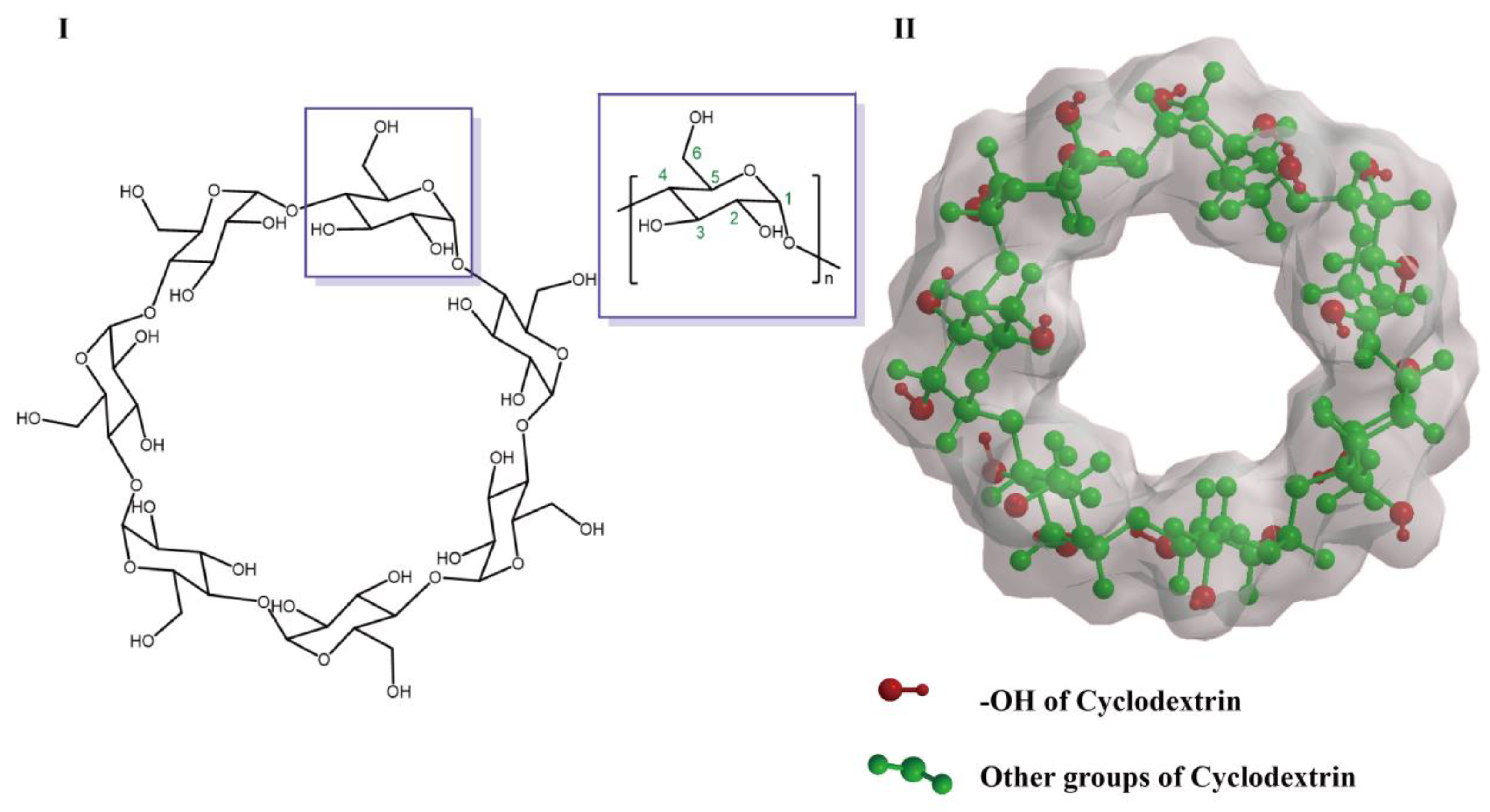
Figure 2.
I) Schematic of the curdlan-CyD dual drug delivery system; II) (A) Microscopic images and (B) fluorescence intensity measurements of RAW 264.7 macrophages (a, b, e, f) and L929 fibroblasts (c, d, g, h) incubated with rhodamine tagged curdlan and curdlan-CyD NPs, (C) Minimal inhibitory concentrations of free drugs and the drug loaded NPs released after 48 h [48]; III) Design of regorafenib@mannose-γ-CyD channel-type NPs (abbreviated as RG@M-γ-CD CNPs) and the synergetic anti-colorectal cancer mechanism; IV) (a, b) Cellular uptake of the CT26 and HT29 cells cultured with Rho@M-γ-CyD and Rho@γ-CyD CNPs (equivalent Rho, 5.0 μM) for 2 h. Scale bar, 20 μm. (c) FACS analysis and statistical result of intracellular fluorescence intensities induced by internalized Rho@M-γ-CyD and Rho@γ-CyD (equivalent Rho, 5.0 μM and 10.0 μM) in CT26 and HT29 cells. (d) In vitro cytotoxicity of different groups (equivalent RG, 0.5–10.0 μM) towards CT26 and HT29 cells with 12 h of treatment. N = 5 biological replicates in each group [50].
Figure 2.
I) Schematic of the curdlan-CyD dual drug delivery system; II) (A) Microscopic images and (B) fluorescence intensity measurements of RAW 264.7 macrophages (a, b, e, f) and L929 fibroblasts (c, d, g, h) incubated with rhodamine tagged curdlan and curdlan-CyD NPs, (C) Minimal inhibitory concentrations of free drugs and the drug loaded NPs released after 48 h [48]; III) Design of regorafenib@mannose-γ-CyD channel-type NPs (abbreviated as RG@M-γ-CD CNPs) and the synergetic anti-colorectal cancer mechanism; IV) (a, b) Cellular uptake of the CT26 and HT29 cells cultured with Rho@M-γ-CyD and Rho@γ-CyD CNPs (equivalent Rho, 5.0 μM) for 2 h. Scale bar, 20 μm. (c) FACS analysis and statistical result of intracellular fluorescence intensities induced by internalized Rho@M-γ-CyD and Rho@γ-CyD (equivalent Rho, 5.0 μM and 10.0 μM) in CT26 and HT29 cells. (d) In vitro cytotoxicity of different groups (equivalent RG, 0.5–10.0 μM) towards CT26 and HT29 cells with 12 h of treatment. N = 5 biological replicates in each group [50].
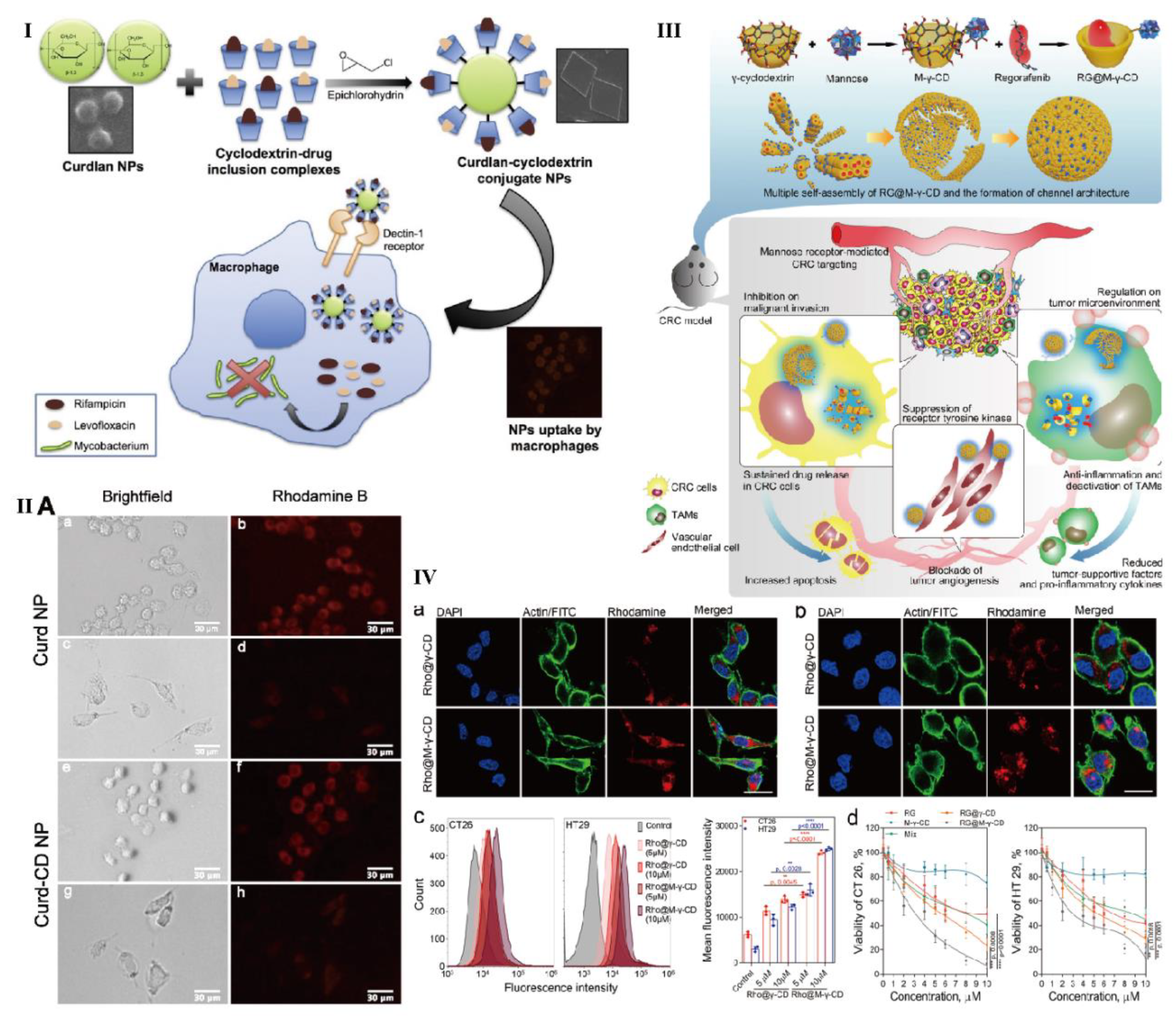
Figure 3.
Ⅰ) Depiction of light responsive β-CyD-azobenzen complex; Ⅱ) Depiction of H2O2 responsive β-CyD- phenylboronic acid pinacol ester complex; Ⅲ) Depiction of ROS responsive β-CyD-ferrocene complex; IV) Depiction of pH responsive β-CyD-benzimidazole complex.
Figure 3.
Ⅰ) Depiction of light responsive β-CyD-azobenzen complex; Ⅱ) Depiction of H2O2 responsive β-CyD- phenylboronic acid pinacol ester complex; Ⅲ) Depiction of ROS responsive β-CyD-ferrocene complex; IV) Depiction of pH responsive β-CyD-benzimidazole complex.
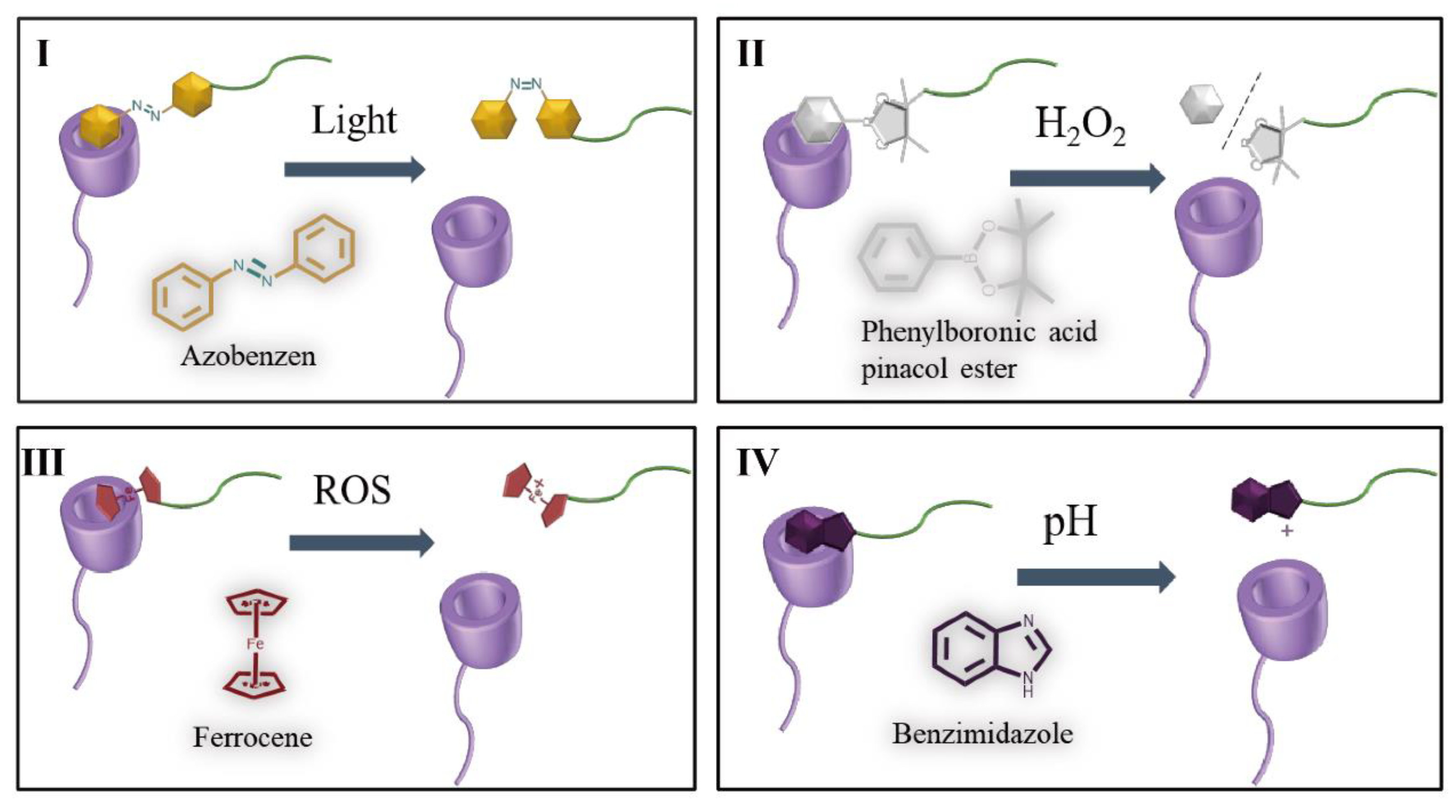
Figure 4.
Ⅰ) Preparation of Bi2Se3@hemin-(G-H)-HA NPs for cooperative cancer therapy. (A) BES-H2O2 fluorescence images, (B) corresponding 2.5D images, (C) flow cytometric diagram, and (D) corresponding fluorescence intensity of HepG2 cells with different treatments: (1) Blank; (2) H2O2; (3) Bi2Se3@hemin-(G-H)-HA NPs + H2O2; (4) Bi2Se3 @hemin-HA NPs + H2O2; (5) Bi2Se3@HA NPs + H2O2; (6) hemin + H2O2 [113]. Ⅱ) Schematic of the self-assembly of adamantane-functionalized M12L24 MOC with β-CyD-conjugated polyethylenimine (PEI-βCyD) and interact with proteins into supramolecular NPs for intracellular protein delivery. III) (a) Representation shows delivery of Cre deletes the stop cassette and activates downstream DsRed protein. (b) The green fluorescent protein expression profiles of the cells was quantified 48 h post protein delivery and compared to cells without treatment. The graph present mean ± SD. n = 3 repeats [118].
Figure 4.
Ⅰ) Preparation of Bi2Se3@hemin-(G-H)-HA NPs for cooperative cancer therapy. (A) BES-H2O2 fluorescence images, (B) corresponding 2.5D images, (C) flow cytometric diagram, and (D) corresponding fluorescence intensity of HepG2 cells with different treatments: (1) Blank; (2) H2O2; (3) Bi2Se3@hemin-(G-H)-HA NPs + H2O2; (4) Bi2Se3 @hemin-HA NPs + H2O2; (5) Bi2Se3@HA NPs + H2O2; (6) hemin + H2O2 [113]. Ⅱ) Schematic of the self-assembly of adamantane-functionalized M12L24 MOC with β-CyD-conjugated polyethylenimine (PEI-βCyD) and interact with proteins into supramolecular NPs for intracellular protein delivery. III) (a) Representation shows delivery of Cre deletes the stop cassette and activates downstream DsRed protein. (b) The green fluorescent protein expression profiles of the cells was quantified 48 h post protein delivery and compared to cells without treatment. The graph present mean ± SD. n = 3 repeats [118].
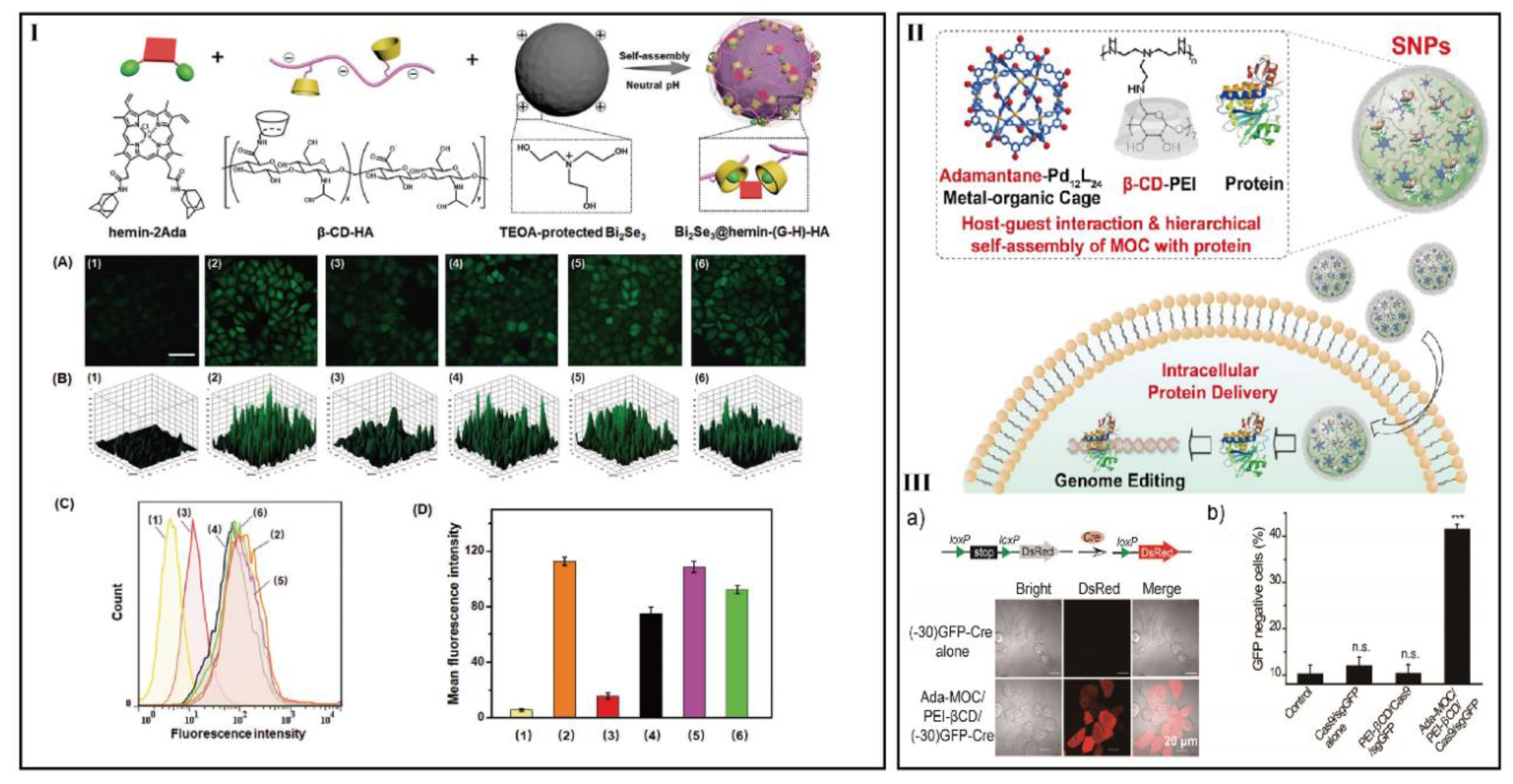
Figure 5.
Ⅰ) Schematic illustration of the synthetic procedure for core-shell-structured PEGMA@GQDs@γ-CyD-MOF composite and PEGMA@GQDs@γ-CyD-MOF-based DOX loading and pH-responsive controlled release system [128]. Ⅱ) Schematic illustration of the preparation of GSH responsive cubic gel particles. Ⅲ) CLSM of HepG2 cells treated with the as-prepared cubic gel after different incubation time [129].
Figure 5.
Ⅰ) Schematic illustration of the synthetic procedure for core-shell-structured PEGMA@GQDs@γ-CyD-MOF composite and PEGMA@GQDs@γ-CyD-MOF-based DOX loading and pH-responsive controlled release system [128]. Ⅱ) Schematic illustration of the preparation of GSH responsive cubic gel particles. Ⅲ) CLSM of HepG2 cells treated with the as-prepared cubic gel after different incubation time [129].
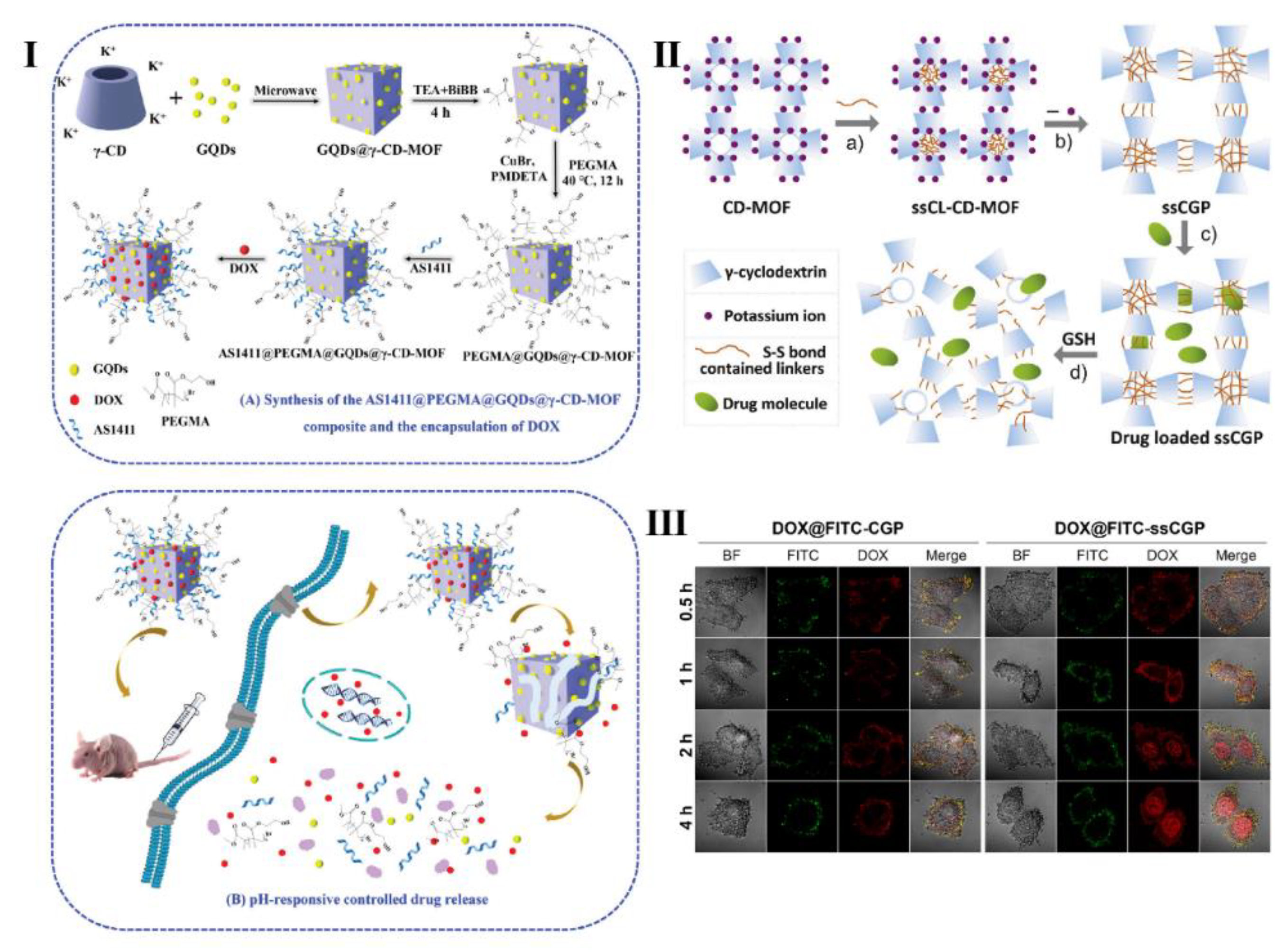
Figure 6.
Ⅰ) (A) Schematic of 4-arm PRX platform for systemic plasmid delivery; (B) The synthesis routes of 4-arm PRX; (C) Optimizing the cationic charge density on α-CyD rings; Ⅱ) Optimized 4-arm PRX enhanced the PK and tumor biodistribution of Cy3-labeled plasmid in vivo. (A) Summary of physicochemical properties of the proposed 4-arm PRX. (B) Evaluating the PK profile of Cy3-plasmid in C57BL/6 mice [137]; Ⅲ) Schematic illustration for preparing PRX. (B) Representative TEM image of the prepared PRX. (C) Cumulative release at various H2O2 concentrations in the presence of 1 μM FeSO4. (D) In vitro dissociation properties [141].
Figure 6.
Ⅰ) (A) Schematic of 4-arm PRX platform for systemic plasmid delivery; (B) The synthesis routes of 4-arm PRX; (C) Optimizing the cationic charge density on α-CyD rings; Ⅱ) Optimized 4-arm PRX enhanced the PK and tumor biodistribution of Cy3-labeled plasmid in vivo. (A) Summary of physicochemical properties of the proposed 4-arm PRX. (B) Evaluating the PK profile of Cy3-plasmid in C57BL/6 mice [137]; Ⅲ) Schematic illustration for preparing PRX. (B) Representative TEM image of the prepared PRX. (C) Cumulative release at various H2O2 concentrations in the presence of 1 μM FeSO4. (D) In vitro dissociation properties [141].
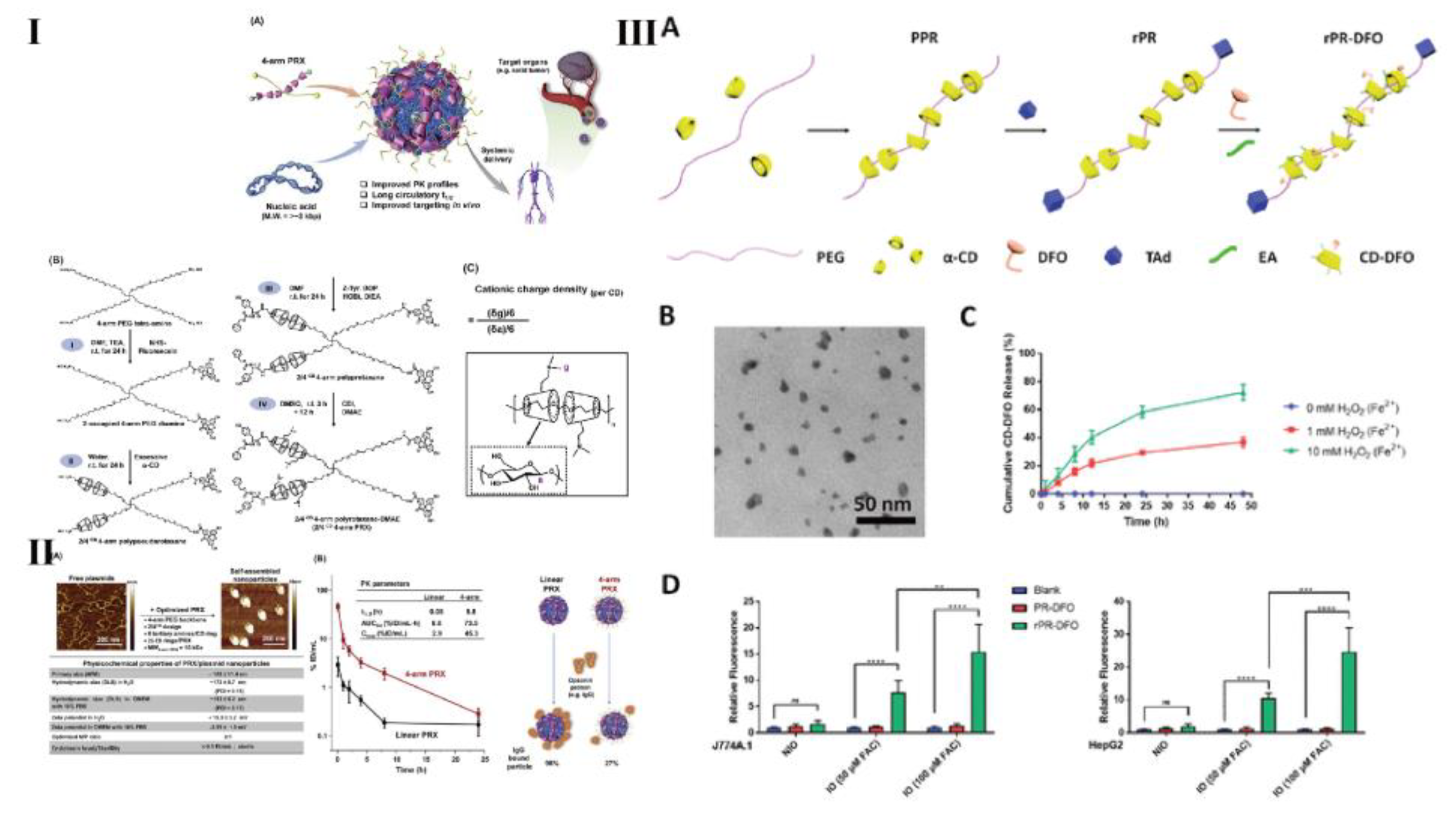
Figure 7.
Ⅰ) Chemical structure of ibuprofen and HP-β-CyD, formation of inclusion complex between ibuprofen and HP-β-CyD molecules and the electrospinning of HP-β-CyD/ibuprofen-IC nanofibers. Ⅱ) (a) XRD and (b) DSC analysis of the as-prepared nanofibers. Ⅲ) (a) Dissolution behavior of as-prepared nanofibers. (b) Disintegration behavior of the as-prepared nanofibers at the artificial saliva environment [149].
Figure 7.
Ⅰ) Chemical structure of ibuprofen and HP-β-CyD, formation of inclusion complex between ibuprofen and HP-β-CyD molecules and the electrospinning of HP-β-CyD/ibuprofen-IC nanofibers. Ⅱ) (a) XRD and (b) DSC analysis of the as-prepared nanofibers. Ⅲ) (a) Dissolution behavior of as-prepared nanofibers. (b) Disintegration behavior of the as-prepared nanofibers at the artificial saliva environment [149].
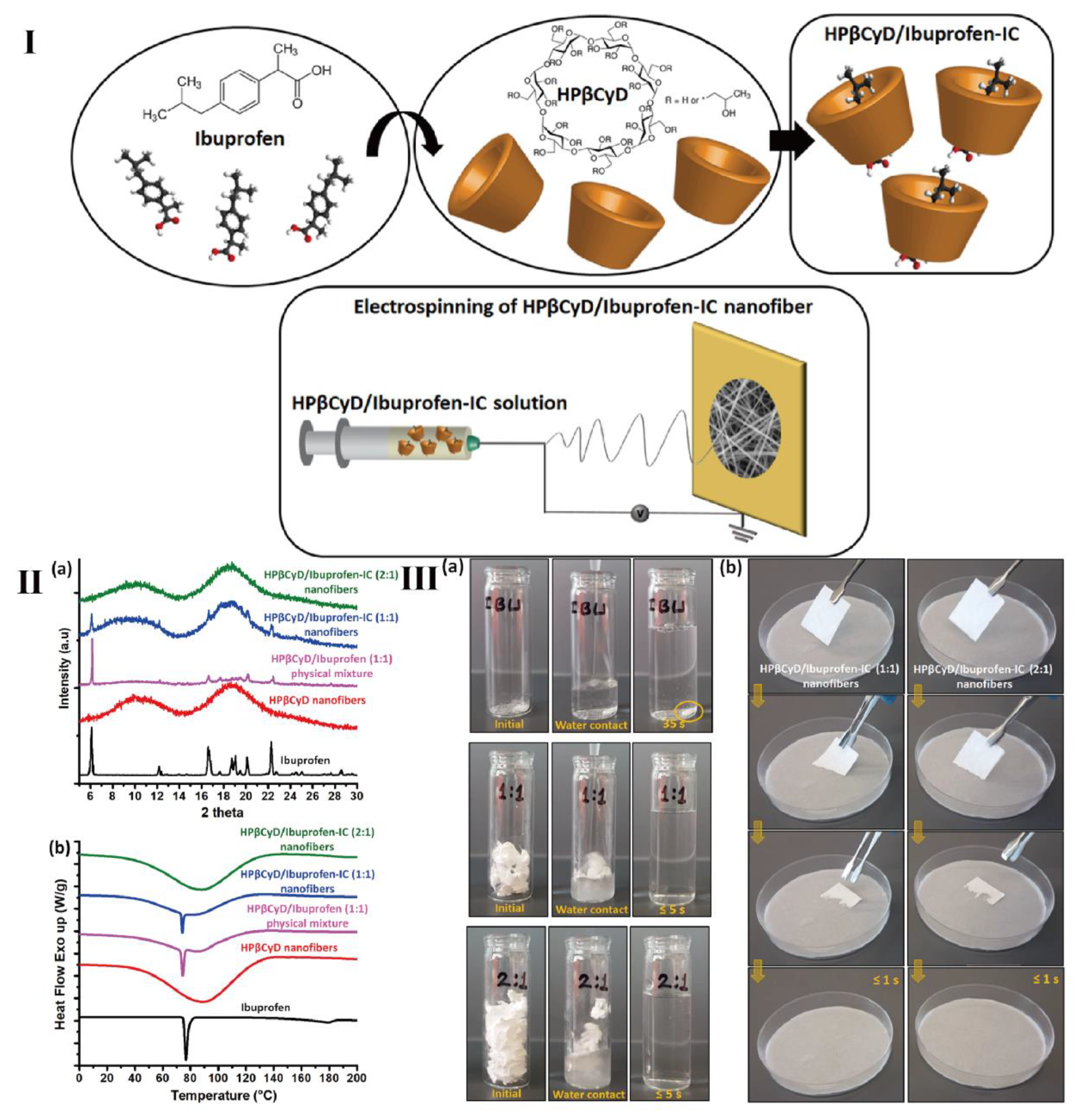

Table 1.
Stimulus responsive units based on CyDs in drug delivery.
| CyD type | stimuli | Responsive guest molecules | drug | cells | Ref |
|---|---|---|---|---|---|
| β-CyD | Light | Azo | DOX | MCF-7 | [6] |
| β-CyD | NIR irradiation and reductase | Arylazopyrazole | siRNA | A549, HeLa, and 293T | [73] |
| β-CyD | light | Azo | Diclofenac sodium | MC3T3-E1 | [74] |
| β-CyD | ROS | 6-(Mercaptohexyl) ferrocene | β-Cyclodextrin/L-Arginine/Au Nanomotors | RAW264.7, and HUVECs | [75] |
| β-CyD | Light | Arylazopyrazole | Gold, iron oxide, and lanthanide-doped LiYF4 NPs | [76] | |
| β-CyD | Light | Azo | Azo modified lanthanide upconversion NPs and β CD modified downconversion nanoprobes | HEK293T and CaOV3 | [77] |
| β-CyD | Hypoxia | Azo | Rho-TP | MCF-7 | [78] |
| β-CyD | H2O2 | Phenylboronic acid pinacol ester | DOX | 4T1 | [79] |
| β-CyD | ROS | Fc | CuS | B16 | [80] |
| β-CyD | pH | Benzimidazole | DOX | MCF-7 | [81] |
| β-CyD | ROS | Fc | DOX | 4T1 | [82] |
| β-CyD | pH | benzimidazole | β-CyD | [83] | |
| β-CyD | H2O2 | Fc | Glucose oxidase | CT26 | [84] |
| β-CyD | Glucose | Phenylboronic acid | Insulin | L929 | [85] |
| β-CyD | ROS | Fc | DOX | HepG2 | [86] |
| β-CyD | ROS | Fc | DOX | HeLa | [87] |
| β-CyD | ROS | Fc | DOX | Bel-7402 and L02 | [88] |
| β-CyD | ROS | Fc | CPT | HEK-293T and PC3 | [89] |
| β-CyD | ROS | Fc | Platinum (IV) | 4T1 | [90] |
| β-CyD | ROS | Fc | Carboxy phthalocyanine | HT29 and A431 | [91] |
Table 2.
Representative self-assembly works based on charge interactions.
| Strategy | Carrier | Drug | Target | cells | Ref |
|---|---|---|---|---|---|
| Dual stimulus responsive of NIR irradiation and reductase under anaerobic conditions | Upconversion NPs encapsulated by β-cyclodex- trin-grafted hyaluronic acid /spermine modified with arylazopyrazoles-IC | siRNA | CD44 | A549, HeLa, and 293T | [76] |
| layer-by-layer coating | Anionic-β-CyD and poly(acrylic acid) and poly(l-lysine) | Tetracycline | HGF and S. aureus | [108] | |
| Host-guest inclusion forms the cationic supramolecular polymer | Cationic β-CyD/ adamantane (Ad)-poly (vinyl alcohol) (PVA)-poly(ethylene glycol) (PEG) -IC | siRNA | A549 and A549/GFP | [111] | |
| Improving Plasmid Transfection in 2D and 3D Spheroid Cells | Cationic hyper-branched cyclodextrin-based polymers | Plasmid DNA | EGFP | HT-29 | [112] |
| Chemodynamic therapy photodynamic therapy | β-CyD-HA/ Bi2Se3 NPs | Bi2Se3 and hemin-2Ada | NIR light assisted tumor targeting | HepG2 | [113] |
| Compact polyelectrolyte complexes | β-CyD-functionalized chitosan/ alginate |
Piroxicam | pH |
RAW | [114] |
| Templated synthesis | CyD-nanoGUMBOS | IR780 | MDA-MB-231, Hs578T, and MCF-7 | [115] | |
| Individually over coming bio-barriers at each delivery stage | PEG-b-PLLDA/MSNs-SS-Py/CyD-PEI | DOX | P-glycoprotein | MCF7/ADR | [116] |
| Doubly linked aromatic clip-polycationic CyD hybrids | CyD-aromatic hybrid/ plasmid DNA | Plasmid DNA | COS-7, and HepG2 | [117] | |
| Hierarchical self-assembly | β-CyD-conjugated polyethylenimine with damantane-functionalized M12L24 MOC-IC | Proteins | HeLa, HeLa-DsRed, and HEK-GFP | [118] | |
| CyD conjugates with dendrimer | Glucuronylglucosyl-β-CyD conjugate | Cas9/single-guide RNA complex | Mouse brain | SHSY5Y | [119] |
| Protein co-assembly | Wind chime-like lysine modified CyD | Ribonuclease A and deoxyribo- nuclease I |
Nucleus | Hela | [120] |
| Layer-by-layer self-assemble | Cationic poly(CyD)/ alginate | 4-Hydroxy- tamoxifen |
Pyrene and 4- hydroxy-tamoxifen | Immortalized mouse podocytes | [121] |
| Combinational therapy | Cationic poly (L-lysine) modified by β-CyD / PEGylated tetraphenyl- porphyrin (TPP)-IC | TPP-PEG and DNA | HeLa | [122] | |
| Cationic moieties for targeted delivery and enhanced uptake | Cationic CyD magnetic nanocarrier | MTX | Magnetic | Saos-2 and human red blood cells | [123] |
| Intracellular protein delivery with fluorescent microscopy imaging | Tetraphenylethylene-featured metal-organic cages (MOCs) and β-CyD-conjugated polyethylenimine | Tetraphenyle- thylene and protein | MAPK/ERK signaling | Neural cells | [124] |
| Synergistic therapy | Multiple β-CyD-attached QD NPs/Ad-modified TCP1 peptide-targeting ligand | 5-Fluorouracil and miRNA- 34a mimics | Colorectal cancer | DLD1 | [125] |
Disclaimer/Publisher’s Note: The statements, opinions and data contained in all publications are solely those of the individual author(s) and contributor(s) and not of MDPI and/or the editor(s). MDPI and/or the editor(s) disclaim responsibility for any injury to people or property resulting from any ideas, methods, instructions or products referred to in the content. |
© 2023 by the authors. Licensee MDPI, Basel, Switzerland. This article is an open access article distributed under the terms and conditions of the Creative Commons Attribution (CC BY) license (http://creativecommons.org/licenses/by/4.0/).
Copyright: This open access article is published under a Creative Commons CC BY 4.0 license, which permit the free download, distribution, and reuse, provided that the author and preprint are cited in any reuse.


