

Submitted:
11 April 2023
Posted:
11 April 2023
You are already at the latest version
Abstract
(1) Background: Foot strike pattern and cadence are two important variables that are related to sport performance and injury risks; the objective of this study is to analyse the foot strike pattern and cadence of the male elite athlete that participated in the Tokyo Olympic Games marathon. (2) Methods: Two independent researchers analysed the foot strike pattern of the first 51 participants in the 5km, and the cadence of the finalists in three different segments of the race. Descriptive statistics were presented for the main variables of this study. A repeated measures ANOVA was used to study the differences in cadence between different sections of the race (p<0.05). (3) Results: Average of the cadence of the eight finalists was 185.5 steps per minute (SD ± 5.1). No differences between sections of the race were found. The more most common foot strike pattern was midfoot strike pattern, followed by rearfoot strike pattern, and forefoot strike pattern. The results of cadence are in line with previous studies that analysed elite athletes, with the values being higher than other research involving recreational runners. (4) Conclusions: elite marathon runners mostly run with a running non-rearfoot strike pattern and a cadence of over 185 steps per minute.
Keywords:
marathon
; performance
; foot strike pattern
; Olympic Games
; cadence
; running
1. Introduction
For coaches and athletes, knowing how elite athletes develop their technique in real sports context offers very valuable information to generate performance profiles of the best athletes, as well as to know the differences between the most and least successful athletes in competition, a context with very particular characteristics that do not occur in training or in controlled studies. In addition, this information can be integrated into the training plans and strategies to correct possible technical errors of the athletes and consequently improve the final performance and prevent from injuries. The analysis of the athlete in real context requires a very complex research methodology, due to the lack of control that researchers have over the environment, however in the literature we find many examples of this type of studies in events such as the long jump [1] or marathon [2].
Nowadays, long-distance road races are gaining relevance at all levels. [3]. In particular, we can highlight among others: the great improvement in world records and athletes personal bests, the increase in running footwear innovations [4], as well as the increase in the number of recreational runners and popular races worldwide [3]. All this context has generated an important change in the world of athletics and has turned road races into the events with the greatest media and sporting impact today, such as the 1:59 challenge held in Vienna with Eliud Kipchoge as the protagonist. To our knowledge, there is only one previous study that analyse elite marathon athletes in a real sporting context, held at World Athletics Championships in London in 2017 [2].
The Olympic Games is one of the most important competitions in the field of sport due to its great media and sporting impact. The world's best athletes and their coaches prepare for this event in a very special way. However, no biomechanical analysis of the marathon event at the Olympic Games is known to date.
The footstrike pattern is one of the main variables in long distance running that has been analysed in several scientific studies and is currently the subject of much debate. There are three types of patterns: heel strike or rear foot strike (RFS), midfoot strike (MFS), and forefoot strike (FFS). It is important to note that these last two types of stance techniques show important biomechanical differences, although in some scientific studies they are considered to be the same. FFS shows increased muscle activity in the gastrocnemius muscles. [5] as well as a higher ankle torque compared to the other two types of techniques. [6].
There is a trend that advocates that the best landing technique for long distance races is the MFS. Several studies conclude that this type of stance technique reduces vertical impact [7] a variable related to the risk of running injuries. Folland et al. associate MFS running with improved performance and increased running economy. [8]. Studies focusing on running retraining technique use the change from RFS to MFS to avoid injury mechanisms [9] and also as a strategy for recovery from common running injuries [10]. Another study with experienced non-elite athletes concludes that to achieve better running economy, a MFS with a long contact time should be sought. [11].
However, there is another stream that concludes that there is insufficient evidence to suggest an improvement in running economy and a prevention of injury risk factors by changing the running pattern from RFS to NRFS (non-rearfoot strikers). [12].
According to the results of the study mentioned above that analysed the technique of the finalists at the 2017 London Marathon World Championships drew the following conclusions: the majority of elite athletes used a heel strike technique (65%). In addition, it was found that elite athletes tend to maintain the type of landing technique throughout the race, so one point of analysis may be sufficient to study this variable in elite athletes. Thirdly, it was observed that there was no difference between the fastest and slowest athletes. [2]. Also noteworthy is the study by Hasegawa et al, which obtained similar results when the entire study sample was included in the analysis, however, Hasegawa's team observed that in the group of the fastest athletes (the first 50) there was a higher percentage of non-rear foot strikers (NRFS), concluding that the percentage of NRFS increased with increasing speed. [13].
These results are in line with the results of other studies involving recreational runners in long-distance races, where the percentage of RFS is as high as 93% in marathons. [14] y 89% in ultra-marathon events [15]. As a general conclusion we can say that recreational runners show RFS.
On the other hand, if we analyse the technique of elite athletes in the track over 10.000m, we observe a different trend. the main foot strike pattern is FFS and MFS. Moreover, the authors did not find any RFS [16]
The latest innovations in running footwear that are coming to market, as noted above, are revolutionising road athletics. As a result of the inclusion of this type of footwear in competitions, an improvement in performance has been observed at the global level in the main marathons of the world, which is 0.8% for men and 1.6% for women. [17]. To our best knowledge, there are no studies that have analysed the type of foot strike patterns of elite runners in real competition using the new running shoes.
Another essential variable for the analysis of sports performance in long-distance running is the running cadence (the number of steps the athlete takes per minute or per second (Hz)). This is directly related to running speed and athletic level. As Quinn and colleagues pointed out in a previous study, different researches set 180 steps per minute as an optimal cadence value.[18], other studies put the optimum value at an average of 176 steps per minute. [19].
According to some authors, raising the cadence to 180 steps resulted in a reduction in heart rate and a decrease in oxygen consumption in well-trained athletes. [18]. Accordingly, previous studies conclude that the preferred cadence of runners tends to perform worse than the preferred cadence plus 5% or 10%. [20]. Small increases in cadence can reduce the load on the hip and knee, the vertical movement of the centre of gravity and the vertical movement of the centre of gravity. [20], the vertical impact [21] and the oxygen consumption [22]. So, knowing the cadence pattern of elite athletes in real competition context with the new footwear innovations can allow coaches and athletes to develop training strategies to achieve better results and avoid sports injuries related to vertical impacts.
Given that there are no known studies that analyse neither the landing technique nor the cadence wearing the new running shoes during an Olympic marathon, the following study has two objectives: to analyse the running strike pattern and the cadence of the participants in the men's marathon of the last Olympic Games in Tokyo 2020. Aligned with the objectives, two hypotheses are proposed: (1) most of the athletes participating in the Olympic Games marathon will present a heel strike technique, (2) the average cadence of the finalists will be above 180 strikes per minute (> 3Hz).
2. Materials and Methods
2.1. Protocol and data collection
For the study of cadence, the complete broadcast of the marathon was used, the cadence was analysed in three sections of the race: km 10-20, km 20-30 and km 30-40, and the average in each segment per finisher was obtained from two independent observers (JGP, JLL). The cadence was calculated as follow:
The descriptive study of the marathon runners' strike pattern technique was carried out by analysing a sagittal plane slow motion (100Hz) footage of the 5 km of the race broadcasted by the organisers of the Tokyo 2020 Olympic Games marathon (Figure 1).
The images were processed with the Kinovea software (version 0.9.3 for Windows) [23] [24]. The whole analysis was conducted by two track and field coaches (JGP, JLL) with experience in biomechanical running analysis.
The race took place in Saporo (North of Japan), 6 a.m. with a temperature of 26ºC to 28ºC with humidity between 72% and 80%.
2.2. Participants
For the study of cadence, we took the data from the eight finalists, whereas for the analysis of the foot strike pattern, data from 52 participants in the men's marathon, including the 8 finalists, were collected. Since the athletes were very close to each other, and the footage was taken from the left side, it was not possible to collect information on 3 right foot strikes.
2.3. Study variables
The two variables of analysis were: cadence measured in steps per minute and frequency; and the foot strike pattern of athletes. Following the methodology of other previous studies, the foot strike pattern was considered categorical variable with three levels, which imply three types of ground contact: (1) rearfoot strike (RFS), which occurs when the runner's foot contacts the ground heel first and in dorsiflexion, (2) midfoot strike (MFS), which occurs when the runner contacts the foot parallel to the ground close to the anatomical position, and (3) forefoot strike (FFS), which occurs when the athlete contacts the ground first with the forefoot area in plantar flexion. [13].
2.4. Data analysis
Firstly, for the descriptive analysis of the data, different statistics were used depending on the type of variable. For quantitative variables we calculated: mean (M), standard deviation (SD), coefficient of variation (CV), maximum and minimum, whereas for categorical variables the absolute frequencies and cumulative frequencies.
In addition, to analyse whether there were differences between the cadences of the kilometre sections, we first used a Shapiro Willk test to verify the normality of the data, and then a repeated measures ANOVA (p<0.05).
Inter-rater reliability of the strike pattern identification as well as the cadence calculation was analysed using interclass correlation coefficient (ICC). Interpretation of the ICC values was: good, 0.75 and above; moderate, 0.50 to 0.74; and poor, below 0.50. [25]
The statistical analysis was performed using SPSS Statistics for Windows (IBM SPSS Statistics for Windows, Version 26.0. IBM Corp, Armonk, NY, USA).
3. Results
For all the variables analysed, ICCs above 0.89 were obtained, showing high inter-observer concordance (Table 1).
Given the weather conditions in Tokyo in August, the Olympic marathon was held in Saporo, a city in northern Japan with more favourable conditions for long-distance events. Even so, the athletes had to face temperatures of 26ºC to 28ºC with humidity between 72% and 80% according to the organisers. The race was won by Eloid Kypchoge with a time of 2:08:38, far from his personal best and world record of 2:01:09. The average time of the eight finishers was 2:10:21, and the pace of the leading pack in the half marathon was 1:05:15.
MFS was the most common stance pattern with both feet (58.8% left foot and 54.2% right foot). In second place, RFS (31.4% left foot and 35.4% right foot) and lastly, FFS was the minority stance pattern (9.8% left foot and 10.4% right foot). These data show that there is a total percentage of NRFS of 68.6% and 64.6% for the left and right stance respectively (Table 2). It is worth noting that 5 athletes showed different strike patterns with the left and right foot. Regarding the eight finalists, three were MFS runners, two FFS, two RFS and one had asymmetrical landing technique, MFS for the right foot and RFS for the left foot.
Regarding cadence of the eight finalists, an average cadence of 185.5 ± 5.1 steps per minute (mean±SD) was observed throughout the race, which represents a coefficient of variation of 2.7%. On the other hand, the three medallists have a total cadence of 188.6 ± 2.3 steps per minute, showing a coefficient of variation of 1.2 %. If we analyse the evolution during the race we see that there are no differences between kilometre sections, F(2, 21) = 0.102, p>0.05, the cadence values remain very stable from 10km to 40km (Table 3).
4. Discussion
This study presents two objectives associated with each of the two hypotheses. According to running strike pattern, the first hypothesis was rejected because the majority of the runners analysed were NRFS. It should be noted that the results obtained by this study differ from the results found in the literature, in other studies most runners were RFS (Table 4). The main reasons of this difference may be due to the sample analysed. While the participants in this study were elite athletes competing in the Tokyo 2020 Olympic Games, other studies studied recreational runners. [13,14,15]. On the other hand, the only study with elite athletes in competition (2), also obtained different results (65 % RFS) this could be due to two reasons. First, the use of the new types of footwear that integrate carbon fibre plates. The second reason can be attributed to different ways between studies in defining a RFS runner. The discrepancies in labelling the foot strike pattern could be caused by the drop of the shoes (difference between the thickness of the heel and the toe area of the midsole) which can sometimes reach 12 mm and can lead to a false RFS (the heel touches the ground first) even though the athlete runs with a MFS and contacts the ground in an anatomical position without dorsal flexion or plantar flexion.
As presented at the background, there is still an open debate about the optimal landing technique in running. Regarding the FFS pattern, it should be noted that it has been observed in a very small number of Olympic athletes (10.4% and 9.8% in the right and left foot, respectively), knowing that this landing technique is more demanding for the foot musculature [5], does not seem to be the recommended landing technique for long distances, such as the marathon specially for recreational runners. On the other hand, in the final of 10.000 m of the 2017 World Championships it was observed that of the 12 finalists, up to 9 ran at some point in the race with FFS Furthermore, this recent study concluded that all participant in the final were NRFS, and some athletes switched from MFS to FFS during the race based on tactical criteria [16]. If a national level athlete aims to follow the same foot strike pattern as elite athletes, he/she should be aware that FFS is the most demanding landing technique that needs a good adaptation period and a specific training of the intrinsic and extrinsic musculature of the foot. It is also a technique that places greater stress on the ankle muscle-tendon unit [6].
In accordance with the results of this study, the MFS pattern is the most chosen by the elite athletes analysed. In addition, the results of previous studies showed several reasons for adopting this running technique: (1) MFS is related to better performance and greater running economy [8], (2) MFS reduces vertical impact compared to RFS [7], (3) studies focused on running retraining proposed a change from RFS to NRFS as a strategy to reduce the risk of injury and as a treatment strategy for running injuries [10], (4) is a technique that avoids excessive dorsiflexion of the foot which poses a risk of injury [26]. If we consider all mentioned above, we can conclude that MFS this is the most favorable technique for long distance road events.
To analyse the foot strike pattern, we used a kilometre point in the initial phase of the race. This could be understood as a limitation for not having a broad view of the entire race, however given the results of Hanley et al. which concluded that no changes were observed in the strike pattern during the marathon race at the 2017 World Championships after analysing 4 kilometre points. [27], at a methodological level this approach is considered adequate to analyse a high-level competition such as an Olympic Games.
As for the second objective focused on cadence, it was hypothesised that the finalists in the Olympic marathon would run with a cadence greater than 180 steps per minute (>3 Hz). After the descriptive analysis this hypothesis was validated as the average was 185.5 steps per minute. In the analysis of the London 2017 World Championships Marathon, the average of the eight finalists was 183.15 [28], similar to the results obtained in this study. These values are higher than the cadence results obtained in long-distance trained athletes [21] and recreational runners [29] in which the average of the sample analysed does not exceed 180 steps per minute. It should be noted that cadence depends on several factors such as speed, weight, technique, distance covered and height of the athlete. No studies define a single cadence value for all athletes and distances. The cadence should be adapted to each athlete according to his or her needs, taking into account that small increases (5%) in the preferred cadence reduce the load on the hip and knee, as well as the vertical movement of the centre of mass and the braking impulse. [20].
If we analyse the results of the present study and the data provided by the literature related to cadence, for high-level marathon athletes whose running speed is around 18km/h, it is considered a recommendable cadence run around 185 steps per minute (3.08 Hz).
A high stability of cadence was observed throughout the Olympic marathon, the values remained constant throughout the race with a mean coefficient of variation of 2.7% (p>0.05), in line with previous studies [16] . Even the winner, Eliud Kipchoge, who ran the second half marathon with two minutes less than the first, kept his cadence constant, increasing stride width to increase speed in the last part of the race (cadence km 10-20: 186ppm, cadence km 20-30: 185ppm, cadence km 30-40: 187ppm).
There are four limitations to this study: firstly, it was not possible to analyse the cadence of all the athletes as a television signal was used; secondly, given the impossibility of placing markers as it was an official competition, it was not possible to analyse some very relevant variables such as the angle of the tibia at the moment of contact; thirdly, for the analysis of the foot strike angle, it was only possible to analyse the footage from the left side, for this reason, some stance made with the right foot of three athletes were lost, and finally, difficulties were encountered when analysing some athletes, since when running in a pack there were runners who covered other competitors, making it impossible to develop the biomechanical analysis.
The main strength of this study was its context of analysis. It was conducted at the most important world competition of the year, where the athletes did not receive any instruction from a research point of view, which allows for a better understanding of the performance of world-class athletes.
To continue transferring knowledge to coaches and athletes, future studies conducted in real competition context should analyse other variables (e.g. tibia inclination, temporal variables, duty factor,…) that allow establishing a biomechanical profile of the foot strike pattern. It would also be essential to perform an association analysis to find out which of these variables best predicts running economy and performance. In this sense, it would be necessary to analyse an elite race on a flat course, with good weather conditions and with pacers who set a constant and maximum pace until approximately the 30th kilometre of the race. In addition, it would be interesting to increase the experimental sample and to be able to record both the right and the left sides of the athletes in the same race.
5. Conclusions
In summary, the marathon runners who competed in the Tokyo Olympics were mostly MFS and the cadences observed in the finalists were stable throughout the race and were above 185 steps per minute. The main results of this study could be use by coaches and runners to develop training strategies to achieve better results in competition.
Author Contributions
Conceptualization, JGP and JLL.; methodology, JGP, ARA and DG.; data collection, JGP and JLL, data analysis CAV and ARA. Writing—original draft preparation, JGP, CAV.; writing—review and editing, ARA. All authors have read and agreed to the published version of the manuscript.
Funding
This research received no external funding
Institutional Review Board Statement
The study was conducted according to the guidelines of the Declaration of Helsinki.
Informed Consent Statement
not applicable.
Data Availability Statement
All available data can be obtained by contacting the corresponding author.
Conflicts of Interest
The authors declare no conflict of interest.
References
- Campos J, Gámez J, Encarnación A, Gutiérrez-dávila M, Rojas J. Three-Dimensional Kinematic Analysis of the Long Jump at the 2008 IAAF World Indoor Championships in Athletics. New Stud Athletics. 2013;(3):115–31.
- Hanley B, Bissas A, Merlino S, Gruber AH. Most marathon runners at the 2017 IAAF World Championships were rearfoot strikers, and most did not change footstrike pattern. J Biomech. 2019;92:54–60. [CrossRef]
- Chan ZYS, Zhang JH, Au IPH, An WW, Shum GLK, Ng GYF, et al. Gait Retraining for the Reduction of Injury Occurrence in Novice Distance Runners: 1-Year Follow-up of a Randomized Controlled Trial. Am J Sports Med. 2018;46(2):388–95. [CrossRef]
- Hoogkamer W, Kipp S, Kram R. The Biomechanics of Competitive Male Runners in Three Marathon Racing Shoes: A Randomized Crossover Study. Sport Med [Internet]. 2019;49(1):133–43. Available from. [CrossRef]
- Shih Y, Lin KL, Shiang TY. Is the foot striking pattern more important than barefoot or shod conditions in running? Gait Posture [Internet]. 2013;38(3):490–4. Available from:. [CrossRef]
- Kerrigan DC, Franz JR, Keenan GS, Dicharry J, Della Croce U, Wilder RP. The Effect of Running Shoes on Lower Extremity Joint Torques. PM R [Internet]. 2009;1(12):1058–63. Available from:. [CrossRef]
- Barnes A, Gámez-Paya J, Castelli A, Heller B. Foot Strike Patterns in Runners Wearing Floating Heel, Minimalist and Conventional Footwear. In: 33rd International Conference on Biomechanics in Sports. Poitiers, France; 2015. p. 519–522.
- Folland JP, Allen SJ, Black MI, Handsaker JC, Forrester SE. Running Technique is an Important Component of Running Economy and Performance. Med Sci Sports Exerc. 2017;49(7):1412–23. [CrossRef]
- Napier C, Cochrane CK, Taunton JE, Hunt MA. Gait modifications to change lower extremity gait biomechanics in runners: A systematic review. Br J Sports Med. 2015;49(21):1382–8. [CrossRef]
- Gamez-Paya J, Dueñas L, Arnal-Gómez A, Benítez-Martínez JC. Foot and lower limb clinical and structural changes in overuse injured recreational runners using floating heel shoes: Preliminary results of a randomised control trial. Sensors. 2021;21(23). [CrossRef]
- Di Michele R, Merni F. The concurrent effects of strike pattern and ground-contact time on running economy. J Sci Med Sport [Internet]. 2014;17(4):414–8. Available from:. [CrossRef]
- Anderson LM, Bonanno DR, Hart HF, Barton CJ. What are the Benefits and Risks Associated with Changing Foot Strike Pattern During Running? A Systematic Review and Meta-analysis of Injury, Running Economy, and Biomechanics [Internet]. Vol. 50, Sports Medicine. Springer International Publishing; 2020. 885–917 p. Available from. [CrossRef]
- Hasegawa HIH, Yamauchi TAY, Kraemer WIJK. Foot strike patterns of runners at the 15-km point during an elite-level half marathon. Strength Cond. 2007;21(3):888–93.
- Larson P, Higgins E, Kaminski J, Decker T, Preble J, Lyons D, et al. Foot strike patterns of recreational and sub-elite runners in a long-distance road race. J Sports Sci. 2011;29(15):1665–73. [CrossRef]
- Kasmer ME, Wren J, Hoffman MD. Foot strike pattern and gait changes during a 161-km ultramarathon. J Strength Cond Res. 2014;28(5):1343–50. [CrossRef]
- Hanley B, Tucker CB, Bissas A, Merlino S, Gruber AH, Hanley B, et al. Footstrike patterns and race performance in the 2017 IAAF World Championship men’ s 10 , 000 m final World Championship men ’ s 10 , 000 m final. Sport Biomech [Internet]. 2021;00(00):1–10. Available from. [CrossRef]
- Senefeld JW, Haischer MH, Jones AM, Wiggins CC, Joyner R, Hunter S. Technological advances in elite marathon performance. J Appl Physiol. 2021;130(6):2002–8. [CrossRef]
- Quinn TJ, Dempsey SL, LaRoche DP, Mackenzie AM, Cook SB. Step frequency training improves running economy in well-trained female runners. J Strength Cond Res. 2021;35(9):2511–7. [CrossRef]
- Hunter I, Smith GA. Preferred and optimal stride frequency, stiffness and economy: Changes with fatigue during a 1-h high-intensity run. Eur J Appl Physiol. 2007;100(6):653–61. [CrossRef]
- Heiderscheit BC, Chumanov ES, Michalski MP, Wille CM, Ryan MB. Effects of step rate manipulation on joint mechanics during running. Med Sci Sports Exerc. 2011;43(2):296–302. [CrossRef]
- Kliethermes SA, Stiffler-Joachim MR, Wille CM, Sanfilippo JL, Zavala P, Heiderscheit BC. Lower step rate is associated with a higher risk of bone stress injury: A prospective study of collegiate cross-country runners. Br J Sports Med. 2021;(May):1–6. [CrossRef]
- Lieberman DE, Warrener AG, Wang J, Castillo ER. Effects of stride frequency and foot position at landing on braking force, hip torque, impact peak force and the metabolic cost of running in humans. J Exp Biol [Internet]. 2015;218(21):3406–14. Available from: http://jeb.biologists.org/cgi/doi/10.1242/jeb.125500.
- Fernández-González P, Koutsou A, Cuesta-Gómez A, Carratalá-Tejada M, Miangolarra-Page JC, Molina-Rueda F. Reliability of kinovea® software and agreement with a three-dimensional motion system for gait analysis in healthy subjects. Sensors (Switzerland). 2020;20(11). [CrossRef]
- Damsted C, Nielsen RO, Larsen LH. Reliability of video-based quantification of the knee- and hip angle at foot strike during running. 2015;10(2):147–54.
- Portney L, Watkins M. Foundations of Clinical Research: Applications to Practice. Prentice Hall, editor. Vol. 892. Upper Saddle River; 2009.
- Davis IS, Futrell E. Gait Retraining: Altering the Fingerprint of Gait Irene. Phys Med Rehabil Clin N Am. 2019;27(1):339–55.
- Hanley B, Bissas A, Merlino S, Gruber AH. Most marathon runners at the 2017 IAAF World Championships were rearfoot strikers, and most did not change footstrike pattern. J Biomech [Internet]. 2019; Available from: https://linkinghub.elsevier.com/retrieve/pii/S0021929019303562.
- Hanley B, Bissas A, Sutton L, Gallagher L, Lawton L, Cooke M, et al. Biomechanical report for the IAAF World Championships. London 2017. Marathon Men’s. Leeds; 2017.
- Ruiter C, Verdijk P, Werker W, Zuidema M, De Haan A. Stride frequency in relation to oxygen consumption in experienced and novice runners. Eur J Sport Sci. 2014;14(3):251–8. [CrossRef]
Figure 1.
Sagittal plane footage.
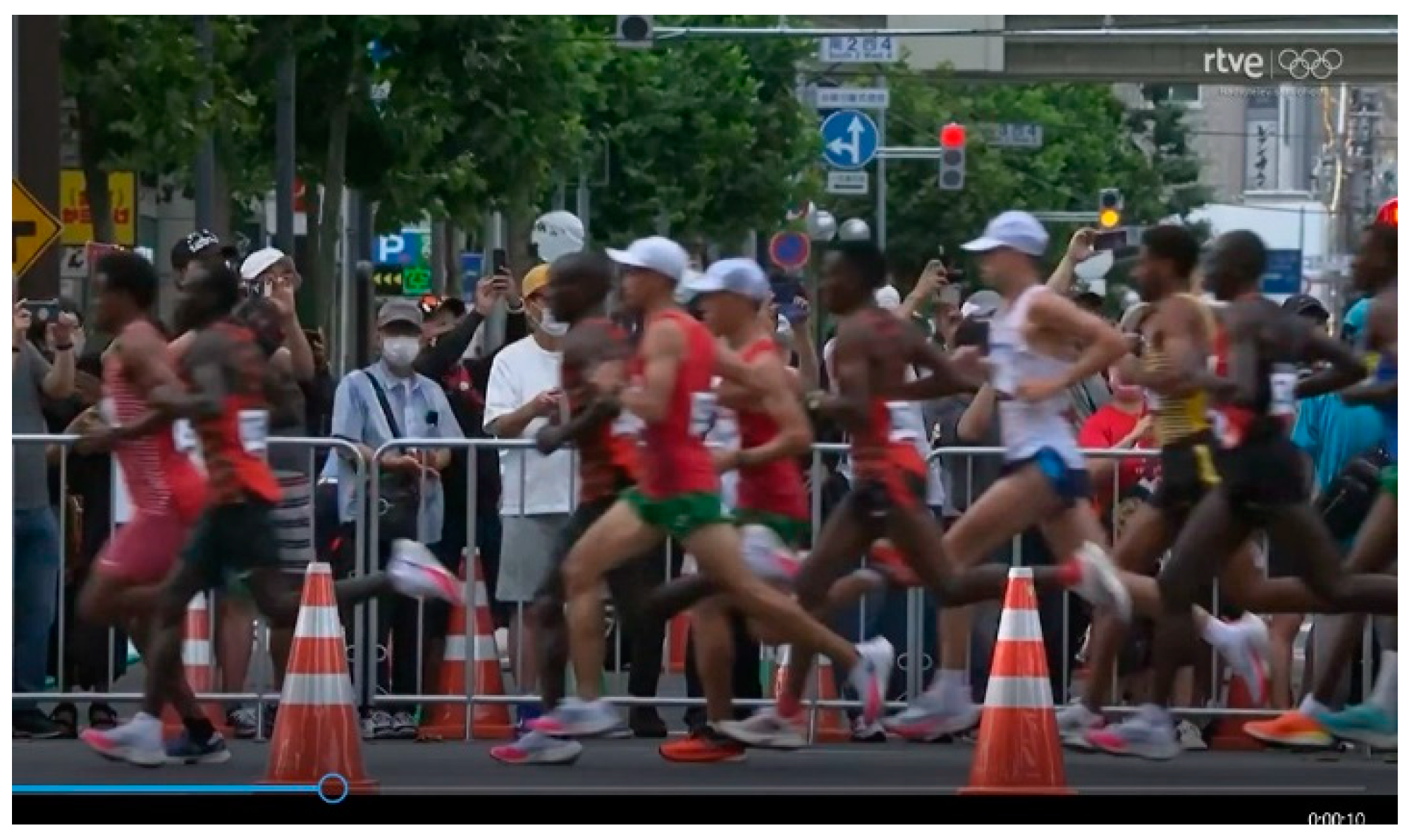

Table 1.
Inter-rater reliability analysis. ICC results.
| Variable | Mean ICC | 95% confidence Interval | ||
|---|---|---|---|---|
| Lower | Upper | |||
| Foot strike angle | Left | 0.898 | 0.811 | 0.945 |
| Right | 0.915 | 0.839 | 0.955 | |
| Cadence | KM 10-20 | 0.973 | 0.865 | 0.995 |
| KM 20-30 | 0.983 | 0.917 | 0.997 | |
| KM 30-40 | 0.983 | 0.917 | 0.997 | |
Table 2.
Descriptive data of the participants (N=51)
| Foot strike angle | Frequency | Percent (%) | Cumulative Percent (%) | Frequency | Percent (%) | Cumulative percent (%) |
|---|---|---|---|---|---|---|
| Right | Left | |||||
| Midfoot strike | 26 | 54.2 | 30 | 58.8 | ||
| Forefoot strike | 5 | 10.4 | 64.6 | 5 | 9.8 | 68.6 |
| Rearfoot strike | 17 | 35.4 | 16 | 31.4 | ||
| Missing data | 3 | 0 | ||||
Table 3.
Cadence descriptive data
| Kilometre range | ||||
| 10-20 km | 20-30 km | 30-40 km | Total | |
| Finalists (8 first) | ||||
| Mean (step/min) | 185.2 | 186.2 | 185.1 | 185.5 |
| SD (step/min) | 4.9 | 4.5 | 5.8 | 5.1 |
| Coeficient of variance (%) | 2.7 | 2.4 | 3.1 | 2.7 |
| Max | 191 | 192 | 192 | |
| Min | 176 | 178 | 176 | |
| Medals (3 first) | ||||
| Mean (step/min) | 188.3 | 188.2 | 189.2 | 188.6 |
| SD (step/min) | 2.6 | 2.4 | 2 | 2.3 |
| Coeficient of variance (%) | 1.4 | 1.3 | 1.1 | 1.2 |
| Max | 191 | 192 | 192 | |
| Min | 186 | 186 | 187 | |
Table 4.
Comparison with other studies
| Study | Present study | Hanley (2019) | Kasmer (2009) | Larson (2011) | Hasegawa (2007) |
|---|---|---|---|---|---|
| Distance | Marathon | Marathon | Ultra-marathon | Maraton | Half marathon |
| RFS (%) | 33.4* | 65 | 89 | 96 | 60 |
* Mean left and right foot
Disclaimer/Publisher’s Note: The statements, opinions and data contained in all publications are solely those of the individual author(s) and contributor(s) and not of MDPI and/or the editor(s). MDPI and/or the editor(s) disclaim responsibility for any injury to people or property resulting from any ideas, methods, instructions or products referred to in the content. |
© 2023 by the authors. Licensee MDPI, Basel, Switzerland. This article is an open access article distributed under the terms and conditions of the Creative Commons Attribution (CC BY) license (http://creativecommons.org/licenses/by/4.0/).
Copyright: This open access article is published under a Creative Commons CC BY 4.0 license, which permit the free download, distribution, and reuse, provided that the author and preprint are cited in any reuse.