

Submitted:
30 January 2023
Posted:
31 January 2023
You are already at the latest version
Abstract
Phytoseiidae inhabit a wide range of herbs, shrubs and trees. Aesculus hippocastanum is an important ornamental tree in Europe and is likely reservoir of these mites. We therefore assessed the species composition and the spatial and seasonal variability in the abundance of Phytoseiidae in city parks in South Bohemia, Czech Republic. Leaf samples were randomly collected from horse chestnut tree branches at eight sites, five times during the vegetation season in 2013. The mites were collected by washing technique and mounted on slides for identification. In total, 13,903 specimens of phytoseiid mites were found, and eight species were identified: Amblyseius andersoni, Euseius finlandicus, Kampimodromus aberrans, Neoseiulella tiliarum, Phytoseilus macropilis, Paraseiulus talbii, Paraseiulus triporus and Typhlodromus (Typhlodromus) pyri. Paraseiulus talbii and P. macropilis were recorded on the leaves of horse chestnut trees for the first time in the Czech Republic in this study. The predominant species was E. finlandicus (96.25%). The number of mites per compound leaf was, on average, 2.53, 10.40, 23.54, 11.59 and 9.27 on the sampling dates in each month between May and September, respectively. The mite density was significantly affected by the sampling site and date.
Keywords:
horse chestnut tree
; diversity
; population dynamics
; mite density
; city parks
1. Introduction
The horse chestnut, Aesculus hippocastanum L. (Sapindales: Sapindaceae), a tree species which originated in the Epirus region and the foothills of the Pindus Mountains in northwestern Greece, has been planted in Europe since the seventeenth century primarily for ornamental purposes [1]. Many A. hippocastanum trees are currently grown in city parks and urban forests for their beauty, providing shade and reducing the urban heat island effect. Moreover, extracts from the various parts of this tree have been widely used in herbal medicine [2].
In addition to its importance for pollinators [3], A. hippocastanum is also considered an important reservoir of phytoseiid mites. A survey of Phytoseiidae on deciduous trees and bushes conducted in Finland in 1989-1991 revealed the highest density of mites to be on A. hippocastanum, with 1063 mites per 100 leaves on average and a maximum of 14.4 mites per leaf in a single sample [4,5]. Similar results were reported for South Bohemia, Czech Republic, where the population density of phytoseiids ranged between 1 and 28, with a mean number of mites per compound leaf of 10.5 [6]. The predominant species in both Finland and in the Czech Republic was Euseius finlandicus (Oudemans), which represented more than 90% of all phytoseiids found [4,6,7]. In Greece, the number of phytoseiids was found to be lower, ranging between 0 and 16, with a mean density of 4.2 mites per compound leaf; another species, Kampimodromus aberrans (Oudemans), was nearly as abundant as E. finlandicus [6].
Although the above data provide basic information on mite abundance, the spatiotemporal variability in the density of phytoseiids on A. hippocastanum in urban environments has not yet been studied. The objectives of the present study were therefore to investigate the species composition of phytoseiid mites inhabiting horse chestnut trees and their abundace and its seasonal changes within a medium-size city.
2. Materials and Methods
2.1. Sampling sites
The research was carried out in the town of České Budějovice, Czech Republic (48° 59′ N, 14° 29′ E; 386 m above sea level). The town, which is predominantly surrounded by forests and agricultural fields, has about 260 hectares of open public green space inhabiting 534 horse chestnut trees [8]. Eight sampling sites were defined within the cadastral area of the town (Table 1).
2.2. Sampling of horse chestnut leaves
The population of Phytoseiidae was assessed on horse chestnut leaves that were collected randomly five times during the vegetation season in 2013. The sampling dates were from 16th to 24th May, from 13th to 21st June, from 11th to 19th July, from 11th to 22nd August and from 9th to 19th September. The sampling took place only when there had been no rain for at least 48 hours prior to sampling. A randomly selected compound leave collected from A. hippocastanum tree up to 2.5 m above ground represented the sample unit. In total, 30 leaves were collected per sampling site. The sampled trees were selected evenly across the whole site. Only one leaf per tree was collected except at sites with less than 30 trees. The leaves at each individual site were all sampled on the same day, placed individually into polyethylene bags and transported in cool box to the laboratory where the leaves were stored at temperature 4°C for less than 24 hours before they were processed.
2.3. Collection and identification of phytoseiid mites
The mites were collected from individual leaves using the washing technique [10]. After taking the photographs, the horse chestnut leaf was held by the petiole, and individual leaflets were cut off by pruning shears into a glass jar (volume 700 ml) containing 350 ml of 85% ethanol. The jar was closed carefully and shaken vigorously for two minutes. Afterwards, each leaflet was removed by tweezer and washed with ethanol using a plastic wash bottle. Particular attention was paid to trichomes and domatia during washing.
The contents of the glass jar were poured through a plastic funnel into a glass dividing funnel with a Teflon® stopcock. The empty glass jar and the plastic funnel were washed with 85% ethanol, which was poured into the dividing funnel immediately. All invertebrates settled at the bottom of the dividing funnel within 5 minutes. Then, the Teflon® stopcock was opened, and approximately 50 ml of ethanol sample containing all invertebrates was poured off into a small glass vial with a plastic plug. The material was stored in this vial until microscope slide preparation and identification.
Each vial with preserved mites was placed in a paper holder to prevent spillage, and the ethanol in the vials was gradually transferred onto a watch glass by using a plastic Pasteur pipette. The sample on the watch glass was inspected using a dissection microscope. All mites were removed with a wire loop and mounted on temporal microscope slides in lactic acid. The mites were identified using the keys of [11,12,13,14,15].
2.4. Data presentation and statistical analysis
The abundance of phytoseiid mites was expressed as the number of mites per compound A. hippocastanum leaf and analyzed by GLMM using a Poisson distribution, and log-link function. The analysis was performed in SAS® Studio for Linux using the GLIMMIX procedure of SAS/STAT® module [16].
The species diversity was quantified using Simpson's diversity index [17]: D=1-((Σi ni(ni-1))/N(N-1)), where n is the total number of organisms of a particular species, and N is the total number of organisms of all species. The value of the index ranges between 0 and 1, and the greater the value is, the greater the species diversity. The coefficient of constancy (C) [18] was used to indicate the frequency of different species in the studied localities: C(%)=Na/N×100, where Na is the number of samples with species a, and N is the total number of samples. The species were classified as accidental (C<25%), accessory (C=25–50%), constant (C=50–75%) or euconstant (C>75%) [18].
3. Results
3.1. Species composition
A total of 13,903 phytoseiid mites belonging to eight species were identified. The species composition was as follows: E. finlandicus 96.25% (C=82.33%), Typhlodromus (Typhlodromus) pyri Scheuten 1.35% (C=10.00%), Amblyseius andersoni (Chant) 0.80% (C=4.50%), Neoseiulella tiliarum (Oudemans) 0.73% (C=5.00%), K. aberrans 0.58% (C=5.83%), Phytoseiulus macropilis (Banks) 0.22% (C=1.00%), Paraseiulus triporus (Chant & Yoshida-Shaul) 0.06% (C=0.33%) and Paraseiulus talbii (Athias-Henriot) 0.01% (C=0.08%). According to the coefficient of constancy, all species can be considered accidental except E. finlandicus, which is a euconstant species. Simpson’s diversity index was only 0.0733.
3.2. Mite abundance and seasonal dynamics
The mean abundance of phytoseiid mites per compound horse chestnut leaf across all sites was 2.53 (SE=0.292; n=240), 10.40 (SE=0.512; n=240), 23.54 (SE=0.909; n=240), 11.59 (SE=0.492; n=240) and 9.27 (SE=0.491; n=240) in May, June, July, August and September, respectively. The overall annual average abundance was 11.47 mites per leaf (SE=0.324, n=1200). Population density of Phytoseiidae and its seasonal changes differed among sampling sites (Figure 1). The statistical analysis confirmed significant effect of site (F7,1160=99.76; P<0.0001). The abundance of mites fluctuated over the season (F4,1160=869.16; P < 0.001) and the interaction between site and time was also significant (F28,1160=38.18; P < 0.001).
4. Discussion
The Phytoseiidae family represents a very important group of predatory mites that inhabit, in addition to herbaceous plants, many species of deciduous trees and shrubs [4,5,19,20,21,22,23,24,25,26,27,28,29,30,31]. Six species of phytoseiids were identified on horse chestnut in city parks in Prague, Czech Republic, by Kabíček and Řeháková [7]: E. finlandicus, Galendromus longipilus (Nesbitt), K. aberrans, Neoseiulella aceri (Collyer), N. tiliarum and T. (T.) pyri. The species richness, however, varied among the investigated sites, from one to four species.
The species composition of the present study confirmed the presence of these species, except G. longipilus and N. aceri, which were not found in any sample in České Budějovice. However, we found these other species: A. andersoni, Ph. macropilis, Pa. triporus and Pa. talbii. Thus, eight species were found on A. hippocastanum in total. Six of them had also been found on horse chestnut in Hungary [32,33], while Pa. talbii and Ph. Macropilis, which were identified in the present study, have not yet been reported on horse chestnut leaves. In Greece, where horse chestnut is an autochthonous tree, only four phytoseiid species were found: E. finlandicus, K. aberrans, Pa. talbii and T. (T.) pyri [6]. The reason for the lower number of species might be the much less intensive sampling compared to that used in the present study.
The most abundant species found in the present study was E. finlandicus, representing approximately 96% of all phytoseiid mites. This confirms that E. finlandicus is predominant in species complexes of phytoseiid mites in Europe on horse chestnut [4,7,27]. In Greece, however, the percentage of E. finlandicus on A. hippocastanum was found to be only 48%, and the second most dominant species, representing approximately 43% of all determined species of Phytoseiidae, was K. aberrans [6]. Euseius finlandicus is also the predominant species on other deciduous trees [4,5,21,24,25,27,34]. For example, in a survey by Kabíček and Povondrová [24], E. finlandicus represented more than 95% of all phytoseiid mites identified in leaf samples collected from various deciduous trees in a park in Prague.
The results of the present study revealed that one A. hippocastanum leaf can host 2.5 - 23.5 phytoseiid mites on average depending on the month. These abundance values agree with those of previous studies conducted in Finland [4,5] and the Czech Republic [7]. The latter authors reported the highest population density of phytoseiids on horse chestnut trees in Prague to be 3.3 mites per leaflet on average [7]. Because A. hippocastanum compound leaves usually have five to seven leaflets [1], the above value could correspond to 19.8 mites per average compound leaf. This result matches that of our third sampling in July. In contrast, the density of phytoseiid mites in Greece was lower, with 4.2 mites per compound leaf on average [6].
Although phytophagous mites are a common food source for most Phytoseiidae [20], we found only a few phytophagous mites in our samples. Among the mites infesting the horse chestnut tree are Eotetranychus pruni (Oudemans) (Acari: Tetranychidae) [35], Aculus hippocastani (Fockeu) and Shevtchenkella carinatus (Nalepa) (Acari: Eriophyidae) [36]. However, according to Tuovinen and Rokx [4], prey density does not seem to have any significant effect on the presence and density of E. finlandicus or P. macropilis. The number of phytoseiids on leaves is influenced by leaf surface characteristics rather than by food availability [37]. Horse chestnut trees have few glandular trichomes with a mean height of 84 μm located only on the midrib surface on the adaxial epidermis; nonglandular trichomes with lengths ranging from 116-436 μm were observed on the lower leaf surface, where they were located on the midrib and lateral veins as well as in the vein axils [38]. The density of leaf trichomes was reported to be 9.96/mm2, which is relatively high compared to that in other tree species [39]. The relatively high phytoseiid density on A. hippocastanum can thus be explained by the favorable micromorphology of its leaves. A positive effect of leaf trichomes and domatia occurrence on the abundance of predatory mites has been well documented in many studies [21,22,37,40,41,42,43,44,45,46,47,48,49,50]. While domatia mainly provide phytoseiid mites with shelter and act as protection from either natural enemies or abiotic stress [42], leaf pubescence also increases the capture and retention of pollen and fungal spores that serve as alternative foods [51]. We often observed many pollen grains on A. hippocastanum leaves. Kugler [52] estimated that this tree species itself can produce 42 million pollen grains from a single inflorescence. The A. hippocastanum pollen was also found to have a very high nutritional quality for phytoseiid mites [53,54]. Because the highest pollen concentration occurs during May [55], its availability probably facilitated the significant increase in phytoseiid mite density in June and July observed in our study. The other food resources like extrafloral nectar or fungi are also considered to be importan for generalist phytoseiid mites [56,57] and their role in nutrition of mites inhabiting horse chestnut needs to be investigated, too.
5. Conclusions
The present study confirmed that (1) the horse chestnut tree is a favorable host tree for phytoseiid mites, (2) the density of mites varied significantly between sites and months, with its peak density in July, and (3) E. finlandicus was the predominant species. Two species, P. talbii and P. macropilis were recorded on horse chestnut for the first time.
Author Contributions
Conceptualization, R.Z. and M.K.; methodology, R.Z. and M.K.; data curation, M.K.; writing—original draft preparation, M.K.; writing—review and editing, M.K. and R.Z.; visualization, M.K and R.Z.; supervision, R.Z. All authors have read and agreed to the published version of the manuscript.
Funding
This research was funded by the Czech Academy of Sciences, grant number RVO: 60077344.
Data Availability Statement
The data presented in this study are available on request from the corresponding author.
Acknowledgments
The authors thank Assoc. Prof. Georgios Th. Papadoulis for his help with the identification of phytoseiid mites and Mrs. Barbora Kozelková for her technical assistance. The American Journal Experts (www.aje.com) is thanked for the English language review.
Conflicts of Interest
The authors declare no conflict of interest. The funders had no role in the design of the study; in the collection, analyses, or interpretation of data; in the writing of the manuscript; or in the decision to publish the results.
References
- Thomas, P.A.; Alhamd, O.; Iszkuło, G.; Dering, M.; Mukassabi, T.A. Biological Flora of the British Isles: Aesculus hippocastanum. J. Ecol. 2019, 107, 992–1030. [Google Scholar] [CrossRef]
- Ulbricht, C.; Tiffany, N.; Boon, H.; Ulbricht, C.; Basch, E.; Bent, S.; Barrette, E.P.; Smith, M.; Sollars, D.; Dennehy, C.; et al. Horse Chestnut: A Multidisciplinary Clinical Review. Journal of Herbal Pharmacotherapy 2002, 2, 71–85. [Google Scholar] [CrossRef]
- Somme, L.; Moquet, L.; Quinet, M.; Vanderplanck, M.; Michez, D.; Lognay, G.; Jacquemart, A.-L. Food in a Row: Urban Trees Offer Valuable Floral Resources to Pollinating Insects. Urban Ecosyst 2016, 19, 1149–1161. [Google Scholar] [CrossRef]
- Tuovinen, T.; Rokx, J.A.H. Phytoseiid Mites (Acari: Phytoseiidae) on Apple Trees and in Surrounding Vegetation in Southern Finland. Densities and Species Composition. Exp Appl Acarol 1991, 12, 35–46. [Google Scholar] [CrossRef]
- Tuovinen, T. Influence of Surrounding Trees and Bushes on the Phytoseiid Mite Fauna on Apple Orchard Trees in Finland. Agriculture, Ecosystems & Environment 1994, 50, 39–47. [Google Scholar] [CrossRef]
- Kopačka, M.; Stathakis, T.I.; Broufas, G.; Papadoulis, G.Th.; Zemek, R. Diversity and Abundance of Phytoseiidae (Acari: Mesostigmata) on Horse Chestnut (Aesculus hippocastanum L.) in an Urban Environment: A Comparison between Greece and the Czech Republic. Acarologia 2018, 58, 83–90. [Google Scholar] [CrossRef]
- Kabíček, J.; Řeháková, M. Phytoseiid Mite Community on Aesculus Hippocastanum in the Parks. Acta Fytotechnica et Zootechnica 2004, 7, 114–115. [Google Scholar]
- Kopacka, M.; Zemek, R. Spatial Variability in the Level of Infestation of the Leaves of Horse Chestnut by the Horse Chestnut Leaf Miner, Cameraria ohridella (Lepidoptera: Gracillariidae) and in the Number of Adult Moths and Parasitoids Emerging from Leaf Litter in an Urban Environment. Eur. J. Entomol. 2017, 114, 42–52. [Google Scholar] [CrossRef]
- Jura, S. Určování Stáří Stromů. Silva Bohemica 1, 19–21.
- Zacharda, M.; Pultar, O.; Muška, J. Washing Technique for Monitoring Mites in Apple Orchards. Exp Appl Acarol 1988, 5, 181–183. [Google Scholar] [CrossRef]
- Beglyarov, G.A. Opredelitel chiscnych klescej fitoseiid (Parasitiformes, Phytoseiidae) fauny SSSR. Info Bjull IOBC 1981, 3, 1–45. [Google Scholar]
- Miedema, E. Survey of Phytoseiid Mites (Acari: Phytoseiidae) in Orchards and Surrounding Vegetation of Northwestern Europe, Especially in the Netherlands. Keys, Descriptions and Figures. Netherlands Journal of Plant Pathology 1987, 93, 1–63. [Google Scholar] [CrossRef]
- Chant, D.A.; Shaul, E.Y. A World Review of the Soleiger Species Group in the Genus Typhlodromus Scheuten (Acarina: Phytoseiidae). Can. J. Zool. 1982, 60, 3021–3032. [Google Scholar] [CrossRef]
- Chant, D.A.; Yoshida-Shaul, E. A World Review of the Tiliarum Species Group in the Genus Typhlodromus Scheuten (Acari: Phytoseiidae). Can. J. Zool. 1989, 67, 1006–1046. [Google Scholar] [CrossRef]
- Karg, W. Acari (Acarina), Milben, Parasitiformes (Anactinochaeta), Cohors Gamasina Leach, Raubmilben, Tierwelt Deutschlands und der angrenzenden Meeresteile nach ihren Merkmalen und nach ihrer Lebensweise, 2nd ed.; VEB Gustav Fischer Verlag: Jena, 1993. [Google Scholar]
- SAS Institute SAS/STAT 14. 3: User’s Guide.; SAS Institute: Cary, NC, USA, 2017. [Google Scholar]
- Adams, J.S. Species Richness: Patterns in the Diversity of Life; Springer-Praxis books in environmental sciences; Springer ; in Association with Praxis: Berlin ; New York : Chichester, UK, 2009; ISBN 978-3-540-74277-7. [Google Scholar]
- Dajoz, R. Introduction to Ecology; Hodder and Stoughton: London, 1977; ISBN 978-0-340-16254-5. [Google Scholar]
- Ragusa di Chiara, S.; Papaioannou-Souliotis, P.; Tsolakis, H.; Tsagkarakou, N. Acari Fitoseidi (Parasitiformes, Phytoseiidae) Della Grecia Associati a Piante Forestali a Diverse Altitudini. Boll. Zool. Agr. Bachicol. 1995, 27, 85–91. [Google Scholar]
- McMurtry, J.A.; Croft, B.A. Life-Styles of Phytoseiid Mites and Their Roles in Biological Control. Annu. Rev. Entomol. 1997, 42, 291–321. [Google Scholar] [CrossRef]
- Kabíček, J. Broad Leaf Trees as Reservoirs for Phytoseiid Mites (Acari: Phytoseiidae). Plant Prot. Sci. 2003, 39, 65–69. [Google Scholar] [CrossRef]
- Kabíček, J. Intraleaf Distribution of the Phytoseiid Mites (Acari, Phytoseiidae) on Several Species of Wild Broad Leaf Trees. Biologia 2005, 60, 523–528. [Google Scholar]
- Kabíček, J. Linden Trees Are Favourable Host Plants for Phytoseiid Generalists in Urban Environment. BALT FOR 2019, 25. [Google Scholar] [CrossRef]
- Kabíček, J.; Povondrová, K. Phytoseiid Mite Communities on Urban Deciduous Trees. Acta Fytotechnica et Zootechnica 2004, 7, 119–121. [Google Scholar]
- Omeri, I. Phytoseiid Mites (Parasitiformes, Phytoseiidae) on Plants in Trostyanets Dendrological Park (Ukraine). Vestnik Zoologii 2009, 43, e–7. [Google Scholar] [CrossRef]
- Barbar, Z. Occurrence, Population Dynamics and Winter Phenology of Spider Mites and Their Phytoseiid Predators in a Citrus Orchard in Syria. Acarologia 2014, 54, 409–423. [Google Scholar] [CrossRef]
- Grabovska, S.L.; Kolodochka, L.A. Species Complexes of Predatory Phytoseiid Mites (Parasitiformes, Phytoseiidae) in Green Urban Plantations of Uman’ (Ukraine). Vestnik Zoologii 2014, 48, 495–502. [Google Scholar] [CrossRef]
- Vieira de Souza, I.; Argolo, P.S.; Gondim Júnior, M.G.C.; de Moraes, G.J.; Bittencourt, M.A.L.; Oliveira, A.R. Phytoseiid Mites from Tropical Fruit Trees in Bahia State, Brazil (Acari, Phytoseiidae). ZK 2015, 533, 99–131. [Google Scholar] [CrossRef]
- Grabovska, S.L.; Mykolaiko, I.I. Кліщі Рoдини Phytoseiidae (Acari, Parasitiformes) в Урбанізoваних Рoслинних Насадженнях. Ukr J Ecol 2017, 7, 216–222. [Google Scholar] [CrossRef]
- Grabovska, S.L.; Mykolaiko, I.I.; Mykolaiko, V.P. Осoбливoсті Структури Кoмплексів Фітoсеїдних Кліщів в Рoслинних Асoціаціях Міст. Ukr J Ecol 2017, 7, 179–186. [Google Scholar] [CrossRef]
- Stojnić, B.; Mladenović, K.; Marčić, D. Spider Mites and Predatory Mites (Acari: Tetranychidae, Phytoseiidae) on Stone Fruit Trees ( Prunus Spp.) in Serbia. International Journal of Acarology 2018, 44, 322–329. [Google Scholar] [CrossRef]
- Ripka, G. Checklist of the Phytoseiidae of Hungary (Acari: Mesostigmata). Folia Entomologica Hungarica 2006, 67, 229–260. [Google Scholar]
- Ripka, G. New Data to the Knowledge on the Phytoseiid Fauna in Hungary (Acari: Mesostigmata). Acta Phytopathologica et Entomologica Hungarica 1998, 33, 395–405. [Google Scholar]
- Komlovszky, S.Z.I.; Jenser, G. The frequent occurrence ofthe predatory mites Amblyseius finlandicus Oudemans and Phytoseius plumifer. Növényvédelem 1987, 23, 193–201. [Google Scholar]
- Gyenis, K.; Pénzes, B.; Hegyi, T. Phytophagous and predatory mites on the horse chestnut tree. Növényvédelem 2005, 41, 143–148. [Google Scholar]
- Ripka, G.; de Lillo, E. New Data to the Knowledge on the Eriophyoid Fauna in Hungary (Acari: Eriophyoidea). Folia Entomologica Hungarica 1997, 58, 147–157. [Google Scholar]
- Karban, R.; English-Loeb, G.; Walker, M.A.; Thaler, J. Abundance of Phytoseiid Mites on Vitis Species: Effects of Leaf Hairs, Domatia, Prey Abundance and Plant Phylogeny. Exp Appl Acarol 1995, 19, 189–197. [Google Scholar] [CrossRef]
- Weryszko-Chmielewska, E.; Haratym, W. Leaf Micromorphology of Aesculus Hippocastanum L. and Damage Caused by Leaf-Mining Larvae of Cameraria Ohridella Deschka and Dimić. Acta Agrobot 2012, 65, 25–34. [Google Scholar] [CrossRef]
- Muhammad, S.; Wuyts, K.; Samson, R. Atmospheric Net Particle Accumulation on 96 Plant Species with Contrasting Morphological and Anatomical Leaf Characteristics in a Common Garden Experiment. Atmospheric Environment 2019, 202, 328–344. [Google Scholar] [CrossRef]
- Overmeer, W.P.J.; Zon, A.Q. The Preference of Amblyseius Potentillae (Garman) (Acarina: Phytoseiidae) for Certain Plant Substrates.; Griffiths, D., Bowman, C., Eds.; Ellis Horwood Limited, Chichester: Chichester, 1984; pp. 591–596. [Google Scholar]
- O’Dowd, D.J.; Willson, M.F. Leaf Domatia and Mites on Australasian Plants: Ecological and Evolutionary Implications. Biological Journal of the Linnean Society 1989, 37, 191–236. [Google Scholar] [CrossRef]
- Walter, D.E.; O’Dowd, D.J. Leaves with Domatia Have More Mites. Ecology 1992, 73, 1514–1518. [Google Scholar] [CrossRef]
- Kreiter, S.; Tixier, M.-S.; Croft, B.A.; Auger, P.; Barret, D. Plants and Leaf Characteristics Influencing the Predaceous Mite Kampimodromus Aberrans (Acari: Phytoseiidae) in Habitats Surrounding Vineyards. Environ Entomol 2002, 31, 648–660. [Google Scholar] [CrossRef]
- Matos, C.H.C.; Pallini, A.; Chaves, F.F.; Schoereder, J.H.; Janssen, A. Do Domatia Mediate Mutualistic Interactions between Coffee Plants and Predatory Mites? Entomologia Experimentalis et Applicata 2006, 118, 185–192. [Google Scholar] [CrossRef]
- Loughner, R.; Goldman, K.; Loeb, G.; Nyrop, J. Influence of Leaf Trichomes on Predatory Mite (Typhlodromus Pyri) Abundance in Grape Varieties. Exp Appl Acarol 2008, 45, 111–122. [Google Scholar] [CrossRef]
- Loughner, R.; Wentworth, K.; Loeb, G.; Nyrop, J. Leaf Trichomes Influence Predatory Mite Densities through Dispersal Behavior. Entomologia Experimentalis et Applicata 2010, 134, 78–88. [Google Scholar] [CrossRef]
- Loughner, R.; Wentworth, K.; Loeb, G.; Nyrop, J. Influence of Leaf Trichomes on Predatory Mite Density and Distribution in Plant Assemblages and Implications for Biological Control. Biological Control 2010, 54, 255–262. [Google Scholar] [CrossRef]
- O’Connell, D.M.; Lee, W.G.; Monks, A.; Dickinson, K.J.M. Does Microhabitat Structure Affect Foliar Mite Assemblages? Ecological Entomology 2010, 35, 317–328. [Google Scholar] [CrossRef]
- Schmidt, R.A. Leaf Structures Affect Predatory Mites (Acari: Phytoseiidae) and Biological Control: A Review. Exp Appl Acarol 2014, 62, 1–17. [Google Scholar] [CrossRef]
- Barba, P.; Loughner, R.; Wentworth, K.; Nyrop, J.P.; Loeb, G.M.; Reisch, B.I. A QTL Associated with Leaf Trichome Traits Has a Major Influence on the Abundance of the Predatory Mite Typhlodromus Pyri in a Hybrid Grapevine Population. Hortic Res 2019, 6, 87. [Google Scholar] [CrossRef] [PubMed]
- Roda, A.; Nyrop, J.; English-Loeb, G. Leaf Pubescence Mediates the Abundance of Non-Prey Food and the Density of the Predatory Mite Typhlodromus Pyri. Experimental and Applied Acarology 2003, 29, 193–211. [Google Scholar] [CrossRef] [PubMed]
- Kugler, H. Blütenökologie; Gustav Fischer Verlag: Stuttgart, Germany, 1970. [Google Scholar]
- Goleva, I.; Zebitz, C.P.W. Suitability of Different Pollen as Alternative Food for the Predatory Mite Amblyseius Swirskii (Acari, Phytoseiidae). Exp Appl Acarol 2013, 61, 259–283. [Google Scholar] [CrossRef] [PubMed]
- Goleva, I.; Rubio Cadena, E.C.; Ranabhat, N.B.; Beckereit, C.; Zebitz, C.P.W. Dietary Effects on Body Weight of Predatory Mites (Acari, Phytoseiidae). Exp Appl Acarol 2015, 66, 541–553. [Google Scholar] [CrossRef]
- Weryszko-Chmielewska, E.; Tietze, M.; Michońska, M. Ecological Features of the Flowers of Aesculus Hippocastanum L. and Characteristics of Aesculus L. Pollen Seasons under the Conditions of Central-Eastern Poland. Acta Agrobot 2012, 65, 61–68. [Google Scholar] [CrossRef]
- Pekas, A.; Wäckers, F.L. Multiple Resource Supplements Synergistically Enhance Predatory Mite Populations. Oecologia 2017, 184, 479–484. [Google Scholar] [CrossRef]
- Pozzebon, A.; Loeb, G.M.; Duso, C. Role of Supplemental Foods and Habitat Structural Complexity in Persistence and Coexistence of Generalist Predatory Mites. Scientific Reports 2015, 5. [Google Scholar] [CrossRef] [PubMed]
Figure 1.
The mean abundance of phytoseiid mites per Aesculus hyppocastanum leaf during vegetation period at eight sam;ling sites in České Budějovice. (a) City centre; (b) Šumava and Máj estate; (c) Vltava estate; (d) Třebotovice and Kaliště village; (e) Rožnov estate; (f) Pražské předměstí estate; (g) Stromovka park; (h) Nádražní street. Vertical bars indicate standard error of the mean (n=30).
Figure 1.
The mean abundance of phytoseiid mites per Aesculus hyppocastanum leaf during vegetation period at eight sam;ling sites in České Budějovice. (a) City centre; (b) Šumava and Máj estate; (c) Vltava estate; (d) Třebotovice and Kaliště village; (e) Rožnov estate; (f) Pražské předměstí estate; (g) Stromovka park; (h) Nádražní street. Vertical bars indicate standard error of the mean (n=30).
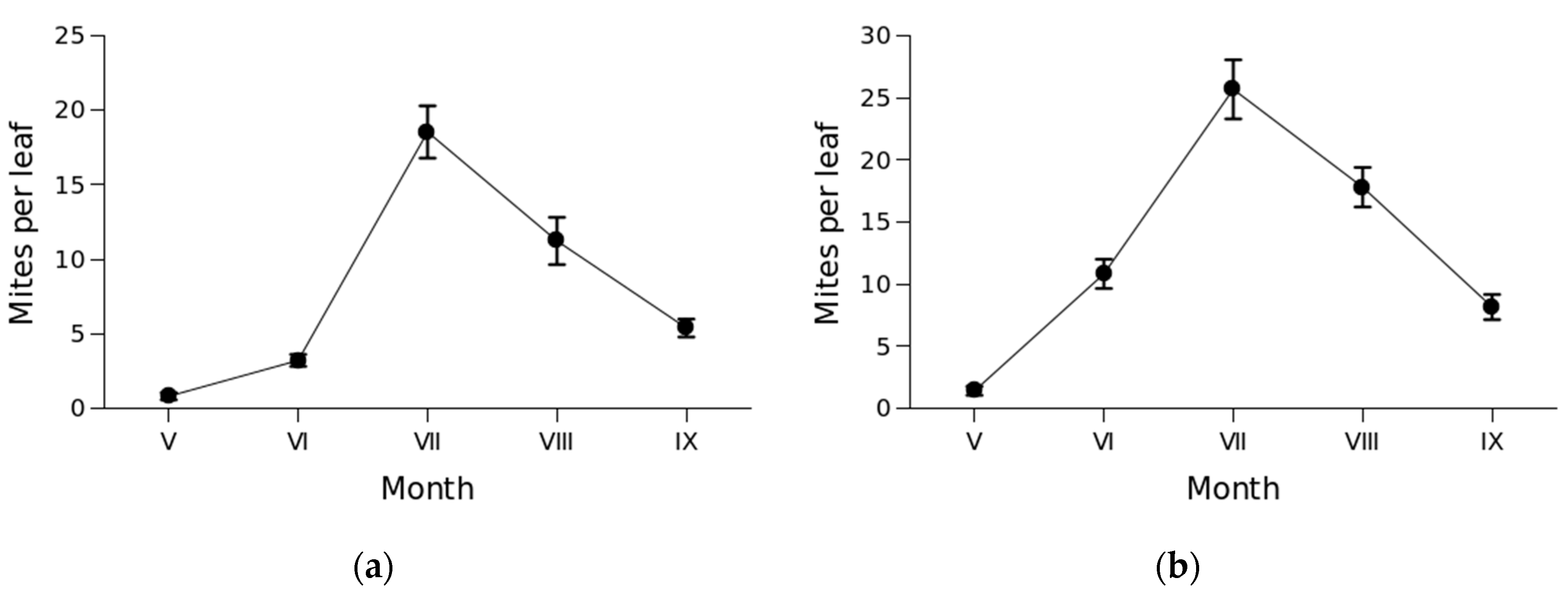
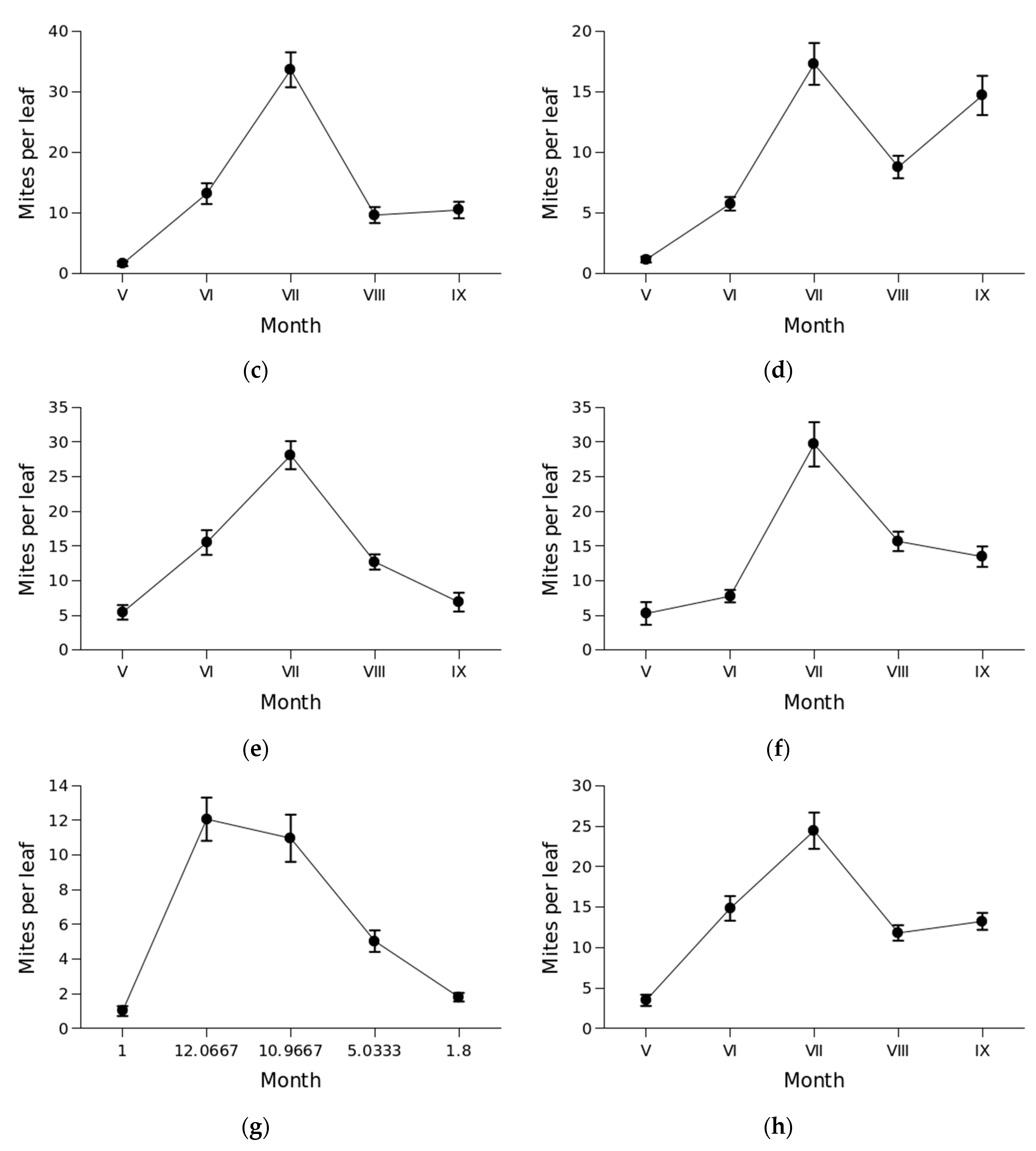

Table 1.
Characteristics of Aesculus hippocastanum sampling sites within České Budějovice.
| Local name | Geographical coordinates of geometric centre |
A. hippocastanum age in years (mean ± SE) 1 |
|---|---|---|
| City centre | 48.9744136N, 14.4770594E | 74.99 ± 1.86 |
| Šumava and Máj estate | 48.9841631N, 14.4407714E | 39.02 ± 3.19 |
| Vltava estate | 48.9962106N, 14.4519647E | 41.79 ± 3.49 |
| Třebotovice and Kaliště village | 48.9612606N, 14.5651828E | 17. 82 ± 6.86 |
| Rožnov estate | 48.9601436N, 14.4763944E | 70.49 ± 4.43 |
| Pražské předměstí estate | 48.9860569N, 14.4674681E | 49.74 ± 2.75 |
| Stromovka Park | 48.9670208N, 14.4551158E | 43.53 ± 4.13 |
| Nádražní Street | 48.9779942N, 14.4866511E | 77.74 ± 3.02 |
1 Tree age was estimated by method proposed by Jura [9].
Disclaimer/Publisher’s Note: The statements, opinions and data contained in all publications are solely those of the individual author(s) and contributor(s) and not of MDPI and/or the editor(s). MDPI and/or the editor(s) disclaim responsibility for any injury to people or property resulting from any ideas, methods, instructions or products referred to in the content. |
© 2023 by the authors. Licensee MDPI, Basel, Switzerland. This article is an open access article distributed under the terms and conditions of the Creative Commons Attribution (CC BY) license (http://creativecommons.org/licenses/by/4.0/).
Copyright: This open access article is published under a Creative Commons CC BY 4.0 license, which permit the free download, distribution, and reuse, provided that the author and preprint are cited in any reuse.


