
Submitted:
23 January 2023
Posted:
25 January 2023
You are already at the latest version
Abstract
Digital transformation of companies is often referred to as a future track and a strategic path towards ensuring the survival and sustainability of companies. In this paper, we aim to outline this transformation process in Tunisian companies and identify its driving factors and finally explain its key success factors. To this end, we examine a sample of 70 companies operating in all economic sectors. The results indicate that such a digital strategy has a significant and a positive effect on the success of digital transformation of companies. Leadership has an effect at a low level of digital maturity. On the other hand, corporate culture does not have a significant effect on digital transformation. These results contribute to explaining this emerging phenomenon by focusing on the driving factors as well as the factors that contribute to its success.
Keywords:
Digital transformation
; digital strategy
; corporate culture
; leadership
; performance
I. Introduction
Market evolution and the birth of a new ecosystem have made companies think more and more about digitization and consider digital transformation seriously, some are forced to face competition, others strategically in order to seize certain opportunities and ensure their development in the market. Then, according to Carcary, M., Doherty, E., & Conway, G. (2019), it is also anticipated that as more devices, systems and infrastructure become interconnected and interdependent as a result of digital transformation, and as more interfaces between customers, suppliers and partners are leveraged, the IT "attack surface" will continue to expand. Hasan, N and all. (2022) argue that digitization is critical for the long-term viability of small businesses in the new economy.
From an economics point of view, digital transformation provides companies with greater organizational flexibility and generates a significant impact on the financial dimension. Moreover, according to Hassen et al (2016), the impact of digitizing costly administrative procedures on turnover can go up to 10% for some digitally mature companies in the Tunisian market, which was confirmed by Parviainen and al (2017). These latter authors stated that digitization of information-intensive processes can generate cost savings that can go up to 90%. The impact of digitization affects both the company and the country as a whole. Indeed, according to Sabbagh and al (2012), digitization has three dimensions: (1) the economic dimension denotes an increase in the gross domestic product (GDP), the creation of jobs and the improvement of the global innovation index. (2) the social dimension refers to an improvement in the quality of life of citizens (3) the governance dimension establishes transparency and implementation of e-government.
II. Review of the literature
According to Carcary et al. (2016), digital transformation presents an evolution distinct from the traditional "brick and mortar" industries, calling for organizations to re-imagine and modify/re-invent their business models and continually engage with customers, suppliers, and partners in a broader ecosystem. Indeed, it is a project that acts on where the company is headed and affects all its functions, regardless of technology. Such a project needs a development plan and an implementation of new capacities that will support its new business objectives.
Hassen et al (2017) examined the barriers to digital transformation of Tunisian companies. The study aimed at identifying digital maturity levels of Tunisian companies, the obstacles to transformation as well as the potential of a digital strategy in the Tunisian economy. In our study, we focuse on the key success factors and the drivers of this digital transformation. Our study extends that of Hassan et al. (2017). In fact, to succeed in its transformation, it is important that the company masters certain organizational and technical factors. To do so, it must develop a wide range of capabilities that take into account its line of business, the sector, and its market position. In this regard, the literature distinguished between 16 key success factors for the digital transformation of companies, namely (1) a digital strategy, (2) corporate culture, (3) employee skills, (4) business processes (5) innovation, (6) employee and customer engagement, (7) leadership, (8) budget management, (9) digital technology, (10) data analytics, (11) vision, (12) customer experience, (13) company structure, (14) organization, (15) governance (16).
III. The research hypotheses
The literature review allowed us to identify several potential key success factors. However, as the aim of this study is to identify the main key success factors, we focus on three key success factors alternatively proposed by the literature: (1) leadership, (2) corporate culture and (3) digital strategy.
III.1. Corporate culture and digital transformation
Schein (1985) defines corporate culture as the pattern of basic values shared by a group, which has invented, discovered or developed them as it learns to overcome its problems of external adaptation or internal integration. Values that are enough mature to be considered operational and, as such, be taught to new members of the group as the right way to perceive, think and feel about similar problems to be solved.
Culture can be an asset to the company in terms of engaging in new projects by providing a fertile ground and an environment for their development and evolution. Indeed, digitization can be a real competitive advantage for supply chains and can help improve their performance, Bennouri, J., & Ouariti, O. P. Z. (2020). The contribution of corporate culture is much more important in cases of implementation of complex projects like digital transformation. Indeed, such a transformation is a project that affects the entire organization and leads to several changes. Moreover, Parviainen et al (2017) define it as changes in work patterns, roles and business offering caused by the adoption of digital technologies in an organization or in the organization's operating environment. However, these changes must be supported and sustained by the entire organization through a culture that is flexible and open to its environment. Indeed, Baumgarten et al (2020) argue that an effective digital transformation needs the organization to integrate a culture that thinks and behaves differently. Indeed, it must be flexible enough to take advantage of the strengths of the digital.
On the other hand, according to Catlin et al. (2015) and Aron and Walker (2014), in a digital transformation context, corporate culture that fosters community sharing, collaboration, and co-development throughout the organization allows for the development of flexibility that offers the company new opportunities. In similar words, Kane et al. (2015) assert that organizational culture plays a crucial role in the success of a company's digital transformation by ensuring an optimal use of digital technologies. Corporate culture represents the foundation on which the company designs its projects. Moreover, Wokurka et al (2017) state that even the best designed digital strategy could fail if the company's culture does not embrace the changes. Moreover, if employees do not accept the transition to new digital channels for customers, the success of their company's transformation could eventually be stalled. In light of the above, we formulate the following hypothesis:
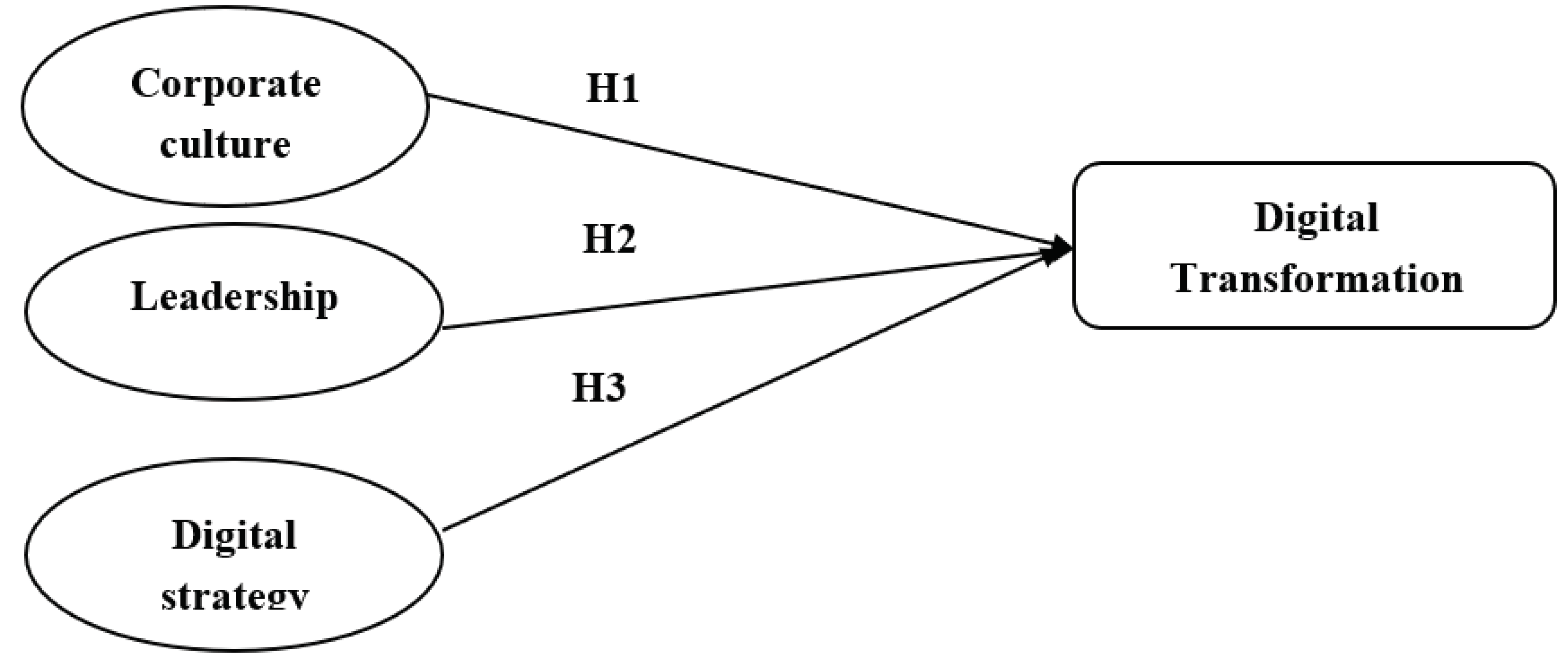
H1: There is a significant relationship between corporate culture and the success of digital transformation
III.2. Leadership and digital transformation
Several studies have focused on the relationship between leadership and the success of a company's digital transformation. Leadership and strategic planning are key to successful digital transformation (Schreckling & Steiger, 2017). Kohnke (2017) states that in a transformational project, like digitization, that affects all management levels and operational areas of an organization, the role of leadership is of a paramount importance in the transition process. Moreover, according to Kane et al. (2017), changes of this magnitude are often doomed to failure or stagnation without considerable support from the organization's leadership. This failure comes back to the fact that digitization puts pressure on leaders in a "VUCA1" world requiring more flexibility from leaders, risk-taking, and speed in decision-making (Horney et al. 2010).
For example, Kane et al. (2015) pointed to the significant link between leadership and corporate digital transformation. They argue that what distinguishes companies that are successfully transforming digitally from the rest is a clear digital strategy coupled with a culture and leadership ready to lead the transformation. They consider that the digital transformation of a company strongly depends on leadership, first, during the planning and designing of the future of the company in the face of the digital, and second, during the implementation of the changes necessary for digital transformation.
In light of the above, it would seem that involvement of leadership contributes to the success of the company's digital transformation. Therefore, we formulate the following hypothesis:
H2: There is a significant relationship between involvement of a company's leadership and the success of digital transformation.
III.3. Digital strategy and digital transformation
Thiétart (1991) defines corporate strategy as the set of decisions and actions taken to choose and articulate the means to achieve specific medium and long-term objectives consistent with corporate goals. It is the process that transforms desires and intentions into objectives by planning and setting the resources and means necessary to achieve these objectives. Digital transformation-wise, strategy is used to set up actions and short and long-term objectives in order to achieve the leadership's vision. In this regard, Mckowen (2017) states that without strategy, the company becomes reactive, rather than proactive. This leads to digitization of products and services rather than to total digital transformation. Therefore, the presence of a digital strategy helps the company to face environment instability and develop prevention and projection mechanisms and systems in the future.
On the other hand, Carcary et al (2016) state that digital strategy represents the way with which business strategy is influenced by the use of digital resources to create differential value. Digital strategy, like all strategies, represents a tool to achieve well-defined objectives. In a highly digitized environment, digital strategy is essential and integrated into the business strategy, which makes its presence mandatory to transform and even survive. In light of the above, we formulate the following hypothesis:
H3: There is a significant relationship between digital strategy and the success of a company's digital transformation.
IV. Research Methodology
In this section, we present the data analysis method, the research design and the sample.
IV.1. The empirical method:
In this study, we use a Multinomial Logistic regression. The purpose of this method is to identify the different degrees of success of digital transformation within companies, and then to check their relationship with the selected research variables. The dependent variable "Digital maturity" includes three categories: low digital maturity, medium digital maturity and high digital maturity. In this study, we only focus on the low and high categories.
The independent variables represent digital strategy, corporate culture and leadership.
When estimating a model with categorical qualitative dependent variables, the application of multinomial logistic regression needs setting a reference category. Therefore, medium maturity was chosen as the reference category since the purpose of our study is to identify digital transformation and explain its key success factors. Such a choice perfectly meets the objectives of the study, as it allows us to determine low and high digital maturity levels.
IV.2. The model
After presenting the different factors and their links with digital transformation as proposed in the literature, our model is as follows:
IV.3. Sample
We use data collected from a sample of 70 companies operating in all economic sectors. We treat the phenomenon independently of the specificities of the different sectors. The companies participating in our survey operate in more than thirteen different sectors. Members of the top management of the companies were contacted to answer our research questionnaire. The choice was based on the fact that digital transformation in Tunisia is considered a strategic project, then collecting answers from top management seems more reasonable and relevant. The respondents are identified according to their management positions and their level of technological interest.
V. Empirical Results
In this section, we present and discuss the descriptive statistics and the results of the logistic regression.
V.1. Descriptive statistics
Like in Kane et al (2015); Hassan et al (2016) and Kane et al (2017), respondents were asked to position themselves against an ideal organization transformed by digital technologies on a scale of 1 to 10, ranging from "1= Not close at all" to "10= Very close".

Table 1.
Distribution of sample by management position of respondents.
| Department | Percentage (%) |
|---|---|
| General Management | 55,7% |
| Information Technology | 15,7% |
| Marketing | 2,9% |
| Production/ Operations | 2,9% |
| Research and development | 1,4% |
| Finance | 7,1% |
| HR | 4,3% |
| Customer Relations | 7,1% |
| Other | 2,9% |
Table 1 shows a strong presence of two departments, namely "General Management" and "Information Technology" to a lesser degree. This imbalance plays a significant role in the relevance and accuracy of the responses, given the strategic nature of the studied phenomenon.
Table 2.
Distribution of sample by sector.
| Sector | Percentage (%) |
|---|---|
| Banking | 11,4% |
| Insurance | 12,9% |
| Asset management | 1,4% |
| Construction/Materials | 2,9% |
| Trade/ Retailing | 8,6% |
| Multimedia | 2,9% |
| Research and consultancy | 10,0% |
| Pharmaceutical | 2,9% |
| IT/ Telecom | 5,7% |
| Industry | 17,1% |
| Transport/ Logistics | 4,3% |
| Tourism | 4,3% |
| Administrative | 7,1% |
| Others | 8,6% |
According to the table above, the sample represents most of the economic sectors that make up the Tunisian economic fabric.
Table 3.
Distribution of sample by technology interest of the respondents.
| Technology interest level | Percentage (%) |
|---|---|
| Very low | 2,9% |
| Low | 27,1% |
| Medium | 32,9% |
| High | 20,0% |
| Very high | 17,1% |
This table indicates that the technological interest of the respondents is medium with 32.9% compared to the rest of the categories. In total, level of technological interest of the respondents seems to be good with 27.1% of managers indicating high/very high levels.
V.2 Results of the multinomial logistic regression
First, an analysis of the indicators of significance and validity of the model will be performed. Then, the indicators of the research variables will be interpreted and discussed.
For the goodness of fit of the model (Table 29), the "Omnibus" tests show that Chi-square is 79.128. This allows us to conclude that the model is globally significant at the 5% level. These results indicate that at least one independent variable has an influence on the dependent variable.
We also note that the "pseudo-square" coefficient (Table 30) captures a good representativeness and a strong relationqhip between the variables of the model. Indeed, the "Nagelkerke R²" coefficient is 76.6% indicating that the model explains 76.6% of the variance of the studied dependent variable: "Digital maturity".
For classification quality (Table 31), we note that the overall percentage of the model reached 74.3%, which means that the model is true in 74.3% of the cases. Therefore, 42.9% of the companies are successfully undergoing digital transformation. The companies with medium digital maturity represent 31.4%. Finally, the companies with low digital maturity represent 25.7% of the sample.
V.3. Impact on digital maturity:
The results of the logistic regression are presented in Table 4. We interpret the impact of the independent variables on low digital maturity and high digital maturity.
For the effect of corporate culture on digital transformation, Table 4 shows that the coefficient of this variable has a P-value around 0.774 for low maturity and 0.654 for high maturity. Therefore, it has no significant impact on either low or high digital maturity.
Moreover, the results indicate that there is no significant relationship between culture and digital maturity of a company. As the purpose of the "digital maturity" variable is to measure the degree of success of a company's digital transformation, it is possible to conclude that culture does not have a significant effect on the success of a company's digital transformation. It does not represent a key success factor in this transformation process.
Even if our results show that there is a significant number of mature companies, digital transformation is still recent in Tunisia. Such a conclusion supports Schein’s proposal (1985) that corporate culture as the pattern of basic values shared by a group, which has invented, discovered or developed as it learns to overcome its problems of external adaptation or internal integration. In this study, corporate culture does not have a significant effect on the success of digital transformation in the short term but it can develop this significant relationship in the future, given that Tunisian companies are in the discovery and experimentation of the phenomenon. Therefore, hypothesis 1 is not confirmed.
For the variable "Leadership", the results indicate that the respective probabilities associated with its coefficients are 0, .091 for low maturity and 0.412 for high maturity. These coefficients indicate that "Leadership" has a significant impact on low maturity and has no impact on high digital maturity. However, this variable has a score ratio (Exp(B)) of 0.238, which is less than 1. The sign of its coefficient is negative, indicating a negative relationship between the two categories (low and high). In other words, companies with leadership attributes are more likely to belong to the group of companies with high digital maturity than those with less leadership attributes. Therefore, hypothesis H2 is partially confirmed.
For the variable "Digital Strategy", the results indicate that the probabilities are respectively around 0.014 for low maturity and 0.013 for high maturity. Then, referring to the signs of the coefficients of this variable for both categories, we found that the variable has a significant and a positive impact on high digital maturity and a significant and a negative impact on low digital maturity. This finding allows us to conclude that digital strategy is positively linked to the success of the company's digital transformation. Indeed, within Tunisian companies, the presence of a clear digital strategy, consistent with the business strategy and stemming from a clear vision for the future is crucial to the success of digital transition and transformation. This positive link between the two variables can be explained by the fact that digital strategy allows for designing a path for the whole company in order to drive this transformation process. The setting of an objectives-guided arrival point allowing for the implementation of digital tools in the core business seems essential for Tunisian companies to succeed their transformation. Such a result aligns with those of (McKeown, 2014; Conway et al., 2016; Kane et al., 2015; Demset et al., 2015; Parviainen et al., 2017; Dahlstrim, 2017; Dörner and Meffert, 2015; Kogler, 2016; Kane et al, 2015; McGee et al., 2014; Brown et al., 2013; Schreckling et al., 2017). Additionally, this finding also confirms the views of Tunisian experts on the effect of digital strategy on such a transformational project. Therefore, hypothesis H3 is validated.
VI. Conclusion
The Tunisian market has reached a certain degree of maturity that has resulted in the total diffusion of digital transformation. However, research fell short in tracking the evolution of the concept, leading to a scarce theoretical base about digital transformation in the Tunisian context, an ambiguity in identifying this phenomenon as well as the factors playing the role of drivers and facilitators, an absence of a managerial vision in treating the phenomenon and a shortage in scientific production both internationally and nationally. Bearing on such a gap, this study was able to define digitization in the Tunisian context and clarify the key success factors, drivers and barriers to such a transformation.
This study defined the phenomenon as well as the main models to estimate the concept. First, the study clarified and enlightened the concept against related concepts such as automation and computerization. Second, it identified the factors that have an impact on digital transformation. The purpose of this stage is to highlight the driving factors that push companies to digitize their activities. Thus, sixteen potential key success factors were identified. Four were most recurrent in the literature: digital strategy, corporate culture, leadership and employee skills.
The results indicated that two of our research hypotheses were confirmed, and only one hypothesis rejected. We found that digital strategy has a significant and a positive effect on the success of digital transformation. Leadership has an influence at a low digital maturity level. On the other hand, corporate culture has no significant effect on digital transformation.
Finally, this study presents contributions at both the national and international levels. On the national level, the contribution of our study is the extension of the study of Hassan et al. (2016). Hassan et al’s (2016) survey of digital maturity of Tunisian companies is complemented by our study in two ways; first it clarified the factors that push Tunisian companies towards digital transformation, second, it identified the factors that make this transformational project successful. Internationally, our study confirmed the significant and positive effect of digital strategy on the success of a company's digital transformation.
Appendices
Table 5.
Model fit.
| Model | Model fit criteria | Likelihood ratio tests | ||
| -2 log Likelihood | Chi-square | p-value | ||
| Constant | 148,867 | - | - | |
| Final | 69,739 | 79,128 | ,000 | |
Table 6.
Cox & Snell, Nagelkerke and McFadden indicators.
| Cox and Snell | 0.677 |
| Nagelkerke | 0.766 |
| McFadden | 0.524 |
Table 7.
Table of classification.
| Observed | Predicted | |||
| Low | Medium | High | Percentage correct | |
| Low | 15 | 2 | 0 | 88,2% |
| Medium | 3 | 15 | 8 | 57,7% |
| High | 0 | 5 | 22 | 81,5% |
| Percentage global | 25,7% | 31,4% | 42,9% | 74,3% |
Table 8.
Overview of study results.
| Variables | Research hypotheses | Results | |
| Dependent | Independent | ||
| Digital maturity | Leadership | H2: There is a significant relationship between the leadership of a company and the success of its digital transformation. | Partially validated |
| Digital maturity | Corporate culture | H1: There is a significant relationship between corporate culture and the success of digital transformation. | Rejected |
| Digital maturity | Digital strategy | H3: There is a significant relationship between digital strategy and the success of a company's digital transformation. | Validated |
| 1 | VUCA is an acronym that is increasingly used. It includes the following concepts: volatility, uncertainty, complexity and ambiguity. http://christian.hohmann.free.fr/index.php/prospective/a-propos-de-prospective/587-quest-ce-quevuca |
References
- Bennouri, J., & Ouariti, O. P. Z. (2020, November). L'étude de l'impact des innovations technologiques digitales sur la performance durable d'une chaîne logistique: cas du secteur halio-industriel. In 13ème CONFERENCE INTERNATIONALE DE MODELISATION, OPTIMISATION ET SIMULATION (MOSIM2020), 12-14 Nov 2020, AGADIR, Maroc.
- Hasan, N. A., Abd Rahim, M., Ahmad, S. H., & Meliza, M. (2022). Digitization of Business for Small And Medium-Sized Enterprises (SMEs). Environment-Behaviour Proceedings Journal, 7(19), 11-16. Carcary, M., Doherty, E., & Conway, G. (2019, July). A Capability Approach to Managing Organisational Information Security. In ECCWS 2019 18th European Conference on Cyber Warfare and Security.–Academic Conferences and publishing limited (pp. 97-105).
- Conway, G. (2018, July). Utilisation of a sequential mixed methods research approach in examining SME digitization. In ECRM 2018 17th European Conference on Research Methods in Business and Management (p. 108). Academic Conferences and publishing limited.
- Waweru Zachary K and Wausi Agnes (2017),The influence of aligning information technology (IT) Strategy , performance contract and IT organizational structure on institutionel performance case of kenyan public universities, International Journal of Managing Public Sector Information and Communication Technologies (IJMPICT) Vol. 8, No. 2, 14p.
- Parviainen, P., Tihinen, M., Kääriäinen, J., & Teppola, S. (2017). Tackling the digitalization challenge: how to benefit from digitalization in practice. International journal of information systems and project management, 5(1), 63-77.
- Caramaschi, P., Biasi, D., Caimmi, C., Barausse, G., Sabbagh, D., Tinazzi, I., ... & Adami, S. (2012). Digital amputation in systemic sclerosis: prevalence and clinical associations. A retrospective longitudinal study. The Journal of Rheumatology, 39(8), 1648-1653.
- Dahlström, P., Desmet, D., & Singer, M. (2017). The seven decisions that matter in a digital transformation: A CEO’s guide to reinvention.
- Baumgarten, C., Simeon, A., & Wilhelm, M. C. (2020). Citizen Developers Driving the Digital Campus. European Journal of Higher Education IT, 1.
- Catlin, T., Scanlan, J., & Willmott, P. (2015). Raising your digital quotient. McKinsey and company.
- Falck, O., Mang, C. and Woessmann, L., (2018), “Virtually no effect? Different uses of classroom computers and their effect on student achievement”. Oxford Bulletin of Economics and Statistics, Vol.80No.1, pp.1-38.
- Fernández-Gutiérrez, M., Gimenez, G. and Calero, J. (2020), “ Is the use of ICT in education leading to higher student outcomes? Analysis from the Spanish Autonomous Communities”. Computers & Education, Vol.157, p.103969.
- Jaiswal, P., (2020), “Integrating Educational Technologies to Augment Learners' Academic Achievements”. International Journal of Emerging Technologies in Learning (IJET), Vol.15No.2, pp.145-159.
- Meerza,.A.H. and Beauchamp, G.(2017), “ Factors influencing attitudes towards information and communication technology (ICT) amongst undergraduates: An empirical study conducted in Kuwait higher education institutions (KHEIs)”.
- Rababah, L.( 2020), “ ICT Obstacles and Challenges Faced by English Language Learners During the Coronavirus Outbreak in Jordan”. International Journal of Linguistics, Vol.12No.1, pp.20- 28.
- Almaroof (2018), Assessing the Impact of Technology Learning and Assessment Method on Academic Performance: Review Paper, EURASIA Journal of Mathematics, Science and Technology Education, 2242-2254p.
- Galih Abdul Fatah Maulani, Nizar Alam Hamdani, (2019), The Influence of Information Technology and Organizational Climate on the Competitiveness of Private Universities in Indonesia, International Journal of Recent Technology and Engineering (IJRTE),4p.
Table 4.
Results of the multinomial logistic regression.
| variables | coefficient | Wald | Sig. | ||
| Low digital maturity | Constant | -3,573 | 7,374 | ,007 | |
| CE | ,205 | ,082 | ,774 | ||
| LD | -1,435 | 2,865 | ,091 | ||
| SD | -3,034 | 5,987 | ,014 | ||
| High digital maturity | Constant | -1,460 | 5,628 | ,018 | |
| CE | -,337 | ,201 | ,654 | ||
| LD | ,802 | ,674 | ,412 | ||
| SD | 2,631 | 6,218 | ,013 | ||
Disclaimer/Publisher’s Note: The statements, opinions and data contained in all publications are solely those of the individual author(s) and contributor(s) and not of MDPI and/or the editor(s). MDPI and/or the editor(s) disclaim responsibility for any injury to people or property resulting from any ideas, methods, instructions or products referred to in the content. |
© 2023 by the authors. Licensee MDPI, Basel, Switzerland. This article is an open access article distributed under the terms and conditions of the Creative Commons Attribution (CC BY) license (http://creativecommons.org/licenses/by/4.0/).
Copyright: This open access article is published under a Creative Commons CC BY 4.0 license, which permit the free download, distribution, and reuse, provided that the author and preprint are cited in any reuse.


