

Submitted:
06 February 2023
Posted:
07 February 2023
Read the latest preprint version here
Abstract
In a randomly moving particle swarm with fixed kinetic energy, the particle speeds follow the Maxwell distribution. In a certain period, the moving directions of particles in a sub-particle swarm may aggregate. Thus, the movements of the particles have the characteristics of biased stochastic movement. Regarding the biased particle swarm formed by a series of randomly moving particles (with a uniform average velocity c) with a greater probability of moving in a certain direction and the same probability of moving in other directions, there is a certain group velocity u in this direction, while the diffusion rate in other directions is slower than that of unbiased moving particles with the same average speed c. Moreover, the degree of slowing follows the Lorentz-like factor. In this article, the characteristics of this kind of biased random process are deduced starting from a biased random walk by using probability theory, and the expression of the Ito equation is provided. This article is expected to provide a reference to understand the nature of the special relativity effect.
Keywords:
Biased Stochastic Process
; Randomly Moving Particles
; Special Relativity Effect
; Lorentz-like factor
1. Introduction
Most random phenomena in nature are biased [1], and so is random motion. Regarding a randomly moving particle swarm, the motion characteristics of its sub-particle swarm are usually biased. Among these biased random motions, several special motion processes deserve our special attention. These special motions include particles that have a greater probability of moving in a certain direction and the same probability of moving in other directions [2]; particles that have greater probabilities of moving in the directions toward a point and the same probability of moving in other directions [3]; and biased random processes of particles that can produce rotation [4]. The study of this kind of phenomenon generally starts with the simplest biased random processes.
Biased random processes are currently popular research [5]. Different biased characteristics will produce different forms of random processes. For example:
where is a Brownian motion process. In Equation (1), when the drift (u) and diffusion () terms grow synchronously according to , geometric Brownian motion will be produced. There will be fractional Brownian motion when particles follow the motion law in Equation (2).
where is the regression speed. In addition, there is another simpler case in which particles with the same jumping speed have a greater probability of moving in a certain direction and the same probability of moving in other directions. This is a common phenomenon in physics. In a system with fixed kinetic energy, we believe that the distribution of the particle speed is not easy to change, and the directions of motions can easily change. In the system in which the motion law of particles follows Equation (3):
the kinetic energy of the system will increase with an increasing drift term . It is obvious that such a system does not reflect real scenarios. In contrast, when the drift term u increases, it may be a better solution to reduce the diffusion term accordingly. There are some quantitative relationships when these concerns are denoted with biased random processes: the diffusion rate of biased random processes of particles with determined jump speed is slower than that of unbiased random walk with the same jump speed. The degree of slowing down is determined by the Lorentz-like factor (it is a function of the particle swarm velocity in this direction, and the group velocity is a function of the biased random probability of particles in this direction). This kind of problem is similar to the problem that the particle speed or time slows down in a moving frame in special relativity. Although these problems have been ignored for a long time, this is a very important issue, that can provide an understanding of the essence behind the special relativity effect. Some researchers [6,7,8,9] demonstrated the diffusion process (random walk) with a special relativistic effect. However, it is the diffusion or random walk of particles when their speed is affected by the special relativity effect. The case involved here is that the particle velocity is determined, and the diffusion in the biased random particle swarm formed by them is restricted by the Lorentz-like factor. They are not the same kind of problem.
Our previous work [1] proved the special-relativity-like effect of this kind of biased random motion based on the uniform speed (the speed of each particle is c) of randomly moving particles. Starting from a random walk, this article proved that this kind of biased random motion still has a special-relativity-like effect based on particles whose speeds follow a Maxwell distribution and whose average speeds are equal. Furthermore, the corresponding Ito process equation is also given, and the motion process of related examples is simulated. This article will provide clues for further understanding the relationship between stochastic processes and the special relativity effect.
2. Results and Discussion
2.1. Biased Random Walk
There are different situations for biased random walk. We will only discuss that the moving probability of particles in one of the 6 directions in 3-dimensional space is p and in the other 5 directions is (where . Another interesting situation occurs when ; however, this will not be studied here). If the jumping speed of particles is c, then the group velocity of all particles is
This is equivalent to the form , where and are 1-dimensional random walks with a jump speed of . We established a 3-dimensional rectangular coordinate system and set its (1, 1, 1) direction parallel to the direction of group velocity u. Thus, the 1-dimensional random walk model on the x-axis of the three equivalent coordinate axes is
where . The corresponding unbiased 1-dimensional random walk model on the x-axis of three equivalent coordinate axes is
where . The relative standard deviation of each axis is
The norm of the 3-dimensional random walk vector formed by and follows the discrete Maxwell distribution. The average speed of this 3-dimensional vector is proportional to the standard deviation of its component vectors on three coordinate axes [2]. Therefore, the moving speed of the biased 3-dimensional random walk is of that in the unbiased case. The biased case is obviously a process of slowing down. However, regarding the continuous time stochastic process, it is not easy to prove it in this way. We can transpose to the following strategy.
2.2. Motion Law of the Stochastic Process of Randomly Moving Particles Following the Maxwell Distribution
When the speeds of particles in particle swarm follow Maxwell distribution with an average value of c, the expression of the scale parameter of this Maxwell distribution is . We can divide the particles in into sub-particle groups with velocity vectors terminating on a series of spheres with radius () according to the speeds, and the velocity vector terminals of particles in are uniformly distributed on the sphere with radius . The numbers of particles in particle swarm on these spheres follow a Maxwell distribution according to r (when the scale parameter is , ). Therefore, the case [1] in which the particle speeds are strictly c can be regarded as a special case when . The motion characteristics of a series of particles with velocity vector terminals on the sphere with radius () are gathered together, which is the motion characteristics of particles whose speeds follow a Maxwell distribution. The numbers of particles in and are large and uniformly distributed. When a subgroup of the parent particle swarm following a Maxwell distribution moving along the z-axis (the reference frame is based on the parent particle swarm) with an average speed of u, it is equivalent to each sub-particle group () moves along the z-axis with the speed .
If r follows Maxwell distribution with scale parameter , follows Maxwell distribution with scale parameter , and the mean value of the Maxwell distribution is linear relationship with the scale parameter. Then, the speed of all particles in particle swarm follow a Maxwell distribution with the mean value u on the z-axis, and the standard deviations () of the mixed distributions of all sphere layers also follow a Maxwell distribution. For the case on the x- or y-axis, we can regard the particles in as a particle swarm possessing a mixed distribution with weight . According to the method similar to my previous work [1], it can be proved that the ratio of the standard deviation of the mixed distribution on the x- or y-axis to that of the unbiased moving particle on that axis satisfies the relationship , and the ratio of the standard deviation on the z-axis also satisfies this relationship (see Part 2 of the Supplementary Information for the detailed Mathematica code).
2.3. Ito Equation of Biased Random Processes
The above results are written in the form of the Ito equation
where u is the drift speed; c is the average speed of particles; is a Brownian motion process; and is its standard deviation. Then, the slice distribution of Equation (8) is
Moreover, the forward equation of Equation (8) is
where is the probability of a particle at position x and time t. This is also a drift-diffusion (or advection-diffusion) equation. Only the diffusion coefficient of this equation is limited by the advection term.
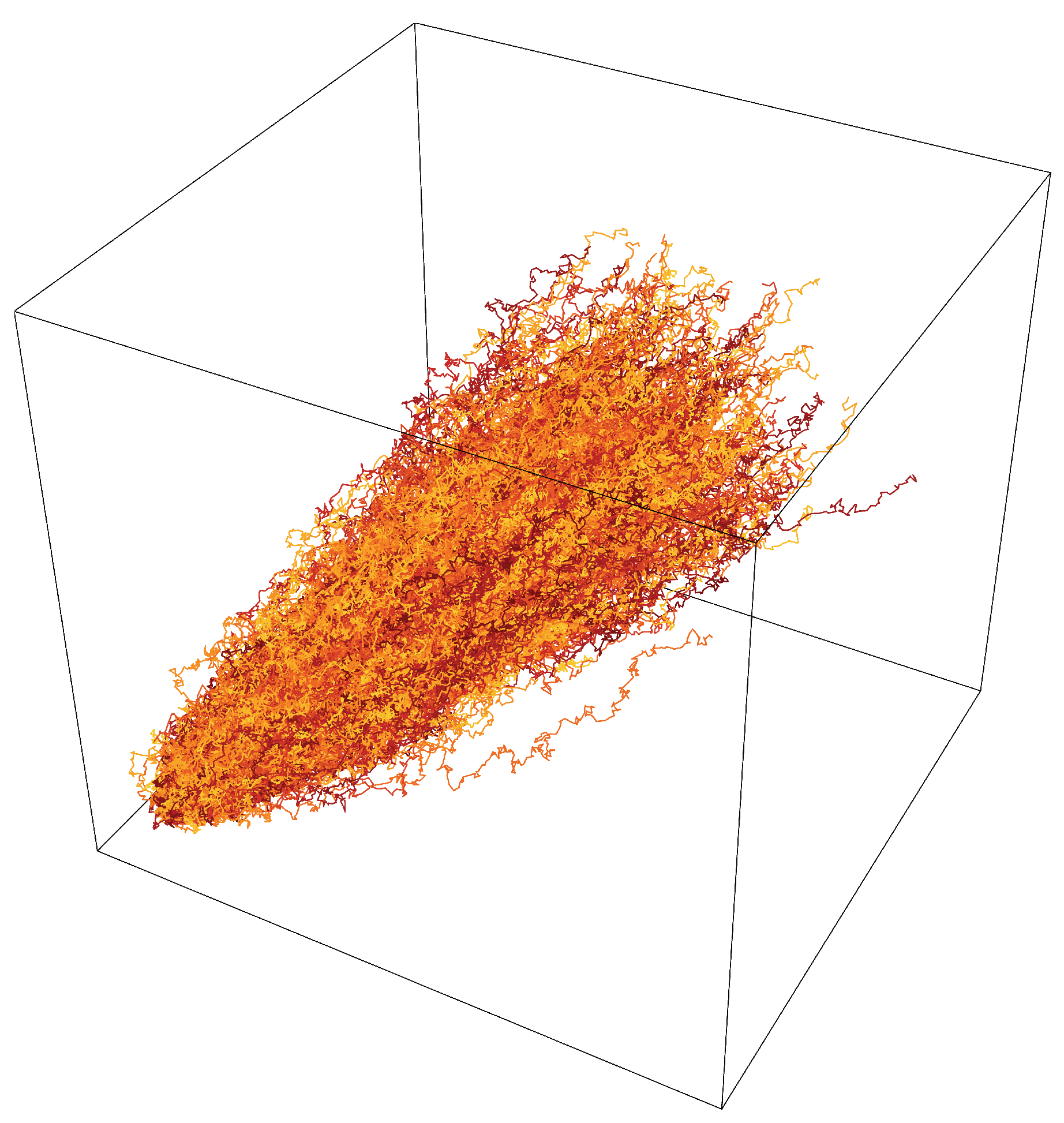
This result (3-dimensional biased Brownian motion) can be simulated by three 1-dimensional Brownian motions . Here, the trajectories of 500 particles randomly moving for 50 s with a time step of 0.1 s are presented in Figure 1. There is no significant difference from the situation that is unbiased and not affected by the special-relativity-like effect.
3. Conclusions
Regarding a particle swarm formed by a series of randomly moving particles (with uniform average speed c) with a greater probability of moving in a certain direction and the same probability of moving in other directions, there is a certain group velocity u in this direction, while the diffusion rate in other directions is slower than that of unbiased moving particles with the same average velocity c. Moreover, the degree of slowing follows the Lorentz-like factor. In this article, the relationship between the special-relativity-like effect and the biased stochastic process of randomly moving particles is explained in detail, and the Ito equation of such a process is Equation (8).
Supplementary Materials
Mathematica code for necessary calculation process and graphics. The following file is available free of charge.
Data Availability Statement
All data generated or analysed during this study are included in this published article and its supplementary information files.
Acknowledgments
The author is thankful for Wolfram Inc..
References
- Tapiero, C.S.; Vallois, P. Run length statistics and the Hurst exponent in random and birth-death random walks. Chaos, Solitons & Fractals 1996, 7, 1333–1341. [CrossRef]
- Guo, T. Study on the average speed of particles from a particle swarm derived from a stationary particle swarm. Scientific Reports 2021, 11, 1–4. [CrossRef]
- Guo, T. Dynamics of Stochastic-constrained Particles 2022. [CrossRef]
- Yang, T.; Guo, T. The angular speed distribution of randomly moving-particle group. AIP Advances 2022, 12, 045005. [CrossRef]
- Codling, E.A.; Plank, M.J.; Benhamou, S. Random walk models in biology. Journal of the Royal society interface 2008, 5, 813–834. [CrossRef]
- Debbasch, F.; Chevalier, C. Relativistic stochastic processes. AIP Conference Proceedings. American Institute of Physics, 2007, Vol. 913, pp. 42–48. [CrossRef]
- Dunkel, J.; Hänggi, P. Relativistic brownian motion. Physics Reports 2009, 471, 1–73. [CrossRef]
- Hakim, R. Relativistic stochastic processes. Journal of Mathematical Physics 1968, 9, 1805–1818. [CrossRef]
- Dunkel, J.; Talkner, P.; Hänggi, P. Relativistic diffusion processes and random walk models. Physical Review D 2007, 75, 043001. [CrossRef]
Figure 1.
Simulation results of the trajectories of 500 particles randomly moving for 50 s (, and ).
Figure 1.
Simulation results of the trajectories of 500 particles randomly moving for 50 s (, and ).
Disclaimer/Publisher’s Note: The statements, opinions and data contained in all publications are solely those of the individual author(s) and contributor(s) and not of MDPI and/or the editor(s). MDPI and/or the editor(s) disclaim responsibility for any injury to people or property resulting from any ideas, methods, instructions or products referred to in the content. |
© 2023 by the authors. Licensee MDPI, Basel, Switzerland. This article is an open access article distributed under the terms and conditions of the Creative Commons Attribution (CC BY) license (http://creativecommons.org/licenses/by/4.0/).
Copyright: This open access article is published under a Creative Commons CC BY 4.0 license, which permit the free download, distribution, and reuse, provided that the author and preprint are cited in any reuse.


