

Submitted:
15 January 2023
Posted:
17 January 2023
You are already at the latest version
Abstract
The move to lean construction is a lengthy process that may call into question established ways of construction management delivery. The objective of this article is to help businesses take the first step on this route by introducing a few lean manufacturing techniques and practices that may be used on projects over the next few weeks. Although the construction industry has come a long way since its start, the essential technology to change it has not yet found a home. The digital switch has now entered the construction industry to boost production. Artificial intelligence (AI) is a discipline of computer science described as the potential of machines to mimic intelligent human behavior by modelling traditionally complicated problems using human-inspired techniques. Due to its complexity, AI distinguishes itself from lower degrees of digitalization. The complexity of artificial intelligence involves the formation of new circumstances for human collaboration and trust. This dissertation investigates the application of artificial intelligence and the suitable interaction between humans and AI-based technologies. This study attempts to shed light on how the construction industry may close the gap between the potential and actual benefits of artificial intelligence deployment. Comparing the prospective benefits of AI implementation to the present benefits and challenges of AI deployment in the construction industry revealed the disparity.
Keywords:
Lean Construction
; Construction Management
; Manufacturing
; Construction Industry
; Optimization
; Projects
1. Introduction
The Toyota Production System is the progenitor of lean manufacturing. This system is credited with reducing the cost of automobiles while simultaneously improving their overall quality during the 1980s and 1990s. Since that time, the concept of "lean thinking" has been used in a wide range of industries other than the automobile industry, including the healthcare industry, the development of software, light manufacturing, and construction. When compared to the other categories of industries, the building and construction industry stands out as being essentially unique. It is project-centric, which means that it involves bringing together hundreds of companies (each of which has its own culture, long-term objectives, and technology choices) for the duration of a project before beginning the next project all over again from scratch. However, before doing so, it is necessary to start from scratch each time. In contrast to the productivity of all other non-agricultural companies, which has increased by more than four times since the 1960s [2], labour efficiency and productivity in the construction industry have both declined in recent decades [2]. This is just another aspect that sets this industry apart from others of a similar kind. Because of this decreasing tendency, the manner in which construction projects are carried out will need to evolve continuously.
Figure 1.
Construction workers on site.

2. Literature Review
There is a variety of scientific literature that explains the concepts and principles of lean, but very little of it goes into depth on how to get started with lean. This essay explains Lean principles through basic exercises that can be put into practice right away. As a result, the framework is completely reimagined by the author. Imagine for a moment that an athlete is preparing for a competition and that the following is the training regimen that they would adhere to. [2] Getting started with achievable baby steps that will yield observable effects in a very short length of time is the most crucial factor. These first triumphs will lend a hand in the establishment of habits, and as the individual grows more used to the Lean culture, they will lay the foundation for long-term success [3].
Lean construction is a methodology that aims to optimize the use of resources and eliminate waste in the construction process. This approach has been widely adopted in the industry, and has been proven to increase efficiency, reduce costs, and improve quality and safety on projects. However, starting a lean journey can be a daunting task for organizations that are new to the approach. This literature review aims to provide a practical guide for organizations on how to begin a lean journey and implement lean construction practices on their projects.
- Step 1: Assess the current state of the organization
The first step in starting a lean journey is to assess the current state of the organization. This includes identifying the current processes and practices that are used, as well as identifying areas of waste and inefficiency. This assessment can be done through a variety of methods, such as value stream mapping, process flow analysis, and data collection. The results of this assessment can then be used to develop a plan for improvement and identify areas where lean principles can be applied.
- Step 2: Develop a plan for improvement
Once the current state of the organization has been assessed, the next step is to develop a plan for improvement. This plan should include specific goals and objectives, as well as a timeline for implementation. The plan should also include a clear definition of the roles and responsibilities of each team member, as well as a communication plan to ensure that everyone is aware of the changes that are being made.
- Step 3: Implement lean practices
Once the plan for improvement has been developed, the next step is to implement lean practices on the project. This includes identifying and eliminating waste, such as overproduction, waiting, unnecessary motion, overprocessing, and defects. It also includes implementing practices such as pull systems, just-in-time delivery, and visual management to improve the flow of work.
- Step 4: Monitor and measure progress
The final step in starting a lean journey is to monitor and measure progress. This includes tracking key performance indicators (KPIs) such as productivity, lead time, and quality, as well as conducting regular audits and reviews to ensure that the organization is on track to achieving its goals.
3. Methodology
3.1. Utilize Visual Displays to Encourage Openness
The idea that the whole project should be optimized is one of the foundational tenets of the lean thinking methodology. It is possible that the overall performance of the project may suffer if you optimize one procedure in isolation from the others. Historically, different "project silos"—site locations, businesses, trade packages, field vs. office labor, and so on—have kept knowledge, work, and resources separate from one another. The goal of lean techniques is to integrate project teams by breaking down the barriers that traditionally separate different aspects of the work being done. The daily huddle meetings will take place in high-traffic areas (such as near the site gates or the entrance to the construction trailer), where individuals will erect visual displays. Make certain that the information is updated on a regular basis so that everyone can easily determine how the project is progressing.
- 1)
- Weather predictions
- 2)
- Safety concerns
- 3)
- Security personnel contact information
- 4)
- Important events for the day (such as crane picks or concrete pours)
- 5)
- Public announcements
- 6)
- Suggestion for improvement
- 7)
- Information is current every day:
- 8)
- Information is updated every two weeks or every month.
- 9)
- Project milestones schedule
- 10)
- Safety performance indicators (accident rate, near misses, etc.)
- 11)
- QA/QC stats, including open problems by industry
- 12)
- RFI and Proposal Metrics (monthly number of open RFIs)
- 13)
- average turnaround, and so on.
- 14)
- Work in progress (WIP) metrics for main project components
- 15)
- (predicted vs. real)
- 16)
- Color-coded floor diagrams depicting the work areas of each trade
- 17)
- Data from the Last Planner®
With the use of visual displays, the team will be able to determine the workflow at the project site and become aware of the action plans that have been developed. In addition to this, they will allow for ongoing improvement by offering a system that may show important performance indicators in order to encourage accountability and duty-taking. Cohesion among the members of the project team is dependent on a high level of transparency. People are only capable of making decisions based on the information that they have; if they lack this knowledge, they may as well consult a crystal ball for the answer. To efficiently disseminate project materials, directives, and measurements, it is thus self-evident that a distribution system must be put into place. Implementing virtual displays is an efficient initial step that may significantly contribute to improving transparency and building a strong sense of team spirit on the project. The use of construction management software may also play a significant role in this respect. When communicating essential project information to the project team, visual displays are a great tool to use. Typically, these are tack boards that are installed on the wall and used in conjunction with whiteboards. This makes it possible to combine information that is frequently published and is typically updated weekly or monthly with information that is more dynamic and is updated daily [3].
Figure 2.
Construction worker using Fieldwire project management on a tablet.

3.2. Start Regular Meetings to Enhance Dependability
In conventional approaches to project management, discrepancies in the flow of work are seen as either insignificant or as factors that are beyond the management team's ability to influence. As a result of this, instead of attempting to find a solution to the problem, management has implemented a variety of different contingency plans and buffers in order to keep the deviation within the bounds of the intended amount of time and expense. Concentrating on the reliability of promises made between site teams, engineering teams, and suppliers may lead to significant increases in productivity, a reduction in inventory, and a reduction in the amount of rework that is required. In the third and last part of this series, we will discuss the Last Planner® System (LPS), which is a comprehensive planning system that has been patented by LCI and strives to increase the reliability of projects while also providing value. The first step in improving the reliability of the project is to begin holding daily huddles that are structured around a comprehensive agenda. Contrary to what most people believe, most of these failures are not caused by factors that are beyond the control of the contractor.
What's a decent daily huddle agenda?
- 1)
- Investigate metrics and team development (as directed by the manager)
- 2)
- Status report for the team: today's commitments, obstacles, and problems (all).
Each member of the team should provide a quick update in response to the following questions [3]: What did I do the day before?
What am I working on today?
What impediments prohibit me from making progress?
These meetings are being held with the intention of establishing two-way communication not just between the office and the field but also between top management and the rest of the team. They bring the team together, make it possible for everyone to engage, and help everyone get a deeper comprehension of the bigger vision. Every member of the team is encouraged to evaluate whether the commitments made the day before were kept and to think about what new promises they may make today. Everyone is brought back to their responsibilities and encouraged to approach issues with the mindset of finding solutions. Both daily huddle discussions and visual displays are integral parts of the process. Visual displays are a great place to start, but they only provide a unidirectional and non-interactive flow of information (from the wall to the viewer). The teams will be more likely to interact with the visual display on a consistent basis if they have their daily huddles in front of it. Daily huddles are regular meetings of the team, and they are often necessary. They shouldn't last more than 15 minutes each, and you should schedule them to take place at the same time every day (i.e., 7 a.m.). Huddles should ideally include the whole project team (including project managers, professional engineers, site superintendents, and foremen), but if the team has more than 30 individuals, they may be convened at the workgroup or site zone level instead.
Figure 3.
Construction workers at a meeting.

The notion of "a place for everything and everything in its place" serves as the driving principle behind the 5S methodology, which is a methodical approach to maintaining order in the workplace. In the 1960s, it was first used at Toyota. It is one of the most used lean manufacturing tactics and has the potential to be used in a variety of settings, including a construction site, an outdoor plant, or even an office. This technique is a good starting point since it establishes the groundwork for several fundamental Lean principles, including the standardization of work, the elimination of waste, and the continual improvement of the process. In addition to that, it boosts the mood of the workers, encourages teamwork, and makes the workplace safer. In the following paragraphs, we will go further into each of these five stages of the methodology. In the following paragraphs, we will discuss many techniques for marking the floor, each of which was inspired by one of the 5S steps: Seiton (set in order) Floor Markings. During the building process, adding markers to the concrete floor slab is a technique that stems from the 5S methodology that helps to maintain site organization. Utilize red floor markings to demarcate the pedestrian circulation channels (carpet, tape, or paint). These must be positioned in safe zones, away from congested sections of the workplace, as soon as possible. This assures that workers will leave a clear route in their work zone, which should boost the pace of circulation while the area is being constructed or in the case of an emergency. People strolling by will be able to avoid potential threats more easily as a result of this, which will lessen interference and safety issues.
Figure 4.
Floor marking.
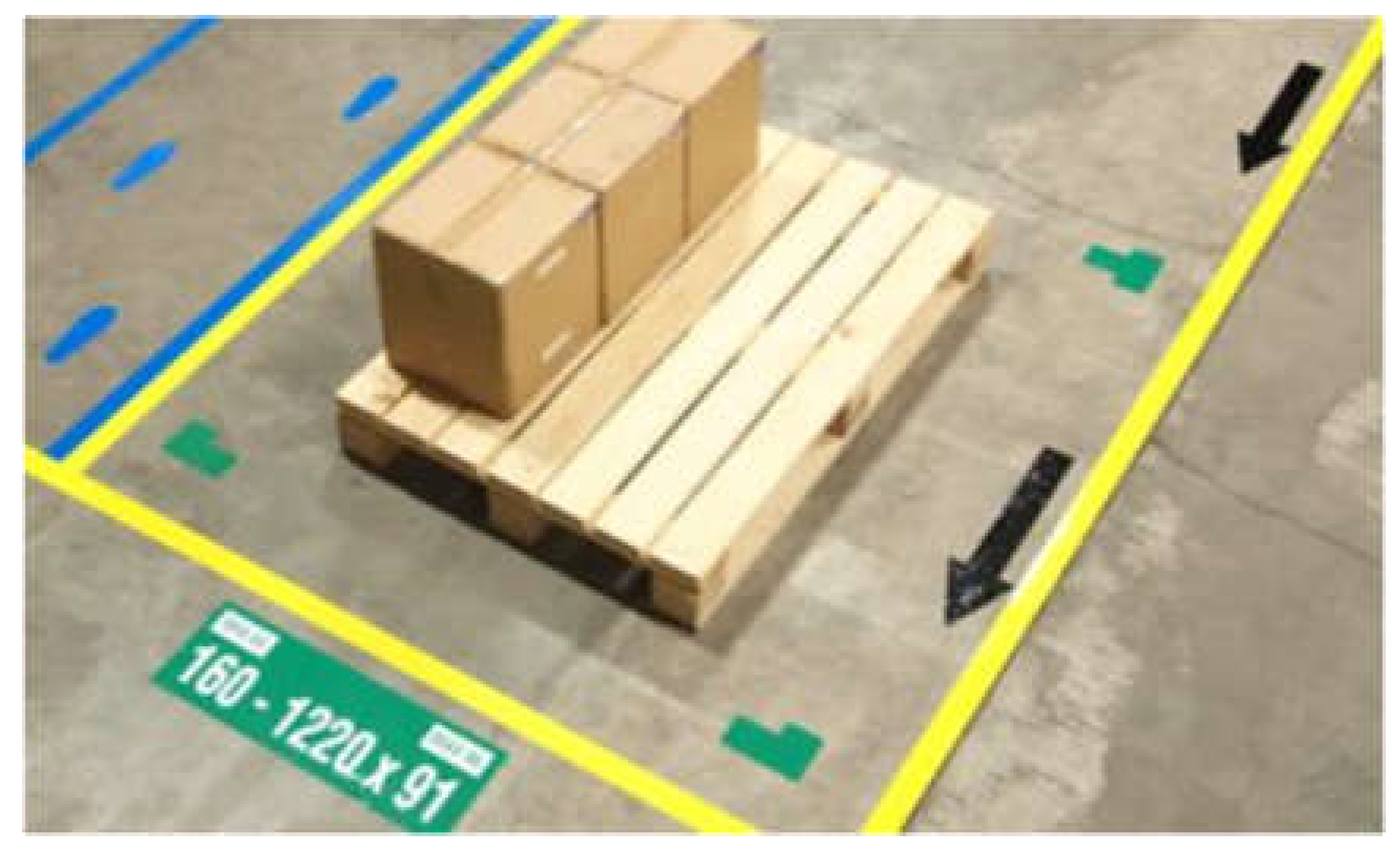
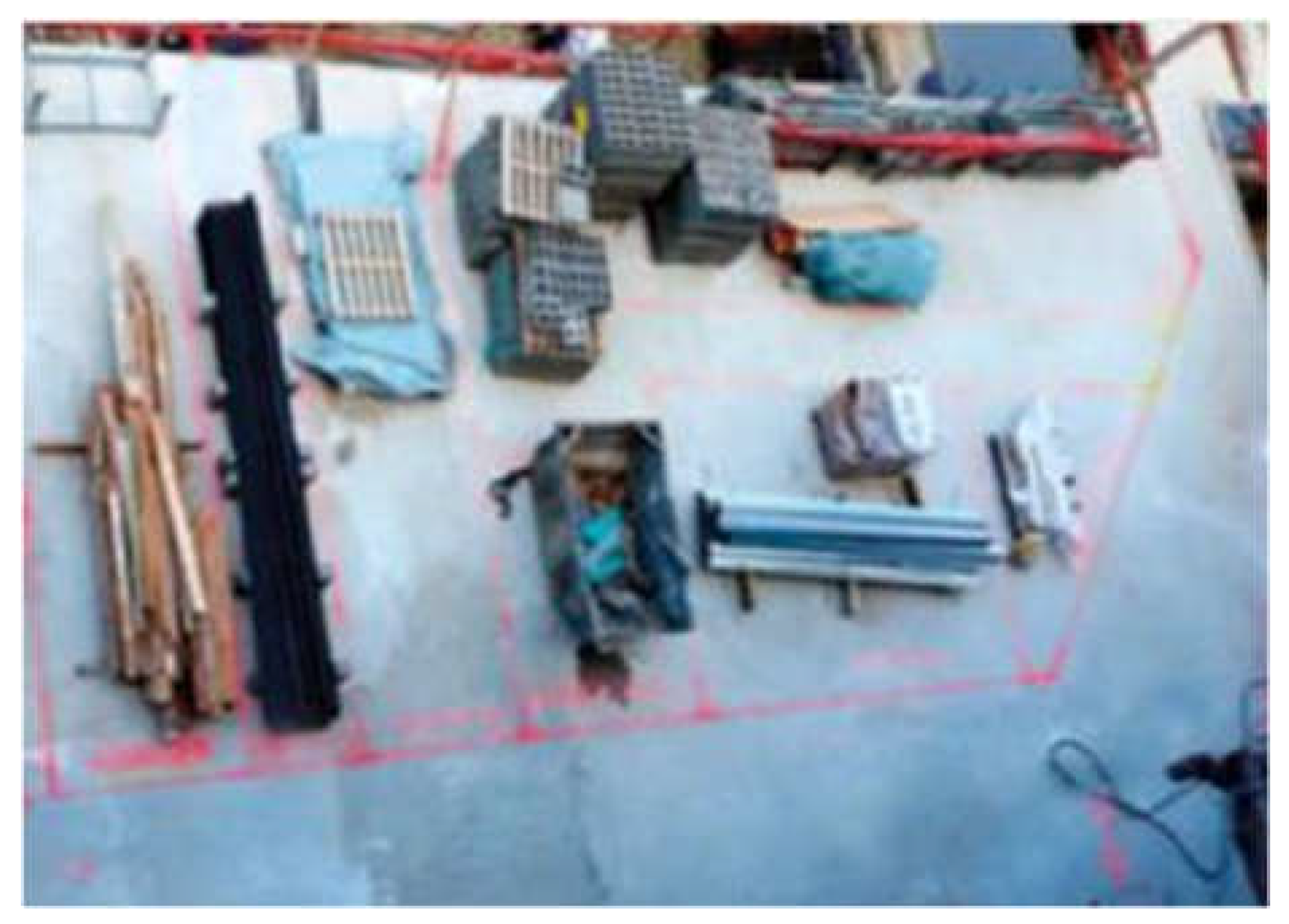
Utilize tape to clearly demarcate the area that will be used for storing materials and equipment. Because of this, it is possible for contractors to decrease their inventory, which is the third kind of waste, so that it does not interfere with the work of other crafts. In addition to contributing to the cleanliness and order of the jobsite, having designated locations for various pieces of equipment and tools (such as a trash can, ladder, or hand truck, for example) is another important factor. Your staff will spend less time looking for crucial tools or equipment.
Figure 5.
Tape to delineate material lay-down.
4. Results and Discussion
Studies have Studies suggest that less than 30% of a worker's day includes building labour [5]. They spend the balance of the day on non-project-related tasks. Supporting activities help the project run but don't provide value. Accounting, estimating, cleaning, and other administrative responsibilities are supporting activities. They should be reduced as much as possible. However, wasteful activities may be avoided without lowering the labour value. Change order requests, billings, RFIs, submittals, time sheets, extra work authorizations, quality and safety inspections, and other forms consume a construction worker's day. Construction workers will confirm this. Even though these papers are crucial to the project, processing them might take a long time. An administrator scanning through hundreds of scarcely visible field forms enters data into an information system too frequently. Project engineers may spend a lot of time filling up tracking logs, re-entering data, and engaging with field teams through RFIs and drawings. Emailing several copies of an RFI answer, a blueprint, authorized shop drawings, etc. is wasteful. Emailing is time-consuming, and the team may be using outdated materials, which may need rework. Instead, the user should search an open-access file-sharing network for the needed content. If delivering a document, use a "live" link to the most recent version. A project engineer helping create a punch list would usually accompany the architect on a walk-through and photograph each punch item. This practice started some years ago. After that, they would spend a lot of time putting these comments and photos into an Excel ledger and updating it when the punch list updated. Modern society should not need such outdated behaviors. Mobile apps may add items to a punch list during a site walk-through, attach photos and other important data, and generate reports and analytics when the user returns to the office. These powers exist. The Lean Building Institute [2] lists seven construction wastes: 1) Defects—Corrective work, error lists, and punch lists 2) Overproduction—premature manufacturing or buying more materials due to low quality. "Overproduction" describes this. Inventory includes on-site or yard-stored items, ongoing work, and unused equipment and components. Excessive processing includes compiling field notes into a report, making unnecessary reports, getting several signatures on a form, and repeating the same thing. Motion: searching a disorganized workplace for paperwork, plans, and other stuff. 6. transporting components, tools, or supplies. The scheduler awaits field-based progress reports while personnel await equipment, information, or supplies. The results of implementing a Lean Construction approach on a project can be significant. Some of the key benefits include:
- Increased efficiency: Lean Construction techniques focus on eliminating waste and maximizing value, which leads to more efficient use of resources and a reduction in project costs.
- Improved communication: Lean Construction encourages collaboration and communication among all project stakeholders, resulting in better coordination and less confusion.
- Greater flexibility: Lean Construction allows for flexibility and adaptability, enabling teams to respond quickly to changes and unexpected events.
- Enhanced safety: Lean Construction promotes a culture of safety, which can lead to fewer accidents and injuries on the job site.
- Increased customer satisfaction: Lean Construction puts the customer at the center of the project, ensuring that their needs are met and that they are satisfied with the final product.
To begin a Lean journey, it is important to first understand the principles of Lean Construction and how they can be applied to your project. This can be achieved through training, workshops, and consulting with experts in the field. Next, it is important to establish a team dedicated to implementing Lean Construction practices, including a Lean champion who will lead the effort. This team should involve all stakeholders, including the project owner, contractors, and other members of the project team. Once the team is in place, it is important to establish clear goals and objectives for the project, and to develop a plan for how to achieve them. This plan should include specific Lean practices and tools that will be used, as well as metrics to measure progress and success. Finally, it is important to continuously monitor and evaluate progress, and to adjust as needed. This includes regularly reviewing project data and metrics, identifying areas for improvement, and implementing corrective actions. Overall, starting a Lean journey on a project requires a commitment to continuous improvement, a willingness to try new things, and a collaborative approach among all stakeholders. With the right mindset and approach, the benefits of Lean Construction can be realized and lead to a successful project outcome.
5. Conclusions
Traditional project management will tell you whether a project is behind schedule or over budget, but it won't tell you why or how to make it better. Within the framework of lean thinking, it is the responsibility of the project team to set up an information management system as well as a culture in order to identify opportunities for improvement and predict upcoming difficulties. While the culture encourages information flow and fluidity, the information management system helps spot issues before they become serious, tracks how they are resolved, and highlights the root causes of those problems. Because of this, teams can continuously uncover and implement modifications, which results in a reduction in both the timetable and the budget for the project. The practice of looking back on one's past actions is an effective strategy for pursuing continued improvement. A plus or minus is a short chat that takes place at the end of a meeting, activity, or project to evaluate how successful it was and provide suggestions for how it may be improved [7]. By using this method, teams can continually grow while acknowledging the contributions of individuals. During the last 10 minutes of a meeting, participants often engage in Plus-Delta dialogues. How to execute it at a meeting:
- 1)
- The person in charge of the meeting should give Plus/Delta 10 minutes and make sure that time isn't wasted.
- 2)
- The facilitator of the meeting should draw a line along the Centre of a whiteboard, call the tops "Plus" and "Delta," and then invite the team to submit their pluses and deltas:
- 3)
- Each team member's opinion should begin with a designation of Plus or Delta. The moderator of the meeting invites attendees to discuss both positives and negatives and will record them on the whiteboard. For deltas, he should try to figure out the root cause of a certain problem and explain what needs to be done at the next meeting.
The Plus/Delta should be included in the meeting minutes and shared with the team.
- 1)
- What additional value did the meeting provide?
- 2)
- Delta: What changes could be made to improve the process or outcome?
Recent studies conducted in the United States Recent research carried out in the United States, Scandinavia, and the United Kingdom suggests that as much as thirty percent of construction must be redone, that labour is utilized at only forty to sixty percent of its potential efficiency, that accidents can account for three to six percent of total project costs, and that at least ten percent of materials are lost or wasted. The takeaway here is unmistakable: reducing waste offers a wealth of opportunities to enhance both the quality and effectiveness of building projects. [6–19]
References
- The Lean Construction Journey: A Practical Guide to Implementing Lean Construction Principles" by Mark B. Harnitchek. Published by CRC Press, 2018.
- "Lean Construction: A Practical Guide to Improving Project Performance" by James S. O'Connell. Published by Routledge, 2018.
- "The Lean Construction Journey: A Roadmap to Success" by David E. Martin. Published by The Lean Construction Institute, 2018.
- "The Lean Construction Handbook: A Guide to Implementing Lean Construction Principles" by John B. Regan. Published by J. Ross Publishing, 2018.
- "Applying Lean Construction: A Guide to Building Better Projects" by Michael B. Easton. Published by Springer, 2018.
- "A Beginner's Guide to Lean Construction: A Practical Approach to Improving Project Performance" by John A. Koskela. Published by CRC Press, 2018.
- "The Lean Construction Blueprint: A Step-by-Step Guide to Implementing Lean Construction Principles" by Gregory A. Howell. Published by Butterworth-Heinemann, 2018.
- "The Lean Construction Method: A Practical Guide to Building Better Projects" by Stefan Hauswirth. Published by Springer, 2018.
- "Lean Construction: A Guide to Improving Productivity and Quality" by David L. Langford. Published by Routledge, 2018.
- "The Lean Construction Project: A Guide to Implementing Lean Construction Principles" by David L. Butler. Published by Taylor & Francis, 2018.
- "Lean Construction: Achieving High Performance in Building Projects" by Jayakumar Raman. Published by Springer, 2018.
- "Lean Construction: A Guide to Implementing Lean Construction Principles in the Building Industry" by Charles E. Kibert. Published by Routledge, 2018.
- "The Lean Construction Experience: A Guide to Implementing Lean Construction Principles in Practice" by Paul J.B. Banfield. Published by Springer, 2018.
- "Lean Construction: A Guide to Improving Productivity and Quality in Building Projects" by James A. Harring. Published by CRC Press, 2018.
- "Lean Construction: A Guide to Implementing Lean Construction Principles in the Construction Industry" by Matthew L. Burris. Published by Routledge, 2018.
- "The Lean Construction Journey: A Guide to Implementing Lean Construction Principles in the Building Industry" by John R. McDonough. Published by Taylor & Francis, 2018.
- "The Lean Construction Method: A Guide to Building Better Projects" by George L. Easton. Published by J. Ross Publishing, 2018.
- "Lean Construction: A Guide to Improving Productivity and Quality in the Building Industry" by Michael J. Fox. Published by Springer, 2018.
- "The Lean Construction Blueprint: A Guide to Implementing Lean Construction Principles in the Construction Industry" by Mark S. Thompson. Published by Butterworth-Heinemann, 2018.
Disclaimer/Publisher’s Note: The statements, opinions and data contained in all publications are solely those of the individual author(s) and contributor(s) and not of MDPI and/or the editor(s). MDPI and/or the editor(s) disclaim responsibility for any injury to people or property resulting from any ideas, methods, instructions or products referred to in the content. |
© 2023 by the authors. Licensee MDPI, Basel, Switzerland. This article is an open access article distributed under the terms and conditions of the Creative Commons Attribution (CC BY) license (http://creativecommons.org/licenses/by/4.0/).
Copyright: This open access article is published under a Creative Commons CC BY 4.0 license, which permit the free download, distribution, and reuse, provided that the author and preprint are cited in any reuse.


