

Submitted:
09 January 2023
Posted:
16 January 2023
You are already at the latest version
Abstract
The host-guest inclusion strategy has potential to surpass the limitations of energy density and suboptimal performances of single explosives. The guest molecules can not only enhance the detonation performance of host explosives but can also enhance their stability. Therefore, the deeply analysis the role of guest influence on the pyrolysis decomposition of the host-guest explosive is necessary. The whole decomposition reaction stage of CL-20/H2O, CL-20/CO2, CL-20/N2O, CL-20/NH2OH was calculated by ReaxFF-MD. The incorporation of CO2, N2O and NH2OH significantly increase the energy levels of CL-20. However, different guest has little influence on the initial decomposition paths of CL-20. The Ea1 and Ea2 values of CL-20/CO2, CL-20/N2O, CL-20/NH2OH systems are higher than the CL-20/H2O system. Clearly, incorporation of CO2, N2O, NH2OH can inhibit the initial decomposition and intermediate decomposition stage of CL-20/H2O. Guest molecules get heavily involved in the reaction and influence on the reaction rate. k1 of CL-20/N2O and CL-20/NH2OH systems are significantly larger than that of CL-20/H2O at high temperatures. k1 of CL-20/CO2 system is much complex, which can be affected deeply by temperatures. k2 of CL-20/CO2, CL-20/N2O system is significantly smaller than that of CL-20/H2O at high temperatures. k2 of CL-20/NH2OH system is little difference at high temperatures. For the CL-20/CO2 system, the k3 value of CO2 is slight higher than that for CL-20/H2O, CL-20/N2O, CL-20/NH2OH systems, while the k3 values of N2 and H2O are slight smaller than that for CL-20/H2O, CL-20/N2O, CL-20/NH2OH systems. For the CL-20/N2O system, the k3 value of CO2 is slight smaller than that for CL-20/H2O, CL-20/CO2, CL-20/NH2OH systems. For the CL-20/NH2OH system, the k3 value of H2O is slight larger than that for CL-20/H2O, CL-20/CO2, CL-20/N2O systems. These mechanisms revealed that CO2, N2O and NH2OH molecules inhibit the early stages of the initial decomposition of CL-20, and play an important role for the decomposition subsequently.
Keywords:
host-guest inclusion strategy
; pyrolysis decomposition
; ReaxFF-MD
; reaction rate
1. Introduction
Successful balance between high energy and safety of energetic materials is challenging due to the time-consuming and difficult for synthesis of a new energetic materials. Host-guest energetic materials as shown in Figure 1 by embedding hydrogen-[1,2,3] or nitrogen-containing [4,5] oxidizing small molecules into the crystal lattice voids may be achieved highest possible energy density and the maximum possible chemical stability [6].
2,4,6,8,10,12-hexanitro-2,4,6,8,10,12-hexaazaisowurtzitane (CL-20) as one of the energetic materials with the highest density has been widely studied recently. Bennion J. C.[3] synthesized two polymorphic hydrogen peroxide (HP) solvates of α-CL-20. Two α-CL-20/H2O2 host-guest compounds are scarcely changing the lattice volume of the α-CL-20/H2O and improving the energy. Thereafter, research focused on adopting a host-guest inclusion strategy to embed suitable guest within the void by removing water of α-CL-20/H2O. A series of α-CL-20-guest energetic materials such as CL-20/CO2[4], CL-20/N2O [4], CL-20/NH2OH [5] have been constructed in this manner.
The simulation of α-CL-20/guest mainly focused on the mechanism of host-guest molecular interaction and the pyrolysis mechanism at high temperatures. The intermolecular interaction is the central scientific issue of energetic cocrystals. Guo [6] had reviewed some typical energetic inclusion compounds and their structures, intermolecular interactions, stabilities, and energy properties. It provides a method to predict appropriate size of guest incorporate into the cavities of the α-CL-20 crystal. The systematically studies [7,8,9] on the comparison of interaction between the host-guest energetic complexes are devoted to summarizing the influence of guest on the performance of α-CL-20. The results would provide fundamental to summarize the properties of guest for α-CL-20/guest with structural stability. Meanwhile, in order to deeply analyze the role of hydrogen-guest small molecules in the host-guest system, the initial decomposition reactions of ICM-102/HNO3[10], ICM-102/H2O2[11] with pure ICM-102 and CL-20/H2O2[12] at several high temperatures were systematically studied by molecular dynamics simulations. It was found that the addition of guest small molecules significantly increased the energy levels of ICM-102 and CL-20, but had little effect on the thermal stability of the host-guest system. The initial reaction path of ICM-102 molecule was not changed by HNO3 and H2O2, but HNO3 and H2O2 promoted the decomposition of ICM-102 molecule in the subsequent decomposition process. With the increase of temperature, the influence of H2O2 on the pyrolysis reaction of CL-20 weakens [13].
All the simulation researches provide information to understand the influence of guest for the host explosives. However, the role of different nitrogen-guest small molecules in the host-guest system has not been studied systematically at different high temperatures. At the same high temperature, when do the different guest molecules participate in the decomposition reaction of host-guest explosive and how do they affect the decomposition process mechanism of host-guest explosive? What is the influence of the same guest on the pyrolysis of the host-guest explosive at different high temperatures? Therefore, detailed studies of the mechanism of the α-CL-20/nitrogen-guest detonation reaction at different high temperatures are necessary.
ReaxFF-MD [10,12,13] can conduct in-depth and detailed research on the pyrolysis mechanism of host-guest explosive at the microscopic scale, and find that how guest molecules participate in the pyrolysis reaction of the guest is an important factor affecting the energy release and detonation performance of the host explosives. In this study, we investigated the initial reaction of CL-20/CO2, CL-20/N2O, CL-20/NH2OH and compared with the pure CL-20/H2O at various temperatures (2500, 2750, 3000, 3250, and 3500K) by ReaxFF-lg reactive MD simulations (MD/ReaxFF-lg). The initial reaction paths, the change of generated/destroyed chemical bond numbers, the main product compositions, kinetic parameters in the different stages were analyzed. The mechanism for the improvement of the explosive energy and stability by incorporation of CO2, N2O and NH2OH is also discussed.
2. Results and Discussion
2.1. Potential Energy (PE) and Total Energy for CL-20/H2O, CL-20/CO2, CL-20/N2O, CL-20/NH2OH Systems
The evolution of potential energy (PE) of CL-20/H2O, CL-20/CO2, CL-20/N2O, CL-20/NH2OH systems with time at (a) 2500K, (b) 2750K, (c) 3000K, (d) 3500K is shown in Figure 2. All the PE of CL-20/guest are much larger than that of CL-20/H2O. It demonstrates that the addition of guest small molecules significantly increase the energy levels of CL-20 just shown in Figure 3. All the systems exhibit an initial rise in the PE curves at different temperatures which correspond to the endothermic reaction stage. When PE is maximized, the value thereafter decreases, signifying that the reaction becomes exothermic. The maximum value of PE increases in the order incorporation of H2O < NH2OH < CO2 < N2O at different temperatures, and the heat release is also increased. That is, the incorporation of guests may have remarkable influence on heat release during the reaction. At a relatively low temperature of 2500K, the PE curve is smooth. However, when the temperature increase to 2750K, the PE curve is a little bit steeper. As the temperature increase to much higher 3000K and 3500K, the PE curve changed little. That is, no obvious heat release occurs during the reaction for much higher temperatures. With the increase of temperature, the PE observed to be close to equilibrium for much shorter time. Therefore, the higher the temperature, the earlier the complete reaction.
The evolution of potential energy (PE) of (a) CL-20/H2O, (b) CL-20/CO2, (c) CL-20/N2O, (d) CL-20/NH2OH system with time at different temperatures is shown in Figure 3. The trend of PE curves for CL-20/H2O and CL-20/N2O is very similar. The trend of PE curves for CL-20/CO2 and CL-20/NH2OH is very similar. That is, the incorporation of N2O may have the same influence on heat release with H2O. While, the incorporation of CO2 may have the same influence on heat release with NH2OH.
2.2. Initial Decomposition Stage
2.2.1. Initial Reaction Path of CL-20/Nitrogen-Guest
Table 1 shows the initial reaction paths of host-guest molecules and their occurrence frequency for CL-20/H2O, CL-20/CO2, CL-20/N2O, CL-20/NH2OH at four high temperatures. There are two main initial decomposition reactions of host CL-20 molecules  and
and  . The frequency of
  is much more than that of
  . As the increase with the temperatures, the frequency of both two main initial decomposition reaction improve for CL-20/H2O, CL-20/CO2, CL-20/N2O, CL-20/NH2OH. A small part of H2O, N2O, NH2OH are broken to smaller pieces except for CO2 with no decomposition. At the same high temperature, the frequency of both two main initial decomposition reactions are not significant difference for CL-20/H2O, CL-20/CO2, CL-20/N2O, CL-20/NH2OH. It demonstrates that different guest has little influence on the initial decomposition paths.
and . The frequency of is much more than that of . As the increase with the temperatures, the frequency of both two main initial decomposition reaction improve for CL-20/H2O, CL-20/CO2, CL-20/N2O, CL-20/NH2OH. A small part of H2O, N2O, NH2OH are broken to smaller pieces except for CO2 with no decomposition. At the same high temperature, the frequency of both two main initial decomposition reactions are not significant difference for CL-20/H2O, CL-20/CO2, CL-20/N2O, CL-20/NH2OH. It demonstrates that different guest has little influence on the initial decomposition paths.2.2.2. Effect of Nitrogen-Guest on the k1
There are three stages for the evolution of the thermal decomposition of CL-20/nitrogen-guest. Firstly, the initial decomposition stage is characterized by rate constant k1 and activation energy Ea1. Then, the intermediate decomposition stage is characterized by rate constant k2 and activation energy Ea2. Finally, the final product evolution stage is characterized by rate constant k3 and activation energy Ea3.
During the initial decomposition stage, the reaction rate was calculated by the change of the number of CL-20 molecules. The decay of the number of CL-20 molecules with time follows first-order decay exponential function [14]: N(t) = N0 × exp[ –k1(t –t0) ], where N0 is the initial number of CL-20 molecules, t0 is the time when CL-20 started to decompose, and k1 is the initial decomposition stage rate constant (Table 2).
The logarithm of k1 plotted against the inverse temperature (1/T) at 2500, 2750, 3000, 3250, and 3500 K is shown in Figure 5. The Ea1 values of the CL-20/H2O, CL-20/CO2, CL-20/N2O, CL-20/NH2OH systems are 64.90, 87.12, 81.93 and 90.12 kJ∙mol−1, respectively. Clearly, incorporation of CO2, N2O, NH2OH impede the initial decomposition. This indicates that nitrogen-guest can inhibit the trigger decomposition of CL-20/H2O.
In addition, k1 of CL-20/N2O system is significantly larger than that of CL-20/H2O at high temperatures. This indicates that N2O significantly accelerates the reaction rate in the initial decomposition stage at high temperatures. k1 of CL-20/NH2OH system is significantly larger than that of CL-20/H2O at relatively higher temperatures (3500K, 3250K, 3000K, 2750K). As the temperature decreased to 2500 K, the difference between k1 of the CL-20/NH2OH and CL-20/N2O systems almost disappears. This indicates that NH2OH significantly accelerates the reaction rate in the initial decomposition stage at relatively higher temperature. k1 of CL-20/CO2 system is much complex. At higher temperatures, k1 of CL-20/CO2 is much larger than that of CL-20/H2O. However, k1 of CL-20/CO2 is much smaller than that of CL-20/H2O at relatively lower temperatures. This indicates the temperature has significant influence on the initial decomposition rate for CL-20/CO2.
2.3. Intermediate Decomposition Stage
2.3.1. Effect of Nitrogen-Guest on the Main Intermediate Products
Figure 6 shows the evolution curves of the main intermediate products and host-guest molecules at different temperatures. For CL-20/H2O at 2500K, the number curve of host CL-20 fluctuates slightly, but the overall level remains horizontal before 0.5ps. The NO2 fragments appears immediately at about 0ps. However, the number curve of guest H2O fluctuates slightly, but the overall level remains horizontal before 0.9ps. This demonstrates that the initial decomposition of CL-20/H2O may broken the C-NO2 bonds of host CL-20 to form NO2. During 0.5ps~1ps, the number of host CL-20 decreases sharply and disappears at 1ps, while the number of NO2 fragments increases rapidly. During 0.9ps~1ps, the number of guest H2O decreases, while the number of guest H2O reaches the minimum value. It demonstrates that guest H2O begins to participate the decomposition reaction deeply. The results of the trend are consistent with those of PE before 1ps for endothermic decomposition stage. During 0.5ps~1ps, the number of guest NO2 increases sharply, while the number of guest NO2 reaches the maximum value. Due to the participation of H2O, the pyrolysis products begin to diversify. The NO3 and NO fragments begin to appear. All the curves for NO3 and NO fragments are similarity at the high temperatures. However, the amount of NO3 and NO fragments would improve as the increase of temperatures. As the temperature increased, the variation curves of the main intermediate produces and host-guest molecules for CL-20/H2O remains the same approximately. However, the reaction rates (k2) are significantly different. The influence of high temperature on k2 will analyse in the following section.
For CL-20/CO2, CL-20/N2O, CL-20/NH2OH at high temperatures, the evolution tendency of the main intermediate products and host molecules is similar with that for CL-20/H2O at 2500K. The variation curves of guest are quite different.
Figure 7, Figure 8 and Figure 9 show the evolution curves of the host and guest molecules for CL-20/H2O, CL-20/CO2, CL-20/N2O, CL-20/NH2OH at 2500K, 3000K, 3500K. All the host CL-20 variation tendency are similarity. The influence of different guest on k2 is not significant at 2500K. With higher temperature, the k2 significantly larger. The guest H2O and CO2, they are the main decomposition products. The variation tendency can divide into four stages: firstly, the tendency of guest is a level for little changeable. Secondly, it decreases for guest decomposition quickly. Then, it increase quickly as the main products. Finally, it reaches horizontal for the completely decomposition. There are two differences for the variation tendency: the first is that H2O and CO2 start to decrease at different times. The longer time to stay the first stage for CO2 shows that CO2 may be more stability than H2O. And the second is that the minimum values of H2O and CO2 are different. It demonstrates that the more intense in pyrolysis reaction for H2O than that of CO2. As the increase of temperatures, the shorter time to stay the first stage and the smaller minimum for CO2 and H2O. It displays that the more intense in pyrolysis reaction at higher temperatures. For N2O, NH2OH just as the role for guest, the variation tendency slowly decreases and then sharply decreases until disappears. However, the reaction rates (k2) for CO2, N2O, NH2OH are significantly different at different temperatures.
2.3.2. Effect of Nitrogen-Guest on the k2
After the PE reached the maximum value, the intermediate exothermic decomposition indicates the chemical reaction stage. The intermediate decomposition stage rate constant k2 can be obtained by fitting the PE curves with a firstorder decay exponential function [15]: U(t)=U∞+ΔUexo•exp[-k2(t-tmax)], where U(t) is the potential energy value at time t, U∞ is the asymptotic value of PE, ΔUexo is the reaction heat, and its size is the difference between the maximun potential energy Umax and U∞.
The chemical reaction rate constants obtained by fitting equation at different temperatures are shown in Table 3. The value of ΔUexo has little change with the gradually increase of U∞ and k2 as temperature increase. This indicates that temperature has a limited effect on the exothermic reaction [16].
The logarithm of k2 plotted against the inverse temperature (1/T) at 2500, 2750, 3000, 3250, and 3500 K is shown in Figure 10. The Ea2 values of the CL-20/H2O, CL-20/CO2, CL-20/N2O, CL-20/NH2OH systems are 80.76, 87.58, 92.73 and 84.88 kJ∙mol−1, respectively. Clearly, incorporation of CO2, N2O, NH2OH can inhibit the intermediate decomposition of CL-20/H2O.
The pre-exponential factor derived from the pyrolysis simulations of the CL-20/H2O, CL-20/CO2, CL-20/N2O, CL-20/NH2OH systems are 29.65, 29.68, 30.03, 29.80. Assuming unimolecular decomposition, transition state theory leads to A = (kBT/h)exp(ΔS/R) where ΔS(CL-20/H2O)=-17.47J•mol−1•K−1, ΔS(CL-20/CO2)=-17.23 J•mol−1•K−1, ΔS(CL-20/N2O)= -14.32J•mol−1•K−1, ΔS(CL-20/NH2OH)=-16.23J•mol−1•K−1. This negative activation of entropy is consistent with the TST for multimolecular reactions, suggesting that the reaction involves a multimolecular transition state [17]. The decrease of entropy at the transition state because of the embedding of nitrogen-containing guests.
In addition, k2 of CL-20/CO2 system is significantly smaller than that of CL-20/H2O at high temperatures. This indicates that CO2 significantly inhibits the reaction in the intermediate decomposition stage at high temperatures. k2 of CL-20/N2O system is significantly smaller than that of CL-20/H2O at relatively lower temperatures (2500K and 2750K). As the temperature increased to 3500 K, the difference between k2 of the CL-20/H2O and CL-20/N2O systems almost disappears. This indicates that N2O significantly restrains the reaction in the intermediate decomposition stage at relatively low temperature. With increasing temperature, N2O has increasingly less effect on the reaction rate. However, k1 of CL-20/N2O indicates that N2O significantly accelerates the reaction in the initial decomposition stage at high temperatures. The conclusion is contrary to that for ICM-102/HNO3[18]. This maybe caused by the hydrogen content for nitrogen-guest. k2 of CL-20/H2O and CL-20/NH2OH systems are little difference at high temperatures, NH2OH has little effect on the reaction rate at high temperatures. The opposite effect of CL-20/H2O2[19] maybe due to the difference of hydrogen content in the guest. The influence of CO2 and N2O on the decomposition reaction of host explosive may be the little interaction between CO2, N2O and CL-20[20]. However, the influence of H2O2 on the decomposition reaction of host explosive may be the significant interaction between H2O2 and CL-20 [20].
2.4. Final Product Evolution Stage
2.4.1. Effect of Nitrogen-Guest on the Final Products
To clarify the effect of CO2, N2O and NH2OH molecules on the main products, the population of CO2, N2, H2O after the complete decomposition reaction for CL-20/H2O, CL-20/CO2, CL-20/N2O, CL-20/NH2OH at 2500K, 3000K and 3500K are shown at Figure 11, Figure 12 and Figure 13.
The population of CO2 for CL-20/NH2OH and CL-20/H2O are nearly equivalent at high temperatures. The population of CO2 for CL-20/N2O is the lowest, while the population of CO2 for CL-20/H2O is largest at 2500K. As the temperature increase, the more population of CO2 for CL-20/N2O grows acutely. However, the population of CO2 for CL-20/CO2, CL-20/NH2OH decrease acutely. It demonstrates that the CO2 produced mechanism for N2O guest is different with CO2 and NH2OH guests. The population of N2 for CL-20/NH2OH and CL-20/H2O are nearly equivalent at high temperatures. As the temperature increase, the more population of CO2 for CL-20/CO2, CL-20/N2O grows acutely. It demonstrates that the N2 produced mechanism for NH2OH guest is different with CO2 and N2O guests. The population of H2O for CL-20/NH2OH and CL-20/H2O are nearly equivalent at high temperatures. The population of H2O for CL-20/CO2 and CL-20/N2O are nearly equivalent at high temperatures. The variation tendency of population for three main products shows that the influence of guest NH2OH and H2O, CO2 and N2O are much same to each other. This may be caused by the hydrogen for two group guest.
2.4.2. Effect of Nitrogen-Guest on the k3
The final products of thermal decomposition of CL-20/guest are N2, CO2 and H2O. The formation rates k3 can be obtained by fitting the variation trend of the final products with the exponential function [21]: C(t)= C∞{1-exp[-k3(t-ti)]}, where C∞ is the asymptotic number of the product, k3 is the formation rate constant of the product, and ti is the time of appearance of the product.
Comparison of the k3 values of CO2, H2O and N2 for the (a) CL-20/H2O, (b) CL-20/CO2, (c) CL-20/N2O, (d) CL-20/NH2OH at different temperatures is shown in Figure 14. All the k3 values of CO2, H2O and N2 are increased as the temperature improvement. This may be due to the facilitation on production the three main products. The k3 values of H2O is larger than that of N2 , while the k3 values of N2 is larger than that of CO2 for CL-20/H2O, CL-20/CO2, CL-20/N2O, CL-20/NH2OH. This demonstrates that the production of H2O is the easiest and the production of CO2 is the least.
Comparison of the k3 values of CO2, H2O and N2 for the CL-20/H2O, CL-20/CO2, CL-20/N2O, CL-20/NH2OH at different temperatures is shown in Figure 15. For the CL-20/CO2 system, the k3 value of CO2 is slight higher than that for CL-20/H2O, CL-20/N2O, CL-20/NH2OH systems, while the k3 values of N2 and H2O are slight smaller than that for CL-20/H2O, CL-20/N2O, CL-20/NH2OH systems. This indicates that CO2 restrains the formation of H2O and N2 molecules. For the CL-20/N2O system, the k3 value of CO2 is slightly smaller than that for CL-20/H2O, CL-20/CO2, CL-20/NH2OH systems. This indicates that N2O restrains the formation of CO2. For the CL-20/NH2OH system, the k3 value of H2O is slightly larger than that for CL-20/H2O, CL-20/CO2, CL-20/N2O systems. This indicates that NH2OH accelerates the formation of H2O.
3. Discussion
We have performed MD/ReaxFF-lg simulations to investigate the thermal decomposition reaction of the CL-20/H2O, CL-20/CO2, CL-20/N2O, CL-20/NH2OH systems at different temperatures. In this work, guest is not only enhanced the safety but also improved its detonation performance.
During the thermal decomposition reaction of CL-20/H2O, CL-20/CO2, CL-20/N2O, CL-20/NH2OH systems at different temperatures, the initial reaction path is not significantly influenced by the incorporation of CO2, N2O, NH2OH:  and
and  . At the same high temperature, the frequency of both two main initial decomposition reaction are not significant difference for CL-20/H2O, CL-20/CO2, CL-20/N2O, CL-20/NH2OH. As the increase with the temperatures, the frequency of both two main initial decomposition reaction improve for CL-20/H2O, CL-20/CO2, CL-20/N2O, CL-20/NH2OH. The nitrogen-guest can inhibit the trigger decomposition for the larger Ea1 and Ea2 values. By embedding N2O and NH2OH can significantly accelerate the reaction in the initial decomposition rates at high temperatures for the larger k1 at high temperatures. However, incorporation of CO2, higher temperature has significant influence on the initial decomposition for the complex k1. By embedding CO2 and N2O significantly inhibits the reaction in the intermediate decomposition stage at high temperatures for the smaller k2 at high temperatures. Incorporation of NH2OH has little effect on the reaction rate at high temperatures with the little difference of k2. All the k3 values of CO2, H2O and N2 are increased as the temperature improvement. Guest CO2 restrains the formation of H2O and N2 molecules for the higher k3 value. Guest N2O restrains the formation of CO2 for the higher k3 value. Guest NH2OH accelerates the formation of H2O molecules for the higher k3 value. The influence of guest NH2OH and H2O, N2O and CO2 on decomposition products maybe similarity for the same amount products with each other.
and . At the same high temperature, the frequency of both two main initial decomposition reaction are not significant difference for CL-20/H2O, CL-20/CO2, CL-20/N2O, CL-20/NH2OH. As the increase with the temperatures, the frequency of both two main initial decomposition reaction improve for CL-20/H2O, CL-20/CO2, CL-20/N2O, CL-20/NH2OH. The nitrogen-guest can inhibit the trigger decomposition for the larger Ea1 and Ea2 values. By embedding N2O and NH2OH can significantly accelerate the reaction in the initial decomposition rates at high temperatures for the larger k1 at high temperatures. However, incorporation of CO2, higher temperature has significant influence on the initial decomposition for the complex k1. By embedding CO2 and N2O significantly inhibits the reaction in the intermediate decomposition stage at high temperatures for the smaller k2 at high temperatures. Incorporation of NH2OH has little effect on the reaction rate at high temperatures with the little difference of k2. All the k3 values of CO2, H2O and N2 are increased as the temperature improvement. Guest CO2 restrains the formation of H2O and N2 molecules for the higher k3 value. Guest N2O restrains the formation of CO2 for the higher k3 value. Guest NH2OH accelerates the formation of H2O molecules for the higher k3 value. The influence of guest NH2OH and H2O, N2O and CO2 on decomposition products maybe similarity for the same amount products with each other. The results of this study revealed that the guest CO2, N2O and NH2OH played a certain inhibitory role during the early stages of the host CL-20 thermal decomposition reaction. The study provided a theoretical basis for the synthesis of new energetic materials with host-guest inclusion strategy.
4. Computational Methods
The initial unit cell structures of CL-20/H2O, CL-20/CO2, CL-20/N2O and CL-20/NH2OH were obtained from the Cambridge Crystallographic Data Centre. In the unit cell, there are eight CL-20 molecules and four guest molecules (H2O, CO2, N2O and NH2OH) (Figure 16). We enlarged the unit cell 48 times along both the a, the b and c axes to construct a 6*4*2 supercell containing 48 unit cells ((a) contain 384 of CL-20 and 384 of guest. The supercell of (b), (c), (d) contains 384 of CL-20 and 192 of guest).
First, the canonical ensemble (NVT) and the Berendsen thermostat were applied to the molecular dynamics (MD) simulation with a total time of 10 ps at 1 K, which further relaxed the α-CL-20/guest supercell. Then, ReaxFF-lg isobaric-isothermal MD (NPT-MD) simulations were performed for 5 ps at 300K controlled by the Berendsen thermostat based on the relax supercell. To instantaneously heat the system from 300 K with NVT-MD simulations to the target temperatures (2500, 2750, 3000, 3250, and 3500 K) to ensure the accuracy of the fitted reaction rate constant and activation energy, we set the damping constant to 0.25 fs. Komeiji demonstrated that 0.25 fs is enough for calculation accuracy of bonds and angles in molecular dynamics simulations. NVT-MD simulations of the supercell system with the Berendsen thermostat were performed until the potential energy (PE) stabilized. An analysis of the fragments was performed with a 0.3 bond order cutoff value for each atom pair to identify the chemical species [22,23]. The information of the dynamic trajectory was recorded every 20 fs, which was used to analyze the evolution details of α-CL-20/guest in the pyrolysis process.
To verify the suitability of the ReaxFF-lg force field for the CL-20/guest system, we compared the lattice parameters and density of relaxed CL-20/guest at 298 K and 0 Pa with the initial structure from the CCDC (Table 4). The cell parameters and density of relaxed CL-20/guest calculated by MD/ReaxFF-lg agreed well with the initial structure values for the error value < 5%. This preliminarily indicated that ReaxFF-lg can describe the decomposition of CL-20/guest system.
Author Contributions
Investigation, M.Z.; data curation, M.Z. and J.L.; writing—original draft preparation, M.Z. and D.X.; writing—review and editing, D.X.; supervision, D.X. All authors have read and agreed to the published version of the manuscript.
Funding
This research was funded by the Provincial Science Foundation of Hubei (Grant No. 2022CFB634) and Provincial Science Foundation of Xinjiang (Grant No. 2022D01A329).
Institutional Review Board Statement
Not applicable.
Informed Consent Statement
Not applicable.
Conflicts of Interest
The authors declare no conflict of interest.
References
- Wang, Y., Song, S., Huang, C., Qi, X., Wang, K., Liu, Y., Zhang, Q. Hunting for advanced high-energy-density materials with well-balanced energy and safety through an energetic host-guest inclusion strategy. J. Mater. 2019, 7(33), 19248-19257. [CrossRef]
- Song, S., Wang, Y., He, W., Wang, K., Yan, M., Yan, Q., Zhang, Q. Melamine n-oxide based self-assembled energetic materials with balanced energy & sensitivity and enhanced combustion behavior. Chem. Eng. J. 2020, 395, 125114. [CrossRef]
- Bennion, J. C., Chowdhury, N., Kampf, J. W., Matzger, A. J. Hydrogen peroxide solvates of 2, 4, 6, 8, 10, 12-hexanitro-2, 4, 6, 8, 10, 12-hexaazaisowurtzitane. Angew. 2016, 128(42), 13312-13315. [CrossRef]
- Xu, J., Zheng, S., Huang, S., Tian, Y., Liu, Y., Zhang, H., Sun, J. Host–guest energetic materials constructed by incorporating oxidizing gas molecules into an organic lattice cavity toward achieving highly-energetic and low-sensitivity performance. ChemComm. 2019, 55(7), 909-912. [CrossRef]
- Sun, S., Zhang, H., Wang, Z., Xu, J., Huang, S., Tian, Y., Sun, J. Smart host–guest energetic material constructed by stabilizing energetic fuel hydroxylamine in lattice cavity of 2,4,6,8,10,12-hexanitrohexaazaisowurtzitane significantly enhanced the detonation, safety, propulsion, and combustion performances. ACS. Appl. Mater. Interfaces. 2021, 13(51), 61324-61333. [CrossRef]
- Guo, Z., Wang, Y., Zhang, Y., Ma, H. Energetic host-guest inclusion compounds: an effective design paradigm for high-energy materials. CrystEngComm. 2022, 24, 3667-3674. [CrossRef]
- Liu, G., Wei, S. H., Zhang, C. Review of the intermolecular interactions in energetic molecular cocrystals. Cryst. Growth. Des. 2020, 20(10), 7065-7079. [CrossRef]
- Zhao, X., Huang, S., Liu, Y., Li, J., Zhu, W. Effects of noncovalent interactions on the impact sensitivity of hns-based cocrystals: a DFT study. Cryst. Growth. Des. 2018, 19(2), 756-767. [CrossRef]
- Wang, K., Zhu, W. Insight into the roles of small molecules in CL-20 based host-guest crystals: a comparative DFT-D study. CrystEngComm. 2020, 22(37), 6228-6238. [CrossRef]
- Xiao, Y., Chen, L., Yang, K., Geng, D., Lu, J., Wu, J. Mechanism of the improvement of the energy of host-guest explosives by incorporation of small guest molecules: HNO3 and H2O2 promoted C–N bond cleavage of the ring of ICM-102. Sci. Rep. 2021, 11(1), 1-12. [CrossRef]
- Xiao, Y., Chen, L., Geng, D., Yang, K., Lu, J., Wu, J. A quantum-based molecular dynamics study of the ICM-102/HNO3 host-guest reaction at high temperatures. Phys. Chem. Chem. Phys. 2020, 22(46), 27002-27012. [CrossRef]
- Xiao, Y., Chen, L., Geng, D., Yang, K., Lu, J., Wu, J., Yu, B. Reaction mechanism of embedding oxidizing small molecules in energetic materials to improve the energy by reactive molecular dynamics simulations. J. Phys. Chem. C. 2019, 123(48), 29144-29154. [CrossRef]
- Zhang, L., Jiang, S. L., Yu, Y., Chen, J. Revealing solid properties of high-energy-density molecular cocrystals from the cooperation of hydrogen bonding and molecular polarizability. Sci. Rep. 2019, 9(1), 1-7. [CrossRef]
- Rom, Naomi., Zybin, Sergey. V., van, Duin., Adri, C. T., Goddard, William. A., Zeiri, Yehuda., Katz, Gil., Kosloff, Ronnie. Density-dependent liquid nitromethane decomposition: molecular dynamics simulations based on ReaxFF. J. Phys. Chem. A. 2011, 115(36), 10181–10202. [CrossRef]
- Wang, F., Chen, L., Geng, D., Wu, J., Lu, J., Wang, C. Thermal decomposition mechanism of CL-20 at different temperatures by ReaxFF reactive molecular dynamics simulations. J. Phys. Chem. A. 2018, 122(16), 3971-3979. [CrossRef]
- Zhang, L., Zybin, S. V., Van Duin, A. C., Dasgupta, S., Goddard III, W. A., Kober, E. M. Carbon cluster formation during thermal decomposition of octahydro-1, 3, 5, 7-tetranitro-1, 3, 5, 7-tetrazocine and 1, 3, 5-triamino-2, 4, 6-trinitrobenzene high explosives from ReaxFF reactive molecular dynamics simulations. J. Phys. Chem. A. 2009, 113(40), 10619-10640. [CrossRef]
- Liu, L., Bai, C., Sun, H., Goddard III, W. A. Mechanism and kinetics for the initial steps of pyrolysis and combustion of 1, 6-dicyclopropane-2, 4-hexyne from ReaxFF reactive dynamics. J. Phys. Chem. A. 2021, 115(19), 4941-4950. [CrossRef]
- Xiao, Y., Chen, L., Geng, D., Yang, K., Lu, J., Wu, J., Yu, B. Reaction mechanism of embedding oxidizing small molecules in energetic materials to improve the energy by reactive molecular dynamics simulations. J. Phys. Chem. C. 2019, 123(48), 29144-29154. [CrossRef]
- Xiao, Y., Chen, L., Geng, D., Yang, K., Lu, J., Wu, J., Yu, B. Reaction mechanism of embedding oxidizing small molecules in energetic materials to improve the energy by reactive molecular dynamics simulations. J. Phys. Chem. C. 2019, 123(48), 29144-29154. [CrossRef]
- Zhou, M., Ye, C., Xiang, D. Theoretical studies on the role of guest in α-CL-20/guest crystals. Molecules. 2022, 27(10), 3266. [CrossRef]
- Bai, H., Gou, R., Chen, M., Zhang, S., Chen, Y., Hu, W. ReaxFF/lg molecular dynamics study on thermal decomposition mechanism of 1-methyl-2, 4, 5-trinitroimidazole. Comput. Theor. Chem. 2022, 1209, 113594. [CrossRef]
- Strachan, A., van Duin, A. C., Chakraborty, D., Dasgupta, S., Goddard III, W. A. Shock waves in high-energy materials: The initial chemical events in nitramine RDX. Phys. Rev. Lett. 2003, 91(9), 098301. [CrossRef]
- Strachan, A., Kober, E. M., Van Duin, A. C., Oxgaard, J., Goddard III, W. A. Thermal decomposition of RDX from reactive molecular dynamics. J. Chem. Phys. 2005, 122(5), 054502. [CrossRef]
Figure 1.
(a) 3D energetic host-guest inclusion materials [1]. (b) Illustration of explosive-oxidant self-assembled strategy and its comparison with traditional energetic material [2].
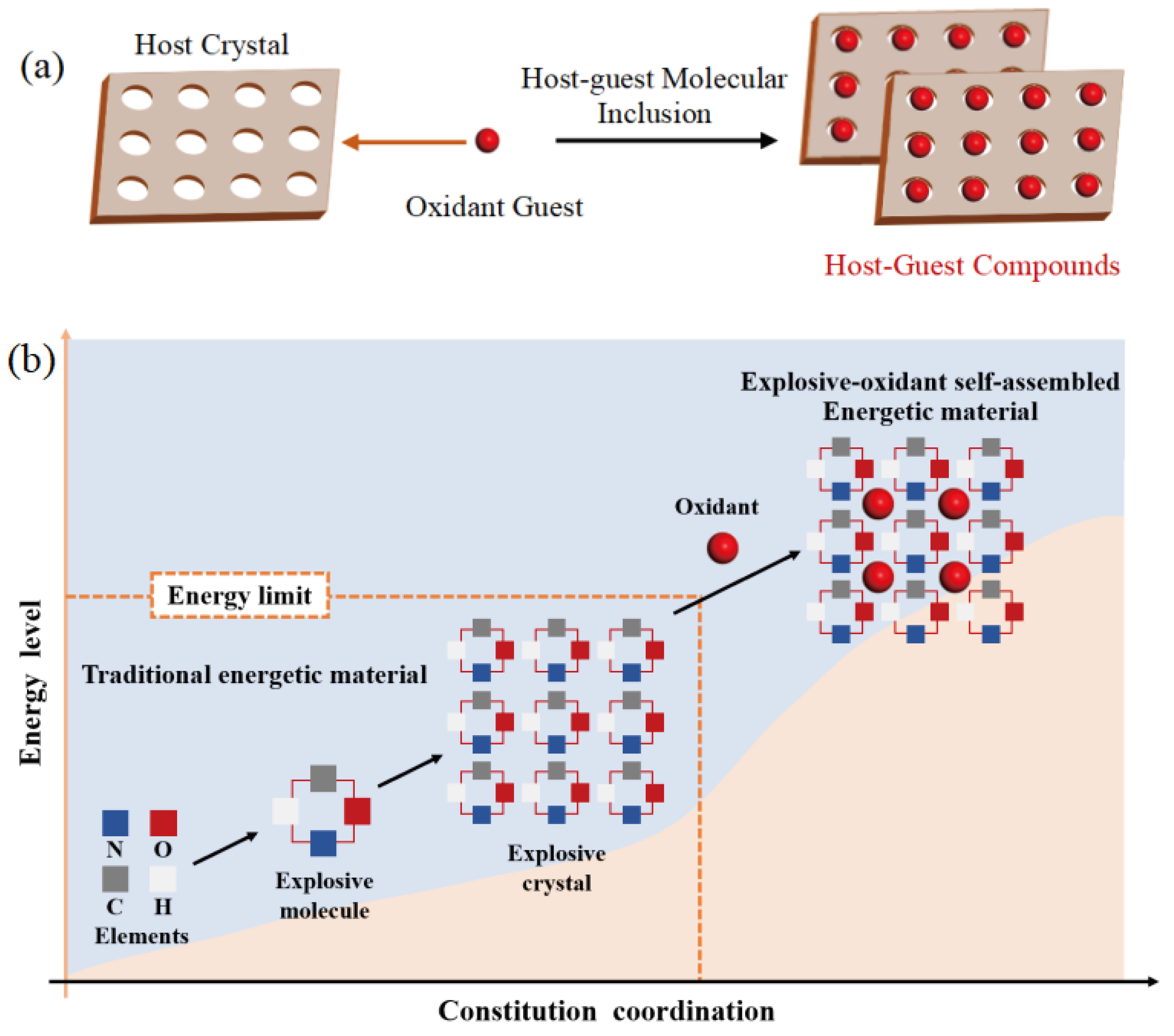
Figure 2.
Evolution of potential energy of CL-20/H2O, CL-20/CO2, CL-20/N2O, CL-20/NH2OH system with time at (a) 2500K, (b) 2750K, (c) 3000K, (d) 3500K. Thick trendline corresponds to the actual concentration data of corresponding matching color.
Figure 2.
Evolution of potential energy of CL-20/H2O, CL-20/CO2, CL-20/N2O, CL-20/NH2OH system with time at (a) 2500K, (b) 2750K, (c) 3000K, (d) 3500K. Thick trendline corresponds to the actual concentration data of corresponding matching color.
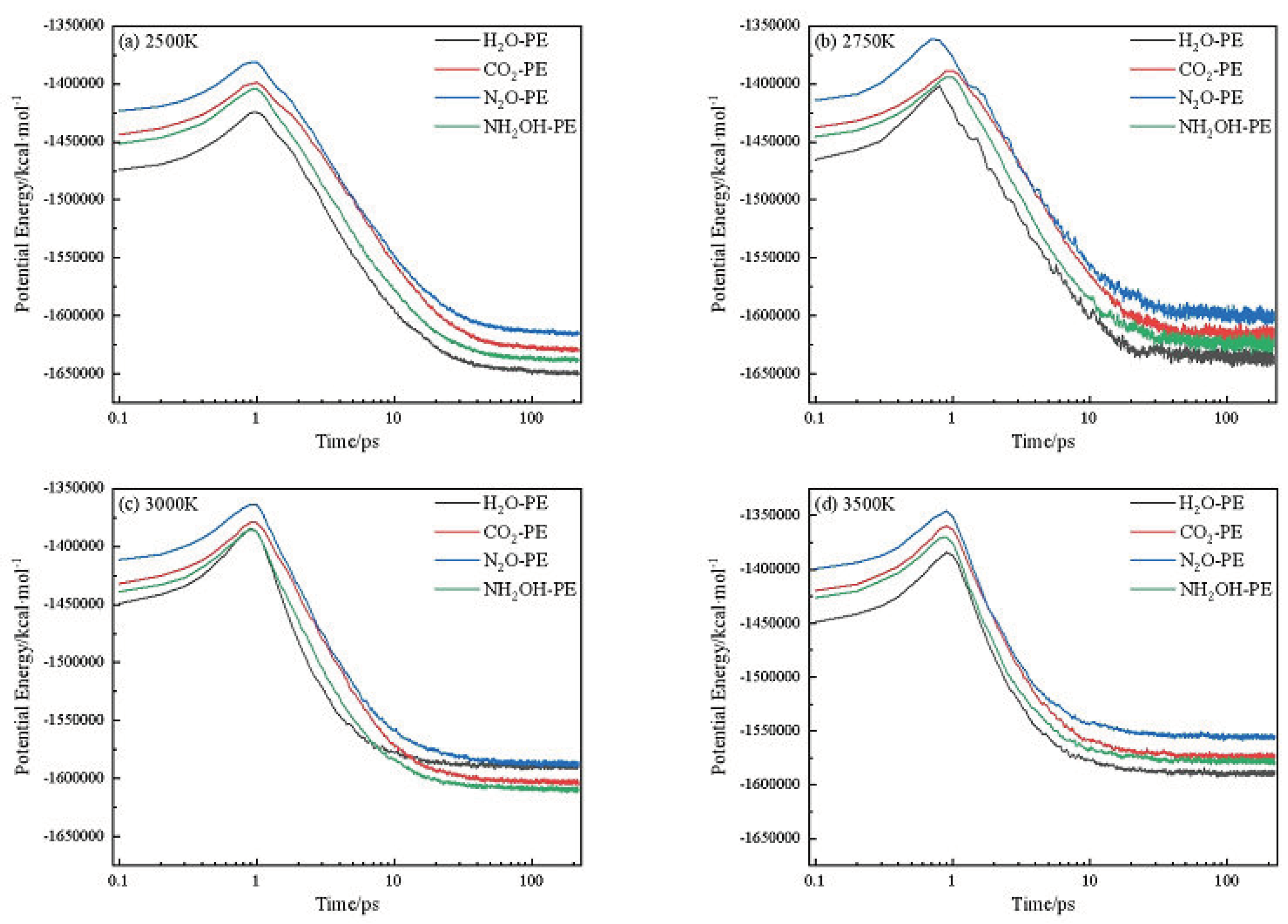
Figure 3.
Evolution of potential energy of (a) CL-20/H2O, (b) CL-20/CO2, (c) CL-20/N2O, (d) CL-20/NH2OH system with time at different temperatures. Thick trendline corresponds to the actual concentration data of corresponding matching color.
Figure 3.
Evolution of potential energy of (a) CL-20/H2O, (b) CL-20/CO2, (c) CL-20/N2O, (d) CL-20/NH2OH system with time at different temperatures. Thick trendline corresponds to the actual concentration data of corresponding matching color.
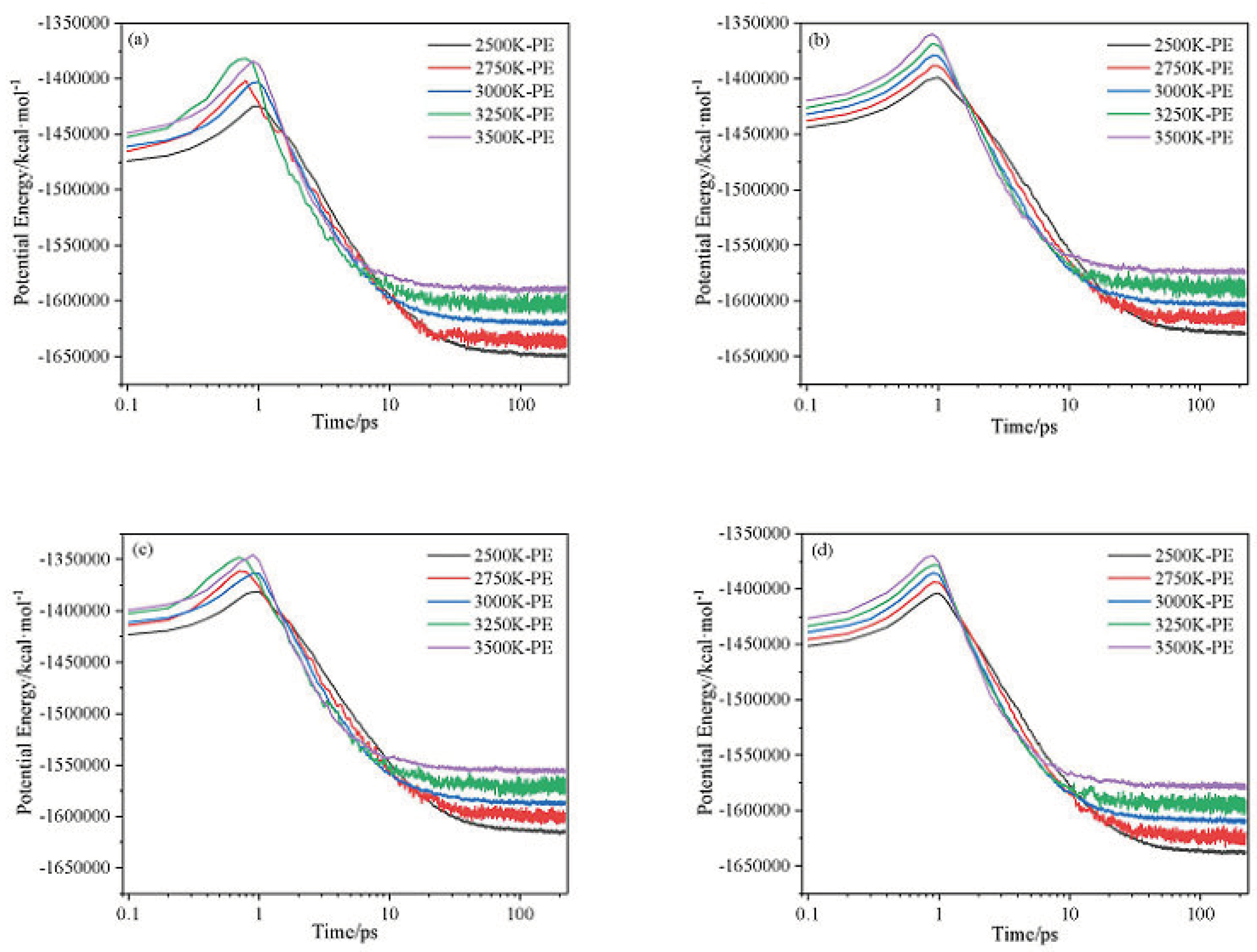
Figure 4.
The total energy of CL-20/H2O, CL-20/CO2, CL-20/N2O, CL-20/NH2OH systems with time at 2500K. Thick trendline corresponds to the actual concentration data of corresponding matching color.
Figure 4.
The total energy of CL-20/H2O, CL-20/CO2, CL-20/N2O, CL-20/NH2OH systems with time at 2500K. Thick trendline corresponds to the actual concentration data of corresponding matching color.
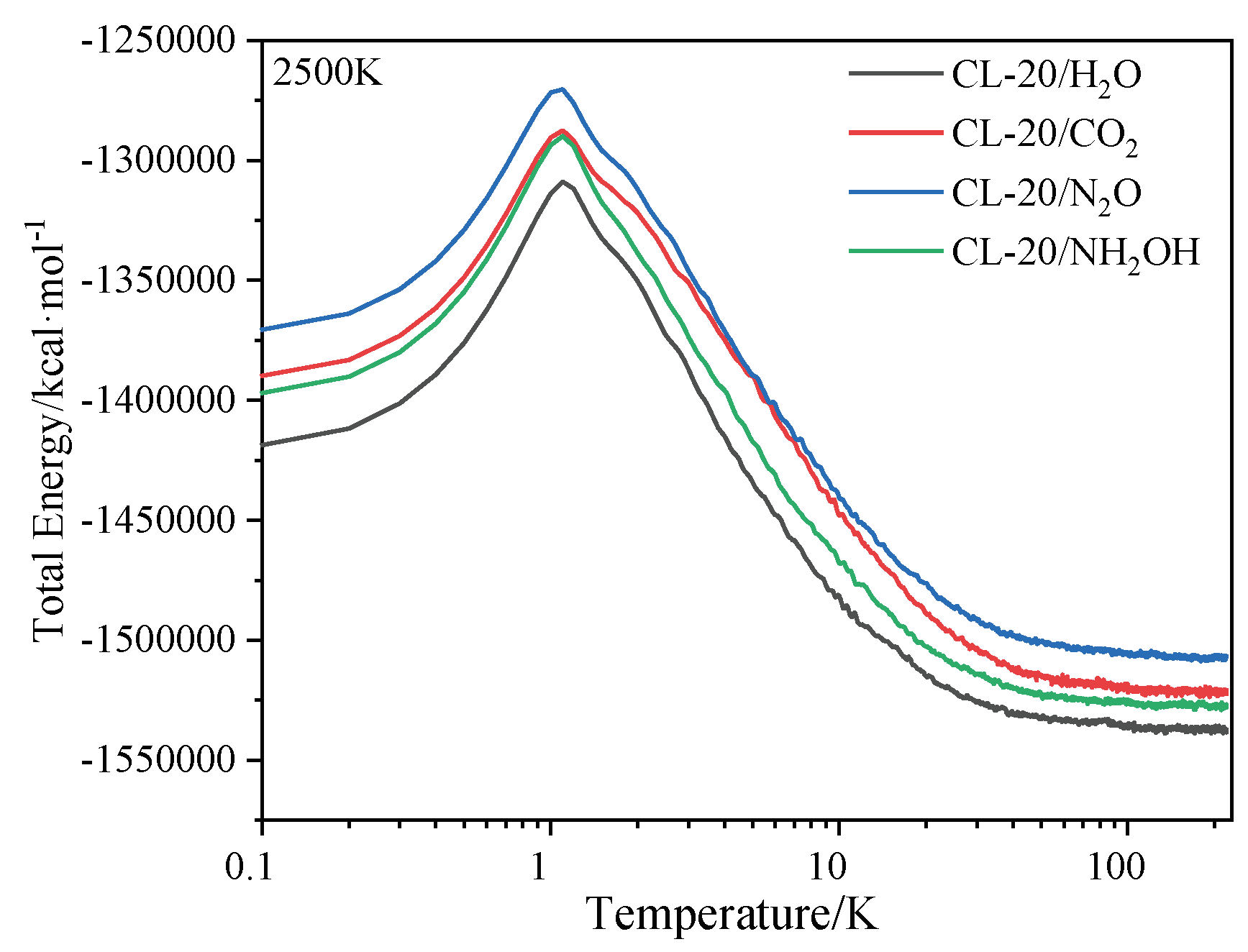
Figure 5.
The logarithm of reaction rate (ln(k1/s−1)) against inverse temperature (1/T) in the exothermic decomposition stage at different temperatures. Thick trendline corresponds to the actual concentration data of corresponding matching color.
Figure 5.
The logarithm of reaction rate (ln(k1/s−1)) against inverse temperature (1/T) in the exothermic decomposition stage at different temperatures. Thick trendline corresponds to the actual concentration data of corresponding matching color.
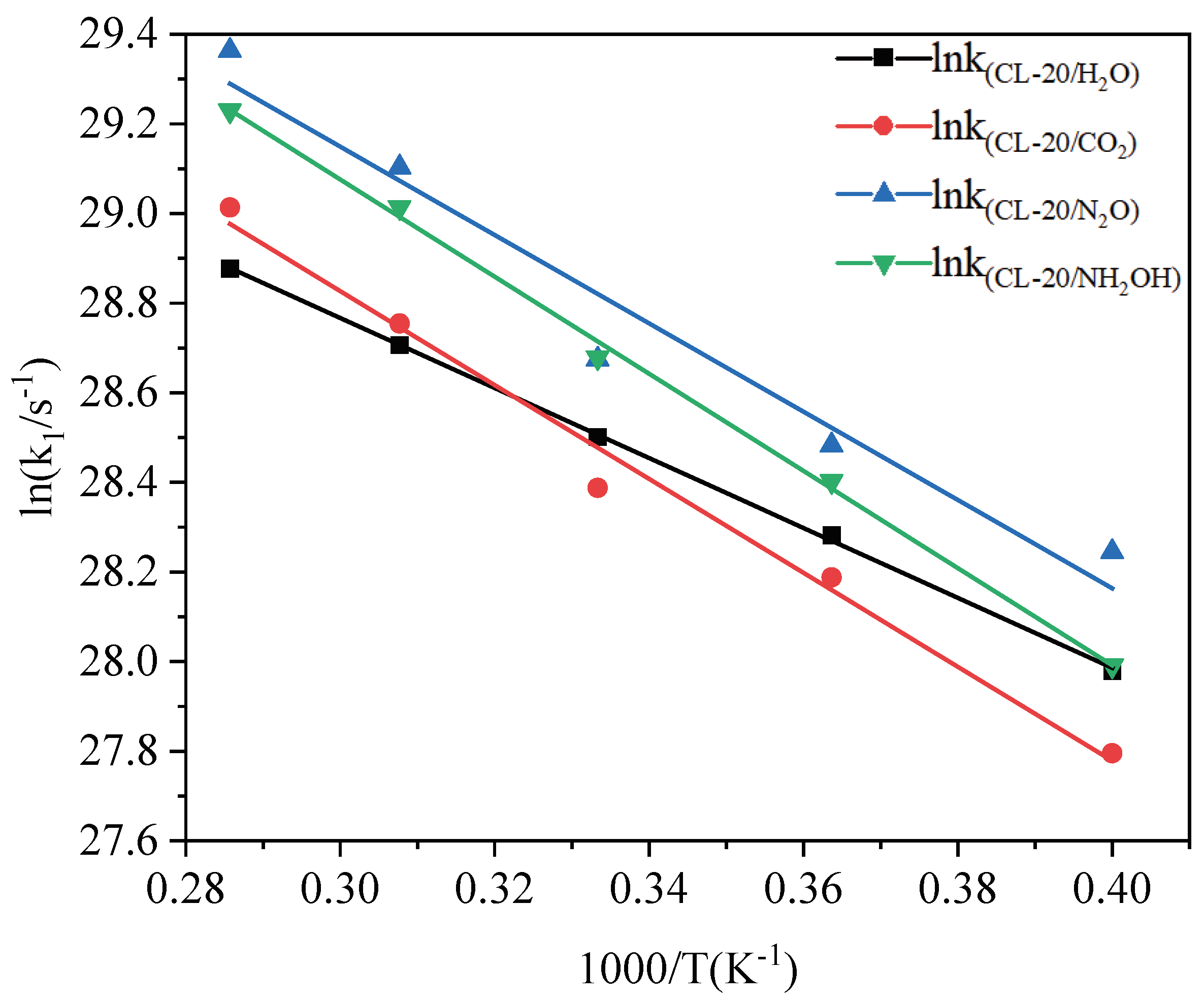
Figure 6.
Evolution curves of the main intermediate products and host-guest molecules at different temperatures. Thick trendline corresponds to the actual concentration data of corresponding matching color.
Figure 6.
Evolution curves of the main intermediate products and host-guest molecules at different temperatures. Thick trendline corresponds to the actual concentration data of corresponding matching color.
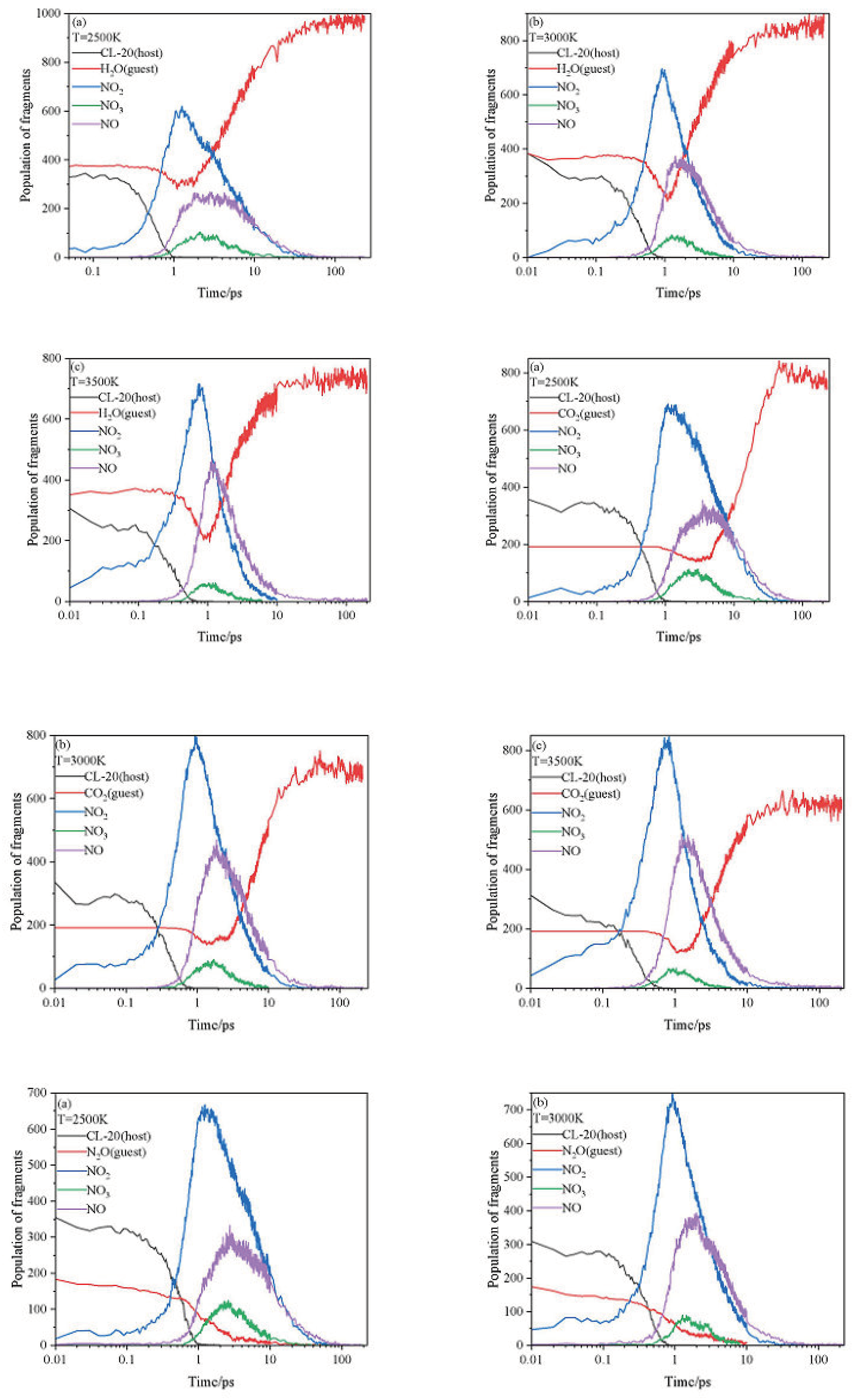
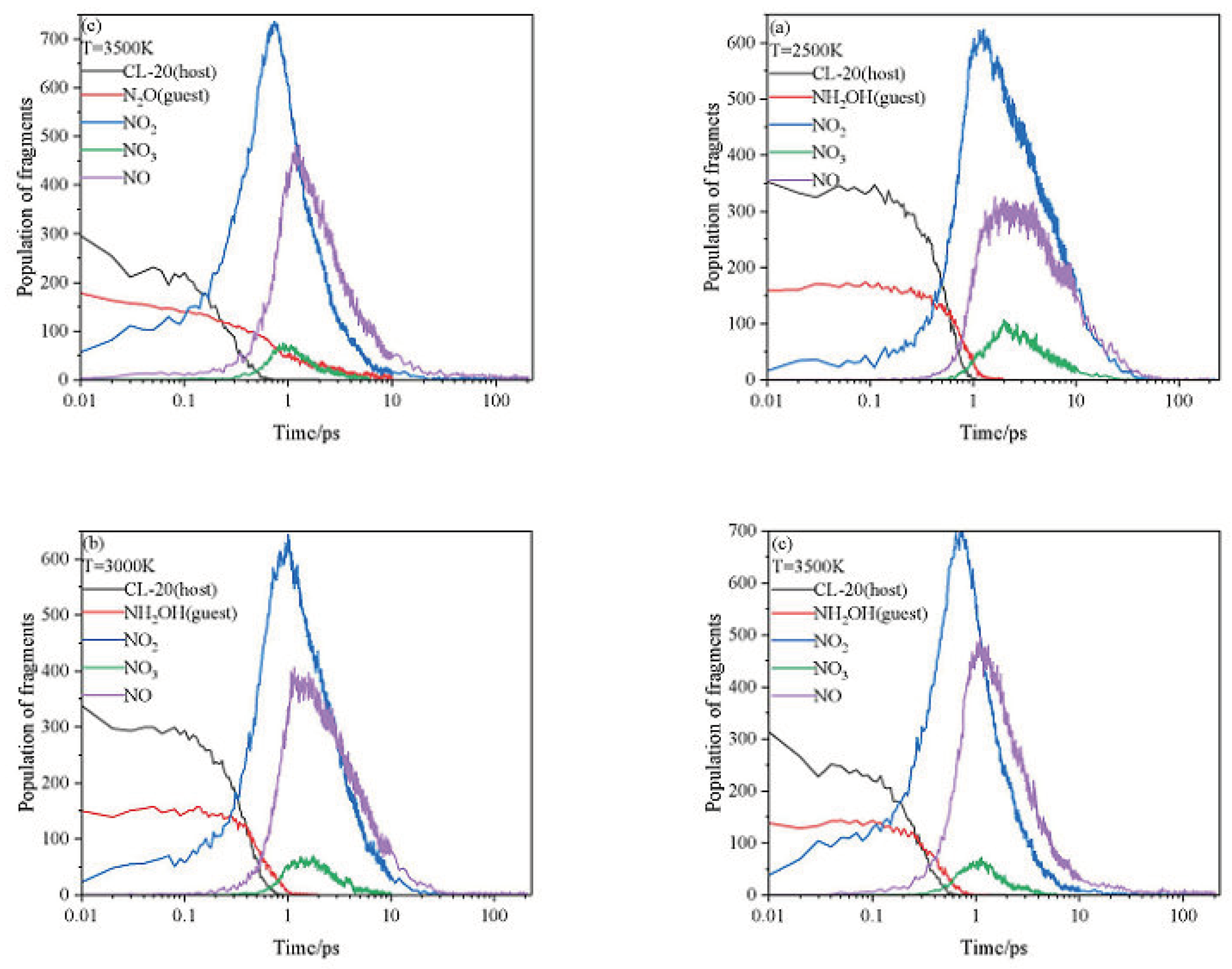
Figure 7.
Evolution curves of the host and guest molecules for CL-20/H2O, CL-20/CO2, CL-20/N2O, CL-20/NH2OH at 2500K. Thick trendline corresponds to the actual concentration data of corresponding matching color.
Figure 7.
Evolution curves of the host and guest molecules for CL-20/H2O, CL-20/CO2, CL-20/N2O, CL-20/NH2OH at 2500K. Thick trendline corresponds to the actual concentration data of corresponding matching color.
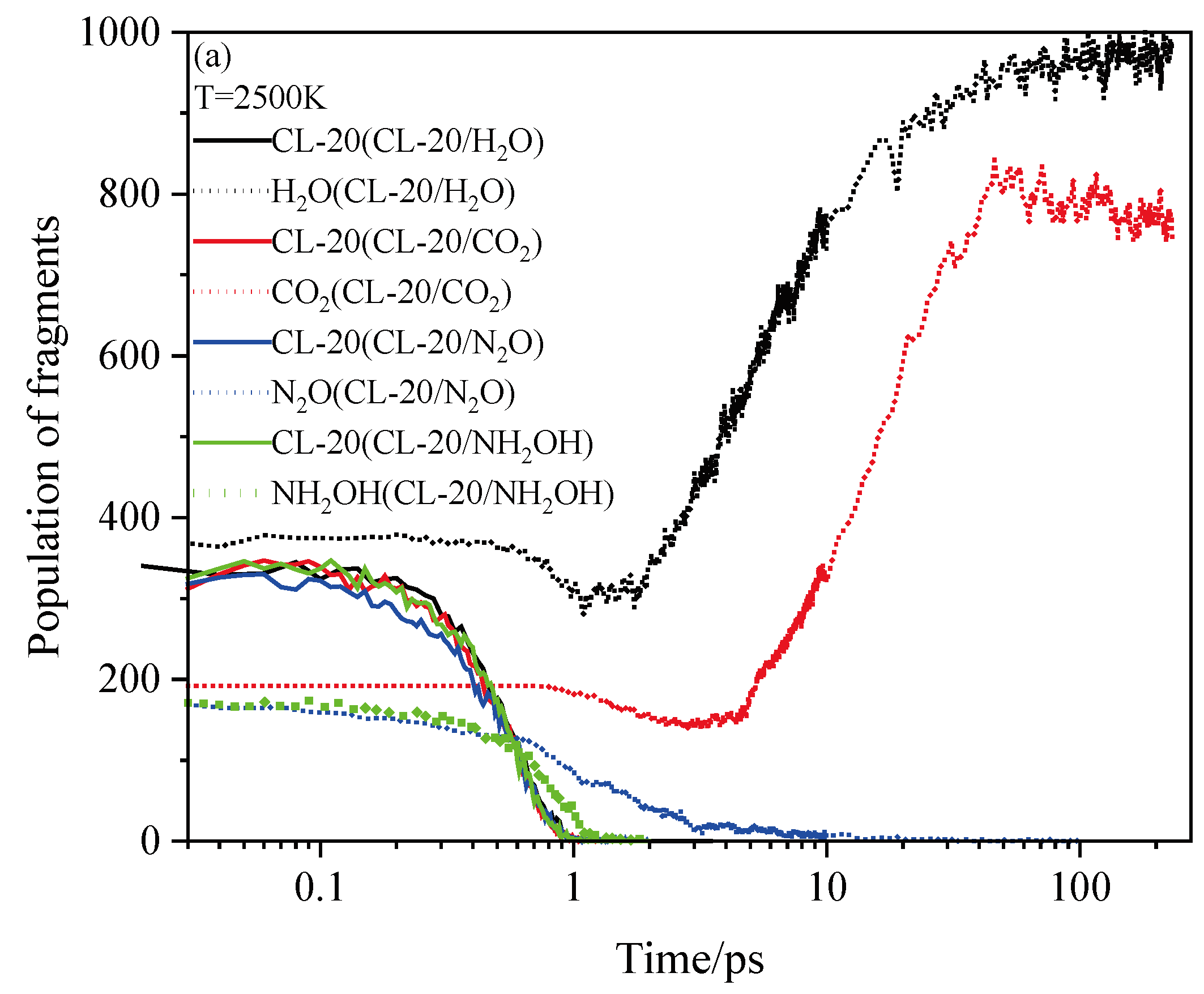
Figure 8.
Evolution curves of the host and guest molecules for CL-20/H2O, CL-20/CO2, CL-20/N2O, CL-20/NH2OH at 3000K. Thick trendline corresponds to the actual concentration data of corresponding matching color.
Figure 8.
Evolution curves of the host and guest molecules for CL-20/H2O, CL-20/CO2, CL-20/N2O, CL-20/NH2OH at 3000K. Thick trendline corresponds to the actual concentration data of corresponding matching color.
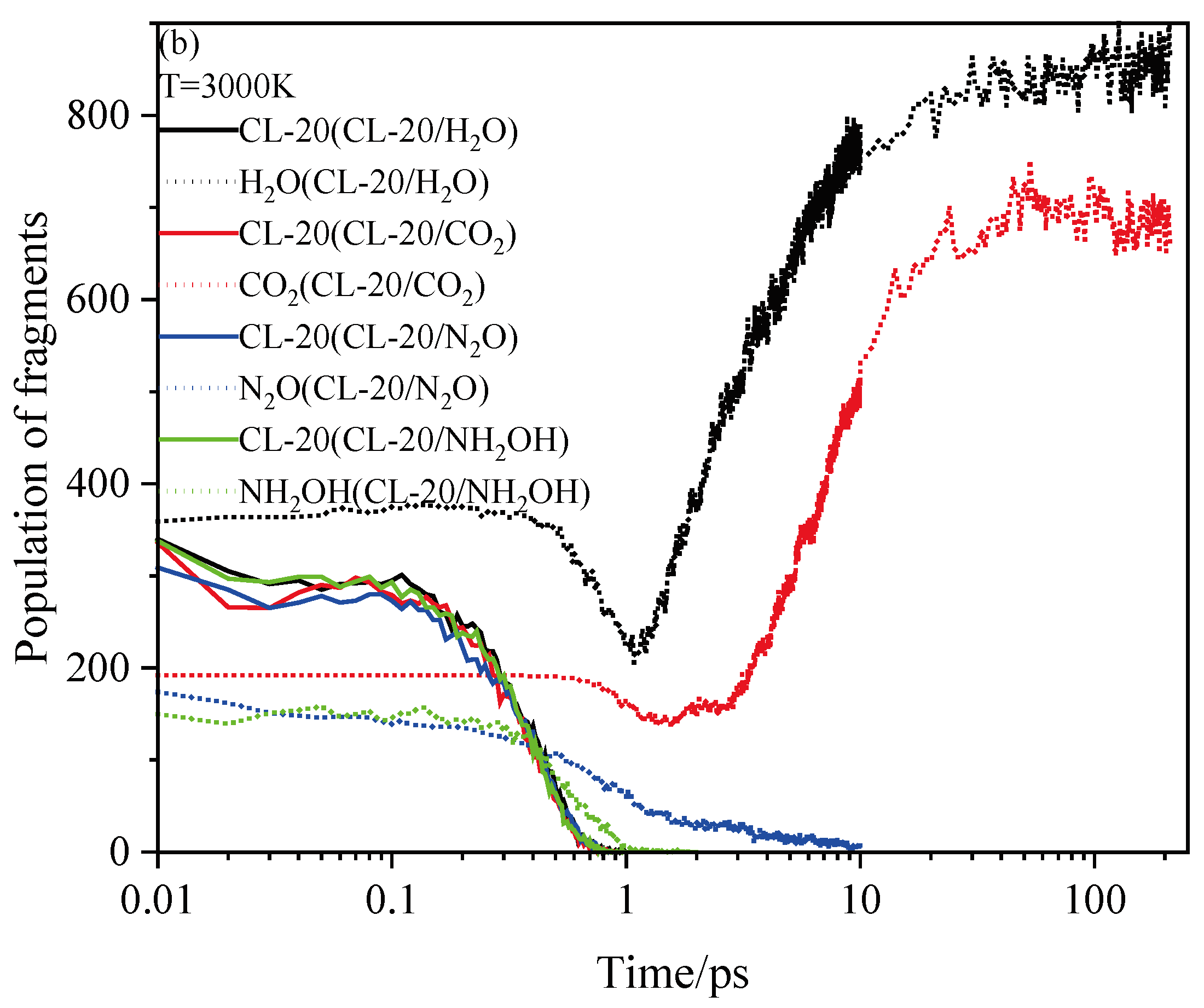
Figure 9.
Evolution curves of the host and guest molecules for CL-20/H2O, CL-20/CO2, CL-20/N2O, CL-20/NH2OH at 3500K. Thick trendline corresponds to the actual concentration data of corresponding matching color.
Figure 9.
Evolution curves of the host and guest molecules for CL-20/H2O, CL-20/CO2, CL-20/N2O, CL-20/NH2OH at 3500K. Thick trendline corresponds to the actual concentration data of corresponding matching color.
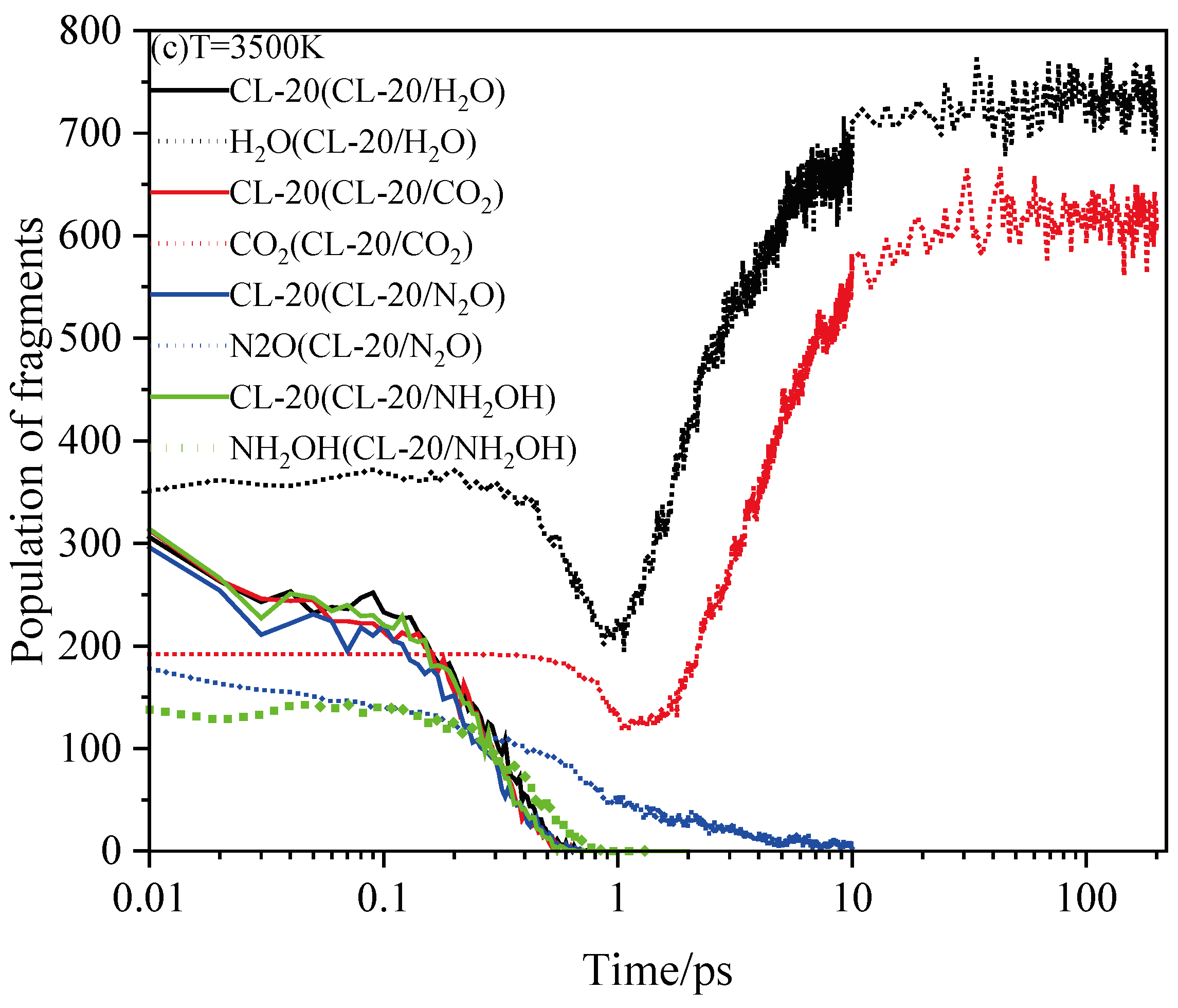
Figure 10.
The logarithm of reaction rate (ln(k1/s−1)) against inverse temperature (1/T) in the exothermic decomposition stage at different temperatures. Thick trendline corresponds to the actual concentration data of corresponding matching color.
Figure 10.
The logarithm of reaction rate (ln(k1/s−1)) against inverse temperature (1/T) in the exothermic decomposition stage at different temperatures. Thick trendline corresponds to the actual concentration data of corresponding matching color.
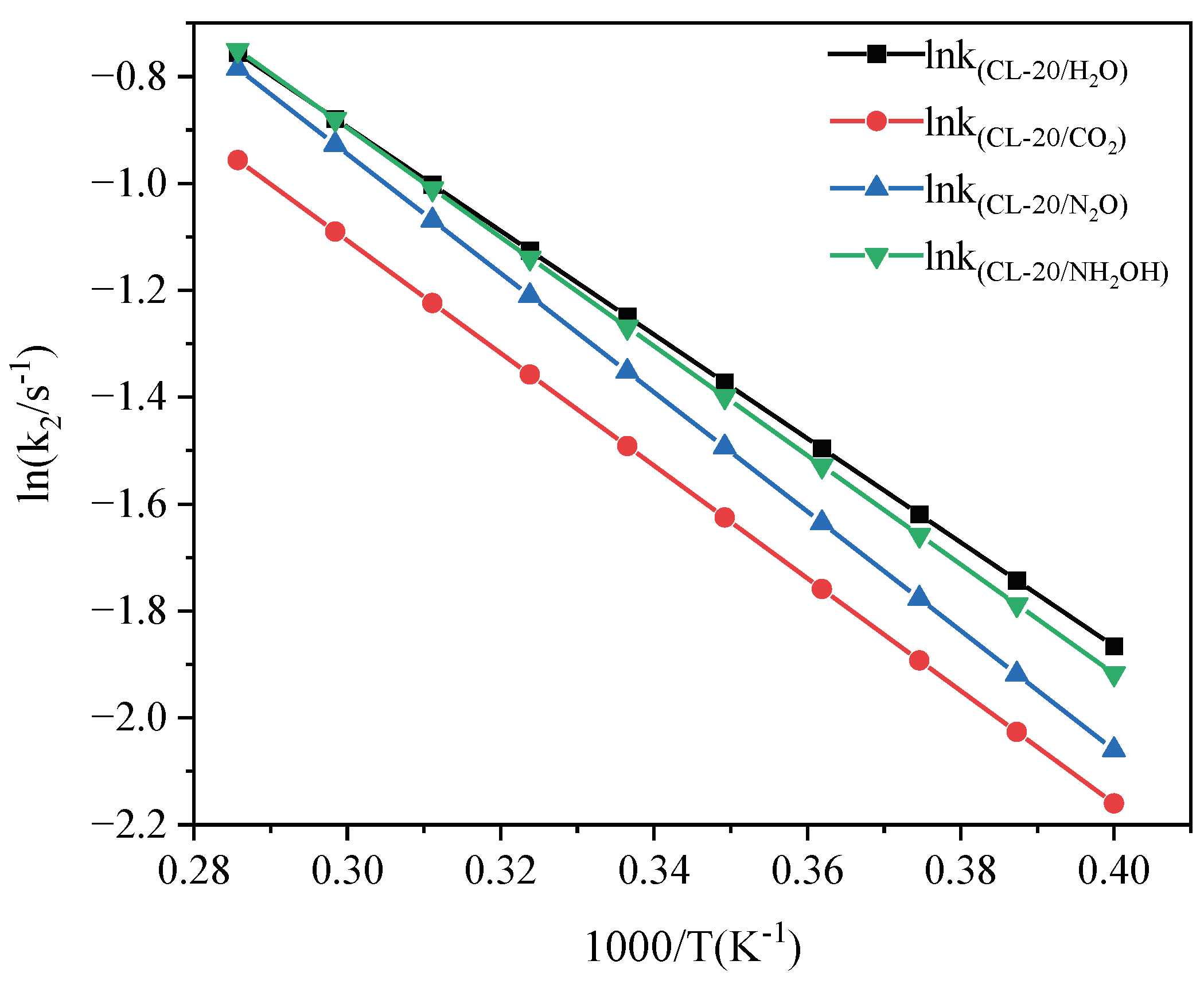
Figure 11.
The population of CO2 after the complete decomposition reaction for CL-20/H2O, CL-20/CO2, CL-20/N2O, CL-20/NH2OH at 2500K, 3000K and 3500K.
Figure 11.
The population of CO2 after the complete decomposition reaction for CL-20/H2O, CL-20/CO2, CL-20/N2O, CL-20/NH2OH at 2500K, 3000K and 3500K.
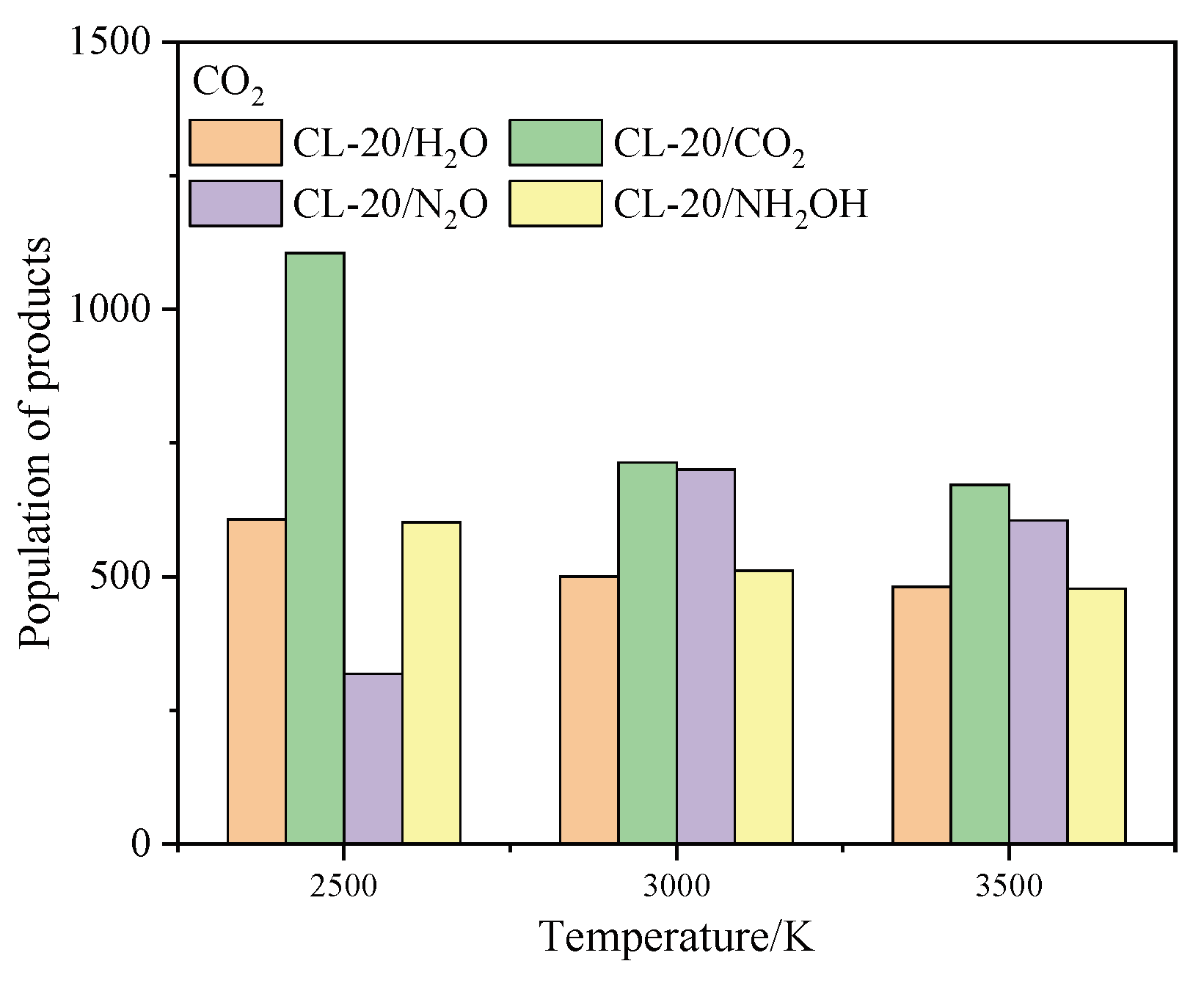
Figure 12.
The population of N2 after the complete decomposition reaction for CL-20/H2O, CL-20/CO2, CL-20/N2O, CL-20/NH2OH at 2500K, 3000K and 3500K.
Figure 12.
The population of N2 after the complete decomposition reaction for CL-20/H2O, CL-20/CO2, CL-20/N2O, CL-20/NH2OH at 2500K, 3000K and 3500K.
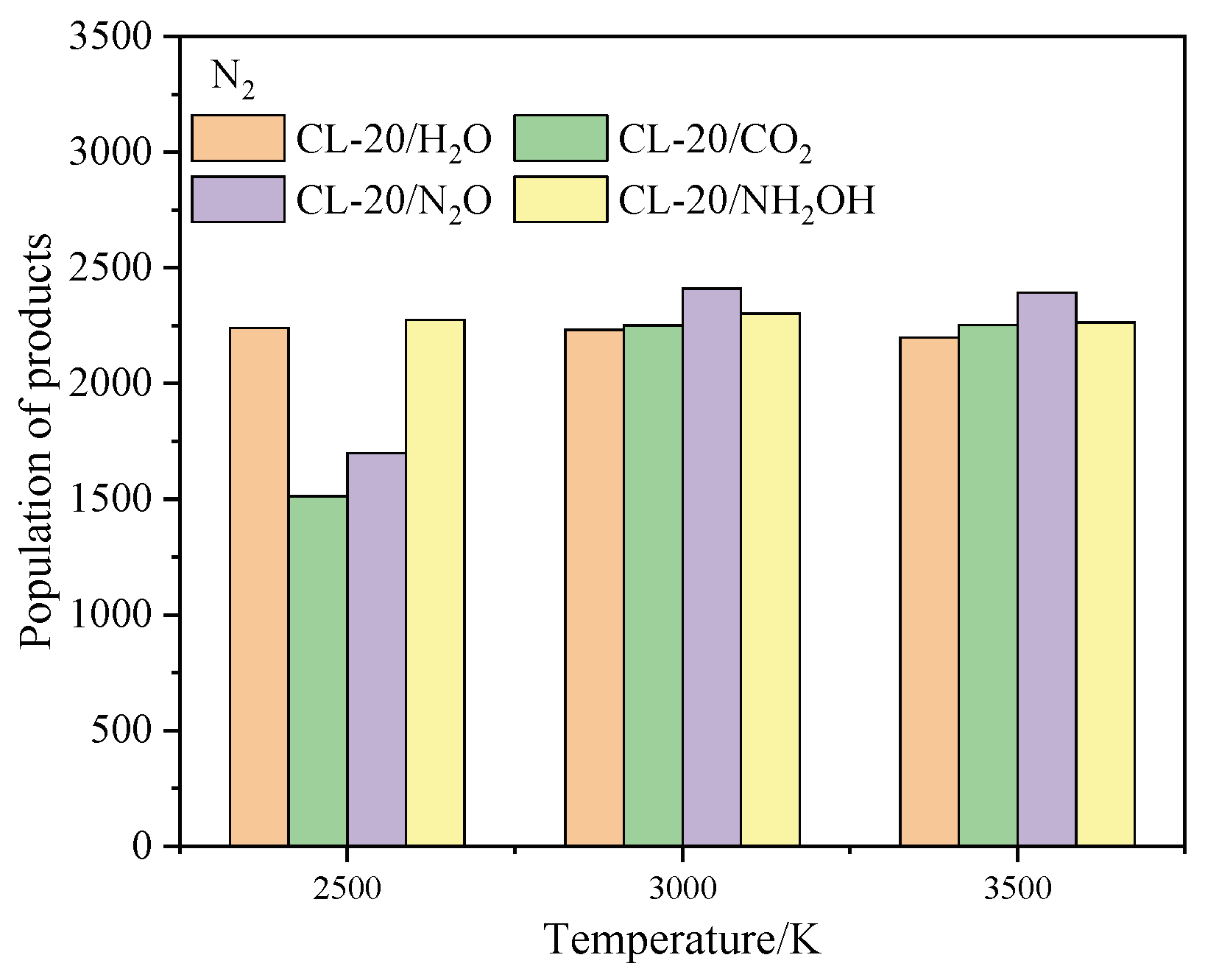
Figure 13.
The population of H2O after the complete decomposition reaction for CL-20/H2O, CL-20/CO2, CL-20/N2O, CL-20/NH2OH at 2500K, 3000K and 3500K.
Figure 13.
The population of H2O after the complete decomposition reaction for CL-20/H2O, CL-20/CO2, CL-20/N2O, CL-20/NH2OH at 2500K, 3000K and 3500K.
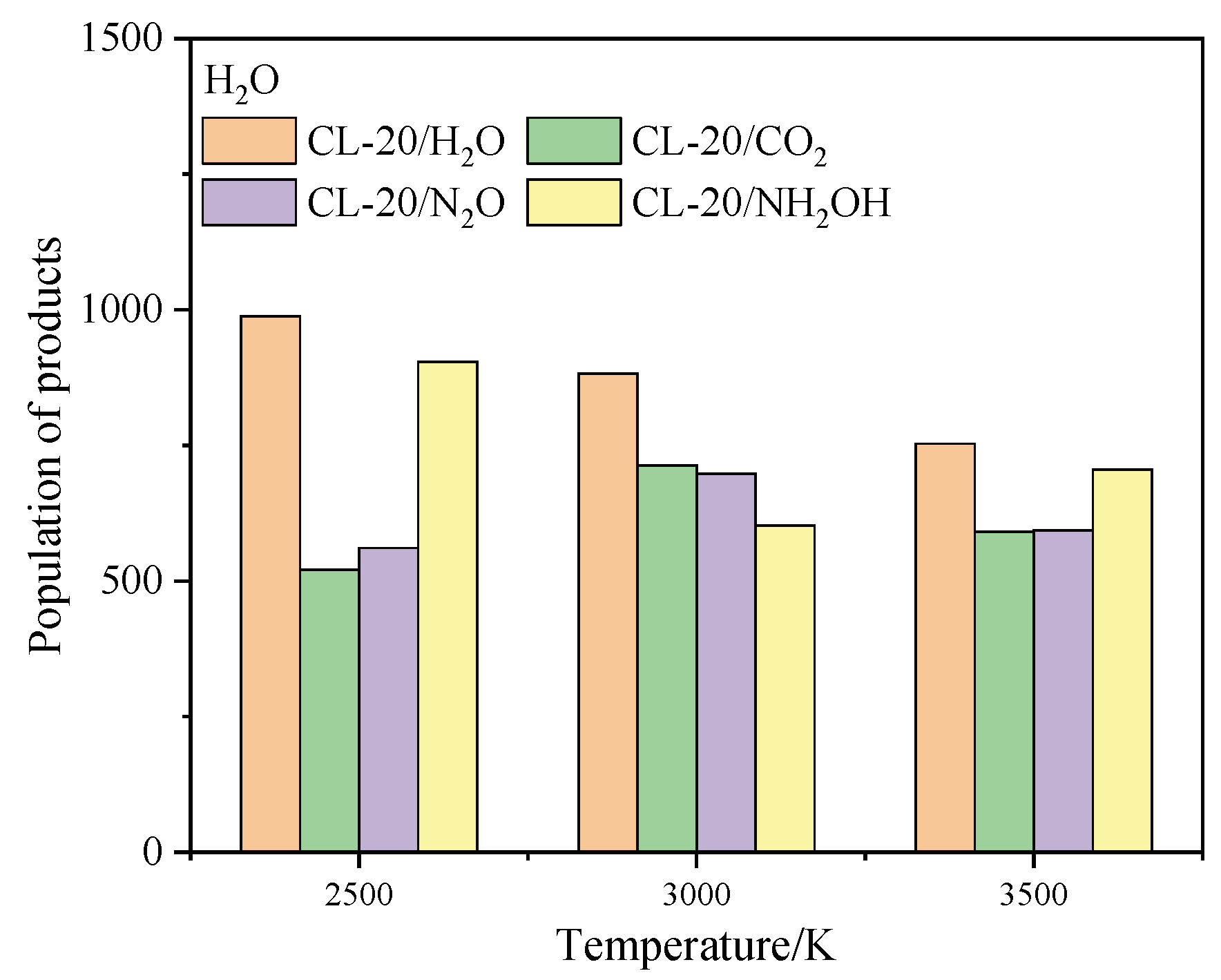
Figure 14.
Comparison of the k3 values of CO2, H2O and N2 for (a) CL-20/H2O, (b) CL-20/CO2, (c) CL-20/N2O, (d) CL-20/NH2OH at different temperatures. Thick trendline corresponds to the actual concentration data of corresponding matching color.
Figure 14.
Comparison of the k3 values of CO2, H2O and N2 for (a) CL-20/H2O, (b) CL-20/CO2, (c) CL-20/N2O, (d) CL-20/NH2OH at different temperatures. Thick trendline corresponds to the actual concentration data of corresponding matching color.
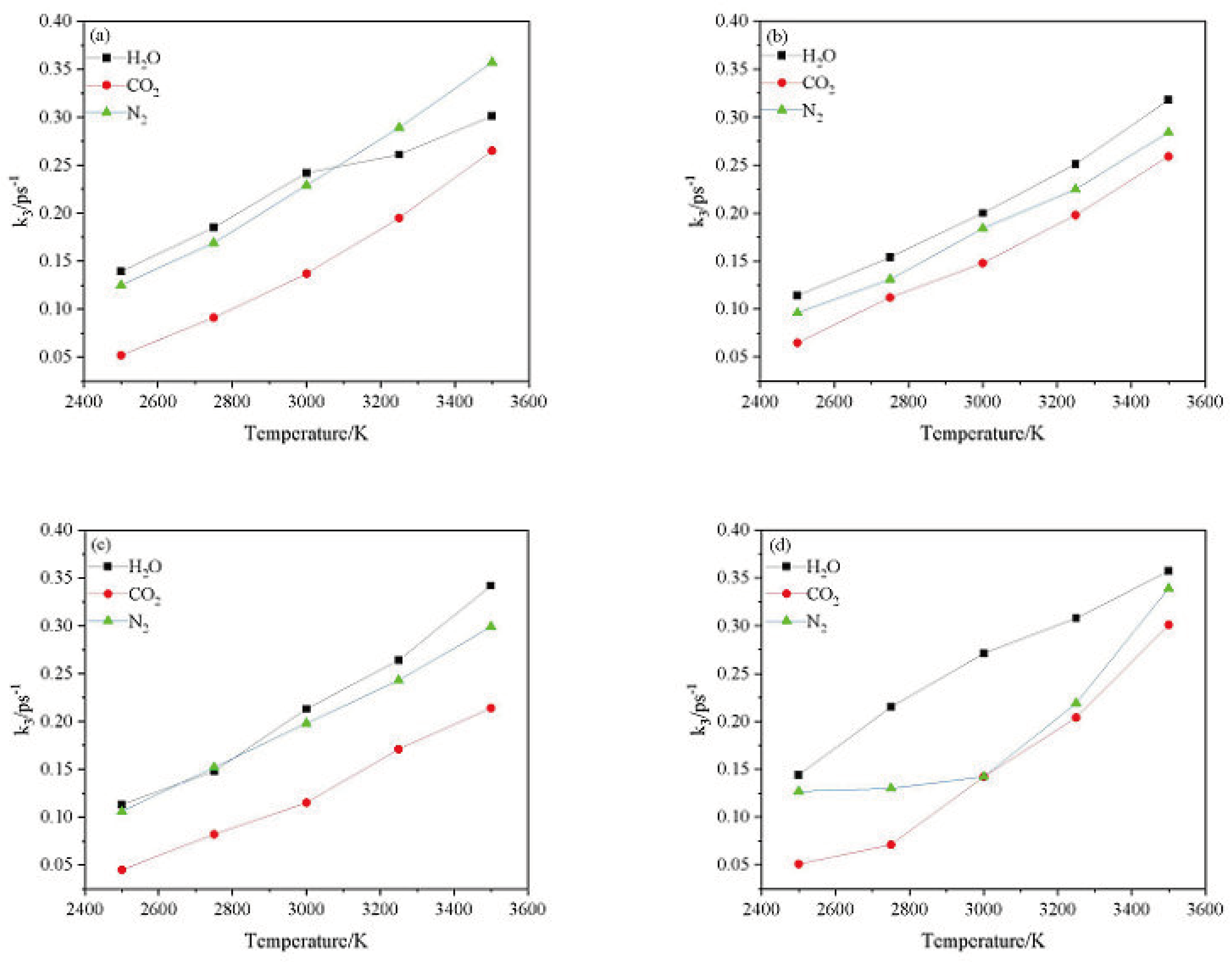
Figure 15.
Comparison of the k3 values of CO2, H2O and N2 for CL-20/H2O, CL-20/CO2, CL-20/N2O, CL-20/NH2OH at different temperatures. Thick trendline corresponds to the actual concentration data of corresponding matching color.
Figure 15.
Comparison of the k3 values of CO2, H2O and N2 for CL-20/H2O, CL-20/CO2, CL-20/N2O, CL-20/NH2OH at different temperatures. Thick trendline corresponds to the actual concentration data of corresponding matching color.
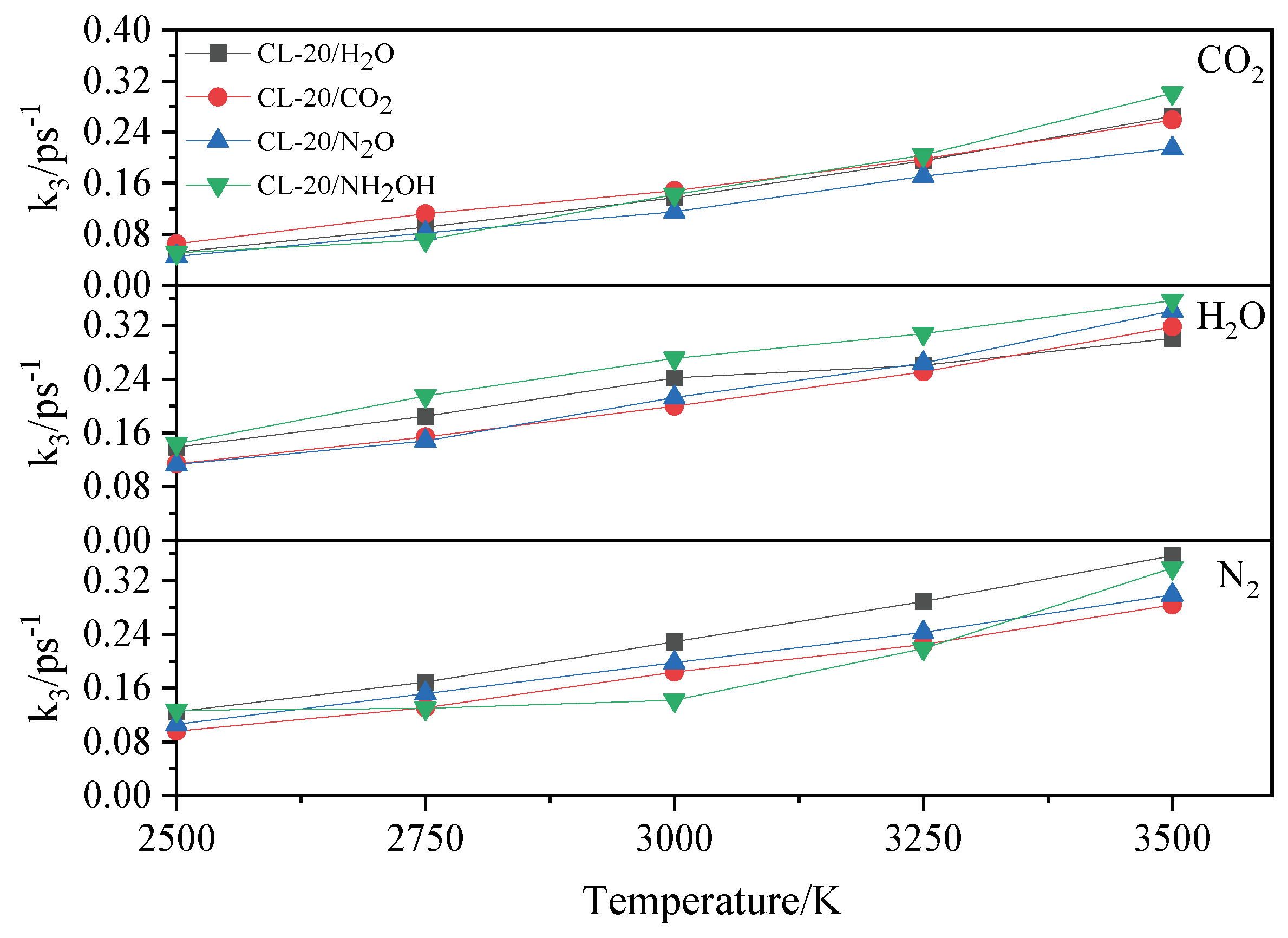
Figure 16.
(a) α-CL-20/H2O, 6*4*2 α-CL-20/H2O supercell, (b) α-CL-20/CO2, 6*4*2 α-CL-20/CO2 supercell, (c) α-CL-20/N2O, 6*4*2 α-CL-20/N2O supercell, (d) α-CL-20/NH2OH, 6*4*2 α-CL-20/NH2OH supercell. The blue atoms represent nitrogen, the red atoms represent oxygen, the white atoms represent hydrogen, the gray atoms represent carbon. The supercell of (a) contain 384 of CL-20 and 384 of guest. The supercell of (b), (c), (d) contains 384 of CL-20 and 192 of guest.
Figure 16.
(a) α-CL-20/H2O, 6*4*2 α-CL-20/H2O supercell, (b) α-CL-20/CO2, 6*4*2 α-CL-20/CO2 supercell, (c) α-CL-20/N2O, 6*4*2 α-CL-20/N2O supercell, (d) α-CL-20/NH2OH, 6*4*2 α-CL-20/NH2OH supercell. The blue atoms represent nitrogen, the red atoms represent oxygen, the white atoms represent hydrogen, the gray atoms represent carbon. The supercell of (a) contain 384 of CL-20 and 384 of guest. The supercell of (b), (c), (d) contains 384 of CL-20 and 192 of guest.
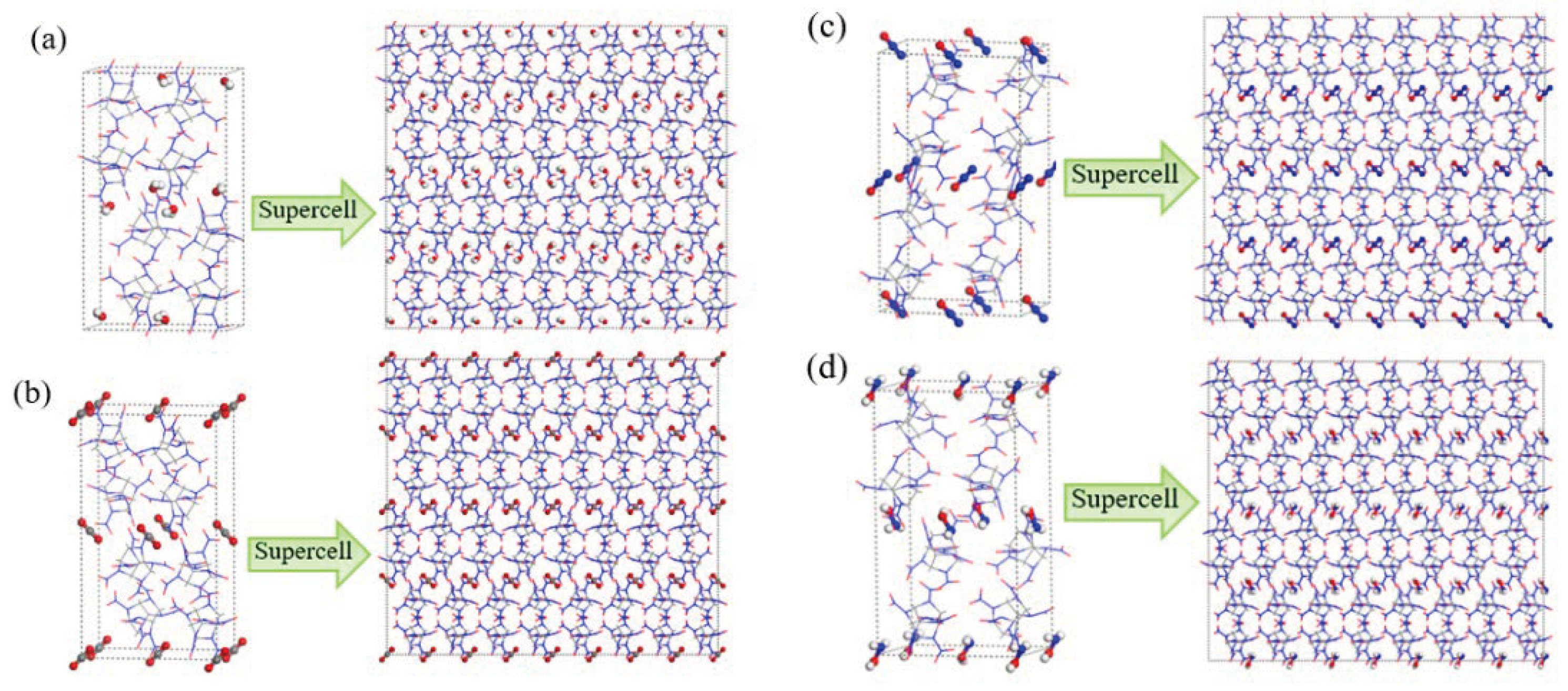

Table 1.
The initial reaction paths of host-guest molecules and their occurrence frequency for CL-20/H2O, CL-20/CO2, CL-20/N2O, CL-20/NH2OH at four high temperatures.
Table 1.
The initial reaction paths of host-guest molecules and their occurrence frequency for CL-20/H2O, CL-20/CO2, CL-20/N2O, CL-20/NH2OH at four high temperatures.
| Host-guest crystal | Temperatures | Initial reaction paths | Frequency |
|---|---|---|---|
| CL-20/H2O | 2500 | C6H6O12N12 C6H6O10N11+NO2 C6H6O10N11+NO2
|
29 |
| C6H6O12N12C6H5O12N12+H |
21 | ||
| H2OH+OH |
20 | ||
| 3000 | C6H6O12N12C6H6O10N11+NO2
|
51 | |
| C6H6O12N12C6H5O12N12+H |
31 | ||
| H2OH+OH |
20 | ||
| 3500 | C6H6O12N12C6H6O10N11+NO2
|
69 | |
| C6H6O12N12C6H5O12N12+H |
41 | ||
| H2OH+OH |
27 | ||
| CL-20/CO2 | 2500 | C6H6O12N12C6H6O10N11+NO2
|
41 |
| C6H6O12N12C6H5O12N12+H |
25 | ||
| 3000 | C6H6O12N12C6H6O10N11+NO2
|
60 | |
| C6H6O12N12C6H5O12N12+H |
38 | ||
| 3500 | C6H6O12N12C6H6O10N11+NO2
|
65 | |
| C6H6O12N12C6H5O12N12+H |
34 | ||
| CL-20/N2O | 2500 | C6H6O12N12C6H6O10N11+NO2
|
30 |
| C6H6O12N12C6H5O12N12+H |
25 | ||
| N2ON+NO |
5 | ||
| N2ON2+O |
18 | ||
| 3000 | C6H6O12N12C6H6O10N11+NO2
|
63 | |
| C6H6O12N12C6H5O12N12+H |
31 | ||
| N2ON+NO |
5 | ||
| N2ON2+O |
34 | ||
| 3500 | C6H6O12N12C6H6O10N11+NO2
|
77 | |
| C6H6O12N12C6H5O12N12+H |
49 | ||
| N2ON+NO |
11 | ||
| N2ON2+O |
24 | ||
| CL-20/NH2OH | 2500 | C6H6O12N12C6H6O10N11+NO2
|
31 |
| C6H6O12N12C6H5O12N12+H |
22 | ||
| NH2OHNH2+OH |
8 | ||
| NH2OHNH2O+H |
11 | ||
| 3000 | C6H6O12N12C6H6O10N11+NO2
|
41 | |
| C6H6O12N12C6H5O12N12+H |
31 | ||
| NH2OHNH2+OH |
27 | ||
| NH2OHNH2O+H |
15 | ||
| 3500 | C6H6O12N12C6H6O10N11+NO2
|
69 | |
| C6H6O12N12C6H5O12N12+H |
48 | ||
| C6H6O10N11C6H6O8N10+NO2
|
6 | ||
| C6H5O12N12C6H5O10N11+NO2
|
7 | ||
| C6H6O12N12C6H4O12N12+2H |
5 | ||
| NH2OHNH2+OH |
35 | ||
| NH2OHNH2O+H |
20 |
Table 2.
Reaction rate constant k1 in the initial endothermic reaction stage.
| Host-guest crystal | T/K | k1/ps−1 |
|---|---|---|
| CL-20/H2O | 2500 | 1.417 |
| 2750 | 1.918 | |
| 3000 | 2.388 | |
| 3250 | 2.932 | |
| 3500 | 3.476 | |
| CL-20/CO2 | 2500 | 1.179 |
| 2750 | 1.745 | |
| 3000 | 2.131 | |
| 3250 | 3.075 | |
| 3500 | 3.984 | |
| CL-20/N2O | 2500 | 1.848 |
| 2750 | 2.344 | |
| 3000 | 2.839 | |
| 3250 | 4.357 | |
| 3500 | 5.653 | |
| CL-20/NH2OH | 2500 | 1.434 |
| 2750 | 2.163 | |
| 3000 | 2.851 | |
| 3250 | 3.985 | |
| 3500 | 4.944 |
Table 3.
Partial parameters of PE curve attenuation process.
| Host-guest crystal | T/K | Umax | U∞ | ΔUexo | k2/ps−1 |
|---|---|---|---|---|---|
| CL-20/H2O | 2500 | -1424794 | -1650929 | 226135 | 0.1523 |
| 2750 | -1413953 | -1636452 | 222499 | 0.2251 | |
| 3000 | -1403193 | -1621948 | 218755 | 0.2963 | |
| 3250 | -1397567 | -1606748 | 209181 | 0.38057 | |
| 3500 | -1384266 | -1591748 | 207482 | 0.46484 | |
| CL-20/CO2 | 2500 | -1398845 | -1630254 | 231409 | 0.11404 |
| 2750 | -1389461 | -1617052 | 227591 | 0.17252 | |
| 3000 | -1379278 | -1603764 | 224486 | 0.23059 | |
| 3250 | -1369415 | -1589817 | 220402 | 0.30645 | |
| 3500 | -1359754 | -1575870 | 216116 | 0.38217 | |
| CL-20/N2O | 2500 | -1381272 | -1616532 | 235260 | 0.12789 |
| 2750 | -1372536 | -1602557 | 230021 | 0.19377 | |
| 3000 | -1363624 | -1588473 | 224849 | 0.25909 | |
| 3250 | -1354660 | -1572699 | 218039 | 0.35959 | |
| 3500 | -1345497 | -1556825 | 211328 | 0.46010 | |
| CL-20/NH2OH | 2500 | -1403762 | -1639940 | 236178 | 0.14567 |
| 2750 | -1395173 | -1625769 | 230596 | 0.21743 | |
| 3000 | -1385384 | -1611798 | 226414 | 0.28695 | |
| 3250 | -1377669 | -1595917 | 218248 | 0.378106 | |
| 3500 | -1369830 | -1580037 | 210207 | 0.47146 |
Table 4.
Comparison of lattice parameters and density of CL-20/guest.
| Crystal | Method | a/Å | b/Å | c/Å | ρ/g·cm−3 |
|---|---|---|---|---|---|
| CL-20/H2O | from CCDC | 9.477 | 13.139 | 23.380 | 2.081 |
| ReaxFF-lg | 9.370 | 12.993 | 23.119 | 2.153 | |
| CL-20/CO2 | from CCDC | 9.673 | 13.203 | 23.553 | 2.033 |
| ReaxFF-lg | 9.467 | 13.167 | 23.489 | 2.049 | |
| CL-20/N2O | from CCDC | 9.577 | 13.256 | 23.625 | 2.038 |
| ReaxFF-lg | 9.427 | 13.049 | 23.256 | 2.137 | |
| CL-20/NH2OH | from CCDC | 9.789 | 13.123 | 23.509 | 2.000 |
| ReaxFF-lg | 9.602 | 12.873 | 23.059 | 2.119 |
Disclaimer/Publisher’s Note: The statements, opinions and data contained in all publications are solely those of the individual author(s) and contributor(s) and not of MDPI and/or the editor(s). MDPI and/or the editor(s) disclaim responsibility for any injury to people or property resulting from any ideas, methods, instructions or products referred to in the content. |
© 2023 by the authors. Licensee MDPI, Basel, Switzerland. This article is an open access article distributed under the terms and conditions of the Creative Commons Attribution (CC BY) license (http://creativecommons.org/licenses/by/4.0/).
Copyright: This open access article is published under a Creative Commons CC BY 4.0 license, which permit the free download, distribution, and reuse, provided that the author and preprint are cited in any reuse.


