

Submitted:
12 January 2023
Posted:
13 January 2023
You are already at the latest version
Abstract
Residents’ perceptions on ecosystem services (ESs) provided by urban green spaces (UGSs) are vital for developing sustainable cities. However, there has been limited research on this issue in Malaysia. The aim of this paper is to assess Malaysians’ perceptions on ESs provided UGSs and how their perceptions are influenced by different socio-demographic factors. We used a structured online questionnaire and obtained 645 responses on 16 ESs from regulatory, cultural, and supporting ES categories. Descriptive statistics and binary logistic regressions were used for data analysis. In general, city dwellers have high positive perceptions on ESs provided by UGSs. Their perceptions for global climate regulation, noise buffering, pest regulation, spiritual, and research and education services would likely to significantly increase as they grow older. Households with moderate income have significantly greater perceptions of microclimate regulation, air filtration and aesthetic services. Having non-tertiary level education would significantly lower their perceptions of global climate and microclimate regulation, spiritual, aesthetics, and recreational services. Tertiary educated residents with non-environmental degrees also showed similar associations. Infrequent visits to UGSs would likely to significantly reduce the perception of global climate regulation, noise buffering, runoff reduction, erosion control, spiritual, and aesthetics services. People living far (>5km) from the UGSs also have significantly lower perceptions of microclimate regulation, air filtration services. Suggestions are made to incorporate ESs related content in pre-university curriculum and establishing small parks in neighborhoods to improve knowledge and uses of UGSs. These findings would assist urban planners designing environmentally sound urban policies and thereby improving human wellbeing in the cities.
Keywords:
Cities
; urban residents
; human perception
; ecosystem services
; nature-based so-lutions
1. Introduction
Urbanization is one of the most important global development processes in the twenty-first century (Arnold et al., 2018). More than half of the global population currently live in towns and cities, and by 2050 this number is projected to increase to around 70% (United Nations, 2017). With the accelerating rate of urbanization and the increasing complexity of urban life, urban green spaces (UGSs) are increasingly important in contributing to the quality of the environment and urban life (Aziz et al., 2011), creating socially and environmentally sustainable cities. UGSs are public and private open spaces covered by vegetation of any kind in urban areas including parks, gardens, playgrounds, urban forests, grasslands, woodlands and wetlands, backyards, private orchards, green roofs, corporate campuses, and communal areas of apartment buildings (James et al., 2009; Siddique et al., 2020; Wolch et al., 2014).
UGSs provide critical ecosystem services (ESs) to the urban population by regulating urban temperatures, reducing noise pollution, mitigating urban heat island (UHI) effects, and improving air quality (Chen et al., 2020), and alleviating the negative effects caused by urbanization (Bodnaruk et al., 2017). Furthermore, UGSs help mitigate climate change through greenhouse gas absorption, carbon storage and sequestration by urban vegetation, and decreases the risk of flooding by intercepting and storing precipitation (Armson et al., 2013; Zhang et al., 2015). UGSs also serve as an important habitat for wildlife which helps the conservation of biodiversity (Armson et al., 2013; Zhang et al., 2015). Meanwhile, UGSs also bring economic benefits, including energy conservation (Syafiqah et al., 2014), increasing value to the surrounding property (Luttik, 2000; Morancho, 2003), boosting retail sales by creating a favorable image of a commercial or residential area (Wolf, 2003), and even promoting tourism in the region (Arvanitidis et al., 2009).
UGSs are widely considered to be a great amenity for health (Jennings et al., 2016) as they can enhance the health and well-being of the urban population by improving physical fitness, relieving stress, alleviating depression, and anxiety levels (Aziz et al., 2018; Mansor & Harun, 2014; Mao et al., 2020; Nath et al., 2018; Paul et al., 2020). UGSs also provide a place to socialize and relax, promoting higher levels of social interaction and potentially stronger relationships within the neighborhood (Mansor et al., 2012; Mao et al., 2020; Rasidi et al., 2012). Overall, UGSs serve as an important indicator of the quality of life in an urban area (Sen & Guchhait, 2021) and well-distributed UGSs can improve the quality of environment and life in urban areas (Aziz et al., 2011). Besides, it can be claimed that good quality UGSs deliver an interacting set of environmental, social, and economic benefits. Thus, UGSs are crucial component of urban environment (Arvanitidis et al., 2009) and help to achieve a number of sustainable development goals (Wey et al., 2022).
In a country with rapid urbanization and industrialization like Malaysia, UGSs are key to maintaining a good quality urban life and environment by providing various ESs. The focus of greenspace discourse in Malaysia has shifted from beautification-dominated to recognizing UGSs as an essential part of urban infrastructure (Aziz et al., 2011). Research on UGSs in Malaysia is mostly focused on management (Aziz et al., 2011; Fatiah et al., 2021; Maryanti et al., 2017; Rasidi et al., 2012; Sreetheran & Adnan, 2007) as well as human health and well-being outcomes (Andrew et al., 2020; Aziz et al., 2012; Foo, 2016; Mansor & Harun, 2014, 2018; Nath et al., 2018), while some concentrated on the uses of UGSs (Aziz et al., 2018; Malek et al., 2015) and ESs provided by UGSs such as biodiversity conservation (Karuppannan et al., 2014; Ridzuan et al., 2021) and reducing land surface temperature (Sheikhi et al., 2015). However, most studies mentioned above only focused on specific study sites. We assume that to provide more common information on UGSs and ensure the sustainability of ESs supply, it is important to integrate residents’ perceptions of ESs provided by UGSs into regional sustainable urban management in Malaysia.
Residents’ perceptions of the ESs could influence their behavior towards natural environmental protection (Zhang et al., 2019). Peoples’ perceptions, their knowledge, attitude, and support provide essential input for policymakers towards making evidence-based decisions in the management and sustainable conservation of urban green spaces (Bakhtiari et al., 2014; Gashu et al., 2020; Macura et al., 2011; Ostoić et al., 2017; Paletto et al., 2013). Having said the above, this cross-sectional study aims: 1) To assess Malaysian urban residents’ positive perception on ESs provided by UGSs; and 2) To understand the factors affecting urban residents’ perception on ESs of UGSs. The findings of this study would greatly contribute to the understanding the local perception of various ESs provided by the UGSs, and the factors influencing the perception in urban areas of Malaysia. The city authorities and policy makers would take strategic actions for the protection and expansion of UGSs, while ensuring well-being of city dwellers. This would eventually support the government to achieve several sustainable development goals including SDG 3 (Good health and wellbeing), SDG 11 (Sustainable cities and communities), SDG 13 (Climate change mitigation) and SDG15 (Life on land).
2. Methodology
2.1. Study Design and Data Collection
A cross-sectional design was applied to examine the urban residents’ perception of ESs provided by UGSs among Malaysian aged 18 years and above. A structured questionnaire was developed based on literature reviews for quantitative data collection. This study selected 16 ESs namely regulating ESs: global climate regulation (GCR) (Strohbach & Haase, 2012; Pataki et al., 2006), microclimate regulation (MR) (Xie et al., 2013; Gill et al., 2007), air filtration (AF) Grote et al., 2016; Jim & Chen, 2008; Nowak et al., 2006), water cycle regulation (WCR) (Armson et al., 2013), runoff reduction (RR) (Armson et al., 2013; Zhang et al., 2015), noise buffering (NB) (Aylor, 1972; Kragh, 1981), pests regulation (PR) (Costanza et al., 1997), erosion control (EC) (Costanza et al., 1997), and biodiversity conservation (BC) (Aronson et al., 2017; Fuller et al., 2007; Karuppannan et al., 2014); cultural ESs: spiritual values (SV) (Baur, 2018), aesthetic values (AV) (Gunnarsson et al., 2017), outdoor recreation (ON) (Costanza et al., 1997), ecotourism (EM) (Costanza et al., 1997) as well as education and research (ER) (Kibria et al. 2017); and supporting ES: habitat provision for wildlife (HW) (Blair, 1996; Blair & Launer Alan, 1997) (Supplementary Table 1).
The structured questionnaire consisted of three sections: (1) the socio-demographic information (2) the characteristic of UGSs, and (3) the residents’ positive perception on ESs provided by UGSs (Supplementary Table 2). The target population of this study were Malaysian nationals living in the country where the inclusion criteria were residents aged 18 years and above and living in urban areas during the study period. The Google Form link was made available through various online platforms, such as WhatsApp, Messenger, Facebook, Instagram, and Telegram. Participants were encouraged to share the link with their relatives and friends thus to achieve a snowball sample. Ethics approval was obtained from the [will provide the name later] Research Ethics Committee (Application Identification Number: THY191121 dated 19 November 2021). Participation was anonymous and voluntary, and respondents were informed that at any point, they had the option to withdraw from the survey. Prior to beginning the questionnaire, informed consent was obtained electronically via the form. The survey was conducted from 1st December 2021 to 15th February 2022 and 645 responses were obtained. This sample size was assumed to be sufficient to generalize the findings of this study as it satisfied at a 95% confidence level with a ±5% margin of error (Israel, 1992; Krejcie & Morgan, 1970).
This study examined one major outcome measure which was urban residents’ perceptions of each ESs provided by UGSs (response variable) using gender, age, educational level, occupation, monthly household income, duration of stay in current residence, distance to UGSs and frequency of visits to UGSs (explanatory variables).
2.2. Econometric Model
Descriptive statistics were produced to find the average values of the responses. A Binary logistic regression modeling was performed to determine the relationship between a set of independent variables and binary dependent variables. The logistic regression was run based on three assumptions: first, the dependent variable in logistic regression must be binary and ordinal data; second, a linear relationship between independent and dependent variables is not required for logistic regression; third, homoscedasticity and a normally distributed residuals are not required. The strength of association was measured using odds ratio (OR) with a 95% confidence interval and regarded statistically significant at p< 0.05.
The dependent variable - urban residents’ perception on each ESs provided by UGSs were gauged where participants indicated the extent to which they agree that UGSs provide them with the ESs on a 5-point Likert scale (1= strongly disagree, 2= disagree, 3= neutral, 4= agree, 5= strongly agree). The responses were collapsed into a binary scale (0/no= low perception with Likert scale value 1-3, 1/yes= high perception with Likert scale value 4-5) (Hafner et al. 2019). Answers of ‘neutral’ were grouped into the “0/no” category to ensure a balanced dataset. Likelihood-ratio-chi-squared test was used to check model fitness and all models had high level of significance values. The present model was better than the null model with p< 0.05. Likelihood-ratio-chi-squared values suggested that the fitted model outperformed the null model. All statistical analyses were done with R. The logistic probability function, which has the following forms:
Here where is a vector of explanatory variables and is a vector of unknown parameters.
Now, as is binary, the estimation form of logistic transformation of the probability of residents’ perceptions on the ESs supply by the UGSs can be expressed as:
Here is the odds of and is the odds of . The ration of the odds of and is called the odds ratio which describes the odds that a consequence will happen (e. g. the probability of perception on ESs supplied by the UGSs) given a special exhibition related to the odds of the consequence happening in the absence of that exposure. Thus, the odds ratio estimation is done as:
3. Results
3.1. Socio-Demographic Characteristics of Respondents
The majority of respondents (70.2%) were female and in the younger age bracket (18 to 30 years) (70.9%). They also had a solid education, holding university degrees (78.1%). Students made up 59.1% of the respondents, just over half of the total. The respondents came primarily (57.8%) from middle class families in terms of their income status (B40). Most respondents (69.4%) had lived in their current residential area for more than five years and (64.2%) were located within one kilometer of their nearest UGSs. The UGSs were occasionally visited by 59.7% of respondents (Table 1).
3.2. Quality and Usage of UGSs
Malaysia's UGSs were generally of a decent grade. The majority of inhabitants said that the UGSs closest to their homes featured well-maintained shade trees, gardens, playgrounds, benches, and well-organized networks of walking and cycling lanes (58.9%). The locations were clean (59.2%), secure (57.7%), and beautiful (60.2%) (Table 2). However, respondents also mentioned that the UGSs closest to their homes did not receive routine maintenance (52.6%) and lacked parking (54%).
The UGSs were used primarily for walking (73.3%) followed by enjoying nature and fresh air (70.4%), relaxing (67.6%), experiencing peace and calmness (45.9%), boosting mood (40.3%), socializing (13.2%), playing space for kids (13%), and reading books (3.6%) (Figure 1).
3.3. Respondents’ Perception on ESs Provided by UGSs
On an average, 91% respondents showed high positive perception on UGSs for supplying ESs which is significantly higher (p= 0.000) than the lower perception of the residents (Figure 2a). Aesthetic values were viewed as the ES provided by the UGSs by the greatest percentage of respondents (96.43%) followed by outdoor recreation (95.96%), air filtration (94.26%), microclimate regulation (93.33%), spiritual values (92.24%), biodiversity conservation (92.24%), global climate regulation (91.62%), and water cycle regulation (90.85%) (Figure 2b).
3.4. Factors Associated with the Urban Residents’ Positive Perception on ESs of UGSs
3.4.1. Regulating ESs
Respondents with 30-45 years of age perceived the UGSs to offer GCR and NB services with higher odds (odds ratio of GCR: 2.06, p= 0.02 and NB:1.86, p= 0.04) than those aged <30 years. Compared to younger respondents (18-30 years old), older respondents aged “31-45 years” had significantly higher odds of perceiving the UGSs to offer GCR service (odds ratio 2.06). The oldest group (>46 years) had significantly greater odds of perceiving UGSs to provide GCR (odds ratio= 3.08, p= 0.01), MR (odds ratio= 2.96, p= 0.02), NB (odds ratio= 3.69, p= 0.002), PR (odds ratio= 2.08, p= 0.05), and BC (odds ratio= 2.38, p= 0.04). Growing older than 30 would therefore probably result in a two- to threefold rise in awareness level (Table 3).
Respondents with tertiary education in non-environmental disciplines had 52% lower odds (odds ratio= 0.48, p= 0.01) of perceiving UGSs to provide MR service, whereas respondents who obtained a secondary or pre-university education had 60% and 69% lower odds of perceiving UGSs providing GCR (odds ratio= 0.4, p= 0.002) MR services (odds ratio= 0.31, p= 0.001) compared to respondents who obtained a tertiary degree in the environmental discipline. Respondents with occupations in non-environmental sectors had significantly lower odds of perceiving the UGSs to provide WCR services (odds ratio 0.25, p= 0.02). Students had significantly lower odds of perceiving the UGSs to supply WCR (odds ratio= 0.28, p= 0.03), RR (odds ratio= 0.3, p= 0.01), NB (odds ratio= 0.37, p= 0.05) and EC (odds ratio= 0.36, p= 0.05) services than the employees in environmental sectors. Those who were homemakers, unemployed and retired had significantly lower odds of perceiving UGSs to provide WCR (odds ratio= 0.18, p= 0.007) and NB (odds ratio= 0.31, p= 0.04) services than the employees in environmental organizations (Table 3).
In comparison to the B40 income group, respondents with higher income level (M40) had significantly greater odds of perceiving the UGSs to provide MR services (odds ratio= 1.55, p= 0.05). The M40 and T20 income groups had significantly higher odds of perceiving the UGSs to deliver AR (odds ratio= 1.62, p= 0.05) and EC (odds ratio= 1.57, p= 0.05) services than the B40 income group, respectively. Respondents who resided more than 5km away from had 42% lower odds of perceiving MR (odds ratio 0.58, p= 0.02) and 39% lower odds of perceiving RR (odds ratio= 0.61, p= 0.05) services than those who lived closer (<1km) to UGSs. Respondents who visited UGSs once a week had a lower odds of perceiving GCR (odds ratio= 0.49, p= 0.01)and EC (odds ratio= 0.57, p= 0.05) services while respondents who visited UGSs only occasionally were associated with lower odds of perception that UGSs provide GCR (odds ratio= 0.58, p= 0.03), RR (odds ratio= 0.61, p= 0.02), NB (odds ratio= 0.6, p= 0.03), and EC (odds ratio= 0.56, p= 0.01) services than those who visited UGSs several days per week (Table 3).
3.4.2. Cultural and Supporting ESs
The oldest age group (46 years and above) was associated with greater odds of perceiving the UGSs provide SV (odds ratio= 2.11, p= 0.05) and ER (odds ratio= 2.75, p= 0.01) services compared to the age group “<30 years” (Table 4). Respondents with a university level education in non- environmental courses had lower odds of perceiving the UGSs provide AV (odds ratio= 0.55, p= 0.04) and ON (odds ratio= 0.49, p= 0.05) services while respondents with secondary or pre-university level education had lower odds of perceiving the UGSs provide a variety of cultural services, including SV (odds ratio= 0.53, p= 0.03), AV (odds ratio= 0.42, p= 0.01), ON (odds ratio= 0.42, p= 0.05) and EM (odds ratio= 0.56, p= 0.05) than the respondents with tertiary education in environmental-related field. Furthermore, respondents in the M40 income group had a higher likelihood of believing UGSs offer AV (odds ratio= 2.17, p=0.001) service than respondents in the B40 income group. Respondents who visited UGSs once a week had 41% lower odds of perceiving SV service (odds ratio 0.59, p= 0.05), whereas respondents who visited UGSs on occasion had 45% lower odds of perceiving the UGSs provide SV (odds ratio 0.55, p= 0.01) and 50% lower odds of providing AV (odds ratio 0.50, p= 0.007) services. Only income had a significant relationship with supporting ESs. Respondents in the T20 income group were less likely to believe that UGSs give HW (odds ratio= 0.44, p= 0.01) than those in the B40 income group (Table 4).
4. Discussion
4.1. Perceptions about the Quality of UGSs and Usage
Despite sporadic maintenance and few parking places, most respondents were happy with the quality features of the nearest UGSs to their home area, indicating that Malaysia's UGSs were of reasonable quality. Infrastructure (Zhan et al., 2018), correct administration, and cleanliness (Bertram & Rehdanz, 2015) have been shown in studies to have a major influence on enhancing ESs and people's health benefits (Jennings et al., 2016; Paquet et al., 2013). Malaysian city dwellers attended UGSs to go for a stroll, enjoy nature and fresh air, and relax. This finding is consistent with a research project conducted in Kuala Lumpur, which found that the primary reasons for visiting UGSs include forest walks, being near to nature, and recreational activities (Nath & Magendran, 2021).
Except PR, most of the ESs offered by UGSs are favorably perceived by urban people (in the regulating ESs). Rupprecht et al. (2015) showed more than 80% of respondents in Brisbane, Australia, and Sapporo, Japan perceived many ESs offered by UGSs in their respective localities. However, several research found that most respondents had a positive impression of regulatory ESs but a negative perception of cultural and supportive ESs (Jim & Chen, 2006; H. Zhang et al., 2019). Zhang et al. (2016), on the other hand, discovered that the majority of respondents had much lower assessments of regulatory, cultural, and supportive ESs.
4.2. Factors Associated with the Urban Residents’ Perceptions
A variety of factors including education, distance to UGSs, gender, age, occupation, income, and frequency of visits to UGSs influenced respondents’ positive perceptions on specific ESs (Brun et al., 2018; Campos et al., 2012; Moutouama et al., 2019; Muhamad et al., 2014; Poppenborg & Koellner, 2013; Zhang et al., 2019; Zhang et al., 2016). We found that age of respondents is largely associated with the perception of most of the regulating ESs followed by occupation type, the visitation frequency, income status, duration of residence, and distance from the closest UGSs. Education level was the influencer of the highest number of cultural ESs while income status, frequency of visit, and age impacted the perception of equal number of cultural ESs. There were no factors except income status that influence the perception of supporting ESs.
Higher age (>30 years) would likely to significantly enhance the positive perception of UGSs for supplying global climate regulation, noise buffering, pest regulation, spiritual, and research and education services. In particular, the oldest age group “46 years and above” demonstrated a two to four times increase in perception of five ESs out of nine. Jim & Shan (2013) also reported that older people in in Guangzhou, China had a more positive perception of the benefits of UGSs. Older people are more conscious about their health and have close social networks that encouraged them using urban parks more often. Eventually they become more aware of ESs as they try to maximize the wellbeing benefits from the nature (Enssle et al., 2020).
Respondents with non-tertiary education (secondary/ pre-university) and tertiary education in non-environmental disciplines reported significantly lower perception. Respondents having non-tertiary education perceived significantly lower perceptions on global climate regulation, and microclimate regulation, spiritual, aesthetics, and outdoor recreation services. Perception on two cultural ESs (aesthetics and outdoor recreation) was likely to be significantly decreased among the respondents with tertiary education in non-environmental disciplines compared to respondents with tertiary education in environmental disciplines. Such perception would likely be further reduced among the respondents with non-tertiary education, as the perception of four out of five ESs was likely to significantly drop. The probable reason for these differences is that education deepens and refines perception and understandings of UGSs (Jim & Shan, 2013). We therefore argue that people with tertiary and environmental education would have stronger perception about the ESs of UGSs. This suggests incorporating environment related content in education systems to increase peoples’ support about the nature-based solution in urban areas to maximize ESs provided by UGSs (Zanten et al., 2016). Malaysian education systems can introduce the concepts of ESs and human wellbeing into the curriculum or even introduce environmental education as an independent syllabus (Aminrad et al., 2013).
Unemployment or non-environmental occupations would likely to significantly reduce respondents’ perception on regulating services. Thus, these two groups of respondents are less interested in reaping benefits of nature. Appropriate education not only ensure employment, but it also enhances the perception and understandings of UGSs (Jim & Shan, 2013). Thomas et al. (2007) stated that working in an environmental sector creates a strong sense of ESs from natural ecosystems, their conservation, and vice versa. This reveals that urban people having environmental education and relevant employment would have strong support towards conservation and uses of UGSs. Compared to the B40 income group, higher income levels likely to significantly increase the perception of one or two out of the nine ESs. In reference to the lower income respondents, moderate income group would have significantly greater perceptions of microclimate regulation, air filtration and aesthetic services. This supports the notion that the higher level of income group has been reportedly more aware of nature’s benefits and willing to protect them than the lower income group (Wang et al., 2021).
Length of residency (>5years), distance to nearest UGSs (>5 km), and infrequent visit to UGSs showed reduction in perception for few ESs (Table 3 and Table 4). Misiune et al. (2021) reported that those who visit green spaces several times in a week valued ESs significantly more compared to those who visit green spaces less often. Many previous studies have shown that perception of ESs is usually developed through interacting directly with the environment and self-experiences (Campos et al., 2012; Muhamad et al., 2014; W. Zhang et al., 2016). Studies have suggested that higher frequency of UGSs visitation may lead to higher perception on ESs (Gashu et al., 2020; Lafortezza et al., 2009; Schipperijn et al., 2010). In order to encourage residents to perceive and enjoy more of the ESs provided by UGSs, the government can develop small UGSs in neighborhood areas which would permit more frequent visitation to UGSs and thus improving their connectedness to nature. This will help promote the sustainability of various ESs and biodiversity conservation (Muhamad et al., 2014).
5. Limitations of the Study
To our best knowledge, there is no adequate baseline literature on the urban residents’ perception of ESs provided by UGSs in Malaysia. Hence, this study can serve as a foundation for future research. However, it is common to have little proportional mismatch with the actual population in social studies where the data collection is beyond control (Nath et al., 2018). We therefore recommend that any future research should keep the filters in place to maintain more balanced demographic features across the sample.
6. Conclusions and Implications
UGSs are crucial in maintaining a good quality urban life and environment as they offer an environment for the society to connect with nature. The quality of UGSs in Malaysia was reasonably good as most of the respondents were satisfied with the organization, networks’ structure, cleanliness, safeness, and aesthetic of the nearest UGSs to their residence. Respondents had high level of positive perception about specific ESs supplied by the UGSs. Age, education, frequency of visit and distance to nearest UGSs played a vital role in creating the perception of some ESs. These findings may provide a baseline data for researchers and urban planners, which they can use to assess the changes of peoples’ perceptions on ESs provided by UGSs. As respondents are positive towards ESs, urban planners may take this opportunity to engage residents in designing, developing, and managing UGSs. Resident groups in urban Malaysia are proactive towards collaborative management of UGSs. Findings of this study also suggest incorporating environment related topics across study programs and establishing pocket parks in neighborhoods which might increase peoples’ perception of ESs and thus increase their visitation to UGSs for wellbeing. When residents become strongly positive about the benefits of UGSs, it would assist to generate more beneficial policy decisions for UGSs development and thereby improve urban wellbeing as well as biodiversity conservation. Development and conservation of UGSs will also assist government to achieve several sustainable development goals including health and wellbeing, sustainable cities, climate action and life on land.
References
- Akpinar, A. (2016). Factors influencing the use of urban greenways: A case study of Aydin, Turkey. Urban Forestry and Urban Greening, 16, 123–131. [CrossRef]
- Aminrad, Z., Sayed Zakariya, S. Z. B., Samad, A. H., & Sakari, M. (2013). Relationship between awareness, knowledge and attitudes towards environmental education among secondary school students in Malaysia. World Applied Sciences Journal, 22(9), 1326– 1333. [CrossRef]
- Andersson, E., Barthel, S., & Ahrné, K. (2007). Measuring social-ecological dynamics behind the generation of ecosystem services. Ecological Applications, 17(5), 1267– 1278. [CrossRef]
- Andrew, V. D., Yusof, M. J., & Kasim, J. A. (2020). Relationship between physical activity in urban green space and dietary patterns among obese children in Kuala Lumpur, Malaysia. Pertanika Journal of Social Sciences & Humanities, 28(1), 633–645.
- Armson, D., Stringer, P., & Ennos, A. R. (2013). The effect of street trees and amenity grass on urban surface water runoff in Manchester, UK. Urban Forestry & Urban Greening, 12(3), 282–286. [CrossRef]
- Arnold, J., Kleemann, J., & Fürst, C. (2018). A differentiated spatial assessment of urban ecosystem services based on land use data in Halle, Germany. Land, 7(3), 1–29. [CrossRef]
- Aronson, M. F. J., Lepczyk, C. A., Evans, K. L., Goddard, M. A., Lerman, S. B., MacIvor, J. S., Nilon, C. H., & Vargo, T. (2017). Biodiversity in the city: key challenges for urban green space management. Frontiers in Ecology and the Environment, 15(4), 189–196. [CrossRef]
- Arvanitidis, P. A., Lalenis, K., Petrakos, G., & Psycharis, Y. (2009). Economic aspects of urban green space: A survey of perceptions and attitudes. International Journal of Environmental Technology and Management, 11(1–3), 143–168. [CrossRef]
- Aylor, D. (1972). Noise reduction by vegetation and ground. Journal of the Acoustical Society of America, 51(1B), 197–205. [CrossRef]
- Aziz, N. A. A., Bosch, K. V. D., & Nillson, K. (2018). Recreational use of urban green space in Malaysian cities. International Journal of Business & Society, 19, 1–16.
- Aziz, N. A. A., Konijnendijk, C. C., Sreetheran, M., & Nilsson, K. (2011). Greenspace planning and management in Klang Valley, Peninsular Malaysia. Arboriculture and Urban Forestry, 37(3), 99–107. [CrossRef]
- Aziz, N. A. A., Konijnendijk, C. C., Stigsdotter, U. K., & Nillson, K. (2012). Malaysian case studies on the relation between use of green space and health promotion. ALAM CIPTA, International Journal on Sustainable Tropical Design Research & Practice, 5(1), 3–14.
- Bakhtiari, F., Jacobsen, J. B., Strange, N. & Helles, F. (2014). Revealing lay people’s perceptions of forest biodiversity value components and their application in valuation method. Global Ecological Conservation, 1, 27–42. [CrossRef]
- Baur, J. W. R. (2018). Urban green spaces, recreation and spiritual experiences. Leisure/ Loisir, 42(2), 205–229. [CrossRef]
- Bertram, C., & Rehdanz, K. (2015). Preferences for cultural urban ecosystem services: Comparing attitudes, perception, and use. Ecosystem Services, 12, 187–199. [CrossRef]
- Blair, R. B. (1996). Land use and avian species diversity along an urban gradient. Ecological Applications, 6(2), 506–519. [CrossRef]
- Blair, R. B., & Launer, Alan, E. (1997). Butterfly diversity and human land use: Species assemblages along an urban gradient. Biological Conservation, 80(1), 113–125. [CrossRef]
- Bodnaruk, E. W., Kroll, C. N., Yang, Y., Hirabayashi, S., Nowak, D. J., & Endreny, T. A. (2017). Where to plant urban trees? A spatially explicit methodology to explore ecosystem service tradeoffs. Landscape and Urban Planning, 157, 457–467. [CrossRef]
- Brun, M., Di Pietro, F., & Bonthoux, S. (2018). Residents’ perceptions and valuations of urban wastelands are influenced by vegetation structure. Urban Forestry and Urban Greening, 29, 393–403. [CrossRef]
- Campos, M., Velázquez, A., Verdinelli, G. B., Priego-Santander, Á. G., McCall, M. K., & Boada, M. (2012). Rural people’s knowledge and perception of landscape: A case study from the Mexican Pacific Coast. Society and Natural Resources, 25(8), 759–774. [CrossRef]
- Chen, Y., Ke, X., Min, M., & Cheng, P. (2020). Disparity in perceptions of social values for ecosystem services of urban green space: A case study in the East Lake Scenic Area, Wuhan. Frontiers in Public Health, 8, 1–11. [CrossRef]
- Costanza, R., D’Arge, R., de Groot, R., Farber, S., Grasso, M., Hannon, B., Limburg, K., Naeem, S., O’Neill, R. V., Paruelo, J., Raskin, R. G., Sutton, P., & Van Den Belt, M. (1997). The value of the world’s ecosystem services and natural capital. Nature, 387(6630), 253–260. [CrossRef]
- Donelli, A. (2017). Draw to restore and represent urban green space in Santa Cruz de Tenerife. UPLanD-Journal of Urban Planning, Landscape & Environmental Design, 2(1), 117–135. [CrossRef]
- Enssle, F., & Kabisch, N. (2020). Urban green spaces for the social interaction, health and well-being of older people—An integrated view of urban ecosystem services and socio-environmental justice. Environmental science & policy, 109, 36-44. [CrossRef]
- Fairbrother, M. (2013). Rich people, poor people, and environmental concern: Evidence across nations and time. European sociological review, 29(5), 910-922. [CrossRef]
- Fatiah, A. A., Ponrahono, Z., & Zakariya, K. (2021). Quality of design and features of small urban green spaces in Petaling Jaya Town, Malaysia. Planning Malaysia, 19(1), 138– 149. [CrossRef]
- Foo, C. H. (2016). Linking forest naturalness and human wellbeing-A study on public’s experiential connection to remnant forests within a highly urbanized region in Malaysia. Urban Forestry and Urban Greening, 16, 13–24. [CrossRef]
- Fuller, R. A., Irvine, K. N., Devine-Wright, P., Warren, P. H., & Gaston, K. J. (2007). Psychological benefits of greenspace increase with biodiversity. Biology Letters, 3(4), 390–394. [CrossRef]
- Gashu, K., Gebre-Egziabher, T., & Wubneh, M. (2020). Local communities’ perceptions and use of urban green infrastructure in two Ethiopian cities: Bahir Dar and Hawassa. Journal of Environmental Planning and Management, 63(2), 287–316. [CrossRef]
- Gill, S. E., Handley, J. F., Ennos, A. R., & Pauleit, S. (2007). Adapting cities for climate change: The role of the green infrastructure. Built Environment, 33(1), 115–133. [CrossRef]
- Grahn, P., & Stigsdotter, U. A. (2003). Landscape planning and stress. Urban forestry & urban greening, 2(1), 1-18. [CrossRef]
- Grote, R., Samson, R., Alonso, R., Amorim, J. H., Cariñanos, P., Churkina, G., Fares, S., Thiec, D. Le, Niinemets, Ü., & Mikkelsen, T. N. (2016). Functional traits of urban trees: air pollution mitigation potential. Frontiers in Ecology and the Environment, 14(10), 543–550. [CrossRef]
- Gunnarsson, B., Knez, I., Hedblom, M., & Sang, O. (2017). Effects of biodiversity and environment-related attitude on perception of urban green space. Urban Ecosystems, 20(1), 37–49. [CrossRef]
- Hafner, J. W., Bleess, B. B., Famakinwa, M. F., Wang, H., & Coleman, M. (2019). The effect of a community crash reenactment program on teen alcohol awareness and behavior. Adolescent health, medicine and therapeutics, 10, 83. [CrossRef]
- Hartter, J. (2010). Resource use and ecosystem services in a forest park landscape. Society and Natural Resources, 23(3), 207–223. [CrossRef]
- Israel, G. D. (1992). Determining Sample Size. Florida Cooperative Extension Service, Institute of Food and Agricultural Sciences, University of Florida.
- James, P., Tzoulas, K., Adams, M. D., Barber, A., Box, J., Breuste, J., Elmqvist, T., Frith, M., Gordon, C., Greening, K. L., Handley, J., Haworth, S., Kazmierczak, A. E., Johnston, M., Korpela, K., Moretti, M., Niemelä, J., Pauleit, S., Roe, M. H., … Ward Thompson, C. (2009). Towards an integrated understanding of green space in the European built environment. Urban Forestry and Urban Greening, 8(2), 65–75. [CrossRef]
- Jennings, V., Larson, L., & Yun, J. (2016). Advancing sustainability through urban green space: Cultural ecosystem services, equity, and social determinants of health. International Journal of Environmental Research and Public Health, 13(2), 1–15. [CrossRef]
- Jim, C. Y., & Chen, W. Y. (2006). Perception and attitude of residents toward urban green spaces in Guangzhou (China). Environmental Management, 38(3), 338–349. [CrossRef]
- Jim, C. Y., & Chen, W. Y. (2008). Assessing the ecosystem service of air pollutant removal by urban trees in Guangzhou (China). Journal of Environmental Management, 88(4), 665–676. [CrossRef]
- Jim, C. Y., & Shan, X. (2013). Socioeconomic effect on perception of urban green spaces in Guangzhou, China. Cities, 31(2013), 123–131. [CrossRef]
- Karuppannan, S., Baharuddin, Z. M., Sivam, A., & Daniels, C. B. (2014). Urban green space and urban biodiversity: Kuala Lumpur, Malaysia. Journal of Sustainable Development, 7(1), 1–16. [CrossRef]
- Kasim, J. A., Yusof, M. J. M., & Shafri, H. Z. M. (2019). Monitoring urban green space (UGS) changes by using high resolution aerial imagery: A case study of Kuala Lumpur, Malaysia. Pertanika Journal of Science and Technology, 27(4), 1971–1990.
- Kibria, A. S. M. G., Behie, A., Costanza, R., Groves, C., & Farrell, T. (2017). The value of ecosystem services obtained from the protected forest of Cambodia: The case of Veun Sai-Siem Pang National Park. Ecosystem services, 26, 27-36. [CrossRef]
- Kragh, J. (1981). Road traffic noise attenuation by belts of trees. Journal of Sound and Vibration, 74(2), 235–241. [CrossRef]
- Krejcie, R. V., & Morgan, D. W. (1970). Determining sample size for research activities. Educational and Psychological Measurement, 30(3), 607–610. [CrossRef]
- Lafortezza, R., Carrus, G., Sanesi, G., & Davies, C. (2009). Benefits and well-being perceived by people visiting green spaces in periods of heat stress. Urban Forestry and Urban Greening, 8(2), 97–108. [CrossRef]
- Luttik, J. (2000). The value of trees, water and open space as reflected by house prices in the Netherlands. Landscape and Urban Planning, 48(3–4), 161–167. [CrossRef]
- Macura, B., Zorondo-Rodríguez, F., Grau-Satorras, M., Demps, K., Laval, M., Garcia, C. A. & Reyes-García, V. (2011). Local community attitudes toward forests outside protected areas in India. Impact of legal awareness, trust, and participation. Ecology & Society, 16(3), 10. [CrossRef]
- Malek, N. A., Mariapan, M., & Rahman, N. I. A. A. (2015). Community participation in quality assessment for green open spaces in Malaysia. Procedia - Social and Behavioral Sciences, 168(2015), 219–228. [CrossRef]
- Mansor, M., & Harun, N. Z. (2014). Health issues and awareness, and the significant of green space for health promotion in Malaysia. Procedia - Social and Behavioral Sciences, 153, 209–220. [CrossRef]
- Mansor, M., & Harun, N. Z. (2018). Health issues and green space as reinforcement for a healthy lifestyle in Malaysia. Journal of ASIAN Behavioural Studies, 3(9), 69–77. [CrossRef]
- Mansor, M., Said, I., & Mohamad, I. (2012). Experiential contacts with green infrastructure’s diversity and well-being of urban community. Procedia-Social and Behavioral Sciences, 49, 257–267. [CrossRef]
- Mao, Q., Wang, L., Guo, Q., Li, Y., Liu, M., & Xu, G. (2020). Evaluating cultural ecosystem services of urban residential green spaces from the perspective of residents’ satisfaction with green space. Frontiers in Public Health, 8(226), 1–16. [CrossRef]
- Martín-López, B., Iniesta-Arandia, I., García-Llorente, M., Palomo, I., Casado-Arzuaga, I., Del Amo, D. G., Gómez-Baggethun, E., Oteros-Rozas, E., Palacios-Agundez, I., Willaarts, B., González, J. A., Santos-Martín, F., Onaindia, M., López-Santiago, C., & Montes, C. (2012). Uncovering ecosystem service bundles through social preferences. PLoS One, 7(6). [CrossRef]
- Maryanti, M. R., Khadijah, H., Uzair, A. M., & Ghazali, M. A. R. M. M. (2017). The urban green space provision using the standards approach: issues and challenges of its implementation in Malaysia. WIT Transactions on Ecology and the Environment, 210, 369–379. [CrossRef]
- Melles, S., Glenn, S., & Martin, K. (2003). Urban bird diversity and landscape complexity: Species-environment associations along a multiscale habitat gradient. Conservation Ecology, 7(1). [CrossRef]
- Misiune, I., Julian, J. P., & Veteikis, D. (2021). Pull and push factors for use of urban green spaces and priorities for their ecosystem services: Case study of Vilnius, Lithuania. Urban Forestry & Urban Greening, 58, 126899. [CrossRef]
- Molla, M. B., Ikporukpo, C. O., & Olatubara, C. O. (2018). Utilization patterns of urban green infrastructure in southern Ethiopia. Journal of Applied Sciences and Environmental Management, 21(7), 1227. [CrossRef]
- Morancho, A. B. (2003). A hedonic valuation of urban green areas. Landscape and Urban Planning, 66(1), 35–41. [CrossRef]
- Moutouama, F. T., Biaou, S. S. H., Kyereh, B., Asante, W. A., & Natta, A. K. (2019). Factors shaping local people’s perception of ecosystem services in the Atacora Chain of Mountains, a biodiversity hotspot in northern Benin. Journal of ethnobiology and ethnomedicine, 15(1), 1-10. [CrossRef]
- Moutouama, F. T., Sorotori, S., Biaou, H., Kyereh, B., Asante, W. A., & Natta, A. K. (2019). Factors shaping local people’s perception of ecosystem services in the Atacora Chain of Mountains, a biodiversity hotspot in northern Benin. Journal of Ethnobiology and Ethnomedicine, 15(1), 1–10. [CrossRef]
- Muhamad, D., Okubo, S., Harashina, K., Parikesit, Gunawan, B., & Takeuchi, K. (2014). Living close to forests enhances people’s perception of ecosystem services in a forest– agricultural landscape of West Java, Indonesia. Ecosystem Services, 8, 197–206. [CrossRef]
- Nath, T. K., & Magendran, M. (2021). Urban community forest in Kuala Lumpur, Malaysia: Current management, public uses and willingness toward conservation. Journal of Sustainable Forestry, 40(8), 749–766. [CrossRef]
- Nath, T. K., Dahalan, M. P. Bin, Parish, F., & Rengasamy, N. (2017). Local peoples’ appreciation on and contribution to conservation of peatland swamp forests: Experience from Peninsular Malaysia. Wetlands, 37(6), 1067–1077. [CrossRef]
- Nath, T. K., Zhe Han, S. S., & Lechner, A. M. (2018). Urban green space and well-being in Kuala Lumpur, Malaysia. Urban Forestry and Urban Greening, 36, 34–41. [CrossRef]
- Nowak, D. J., Crane, D. E., & Stevens, J. C. (2006). Air pollution removal by urban trees and shrubs in the United States. Urban Forestry & Urban Greening, 4(3–4), 115–123. [CrossRef]
- Ostoić, S.K., Konijnendijk van den Bosch, C.C, Vuletic´, D., Stevanov, M., ˇZivojinovic´, I., Mutabdˇzija-Bec´irovic´c, S., Lazarevi´c, J., Stojanova, B., Blagojevi´c, D., Stojanovska, M., Neveni´c, R. & Malovrh, S.P. (2017). Citizens’ perception of and satisfaction with urban forests and green space: Results from selected Southeast European cities. Urban Forestry & Urban Greening, 23, 93–103. [CrossRef]
- Paletto, A., De Meo, I., Cantiani, M. G. & Maino, F. (2013). Social perceptions and Forest management strategies in an Italian alpine community. Mountain Research & Development, 33(2), 152–160. [CrossRef]
- Paquet, C., Orschulok, T. P., Coffee, N. T., Howard, N. J., Hugo, G., Taylor, A. W., Adams, R. J., & Daniel, M. (2013). Are accessibility and characteristics of public open spaces associated with a better cardiometabolic health? Landscape and Urban Planning, 118, 70–78. [CrossRef]
- Pataki, D. E., Alig, R. J., Fung, A. S., Golubiewski, N. E., Kennedy, C. A., Mcpherson, E. G., Nowak, D. J., Pouyat, R. V., & Lankao, P. R. (2006). Urban ecosystems and the North American carbon cycle. Global Change Biology, 12(11), 2092–2102. [CrossRef]
- Paul, A., Nath, T. K., Noon, S. J., Islam, M. M., & Lechner, A. M. (2020). Public open space, green exercise and well-being in Chittagong, Bangladesh. Urban Forestry & Urban Greening, 55, 126825. [CrossRef]
- Poppenborg, P., & Koellner, T. (2013). Do attitudes toward ecosystem services determine agricultural land use practices? An analysis of farmers’ decision-making in a South Korean watershed. Land Use Policy, 31, 422–429. [CrossRef]
- Qiu, L., Lindberg, S., & Nielsen, A. B. (2013). Is biodiversity attractive?-On-site perception of recreational and biodiversity values in urban green space. Landscape and Urban Planning, 119, 136–146. [CrossRef]
- Rasidi, M. H., Jamirsah, N., & Said, I. (2012). Urban green space design affects urban residents’ social interaction. Procedia - Social and Behavioral Sciences, 68, 464–480. [CrossRef]
- Ridzuan, N. H., Farouk, S. A., Razak, S. A., Avicor, S. W., Talb, N., & Hamzah, S. N. (2021). Insect biodiversity of urban green spaces in Penang Island, Malaysia. International Journal of Tropical Insect Science, 42(1), 275–284. [CrossRef]
- Rupprecht, C. D. D., Byrne, J. A., Ueda, H., & Lo, A. Y. (2015). “It’s real, not fake like a park”: Residents’ perception and use of informal urban green-space in Brisbane, Australia and Sapporo, Japan. Landscape and Urban Planning, 143, 205–218. [CrossRef]
- Schipperijn, J., Ekholm, O., Stigsdotter, U. K., Toftager, M., Bentsen, P., Kamper-Jørgensen, F., & Randrup, T. B. (2010). Factors influencing the use of green space: Results from a Danish national representative survey. Landscape and Urban Planning, 95(3), 130–137. [CrossRef]
- Sen, S., & Guchhait, S. K. (2021). Urban green space in India: Perception of cultural ecosystem services and psychology of situatedness and connectedness. Ecological Indicators, 123, 107338. [CrossRef]
- Sheikhi, A., Kanniah, K. D., & Ho, C. H. (2015). Effect of land cover and green space on land surface temperature of a fast growing economic region in Malaysia. Earth Resources and Environmental Remote Sensing/GIS Applications, 9644, 215–222. [CrossRef]
- Sheng, W., Zhen, L., Xiao, Y., & Hu, Y. (2019). Ecological and socioeconomic effects of ecological restoration in China's Three Rivers Source Region. Science of the total environment, 650, 2307-2313. [CrossRef]
- Siddique, G., Roy, A., Hasan, M., Ghosh, S., Basak, A., Singh, M., & Mukherjee, N. (2020). An assessment on the changing status of urban green space in Asansol city, West Bengal. GeoJournal, 1–23. [CrossRef]
- Sreetheran, M., & Adnan, M. R. (2007). Green Network Development of Kuala Lumpur City: From the perspective of Kuala Lumpur Structure Plan. Journal of Postgraduate Studies in Architecture, Planning and Landscape, 7, 38–41.
- Strohbach, M. W., & Haase, D. (2012). Above-ground carbon storage by urban trees in Leipzig, Germany: Analysis of patterns in a European city. Landscape and Urban Planning, 104(1), 95–104. [CrossRef]
- Syafiqah, A. S. N., Rahim, A. S. A., & Johari, M. Y. M. (2014). Economic valuation of urban green space in Kuala Lumpur: A preliminary study. National Research & Innovation Conference for the Graduate Students in Social Sciences 2014, 455–469.
- Thomas, I., Lane, R., Ribon-Tobon, L., & May, C. (2007). Careers in the environment in Australia: surveying environmental jobs. Environmental Education Research, 13(1), 97-117. [CrossRef]
- Tommasi, D., Miro, A., Higo, H. A., & Winston, M. L. (2004). Bee diversity and abundance in an urban setting. Canadian Entomologist, 136(6), 851–869. [CrossRef]
- Tzoulas, K., & James, P. (2004). Finding links between urban biodiversity and human health and well-being. Journal of Epidemiology & Community Health, 56(12), 913–916.
- United Nations. (2017). World population projected to reach 9.8 billion in 2050, and 11.2 billion in 2100. Available at: https://www.un.org/development/desa/en/news/population/world- population-prospects-2017.html. Accessed on March 27, 2022.
- van Zanten, B. T., Zasada, I., Koetse, M. J., Ungaro, F., Häfner, K., & Verburg, P. H. (2016). A comparative approach to assess the contribution of landscape features to aesthetic and recreational values in agricultural landscapes. Ecosystem Services, 17, 87-98. [CrossRef]
- Wang, W., Mu, J. E., & Ziolkowska, J. R. (2021). Perceived Economic Value of Ecosystem Services in the US Rio Grande Basin. Sustainability, 13(24), 13798. [CrossRef]
- Wey, Y. E., Sarma, V., Lechner, A. M., & Nath, T. K. (2022). Malaysians’ perception on the contribution of urban green spaces to the UN sustainable development goals. Urban Forestry & Urban Greening, 78, 127792. [CrossRef]
- Winpenny, E. M., Smith, M., Penney, T., Foubister, C., Guagliano, J. M., Love, R.,... & Corder, K. (2020). Changes in physical activity, diet, and body weight across the education and employment transitions of early adulthood: A systematic review and meta-analysis. Obesity Reviews, 21(4), e12962. [CrossRef]
- Wolch, J. R., Byrne, J., & Newell, J. P. (2014). Urban green space, public health, and environmental justice: The challenge of making cities ‘just green enough.’ Landscape and Urban Planning, 125, 234–244. [CrossRef]
- Wolf, K. L. (2003). Public response to the urban forest in inner-city business districts. Journal of Arboriculture, 29(3), 117–126. [CrossRef]
- Xie, M., Wang, Y., Chang, Q., Fu, M., & Ye, M. (2013). Assessment of landscape patterns affecting land surface temperature in different biophysical gradients in Shenzhen, China. Urban Ecosystems, 16(4), 871–886. [CrossRef]
- Yang, Y. E., Passarelli, S., Lovell, R. J., & Ringler, C. (2018). Gendered perspectives of ecosystem services: A systematic review. Ecosystem Services, 31, 58-67. [CrossRef]
- Zhan, D., Kwan, M. P., Zhang, W., Fan, J., Yu, J., & Dang, Y. (2018). Assessment and determinants of satisfaction with urban livability in China. Cities, 79, 92–101. [CrossRef]
- Zhang, B., Xie, G., Li, N., & Wang, S. (2015). Landscape and Urban Planning Effect of urban green space changes on the role of rainwater runoff reduction in Beijing, China. Landscape and Urban Planning, 140, 8–16. [CrossRef]
- Zhang, H., Pang, Q., Long, H., Zhu, H., Gao, X., & Li, X. (2019). Local residents’ perceptions for ecosystem services: A case study of Fenghe River Watershed. International Journal of Environmental Research and Public Health, 16(3602), 1–19. [CrossRef]
- Zhang, L., Cao, H., & Han, R. (2021). Residents’ preferences and perceptions toward green open spaces in an urban area. Sustainability, 13(3), 1–23. [CrossRef]
- Zhang, W., Kato, E., Bhandary, P., Nkonya, E., Ibrahim, H. I., Agbonlahor, M., Ibrahim, H. Y., & Cox, C. (2016). Awareness and perceptions of ecosystem services in relation to land use types: Evidence from rural communities in Nigeria. Ecosystem Services, 22, 150–160. [CrossRef]
- Zsóka, Á., Szerényi, Z. M., Széchy, A., & Kocsis, T. (2013). Greening due to environmental education? Environmental knowledge, attitudes, consumer behavior and everyday pro- environmental activities of Hungarian high school and university students. Journal of Cleaner Production, 48, 126–138. [CrossRef]
Figure 1.
Usage composition of UGSs by the urban residents of Malaysia.
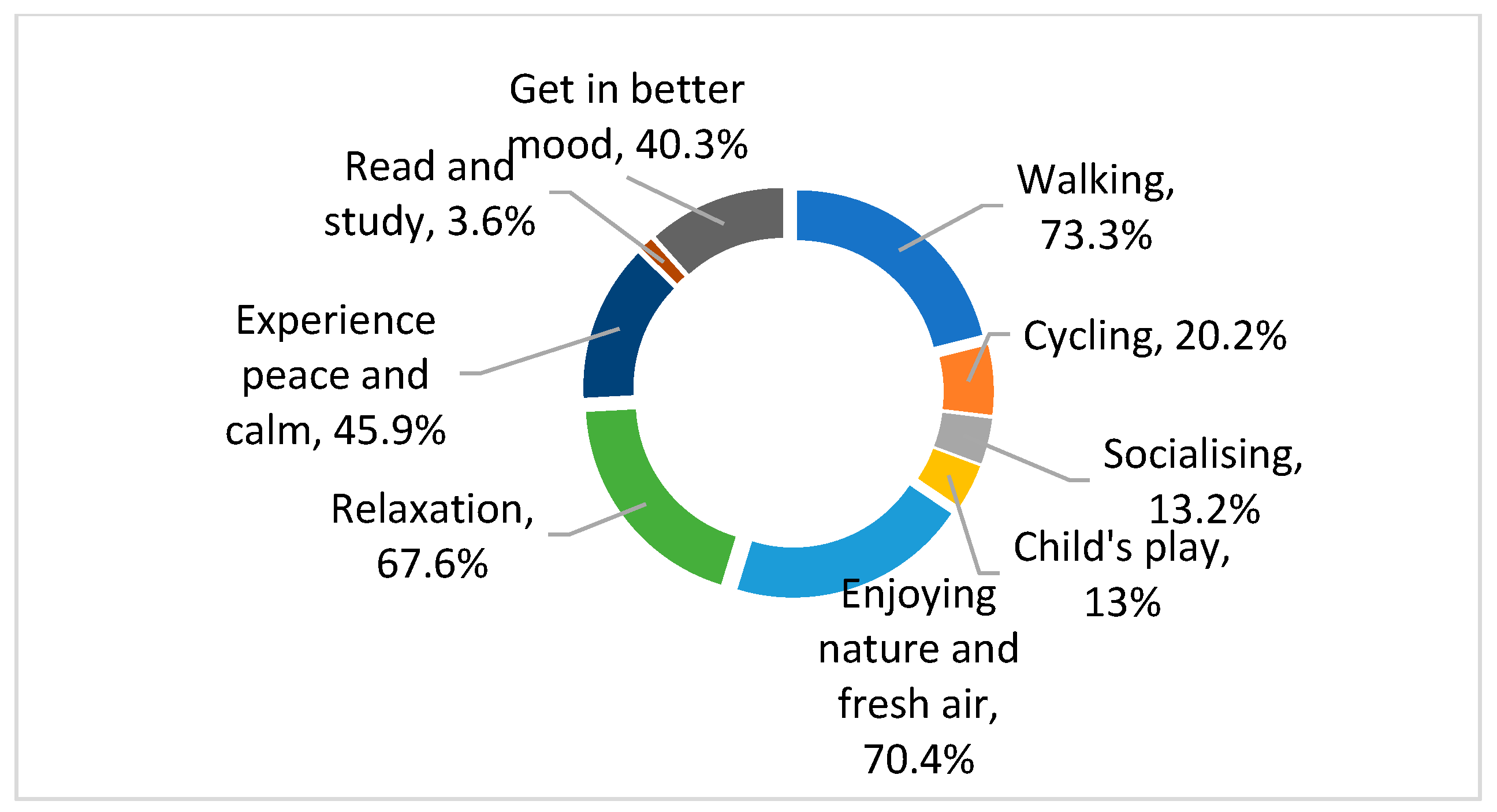
Figure 2.
Malaysian urban residents’ perception about UGS suppling ESs: a) Overall perception b) perception about different ecosystem services.
Figure 2.
Malaysian urban residents’ perception about UGS suppling ESs: a) Overall perception b) perception about different ecosystem services.
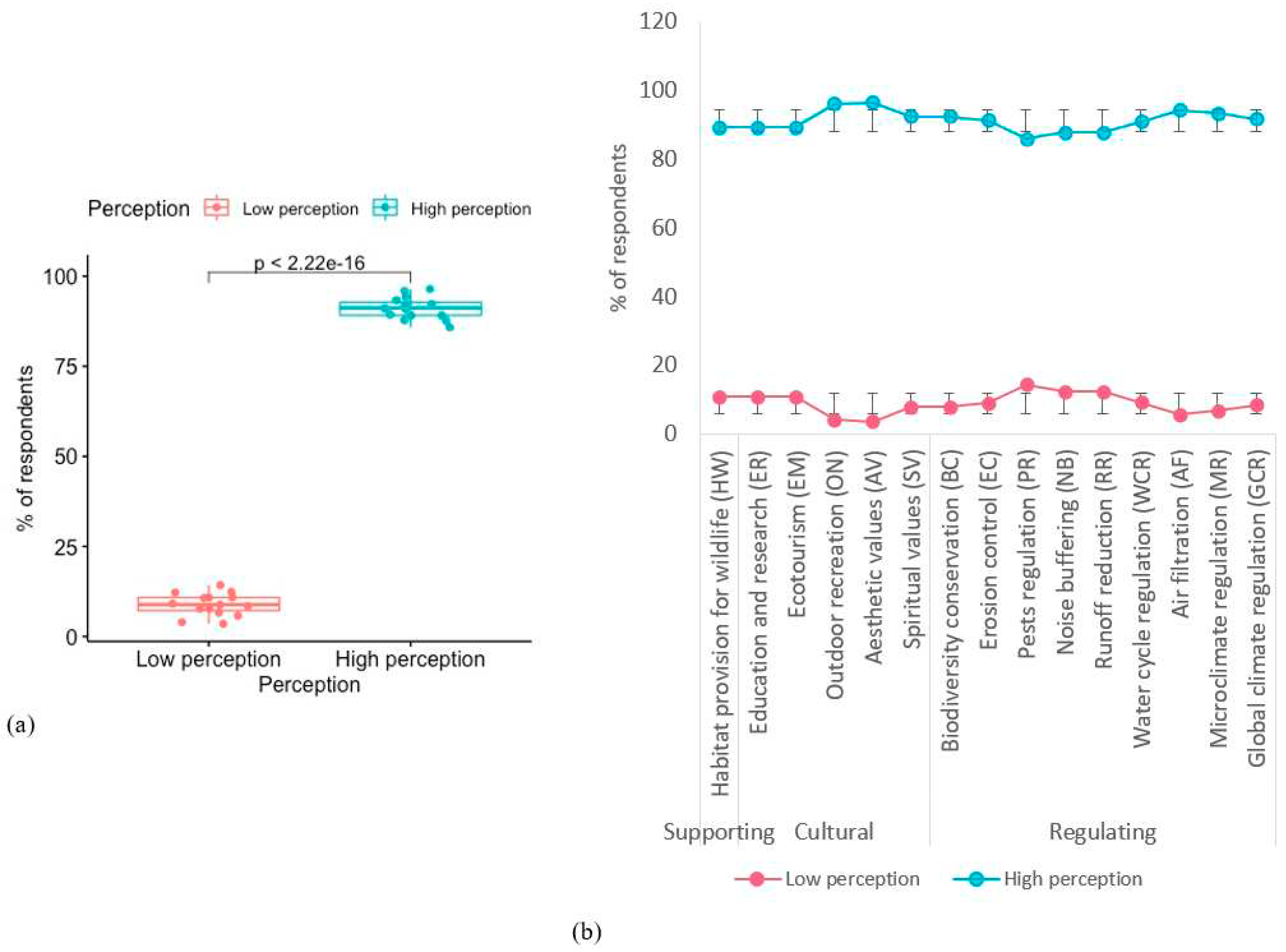

Table 1.
Socio-demographic features of the respondents.
| Variables | Frequency (N= 645) | Percentage of responses |
| Gender | ||
| Male | 192 | 29.8 |
| Female | 453 | 70.2 |
| Age | ||
| 18-30 years | 457 | 70.9 |
| 31-5 years | 129 | 20.0 |
| 46 and above | 59 | 9.1 |
| Educational level | ||
| University (Environmental) | 104 | 16.1 |
| University (Non-environmental) | 401 | 62.2 |
| Others | 140 | 21.7 |
| Occupation | ||
| Environmental sector | 35 | 5.4 |
| Non-environmental sector | 177 | 27.4 |
| Student | 381 | 59.1 |
| Others (Retired person, homemaker, and unemployed) | 52 | 8.1 |
| Household income | ||
| B40 (Up to RM5,000) | 373 | 57.8 |
| M40 (RM5,001- RM10,000) | 158 | 24.5 |
| T20 (RM10,001 and above) | 114 | 17.7 |
| Duration of stay in current residence | ||
| Less than 5 years | 197 | 30.6 |
| More than 5 years | 448 | 69.4 |
| Distance to the nearest UGSs | ||
| Up to 1km | 414 | 64.2 |
| 1 to 5km | 121 | 18.8 |
| More than 5km | 110 | 17.0 |
| Frequency of visits to UGSs | ||
| Few days a week | 137 | 21.2 |
| Once a week | 123 | 19.1 |
| Occasional | 385 | 59.7 |
Note: 1 US$= RM 4.3; B40 means bottom 40% of Malaysian population; M40 means middle 40% of Malaysian population and T20 means top 20% of Malaysian population based on income level.
Table 2.
Respondents’ opinion on quality of UGSs in Malaysia.
| Features | Yes | No | ||
| Frequency (N= 645) | Percentage of respondents | Frequency (N= 645) | Percentage of respondents | |
| Periodical maintenance | 306 | 47.4 | 339 | 52.6 |
| Diverse and well-organized landscape | 413 | 64.1 | 232 | 35.9 |
| Well-designed paths | 380 | 58.9 | 265 | 41.1 |
| Cleanliness | 382 | 59.2 | 263 | 40.8 |
| Safety | 372 | 57.7 | 273 | 42.3 |
| Aesthetically pleasant | 388 | 60.2 | 257 | 39.8 |
| Sufficient parking space | 297 | 46.1 | 348 | 53.9 |
Table 3.
Logistic regression on urban residents’ perception on regulating services provided by UGSs in Malaysia.
Table 3.
Logistic regression on urban residents’ perception on regulating services provided by UGSs in Malaysia.
| Independent Variables | Odds ratio (95% CI) | ||||||||
| Global climate regulation (GCR) | Microclimate regulation (MR) | Air filtration (AF) | Water cycle regulation (WCR) | Runoff reduction (RR) | Noise buffering (NB) | Pest regulation (PR) | Erosion control (EC) | Biodiversity conservation (BC) | |
| Gender | |||||||||
| Male (Ref.) | 1.00 | 1.00 | 1.00 | 1.00 | 1.00 | 1.00 | 1.00 | 1.00 | 1.00 |
| Female | 1.07 (0.73-1.56) | 0.86 (0.58-1.26) | 1.27 (0.83-1.93) | 0.95 (0.65-1.37) | 1.25 (0.87-1.8) | 0.94 (0.65-1.35) | 1.17 (0.82-1.67) | 1.01 (0.7-1.46) | 1.15 (0.79-1.67) |
| Age | |||||||||
| 18-30 years (Ref.) | 1.00 | 1.00 | 1.00 | 1.00 | 1.00 | 1.00 | 1.00 | 1.00 | 1.00 |
| 31-45 years | 2.06 (1.1-3.86)* | 1.43 (0.76-2.66) | 1.42 (0.71-2.84) | 1.36 (0.74-2.49) | 1.04 (0.57-1.89) | 1.86 (1.02-3.38)* | 1.19 (0.66-2.12) | 1.02 (0.56-1.87) | 1.38 (0.75-2.53) |
| 46 and above | 3.08 (1.29-7.36)** | 2.96 (1.2-7.33)* | 1.72 (0.65-4.51) | 1.56 (0.71-3.46) | 1.52 (0.69-3.32) | 3.69 (1.57-8.67)** | 2.08 (1-4.35)* | 1.13 (0.51-2.53) | 2.38 (1.02-5.55)* |
| Education level | |||||||||
| University (Environmental) (Ref.) | 1.00 | 1.00 | 1.00 | 1.00 | 1.00 | 1.00 | 1.00 | 1.00 | 1.00 |
| University (Non- environmental) | 0.77 (0.45-1.3) | 0.48 (0.27-0.85)** | 1.07 (0.61-1.9) | 0.67 (0.4-1.12) | 0.73 (0.45-1.2) | 0.76 (0.46-1.24) | 1.09 (0.68-1.75) | 0.79 (0.48-1.3) | 0.85 (0.51-1.41) |
| Others | 0.40 (0.22-0.73)** | 0.31 (0.17-0.58)*** | 0.86 (0.45-1.65) | 0.63 (0.35-1.13) | 0.71 (0.4-1.24) | 0.68 (0.39-1.2) | 1.13 (0.66-1.95) | 0.7 (0.4-1.24) | 0.61 (0.34-1.08) |
| Occupation | |||||||||
| Environmental sector (Ref.) | 1.00 | 1.00 | 1.00 | 1.00 | 1.00 | 1.00 | 1.00 | 1.00 | 1.00 |
| Non-environmental sector | 0.57 (0.21-1.55) | 0.79 (0.29-2.17) | 0.55 (0.19-1.64) | 0.25 (0.08-0.79)* | 0.44 (0.17-1.13) | 0.42 (0.15-1.13) | 0.6 (0.27-1.34) | 0.44 (0.16-1.18) | 0.97 (0.4-2.36) |
| Student | 0.67 (0.24-1.83) | 0.7 (0.25-1.94) | 0.69 (0.23-2.08) | 0.28 (0.09-0.87)* | 0.3 (0.11-0.78)** | 0.37 (0.14-1.02)* | 0.81 (0.36-1.86) | 0.36 (0.13-0.98)* | 0.91 (0.37-2.26) |
| Others | 0.4 (0.13-1.25) | 0.42 (0.13-1.31) | 0.69 (0.19-2.47) | 0.18 (0.05-0.62)** | 0.41 (0.14-1.18) | 0.31 (0.1-0.97)* | 0.45 (0.18-1.14) | 0.4 (0.13-1.22) | 0.48 (0.17-1.34) |
| Monthly household income | |||||||||
| B40 (Up to RM5,000) (Ref.) | 1.00 | 1.00 | 1.00 | 1.00 | 1.00 | 1.00 | 1.00 | 1.00 | 1.00 |
| M40 (RM5,001-RM10,000) | 1.1 (0.72-1.68) | 1.55 (1.01-2.39)* | 1.62 (0.97-2.69)* | 1.18 (0.78-1.77) | 0.77 (0.52-1.16) | 0.96 (0.64-1.44) | 0.97 (0.65-1.43) | 1.08 (0.72-1.62) | 0.97 (0.64-1.47) |
| T20 (RM10,001 and above) | 0.99 (0.61-1.63) | 1.39 (0.84-2.29) | 1.1 (0.63-1.91) | 1.07 (0.67-1.72) | 0.8 (0.5-1.27) | 0.85 (0.53-1.37) | 0.85 (0.54-1.34) | 1.57 (0.96-2.56)* | 1.13 (0.69-1.84) |
| Duration of stay in current residence | |||||||||
| Less than 5 years (Ref.) | 1.00 | 1.00 | 1.00 | 1.00 | 1.00 | 1.00 | 1.00 | 1.00 | 1.00 |
| More than 5 years | 0.95 (0.65-1.4) | 0.89 (0.6-1.31) | 0.99 (0.64-1.52) | 0.67 (0.46-0.97)* | 0.67 (0.46-0.96)* | 0.77 (0.53-1.12) | 0.94 (0.66-1.34) | 0.96 (0.66-1.39) | 1.06 (0.72-1.54) |
| Distance to the nearest UGSs | |||||||||
| Up to 1km (Ref.) | 1.00 | 1.00 | 1.00 | 1.00 | 1.00 | 1.00 | 1.00 | 1.00 | 1.00 |
| 1-5 km | 0.87 (0.55-1.37) | 0.91 (0.58-1.44) | 1.08 (0.63-1.83) | 0.92 (0.59-1.42) | 1.1 (0.72-1.7) | 1.31 (0.85-2.03) | 1.1 (0.72-1.68) | 1.11 (0.72-1.72) | 1.42 (0.89-2.27) |
| More than 5km | 0.67 (0.42-1.06) | 0.58 (0.36-0.93)* | 0.61 (0.37-1.01)* | 0.74 (0.47-1.17) | 1.01 (0.64-1.6) | 0.91 (0.58-1.44) | 1.41 (0.9-2.2) | 0.83 (0.53-1.31) | 0.84 (0.53-1.34) |
| Frequency of visits to UGSs | |||||||||
| Few days per week (Ref.) | 1.00 | 1.00 | 1.00 | 1.00 | 1.00 | 1.00 | 1.00 | 1.00 | 1.00 |
| Once a week | 0.49 (0.28-0.87)** | 0.79 (0.45-1.39) | 1.07 (0.54-2.13) | 0.7 (0.41-1.19) | 0.79 (0.46-1.34) | 0.61 (0.36-1.05) | 0.67 (0.4-1.11) | 0.57 (0.33-0.99)* | 0.84 (0.48-1.48) |
| Occasional | 0.58 (0.35-0.94)* | 0.81 (0.51-1.3) | 0.68 (0.39-1.16) | 0.7 (0.45-1.1) | 0.61 (0.4-0.95)* | 0.6 (0.38-0.94)* | 0.69 (0.45-1.06) | 0.56 (0.35-0.89)** | 0.67 (0.42-1.06) |
*Significant at 0.05 level; **Significant at 0.01 level; ***Significant at 0.001 level. In education group, ‘others’ refers to respondents who have up to secondary education or pre-university education. In occupations, ‘others’ refers to respondents who are retired, homemaker and unemployed.
Table 4.
Logistic regression on urban residents’ perception on cultural services and supporting services.
Table 4.
Logistic regression on urban residents’ perception on cultural services and supporting services.
| Independent Variables | Odds ratio (95% CI) | |||||
| Cultural services | Supporting service | |||||
| Spiritual values (SV) | Aesthetic values (AV) | Outdoor recreation (ON) | Ecotourism (EM) | Education and research (ER) | Habitat provision for wildlife (HW) | |
| Gender | ||||||
| Male (Ref.) | 1.00 | 1.00 | 1.00 | 1.00 | 1.00 | 1.00 |
| Female | 0.99 (0.69-1.43) | 1.03 (0.69-1.54) | 1.21 (0.76-1.93) | 1.04 (0.72-1.49) | 1.15 (0.8-1.63) | 0.95 (0.53-1.69) |
| Age | ||||||
| 18-30 years (Ref.) | 1.00 | 1.00 | 1.00 | 1.00 | 1.00 | 1.00 |
| 31-45 years | 1.37 (0.76-2.47) | 0.85 (0.44-1.66) | 1.75 (0.8-3.83) | 0.93 (0.51-1.67) | 1.62 (0.91-2.88) | 1.25 (0.5-3.09) |
| 46 and above | 2.11 (0.94-4.7)* | 1.21 (0.48-3.05) | 2.51 (0.8-7.92) | 1.05 (0.49-2.25) | 2.75 (1.28-5.89)** | 1.72 (0.53-5.58) |
| Education | ||||||
| University (Environmental) (Ref.) | 1.00 | 1.00 | 1.00 | 1.00 | 1.00 | 1.00 |
| University (Non-environmental) | 0.86 (0.52-1.4) | 0.55 (0.31-0.98)* | 0.49 (0.24-1.01)* | 0.7 (0.43-1.15) | 0.74 (0.46-1.19) | 1.29 (0.64-2.61) |
| Others | 0.53 (0.3-0.93)* | 0.42 (0.22-0.8)** | 0.42 (0.19-0.93)* | 0.56 (0.32-0.99)* | 0.64 (0.37-1.11) | 1.69 (0.71-4.03) |
| Occupation | ||||||
| Environmental sector (Ref.) | 1.00 | 1.00 | 1.00 | 1.00 | 1.00 | 1.00 |
| Non-environmental sector | 0.94 (0.4-2.18) | 0.69 (0.24-2) | 1.53 (0.5-4.68) | 0.68 (0.29-1.64) | 1.09 (0.49-2.45) | 1.06 (0.3-3.76) |
| Student | 1.02 (0.43-2.44) | 0.5 (0.17-1.48) | 1.41 (0.46-4.32) | 0.62 (0.25-1.53) | 1.25 (0.54-2.87) | 1.1 (0.3-4.02) |
| Others | 1.14 (0.42-3.11) | 0.6 (0.18-2.01) | 1.12 (0.3-4.21) | 0.46 (0.17-1.25) | 1.15 (0.44-2.96) | 0.41 (0.11-1.61) |
| Monthly household income | ||||||
| B40: Up to RM5,000 (Ref.) | 1.00 | 1.00 | 1.00 | 1.00 | 1.00 | 1.00 |
| M40: RM5,001 – RM10,000 | 1.02 (0.68-1.53) | 2.17 (1.35-3.49)*** | 1.45 (0.84-2.49) | 1.17 (0.78-1.75) | 0.84 (0.56-1.24) | 0.94 (0.48-1.85) |
| T20: RM10,001 and above | 0.69 (0.44-1.1) | 1.35 (0.81-2.25) | 1.39 (0.73-2.65) | 0.94 (0.59-1.49) | 0.72 (0.45-1.13) | 0.44 (0.23-0.83)* |
| Duration of stay in current residence | ||||||
| Less than 5 years (Ref.) | 1.00 | 1.00 | 1.00 | 1.00 | 1.00 | 1.00 |
| More than 5 years | 0.94 (0.65-1.36) | 0.88 (0.58-1.31) | 1.02 (0.63-1.63) | 0.92 (0.64-1.33) | 0.89 (0.62-1.28) | 1.06 (0.6-1.89) |
| Distance to the nearest UGSs | ||||||
| Up to 1km (Ref.) | 1.00 | 1.00 | 1.00 | 1.00 | 1.00 | 1.00 |
| 1-5 km | 1.12 (0.72-1.73) | 0.88 (0.55-1.4) | 0.8 (0.46-1.39) | 1.19 (0.77-1.84) | 1.09 (0.72-1.67) | 1.67 (0.78-3.6) |
| More than 5km | 1.09 (0.69-1.73) | 0.82 (0.5-1.33) | 0.73 (0.41-1.29) | 1.18 (0.74-1.86) | 1.31 (0.83-2.06) | 0.98 (0.48-1.99) |
| Frequency of visits to UGSs | ||||||
| Few days per week (Ref.) | 1.00 | 1.00 | 1.00 | 1.00 | 1.00 | 1.00 |
| Once a week | 0.59 (0.34-1.01)* | 0.68 (0.36-1.25) | 0.78 (0.39-1.56) | 0.62 (0.37-1.05) | 0.89 (0.53-1.49) | 0.75 (0.33-1.75) |
| Occasional | 0.55 (0.35-0.87)** | 0.5 (0.3-0.83)** | 0.9 (0.5-1.61) | 0.66 (0.42-1.02) | 0.84 (0.55-1.29) | 0.74 (0.36-1.52) |
*Significant at 0.05 level; **Significant at 0.01 level; ***Significant at 0.001 level. In education group, ‘others’ refers to respondents who have up to secondary education or pre-university education. In occupations, ‘others’ refers to respondents who are retired, homemaker and unemployed.
Disclaimer/Publisher’s Note: The statements, opinions and data contained in all publications are solely those of the individual author(s) and contributor(s) and not of MDPI and/or the editor(s). MDPI and/or the editor(s) disclaim responsibility for any injury to people or property resulting from any ideas, methods, instructions or products referred to in the content. |
© 2023 by the authors. Licensee MDPI, Basel, Switzerland. This article is an open access article distributed under the terms and conditions of the Creative Commons Attribution (CC BY) license (http://creativecommons.org/licenses/by/4.0/).
Copyright: This open access article is published under a Creative Commons CC BY 4.0 license, which permit the free download, distribution, and reuse, provided that the author and preprint are cited in any reuse.


