
Submitted:
25 February 2023
Posted:
28 February 2023
You are already at the latest version
Abstract
Background: A plethora of data supports HPV-based screening to be the preferred strategy for cervical cancer prevention. The shift to a more sensitive firstline test brings the need of effective triage up for discussion. Currently, most algorithms apply cytology as triage of HPV-DNA positive women. This study compared the performance of a 7-type HPV-mRNA test to cytology. Methods: From 2019-01-01, until 2021-12-31, cervical samples from 58,029 women were examined at the University Hospital of North Norway. 30.5% (17,684/58,029) fulfilled the criteria for HPV-DNA primary screening. All positive samples were triaged by cytology and followed-up according to national guidelines through 2022. Additionally, a 7-type HPV-mRNA test was applied. Study endpoint was histologically confirmed high grade lesion (CIN2+). Results: 5.6% (990/17,684) had positive HPV-DNA test, 97.2% (962/990) with valid HPV-mRNA results. 55.5% (534/962) had abnormal cytology (ASC-US+) and 35.1% (338/962) had positive HPV-mRNA test. 13.9% (134/962) had CIN2+. Sensitivity (CIN2+) of cytology versus the HPV-mRNA test was 76.1% (102/134)) versus 73.1% (98/134)), p=0.67. The specificity was 47.8% (396/828) versus 71.0% (588/624), p<0.001. PPV was 19.1% (102/534) and 29.0% (98/338), p<0.001 respectively. The number of colposcopies per CIN2+ detected by cytology and HPV-mRNA test was 5.2 and 3.1. Conclusion: The 7-type HPV mRNA test was significant more specific than cervical cytology in triage of HPV-DNA positive women. Using this biomarker as threshold for colposcopy may better balance the benefits and harms of screening.
Keywords:
HPV-DNA
; primary screening
; HPV-mRNA
; biomarker
; triage
; liquid-based cytology
; colposcopy
; CIN2+
1. Introduction
Today's comprehensive knowledge and applied science about HPV as the causative agent for cervical cancer offers enormous potential for improved prevention of cervical cancer [1]. For decades, cytology-based screening has been the most important strategy, reducing cervical cancer incidences and mortality by detection and treatment of precancerous lesions [2]. However, the availability of new technologies and HPV-vaccination urges policymakers to review current screening policies and adapt practices. The transition to HPV primary screening is a logical step considering the overwhelming evidence from clinical data that HPV testing has higher sensitivity than cytology for cervical cancer and its precursors, implying increased safety [3]. However, its specificity for CIN2+ is lower than cytology [4].
Understanding the natural history of the HPV infection and progression to cervical cancer is key to tailoring an optimal program for prevention, balancing the benefits and harms of screening [5]. HPV is a common infection, highly prevalent among the general population, declining with age. The risk of future cell abnormalities, linked to the overexpression of the E6/E7 viral oncogenes affecting cellular pathways, varies strongly by HPV genotype and duration of infection [6]. Most of the infections are transient and will be eliminated by the immune system during 1 to 2 years, resulting in a considerable risk of overdiagnosis and overtreatment of the HPV primary screening positives [7].
Several countries in Europe have implemented molecular testing while it is still debated how to best manage the HPV screened positives [8]. To date, cytology alone or in combination with partial genotyping (HPV 16/18) are the recommended triage options. Despite this, cervical cytology is an imperfect test due to its subjectivity, poor reproducibility where its sensitivity varies widely, reducing the overall program sensitivity [9].
Given the above, onus is still on the expert community to search for alternatives for how to improve management of the HPV-positive women. In a recent systematic review by Bonde et al., they examined if extended HPV genotyping might be used as risk discrimination of high-grade cervical intraepithelial neoplasia. Evidence was presented that seven HPV types (16, 18, 31, 33, 45, 52, 58) represented a significant higher risk of CIN3+, regardless of cytology result at baseline [10]. The genotype-spesific risk profiles identified have been supported by literature describing the same seven genotypes to be the most oncogenic HPV-types, identified in 90% of cervical cancer tissue worldwide [11]. Wentzensen et al. further discuss how clinical management of women with cervical cancer screening results is moving to use risk thresholds rather than individual test results, describing the goals of screening this way: «An optimal integrated screening and triage strategy should reassure the vast majority of women that they are at very low risk of cervical cancer, send the women at highest risk to colposcopy at the right time, when disease can be colposcopically detected, and minimize the intermediate risk group that requires continued surveillance» [12]. One of the promising biomarkers that have been suggested to might serve as a better risk stratification tool among HPV primary screen positive women warranted for immediate colposcopy, is the detection of HPV mRNA E6/E7 [13]. A new HPV mRNA test on the market enables extended genotyping of the seven types (16, 18, 31, 33, 45, 52, 58) proven to be associated with the highest oncogenic risk. The knowledge of the individual genotype and its risk profile, combined with the information whether mRNA E6/E7 is overexpressed or not, might be a more precise threshold for colposcopy of HPV primary screening positive women. In this study we compared the performance of the 7-type HPV mRNA test to cervical cytology being the approved strategy in triage of the HPV-DNA primary screen positive women and evaluated the test characteristics towards detection of cervical intraepithelial neoplasia grade 2 (CIN2+).
2. Materials and Methods
2.1. The Norwegian cervical cancer screening settings during the study period
Norway has a nationwide organized screening system, the Norwegian Cervical Cancer Screening program (NCCSP), which is run by the Cancer Registry of Norway. All women between the ages of 25 and 69 years are invited to participate, and reminders are sent to non-attenders. Cervical specimens are sent for centralized testing at national hospitals’ pathology departments, which perform HPV DNA testing and liquid-based cytology (LBC) evaluations. LBC results are reported following the 2014 Bethesda classification [14] and histology is reported according to the WHO`s CIN classification [15]. Norwegian recommendations instruct biopsies to be obtained on all visible lesions and if no lesions visible, from all four quadrants of the squamocolumnar junction (SCJ).
The results of primary testing and triaging are evaluated, and in the event of any abnormal test result, follow-up actions according to the Norwegian algorithm are recommended. Recently, HPV DNA primary screening for women ≥34 years of age every five years was implemented, while primary cytology every three years has been maintained for women 25-33 years of age. Following the governmental roll-out plan for a gradual introduction of HPV-DNA test in primary screening, 50% of the women 34-69 years of age were randomized for HPV testing during 2019 throughout 2020, whereas HPV testing was fully implemented from 2021 [16]. HPV-DNA primary screen positive women were managed according to standard of care as follows; HPV 16/18 DNA positive/cytology abnormal and HPV (non-16/18) DNA positive/high-grade cytology positive women were sent to colposcopy/cervical biopsies evaluations to determine disease status. Women with other HPV/cytology results combinations were sent to 1- or 2-year surveillance to determine HPV persistence [17].
2.2. Study design
This study was nested in a real HPV-primary screening setting in the northernmost county in Norway during 2019 throughout 2021. The department of Clinical Pathology at the University Hospital of North Norway (UNN) receives cervical samples collected in ThinPrep Pap test vials with PreservCyt solution from all women participating in cervical cancer screening in Troms and Finnmark county [18]. All women 34 - 69 years of age who were randomized for HPV-DNA primary screening at UNN during the three years period were included. The department utilized the Cobas 4800 HPV-test (Roche) in daily routine, that reports individual results for HPV 16 and HPV 18, along with a simultaneous, pooled result for other high-risk genotypes (31, 33, 35, 39, 45, 51, 52, 56, 58, 59, 66, 68). Following the national guidelines standard of care, all HPV-DNA primary screen positive women were triaged by cytology and partial genotyping (HPV 16/18) results, guiding further referrals to colposcopy or surveillance testing [14]. All test postivites have been followed-up until December 2022 for the evaluation of histologically confirmed cervical intraepithelial neoplasia grade 2 (CIN2+).
The residual LBC-samples after HPV-DNA testing and LBC processing were kept at ambient temperatures, and sent to an accredited HPV-processing laboratory (PreTect AS), for HPV mRNA testing within 2-6 weeks from date of collection. Nucleic acids were isolated from 1 ml of the residual sample using PreTect X (PreTect AS, Norway) and analyzed for HPV mRNA E6/E7 expression from the types 16, 18, 31, 33, 45, 52 and 58 (PreTect HPV-Proofer`7, PreTect AS, Norway) according to the manufacturer’s instructions. The assay is based on real time Nucleic Acid Sequence Based Amplification (NASBA) technology, an isothermal RNA amplification method targeting full-length E6/E7 transcripts providing qualitative results. Assay validation comprised positive and negative controls corresponding to the viral mRNA for all targets, including an intrinsic sample control confirming sample adequacy. Results were interpreted and presented by the PreTect Analysis Software.
2.3. Selection of study population
During January 1.st, 2019, until December 31.st, 2021, cervical samples from 58,029 women were sent to the department of Clinical Pathology at UNN for examination. 30.5% (17,684/58,029) of the women were randomized to, and fulfilled the criteria for, HPV-DNA primary screening. Among those, 5.6% (990/17,684) of the women tested positive for HPV DNA, eligible for HPV mRNA testing. Residual LBC-samples with insufficient volume (< 1 ml) for HPV mRNA testing and samples testing negative for the mRNA intrinsic sample control (ISC) were excluded. In total, 2.8% (28/990) of the HPV DNA positive women were excluded, hence the valid study population comprised 962 women (Figure 1).
2.4. Study outcomes
The aim of this study was to compare the effectiveness of a new type of test for human papillomavirus (HPV) mRNA, called 7-type HPV mRNA test, with liquid-based cytology (LBC) in identifying cervical intraepithelial neoplasia grade 2 (CIN2+) in women who tested positive for HPV DNA in the initial screening. The comparison was based on several measures, including sensitivity, specificity, diagnostic accuracy (AU), and positive and negative predictive values (PPV/NPV). We defined sensitivity as the proportion of CIN2+ cases detected by either the baseline cytology or baseline HPV mRNA test. Specificity and negative predictive values (NPV) were calculated assuming that women with negative cytology results (including repeat testing after 12 months) and negative HPV DNA test results, and who showed no signs of CIN2+ during the follow-up period, did not have the disease. Test accuracy was calculated (AU=(SE+SP)/2). Further, the increasing risk of CIN2+ by the positive predictive values (% PPV) for each test combination at the specific branching points in screening (first line test and triage), was illustrated using a color flow risk-diagram.
Secondly, the rate of colposcopies per CIN2+ detected were evaluated for the four alternative triage strategies, by applying different thresholds for referral for the two technologies (Cytology ASC-US+ versus ASC-H+ and 7-types versus 5-types HPV mRNA test). The ratio was calculated by estimating that all the test positives within each strategy were scheduled to colposcopy, divided by the actual number of CIN2+ cases detected, even though the total CIN2+ prevalence was detected solely using cytology (and repeat HPV DNA+ test) as threshold for referral, to follow the Norwegian guidelines.
Finally, the absolute risk of CIN2+ by HPV genotype for DNA versus mRNA detection was calculated as percentage of CIN2+ cases among the total number of HPV genotype infections.
Statistical analysis: Data were analyzed in Statistical Package for Social Sciences (SPSS) version 28.0 with Chi-square test and Chi-square test for trend with p-values < 0.05 as significance level.
Ethical approval: The Regional Committee for Medical and Health Research Ethics (REC North) has approved the protocol as quality assurance (REK nord 203384). Norwegian regulations exempt quality assurance studies from written informed consent from the patients.
3. Results
3.1. Test positivity rates and detection rate of CIN2+
Of the 17,684 women with an HPV-DNA test as primary screening, 990 women (5.6%) had a positive HPV-DNA test. Included were 962 women with a positive HPV-DNA test and a valid HPV mRNA test. In triage of HPV-DNA positive women, 55.5% (534/962) had abnormal cytology (ASC-US+) and 35.1% (338/962) had a positive HPV mRNA test (Figure 1). Of the women with a positive HPV-DNA test, 414 women had a biopsy taken during follow-up throughout December 2022. Total detection rate of CIN2+ among study population was 13.9% (134/962).
3.2. Sensitivity, specificity and predictive values for CIN2+
In total, 134 women, 13.9% (134/962), had confirmed CIN2+ during follow-up. The sensitivity of cytology versus the HPV mRNA test in triage of HPV-DNA positive women was 76.1% (102/134) versus 73.1% (98/134), p=0.67. The specificity of cytology versus the HPV mRNA test was 47.8% (396/828) versus 71.0% (588/828), p<0.001. The PPV for CIN2+ was 19.1% (102/534) for cytology and 29.0% (98/338) for the HPV mRNA test, p<0.001. NPV was 92.5% (396/428) and 94.2% (588/624), p=0.33, respectively.
Applying high grade cytology (ASC-H+) as cut-off instead of ASC-US+, the number of triage positives was reduced from 55.5% (534/962) to 6.9% (66/962), while the sensitivity for CIN2+ dropped from 76.1% (102/134) to 27.6% (37/134). Restricting the number of HPV-types in the HPV mRNA test from seven (16, 18, 31, 33, 45, 52 and 58) to five (16, 18, 31, 33 and 45), the number of triage positives was reduced from 35.1% (338/962) to 27.9% (268/962), p<0.001, and the sensitivity for CIN2+ dropped from 73.1% (98/134) to 64.2% (86/134), p=0.15, (Table 1).
The increased risk of high-grade dysplasia (CIN2+) across the triage positives was 19.1% for ASC-US+ versus 29.0% for HPV mRNA positive women. Among triage negatives, the risk of CIN2+ in cytology normal women was 7.5% versus 5.8% in HPV mRNA negative women, as illustrated in Figure 2.
3.3. Estimated number of colposcopies per CIN2+ detected
The number of colposcopies per CIN2+ detected by cytology if applying ASC-US+ or ASC-H+ as threshold for referral was 5.2 versus 1.8, while the estimated number of colposcopies to be performed to detect one case CIN2+ based on HPV mRNA 7-type versus 5-type test positives, was 3.4 versus 3.1, respectively (Table 2). The number of colposcopies required per CIN2+ case detected was calculated estimating that all test positives for each strategy would be scheduled for colposcopy, even though the total CIN2+ prevalence among our study population was detected solely using cytology (and repeat HPV DNA+ test) as threshold for referral.
4. Discussion
Our study is the first to analyze the performance of extended genotyping by mRNA E6/E7 detection in triage of HPV-DNA primary screen positive women. The objectives were firstly to compare the key performance indicators such as relative sensitivity, specificity, and predictive values for detection of CIN2+ towards the established triage implemented. The reported data revealed that a 7-type mRNA test significantly increased the specificity by x1.5 compared to liquid-based cytology, while a similar sensitivity was maintained. The risk of CIN2+ among mRNA positives (29.0%) was substantially higher versus the ASC-US+ cases (19.1%), while the risk among triage mRNA negatives (5.8%) was lower than that of cytology (7.5%).
Molecular HPV testing has shown to be an objective, preferential method in preventing cervical cancer. While HPV DNA tests detect the presence of virus, in both transient and persistent state, mRNA tests identify only transcriptionally active viruses. Taking in account that the established cause of cervical cancer is not the infection per se, but an overexpression of the E6/E7 viral oncogenes affecting cellular pathways, it might be reasonable to trust HPV mRNA tests to give a more precise information of a high-risk condition, as supported by our findings. Literature describes the E6/E7 mRNA biomarkers to have a good correlation with the risk of cervical cancer development [13,18,19,20,21,22,23]. Additionally, in contrast to cervical cytology, triage by molecular biomarkers allows the use of HPV-self-sampling [24]. Importantly, self-sampling has been anticipated to offering great potential to increased participation of hard-to-reach women, thus improving prevention of cervical cancer [25].
In view of HPV being highly prevalent (8-10% in western countries) and the lifetime risk for HPV estimated to be up to 80% for sexually active people combined with the biology of the viral infections where most are self-resolving [26], the benefits of a sensitive 14-type HPV test in primary screening are challenged by the low specificity [4]. The risk of clinically significant disease (CIN3+) among HPV-DNA positive women has been shown to be only 5-8% [27], a contrast that might result in unnecessary follow up and over treatment of test positive women. Affirming the above, our study population represented a low-risk population, where all women with any previously abnormal screening results were excluded from enrollment to HPV primary screening in Norway during the implementation phase. Even so, the HPV DNA positivity rate was 5.6%, resulting in a CIN2+ prevalence at 13.9% with only 3.0% CIN3+ cases detected during follow-up.
Most countries having implemented HPV DNA test in primary screening use cytology in triage of screen positive women, applying ASC-US+ as cut-off. When tailoring an optimal screening algorithm, it is important to carefully choose a threshold for referral to colposcopy based on the balance between benefits and harms. Comparing screening strategies, the number of colposcopies required to detected one CIN2+ case is commonly used as an indicator of over referrals, representing the harms of screening. Our analysis estimated the number of colposcopies/CIN2+ across the four triage strategies presented, where the lowest ratio (1.8) was found for LBC using ASC-H+ as threshold for colposcopies, increasing to 3.1 for the mRNA test, while it almost tripled (5.2) for the established practice using ASC-US+ as threshold. However, these estimates must be seen in context with the fact that in this study, the total CIN2+ prevalence was solely identified by current practice using cytology ASC-US+ (and repeat HPV DNA+ test) as threshold for colposcopies.
In countries with limited colposcopy resources, it might be justified to make use of ASC-H as a cut-off to reduce the number of colposcopies, while still being able to identify the few women warranted for immediate colposcopy and treatment. In present material, this strategy would reduce the referral rate at baseline from 55.5% to 6.9%, at the expense of a substantial reduction of sensitivity for CIN2+ from 76.1% to 27.6% and lowering the number of colposcopies per CIN2+ from a ratio of 5.2 for ASC-US+ to 1.8 for ASC-H+. It must be noted that in developed countries, a sensitivity for CIN2+ at baseline of 27.6% is considered far too low for implementation of such strategy.
Ideally, optimal screening strategies would detect as many CIN3+ as possible while keeping the number of colposcopies at an acceptable level. Thus, requiring a highly specific test in triage of the HPV screen positive women [28]. Evaluating which triage approach that might perform better for HPV DNA primary screen positive women, our data confirmed the 7-type HPV mRNA test to be significantly more specific than cervical cytology (71.0% versus 47.8%), reducing the number of colposcopies while keeping the same sensitivity towards detection of CIN2+. Our findings were in line with the previously reported advantage of mRNA testing, verifying the E6/E7 mRNA transcripts to have a higher specificity, with the potential to limit the addressed harms of screening for cervical cancer in a population of healthy women [13,18,19,20,21,22,23]. The repeatedly discussion of whether a slightly lower sensitivity for the mRNA-test compared to cytology (73.1% versus 76.1%, p=0.67) might negatively affect the effectiveness of screening is of minor importance as long as triage negative women will be guided to surveillance testing at dedicated intervals. Realistically no test is 100% perfect, and we must own up to the need for periodically repeated testing of triage negative women, informed by the tests’ safety (NPV). In the present analysis, NPV for the approved triage algorithm cytology ASC-US+ was 92.5% while the mRNA test provided similar or improved safety, (NPV 94.2%), justifying return to follow-up for triage mRNA negative women as for cytology negative women.
The recognition that persistent HPV infection is necessary for developing precancer and cancer and the characteristics of infections including which genotype and duration of infection, underlies the new US risk-based approach for assessing a patient’s immediate risk of precancer [29]. The value of HPV extended genotyping for clinical management of abnormal screening results is well established in the literature [28]. Scientific data over decades have been informing of the risk profile per genotype and their cancer-causing strengths and have identified seven hrHPV-types (HPV 16, 18, 31, 33, 45, 52, 58) as the most prevalent and aggressive types associated with cervical cancer [10,11]. These data have helped to improve the HPV vaccine by including the same seven types for maximal protection and informed the design of new molecular tests entailing extended genotyping.
Recent publications address the fact that genotyping may improve risk stratification of hrHPV screen positive women, after investigating the difference in HPV type distribution among HPV-infected women across different cervical lesions, from normal to severe lesions [30,31,32]. So et al. concluded that HPV 16, 31, 33, 52, and 58 infections implied significant risk of high-grade disease for cervical carcinogenesis [30], while in a danish population-based study by Kjær et al., the greatest risk was associated with HPV16, followed by 18, 33, 31, 35, 58 and 45 [31]. Guen et al. confirmed in their meta analysis, reviewing HPV-infected women from cervical infection to cancer, the exceptional difference in carciogenicity among individual genotypes. Again, the types HPV 16, 18, 31, 33 were identified as the types carring the absolute highest risks for progression [32].
In our analysis, the HPV mRNA genotype specific risks for CIN2+ take precedence of the corresponding HPV DNA types, verifying the importance of the seven types included in the triage test. In descending order, our data reported the highest absolute CIN2+ risk for type 16, 33, 18, 31, 52, 58 and 45, in line with the findings of Bonde et al., summarizing their findings this way: “Beyond HPV 16, 31, 18, and 33, HPV 52, 58, and 45 carried moderate risks, with 35, 39, 51, 56, 59, 66, and 68 consistently having the lowest CIN 3 or worse risks, regardless of cytology” [10].
In Europe, most cases of cervical cancer are caused by only five hrHPV-types (HPV 16, 18, 31, 33 and 45) [11]. Restricting the number of HPV-types in triage to mRNA expression from these five types in this study, the referral rate was reduced from 35.1% to 27.9% (p<0.001). The sensitivity for CIN2+ was reduced from 73.1% to 64.2%, (p=0.15) and the corresponding number of colposcopies per CIN2+ was 3.4 using seven HPV mRNA-types and 3.1 using five HPV mRNA-types as a cut-off. Given the significant reduction of number of referrals and insignificant drop of sensitivity, the five-type approach might be worth considering. However, the slight reduction of number of colposcopies per CIN2+ (3.4-3.1) must be weighed against the increased detection of CIN2 in a prospective cost-benefit analysis.
In the previous work of Stoler et al., various triage strategies including combinations of genotypes and dual-stained cytology were evaluated for a subset of women with hrHPV infections who were participating in the Addressing the Need for Advanced HPV Diagnostics (ATHENA) study [28]. Among the HPV-DNA genotype combinations evaluated, the 7-type (HPV16/18/31/33/45/52/58) were found to be more sensitive than the FDA approved algorithm (HPV16/18+ or 12-other hrHPV+ AND Pap+) but also to slightly increase the number of colposcopies per CIN3 detected from a ratio of 8.4 to 8.9. Taken in consideration that the reported HPV types were detecting DNA, identified using the LINEAR ARRAY HPV Genotyping Test, along with assessing CIN3+, a direct comparison to our material is not possible. However, by utilizing mRNA E6/E7 extended genotyping, it is presumed a lower relative positivity rate for the mRNA types versus the corresponding DNA, especially in a low-risk population such as women attending primary screening. In Predictors 3, Cuzick et al. reported a relative positivity rate for HPV DNA 16 at 3,5% (Cobas 4800, Roche) versus 2.1% for HPV mRNA 16 (PreTect HPV-Proofer, PreTect AS) [33]. In present material, HPV 16+ cases were 13.5% (130/962) versus 7.6% (73/962) for mRNA 16 positives. Integrating a 7-type mRNA test in triage would most likely improve the clinical utility over what has been reported for DNA extended genotyping, having higher specificity, and lowering the number of colposcopies per detected CIN2+.In 2015, Norway ran a pilot using Cobas 4800 HPV DNA test in primary screening in four counties [34]. All HPV DNA positive women with abnormal cytology (ASC-US+) were referred to colposcopy and biopsy, giving a three times higher referral rate for colposcopy at baseline in the HPV-arm compared to the cytology arm. Experiences from the pilot demonstrated that partial HPV 16/18 genotyping provided further risk stratification and reduced over referral of all women who had an HPV positive and low-grade cytology (ASC-US/LSIL) result to colposcopy and biopsy. Women with low-grade cytology and HPV 16/18 should be referred to colposcopy, while women with low-grade cytology and other HPV-types should be followed-up with a new HPV-test after 12 months [17]. From 2021, this approach was fully implemented in the Norwegian algorithm, expected to inevitably reduce the referral rate of HPV DNA positive women, but also reduce the sensitivity of CIN2+ at baseline. Given the high inter-laboratory differences for cytology results observed in Norway [9,17], an objective biomarker as a 7-type HPV mRNA test might serve as a better alternative to reach the goal of screening, hereby maximizing the number of immediate CIN3+ detections and minimize the number of colposcopies. Still, prospective studies addressing the associated costs of shifting from an already established practice such as cytology to a molecular triage test are required.
Strengths and limitations
One of the strengths of this study is the continued enrollment of all women attending screening in one county in Norway, still ongoing. All results have been derived from the original liquid-based cytology sample, making a direct comparison of the triage alternatives possible. A major limitation is that follow up of test positive women has been according to cytology (and repeat HPV-DNA test) only, complying with the approved Norwegian algorithm. Cytology negative, 7-type mRNA positive women were not scheduled to colposcopy/biopsy and the reported performance of the mRNA test in this analysis might be underestimated accordingly. It should be acknowledged that in real-world clinical practice, adherence to screening guidelines is not always consistent. Unlike a controlled research study, individual patient evaluations are often performed, and the clinical history of the patient is taken into consideration in determining the need for referral to treatment. It should be noted that present data do not include an HPV-vaccinated population, hence performance might be directly impacted by vaccinated women entering screening in 2031. Inevitably, debates on how to adapt screening practices in future must recognize the importance of triage alternatives addressing a high-risk condition among a low prevalence disease population.
5. Conclusions
In summary, this analysis found the 7-type HPV mRNA test to be significantly more specific than cervical cytology in triage of the HPV DNA positive women. Using this biomarker as a threshold for referral to colposcopy may better balance the benefits and harms of screening. Women with a positive HPV DNA test, and negative HPV mRNA test in triage have equal risk of CIN2+ as current approved triage practice and can safely be followed up with repeat HPV DNA testing after 12 months.
Author Contributions
Conceptualization, S.W.S. and B.M.F.; methodology, S.W.S. and B.M.F.; formal analysis, S.W.S.; investigation, S.W.S., M.A and B.M.F.; resources, S.W.S., M.A and B.M.F.; data curation, S.W.S.; writing—original draft preparation, S.W.S. and B.M.F.; writing—review and editing, S.W.S., M.A. and B.M.F.; visualization, S.W.S. and B.M.F.; supervision, S.W.S.; project administration, S.W.S. and B.M.F.; funding acquisition, S.W.S. and B.M.F. All authors have read and agreed to the published version of the manuscript.
Funding
This research received no external funding. HPV mRNA test kits were provided FOC by PreTect AS.
Institutional Review Board Statement
The study was conducted in accordance with the Declaration of Helsinki and approved by the Regional Committee for Medical and Health Research Ethics (REC North, 203384, 18th December 2020) for studies involving humans.
Informed Consent Statement
Patient consent was waived due to Norwegian regulations which exempt quality assurance studies from written informed consent.
Data Availability Statement
All data presented are available upon request.
Acknowledgments
The authors would like to extend our gratitude to the staff at the department of Clinical Pathology at the University Hospital of North Norway and to all the laboratory staff performing HPV DNA/mRNA testing, cytology and histopathology evaluation for their great work and collaboration during this study.
Conflicts of Interest
S.W.S and M.A declare no conflict of interest. B.M.F is an employee of PreTect AS.
References
- Walboomers JM, Jacobs MV, Manos MM, Bosch FX, Kummer JA, Shah KV, et al. Human papillomavirus is a necessary cause of invasive cervical cancer worldwide. J Pathol. 1999;189(1):12-9.
- Denny L. Cytological screening for cervical cancer prevention. Best Pract Res Clin Obstet Gynaecol. 2012;26(2):189-96. [CrossRef]
- Ronco G, Dillner J, Elfstrom KM, Tunesi S, Snijders PJ, Arbyn M, et al. Efficacy of HPV-based screening for prevention of invasive cervical cancer: follow-up of four European randomised controlled trials. Lancet. 2014;383(9916):524-32. [CrossRef]
- Koliopoulos G, Nyaga VN, Santesso N, Bryant A, Martin-Hirsch PP, Mustafa RA, et al. Cytology versus HPV testing for cervical cancer screening in the general population. Cochrane Database Syst Rev. 2017;8:CD008587. [CrossRef]
- de Sanjose S, Brotons M, Pavon MA. The natural history of human papillomavirus infection. Best Pract Res Clin Obstet Gynaecol. 2018;47:2-13. [CrossRef]
- zur HH. Papillomaviruses and cancer: from basic studies to clinical application. Nat Rev Cancer. 2002;2(5):342-50. [CrossRef]
- Sroczynski G, Esteban E, Widschwendter A, Oberaigner W, Borena W, von Laer D, et al. Reducing overtreatment associated with overdiagnosis in cervical cancer screening-A model-based benefit-harm analysis for Austria. Int J Cancer. 2020;147(4):1131-42. [CrossRef]
- Cuschieri K, Ronco G, Lorincz A, Smith L, Ogilvie G, Mirabello L, et al. Eurogin roadmap 2017: Triage strategies for the management of HPV-positive women in cervical screening programs. Int J Cancer. 2018;143(4):735-45. [CrossRef]
- Sorbye SW, Suhrke P, Reva BW, Berland J, Maurseth RJ, Al-Shibli K. Accuracy of cervical cytology: comparison of diagnoses of 100 Pap smears read by four pathologists at three hospitals in Norway. BMC Clin Pathol. 2017;17:18. [CrossRef]
- Bonde JH, Sandri MT, Gary DS, Andrews JC. Clinical Utility of Human Papillomavirus Genotyping in Cervical Cancer Screening: A Systematic Review. J Low Genit Tract Dis. 2020 Jan;24(1):1-13. [CrossRef] [PubMed]
- Arbyn M, Tommasino M, Depuydt C, Dillner J. Are 20 human papillomavirus types causing cervical cancer? J Pathol. 2014;234(4):431-5. [CrossRef]
- Wentzensen N, Schiffman M, Palmer T, Arbyn M. Triage of HPV positive women in cervical cancer screening. J Clin Virol. 2016;76 Suppl 1:S49-S55. [CrossRef]
- Derbie A, Mekonnen D, Woldeamanuel Y, Van Ostade X, Abebe T. HPV E6/E7 mRNA test for the detection of high grade cervical intraepithelial neoplasia (CIN2+): a systematic review. Infect Agent Cancer. 2020;15:9. [CrossRef]
- Nayar R, Wilbur DC. The Bethesda System for Reporting Cervical Cytology: A Historical Perspective. Acta Cytol. 2017;61(4-5):359-72. [CrossRef]
- Richart RM. Cervical intraepithelial neoplasia. Pathol Annu. 1973;8:301-28. [CrossRef]
- Maver PJ, Poljak M. Primary HPV-based cervical cancer screening in Europe: implementation status, challenges, and future plans. Clin Microbiol Infect. 2020;26(5):579-83. [CrossRef]
- Hashim D, Engesaeter B, Baadstrand SG, Castle PE, Bjorge T, Trope A, et al. Real-world data on cervical cancer risk stratification by cytology and HPV genotype to inform the management of HPV-positive women in routine cervical screening. Br J Cancer. 2020;122(11):1715-23. [CrossRef]
- Sorbye SW, Fismen S, Gutteberg TJ, Mortensen ES, Skjeldestad FE. HPV mRNA is more specific than HPV DNA in triage of women with minor cervical lesions. PLoS One. 2014;9(11):e112934. [CrossRef]
- Rijkaart DC, Berkhof J, van Kemenade FJ, Coupe VM, Hesselink AT, Rozendaal L, et al. Evaluation of 14 triage strategies for HPV DNA-positive women in population-based cervical screening. Int J Cancer. 2012;130(3):602-10. [CrossRef]
- Benevolo M, Vocaturo A, Caraceni D, French D, Rosini S, Zappacosta R, et al. Sensitivity, specificity, and clinical value of human papillomavirus (HPV) E6/E7 mRNA assay as a triage test for cervical cytology and HPV DNA test. J Clin Microbiol. 2011;49(7):2643-50. [CrossRef]
- Origoni M, Cristoforoni P, Carminati G, Stefani C, Costa S, Sandri MT, et al. E6/E7 mRNA testing for human papilloma virus-induced high-grade cervical intraepithelial disease (CIN2/CIN3): a promising perspective. Ecancermedicalscience. 2015;9:533. [CrossRef]
- Westre B, Giske A, Guttormsen H, Sorbye SW, Skjeldestad FE. 5-type HPV mRNA versus 14-type HPV DNA test: test performance, over-diagnosis and overtreatment in triage of women with minor cervical lesions. BMC Clin Pathol. 2016;16:9. [CrossRef]
- Sorbye SW, Fismen S, Gutteberg T, Mortensen ES. Triage of women with minor cervical lesions: data suggesting a "test and treat" approach for HPV E6/E7 mRNA testing. PLoS One. 2010;5(9):e12724. [CrossRef]
- Aranda Flores CE, Gomez Gutierrez G, Ortiz Leon JM, Cruz Rodriguez D, Sorbye SW. Self-collected versus clinician-collected cervical samples for the detection of HPV infections by 14-type DNA and 7-type mRNA tests. BMC Infect Dis. 2021;21(1):504. [CrossRef]
- Giorgi Rossi P, Fortunato C, Barbarino P, Boveri S, Caroli S, Del Mistro A, et al. Self-sampling to increase participation in cervical cancer screening: an RCT comparing home mailing, distribution in pharmacies, and recall letter. Br J Cancer. 2015;112(4):667-75. [CrossRef]
- Kombe Kombe AJ, Li B, Zahid A, Mengist HM, Bounda GA, Zhou Y, et al. Epidemiology and Burden of Human Papillomavirus and Related Diseases, Molecular Pathogenesis, and Vaccine Evaluation. Front Public Health. 2020;8:552028. [CrossRef]
- Castle PE, Glass AG, Rush BB, Scott DR, Wentzensen N, Gage JC, et al. Clinical human papillomavirus detection forecasts cervical cancer risk in women over 18 years of follow-up. J Clin Oncol. 2012;30(25):3044-50. [CrossRef]
- Stoler MH, Baker E, Boyle S, Aslam S, Ridder R, Huh WK, et al. Approaches to triage optimization in HPV primary screening: Extended genotyping and p16/Ki-67 dual-stained cytology-Retrospective insights from ATHENA. Int J Cancer. 2020;146(9):2599-607. [CrossRef]
- Demarco M, Egemen D, Raine-Bennett TR, Cheung LC, Befano B, Poitras NE, et al. A Study of Partial Human Papillomavirus Genotyping in Support of the 2019 ASCCP Risk-Based Management Consensus Guidelines. J Low Genit Tract Dis. 2020;24(2):144-7. [CrossRef]
- So KA, Lee IH, Lee KH, Hong SR, Kim YJ, Seo HH, Kim TJ. Human papillomavirus genotype-specific risk in cervical carcinogenesis. J Gynecol Oncol. 2019 Jul;30(4):e52. [CrossRef] [PubMed]
- Kjær SK, Frederiksen K, Munk C, Iftner T. Long-term absolute risk of cervical intraepithelial neoplasia grade 3 or worse following human papillomavirus infection: role of persistence. J Natl Cancer Inst. 2010 Oct 6;102(19):1478-88. [CrossRef] [PubMed]
- Guan P, Howell-Jones R, Li N, Bruni L, de Sanjosé S, Franceschi S, Clifford GM. Human papillomavirus types in 115,789 HPV-positive women: a meta-analysis from cervical infection to cancer. Int J Cancer. 2012 Nov 15;131(10):2349-59. [CrossRef] [PubMed]
- Cuzick J, Cadman L, Mesher D, Austin J, Ashdown-Barr L, Ho L, et al. Comparing the performance of six human papillomavirus tests in a screening population. Br J Cancer. 2013;108(4):908-13. [CrossRef]
- Engesaeter B, van Diermen Hidle B, Hansen M, Moltu P, Staby KM, Borchgrevink-Persen S, et al. Quality assurance of human papillomavirus (HPV) testing in the implementation of HPV primary screening in Norway: an inter-laboratory reproducibility study. BMC Infect Dis. 2016;16(1):698. [CrossRef]
Figure 1.
Flowchart outlining study population.
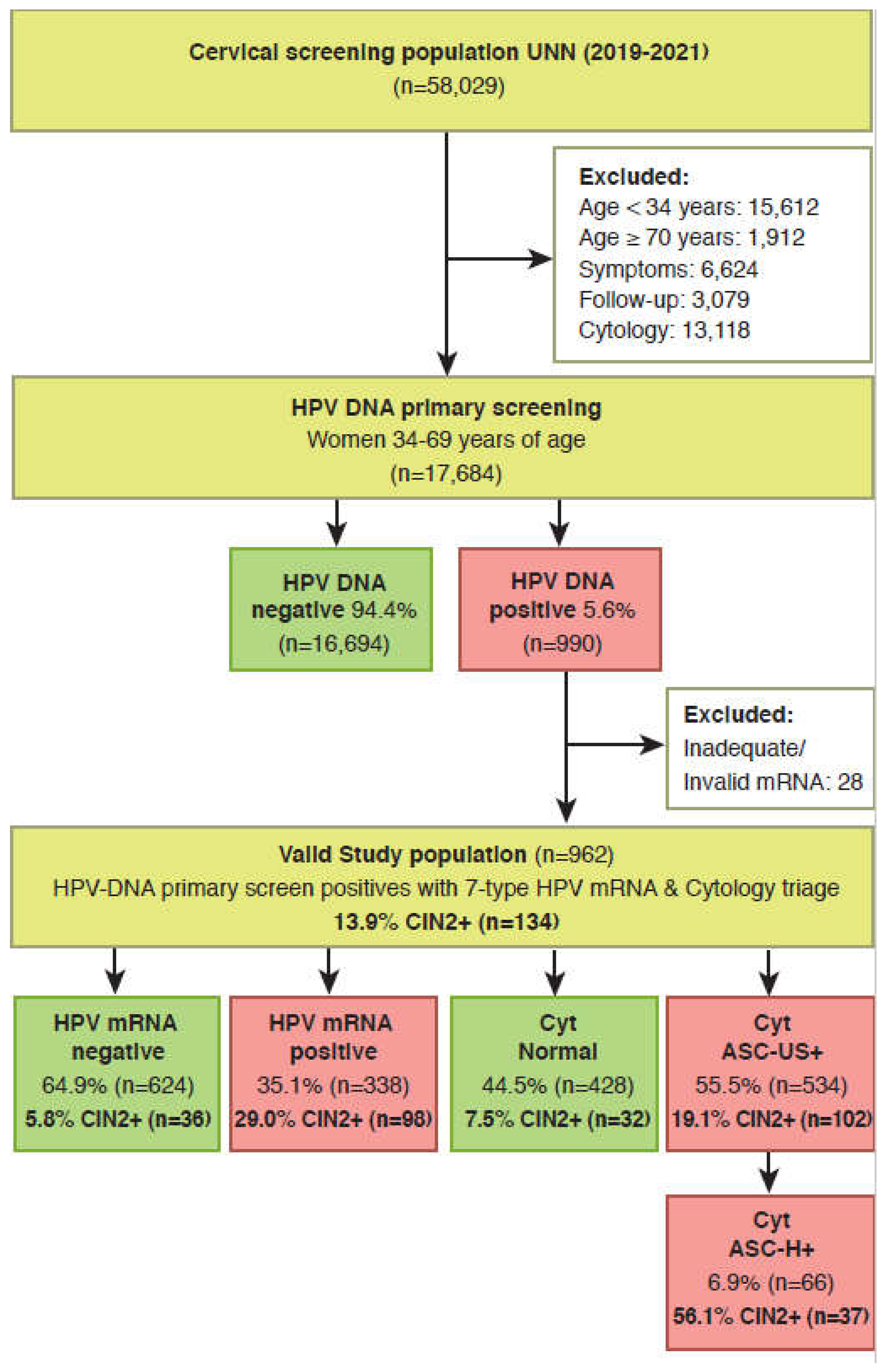
Figure 2.
Increasing risk of CIN2+ at spesific brancing points in screening. *y-axis indicates CIN2+ risk (%), based on the test`s PPV, and the x-axis represents the specific branching points in screening, at the time of the first screening test followed by the triage outcomes.
Figure 2.
Increasing risk of CIN2+ at spesific brancing points in screening. *y-axis indicates CIN2+ risk (%), based on the test`s PPV, and the x-axis represents the specific branching points in screening, at the time of the first screening test followed by the triage outcomes.
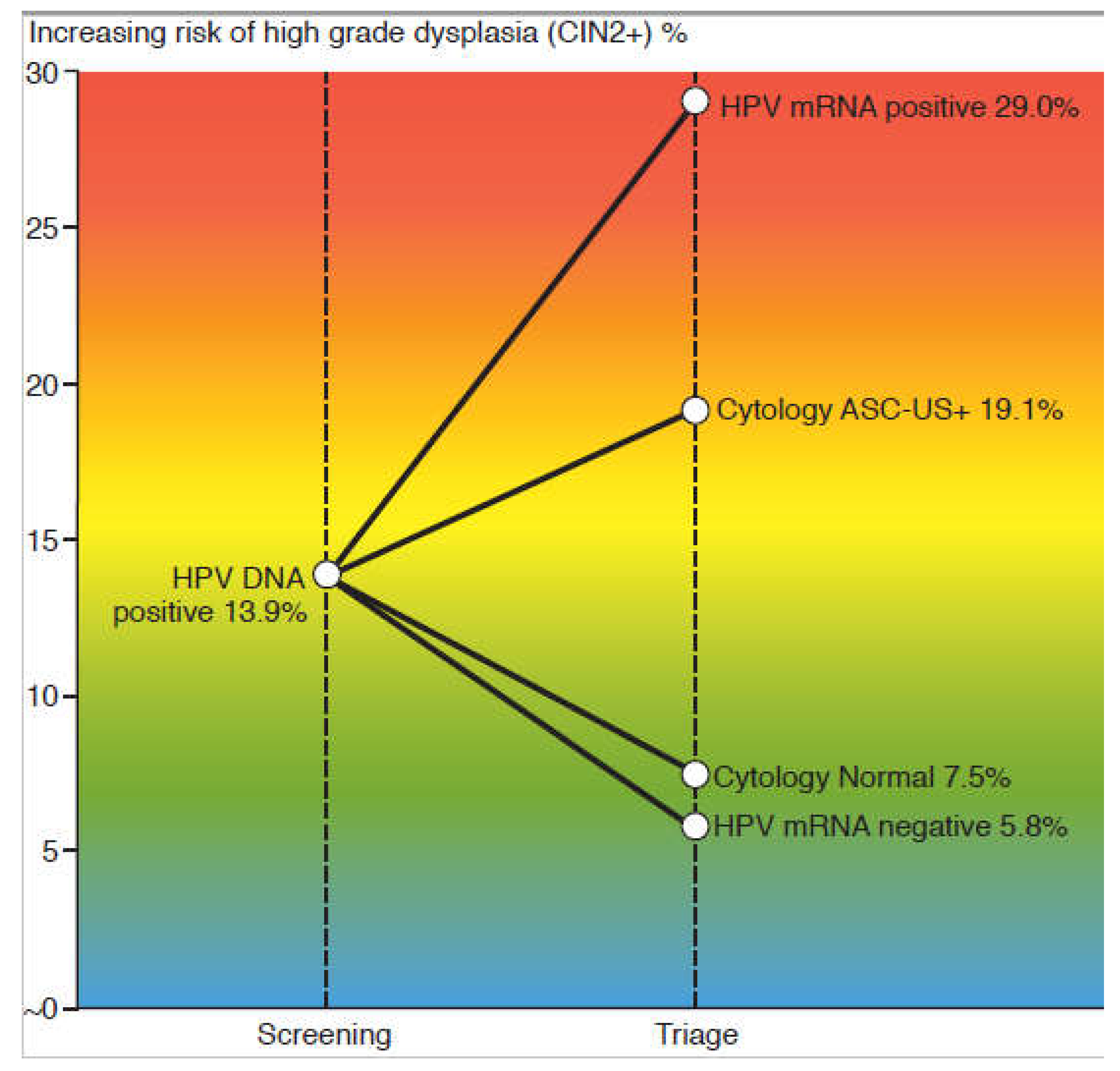

Table 1.
Comparison of different triage strategies in hrHPV positive women for detection of CIN2+.
| Triage strategies | TP | TN | FP | FN | SE % | SP % | AU* % | PPV % | 95% CI (PPV) | NPV % |
|---|---|---|---|---|---|---|---|---|---|---|
| Cytology ASC-US+ | 102 | 396 | 432 | 32 | 76.1 | 47.8 | 62.0 | 19.1 | 15.8 - 22.4 | 92.5 |
| Cytology ASC-H+ | 37 | 799 | 29 | 97 | 27.6 | 96.5 | 62.1 | 56.1 | 44.1 - 68.0 | 89.2 |
| HPV mRNA 16,18,31,33,45+ | 86 | 646 | 182 | 48 | 64.2 | 78.0 | 71.1 | 32.1 | 26.5 - 37.7 | 93.1 |
| HPV mRNA 16,18,31,33,45,52,58+ | 98 | 588 | 240 | 36 | 73.1 | 71.0 | 72.1 | 29.0 | 24.2 - 33.8 | 94.2 |
* True positive (TP), True negative (TN), False positive (FP), False negative (FN), Sensitivity (SE), Specificity (SP) and Diagnostic Accuracy ((AU) = (SE+SP)/2) for CIN2+ per triage strategy.
Table 2.
CIN2+ detection at baseline using the 4 triage strategies in hrHPV-positive women.
| Triage strategies | Triage positives (%) | No. of CIN2+ (1) | No. of colposcopies (2) | Colposcopies/CIN2+ (3) |
|---|---|---|---|---|
| Cytology ASC-US+ | 55.5 | 102 | 534 | 5.2 |
| Cytology ASC-H+ | 6.9 | 37 | 66 | 1.8 |
| HPV mRNA 16,18,31,33,45+ | 27.9 | 86 | 268 | 3.1 |
| HPV mRNA 16,18,31,33,45,52,58+ | 35.1 | 98 | 338 | 3.4 |
(1) the number of CIN2+ cases detected by each strategy among the total 134 cases. (2) the estimated number of colposcopies to be performed if all test positives will be scheduled to colposcopy. (3) the calculated number of colposcopies required to detect one case of CIN2+.
Disclaimer/Publisher’s Note: The statements, opinions and data contained in all publications are solely those of the individual author(s) and contributor(s) and not of MDPI and/or the editor(s). MDPI and/or the editor(s) disclaim responsibility for any injury to people or property resulting from any ideas, methods, instructions or products referred to in the content. |
© 2023 by the authors. Licensee MDPI, Basel, Switzerland. This article is an open access article distributed under the terms and conditions of the Creative Commons Attribution (CC BY) license (http://creativecommons.org/licenses/by/4.0/).
Copyright: This open access article is published under a Creative Commons CC BY 4.0 license, which permit the free download, distribution, and reuse, provided that the author and preprint are cited in any reuse.


