

Submitted:
22 November 2022
Posted:
23 November 2022
You are already at the latest version
Preprints on COVID-19 and SARS-CoV-2
Abstract
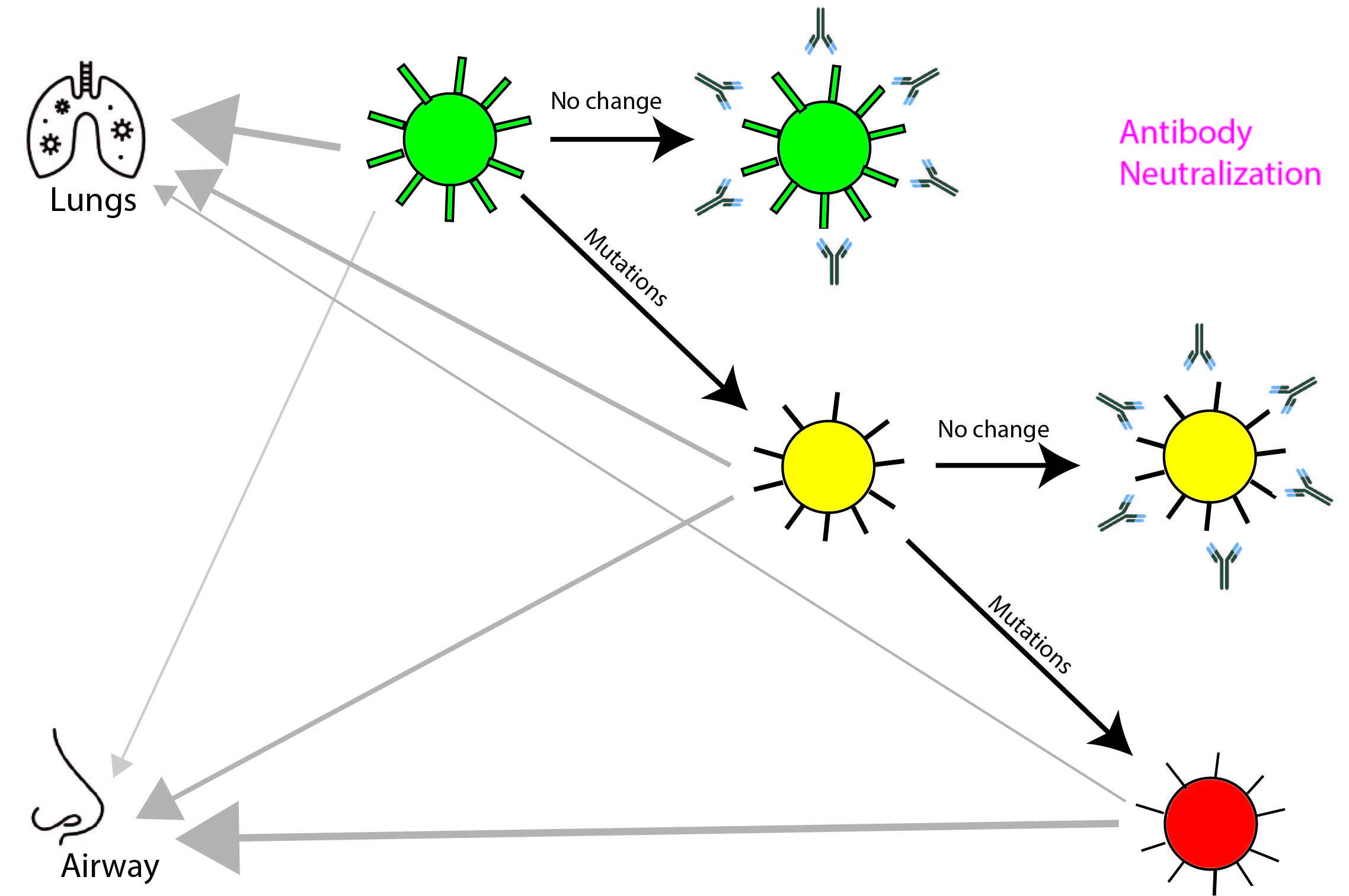
Evolution of SARS-CoV-2 has followed similar trends as other RNA viruses, e.g., HIV-1 and influenza A. Rapid initial diversification was followed by strong competition and rapid succession of dominant variants. Host-initiated RNA editing has been the primary mechanism for introducing mutations. A significant number of mutations were detrimental and were quickly purged. Fixed mutations are mostly diversifying mutations selected for host adaptation and immune evasion, with the latter accounting for more of the changes. However, immune evasion often comes at the cost of functionality, so that optimal functionality is still far from being accomplished. Instead, selection for antibody-escaping variants and accumulation of near-neutral mutations has led to suboptimal codon usage and reduced replicative capacity as demonstrated in non-respiratory cell lines. Beneficial adaptation of the virus includes reduced infectivity in lung tissues and increased tropism for the upper airway, resulting in shorter incubation periods, milder diseases, and more efficient transmission between people.
Keywords:
SARS-CoV-2
; evolution
; immune evasion
; codon usage
; attenuation
; genome degradation
; degeneration
; COVID-19
Copyright: This open access article is published under a Creative Commons CC BY 4.0 license, which permit the free download, distribution, and reuse, provided that the author and preprint are cited in any reuse.


