

Submitted:
16 November 2022
Posted:
17 November 2022
You are already at the latest version
Abstract
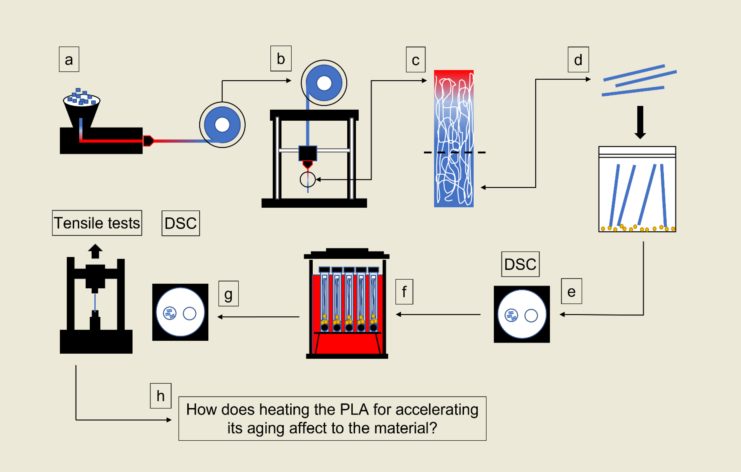
The effects of post-treatment temperature-based methods on 1D single PLA filaments after FFF have been studied. This lets to decouple the variables related to the 3D structure (layer height, raster angle, infill density, and others) from the variables solely related to the material (molecular weight, molecular orientation, crystallinity, and others). PLA 1D filaments have been aged at 20, 39, 42, 51, 65, 75 and 80 ºC in a water-bath-inspired process in which the hydrolytic degradation of the PLA has been minimised for the ageing temperatures of interest. The evolution of the thermal and mechanical properties of the PLA filaments at different temperatures was recorded. Differential scanning calorimetry (DSC) was used to evaluate thermal and physical properties, in which the glass transition, enthalpic relaxation, crystallisation and melting reactions were analysed. Tensile tests were performed to evaluate the tensile strength and elastic modulus. The flow-induced molecular orientation, the degradation, the logistic fitting and the so-called summer effect –stabilisation of properties at higher temperatures– are discussed for assessing the safeness of accelerating ageing.
Keywords:
Keywords 1D PLA filaments
; mechanical properties
; thermal properties
; temperature
; ageing
Copyright: This open access article is published under a Creative Commons CC BY 4.0 license, which permit the free download, distribution, and reuse, provided that the author and preprint are cited in any reuse.