

Submitted:
15 August 2023
Posted:
16 August 2023
You are already at the latest version
Abstract
This research focuses on exploring gravitational lensing of the wormhole in Einstein-bumblebee gravity with an antisymmetric tensor. The Gibbons and Werner technique based on the Gauss-Bonnet theorem is utilized to calculate the bending angle of light. The effects of non-plasma and plasma medium on the bending angles are investigated. Furthermore, we examine the deflection angle $\Tilde{\alpha}$ in relation to the impact parameter $\sigma$ and minimal radius $r_{0}$ in both non-plasma and plasma mediums. Our findings indicate that the deflection angle is positively correlated with $r_{0}$, meaning that larger values of $r_{0}$ result in larger deflection angles and smaller values of $r_{0}$ result in smaller deflection angles. On the other hand, the deflection angle $\Tilde{\alpha}$ is inversely related to the impact parameter $\sigma$.
Keywords:
Wormhole
; Deflection angle
; Gauss-Bonnet Theorem
; Bumblebee gravity
; Plasma Medium
1. Introduction
The exploration of Wormhole (WH) solutions traces its origins to Flamm’s investigations in 1916, conducted within the framework of General Relativity [1]. Similar to black holes (BHs), wormholes also emerge as solutions to Einstein’s field equations. The simplest representation of the gravitational field surrounding a static and spherically symmetric mass is provided by the Schwarzschild metric [2]. When the density reaches sufficiently high levels, this solution characterizes a black hole known as the Schwarzschild BH. Additionally, Flamm made another significant finding in the realm of Einstein’s equations, leading to what we now call a white hole. These solutions for black holes and white holes delineate separate areas of spacetime that are connected by a conduit referred to as a spacetime tube. In 1935, Einstein and Rosen [3] delved into the concept of interconnections between different universes. Their objective was to elucidate elementary charged particles through the lens of spacetime conduits that are traversed by electromagnetic force lines. Subsequently, these pathways within spacetime were labeled as Einstein-Rosen Bridges. Later, in 1957, Wheeler introduced the term wormhole to describe these bridges [4].
In 1988, the terminology traversable wormhole was introduced by Morris and Thorne [5], denoting a situation where the throat of a wormhole is enlarged. A traversable wormhole, devoid of horizons, permits bidirectional travel by linking two separate spacetime regions within Lorentzian geometry. Through a traversable wormhole, it becomes feasible to journey between distinct universes [6,7,8,9,10,11,12,13,14,15,16,17,18,19,20,21,22,23,24]. Morris, Thorne, and Yurtsever [6] established the existence of flat traversable wormholes featuring exotic matter that deviates from the null energy conditions. They further demonstrated the stabilization of such traversable wormholes utilizing the Casimir effect. In 1989, Matt-Visser introduced an alternative form of traversable wormhole known as the thin shell wormhole [1]. This variant arises by connecting two spacetimes to create a geodesically complete manifold housing a shell situated at the connecting interface.
The phenomenon of light deflection by the Ellis wormhole was initially pinpointed by Chetouani and Clement [25]. The intricate and mild deflection limits exhibited by Ellis wormholes have been recently scrutinized by Tsukamoto [27,28,29], who also examined gravitational lensing by these structures. Nakajima and Asada [30] conducted a study on the gravitational lensing effects induced by the Ellis wormhole. Bhattachary and Potapov [31] adopted diverse techniques, including direct integration, perturbation analysis, and invariant angle methodologies, to compute the deflection angle within the context of Ellis spacetime. In the realm of the Einstein-dilaton-Gauss-Bonnet theory, Cuyubamba et al. demonstrated the absence of stable wormhole solutions [32].
In the 20th century, Einstein’s General Relativity put forth a prediction that as light traverses through massive celestial entities, its trajectory becomes curved owing to the gravitational attraction exerted by these entities. This occurrence, recognized as Gravitational Lensing (GL), has garnered substantial attention over the last two decades, primarily aimed at probing the potential presence of WHs and discerning their differentiation from BHs [33]. A multitude of investigations, documented in references [34,35,36,37,38,39,40,41,42,43,44,45,46,47,48,49,50,51,52,53,54,55,56,57,58,59,60,61,62,63,64,65,66,67,68,69,70,71,72,73,74,75,76,77,78,79,80,81,82,83,84,85,86,87,88,89,90,91,92,93,94,95,96,97,98,99,100,101,102,103], have undertaken a comprehensive exploration of the gravitational lensing phenomena exhibited by both BHs and WHs.
Recently, Gibbons and Werner introduced an innovative approach for calculating the deflection angle of light. This technique leverages the Gauss-Bonnet theorem (GBT) applied to the optical geometry [104]. The application of GBT involves the utilization of the space, which is confined by a light beam and a circular boundary curve within the focal region where the photon beam intersects both the light source and the observer. This setup assumes that both the light source and the observer are situated at a distance from the focal area. Particularly in scenarios of weak gravitational fields, the Gauss-Bonnet theorem furnishes a mathematical formulation for determining the deflection angle [104]:
The formula for the asymptotic deflection angle can be obtained by incorporating the Gaussian optical curvature (), the surface element of the optical geometry (), and the region encompassing the light source, observer, and lens center. As a simplification, it is presumed that the sum of external angles approaches for the observer as the radial distance R tends towards infinity [105]. Utilizing this context, Gibbons and Werner derived the subsequent mathematical expression via the Gauss-Bonnet theorem under the conditions of weak gravitational fields [104]:
Moreover, the technique introduced by Gibbons and Werner has been independently extended to stationary black holes by Werner in his work [105]. Additionally, studies have demonstrated the applicability of this approach for calculating the deflection angle of light in the context of charged wormholes within the framework of the Einstein-Maxwell-dilation theory. This computation involves the use of the Gauss-Bonnet theorem and the spacetime of a rotating monopole [107,108,109,110]. Furthermore, Sakalli and Övgün examined the bending angle of light in the infrared spectrum concerning the Rindler modified Schwarzschild black hole [111].
The notion of Lorentz symmetry breaking at the Planck scale finds support in certain foundational theories, including string theory [112,113]. A theoretical framework capable of describing the low-energy repercussions stemming from such symmetry breaking is the Standard-Model Extension (SME), originally proposed by Colladay and Kostelecký in the late 1990s [114,115]. Within the SME, CPT- and Lorentz-symmetry-violating terms are integrated across all the customary sectors of the standard model. Later, it was extended to incorporate gravity as an effective theory, enabling it to provide predictions that can be assessed or confirmed through observational means within the confines of current technological capabilities [116]. Since its inception, the SME has undergone numerous theoretical analyses and experimental tests that have enabled the imposition of stringent constraints on Lorentz invariance in the natural world [117,118,119,120].
In this context, there is a significant interest in investigating the implications of Lorentz violation within the gravitational realm, particularly concerning compact entities such as black holes and wormholes [45,60,121,122,123,124,125,126,127,128].
In this research paper, our primary focus centers on the examination of the deflection angle experienced by light when encountering diverse mediums, encompassing plasma and non-plasma substances. This investigation specifically pertains to wormhole in Einstein-bumblebee gravity with an antisymmetric tensor (WHs). To comprehensively analyze this phenomenon, we employ two distinct methodologies, with the Gauss-Bonnet theorem being one of them. This approach enables us to precisely calculate the deflection angle within this context.
The structure of the paper is organized as follows: Section provides a concise introduction to wormhole in Einstein-bumblebee gravity with an antisymmetric tensor, offering an initial understanding of the topic. Section is dedicated to the calculation of the deflection angle of light for wormholes in a non-plasma medium. This is achieved through the application of the Gauss-Bonnet theorem. Section delves into a thorough analysis of the influence exerted by the presence of a plasma medium on gravitational lensing. Finally, Section provides a discussion of the outcomes and findings obtained from the study.
2. Wormhole in Einstein-bumblebee gravity with an antisymmetric tensor
In this section, we briefly review the fundamental components of the model that underpins this study. The adopted framework encompasses the Einstein-Hilbert term of general relativity, augmented by the inclusion of an antisymmetric 2-tensor denoted as [1]. The expression for this model is succinctly expressed as follows [127]:
In this equation, , with being the Newtonian gravitational constant. The coupling constant (with mass dimension in natural units) signifies a nonderivative gravitational connection to , characterized by linearity in the curvature. The field-strength tensor , linked to , is defined as follows:
where remains invariant in the face of gauge transformations . Moreover, the potential V serves as the catalyst for instigating spontaneous Lorentz violation, resulting in a non-zero vacuum expectation value . The term encompasses the description of conventional matter content, which will be elucidated in subsequent details.
The goal is to ascertain the presence of a wormhole solution that has been influenced by the coupling, which is responsible for generating a non-zero vacuum value for . By varying the expression (1) with respect to while holding other fields constant, we can derive the equations governing gravity. This leads us to:
In equation (3), the left-hand side features the conventional Einstein tensor denoted as . On the right-hand side, we encounter the energy-momentum tensors attributed to the matter content, denoted as , as well as contributions arising from the field. These contributions emanate from both the kinetic and potential terms, represented as , and the effects originating from the nonminimal coupling, denoted as :
For the sake of simplicity, we have considered the potential V to depend on , and this dependence is expressed by the form:
Here, the variable x denotes a real number, signifying the vacuum value of the invariant
In this context, the prime () signifies differentiation concerning the potential argument. It’s worth noting that denotes the vacuum value of the inverse metric. For our current objective, we can consider that both the field and the metric remain in their vacuum states, leading to:
This also ensures that the vacuum conditions are fulfilled. Lastly, the effects stemming from the nonminimal gravitational coupling are:
The equations that govern the behavior of the antisymmetric tensor field are derived from the action (1). To obtain these equations, we perform a variation of the action with respect to , while keeping the metric and matter fields constant. This leads us to:
It’s important to highlight that in this context, we are intentionally excluding any form of interaction between the matter fields and . The inclusion of such a coupling might introduce alterations to the conservation of conventional matter currents, a topic that lies outside the scope of our current investigation.
Within the realm of physics, a wormhole represents a theoretical construct in spacetime that holds the intriguing possibility of serving as a shortcut for travel across both space and time. If realized, it could facilitate transportation between different universes. The passage through a wormhole is envisioned to require only a brief duration, with travelers experiencing a slightly diminished gravitational force while traversing it. Nonetheless, it’s important to acknowledge that the existence of wormholes currently remains unverified, standing as a concept rooted in mathematical theory.
An illustration of a hypothetical solution that characterizes a static and spherically symmetric wormhole is the Morris-Thorne geometry, as outlined by references [6,130]:
The shape function of a wormhole, denoted as , and its corresponding redshift function, represented by , play a pivotal role in defining the properties of the wormhole. Especially crucial for describing a traversable wormhole, these functions, and , must adhere to specific conditions. Among these requirements, one involves the existence of a minimal radius denoted as , where signifies the radius of the wormhole’s throat. Another significant constraint is the flare-out condition at the throat, where and . Furthermore, the wormhole must display exceedingly weak tidal gravitational forces, translating to . For the sake of simplifying our analysis, we will consider to disregard the effects of tidal forces.
Regarding the matter-energy distribution, our approach involves considering a perfect fluid. Consequently, the energy-momentum tensor for this matter is characterized by . It’s essential to underscore that the perfect fluid is not presumed to exhibit isotropy, as the radial and lateral pressures are not assumed to be equal beforehand.
Let’s now establish the setup for the Lorentz-violating field. Drawing inspiration from References [128,129], we will confine our focus to the pseudo-electric configuration. In this arrangement, the field assumes its vacuum expectation value , the explicit expression of which is provided by:
By adopting this approach, the background field assumes a constant norm, namely , where a is a real and positive parameter. Importantly, this arrangement preserves the spacetime’s spherical and static symmetry. Additionally, referencing relations (2) and (11), the field strength becomes inherently null. It can be explicitly verified that the equations governing the behavior of , as depicted in (9), are inherently satisfied under these circumstances.
Certainly, when considering the vacuum conditions () and the vacuum expectation value (11) for , the pertinent components derived from Equation (9) manifest as .
Subsequently, the Einstein field equations can be solved by considering the Bumblebee field, leading to the determination of the shape function as elucidated in [131].
Here, is a dimensionless real parameter, and represents an affine parameter. It’s evident that the radial metric component diverges at , which is a characteristic feature of any wormhole.
For the sake of reducing the intricacy in calculations, one can streamline the expression in Eq. (12) by selecting and . With these chosen values, the shape function can be succinctly represented as:
The spacetime metric can be expressed in a general format as follows:
where and .
3. Weak deflection angle in Non-plasma Medium
In this section, we will delve into the analysis of the deflection angle of wormhole in Einstein-bumblebee gravity with an antisymmetric tensor using the method of Gibbons and Werner [104]. To describe the optical path, we employ the null geodesic condition in conjunction with Eq. (14). This facilitates the representation of the optical path metric as follows:
We proceed with the analysis of the deflection angle for wormhole in Einstein-bumblebee gravity with an antisymmetric tensor in this section. To describe the optical path, we employ the null geodesic condition together with Eq. (14). This allows us to represent the optical path metric as:
By situating the metric in the equatorial plane with , the corresponding expression becomes:
The Gaussian curvature can be defined using the Ricci scalar R as
We can evaluate the Gaussian curvature as follows:
The parameter is a bivariate function dependent on the radial coordinate r and the minimal radius of the wormhole throat. Given that we are working with weak gravitational fields, the most appropriate approach for calculating the deflection angle involves employing the Gauss-Bonnet theorem (GBT).
As the light rays come from a source at infinity up to such radial distance, the rays becomes nearly straight. So, we can use the straight line approximation , where is the impact parameter
where the term is surface element and calculated as
After substituting the values of Gaussian curvature and , the expression for the deflection angle in non-plasma medium can be simplified as follows
The weak deflection angle in non-plasma medium is plotted in Figure 1.
It is evident that the deflection angle of wormhole in Einstein-bumblebee gravity with an antisymmetric tensor depends on two parameters: the impact parameter and the minimal radius of the WH throat . An increase in leads to a larger deflection angle , while a decrease in results in a smaller deflection angle. Conversely, the deflection angle shows an inverse relation with the impact parameter , as its value decreases with an increase in , and vice versa.
Here we examine the graphical representation of the light bending angle in a non-plasma medium. We will also demonstrate the influence of the minimal radius and impact parameter on the deflection angle.
4. Deflection angle in Plasma Medium
The aim of this section is to analyze the gravitational lensing of the wormhole in Einstein-bumblebee gravity with an antisymmetric tensor in the presence of a plasma medium using the method defined in [53]. To achieve this, we describe the refractive index n of the plasma medium as follows [53]
where . In refractive index , represents the plasma frequency of electron while denotes the frequency of photon which is noticed by an observer at infinity. The optical metric in plasma medium can be defined as
One can find the Gaussian curvature (17). The calculated Gaussian curvature in plasma medium can be written as
and the surface element is
By using GBT (19), we calculate the deflection in plasma medium as
5. Conclusion
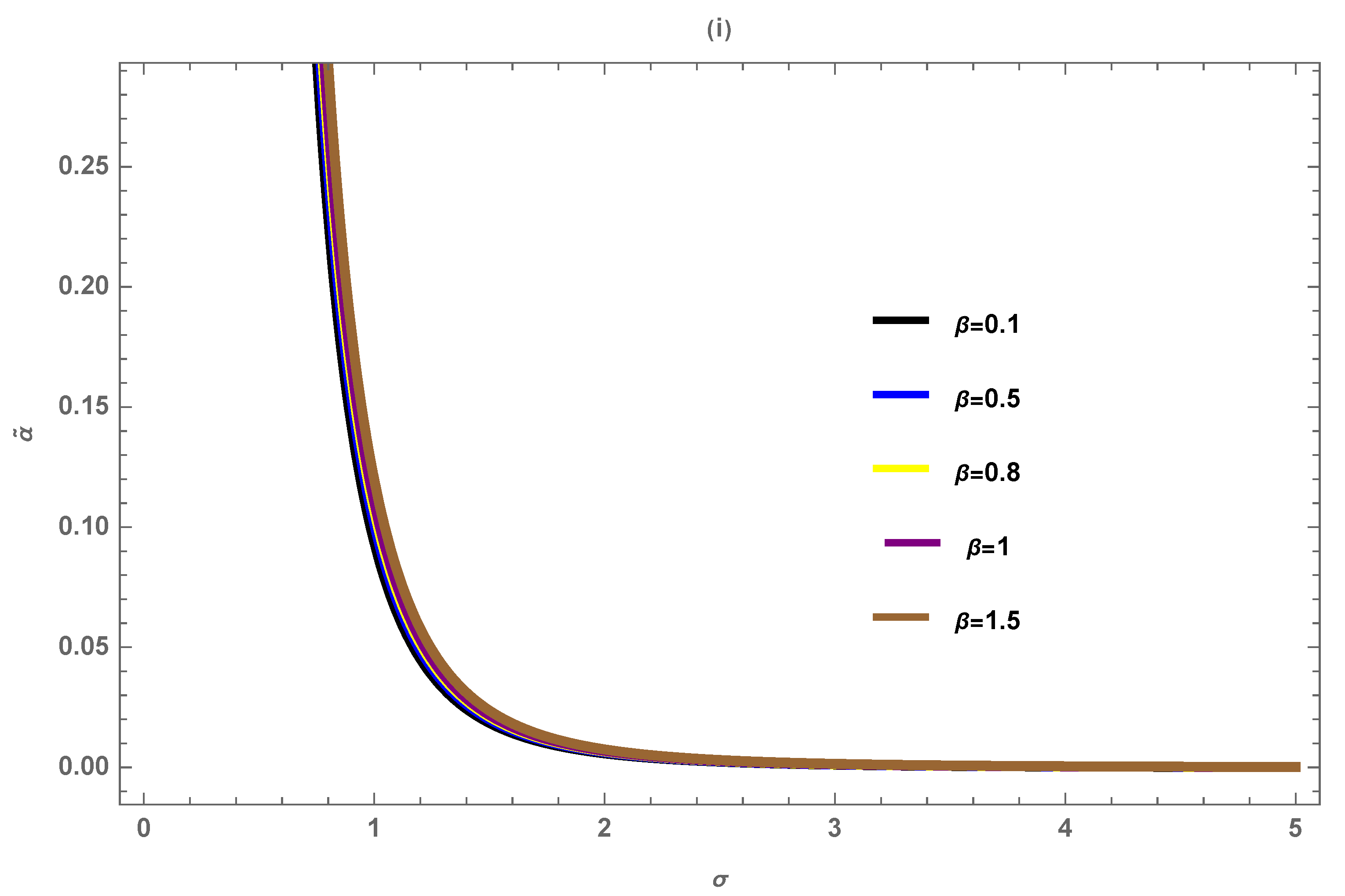
In this research, we have delved into the weak deflection angle of a wormhole within the framework of Einstein-bumblebee gravity coupled with an antisymmetric tensor. Employing the method devised by Gibbons and Werner, we’ve ascertained the deflection angle of the wormhole in Einstein-bumblebee gravity with an antisymmetric tensor under the weak field approximation. We’ve extended our analysis to encompass different mediums, including both plasma and non-plasma environments. Our findings underscore that the deflection angle is influenced by two key parameters: the impact parameter and the minimal radius . Notably, the deflection angle manifests a direct correlation with while exhibiting an inverse relationship with . Our observations reveal that the graph depicting the deflection angle against follows an asymptotic increase with higher values of and a decrease in . Additionally, the presence of a plasma medium amplifies the weak deflection angle.
To summarize, the deflection angle of light in a wormhole under the context of Einstein-bumblebee gravity coupled with an antisymmetric tensor solution hinges on the parameters of impact () and minimal radius (). The outcomes suggest that a wormhole with a larger throat radius wields a more substantial gravitational pull, consequently leading to a more pronounced bending of light. Conversely, a smaller radius corresponds to a weaker gravitational pull and a lesser angle of light bending. The deflection angle also displays an inversely proportional relation to the impact parameter, implying that a higher value of corresponds to a reduced deflection angle and vice versa.
The results of this study open up intriguing possibilities for future research in the field of wormhole lensing. The investigation could be extended to encompass more intricate scenarios, such as the deflection angle in the presence of gravitational waves. Furthermore, the influence of parameters like the minimal radius and impact parameter could be further scrutinized. By exploring factors like the wormhole’s shape and curvature, we could gain deeper insights into how these aspects impact the gravitational lensing phenomenon.
Acknowledgments
A. Ö. and R. P. would like to acknowledge networking support by the COST Action CA18108 - Quantum gravity phenomenology in the multi-messenger approach (QG-MM).
References
- M. Visser, Lorentzian Wormholes: From Einstein to Hawking (American Institute of Physics, New York, 1996).
- K. Schwarzschild, “On the gravitational field of a mass point according to Einstein’s theory,” Sitzungsber. Preuss. Akad. Wiss. Berlin (Math. Phys. ) 1916, 189-196 (1916) [arXiv:physics/9905030 [physics]].
- A. Einstein and N. Rosen, “The Particle Problem in the General Theory of Relativity,” Phys. Rev. 48, 73-77 (1935).
- J. A. Wheeler, “Geons,” Phys. Rev. 97, 511-536 (1955).
- M. S. Morris and K. S. Thorne, “Wormholes in space-time and their use for interstellar travel: A tool for teaching general relativity,” Am. J. Phys. 56, 395-412 (1988).
- M. S. Morris, K. S. M. S. Morris, K. S. Thorne and U. Yurtsever, “Wormholes, Time Machines, and the Weak Energy Condition,” Phys. Rev. Lett. 61, 1446-1449 (1988).
- F. Rahaman, N. F. Rahaman, N. Paul, A. Banerjee, S. S. De, S. Ray and A. A. Usmani, “The Finslerian wormhole models,” Eur. Phys. J. C 76, no.5, 246 (2016).
- F. Rahaman, T. F. Rahaman, T. Manna, R. Shaikh, S. Aktar, M. Mondal and B. Samanta, “Thin accretion disks around traversable wormholes,” Nucl. Phys. B 972, 115548 (2021).
- F. Rahaman, K. N. F. Rahaman, K. N. Singh, R. Shaikh, T. Manna and S. Aktar, “Shadows of Lorentzian traversable wormholes,” Class. Quant. Grav. 38, no.21, 215007 (2021).
- F. Rahaman, S. F. Rahaman, S. Sarkar, K. N. Singh and N. Pant, “Generating functions of wormholes,” Mod. Phys. Lett. A 34, no.01, 1950010 (2019).
- P. K. F. Kuhfittig, “Traversable wormholes sustained by an extra spatial dimension,” Phys. Rev. D 98, no.6, 064041 (2018).
- P. K. F. Kuhfittig, “Wormholes admitting conformal Killing vectors and supported by generalized Chaplygin gas,” Eur. Phys. J. C 75, no.8, 357 (2015).
- P. K. F. Kuhfittig, “Accounting for exotic matter and the extreme radial tension in Morris–Thorne wormholes of embedding class one,” Eur. Phys. J. C 81, no.8, 778 (2021).
- P. K. F. Kuhfittig, “Accounting for the large radial tension in Morris–Thorne wormholes,” Eur. Phys. J. Plus 135, no.6, 510 (2020).
- P. K. F. Kuhfittig and V. D. Gladney, “Seeking connections between wormholes, gravastars, and black holes via noncommutative geometry,” Mod. Phys. Lett. A 35, no.09, 2050059 (2019).
- P. K. F. Kuhfittig, “Thin-shell wormholes from Kiselev black holes,” Turk. J. Phys. 43, no.2, 213-220 (2019).
- S. Ansoldi and E. I. Guendelman, “Universes out of almost empty space,” Prog. Theor. Phys. 120, 985-993 (2008).
- S. Bahamonde, D. S. Bahamonde, D. Benisty and E. I. Guendelman, “Linear potentials in galaxy halos by Asymmetric Wormholes,” Universe 4, no. 2018. [Google Scholar]
- S. Ansoldi, Z. S. Ansoldi, Z. Merali and E. I. Guendelman, “From Black Holes to Baby Universes: Exploring the Possibility of Creating a Cosmos in the Laboratory,” Bulg. J. Phys. 45, no.2, 203-220 (2018).
- E. Guendelman, E. E. Guendelman, E. Nissimov, S. Pacheva and M. Stoilov, “Einstein-Rosen ”Bridge” Revisited and Lightlike Thin-Shell Wormholes,” Bulg. J. Phys. 44, no.1, 084-097 (2017).
- E. I. Guendelman, A. E. I. Guendelman, A. Kaganovich, E. Nissimov and S. Pacheva, “Einstein-Rosen ’Bridge’ Needs Lightlike Brane Source,” Phys. Lett. B 681, 457-462 (2009).
- E. I. Guendelman, “Wormholes and the construction of compactified phases,” Gen. Rel. Grav. 23, 1415-1419 (1991).
- E. I. Guendelman and D. A. Owen, “Universe creation entropy and extra dimensions,” Gen. Rel. Grav. 1989; 21.
- M. Visser, “Wormholes, Baby Universes and Causality,” Phys. Rev. D 41, 1116 (1990).
- L. Chetouani, L., G. L. Chetouani, L., G. Clement, “Geometrical optics in the Ellis geometry,” Gen Relat Gravit 16, 111–119 (1984).
- H. G. Ellis, “Ether flow through a drainhole - a particle model in general relativity,” J. Math. Phys. 14, 104-118 (1973).
- N. Tsukamoto and T. Harada, “Light curves of light rays passing through a wormhole,” Phys. Rev. D 95, no.2, 024030 (2017).
- N. Tsukamoto, T. N. Tsukamoto, T. Harada and K. Yajima, “Can we distinguish between black holes and wormholes by their Einstein ring systems?,” Phys. Rev. D 86, 104062 (2012).
- N. Tsukamoto and T. Harada, “Signed magnification sums for general spherical lenses,” Phys. Rev. D 87, no.2, 024024 (2013).
- K. Nakajima and H. Asada, “Deflection angle of light in an Ellis wormhole geometry,” Phys. Rev. D 85, 107501 (2012).
- A. Bhattacharya and A. A. Potapov, “Bending of light in Ellis wormhole geometry,” Mod. Phys. Lett. A 25, 2399-2409 (2010).
- M. A. Cuyubamba, R. A. M. A. Cuyubamba, R. A. Konoplya and A. Zhidenko, “No stable wormholes in Einstein-dilaton-Gauss-Bonnet theory,” Phys. Rev. D 98, no. 0440. [Google Scholar]
- J. Wambsganss, “Gravitational lensing in astronomy,” Living Rev. Rel. 1, 12 (1998).
- F. Atamurotov, A. F. Atamurotov, A. Abdujabbarov and B. Ahmedov, “Shadow of rotating non-Kerr black hole,” Phys. Rev. D 88, no.6, 064004 (2013).
- V. Bozza, “Gravitational lensing in the strong field limit,” Phys. Rev. D 66, 103001 (2002).
- A. Övgün, “Light deflection by Damour-Solodukhin wormholes and Gauss-Bonnet theorem,” Phys. Rev. D 98, no.4, 044033 (2018).
- K. Jusufi and A. Övgün, “Gravitational Lensing by Rotating Wormholes,” Phys. Rev. D 97, no.2, 024042 (2018).
- K. S. Virbhadra and G. F. R. Ellis, “Schwarzschild black hole lensing,” Phys. Rev. D 62, 084003 (2000).
- K. S. Virbhadra and G. F. R. Ellis, “Gravitational lensing by naked singularities,” Phys. Rev. D 65, 103004 (2002).
- K. S. Virbhadra, D. K. S. Virbhadra, D. Narasimha and S. M. Chitre, “Role of the scalar field in gravitational lensing,” Astron. Astrophys. 337, 1-8 (1998).
- K. S. Virbhadra and C. R. Keeton, “Time delay and magnification centroid due to gravitational lensing by black holes and naked singularities,” Phys. Rev. D 77, 124014 (2008).
- K. S. Virbhadra, “Relativistic images of Schwarzschild black hole lensing,” Phys. Rev. D 79, 083004 (2009).
- N. Tsukamoto and Y. Gong, “Extended source effect on microlensing light curves by an Ellis wormhole,” Phys. Rev. D 97, no.8, 084051 (2018).
- P. K. F. Kuhfittig, “Gravitational lensing of wormholes in the galactic halo region,” Eur. Phys. J. C 74, no.99, 2818 (2014).
- A. Övgün,, K. Jusufi and I. Sakalli, “Gravitational lensing under the effect of Weyl and bumblebee gravities: Applications of Gauss–Bonnet theorem,” Annals Phys. 399, 193-203 (2018).
- N. Tsukamoto, “Strong deflection limit analysis and gravitational lensing of an Ellis wormhole,” Phys. Rev. D 94, no.12, 124001 (2016).
- A. Övgün, İ. Sakallı and J. Saavedra, “Shadow cast and Deflection angle of Kerr-Newman-Kasuya spacetime,” JCAP 10, 041 (2018).
- A. Övgün, İ. Sakallı and J. Saavedra, “Weak gravitational lensing by Kerr-MOG black hole and Gauss–Bonnet theorem,” Annals Phys. 411, 167978 (2019).
- A. Övgün and İ. Sakallı, “Testing generalized Einstein–Cartan–Kibble–Sciama gravity using weak deflection angle and shadow cast,” Class. Quant. Grav. 37, no.22, 225003 (2020).
- W. Javed, M. B. W. Javed, M. B. Khadim, A. Övgün and J. Abbas, “Weak gravitational lensing by stringy black holes,” Eur. Phys. J. Plus 135, no.3, 314 (2020).
- K. Jusufi, A. K. Jusufi, A. Övgün, J. Saavedra, Y. Vásquez and P. A. González, “Deflection of light by rotating regular black holes using the Gauss-Bonnet theorem,” Phys. Rev. D 97, no.12, 124024 (2018).
- M. Sereno and F. De Luca, “Analytical Kerr black hole lensing in the weak deflection limit,” Phys. Rev. D 74, 123009 (2006).
- G. Crisnejo and E. Gallo, “Weak lensing in a plasma medium and gravitational deflection of massive particles using the Gauss-Bonnet theorem. A unified treatment,” Phys. Rev. D 97, no.12, 124016 (2018).
- W. Javed, R. W. Javed, R. Babar and A. Övgün, “The effect of the Brane-Dicke coupling parameter on weak gravitational lensing by wormholes and naked singularities,” Phys. Rev. D 99, no.8, 084012 (2019).
- A. Övgün, “Weak field deflection angle by regular black holes with cosmic strings using the Gauss-Bonnet theorem,” Phys. Rev. D 99, no.10, 104075 (2019).
- A. Övgün, “Deflection Angle of Photons through Dark Matter by Black Holes and Wormholes Using Gauss–Bonnet Theorem,” Universe 5, no.5, 115 (2019).
- A. Övgün, G. A. Övgün, G. Gyulchev and K. Jusufi, “Weak Gravitational lensing by phantom black holes and phantom wormholes using the Gauss-Bonnet theorem,” Annals Phys. 406, 152-172 (2019).
- İ. Çimdiker, D. İ. Çimdiker, D. Demir and A. Övgün, “Black hole shadow in symmergent gravity,” Phys. Dark Univ. 34, 100900 (2021).
- W. Javed, M. B. W. Javed, M. B. Khadim and A. Övgün, “Weak gravitational lensing by Bocharova–Bronnikov–Melnikov–Bekenstein black holes using Gauss–Bonnet theorem,” Eur. Phys. J. Plus 135, no.7, 595 (2020).
- Z. Li and A. Övgün, “Finite-distance gravitational deflection of massive particles by a Kerr-like black hole in the bumblebee gravity model,” Phys. Rev. D 101, no.2, 024040 (2020).
- W. Javed, J. W. Javed, J. Abbas and A. Övgün, “Deflection angle of photon from magnetized black hole and effect of nonlinear electrodynamics,” Eur. Phys. J. C 79, no.8, 694 (2019).
- W. Javed, j. W. Javed, j. Abbas and A. Övgün, “Effect of the Hair on Deflection Angle by Asymptotically Flat Black Holes in Einstein-Maxwell-Dilaton Theory,” Phys. Rev. D 100, no.4, 044052 (2019).
- Y. Kumaran and A. Övgün, “Deriving weak deflection angle by black holes or wormholes using Gauss-Bonnet theorem,” Turk. J. Phys. 45, no.5, 247-267 (2021).
- Z. Li, G. Z. Li, G. Zhang and A. Övgün, “Circular Orbit of a Particle and Weak Gravitational Lensing,” Phys. Rev. D 101, no.12, 124058 (2020).
- W. Javed, J. W. Javed, J. Abbas, Y. Kumaran and A. Övgün, “Weak deflection angle by asymptotically flat black holes in Horndeski theory using Gauss-Bonnet theorem,” Int. J. Geom. Meth. Mod. Phys. 18, no.01, 2150003 (2021).
- R. C. Pantig and A. Övgün, “Dark matter effect on the weak deflection angle by black holes at the center of Milky Way and M87 galaxies,” Eur. Phys. J. C 82, no.5, 391 (2022).
- R. C. Pantig and A. Övgün, “Dehnen halo effect on a black hole in an ultra-faint dwarf galaxy,” JCAP 08, no.08, 056 (2022).
- R. C. Pantig, P. K. R. C. Pantig, P. K. Yu, E. T. Rodulfo and A. Övgün, “Shadow and weak deflection angle of extended uncertainty principle black hole surrounded with dark matter,” Annals of Physics 436, 168722 (2022).
- A. Uniyal, R. C. A. Uniyal, R. C. Pantig and A. Övgün, “Probing a nonlinear electrodynamics black hole with thin accretion disk, shadow and deflection angle with M87* and Sgr A* from EHT,” Physics of the Dark Universe 40 (2023) 101178.
- R. C. Pantig and A. Övgün, “Testing dynamical torsion effects on the charged black hole’s shadow, deflection angle and greybody with M87* and Sgr A* from EHT,” Annals Phys. 448, 169197 (2023).
- J. Rayimbaev, R. C. J. Rayimbaev, R. C. Pantig, A. Övgün, A. Abdujabbarov and D. arXiv:2206.06599 [gr-qc]].
- G. Mustafa, F. G. Mustafa, F. Atamurotov, I. Hussain, S. Shaymatov and A. Övgün, “Shadows and gravitational weak lensing by the Schwarzschild black hole in the string cloud background with quintessential field,” Chin. Phys. C 46, no.12, 125107 (2022).
- X. M. Kuang and A. Övgün, “Strong gravitational lensing and shadow constraint from M87* of slowly rotating Kerr-like black hole,” Annals Phys. 447, 169147 (2022).
- W. Javed, S. W. Javed, S. Riaz and A. Övgün, “Weak Deflection Angle and Greybody Bound of Magnetized Regular Black Hole,” Universe 8, no.5, 262 (2022).
- E. F. Eiroa, G. E. E. F. Eiroa, G. E. Romero and D. F. Torres, “Reissner-Nordstrom black hole lensing,” Phys. Rev. D 66, 024010 (2002).
- C. R. Keeton, C. S. C. R. Keeton, C. S. Kochanek and E. E. Falco, “The Optical properties of gravitational lens galaxies as a probe of galaxy structure and evolution,” Astrophys. J. 509, 561-578 (1998).
- R. C. Pantig, L. R. C. Pantig, L. Mastrototaro, G. Lambiase and A. Övgün, “Shadow, lensing and neutrino propagation by dyonic ModMax black holes,” Eur. Phys. J. C 82, no.12, 1155 (2022).
- M. Sharif and S. Iftikhar, “Strong gravitational lensing in non-commutative wormholes,” Astrophys. Space Sci. 357, no.1, 85 (2015).
- R. Shaikh and S. Kar, “Gravitational lensing by scalar-tensor wormholes and the energy conditions,” Phys. Rev. D 96, no.4, 044037 (2017).
- S. N. Sajadi and N. Riazi, “Gravitational lensing by multi-polytropic wormholes,” Can. J. Phys. 98, no.11, 1046-1054 (2020).
- R. C. Pantig and E. T. Rodulfo, “Weak deflection angle of a dirty black hole,” Chin. J. Phys. 66, 691-702 (2020).
- W. Javed, R. W. Javed, R. Babar and A. Övgün, “Effect of the dilaton field and plasma medium on deflection angle by black holes in Einstein-Maxwell-dilaton-axion theory,” Phys. Rev. D 100, no.10, 104032 (2019).
- A. Övgün, “Weak Deflection Angle of Black-bounce Traversable Wormholes Using Gauss-Bonnet Theorem in the Dark Matter Medium,” Turk. J. Phys. 44, no.5, 465-471 (2020).
- Y. Kumaran and A. Övgün, “Weak Deflection Angle of Extended Uncertainty Principle Black Holes,” Chin. Phys. C 44, no.2, 025101 (2020).
- A. Övgün, Y. A. Övgün, Y. Kumaran, W. Javed and J. Abbas, “Effect of Horndeski theory on weak deflection angle using the Gauss–Bonnet theorem,” Int. J. Geom. Meth. Mod. Phys. 2250192 (2022).
- M. Okyay and A. Övgün, “Nonlinear electrodynamics effects on the black hole shadow, deflection angle, quasinormal modes and greybody factors,” JCAP 01, no.01, 009 (2022).
- W. Javed, J. W. Javed, J. Abbas and A. Övgün, “Effect of the Quintessential Dark Energy on Weak Deflection Angle by Kerr-Newmann Black Hole,” Annals Phys. 418, 168183 (2020).
- W. Javed, A. W. Javed, A. Hamza and A. Övgün, “Effect of nonlinear electrodynamics on the weak field deflection angle by a black hole,” Phys. Rev. D 101, no.10, 103521 (2020).
- T. K. Dey and S. Sen, “Gravitational lensing by wormholes,” Mod. Phys. Lett. A 23, 953-962 (2008).
- H. Asada, “Gravitational lensing by exotic objects,” Mod. Phys. Lett. A 32, no.34, 1730031 (2017).
- C. M. Yoo, T. C. M. Yoo, T. Harada and N. Tsukamoto, “Wave Effect in Gravitational Lensing by the Ellis Wormhole,” Phys. Rev. D 87, 084045 (2013).
- N. Tsukamoto, T. N. Tsukamoto, T. Harada and K. Yajima, “Can we distinguish between black holes and wormholes by their Einstein ring systems?,” Phys. Rev. D 86, 104062 (2012).
- W. Javed, I. W. Javed, I. Hussain and A. Övgün, “Weak deflection angle of Kazakov–Solodukhin black hole in plasma medium using Gauss–Bonnet theorem and its greybody bonding,” Eur. Phys. J. Plus 137, no.1, 148 (2022).
- H. El Moumni, K. H. El Moumni, K. Masmar and A. Övgün, “Weak deflection angle of light in two classes of black holes in nonlinear electrodynamics via Gauss–Bonnet theorem,” Int. J. Geom. Meth. Mod. Phys. 19, no.06, 2250094 (2022).
- A. Belhaj, H. A. Belhaj, H. Belmahi, M. Benali and H. arXiv:2204.10150 [gr-qc]].
- A. Belhaj, H. A. Belhaj, H. Belmahi, M. Benali and H. El Moumni, “Light deflection angle by superentropic black holes,” Int. J. Mod. Phys. D 31, no.07, 2250054 (2022).
- A. Belhaj, M. A. Belhaj, M. Benali, A. El Balali, H. El Moumni and S. E. Ennadifi, “Deflection angle and shadow behaviors of quintessential black holes in arbitrary dimensions,” Class. Quant. Grav. 37, no.21, 215004 (2020).
- Z. Li, G. Z. Li, G. Zhang and A. Övgün, “Circular Orbit of a Particle and Weak Gravitational Lensing,” Phys. Rev. D 101, no.12, 124058 (2020).
- W. Javed, M. W. Javed, M. Aqib and A. Övgün, “Effect of the magnetic charge on weak deflection angle and greybody bound of the black hole in Einstein-Gauss-Bonnet gravity,” Phys. Lett. B 829, 137114 (2022).
- W. Javed, A. W. Javed, A. Hamza and A. Övgün, “Weak Deflection Angle and Shadow by Tidal Charged Black Hole,” Universe 7, no.10, 385 (2021).
- W. Javed, M. B. W. Javed, M. B. Khadim and A. Övgün, “Weak gravitational lensing by Einstein-nonlinear-Maxwell–Yukawa black hole,” Int. J. Geom. Meth. Mod. Phys. 17, no.12, 2050182 (2020).
- C. R. Keeton and A. O. Petters, “Formalism for testing theories of gravity using lensing by compact objects. I. Static, spherically symmetric case,” Phys. Rev. D 72, 104006 (2005).
- K. K. Nandi, Y. Z. K. K. Nandi, Y. Z. Zhang and A. V. Zakharov, “Gravitational lensing by wormholes,” Phys. Rev. D 74, 024020 (2006).
- G. W. Gibbons and M. C. Werner, “Applications of the Gauss-Bonnet theorem to gravitational lensing,” Class. Quant. Grav. 25, 235009 (2008).
- A. Ishihara, Y. A. Ishihara, Y. Suzuki, T. Ono and H. Asada, “Finite-distance corrections to the gravitational bending angle of light in the strong deflection limit,” Phys. Rev. D 95, no.4, 044017 (2017).
- M. C. Werner, “Gravitational lensing in the Kerr-Randers optical geometry,” Gen. Rel. Grav. 44, 3047-3057 (2012).
- K. Jusufi, M. C. K. Jusufi, M. C. Werner, A. Banerjee and A. Övgün, “Light Deflection by a Rotating Global Monopole Spacetime,” Phys. Rev. D 95, no.10, 104012 (2017).
- P. Goulart, “Phantom wormholes in Einstein–Maxwell-dilaton theory,” Class. Quant. Grav. 35, no.2, 025012 (2018).
- K. Jusufi, A. K. Jusufi, A. Övgün and A. Banerjee, “Light deflection by charged wormholes in Einstein-Maxwell-dilaton theory,” Phys. Rev. D 96, no.8, 084036 (2017).
- K. Jusufi, I. K. Jusufi, I. Sakallı and A. Övgün, “Effect of Lorentz Symmetry Breaking on the Deflection of Light in a Cosmic String Spacetime,” Phys. Rev. D 96, no.2, 024040 (2017).
- I. Sakalli and A. Övgün,, “Hawking Radiation and Deflection of Light from Rindler Modified Schwarzschild Black Hole,” EPL 118, no.6, 60006 (2017).
- V. A. Kostelecky and S. Samuel, “Spontaneous Breaking of Lorentz Symmetry in String Theory,” Phys. Rev. D 39, 683 (1989).
- V. A. Kostelecky and R. Potting, “CPT and strings,” Nucl. Phys. B 359, 545-570 (1991).
- D. Colladay and V. A. Kostelecky, “CPT violation and the standard model,” Phys. Rev. D 55, 6760-6774 (1997).
- D. Colladay and V. A. Kostelecky, “Lorentz violating extension of the standard model,” Phys. Rev. D 58, 116002 (1998).
- V. A. Kostelecky, “Gravity, Lorentz violation, and the standard model,” Phys. Rev. D 69, 105009 (2004).
- V. A. Kostelecky and N. Russell, “Data Tables for Lorentz and CPT Violation,” Rev. Mod. Phys. 83, 11-31 (2011).
- V. A. Kostelecky and R. Lehnert, “Stability, causality, and Lorentz and CPT violation,” Phys. Rev. D 63, 065008 (2001).
- V. A. Kostelecky, R. V. A. Kostelecky, R. Lehnert and M. J. Perry, “Spacetime - varying couplings and Lorentz violation,” Phys. Rev. D 68, 123511 (2003).
- R. Lehnert, “Threshold analyses and Lorentz violation,” Phys. Rev. D 68, 085003 (2003).
- R. Casana, A. R. Casana, A. Cavalcante, F. P. Poulis and E. B. Santos, “Exact Schwarzschild-like solution in a bumblebee gravity model,” Phys. Rev. D 97, no.10, 104001 (2018).
- A. Delhom, T. A. Delhom, T. Mariz, J. R. Nascimento, G. J. Olmo, A. Y. Petrov and P. J. Porfírio, “Spontaneous Lorentz symmetry breaking and one-loop effective action in the metric-affine bumblebee gravity,” JCAP 07, no.07, 018 (2022).
- A. Delhom, J. R. A. Delhom, J. R. Nascimento, G. J. Olmo, A. Y. Petrov and P. J. Porfírio, “Metric-affine bumblebee gravity: classical aspects,” Eur. Phys. J. C 81, no.4, 287 (2021).
- A. F. Santos, A. Y. A. F. Santos, A. Y. Petrov, W. D. R. Jesus and J. R. Nascimento, “Gödel solution in the bumblebee gravity,” Mod. Phys. Lett. A 30, no.02, 1550011 (2015).
- C. Ding and X. Chen, “Slowly rotating Einstein-bumblebee black hole solution and its greybody factor in a Lorentz violation model,” Chin. Phys. C 45, no.2, 025106 (2021).
- R. V. Maluf and J. C. S. Neves, “Black holes with a cosmological constant in bumblebee gravity,” Phys. Rev. D 103, no.4, 044002 (2021).
- B. Altschul, Q. G. B. Altschul, Q. G. Bailey and V. A. Kostelecky, “Lorentz violation with an antisymmetric tensor,” Phys. Rev. D 81, 065028 (2010).
- L. A. Lessa, J. E. G. L. A. Lessa, J. E. G. Silva, R. V. Maluf and C. A. S. Almeida, “Modified black hole solution with a background Kalb–Ramond field,” Eur. Phys. J. C 80, no.4, 335 (2020).
- L. A. Lessa, R. L. A. Lessa, R. Oliveira, J. E. G. Silva and C. A. S. Almeida, “Traversable wormhole solution with a background Kalb–Ramond field,” Annals Phys. 433, 168604 (2021).
- M. S. Morris and K. S. Thorne, “Wormholes in space-time and their use for interstellar travel: A tool for teaching general relativity,” Am. J. Phys. 56, 395-412 (1988).
- R. V. Maluf and C. R. Muniz, “Exact solution for a traversable wormhole in a curvature-coupled antisymmetric background field,” Eur. Phys. J. C 82, no.5, 445 (2022).
- C. R. Keeton and A. O. Petters, “Formalism for testing theories of gravity using lensing by compact objects. II. Probing post-post-Newtonian metrics,” Phys. Rev. D 73, 044024 (2006).
Figure 1.
Figure shows the graphical behaviour of deflection angle w.r.t impact parameter when . We noticed that the deflection angle decreases when and and shows the same behaviour for the small and larger values of .
Figure 1.
Figure shows the graphical behaviour of deflection angle w.r.t impact parameter when . We noticed that the deflection angle decreases when and and shows the same behaviour for the small and larger values of .
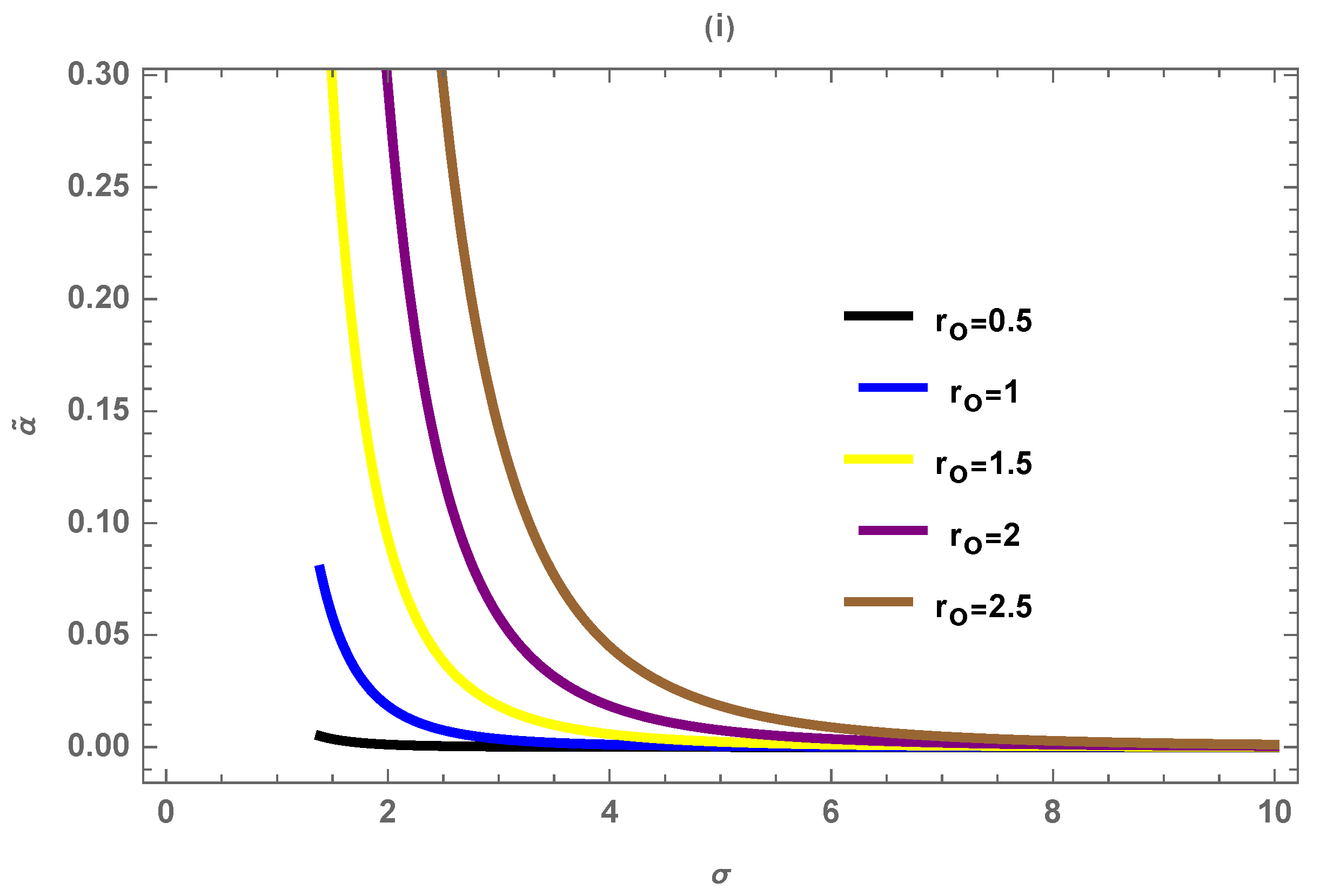
Figure 2.
Figure shows the graphical behaviour of deflection angle w.r.t impact parameter by varying when in the presence of plasma medium. We observe that the graph of increases asymptotically as we increase the value of with the decrease in impact parameter .
Figure 2.
Figure shows the graphical behaviour of deflection angle w.r.t impact parameter by varying when in the presence of plasma medium. We observe that the graph of increases asymptotically as we increase the value of with the decrease in impact parameter .
Disclaimer/Publisher’s Note: The statements, opinions and data contained in all publications are solely those of the individual author(s) and contributor(s) and not of MDPI and/or the editor(s). MDPI and/or the editor(s) disclaim responsibility for any injury to people or property resulting from any ideas, methods, instructions or products referred to in the content. |
© 2023 by the authors. Licensee MDPI, Basel, Switzerland. This article is an open access article distributed under the terms and conditions of the Creative Commons Attribution (CC BY) license (http://creativecommons.org/licenses/by/4.0/).
Copyright: This open access article is published under a Creative Commons CC BY 4.0 license, which permit the free download, distribution, and reuse, provided that the author and preprint are cited in any reuse.


