

Submitted:
30 August 2022
Posted:
31 August 2022
You are already at the latest version
Abstract
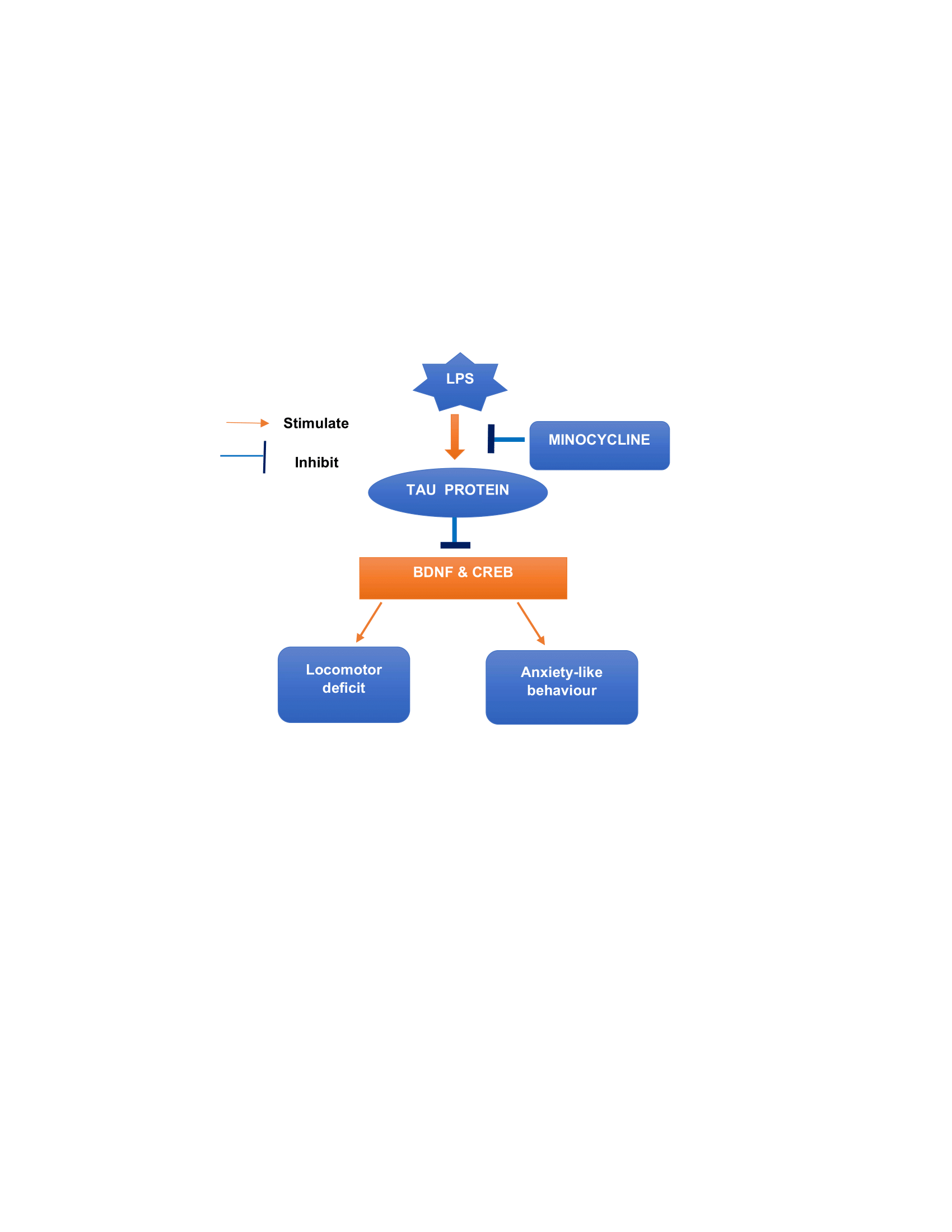
Introduction: Neuroinflammation following lipopolysaccharide (LPS) administration induces locomotor deficit and anxiety-like behavior. In this study, minocycline was compared to memantine, the NMDA receptor antagonist, for its effects on LPS-induced locomotor deficit and anxiety-like behavior in rats. Methodology: Adult male Sprague Dawley rats were administered either two different doses of minocycline (25 or 50 mg/kg/day, i.p.) or 10 mg/kg/day of memantine (i.p.) for 14 days four days prior to LPS (5 mg/kg, i.p.) injection. The locomotor activity and anxiety-like behavior were assessed using the open field test (OFT). The phosphorylated tau protein level was measured using ELISA while the expression and density of brain-derived neurotrophic factor (BDNF) and cAMP response element-binding protein (CREB) protein in the medial prefrontal cortex (mPFC) were measured using immunohistochemistry and western blot, respectively. Results: In the mPFC, minocycline treatment reduced the locomotor deficit and anxiety-like behavior, reduced phosphorylated tau protein level, and upregulated BDNF/CREB protein expression comparable to memantine, with the higher dose of minocycline having better benefits. Conclusion: Minocycline treatment attenuated LPS-induced locomotor deficit and anxiety-like behavior in rats, possibly via a decrease in phosphorylated tau protein levels and an increase in the expression of the BDNF/CREB proteins.
Keywords:
lipopolysaccharide
; minocycline
; memantine
; medial prefrontal cortex
; locomotor deficit
; anxiety-like behaviour
Copyright: This open access article is published under a Creative Commons CC BY 4.0 license, which permit the free download, distribution, and reuse, provided that the author and preprint are cited in any reuse.


