

Submitted:
22 March 2026
Posted:
23 March 2026
Read the latest preprint version here
Abstract
Special and general relativity (SR/GR) work for observers, but they do not provide diagrams of nature that work for all observers. This is because there is no concept of absolute space in SR/GR, where all action is due to an absolute parameter. We show: Euclidean relativity (ER) achieves precisely that. ER describes a mathematical Master Reality, which is absolute 4D Euclidean space (ES). All objects move through ES at the dimensionless speed C. There is no time coordinate in ES. All action in ES is due to an absolute, external evolution parameter θ. In addition, ER describes an observer’s physical reality. He experiences two projections of ES as space and time. The axis of his current 4D motion is his proper time τ. Three orthogonal axes make up his 3D space x1, x2, x3. An observer’s physical reality is his spacetime x1, x2, x3, τ, where τ is the time coordinate and θ is converted to parameter time ϑ. Without gravity, his spacetime is the Minkowskian reassembly of his axes x1, x2, x3, τ. Gravity curves his spacetime in the same way as in GR. ER reproduces the Lorentz factor and gravitational time dilation. Both GR and ER have advantages and disadvantages: GR is background-free, but spacetime diagrams are observer-specific. ER provides observer-independent ES diagrams, but ER is not background-free. ER predicts the arrow of time, galactic motion, the Hubble tension, and entanglement. Remarkably, ER manages without cosmic inflation, expanding space, dark energy, and non-locality. We conclude: Observer-independent diagrams are indispensable for unifying physics.
Keywords:
cosmology
; spacetime
; special relativity
; general relativity
; Hubble tension
; dark energy
Clocks measure proper time. There are two ways to interpret : In special and general relativity (SR/GR) [1,2], can parameterize an object’s worldline in spacetime. In Euclidean relativity (ER), is the time coordinate of spacetime. Physical realities remain relative, but they are embedded in absolute 4D space and parameterized by absolute time. ER provides observer-independent diagrams of nature. There are no such diagrams in SR/GR.
Why do we need ER? ER is required to describe (a) cosmic homogeneity, (b) very distant objects, and (c) entanglement without postulating non-locality. In all cases, a 4D Euclidean vector “flow of proper time” must be taken into account. For instance, entangled objects have never been separated spatially from their perspective, but their proper time flows in opposite 4D directions. What is the key message of ER? There is a mathematical reality beyond all physical realities. Does ER make quantitative predictions? Yes, ER predicts the ten percent discrepancy in the published values of the Hubble constant (see Sect. 5.10).
Request to all readers: Take these five pieces of advice to heart. Top journals ignored them. (1) Do not apply the concepts of SR/GR to ER. The only standards for a scientific theory are its own concepts and empirical facts. (2) Do not play SR/GR off against ER. ER provides relevant information that is not available in GR. (3) Do not reject ER because it goes beyond an observer’s reality. ER is a physical theory because it predicts what we observe. (4) Be curious. New coordinates can reveal new insights. In SR/GR, coordinates are merely labels that can be adjusted to simplify computations. In ER, coordinates are inherent properties of objects. They cannot be adjusted because they refer to absolute 4D Euclidean space. (5) Be fair. One paper cannot cover all of physics. Future papers can build upon our work.
1. Introduction
The concepts of space and time in today’s physics were coined by Albert Einstein. In SR, a flat spacetime is described by the Minkowski metric. The geometric framework for SR is Minkowski spacetime [3]. The muon lifetime [4] is an example that supports SR. In GR, a curved spacetime is described by the Einstein tensor. The deflection of starlight [5] and the accuracy of GPS [6] are two examples that support GR. Quantum field theory [7] unifies classical field theory, SR, and quantum mechanics (QM), but not GR.
Newburgh and Phipps [8] pioneer ER. Montanus [9,10] adds a restriction: He considers a preferred reference frame in which a pure time interval is a pure time interval for all observers (see page 351 of [9]). By doing so, he deprives ER of its key feature: full symmetry in all four axes. Montanus claims (see page 17 of [11]): The preferred frame avoids “distant collisions” (without a physical contact) and a “character paradox” (confusion of photons, particles, antiparticles). Our formulation of ER does not prefer any reference frame. There are no distant collisions: Only three axes are experienced as spatial. There is no character paradox: “Photons”, “particles”, and “antiparticles” are physical terms. They refer to physical realities, but not to a mathematical reality. Montanus [10] uses a Euclidean metric to derive the deflection of starlight and the precession of Mercury’s perihelion. He attempts to derive Maxwell’s equations [11], but fails because of the SO(4) symmetry.
Almeida [12] analyses geodesics in 4D Euclidean space. Gersten [13] shows that the Lorentz transformation is an SO(4) rotation in a mixed space , where is the Lorentz transform of . There is also a website about ER: https://euclideanrelativity.com. Previous formulations of ER [8,9,10,11,12,13] merely rearrange the metric of SR to give it a Euclidean appearance. We propose a new approach to make ER work: Observers experience projections of a mathematical reality (4D Euclidean space) as their physical realities.
To this day, ER is rejected for various reasons: (a) Experiments have repeatedly confirmed GR. (b) There seem to be paradoxes in ER. (c) ER does not yet reproduce all of GR’s predictions. Physics is now at a turning point: (a) No theory is set in stone. (b) Projections avoid paradoxes. (c) SR/GR have been tested for 100+ years. ER is an emerging theory. It is not fair to reject ER because it does not yet reproduce all of GR’s predictions. If it were fair, GR would also have to be rejected until GR-based cosmology reproduces all of ER’s predictions, such as the Hubble tension. The same standards apply to all theories.
In Newton’s physics, all objects move through 3D Euclidean space as a function of time. There is no speed limit. In Einstein’s physics, all objects move through a 4D non-Euclidean spacetime as a function of an internal parameter. The speed limit is . In Euclidean relativity, all objects move through 4D Euclidean space as a function of an external parameter. The 4D speed of everything is dimensionless . Einstein’s physics reduces to Newton’s physics when the speeds are very low and gravity is very weak. ER does not (!) reduce to Einstein’s physics. Rather, ER uses different concepts to predict the same effects as SR/GR.
2. Coordinate Time and Its Shortcomings
In § 1 of SR [1], Einstein considers a reference frame “in which the equations of Newton’s physics apply” (to a first approximation). If an object is at rest in this frame, its position in 3D space is determined using rigid rods and a 3D Euclidean geometry. If we also want to describe an object’s motion, we have to define time. Einstein gives an instruction on how to synchronize clocks at the points P and Q. At a coordinate time , a light signal is sent from P to Q. At , it is reflected at Q. At , it is back at P. The clocks synchronize if
In § 3 of SR, Einstein derives the Lorentz transformation. The coordinates of an event in a system K are transformed to the coordinates in K’ by
where K’ moves relative to K in at the constant speed and is the Lorentz factor. Equations (2a–b) transform the coordinates from K to K’. Covariant equations transform the coordinates from K’ to K. The metric of Minkowski spacetime is
where is an infinitesimal change in the invariant , and all () and are infinitesimal distances in coordinate space and coordinate time . Minkowski spacetime is a construct because is a man-made concept: is a label that is not inherent in clocks. In GR, retains its function as a label. We identify four shortcomings of : (1) SR/GR work for observers, but they do not provide diagrams of nature that work for all observers. (2) GR-based cosmology fails to predict time’s arrow and the Hubble tension. Other empirical facts are predicted, but only by postulating highly speculative concepts (cosmic inflation, expanding space, dark energy). (3) -based QM postulates another highly speculative concept (non-locality). (4) GR is incompatible with QM.
SR/GR provide observer-specific diagrams of nature: These diagrams (spacetime diagrams) do not work for all observers. There are coordinate-free formulations of SR and GR [14,15], but they still lack absolute space and absolute time. In ER, the physical realities of observers remain relative, but they are embedded in absolute 4D space and parameterized by absolute time. ER provides observer-independent diagrams of nature: Diagrams of 4D Euclidean space work for all observers (see Sect. 3). Physics has paid a high price for sticking to coordinate time. ER predicts empirical facts (see Sect. 5) without postulating highly speculative concepts. ER even predicts time’s arrow and the Hubble tension. The shortcomings of coordinate time are real. Michelson and Morley [16] refute absolute 3D space (“ether”), but not absolute 4D space, in which countless relative 3D spaces are embedded.
SR/GR do not make false predictions. The shortcomings have much in common with the shortcomings of geocentrism: SR/GR require unnecessary concepts and cannot explain all observations. In the old days, it was believed that all celestial bodies orbited Earth. Only astronomers wondered about the retrograde loops of planets and claimed: Earth orbits the sun! Nowadays, it is believed that the universe is expanding. It is our turn to wonder: What could the universe expand into? The standard answer is this: The universe expands by creating new space within itself. Since spacetime is a 4D entity, time would also have to expand. However, the Friedmann–Lemaître–Robertson–Walker metric only scales the spatial components [17]. Physics is at an impasse and struggles to break new ground.
The analogy between geocentrism and egocentrism in SR/GR is striking: (1) Diagrams of geocentrism are centered in Earth (“geo”). Spacetime diagrams of SR/GR are centered in observers (“ego”). (2) After centering another planet or after a transformation in SR/GR, the diagrams are still geocentric or else egocentric. (3) Retrograde loops make geocentrism work, but are dispensable in heliocentrism. Dark energy and non-locality make cosmology and QM work, but are dispensable in ER. (4) Heliocentrism breaks geocentrism. ER breaks egocentrism. (5) Geocentrism was a dogma in the old days. SR/GR are dogmata nowadays. One may ask: Has physics not learned from history? Is history repeating itself?
3. The Physics of Euclidean Relativity
Einstein merges 3D Euclidean space and coordinate time into a non-Euclidean spacetime. This step has far-reaching consequences because it also affects GR. There is an alternative description of nature that omits coordinate time . Here is how we proceed: To determine an object’s position in an observer’s 3D space, we use the same rigid rods and the same 3D geometry (Euclidean geometry) as in SR. Regarding the time coordinate, we do not use , but the proper time measured by clocks. That is, we do not construct time.
The ER postulates: (1) All objects move through 4D Euclidean space (ES) at the dimensionless speed . There is no time coordinate in ES. All action in ES is due to an absolute, external evolution parameter . (2) An observer experiences two orthogonal projections of ES as space and time. The axis of his current 4D motion is his proper time . Three orthogonal axes make up his 3D space . Without gravity, his 3D space is Euclidean and thus the same as in SR. Orthogonal projections are described in various textbooks [18,19]. (3) The laws of physics take the same form in the physical realities of all observers. An observer’s physical reality is his spacetime . Without gravity, his spacetime is the Minkowskian reassembly of his axes (see below). Gravity curves his spacetime in the same way as in GR. Our first postulate is stronger than the second SR postulate: is absolute and universal. Our second postulate is unique. Our third postulate refers to physical realities, not to ES. Variational principles [20] could be another way to derive ER. The metric of ES is
where is an infinitesimal change in the invariant , and all () are infinitesimal distances in ES. We prefer the four indices 1–4 to 0–3 to emphasize the SO(4) symmetry of ES. We set the speed to . We define an object’s 4D Euclidean vector “proper velocity” in ES. Its four components are called “proper speed”. According to these agreements, Equation (4) is equivalent to our first postulate.
ES is a mathematical reality: , , , are dimensionless. We consider two objects “r” (red) and “b” (blue) that move uniformly through ES. Every object is free to label the axes of its reference frame. We can thus assume that “r” (or “b”) labels the axis of its current 4D motion as (or else ) and three orthogonal axes as (or else ). According to our first postulate, “r” (or “b”) always moves in the (or else ) axis at the speed . Because of length contraction at the speed (see Sect. 4), “r” does not experience as space, but as “time”. It experiences as “space”.
To accomplish the transition from ES to an observer’s physical reality, we add units to , obtaining . We reassemble the axes in the Minkowski way (space and time are given opposite signs) and call the result “-based Minkowskian spacetime” (-MS). The adjective “Minkowskian” refers to the metric. The coordinates are , where is the time coordinate and is converted to parameter time . An observer does not experience ES, but -MS. The metric of -MS is
which differs from Equation (3) only in that is replaced by , and is replaced by . In -MS, speed is . The following conversions apply to the quantities in -MS.
Since the metrics in Equations (3) and (6) have the same form, Minkowski spacetime and -MS are mathematically identical. The time coordinate is not a label, but the proper time of a specific observer. We conclude: ER retains a Minkowskian spacetime, but we must specify the observer’s . Equations (8a–b) show Maxwell’s equations in the time coordinate .
where is the electric field, is the magnetic field, is the electric charge density, is the vacuum permittivity, is the vacuum permeability, and is the current density. The great advantage of mathematics is that derived equations also retain their form when a variable is replaced. Thus, the wave equation for the electric field in -MS is
ER describes two realities: a mathematical reality and an observer’s physical reality. Without gravity, the latter is -MS. Note that the SO(4) symmetry of ES is not compatible with waves, while the SO(1,3) symmetry of -MS is. Waves exist in physical realities only. How do we synchronize clocks in ER? That is not necessary because is absolute. Clocks are naturally synchronized in terms of . Thus, causality still holds in ER. Events are causal with respect to the parameter . Since an object’s flows in the direction of its 4D motion, it makes sense to introduce a 4D Euclidean vector “flow of proper time” .
-MS is not a construct because is a natural concept: is inherent in clocks. Clocks measure nothing but proper time. In SR, the coordinates are , where is a man-made concept and is an internal parameter. In ER, the coordinates of ES are and the coordinates of -MS are , where is a natural concept. and are external parameters. ES is absolute. -MS is relative: An observer’s time axis and thus his 3D space depend on his 4D vector .
It is instructive to compare , , and . The evolution parameter is the invariant in ES. In ES, clocks are odometers that display . Since does not depend on anything, it is absolute. Parameter time is the invariant in -MS. Because of Equation (7a), is absolute too. Proper time is the time coordinate in -MS. Observers experience projections only: Every clock measures its proper time , but its time axis is projected onto an observer’s time axis . Thus, every clock displays (not ) in his -MS. The same clock can display different values in ES and in an observer’s -MS because the projections affect both space and time. For uniformly moving objects, Equations (3) and (6) apply. These equations give us
Remarks: (1) Mathematically, ES is a 4D Euclidean manifold. Physically, only three axes of ES are experienced as space and one as time. (2) ES is not observable. Our ES diagrams show objects (clock, rockets, etc.) in order to illustrate the projections. (3) Parameter time is not a fifth dimension. In SR/GR, the parameter is not a fifth dimension either. (4) In the standard notation of SR/GR, time is always the first (or fourth) coordinate. The same applies to -MS, but any one axis of ES can be the preimage of the time axis in -MS. The variable preimage of the time axis justifies the 4D vector , which is missing in SR/GR. (5) Do not confuse ER with a Wick rotation [21], where is the parameter.
We consider two clocks “r” and “b” that move uniformly through 3D space. In SR, “r” moves in the axis. “b” moves at the speed . Figure 1 left shows that instant when both clocks moved 1.0 Ls in . “b” moved 0.8 Ls in . Thus, “b” displays “0.8”. In ER, “r” moves in the axis. “b” moves at the speed . Figure 1 right shows that instant when 1.0 has elapsed in since both clocks left the origin. Thus, both clocks display “1.0” in ES. “r” moved 1.0 Ls in . Thus, “r” displays “1.0” in the reality of “r”. “b” moved 0.8 Ls in and 1.0 Ls in . Thus, “b” displays “0.8” in the reality of “r” and “1.0” in the reality of “b” (not shown). Red digits on “b” indicate that it is read in the reality of “r”.
. Coordinate time is relative (“b” is at different positions in and ). Right: “b” is slow with respect to “r” in . The evolution parameter is absolute (both clocks are at ).
We assume that observer R (or B) moves with clock “r” (or else “b”). In SR and only for R (“b” measures and not ), B is at when R is at (see Figure 1 left). Thus, “b” is slow with respect to “r” in . In ER and independently of observers, B is at when R is at (see Figure 1 right). Thus, “b” is slow with respect to “r” in . In SR and ER, “b” is slow with respect to “r”, but time dilates in different axes. Experiments do not reveal in which axis a clock is slow. If “b” reverses its motion at , it collides with “r” at . At this very instant (not shown), both “r” and “b” display “2.0” in ES. In the reality of “r”, however, “r” displays “2.0” and “b” displays “1.6”. This is the ER analogy to the twin paradox in SR. It is not actually a paradox because it is resolved in the same way as in SR: “b” experiences a deceleration and an acceleration.
R and B experience different axes as time. This is why Figure 1 left works for R only. A second Minkowski diagram is required for B, in which his axes and are orthogonal. Minkowski diagrams are observer-specific. Most physicists do not care that two diagrams are required because there is no simultaneity (no “at once”) for the two observers in SR. The ES diagram in Figure 1 right works for R and for B “at once” (at the same ). Not only are the two axes and orthogonal, but so are and . ES diagrams (not the spacetime diagrams) are observer-independent. They work for all observers. They show a mathematical Master Reality beyond all physical realities. ES diagrams can be projected onto any observer’s physical reality. This is a huge advantage over SR/GR (see Sect. 5).
4. Relativistic Effects in Euclidean Relativity
We consider two rockets “r” and “b” that move uniformly through 3D space. R (or B) is in the rear end of “r” (or else “b”). R (or B) experiences (or else ) as his 3D space. R (or B) experiences (or else ) as his proper time. The two rockets start at the same point P and the same . They move relative to each other at the constant speed . The ES diagrams in Figure 2 must satisfy our three postulates and the two initial conditions (same P, same ). This is achieved by rotating the red and blue frames against each other. In ES diagrams, objects retain proper length. For better readability, a rocket’s width is drawn in (or ) although its actual width is in and (or else and ).
, but in different 4D directions. The ES diagrams are identical. Bottom left: In the projection onto the 3D space of R, “b” contracts to . Bottom right: In the projection onto the 3D space of B, “r” contracts to .
We now show: Projecting distances in ES onto the axes and causes length contraction and time dilation. Let (or ) be the length of “b” for observer R (or else B). In a first step, we project onto the axis (see Figure 2 left).
where has the same form as in SR. if . From and , we derive: if . According to Equation (11), for uniformly moving objects. Since both rockets move uniformly, we conclude: ER reproduces the Lorentz factor. Note that the orthogonal projections of ES are not injective. This fact justifies our designation of ES as the “Master Reality”. In a second step, we project B’s motion through ES onto the axis (see Figure 2 left).
where (or ) is the distance that B traveled in (or else ). With (R and B travel the same distance in ES, but in different 4D directions), we calculate
where is the distance that R traveled in . Equations (13) and (16) tell us: ER reproduces length contraction and time dilation. However, as shown in Sect. 3, time dilates in different axes in SR and ER. Can R observe distances in ? We rotate “b” until it serves as a ruler in . In the 3D space of R, this ruler contracts to zero length: The axis disappears because of length contraction at the speed . The two rockets are just an example. To calculate the lifetime of a muon, we replace “b” with a muon and apply Equation (16).
We now transform the coordinates of R (unprimed) to the ones of B (primed). R cannot measure the proper time ticking for B, and vice versa, but we can calculate from ES diagrams. Figure 2 right tells us how to calculate the 4D motion of R in the coordinates of B. The transformation is shown in Equations (17a–b). It is a Euclidean 4D rotation by the angle . Adding multiple rotations does not violate Einstein’s relativistic addition of velocities. In SO(4), 4D rotations are additive. In SO(1,3), velocities are not additive.
Up next, we show: ER reproduces gravitational time dilation. Initially, our clocks “r” and “b” are very far away from Earth and move in the axis at the speed (see Figure 3). Eventually, “b” falls freely toward Earth. If an object’s worldline in ES is curved, its four axes continuously adapt to the current curvature (curvilinear coordinates, see [22]).
We make two assumptions: (1) In the physical reality of “r”, the kinetic energy of “b” and the potential energy of “b” take the same form as in Newton’s physics. (2) In the physical reality of “r”, energy is conserved. Our first assumption is reasonable because we learned that relativistic effects in ER are caused by projecting ES, not by moving at high speeds. In particular, there is no need to consider a relativistic term of kinetic energy once we use proper time as the time coordinate. Our second assumption is reasonable because energy conservation is a rigorously tested law of physics. Our two assumptions give us
where is the kinetic energy of “b” in the axis (see Figure 3), is the mass of “b”, is the speed of “b” in the axis (), is the potential energy of “b”, is the gravitational constant, is the mass of Earth, and is the distance of “b” to the center of Earth in the axis. Our first postulate tells us: If an object accelerates in three axes of ES, it automatically decelerates in the fourth axis.
With the relation , Equation (20) turns into
By combining Equations (19) and (21), we calculate
By inserting the speeds (“b” moves in the axis at the speed ) and (“r” moves in the axis at the speed ), Equation (22) gives us
where is the same dilation factor as in GR. We conclude: ER reproduces gravitational time dilation. Note that the axis of time dilation is different from that in GR. In ER, it is the observer’s axis. We have shown that ER reproduces the factors and . Thus, the Hafele–Keating experiment [23] supports not only SR/GR, but also ER. In particular, GPS devices [6] work in ER just as well as in SR/GR.
indicates the current 4D motion of “b” (curvilinear coordinates).
In GR, Einstein’s field equations (EFE) are tensor equations given by
where is the Einstein tensor, is the cosmological constant, is the metric tensor, and is the stress–energy tensor. The EFE are coordinate-invariant. They hold in any smooth and invertible coordinate system, including those systems that use as the time coordinate. Thus, the EFE hold in an observer’s spacetime , but we must specify his , as is the case with Maxwell’s equations given by Equations (8a–b). We conclude: Gravity curves an observer’s spacetime in the same way as in GR. An example of a curved spacetime is the reference frame of clock “b” partially shown in Figure 3. Note that the EFE do not apply to ES. The mathematical reality remains flat—everywhere and at any .
Even in GR, is sometimes used as the time coordinate. “Comoving observers” [24] or collapsing stars [25] are two examples. Once we use as the time coordinate, the time-time component of the metric tensor is or else , depending on the signature. However, there seems to be a catch: is a local quantity. In a gravitational field, clocks cannot be synchronized in terms of . We recall that we do not synchronize clocks in ER. They are naturally synchronized in . This fact renders the catch irrelevant.
Remarkably, both GR and ER have advantages and disadvantages: GR is background-free, but spacetime diagrams are observer-specific. ER provides observer-independent ES diagrams, but ER is not background-free. Which disadvantage is less serious? Which advantage is indispensable? Sect. 5 will tell us that observer-independent diagrams are indispensable. We will not discuss the EFE further, as we do not need them in Sect. 5.
ER also predicts gravitational waves [26]. In GR, a weak field allows us to decompose the metric into a flat Minkowski metric plus a small perturbation [15,27].
Since coordinate time is a label, we can again use as the time coordinate. Lee and Zurek showed that is not just a parameter, but a physical observable of in interferometer experiments [28]. ER supports the idea that gravity is carried by gravitons [29] and manifests itself in physical realities as waves. Further studies are required.
ER teaches us that “observing” is synonymous with “projecting ES onto an observer’s reality”. Figure 4 illustrates how to read an ES diagram correctly. Problem 1: A rocket moves along a guide wire. We assume that the guide wire moves in the axis at the speed . Since the rocket moves in the two axes and , its speed is less than . Doesn’t the wire eventually escape from the rocket? Problem 2: Earth orbits the sun. We assume that the sun moves in the axis at the speed . Since Earth moves in the three axes , , and , its speed is less than . Doesn’t the sun eventually escape from Earth?
The last paragraph seems to reveal paradoxes. The fallacy lies in assuming that all four axes of ES are experienced as spatial at once. We solve the problems by projecting ES onto the 3D space of that object which moves in at the speed . In Figure 4 left, the guide wire does not escape from the rocket spatially. They age in different 4D directions! In physical realities, the only relevant quantities for guiding the rocket or for a collision of objects are . In the projection onto 3D space, is projected away. As in SR/GR, and of two objects do not have to match. Collisions in 3D space do not appear as collisions in ES because and are not coordinates, but parameters. In Figure 4 right, the sun does not escape from Earth spatially. They age in different—and also in changing—4D directions! ES diagrams do not show events, but an object’s position and its 4D vector .
5. Empirical Evidence for Euclidean Relativity
Here we show that ER predicts 12 empirical facts. In particular, ER passes those three tests that Albert Einstein himself proposes to validate GR (see § 22 of [2]): gravitational redshift, the deflection of starlight, and the precession of Mercury’s perihelion.
5.1. Arrow of Time
“Time’s arrow” stands for time that flows only forward. Why can’t time flow backward? Experienced time is the distance traveled in absolute ES divided by . A distance traveled in absolute ES cannot be “untraveled” because is a monotonically increasing, absolute, external parameter. There is no such parameter in SR/GR.
5.2. Gravitational Redshift
Gravitational redshift is the decrease in frequency of radiation emerging from a gravitational well. Frequency is related to time. Since ER predicts the same gravitational time dilation as GR (see Sect. 4), ER also predicts gravitational redshift.
5.3. Deflection of Starlight
Montanus [10] uses a Euclidean metric to derive the deflection of starlight by a spherical mass. On page 1387 of [10], he calculates the deflection angle .
where is half the Schwarzschild radius and is the closest approach. Since [10] is published, we do not repeat the calculation. Montanus uses the parameter (see page 1368 of [10]). For starlight deflected by the sun and observed on Earth, is as good a parameter as : Because of their high speed , the sun and Earth move almost uniformly through ES. Thus, according to Equation (11). We conclude: GR and ER predict the same .
5.4. Precession of Mercury’s Perihelion
Montanus [10] uses a Euclidean metric to derive the precession of orbits. On page 1389 of [10], he calculates the additional orbital angle covered per revolution.
where is the semimajor axis and is the eccentricity. For Mercury, Montanus estimates per century (see page 72 of [11]). Since [11] is not peer reviewed, further studies are required. Again, is as good a parameter as : Because of its high speed , Mercury also moves almost uniformly through ES. We conclude: GR and ER predict the same .
5.5. Cosmic Microwave Background (CMB)
Today’s standard model of cosmology, the inflationary Lambda-CDM model [30,31], is based on GR. According to this model, the universe inflated from a singularity. The Big Bang occurred everywhere. In Sects. 5.5 to 5.11, we outline an ER-based model of cosmology, which localizes the Big Bang: A huge amount of energy was injected into a given ES at an origin O. The Big Bang was a singularity in providing energy and radial momentum. Ever since the Big Bang (), parameter time has been ticking uniformly and energy has been moving through ES at the speed . Shortly after the Big Bang, all energy was highly concentrated. As it receded from O, it became less concentrated and created plasma particles. Today, we still observe the emitted recombination radiation as CMB [32].
The ER-based model must be able to answer several questions: (1) Why is the CMB so isotropic? (2) Why is the CMB temperature so low? (3) Why do we still observe the CMB today? Here are some possible answers: (1) The CMB is scattered equally in the 3D space of Earth. (2) Plasma particles receded from O at very high speeds (Doppler redshift, see Sect. 5.11). (3) Some of the recombination radiation reaches Earth after traveling the same distance in (multiple scattering) as the Milky Way in (for the axes, see Figure 5).
. Left: A galaxy G recedes from O at the speed and from the axis at the speed . Right: If a star happens to be at the same distance today at which the supernova of S occurred, recedes more slowly from than S.
5.6. Hubble–Lemaître Law
The Milky Way and a galaxy G recede from O at the speed (see Figure 5 left). G recedes from the axis of the Milky Way at the speed . (or ) is the distance of G to the Milky Way in the 3D space of the Milky Way at a specific value (or else ). is to as is to the radius of a 3D hypersurface. All energy is within the 4D hypersphere. Its radius is parameterized by . Because of various effects (gravitation, scattering, photon emission, pair production), some energy does not recede radially anymore.
where is the ER-equivalent to the Hubble parameter. If we observe the galaxy G today (we denote “today” with the value and thus with the parameter time ), the two speeds and remain unchanged. Thus, Equation (29) turns into
where is the ER-equivalent to the Hubble constant, , and is today’s radius of the hypersurface. Equation (30) is an improved Hubble–Lemaître law [33,34]. Cosmologists are well aware of the Hubble parameter. They are not yet aware that (a) the 4D geometry is Euclidean, (b) and are absolute, and (c) Equation (30) relates the recession speed to (not to ). Of two galaxies, the more distant one recedes faster, but distant galaxies maintain their recession speeds. G moves in at the speed . Thus, a clock in G is slow with respect to a clock in the Milky Way in by the factor . In the 3D space of the Milky Way, light emitted by G at the parameter time (the orange wave in Figure 5 left) moves at the speed and reaches the Milky Way at .
5.7. Flat Universe
An observer experiences neither flat ES nor a curved 3D hypersurface. His “universe” (physical reality) is his spacetime . Mass and energy can locally curve his universe, but the overall spatial geometry is determined by ES and is thus flat.
5.8. Large-Scale Structures
Most cosmologists [35,36] believe that an inflation of space shortly after the Big Bang is responsible for the isotropic CMB, the flat universe, and large-scale structures. The latter are said to have inflated from quantum fluctuations. We have shown that ER predicts the isotropic CMB and the flat universe. ER predicts large-scale structures if the fluctuations have been expanding with the hypersphere. ER manages without cosmic inflation.
5.9. Cosmic Homogeneity (Horizon Problem)
How can the universe be so homogeneous on large scales? In the Lambda-CDM model, two regions A and B at “opposite sides” of the universe are causally disconnected unless we postulate a “cosmic inflation”. Otherwise, information could not have been transferred. In the ER-based model, A is at (see Figure 5 left) and B is at (not shown). A and B experience (equal to their ) as their time axis. For A and for B, the axis disappears because of length contraction at the speed . From their perspective, A and B have never been separated spatially, but their proper time flows in opposite 4D directions. This is how the two regions A and B are causally connected. Their opposite 4D vectors do not affect causal connectivity as long as A and B stay together spatially.
5.10. Hubble Tension
Up next, we show: ER predicts the ten percent discrepancy in the published values of the Hubble constant (Hubble tension, tension). We consider CMB measurements and distance ladder measurements. The values do not match: according to team A [37]. according to team B [38]. Team B made efforts to minimize the error margins in the distance measurements, but there is a systematic error in its calculation: Team B assumes an incorrect cause of the redshift.
We assume that team A’s value is correct. We now simulate the supernova of a star S, which occurred at a distance of (corresponding to 400 Mpc in the 3D space of the Milky Way) from the Milky Way (see Figure 5 right). The recession speed of S is calculated from the measured redshift. The redshift parameter tells us how a wavelength of the supernova’s light is either stretched by an expanding space (team B) or else Doppler-redshifted by receding objects (ER-based model). We assume that the supernova occurred at a specific value , but we observe it today at . While the supernova’s light traveled the distance in , the Milky Way traveled the same distance in .
According to Equation (29), we now plot versus for distances from 0 to 500 in steps of 25 (red points in Figure 6). The slope of a straight-line fit through the origin is roughly ten percent higher than 67.66. This is because is not a constant. If we compare the supernovae of two stars S and S’, the more distant one recedes faster, but distant stars maintain their recession speeds. We ignore the fact that every star orbits the center of a galaxy. To a first approximation, S and S’ move uniformly through ES. According to Equation (11), . Thus, in our plot is approximately equal to , which is calculated from the redshift. According to Equation (30), we have to plot versus to obtain a straight line (blue points). Since team B does not take Equation (30) into account, its value of is roughly ten percent too high. Ignoring the 4D Euclidean geometry in the distance ladder measurements overestimates the value of . This line of reasoning explains the Hubble tension.
is not proportional to . The blue points, calculated according to Equation (30), do form a straight line because is proportional to .
Equation (30) requires the knowledge of , but measurable magnitudes of supernovae are related to . We solve this technical difficulty by rewriting Equation (30) as
where is the recession speed in of a star that happens to be at the same distance today at which the supernova of S occurred (see Figure 5 right). We calculate
We now solve Equation (29) for , we solve Equation (31) for , and we insert the resulting expressions and the above approximation into Equation (32). This gives us
We kindly ask team B to convert to according to Equation (34). Because of Equation (31), plotting versus yields the correct value of . Figure 6 also tells us: The more high-redshift data are taken into account, the more the Hubble tension increases.
5.11. Cosmological Redshift
Up next, we identify a second systematic error. This error is even more serious than team B’s error in the value of . It concerns the supposedly “accelerating expansion” of space and cannot be resolved within the Lambda-CDM model unless we postulate a “dark energy”. Most cosmologists [39,40] believe in an accelerating expansion of space because the recession speeds increasingly deviate from a straight line when plotted versus distance. Indeed, an accelerating expansion of space would stretch each wavelength even further, thus causing these deviations. In the Lambda-CDM model, the moment of the supernova is irrelevant. All that matters is the duration of the light’s journey to Earth.
In the ER-based model, all that matters is the moment of the supernova. Its light is redshifted by the Doppler effect. The longer ago a supernova occurred, the more deviates from , and thus the more deviates from . If a star happens to be at the same distance of today at which the supernova of S occurred, Equation (33) tells us: recedes more slowly (, the shortest arrow in Figure 5 right) from than S (). It does so because of the 4D Euclidean geometry. The 4D vector of differs less from of the Milky Way than of S differs from . Physicists invented “dark energy” [41] to explain an accelerating expansion of space. Dark energy is a stopgap solution for an effect that the Lambda-CDM model cannot explain. Earlier supernovae recede faster because of a greater value of , not because of a dark energy.
Cosmological redshift and the Hubble tension have the same physical background: In Equation (30), we must not confuse with . Because of Equations (29) and (32), is not proportional to the distance , but to . Any expansion of space—uniform or else accelerating—is only virtual even if the Nobel Prize in Physics 2011 was awarded “for the discovery of the accelerating expansion of the Universe through observations of distant supernovae”. This particular prize was awarded for an illusion. Most galaxies recede from the Milky Way, but they do so uniformly in a non-expanding ES. ER clearly identifies dark energy, the driving force behind a supposedly accelerating expansion, as an illusion. Most energy recedes radially from the origin O of ES because of the radial momentum provided by the Big Bang. ER manages without expanding space and dark energy.
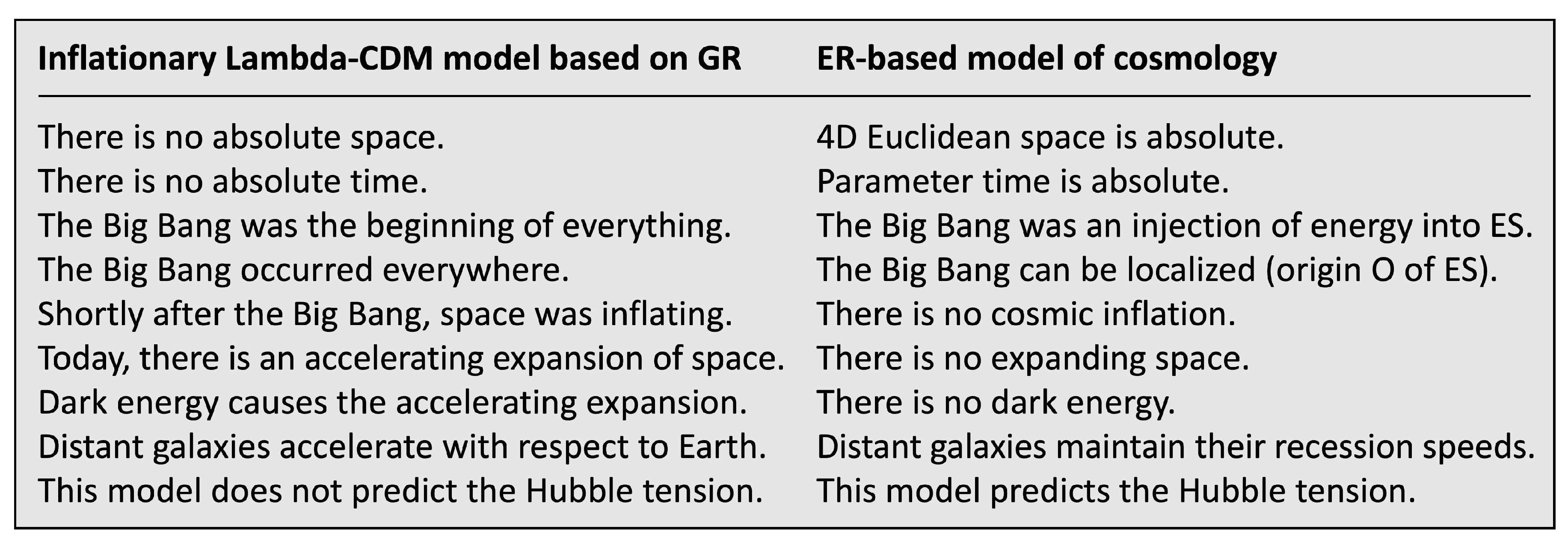
Cosmological redshift and the Hubble tension are very strong empirical evidence that challenges the Lambda-CDM model. They force us to take the 4D Euclidean geometry into account, and in particular. GR works well if is irrelevant, but of a high-redshift supernova differs greatly from of the Milky Way. Space is not driven by dark energy. Galaxies are driven by their momentum. Because of various effects (gravitation, scattering, photon emission, pair production), some energy does not recede radially anymore. Gravity pulls nearby galaxies toward our galaxy. Table 1 compares two models of cosmology. ER predicts the arrow of time, galactic motion, and the Hubble tension. Remarkably, ER manages without cosmic inflation, expanding space, dark energy, and even without non-locality (see Sect. 5.12). Thus, ER significantly improves cosmology and QM.
5.12. Quantum Entanglement
Erwin Schrödinger coins the word “entanglement” in a comment [42] on the Einstein–Podolsky–Rosen paradox [43]. These three authors argue that QM does not provide a complete description of reality. Schrödinger’s neologism does not resolve the paradox, but it highlights our enormous difficulties in comprehending QM. John Bell [44] shows that QM is incompatible with local hidden-variable theories. Meanwhile, several experiments [45,46,47] have confirmed that entanglement violates locality in an observer’s 3D space. Quantum entanglement has been interpreted as a “non-local effect” ever since.
Up next, we show: ER “untangles” entanglement without the concept of non-locality. There is no violation of locality in 4D (!) space, where all four axes are fully symmetric. In Figure 7, observer R moves in the axis at the speed . We consider two pairs of objects. The first pair was created at the point P and moves in opposite directions (equal to of R) at the speed . The second pair was created at the point Q and moves in opposite directions at the speed . In his 3D space, R experiences the first pair as entangled photons. In his 3D space, R experiences the second pair as entangled material objects, such as electrons. In his 3D space, either pair is separated spatially. R has no idea how two entangled objects are able to “communicate” with each other in no time.
. In his 3D space, he experiences one pair of objects as entangled photons and the other pair as entangled electrons. In the photons’ 3D space, the photons stay together spatially. They interpret the axis as “time”, but R interprets the same axis () as “space”. In the electrons’ 3D space (not shown), the electrons stay together spatially.
For the photons (or electrons), the (or else ) axis disappears because of length contraction at the speed . From their perspective, the entangled objects have never been separated spatially, but their proper time flows in opposite 4D directions. This is how they communicate with each other in no time. Their opposite 4D vectors do not affect local communication as long as the twins stay together spatially. There is a “spooky action at a distance” (phrase attributed to Albert Einstein) for observers only.
Entanglement and cosmic homogeneity have the same physical background: An observed object’s (or region’s) 4D vector and its 3D space may have rotated with respect to an observer’s 4D vector and his 3D space. This is only possible in ES, where all axes are fully symmetric. The SO(4) symmetry enables the entanglement of photons and other objects [48]. ER predicts that any two objects created in pair production are entangled. This gives us a chance to falsify ER. A measurement terminates one twin or rotates its 4D vector . The entanglement is destroyed. ER manages without non-locality.
6. Conclusions
ER takes a unique approach to describing nature: (1) ER interprets an observer’s physical reality as two projections of a mathematical reality. Gravity curves an observer’s spacetime in the same way as in GR. Without gravity, an observer’s spacetime is flat -MS. (2) In ER, there is absolute space (ES), an absolute evolution parameter (), and a 4D vector “flow of proper time” (). Information hidden in ES, , and is not available in SR/GR. ES is relevant for modeling physical realities. is relevant for modeling galactic motion. is relevant for understanding cosmic homogeneity, cosmological redshift, and entanglement. (3) ER omits coordinate time . There is a difference regarding the axis of time dilation. In SR/GR, an observed clock is slow with respect to an observer’s clock in its own time axis. In ER, it is slow in the time axis of the observer’s clock. Ultimately, this difference is irrelevant because experiments do not reveal in which axis a clock is slow.
ES is a background reality. GR is a background-free theory. ER refutes the widespread assumption that background-free theories are advantageous. For instance, time is not an operator in the Schrödinger equation, but acts as an absolute, external parameter. and are such parameters. There are none in SR/GR. Thus, ER fits QM better than SR and GR. In summary, we propose (a) replacing Minkowski spacetime with -MS, (b) using ER in cosmology, and (c) using ER in QM. It is obvious that one paper cannot cover all of physics. It is also obvious that 12 predicted empirical facts in different (!) areas of physics are most likely not 12 coincidences. Some of these 12 facts can be predicted without ER, but only by postulating cosmic inflation, expanding space, dark energy, and non-locality. ER manages without these concepts. Occam’s razor shaves them all off. No exceptions.
Einstein was awarded the Nobel Prize in Physics 1921 for his theory of the photoelectric effect [49], not for SR or GR. Our results show that ER penetrates to a “deeper level”. Einstein, one of the most brilliant physicists ever, did not realize that nature’s fundamental metric is Euclidean. He sacrificed absolute space and absolute time. ER reinstates absolute space (not 3D space, but 4D space) and absolute time (not a time coordinate, but parameter time). In retrospect, it was man-made coordinate time that delayed the formulation of ER. For the first time, humanity understands the nature of time: Experienced time is the distance traveled in absolute ES divided by . The human brain is able to imagine that we move at the speed of light. Against this backdrop, human conflicts fade into insignificance.
Is ER a physical or a metaphysical theory? That is a very good question because only in proper coordinates can we access ES, but we are not able to measure the proper time ticking for another object. However, we can calculate from ES diagrams, , and Equations (7b) and (17b). ES diagrams are observer-independent Master Diagrams of nature. It is true that observing is our primary source of knowledge, but concepts can mislead us if they originate from observing. Physics is more than just observing. For instance, we cannot observe time. Coordinate time works well in everyday life, but unfortunately has also been applied to the very distant and to the very small. For this reason, cosmology and QM benefit most from ER. ER is a physical theory because it predicts what we observe.
It seems as if Greek philosopher Plato anticipated ER in his famous Cave Allegory [50]: Humanity experiences projections, but it cannot observe the Master Reality beyond these projections. We have laid the foundation for ER and demonstrated its strength. Paradoxes are only virtual. One of the most important questions in science is this: How can we describe nature without postulating highly speculative concepts? The answer to this very question leads to the truth. ER describes nature from the very distant (cosmology) to the very small (QM). Thus, observer-independent diagrams are indispensable for unifying physics. Everyone is invited to test ER. Only in ER does Mother Nature reveal her secrets.
Funding
No funding was received.
Acknowledgements
I thank Siegfried W. Stein for his contributions to Sect. 5.10 and Figures 2, 4, 5. After several rejected submissions, he decided to withdraw his co-authorship. I thank Matthias Bartelmann, Walter Dehnen, Cornelis Dullemond, Felix Finster, Xuan Phuc Nguyen, Dirk Rischke, Jürgen Struckmeier, Christopher Tyler, Götz Uhrig, and Andreas Wipf for asking inspiring questions about ER. My special thanks go to all reviewers and editors for investing some of their valuable, proper time.
Comments: (1) Further studies on gravity are required, but this is no reason to reject ER. GR seems to explain gravity, but GR is incompatible with QM unless we add quantum gravity. (2) In ES, there are no singularities and thus no black holes. Again, this is no reason to reject ER. Singularities conflict with QM. Projections of highly concentrated energy could possibly be interpreted as “black holes”. (3) It is often a good idea to match the symmetry. The symmetry of nature is SO(4). (4) Absolute time puts an end to all discussions about time travel. Does any other theory explain time’s arrow as clearly as ER? (5) Physics does not ask: Why is my reality a projection? Projections are less speculative than postulating cosmic inflation plus expanding space plus dark energy plus non-locality.
It takes open-minded editors and reviewers to evaluate a new theory that heralds a paradigm shift. Taking SR and GR for granted paralyzes progress. I apologize for my numerous preprint versions, but I received little support only. The preprints document my path. The final version is all that is needed. I did not surrender when top journals rejected ER. Interestingly, I was never given any valid arguments that would disprove ER. I was advised to consult experts or submit to other journals. Were the editors afraid of publishing against the mainstream? Did they underestimate the benefits of ER? I am told that predicting 12 empirical facts would be too much to be convincing. I disagree. A paradigm shift often leads to many new insights. Even good friends refused to support me. Every setback motivated me to formulate ER even better. Finally, I identified four shortcomings of coordinate time.
A well-known preprint archive suspended my submission privileges. I was penalized because I showed that GR is not as general as it seems. The editor-in-chief of a top journal replied: “Publishing is for experts only.” One editor rejected ER because it would “demand too much” from his reviewers. Several journals rejected ER because it was “neither innovative nor significant”. I like to speak of ER as “holistic physics”, but unfortunately the reviewers did not accept this term. I do not blame anyone. Paradigm shifts are hard to accept. In the long run, ER will prevail because it predicts what we observe. These comments shall encourage young scientists to stand up for good ideas even if it is challenging: “unscholarly research”, “fake science”, “equations from entry-level textbooks”, “too simple to be true”. Simplicity and truth are not mutually exclusive. Beauty is when they go hand in hand together.
Data Availability: The data that support the findings of this study are available within this article.
Competing Interests: The author declares no competing interests.
References
- Einstein, A. : Zur Elektrodynamik bewegter Körper. Ann. Phys. 1905, 322, 891–921. [Google Scholar] [CrossRef]
- Einstein, A. : Die Grundlage der allgemeinen Relativitätstheorie. Ann. Phys. 1905, 354, 769–822. [Google Scholar] [CrossRef]
- Minkowski, H. : Die Grundgleichungen für die elektromagnetischen Vorgänge in bewegten Körpern. Math. Ann. 1910, 68, 472–525. [Google Scholar] [CrossRef]
- Rossi, B.; Hall, D.B. : Variation of the rate of decay of mesotrons with momentum. Phys. Rev. 1941, 59, 223–228. [Google Scholar] [CrossRef]
- Dyson, F.W.; Eddington, A.S.; Davidson, C. : A determination of the deflection of light by the sun’s gravitational field, from observations made at the total eclipse of May 29, 1919. Phil. Trans. R. Soc. A 1920, 220, 291–333. [Google Scholar] [CrossRef]
- Ashby, N. : Relativity in the global positioning system. Living Rev. Relativ. 2003, 6, 1–42. [Google Scholar] [CrossRef] [PubMed]
- Ryder, L. Quantum Field Theory; Cambridge University Press: Cambridge, 1985. [Google Scholar]
- Newburgh, R.G., Phipps Jr., T.E.: Physical Sciences Research Papers no. 401. United States Air Force (1969) .
- Montanus, H. : Special relativity in an absolute Euclidean space-time. Phys. Essays 1991, 4, 350–356. [Google Scholar] [CrossRef]
- Montanus, J.M.C. : Proper-time formulation of relativistic dynamics. Found. Phys. 2001, 31, 1357–1400. [Google Scholar] [CrossRef]
- Montanus, H. : Proper Time as Fourth Coordinate. 2023. Available online: https://greenbluemath.nl/proper-time-as-fourth-coordinate/ (accessed on 21 March 2026).
- Almeida, J.B. : An alternative to Minkowski space-time. arXiv 2001, arXiv:gr. [Google Scholar]
- Gersten, A. : Euclidean special relativity. Found. Phys. 2003, 33, 1237–1251. [Google Scholar] [CrossRef]
- Hudgin, R.H. : Coordinate-free relativity. Synthese 1972, 24, 281–297. [Google Scholar] [CrossRef]
- Misner, C.W.; Thorne, K.S.; Wheeler, A. Gravitation; W. H. Freeman and Company: San Francisco, 1973. [Google Scholar]
- Michelson, A.A.; Morley, E.W. : On the relative motion of the Earth and the luminiferous ether. Am J. Sci. 1887, 34, 333–345. [Google Scholar] [CrossRef]
- Dodelson, S.; Schmidt, F. Modern Cosmology; Elsevier: London, 2025. [Google Scholar]
- Church, A.E.; Bartlett, G.M. Elements of Descriptive Geometry. Part I. Orthographic Projections; American Book Company: New York, 1911. [Google Scholar]
- Nowinski, J.L. Applications of Functional Analysis in Engineering; Plenum Press: New York, 1981. [Google Scholar]
- Wald, R.M. General Relativity; The University of Chicago Press: Chicago, 1984. [Google Scholar]
- Wick, G.C. : Properties of Bethe-Salpeter wave functions. Phys. Rev. 1954, 96, 1124–1134. [Google Scholar] [CrossRef]
- Matthews, P.C. Vector Calculus; Springer-Verlag: London, 1998. [Google Scholar]
- Hafele, J.C.; Keating, R.E. : Around-the-world atomic clocks: predicted relativistic time gains. Science 1972, 177, 166–168. [Google Scholar] [CrossRef]
- Ellis, G.F.R.; Maartens, R.; MacCallum, M. Relativistic Cosmology; Cambridge University Press: Cambridge, 2012. [Google Scholar]
- Oppenheimer, J.R.; Snyder, H. : On continued gravitational contraction. Phys. Rev. 1939, 56, 455–459. [Google Scholar] [CrossRef]
- Abbott, B.P.; et al. : Observation of gravitational waves from a binary black hole merger. Phys. Rev. Lett. 2016, 116, 061102. [Google Scholar] [CrossRef]
- Carroll, S.M. : Lecture notes on general relativity. arXiv 1997, arXiv:gr. [Google Scholar]
- Lee, V.S.H.; Zurek, K.M. : Proper time observables of general perturbations in laser interferometry-based gravitational wave detectors. Phys. Rev. D 2025, 111, 124037. [Google Scholar] [CrossRef]
- Holstein, B.R. : Graviton physics. Am. J. Phys. 2006, 74, 1002–1011. [Google Scholar] [CrossRef]
- Ellis, G. : The standard cosmological model: achievements and issues. Found. Phys. 2018, 48, 1226–1245. [Google Scholar] [CrossRef]
- Abdalla, E.; et al. : Cosmology intertwined: a review of the particle physics, astrophysics, and cosmology associated with the cosmological tensions and anomalies. J. High En. Astrophys. 2022, 34, 49–211. [Google Scholar]
- Penzias, A.A.; Wilson, R.W. : A measurement of excess antenna temperature at 4080 Mc/s. Astrophys. J. 1965, 142, 419–421. [Google Scholar] [CrossRef]
- Hubble, E. : A relation between distance and radial velocity among extra-galactic nebulae. Proc. Natl. Acad. Sci. U.S.A 1965, 15, 168–173. [Google Scholar] [CrossRef]
- Lemaître, G. : Un univers homogène de masse constante et de rayon croissant, rendant compte de la vitesse radiale des nébuleuses extra-galactiques. Ann. Soc. Sci. Bruxelles A 1927, 47, 49–59. [Google Scholar]
- Linde, A. Inflation and Quantum Cosmology; Academic Press: Boston, 1990. [Google Scholar]
- Guth, A.; et al. The Inflationary Universe; Perseus Books: New York, 1997. [Google Scholar]
- Aghanim, N.; et al. : Planck 2018 results. VI. Cosmological parameters. Astron. Astrophys. 2020, 641, A6. [Google Scholar]
- Riess, A.G.; et al. : A comprehensive measurement of the local value of the Hubble constant with 1 km s−1 Mpc−1 uncertainty from the Hubble Space Telescope and the SH0ES team. Astrophys. J. Lett. 2022, 934, L7. [Google Scholar] [CrossRef]
- Perlmutter, S.; et al. : Measurements of Ω and Λ from 42 high-redshift supernovae. Astrophys. J. 1999, 517, 565–586. [Google Scholar] [CrossRef]
- Riess, A.G.; et al. : Observational evidence from supernovae for an accelerating universe and a cosmological constant. Astron. J. 1998, 116, 1009–1038. [Google Scholar] [CrossRef]
- Turner, M. : Dark matter and dark energy in the universe. arXiv 1998, arXiv:astro. [Google Scholar]
- Schrödinger, E. : Die gegenwärtige Situation in der Quantenmechanik. Naturwissenschaften 1935, 23, 807–812. [Google Scholar] [CrossRef]
- Einstein, A.; Podolsky, B.; Rosen, N. : Can quantum-mechanical description of physical reality be considered complete? Phys. Rev. 1935, 47, 777–780. [Google Scholar] [CrossRef]
- Bell, J.S. : On the Einstein Podolsky Rosen paradox. Physics 1964, 1, 195–200. [Google Scholar] [CrossRef]
- Freedman, S.J.; Clauser, J.F. : Experimental test of local hidden-variable theories. Phys. Rev. Lett. 1972, 28, 938–941. [Google Scholar] [CrossRef]
- Aspect, A.; Dalibard, J.; Roger, G. : Experimental test of Bell’s inequalities using time-varying analyzers. Phys. Rev. Lett. 1982, 49, 1804–1807. [Google Scholar] [CrossRef]
- Bouwmeester, D.; et al. : Experimental quantum teleportation. Nature 1997, 390, 575–579. [Google Scholar] [CrossRef]
- Hensen, B.; et al. : Loophole-free Bell inequality violation using electron spins separated by 1.3 kilometres. Nature 2015, 526, 682–686. [Google Scholar] [CrossRef]
- Einstein, A. : Über einen die Erzeugung und Verwandlung des Lichtes betreffenden heuristischen Gesichtspunkt. Ann. Phys. 1905, 322, 132–148. [Google Scholar] [CrossRef]
- Plato. Politeia; p. 514a.
Figure 1.
Minkowski diagram and ES diagram of two uniformly moving clocks. Left: “b” is slow with respect to “r” in . Coordinate time is relative (“b” is at different positions in and ). Right: “b” is slow with respect to “r” in . The evolution parameter is absolute (both clocks are at ).
Figure 1.
Minkowski diagram and ES diagram of two uniformly moving clocks. Left: “b” is slow with respect to “r” in . Coordinate time is relative (“b” is at different positions in and ). Right: “b” is slow with respect to “r” in . The evolution parameter is absolute (both clocks are at ).
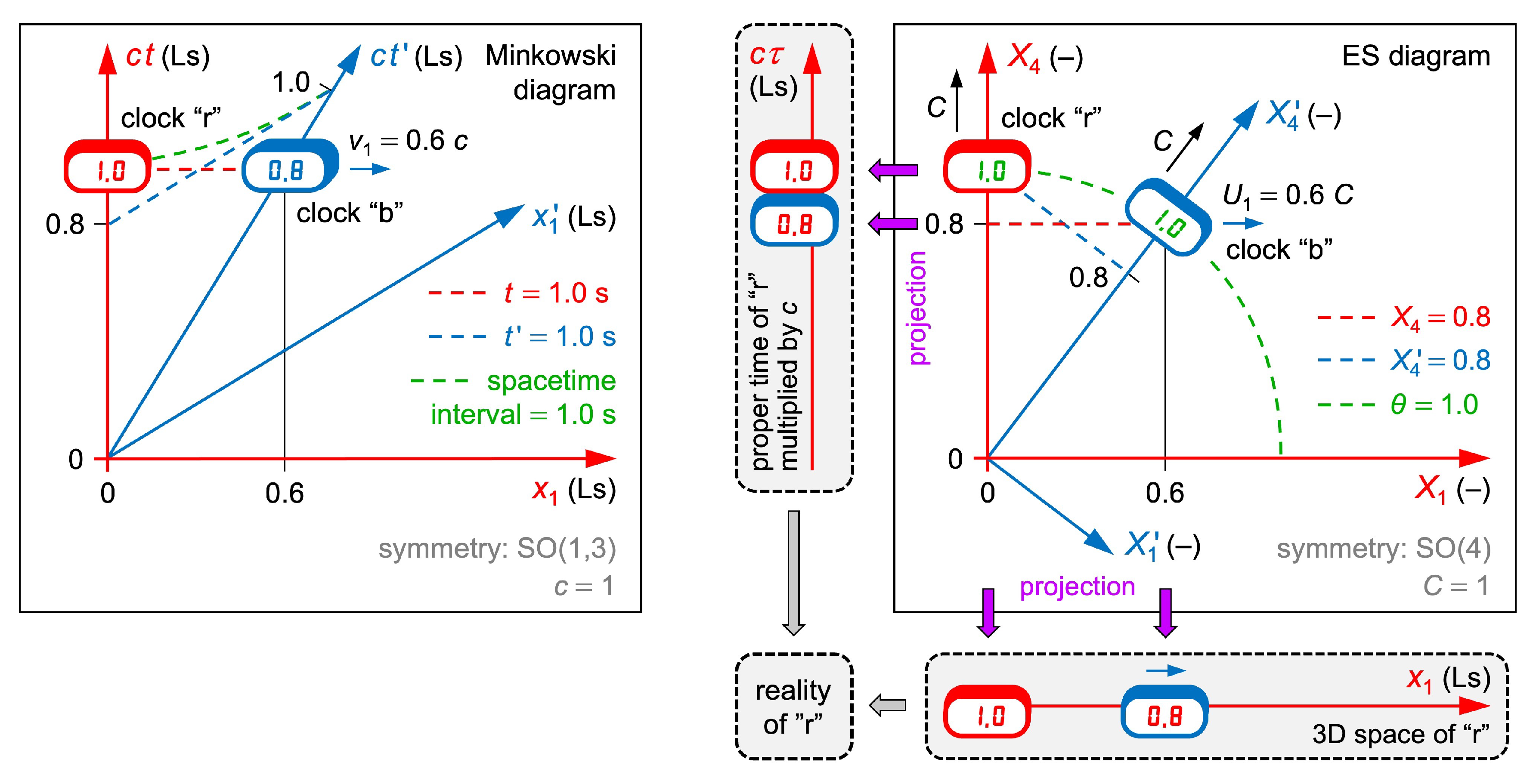
Figure 2.
ES diagrams of two uniformly moving rockets. Observer R (or B) is in the rear end of “r” (or else “b”). Top left and right: “r” and “b” move at the speed , but in different 4D directions. The ES diagrams are identical. Bottom left: In the projection onto the 3D space of R, “b” contracts to . Bottom right: In the projection onto the 3D space of B, “r” contracts to .
Figure 2.
ES diagrams of two uniformly moving rockets. Observer R (or B) is in the rear end of “r” (or else “b”). Top left and right: “r” and “b” move at the speed , but in different 4D directions. The ES diagrams are identical. Bottom left: In the projection onto the 3D space of R, “b” contracts to . Bottom right: In the projection onto the 3D space of B, “r” contracts to .
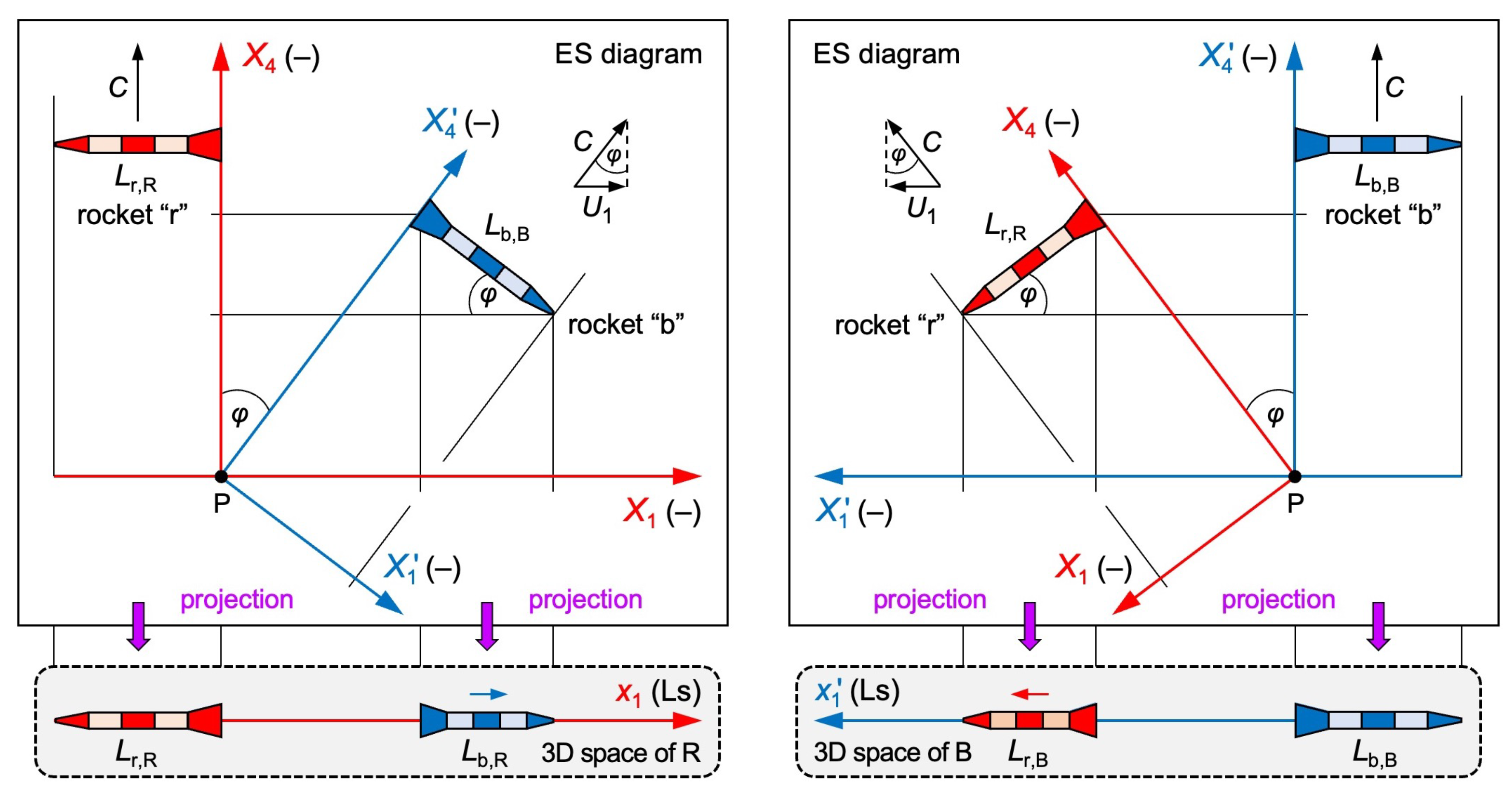
Figure 3.
ES diagram of two clocks. “b” falls freely toward Earth. It experiences gravity as an acceleration of everything else. indicates the current 4D motion of “b” (curvilinear coordinates).
Figure 3.
ES diagram of two clocks. “b” falls freely toward Earth. It experiences gravity as an acceleration of everything else. indicates the current 4D motion of “b” (curvilinear coordinates).
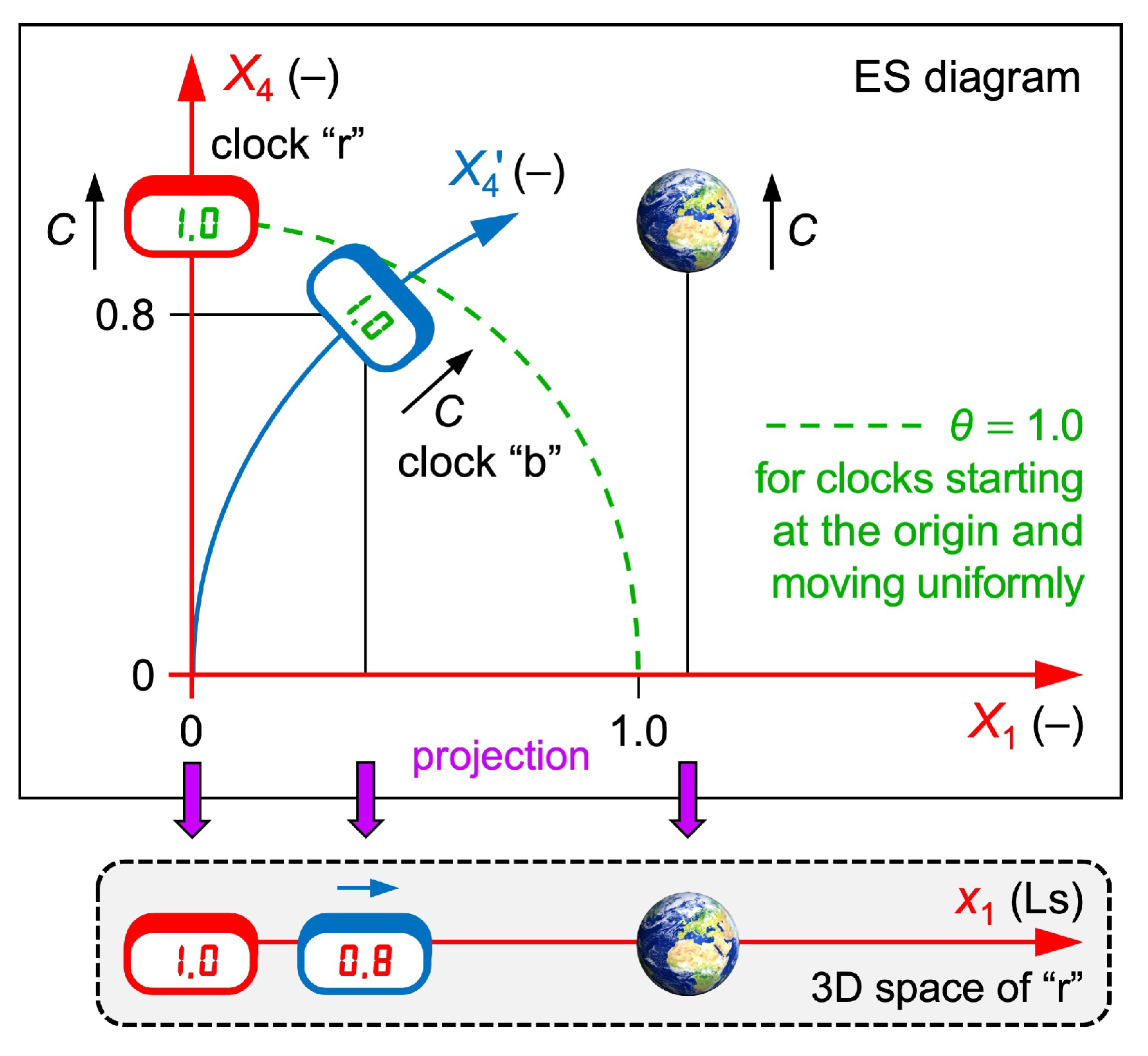
Figure 4.
Instructive problems. Left: In the 3D space of a guide wire, a rocket moves along the wire. In ES, the wire escapes from the rocket. Right: In the 3D space of the sun, Earth orbits the sun. In ES, the sun escapes from Earth. We ignore the fact that the sun orbits the center of the Milky Way.
Figure 4.
Instructive problems. Left: In the 3D space of a guide wire, a rocket moves along the wire. In ES, the wire escapes from the rocket. Right: In the 3D space of the sun, Earth orbits the sun. In ES, the sun escapes from Earth. We ignore the fact that the sun orbits the center of the Milky Way.
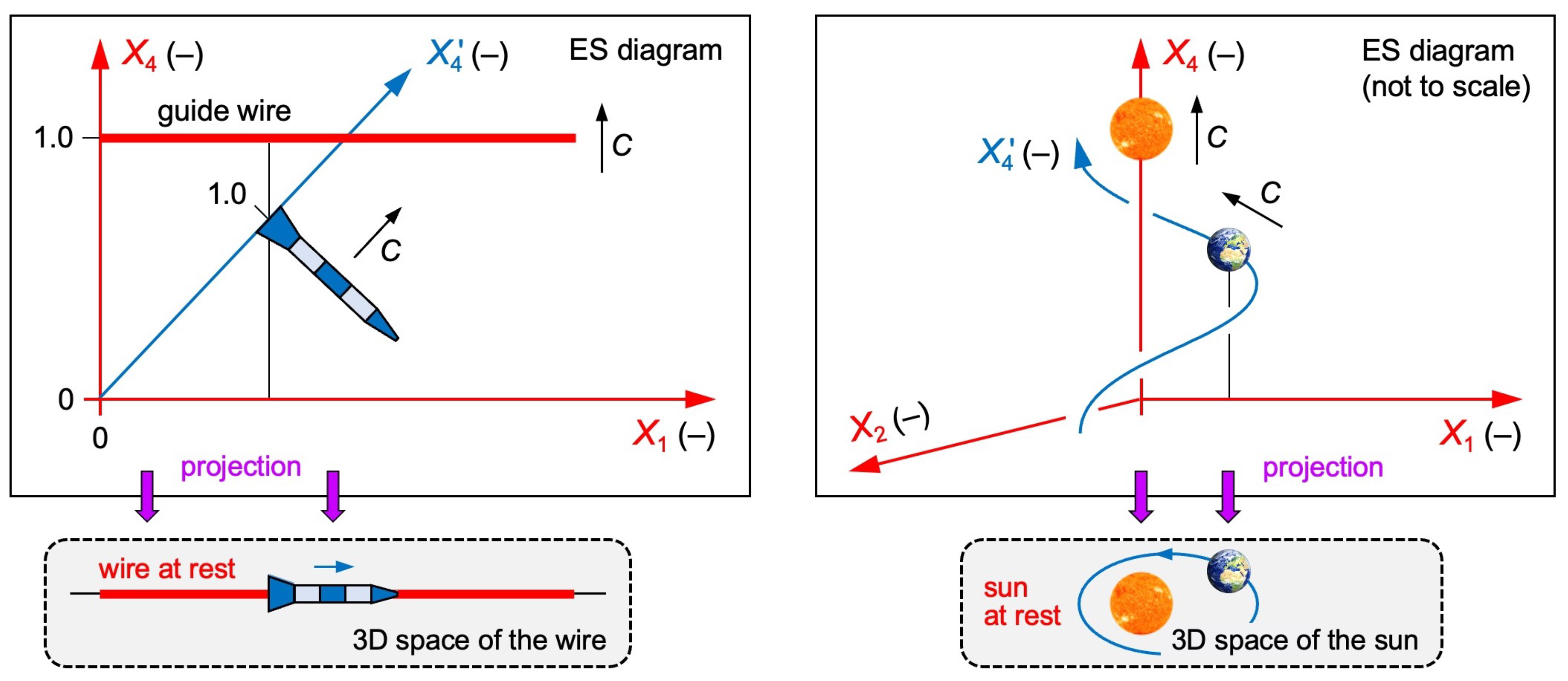
Figure 5.
ER-based model of cosmology. The green arcs show a 3D hypersurface, which is expanding from the origin O of ES (location of the Big Bang) at the speed . Left: A galaxy G recedes from O at the speed and from the axis at the speed . Right: If a star happens to be at the same distance today at which the supernova of S occurred, recedes more slowly from than S.
Figure 5.
ER-based model of cosmology. The green arcs show a 3D hypersurface, which is expanding from the origin O of ES (location of the Big Bang) at the speed . Left: A galaxy G recedes from O at the speed and from the axis at the speed . Right: If a star happens to be at the same distance today at which the supernova of S occurred, recedes more slowly from than S.
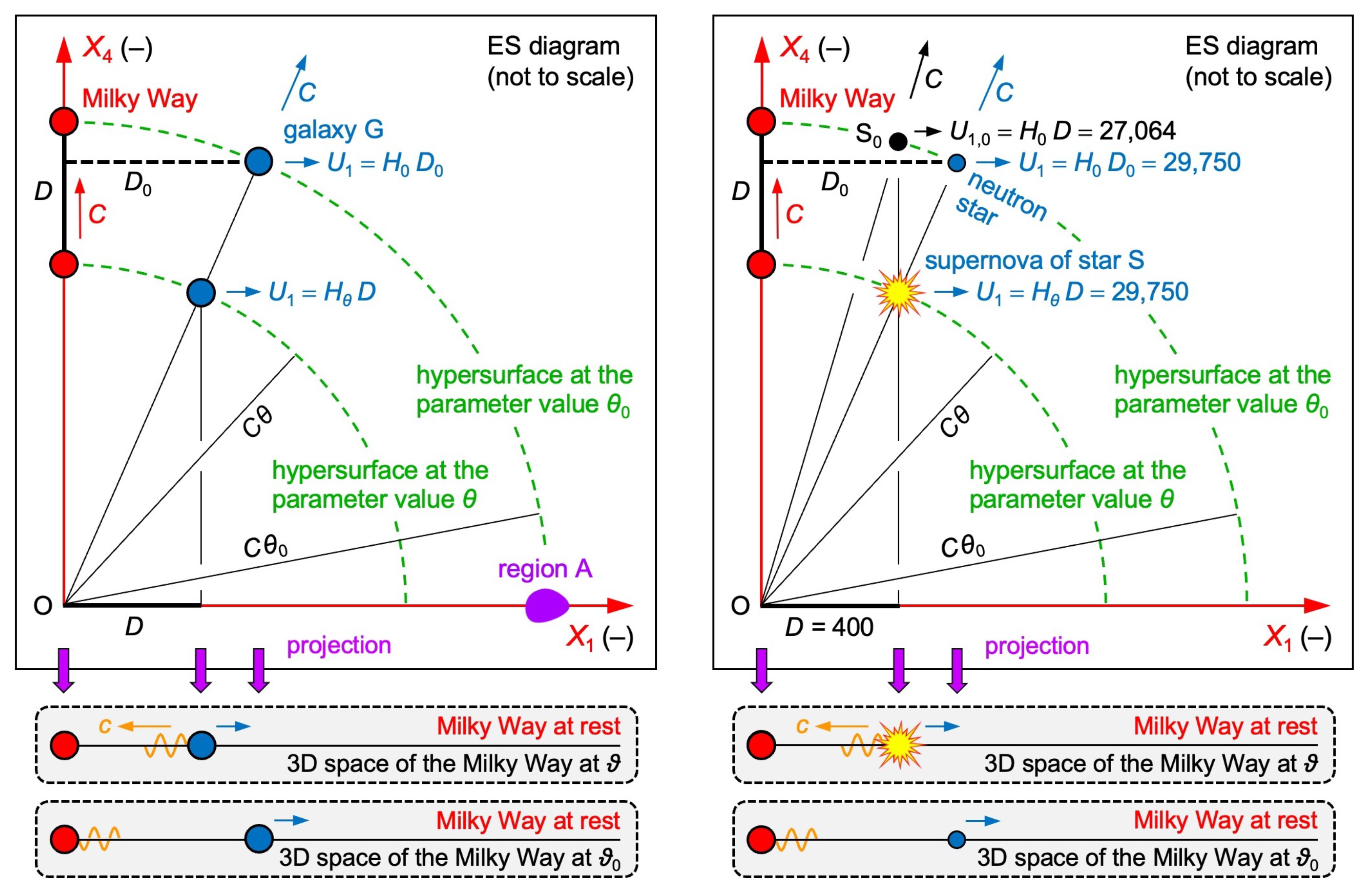
Figure 6.
Hubble diagram of simulated supernovae. The red points, calculated according to Equation (29), do not form a straight line. Because of Equations (29) and (32), is not proportional to . The blue points, calculated according to Equation (30), do form a straight line because is proportional to .
Figure 6.
Hubble diagram of simulated supernovae. The red points, calculated according to Equation (29), do not form a straight line. Because of Equations (29) and (32), is not proportional to . The blue points, calculated according to Equation (30), do form a straight line because is proportional to .
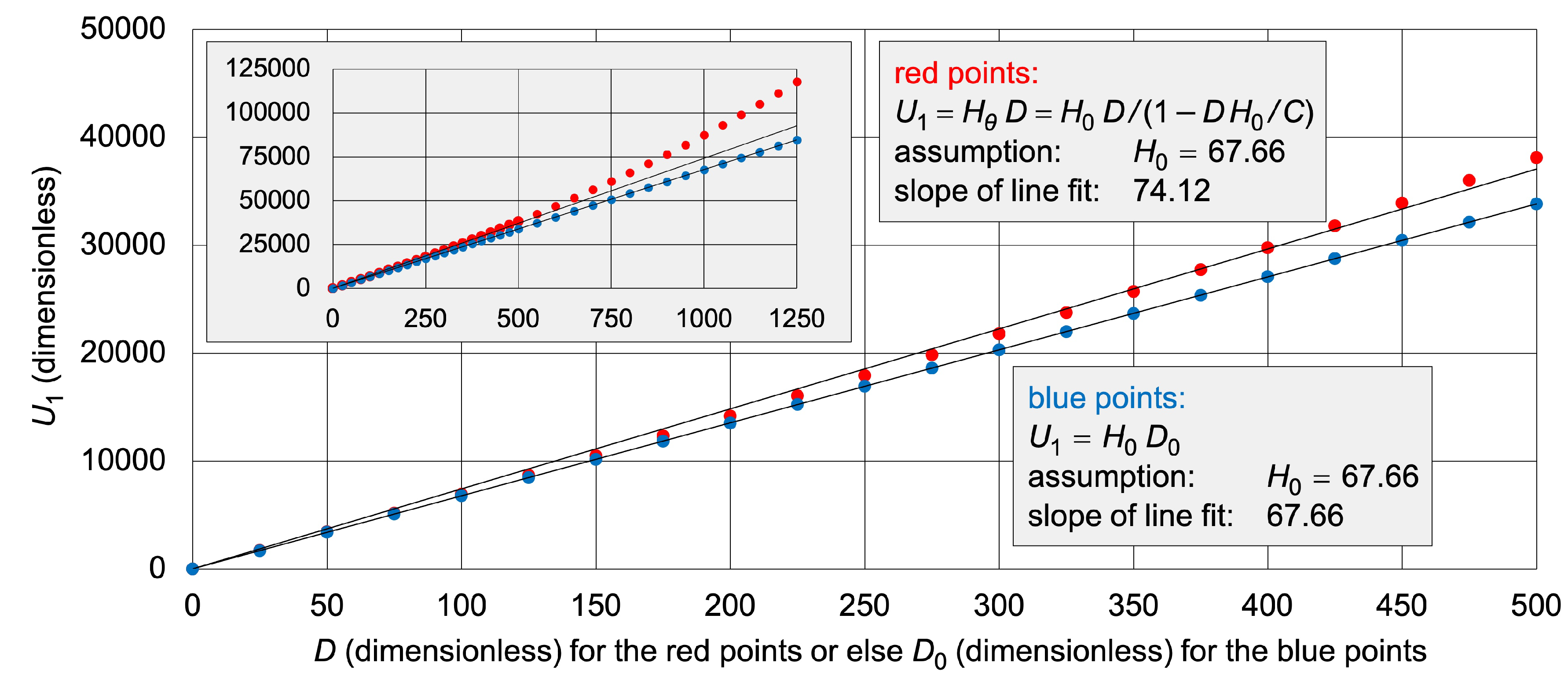
Figure 7.
Entanglement. Observer R moves in . In his 3D space, he experiences one pair of objects as entangled photons and the other pair as entangled electrons. In the photons’ 3D space, the photons stay together spatially. They interpret the axis as “time”, but R interprets the same axis () as “space”. In the electrons’ 3D space (not shown), the electrons stay together spatially.
Figure 7.
Entanglement. Observer R moves in . In his 3D space, he experiences one pair of objects as entangled photons and the other pair as entangled electrons. In the photons’ 3D space, the photons stay together spatially. They interpret the axis as “time”, but R interprets the same axis () as “space”. In the electrons’ 3D space (not shown), the electrons stay together spatially.
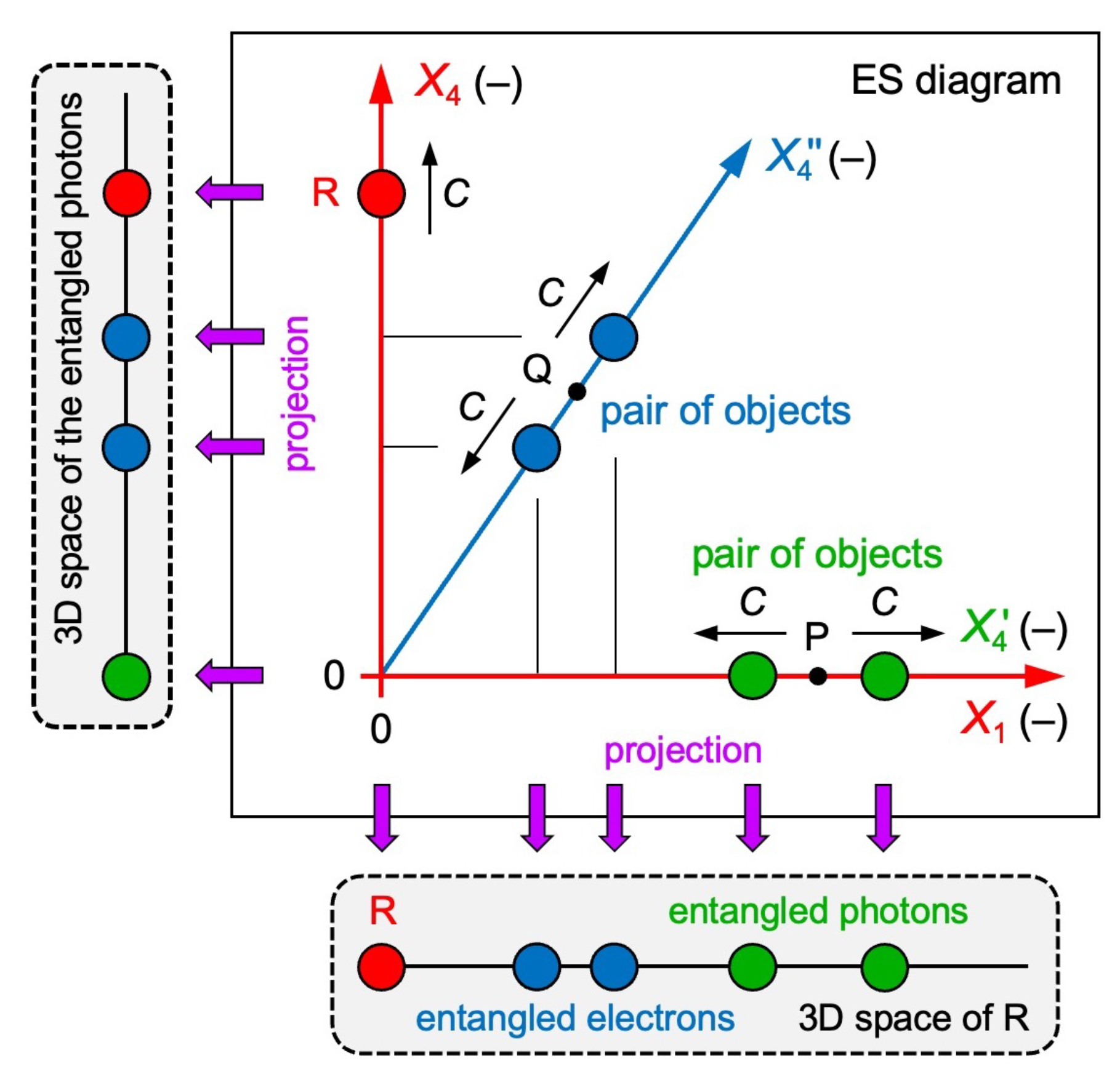

Table 1.
Comparing two models of cosmology.
 |
Disclaimer/Publisher’s Note: The statements, opinions and data contained in all publications are solely those of the individual author(s) and contributor(s) and not of MDPI and/or the editor(s). MDPI and/or the editor(s) disclaim responsibility for any injury to people or property resulting from any ideas, methods, instructions or products referred to in the content. |
© 2026 by the author. Licensee MDPI, Basel, Switzerland. This article is an open access article distributed under the terms and conditions of the Creative Commons Attribution (CC BY) license.
Copyright: This open access article is published under a Creative Commons CC BY 4.0 license, which permit the free download, distribution, and reuse, provided that the author and preprint are cited in any reuse.