

Submitted:
27 December 2021
Posted:
28 December 2021
You are already at the latest version
Abstract
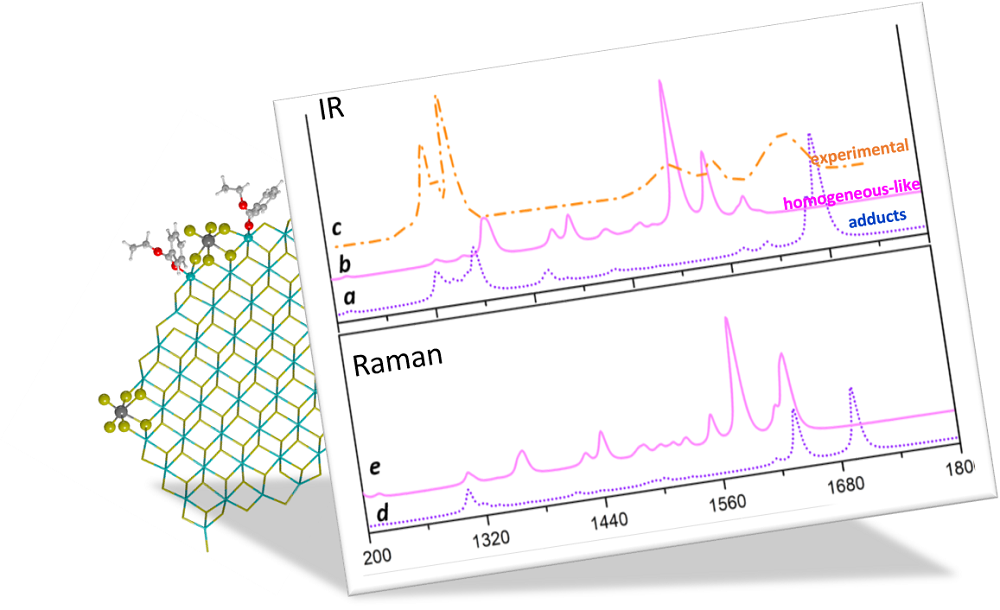
Understanding the structure and properties of MgCl2/TiCl4/ID nanoclusters is a key to uncover the origin of Ziegler-Natta catalysis. In this work MgCl2/TiCl4 nanoplatelets derived by machine learning and DFT calculations have been used to model the interaction with ethyl-benzoate EB (as internal donor) with available exposed sites of binary TixCly/MgCl2 systems. The influence of vicinal Ti2Cl8 and coadsorbed TiCl4 on energetic, structural and spectroscopic behaviour of EB has been considered. The adsorption of homogeneous-like TiCl4EB and TiCl4(EB)2 at the various surface sites have been also simulated. Calculations have been carried out by employing B3LYP-D2 and M06 functionals. The adducts have been characterized by computing IR and Raman spectra that have been found to provide specific fingerprints useful to identify surface species; IR spectra have been successfully compared to available experimental data.
Keywords:
polymerization catalysis
; machine learning
; nanoclusters
; DFT
; Raman spectrum
; IR spectrum
; Lewis bases
Copyright: This open access article is published under a Creative Commons CC BY 4.0 license, which permit the free download, distribution, and reuse, provided that the author and preprint are cited in any reuse.