

Submitted:
31 July 2021
Posted:
02 August 2021
You are already at the latest version
Abstract
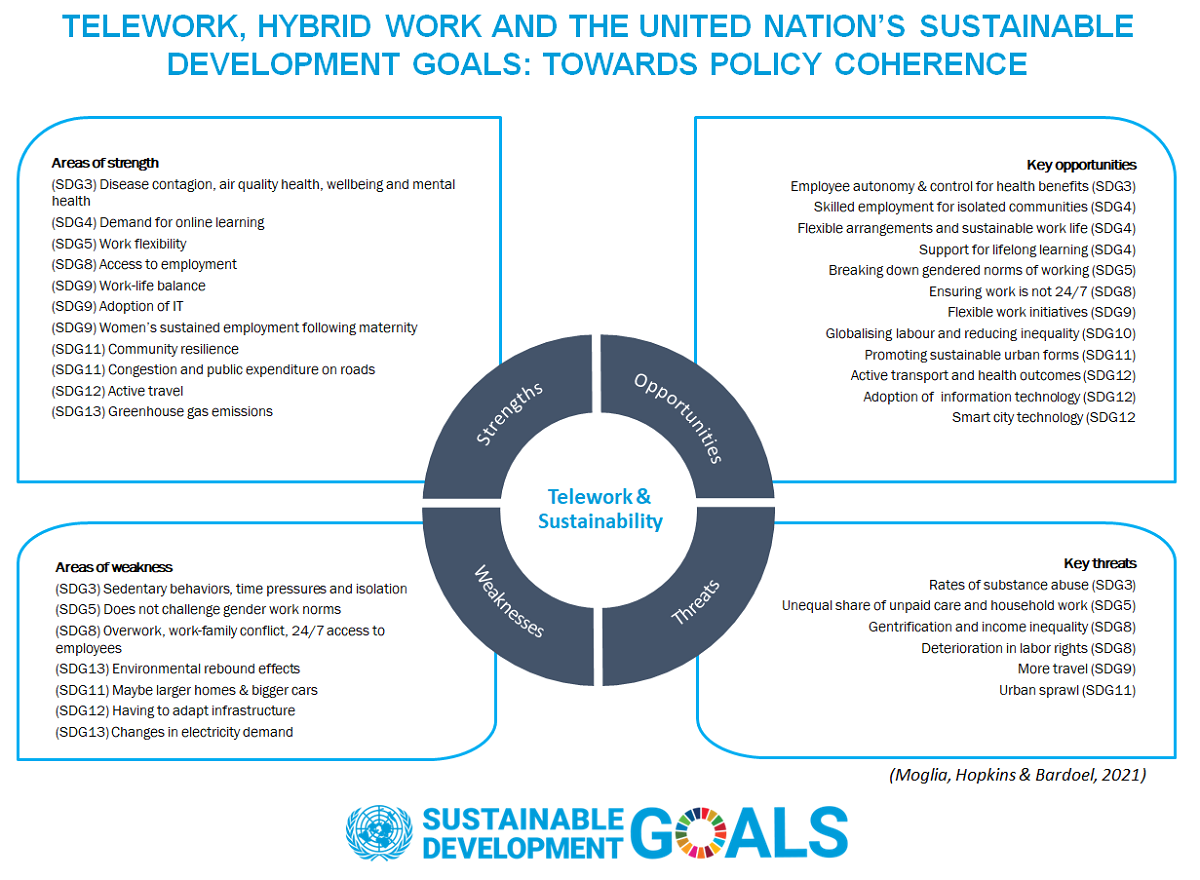
With increased participation in telework expected to continue, to support emerging hybrid work models in the aftermath of the Covid-19, it is important to consider the long-term impact this practice could have on sustainability outcomes. This paper describes a systematic review of 113 academic journal articles and identifies associations between telework and sustainability, explored by previous researchers. Those associations were categorized and discussed, based on their contributions to different United Nations Social Development Goals. Most of research was found to focus on countries classified as having a very high human development index status, and regions with a low, medium or high human development index, largely ignored. The SWOT matrix technique was used to illustrate the strengths and weaknesses identified in the current literature as well as threats and opportunities for future work. This can help to ensure policy coherence and that strategies to promote one outcome, such as economic productivity improvements, does not undermine another, such as improved health. Practical implications and potential research opportunities were identified across a range of SDG impact areas, including good health and well-being, gender equality, reduced inequality, climate mitigation, sustainable cities and resilient communities. On the whole, our impression is that increased rates of telework present an important opportunity to improve sustainability outcomes, however, it will be important that integrated and holistic policy is developed that mitigates key risks.
Keywords:
Telework
; hybrid work
; working from home
; sustainability
; UN Sustainable Development Goals
; policy coherence
Copyright: This open access article is published under a Creative Commons CC BY 4.0 license, which permit the free download, distribution, and reuse, provided that the author and preprint are cited in any reuse.