
Submitted:
28 June 2023
Posted:
29 June 2023
You are already at the latest version
Preprints on COVID-19 and SARS-CoV-2
Abstract
Since the outbreak of the Covid-19, working from home has become the norm for millions of workers worldwide. The current research focuses on the benefits and challenges of teleworking in the administrative sectors of greek healthcare units, with a view to harnessing the knowledge gained through experience, in order to create the frame for sustainable behaviors. Anyways, the implementation of teleworking requires complex and dynamic changes in technical and behavioral aspects. Therefore, a systematic review was also conducted to identify the relationships between telecommuting and organizational behavior, with the aim of achieving sustainable development in businesses. Moreover, an important positive aspect of telework that emerged from this literature review appears to create opportunities for potential direct or indirect linkages between telework and many SDGs areas, based on the fact that telework appears to be a community-friendly form of work. In summary, this research strongly suggests that leaders facilitate telecommuters to adopt green practices and volunteerism that can consequently contribute to the SDGs. However, in order to meet the challenges arising from unprecedented times, the leaders of the organizations will have to redesign their policies, while the states will have to focus on guaranteeing the rights and freedoms of the workers.
Keywords:
telecommuting
; SDGs
; organizational behavior
; sustainable behaviors
; living & working environment
; leadership 4.0
; digitalization
1. Introduction
Since the term telecommuting was first coined in the 1970s, scholars and practitioners have debated the merits of working away from the office, as it represents a fundamental shift in the way organizations have historically operated[105].
The year 2020 was an unplanned milestone in the progress of digital transformation. Due to the social distancing required due to Covid-19, many workers have been led to telecommute and take advantage of new technologies even in administrative areas of hospitals. In the aftermath of the global health crisis, the world has finally begun to open its doors again and now faces the new realities of a new era. As telework and hybrid work continue to increase [2][50], it is crucial to investigate the long-term sustainability impact of these options.
At the same time, businesses and organizations were given the opportunity to adapt their business models to the requirements of the new era. In this context, questions such as the following arise:
What are the implications of these rapid digitalization technological changes in terms of teleworking?
Could telecommuting have a future as a good practice for achieving sustainability?
What is the role of leadership and organizational behavior management in the post-Covid-19 era?
Through which mechanism can teleworking have positive results from the perspective of the individual, the organization and society?
The purpose of this paper is to investigate the challenges and perspectives of leadership in the era of digital transition through the case study of telecommuting among employees in administrative positions in greek health care units during the Covid-19 era. In particular, the implementation of teleworking requires complex and dynamic changes in technical and behavioral aspects. Therefore, it will analyze the changes in question that permeate all areas of life, pushing companies and organizations to undertake extensive transformation processes and focusing on the development of new leadership skills in the new era.
While conducting the literature survey, we also identified that studies on the relationships between telework and sustainability have increased significantly in recent years. However, the final sample of relevant literature was still relatively small. For this reason, a systematic review was also carried out to identify the relationships between teleworking and organizational culture, with the aim of achieving sustainable growth in companies.
Many authors consider that a research in this direction makes a significant contribution to the academic body of knowledge in an area that intersects a wide range of economic, social and environmental interests. It is further intended that this paper will contribute to informing practitioners, leaders and policy makers who seek to better understand the wider implications for long-term telework and help them to mitigate any negative consequences, while at the same time it would be reasonable to promote the positive aspects of teleworking. In any case, the hybrid model that is expected to prevail requires a rethinking of the way work is performed, coordinated and regulated at both corporate and societal levels [40].
1.1. Impact of Teleworking
Remote work is a type of flexible working arrangement that allows an employee to work from remote location outside of corporate offices. There are several different terms used to define this concept. Telework and telecommuting are used interchangeably along with other terms such as also work-from-home (WFH), e-work, flexible work, home office, home-based telecommuting, mobile work and virtual workplace [35,85,86].
Remote working has exploded in the year 2020, with estimates suggesting that almost 40% of people employed in the EU started teleworking fulltime as a result of Covid-19, according the European Commission [81]. In other words, this year changed the world economy and the world of work in an unprecedented way. In addition, the mass adoption of telecommuting has been a vital business shift since the virus outbreak. The sudden demand for working from home has given significant impetus to the digital transformation of the workforce [90].
According to Beňo [7] provides more positive than negative evidence, as more than half of the studies cited flexibility, productivity, efficiency and satisfaction as advantages. Nevertheless, in many studies the results are contradictory and many implications remain unknown regarding how it affects the employee experience, which can be considered one of the paradoxes of telecommuting [102]. In any case, this way of working is not for everyone, as the perception of difficulties leading to the implementation of teleworking was influenced by socio-demographic characteristics.
Moreover, the impact of telecommuting can be multifaceted [17,38]:
- Individual
- Organizational
- Social
New data, technological developments and a globally connected world make it clear that telecommuting will play a critical role in the future of the workplace.
Based in this context, the following hypotheses were established.
Research Hypothesis 1. The perception of difficulties during COVID-19 that led to the implementation of teleworking were heterogeneous by sociodemographic characteristics (e.g. gender, age and education level).
Research Hypothesis 2. The educational level of employees affects their intention and attitude towards teleworking.
1.2. Challenges to the implementation of telework
Teleworking during the pandemic poses additional challenges. New home-workers are probably not used to being isolated from their co-workers and may not have a home office or work-friendly area. Besides, getting virtual meeting technology to work well is not always easy. It just seems like another chore, which however is necessary to social distancing. With other family members potentially also at home, including children or a partner, avoiding distractions and interruptions can be nearly impossible. This challenge concerns especially women due to parenting [97].
Teleworkers may not have a home office or work-friendly area. To find privacy, employees might find themselves in the awkward situation of conducting meetings and their duties from their bedrooms or kitchens. And getting virtual meeting technology to work well is not always easy. All these changes can originate anxiety, fear of job loss, anger, sadness, or frustration [99,100].
Based in this context, the following hypotheses were established.
Research Hypothesis 3: The educational level of workers affects having the necessary equipment and space at home, as well the required technological support for the implementation of teleworking.
Research Hypothesis 4: There are factors of organizational stress that can predict the acceptance of sustainable development through telework.
The potential factors associated with teleworking in the COVID-19 era are categorized as follows [99]:
- Environmental: the economic uncertainty that accompanies the health crisis is a stressful factor, due to the fear of losing a job. Simultaneously, a technological change is taking place.
- Organizational: with the assumption of responsibilities, the work role of teleworkers is overloaded, while there is a lack of social support, space problems and distraction.
- Personal: this is the case of conflict of family-professional responsibilities.
As a consequence of work stress, the following symptoms are observed, which impede efficiency and productivity:
- Physiological: e.g. headaches, high blood pressure, chronic diseases.
- Psychological: eg job dissatisfaction, depression, uncertainty about future prospects due to pandemic, insufficient conditions for well-being.
- Behavioral: e.g. nervousness, absenteeism.
Regarding the responses to job dissatisfaction of the teleworker can be categorized as follows [82]:
- Exit.
- Voice.
- Loyalty.
- Neglect.
The above-mentioned conditions may have a negative impact on business in the following aspects:
- Decreased productivity: as a result of low performance and deviant behavior at work due to lack of job satisfaction.
- Low degree of internal business communication/cooperation: given the work inclusion experienced in teleworking conditions, there is a high possibility of misunderstandings within the company and time delays.
- Poor services/products quality: as a consequence of the above problems such as low morale and the increase in the number of errors, the project provided may not meet the specifications of the company [98].
Regarding the organizational measures that would be proposed in the management of the stress of the teleworker in our case are the following:
- Training: training in the form of seminars can help support and improve self-efficacy.
- Employee involvement: the employee must be involved in matters related to his/her job performance (eg making decisions or submitting proposals for improvements).
- Organizational communication: due to the isolation of the individual it would be useful to increase the formal organizational communication in order to properly manage issues and reduce stress.
- Leave and wellness programs: for exhausted employees, it is important to take leave for their rejuvenation and to have access to psychological support programs.
At least, sustainable development is inextricably linked to employee participation, giving particular importance to determining attitudes and behavior in the workplace. For this reason, it must be emphasized that employee engagement practices are, in their purest form, exercises in innovation, but also commitment at the same time. Therefore, to attract employees and benefit from it, the organization must invest not only in meeting the needs of employees but also in engagement practices in order to drive and sustain growth [58].
1.3. Telework and Sustainable Development
The Global Goals and the 2030 Agenda for Sustainable Development is a chain of reflection, commitment and concerted action that seek to end poverty and hunger, realize the human rights of all, achieve gender equality and empower all women and girls, and ensure the sustainable protection of the planet and its natural resources [87]. Sustainable development is a dynamic and constantly evolving concept, and refers to meeting the needs of the current generation without jeopardizing the future of the next [63,64].
More specifically, social sustainability is about the quality of an organization's relationships with its stakeholders. In this context, teleworking can be seen as a way of working that can be used to propose organizational transformations aimed at the seventeen sustainable development and social sustainability goals set by the United Nations. The specific social, economic and environmental objectives aim to improve human well-being and environmental health [15,41].
In particular, the positive aspects of telecommuting include aspects related to the long-term impact on sustainable development issues. The scoping review of Moglia et.al. [45] identified the link between telecommuting and sustainability outcomes from many previous academic studies. In particular, there seems to be a connection with the following 9 SDGs [66]:
- No 3. Ensure healthy lives and promote well-being for all at all ages;
- No 4. Ensure inclusive and equitable quality education and promote lifelong learning opportunities for all;
- No 5. Achieve gender equality and empower all women and girls;
- No 8. Promote sustained, inclusive and sustainable economic growth, full and productive employment and decent work for all;
- No 9. Build resilient infrastructure, promote inclusive and sustainable industrialisation and foster innovation;
- No 10. Reduce inequality within and among countries;
- No 11. Make cities and human settlements inclusive, safe, resilient and sustainable;
- No 12. Ensure sustainable consumption and production patterns;
- No 13. Take urgent action to combat climate change and its impacts.
More specifically, diverse impacts and research opportunities were identified across a range of areas on the impacts of the SDGs with a greater impact on goals No 9-3-8-11-13 and relatively smaller impacts on goals No 5-4-12-10, in line with the above literature review. The increased rates of teleworking may therefore contribute positively to the SDGs related with e.g. good health and well-being, gender equality, reducing social inequalities, mitigating the effects of environmental issues, as well as challenges for the future in sustainable cities and resilient communities [45].
Based in this context, the following hypothesis was established.
Research Hypothesis 5. The impact of telecommuting during the COVID-19 crisis is perceived in various aspects (social, economic, environmental) of the lives and careers of hospital workers.
1.4. Telework and the frame for sustainable behaviors
Notably, there is another positive aspect of telework, which appears to create opportunities for potential linkages between telework and other additional SDG areas. According to Kamerade & Burchell [34] telecommuting appears to be a community-friendly form of work, as a counterbalance to the position that it leads to social distancing. The results show that telecommuters tend to report involvement in both volunteer/philanthropic and political/union activities more than non-telecommuters, after controlling for demographic and labor market variables.
More specifically, the specific study [34] shows that telecommuting can make volunteering possible, since working from home and avoiding a commute gives professionals time to give back to their communities. Therefore, volunteering related to telecommuting can, for example, contribute either to the fight against poverty, or to ensuring food for the hungry, or to caring for the homeless, or to adopting abandoned pets, or to getting involved in solving environmental problems.
Similarly, the contribution of volunteering to the successful management even of phenomena such as an energy transition can be mentioned, given that such changes require the acceptance and support of citizens. Active participation in the community and the local energy system is therefore important. For instance, rather than participating as simple consumers of energy, community members can now take on a number of different roles within the energy system, as they are able to influence the ways and extent to which energy is produced. Moreover, the importance of civil society groups for transformations towards an environmentally friendly energy system has been emphasized in countries such as the UK, Germany and the USA [13,32].
In this way, telecommuting can act as a framework for promoting sustainable behaviors among citizens-teleworkers, who offer voluntary work to solve social problems. Therefore, since volunteering is an inherently multidimensional phenomenon [27,28], it can be said that teleworking can be directly or indirectly linked to solving problems related to the remaining 8 areas of the SDGs, which are the following [66]:
- No 1. End poverty in all its forms everywhere;
- No 2. End hunger, achieve food security and improved nutrition and promote sustainable agriculture;
- No 6. Ensure availability and sustainable management of water and sanitation for all;
- No 7. Ensure access to affordable, reliable, sustainable and modern energy for all;
- No 14. Conserve and sustainably use the oceans, seas and marine resources for sustainable development;
- No 15. Protect, restore and promote sustainable use of terrestrial ecosystems, sustainably manage forests, combat desertification, and halt and reverse land degradation and halt biodiversity loss;
- No 16. Promote peaceful and inclusive societies for sustainable development, provide access to justice for all and build effective, accountable and inclusive institutions at all levels;
- No 17. Strengthen the means of implementation and revitalize the Global Partnership for Sustainable Development.
At the same time, according to Jones (2010), employees could respond to the socially responsible business practices of their company. These hypotheses derive from organizational identity and social exchange theories and refer to company volunteering programs, through which employees could spend volunteer time during their paid work hours. The effects of these socially responsible business practices appear to be linked to the benefit of companies and their employees. In other words, telecommuting could potentially act as an opportunity for volunteering for the employee (e.g. contributing to sociality and well-being [26]), while simultaneously there could be a benefit for the image of the company, as a corporate social responsibility that aims to achieve the SDGs.
In short, teleworking as a framework of sustainable behaviors may potentially contribute significantly in a direct (as suggested in the literature review of Moglia et.al. [45]) or in an indirect way (as mentioned by Kamerade & Burchell [34] to the achievement of all of the United Nations SDGs, for the benefit of humanity.
Therefore, the framework of sustainable behaviors could concern most workers in teleworkable sectors. After all, during the covid-19 crisis, the majority of them showed a willingness to cooperate for the common good, regardless of socio-demographic factors. A human characteristic could be considered the intention to cooperate, help each other and show compassion catastrophe (in other words to show understanding and extending prosociality under crisis[89]), even at personal cost [88] (eg sacrificing free time for volunteering).
Based in this context, the following hypothesis was established.
Research Hypothesis 6. Employees' intention to telework during times of crisis in order to support the needs of hospital administrative departments is not influenced by sociodemographic factors.
1.5. The role of leaders on remote work
The sudden need to teleworking is driving the digital transformation of the workforce and the evolution of the work environment at unprecedented speed [90]. Furthermore, it is leading to radical changes in business models, organizations and work design. For managers, this means that they increasingly have to relinquish power in favor of more democratic models of leadership [95][94],[93].
This fact goes hand in hand with the empowerment of their employees for self-action and responsibility, through a behavior oriented towards human relations, mentoring and networking. In addition, digitization leads to changes in the skills required for management tasks, such as agility, willingness to change and remote leadership. Digitization also means that employee performance is more transparent to managers and that presence in the workplace can be used less as a means to performance today, since interest in exploiting digital workplaces is growing. Therefore, result orientation plays a key role, while the right implementation of smart technologies in the workplace is required so that the business benefits of digital workplaces bring positive results [91]. Also, to prevent workers from being hindered in their productivity by the increasing pressure in the context of digitization, leadership should focus on the health and well-being of teleworkers [72].
Moreover, a proposed type of leadership of the new era is that of transformational leadership, thanks to the various advantages of its application so far. As a trust-building concept it can successfully shape change processes, creating commitment from employees. On the contrary, obstacles to the implementation of transformational leadership must be pointed out, such as leadership distance, which increases with digitalization. Since the digitization of the world of work places new skill demands on managers, the established model needs to be re-evaluated and supplemented in a different background. The addition of the model leads to a focus on future sustainability and the SDGs and can ideally minimize some of the problem areas [72][92].
In addition, from the managers' point of view, it is of prime importance to promote ICT (information and communications technology) lifelong learning (as it relates to telework and digitization) to keep up with the latest developments since they can act as one of the most important factors in achieving the SDGs in 2030 [96].
It is noteworthy, however, that while in developed countries, regulation of telework is a common practice, this is not the case in some Asian countries (eg Indonesia, China), and where long leadership distance emphasizes on increased supervision and punishment among many workers and often is a preferred management style. Nevertheless, the existence of socio-cultural barriers in these countries can hinder the utilization of the advantages of teleworking [25].
2. Literature Review and Conceptual Framework
As various studies have attempted to determine whether telecommuting is ultimately a positive or a negative thing for many years, the findings are often contradictory and much remains unknown about how it affects the employee experience [102]. In fact, some researchers have labeled this “gray zone” as the “telework paradox of mutually incompatible consequences for employees”[14][103]. If telecommuting enhances perceived autonomy and reduces work-family conflict, this, in turn, will have a positive impact on work attitudes, performance, and stress. At the same time, if telecommuting harms relationships with colleagues and supervisors, this would mean that the positive effects mentioned above come at the expense of social bonds [14][103] and by extension the achievement of SDGs. Therefore, the different perspectives of the individual, the organization and society will then be presented in the form of a literature review (see Table 1).

Table 1.
Advantages (+) & Disadvantages (-) of Telework.
| Part 1: The individual/teleworkers’ perspectives | |
| + Autonomy / independence [22]. + Flexible working hours [22][19][67]. +Improving time management, professional flexibility [22]. +Saving time and travel expenses [22][26][84]. +Flexibility in organizing care for family members/relatives [22][40][20][73]. + Job satisfaction [38][8][69]. + Personalised workspace and chosen silence: it concerns workers with their own workplace, which promotes well-being, concentration and few distractions. It allows you to work from anywhere [12][42]. + Reduced stress from arriving late for work - Less travel time will reduce travel stress [20][74][40]. + Teleworkers were able to develop greater social support relationships with certain colleagues, especially other teleworkers, while simultaneously allowing them to distance themselves from negative work relationships [104]. |
- Reduced sense of belonging [22]. - Professional and social isolation, lack of face to face, in person interactions and emotional support from colleagues, negative effects on co-worker relationships, less visibility, observation [22][31][42][14][79]. - Hyperavailability Syndrome- Work-life imbalance - Employees struggle to separate work and home life[22][76][40][31]. - Need for self-discipline & motivation [22][31]. - Lack of professional support [22][80]. - Performance Control, loss of data security and equipment accountability [31][25]. -The increased use of electronic monitoring and surveillance methods by employers can increase employee anxiety and stress levels and increase the invasion of teleworkers' privacy [42][107][23]. - Legal issues, loss of legal rights (e.g. teleworkers' right to log off, unpaid overtime hours [2][45]. - Reduced employment opportunities - Teleworking negatively affects career aspirations due to inadequate managerial assessments [22][67][74][75]. - Lack of skills - Inadequate training [40][84]. - Technostress, digital exhaust, technology dependence and sedentary life as impacts on workers' mental and physical health and safety [42],[49][9][39]. - Long working hours and a lack of adequate work space and ergonomically adapted equipment and furniture at home can also increase risks to teleworkers' physical health [42],[49][9]. |
| Part 2: The organizational perspectives | |
| + Increase in productivity [22][31][78]. + Secure retention, strengthen organizational commitment and improve performance within the organization [78]. + Increased supply of human resources [22][31]. + Significant reduction in absenteeism and delays [22][31]. + Savings on direct costs [22][31]. + Increased motivation and satisfaction [22][72]. + Creation of a positive corporate image [22]. + Reductions in office space requirements, capital + Retention of rare skills and talents [31][72]. |
- Implementation difficulties for centrally managed organizations [22][72]. - Investments in training and new methods of supervision [22][72]. - Challenges for managers [22][72]. - Potential damage to engagement and identification with the organization due to complex communication [22][72]. - Changes in working methods [22][72]. - Costs associated with moving to teleworking [22]. - Legal issues [22][31]. - Internal HR Policies - If these policies are not designed and implemented, employees will only depend on the management support [24][38]. - Difficulties in selecting suitable work activities and people. -Teleworking may apply to some employees [22][20][73]. - Loss of data security and equipment accountability [31]. |
| Part 3: The societal & SDG perspectives | |
| + Reduction of environmental damage[22][31][106][41]. + Reduce traffic/congestion [22][31][106][41]. + Solutions for population groups with special needs or health problems [22]. + Reduces discrimination (i.g. gender, sexual orientation, religion, skin color or nationality). Perceived discrimination may be reduced since telecommuting, by definition, reduces physical, face-to-face interaction [44][36][74]. + Saving of infrastructure and energy [31][106][41]. +Regeneration for rural or marginal areas. Through Internet access and the trend of digital nomads, a town could get an economic boost [62][42][10]. +Benefits for the family. Parents can prioritize family and have more time for their children or themselves [20][23][73][40]. +Health living (i.e. lessens fast food consumption) [37][54]. +Telecommuting appears to be a community-friendly form of work, because telecommuters tend to report involvement in both volunteer and political/union activities [34]. +Benefits the military spouse population, which is an underutilized and underemployed group of educated or experienced professionals. Due to their frequent movements and need for flexibility, many remain unemployed [31][16]. +Extends career beyond retirement. It also allows retirees to maintain their savings while remaining professionally and physical active in giving back to their communities and families [67][40]. +Improves Public Health as it can help keep people healthy (e.g. during Covid-19) [8][49]. |
-Social distancing [22]. -The existence of socio-cultural barriers (e.g. particularly in autocraticasian societies) may hinder the utilization of the benefits of teleworking [25]. -Home energy consumption patterns may offset the benefits of teleworking[45,6][42][47]. -Dependency on technology [42]. -Effects on the mental and physical health and safety of workers may have an impact on society [42][25][50][45]. - Women who telecommute from home also face increased risks of digital harassment and domestic violence [42]. - Degradation of labor rights [45]. - It can lead to further urban sprawl and gentrification that would undermine environmental benefits. [45]. - Fragmentation of the workforce, individualization of employment relationships and the emergence of new inequalities in the labor market between those who can work remotely and those who cannot (e.g. because not everyone has access to broadband or the necessary equipment and space at home). These inequalities are closely related to socio-economic inequalities [42]. |
2.1. Individual / Teleworkers’ perspectives on telecommuting
Many studies have sought to profile and distinguish the motivations of the teleworker, taking into account demographic characteristics and aspects such as gender, age, education, parental status, number of children, commuting time, disability status, health, occupation [45][63][40]. However, the effect of gender as a determinant of telecommuting preference remains undefined. In general, this option is chosen or appears to benefit female workers more often, since women in multiple roles (e.g. mother, wife, worker, homemaker) are usually absent from work more often than men. In addition, during telecommuting, fewer conflicts were observed between employees, as due to time flexibility they are rarely absent. They added that due to solving problems related to family obligations, they show more satisfaction and loyalty in relation to their organization [57]. Furthermore, telecommuting seems to be preferred by certain age groups. For young workers who can easily use information and communication technologies (ICT), telecommuting has become a natural part of work, while for older workers it has become a form of postponing or staying after retirement [40][67] (see Table 5-Part 1).
In opposition, the following can be considered as important negative aspects:: isolation, technostress, technology dependence and sedentary life as impacts on workers' mental and physical health and safety; hyperavailability Syndrome; Work-life imbalance [42][49][9][39][22][76][40][31].
2.2. Organizational perspective of telework
Factors such as improved productivity, improved monitoring of employee performance through digitization, reduced maintenance and operation costs in the workplace, and better employee attraction and retention are some of the benefits of telecommuting from the point of view of organizations.
On the contrary, various challenges for organizations are reported in research, such as the negative impact on the organization regarding the culture and the weakening of team spirit, lack of coordination and feedback between office workers and telecommuters, as well as the loss of time in extended online meetings [27][40][59]. Therefore, organizational changes are required to implement telework, a step that was not taken in numerous cases due to the implementation of telework forced and suddenly due to covid-19, as in the case of our study. These changes include issues such as training employees, providing equipment and support technologies to accelerate telecommuting, implementing a telecommuting program aligned with organizational culture, investing in security measures, implementing GDPR, and evaluating the features of work[24][26][59]. In addition, the support of teleworkers (as they are the most important factor) at all levels (e.g. psychological, emotional, physical, technological), the strengthening of trust in order to develop capabilities is crucial for the success of the implementation of the telework project e.g. through the promotion of autonomy, self-motivation and self-organization of work for the employee [28][59][40] (see Table 5-Part 2).
2.3. Societal & SDG perspectives of telework
In the literature there are many reports on the positive effect of telework on society and in particular as an action for the Sustainable Development Goals (SDGs). These challenges are related to issues such as global warming, travel or traffic times, natural disasters or the energy crisis, but also issues related to the possibility of teleworking for socially vulnerable groups of citizens (e.g. disabled, long-term patients, pregnant women) [73]. In particular, it is considered that the above challenges can have a more positive development thanks to the possibilities offered by teleworking since the digital transformation is increasing [77]. Further telecommuting is related to the transformation taking place in the form of the workplace due to the growth of jobs in various industries. These are related to ICT, education, art, design, utilities, scientific and technical services, as well as financial services, in which sectors telework seems to be easier to implement or more affected by telework. The pandemic has shown how important the application of telecommuting is to the management of crises, epidemics, natural and man-made mass disasters [45][76][40][52].
On the negative side, we should highlight the view that energy consumption patterns at home may offset the benefits of telecommuting. For example, telecommuting and associated energy use at home (e.g. for heating, cooking and lighting) may not reduce the energy used in the office (e.g. offices may continue to be heated and lit as long as before)[25]. Finally, telecommuting can also lead to greater (or more intense) use of digital technologies, which can, in turn, increase greenhouse gas emissions – currently data center and network infrastructure use account for 2 % of global greenhouse gas emissions[6]. Other important negative aspects could be: the dependency on technology[42]; the fact that effects on the mental and physical health and safety of workers may have an impact on society [42][25][50][45]; Women teleworkers might face increased risks of digital harassment and domestic violence [42].
Important issues are also the degradation of labor rights [45] and the existence of socio-cultural barriers (e.g. particularly in authoritarian societies, where increased supervision and punishment among workers is observed)[25], which can prevent the benefits of telecommuting from being exploited. Therefore, our case study is of interest as it concerns workers in healthcare administration who were forced to work remotely under the covid-19 lockdown (see Table 5-Part 3).
3. Materials and Methods
3.1. Research Questions
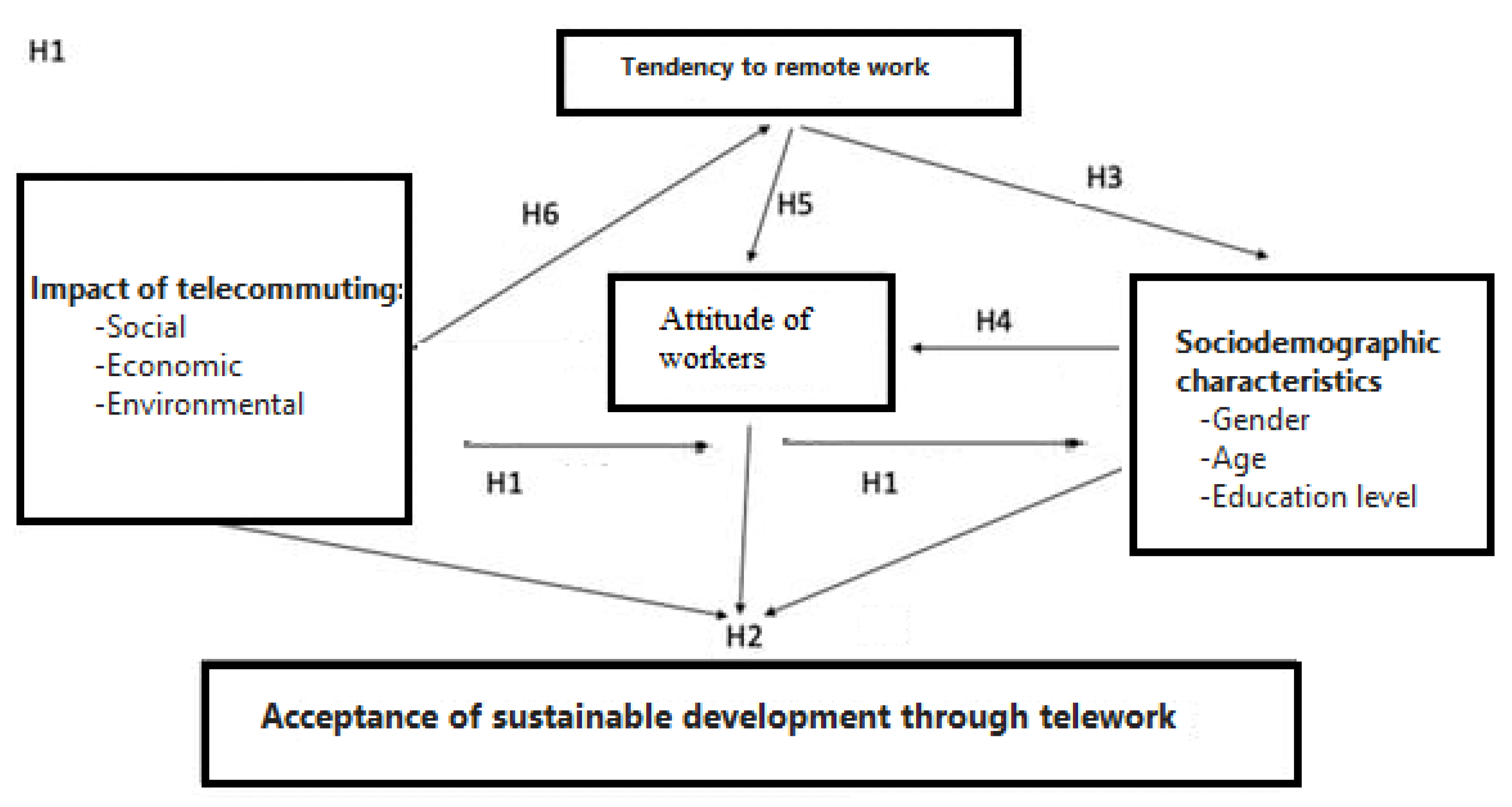
Quantitative research was chosen by using a questionnaire to conduct the research. Quantitative research is an important and frequently used way of collecting data, which allows examining the relationship between variables, as well as collecting a large amount of data [101]. The general objective of the research is to investigate the attitude and behavior of employees in teleworkable sectors of greek health care units during the covid-19 confinement period. Based on the purpose of the research, the research design focused on the following research hypotheses, which are also illustrated in the following research model (see Figure 2).
Figure 2.
Research model.
3.2. Research Tool and Data Collection
The questionnaire was created in proportion to the objectives of the research, and it was based on previous research efforts of Baert et.al. [4], Raišienė et.al.[57] and Schuster et.al.[60]. The types of closed questions mainly used are double choice, multiple choice, Likert scale and importance scale. The majority of answers to the questions are given on a 5-point Likert scale, so that the respondents can indicate the level that best represents them.
Τhe questionnaires were distributed online to hospital administrators in Greece, at a time when teleworking was still very common due to the measures against the spread of Covid-19.The research took place in September and October 2021. Participation was voluntary and anonymous.
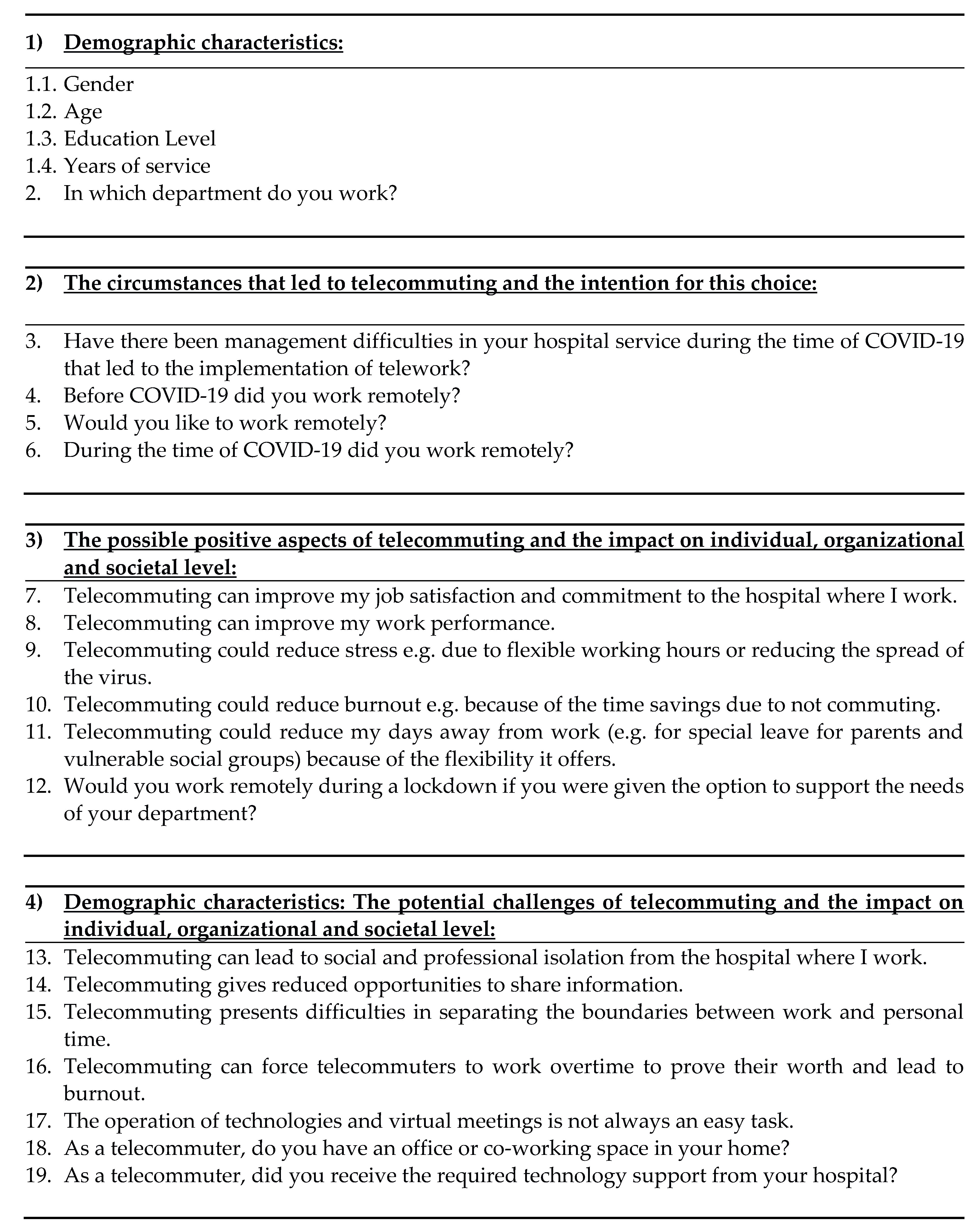
The questionnaire includes 23 questions (see Table 7) that are classified into 4 different groups, according to the purposes of the research, its objectives and the research hypotheses. The groups concerned the following:
1) Demographic data (Questions No.1.1-1.4 &No.2). The data of the questions No.1.1 to No.1.4 are categorical (nominal data) and concern the following: gender, age, education and years of service. While question 2 is open-ended and concerns the employment department in order to note the range of departments in which teleworking can be implemented in a hospital.
2) Questions about the circumstances that led to telecommuting and the intention for this choice (questions No.3-6).
3) Questions about the possible positive aspects of telecommuting and the impact on individual, organizational and societal level (questions No.7-12).
4) Questions about the potential challenges of telecommuting and the impact on individual, organizational and societal level (questions No.13-19).
Table 7.
Structure of the Questionnaire.
3.3. Sampling and Participants
Sample selection refers to the taking of a number of respondents from the wider community [101]. In particular, the research population is the total of possible respondents that can be selected during the research process [101]. In the present survey, the target population is the teleworkable / administrative sectors of greek health and welfare units, with the final sample of the survey being 125 respondents. The selection of the respondents was made randomly from a sampling frame of healthcare worker social networking groups. Table 4.18 shows the answers of the respondents regarding their demographic characteristics. Specifically, 87.2% were women, 12.8% were men. Regarding their age, it is observed that 5.6% were 55+ years old, 75.2% were 41-55 years old, 11.2% were 31-40 years old and 6.4% were 25-30 years old and 1.6% reported being 18-24 years old.
4. Results
4.1. Results of Descriptive Statistics
First, the results obtained using Descriptive Statistics are going to be presented. Thus, for the categorical variables, the absolute and relative frequency for each of their categories will be presented. For the ordinal variables, in addition to the absolute and relative frequencies, the median value and the interquartile range will also be presented, two statistics suitable for describing Likert-type variables.
4.1.1. Demographic characteristics
125 people took part in this research, of which 87.2% were women, 12.8% were men (Table 4.1). Regarding their age, it is observed that 5.6% were 55+ years old, 75.2% were 41-55 years old, 11.2% were 31-40 years old and 6.4% were 25-30 years old and 1.6% reported being 18-24 years old.
Also shown is the distribution of the participants' responses regarding their education. More specifically, it is found that 43.2% participants were graduates of higher education, 33.6% were holders of postgraduate degrees, 19.2% were graduates of secondary education and 4% were holders of Ph.D.
For years of service, from the Table 4.1 below, the median was 17 years, with an interquartile range of 11 years.
Table 4.1.
Demographic characteristics.
| Distribution of answers regarding the sample (N=125): | ||||
| 1.1. Gender | ||||
| Frequency | Percent | Valid Percent | Cumulative Percent | |
| Female | 109 | 87.2 | 87.2 | 87.2 |
| Male | 16 | 12.8 | 12.8 | 100 |
| Total | 125 | 100 | 100 | |
| 1.2. Age | ||||
| 18-24 | 2 | 1.6 | 1.6 | 1.6 |
| 25-30 | 8 | 6.4 | 6.4 | 8 |
| 31-40 | 14 | 11.2 | 11.2 | 19.2 |
| 41-55 | 94 | 75.2 | 75.2 | 94.4 |
| 55+ | 7 | 5.6 | 5.6 | 100 |
| Total | 125 | 100 | 100 | |
| 1.3. Education Level | ||||
| Secondary education | 24 | 19.2 | 19.2 | 19.2 |
| Higher education | 54 | 43.2 | 43.2 | 62.4 |
| Master's degree holder | 42 | 33.6 | 33.6 | 96 |
| Holder of a Ph.D | 5 | 4 | 4 | 100 |
| Total | 125 | 100 | 100 | |
| 1.4.Years of service: Median=17.00 . Interquartile Range: 11.00 | ||||
Regarding the employment section of the sample, the Table 4.2 shows that the majority of participants were administrative employees of many different hospital departments (32.8%). The departments with the highest percentage were secretarial (32%) and accounting employees (24%), while HR department (6.4%) and IT employees (4.8%) also had comparatively high rates of telecommuting.
Table 4.2.
Distribution of responses to the following question (N=125): In which department do you work?
Table 4.2.
Distribution of responses to the following question (N=125): In which department do you work?
| Frequency | Percent | Valid Percent | Cumulative Percent | |
| Citizen service office | 1 | 0.8 | 0.8 | 0.8 |
| Call center | 1 | 0.8 | 0.8 | 1.6 |
| Surgery warehouse | 1 | 0.8 | 0.8 | 2.4 |
| Secretariat | 40 | 32 | 32 | 34.4 |
| Office of Education | 1 | 0.8 | 0.8 | 35.2 |
| Program management office | 1 | 0.8 | 0.8 | 36 |
| Patient movement office | 5 | 4 | 4 | 40 |
| Supply office | 3 | 2.4 | 2.4 | 42.4 |
| Telemedicine design and development office | 1 | 0.8 | 0.8 | 43.2 |
| Dietetics department | 2 | 1.6 | 1.6 | 44.8 |
| Human resources management | 1 | 0.8 | 0.8 | 45.6 |
| Material Management Department | 1 | 0.8 | 0.8 | 46.4 |
| Hospital director | 3 | 2.4 | 2.4 | 48.8 |
| Quality control department | 1 | 0.8 | 0.8 | 49.6 |
| Medical service | 1 | 0.8 | 0.8 | 50.4 |
| Social service | 1 | 0.8 | 0.8 | 51.2 |
| Accounting department | 30 | 24 | 24 | 75.2 |
| Payroll | 1 | 0.8 | 0.8 | 76 |
| Nursing department | 2 | 1.6 | 1.6 | 77.6 |
| Economics Department | 4 | 3.2 | 3.2 | 80.8 |
| Pathological clinic | 1 | 0.8 | 0.8 | 81.6 |
| Order Office | 1 | 0.8 | 0.8 | 82.4 |
| Nursing service | 1 | 0.8 | 0.8 | 83.2 |
| Department of receipt of sanitary material | 1 | 0.8 | 0.8 | 84 |
| Information technology department | 6 | 4.8 | 4.8 | 88.8 |
| Protocol Department | 2 | 1.6 | 1.6 | 90.4 |
| Human ressources Department | 8 | 6.4 | 6.4 | 96.8 |
| Quality control service | 1 | 0.8 | 0.8 | 97.6 |
| Pharmacy | 1 | 0.8 | 0.8 | 98.4 |
| Psychiatric clinic | 2 | 1.6 | 1.6 | 100 |
| Total | 125 | 100 | 100 |
From the demographic characteristics it is concluded that women participants are the majority compared to men. Although in our survey an attempt was made to send questionnaires to an equal number of men and women, the female responses received were overwhelmingly greater. This fact can be a limitation of our research and may mean that most of the men who did not participate in the survey have never worked remotely. Therefore, it could be assumed that telecommuting in our research serves women more, possibly because of their role as mothers and homecarers. However, further investigation of the matter is suggested to confirm the assumption.
4.1.2. Descriptions for the main research part
Participants were then asked a number of questions (Table 4.3 to Table 4.19) related to employment in greek health care units hospitals during the Covid-19 lockdown and telecommuting. The following tables show the frequencies and percentages, while they include the median and the interquartile range. For variables that were nominal, only frequencies and percentages are given.
Table 4.3.
Distribution of responses to the following question (N=125): Have there been management difficulties in your hospital service during the time of COVID-19 that led to the implementation of telework?
Table 4.3.
Distribution of responses to the following question (N=125): Have there been management difficulties in your hospital service during the time of COVID-19 that led to the implementation of telework?
| Frequency | Percent | Valid Percent | Cumulative Percent | |
| I absolutely disagree | 2 | 1.6 | 1.6 | 1.6 |
| Disagree | 3 | 2.4 | 2.4 | 4 |
| I neither agree nor disagree | 18 | 14.4 | 14.4 | 18.4 |
| Agree | 50 | 40 | 40 | 58.4 |
| Strongly Agree | 52 | 41.6 | 41.6 | 100 |
| Total | 125 | 100 | 100 | |
| Median=4 . Interquartile Range=1 | ||||
Table 4.4.
Distribution of responses to the following question (N=125): Before COVID-19 did you work remotely?
Table 4.4.
Distribution of responses to the following question (N=125): Before COVID-19 did you work remotely?
| Frequency | Percent | Valid Percent | Cumulative Percent | ||
| No | 109 | 87.2 | 87.2 | 87.2 | |
| yes | 16 | 12.8 | 12.8 | 100.0 | |
| Total | 125 | 100.0 | 100.0 | ||
Table 4.5.
Distribution of responses to the following question (N=125): Would you like to work remotely?
Table 4.5.
Distribution of responses to the following question (N=125): Would you like to work remotely?
| Frequency | Percent | Valid Percent | Cumulative Percent | ||
| Νο | 47 | 37.6 | 37.6 | 37.6 | |
| Yes | 78 | 62.4 | 62.4 | 100.0 | |
| Total | 125 | 100.0 | 100.0 | ||
Table 4.6.
Distribution of responses to the following question (N=125): During the time of COVID-19 did you work remotely?
Table 4.6.
Distribution of responses to the following question (N=125): During the time of COVID-19 did you work remotely?
| Frequency | Percent | Valid Percent | Cumulative Percent | ||
| Νο | 44 | 35.2 | 35.2 | 35.2 | |
| Yes | 81 | 64.8 | 64.8 | 100.0 | |
| Total | 125 | 100.0 | 100.0 | ||
From the comparison of the results of Tables 4.4 -4.5 -4.6 it can be concluded that before the pandemic a small percentage of 12,8% of the workers in the Greek health and welfare units worked remotely (see Table 4.8) while since the Covid-19 pandemic a 64,8% of employees worked remotely (see Table 4.5), while telecommuting seems to be viewed positively by a 62.4% of employees (see Table 4.6).
Table 4.7.
Distribution of responses to the following question (N=125): Telecommuting can improve my job satisfaction and commitment to the hospital where I work.
Table 4.7.
Distribution of responses to the following question (N=125): Telecommuting can improve my job satisfaction and commitment to the hospital where I work.
| Frequency | Percent | Valid Percent | Cumulative Percent | ||
| I absolutely disagree | 13 | 10.4 | 10.4 | 10.4 | |
| Disagree | 14 | 11.2 | 11.2 | 21.6 | |
| I neither agree nor disagree | 43 | 34.4 | 34.4 | 56.0 | |
| Agree | 32 | 25.6 | 25.6 | 81.6 | |
| Strongly Agree | 23 | 18.4 | 18.4 | 100.0 | |
| Total | 125 | 100.0 | 100.0 | ||
| Median=3.Interquartile Range=4 | |||||
Table 4.8.
Distribution of responses to the following question (N=125): Telecommuting can improve my work performance.
Table 4.8.
Distribution of responses to the following question (N=125): Telecommuting can improve my work performance.
| Frequency | Percent | Valid Percent | Cumulative Percent | ||
| I absolutely disagree | 14 | 11.2 | 11.2 | 11.2 | |
| Disagree | 22 | 17.6 | 17.6 | 28.8 | |
| I neither agree nor disagree | 34 | 27.2 | 27.2 | 56.0 | |
| Agree | 29 | 23.2 | 23.2 | 79.2 | |
| Strongly Agree | 26 | 20.8 | 20.8 | 100.0 | |
| Total | 125 | 100.0 | 100.0 | ||
| Median=3.Interquartile Range=2 | |||||
Table 4.9.
Distribution of responses to the following question (N=125): Telecommuting could reduce stress e.g. due to flexible working hours or reducing the spread of the virus.
Table 4.9.
Distribution of responses to the following question (N=125): Telecommuting could reduce stress e.g. due to flexible working hours or reducing the spread of the virus.
| Frequency | Percent | Valid Percent | Cumulative Percent | ||
| I absolutely disagree | 4 | 3.2 | 3.2 | 3.2 | |
| Disagree | 5 | 4.0 | 4.0 | 7.2 | |
| I neither agree nor disagree | 28 | 22.4 | 22.4 | 29.6 | |
| Agree | 45 | 36.0 | 36.0 | 65.6 | |
| Strongly Agree | 43 | 34.4 | 34.4 | 100.0 | |
| Total | 125 | 100.0 | 100.0 | ||
| Median=4.Interquartile Range=2 | |||||
Table 4.10.
Distribution of responses to the following question (N=125): Telecommuting could reduce burnout e.g. because of the time savings due to not commuting.
Table 4.10.
Distribution of responses to the following question (N=125): Telecommuting could reduce burnout e.g. because of the time savings due to not commuting.
| Frequency | Percent | Valid Percent | Cumulative Percent | ||
| Valid | I absolutely disagree | 4 | 3.2 | 3.2 | 3.2 |
| Disagree | 12 | 9.6 | 9.6 | 12.8 | |
| I neither agree nor disagree | 17 | 13.6 | 13.6 | 26.4 | |
| Agree | 47 | 37.6 | 37.6 | 64.0 | |
| Strongly Agree | 45 | 36.0 | 36.0 | 100.0 | |
| Total | 125 | 100.0 | 100.0 | ||
| Median=4.Interquartile Range=2 | |||||
Table 4.11.
Distribution of responses to the following question (N=125): Telecommuting could reduce my days away from work (eg for special leave for parents and vulnerable social groups) because of the flexibility it offers.
Table 4.11.
Distribution of responses to the following question (N=125): Telecommuting could reduce my days away from work (eg for special leave for parents and vulnerable social groups) because of the flexibility it offers.
| Frequency | Percent | Valid Percent | Cumulative Percent | ||
| I absolutely disagree | 6 | 4.8 | 4.8 | 4.8 | |
| Disagree | 6 | 4.8 | 4.8 | 9.6 | |
| I neither agree nor disagree | 19 | 15.2 | 15.2 | 24.8 | |
| Agree | 46 | 36.8 | 36.8 | 61.6 | |
| Strongly Agree | 48 | 38.4 | 38.4 | 100.0 | |
| Total | 125 | 100.0 | 100.0 | ||
| Median=4.Interquartile Range=2 | |||||
Table 4.12.
Distribution of responses to the following question (N=125): Would you work remotely during a lockdown/quarantine if you were given the option to support the needs of your department?
Table 4.12.
Distribution of responses to the following question (N=125): Would you work remotely during a lockdown/quarantine if you were given the option to support the needs of your department?
| Frequency | Percent | Valid Percent | Cumulative Percent | ||
| Νο | 6 | 4.8 | 4.8 | 4.8 | |
| Yes | 119 | 95.2 | 95.2 | 100.0 | |
| Total | 125 | 100.0 | 100.0 | ||
Furthermore, research proposed that teleworking could improve employees' job satisfaction and commitment to an organization and even their job performance (see Tables 4.7-4.8). Teleworking could also reduce work-related burnout and stress, due to reduced commuting or more flexible hours (see Tables 4.9-4.10). Other profits include reduced commuting costs and flexibility to work from anywhere (see Tables 4.10-4.11). In addition, thanks to remote work, the health and welfare units can thus continue without interruption the operation of their administrative services by supporting effectively and dynamically all the other health and welfare services (see Table 4.12).
Table 4.13.
Distribution of responses to the following question (N=125): Telecommuting can lead to social and professional isolation from the hospital where I work.
Table 4.13.
Distribution of responses to the following question (N=125): Telecommuting can lead to social and professional isolation from the hospital where I work.
| Frequency | Percent | Valid Percent | Cumulative Percent | ||
| I absolutely disagree | 3 | 2.4 | 2.4 | 2.4 | |
| Disagree | 16 | 12.8 | 12.8 | 15.2 | |
| I neither agree nor disagree | 43 | 34.4 | 34.4 | 49.6 | |
| Agree | 33 | 26.4 | 26.4 | 76.0 | |
| Strongly Agree | 30 | 24.0 | 24.0 | 100.0 | |
| Total | 125 | 100.0 | 100.0 | ||
| Median=4.Interquartile Range=1 | |||||
Table 4.14.
Distribution of responses to the following question (N=125): Telecommuting gives reduced opportunities to share information.
Table 4.14.
Distribution of responses to the following question (N=125): Telecommuting gives reduced opportunities to share information.
| Frequency | Percent | Valid Percent | Cumulative Percent | ||
| I absolutely disagree | 5 | 4.0 | 4.0 | 4.0 | |
| Disagree | 17 | 13.6 | 13.6 | 17.6 | |
| I neither agree nor disagree | 34 | 27.2 | 27.2 | 44.8 | |
| Agree | 46 | 36.8 | 36.8 | 81.6 | |
| Strongly Agree | 23 | 18.4 | 18.4 | 100.0 | |
| Total | 125 | 100.0 | 100.0 | ||
| Median=4.Interquartile Range=1 | |||||
Table 4.15.
Distribution of responses to the following question (N=125): Telecommuting presents difficulties in separating the boundaries between work and personal time.
Table 4.15.
Distribution of responses to the following question (N=125): Telecommuting presents difficulties in separating the boundaries between work and personal time.
| Frequency | Percent | Valid Percent | Cumulative Percent | ||
| I absolutely disagree | 4 | 3.2 | 3.2 | 3.2 | |
| Disagree | 12 | 9.6 | 9.6 | 12.8 | |
| I neither agree nor disagree | 28 | 22.4 | 22.4 | 35.2 | |
| Agree | 39 | 31.2 | 31.2 | 66.4 | |
| Strongly Agree | 42 | 33.6 | 33.6 | 100.0 | |
| Total | 125 | 100.0 | 100.0 | ||
| Median=4.Interquartile Range=2 | |||||
Table 4.16.
Distribution of responses to the following question (N=125): Telecommuting can force telecommuters to work overtime to prove their worth and lead to burnout.
Table 4.16.
Distribution of responses to the following question (N=125): Telecommuting can force telecommuters to work overtime to prove their worth and lead to burnout.
| Frequency | Percent | Valid Percent | Cumulative Percent | ||
| I absolutely disagree | 10 | 8.0 | 8.0 | 8.0 | |
| Disagree | 20 | 16.0 | 16.0 | 24.0 | |
| I neither agree nor disagree | 31 | 24.8 | 24.8 | 48.8 | |
| Agree | 34 | 27.2 | 27.2 | 76.0 | |
| Strongly Agree | 30 | 24.0 | 24.0 | 100.0 | |
| Total | 125 | 100.0 | 100.0 | ||
| Median=4.Interquartile Range=1 | |||||
Table 4.17.
Distribution of responses to the following question (N=125): The operation of technologies and virtual meetings is not always an easy task.
Table 4.17.
Distribution of responses to the following question (N=125): The operation of technologies and virtual meetings is not always an easy task.
| Frequency | Percent | Valid Percent | Cumulative Percent | ||
| I absolutely disagree | 4 | 3.2 | 3.2 | 3.2 | |
| Disagree | 12 | 9.6 | 9.6 | 12.8 | |
| I neither agree nor disagree | 35 | 28.0 | 28.0 | 40.8 | |
| Agree | 48 | 38.4 | 38.4 | 79.2 | |
| Strongly Agree | 26 | 20.8 | 20.8 | 100.0 | |
| Total | 125 | 100.0 | 100.0 | ||
| Median=4.Interquartile Range=1 | |||||
Table 4.18.
Distribution of responses to the following question (N=125): As a telecommuter, do you have an office or co-working space in your home?
Table 4.18.
Distribution of responses to the following question (N=125): As a telecommuter, do you have an office or co-working space in your home?
| Frequency | Percent | Valid Percent | Cumulative Percent | ||
| Νο | 51 | 40.8 | 40.8 | 40.8 | |
| Yes | 74 | 59.2 | 59.2 | 100.0 | |
| Total | 125 | 100.0 | 100.0 | ||
Table 4.19.
Distribution of responses to the following question (N=125): As a telecommuter, did you receive the required technology support from your hospital?
Table 4.19.
Distribution of responses to the following question (N=125): As a telecommuter, did you receive the required technology support from your hospital?
| Frequency | Percent | Valid Percent | Cumulative Percent | ||
| Valid | Νο | 96 | 76.8 | 76.8 | 76.8 |
| Yes | 29 | 23.2 | 23.2 | 100.0 | |
| Total | 125 | 100.0 | 100.0 | ||
However, telecommuting is confirmed by our case study to have disadvantages, such as social and professional isolation, reduced opportunities for information sharing, and difficulties in separating work and personal time (see Tables 4.13-4.15). The lack of physical separation between these two worlds can create problems, such as family responsibilities extending into work and professional obligations encroaching on family time. This can cause telecommuters to work overtime to prove themselves, leading to burnout. The ability to be constantly connected to work through a variety of technologies (e.g. Zoom, Slack) can also make workers feel like they cannot unplug at the end of the day (see Tables 4.16-4.17).
It is also noteworthy that many employees (40.8%, see Table 4.18) do not have a suitable space for teleworking, while the vast majority (76.18%, see Table 4.19) lack technological support during the performance of their work duties.
4.2. Results of Inductive Statistics
In the second part of the analysis of the results obtained from the present research, the relationships between the examined variables were studied.
4.2.1. Relationship between main research part questions and age
Because the dependent variables were ordinal and age had two levels, we used the Mann–Whitney test to examine possible differences in their responses by age.
We find only one statistically significant relationship, which concerns responses to the question "Have there been management difficulties in your hospital service during the time of COVID-19 that led to the implementation of telework" and age (U = 776.5. p = 0.003). Looking at the mean ranks, we conclude that participants who were 41 years of age or older expressed a higher degree of agreement with the proposition that there were ‘management difficulties in their hospital service during the time of COVID-19 that led to the implementation of telework’ than those who were under 41 years. Therefore, participants who were 41 years of age or older appear to have struggled more than participants who were under 41 years of age (Table 4.20).
Table 4.20.
Differences in responses by age.
| Questions | Age | N | Mean Rank | Sum of Ranks |
| 1) Have there been management difficulties in your hospital service during the time of COVID-19 that led to the implementation of telework? | <41 years old | 24 | 44.85 | 1076.50 |
| 41 years and older | 101 | 67.31 | 6798.50 | |
| U=776.5 P=0.003 | ||||
| 2) Telecommuting can improve my job satisfaction and commitment to the hospital where I work. | <41 years old | 24 | 67.65 | 1623.50 |
| 41 years and older | 101 | 61.90 | 6251.50 | |
| U=1100.5 P=0.47 | ||||
| 3) Telecommuting can improve my work performance. | <41 years old | 24 | 69.92 | 1678.00 |
| 41 years and older | 101 | 61.36 | 6197.00 | |
| U=1046.0 P=0.286 | ||||
| 4) Telecommuting could reduce stress e.g. due to flexible working hours or reducing the spread of the virus. | <41 years old | 24 | 69.48 | 1667.50 |
| 41 years and older | 101 | 61.46 | 6207.50 | |
| U=1056.5 P=0.305 | ||||
| 5) Telecommuting could reduce burnout e.g. because of the time savings due to not commuting. | <41 years old | 24 | 69.52 | 1668.50 |
| 41 years and older | 101 | 61.45 | 6206.50 | |
| U=1055.5 P=0.300 | ||||
| 6) Telecommuting could reduce my days away from work because of the flexibility it offers. | <41 years old | 24 | 58.04 | 1393.00 |
| 41 years and older | 101 | 64.18 | 6482.00 | |
| U=1093.0 P=0.429 | ||||
| 7) Telecommuting can lead to social and professional isolation from the hospital where I work. | <41 years old | 24 | 63.40 | 1521.50 |
| 41 years and older | 101 | 62.91 | 6353.50 | |
| U=1202.5 P=0.951 | ||||
| 8)Telecommutinggives reduced opportunities to share information. | <41 years old | 24 | 60.08 | 1442.00 |
| 41 years and older | 101 | 63.69 | 6433.00 | |
| U=1142.0 P=0.648 | ||||
| 9) Telecommuting presents difficulties in separating the boundaries between work and personal time. | <41 years old | 24 | 61.31 | 1471.50 |
| 41 years and older | 101 | 63.40 | 6403.50 | |
| U=1171.5 P=0.791 | ||||
| 10) Telecommuting can force telecommuters to work overtime to prove their worth and lead to burnout. | <41 years old | 24 | 53.46 | 1283.00 |
| 41 years and older | 101 | 65.27 | 6592.00 | |
| U=983.0 P=0.140 | ||||
| 11) The operation of technologies and virtual meetings is not always an easy task | <41 years old | 24 | 59.75 | 1434.00 |
| 41 years and older | 101 | 63.77 | 6441.00 | |
| U=1134.0 P=0.609 | ||||
In the Table 4.21 anx2 independence test was applied, because we had a series of nominal variables (Yes/No answers) and an ordinal one (age). From the results that follow, no statistically significant relationship is found.
Table 4.21.
Anx2 independence test to a series of nominal variables (Yes/No answers) & an ordinal one (age).
Table 4.21.
Anx2 independence test to a series of nominal variables (Yes/No answers) & an ordinal one (age).
| Variables | Categories | Age | x2 (1) | p | |
| <41 years old | 41+ years old | ||||
| n (%) | n (%) | ||||
| 1) Before COVID-19. did you work remotely? | Νο | 19 | 90 | 1.72 | 0.190 |
| 79.2% | 89.1% | ||||
| Yes | 5 | 11 | |||
| 20.8% | 10.9% | ||||
| 2) Would you like to work remotely? | Νο | 7 | 40 | 0.90 | 0.343 |
| 29.2% | 39.6% | ||||
| Yes | 17 | 61 | |||
| 70.8% | 60.4% | ||||
| 3) During the time of COVID-19. did you work remotely? | Νο | 8 | 36 | 0.045 | 0.831 |
| 33.3% | 35.6% | ||||
| Yes | 16 | 65 | |||
| 66.7% | 64.4% | ||||
| 4) As a telecommuter. do you have an office or co-working space in your home? | Νο | 10 | 41 | 0.009 | 0.923 |
| 41.7% | 40.6% | ||||
| Yes | 14 | 60 | |||
| 58.3% | 59.4% | ||||
| 5) As a telecommuter. did you receive the required technology support from your hospital? | Νο | 21 | 75 | 1.909 | 0.167 |
| 87.5% | 74.3% | ||||
| Yes | 3 | 26 | |||
| 12.5% | 25.7% | ||||
4.2.2. Relationship between main research part questions and educational level
Because the dependent variables were ordinal and educational level was categorized into three levels (Secondary education, Higher education, Master's/PhD holder), the Kruskal-Wallis test was used to examine possible differences in their responses according to their educational level.
Only one statistically significant relationship was found, which concerns responses to the question "Were there any management difficulties in your hospital service during the COVID-19 era that led to the implementation of telework?" and educational level (x2(2) = 7.796,p = 0.020).
Also, in the Τable-4.22, the mean rank per age category is presented, as well as the corresponding values of x2(2) and p.
Table 4.22.
Τhe mean rank per age category & the corresponding values of x2(2) & p.
| Questions | Education level | N | Mean Rank |
| 1) Were there any management difficulties in your hospital service during the COVID-19 era that led to the implementation of telework? | Secondary education | 24 | 64.08 |
| Higher education | 54 | 54.05 | |
| Master's/PhD holder | 47 | 72.73 | |
| x2(2) = 7.796 p = 0.020 | |||
| 2) Telecommuting can improve my job satisfaction and commitment to the hospital where I work. | Secondary education | 24 | 49.31 |
| Higher education | 54 | 64.21 | |
| Master’s/PhD holder | 47 | 68.60 | |
| x2(2) = 4.934 p = 0.085 | |||
| 3) Telecommuting can improve my work performance. | Secondary education | 24 | 52.06 |
| Higher education | 54 | 64.16 | |
| Master’s/PhD holder | 47 | 67.26 | |
| x2(2) = 3.038 p = 0.219 | |||
| 4) Telecommuting could reduce stress e.g. due to flexible working hours or reducing the spread of the virus. | Secondary education | 24 | 60.10 |
| Higher education | 54 | 60.28 | |
| Master’s/PhD holder | 47 | 67.61 | |
| x2(2) = 1.351 p = 0.509 | |||
| 5) Telecommuting could reduce burnout e.g. because of the time savings due to not commuting. | Secondary education | 24 | 56.27 |
| Higher education | 54 | 63.56 | |
| Master’s/PhD holder | 47 | 65.79 | |
| x2(2) = 1.248 p = 0.536 | |||
| 6) Telecommuting could reduce my days away from work (e.g. for special leave for parents and vulnerable social groups) because of the flexibility it offers. | Secondary education | 24 | 57.44 |
| Higher education | 54 | 57.64 | |
| Master’s/PhD holder | 47 | 72.00 | |
| x2(2) = 5.224 p = 0.073 | |||
| 7) Telecommuting can lead to social and professional isolation from the hospital where I work. | Secondary education | 24 | 67.92 |
| Higher education | 54 | 65.36 | |
| Master’s/PhD holder | 47 | 57.78 | |
| x2(2) = 1.782 p = 0.410 | |||
| 8) Telecommutinggives reduced opportunities to share information. | Secondary education | 24 | 70.31 |
| Higher education | 54 | 62.61 | |
| Master’s/PhD holder | 47 | 59.71 | |
| x2(2) = 1.488 p = 0.475 | |||
| 9) Telecommuting presents difficulties in separating the boundaries between work and personal time. | Secondary education | 24 | 61.54 |
| Higher education | 54 | 65.47 | |
| Master’s/PhD holder | 47 | 60.90 | |
| x2(2) = 0.487 p = 0.784 | |||
| 10) Telecommuting can force telecommuters to work overtime to prove their worth and lead to burnout. | Secondary education | 24 | 60.38 |
| Higher education | 54 | 61.76 | |
| Master’s/PhD holder | 47 | 65.77 | |
| x2(2) = 0.490 p = 0.783 | |||
| 11) The operation of technologies and virtual meetings is not always an easy task. | Secondary education | 24 | 64.19 |
| Higher education | 54 | 66.73 | |
| Master’s/PhD holder | 47 | 58.11 | |
| x2(2) = 1.597 p = 0.450 | |||
To see between which categories of educational level there are differences on the variable "Were there managerial difficulties in your service of your hospital during the time of COVID-19 that led to the implementation of telework", we perform paired Mann-Whitney tests. From the results that follow, we conclude that the participants who were holders of a master's/doctorate degree showed a higher degree of agreement with the proposition in question, compared to those who had Higher education (U=882.5 p=0.004). Therefore, participants who held a master's/doctoral degree seem to have had more difficulty than participants who had a Higher education.
Also, in the Table 4.23 the mean rank per education level category is presented.as well as the corresponding values of U and p.
Table 4.23.
The mean rank per education level category & the corresponding values of U & p.
| Education level | Mean Rank | U | P | |
| Have there been management difficulties in your hospital service …? | Secondary education | 43.54 | ||
| Higher education | 37.70 | |||
| 551.000 | 0.264 | |||
| Secondary education | 33.04 | |||
| Master’s/PhD holder | 37.51 | |||
| 493.000 | 0.341 | |||
| Higher education | 43.84 | |||
| Master’s/PhD holder | 59.22 | |||
| 882.500 | 0.004 |
Finally, because there were a number of nominal variables (yes/no responses) and one ordinal (educational level), anx2independence test was applied (see Table 4.24). From the results that follow, two statistically significant relationships are identified.
- A statistically significant relationship is found between educational level and the variable "Would you like to work remotely?" (x2 (2) =8.46. p=0.015). In particular, the majority of participants who held a master's degree/doctorate (72.3%) wished to work remotely, as did the majority of participants who were graduates of higher education (64.8%). However, the majority of participants who were secondary school graduates did not wish to work remotely (62.5%).
- A statistically significant relationship is found between educational level and the variable "As teleworkers, did you receive the required technological support from your hospital?" (x2 (2) =10.01. p=0.007). In particular, the majority of participants who held a Master's/PhD (72.3%) stated that they had an office or friendly workspace at home. as did the majority of participants who were graduates of higher education (59.3%). However, the majority of participants who were secondary school graduates stated that they did not have an office or a friendly workspace at home (66.7%).
Table 4.24.
An x2 independence test, on nominal variables (yes/no responses) &an ordinal (educational level).
Table 4.24.
An x2 independence test, on nominal variables (yes/no responses) &an ordinal (educational level).
| Education level | ||||||
| Secondary education | Higher education | Master’s/PhD holder | ||||
| 1)Before COVID-19. did you work remotely? | Νο | Count | 20 | 49 | 40 | 109 |
| % within Education level | 83.3% | 90.7% | 85.1% | 87.2% | ||
| Yes | Count | 4 | 5 | 7 | 16 | |
| % within Education level | 16.7% | 9.3% | 14.9% | 12.8% | ||
| x2 (2) =1.113, p=0.573 | ||||||
| 2)Would you like to work remotely? | Νο | Count | 15 | 19 | 13 | 47 |
| % within Education level | 62.5% | 35.2% | 27.7% | 37.6% | ||
| Yes | Count | 9 | 35 | 34 | 78 | |
| % within Education level | 37.5% | 64.8% | 72.3% | 62.4% | ||
| x2 (2) =8.46, p=0.015) | ||||||
| 3)During the time of COVID-19. did you work remotely? | Νο | Count | 12 | 21 | 11 | 44 |
| % within Education level | 50.0% | 38.9% | 23.4% | 35.2% | ||
| Yes | Count | 12 | 33 | 36 | 81 | |
| % within Education level | 50.0% | 61.1% | 76.6% | 64.8% | ||
| x2 (2) =5.494.p=0.064 | ||||||
| 4)As a telecommuter. do you have an office or co-working space in your home? | Νο | Count | 16 | 22 | 13 | 51 |
| % within Education level | 66.7% | 40.7% | 27.7% | 40.8% | ||
| Yes | Count | 8 | 32 | 34 | 74 | |
| % within Education level | 33.3% | 59.3% | 72.3% | 59.2% | ||
| x2 (2) =10.01, p=0.007 | ||||||
| 5)As a telecommuter. did you receive the required technology support from your hospital? | Νο | Count | 22 | 39 | 35 | 96 |
| % within Education level | 91.7% | 72.2% | 74.5% | 76.8% | ||
| Yes | Count | 2 | 15 | 12 | 29 | |
| % within Education level | 8.3% | 27.8% | 25.5% | 23.2% | ||
| x2 (2) =3.756, p=0.153 | ||||||
5. Discussion
The effects of telecommuting have been widely discussed in the last decade and especially since the emergence of covid-19, during which many people were forced to telecommute due to lockdowns. This issue has been discussed both in the relevant literature and in official government documents at an international level. Although the effects are rarely seen in isolation, they have been divided into different categories based on the changes they cause. The adoption of telecommuting measures has been shown to have economic, equity and environmental benefits for organizations, workers and local governments. Furthermore, the effects can be at a personal, organizational or societal level and by extension affect the achievement of the SDGs. Moreover, the importance and benefits of telework organization have been widely recognized by organizations, governments and academics around the world [105][106][41].
First, it was observed that employees' socio-demographic characteristics can potentially influence the perception of the difficulties that led to the adoption of teleworking during the crisis period as it happened with greek health care administrators during covid-19 (Hypothesis 1, confirmed), since participants who were 41 years of age or older seem to have struggled more than participants who were under 41 years of age. Also, the educational level of employees affects their intention to telework and is related to their positive or negative attitude to work from home (Hypothesis 2, confirmed). In particular, the majority of participants with a master's/Ph.D. desired to work remotely, as did the majority of higher education graduates, in contrast to secondary education graduates. Those findings are supported by previous studies, such as those of Moens et.al.[44], Beňo [7] and Gajendran & Harrison [14].
Furthermore, the educational level (and possibly the income of the employees since in Greek greek health care units the employees are paid according to their educational level) affects the existence of the necessary equipment and space at home, as well as the required technological support for the implementation of telework (Hypothesis 3, confirmed). More specifically, the majority of university graduate participants (of all levels) stated that they had an office or friendly work space at home but also received the required technological support from the hospital, in contrast to the participants who were secondary school graduates. Those findings are supported by previous studies, such as those of Cuerdo-Vilcheset.al.[12]and Campbell & Gavett [97]. Finally, it should be underlined that from Hypotheses 2 and 3 it may be concluded that the possibility for the adoption of telework is linked to the educational level and economic status of the employee, which creates social inequalities in access to telework. This element was previously mentioned in a research by Martins & Sobral [42].
In addition, supporting the findings of Boell et.al. [102] and Cuerdo-Vilcheset.al.[12], the research outcomes suggest that telecommuting could improve the job satisfaction and commitment [38][8][69] of employees in an organization and even their work performance. These positives could be offset by the negatives associated with organizational stress in order to predict acceptance of sustainable development through telework (Hypothesis 4, confirmed). At the same time, the assumption on the part of telecommuters, as emerged from the survey, that telecommuting could reduce burnout and stress, due to reduced commuting or more flexible hours, may contribute to the same goal [22][26][84].
Moreover, supporting the findings of Green et.al. [17] and Lebopo et.al. [38] the research outcomes suggest that the impact of telecommuting during the COVID-19 crisis is perceived in various aspects (social, economic, environmental) of hospital workers' lives and careers (Hypothesis 5, confirmed). This is also related to the fact that the impact of telecommuting may be even higher since the adoption of telecommuting can reduce commuting costs (for all parties, e.g. individuals, organisations and the environment), increasing the flexibility to work from anywhere, as it emerged from our case study [22][40][20][73].
It could also be implicitly concluded that higher acceptance of telecommuting (and by extension the sustainable development it entails) can be achieved when there are higher levels of positive economic and social impact. Finally, it is confirmed that employees' intention to telework in times of crisis to support the needs of the hospital's administrative departments is not influenced by socio-demographic factors (Hypothesis 6, confirmed), since the vast majority (95.2%) of the participants stated that they would work from distance during a lockdown/quarantine if given the option in order to support the needs of their department. Those findings are supported by previous studies, such as those of Moglia et.al. [45] and Karia & Asaari [35].
From the above it follows that there is an interconnection between the variables, as well as the multiple effects of telework on sustainable development in the teleworkable sectors of greek health care units.
5.1. Recommendations for future research
The present study only focused on one area, which can be characterized as a weakness, as the results cannot be compared to other regions or countries. However, this could be an opportunity for future research to be extended to other areas to provide an opportunity to compare and contrast both locally and internationally. This could lead to the inclusion of other variables, such as the association of telework with volunteering and teleworkers' intention to contribute to society and the achievement of the SDGs. In other words, the analysis can be further developed to expand the areas of focus and broaden our understanding of how the SDGs intersect with volunteering, which results from telecommuting. Therefore, the aim is to confirm telecommuting as an option for sustainable behavior, since it can be transformed into a community-friendly form of work for more workers. In each case the aim is to improve human well-being and enhance human and environmental health.
Then, it would be recommended to further research the topic in order to investigate the extent to which contemporary leaders possess the characteristics of digital leadership 4.0 linked to telework and digital transformation, as well as to future sustainability and the SDGs. This research could make a significant contribution to humanity's future crises.
Finally, a mixed research design approach that adds qualitative aspects in the form of interviews with both teleworkers and managers, as well as policy makers with could provide additional data on the research topic and in particular on promoting sustainable behaviors and acceptance of sustainable development through teleworking.
6. Conclusions
Telework has many aspects and ramifications, for this reason it is important to study this topic, in the service of the interest and general well-being of employees, organizations and the community. Research findings suggest that telecommuting has a greater impact on labor market, economic and social benefits. Thus, its impact is multiple and affects many aspects of society and the SDGs.
More specifically, the adoption of telecommuting requires complex and dynamic changes in technical and behavioral aspects. Few studies attempt to understand the organizational behavioral side of the successful transition to telework or some hybrid form of work. Thus, this study proposes a theoretical framework that addresses the requirements for successfully transitioning to a sustainable effectiveness with telecommuters, as well as telework leadership from an organizational perspective. In addition, the use of this framework could lead to the achievement of sustainable development.
Telecommuting has received tremendous attention from researchers and the public because of its potential for widespread benefits at the individual, organizational, and societal levels. However, there are potential downsides as well. This article provides a critical synthesis of the telework literature. An interdisciplinary, integrated understanding of both the advantages and disadvantages of telework can be used to more effectively shape and inform organizational practices and public policy.
In addition, an important positive aspect of telework that emerged from the present literature review appears to create opportunities for potential linkages between telework and other additional SDG areas, based on the fact that telework appears to be a community-friendly form of work. Therefore the giving and volunteering displayed by many teleworkers, as mentioned by Kamerade & Burchell [34], act as a counterweight to the position that it leads to social distancing and can lead to sustainable behaviors. For this reason, this research strongly suggests that leaders facilitate telecommuters to adopt green practices and volunteerism that can consequently contribute to the SDGs.
Based on the results of this study, we can also say that implementing a telecommuting program is a good way to create a climate that promotes greater employee satisfaction. This type of work facilitates meeting the basic psychological needs of employees and, consequently, providing arrangements that will promote greater job satisfaction. This conclusion provides evidence for organizations wishing to develop effective strategies for attracting and retaining staff. In other words, this result tends to support the idea that it is possible to create management practices that will counteract the supposed harmful effects, risks and social inequalities of telework.
In summary, to meet the challenges arising from unprecedented times, leaders should redesign their policies, while states should focus on safeguarding workers' rights and freedoms. The value of the most important factor (i.e. the employee) must therefore be assessed for the successful adoption of telework for the benefit of all parties involved (employees, organizations, society) and for the achievement of the social, environmental and organizational sustainability.
Author Contributions
Conceptualization, G.T. and A.V..; methodology, I.S., G.T., A.V and G.H.; software, I.S., A.V.; validation, I.S. and G.T.; formal analysis, G.T. and A.V.; investigation, G.T. and A.V.; resources, G.T. and A.V.; data curation, I.S., G.T., and G.H.; writing—original draft preparation, G.T. and A.V.; writing—review and editing, I.S., G.T., A.V. and G.H.; visualization, A.V. and G.H..; supervision, I.S. and G.T. ; project administration, I.S., G.T. and A.V. All authors have read and agreed to the published version of the manuscript.
Funding
This research received no external funding.
Institutional Review Board Statement
Not applicable.
Informed Consent Statement
Informed consent was obtained from all subjects involved in the study.
Data Availability Statement
Not applicable.
Conflicts of Interest
The authors declare no conflict of interest.
References
- Albrecht SL, Bakker AB, Gruman JA, Macey WH, Saks AM. Employee engagement, human resource management practices and competitive advantage: An integrated approach. Journal of Organizational Effectiveness: People and Performance. 2015 Mar 9.Available online: https://scholar.google.com/scholar?hl=en&as_sdt=0%2C5&q=%5B1%5D%09Albrecht+SL%2C+Bakker+AB%2C+Gruman+JA%2C+Macey+WH%2C+Saks+AM.+Employee+engagement%2C+human+resource+management+practices+and+competitive+advantage%3A+An+integrated+approach.+Journal+of+Organizational+Effectiveness%3A+People+and+Performance.+2015+Mar+9.&btnG= (accessed on 16 May 2023). [CrossRef]
- Alipour JV, Falck O, Schüller S. Homeofficewährend der Pandemie und die ImplikationenfüreineZeitnach der Krise. ifoSchnelldienst. 2020;73(07):30-6. Available online: https://scholar.google.com/scholar?hl=en&as_sdt=0%2C5&q=%5B2%5D%09Alipour%2C+J.+V.%2C+Falck%2C+O.%2C+%26+Sch%C3%BCller%2C+S.+%282020%29.+Homeoffice+w%C3%A4hrend+der+Pandemie+und+die+Implikationen+f%C3%BCr+eine+Zeit+nach+der+Krise.+ifo+Schnelldienst%2C+73%2807%29%2C+30-36.&btnG=&https://www.econstor.eu/handle/10419/225150(accessed on 3 May 2023).
- Anderson N, Potočnik K, Zhou J. Innovation and creativity in organizations: A state-of-the-science review, prospective commentary, and guiding framework. Journal of management. 2014 Jul;40(5):1297-333. Available online: https://scholar.google.com/scholar?hl=en&as_sdt=0%2C5&q=%5B3%5D%09Anderson%2C+N.%2C+Poto%C4%8Dnik%2C+K.%2C+%26+Zhou%2C+J.+%282014%29.+Innovation+and+creativity+in+organizations%3A+A+state-of-the-science+review%2C+prospective+commentary%2C+and+guiding+framework.+Journal+of+management%2C+40%285%29%2C+1297-1333.+&btnG= (accessed on 16 May 2023). [CrossRef]
- Baert S, Lippens L, Moens E, Weytjens J, Sterkens P. The COVID-19 crisis and telework: A research survey on experiences, expectations and hopes. Available online: https://scholar.google.com/scholar?hl=en&as_sdt=0%2C5&q=%5B4%5D%09Baert%2C+S.%2C+Lippens%2C+L.%2C+Moens%2C+E.%2C+Weytjens%2C+J.%2C+%26Sterkens%2C+P.+%282020%29.+The+COVID- (accessed on 17 April 2023). [CrossRef]
- Balbontin C, Hensher DA, Beck MJ, Giesen R, Basnak P, Vallejo-Borda JA, Venter C. Impact of COVID-19 on the number of days working from home and commuting travel: A cross-cultural comparison between Australia, South America and South Africa. Journal of Transport Geography. 2021 Oct 1;96:103188. Available online: https://scholar.google.com/scholar?hl=en&as_sdt=0%2C5&q=%5B5%5D%09Balbontin%2C+C.%2C+Hensher%2C+D.+A.%2C+Beck%2C+M.+J.%2C+Giesen%2C+R.%2C+Basnak%2C+P.%2C+Vallejo-Borda%2C+J.+A.%2C+%26+Venter%2C+C.+%282021%29.+Impact+of+COVID-19+on+the+number+of+days+working+from+home+and+commuting+travel%3A+A+cross-cultural+comparison+between+Australia%2C+South+America+and+South+Africa.+Journal+of+Transport+Geography%2C+96%2C+103188&btnG= (accessed on 6 May 2023). [CrossRef]
- Batut, C. and Tabet, Y., What do we know about the economic effects of remote work?, Direction générale du Trésor, Trésor-Economics, 2020. No. 270, November.Available at: https://www.tresor.economie.gouv.fr/Articles/7b3be9a0-7f07-4c7b-b5f9-85319aa7d02b/files/1527a501-7e52-4f7b-8dca-ba8a18f5a20d (accessed on 16 April 2023).
- Beňo M. The advantages and disadvantages of E-working: An examination using an ALDINE analysis. Emerging Science Journal. 2021 Apr 19;5(1):11-20. Available online: https://scholar.google.com/scholar?hl=en&as_sdt=0%2C5&q=%5B7%5D%09Be%C5%88o%2C+M.+%282021%29.+The+advantages+and+disadvantages+of+E-working%3A+An+examination+using+an+ALDINE+analysis.+Emerging+Science+Journal%2C+5%281%29%2C+11-20.+&btnG=#d=gs_cit&t=1685464910686&u=%2Fscholar%3Fq%3Dinfo%3AqQxS9yEUICcJ%3Ascholar.google.com%2F%26output%3Dcite%26scirp%3D0%26hl%3Den(accessed on 18 April 2023). [CrossRef]
- Bentley, T., McLeod, L. &Bosua, R. .Future of Work Program: The Trans-Tasman Telework Survey. 2013.AUT University. Available online: https://workresearch.aut.ac.nz/__data/assets/pdf_file/0018/34209/trans-tasman-telework-survey-report-Final-December-2013.pdf(accessed on 16 May 2023).
- Camacho, S., & Barrios, A. . Teleworking and technostress: early consequences of a COVID-19 lockdown. Cognition, Technology & Work, 2022. 24(3), 441-457. Available online: https://scholar.google.com/scholar?hl=el&as_sdt=0%2C5&q=%5B12%5D%09Camacho%2C+S.%2C+%26+Barrios%2C+A.+%282022%29.+Teleworking+and+technostress%3A+early+consequences+of+a+COVID-19+lockdown.+Cognition%2C+Technology+%26+Work%2C+24%283%29%2C+441-457&btnG= (accessed on 16 April 2023). [CrossRef]
- Clark, M. A. . Teleworking in the countryside: Home-based working in the information society. Routledge2018. Available online: https://scholar.google.com/scholar?hl=el&as_sdt=0%2C5&q=%5B13%5D%09Clark%2C+M.+A.+%282018%29.+Teleworking+in+the+countryside%3A+Home-based+working+in+the+information+society.+Routledge&btnG= (accessed on 16 April 2023). [CrossRef]
- Criscuolo, C., Gal, P., Leidecker, T., Losma, F., &Nicoletti, G. . The role of telework for productivity during and post-COVID-19: Results from an OECD survey among managers and workers.2021. Available online: https://scholar.google.com/scholar?hl=el&as_sdt=0%2C5&q=%5B14%5D%09Criscuolo%2C+C.%2C+Gal%2C+P.%2C+Leidecker%2C+T.%2C+Losma%2C+F.%2C+%26Nicoletti%2C+G.+%282021%29.+The+role+of+telework+for+productivity+during+and+post-COVID-19%3A+Results+from+an+OECD+survey+among+managers+and+workers.+&btnG= (accessed on 15 April 2023). [CrossRef]
- Cuerdo-Vilches, T., Navas-Martín, M. Á., March, S., &Oteiza, I. . Adequacy of telework spaces in homes during the lockdown in Madrid, according to socioeconomic factors and home features. Sustainable Cities and Society, 2021. 75, 103262. Available online: https://scholar.google.com/scholar?hl=el&as_sdt=0%2C5&q=%5B15%5D%09Cuerdo-Vilches%2C+T.%2C+Navas-Mart%C3%ADn%2C+M.+%C3%81.%2C+March%2C+S.%2C+%26Oteiza%2C+I.+%282021%29.+Adequacy+of+telework+spaces+in+homes+during+the+lockdown+in+Madrid%2C+according+to+socioeconomic+factors+and+home+features.+Sustainable+Cities+and+Society%2C+75%2C+103262&btnG= (accessed on 16 April 2023). [CrossRef]
- Frantzeskaki, N., Dumitru, A., Anguelovski, I., Avelino, F., Bach, M., Best, B., ..&Rauschmayer, F. . Elucidating the changing roles of civil society in urban sustainability transitions. Current Opinion in Environmental Sustainability, 2016. 22, 41-50. Available online: https://scholar.google.com/scholar?hl=el&as_sdt=0%2C5&q=%5B16%5D%09Frantzeskaki%2C+N.%2C+Dumitru%2C+A.%2C+Anguelovski%2C+I.%2C+Avelino%2C+F.%2C+Bach%2C+M.%2C+Best%2C+B.%2C+..%26Rauschmayer%2C+F.+%282016%29.+Elucidating+the+changing+roles+of+civil+society+in+urban+sustainability+transitions.+Current+Opinion+in+Environmental+Sustainability%2C+22%2C+41-50&btnG=& (accessed on 15 April 2023). [CrossRef]
- Gajendran, R. S., & Harrison, D. A. .The good, the bad, and the unknown about telecommuting: meta-analysis of psychological mediators and individual consequences. Journal of applied psychology, 2007. 92(6), 1524. Available online: https://scholar.google.com/scholar?hl=el&as_sdt=0%2C5&q=%5B17%5D%09Gajendran%2C+R.+S.%2C+%26+Harrison%2C+D.+A.+%282007%29.+The+good%2C+the+bad%2C+and+the+unknown+about+telecommuting%3A+meta-analysis+of+psychological+mediators+and+individual+consequences.+Journal+of+applied+psychology%2C+92%286%29%2C+1524.+&btnG=& (accessed on 2 May 2023). [CrossRef]
- Gálvez, A., Tirado, F.&Martínez, M. J. .Work–life balance, organizations and social sustainability: Analyzing female telework in Spain. Sustainability, 2020. 12(9), 3567.Available online: https://scholar.google.com/scholar?hl=el&as_sdt=0%2C5&q=%5B18%5D%09G%C3%A1lvez%2C+A.%2C+Tirado%2C+F.%2C+%26Mart%C3%ADnez%2C+M.+J.+%282020%29.+Work%E2%80%93life+balance%2C+organizations+and+social+sustainability%3A+Analyzing+female+telework+in+Spain.+Sustainability%2C+12%289%29%2C+3567&btnG=&(accessed on 20 April 2023). [CrossRef]
- Gonzalez, G. C., Matthews, L. J., Posard, M., Roshan, P., & Ross, S. M. .Evaluation of the military spouse employment partnership: Progress report on first stage of analysis. RAND Corporation National Defense Research Institute Santa Monica United States, 2015. Available online: https://scholar.google.com/scholar?hl=el&as_sdt=0%2C5&q=%5B19%5D%09Gonzalez%2C+G.+C.%2C+Matthews%2C+L.+J.%2C+Posard%2C+M.%2C+Roshan%2C+P.%2C+%26+Ross%2C+S.+M.+%282015%29.+Evaluation+of+the+military+spouse+employment+partnership%3A+Progress+report+on+first+stage+of+analysis.+RAND+Corporation+National+Defense+Research+Institute+Santa+Monica+United+States.+&btnG=&(accessed on 16 April 2023). [CrossRef]
- Green, N., Tappin, D., & Bentley, T. . Exploring the Teleworking Experiences of Organisations in a Post-Disaster Environment. New Zealand Journal of Human Resources Management, 2017. 17(1). Available online: https://scholar.google.com/scholar?hl=el&as_sdt=0%2C5&q=%5B20%5D%09Green%2C+N.%2C+Tappin%2C+D.%2C+%26+Bentley%2C+T.+%282017%29.+Exploring+the+Teleworking+Experiences+of+Organisations+in+a+Post-Disaster+Environment.+New+Zealand+Journal+of+Human+Resources+Management%2C+17%281%29.+&btnG=& (accessed on 20 April 2023). [CrossRef]
- Greer, T. W., & Payne, S. C. . Overcoming telework challenges: Outcomes of successful telework strategies. The Psychologist-Manager Journal, 2014.17(2), 87.Available online: https://scholar.google.com/scholar?hl=el&as_sdt=0%2C5&q=%5B21%5D%09Greer%2C+T.+W.%2C+%26+Payne%2C+S.+C.+%282014%29.+Overcoming+telework+challenges%3A+Outcomes+of+successful+telework+strategies.+The+Psychologist-Manager+Journal%2C+17%282%29%2C+87.&btnG=& (accessed on 20 April 2023). [CrossRef]
- Grzegorczyk, M., Mariniello, M., Nurski, L., &Schraepen, T. .Blending the physical and virtual: a hybrid model for the future of work (No. 14/2021). Bruegel Policy Contribution, 2021. Available online: https://scholar.google.com/scholar?hl=el&as_sdt=0%2C5&q=%5B22%5D%09Grzegorczyk%2C+M.%2C+Mariniello%2C+M.%2C+Nurski%2C+L.%2C+%26Schraepen%2C+T.+%282021%29.+Blending+the+physical+and+virtual%3A+a+hybrid+model+for+the+future+of+work+%28No.+14%2F2021%29.+Bruegel+Policy+Contribution&btnG=&https://www.bruegel.org/policy-brief/blending-physical-and-virtual-hybrid-model-future-work(accessed on 5 May 2023).
- Harpaz, I. . Advantages and disadvantages of telecommuting for the individual, organization and society. Work study, 2002. Available online: https://scholar.google.com/scholar?hl=el&as_sdt=0%2C5&q=%5B23%5D%09Harpaz%2C+I.+%282002%29.+Advantages+and+disadvantages+of+telecommuting+for+the+individual%2C+organization+and+society.+Work+study&btnG=& (accessed on 16 May 2023). [CrossRef]
- Haski-Leventhal, D., Hustinx, L., & Handy, F. . What money cannot buy: The distinctive and multidimensional impact of volunteers. Journal of Community Practice, 2011. 19(2), 138-158.Available online: https://scholar.google.com/scholar?hl=el&as_sdt=0%2C5&q=%5B24%5D%09Haski-Leventhal%2C+D.%2C+Hustinx%2C+L.%2C+%26+Handy%2C+F.+%282011%29.+What+money+cannot+buy%3A+The+distinctive+and+multidimensional+impact+of+volunteers.+Journal+of+Community+Practice%2C+19%282%29%2C+138-158&btnG=&https://www.tandfonline.com/doi/abs/10.1080/10705422.2011.568930(accessed on 16 May 2023). [CrossRef]
- Hensher, D. A., Balbontin, C., Beck, M. J., & Wei, E. . The impact of working from home on modal commuting choice response during COVID-19: Implications for two metropolitan areas in Australia. Transportation Research Part A: Policy and Practice, 2022. 155, 179-201. Available online: https://scholar.google.com/scholar?hl=el&as_sdt=0%2C5&q=%5B25%5D%09Hensher%2C+D.+A.%2C+Balbontin%2C+C.%2C+Beck%2C+M.+J.%2C+%26+Wei%2C+E.+%282022%29.+The+impact+of+working+from+home+on+modal+commuting+choice+response+during+COVID-19%3A+Implications+for+two+metropolitan+areas+in+Australia.+Transportation+Research+Part+A%3A+Policy+and+Practice%2C+155%2C+179-201&btnG=& (accessed on 2 April 2023). [CrossRef]
- Himawan, K. K., Helmi, J., &Fanggidae, J. P. . The sociocultural barriers of work-from-home arrangement due to COVID-19 pandemic in Asia: Implications and future implementation. Knowledge and Process Management, 2022. 29(2), 185-193. Available online: https://scholar.google.com/scholar?hl=el&as_sdt=0%2C5&q=%5B26%5D%09Himawan%2C+K.+K.%2C+Helmi%2C+J.%2C+%26Fanggidae%2C+J.+P.+%282022%29.+The+sociocultural+barriers+of+work%E2%80%90from%E2%80%90home+arrangement+due+to+COVID%E2%80%9019+pandemic+in+Asia%3A+Implications+and+future+implementation.+Knowledge+and+Process+Management%2C+29%282%29%2C+185-193.+&btnG=& (accessed on 8 May 2023). [CrossRef]
- Hoch, J. E., & Kozlowski, S. W. . Leading virtual teams: Hierarchical leadership, structural supports, and shared team leadership. Journal of applied psychology, 2014. 99(3), 390. Available online: https://scholar.google.com/scholar?hl=el&as_sdt=0%2C5&q=%5B27%5D%09Hoch%2C+J.+E.%2C+%26+Kozlowski%2C+S.+W.+%282014%29.+Leading+virtual+teams%3A+Hierarchical+leadership%2C++structural+supports%2C+and+shared+team+leadership.+Journal+of+applied+psychology%2C+99%283%29%2C+390&btnG=& (accessed on 20 April 2023). [CrossRef]
- Hook, A., Sovacool, B. K., & Sorrell, S. A systematic review of the energy and climate impacts of teleworking. Environmental Research Letters, 2020. 15(9), 093003. Available online: https://scholar.google.com/scholar?hl=el&as_sdt=0%2C5&q=%5B28%5D%09Hook%2C+A.%2C+Sovacool%2C+B.+K.%2C+%26+Sorrell%2C+S.+%282020%29.+A+systematic+review+of+the+energy+and+climate+impacts+of+teleworking.+Environmental+Research+Letters%2C+15%289%29%2C+093003.+&btnG=& (accessed on 16 May 2023). [CrossRef]
- Hui, B. P., Ng, J. C., Berzaghi, E., Cunningham-Amos, L. A., &Kogan, A. . Rewards of kindness? A meta-analysis of the link between prosociality and well-being. Psychological Bulletin, 2020. 146(12), 1084. Available online: https://scholar.google.com/scholar?hl=el&as_sdt=0%2C5&q=%5B29%5D%09Hui%2C+B.+P.%2C+Ng%2C+J.+C.%2C+Berzaghi%2C+E.%2C+Cunningham-Amos%2C+L.+A.%2C+%26Kogan%2C+A.+%282020%29.+Rewards+of+kindness%3F+A+meta-analysis+of+the+link+between+prosociality+and+well-being.+Psychological+Bulletin%2C+146%2812%29%2C+1084&btnG=& (accessed on 16 May 2023). [CrossRef]
- Haski-Leventhal, D., Hustinx, L., & Handy, F. . What money cannot buy: The distinctive and multidimensional impact of volunteers.Journal of Community Practice, 2011.19(2), 138-158.https://scholar.google.com/scholar?hl=el&as_sdt=0%2C5&q=%5B30%5D%09Haski-Leventhal%2C+D.%2C+Hustinx%2C+L.%2C+%26+Handy%2C+F.+%282011%29.+What+money+cannot+buy%3A+The+distinctive+and+multidimensional+impact+of+volunteers.Journal+of+Community+Practice%2C+19%282%29&btnG=.
- Hustinx, L., Handy, F., &Cnaan, R. A. . Volunteering. Third sector research, 2010. 73-89. Available online: https://scholar.google.com/scholar?hl=el&as_sdt=0%2C5&q=%5B30%5D%09Haski-Leventhal%2C+D.%2C+Hustinx%2C+L.%2C+%26+Handy%2C+F.+%282011%29.+What+money+cannot+buy%3A+The+distinctive+and+multidimensional+impact+of+volunteers.Journal+of+Community+Practice%2C+19%282%29&btnG=&https://link.springer.com/chapter/10.1007/978-1-4419-5707-8_7(accessed on 16 May 2023).
- Iscan, O. F., &Naktiyok, A. . Attitudes towards telecommuting: the Turkish case. Journal of Information Technology, 2005. 20(1), 52-63. Available online: https://scholar.google.com/scholar?hl=el&as_sdt=0%2C5&q=%5B32%5D%09Iscan%2C+O.+F.%2C+%26Naktiyok%2C+A.+%282005%29.+Attitudes+towards+telecommuting%3A+the+Turkish+case.+Journal+of+Information+Technology%2C+20%281%29%2C+52-63.+&btnG=& (accessed on 20 April 2023). [CrossRef]
- Jones, D. A. . Does serving the community also serve the company? Using organizational identification and social exchange theories to understand employee responses to a volunteerism programme. Journal of Occupational and Organizational Psychology, 2010. 83(4), 857-878. Available online: https://scholar.google.com/scholar?hl=el&as_sdt=0%2C5&q=%5B33%5D%09Jones%2C+D.+A.+%282010%29.+Does+serving+the+community+also+serve+the+company%3F+Using+organizational+identification+and+social+exchange+theories+to+understand+employee+responses+to+a+volunteerism+programme.+Journal+of+Occupational+and+Organizational+Psychology%2C+83%284%29%2C+857-878&btnG=& (accessed on 20 May 2023). [CrossRef]
- Jones, G. K., & Lee, L. .Overcoming Obstacles. Military Spouses with Graduate Degrees: Interdisciplinary Approaches to Thriving amidst Uncertainty, 2019. 197. Available online: https://scholar.google.com/scholar?hl=el&as_sdt=0%2C5&q=%5B34%5D%09Jones%2C+G.+K.%2C+%26+Lee%2C+L.+%282019%29.+Overcoming+Obstacles.+Military+Spouses+with+Graduate+Degrees%3A+Interdisciplinary+Approaches+to+Thriving+amidst+Uncertainty%2C+197.+&btnG=& (accessed on 20 May 2023). [CrossRef]
- Kalkbrenner, B. J., &Roosen, J. Citizens’ willingness to participate in local renewable energy projects: The role of community and trust in Germany. Energy Research & Social Science, 2016. 13, 60-70. Available online: https://scholar.google.com/scholar?hl=el&as_sdt=0%2C5&q=%5B33%5D%09Kalkbrenner%2C+B.+J.%2C+%26Roosen%2C+J.+%28%29.+Citizens%E2%80%99+willingness+to+participate+in+local+renewable+energy+projects%3A+The+role+of+community+and+trust+in+Germany.+Energy+Research+%26+Social+Science%2C+2016.+13%2C+60-70&btnG= & (accessed on 22 May 2023). [CrossRef]
- Kalter, M. J. O., Geurs, K. T., &Wismans, L. Post COVID-19 teleworking and car use intentions. Evidence from large scale GPS-tracking and survey data in the Netherlands. Transportation Research Interdisciplinary Perspectives, 2021. 12, 100498. Available online: https://scholar.google.com/scholar?hl=en&as_sdt=0%2C5&q=%5B34%5D%09Kalter%2C+M.+J.+O.%2C+Geurs%2C+K.+T.%2C+%26Wismans%2C+L.+%282021%29.+Post+COVID-19+teleworking+and+car+use+intentions.+Evidence+from+large+scale+GPS-tracking+and+survey+data+in+the+Netherlands.+Transportation+Research+Interdisciplinary+Perspectives%2C+12%2C+100498&btnG=& (accessed on 20 April 2023). [CrossRef]
- Kamerade, D., &Burchell, B. Teleworking and participatory capital: Is teleworking an isolating or a community-friendly form of work?. European Sociological Review, 2004. 20(4), 345-361. Available online: https://scholar.google.com/scholar?hl=en&as_sdt=0%2C5&q=%5B34%5D%09Kalter%2C+M.+J.+O.%2C+Geurs%2C+K.+T.%2C+%26Wismans%2C+L.+%282021%29.+Post+COVID-19+teleworking+and+car+use+intentions.+Evidence+from+large+scale+GPS-tracking+and+survey+data+in+the+Netherlands.+Transportation+Research+Interdisciplinary+Perspectives%2C+12%2C+100498&btnG=#d=gs_cit&t=1685638806595&u=%2Fscholar%3Fq%3Dinfo%3AregdoIpvOKMJ%3Ascholar.google.com%2F%26output%3Dcite%26scirp%3D0%26hl%3Den& (accessed on 22 May 2023). [CrossRef]
- Karia, N., &Asaari, M. H. A. H. Innovation capability: the impact of teleworking on sustainable competitive advantage. International Journal of Technology, Policy and Management, 2016. 16(2), 181-194. Available online: https://scholar.google.com/scholar?hl=el&as_sdt=0%2C5&q=%5B35%5D%09Karia%2C+N.%2C+%26Asaari%2C+M.+H.+A.+H.+%28%29.+Innovation+capability%3A+the+impact+of+teleworking+on+sustainable+competitive+advantage.+International+Journal+of+Technology%2C+Policy+and+Management%2C+2016.+16%282%29%2C+181-194.+&btnG= &(accessed on 20 April 2023). [CrossRef]
- Kirk, J., &Belovics, R. Making e-working work. Journal of Employment Counseling, 2006. 43(1), 39-46. Available online: https://scholar.google.com/scholar?hl=el&as_sdt=0%2C5&q=kirk%2C+J.%2C+%26+Belovics%2C+R.+%28%29.+Making+e%E2%80%90working+work.+Journal+of+Employment+Counseling%2C+2006.+43%281%29%2C+39-46.+&btnG= & (accessed on 23 May 2023). [CrossRef]
- Kolakowski, H., Shepley, M. M., Valenzuela-Mendoza, E., &Ziebarth, N. R. How the COVID-19 pandemic will change workplaces, healthcare markets and healthy living: An overview and assessment. Sustainability, 2021. 13(18), 10096. Available online: https://scholar.google.com/scholar?hl=el&as_sdt=0%2C5&q=%5B37%5D%09Kolakowski%2C+H.%2C+Shepley%2C+M.+M.%2C+Valenzuela-Mendoza%2C+E.%2C+%26+Ziebarth%2C+N.+R.+%28%29.+How+the+COVID-19+pandemic+will+change+workplaces%2C+healthcare+markets+and+healthy+living%3A+An+overview+and+assessment.+Sustainability%2C+2021.+13%2818%29%2C+10096&btnG= & (accessed on 20 April 2023). [CrossRef]
- Lebopo, C. M., Seymour, L. F., &Knoesen, H. Explaining factors affecting telework adoption in South African organisations pre-COVID-19. In Conference of the South African Institute of Computer Scientists and Information Technologists 2020. 2020, September. (pp. 94-101). Available online: https://scholar.google.com/scholar?hl=el&as_sdt=0%2C5&q=%5B38%5D%09Lebopo%2C+C.+M.%2C+Seymour%2C+L.+F.%2C+%26+Knoesen%2C+H.+%28%29.+Explaining+factors+affecting+telework+adoption+in+South+African+organisations+pre-COVID-19.+In+Conference+of+the+South+African+Institute+of+Computer+Scientists+and+Information+Technologists+2020.+2020%2C+September.+%28pp.+94+-101%29.+&btnG= & (accessed on 3 April 2023). [CrossRef]
- Leonardi, P. M. COVID-19 and the new technologies of organizing: digital exhaust, digital footprints, and artificial intelligence in the wake of remote work. Journal of Management Studies, 2021. 58(1), 249. Available online: https://scholar.google.com/scholar?hl=el&as_sdt=0%2C5&q=%5B39%5D%09Leonardi%2C+P.+M.+%28%29.+COVID%E2%80%9019+and+the+new+technologies+of+organizing%3A+digital+exhaust%2C+digital+footprints%2C+and+artificial+intelligence+in+the+wake+of+remote+work.+Journal+of+Management+Studies%2C+2021.+58%281%29%2C+249&btnG= & (accessed on 16 May 2023). [CrossRef]
- Lodovici, M. S., Ferrari, E., Paladino, E., Pesce, F., Frecassetti, P., & Aram, E. The impact of teleworking and digital work on workers and society. Study Requested by the EMPL Committee. 2021. Available online: https://scholar.google.com/scholar?hl=el&as_sdt=0%2C5&q=Lodovici%2C+M.+S.%2C+Ferrari%2C+E.%2C+Paladino%2C+E.%2C+Pesce%2C+F.%2C+Frecassetti%2C+P.%2C+%26+Aram%2C+E.+%28%29.+The+impact+of+teleworking+and+digital+work+on+workers+and+society.+Study+Requested+by+the+EMPL+Committee.+2021&btnG= &https://www.europarl.europa.eu/RegData/etudes/STUD/2021/662904/IPOL_STU(2021)662904_EN.pdf(accessed on 20 April 2023).
- Loia, F., &Adinolfi, P. Teleworking as an eco-innovation for sustainable development: Assessing collective perceptions during COVID-19. Sustainability, 2021. 13(9), 4823.Available online: https://scholar.google.com/scholar?hl=el&as_sdt=0%2C5&q=%5B41%5D%09Loia%2C+F.%2C+%26+Adinolfi%2C+P.+%28%29.+Teleworking+as+an+eco-innovation+for+sustainable+development%3A+Assessing+collective+perceptions+during+COVID-19.+Sustainability%2C+2021.+13%289%29%2C+4823.&btnG= & (accessed on 20 April 2023). [CrossRef]
- Martins, A. D., &Sobral, S. R. Working and learning during the COVID-19 confinement: An exploratory analysis with a small sample from Portugal. Informatics. 2021, June.(Vol. 8, No. 3, p. 44). MDPI. Available online: https://scholar.google.com/scholar?hl=el&as_sdt=0%2C5&q=%5B42%5D%09Martins%2C+A.+D.%2C+%26+Sobral%2C+S.+R.+%28%29.+Working+and+learning+during+the+COVID-19+confinement%3A+An+exploratory+analysis+with+a+small+sample+from+Portugal.+In+Informatics.+2021%2C+June&btnG=& (accessed on 16 May 2023). [CrossRef]
- Maruyama, T., &Tietze, S. From anxiety to assurance: Concerns and outcomes of telework. Personnel Review, 2012. 41(4), 450-469.Available online: https://scholar.google.com/scholar?hl=el&as_sdt=0%2C5&q=Maruyama%2C+T.%2C+%26+Tietze%2C+S.+%28%29.+From+anxiety+to+assurance%3A+Concerns+and+outcomes+of+telework.+Personnel+Review%2C+2012.+41%284%29%2C+450-469.+&btnG= (accessed on 25 April 2023). [CrossRef]
- Moens, E., Lippens, L., Sterkens, P., Weytjens, J., &Baert, S. The COVID-19 crisis and telework: a research survey on experiences, expectations and hopes. The European Journal of Health Economics, 2022. 23(4), 729-753. Available online: https://scholar.google.com/scholar?hl=el&as_sdt=0%2C5&q=%5B44%5D%09Moens%2C+E.%2C+Lippens%2C+L.%2C+Sterkens%2C+P.%2C+Weytjens%2C+J.%2C+%26Baert%2C+S.+%28%29.+The+COVID-19+crisis+and+telework%3A+a+research+survey+on+experiences%2C+expectations+and+hopes.+The+European+Journal+of+Health+Economics%2C+2022.+23%284%29%2C+729-753.+&btnG= (accessed on 28 April 2023). [CrossRef]
- Moglia, M., Hopkins, J., &Bardoel, A. Telework, hybrid work and the United Nation’s Sustainable Development Goals: towards policy coherence. Sustainability, 2021. 13(16), 9222. Available online: https://scholar.google.com/scholar?hl=el&as_sdt=0%2C5&q=%5B45%5D%09Moglia%2C+M.%2C+Hopkins%2C+J.%2C+%26+Bardoel%2C+A.+%28%29.+Telework%2C+hybrid+work+and+the+United+Nation%E2%80%99s+Sustainable+Development+Goals%3A+towards+policy+coherence.+Sustainability%2C+2021.+13%2816%29%2C+9222.+&btnG=(accessed on 1 May 2023). [CrossRef]
- Morikawa, M. Productivity of working from home during the COVID-19 pandemic: Evidence from an employee survey. Covid Economics, 2020. 49, 123-139. Available online: https://cepr.org/system/files/publication-files/101401-covid_economics_issue_49.pdf#page=128 (accessed on 20 April 2023).
- Nakanishi, H. Does telework really save energy?. International Management Review, 2015. 11(2), 89-97. Available online: https://scholar.google.com/scholar?hl=el&as_sdt=0%2C5&q=%5B47%5D%09Nakanishi%2C+H.+%28%29.+Does+telework+really+save+energy%3F.+International+Management+Review%2C+2015.+11%282%29%2C+89-97&btnG= &https://www.researchgate.net/profile/Hodaka-Nakanishi-2/publication/280599807_Energy_Saving_Effects_of_Telework/links/5ec319bca6fdcc90d6825a1b/Energy-Saving-Effects-of-Telework.pdf (accessed on 16 May 2023).
- Niebuhr, F., Borle, P., Börner-Zobel, F., &Voelter-Mahlknecht, S. Healthy and happy working from home? Effects of working from home on employee health and job satisfaction. International journal of environmental research and public health, 2022. 19(3), 1122. Available online: https://scholar.google.com/scholar?hl=el&as_sdt=0%2C5&q=%2C+F.%2C+Borle%2C+P.%2C+B%C3%B6rner-Zobel%2C+F.%2C+%26+Voelter-Mahlknecht%2C+S.+%28%29.+Healthy+and+happy+working+from+home%3F+Effects+of+working+from+home+on+employee+health+and+job+satisfaction.+International+journal+of+environmental+research+and+public+health%2C+2022.+19%283%29%2C+1122.+&btnG= (accessed on 16 May 2023). https://www.mdpi.com/1660-4601/19/3/1122.
- Oakman, J., Kinsman, N., Stuckey, R., Graham, M., &Weale, V. A rapid review of mental and physical health effects of working at home: how do we optimise health? BMC public health, 2020. 20, 1-13. Available online: https://scholar.google.com/scholar?hl=el&as_sdt=0%2C5&q=%5B49%5D%09Oakman%2C+J.%2C+Kinsman%2C+N.%2C+Stuckey%2C+R.%2C+Graham%2C+M.%2C+%26+Weale%2C+V.+%28%29.+A+rapid+review+of+mental+and+physical+health+effects+of+working+at+home%3A+how+do+we+optimise+health%3F.+BMC+public+health%2C+2020.+20%2C+1-13.+&btnG= (accessed on 29 April 2023). [CrossRef]
- O'Brien, W., &Aliabadi, F. Y. Does telecommuting save energy? A critical review of quantitative studies and their research methods. Energy and Buildings, 2020. 225, 110298.Available online: https://scholar.google.com/scholar?hl=el&as_sdt=0%2C5&q=O%27Brien%2C+W.%2C+%26Aliabadi%2C+F.+Y.+%282020%29.+Does+telecommuting+save+energy%3F+A+critical+review+of+quantitative+studies+and+their+research+methods.+Energy+and+Buildings%2C+225%2C+110298&btnG= (accessed on 16 May 2023). [CrossRef]
- Obrenovic, B., Du, J., Godinic, D., Tsoy, D., Khan, M. A. S., &Jakhongirov, I. Sustaining enterprise operations and productivity during the COVID-19 pandemic:“Enterprise Effectiveness and Sustainability Model”. Sustainability, 2020. 12(15), 5981. Available online: https://scholar.google.com/scholar?hl=el&as_sdt=0%2C5&q=%5B51%5D%09Obrenovic%2C+B.%2C+Du%2C+J.%2C+Godinic%2C+D.%2C+Tsoy%2C+D.%2C+Khan%2C+M.+A.+S.%2C+%26+Jakhongirov%2C+I.+%28%29.+Sustaining+enterprise+operations+and+productivity+during+the+COVID-19+pandemic%3A%E2%80%9CEnterprise+Effectiveness+and+Sustainability+Model%E2%80%9D.+Sustainability%2C+2020.+12%2815%29%2C+5981.&btnG= (accessed on 20 April 2023). [CrossRef]
- Organisation for Economic Co-operation and Development. Teleworking in the COVID-19 pandemic: trends and prospects. Paris: OECD Publishing.2021. Available online: https://scholar.google.com/scholar?hl=el&as_sdt=0%2C5&q=%5B52%5D%09Organisation+for+Economic+Co-operation+and+Development.+%28%29.+Teleworking+in+the+COVID-19+pandemic%3A+trends+and+prospects.+Paris%3A+OECD+Publishing.+2021&btnG= (accessed on 20 April 2023). [CrossRef]
- Pan, S. Y., Gao, M., Kim, H., Shah, K. J., Pei, S. L., & Chiang, P. C. Advances and challenges in sustainable tourism toward a green economy. Science of the total environment, 2018. 635, 452-469. Available online: https://scholar.google.com/scholar?hl=el&as_sdt=0%2C5&q=%5B53%5D%09Pan%2C+S.+Y.%2C+Gao%2C+M.%2C+Kim%2C+H.%2C+Shah%2C+K.+J.%2C+Pei%2C+S.+L.%2C+%26+Chiang%2C+P.+C.+%28%29.+Advances+and+challenges+in+sustainable+tourism+toward+a+green+economy.+Science+of+the+total+environment%2C+2018.+635%2C+452-469&btnG= (accessed on 7 May 2023). [CrossRef]
- Parks, A., &Rauchwerger, J. First Food Responders: People are Hungry. Feed Them Now! Here’s How. Morgan James Publishing, 2023.Available online: https://scholar.google.com/scholar?hl=el&as_sdt=0%2C5&q=Parks%2C+A.%2C+%26Rauchwerger%2C+J.+%282023%29.+First+Food+Responders%3A+People+are+Hungry.+Feed+Them+Now%21+Here%E2%80%99s+How.+Morgan+James+Publishing&btnG= (accessed on 7 May 2023).
- Pordelan, N., Hosseinian, S., Heydari, H., Khalijian, S., &Khorrami, M. Consequences of teleworking using the internet among married working women: Educational careers investigation. Education and Information Technologies, 2022. 27(3), 4277-4299.Available online: https://scholar.google.com/scholar?hl=el&as_sdt=0%2C5&q=%5B55%5D%09Pordelan%2C+N.%2C+Hosseinian%2C+S.%2C+Heydari%2C+H.%2C+Khalijian%2C+S.%2C+%26Khorrami%2C+M.+%28%29.+Consequences+of+teleworking+using+the+internet+among+married+working+women%3A+Educational+careers+investigation.+Education+and+Information+Technologies%2C+2022.+27%283%29%2C+4277-4299.&btnG= (accessed on 30 April 2023). [CrossRef]
- Raišienė, A. G., Rapuano, V., Varkulevičiūtė, K., &Stachová, K. Working from home—Who is happy? A survey of Lithuania’s employees during the COVID-19 quarantine period. Sustainability, 2020. 12(13), 5332. Available online: https://scholar.google.com/scholar?hl=el&as_sdt=0%2C5&q=%5B56%5D%09Rai%C5%A1ien%C4%97%2C+A.+G.%2C+Rapuano%2C+V.%2C+Varkulevi%C4%8Di%C5%ABt%C4%97%2C+K.%2C+%26Stachov%C3%A1%2C+K.+%28%29.+Working+from+home%E2%80%94Who+is+happy%3F+A+survey+of+Lithuania%E2%80%99s+employees+during+the+COVID-19+quarantine+period.+Sustainability%2C+2020.+12%2813&btnG= (accessed on 20 April 2023). [CrossRef]
- Raišienė, A. G., Rapuano, V., Dőry, T., &Varkulevičiūtė, K. Does telework work? Gauging challenges of telecommuting to adapt to a “new normal”. Human technology, 2021. 17(2), 126. Available online: https://scholar.google.com/scholar?hl=el&as_sdt=0%2C5&q=%5B57%5D%09Rai%C5%A1ien%C4%97%2C+A.+G.%2C+Rapuano%2C+V.%2C+D%C5%91ry%2C+T.%2C+%26+Varkulevi%C4%8Di%C5%ABt%C4%97%2C+K.+%28%29.+Does+telework+work%3F+Gauging+challenges+of+telecommuting+to+adapt+to+a+%E2%80%9Cnew+normal%E2%80%9D.+Human+technology%2C+2021.+17%282%29%2C+126.+&btnG= & https://media.proquest.com/media/hms/PFT/1/oP6JN?_s=uBeXmh9gJbPr9elBkz75EIjORW0%3D (accessed on 22 April 2023).
- Rao, V. Innovation through employee engagement. Asia Pacific Journal of Advanced Business and Social Studies, 2016. 2(2), 337-345. Available online: https://apiar.org.au/wp-content/uploads/2016/05/APCAR_BRR710_BUS1-9.pdf(accessed on 7 May 2023).
- Spagnoli, P., Molino, M., Molinaro, D., Giancaspro, M. L., Manuti, A., &Ghislieri, C. Workaholism and technostress during the COVID-19 emergency: The crucial role of the leaders on remote working. Frontiers in psychology, 2020. 11, 620310. Available online: https://scholar.google.com/scholar?hl=el&as_sdt=0%2C5&q=%5B59%5D%09Spagnoli%2C+P.%2C+Molino%2C+M.%2C+Molinaro%2C+D.%2C+Giancaspro%2C+M.+L.%2C+Manuti%2C+A.%2C+%26Ghislieri%2C+C.+%28%29.+Workaholism+and+technostress+during+the+COVID-19+emergency%3A+The+crucial+role+of+the+leaders+on+remote+working.+Frontiers+in+psychology%2C+2020.+11%2C+620310&btnG= (accessed on 21 April 2023). [CrossRef]
- Schuster, C., Weitzman, L., SassMikkelsen, K., Meyer-Sahling, J., Bersch, K., Fukuyama, F., ..& Kay, K. Responding to COVID-19 through surveys of public servants. Public Administration Review, 2020. 80(5), 792-796. Available online: https://scholar.google.com/scholar?hl=el&as_sdt=0%2C5&q=%5B60%5D%09Schuster%2C+C.%2C+Weitzman%2C+L.%2C+SassMikkelsen%2C+K.%2C+Meyer%E2%80%90Sahling%2C+J.%2C+Bersch%2C+K.%2C+Fukuyama%2C+F.%2C+..%26+Kay%2C+K.+%28%29.+Responding+to+COVID%E2%80%9019+through+surveys+of+public+servants.+Public+Administration+Review%2C+2020.+80%285%29%2C+792-796.+&btnG= (accessed on 7 May 2023). [CrossRef]
- Thompson, R. J., Payne, S. C., Alexander, A. L., Gaskins, V. A., & Henning, J. B. A taxonomy of employee motives for telework. Occupational Health Science, 2021. 1-32. Available online: https://scholar.google.com/scholar?hl=el&as_sdt=0%2C5&q=Thompson%2C+R.+J.%2C+Payne%2C+S.+C.%2C+Alexander%2C+A.+L.%2C+Gaskins%2C+V.+A.%2C+%26+Henning%2C+J.+B.+%28%29.+A+taxonomy+of+employee+motives+for+telework.+Occupational+Health+Science%2C+2021.+1-32.+&btnG= (accessed on 7 May 2023). [CrossRef]
- Tomaz, E., Moriset, B., & Teller, J. Rural coworking spaces in the COVID-19 era: A window of opportunity?. In The covid-19 pandemic and the future of working spaces (pp. 122-135). Routledge. 2022. Available online: https://scholar.google.com/scholar?hl=el&as_sdt=0%2C5&q=%5B62%5D%09Tomaz%2C+E.%2C+Moriset%2C+B.%2C+%26+Teller%2C+J.+%28%29.+Rural+coworking+spaces+in+the+COVID-19+era%3A+A+window+of+opportunity%3F.+In+The+covid-19+pandemic+and+the+future+of+working+spaces+%28pp.+122-135%29.+Routledge.+2022&btnG= (accessed on 5 April 2023). [CrossRef]
- Tomislav, K. The concept of sustainable development: From its beginning to the contemporary issues. Zagreb International Review of Economics & Business, 21(1), 2018. 67-94.Available online: https://scholar.google.com/scholar?hl=el&as_sdt=0%2C5&q=%5B63%5D%09Tomislav%2C+K.+%28%29.+The+concept+of+sustainable+development%3A+From+its+beginning+to+the+contemporary+issues.+Zagreb+International+Review+of+Economics+%26+Business%2C+21%281%29%2C+2018.+67-94&btnG= (accessed on 2 May 2023). [CrossRef]
- Tsekouropoulos, G., Gkouna, O., Theocharis, D., &Gounas, A. Innovative sustainable tourism development and entrepreneurship through sports events. Sustainability, 2022. 14(8), 4379.Available online: https://scholar.google.com/scholar?hl=el&as_sdt=0%2C5&q=Tsekouropoulos%2C+G.%2C+Gkouna%2C+O.%2C+Theocharis%2C+D.%2C+%26Gounas%2C+A.+%28%29.+Innovative+sustainable+tourism+development+and+entrepreneurship+through+sports+events.+Sustainability%2C+2022.+14%288%29%2C+4379.&btnG= (accessed on 2 April 2023). [CrossRef]
- Türkeș, M. C., &Vuță, D. R. Telework: Before and after COVID-19. Encyclopedia, 2022. 2(3), 1370-1383. Available online: https://scholar.google.com/scholar?hl=el&as_sdt=0%2C5&q=%2C+M.+C.%2C+%26+Vu%C8%9B%C4%83%2C+D.+R.+%28%29.+Telework%3A+Before+and+after+COVID-19.+Encyclopedia%2C+2022.+2%283%29%2C+1370-1383&btnG= (accessed on 17 May 2023). [CrossRef]
- 2015. Available online: https://sdgs.un.org/goals (accessed on 1 April 2023).
- Van der Merwe, F. I., & Smith, D. C. Telework: Enablers and moderators when assessing organisational fit. Proceedings of the Southern African Institute for Computer Scientist and Information Technologists Annual Conference 2014 on SAICSIT 2014 Empowered by Technology, 2014, September. (pp. 323-333). Available online: https://scholar.google.com/scholar?hl=el&as_sdt=0%2C5&q=%5B67%5D%09Van+der+Merwe%2C+F.+I.%2C+%26+Smith%2C+D.+C.+%28%29.+Telework%3A+Enablers+and+moderators+when+assessing+organisational+fit.+In+Proceedings+of+the+Southern+African+Institute+for+Computer+Scientist+and+Information+Technologists+Annual+Conference+2014+on+SAICSIT+2014+Empowered+by+Technology%2C+2014%2C+September.+%28pp.+323-333%29.+&btnG= (accessed on 25 April 2023). [CrossRef]
- Van Lier, T., De Witte, A., &Macharis, C. How worthwhile is teleworking from a sustainable mobility perspective? The case of Brussels Capital region. European Journal of Transport and Infrastructure Research, 2014. 14(3).Available online: https://scholar.google.com/scholar?hl=el&as_sdt=0%2C5&q=%5B68%5D%09Van+Lier%2C+T.%2C+De+Witte%2C+A.%2C+%26Macharis%2C+C.+%28%29.+How+worthwhile+is+teleworking+from+a+sustainable+mobility+perspective%3F+The+case+of+Brussels+Capital+region.+European+Journal+of+Transport+and+Infrastructure+Research%2C+2014.+14%283%29.&btnG= (accessed on 5 May 2023). [CrossRef]
- Vrana, V. Sustainable Tourism Development and Innovation: Recent Advances and Challenges. Sustainability, 2023. 15(9), 7224.Available online: https://scholar.google.com/scholar?hl=el&as_sdt=0%2C5&q=Vrana%2C+V.+%28%29.+Sustainable+Tourism+Development+and+Innovation%3A+Recent+Advances+and+Challenges.+Sustainability%2C+2023.+15%289%29%2C+7224.&btnG= (accessed on 2 April 2023). [CrossRef]
- Wojcak, E., Bajzikova, L., Sajgalikova, H., &Polakova, M. How to achieve sustainable efficiency with teleworkers: Leadership model in telework. Procedia-Social and Behavioral Sciences, 2016. 229, 33-41. Available online: https://scholar.google.com/scholar?hl=el&as_sdt=0%2C5&q=%5B70%5D%09Wojcak%2C+E.%2C+Bajzikova%2C+L.%2C+Sajgalikova%2C+H.%2C+%26+Polakova%2C+M.+%28%29.+How+to+achieve+sustainable+efficiency+with+teleworkers%3A+Leadership+model+in+telework.+Procedia-Social+and+Behavioral+Sciences%2C+2016.+229%2C+33-41.+&btnG= (accessed on 24 May 2023). [CrossRef]
- Grobler, P. A., & De Bruyn, A. J. Flexible Work Practices (FWP)-an effective instrument in the retention of talent: a survey of selected JSE-listed companies, South African Journal of Business Management, 42 (4) December 2011: pp. 63-78. South African Journal of Business Management, 2012. 43(1), 93. Available online: https://scholar.google.com/scholar?hl=el&as_sdt=0%2C5&q=%5B71%5D%09Grobler%2C+P.+A.%2C+%26+De+Bruyn%2C+A.+J.+%28%29.+Flexible+Work+Practices+%28FWP%29-an+effective+instrument+in+the+retention+of+talent%3A+a+survey+of+selected+JSE-listed+companies%2C+South+African+Journal+of+Business+Management%2C+42+%284%29+December+2011%3A+pp.+63-78.+South+African+Journal+of+Business+Management%2C+2012.+43%281%29%2C+&btnG= (accessed on 21 April 2023). [CrossRef]
- Schwarzmüller T, Brosi P, Welpe IM. Digital Work Design–Wie die DigitalisierungGeschäftsmodelle, Arbeit und Führungverändert. München: TechnischeUniversitätMünchen. 2017. Available online: https://scholar.google.com/scholar?hl=en&as_sdt=0%2C5&q=https%3A%2F%2Flink.springer.com%2Fbook%2F10.1007%2F978-3-662-53202-7&btnG=#d=gs_cit&t=1685475189842&u=%2Fscholar%3Fq%3Dinfo%3ANncc_ITk7iUJ%3Ascholar.google.com%2F%26output%3Dcite%26scirp%3D0%26hl%3Den&https://www.researchgate.net/publication/303984407_Fuhrung_40_-_Wie_die_Digitalisierung_Fuhrung_verandert(accessed on 21 April 2023).
- Jones, A. A qualitative multi-level analysis of factors influencing the diffusion and practice of teleworking among employees: insights from within three organisations. Ph.D. Dissertation, King’s College London (University of London). 2013. Available online: https://scholar.google.com/scholar?q=Jones,+A.++A+qualitative+multi-level+analysis+of+factors+influencing+the+diffusion+and+practice+of+teleworking+among+employees:+insights+from+within+three+organisations.+Ph.D.+Dissertation,+King%E2%80%99s+College+London+(University+of+London).+2013.&hl=el&as_sdt=0,5&https://ethos.bl.uk/OrderDetails.do?uin=uk.bl.ethos.628349(accessed on 20 April 2023).
- Blount, Y. Pondering the fault lines of anywhere working (telework, telecommuting): A literature review. Foundations and Trends® in Information Systems, 2015. 1(3), 163-276. Available online: https://scholar.google.com/scholar?hl=el&as_sdt=0%2C5&q=Blount%2C+Y.+%28%29.+Pondering+the+fault+lines+of+anywhere+working+%28telework%2C+telecommuting%29%3A+A+literature+review.+Foundations+and+Trends%C2%AE+in+Information+Systems%2C+2015.+1%283%29%2C+163-276&btnG= (accessed on 7 May 2023). [CrossRef]
- Wheatley, D. Work-life balance, travel-to-work, and the dual career household. Personnel review, 2012. Available online: https://scholar.google.com/scholar?hl=el&as_sdt=0%2C5&q=Wheatley%2C+D.+%28%29.+Work%E2%80%90life+balance%2C+travel%E2%80%90to%E2%80%90work%2C+and+the+dual+career+household.+Personnel+review%2C+2012.+&btnG= (accessed on 4 April 2023). [CrossRef]
- Chung, H., & Van der Lippe, T. Flexible working, work–life balance and gender equality: Introduction. Social Indicators Research, 2020. 151(2), 365-381. Available online: https://scholar.google.com/scholar?hl=el&as_sdt=0%2C5&q=Chung%2C+H.%2C+%26+Van+der+Lippe%2C+T.+%28%29.+Flexible+working%2C+work%E2%80%93life+balance+and+gender+equality%3A+Introduction.+Social+Indicators+Research%2C+2020.+151%282%29%2C+365-381&btnG= (accessed on 6 April 2023). [CrossRef]
- Mattern, F., Staake, T., & Weiss, M. ICT for green: how computers can help us to conserve energy. In Proceedings of the 1st international conference on energy-efficient computing and networking (pp. 1-10). 2010, April . Available online: https://scholar.google.com/scholar?hl=el&as_sdt=0%2C5&q=Mattern%2C+F.%2C+Staake%2C+T.%2C+%26+Weiss%2C+M.+%28%29.+ICT+for+green%3A+how+computers+can+help+us+to+conserve+energy.+In+Proceedings+of+the+1st+international+conference+on+energy-efficient+computing+and+networking+%28pp.+1-10%29.+2010%2C+April+&btnG=& (accessed on 20 April 2023). [CrossRef]
- Harker Martin, B., & MacDonnell, R. Is telework effective for organizations? A meta-analysis of empirical research on perceptions of telework and organizational outcomes. Management Research Review, 2012. 35(7), 602-616. Available online: https://scholar.google.com/scholar?hl=el&as_sdt=0%2C5&q=Harker+Martin%2C+B.%2C+%26+MacDonnell%2C+R.+%28%29.+Is+telework+effective+for+organizations%3F+A+meta%E2%80%90analysis+of+empirical+research+on+perceptions+of+telework+and+organizational+outcomes.+Management+Research+Review%2C+2012.+35%287%29%2C+602-616&btnG= (accessed on 7 April 2023). [CrossRef]
- Pyöriä, P. Managing telework: risks, fears and rules. Management Research Review, 2011. 34(4), 386-399.Available online: https://scholar.google.com/scholar?hl=el&as_sdt=0%2C5&q=Py%C3%B6ri%C3%A4%2C+P.+%28%29.+Managing+telework%3A+risks%2C+fears+and+rules.+Management+Research+Review%2C+2011.+34%284%29%2C+386-399.Available+online&btnG=& (accessed on 27 April 2023). [CrossRef]
- Turetken, O., Jain, A., Quesenberry, B., &Ngwenyama, O. An empirical investigation of the impact of individual and work characteristics on telecommuting success. IEEE Transactions on Professional Communication, 2010. 54(1), 56-67. Available online: https://scholar.google.com/scholar?hl=el&as_sdt=0%2C5&q=Turetken%2C+O.%2C+Jain%2C+A.%2C+Quesenberry%2C+B.%2C+%26+Ngwenyama%2C+O.+%28%29.+An+empirical+investigation+of+the+impact+of+individual+and+work+characteristics+on+telecommuting+success.+IEEE+Transactions+on+Professional+Communication%2C+2010.+54%281%29%2C+56-67&btnG= &(accessed on 20 April 2023). [CrossRef]
- Ceurstemont S. Teleworking is here to stay–here’s what it means for the future of work. Horizon–The EU Research & Innovation Magazine. 2020 Sep;1(9):2020.Available online: https://scholar.google.com/scholar?hl=en&as_sdt=0%2C5&q=%5B82%5D%09Ceurstemont%2C+S.+%282020%29.+Teleworking+is+here+to+stay%E2%80%93here%E2%80%99s+what+it+means+for+the+future+of+work.+Horizon%E2%80%93The+EU+Research+%26+Innovation+Magazine%2C+1%289%29%2C+&btnG= &.https://ec.europa.eu/research-and-innovation/en/horizon-magazine/teleworking-here-stay-heres-what-it-means-future-work.(accessed on 20 May 2023).
- Thomas DC, Pekerti AA. Effect of culture on situational determinants of exchange behavior in organizations: A comparison of New Zealand and Indonesia. Journal of Cross-Cultural Psychology. 2003 May;34(3):269-81. Available online: https://scholar.google.com/scholar?hl=en&as_sdt=0%2C5&as_ylo=2003&as_yhi=2005&q=Thomas%2C+D.C.+and+Pekerti%2C+Andre+A.+%282003%29.+Effect+of+culture+on+situational+determinants+of+exchange+behaviour+in+organizations%3A+A+comparison+on+New+Zealand+and+Indonesia.+Journal+of+Cross-Cultural+Psychology+34%283%29%3A+269-281.&btnG=& (accessed on 20 May 2023). [CrossRef]
- Tavares, F., Santos, E., Diogo, A., &Ratten, V. Teleworking in Portuguese communities during the COVID-19 pandemic. Journal of Enterprising Communities: people and places in the global economy, 2021. 15(3), 334-349.Available online: https://scholar.google.com/scholar?hl=el&as_sdt=0%2C5&q=%5B83%5D%09Tavares%2C+F.%2C+Santos%2C+E.%2C+Diogo%2C+A.%2C+%26Ratten%2C+V.+%28%29.+Teleworking+in+Portuguese+communities+during+the+COVID-19+pandemic.+Journal+of+Enterprising+Communities%3A+people+and+places+in+the+global+economy%2C+2021.+15%283%29%2C+334-349.&btnG= (accessed on 19 April 2023). [CrossRef]
- Bloom, N. Hybrid is the future of work. Stanford Institute for Economic Policy Research (SIEPR): Stanford, CA, USA. 2021. Available online: https://scholar.google.com/scholar_lookup?title=Hybrid+is+the+Future+of+Work&author=Bloom,+N.&publication_year=2021(accessed on 19 April 2023).
- Grant CA, Wallace LM, Spurgeon PC. An exploration of the psychological factors affecting remote e-worker's job effectiveness, well-being and work-life balance. Employee Relations. 2013 Aug 9.Available online: https://scholar.google.com/scholar?hl=en&as_sdt=0%2C5&q=Grant%2C+C.+%2C+Wallace%2C+L.M.+and+Spurgeon%2C+P.C.+%282013%29+An+exploration+of+the+psychological+factors+affecting+remote+e-worker%27s+job+effectiveness%2C+well-being+and+work-life+balance.+Employee+Relations%2C+volume+35+%285%29%3A+527-546.+http%3A%2F%2Fdx.doi.org%2F10.1108%2FER-08-2012-0059&btnG=#d=gs_cit&t=1685735673440&u=%2Fscholar%3Fq%3Dinfo%3Ai9ISXiwRoZMJ%3Ascholar.google.com%2F%26output%3Dcite%26scirp%3D0%26hl%3Den& (accessed on 19 May 2023). [CrossRef]
- Karanikas N, Cauchi J. Literature review on parameters related to Work-From-Home (WFH) arrangements. Available online: https://scholar.google.com/scholar?hl=en&as_sdt=0%2C5&q=https%3A%2F%2Feprints.qut.edu.au%2F205308%2F&btnG= & (accessed on 19 May 2023). https://eprints.qut.edu.au/205308/.
- och Regeringskansliet R. The Global Goals and the 2030 Agenda for Sustainable Development.2015. Available online: https://scholar.google.com/scholar?hl=en&as_sdt=0%2C5&q=The+Global+Goals+and+the+2030+Agenda+for+Sustainable+Development+is+a+chain+of+reflection%2C+commitment+and+concerted+action+that+seek+to+end+poverty+and+hunger%2C+realize+the+human+rights+of+all%2C+achieve+gender+equality+and+empower+all+women+and+girls%2C+and+ensure+the+sustainable+protection+of+the+planet+and+its+natural+resources.&btnG=#d=gs_cit&t=1685785486538&u=%2Fscholar%3Fq%3Dinfo%3Ay4Xpg83dVEcJ%3Ascholar.google.com%2F%26output%3Dcite%26scirp%3D0%26hl%3Den&https://www.government.se/government-policy/the-global-goals-and-the-2030-Agenda-for-sustainable-development/(accessed on 3 June 2023).
- Capraro V, Boggio P, Böhm R, Perc M, Sjåstad H. Cooperation and acting for the greater good during the COVID-19 pandemic.2021. Available online: https://scholar.google.com/scholar?hl=en&as_sdt=0%2C5&q=Capraro%2C+V.%2C+Boggio%2C+P.%2C+B%C3%B6hm%2C+R.%2C+Perc%2C+M.%2C+%26+Sj%C3%A5stad%2C+H.+%282021%29.+Cooperation+and+acting+for+the+greater+good+during+the+COVID-19+pandemic.&btnG=&https://psyarxiv.com/65xmg/download?format=pdf(accessed on 3 June 2023).
- Zaki J. Catastrophe compassion: Understanding and extending prosociality under crisis. Trends in cognitive sciences. 2020 Aug 1;24(8):587-9. Available online: https://scholar.google.com/scholar?hl=en&as_sdt=0%2C5&q=Zaki%2C+J.+%282020%29.+Catastrophe+compassion%3A+Understanding+and+extending+prosociality+under+crisis.+Trends+in+Cognitive+Sciences%2C+24%2C+587-589.&btnG=#d=gs_cit&t=1685790024776&u=%2Fscholar%3Fq%3Dinfo%3AHY4N_DSHm1IJ%3Ascholar.google.com%2F%26output%3Dcite%26scirp%3D0%26hl%3Den&https://www.sciencedirect.com/science/article/pii/S1364661320301182(accessed on 3 June 2023). [CrossRef]
- Savić D. COVID-19 and work from home: Digital transformation of the workforce. Grey Journal (TGJ). 2020 May;16(2):101-4. Available online: https://scholar.google.com/scholar?hl=en&as_sdt=0%2C5&q=Savi%C4%87+D.+COVID-19+and+work+from+home%3A+Digital+transformation+of+the+workforce.+Grey+Journal+%28TGJ%29.+2020+May%3B16%282%29%3A101-4.&btnG=&https://dobrica.savic.ca/pubs/TGJ_V16_N2_Summer_2020_DS_article.pdf(accessed on 1 June 2023).
- Winkler K, Heim N, Heinz T. Transformationale Führung im Zeitalter der Digitalisierung: Ein Denkmodell. Human Digital Work–Eine Utopie? Erkenntnisse aus Forschung und Praxis zur digitalen Transformation der Arbeit. 2020:189-204. Available online: https://scholar.google.com/scholar?hl=en&as_sdt=0%2C5&q=70.%09Winkler%2C+K.%2C+Heim%2C+N.%2C+Heinz%2C+T.+%282020%29%2C+Transformationale+F%C3%BChrung+im+Zeitalter+der+Digitalisierung+%28Transformational+leadership+in+the+age+of+digitization%29.&btnG=#d=gs_cit&t=1685796100088&u=%2Fscholar%3Fq%3Dinfo%3A6faW50KqcmUJ%3Ascholar.google.com%2F%26output%3Dcite%26scirp%3D0%26hl%3Den&https://link.springer.com/chapter/10.1007/978-3-658-26798-8_10(accessed on 3 June 2023). [CrossRef]
- Frishammar J, Parida V. Circular business model transformation: A roadmap for incumbent firms. California Management Review. 2019 Feb;61(2):5-29. Available online: https://scholar.google.com/scholar?hl=en&as_sdt=0%2C5&q=Frishammar%2C+J.%2C+%26+Parida%2C+V.+%282019%29.+Circular+business+model+transformation%3A+A+roadmap+for+incumbent+firms.+California+Management+Review%2C+61%282%29%2C+5-29.&btnG= &https://journals.sagepub.com/doi/pdf/10.1177/0008125618811926(accessed on 3 June 2023). [CrossRef]
- Betz, A. & Martin, B. (2018). Buurtzorg Britain & Ireland: Transforming the national health service when resources are scarce, Available online: https://enliveningedge.org/organizations/buurtzorg-uk-ireland-transforming-national-health-service-resources-scarce-part-1-shifting-mindsets/(accessed on 3 June 2023).
- Holbeche LS. Organisational effectiveness and agility. Journal of Organizational Effectiveness: People and Performance. 2018 Oct 2;5(4):302-13.Available online: https://scholar.google.com/scholar?hl=en&as_sdt=0%2C5&q=Holbeche%2C+L.S.+%282018%29.+Organisational+effectiveness+and+agility.+Journal+of+Organizational+Effectiveness%3A+People+and+Performance%2C+Vol.+5+No.+4%2C+pp.+302-313.&btnG=#d=gs_cit&t=1685797345611&u=%2Fscholar%3Fq%3Dinfo%3ALyP6wcPHerIJ%3Ascholar.google.com%2F%26output%3Dcite%26scirp%3D0%26hl%3Den& (accessed on 3 June 2023). [CrossRef]
- Welpe I, Tumasjan A, Theurer C. Der Blick der Managementforschung. Das demokratische Unternehmen. Neue Arbeits-und Führungskulturen im Zeitalter digitaler Wirtschaft. 2015 Sep 10:77-91. Available online: https://scholar.google.com/scholar?hl=en&as_sdt=0%2C5&q=69.%09Welpe+IM%2C+Tumasjan+A%2C+Theurer+C+%282015%29.+Der+Blick+der+Managementforschung+%28The+view+of+management+research%29.+In%3A+Sattelberger+T%2C+Welpe+IM%2C+Boes+A+%28Hrsg%29+Das+demokratische+Unternehmen%3A+Neue+Arbeits-+und+F%C3%BChrungskulturen+im+Zeitalter+digitaler+Wirtschaft.+Haufe%2C+Freiburg.+%3A+79%E2%80%93103.&btnG=(accessed on 3 June 2023).
- Tjoa AM, Tjoa S. The role of ICT to achieve the UN sustainable development goals (SDG). InICT for Promoting Human Development and Protecting the Environment: 6th IFIP World Information Technology Forum, WITFOR 2016, San José, Costa Rica, September 12-14, 2016, Proceedings 6 2016 (pp. 3-13). Springer International Publishing. Available online: https://scholar.google.com/scholar?hl=en&as_sdt=0%2C5&q=Tjoa+AM%2C+Tjoa+S.+The+role+of+ICT+to+achieve+the+UN+sustainable+development+goals+%28SDG%29.+InICT+for+Promoting+Human+Development+and+Protecting+the+Environment%3A+6th+IFIP+World+Information+Technology+Forum%2C+WITFOR+2016%2C+San+Jos%C3%A9%2C+Costa+Rica%2C+September+12-14%2C+2016%2C+Proceedings+6+2016+%28pp.+3-13%29.+Springer+International+Publishing.&btnG=&https://link.springer.com/chapter/10.1007/978-3-319-44447-5_1 (accessed on 3 June 2023).
- Campbell, M., & Gavett, G. What covid-19 has done to our well-being, in 12 charts. Harvard Business Review, 2021. 10. Available online: https://scholar.google.com/scholar?hl=en&as_sdt=0%2C5&q=%5B98%5D%09Campbell%2C+M.%2C+%26+Gavett%2C+G.+%282021%29.+What+covid-19+has+done+to+our+well-being%2C+in+12+charts.+Harvard+Business+Review%2C+10.++%5C&btnG= &https://www.inspired-engagement.com/wp-content/uploads/What-Covid-19-Has-Done-to-Our-Well-Being-in-12-Charts.pdf(accessed on 2 June 2023).
- Robbins, S. P., & Judge, T. A. Organizational Behavior (18th ed.). London: Pearson Education. 2018. p.597. Available online: https://www.academia.edu/9537227/Chapter_18_Organizational_Change_and_Stress_Management (accessed on 3 June 2023).
- ILO (International Labour Office). Teleworking during the COVID-19 pandemic and beyond: A Practical Guide. 2020. Available online: https://www.voced.edu.au/content/ngv:87335(accessed on 1 June 2023).
- European Commission. Telework in the EU before and after the COVID-19. Science for Policy Briefs. 2020. Available online: https://ec.europa.eu/jrc/sites/jrcsh/files/jrc120945_policy_brief_-_covid_and_telework_final.pdf (accessed on 3 June 2023).
- Tharenou, P.; Donohue, R.; Cooper, B. Management Research Methods; Cambridge University Press: Cambridge, UK, 2007.
- Boell, S. K., Cecez-Kecmanovic, D., & Campbell, J. Telework paradoxes and practices: The importance of the nature of work. New Technology, Work and Employment, 2016. 31(2), 114-131. Available online: https://scholar.google.com/scholar?hl=el&as_sdt=0%2C5&q=Boell%2C+S.+K.%2C+Cecez+Kecmanovic%2C+D.%2C+%26+Campbell%2C+J.+%282016%29.+Telework+paradoxes+and+practices%3A+The+importance+of+the+nature+of+work.+New+Technology%2C+Work+and+Employment%2C+31%2C+114%E2%80%93131.&btnG=&(accessed on 4 June 2023). [CrossRef]
- Brunelle, E., & Fortin, J. A. Distance makes the heart grow fonder: An examination of teleworkers’ and office workers’ job satisfaction through the lens of self-determination theory. Sage open, 2021. 11(1), 2158244020985516. Available online: https://scholar.google.com/scholar?hl=el&as_sdt=0%2C5&q=https%3A%2F%2Fjournals.sagepub.com%2Fdoi%2Fpdf%2F10.1177%2F2158244020985516&btnG=#d=gs_cit&t=1685898786579&u=%2Fscholar%3Fq%3Dinfo%3ADbiKSZ3Lj5UJ%3Ascholar.google.com%2F%26output%3Dcite%26scirp%3D0%26hl%3Del&https://journals.sagepub.com/doi/pdf/10.1177/2158244020985516(accessed on 5 June 2023).
- Collins, A. M., Hislop, D., & Cartwright, S. Social support in the workplace between teleworkers, office-based colleagues and supervisors. New Technology, Work and Employment, 2016. 31(2), 161-175. Available online: https://scholar.google.com/scholar?hl=el&as_sdt=0%2C5&q=https%3A%2F%2Fonlinelibrary.wiley.com%2Fdoi%2Ffull%2F10.1111%2Fntwe.12065&btnG=#d=gs_cit&t=1685899355009&u=%2Fscholar%3Fq%3Dinfo%3Ac6V68PkUt9oJ%3Ascholar.google.com%2F%26output%3Dcite%26scirp%3D0%26hl%3Del& (accessed on 3 June 2023). [CrossRef]
- Allen TD, Golden TD, Shockley KM. How effective is telecommuting? Assessing the status of our scientific findings. Psychological science in the public interest. 2015 Oct;16(2):40-68. Available online: https://scholar.google.com/scholar?hl=en&as_sdt=0%2C5&q=Allen+TD%2C+Golden+TD%2C+Shockley+KM.+How+effective+is+telecommuting%3F+Assessing+the+status+of+our+scientific+findings.+Psychological+science+in+the+public+interest.+2015+Oct%3B16%282%29%3A40-68.&btnG=&https://journals.sagepub.com/doi/pdf/10.1177/1529100615593273(accessed on 5 June 2023).
- Belzunegui-Eraso A, Erro-Garcés A. Teleworking in the Context of the Covid-19 Crisis. Sustainability. 2020 May 1;12(9):3662. Available online: https://scholar.google.com/scholar?hl=en&as_sdt=0%2C5&q=Belzunegui-Eraso%2C+A.%3B+Erro-Garc%C3%A9s%2C+A.+Teleworking+in+the+Context+of+the+Covid-19+Crisis.+Sustainability+2020%2C+12%2C+3662.+%5BGoogle+Scholar%5D+%5BCrossRef%5D&btnG=#d=gs_cit&t=1685938678529&u=%2Fscholar%3Fq%3Dinfo%3ARQ70F1lMdTQJ%3Ascholar.google.com%2F%26output%3Dcite%26scirp%3D0%26hl%3Den& (accessed on 5 June 2023). [CrossRef]
- Jeske, D. Remote workers' experiences with electronic monitoring during Covid-19: implications and recommendations. International Journal of Workplace Health Management.2022. Available online: https://scholar.google.com/scholar?hl=el&as_sdt=0%2C5&q=https%3A%2F%2Fwww.emerald.com%2Finsight%2Fcontent%2Fdoi%2F10.1108%2FIJWHM-02-2021-0042%2Ffull%2Fhtml&btnG=#d=gs_cit&t=1685994446626&u=%2Fscholar%3Fq%3Dinfo%3AWuKf6-He2WAJ%3Ascholar.google.com%2F%26output%3Dcite%26scirp%3D0%26hl%3Del:~:text=Jeske%2C%20D.%20(2022).%20Remote%20workers%27%20experiences%20with%20electronic%20monitoring%20during%20Covid%2D19%3A%20implications%20and%20recommendations.%20International%20Journal%20of%20Workplace%20Health%20Management.&https://www.emerald.com/insight/content/doi/10.1108/IJWHM-02-2021-0042/full/html (accessed on 5 June 2023).
- Buomprisco, G., Ricci, S., Perri, R., & De Sio, S. Health and telework: new challenges after COVID-19 pandemic. European Journal of Environment and Public Health, 2021.5(2), em0073. Available online: https://scholar.google.com/scholar?hl=el&as_sdt=0%2C5&q=%5B10%5D%09Buomprisco%2C+G.%2C+Ricci%2C+S.%2C+Perri%2C+R.%2C+%26+De+Sio%2C+S.+%282021%29.+Health+and+telework%3A+new+challenges+after+COVID-19+pandemic.+European+Journal+of+Environment+and+Public+Health%2C+5%282%29%2C+em0073.+&btnG=& (accessed on 18 April 2023). [CrossRef]
- Campisi, T., Tesoriere, G., Trouva, M., Papas, T., & Basbas, S. Impact of teleworking on travel behaviour during the COVID-19 era: the case of Sicily, Italy. Transportation Research Procedia, 2022. 60, 251-258. Available online: https://scholar.google.com/scholar?hl=el&as_sdt=0%2C5&q=%5B11%5D%09Campisi%2C+T.%2C+Tesoriere%2C+G.%2C+Trouva%2C+M.%2C+Papas%2C+T.%2C+%26Basbas%2C+S.+%282022%29.+Impact+of+teleworking+on+travel+behaviour+during+the+COVID-19+era%3A+the+case+of+Sicily%2C+Italy.+Transportation+Research+Procedia&btnG=& (accessed on 5 May 2023). [CrossRef]
Disclaimer/Publisher’s Note: The statements, opinions and data contained in all publications are solely those of the individual author(s) and contributor(s) and not of MDPI and/or the editor(s). MDPI and/or the editor(s) disclaim responsibility for any injury to people or property resulting from any ideas, methods, instructions or products referred to in the content. |
© 2023 by the authors. Licensee MDPI, Basel, Switzerland. This article is an open access article distributed under the terms and conditions of the Creative Commons Attribution (CC BY) license (http://creativecommons.org/licenses/by/4.0/).
Copyright: This open access article is published under a Creative Commons CC BY 4.0 license, which permit the free download, distribution, and reuse, provided that the author and preprint are cited in any reuse.


