

Submitted:
24 February 2021
Posted:
25 February 2021
You are already at the latest version
Abstract
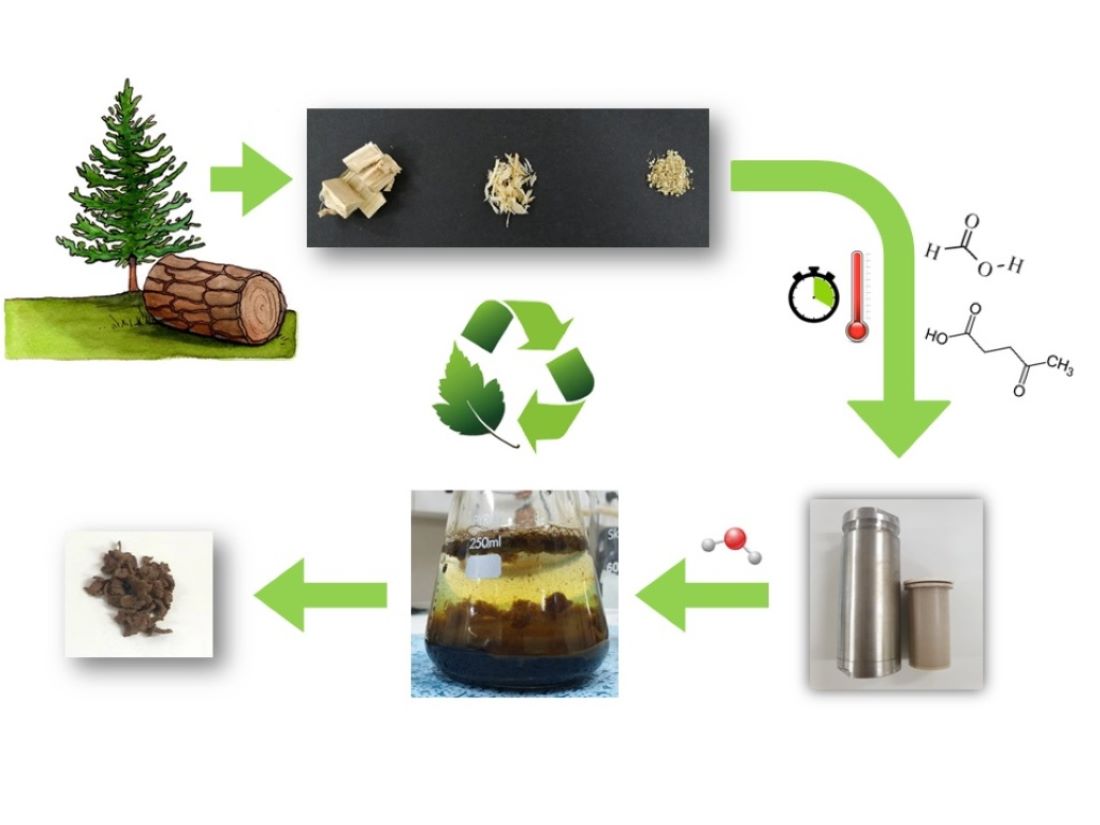
Lignocellulosic biomass fractionation is typically performed using methods that are somehow harsh to the environment, such as in the case of the kraft pulping. In recent years, the development of new sustainable and environmentally friendly alternatives has grown significantly. Among the developed systems, bio-based solvents emerge as promising alternatives for biomass processing. Therefore, in the present work, the bio-based and renewable chemicals, levulinic acid (LA) and formic acid (FA), were combined to fractionate lignocellulosic waste (i.e., Maritime pine sawdust) and isolate lignin. Different parameters, such as LA/FA ratio, temperature, and extraction time, were optimized to boost the yield and purity of extracted lignin. The LA/FA ratio was found to be crucial regarding the superior lignin extraction from the waste biomass. Moreover, the increase in temperature and extraction time enhances the amount of extracted residue but compromises the lignin purity and reduces its molecular weight. The electron microscopy images revealed that biomass samples suffer significant structural and morphological changes, which further suggests the suitability of the new developed bio-fractionation process. Same was concluded by the FTIR analysis, in which no remaining lignin was detected in the cellulose-rich fraction. Overall, the novel combination of bio-sourced FA and LA has shown to be a very promising system for lignin extraction of high purity from biomass waste, thus contributing to extend the opportunities of lignin manipulation and valorisation into novel added-value biomaterials.
Keywords:
Biomass fractionation
; formic acid
; levulinic acid
; lignin
; maritime pine
Copyright: This open access article is published under a Creative Commons CC BY 4.0 license, which permit the free download, distribution, and reuse, provided that the author and preprint are cited in any reuse.


