
Submitted:
24 October 2025
Posted:
29 October 2025
You are already at the latest version
Abstract
Time is a component quantity of various measurements and is also used on its own to sequence events, to compare the duration of events or the intervals between them, and to quantify rates of change in quantities in material reality or in the conscious experience.The equipment for measuring time might well be a clock. By making a presupposition that a clock is time, it is perceived experimentally that “time exhibits wave-like properties”.
Keywords:
tools and metrology
; time and frequency
; philosophy of science
; special relativity
; semiconductors
1. Introduction
Time has been a perplexing quantity since Galileo’s time, and it plays a predominant role in science, philosophy, and religion. Galileo, Newton, Einstein, and others have introduced many philosophical, metaphysical, and physical interpretations of time [1,2]. Space was considered a Euclidean element since the time of Newton. Einstein replaced Newtonian laws of motion in 1905 in his theory of special relativity, where the speed of light in vacuum has the same value of 299,792,458 m/s irrespective of the reference frame. This 1905 theory also unified space and time with the so-called space-time continuum, where time is a coordinate time and complex. What is known to date is that proper time is what an ideal clock measures [3]. In this paper, I have tried to give a unified understanding of time and space-time based on experiment. However, to do so, I must construe the Michelson-Morley experiment [4] as proving the postulate of special relativity.
2. Experimental Details
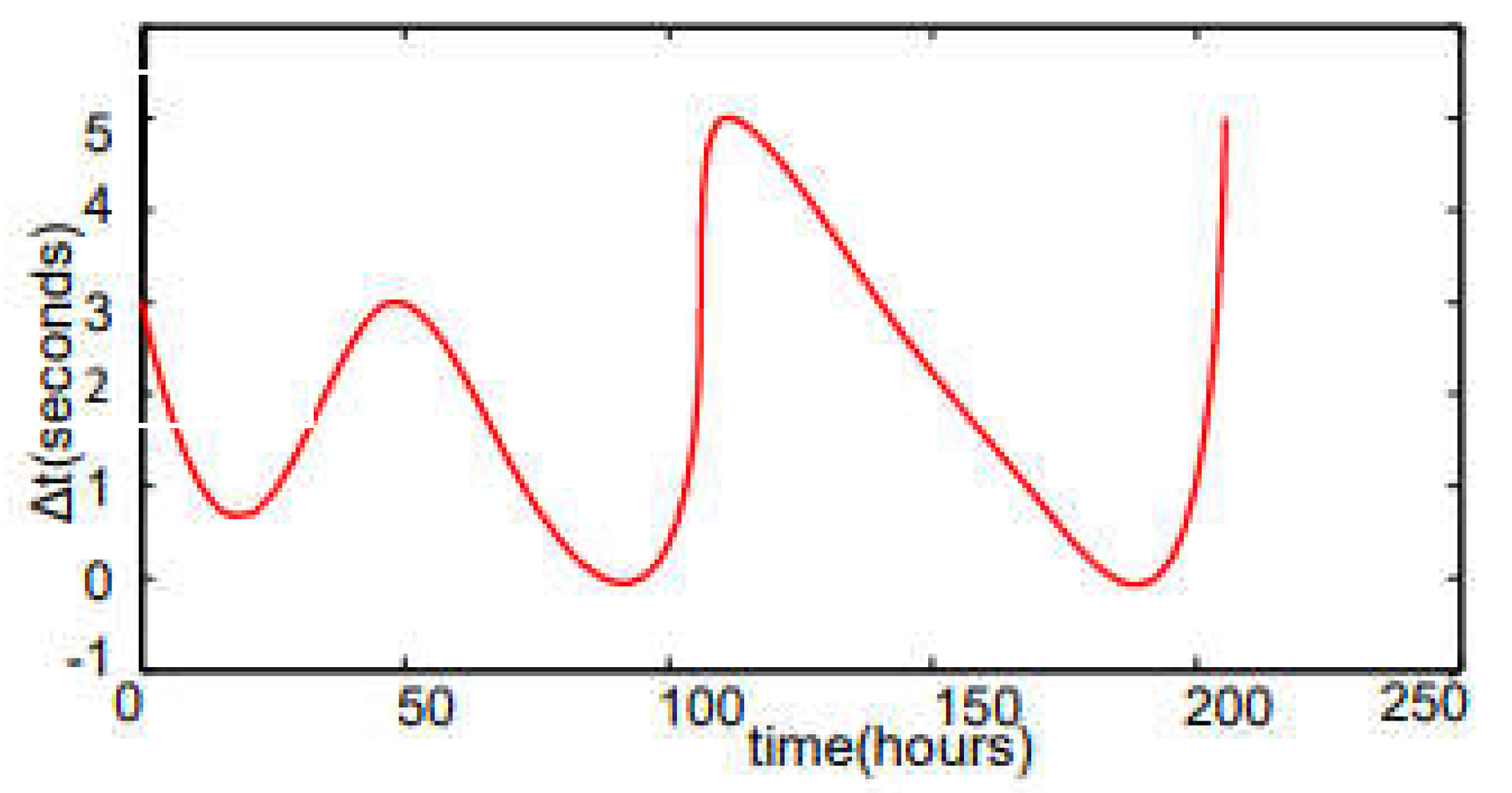
An experiment was performed by synchronizing two digital clocks at the same time, which can measure every second precisely. Both digital clocks are electronically displayable in the 'hh:mm: ss' time format using an LCD. The clock pieces are built using the same technology and are similar in structure. The digital clock exhibits the ill effect of timing jitter [5]. Both clocks navigated different paths compared to each other over the duration of ten days, and Δt was measured continually within some finite time interval at the observed reference frame , where Δt is the time difference between two clocks at a certain point in time. The moving digital clock acted as a space-time odometer. The environmental conditions were similar to those for both clocks during the ten days. Let us represent two clocks as two additional reference frames. Let the first clock be called and the other be called. has a coordinate within, and has a coordinate within . and move in uniform relative motion (velocity ) along the common direction of and . The clock synchronization was carried out at time . Initially, was kept 3 seconds ahead of ; thus ∆t = 3 s. The velocity of was greater than the velocity of , but the relative velocity between and , where is the speed of light in vacuum. Δt was determined to be a nondeterministic wave-like function over time.
3. Supporting Mathematics
and (t) are the corresponding time functions for and
is a time reliant on the wave-like function shown in Figure 1.
Lemma.
ifis a time reliant on a wave-like function, and similarly are wave-like functions.
If the clock measures time, we have the following set of equations:
Therefore, Minkowski ℝ4 flat space-time can be deduced from
is a natural unit set to 1, and is a wave-like time function.
If the clock does not measure time, we have the following set of equations:
Therefore, Minkowski ℝ4 flat space-time can be deduced from
which is a Euclidian ℝ3 space.
4. Conclusions
Can we determine the time manifesting wave-like behavior?
Funding
This project was not funded externally.
Data availability
The data that supports the findings of this study are available within the article.
Competing interests
The author declares no competing interests.
References
- Le Poidevin, R. The experience and perception of time. In The Stanford Encyclopedia of Philosophy; Zalta, E.N., Ed.; 2011; Available online: https://plato.stanford.edu/archives/win2004/entries/time-experience/.
- Einstein, A. Zur Elektrodynamik bewegter Körper. Ann. Phys. 1905, 322, 891–921. [Google Scholar] [CrossRef]
- Ashby, N. Relativity in the Global Positioning System. Living Rev. Relativ. 2003, 6, 1–42. [Google Scholar] [CrossRef] [PubMed]
- Michelson, A.A.; Morley, E.W. On the Relative Motion of the Earth and the Luminiferous Ether. Am. J. Sci. 1887, 34, 333–345. [Google Scholar]
- Lee, D.C. Analysis of jitter in phase-locked loops. IEEE Trans. Circuits Syst. II Analog Digit. Signal Process. 2002, 49, 704–711. [Google Scholar] [CrossRef]
Figure 1.
Because of the pll jitter component, the moving digital clock goes both slow and fast.
Disclaimer/Publisher’s Note: The statements, opinions and data contained in all publications are solely those of the individual author(s) and contributor(s) and not of MDPI and/or the editor(s). MDPI and/or the editor(s) disclaim responsibility for any injury to people or property resulting from any ideas, methods, instructions or products referred to in the content. |
© 2025 by the author. Licensee MDPI, Basel, Switzerland. This article is an open access article distributed under the terms and conditions of the Creative Commons Attribution (CC BY) license (https://creativecommons.org/licenses/by/4.0/).
Copyright: This open access article is published under a Creative Commons CC BY 4.0 license, which permit the free download, distribution, and reuse, provided that the author and preprint are cited in any reuse.


