

Submitted:
11 November 2019
Posted:
13 November 2019
You are already at the latest version
Abstract
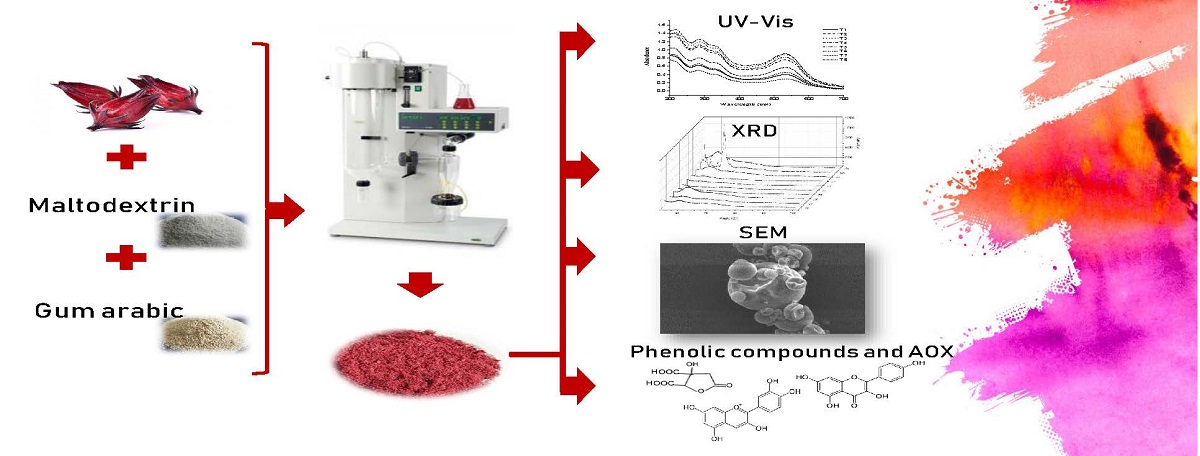
Aqueous and ethanolic extracts of Hibiscus sabdariffa were spray-drying using maltodextrin (MD) and gum arabic (GA) as carriers agents. An experimental design Taguchi L8 with seven variables was implemented. Physicochemical properties in the encapsulates were evaluated by UV-Vis, XRD, spectroscopy and gravimetric techniques. Treatments with aqueous extracts showed the highest concentration of total soluble polyphenols (TSP) 32.12- 21.23 mg EAG/g DW, and antioxidant capacity (AOX) for ABTS assay. The best treatment for TSP and AOX was T4: 2.5% Hibiscus w/w, aqueous extracts, decoction, extract-to-carrier ratio 1:1 (w/w), proportion to carriers (MD:GA) 80:20 (w/w), 10000 rpm, 150°C. Taguchi L8 model is a tool that allows the use of multiple variables with a low number of treatments that indicate the drying conditions that give the best parameters, focusing mainly on TSP and AOX, in addition, is a good alternative for the preservation and stability of the PC in Hibiscus.
Keywords:
Hibiscus sabdariffa
; phenolic compounds
; spray-drying
; antioxidant capacity
Copyright: This open access article is published under a Creative Commons CC BY 4.0 license, which permit the free download, distribution, and reuse, provided that the author and preprint are cited in any reuse.


