

Submitted:
09 September 2018
Posted:
10 September 2018
You are already at the latest version
Abstract
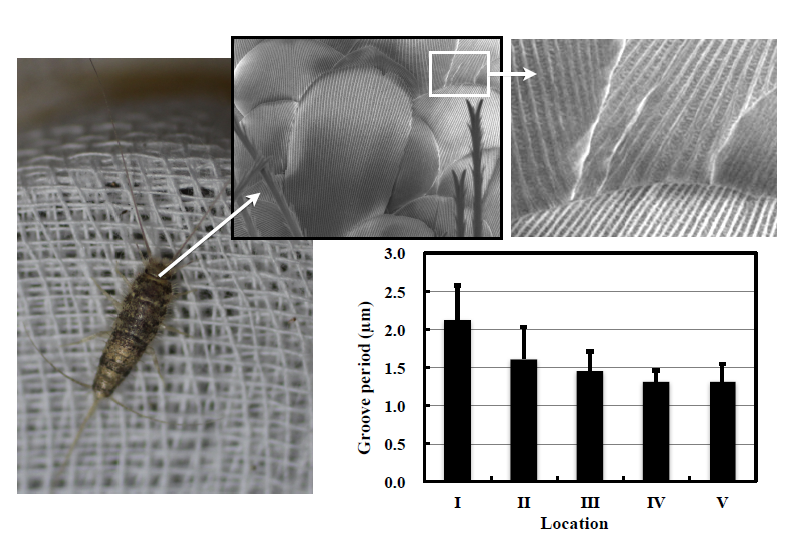
Friction is an important subject for sustainability due to problems associated with energy loss. Recent years, surface micro- and nanostructures have attracted much attention to reduce friction; however, suitable structures are still under consideration. Many functional surfaces are present in nature, such as the friction reduction surfaces of snake skins. In this study, we focused on firebrats, Thermobia domestica, living in narrow spaces such as under bark, so their surface frequently contacts with surrounding surfaces. We speculate that their body surface would be adapted to reduce friction. To investigate the firebrat surface functions, firebrat surfaces were observed by using a field-emission scanning electron microscope (FE-SEM) and a colloidal probe atomic force microscope (AFM), respectively. Results of surface observations by the FE-SEM revealed that firebrats are entirely covered with scales, whose surfaces have micro groove structures. Scale groove periods around the firebrat's head are almost uniform within a scale but vary between scales. AFM friction force measurements revealed that firebrat scale reduces friction by decreasing contact area between scales and a colloidal probe. The heterogeneity of groove periods of the scales suggest that it is difficult to fix the whole body in particular rough surfaces and that lead to be "fail-safe".
Keywords:
Firebrat
; Friction
; AFM
; Colloidal probe
; Scale
; Microstructure34
Copyright: This open access article is published under a Creative Commons CC BY 4.0 license, which permit the free download, distribution, and reuse, provided that the author and preprint are cited in any reuse.


