
Submitted:
15 August 2018
Posted:
16 August 2018
You are already at the latest version
Abstract
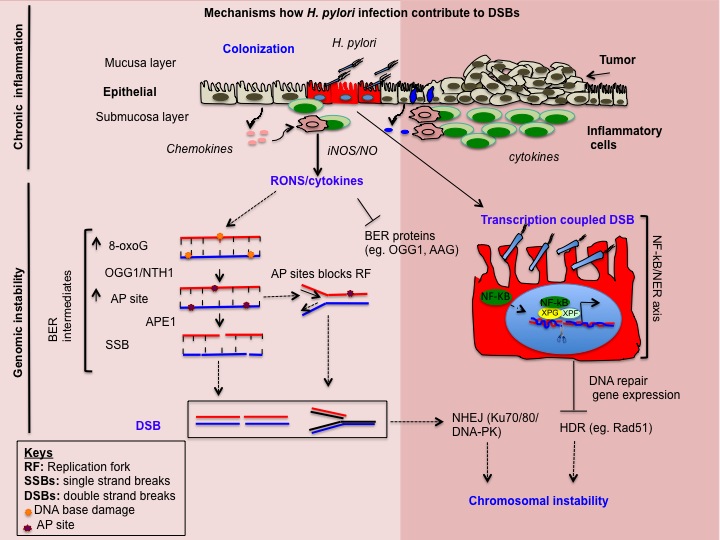
Infections contribute to carcinogenesis through inflammation-related mechanisms. It is well established that H. pylori infection is an etiological factor in gastric carcinogenesis. However, the mechanism through which H. pylori infection contributes to the development of gastric cancer has not been fully elucidated. H. pylori-associated chronic inflammation is linked to genomic instability via reactive oxygen and nitrogen species (RONS). In this article, we summarize the current knowledge of H. pylori-induced double strand breaks (DSBs). Further, we will provide mechanistic insight into how processing of oxidative DNA damage via base excision repair (BER) leads to double strand breaks (DSBs). We review the recent progress how H. pylori infection triggers NF-kB /iNOS versus NF-kB/nucleotide excision repair (NER) axis mediated DSBs to drive genomic instability. Taken together, this review discusses current findings related to DSBs and their implications for the mechanisms of DSB repair.
Keywords:
H. pylori
; DSBs
; BER
Copyright: This open access article is published under a Creative Commons CC BY 4.0 license, which permit the free download, distribution, and reuse, provided that the author and preprint are cited in any reuse.