

Submitted:
01 August 2016
Posted:
02 August 2016
You are already at the latest version
Abstract
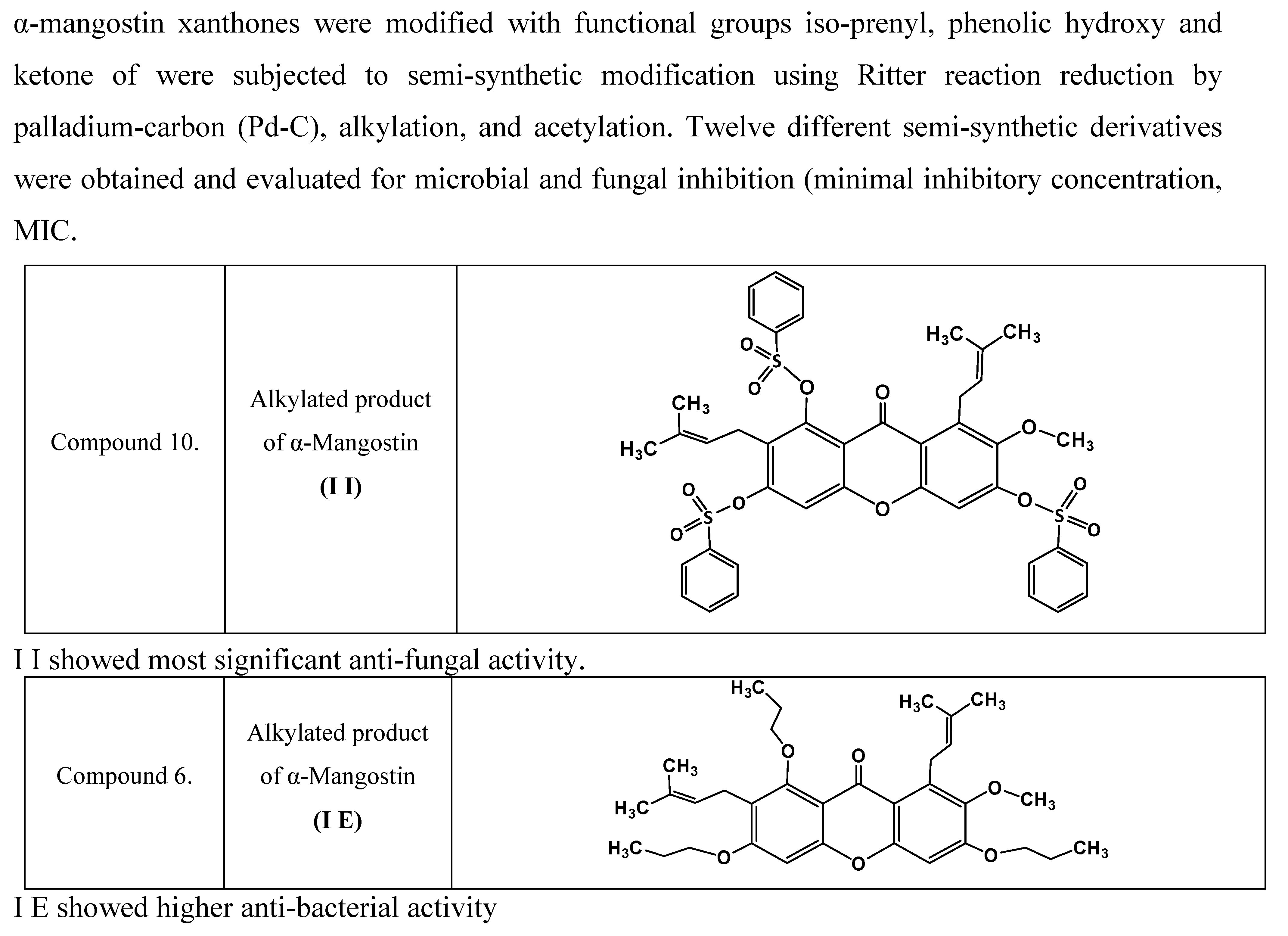
The microbial contamination in food packaging have been a major concern that paved the way for the search for natural based new anti-microbial agents, such as modified α-mangostin. In the present work, twelve synthetic analogs were obtained via semi-synthetic modification of α-mangostin by Ritter reaction, reduction by palladium-carbon (Pd-C), alkylation, and acetylation. The evaluation of the anti-microbial potential of the synthetic analogs showed higher therapeutic value than the parent molecule. The anti-microbial studies proved that I E showed higher antibacterial activity whereas I I showed most significant antifungal activity. Due to their microbial properties, modified α-mangostin can be utilized as active anti-microbial agents in food packaging.
Keywords:
α-mangostin
; antibacterial
; antifungal
; food packaging
; semi-synthetic modification
Copyright: This open access article is published under a Creative Commons CC BY 4.0 license, which permit the free download, distribution, and reuse, provided that the author and preprint are cited in any reuse.