
Submitted:
26 November 2026
Posted:
27 November 2026
You are already at the latest version
Abstract
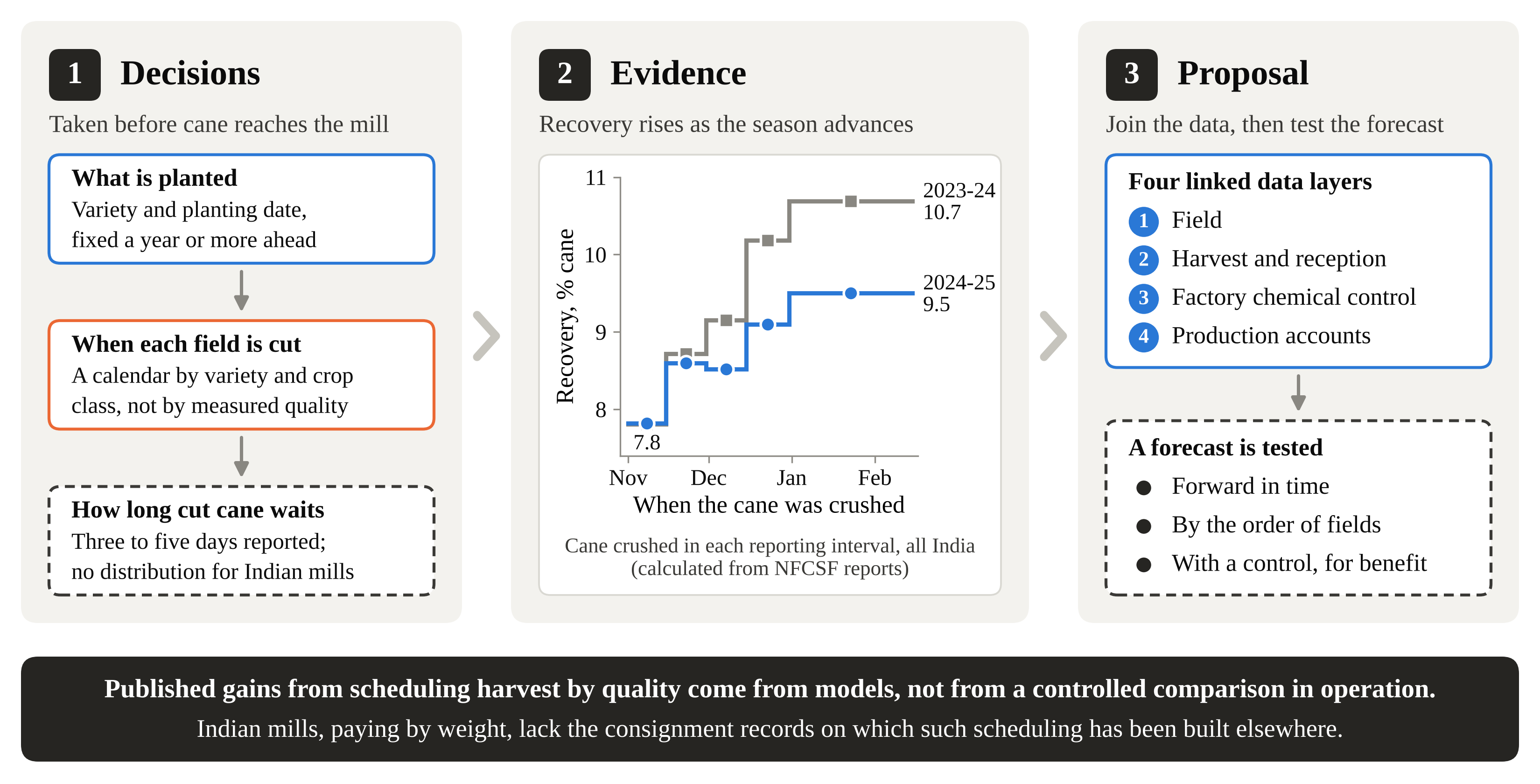
Sugar recovery depends on decisions taken before cane reaches the mill: what is planted, when each field is cut and how long cut cane waits. This narrative review examines the evidence behind those decisions, with India as the focal case and Australia, South Africa, Brazil and Thailand as comparators. The prevailing Indian cane payment arrangements do not routinely generate consignment quality records, unlike the payment on measured quality documented elsewhere. Optimisation in Australia indicated a 3% gain in sugar yield, and simulation in South Africa a gain of up to 2.7% in recoverable value terms; neither establishes a controlled operational benefit. Long cut to crush delays have been reported in India and South Africa, but no representative distribution for Indian mills was identified. Satellite and weather models show promise at mill area scale, with weaker field level results and limited evidence of transfer to new seasons. The first advance estimate of gross Indian sugar output for 2025-26 was 34.35 million tonnes; the industry figure reported in November 2026 was 31.213 million tonnes. A four layer framework is proposed to link fields, consignments, factory chemical control and production accounts through traceable measurements, mass weighted blending and a sucrose balance with a reported residual. Forecasts should be tested forward in time, for their ability to support feasible harvest decisions and, separately, for operational benefit.
Keywords:
sugarcane
; maturity forecasting
; harvest scheduling
; cut to crush delay
; cane payment
; sugar recovery
; forecast validation
; India
Copyright: This open access article is published under a Creative Commons CC BY 4.0 license, which permit the free download, distribution, and reuse, provided that the author and preprint are cited in any reuse.