
Submitted:
26 November 2026
Posted:
27 November 2026
You are already at the latest version
Abstract
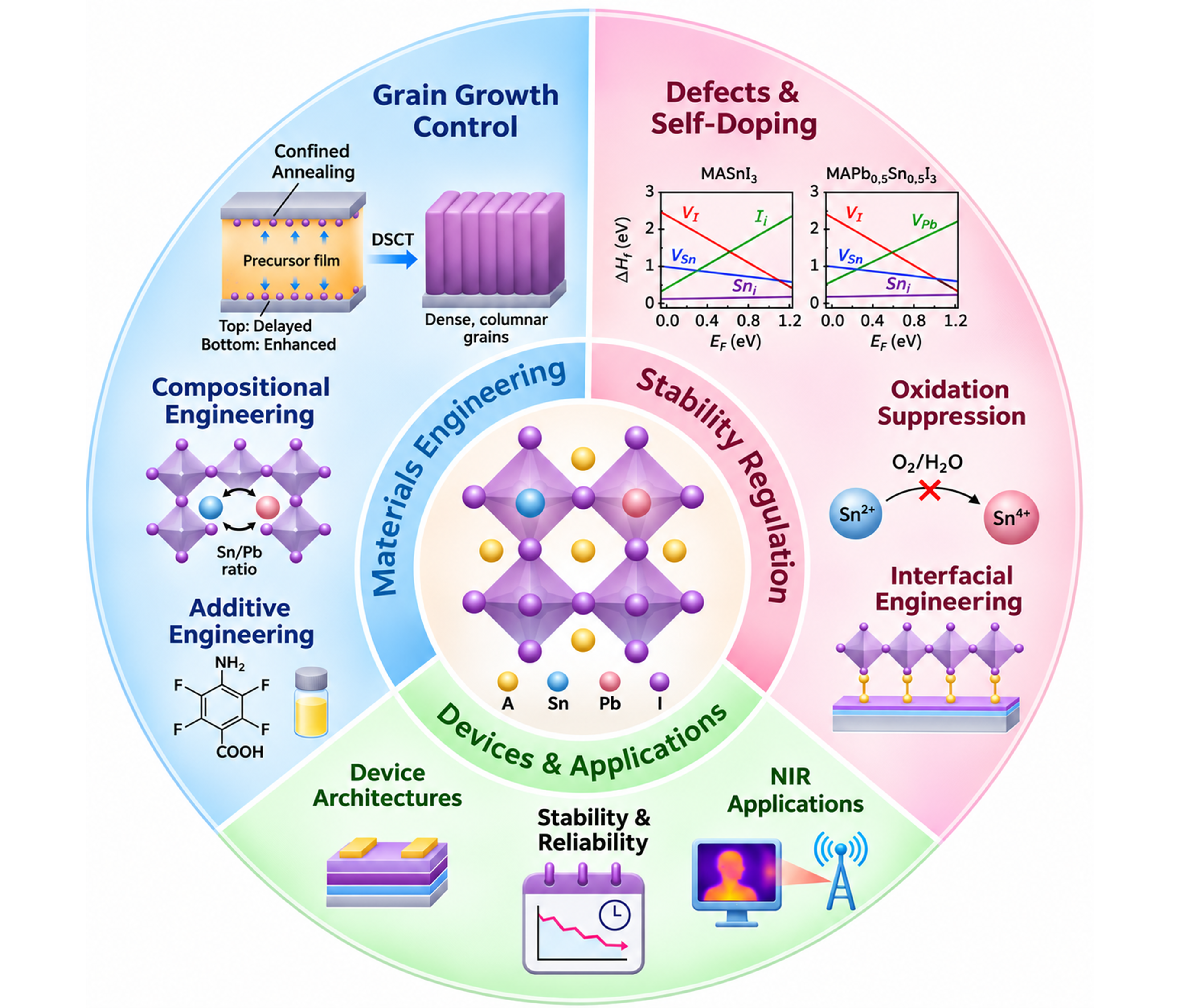
Mixed tin-lead (Sn-Pb) halide perovskites are promising absorbers for near-infrared (NIR) photo-detection because of their tunable narrow bandgaps, strong optical absorption, and compatibility with low-temperature solution processing. However, mismatched crystallization kinetics of Sn- and Pb-containing precursors, the oxidation susceptibility of Sn(II), and chemically reactive interfaces can compromise film quality and device stability. This review outlines the electronic structure, carrier dynamics, and defect chemistry of mixed Sn-Pb perovskites, and examines how crystallization control, additive and compositional engineering, and oxidation suppression affect absorber properties. Device-level strategies, including charge-selective contacts, interfacial modification, electrode protection, and encapsulation, are evaluated in relation to charge collection and device degradation. Reported stability results are discussed with attention to testing conditions and the distinction between initial performance and long-term durability. Finally, remaining challenges in linking chemical and structural degradation to electrical performance and improving photodetector reliability are outlined.
Keywords:
mixed Sn-Pb perovskites
; near-infrared photodetectors
; defect chemistry
; Sn(II) oxidation
; interfacial engineering
; operational stability
Copyright: This open access article is published under a Creative Commons CC BY 4.0 license, which permit the free download, distribution, and reuse, provided that the author and preprint are cited in any reuse.