
Submitted:
25 November 2026
Posted:
27 November 2026
You are already at the latest version
Abstract
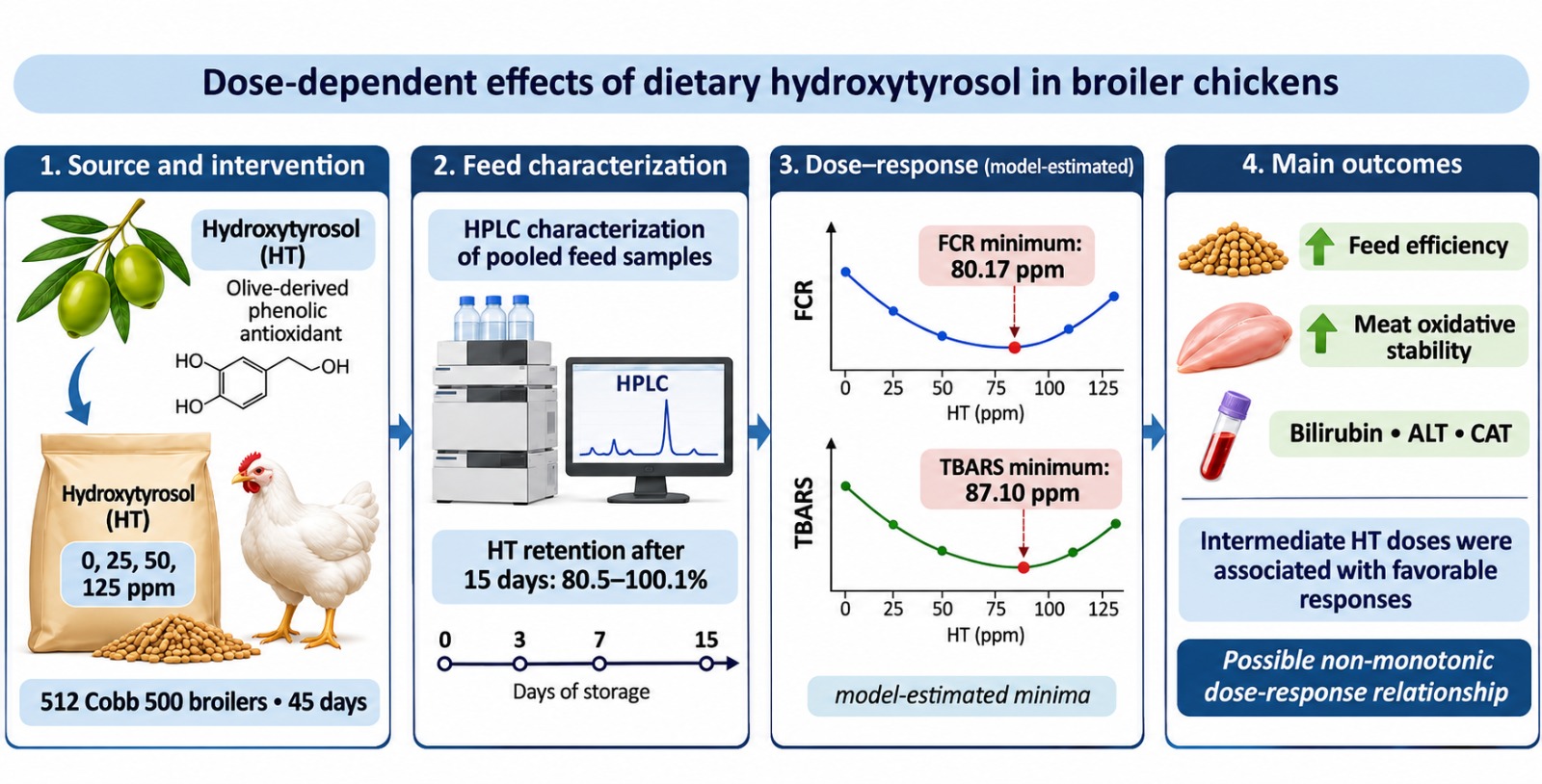
Hydroxytyrosol (HT) is an olive-derived phenolic compound with antioxidant properties and potential applications in poultry nutrition. This study evaluated dietary HT supplementation (0, 25, 50, and 125 ppm) on growth performance, meat oxidative stability, and antioxidant metabolism in broiler chickens. A total of 512 male Cobb 500 broilers were allocated to four treatments with eight replicates over 45 days. HT concentrations and storage stability in pooled feed samples were evaluated by HPLC. Measured concentrations generally agreed with nominal levels, with retention ranging from 80.5% to 100.1% after 15 days. Feed conversion ratio showed a significant quadratic response (P = 0.0294), with a model-estimated minimum at 80.17 ppm HT. Lipid peroxidation in refrigerated breast meat also exhibited a significant quadratic response (P = 0.0046), with a predicted minimum at 87.10 ppm. HT supplementation modulated bilirubin, alanine aminotransferase, and catalase activity. Multivariate analyses indicated differences in metabolic response profiles among treatments. Overall, dietary HT supplementation was associated with improved feed efficiency and meat oxidative stability. The convergence of model-estimated optima near 80–90 ppm suggests a possible non-monotonic dose-response relationship and warrants further investigation to confirm optimal supplementation levels.
Keywords:
antioxidant metabolism
; broiler chickens
; feed efficiency
; hormesis
; hydroxytyrosol
; oxidative stability
Copyright: This open access article is published under a Creative Commons CC BY 4.0 license, which permit the free download, distribution, and reuse, provided that the author and preprint are cited in any reuse.