

Submitted:
21 November 2026
Posted:
26 November 2026
You are already at the latest version
Abstract
We investigate a phenomenological modified inertial mass-flowrate (MIMF) relation for the gravitating-to-luminous mass ratio across heterogeneous galaxy samples. The primary one-parameter calibration uses 136 SPARC galaxies and 2,215 retained radial measurements and gives a₁ = 0.992295 with a galaxy-balanced MAPE of 22.56%. Because the gravitating and luminous mass-flowrate variables share the same characteristic timescale, the construction is algebraically coupled to the target mass ratio and is not interpreted as prediction of an independent observable. A galaxy-level permutation test preserving the mass variables and radial sampling gives a statistically detectable but very small advantage for the observed galaxy-timescale pairing (0.0666 percentage points in GB-MAPE; p = 0.0005), confirming that most of the predictive organization arises from the shared mass structure. Using identical out-of-fold validation, fitting a₁ improves absolute calibration relative to fixing a₁ = 1 (OOF GB-MAPE 22.68% versus 40.15%), while the fixed-unity model retains the higher predictive R². An observational Monte Carlo analysis gives a median a₁ = 0.993516 with a 2.5–97.5 percentile range of 0.992853–0.994129, supporting interpretation of a₁ as an empirical calibration parameter rather than a fundamental exponent. With the SPARC coefficient frozen, MAPEs are 24.86% for Wolf, 15.75% for Courteau, and 8.59% for ATLAS3D; residual offsets are dataset dependent and sensitive to stellar mass-to-light assumptions. On the same retained SPARC radial sample, a standard radial-acceleration-relation benchmark gives a log-acceleration residual RMS of 0.163 dex and a higher predictive R², whereas MIMF gives the lower percentage error on the adopted YM target. These comparisons are not equal-input competitions. Overall, MIMF is best regarded as a compact phenomenological calibration framework whose usefulness and limitations are set by algebraic coupling, sample selection, stellar-mass normalization, and heterogeneous dynamical constructions.
Keywords:
galaxy dynamics
; galaxy mass discrepancy
; dark matter
; galaxy kinematics
; scaling relations
; modified inertial mass-flowrate
1. Introduction
The discrepancy between the mass inferred from galaxy kinematics and the mass associated with directly observed luminous matter is one of the central empirical problems of galactic dynamics. Extended rotation curves of disc galaxies, velocity-dispersion measurements of pressure-supported systems, and dynamical models of early-type galaxies consistently imply gravitating masses that exceed the contribution inferred from stars and gas over substantial radial ranges [1,2,3,4,5,6,7,8]. Within the standard cosmological framework, the discrepancy is primarily attributed to non-baryonic dark matter [9]. Modified-dynamics approaches and empirical scaling relations provide complementary descriptions of the same observations [10,11,12].
Interpretation of a galaxy mass discrepancy also depends on the adopted stellar population and mass-to-light normalization, gas fraction, environment, morphology, and the balance between ordered and random stellar motions. These effects can change both the luminous reference mass and the kinematic estimator and therefore become especially important when heterogeneous catalogues are compared.
A useful phenomenological relation need not replace these established frameworks to be informative. It can instead identify a low-dimensional empirical regularity, expose residual systematics between catalogues, and provide a compact target for later theoretical work. Such a relation is especially interesting if it remains stable when the calibration is performed on one homogeneous sample and the fitted parameters are then frozen and transferred to systems with different observational characteristics and different dominant modes of kinematic support.
The present study explores this possibility using the modified inertial mass-flowrate (MIMF) construction. MIMF was originally introduced in high-pressure gas-flow metrology to describe calibration structure [13]. In the present astronomical application, only the mathematical architecture is transferred: a characteristic mass is multiplied by a characteristic angular frequency and divided by 2π to form a mass-per-cycle dynamical-rate scale. No bulk transfer of galactic mass, fluid-mechanical equivalence, or common microphysics with the laboratory system is implied. The laboratory velocity-dependent factor is not invoked here and is set to unity in the galaxy formulation.
Throughout the analysis, MLG denotes a photometrically inferred luminous reference mass and MGG denotes an effective gravitating mass obtained from the adopted kinematic estimator. These are operational definitions. MLG is not assumed to be dynamically static, and MGG is not treated as a separately moving substance. The characteristic timescale depends on the dominant support mechanism: orbital timescales are used for rotation-supported systems, a crossing-like timescale is used for dispersion-supported systems, and a hybrid rotation-plus-dispersion prescription is adopted for ATLAS³D galaxies.
The study is designed around the following questions. Can the one-parameter SPARC calibration reproduce the adopted mass-ratio target with stable galaxy-grouped validation? How much of the apparent performance follows from the shared algebraic structure, and does the observed galaxy-timescale pairing add any measurable information beyond a suitable permutation null? How sensitive are the fitted calibration, residuals, and external transfer results to stellar M/L, radial selection, surface-brightness extrapolation, observational uncertainties, and the fixed-a₁ = 1 limit? How does the construction compare quantitatively with the radial acceleration relation (RAR) and conceptually with the baryonic Tully-Fisher relation (BTFR)? Finally, what changes when the frozen SPARC calibration is transferred across the heterogeneous Wolf, Courteau, and ATLAS³D constructions?
We analyse 588 retained galaxies: 136 SPARC late-type galaxies, 232 Courteau galaxies, 25 Wolf et al. dispersion-supported systems, and 195 ATLAS³D early-type galaxies. SPARC supplies the primary calibration and internal validation; the fitted coefficient is then frozen for cross-catalogue empirical transfer tests. Because the external samples differ in characteristic radius, stellar-mass prescription, galaxy population, and kinematic estimator, their results are not interpreted as validation under identical physical conditions.
2. Data and Methods
2.1. Galaxy Samples
The working analysis contains 588 retained galaxies drawn from four public data sources. SPARC contributes 136 late-type galaxies from the published 175-galaxy compilation [1]. Historical reconstruction files show an earlier preprocessing/data-consistency stage with 163 working galaxies; after the corrected 3.6-μm stellar-mass reconstruction, the positivity requirement MGG > MLG, and the requirement of at least five retained radial measurements, the final SPARC calibration contains 136 galaxies and 2,215 radial points. Courteau contributes 232 spiral galaxies [2,3,4], Wolf et al. contributes 25 dispersion-supported systems [5], and ATLAS³D contributes 195 early-type galaxies from the published 260-galaxy survey [6,7,8]. In the intermediate ATLAS³D merged master table used for this reconstruction, 259 galaxies were available; NGC 4486A was absent from that intermediate table. Of those 259, 195 satisfy the adopted positive-mass-discrepancy requirements and contain the stellar-mass quantities required for the calculation.
Sample selection is therefore explicitly data dependent. For SPARC, the 12 galaxies omitted during the earlier 175-to-163 preprocessing stage are documented in Supplementary Table S3. All 12 have corresponding raw surface-brightness and rotation-curve files, but the surviving historical files do not establish a single unambiguous exclusion rule applicable to all 12. For ATLAS³D, 60 of the 259 intermediate-master galaxies have fDM(<Re) = 0, two (NGC 2592 and NGC 4342) do not satisfy the strict reconstructed Mdyn(<Re) > M*(<Re) condition, and two (PGC 58114 and PGC 71531) lack the stellar-mass quantities required for the calculation, yielding the final N = 195. These selection rules are described to document sample construction rather than to imply error-independent filtering. The principal characteristics, sample sizes, dominant support mechanisms, and roles of the four datasets are summarized in Table 1.
2.2. Unified Mass and Kinematic Construction for Rotation-Supported Samples
For rotation-supported galaxies, the MIMF variables are constructed from a luminous-mass distribution and an observed rotation curve over a common radial domain. For an outer radius R, the characteristic radius and characteristic velocity are defined as stellar-mass-weighted quantities
The representative angular speed is defined directly as the stellar-mass-weighted average of the local angular speed V(r)/r over the enclosed radial domain:
The same characteristic angular speed is applied to the luminous and gravitating masses, giving
This common-timescale construction ensures that ṀGG/ṀLG = MGG/MLG within a given radial domain. Importantly, the representative angular frequency in Equation (3) is the mass-weighted average ⟨V/r⟩M*, not the ratio of the separately averaged quantities V̄/R̄. SPARC and the profile-based Courteau reconstruction use the same local angular-frequency averaging rule.
2.2.1. SPARC Profile-Based Reconstruction
For SPARC, quantities are evaluated cumulatively at each observed rotation-curve radius Ri. The SPARC surface-brightness profiles are Spitzer 3.6-μm measurements in mag arcsec⁻². The luminosity-surface-density conversion was verified against the implemented reconstruction and explicitly includes the solar absolute magnitude M⊙,3.6 = 3.24 [1]. The constant 21.572 = 5 log10(206265) - 5 is the arcsec-to-pc surface-brightness conversion term. The adopted stellar M/L normalization is applied after this photometric conversion.
The stellar surface-mass density is then Σ* = ϒ*ΣL,3.6 with ϒ* = 0.5. The numerical term 21.572 converts mag arcsec⁻² to L⊙ pc⁻² when the solar absolute magnitude is explicitly included. The stellar mass in a circular annulus is
and the enclosed luminous mass is
The observed rotation curve is interpolated onto the surface-brightness radial grid. Equations (1) and (2) are then evaluated with the same annular stellar-mass weights. The gravitating mass at each rotation-curve radius is estimated with the spherical-equivalent proxy
Thus MLG, MGG, R̄, V̄, and refer to the same enclosed radial domain. This spherical-equivalent mass proxy is an operational estimator used consistently in the present analysis; it is not a full axisymmetric disc mass model.
For rotation curves extending beyond the measured SPARC surface-brightness profile, the outer photometry is extrapolated with a Theil-Sen line fitted to up to the outermost ten valid measurements and anchored to the last measured point. In the final calibration sample, 63 of 136 galaxies require such extrapolation for at least one retained radius, corresponding to 469 of 2,215 radial points. A no-extrapolation sensitivity analysis removes these points and reapplies the NRi ≥ 5 rule, leaving 132 galaxies and 1,732 radial points. The characteristic angular speed is computed as the cumulative stellar-mass-weighted average of V(r)/r defined in Equation (3); it is not V̄/R̄.
2.2.2. Courteau Profile-Based Reconstruction
The final Courteau reconstruction places the 232 galaxies on a radial basis closely matched to the SPARC treatment. Courteau-1997 rotation curves, compiled in PROBES-I, are matched to homogeneous PROBES-I r-band surface-brightness profiles [2,4]. The rotation curves are corrected for projected inclination and heliocentric redshift according to the adopted catalogue quantities. The photometric profiles are converted to stellar surface density using ϒr = 1.0 as a fixed modelling normalization. Because the PROBES-I profiles use elliptical isophotes, the stellar mass in an annulus is
Surface-brightness points with large reported errors are excluded from the radial integration, and a robust declining outer extrapolation is used when a usable rotation curve extends beyond the photometric profile. The cumulative luminous mass, R̄(Ri), and V̄(Ri) are then obtained from Equations (1), (2), and (7), while the gravitating mass is evaluated from Equation (8) at the same Ri. The profile-based Courteau reconstruction is therefore not a different physical definition of MIMF. It is a more observation-driven implementation of the same radial, mass-weighted construction used for SPARC. The principal geometric difference is the circular annular weight 2πrΣ*dr for SPARC versus the elliptical weight 2πqrΣ*dr for Courteau/PROBES-I.
2.2.3. Common Radial Selection Criterion
For the radially resolved SPARC and profile-based Courteau calculations, only radial points satisfying MGG(<Ri) > MLG(<Ri) are retained. Because the two mass-flowrate scales at a given radius use the same characteristic frequency, this is equivalent to requiring a positive MIMF difference. The cut is data dependent and truncates the domain near YM = 1. For SPARC, the fitted exponent and performance were therefore re-evaluated at progressively stricter thresholds YM > 1.00, 1.05, 1.10, and 1.20. The final baseline calibration additionally requires at least five retained radial measurements per galaxy.
2.3. Dispersion-Supported and Mixed-Support Samples
2.3.1. Wolf Sample
The Wolf et al. systems are treated as dispersion-supported. The published three-dimensional half-light radius r1/2 and line-of-sight velocity dispersion σlos are used [5]. The characteristic random speed is taken as Veff = √3 σlos, while the effective path-length normalization is 4r1/2/3. The corresponding crossing-like timescale is
Published dynamical masses within r1/2 are used directly where available. The luminous mass within r1/2 is obtained from the reported V-band luminosity and the half-light definition using a fixed stellar mass-to-light ratio (M/L)V = 3. This common normalization is a modelling choice rather than a galaxy-by-galaxy stellar-population estimate; its systematic influence is explicitly assessed with a ±30% sensitivity test. Both MLG and MGG are divided by the same tdis when constructing their mass-flowrate scales.
2.3.2. ATLAS³D Hybrid Prescription
ATLAS³D galaxies contain both ordered and random stellar motions and are treated with an operational hybrid prescription. The effective second-moment speed Vrms combines Ve and σe, the rotational angular frequency is ωrot = 2Ve/Re, and the dispersion timescale is tdis = (4Re/3)/σe. The adopted gravitating mass is MGG = Mdyn(Re) = 5Vrms²Re/G, while catalogue-specific stellar M/L values are used to construct MLG within Re. In the 195-galaxy working sample, 58 galaxies have non-zero Ve entries and 137 have Ve = 0 entries; there are no missing/NA Ve entries. In the forced-Ve = 0 diagnostic, σe is kept fixed, the rotational term is removed, Vrms is recalculated, and therefore MGG (the adopted dynamical mass within Re) is recalculated self-consistently. These definitions are modelling prescriptions rather than unique dynamical decompositions; the dataset-specific implementations are summarized in Table 2
2.4. Phenomenological MIMF Relation and Reconstructed Mass Ratio
For each object or radial domain, the measured MIMF quantity is defined by
The fitted relation retains the power-law architecture of the earlier metrological formulation. For the galaxy application, the laboratory velocity-dependent factor is set to unity. The primary SPARC calibration fixes b = 0 and optimizes only a₁. This one-parameter value is therefore conditional on the adopted numerical normalization and is treated as an empirical calibration parameter, not as a unit-invariant physical exponent. A separate two-parameter (b, a₁) diagnostic is used below to test reference-scale dependence.
where Ṁ₀ is the fixed mass-flowrate reference used to render the logarithmic arguments dimensionless. The implemented diagnostic uses the numerical baseline Ṁ₀ = 1 and rescales it by 10 and 20 decades. The physical unit of Ṁ₀ is kg s⁻¹. Because b = 0 in the primary one-parameter model, changing this reference scale can be absorbed partly by the fitted slope; the two-parameter diagnostic therefore allows b to vary.
The predicted mass ratio is reconstructed from the fitted MIMF term as
The primary optimization loss is the galaxy-balanced mean absolute percentage error in YM. For a galaxy g with ng radial points,
For reporting, 100L is expressed as a percentage and referred to as the galaxy-balanced MAPE (GB-MAPE). A separate radial-point MAPE is also calculated by averaging APE over all retained radial measurements without galaxy balancing. The signed percentage residual used for bias and residual figures is
2.5. Optimization and Performance Metrics
The SPARC calibration optimizes only a₁. A one-dimensional numerical search is used, consisting of a coarse scan followed by golden-section refinement near the minimum. The primary optimization metric is GB-MAPE. Additional performance summaries are radial-point MAPE, median absolute percentage error, signed bias, and predictive R². Predictive R² is calculated directly from the unrescaled predictions, R²pred = 1 - SSE/SST, and therefore measures predictive agreement with the one-to-one relation.
2.6. Galaxy-Grouped 10-Fold Cross-Validation and Pooled OOF Bootstrap
The radially resolved SPARC sample contains 136 galaxies and 2,215 retained radial measurements. All radial points from a given galaxy are assigned to the same fold so that no galaxy contributes simultaneously to training and test data. Galaxies are randomly shuffled using a fixed seed and allocated to ten folds while approximately balancing the number of radial points. For each fold, a₁ is optimized on the nine training folds using the galaxy-balanced loss in Equation (16), then frozen and applied to the held-out galaxies.
To quantify uncertainty in the pooled out-of-fold (OOF) predictive performance, the test predictions from all ten folds are frozen and combined so that every SPARC galaxy is represented only by predictions from a model that excluded that galaxy during fitting. A non-parametric cluster bootstrap is then performed with 10,000 resamples at the galaxy level. Each bootstrap realization samples 136 galaxies with replacement and retains all Ri values belonging to every selected galaxy. GB-MAPE, radial-point MAPE, median APE, signed bias, and predictive R² are recalculated for each realization. The 2.5th and 97.5th percentiles define the reported 95% confidence intervals.
2.7. Galaxy-Level Bootstrap of the Fitted Exponent
The sampling uncertainty of a₁ is evaluated independently of the OOF predictive bootstrap. In each of 10,000 galaxy-level bootstrap realizations, 136 SPARC galaxies are sampled with replacement, all radial measurements belonging to each sampled galaxy are retained together, and a₁ is re-optimized from the resampled training data using the same galaxy-balanced objective. The bootstrap distribution is summarized by its mean, median, standard deviation, bias relative to the full-sample optimum, and percentile 95% confidence interval. The optimized galaxy-balanced loss is also recorded for each realization.
2.8. Frozen-Parameter External Validation and Uncertainty
The full-SPARC value of a₁ is frozen and applied without re-optimization to the Wolf, profile-based Courteau, and ATLAS³D samples. This design tests transfer beyond SPARC parameter calibration. For each external catalogue, uncertainty in MAPE and signed bias is estimated by 10,000 galaxy-level non-parametric bootstrap resamples with replacement while the SPARC coefficient remains fixed.
2.9. Baseline Predictors and Diagnostic Fits
To test whether the performance can be reproduced by a generic one-variable power law, the MIMF power-law architecture is re-fit after replacing ṀGG with alternative predictors: MGG, ṀLG, MLG, and an effective kinematic speed Veff. A constant mass-ratio predictor Y₀ is also fitted. To make the predictor comparison scale-fair, all power-law predictors, including ṀGG, are fitted in the common two-parameter form log₁₀(MIMFOpt/Ṁ₀) = b + a₁ log₁₀(X/X₀), with b and a₁ free. One comparison uses SPARC alone for calibration and then freezes the fitted parameters for the three external datasets. A second diagnostic optimization uses all four datasets jointly. These baseline fits are diagnostic and are distinct from the primary one-parameter SPARC model.
2.10. Paired Galaxy-Bootstrap Comparison of Baseline Predictors
To quantify whether the MAPE advantage of ṀGG over the strongest alternative predictors could arise from sample fluctuations, paired galaxy-level bootstrap comparisons are performed for ṀGG versus Veff and ṀGG versus MGG in each external dataset. For every bootstrap realization, the same galaxy indices are resampled with replacement for the two competing models. The statistic ΔMAPE = MAPEbaseline - MAPEṀGG is then calculated. Positive values favor ṀGG, and a percentile 95% confidence interval with a lower bound greater than zero is interpreted as a statistically resolved MAPE reduction for ṀGG.
2.11. Structural-Coupling, Permutation/Null, and Fixed-Unity Diagnostics
Because ṀGG and ṀLG share the same characteristic timescale and MGG appears in both the predictor construction and the target ratio, the model is algebraically coupled to its target. A galaxy-level permutation/null test therefore keeps MGG, MLG, radial sampling, and each galaxy’s ω-profile shape fixed while randomly reassigning the galaxy-level ω̄(Rmax) normalization among the 136 SPARC galaxies. Ten thousand permutations are used, and the one-sided p-value is computed from the fraction of null GB-MAPE values no larger than the observed value. In addition, the primary fitted model is compared directly with a fixed-a₁ = 1 model under identical pooled OOF validation.
2.12. Observational Monte Carlo and Stellar-M/L Sensitivity
Observational uncertainty is propagated with 1,000 full-sample SPARC Monte Carlo realizations. Galaxy distances and inclinations are perturbed using their catalogue uncertainties, rotation-curve velocities using their pointwise errors, and the 3.6-μm luminosity normalization using the catalogue luminosity uncertainty. The stellar M/L normalization is additionally perturbed with an adopted 20% (1σ) uncertainty. Derived masses, cumulative angular frequencies, MIMF quantities, and a₁ are recomputed, and the positivity and NRi ≥ 5 criteria are reapplied in every realization. This Monte Carlo is distinct from the galaxy bootstrap: it propagates the adopted observational-error model and allows sample membership to vary. Separate ±30% M/L sensitivity tests are also performed for SPARC, Courteau, Wolf, and ATLAS³D.
2.13. RAR Benchmark and BTFR Context
A quantitative radial acceleration relation (RAR) benchmark is evaluated on exactly the same 136 SPARC galaxies and 2,215 retained radial points. Baryonic acceleration is constructed from the SPARC gas, stellar-disc, and bulge mass-model contributions using the standard RAR functional form. Performance is reported both as the scatter of log10(gobs)-log10(gRAR) and, for a same-target diagnostic, after converting gRAR to an equivalent dynamical mass and evaluating the same YM error metrics used for MIMF. Because RAR uses total baryonic information whereas the MIMF denominator is the stellar luminous mass and the MIMF predictor is structurally coupled to the target, this is treated as an established benchmark rather than an equal-input competition. The BTFR is discussed as a global Mb-Vf relation and is not used as a point-by-point radial comparator.
2.14. Residual-Correlation and CV-Dependence Diagnostics
To investigate cross-catalogue offsets, galaxy-level signed percentage residuals are tested for monotonic association with available stellar-mass and kinematic quantities using Spearman rank correlation. These tests are exploratory and their p-values are interpreted nominally rather than as a family of confirmatory hypothesis tests. For SPARC, galaxy-level pooled OOF MAPE and signed OOF bias are tested against log10[MLG(Rmax)] and the number of retained radial points NRi; mass-quartile summaries are also reported.
2.15. Reference-Scale Diagnostic
To test the reference-scale issue explicitly, a two-parameter diagnostic fit log10(MIMF/Ṁ0) = b+a₁log10(ṀGG/Ṁ0) is repeated for Ṁ0 values differing by 20 decades. Under a reference rescaling Ṁ0′ = cṀ0, the expected transformation is b′ = b+(a₁−1)log10(c) while the freely fitted slope should remain invariant. This diagnostic is not the primary one-parameter calibration. The complete analysis workflow is summarized in Figure 1.
2.16. Use of Generative AI
Generative AI (OpenAI ChatGPT) was used as an assisting tool during the development and revision of this study. Its use included assistance in locating and understanding relevant public astronomical data sources; drafting and refining VBA and Python code for repetitive data processing and statistical analyses; and supporting the implementation of galaxy-grouped cross-validation, bootstrap resampling, permutation/null testing, observational Monte Carlo uncertainty propagation, RAR benchmarking, sample-selection and positivity accounting, outer-extrapolation sensitivity tests, residual-correlation analyses, and preparation of summary tables and figures.
Generative AI was also used to support manuscript drafting, revision, English-language editing, and organization of point-by-point responses to the reviewers. All observational data were obtained from the published catalogues cited in this study. Generative AI did not generate or alter any original astronomical observations. All code was executed by the author, all derived quantities and statistical outputs were independently checked by the author, and all scientific interpretations, methodological choices, and final conclusions remain the sole responsibility of the author.
3. Results
3.1. Full-Sample SPARC Calibration
The primary one-parameter MIMF model was calibrated on the full SPARC sample of 136 galaxies and 2,215 retained radial measurements. Repeated initialization converged to a₁ ≈ 0.9923 with GB-MAPE = 22.56%, median APE = 21.80%, bias = 4.82%, and predictive R² = 0.8724. These values describe the adopted empirical calibration; the physical significance of the sub-unity exponent is assessed separately with fixed-unity, M/L, reference-scale, and observational-uncertainty diagnostics. The repeated-start results are summarised in Table 3.
Figure 2 shows a galaxy-level visualization of the fitted relation over the sampled range of ṀGG. The plotted points are one-per-galaxy summaries of the radial quantities; the optimization itself uses all 2,215 retained radial measurements with galaxy-balanced weighting. Figure 3 shows galaxy-level signed residual summaries and a modest positive offset, consistent with the positive calibration bias.
3.2. Galaxy-Grouped 10-Fold Internal Validation
A galaxy-grouped 10-fold cross-validation kept all radial measurements from a galaxy in the same fold. The fitted a₁ values remain narrowly distributed, whereas the test bias varies more strongly with fold composition. The pooled OOF predictions are therefore used as the preferred internal-validation summary. In particular, MAPE and predictive R² are treated as complementary rather than interchangeable metrics: later fixed-a₁ diagnostics show that a model can have very high predictive R² while retaining poor absolute calibration. The fold-by-fold training and test results, including the fitted a1, sample sizes, predictive R2,… etc. are reported in Table 4.
3.3. Bootstrap uncertainty of pooled OOF predictions
The pooled out-of-fold predictions were further evaluated using galaxy-level bootstrap resampling. The observed GB-MAPE was 22.68%, with a 95% bootstrap confidence interval of 21.36-24.05%. The OOF radial-point MAPE was 23.22%, with a 95% CI of 21.90-24.51%. The corresponding median APE was 21.71% (95% CI: 19.98-23.47%). The predictive coefficient of determination was R²pred = 0.8679, with a 95% CI of 0.8607-0.8749. The OOF bias was +6.79%, with a 95% CI of 3.09-10.22%, indicating a modest but statistically resolved positive prediction bias in the SPARC internal validation. The corresponding observed OOF statistics, bootstrap means, and percentile-based 95% confidence intervals are summarized in Table 5.
3.4. Bootstrap Stability of the Fitted Exponent
Galaxy-level bootstrap resampling with re-optimization gives a mean a₁ = 0.992305 and a narrow formal sampling interval. However, this bootstrap quantifies sampling variability within the adopted model and does not by itself establish astrophysical significance of the deviation from unity. The observational Monte Carlo, M/L sensitivity, fixed-a₁ comparison, and reference-scale diagnostic below provide the relevant systematic context. The bootstrap distribution of a1 and the corresponding optimized loss are summarized in Table 6 and Table 7, respectively.
3.5. Frozen-Parameter External Validation
The SPARC-calibrated one-parameter relation was next frozen and applied to three heterogeneous external catalogues. The resulting MAPEs are 24.86% for Wolf, 15.75% for Courteau, and 8.59% for ATLAS³D. These values are reported separately because the samples differ in galaxy population, characteristic radius, stellar-mass prescription, and kinematic estimator. The simple unweighted mean across the three catalogues is retained only as a descriptive statistic and is not interpreted as an overall external-validation accuracy. The frozen-parameter performance metrics for SPARC and the three external datasets are summarized in Table 8.
Galaxy-level bootstrap resampling gives MAPE intervals of 20.46–28.60% for Wolf, 14.72–16.81% for Courteau, and 7.64–9.60% for ATLAS³D. Wolf and Courteau retain negative signed offsets, whereas the ATLAS³D bias interval includes zero. The revised interpretation treats these as cross-catalogue transfer results with dataset-specific systematic structure rather than validation under identical physical conditions. The galaxy-level bootstrap confidence intervals for external MAPE and signed bias are reported in Table 9. These results indicate that the SPARC-calibrated relation transfers to external galaxy samples, although the systematic residual offset depends on the dataset. The signed residual distributions across SPARC, Wolf, Courteau, and ATLAS³D are shown in Figure 4, illustrating the dataset-dependent systematic offsets.
3.6. Comparison with Baseline Predictors
The predictive role of ṀGG was tested against five alternative predictors: MGG, ṀLG, MLG, Veff, and a constant-ratio baseline Y₀. The comparison was performed under both SPARC-only calibration and pooled four-dataset calibration using the common two-parameter specification described in Section 2.9. Under SPARC calibration, the ṀGG model achieved an external mean MAPE of 15.10% and an external mean predictive R² of 0.8076. The corresponding external mean MAPEs for MGG, ṀLG, MLG, Veff, and Y₀ were 50.52%, 59.06%, 67.36%, 35.18%, and 58.67%, respectively. Under pooled four-dataset calibration, ṀGG again gave the best performance, with a MAPE of 13.65% and predictive R² = 0.9043. No other predictor approached this level of accuracy or predictive association. The superiority of ṀGG therefore persists under two distinct calibration strategies, indicating that its advantage is not a consequence of a single sample-specific fitting procedure.
The external mean MAPE of 15.10% in this predictor-comparison analysis is not the same statistic as the 16.40% external mean obtained from the primary one-parameter frozen model. The baseline comparison uses its own common two-parameter fitting specification for all candidate predictors so that the comparison remains methodologically fair. The comparative performance of all six predictors is summarized in Table 10.
3.7. Paired Galaxy-Bootstrap Comparison with Baseline Predictors
To assess whether the apparent observed MAPE advantage of ṀGG over the strongest alternative predictors could be attributed to sample fluctuations, paired galaxy-level bootstrap resampling was performed for the external Wolf, Courteau, and ATLAS³D datasets. Positive ΔMAPE values indicate lower prediction error for ṀGG. For Wolf, the observed ΔMAPE relative to Veff was 4.42 percentage points, with a 95% bootstrap confidence interval of -0.08 to 9.01 percentage points; the interval marginally included zero. In contrast, the comparison with MGG gave ΔMAPE = 57.07 percentage points, with a 95% CI of 47.52-65.40. For Courteau, ṀGG outperformed Veff by 14.33 percentage points (95% CI: 10.05-18.73), whereas the advantage over MGG was 1.99 percentage points (95% CI: -0.12 to 4.10). For ATLAS³D, both comparisons strongly favored ṀGG, with ΔMAPE values of 41.49 and 47.23 percentage points relative to Veff and MGG, respectively. Overall, ṀGG yielded lower MAPE in all six paired comparisons and showed a statistically significant advantage in four of the six cases; the complete paired-bootstrap results are summarized in Table 11.
3.8. ATLAS³D Sensitivity to the Rotational Contribution
To assess whether the ATLAS³D result depended on the adopted rotational component, the calculation was repeated with Ve forced to zero while σe was held fixed. Vrms and MGG = Mdyn(Re) were then recalculated self-consistently, so this is a counterfactual dispersion-only recalculation rather than a post-processing removal of one term. The baseline model gives MAPE = 8.59%, median APE = 7.20%, bias = +0.67%, and predictive R² = 0.8625; the forced-Ve = 0 diagnostic gives 8.48%, 6.75%, +1.69%, and 0.8643, respectively. The working sample contains 58 non-zero Ve entries and 137 Ve = 0 entries and no missing/NA Ve entries. The aggregate insensitivity to forcing Ve = 0 therefore supports a predominantly dispersion-associated interpretation of the low sample-level error. The corresponding sensitivity results are listed in Table 12.
3.9. Structural-Coupling Permutation/Null Test
In Table 13, the observed galaxy-timescale pairing gives GB-MAPE = 22.56%, compared with a null mean of 22.63% after 10,000 galaxy-level permutations. Only four null realizations perform as well as or better than the observed pairing (one-sided p = 0.0005). The effect size is nevertheless only 0.0666 percentage points, or 0.294% relative improvement. Thus the observed timescale pairing contributes a small but detectable empirical signal, whereas most of the apparent organization remains associated with the shared mass variables and model architecture.
3.10. Fixed-Unity and Observational-Uncertainty Diagnostics
Under identical pooled OOF validation, the fitted model gives GB-MAPE = 22.68% and bias = +6.79%, whereas fixing a₁ = 1 gives GB-MAPE = 40.15% and bias = +42.49%. Conversely, predictive R² is higher for the fixed-unity model (0.9932 versus 0.8679), demonstrating that predictive association and absolute calibration measure different properties. The direct fitted-versus-fixed comparison is summarized in Table 14. In 1,000 observational Monte Carlo realizations, the median fitted exponent is 0.993516 with a 2.5–97.5 percentile range of 0.992853–0.994129; median GB-MAPE is 21.19% with a 95% range of 19.90–22.49%. Because the selection criteria are reapplied in each realization, this range includes observational perturbations and selection instability and is not a purely statistical confidence interval on a₁. The narrow Monte Carlo distribution shows that the near-unity fitted exponent and the overall SPARC calibration accuracy are stable under the adopted observational perturbations. However, the systematic shift of the Monte Carlo median relative to the nominal fit indicates that measurement uncertainties and re-selection alter the calibration slightly, reinforcing the interpretation of a1 as a conditional empirical parameter rather than a fundamental physical exponent. The sensitivity of the SPARC calibration to the adopted stellar mass-to-light normalization is reported separately in Supplementary Table S1. Across ±30% changes in the adopted stellar M/L, the fitted a1 remains close to unity but the absolute calibration metrics change appreciably, reinforcing that a1 is conditional on the adopted stellar-mass scale.
3.11. Radial-Acceleration-Relation Benchmark
On the same 136 SPARC galaxies and 2,215 retained radial points, the standard RAR gives a log-acceleration residual RMS of 0.163 dex. When converted to the same YM target for a diagnostic comparison, RAR gives GB-MAPE = 37.03% and predictive R² = 0.9281, compared with 22.56% and 0.8724 for MIMF. These metrics rank the two descriptions differently. Because their inputs and algebraic structures differ, the lower MIMF percentage error is not interpreted as evidence that MIMF supersedes the RAR. The BTFR is discussed separately as a global, rather than radial, relation. The quantitative RAR–MIMF comparison, including percentage-error metrics, predictive R2, and log-residual scatter, is summarized in Table 15.
3.12. External Residual Structure and Stellar-Mass Sensitivity
Spearman diagnostics show that the external signed residuals are not uniform across galaxy properties. Courteau residuals have no significant monotonic dependence on luminous mass but show a weak negative association with characteristic rotation velocity. Wolf residuals show a strong positive association with luminous mass and a moderate association with velocity dispersion. ATLAS³D residuals correlate with luminous mass, σe, Ve, and especially the adopted stellar M/L. These tests are exploratory. Separate ±30% stellar-M/L sensitivity tests materially shift the external offsets in a dataset-dependent manner. Courteau shows progressively reduced negative bias as M/L is increased, Wolf shows a similar shift in bias without a monotonic improvement in MAPE, and ATLAS3D performs best near the baseline catalogue-dependent normalization. The full sensitivity results are reported in Supplementary Table S2. Accordingly, the Wolf and Courteau offsets are not attributed solely to intrinsic failure of the MIMF relation. The exploratory galaxy-level Spearman residual-correlation diagnostics for the three external catalogues are shown in Table 16.
3.13. ATLAS³D Subgroup and Forced-Ve = 0 Diagnostics
Of the 195 ATLAS³D galaxies, 58 have non-zero Ve entries and 137 have Ve = 0 entries in the working dataset; no Ve entries are coded as missing/NA. The Ve = 0 subgroup already forms the majority and has lower MAPE than the non-zero subgroup. In the forced-Ve = 0 counterfactual, σe is held fixed while Vrms and MGG are recalculated. The small sample-level performance change indicates that the low aggregate ATLAS³D error is primarily associated with the dispersion-supported population and adopted dynamical-mass construction rather than requiring a finely tuned rotational contribution. The ATLAS³D subgroup and forced-Ve = 0 diagnostic results are summarized in Table 17.
3.14. SPARC Radial-Extrapolation Sensitivity
Removing all 469 radial points that depend on outer SFB extrapolation and reapplying the NRi ≥ 5 rule leaves 132 galaxies and 1,732 points. The fitted exponent changes only from 0.992295 to 0.990782 and SPARC calibration MAPE from 22.56% to 23.01%, although predictive R² decreases from 0.8724 to 0.8227. Frozen external transfer is more sensitive, particularly for Courteau and Wolf. Because removal of the extrapolated points causes four galaxies to fall below the minimum-point threshold, this analysis represents a full-pipeline sensitivity test rather than an isolated photometric perturbation. The corresponding results are summarized in Table 18.
3.15. OOF Performance Versus Galaxy Mass and Radial-Point Count
Galaxy-level pooled OOF MAPE shows no significant monotonic dependence on luminous mass (ρs = 0.123, p = 0.155) or NRi (ρs = 0.146, p = 0.089). In contrast, signed OOF bias shows a strong positive association with luminous mass (ρs = 0.654, p = 5.9×10⁻¹⁸) but no dependence on NRi. The same bias-mass trend persists and is slightly stronger when a₁ is fixed at unity (ρs = 0.686, p = 2.9×10⁻²⁰), showing that the trend is not created by the fitted sub-unity exponent itself. Table 19 summarizes the galaxy-level dependence of pooled SPARC OOF error and signed bias on luminous mass and NRi, together with mass-quartile summaries.
3.16. Reference-Scale Diagnostic
In the two-parameter diagnostic, changing Ṁ0 from 1 to 10¹⁰ to 10²⁰ changes the fitted intercept but leaves the slope and SPARC performance invariant to numerical precision. The fitted slopes are 0.966557, 0.966579, and 0.966528, respectively, while b shifts as expected under b′=b+(a₁−1)log10(c). This confirms that the numerical one-parameter a₁ value is conditional on the b = 0 normalization and should not be assigned fundamental physical meaning. The two-parameter reference-scale diagnostic results are summarized in Table 20.
4. Discussion
4.1. Stability of the MIMF Scaling
The primary SPARC exponent is numerically stable under repeated initialization, grouped cross-validation, and resampling, but numerical stability is not equivalent to astrophysical significance. The fixed-a₁ = 1 comparison, ±30% stellar-M/L sensitivity, observational Monte Carlo, and reference-scale diagnostic all show that a₁ is best treated as an empirical calibration parameter conditional on the adopted mass scale, sample selection, and one-parameter normalization. The manuscript therefore no longer interprets the formal bootstrap exclusion of unity as evidence for a fundamental sub-linear physical exponent. This interpretation is also supported by the stellar-M/L sensitivity summarized in Supplementary Table S1.
4.2. Predictive Rather than Purely Descriptive Performance
The grouped-CV and pooled OOF results show that the empirical calibration generalizes across held-out SPARC galaxies within the adopted construction. However, MAPE, bias, and predictive R² measure different properties. The fixed-a₁ = 1 diagnostic provides a direct example: it has much higher predictive R² but much poorer MAPE and bias. In addition, OOF MAPE does not depend significantly on luminous mass or NRi, whereas signed bias increases strongly with luminous mass. Thus internal validation supports numerical generalization while also revealing a mass-dependent calibration drift.
4.3. External Transferability Across Heterogeneous Galaxy Samples
The frozen-parameter calculations are best described as cross-catalogue empirical transfer tests rather than validation under identical physical conditions. SPARC/Courteau use radially cumulative rotation-supported quantities, Wolf uses half-light dispersion quantities, and ATLAS³D uses an effective-radius hybrid/virial construction. Their stellar M/L prescriptions also differ. Dataset-specific residual correlations and ±30% M/L tests show that the Wolf and Courteau negative offsets are associated with stellar-mass normalization and sample properties, while ATLAS³D residuals correlate especially with catalogue M/L. The simple unweighted mean external MAPE is therefore not used as a principal performance claim.
4.4. Why ṀGG Performs Better than Simpler Predictors
The baseline predictor comparison shows that ṀGG gives lower MAPE than the tested one-variable alternatives within the common fitted architecture. This should not be interpreted as proof of independent physical information because MGG is present in both ṀGG and the target YM. The permutation/null test addresses this structural concern directly: the true galaxy-timescale pairing improves GB-MAPE relative to the shuffled null by only 0.0666 percentage points, despite a small p-value. Most of the predictive organization is therefore attributable to shared mass structure and model architecture, with only a small additional timescale-associated signal.
4.5. Statistical Robustness of the Predictor Advantage
The paired-bootstrap comparison continues to show lower observed MAPE for ṀGG than Veff or MGG in all six external comparisons, with four intervals fully above zero. These comparisons establish empirical differences within the tested fitting architecture, but their interpretation is constrained by structural coupling, heterogeneous catalogue definitions, and the fact that external transfer is not an equal-physics comparison. Statistical significance of the predictor differences is therefore reported without claiming a unique physical driver.
4.6. Interpretation of the Fitted Exponent
Because a₁ is close to unity, the primary empirical relation is approximately linear in logarithmic space. The fitted value improves absolute calibration relative to fixing a₁ = 1, but the value itself shifts under stellar-M/L changes and is conditional on the fixed-intercept normalization. In the two-parameter reference-scale diagnostic, the slope is invariant while the intercept absorbs changes in Ṁ0. We therefore assign no fundamental physical interpretation to the numerical one-parameter exponent.
4.7. ATLAS³D Rotational Sensitivity
The ATLAS³D diagnostics indicate that the low aggregate error is predominantly dispersion associated. The majority of the working sample has Ve = 0 entries, and forcing Ve = 0 for the full sample while holding σe fixed and recalculating Vrms and MGG changes the performance only slightly. This does not show that ordered rotation is physically unimportant; rather, it shows that the present sample-level MIMF performance does not require the rotational term to obtain its reported accuracy.
4.8. Limitations
Several limitations are central to interpretation. First, the target and predictor are algebraically coupled because the same characteristic timescale is used and MGG appears in both constructions; the model does not predict an independent observable. Second, stellar M/L assumptions materially affect the fitted calibration and external offsets, and the external catalogues use non-identical stellar-population prescriptions. Third, SPARC selection is data dependent: the positivity condition truncates the domain near YM = 1, and tightening the threshold improves percentage-error statistics. Fourth, outer SFB extrapolation affects 63 SPARC galaxies and 469 retained points; removing all extrapolated points leaves the fitted exponent nearly unchanged but alters some external transfer metrics. Fifth, the external samples use non-commensurate characteristic radii and kinematic estimators. Sixth, the SPARC OOF signed bias shows a strong mass dependence even though absolute error does not. These limitations motivate treating MIMF as a phenomenological calibration framework, not as a replacement for dark-matter, modified-dynamics, RAR, or BTFR descriptions.
Galaxy environment, stellar-population differences, gas content, and dynamical state can further modify the relationship between photometric mass proxies and kinematic estimators. The present cross-catalogue tests do not isolate these influences individually, and morphology was not available as a common residual-diagnostic variable across all three external analysis workbooks. Future work should therefore test the calibration against more homogeneous stellar-population models and more independent dynamical-mass reconstructions.
5. Conclusion
This study evaluates a phenomenological MIMF calibration of galaxy gravitating-to-luminous mass ratios using SPARC and cross-catalogue transfer to Wolf, Courteau, and ATLAS³D. The revised analysis emphasizes the following conclusions:
1. The SPARC calibration is numerically stable near a₁ ≈ 0.9923 and gives GB-MAPE ≈ 22.6%, but a₁ is interpreted as an empirical calibration parameter rather than a fundamental exponent.
2. Galaxy-grouped OOF validation shows stable absolute error, while signed bias exhibits a strong luminous-mass dependence. MAPE and predictive R² are therefore reported as complementary rather than interchangeable metrics.
3. Structural coupling is central: a permutation/null test finds only a 0.0666-percentage-point GB-MAPE advantage for the observed galaxy-timescale pairing. The construction should not be interpreted as prediction of an independent observable.
4. Frozen SPARC transfer gives dataset-specific MAPEs of 24.86% (Wolf), 15.75% (Courteau), and 8.59% (ATLAS³D), but the offsets depend on stellar M/L and heterogeneous mass/kinematic definitions; no single external mean is treated as a universal accuracy.
5. The same-point RAR benchmark provides an established radial reference. MIMF has lower percentage error on the adopted YM target, while RAR has higher predictive R²; the comparison is not an equal-input competition and does not establish superiority over RAR or BTFR.
6. Observational Monte Carlo, M/L, positivity-threshold, no-extrapolation, fixed-unity, and reference-scale diagnostics show that the principal empirical conclusions are more robust than any physical interpretation of the fitted exponent.
7. ATLAS³D performance is largely dispersion associated under the present hybrid prescription; forcing Ve = 0 and recalculating Vrms and MGG changes sample-level accuracy only slightly.
Overall, the MIMF relation provides a compact empirical organization of the adopted derived quantities, but its usefulness is inseparable from structural coupling, sample selection, stellar-mass normalization, and dataset-specific dynamical definitions. The appropriate next step is testing the same architecture against more independent observables and mass reconstructions rather than treating the present calibration as a new fundamental law.
Data Availability
The source data used in this study are derived from the published SPARC [1], Courteau [2,3], PROBES-I [4], Wolf et al. [5], and ATLAS³D [6,7,8] resources. The derived quantities used in the present analysis are listed in the Supplementary Appendices. Processed radial products, sensitivity-analysis outputs, and the Python scripts used for the RAR, selection, and observational Monte Carlo diagnostics are supplied as Supplementary Files or are available from the corresponding author on reasonable request.
Acknowledgments
The author gratefully acknowledges the astronomy community for the observational and modelling efforts that produced the galaxy kinematic and photometric data used in this study, particularly the SPARC, Courteau/PROBES, Wolf, and ATLAS³D teams. The author gives thanks to God: “For from Him and through Him and to Him are all things” (Romans 11:36).
Generative AI Disclosure
During the preparation and revision of this manuscript, the author used OpenAI ChatGPT (web application; model versions varied during the manuscript-preparation period) as an assisting tool for data-processing workflow development, VBA and Python code drafting, statistical-analysis support, preparation of Monte Carlo, permutation/null, RAR-benchmark, sample-selection, extrapolation-sensitivity, and residual-diagnostic workflows, manuscript drafting and revision, and English-language refinement. All source observational data were obtained from the published catalogues cited in this work. No original observational data were generated or modified by Generative AI. All code was executed by the author, and all calculations, derived datasets, statistical outputs, interpretations, and AI-assisted text were reviewed and verified by the author, who takes full responsibility for the content of the manuscript.
Appendix A
Appendix A1. SPARC profile-based
| Galaxy | Rmax | vRmax | MLG,max | MGG,max | |||
| (kpc) | (km/s) | (M⊙) | (M⊙) | (kpc) | (km/s) | (rad/s) | |
| D564-8 | 3.07 | 25 | 1.703E+07 | 4.461E+08 | 0.847306 | 11.828910 | 4.908E-16 |
| D631-7 | 7.19 | 57.3 | 1.919E+08 | 5.489E+09 | 1.393109 | 23.247725 | 5.847E-16 |
| DDO064 | 2.98 | 46.9 | 2.043E+08 | 1.524E+09 | 1.242183 | 30.814925 | 8.954E-16 |
| DDO154 | 5.92 | 45.5 | 2.857E+07 | 2.850E+09 | 0.715578 | 16.297906 | 8.030E-16 |
| DDO161 | 13.37 | 66.1 | 1.120E+09 | 1.358E+10 | 5.716245 | 42.963541 | 4.143E-16 |
| DDO168 | 4.12 | 52 | 2.852E+08 | 2.590E+09 | 1.791494 | 36.452607 | 7.631E-16 |
| DDO170 | 12.33 | 62.2 | 1.007E+09 | 1.109E+10 | 4.465537 | 40.688266 | 3.688E-16 |
| ESO116-G012 | 9.86 | 112 | 9.438E+09 | 2.876E+10 | 2.899741 | 74.262800 | 1.064E-15 |
| ESO444-G084 | 4.44 | 62.7 | 6.320E+07 | 4.058E+09 | 1.769791 | 43.162481 | 1.224E-15 |
| ESO563-G021 | 42.41 | 312 | 7.485E+11 | 9.599E+11 | 11.943659 | 262.684085 | 8.842E-16 |
| F563-1 | 20.1 | 106 | 1.703E+09 | 5.251E+10 | 5.647300 | 76.336527 | 5.642E-16 |
| F563-V1 | 7.87 | 27.3 | 1.029E+09 | 1.364E+09 | 4.099665 | 24.059862 | 2.182E-16 |
| F563-V2 | 10.47 | 118 | 2.468E+09 | 3.390E+10 | 4.089285 | 93.959711 | 9.293E-16 |
| F565-V2 | 8.8 | 83.1 | 5.577E+08 | 1.413E+10 | 3.759809 | 50.566904 | 4.750E-16 |
| F567-2 | 9.59 | 52.2 | 1.124E+09 | 6.076E+09 | 4.459090 | 39.453273 | 3.411E-16 |
| F568-1 | 13.23 | 142 | 3.865E+09 | 6.203E+10 | 6.283714 | 106.843006 | 6.887E-16 |
| F568-3 | 17.98 | 120 | 9.788E+09 | 6.020E+10 | 7.661319 | 83.177093 | 4.360E-16 |
| F568-V1 | 17.63 | 118 | 2.444E+09 | 5.708E+10 | 5.145365 | 91.853233 | 7.746E-16 |
| F571-8 | 15.55 | 144 | 1.271E+10 | 7.497E+10 | 2.529788 | 63.517591 | 1.171E-15 |
| F571-V1 | 13.59 | 83.9 | 1.194E+09 | 2.224E+10 | 4.593660 | 53.618287 | 4.375E-16 |
| F574-1 | 12.6 | 99.7 | 6.723E+09 | 2.912E+10 | 5.833567 | 79.100678 | 5.693E-16 |
| F579-V1 | 15.16 | 114 | 6.568E+09 | 4.581E+10 | 6.122146 | 102.277226 | 7.971E-16 |
| F583-1 | 16.26 | 85.8 | 1.180E+09 | 2.783E+10 | 4.964313 | 57.143950 | 4.656E-16 |
| F583-4 | 7.29 | 69.9 | 8.550E+08 | 8.282E+09 | 3.164213 | 48.335832 | 6.157E-16 |
| IC2574 | 10.23 | 67.5 | 1.783E+09 | 1.084E+10 | 4.367004 | 36.706613 | 2.987E-16 |
| KK98-251 | 3.13 | 34.2 | 1.981E+08 | 8.512E+08 | 1.630996 | 23.752944 | 4.948E-16 |
| NGC0024 | 11.27 | 110 | 7.538E+09 | 3.171E+10 | 2.491056 | 89.709112 | 1.658E-15 |
| NGC0100 | 9.62 | 91.2 | 1.029E+10 | 1.860E+10 | 3.147845 | 56.611308 | 6.969E-16 |
| NGC0247 | 14.54 | 107 | 2.241E+10 | 3.871E+10 | 6.300800 | 78.139066 | 5.056E-16 |
| NGC0289 | 71.12 | 165 | 5.915E+10 | 4.502E+11 | 5.791693 | 158.465482 | 2.031E-15 |
| NGC0300 | 11.8 | 93.5 | 2.318E+09 | 2.399E+10 | 1.935903 | 49.836963 | 9.608E-16 |
| NGC1003 | 30.24 | 115 | 1.153E+10 | 9.299E+10 | 3.246106 | 66.403861 | 8.232E-16 |
| NGC1090 | 30.09 | 160 | 7.778E+10 | 1.791E+11 | 7.069417 | 141.643249 | 9.028E-16 |
| NGC1705 | 6 | 71.5 | 3.537E+08 | 7.132E+09 | 0.734717 | 57.007699 | 4.106E-15 |
| NGC2366 | 6.06 | 49.4 | 1.611E+08 | 3.438E+09 | 1.527147 | 27.802524 | 6.977E-16 |
| NGC2403 | 20.87 | 134 | 9.517E+09 | 8.713E+10 | 3.192511 | 97.307534 | 1.605E-15 |
| NGC2841 | 63.64 | 294 | 2.118E+11 | 1.279E+12 | 7.703892 | 261.233405 | 1.718E-15 |
| NGC2903 | 24.96 | 180 | 5.417E+10 | 1.880E+11 | 3.278536 | 170.731666 | 2.600E-15 |
| NGC2915 | 10.04 | 86.5 | 5.212E+08 | 1.747E+10 | 0.768054 | 28.330979 | 1.282E-15 |
| NGC2955 | 35.43 | 227 | 2.742E+11 | 4.245E+11 | 9.090293 | 248.287316 | 1.843E-15 |
| NGC2998 | 42.28 | 203 | 1.407E+11 | 4.051E+11 | 9.285650 | 196.558521 | 1.304E-15 |
| NGC3109 | 6.45 | 67.3 | 9.353E+08 | 6.792E+09 | 2.463822 | 38.480426 | 5.534E-16 |
| NGC3521 | 17.74 | 206 | 7.422E+10 | 1.750E+11 | 3.222771 | 191.555917 | 3.687E-15 |
| NGC3726 | 32.52 | 167 | 6.616E+10 | 2.109E+11 | 7.027187 | 121.354627 | 7.075E-16 |
| NGC3741 | 7 | 51.6 | 1.912E+07 | 4.333E+09 | 0.433128 | 15.485992 | 1.428E-15 |
| NGC3769 | 37.16 | 113 | 2.724E+10 | 1.103E+11 | 3.344205 | 85.457692 | 1.212E-15 |
| NGC3893 | 19.05 | 167 | 4.515E+10 | 1.235E+11 | 3.857753 | 146.269491 | 1.826E-15 |
| NGC3917 | 14.86 | 137 | 4.441E+10 | 6.485E+10 | 5.776929 | 107.794017 | 6.991E-16 |
| NGC3992 | 46.02 | 237 | 2.049E+11 | 6.010E+11 | 10.886909 | 199.937507 | 7.159E-16 |
| NGC4100 | 22.76 | 159 | 9.340E+10 | 1.338E+11 | 5.171561 | 150.005882 | 1.140E-15 |
| NGC4138 | 18.58 | 150 | 3.421E+10 | 9.720E+10 | 2.598498 | 122.890986 | 1.932E-15 |
| NGC4183 | 21.02 | 113 | 2.923E+10 | 6.241E+10 | 5.629918 | 91.797222 | 7.331E-16 |
| NGC4214 | 5.63 | 80.6 | 1.077E+09 | 8.504E+09 | 0.868781 | 62.407305 | 3.563E-15 |
| NGC4559 | 20.97 | 119 | 4.429E+10 | 6.904E+10 | 10.555450 | 106.817423 | 5.980E-16 |
| NGC5033 | 44.59 | 196 | 1.183E+11 | 3.983E+11 | 5.433207 | 203.362387 | 3.304E-15 |
| NGC5055 | 54.59 | 172 | 1.300E+11 | 3.755E+11 | 5.584192 | 180.251369 | 2.028E-15 |
| NGC5371 | 46.24 | 213 | 2.384E+11 | 4.878E+11 | 11.870975 | 217.692445 | 1.222E-15 |
| NGC5585 | 10.96 | 89.4 | 2.717E+09 | 2.037E+10 | 3.817911 | 62.633477 | 9.171E-16 |
| NGC5985 | 34.72 | 285 | 2.295E+11 | 6.557E+11 | 12.443876 | 267.568181 | 9.986E-16 |
| NGC6015 | 29.23 | 152 | 3.152E+10 | 1.570E+11 | 4.595812 | 133.247782 | 1.365E-15 |
| NGC6195 | 36.43 | 246 | 2.899E+11 | 5.126E+11 | 11.342218 | 234.730771 | 1.336E-15 |
| NGC6503 | 23.5 | 115 | 2.198E+10 | 7.226E+10 | 2.265970 | 95.792831 | 2.007E-15 |
| NGC6674 | 72.41 | 242 | 1.833E+11 | 9.860E+11 | 11.366421 | 247.501956 | 1.224E-15 |
| NGC6946 | 20.4 | 154 | 4.497E+10 | 1.125E+11 | 4.620333 | 154.048042 | 2.866E-15 |
| NGC7331 | 36.31 | 238 | 3.063E+11 | 4.782E+11 | 6.232026 | 204.486583 | 1.808E-15 |
| NGC7793 | 7.87 | 90.8 | 5.135E+09 | 1.509E+10 | 2.411377 | 82.190949 | 1.584E-15 |
| NGC7814 | 19.53 | 214 | 7.841E+10 | 2.080E+11 | 3.542506 | 218.291604 | 5.244E-15 |
| PGC51017 | 3.63 | 18.3 | 7.979E+07 | 2.826E+08 | 1.043606 | 19.062750 | 9.024E-16 |
| UGC00128 | 53.75 | 125 | 1.127E+10 | 1.953E+11 | 12.479826 | 99.924334 | 4.148E-16 |
| UGC00191 | 9.98 | 83.85 | 1.577E+09 | 1.631E+10 | 2.884712 | 62.632354 | 9.149E-16 |
| UGC00731 | 10.91 | 73.9 | 1.308E+09 | 1.385E+10 | 4.077173 | 54.191743 | 5.636E-16 |
| UGC01230 | 36.54 | 103 | 4.055E+09 | 9.013E+10 | 7.399257 | 89.325478 | 5.250E-16 |
| UGC01281 | 4.99 | 56.9 | 1.107E+09 | 3.756E+09 | 2.102883 | 35.462792 | 5.934E-16 |
| UGC02259 | 8.14 | 90 | 1.288E+09 | 1.533E+10 | 2.717206 | 69.632348 | 1.070E-15 |
| UGC02487 | 80.38 | 333 | 2.803E+11 | 2.072E+12 | 13.322205 | 275.779459 | 9.450E-16 |
| UGC02885 | 74.07 | 298 | 2.742E+11 | 1.529E+12 | 16.526564 | 263.437892 | 1.438E-15 |
| UGC02916 | 38 | 181 | 1.532E+11 | 2.895E+11 | 18.619910 | 198.383850 | 1.890E-15 |
| UGC02953 | 62.39 | 272 | 1.740E+11 | 1.073E+12 | 5.986344 | 283.527496 | 3.869E-15 |
| UGC03205 | 40.04 | 220 | 1.218E+11 | 4.506E+11 | 7.328891 | 212.185770 | 1.810E-15 |
| UGC03546 | 29.23 | 193 | 7.385E+10 | 2.532E+11 | 4.453891 | 193.879897 | 4.944E-15 |
| UGC03580 | 27.06 | 124 | 1.172E+10 | 9.674E+10 | 6.126421 | 89.433635 | 1.953E-15 |
| UGC04278 | 6.69 | 92.8 | 5.033E+09 | 1.340E+10 | 2.879403 | 50.663351 | 6.884E-16 |
| UGC04305 | 5.52 | 33 | 3.991E+08 | 1.398E+09 | 1.865238 | 28.367485 | 5.725E-16 |
| UGC04325 | 5.59 | 91.5 | 1.644E+09 | 1.088E+10 | 2.436784 | 76.533253 | 1.220E-15 |
| UGC04483 | 1.21 | 24.2 | 7.525E+06 | 1.648E+08 | 0.320281 | 12.666515 | 1.472E-15 |
| UGC04499 | 8.18 | 74.3 | 1.278E+09 | 1.050E+10 | 2.967369 | 49.226914 | 6.704E-16 |
| UGC05005 | 28.61 | 99.1 | 2.070E+09 | 6.533E+10 | 6.331692 | 55.502182 | 3.546E-16 |
| UGC05253 | 53.29 | 218 | 1.050E+11 | 5.888E+11 | 8.335364 | 241.669464 | 4.782E-15 |
| UGC05414 | 4.11 | 61.4 | 6.366E+08 | 3.603E+09 | 2.004652 | 40.408359 | 7.354E-16 |
| UGC05716 | 12.37 | 74.7 | 3.992E+08 | 1.605E+10 | 2.763894 | 47.267059 | 7.966E-16 |
| UGC05721 | 6.74 | 79.5 | 4.541E+08 | 9.905E+09 | 0.767920 | 52.189991 | 3.076E-15 |
| UGC05750 | 22.85 | 78.9 | 5.826E+09 | 3.307E+10 | 7.057359 | 55.777523 | 2.905E-16 |
| UGC05764 | 3.62 | 49.9 | 1.497E+08 | 2.096E+09 | 1.491247 | 40.878505 | 1.144E-15 |
| UGC05829 | 6.91 | 68.6 | 6.693E+08 | 7.561E+09 | 3.127388 | 41.601898 | 5.003E-16 |
| UGC05918 | 4.46 | 44.5 | 1.634E+08 | 2.053E+09 | 2.287812 | 33.989389 | 5.836E-16 |
| UGC05986 | 9.41 | 107 | 1.313E+10 | 2.505E+10 | 2.735252 | 80.031951 | 1.074E-15 |
| UGC05999 | 16.22 | 100 | 1.702E+09 | 3.771E+10 | 5.644346 | 58.569273 | 3.773E-16 |
| UGC06399 | 7.85 | 87.6 | 3.661E+09 | 1.401E+10 | 3.398375 | 61.596412 | 6.795E-16 |
| UGC06446 | 10.22 | 80.1 | 6.202E+08 | 1.525E+10 | 2.314557 | 57.642440 | 1.084E-15 |
| UGC06614 | 64.59 | 204 | 6.541E+10 | 6.250E+11 | 6.817046 | 135.054440 | 1.298E-15 |
| UGC06786 | 34.05 | 211 | 6.673E+10 | 3.525E+11 | 5.723020 | 205.490719 | 3.342E-15 |
| UGC06787 | 37.19 | 255 | 8.502E+10 | 5.623E+11 | 5.962578 | 236.514847 | 6.076E-15 |
| UGC06818 | 6.98 | 74.4 | 1.672E+09 | 8.983E+09 | 2.523022 | 37.560855 | 5.640E-16 |
| UGC06917 | 10.47 | 111 | 6.487E+09 | 2.999E+10 | 4.079353 | 77.114029 | 7.767E-16 |
| UGC06923 | 5.16 | 81.1 | 2.316E+09 | 7.891E+09 | 2.056698 | 52.580971 | 1.013E-15 |
| UGC06930 | 16.61 | 108 | 8.588E+09 | 4.505E+10 | 5.576531 | 82.371523 | 6.372E-16 |
| UGC06983 | 15.68 | 109 | 4.865E+09 | 4.332E+10 | 4.010705 | 76.297605 | 8.119E-16 |
| UGC07089 | 9.16 | 79.1 | 7.484E+09 | 1.333E+10 | 3.867926 | 50.915591 | 5.017E-16 |
| UGC07125 | 18.68 | 64.9 | 4.302E+09 | 1.829E+10 | 4.983275 | 44.569306 | 3.848E-16 |
| UGC07151 | 5.5 | 76.2 | 4.300E+09 | 7.425E+09 | 2.360723 | 56.772000 | 1.002E-15 |
| UGC07261 | 6.67 | 76.1 | 2.854E+09 | 8.981E+09 | 1.965962 | 55.956662 | 1.109E-15 |
| UGC07323 | 5.82 | 85.6 | 3.249E+09 | 9.915E+09 | 2.910115 | 57.037859 | 7.299E-16 |
| UGC07399 | 6.13 | 106 | 1.415E+09 | 1.601E+10 | 2.082394 | 71.409723 | 1.594E-15 |
| UGC07524 | 10.69 | 79 | 3.417E+09 | 1.551E+10 | 5.063965 | 61.053169 | 5.053E-16 |
| UGC07559 | 2.53 | 32.1 | 5.550E+07 | 6.061E+08 | 1.018012 | 18.888922 | 6.686E-16 |
| UGC07603 | 4.11 | 64 | 4.597E+08 | 3.914E+09 | 1.058461 | 37.677234 | 1.398E-15 |
| UGC07608 | 4.78 | 69.3 | 2.783E+08 | 5.337E+09 | 2.200556 | 43.485562 | 7.052E-16 |
| UGC07690 | 4.13 | 55.9 | 4.755E+08 | 3.001E+09 | 1.010764 | 45.380547 | 1.897E-15 |
| UGC07866 | 2.32 | 33.1 | 9.893E+07 | 5.910E+08 | 1.017297 | 21.628253 | 8.146E-16 |
| UGC08286 | 8.04 | 84.3 | 4.213E+09 | 1.328E+10 | 2.362724 | 63.412500 | 1.063E-15 |
| UGC08490 | 10.15 | 77.6 | 9.766E+08 | 1.421E+10 | 2.098477 | 62.330564 | 1.743E-15 |
| UGC08550 | 5.36 | 57.5 | 6.192E+08 | 4.120E+09 | 1.028026 | 36.950898 | 1.326E-15 |
| UGC08699 | 25.7 | 183 | 6.035E+10 | 2.001E+11 | 4.810715 | 180.776699 | 4.067E-15 |
| UGC08837 | 4.2 | 48 | 4.554E+08 | 2.250E+09 | 1.971131 | 26.272847 | 4.375E-16 |
| UGC09037 | 27.96 | 152 | 5.689E+10 | 1.502E+11 | 7.521130 | 104.380625 | 5.986E-16 |
| UGC09133 | 108.31 | 229 | 2.178E+11 | 1.321E+12 | 9.292726 | 277.801109 | 3.588E-15 |
| UGC09992 | 3.89 | 34.3 | 2.450E+08 | 1.064E+09 | 1.556550 | 27.851511 | 7.688E-16 |
| UGC10310 | 7.74 | 73.2 | 1.382E+09 | 9.643E+09 | 2.959271 | 54.495401 | 7.027E-16 |
| UGC11557 | 10.56 | 84.5 | 6.734E+09 | 1.753E+10 | 4.090201 | 56.974629 | 4.949E-16 |
| UGC11820 | 15.82 | 84.45 | 5.770E+08 | 2.623E+10 | 3.561192 | 50.352480 | 7.538E-16 |
| UGC11914 | 9.83 | 305 | 7.398E+10 | 2.126E+11 | 3.293268 | 271.190009 | 5.406E-15 |
| UGC12632 | 10.66 | 73.1 | 1.129E+09 | 1.324E+10 | 3.850514 | 53.169002 | 5.626E-16 |
| UGC12732 | 15.4 | 98 | 1.415E+09 | 3.439E+10 | 3.581559 | 57.564999 | 6.749E-16 |
| UGCA281 | 1.08 | 29.5 | 4.925E+07 | 2.185E+08 | 0.473803 | 20.537820 | 1.619E-15 |
| UGCA442 | 6.33 | 56.5 | 5.106E+08 | 4.698E+09 | 2.295569 | 37.840088 | 6.471E-16 |
| UGCA444 | 2.62 | 38.3 | 1.645E+07 | 8.936E+08 | 0.552106 | 16.026362 | 1.068E-15 |
Appendix A2. Courteau profile-based
| Galaxy | Rmax | vRmax | MLG,max | MGG,max | |||
| (kpc) | (km/s) | (M⊙) | (M⊙) | (kpc) | (km/s) | (rad/s) | |
| UGC 14 | 30.49 | 164.99 | 5.070E+10 | 1.929E+11 | 11.39 | 171.87 | 4.890E-16 |
| UGC 111 | 12.21 | 90.41 | 1.175E+10 | 2.320E+10 | 5.30 | 95.79 | 5.855E-16 |
| UGC 166 | 15.04 | 144.03 | 1.094E+10 | 7.250E+10 | 6.47 | 108.22 | 5.423E-16 |
| UGC 179 | 11.45 | 118.61 | 6.241E+09 | 3.744E+10 | 4.10 | 87.15 | 6.893E-16 |
| UGC 195 | 14.10 | 112.57 | 1.413E+10 | 4.152E+10 | 5.65 | 100.34 | 5.751E-16 |
| UGC 210 | 9.99 | 147.99 | 6.412E+09 | 5.088E+10 | 4.06 | 94.92 | 7.586E-16 |
| UGC 229 | 12.92 | 87.91 | 1.082E+10 | 2.320E+10 | 5.27 | 90.32 | 5.560E-16 |
| UGC 272 | 10.54 | 103.43 | 4.448E+09 | 2.620E+10 | 5.20 | 97.53 | 6.074E-16 |
| UGC 299 | 15.99 | 221.64 | 1.604E+10 | 1.826E+11 | 6.49 | 154.50 | 7.717E-16 |
| UGC 310 | 9.69 | 122.17 | 5.197E+09 | 3.362E+10 | 4.63 | 64.35 | 4.502E-16 |
| UGC 346 | 9.71 | 126.21 | 1.185E+10 | 3.597E+10 | 5.22 | 116.14 | 7.205E-16 |
| UGC 533 | 13.16 | 131.36 | 7.445E+09 | 5.279E+10 | 6.58 | 98.46 | 4.847E-16 |
| UGC 565 | 11.98 | 140.72 | 1.048E+10 | 5.513E+10 | 5.88 | 81.55 | 4.494E-16 |
| UGC 624 | 17.88 | 253.98 | 5.402E+10 | 2.681E+11 | 6.11 | 238.88 | 1.267E-15 |
| UGC 633 | 19.74 | 150.78 | 2.353E+10 | 1.043E+11 | 6.49 | 139.39 | 6.966E-16 |
| UGC 673 | 14.70 | 115.25 | 9.227E+09 | 4.540E+10 | 6.14 | 102.63 | 5.415E-16 |
| UGC 784 | 9.50 | 158.49 | 1.029E+10 | 5.546E+10 | 3.65 | 133.08 | 1.181E-15 |
| UGC 810 | 15.41 | 197.98 | 1.128E+10 | 1.404E+11 | 7.43 | 95.51 | 4.168E-16 |
| UGC 890 | 21.97 | 181.46 | 2.390E+10 | 1.682E+11 | 8.57 | 124.58 | 4.713E-16 |
| UGC 899 | 16.76 | 199.10 | 2.870E+10 | 1.544E+11 | 7.09 | 152.35 | 6.966E-16 |
| UGC 927 | 17.87 | 229.10 | 2.883E+10 | 2.180E+11 | 8.23 | 131.62 | 5.181E-16 |
| UGC 987 | 19.73 | 136.81 | 3.337E+10 | 8.585E+10 | 5.22 | 147.56 | 9.163E-16 |
| UGC 1053 | 12.34 | 252.42 | 4.668E+10 | 1.828E+11 | 6.33 | 208.30 | 1.066E-15 |
| UGC 1083 | 10.98 | 109.90 | 1.330E+10 | 3.083E+10 | 4.15 | 130.08 | 1.016E-15 |
| UGC 1152 | 13.76 | 135.45 | 1.749E+10 | 5.867E+10 | 5.18 | 134.18 | 8.400E-16 |
| UGC 1174 | 28.91 | 249.23 | 1.152E+11 | 4.174E+11 | 12.69 | 201.83 | 5.153E-16 |
| UGC 1192 | 13.45 | 153.72 | 1.919E+10 | 7.389E+10 | 4.54 | 122.35 | 8.728E-16 |
| UGC 1235 | 8.72 | 125.41 | 9.302E+09 | 3.189E+10 | 4.46 | 98.38 | 7.141E-16 |
| UGC 1426 | 16.33 | 167.61 | 1.170E+10 | 1.067E+11 | 6.41 | 109.68 | 5.545E-16 |
| UGC 1457 | 18.31 | 270.94 | 3.711E+10 | 3.125E+11 | 6.31 | 280.50 | 1.440E-15 |
| UGC 1531 | 17.21 | 187.50 | 2.709E+10 | 1.406E+11 | 6.99 | 137.47 | 6.378E-16 |
| UGC 1536 | 12.07 | 154.93 | 1.910E+10 | 6.736E+10 | 5.49 | 145.49 | 8.587E-16 |
| UGC 1554 | 10.75 | 127.03 | 1.058E+10 | 4.032E+10 | 4.38 | 117.21 | 8.673E-16 |
| UGC 1697 | 17.95 | 347.22 | 7.506E+10 | 5.030E+11 | 7.71 | 222.59 | 9.358E-16 |
| UGC 1812 | 7.51 | 127.47 | 8.290E+09 | 2.837E+10 | 4.08 | 91.27 | 7.256E-16 |
| UGC 1835 | 14.99 | 178.54 | 3.612E+10 | 1.111E+11 | 6.98 | 177.05 | 8.214E-16 |
| UGC 1848 | 20.24 | 220.95 | 4.231E+10 | 2.297E+11 | 7.68 | 180.16 | 7.606E-16 |
| UGC 1888 | 6.24 | 130.50 | 8.348E+09 | 2.471E+10 | 3.47 | 111.17 | 1.039E-15 |
| UGC 1935 | 22.78 | 223.75 | 5.921E+10 | 2.651E+11 | 8.05 | 158.27 | 6.373E-16 |
| UGC 1995 | 15.78 | 180.63 | 2.446E+10 | 1.197E+11 | 7.14 | 154.31 | 6.999E-16 |
| UGC 2134 | 12.24 | 129.84 | 2.727E+10 | 4.797E+10 | 5.84 | 148.77 | 8.262E-16 |
| UGC 2151 | 26.91 | 222.42 | 8.291E+10 | 3.095E+11 | 12.12 | 199.65 | 5.341E-16 |
| UGC 2176 | 17.42 | 172.54 | 2.522E+10 | 1.206E+11 | 5.73 | 137.27 | 7.764E-16 |
| UGC 2220 | 14.94 | 133.70 | 2.376E+10 | 6.206E+10 | 6.49 | 151.15 | 7.545E-16 |
| UGC 2405 | 18.06 | 203.55 | 3.983E+10 | 1.739E+11 | 7.89 | 164.12 | 6.742E-16 |
| UGC 2628 | 20.30 | 195.18 | 2.672E+10 | 1.797E+11 | 8.42 | 156.45 | 6.022E-16 |
| UGC 2690 | 16.12 | 213.48 | 2.028E+10 | 1.708E+11 | 6.92 | 124.89 | 5.851E-16 |
| UGC 3062 | 5.09 | 177.64 | 8.128E+09 | 3.731E+10 | 2.69 | 125.00 | 1.508E-15 |
| UGC 3717 | 12.19 | 228.38 | 2.505E+10 | 1.478E+11 | 6.05 | 161.86 | 8.674E-16 |
| UGC 3741 | 9.45 | 195.34 | 8.084E+09 | 8.380E+10 | 4.60 | 117.16 | 8.249E-16 |
| UGC 3834 | 10.34 | 133.31 | 8.703E+09 | 4.271E+10 | 5.09 | 109.29 | 6.959E-16 |
| UGC 3944 | 9.65 | 118.30 | 8.972E+09 | 3.139E+10 | 4.14 | 107.13 | 8.395E-16 |
| UGC 3991 | 7.41 | 132.22 | 6.960E+09 | 3.013E+10 | 3.50 | 91.90 | 8.511E-16 |
| UGC 4027 | 17.90 | 249.79 | 4.981E+10 | 2.596E+11 | 7.76 | 203.68 | 8.509E-16 |
| UGC 4128 | 12.90 | 183.58 | 2.929E+10 | 1.010E+11 | 6.17 | 172.32 | 9.055E-16 |
| UGC 4154 | 8.24 | 95.97 | 6.409E+09 | 1.765E+10 | 4.47 | 99.64 | 7.231E-16 |
| UGC 4213 | 12.70 | 154.47 | 1.365E+10 | 7.046E+10 | 5.86 | 109.46 | 6.051E-16 |
| UGC 4232 | 10.38 | 112.26 | 6.521E+09 | 3.041E+10 | 4.97 | 69.22 | 4.514E-16 |
| UGC 4299 | 7.67 | 135.83 | 1.063E+10 | 3.289E+10 | 3.45 | 123.56 | 1.162E-15 |
| UGC 4301 | 13.92 | 160.23 | 2.162E+10 | 8.309E+10 | 6.45 | 151.22 | 7.603E-16 |
| UGC 4326 | 13.80 | 214.12 | 2.821E+10 | 1.471E+11 | 5.47 | 185.61 | 1.100E-15 |
| UGC 4353 | 7.76 | 130.59 | 6.780E+09 | 3.078E+10 | 3.87 | 89.73 | 7.521E-16 |
| UGC 6376 | 29.27 | 285.76 | 9.905E+10 | 5.557E+11 | 13.81 | 269.55 | 6.324E-16 |
| UGC 6493 | 6.98 | 97.56 | 6.864E+09 | 1.544E+10 | 3.15 | 107.17 | 1.101E-15 |
| UGC 6530 | 21.90 | 282.81 | 9.709E+10 | 4.072E+11 | 10.03 | 218.36 | 7.054E-16 |
| UGC 6544 | 12.64 | 215.60 | 2.677E+10 | 1.366E+11 | 6.24 | 174.79 | 9.074E-16 |
| UGC 6607 | 6.96 | 136.66 | 3.002E+09 | 3.024E+10 | 3.47 | 91.94 | 8.588E-16 |
| UGC 6692 | 15.42 | 223.46 | 2.703E+10 | 1.790E+11 | 7.83 | 164.22 | 6.801E-16 |
| UGC 7082 | 20.46 | 162.53 | 4.080E+10 | 1.256E+11 | 8.21 | 152.44 | 6.021E-16 |
| UGC 7096 | 2.60 | 191.53 | 4.281E+09 | 2.219E+10 | 1.05 | 196.07 | 6.024E-15 |
| UGC 7122 | 4.60 | 153.14 | 5.463E+09 | 2.510E+10 | 2.00 | 115.63 | 1.871E-15 |
| UGC 7130 | 16.06 | 166.68 | 2.206E+10 | 1.037E+11 | 5.71 | 143.95 | 8.164E-16 |
| UGC 7145 | 15.13 | 226.83 | 1.973E+10 | 1.810E+11 | 7.22 | 154.13 | 6.919E-16 |
| UGC 7234 | 9.09 | 168.66 | 1.281E+10 | 6.009E+10 | 4.01 | 149.32 | 1.208E-15 |
| UGC 7334 | 12.85 | 194.01 | 1.682E+10 | 1.125E+11 | 6.58 | 167.27 | 8.241E-16 |
| UGC 7341 | 17.29 | 136.22 | 3.032E+10 | 7.458E+10 | 7.17 | 136.86 | 6.183E-16 |
| UGC 7358 | 11.98 | 185.44 | 1.196E+10 | 9.574E+10 | 5.63 | 113.43 | 6.535E-16 |
| UGC 7393 | 13.01 | 198.60 | 1.673E+10 | 1.193E+11 | 5.34 | 155.17 | 9.425E-16 |
| UGC 7632 | 24.09 | 239.04 | 4.048E+10 | 3.200E+11 | 10.15 | 191.54 | 6.113E-16 |
| UGC 7749 | 19.55 | 228.53 | 5.825E+10 | 2.373E+11 | 7.38 | 233.40 | 1.025E-15 |
| UGC 7810 | 11.70 | 200.20 | 8.587E+09 | 1.090E+11 | 5.89 | 106.32 | 5.848E-16 |
| UGC 7823 | 14.12 | 169.32 | 3.015E+10 | 9.411E+10 | 6.76 | 156.69 | 7.507E-16 |
| UGC 8118 | 15.21 | 227.33 | 2.740E+10 | 1.827E+11 | 7.23 | 162.53 | 7.281E-16 |
| UGC 8143 | 15.34 | 226.46 | 3.309E+10 | 1.829E+11 | 7.29 | 199.77 | 8.876E-16 |
| UGC 8161 | 17.90 | 211.05 | 1.945E+10 | 1.853E+11 | 5.82 | 129.12 | 7.187E-16 |
| UGC 8451 | 11.66 | 243.58 | 1.728E+10 | 1.608E+11 | 6.26 | 151.14 | 7.822E-16 |
| UGC 8477 | 17.67 | 178.82 | 4.522E+10 | 1.313E+11 | 8.05 | 212.01 | 8.530E-16 |
| UGC 8707 | 31.58 | 217.61 | 6.503E+10 | 3.476E+11 | 12.28 | 215.01 | 5.676E-16 |
| UGC 8749 | 12.73 | 109.97 | 1.452E+10 | 3.578E+10 | 5.26 | 141.60 | 8.725E-16 |
| UGC 8804 | 8.42 | 93.24 | 4.172E+09 | 1.701E+10 | 3.99 | 84.46 | 6.857E-16 |
| UGC 8809 | 17.69 | 231.93 | 3.641E+10 | 2.212E+11 | 8.26 | 203.99 | 8.003E-16 |
| UGC 8938 | 17.75 | 152.84 | 3.027E+10 | 9.636E+10 | 5.65 | 112.80 | 6.475E-16 |
| UGC 8944 | 14.27 | 200.95 | 3.891E+10 | 1.339E+11 | 6.04 | 170.94 | 9.175E-16 |
| UGC 8948 | 10.22 | 214.86 | 1.497E+10 | 1.097E+11 | 4.57 | 135.68 | 9.627E-16 |
| UGC 9019 | 17.70 | 241.04 | 3.308E+10 | 2.391E+11 | 8.16 | 183.16 | 7.278E-16 |
| UGC 9023 | 15.02 | 110.22 | 8.421E+09 | 4.240E+10 | 6.29 | 78.97 | 4.069E-16 |
| UGC 9026 | 5.47 | 171.60 | 7.919E+09 | 3.744E+10 | 2.54 | 149.58 | 1.909E-15 |
| UGC 9121 | 12.68 | 121.03 | 1.479E+10 | 4.319E+10 | 5.00 | 143.58 | 9.302E-16 |
| UGC 4419 | 15.74 | 207.22 | 3.313E+10 | 1.571E+11 | 7.31 | 174.99 | 7.760E-16 |
| UGC 4429 | 14.98 | 203.83 | 2.089E+10 | 1.447E+11 | 7.17 | 130.81 | 5.915E-16 |
| UGC 4461 | 17.54 | 148.23 | 1.949E+10 | 8.956E+10 | 6.49 | 124.91 | 6.238E-16 |
| UGC 4475 | 28.03 | 251.37 | 9.260E+10 | 4.116E+11 | 11.74 | 228.61 | 6.308E-16 |
| UGC 4511 | 16.76 | 153.90 | 3.348E+10 | 9.230E+10 | 7.58 | 148.77 | 6.363E-16 |
| UGC 4580 | 12.12 | 163.80 | 2.621E+10 | 7.562E+10 | 5.13 | 146.05 | 9.224E-16 |
| UGC 4746 | 15.56 | 208.12 | 1.450E+10 | 1.567E+11 | 6.84 | 136.86 | 6.489E-16 |
| UGC 4779 | 6.42 | 152.59 | 7.673E+09 | 3.476E+10 | 3.42 | 144.88 | 1.373E-15 |
| UGC 4825 | 7.35 | 142.08 | 9.999E+09 | 3.450E+10 | 3.04 | 115.46 | 1.230E-15 |
| UGC 4888 | 12.17 | 182.31 | 1.322E+10 | 9.405E+10 | 6.09 | 134.82 | 7.175E-16 |
| UGC 4895 | 12.54 | 218.58 | 2.931E+10 | 1.392E+11 | 4.83 | 176.12 | 1.182E-15 |
| UGC 4900 | 10.48 | 134.21 | 9.152E+09 | 4.389E+10 | 4.78 | 89.30 | 6.060E-16 |
| UGC 4981 | 12.54 | 121.79 | 8.593E+09 | 4.325E+10 | 4.54 | 100.01 | 7.137E-16 |
| UGC 5058 | 17.47 | 171.04 | 2.212E+10 | 1.188E+11 | 7.50 | 145.95 | 6.308E-16 |
| UGC 5134 | 16.96 | 233.81 | 1.862E+10 | 2.156E+11 | 5.84 | 165.30 | 9.171E-16 |
| UGC 5166 | 36.11 | 232.84 | 7.086E+10 | 4.550E+11 | 10.21 | 246.26 | 7.818E-16 |
| UGC 5183 | 3.23 | 193.71 | 6.151E+09 | 2.817E+10 | 1.73 | 162.61 | 3.048E-15 |
| UGC 5185 | 19.82 | 285.40 | 5.904E+10 | 3.753E+11 | 9.74 | 208.92 | 6.953E-16 |
| UGC 5250 | 42.50 | 192.22 | 4.500E+10 | 3.650E+11 | 10.93 | 182.40 | 5.409E-16 |
| UGC 5359 | 22.97 | 182.15 | 3.500E+10 | 1.772E+11 | 9.28 | 184.10 | 6.431E-16 |
| UGC 5424 | 16.75 | 97.38 | 1.549E+10 | 3.691E+10 | 7.64 | 120.69 | 5.121E-16 |
| UGC 5573 | 23.67 | 168.42 | 4.249E+10 | 1.560E+11 | 9.90 | 179.62 | 5.881E-16 |
| UGC 5604 | 21.75 | 123.89 | 2.192E+10 | 7.760E+10 | 10.64 | 154.25 | 4.698E-16 |
| UGC 5607 | 26.57 | 218.16 | 3.995E+10 | 2.940E+11 | 7.58 | 185.31 | 7.920E-16 |
| UGC 5631 | 8.41 | 95.26 | 5.111E+09 | 1.775E+10 | 3.56 | 112.27 | 1.023E-15 |
| UGC 5696 | 22.89 | 252.03 | 7.190E+10 | 3.380E+11 | 10.45 | 228.94 | 7.103E-16 |
| UGC 5715 | 16.79 | 192.69 | 4.705E+10 | 1.449E+11 | 7.26 | 186.00 | 8.300E-16 |
| UGC 5717 | 5.24 | 109.64 | 4.480E+09 | 1.466E+10 | 2.00 | 98.84 | 1.601E-15 |
| UGC 5753 | 6.12 | 209.75 | 1.081E+10 | 6.256E+10 | 3.23 | 177.73 | 1.783E-15 |
| UGC 5774 | 7.24 | 139.01 | 6.633E+09 | 3.254E+10 | 2.35 | 119.50 | 1.647E-15 |
| UGC 5794 | 9.18 | 113.97 | 9.271E+09 | 2.770E+10 | 3.78 | 119.24 | 1.023E-15 |
| UGC 5820 | 10.37 | 190.01 | 7.726E+09 | 8.700E+10 | 4.26 | 107.66 | 8.199E-16 |
| UGC 5852 | 32.91 | 185.62 | 4.460E+10 | 2.636E+11 | 9.20 | 148.90 | 5.244E-16 |
| UGC 5872 | 35.01 | 215.86 | 4.193E+10 | 3.792E+11 | 10.39 | 150.51 | 4.694E-16 |
| UGC 5897 | 12.21 | 111.86 | 8.436E+09 | 3.552E+10 | 5.79 | 117.74 | 6.594E-16 |
| UGC 5929 | 14.36 | 144.88 | 1.476E+10 | 7.008E+10 | 6.94 | 99.72 | 4.657E-16 |
| UGC 5932 | 29.18 | 275.59 | 9.401E+10 | 5.151E+11 | 12.09 | 228.84 | 6.133E-16 |
| UGC 5997 | 5.01 | 182.60 | 3.639E+09 | 3.886E+10 | 2.30 | 117.96 | 1.665E-15 |
| UGC 6215 | 13.43 | 192.58 | 2.233E+10 | 1.157E+11 | 6.80 | 170.02 | 8.102E-16 |
| UGC 6262 | 9.72 | 125.26 | 9.401E+09 | 3.545E+10 | 3.56 | 128.32 | 1.168E-15 |
| UGC 6290 | 9.98 | 103.90 | 4.107E+09 | 2.504E+10 | 4.79 | 73.83 | 4.998E-16 |
| UGC 6325 | 22.58 | 188.59 | 2.344E+10 | 1.867E+11 | 9.21 | 150.66 | 5.302E-16 |
| UGC 6338 | 13.26 | 166.36 | 1.940E+10 | 8.532E+10 | 7.10 | 161.02 | 7.347E-16 |
| UGC 9133 | 107.21 | 217.41 | 7.520E+10 | 1.178E+12 | 14.35 | 249.38 | 5.631E-16 |
| UGC 9195 | 29.85 | 282.89 | 1.021E+11 | 5.553E+11 | 11.52 | 238.97 | 6.724E-16 |
| UGC 9218 | 19.81 | 202.69 | 4.431E+10 | 1.892E+11 | 7.64 | 192.77 | 8.177E-16 |
| UGC 9255 | 41.11 | 412.34 | 1.926E+11 | 1.625E+12 | 16.32 | 288.14 | 5.721E-16 |
| UGC 9309 | 21.70 | 162.57 | 3.864E+10 | 1.333E+11 | 7.61 | 137.07 | 5.835E-16 |
| UGC 9366 | 11.56 | 240.62 | 3.326E+10 | 1.556E+11 | 5.28 | 222.18 | 1.363E-15 |
| UGC 9410 | 17.16 | 136.92 | 1.787E+10 | 7.476E+10 | 7.06 | 130.59 | 5.996E-16 |
| UGC 9467 | 9.38 | 140.61 | 9.413E+09 | 4.310E+10 | 3.96 | 125.25 | 1.025E-15 |
| UGC 9493 | 5.04 | 199.19 | 7.293E+09 | 4.646E+10 | 2.28 | 161.26 | 2.289E-15 |
| UGC 9498 | 8.56 | 177.70 | 1.030E+10 | 6.284E+10 | 4.19 | 119.20 | 9.210E-16 |
| UGC 9598 | 15.89 | 162.65 | 2.294E+10 | 9.769E+10 | 7.23 | 160.32 | 7.183E-16 |
| UGC 9645 | 5.90 | 152.75 | 8.686E+09 | 3.198E+10 | 2.50 | 145.39 | 1.884E-15 |
| UGC 9701 | 17.92 | 164.81 | 2.324E+10 | 1.131E+11 | 8.28 | 133.08 | 5.210E-16 |
| UGC 9718 | 26.37 | 146.09 | 6.242E+10 | 1.308E+11 | 9.81 | 183.33 | 6.059E-16 |
| UGC 9745 | 14.05 | 190.00 | 2.438E+10 | 1.179E+11 | 6.54 | 168.38 | 8.341E-16 |
| UGC 9753 | 4.55 | 163.71 | 3.972E+09 | 2.835E+10 | 1.63 | 112.04 | 2.231E-15 |
| UGC 9757 | 24.96 | 293.88 | 9.463E+10 | 5.010E+11 | 11.45 | 242.36 | 6.861E-16 |
| UGC 9800 | 15.81 | 290.43 | 5.412E+10 | 3.100E+11 | 7.12 | 234.69 | 1.069E-15 |
| UGC 9817 | 24.24 | 197.34 | 3.873E+10 | 2.194E+11 | 9.79 | 183.52 | 6.076E-16 |
| UGC 9884 | 4.87 | 94.35 | 3.169E+09 | 1.007E+10 | 2.69 | 84.27 | 1.014E-15 |
| UGC 9940 | 14.27 | 174.58 | 4.527E+10 | 1.011E+11 | 5.16 | 174.51 | 1.097E-15 |
| UGC 10011 | 20.29 | 199.61 | 3.088E+10 | 1.879E+11 | 9.75 | 168.11 | 5.586E-16 |
| UGC 10047 | 27.95 | 336.95 | 7.670E+10 | 7.377E+11 | 10.02 | 168.54 | 5.449E-16 |
| UGC 10062 | 24.44 | 119.55 | 2.416E+10 | 8.119E+10 | 9.83 | 120.61 | 3.974E-16 |
| UGC 10096 | 11.70 | 162.77 | 1.955E+10 | 7.205E+10 | 5.50 | 145.11 | 8.552E-16 |
| UGC 10196 | 19.63 | 269.26 | 4.567E+10 | 3.308E+11 | 7.67 | 218.86 | 9.251E-16 |
| UGC 10210 | 7.07 | 143.12 | 8.165E+09 | 3.368E+10 | 3.74 | 133.93 | 1.160E-15 |
| UGC 10224 | 15.11 | 180.56 | 3.406E+10 | 1.145E+11 | 7.23 | 162.14 | 7.264E-16 |
| UGC 10226 | 23.24 | 106.80 | 2.743E+10 | 6.162E+10 | 8.60 | 157.44 | 5.933E-16 |
| UGC 10230 | 13.82 | 211.99 | 2.504E+10 | 1.443E+11 | 6.42 | 172.16 | 8.695E-16 |
| UGC 10235 | 10.94 | 207.53 | 1.920E+10 | 1.095E+11 | 4.97 | 131.10 | 8.552E-16 |
| UGC 10337 | 18.52 | 276.33 | 5.067E+10 | 3.287E+11 | 8.60 | 210.12 | 7.919E-16 |
| UGC 10439 | 9.93 | 219.20 | 2.772E+10 | 1.110E+11 | 3.63 | 193.88 | 1.730E-15 |
| UGC 10456 | 20.15 | 152.27 | 4.319E+10 | 1.086E+11 | 8.55 | 184.37 | 6.985E-16 |
| UGC 10536 | 25.40 | 215.64 | 2.567E+10 | 2.745E+11 | 8.55 | 148.35 | 5.622E-16 |
| UGC 10545 | 20.08 | 202.11 | 4.093E+10 | 1.907E+11 | 9.19 | 166.55 | 5.875E-16 |
| UGC 10560 | 19.29 | 208.78 | 3.481E+10 | 1.955E+11 | 8.39 | 176.27 | 6.808E-16 |
| UGC 10621 | 20.52 | 261.39 | 6.634E+10 | 3.259E+11 | 8.64 | 264.93 | 9.940E-16 |
| UGC 10655 | 17.87 | 121.42 | 2.716E+10 | 6.123E+10 | 6.92 | 128.07 | 5.996E-16 |
| UGC 10706 | 16.15 | 228.70 | 2.984E+10 | 1.963E+11 | 7.77 | 168.66 | 7.032E-16 |
| UGC 10721 | 7.15 | 133.69 | 9.085E+09 | 2.970E+10 | 3.09 | 117.87 | 1.235E-15 |
| UGC 10815 | 15.87 | 247.46 | 2.785E+10 | 2.259E+11 | 6.55 | 197.90 | 9.790E-16 |
| UGC 10909 | 15.82 | 177.62 | 1.628E+10 | 1.160E+11 | 7.77 | 120.04 | 5.008E-16 |
| UGC 10997 | 11.99 | 151.25 | 1.613E+10 | 6.376E+10 | 5.03 | 140.32 | 9.049E-16 |
| UGC 10998 | 20.91 | 306.50 | 7.844E+10 | 4.566E+11 | 8.96 | 228.37 | 8.262E-16 |
| UGC 11038 | 11.78 | 124.23 | 1.963E+10 | 4.226E+10 | 5.95 | 137.60 | 7.498E-16 |
| UGC 11076 | 13.53 | 227.37 | 3.965E+10 | 1.626E+11 | 6.25 | 177.28 | 9.197E-16 |
| UGC 11085 | 19.13 | 167.42 | 2.196E+10 | 1.246E+11 | 8.73 | 148.13 | 5.501E-16 |
| UGC 11118 | 16.08 | 77.80 | 2.525E+10 | 2.263E+10 | 6.92 | 113.97 | 5.334E-16 |
| UGC 11252 | 8.88 | 170.12 | 2.148E+10 | 5.972E+10 | 4.00 | 145.02 | 1.176E-15 |
| UGC 11765 | 16.00 | 120.50 | 1.634E+10 | 5.400E+10 | 6.08 | 112.18 | 5.977E-16 |
| UGC 11809 | 25.43 | 239.27 | 7.789E+10 | 3.384E+11 | 11.16 | 234.06 | 6.795E-16 |
| UGC 11810 | 16.96 | 175.06 | 1.987E+10 | 1.208E+11 | 7.29 | 141.29 | 6.281E-16 |
| UGC 11846 | 15.60 | 182.64 | 3.824E+10 | 1.210E+11 | 7.16 | 181.59 | 8.218E-16 |
| UGC 11867 | 13.31 | 103.83 | 1.499E+10 | 3.336E+10 | 5.52 | 96.73 | 5.676E-16 |
| UGC 11957 | 17.74 | 128.11 | 2.227E+10 | 6.767E+10 | 7.93 | 134.46 | 5.497E-16 |
| UGC 12045 | 9.78 | 131.07 | 1.072E+10 | 3.904E+10 | 3.45 | 117.90 | 1.107E-15 |
| UGC 12122 | 6.31 | 182.90 | 7.063E+09 | 4.904E+10 | 3.12 | 134.61 | 1.397E-15 |
| UGC 12134 | 28.46 | 173.22 | 4.275E+10 | 1.985E+11 | 10.75 | 164.48 | 4.958E-16 |
| UGC 12159 | 16.36 | 292.44 | 4.684E+10 | 3.251E+11 | 8.06 | 203.76 | 8.188E-16 |
| UGC 12172 | 19.52 | 214.17 | 3.468E+10 | 2.081E+11 | 8.42 | 179.94 | 6.926E-16 |
| UGC 12200 | 19.77 | 283.67 | 6.518E+10 | 3.699E+11 | 7.73 | 238.52 | 1.000E-15 |
| UGC 12230 | 24.86 | 261.28 | 4.187E+10 | 3.945E+11 | 10.63 | 238.26 | 7.262E-16 |
| UGC 12296 | 24.87 | 245.49 | 3.847E+10 | 3.484E+11 | 11.15 | 172.31 | 5.008E-16 |
| UGC 12304 | 5.62 | 138.22 | 1.291E+09 | 2.497E+10 | 3.82 | 87.25 | 7.393E-16 |
| UGC 12319 | 24.49 | 213.23 | 5.547E+10 | 2.588E+11 | 8.61 | 187.82 | 7.071E-16 |
| UGC 12325 | 14.65 | 243.21 | 2.819E+10 | 2.015E+11 | 7.43 | 157.66 | 6.876E-16 |
| UGC 12354 | 7.34 | 134.17 | 6.740E+09 | 3.073E+10 | 3.80 | 102.66 | 8.760E-16 |
| UGC 12378 | 26.83 | 195.64 | 5.327E+10 | 2.387E+11 | 10.30 | 171.52 | 5.395E-16 |
| UGC 12417 | 13.19 | 136.16 | 1.156E+10 | 5.686E+10 | 3.65 | 113.42 | 1.007E-15 |
| UGC 12447 | 14.68 | 206.29 | 3.873E+10 | 1.452E+11 | 7.17 | 187.39 | 8.473E-16 |
| UGC 12485 | 27.31 | 262.05 | 9.216E+10 | 4.360E+11 | 11.66 | 222.09 | 6.173E-16 |
| UGC 12486 | 27.35 | 185.25 | 4.902E+10 | 2.182E+11 | 7.70 | 212.61 | 8.948E-16 |
| UGC 12494 | 11.02 | 96.00 | 5.213E+09 | 2.360E+10 | 5.82 | 80.06 | 4.460E-16 |
| UGC 12498 | 8.56 | 145.91 | 1.114E+10 | 4.234E+10 | 4.02 | 122.39 | 9.859E-16 |
| UGC 12521 | 12.68 | 92.73 | 1.269E+10 | 2.535E+10 | 5.63 | 120.67 | 6.944E-16 |
| UGC 12539 | 13.81 | 165.15 | 2.444E+10 | 8.756E+10 | 5.38 | 155.85 | 9.386E-16 |
| UGC 12561 | 7.27 | 139.93 | 1.937E+09 | 3.308E+10 | 3.61 | 69.68 | 6.254E-16 |
| UGC 12562 | 7.39 | 70.04 | 1.957E+09 | 8.422E+09 | 4.00 | 56.70 | 4.597E-16 |
| UGC 12564 | 23.07 | 209.14 | 5.908E+10 | 2.346E+11 | 10.48 | 204.28 | 6.318E-16 |
| UGC 12598 | 10.54 | 193.23 | 2.514E+10 | 9.152E+10 | 3.93 | 158.12 | 1.304E-15 |
| UGC 12631 | 16.20 | 232.93 | 4.634E+10 | 2.043E+11 | 6.60 | 179.46 | 8.807E-16 |
| UGC 12678 | 23.12 | 263.45 | 4.019E+10 | 3.731E+11 | 8.46 | 167.80 | 6.425E-16 |
| UGC 12701 | 20.09 | 171.59 | 1.841E+10 | 1.375E+11 | 6.99 | 108.82 | 5.045E-16 |
| UGC 12746 | 24.22 | 181.90 | 3.422E+10 | 1.862E+11 | 9.52 | 141.57 | 4.817E-16 |
| UGC 12772 | 13.42 | 293.80 | 5.317E+10 | 2.692E+11 | 5.19 | 194.27 | 1.212E-15 |
| UGC 12810 | 29.87 | 243.91 | 5.518E+10 | 4.130E+11 | 12.61 | 193.05 | 4.959E-16 |
| UGC 12816 | 11.35 | 251.03 | 1.274E+10 | 1.662E+11 | 5.19 | 109.38 | 6.832E-16 |
| UGC 12818 | 13.71 | 107.92 | 1.820E+10 | 3.712E+10 | 6.79 | 99.25 | 4.739E-16 |
| UGC 12834 | 20.17 | 391.54 | 8.452E+10 | 7.187E+11 | 8.77 | 312.97 | 1.156E-15 |
| UGC 12844 | 20.24 | 213.84 | 2.109E+10 | 2.152E+11 | 8.40 | 143.18 | 5.525E-16 |
Appendix A3. Selected Wolf Dispersion-Supported Galaxies and Derived Quantities
| Galaxy | r1/2 | los | MGG | MLG* |
| (pc) | (km/s) | (M⊙) | (M⊙) | |
| Carina | 334 | 6.4 | 9.56E+06 | 6.45E+05 |
| Draco | 291 | 10.1 | 2.11E+07 | 3.30E+05 |
| Fornax | 944 | 10.7 | 7.39E+07 | 2.55E+07 |
| Leo I | 388 | 9 | 2.21E+07 | 7.50E+06 |
| Leo II | 233 | 6.6 | 7.25E+06 | 1.17E+06 |
| Sculptor | 375 | 9 | 2.25E+07 | 3.75E+06 |
| Sextans | 1019 | 7.1 | 3.49E+07 | 8.85E+05 |
| Ursa Minor | 588 | 11.5 | 5.56E+07 | 5.85E+05 |
| Bootes I | 322 | 9 | 2.36E+07 | 4.20E+04 |
| Canes Venatici I | 750 | 7.6 | 2.77E+07 | 3.45E+05 |
| Canes Venatici II | 97 | 4.6 | 1.43E+06 | 1.19E+04 |
| Coma Berenices | 100 | 4.6 | 1.97E+06 | 5.55E+03 |
| Hercules | 305 | 5.1 | 7.50E+06 | 1.65E+04 |
| Leo IV | 151 | 3.3 | 1.14E+06 | 1.31E+04 |
| Leo T | 152 | 7.8 | 7.37E+06 | 2.10E+05 |
| Segue 1 | 38 | 4.3 | 6.01E+05 | 5.10E+02 |
| Ursa Major I | 416 | 7.6 | 1.26E+07 | 2.10E+04 |
| Ursa Major II | 184 | 6.7 | 7.91E+06 | 6.00E+03 |
| Willman 1 | 33 | 4 | 3.86E+05 | 1.50E+03 |
| NGC 185 | 355 | 31 | 2.93E+08 | 1.65E+08 |
| NGC 855 | 837 | 58 | 2.48E+09 | 1.65E+09 |
| NGC 499 | 6070 | 274 | 3.27E+11 | 6.15E+10 |
| NGC 731 | 4850 | 163 | 8.52E+10 | 5.85E+10 |
| NGC 3853 | 4110 | 198 | 8.54E+10 | 3.15E+10 |
| NGC 4478 | 1490 | 147 | 1.96E+10 | 1.05E+10 |
| *: A fixed (M/L)V=3 is adopted as a modelling assumption for the conversion from luminosity to luminous mass. | ||||
Appendix A4. Selected ATLAS3D Galaxies and Derived Quantities
| Galaxy | Re | σe | Ve | Vrms | 2Ve/Re | ϒ* | MLG | MGG |
| (pc) | (km/s) | (km/s) | (km/s) | (rad/s) | (M⊙/L⊙) | (M⊙) | (M⊙) | |
| IC 0560 | 1699 | 75.7 | 20.6 | 78.4 | 7.86E-16 | 2.69E+00 | 4.94E+09 | 1.21E+10 |
| IC 0598 | 1792 | 99.1 | 0.0 | 99.1 | 0.00E+00 | 1.85E+00 | 6.24E+09 | 2.04E+10 |
| IC 0676 | 2670 | 64.0 | 34.4 | 72.6 | 8.34E-16 | 3.03E+00 | 6.92E+09 | 1.64E+10 |
| IC 0719 | 1794 | 128.2 | 0.0 | 128.2 | 0.00E+00 | 6.81E+00 | 1.69E+10 | 3.43E+10 |
| IC 0782 | 3940 | 74.1 | 47.5 | 88.0 | 7.81E-16 | 2.08E+00 | 4.59E+09 | 3.55E+10 |
| IC 1024 | 1316 | 78.0 | 0.0 | 78.0 | 0.00E+00 | 3.72E+00 | 5.50E+09 | 9.30E+09 |
| NGC 0448 | 1605 | 111.4 | 0.0 | 111.4 | 0.00E+00 | 2.49E+00 | 1.03E+10 | 2.32E+10 |
| NGC 0509 | 3671 | 71.1 | 0.0 | 71.1 | 0.00E+00 | 3.13E+00 | 5.08E+09 | 2.16E+10 |
| NGC 0516 | 2432 | 69.7 | 0.0 | 69.7 | 0.00E+00 | 2.64E+00 | 5.36E+09 | 1.37E+10 |
| NGC 0524 | 4931 | 220.3 | 0.0 | 220.3 | 0.00E+00 | 4.22E+00 | 7.38E+10 | 2.78E+11 |
| NGC 0661 | 1956 | 178.2 | 0.0 | 178.2 | 0.00E+00 | 8.49E+00 | 4.00E+10 | 7.22E+10 |
| NGC 0680 | 2628 | 182.8 | 0.0 | 182.8 | 0.00E+00 | 5.16E+00 | 4.87E+10 | 1.02E+11 |
| NGC 0770 | 1550 | 109.1 | 0.0 | 109.1 | 0.00E+00 | 2.30E+00 | 6.73E+09 | 2.15E+10 |
| NGC 0821 | 4516 | 179.5 | 0.0 | 179.5 | 0.00E+00 | 5.42E+00 | 5.08E+10 | 1.69E+11 |
| NGC 0936 | 5699 | 167.9 | 0.0 | 167.9 | 0.00E+00 | 3.19E+00 | 6.27E+10 | 1.87E+11 |
| NGC 1121 | 1269 | 167.9 | 0.0 | 167.9 | 0.00E+00 | 5.08E+00 | 1.39E+10 | 4.16E+10 |
| NGC 1222 | 2032 | 90.8 | 36.1 | 97.7 | 1.15E-15 | 1.66E+00 | 5.27E+09 | 2.25E+10 |
| NGC 1289 | 3388 | 124.5 | 3.2 | 124.5 | 6.08E-17 | 3.78E+00 | 2.29E+10 | 6.10E+10 |
| NGC 1665 | 5749 | 90.8 | 25.0 | 94.2 | 2.82E-16 | 2.82E+00 | 1.78E+10 | 5.93E+10 |
| NGC 2481 | 1624 | 167.5 | 0.0 | 167.5 | 0.00E+00 | 4.39E+00 | 2.19E+10 | 5.30E+10 |
| NGC 2549 | 1136 | 141.9 | 0.0 | 141.9 | 0.00E+00 | 4.63E+00 | 1.04E+10 | 2.66E+10 |
| NGC 2577 | 2109 | 196.3 | 0.0 | 196.3 | 0.00E+00 | 6.97E+00 | 3.88E+10 | 9.45E+10 |
| NGC 2594 | 1124 | 167.5 | 0.0 | 167.5 | 0.00E+00 | 4.56E+00 | 1.24E+10 | 3.67E+10 |
| NGC 2679 | 3375 | 101.2 | 0.0 | 101.2 | 0.00E+00 | 2.65E+00 | 1.09E+10 | 4.01E+10 |
| NGC 2685 | 2081 | 104.5 | 9.7 | 104.9 | 3.02E-16 | 2.12E+00 | 7.64E+09 | 2.66E+10 |
| NGC 2695 | 2477 | 180.7 | 0.0 | 180.7 | 0.00E+00 | 4.70E+00 | 3.72E+10 | 9.40E+10 |
| NGC 2699 | 1458 | 127.1 | 0.0 | 127.1 | 0.00E+00 | 3.45E+00 | 1.14E+10 | 2.74E+10 |
| NGC 2778 | 1713 | 132.1 | 0.0 | 132.1 | 0.00E+00 | 6.95E+00 | 1.52E+10 | 3.48E+10 |
| NGC 2824 | 1429 | 127.4 | 0.0 | 127.4 | 0.00E+00 | 1.83E+00 | 7.08E+09 | 2.69E+10 |
| NGC 2859 | 3523 | 162.9 | 0.0 | 162.9 | 0.00E+00 | 3.52E+00 | 4.46E+10 | 1.09E+11 |
| NGC 2880 | 2157 | 132.1 | 39.2 | 137.8 | 1.18E-15 | 3.80E+00 | 1.64E+10 | 4.76E+10 |
| NGC 2950 | 1089 | 156.0 | 0.0 | 156.0 | 0.00E+00 | 3.46E+00 | 1.33E+10 | 3.08E+10 |
| NGC 2974 | 3852 | 226.5 | 0.0 | 226.5 | 0.00E+00 | 8.91E+00 | 6.32E+10 | 2.30E+11 |
| NGC 3032 | 1368 | 82.0 | 0.0 | 82.0 | 0.00E+00 | 1.46E+00 | 3.55E+09 | 1.07E+10 |
| NGC 3073 | 2145 | 62.2 | 0.0 | 62.2 | 0.00E+00 | 1.27E+00 | 3.20E+09 | 9.65E+09 |
| NGC 3098 | 1470 | 126.2 | 0.0 | 126.2 | 0.00E+00 | 3.29E+00 | 1.07E+10 | 2.72E+10 |
| NGC 3156 | 1837 | 68.7 | 20.9 | 71.8 | 7.36E-16 | 1.76E+00 | 4.30E+09 | 1.10E+10 |
| NGC 3182 | 3444 | 112.7 | 0.0 | 112.7 | 0.00E+00 | 2.17E+00 | 1.36E+10 | 5.09E+10 |
| NGC 3193 | 4221 | 178.6 | 0.0 | 178.6 | 0.00E+00 | 3.40E+00 | 6.70E+10 | 1.57E+11 |
| NGC 3230 | 3599 | 180.3 | 0.0 | 180.3 | 0.00E+00 | 5.68E+00 | 6.28E+10 | 1.36E+11 |
| NGC 3245 | 2472 | 177.0 | 0.0 | 177.0 | 0.00E+00 | 3.87E+00 | 2.88E+10 | 9.00E+10 |
| NGC 3248 | 1890 | 87.9 | 15.4 | 89.2 | 5.30E-16 | 2.63E+00 | 8.39E+09 | 1.75E+10 |
| NGC 3301 | 2205 | 110.9 | 0.0 | 110.9 | 0.00E+00 | 1.98E+00 | 1.19E+10 | 3.15E+10 |
| NGC 3377 | 1875 | 128.2 | 0.0 | 128.2 | 0.00E+00 | 3.57E+00 | 1.38E+10 | 3.58E+10 |
| NGC 3379 | 1988 | 185.8 | 0.0 | 185.8 | 0.00E+00 | 3.98E+00 | 3.22E+10 | 7.97E+10 |
| NGC 3384 | 1773 | 138.0 | 0.0 | 138.0 | 0.00E+00 | 2.54E+00 | 1.56E+10 | 3.93E+10 |
| NGC 3400 | 2034 | 77.3 | 0.0 | 77.3 | 0.00E+00 | 3.33E+00 | 5.41E+09 | 1.41E+10 |
| NGC 3412 | 1648 | 92.7 | 36.4 | 99.6 | 1.43E-15 | 1.63E+00 | 4.66E+09 | 1.90E+10 |
| NGC 3414 | 2849 | 189.2 | 0.0 | 189.2 | 0.00E+00 | 5.18E+00 | 5.48E+10 | 1.19E+11 |
| NGC 3457 | 1314 | 72.6 | 0.0 | 72.6 | 0.00E+00 | 1.49E+00 | 2.55E+09 | 8.05E+09 |
| NGC 3458 | 1720 | 152.1 | 0.0 | 152.1 | 0.00E+00 | 4.24E+00 | 1.90E+10 | 4.62E+10 |
| NGC 3489 | 1270 | 101.2 | 0.0 | 101.2 | 0.00E+00 | 1.30E+00 | 5.48E+09 | 1.51E+10 |
| NGC 3499 | 1115 | 71.8 | 21.6 | 74.9 | 1.25E-15 | 1.55E+00 | 2.38E+09 | 7.28E+09 |
| NGC 3522 | 1265 | 98.4 | 8.9 | 98.8 | 4.57E-16 | 3.82E+00 | 7.60E+09 | 1.44E+10 |
| NGC 3530 | 1121 | 116.9 | 0.0 | 116.9 | 0.00E+00 | 3.11E+00 | 5.82E+09 | 1.78E+10 |
| NGC 3599 | 2250 | 63.7 | 0.0 | 63.7 | 0.00E+00 | 1.71E+00 | 4.62E+09 | 1.06E+10 |
| NGC 3607 | 4187 | 206.5 | 0.0 | 206.5 | 0.00E+00 | 4.58E+00 | 1.05E+11 | 2.08E+11 |
| NGC 3608 | 3191 | 169.0 | 0.0 | 169.0 | 0.00E+00 | 4.67E+00 | 4.11E+10 | 1.06E+11 |
| NGC 3610 | 1598 | 182.0 | 0.0 | 182.0 | 0.00E+00 | 2.56E+00 | 2.27E+10 | 6.15E+10 |
| NGC 3619 | 3417 | 143.5 | 37.8 | 148.4 | 7.16E-16 | 4.12E+00 | 3.36E+10 | 8.75E+10 |
| NGC 3626 | 2430 | 131.2 | 0.0 | 131.2 | 0.00E+00 | 2.15E+00 | 1.36E+10 | 4.86E+10 |
| NGC 3630 | 1526 | 156.7 | 0.0 | 156.7 | 0.00E+00 | 3.55E+00 | 1.61E+10 | 4.35E+10 |
| NGC 3640 | 3940 | 176.2 | 0.0 | 176.2 | 0.00E+00 | 3.42E+00 | 7.13E+10 | 1.42E+11 |
| NGC 3641 | 1172 | 141.3 | 0.0 | 141.3 | 0.00E+00 | 6.62E+00 | 1.16E+10 | 2.72E+10 |
| NGC 3648 | 2039 | 167.5 | 0.0 | 167.5 | 0.00E+00 | 4.94E+00 | 2.01E+10 | 6.65E+10 |
| NGC 3665 | 4959 | 216.3 | 43.2 | 220.5 | 5.64E-16 | 5.60E+00 | 1.61E+11 | 2.80E+11 |
| NGC 3674 | 1817 | 185.4 | 0.0 | 185.4 | 0.00E+00 | 6.47E+00 | 3.12E+10 | 7.25E+10 |
| NGC 3694 | 1787 | 87.3 | 27.7 | 91.6 | 1.00E-15 | 1.21E+00 | 3.40E+09 | 1.74E+10 |
| NGC 3757 | 976 | 134.3 | 0.0 | 134.3 | 0.00E+00 | 4.07E+00 | 8.71E+09 | 2.05E+10 |
| NGC 3796 | 1264 | 82.4 | 17.1 | 84.2 | 8.78E-16 | 1.75E+00 | 2.94E+09 | 1.04E+10 |
| NGC 3945 | 3170 | 177.4 | 0.0 | 177.4 | 0.00E+00 | 3.54E+00 | 4.39E+10 | 1.16E+11 |
| NGC 3998 | 1325 | 223.9 | 0.0 | 223.9 | 0.00E+00 | 8.32E+00 | 3.85E+10 | 7.72E+10 |
| NGC 4026 | 1307 | 156.7 | 0.0 | 156.7 | 0.00E+00 | 4.30E+00 | 1.73E+10 | 3.73E+10 |
| NGC 4078 | 1536 | 183.7 | 0.0 | 183.7 | 0.00E+00 | 6.65E+00 | 2.90E+10 | 6.02E+10 |
| NGC 4119 | 3185 | 68.9 | 10.4 | 69.6 | 2.11E-16 | 2.65E+00 | 9.35E+09 | 1.80E+10 |
| NGC 4143 | 1845 | 178.6 | 0.0 | 178.6 | 0.00E+00 | 4.43E+00 | 1.80E+10 | 6.84E+10 |
| NGC 4150 | 1030 | 82.2 | 0.0 | 82.2 | 0.00E+00 | 2.17E+00 | 3.60E+09 | 8.09E+09 |
| NGC 4168 | 4524 | 170.6 | 21.0 | 171.9 | 3.01E-16 | 5.96E+00 | 7.45E+10 | 1.55E+11 |
| NGC 4179 | 1596 | 167.5 | 0.0 | 167.5 | 0.00E+00 | 5.30E+00 | 2.53E+10 | 5.20E+10 |
| NGC 4191 | 2182 | 124.5 | 0.0 | 124.5 | 0.00E+00 | 3.41E+00 | 1.90E+10 | 3.93E+10 |
| NGC 4215 | 2311 | 133.0 | 0.0 | 133.0 | 0.00E+00 | 3.88E+00 | 2.59E+10 | 4.76E+10 |
| NGC 4233 | 2545 | 194.1 | 0.0 | 194.1 | 0.00E+00 | 5.30E+00 | 4.58E+10 | 1.11E+11 |
| NGC 4249 | 2362 | 79.6 | 18.9 | 81.8 | 5.19E-16 | 8.49E-01 | 1.99E+09 | 1.84E+10 |
| NGC 4251 | 1805 | 128.8 | 0.0 | 128.8 | 0.00E+00 | 2.29E+00 | 1.86E+10 | 3.48E+10 |
| NGC 4255 | 1904 | 159.6 | 0.0 | 159.6 | 0.00E+00 | 6.10E+00 | 2.45E+10 | 5.64E+10 |
| NGC 4259 | 1400 | 108.6 | 0.0 | 108.6 | 0.00E+00 | 1.63E+00 | 3.91E+09 | 1.92E+10 |
| NGC 4261 | 5677 | 265.5 | 0.0 | 265.5 | 0.00E+00 | 6.61E+00 | 2.05E+11 | 4.65E+11 |
| NGC 4262 | 940 | 161.1 | 0.0 | 161.1 | 0.00E+00 | 5.64E+00 | 1.50E+10 | 2.83E+10 |
| NGC 4264 | 2510 | 106.9 | 0.0 | 106.9 | 0.00E+00 | 2.91E+00 | 1.30E+10 | 3.33E+10 |
| NGC 4267 | 2912 | 123.6 | 0.0 | 123.6 | 0.00E+00 | 3.53E+00 | 1.67E+10 | 5.17E+10 |
| NGC 4268 | 2436 | 154.2 | 0.0 | 154.2 | 0.00E+00 | 5.55E+00 | 2.15E+10 | 6.73E+10 |
| NGC 4278 | 2392 | 212.8 | 0.0 | 212.8 | 0.00E+00 | 5.42E+00 | 4.79E+10 | 1.26E+11 |
| NGC 4324 | 1596 | 90.4 | 0.0 | 90.4 | 0.00E+00 | 2.04E+00 | 5.55E+09 | 1.51E+10 |
| NGC 4340 | 3314 | 106.4 | 38.1 | 113.0 | 7.45E-16 | 3.05E+00 | 1.41E+10 | 4.92E+10 |
| NGC 4346 | 1314 | 127.1 | 0.0 | 127.1 | 0.00E+00 | 3.29E+00 | 9.37E+09 | 2.47E+10 |
| NGC 4350 | 1268 | 174.6 | 0.0 | 174.6 | 0.00E+00 | 5.21E+00 | 2.32E+10 | 4.49E+10 |
| NGC 4365 | 5928 | 221.3 | 0.0 | 221.3 | 0.00E+00 | 4.88E+00 | 1.48E+11 | 3.37E+11 |
| NGC 4371 | 2432 | 143.9 | 18.0 | 145.0 | 4.80E-16 | 3.94E+00 | 2.52E+10 | 5.94E+10 |
| NGC 4374 | 4707 | 258.2 | 0.0 | 258.2 | 0.00E+00 | 5.77E+00 | 1.69E+11 | 3.65E+11 |
| NGC 4377 | 1164 | 123.6 | 0.0 | 123.6 | 0.00E+00 | 1.92E+00 | 5.19E+09 | 2.07E+10 |
| NGC 4382 | 5733 | 179.1 | 32.3 | 181.9 | 3.65E-16 | 2.74E+00 | 9.04E+10 | 2.21E+11 |
| NGC 4406 | 7601 | 190.5 | 10.4 | 190.8 | 8.89E-17 | 5.21E+00 | 1.83E+11 | 3.22E+11 |
| NGC 4417 | 1379 | 135.8 | 0.0 | 135.8 | 0.00E+00 | 3.71E+00 | 1.49E+10 | 2.96E+10 |
| NGC 4425 | 1919 | 82.8 | 0.0 | 82.8 | 0.00E+00 | 3.38E+00 | 6.92E+09 | 1.53E+10 |
| NGC 4435 | 2502 | 152.8 | 58.7 | 163.6 | 1.52E-15 | 3.30E+00 | 2.06E+10 | 7.79E+10 |
| NGC 4458 | 1864 | 88.5 | 0.0 | 88.5 | 0.00E+00 | 2.88E+00 | 4.61E+09 | 1.70E+10 |
| NGC 4459 | 2834 | 158.1 | 0.0 | 158.1 | 0.00E+00 | 3.73E+00 | 3.50E+10 | 8.24E+10 |
| NGC 4461 | 2009 | 127.6 | 0.0 | 127.6 | 0.00E+00 | 4.18E+00 | 1.70E+10 | 3.80E+10 |
| NGC 4473 | 1996 | 186.6 | 0.0 | 186.6 | 0.00E+00 | 3.75E+00 | 3.06E+10 | 8.08E+10 |
| NGC 4474 | 1509 | 85.1 | 33.1 | 91.3 | 1.42E-15 | 3.03E+00 | 7.34E+09 | 1.46E+10 |
| NGC 4476 | 1352 | 75.9 | 11.8 | 76.8 | 5.65E-16 | 2.11E+00 | 3.63E+09 | 9.26E+09 |
| NGC 4477 | 3112 | 148.9 | 11.8 | 149.4 | 2.45E-16 | 4.00E+00 | 3.33E+10 | 8.07E+10 |
| NGC 4483 | 1407 | 87.3 | 0.0 | 87.3 | 0.00E+00 | 2.96E+00 | 4.77E+09 | 1.25E+10 |
| NGC 4486 | 6778 | 264.2 | 474.0 | 542.7 | 4.53E-15 | 6.53E+00 | 2.42E+11 | 2.32E+12 |
| NGC 4489 | 1964 | 67.9 | 28.8 | 73.8 | 9.49E-16 | 9.33E-01 | 1.24E+09 | 1.24E+10 |
| NGC 4494 | 3942 | 150.0 | 0.0 | 150.0 | 0.00E+00 | 3.24E+00 | 4.02E+10 | 1.03E+11 |
| NGC 4521 | 3121 | 185.8 | 0.0 | 185.8 | 0.00E+00 | 5.94E+00 | 5.52E+10 | 1.25E+11 |
| NGC 4528 | 1082 | 101.6 | 9.7 | 102.1 | 5.82E-16 | 3.80E+00 | 6.59E+09 | 1.31E+10 |
| NGC 4550 | 1164 | 115.3 | 0.0 | 115.3 | 0.00E+00 | 3.44E+00 | 8.43E+09 | 1.80E+10 |
| NGC 4552 | 2595 | 224.4 | 0.0 | 224.4 | 0.00E+00 | 5.53E+00 | 6.81E+10 | 1.52E+11 |
| NGC 4564 | 1564 | 154.5 | 0.0 | 154.5 | 0.00E+00 | 4.67E+00 | 1.85E+10 | 4.34E+10 |
| NGC 4570 | 1654 | 167.1 | 0.0 | 167.1 | 0.00E+00 | 3.75E+00 | 2.22E+10 | 5.37E+10 |
| NGC 4578 | 2557 | 106.7 | 42.8 | 114.9 | 1.08E-15 | 3.27E+00 | 1.06E+10 | 3.92E+10 |
| NGC 4596 | 3112 | 125.6 | 0.0 | 125.6 | 0.00E+00 | 4.35E+00 | 3.75E+10 | 5.71E+10 |
| NGC 4612 | 2021 | 86.1 | 41.5 | 95.6 | 1.33E-15 | 1.47E+00 | 5.36E+09 | 2.15E+10 |
| NGC 4621 | 3081 | 197.7 | 0.0 | 197.7 | 0.00E+00 | 5.74E+00 | 6.49E+10 | 1.40E+11 |
| NGC 4623 | 1722 | 76.6 | 0.0 | 76.6 | 0.00E+00 | 2.04E+00 | 3.32E+09 | 1.17E+10 |
| NGC 4624 | 3492 | 123.0 | 0.0 | 123.0 | 0.00E+00 | 3.82E+00 | 3.27E+10 | 6.14E+10 |
| NGC 4636 | 6179 | 181.6 | 12.9 | 182.0 | 1.36E-16 | 6.15E+00 | 9.53E+10 | 2.38E+11 |
| NGC 4638 | 1408 | 136.1 | 0.0 | 136.1 | 0.00E+00 | 2.71E+00 | 1.18E+10 | 3.03E+10 |
| NGC 4643 | 1919 | 148.3 | 0.0 | 148.3 | 0.00E+00 | 4.32E+00 | 3.50E+10 | 4.90E+10 |
| NGC 4649 | 5541 | 267.9 | 38.2 | 270.6 | 4.46E-16 | 5.94E+00 | 2.26E+11 | 4.72E+11 |
| NGC 4660 | 895 | 183.2 | 0.0 | 183.2 | 0.00E+00 | 3.99E+00 | 1.29E+10 | 3.49E+10 |
| NGC 4684 | 1327 | 70.3 | 36.1 | 79.0 | 1.76E-15 | 2.01E+00 | 4.22E+09 | 9.63E+09 |
| NGC 4753 | 5437 | 174.2 | 71.8 | 188.4 | 8.55E-16 | 3.30E+00 | 1.00E+11 | 2.24E+11 |
| NGC 4754 | 2468 | 160.0 | 0.0 | 160.0 | 0.00E+00 | 3.94E+00 | 2.67E+10 | 7.34E+10 |
| NGC 4762 | 4783 | 133.7 | 0.0 | 133.7 | 0.00E+00 | 2.61E+00 | 4.56E+10 | 9.93E+10 |
| NGC 4803 | 1664 | 105.4 | 16.0 | 106.7 | 6.25E-16 | 2.17E+00 | 6.14E+09 | 2.20E+10 |
| NGC 5103 | 1188 | 111.2 | 22.8 | 113.5 | 1.24E-15 | 2.38E+00 | 6.64E+09 | 1.78E+10 |
| NGC 5173 | 1905 | 96.8 | 0.0 | 96.8 | 0.00E+00 | 1.82E+00 | 9.16E+09 | 2.08E+10 |
| NGC 5273 | 2900 | 66.7 | 59.0 | 89.0 | 1.32E-15 | 1.77E+00 | 4.76E+09 | 2.67E+10 |
| NGC 5308 | 2716 | 206.5 | 0.0 | 206.5 | 0.00E+00 | 5.55E+00 | 6.11E+10 | 1.35E+11 |
| NGC 5322 | 5848 | 224.4 | 0.0 | 224.4 | 0.00E+00 | 4.31E+00 | 1.50E+11 | 3.42E+11 |
| NGC 5342 | 1606 | 154.5 | 0.0 | 154.5 | 0.00E+00 | 4.74E+00 | 1.36E+10 | 4.46E+10 |
| NGC 5353 | 3405 | 281.2 | 0.0 | 281.2 | 0.00E+00 | 5.87E+00 | 1.36E+11 | 3.13E+11 |
| NGC 5355 | 2065 | 87.7 | 29.5 | 92.5 | 9.25E-16 | 1.69E+00 | 4.91E+09 | 2.05E+10 |
| NGC 5358 | 2067 | 86.7 | 9.4 | 87.2 | 2.95E-16 | 3.00E+00 | 5.94E+09 | 1.83E+10 |
| NGC 5379 | 3039 | 90.4 | 0.0 | 90.4 | 0.00E+00 | 2.03E+00 | 3.66E+09 | 2.88E+10 |
| NGC 5422 | 3192 | 157.4 | 0.0 | 157.4 | 0.00E+00 | 4.68E+00 | 3.41E+10 | 9.19E+10 |
| NGC 5473 | 3363 | 180.7 | 0.0 | 180.7 | 0.00E+00 | 3.24E+00 | 4.11E+10 | 1.28E+11 |
| NGC 5475 | 2301 | 115.1 | 0.0 | 115.1 | 0.00E+00 | 2.58E+00 | 9.93E+09 | 3.54E+10 |
| NGC 5485 | 3443 | 167.1 | 32.1 | 170.2 | 6.04E-16 | 6.40E+00 | 5.16E+10 | 1.16E+11 |
| NGC 5493 | 2597 | 197.7 | 0.0 | 197.7 | 0.00E+00 | 2.02E+00 | 3.15E+10 | 1.18E+11 |
| NGC 5500 | 2326 | 83.9 | 0.0 | 83.9 | 0.00E+00 | 4.46E+00 | 9.25E+09 | 1.91E+10 |
| NGC 5507 | 1700 | 164.4 | 0.0 | 164.4 | 0.00E+00 | 5.11E+00 | 2.05E+10 | 5.34E+10 |
| NGC 5557 | 5425 | 202.3 | 0.0 | 202.3 | 0.00E+00 | 4.56E+00 | 1.07E+11 | 2.58E+11 |
| NGC 5574 | 1517 | 80.7 | 32.3 | 87.0 | 1.38E-15 | 2.39E+00 | 6.05E+09 | 1.33E+10 |
| NGC 5582 | 3699 | 147.9 | 30.7 | 151.1 | 5.39E-16 | 3.97E+00 | 2.74E+10 | 9.81E+10 |
| NGC 5611 | 1188 | 137.4 | 0.0 | 137.4 | 0.00E+00 | 4.48E+00 | 1.00E+10 | 2.61E+10 |
| NGC 5631 | 2735 | 150.0 | 0.0 | 150.0 | 0.00E+00 | 3.80E+00 | 3.47E+10 | 7.15E+10 |
| NGC 5638 | 3498 | 144.5 | 24.3 | 146.6 | 4.49E-16 | 4.44E+00 | 4.04E+10 | 8.73E+10 |
| NGC 5687 | 3021 | 164.4 | 0.0 | 164.4 | 0.00E+00 | 7.31E+00 | 4.24E+10 | 9.49E+10 |
| NGC 5770 | 1523 | 80.4 | 0.0 | 80.4 | 0.00E+00 | 2.13E+00 | 4.27E+09 | 1.14E+10 |
| NGC 5813 | 8732 | 210.9 | 0.0 | 210.9 | 0.00E+00 | 5.00E+00 | 1.30E+11 | 4.51E+11 |
| NGC 5831 | 3215 | 143.9 | 30.0 | 147.0 | 6.06E-16 | 4.07E+00 | 3.25E+10 | 8.07E+10 |
| NGC 5839 | 1770 | 125.3 | 0.0 | 125.3 | 0.00E+00 | 5.20E+00 | 1.30E+10 | 3.23E+10 |
| NGC 5846 | 6908 | 223.4 | 19.5 | 224.2 | 1.83E-16 | 6.98E+00 | 1.61E+11 | 4.04E+11 |
| NGC 5854 | 2311 | 104.7 | 0.0 | 104.7 | 0.00E+00 | 2.27E+00 | 1.20E+10 | 2.95E+10 |
| NGC 5869 | 2465 | 167.5 | 0.0 | 167.5 | 0.00E+00 | 5.62E+00 | 3.03E+10 | 8.04E+10 |
| NGC 6010 | 2144 | 159.2 | 0.0 | 159.2 | 0.00E+00 | 4.84E+00 | 2.69E+10 | 6.32E+10 |
| NGC 6014 | 3885 | 88.3 | 0.0 | 88.3 | 0.00E+00 | 2.69E+00 | 1.14E+10 | 3.52E+10 |
| NGC 6149 | 1932 | 105.0 | 0.0 | 105.0 | 0.00E+00 | 2.66E+00 | 7.87E+09 | 2.47E+10 |
| NGC 6278 | 3452 | 197.2 | 0.0 | 197.2 | 0.00E+00 | 4.65E+00 | 4.46E+10 | 1.56E+11 |
| NGC 6547 | 2271 | 180.7 | 0.0 | 180.7 | 0.00E+00 | 5.50E+00 | 3.39E+10 | 8.62E+10 |
| NGC 6548 | 2431 | 142.2 | 0.0 | 142.2 | 0.00E+00 | 5.86E+00 | 2.94E+10 | 5.72E+10 |
| NGC 6798 | 3087 | 130.0 | 0.0 | 130.0 | 0.00E+00 | 3.66E+00 | 1.95E+10 | 6.07E+10 |
| NGC 7280 | 2456 | 105.7 | 38.7 | 112.6 | 1.02E-15 | 2.55E+00 | 9.08E+09 | 3.62E+10 |
| NGC 7332 | 1887 | 125.0 | 0.0 | 125.0 | 0.00E+00 | 1.94E+00 | 1.54E+10 | 3.43E+10 |
| NGC 7454 | 2891 | 114.3 | 19.7 | 116.0 | 4.41E-16 | 4.71E+00 | 1.84E+10 | 4.52E+10 |
| NGC 7457 | 2271 | 74.6 | 39.9 | 84.6 | 1.14E-15 | 1.73E+00 | 4.71E+09 | 1.89E+10 |
| NGC 7465 | 1128 | 95.7 | 21.7 | 98.1 | 1.25E-15 | 2.15E+00 | 7.23E+09 | 1.26E+10 |
| PGC 170172 | 1396 | 68.5 | 0.0 | 68.5 | 0.00E+00 | 1.29E+00 | 2.34E+09 | 7.62E+09 |
| PGC 28887 | 2390 | 128.5 | 0.0 | 128.5 | 0.00E+00 | 4.40E+00 | 1.00E+10 | 4.59E+10 |
| PGC 29321 | 1539 | 66.4 | 24.1 | 70.6 | 1.02E-15 | 2.88E-01 | 3.22E+08 | 8.92E+09 |
| PGC 42549 | 2265 | 102.1 | 0.0 | 102.1 | 0.00E+00 | 2.64E+00 | 8.45E+09 | 2.74E+10 |
| PGC 44433 | 997 | 122.2 | 0.0 | 122.2 | 0.00E+00 | 4.88E+00 | 1.07E+10 | 1.73E+10 |
| PGC 50395 | 1977 | 81.1 | 16.1 | 82.7 | 5.28E-16 | 8.69E-01 | 1.62E+09 | 1.57E+10 |
| PGC 51753 | 1900 | 88.9 | 37.3 | 96.4 | 1.27E-15 | 3.84E+00 | 6.58E+09 | 2.05E+10 |
| PGC 54452 | 1974 | 63.5 | 0.0 | 63.5 | 0.00E+00 | 2.58E+00 | 3.46E+09 | 9.26E+09 |
| PGC 61468 | 2015 | 76.6 | 31.9 | 83.0 | 1.03E-15 | 5.25E-01 | 6.55E+08 | 1.61E+10 |
| UGC 3960 | 2797 | 83.0 | 23.0 | 86.1 | 5.33E-16 | 5.36E+00 | 1.20E+10 | 2.41E+10 |
| UGC 4551 | 1455 | 165.6 | 0.0 | 165.6 | 0.00E+00 | 4.55E+00 | 1.72E+10 | 4.63E+10 |
| UGC 6062 | 2105 | 133.4 | 0.0 | 133.4 | 0.00E+00 | 4.26E+00 | 1.56E+10 | 4.35E+10 |
| UGC 6176 | 2083 | 96.4 | 27.8 | 100.3 | 8.65E-16 | 2.14E+00 | 6.04E+09 | 2.44E+10 |
| UGC 9519 | 992 | 100.2 | 0.0 | 100.2 | 0.00E+00 | 3.26E+00 | 5.20E+09 | 1.16E+10 |
References
- Lelli, F.; McGaugh, S.S.; Schombert, J.M. SPARC: Mass models for 175 disk galaxies with Spitzer photometry and accurate rotation curves. Astron. J. 2016, 152, 157. [Google Scholar] [CrossRef]
- Courteau, S. Optical rotation curves and linewidths for Tully-Fisher applications. Astron. J. 1997, 114, 2402–2422. [Google Scholar] [CrossRef]
- Courteau, S. Deep R-band photometry for northern spiral galaxies. Astrophys. J. Suppl. Ser. 1996, 103, 363. [Google Scholar] [CrossRef]
- Stone, C.; Courteau, S.; Arora, N.; Frosst, M.; Jarrett, T.H. PROBES. I. A compendium of deep rotation curves and matched multiband photometry. Astrophys. J. Suppl. Ser. 2022, 262, 33. [Google Scholar] [CrossRef]
- Wolf, J.; Martinez, G.D.; Bullock, J.S.; Kaplinghat, M.; Geha, M.; Muñoz, R.R.; Simon, J.D.; Avedo, F.F. Accurate masses for dispersion-supported galaxies. Mon. Not. R. Astron. Soc. 2010, 406, 1220–1237. [Google Scholar] [CrossRef]
- Cappellari, M.; et al. The ATLAS³D project-I. A volume-limited sample of 260 nearby early-type galaxies: Science goals and selection criteria. Mon. Not. R. Astron. Soc. 2011, 413, 813–836. [Google Scholar] [CrossRef]
- Cappellari, M.; et al. The ATLAS³D project-XV. Benchmark for early-type galaxies scaling relations from 260 dynamical models: Mass-to-light ratio, dark matter, Fundamental Plane and Mass Plane. Mon. Not. R. Astron. Soc. 2013, 432, 1709–1741. [Google Scholar] [CrossRef]
- Emsellem, E.; Cappellari, M.; Krajnović, D.; et al. The ATLAS³D project-III. A census of the stellar angular momentum within the effective radius of early-type galaxies: Unveiling the distribution of fast and slow rotators. Mon. Not. R. Astron. Soc. 2011, 414, 888–912. [Google Scholar] [CrossRef]
- Navarro, J.F.; Frenk, C.S.; White, S.D.M. The structure of cold dark matter halos. Astrophys. J. 1996, 462, 563–575. [Google Scholar] [CrossRef]
- Milgrom, M. A modification of the Newtonian dynamics as a possible alternative to the hidden mass hypothesis. Astrophys. J. 1983, 270, 365–370. [Google Scholar] [CrossRef] [PubMed]
- McGaugh, S.S.; Lelli, F.; Schombert, J.M. Radial acceleration relation in rotationally supported galaxies. Phys. Rev. Lett. 2016, 117, 201101. [Google Scholar] [CrossRef] [PubMed]
- McGaugh, S.S. The baryonic Tully-Fisher relation of gas-rich galaxies as a test of ΛCDM and MOND. Astron. J. 2012, 143, 40. [Google Scholar] [CrossRef]
- Yang, F.-R. Explaining pressure effects in high-pressure gas flow measurement: A mechanical perspective with a modified inertial mass flowrate model. Flow Meas. Instrum. 2026, 111, 103449. [Google Scholar] [CrossRef]
Figure 1.
Complete analysis workflow. Dataset-specific observables are converted to common luminous-mass, gravitating-mass, and characteristic-timescale variables. SPARC supplies the primary calibration, grouped cross-validation, pooled OOF bootstrap, parameter bootstrap, permutation/null test, observational Monte Carlo, selection and extrapolation sensitivity tests, and the RAR benchmark. The full-SPARC coefficient is then frozen for cross-catalogue empirical transfer to Wolf, Courteau, and ATLAS³D, with additional residual, M/L, and ATLAS³D kinematic diagnostics.
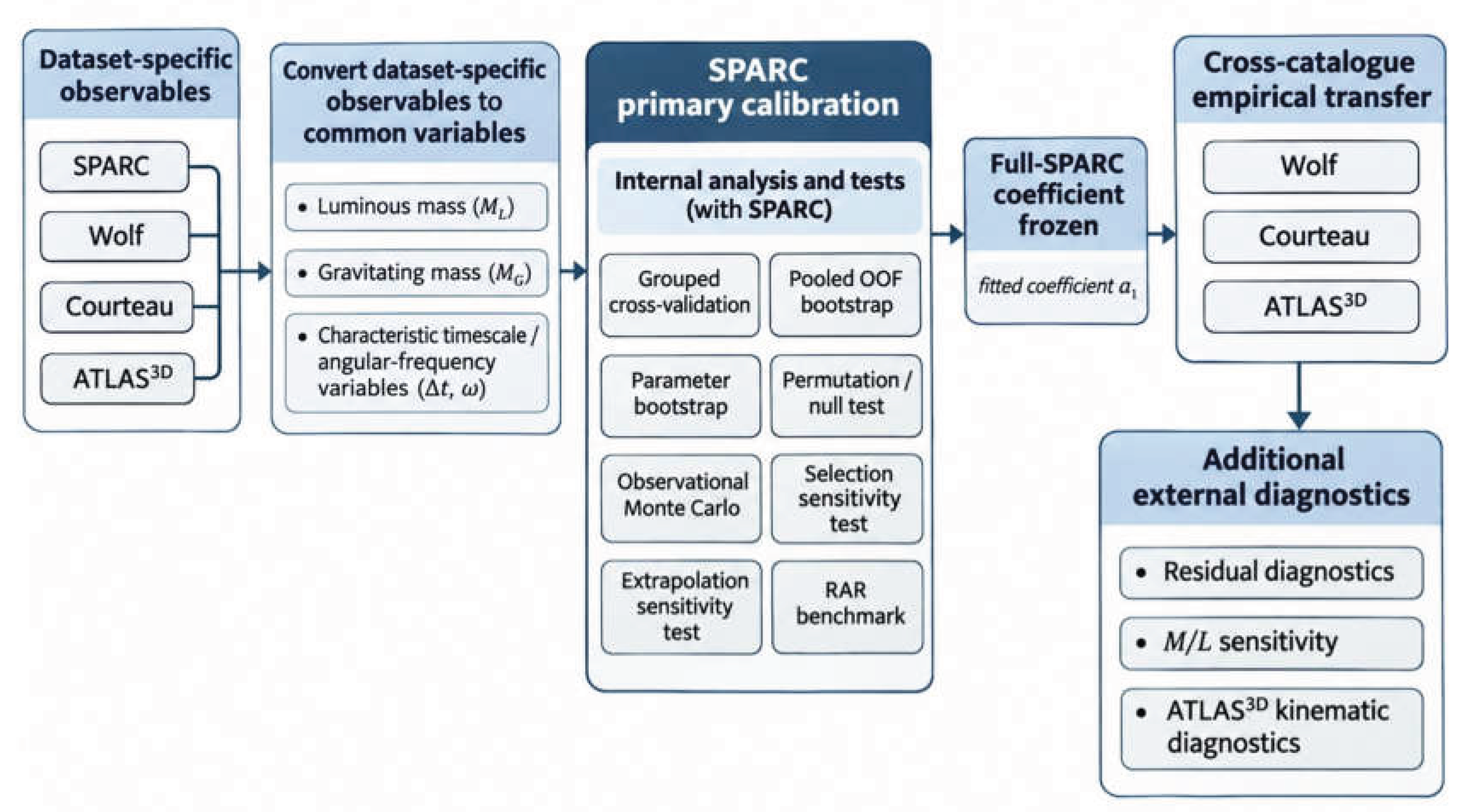
Figure 2.
Galaxy-level visualization of the measured MIMF and the optimized one-parameter relation for the 136 SPARC calibration galaxies. Each point represents a one-per-galaxy summary of the radial variables, while the calibration itself uses all retained radial measurements with galaxy-balanced weighting. The solid curve denotes the optimized relation obtained with a₁ = 0.992295.
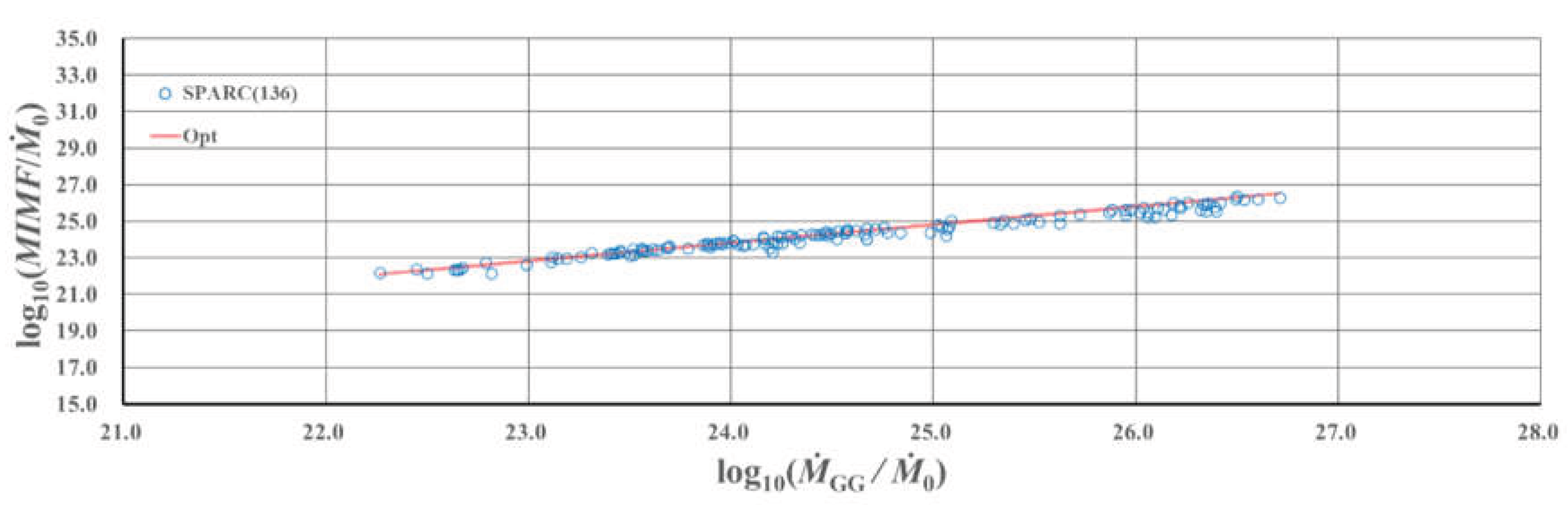
Figure 3.
Galaxy-level signed percentage residual summaries of the predicted gravitating-to-luminous mass ratio for the SPARC calibration sample as a function of log₁₀(ṀGG). The central reference line indicates zero residual, while the additional horizontal lines show the median and adopted percentile bands.
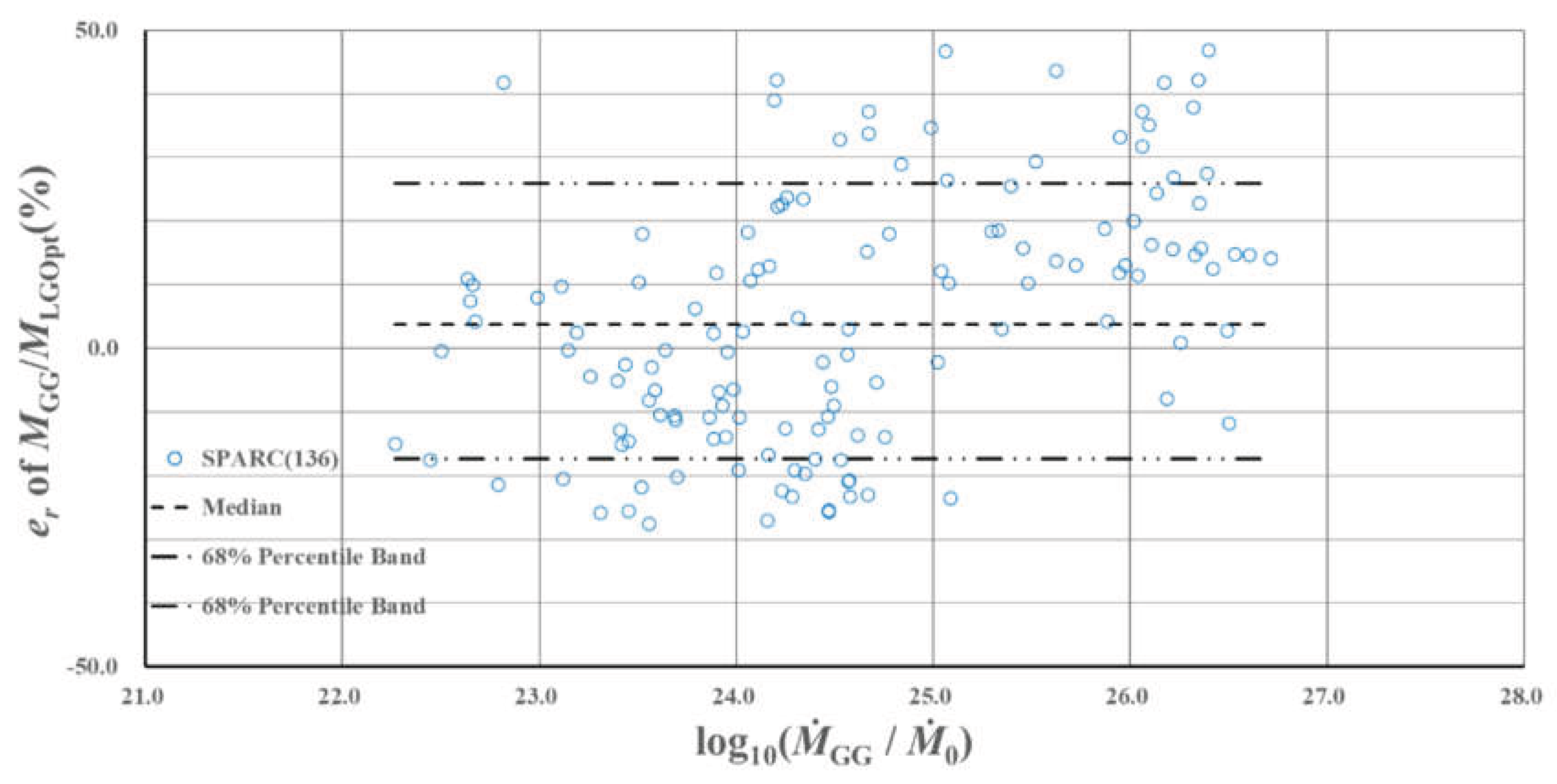
Figure 4.
Signed percentage residuals in MGG/MLG for the three frozen-parameter external transfer samples as a function of log10(ṀGG). The SPARC-calibrated value of a₁ was held fixed without re-optimization for Wolf, Courteau, and ATLAS³D. Individual symbols show galaxy-level residuals. The median signed residuals are −15.43% for Courteau, −30.01% for Wolf, and +2.01% for ATLAS³D; the corresponding 16th–84th percentile intervals are −23.14% to −4.73%, −32.03% to +3.75%, and −9.62% to +10.20%, respectively. The offsets are therefore dataset dependent and are interpreted in the context of stellar M/L assumptions, galaxy populations, kinematic estimators, and characteristic radial domains.
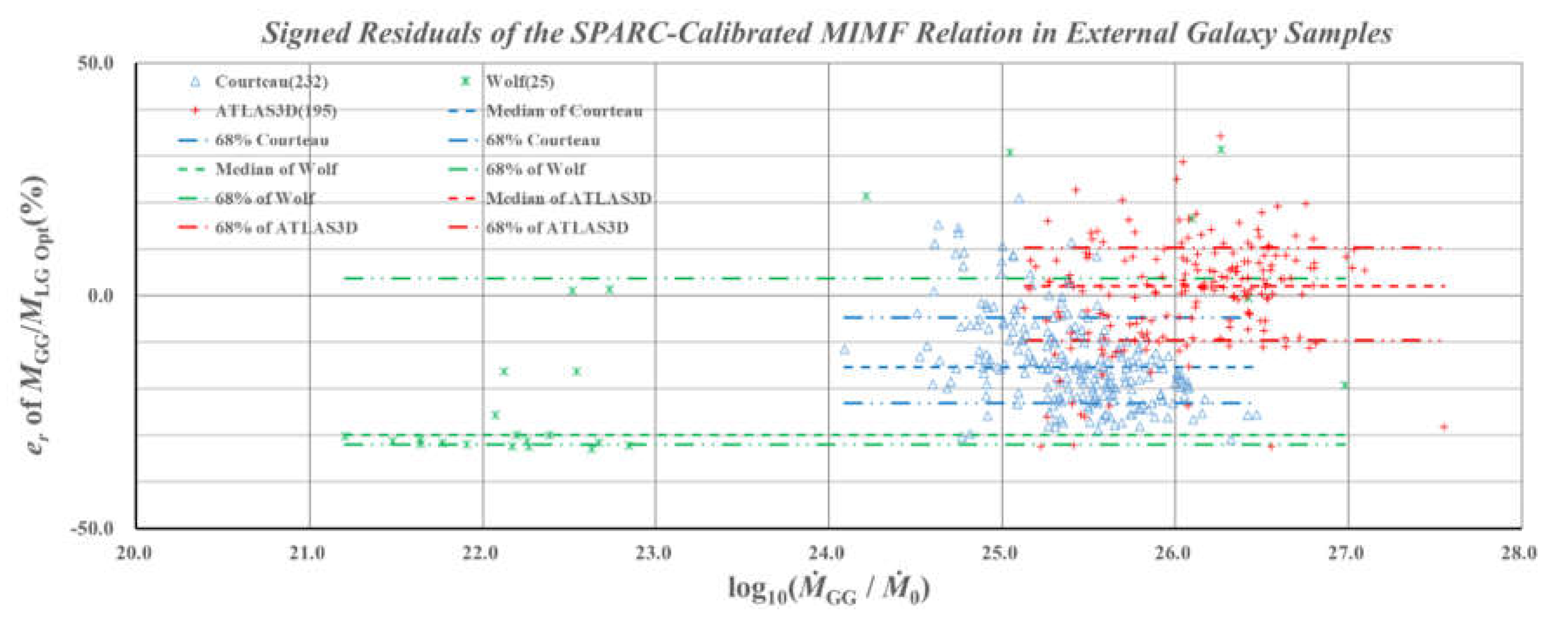

Table 1.
Galaxy samples, dominant support, sample sizes, and roles in the analysis.
| Dataset | Dominant support | Primary kinematic observable | N | Role |
| SPARC | Rotation | V(R) | 136 | Calibration and internal validation |
| Courteau | Rotation | V(R) | 232 | Frozen-parameter external validation |
| Wolf et al. | Dispersion | σlos | 25 | Frozen-parameter external validation |
| ATLAS³D | Mixed | Ve, σe | 195 | Frozen-parameter external validation; sensitivity test |
Table 2.
Dataset-specific implementation of the characteristic masses and kinematic quantities.
| Reconstruction | Radial domain | ϒ* | MLG | MGG | Characteristic kinematics | Weighting |
| SPARC profile | each Ri | 0.5 | cumulative SFB | V²(Ri)Ri/G | mass-weighted R̄, V̄, and ω̄=⟨V/r⟩M* | 2πrΣ*dr |
| Courteau profile | each Ri | 1.0 | cumulative SFB | V²(Ri)Ri/G | mass-weighted R̄, V̄, and ω̄=⟨V/r⟩M* | 2πqrΣ*dr |
| Wolf | r1/2 | 3 | within r1/2 | published Wolf mass | Veff=√3σlos; crossing time | characteristic estimator |
| ATLAS³D | Re | catalogue M/L | within Re | 5Vrms²Re/G | hybrid rotation + dispersion | characteristic estimator |
Table 3.
Reproducibility of the full-sample SPARC one-parameter calibration from 11 different initial values of a₁. The extremely small run-to-run variation demonstrates numerical stability of the optimization.
Table 3.
Reproducibility of the full-sample SPARC one-parameter calibration from 11 different initial values of a₁. The extremely small run-to-run variation demonstrates numerical stability of the optimization.
| 1 | 2 | 3 | 4 | 5 | 6 | 7 | 8 | 9 | 10 | 11 | Rel. % SD | Average | |
| a₁ | 0.992295 | 0.992295 | 0.992295 | 0.992295 | 0.992295 | 0.992295 | 0.992295 | 0.992295 | 0.992295 | 0.992295 | 0.992295 | 9.984 × 10⁻⁶ | 0.992295 |
| GB-MAPE (%) | 22.56 | 22.56 | 22.56 | 22.56 | 22.56 | 22.56 | 22.56 | 22.56 | 22.56 | 22.56 | 22.56 | 1.766 × 10⁻⁶ | 22.56 |
| Median APE | 21.80 | 21.80 | 21.80 | 21.80 | 21.80 | 21.80 | 21.80 | 21.80 | 21.80 | 21.80 | 21.80 | 1.314 × 10⁻³ | 21.80 |
| Bias | 4.818 | 4.818 | 4.817 | 4.817 | 4.817 | 4.818 | 4.817 | 4.818 | 4.817 | 4.818 | 4.817 | 7.519 × 10⁻³ | 4.817 |
| Predictive R² | 0.8724 | 0.8724 | 0.8724 | 0.8724 | 0.8724 | 0.8724 | 0.8724 | 0.8724 | 0.8724 | 0.8724 | 0.8724 | 3.173 × 10⁻⁴ | 0.8724 |
| Initial a₁ | 1.002 | 0.7317 | 1.081 | 0.7260 | 0.8899 | 0.8318 | 0.8899 | 0.8318 | 0.8456 | 0.7588 | 1.086 | 14.58 | 0.8795 |
Table 4.
Galaxy-grouped 10-fold cross-validation results for the SPARC calibration sample. All radial measurements from an individual galaxy were assigned to the same fold. GB-MAPE denotes the galaxy-balanced optimization loss expressed as a percentage; radial MAPE averages APE over all retained radial points.
| Metric | 1 | 2 | 3 | 4 | 5 | 6 | 7 | 8 | 9 | 10 | Full |
| a₁ | 0.992263 | 0.992291 | 0.992657 | 0.992013 | 0.992467 | 0.992601 | 0.992276 | 0.992145 | 0.992210 | 0.992341 | 0.992295 |
| Ngal_Train | 122 | 121 | 124 | 120 | 126 | 123 | 125 | 120 | 124 | 119 | 136 |
| Ngal_Test | 14 | 15 | 12 | 16 | 10 | 13 | 11 | 16 | 12 | 17 | — |
| N_Ri_Train | 1992 | 1990 | 2003 | 1982 | 1998 | 1995 | 1994 | 2001 | 1976 | 2004 | 2215 |
| N_Ri_Test | 223 | 225 | 212 | 233 | 217 | 220 | 221 | 214 | 239 | 211 | — |
| R²pred_Train | 0.8717 | 0.8734 | 0.8820 | 0.8616 | 0.8762 | 0.8801 | 0.8720 | 0.8685 | 0.8701 | 0.8740 | 0.8724 |
| R²pred_Test | 0.8503 | 0.8436 | 0.8828 | 0.8601 | 0.8830 | 0.8862 | 0.8586 | 0.8373 | 0.8674 | 0.8662 | — |
| R²pred_Full | 0.8715 | 0.8723 | 0.8824 | 0.8644 | 0.8771 | 0.8808 | 0.8718 | 0.8682 | 0.8700 | 0.8737 | 0.8724 |
| GB-MAPE_Train | 22.65 | 22.53 | 22.67 | 22.63 | 22.53 | 22.49 | 22.70 | 22.85 | 22.29 | 22.22 | 22.56 |
| GB-MAPE_Test | 21.82 | 22.83 | 21.74 | 22.17 | 23.03 | 23.42 | 21.01 | 20.46 | 25.35 | 24.95 | — |
| Radial MAPE_Train | 22.99 | 23.09 | 23.24 | 23.03 | 23.08 | 23.03 | 23.02 | 23.49 | 22.78 | 22.91 | 23.07 |
| MedianAPE_Train | 21.59 | 21.51 | 21.36 | 21.77 | 21.30 | 21.04 | 21.55 | 22.26 | 21.27 | 21.30 | 21.56 |
| Bias_Train | 6.77 | 7.34 | 7.37 | 6.44 | 6.50 | 6.90 | 6.56 | 6.98 | 6.37 | 6.86 | 6.69 |
| Radial MAPE_Test | 23.64 | 22.82 | 22.78 | 22.72 | 23.53 | 24.41 | 23.46 | 18.69 | 25.22 | 24.69 | — |
| MedianAPE_Test | 21.80 | 22.02 | 18.29 | 22.94 | 21.31 | 21.98 | 22.22 | 16.48 | 25.15 | 22.96 | — |
| Bias_Test | 4.81 | 0.79 | 14.35 | -1.04 | 14.94 | 16.18 | 7.16 | -1.71 | 6.43 | 6.84 | — |
Table 5.
Galaxy-level bootstrap uncertainty of the pooled out-of-fold SPARC predictions. Reported values include the observed OOF statistic, bootstrap mean, and percentile-based 95% confidence interval.
Table 5.
Galaxy-level bootstrap uncertainty of the pooled out-of-fold SPARC predictions. Reported values include the observed OOF statistic, bootstrap mean, and percentile-based 95% confidence interval.
| Statistic | Observed_OOF | Bootstrap_Mean | 95% CI |
| GB-MAPE (%) | 22.68 | 22.66 | 21.36 to 24.05 |
| Radial MAPE | 23.22 | 23.21 | 21.90 to 24.51 |
| Median APE | 21.71 | 21.73 | 19.98 to 23.47 |
| Bias | 6.79 | 6.73 | 3.09 to 10.22 |
| Predictive R² | 0.8679 | 0.8676 | 0.8607 to 0.8749 |
Table 6.
Galaxy-bootstrap stability of the fitted SPARC exponent a₁.
| Statistic | Value |
| Observed full-data a₁ | 0.992295 |
| Bootstrap mean a₁ | 0.992305 |
| Bootstrap median a₁ | 0.992295 |
| Bootstrap SD | 6.32E-04 |
| Relative SD (%) | 6.37 × 10⁻² |
| Bootstrap bias | 1.06 × 10⁻⁵ |
| 95% CI | 0.990987 to 0.993571 |
| Minimum | 0.990295 |
| Maximum | 0.994295 |
| CI contains 1? | No |
Table 7.
Bootstrap distribution of the optimized galaxy-balanced loss associated with the fitted SPARC exponent.
Table 7.
Bootstrap distribution of the optimized galaxy-balanced loss associated with the fitted SPARC exponent.
| Statistic | GB-MAPE (%) |
| Mean | 22.48 |
| Median | 22.47 |
| SD | 0.687 |
| 95% CI | 21.15 to 23.83 |
Table 8.
Frozen-parameter cross-catalogue transfer of the SPARC-calibrated one-parameter MIMF relation.
Table 8.
Frozen-parameter cross-catalogue transfer of the SPARC-calibrated one-parameter MIMF relation.
| Dataset | Role | MAPE | Median APE | Bias | Predictive R² |
| SPARC | Calibration | 22.56 | 21.80 | 4.82 | 0.8724 |
| Wolf | External transfer | 24.86 | 30.66 | -16.67 | 0.8588 |
| Courteau | External transfer | 15.75 | 15.57 | -13.59 | 0.7336 |
| ATLAS³D | External transfer | 8.59 | 7.20 | 0.67 | 0.8625 |
| Descriptive unweighted mean | External transfer | 16.40 | 17.81 | -9.86 | 0.8183 |
Table 9.
Galaxy-level bootstrap uncertainty of the frozen cross-catalogue transfer results. MAPE and bias are reported with percentile-based 95% confidence intervals from 10,000 bootstrap resamples.
Table 9.
Galaxy-level bootstrap uncertainty of the frozen cross-catalogue transfer results. MAPE and bias are reported with percentile-based 95% confidence intervals from 10,000 bootstrap resamples.
| Dataset | N | MAPE | MAPE 95% CI | Bias | Bias 95% CI | Bootstrap iterations | Confidence level |
| Wolf | 25 | 24.86 | 20.46 to 28.60 | -16.67 | -24.55 to -8.03 | 10000 | 95% |
| Courteau | 232 | 15.75 | 14.72 to 16.81 | -13.59 | -15.00 to -12.01 | 10000 | 95% |
| ATLAS³D | 195 | 8.59 | 7.64 to 9.60 | 0.67 | -0.88 to 2.25 | 10000 | 95% |
Table 10.
Comparison of ṀGG with alternative baseline predictors. SPARC-calibration performance, mean external-transfer performance, and pooled four-dataset performance are shown for ṀGG, MGG, ṀLG, MLG, Veff, and the constant-ratio baseline Y₀. The external mean is used here only as a common descriptive summary for comparing predictors under the same fitting specification.
| Predictor | SPARC Calibration MAPE | External Mean MAPE | External Mean Pred. R² | 4-data Pooled MAPE | 4-data Pooled Pred. R² |
| ṀGG | 22.17 | 15.10 | 0.8076 | 13.65 | 0.9043 |
| MGG | 30.28 | 50.52 | 0.0412 | 36.49 | 0.3107 |
| ṀLG | 47.24 | 59.06 | -0.8948 | 41.30 | -0.4473 |
| MLG | 49.88 | 67.36 | -0.9235 | 51.27 | -0.3838 |
| Veff | 35.10 | 35.18 | 0.3258 | 37.82 | 0.0607 |
| Y₀ | 48.44 | 58.67 | -0.8939 | 42.13 | -0.5305 |
Table 11.
Paired galaxy-level bootstrap comparison of the SPARC-calibrated ṀGG predictor with Veff and MGG in the three external-transfer datasets. ΔMAPE = MAPEbaseline - MAPEṀGG; positive values favor ṀGG. A lower 95% confidence bound greater than zero indicates a statistically resolved reduction in MAPE for ṀGG.
| Dataset | Comparison | N | MAPEṀGG | MAPEBaseline | Observed ΔMAPE | Bootstrap Mean | Bootstrap Median | Bootstrap SD | 95% CI | CI Lower > 0 |
| Wolf | ṀGG vs Veff | 25 | 18.27 | 22.69 | 4.42 | 4.43 | 4.39 | 2.308 | -0.08 to 9.01 | NO |
| Wolf | ṀGG vs MGG | 25 | 18.27 | 75.33 | 57.07 | 57.07 | 57.28 | 4.583 | 47.52 to 65.40 | YES |
| Courteau | ṀGG vs Veff | 232 | 18.30 | 32.63 | 14.33 | 14.31 | 14.24 | 2.211 | 10.05 to 18.73 | YES |
| Courteau | ṀGG vs MGG | 232 | 18.30 | 20.29 | 1.99 | 1.99 | 2.01 | 1.072 | -0.12 to 4.10 | NO |
| ATLAS³D | ṀGG vs Veff | 195 | 8.73 | 50.22 | 41.49 | 41.49 | 41.51 | 0.657 | 40.15 to 42.70 | YES |
| ATLAS³D | ṀGG vs MGG | 195 | 8.73 | 55.95 | 47.23 | 47.22 | 47.24 | 0.673 | 45.83 to 48.47 | YES |
Table 12.
Sensitivity of the ATLAS³D external-validation results to the rotational contribution. The nominal calculation including Ve is compared with a dispersion-only sensitivity case in which Ve = 0.
Table 12.
Sensitivity of the ATLAS³D external-validation results to the rotational contribution. The nominal calculation including Ve is compared with a dispersion-only sensitivity case in which Ve = 0.
| Metric | Ve | Ve=0 |
| MAPE | 8.59 | 8.48 |
| Median APE | 7.20 | 6.75 |
| Bias | 0.67 | 1.69 |
| Predictive R² | 0.8625 | 0.8643 |
Table 13.
Galaxy-level permutation/null test of the additional information carried by the observed SPARC galaxy-timescale pairing. The p-value is reported together with the effect size to distinguish statistical detectability from practical magnitude.
Table 13.
Galaxy-level permutation/null test of the additional information carried by the observed SPARC galaxy-timescale pairing. The p-value is reported together with the effect size to distinguish statistical detectability from practical magnitude.
| Observed statistic | Value | Null statistic | Value |
| Number of galaxies | 136 | Null GB-MAPE mean (%) | 22.63 |
| Number of radial points | 2215 | Null GB-MAPE median (%) | 22.63 |
| Observed GB-MAPE (%) | 22.56 | Null GB-MAPE 2.5% | 22.59 |
| Observed radial MAPE (%) | 23.07 | Null GB-MAPE 97.5% | 22.67 |
| Observed median APE (%) | 21.56 | Number of null GB-MAPE values ≤ observed | 4 |
| Observed Bias (%) | 6.69 | One-sided permutation p-value | 0.0005 |
| Observed Predictive R2 | 0.8724 | Observed advantage vs null mean (percentage points) | 0.0666 |
| Observed relative improvement vs null mean (%) | 0.294 |
Table 14.
Direct pooled-OOF comparison between the fitted one-parameter model and the fixed-a₁=1 diagnostic.
Table 14.
Direct pooled-OOF comparison between the fitted one-parameter model and the fixed-a₁=1 diagnostic.
| Model | OOF GB-MAPE | GB-MAPE 95% CI | OOF radial MAPE | Radial MAPE 95% CI | Median APE | Bias | Predictive R2 |
| Fitted a1 | 22.68 | 21.36 to 24.05 | 23.22 | 21.90 to 24.51 | 21.71 | 6.79 | 0.8679 |
| Fixed a1 = 1 | 40.15 | 36.74 to 43.57 | 42.49 | 38.63 to 46.06 | 38.86 | 42.49 | 0.9932 |
Table 15.
Quantitative RAR benchmark on the same retained SPARC radial sample used for MIMF calibration. The same-target YM metrics are diagnostic and do not constitute an equal-input comparison.
Table 15.
Quantitative RAR benchmark on the same retained SPARC radial sample used for MIMF calibration. The same-target YM metrics are diagnostic and do not constitute an equal-input comparison.
| Metric | RAR | MIMF |
| Ngalaxies | 136 | 136 |
| Npoints | 2215 | 2215 |
| GB-MAPE (%) | 37.03 | 22.56 |
| MAPE | 30.21 | 23.07 |
| Median APE | 21.09 | 21.56 |
| Bias | 6.82 | 6.69 |
| Predictive R2 | 0.9281 | 0.8724 |
| OLS R2 | 0.9289 | 0.9999 |
| Mean log residual (dex) | 0.005 | -0.014 |
| Median log residual (dex) | 0.011 | |
| RMS log residual (dex) | 0.163 | 0.110 |
| SD of log residual (dex) | 0.163 | 0.109 |
Table 16.
Exploratory galaxy-level Spearman residual-correlation diagnostics for the three external catalogues.
Table 16.
Exploratory galaxy-level Spearman residual-correlation diagnostics for the three external catalogues.
| Dataset | Residual vs variable | Spearman ρ | p-value |
| Courteau | log10 MLG | -0.068 | 0.300 |
| Courteau | Vavg(Rmax) | -0.174 | 0.008 |
| Wolf | log10 MLG | +0.800 | 1.6 × 10⁻⁶ |
| Wolf | σlos | +0.538 | 0.006 |
| ATLAS3D | log10 MLG | +0.372 | 8.4 × 10⁻⁸ |
| ATLAS3D | σe | +0.229 | 0.001 |
| ATLAS3D | Ve | -0.185 | 0.009 |
| ATLAS3D | M/L | +0.450 | 4.2 × 10⁻¹¹ |
Table 17.
ATLAS³D subgroup and forced-Ve = 0 diagnostic results.
| ATLAS3D case/group | N | MAPE (%) | Median APE (%) | Bias (%) | Predictive R2 |
| Baseline rotation+dispersion | 195 | 8.59 | 7.20 | +0.67 | 0.8625 |
| Forced Ve = 0 diagnostic | 195 | 8.48 | 6.75 | +1.69 | 0.8643 |
| Measured nonzero Ve | 58 | 11.12 | 9.56 | -2.60 | — |
| Measured zero Ve | 137 | 7.14 | 5.99 | +2.50 | — |
Table 18.
Sensitivity to excluding all outer-SFB-extrapolated SPARC radial points and reapplying the original NRi ≥ 5 inclusion rule.
Table 18.
Sensitivity to excluding all outer-SFB-extrapolated SPARC radial points and reapplying the original NRi ≥ 5 inclusion rule.
| Calibration scenario | Dataset | MAPE (%) | Median APE (%) | Bias (%) | Predictive R² |
| Baseline 136/2215 | SPARC | 22.56 | 21.80 | +4.82 | 0.8724 |
| Baseline 136/2215 | Wolf | 24.86 | 30.66 | −16.67 | 0.8588 |
| Baseline 136/2215 | Courteau | 15.75 | 15.57 | −13.59 | 0.7336 |
| Baseline 136/2215 | ATLAS³D | 8.59 | 7.20 | +0.67 | 0.8625 |
| No extrapolation 132/1732 | SPARC | 23.01 | 22.14 | +3.16 | 0.8227 |
| No extrapolation 132/1732 | Wolf | 28.06 | 35.03 | −21.79 | 0.8116 |
| No extrapolation 132/1732 | Courteau | 20.29 | 20.91 | −18.98 | 0.5984 |
| No extrapolation 132/1732 | ATLAS³D | 8.93 | 6.08 | −4.79 | 0.8082 |
Table 19.
Galaxy-level dependence of pooled SPARC OOF error and signed bias on luminous mass and NRi. The lower panel gives mass-quartile summaries.
Table 19.
Galaxy-level dependence of pooled SPARC OOF error and signed bias on luminous mass and NRi. The lower panel gives mass-quartile summaries.
| OOF metric | Galaxy property | Spearman | p-value |
| MAPE | log10 MLG(Rmax) | +0.123 | 0.155 |
| MAPE | NRi | +0.146 | 0.089 |
| Bias | log10 MLG(Rmax) | +0.654 | 5.9 × 10⁻¹⁸ |
| Bias | NRi | +0.036 | 0.681 |
| Mass quartile | N galaxies | Median OOF MAPE (%) | Median OOF Bias (%) |
| Q1 (lowest) | 34 | 23.04 | -11.49 |
| Q2 | 34 | 20.19 | -10.00 |
| Q3 | 34 | 22.34 | +14.40 |
| Q4 (highest) | 34 | 23.47 | +18.07 |
Table 20.
Two-parameter reference-scale diagnostic. The freely fitted slope remains invariant while the intercept shifts with Ṁ0.
Table 20.
Two-parameter reference-scale diagnostic. The freely fitted slope remains invariant while the intercept shifts with Ṁ0.
| Metric | Ṁ0 = 1 | Ṁ0 = 10¹⁰ | Ṁ0 = 10²⁰ |
| b | 0.633651 | 0.298994 | −0.035080 |
| a₁ | 0.966557 | 0.966579 | 0.966528 |
| SPARC MAPE (%) | 22.17 | 22.17 | 22.17 |
| SPARC Bias (%) | 5.22 | 5.23 | 5.22 |
| SPARC predictive R² | 0.8864 | 0.8865 | 0.8864 |
Disclaimer/Publisher’s Note: The statements, opinions and data contained in all publications are solely those of the individual author(s) and contributor(s) and not of MDPI and/or the editor(s). MDPI and/or the editor(s) disclaim responsibility for any injury to people or property resulting from any ideas, methods, instructions or products referred to in the content. |
© 2026 by the authors. Licensee MDPI, Basel, Switzerland. This article is an open access article distributed under the terms and conditions of the Creative Commons Attribution (CC BY) license (http://creativecommons.org/licenses/by/4.0/).
Copyright: This open access article is published under a Creative Commons CC BY 4.0 license, which permit the free download, distribution, and reuse, provided that the author and preprint are cited in any reuse.