
Submitted:
23 November 2026
Posted:
25 November 2026
You are already at the latest version
Abstract
Direct conversion of methane (CH₄) and carbon dioxide (CO₂) into oxygenated products remains challenging because of the high stability of both molecules and the complexity of controlling product selectivity. This study investigated oxygen-assisted non-thermal plasma (NTP)-catalytic dry methane reforming (DMR) for directing product formation toward methanol. Plasma-only, 13X, and Co/13X were evaluated using oxygen co-feeding at a CH4: CO2: O2 ratio of 3:1:1.3. Under conventional DMR conditions (CH4: CO2 = 3:1), product distributions were dominated by syngas and light hydrocarbons, while methanol selectivity remained below 3.33%. Oxygen addition substantially modified the product distribution, increasing methanol selectivity to 10.95%, 15.27%, and 18.14% for plasma-only, 13X, and Co/13X configurations, respectively. Optical emission spectroscopy revealed increased emission from excited atomic oxygen (777 nm), supporting the proposed contribution of oxygen plasma mediated reaction pathways. Furthermore, Physio-chemical, XPS and FTIR surface analyses indicated reduced carbon accumulation following oxygen addition. These findings demonstrated that oxygen co-feeding, particularly in combination with Co/13X, provided an effective approach for enhancing methanol selectivity during plasma-assisted DMR. The results highlighted the potential of feed-composition engineering and plasma-catalyst interactions for directing methane and CO₂ conversion toward targeted oxygenated products.
Keywords:
non-thermal plasma
; dielectric barrier discharge (DBD)
; dry methane reforming
; oxygen-assisted plasma catalysis
; methanol selectivity
; zeolite 13X
; cobalt-modified zeolite
; oxygenates
1. Introduction
Methane (CH4) and carbon dioxide (CO2) are the two most important anthropogenic greenhouse gases; ; CH₄ has a global warming potential approximately 80 times that of CO₂ over 20 years [1] and 28 times over 100 years [2]. CH4 is also the main component of natural gas, biogas, and landfill gas, yet a substantial fraction of it is flared, vented, or lost during extraction and transport [1]. Much of this gas originates from stranded, remote, or small sources, where transporting CH4 is difficult and large conversion plants are not economical. This situation has motivated the development of electrified, flexible, and modular technologies that convert CH4 into liquid products close to the source [3,4]; converting CH₄ and CO₂ together into a transportable liquid would consume two greenhouse gases while generating a value-added chemical [5,6].
Methanol (CH3OH) is a key commodity chemical, a clean liquid fuel and energy carrier, and the cornerstone of the methanol economy concept proposed by Olah [2,7,8,9]. Industrially, however, CH3OH is produced indirectly: CH4 is first reformed to synthesis gas (syngas, CO + H2) at 800–1000 °C [1], which is then converted to CH3OH over Cu–ZnO-based catalysts at 250–280 °C and 60–100 bar [8]. When CO2 is the co-reactant, the first step is the dry reforming of methane (DMR; CH4 + CO2 → 2CO + 2H2, ΔH298 K = +247 kJ mol−1), which requires temperatures above 700 °C and suffers from catalyst deactivation by carbon deposition [10,11]. Such multistep processes rely on economies of scale [12,13]. A direct, single-step route would bypass syngas, but it is intrinsically difficult to achieve. The C–H bond of CH4 (434 kJ mol−1) is stronger than that of CH3OH (393 kJ mol−1), so the product is more easily oxidized than the reactant [1,14]and in thermal catalysis, the temperatures needed to activate CH4 also decompose the desired product [6]. For the CH4 + CO2 pair, there is no thermally activated direct route from CO2 and CH4 to oxygenates such as methanol at ambient pressure [5].
Non-thermal plasma (NTP) offers a way around these constraints. In an NTP, electrons reach energies of about 1–10 eV while the bulk gas remains near ambient temperature, so that stable molecules such as CH4 and CO2 are dissociated into radicals, ions, and excited species without external heating [5,10]. The dielectric barrier discharge (DBD) dominates plasma-catalysis research because of its simple design, operation at atmospheric pressure and ambient temperature, ease of packing with catalyst pellets, and scale-up potential [4,5], and is already established industrially for ozone generation [15]. Plasma processes can be rapidly started and stopped, facilitating integration with intermittent renewable electricity [6,16]. Combining plasma with a catalyst can steer product selectivity, lower the catalyst's operating temperature, and reduce poisoning, coking, and sintering [17].
Our group has applied radiofrequency (RF) and Dielectric Barrier Discharge (DBD) plasmas for dry methane reforming (DMR), and methane upgrading. Our recent studies have shown that oxygen mobility in zirconia packings alters the gas-phase chemistry and product distribution [11], that zeolite 13X promotes methane activation toward hydrogen and value-added hydrocarbons [18], and that adsorption and surface transport govern how CH₄ and CO₂ interact with plasma-activated silicoaluminophosphates [19].
The main limitation of plasma is selectivity: electron-impact activation is inherently non-selective, the resulting radicals recombine into a broad product distribution, and subsequent collisions with electrons and radicals can destroy desirable products [5,11], which is decisive for a readily oxidized product such as CH₃OH.
Most plasma studies of direct CH3OH synthesis have used O2 as the oxidant (partial oxidation of methane), mostly in DBD reactors [7]. Early catalyst-free studies formed CH₃OH at ambient temperature, but in low yields: 2.4% in a square-pulsed silent discharge (CH₄:O₂ = 92:8) [20]; 3% (14% CH₄ conversion, 22% selectivity) in a DBD (CH₄:O₂ = 8:2) [21]; and 47% selectivity at only 1.9% conversion in a pulsed discharge (CH₄:O₂ = 94:6) [22]. In a double-dielectric DBD, changing CH₄:O₂ from 80:20 to 50:50 increased CH₄ conversion from 17.2% to 66.4% but decreased CH₃OH selectivity from 22.1% to 16.3% [23]. Quick product removal has been more effective than changes in feed composition: silent-discharge reactors simulated in series with intermediate O₂ addition and liquid condensation gave a 35% yield of liquid oxygenates at 59% CH₄ conversion [24], and microscale DBD reactors with efficient heat removal reached 34% CH₃OH selectivity at 30% conversion, with reproducible one-pass yields up to 10% [25], and 30–50% selectivity to total oxygenates above 40% conversion [26]. Other discharge types such as pulsed discharge gave a combined selectivity of 64% for CH3OH and HCHO [27]. Across these studies, O2 activates CH4 effectively but drives over-oxidation to CO and CO2 [6,11].
Alternative oxygen sources have been explored to temper this over-oxidation. With N₂O in a DBD, approximately 40% combined selectivity to CH₃OH and HCHO [28], and 28–36% CH₃OH selectivity at 10–23% CH₄ conversion (the latter over Cu–Ni/CeO₂) [29,30] were reported, and NO₂ gave 32% selectivity at 65% conversion (20.8% yield) [31]. Water has recently attracted great attention. Gas-phase steam gave only 7.5% CH₃OH selectivity [32], whereas configurations in which the products form at, or are rapidly transferred into, a liquid phase reported liquid-phase CH₃OH selectivities of 86–96.8% [33,34,35], and Cu/mordenite raised the CH3OH selectivity in a CH4/H2O/Ar DBD from 30.3% to 73.1% [36]. These high selectivities, however, were obtained at CH₄ conversions of approximately 2–7% [34,36,37], and liquid-phase selectivities are not directly comparable to carbon-based selectivities. A DBD coupled with electrocatalysis reported a faradaic efficiency of 80.1%, which likewise cannot be compared directly [38].
Catalysts and packing materials have been the principal lever for improving CH₃OH selectivity in O₂-containing DBDs. First, packing alone matters: glass beads raised CH₄ conversion from about 7% to 15.4% and CH₃OH selectivity from 25% to 35.4% (yield from 1.7% to 5.4%) [39], and metal-oxide-coated glass beads gave a 12.3% yield (40.2% selectivity) with Mn₂O₃ [40] and a 5% yield with NiO [41]. Second, Cu-containing catalysts, which echo the industrial Cu/ZnO/Al₂O₃ formulation, are the most studied: Cu–Zn–Al (CZA) mixed oxides gave 19–27% selectivity [42]; Ga promotion of CZA increased the CH₃OH yield from 3.1% to 12.1% [43]; and CuO/γ-Al₂O₃ and CuZrAl each raised selectivity by about 10 percentage points [44,45]. Zeolite-confined Cu sites gave the highest selectivities in this regime, 50.6% over Cu–S-1 [46] and 51% over Cu-MOR (13,877 µmol gcat−1 h−1) [47], but at CH4 conversions below 8%; CuO/ZSM-5 gave 1370 µmol gcat−1 h−1 [48]. Third, other transition- and noble-metal systems, including Fe–Hf/YSZ [49], Ni/YSZ [50], Fe/γ-Al2O3 [51], Pd/SBA-15 [52], V2O5/SiO2 in a pulsed discharge [53], Fe-, Mo-, Pd-, and zeolite-based catalysts [3], and NiO/γ-Al2O3 [54], gave selectivities between 23.6% and 49.7% where reported; the upper value was obtained over NiO/γ-Al2O3 at 6.4% conversion [54]. Finally, reactor configuration also matters: in-plasma and post-plasma catalyst placement have been compared directly [56,57], and post-plasma Cu/SSZ-13 recently achieved 58% selectivity, albeit at 2% conversion [37]. One study reported 76% conversion and 36.2% selectivity (27.5% yield) with a Cu inner electrode used an O₂-rich feed (CH₄:O₂ = 100:75) and is not treated here as a benchmark [55]. Mechanistic studies attribute the plasma–catalyst synergy mainly to plasma-generated radicals, such as O and CH3O2, reacting at the catalyst surface rather than to plasma heating [4,8,56], and 16 products have been identified in a CH₄/O₂ DBD, underlining how broadly the carbon is distributed [15].
Co-feeding O2 with CO2 is attractive because CO2 is a milder oxidant that should limit deep oxidation, and the process then consumes both greenhouse gases [6,11]. Plasma DMR in DBDs, however, has been studied mainly for syngas production, and overall oxygenate selectivities above about 15% are difficult to obtain [5,57]. Kinetic modeling of a 70/30 CH4/CO2 DBD shows that about 94% of the CH3 radicals recombine into higher hydrocarbons, whereas CH₃ + OH recombination accounts for only about 0.4% CH₃OH [5]. The experimental record for CH₃OH from CH₄/CO₂ in DBDs is correspondingly lean, with CH₃OH always one product among several oxygenates. A starch-coated dielectric gave 7.1% CH₃OH selectivity at 24.7% CH₄ conversion, although the starch layer itself may supply O and OH species [58]; a DBD with a grounded water electrode at 30 °C gave 11.9% CH₃OH selectivity at 18.3% conversion, with acetic acid as the main liquid product [10]; 10% Cu/UiO-66-NH₂ at CH₄:CO₂ = 1:1 gave 20.9% selectivity at 23.5% conversion [57]; and a catalyst-free, water-cooled DBD reached up to 43% CH₃OH selectivity at 5 °C and 15 W, showing how sensitive CH₃OH survival is to the gas temperature [59].Our group has also observed CH₃OH formation from CH₄/CO₂ over MOF-177, where selectivity was referenced to the converted CO₂ [6].
Three patterns emerge from this body of work. First, the highest CH₃OH selectivities in DBD reactors have been obtained with O₂, N₂O, or H₂O as the oxygen source, combined with Cu-based or zeolite-confined Cu catalysts, rapid product quenching, or liquid-phase product capture, usually at single-digit CH₄ conversions. Second, only four of the studies compiled in our survey (Table S1) address CH₄ + CO₂ in a DBD [10,57,58,59], and none reports a CH₃OH yield or productivity. Third, selectivity is defined inconsistently (on a carbon basis, a liquid-phase basis, or relative to the limiting reactant), which hampers quantitative comparison.
Herein, we investigate the direct, single-step synthesis of CH3OH from CH4 and CO2 with O2 addition in a DBD reactor at atmospheric pressure and without external heating, with CH3OH as the primary target product, aiming to shed some light into this process.
2. Results
2.1. Electrical characterization
The reactor operating parameters were kept consistent across all configurations, including plasma-only, 13X, and Co/13X systems, with an input power of 10 W, a frequency of 21.5 kHz, and a peak-to-peak voltage of 16 kV. The corresponding Lissajous figures (applied voltage versus transferred charge) exhibited comparable profiles across the investigated conditions, indicating similar overall discharge characteristics (see Figure 1). More electrical characterization details on applied voltage (kV) and current (mA) are presented in supplementary information (see Figure S1.)
2.2. Plasma only performance
2.2.1. CH4 and CO2 Conversion (%)
Non-thermal plasma (NTP)-assisted dry methane reforming has the potential to produce a range of products, including syngas (CO and H2), light hydrocarbons (C2-C4), and oxygenated products. Among these products, methanol is of particular interest because of its importance as a versatile chemical feedstock, hydrogen carrier, and potential liquid fuel. However, directing the plasma-driven reaction network toward methanol formation remains challenging, as competing reaction pathways often favor the production of gaseous products. As an initial step, the plasma-only system was evaluated to establish the influence of feed composition on CH4 and CO2 conversion in the absence of a catalyst.
In this work, the CH4: CO2 feed ratio was varied from 10:1 to 1:10 while maintaining a constant total flow rate of 30 sccm. Plasma power was kept constant for all runs at 10 Watts (Frequency 21.5 kHz and Vpk-pk of 16 kV). Methane conversion was strongly dependent on the feed composition. Under methane-rich conditions, conversion remained low, ranging from 0.53% to 7.80% for the 5:1 to 2:1 feed ratios, with a value of 1.52% at 10:1. At an equimolar CH4: CO2 ratio, methane conversion increased to 18.74%. Further increase of the CO2 content resulted in a substantial increase in methane conversion, reaching 37.38%, 47.00%, 65.10%, and 87.27% at feed ratios of 1:2, 1:3, 1:5, and 1:10, respectively (see Figure 2). These results demonstrate that methane conversion increased progressively as the methane feed was diluted with CO₂ under the investigated operating conditions. A similar trend was observed in our previous study using a radio-frequency plasma configuration[60].
In comparison, CO2 conversion exhibited a less consistent dependence on feed composition. Conversion ranged from 2.23% to 11.83% across the 5:1 to 1:1 feed ratios, with the maximum value in this range observed at 1:1. At higher CO₂ feed fractions, conversion decreased to 4.17% at 1:2 and remained between 6.82% and 7.04% at 1:3 and 1:5. At the most CO₂-rich condition (1:10), CO₂ conversion increased to 34.36%(see Figure 2).
The conversion trends across the investigated feed ratios provided a basis for narrowing the feed composition range for subsequent product-selectivity measurements. Accordingly, the intermediate CH4: CO2 ratios (3:1 to 1:3) were selected for further investigation to examine product formation under conditions with more balanced contributions from both precursors.
2.2.2. Product Selectivity (%)
The product distribution across the selected CH4: CO2 feed ratios (3:1, 1:1, and 1:3) was dominated by syngas and hydrocarbon products, accounting for 89.41%, 86.25%, and 86.58% global selectivity, respectively (Figure 3). CO and H₂ were the major products, with CO selectivity increasing from 30.35% at 3:1 to 36.86% at 1:3, while H₂ selectivity ranged from 19.04% to 23.06%. Among the hydrocarbons, ethane (C2H6) was the predominant product, with global selectivity of 16.08%, 17.65%, and 19.00% at 3:1, 1:1, and 1:3, respectively. Other hydrocarbons included ethylene (C2H4), acetylene (C2H2), propane (C3H8), and butane isomers, whose contributions varied with feed composition. Oxygenated products accounted for 10.59%, 13.75%, and 13.42% global selectivity, respectively, and comprised formaldehyde (HCHO), methanol (CH3OH), acetone (C3H6O), formic acid (HCOOH), and acetic acid (CH₃COOH). Methanol selectivity increased from 3.33% at 3:1 to 6.09% at 1:3, while formaldehyde was the most abundant oxygenate at 3:1 and 1:1, with selectivity of 5.69% and 6.58%, respectively. Although syngas and light hydrocarbons remained the predominant products, oxygenate formation was observed across all three feed ratios. At the extreme feed ratios of 10:1 and 1:10, oxygenated products were not detected, and the product distribution was primarily associated with syngas formation (CO and H2). These results motivated further investigation of catalyst incorporation to influence the product distribution toward oxygenate formation and improve methanol production.
2.3. Zeolite 13X and Metal Impregnated Co/13X
2.3.1. CH4 and CO2 Conversion (%)
To investigate whether catalyst incorporation could influence oxygenate production, zeolite 13X and transition-metal-impregnated 13X catalysts were synthesized in-house using Cobalt as active metals. Zeolites were selected as catalyst supports because their microporous structures and acidic sites offer potential advantages for precursor conversion and product-selectivity control. In particular, zeolite 13X possesses a faujasite (FAU) framework, providing a defined microporous structure for investigating the influence of a catalyst support on plasma-assisted conversion. Co was selected based on its established use in methane conversion and reforming studies.
Methane and carbon dioxide conversions were subsequently compared for plasma-only, bare 13X, Co/13X at CH₄:CO₂ feed ratios of 3:1, 1:1, and 1:3. Overall, catalyst incorporation did not produce a consistent increase in the conversion of both precursors across all feed compositions. At a 1:3 feed ratio, the plasma-only system exhibited the highest methane conversion (47%), compared with 16.88%, and 22.63% for 13X, and Co/13X, see Figure 4(a). In contrast, at a 3:1 feed ratio, 13X achieved the highest CO₂ conversion (14.60%), exceeding the values obtained with plasma-only (5.64%), 13X (9.33%), and Co/13X (2.45%) see Figure 4(b). These results indicate that the effect of catalyst incorporation on precursor conversion depended on both the supported metal and the feed composition. Since the primary objective was to determine whether catalyst incorporation could shift product formation toward methanol, precursor conversion alone was insufficient to establish the benefit of the different catalysts. In the next section we present the comparison on product distribution with Co supported on 13X.
2.3.2. Product Selectivity (%)
Following the comparison of precursor conversion, the global product distribution was evaluated to determine how zeolite 13X and Co-impregnated 13X influenced syngas, hydrocarbon, and oxygenate formation. For pristine 13X, syngas (CO and H₂) accounted for 62.89%, 63.87%, and 64.78% global selectivity at CH4:CO2 feed ratios of 3:1, 1:1, and 1:3, respectively. Hydrocarbons contributed 34.48%, 31.93%, and 30.92%, with ethane (C₂H₆) being the predominant hydrocarbon product (16.54-18.50%). Oxygenates accounted for 2.19%, 4.19%, and 4.31% global selectivity, comprising formaldehyde, methanol, acetone, formic acid, and acetic acid. Methanol selectivity increased from 0.43% at 3:1 to 1.05% at 1:3, indicating that the pristine zeolite support favored syngas and hydrocarbon formation over oxygenate production.
Following Co incorporation, syngas selectivity was 61.90%, 58.51%, and 57.35% at 3:1, 1:1, and 1:3, respectively, while hydrocarbons contributed 32.93%, 31.84%, and 36.77%. Ethane remained the predominant hydrocarbon, with global selectivity of 18.03%, 19.55%, and 20.50%, respectively. In contrast, oxygenate selectivity increased to 5.17%, 5.39%, and 5.88%, with methanol selectivity reaching 0.47%, 1.18%, and 1.39% across the respective feed ratios. Formaldehyde, acetone, formic acid, and acetic acid were also detected (Figure 5).
Overall, Co incorporation into zeolite 13X resulted in a modest shift in the global product distribution toward oxygenate formation, accompanied by a reduction in syngas selectivity, particularly under CO2 rich conditions. Although syngas and hydrocarbons remained the dominant products, Co/13X exhibited consistently higher oxygenate and methanol selectivity than pristine 13X across the investigated feed ratios, demonstrating the influence of metal incorporation on product distribution.
2.3.3. Molar Yield and Ratio
The methanol yields were compared across the three CH4: CO2 feed ratios (1:3, 1:1, and 3:1) to evaluate the influence of catalyst composition on oxygenate production. For the bare 13X support, the highest methanol yield was obtained at the equimolar feed ratio, reaching 0.89 µmol/g-cat.h. For the Co/13X catalyst, the highest methanol yield was observed at the 1:3 feed ratio, with a value of 0.62 µmol/g-cat.h. These results indicate that the feed composition associated with the highest methanol yield depended on the catalyst employed. Under conventional DMR conditions, the product distribution was dominated by syngas and light hydrocarbons, while only minor amounts of oxygenated compounds were formed. To investigate whether the product distribution could be shifted toward oxygenate formation, the subsequent section examined the effect of oxygen co-feeding on product selectivity, with particular emphasis on methanol production.
2.4. Effect of Oxygen addition in DMR
Across the investigated dry methane reforming (DRM) conditions, the product distribution was dominated by light hydrocarbons, particularly alkanes, whereas oxygenated products were formed at comparatively low selectivity’s. Among the feed compositions examined, the CH4: CO2 ratio of 1:3 provided the most favorable overall performance for precursor conversion and oxygenate formation. However, this feed was CO2-rich, with methane accounting for only 25% of the combined CH4 and CO2 feed. This general trend was observed in the plasma-only system, with bare zeolite 13X, and Co impregnated 13X, indicating that the predominance of gaseous hydrocarbons persisted across the investigated configurations.
The beneficial effect of oxygen addition on oxygenate formation during plasma-assisted dry methane reforming has also been demonstrated in previous studies. Li et al. (2023) from the Bogaerts group showed that the addition of small amounts of O2 could substantially enhance oxygenate production during plasma-assisted DMR, supported by experimental observations and plasma chemical kinetics modeling[61]. Similarly, Maerivoet et al. (2024) investigated the influence of O2 on plasma-based DMR and identified the importance of feed composition in controlling product distribution and optimizing oxygenate formation[62]. More recently, Golubev et al. (2025) demonstrated the potential of oxygen-promoted plasma-catalytic DMR over mesoporous catalysts for enhanced oxygenate production[63]. Collectively, these studies establish oxygen co-feeding as a promising approach for directing plasma-assisted methane reforming toward oxygenated products and provide a basis for investigating its influence in the present plasma-zeolite catalytic system.
To investigate whether oxygen addition could alter the reaction pathway and improve the product distribution, a subsequent set of experiments was conducted. The results were compared with those obtained without oxygen in addition to isolate the influence of O2 on product formation. A nominally methane-rich CH4: CO2 feed ratio of 3:1 was selected for this comparison, and 10 sccm of pure O₂ was introduced as an additional feed. The resulting feed composition was 22.5 sccm CH₄, 7.5 sccm CO2, and 10 sccm O2, corresponding to a CH4: CO2: O2 flow ratio of 3:1:1.3 and a total flow rate of 40 sccm. This configuration enabled evaluation of how oxygen addition influenced the distribution of gaseous hydrocarbons and oxygenated products related to the corresponding oxygen-free plasma system.
Precursors conversion was investigated under dry methane reforming (DMR; CH4:CO2 = 3:1) and oxygen co-feeding (CH4:CO2:O2 = 3:1:1.3) using plasma-only, 13X, and Co/13X catalyst at a total flow rate of 30-40 sccm, an input power of 10 W, a peak-to-peak voltage of 16 kV, and a frequency of 21.5 kHz. Under DMR conditions, methane conversion remained relatively low, reaching 7.40% for plasma-only, 8.63% for 13X, and 5.61% for Co/13X. In contrast, oxygen co-feeding substantially increased methane conversion to 36.80%, 34.28%, and 29.93%, respectively, demonstrating the enhanced methane activation in the presence of oxygen. CO2 conversion under DMR was 5.64%, 9.33%, and 2.45% for plasma-only, 13X, and Co/13X, respectively. With oxygen co-feeding, the corresponding CO2 conversion values were 2.50%, 12.70%, and 9.50%; however, these measurements exhibited considerable variability because CO₂ was also generated during the oxidation of methane and other reaction intermediates, which makes it challenging for net CO₂ conversion. Furthermore, oxygen conversion under co-feeding conditions reached 18.60%, 25.80%, and 22.40% for plasma-only, 13X, and Co/13X, respectively. The carbon balance for all reactor configurations exceeded 98%, confirming reasonable balance across the investigated systems (Table S2).Overall, oxygen co-feeding substantially enhanced methane conversion across all systems and facilitated a shift in product distribution toward oxygenates (described in section 2.4.1). This improvement is particularly significant for the methane-rich 3:1 feed, for which methane activation and oxygenate formation were limited under DMR conditions alone (See Figure S2.).
2.4.1. Product Selectivity (%)
Plasma only (no catalyst)
The addition of oxygen substantially altered the global product selectivity in the plasma-only system, shifting the product distribution away from light hydrocarbon formation toward oxygenated compounds. Under dry methane reforming conditions (CH4: CO2 = 3:1), syngas (CO + H₂) accounted for 53.42% of the global selectivity, while hydrocarbons contributed 36.00% and oxygenates accounted for 10.59%. Following the addition of O₂ (CH4: CO2: O2 = 3:1:1.3; total flow rate = 40 sccm), syngas selectivity decreased slightly to 52.50%, whereas hydrocarbon selectivity decreased to 16.89%. In contrast, the combined selectivity of oxygenated organic products increased to 18.74%. These results indicate that oxygen addition modified the product distribution, favoring oxygenate formation while suppressing the formation of light hydrocarbons.
The changes were particularly evident in the selectivity of individual products. Ethane (C2H6), the most abundant hydrocarbon under conventional DMR conditions, decreased from 16.08% to 8.97% following O₂ addition. Propane (C3H8) selectivity also decreased substantially, from 9.33% to 1.77%, while isobutane and n-butane, initially detected at 1.01% and 1.87%, respectively, were no longer detected. In contrast, methanol selectivity increased from 3.33% to 10.95%, representing more than a threefold increase. Acetone, formic acid, and acetic acid selectivities also increased from 0.76%, 0.52%, and 0.29% to 2.23%, 1.95%, and 1.37%, respectively (Figure 6a).
Evidently, oxygen addition shifted the global product distribution toward oxygenated organic compounds, with methanol showing the most pronounced increase among the individual oxygenates. Although syngas remained a major product, the reduction in hydrocarbon selectivity and the increased contribution of oxygenates demonstrated the influence of O₂ on product distribution. This observation motivated further investigation of zeolite 13X and Co-13X under oxygen-free and oxygen-assisted conditions.
Zeolite 13X
A similar shift in product distribution was observed in the plasma system containing zeolite 13X following oxygen addition. Under conventional DMR conditions (CH4: CO2 = 3:1), syngas accounted for 62.89% of the global selectivity, while hydrocarbons and oxygenated organic products contributed 34.48% and 2.19%, respectively. Following oxygen addition (CH4: CO2: O2= 3:1:1.3; total flow rate = 40 sccm), syngas selectivity decreased to 48.46%, accompanied by a reduction in hydrocarbon selectivity to 18.11%. The combined selectivity of oxygenated organic products increased to 19.40%. These changes indicate that oxygen co-feeding substantially modified the product distribution in the presence of 13X, increasing the relative contribution of oxygenated products while decreasing hydrocarbon formation.
Among the individual products, ethane selectivity decreased from 16.54% to 9.67%, while propane decreased from 8.75% to 0.27%. Isobutane and n-butane, initially detected at 0.77% and 1.54%, respectively, were no longer detected following oxygen addition. Methanol selectivity increased markedly from 0.43% to 15.27%, becoming the most abundant oxygenated organic product. Acetylene and ethylene selectivities increased from 4.39% and 2.49% to 4.73% and 3.44%, respectively, despite the overall decrease in hydrocarbon selectivity. Among the other oxygenates, formic acid selectivity increased from 0.48% to 1.87%, whereas acetic acid increased from 0.18% to 0.60%. Acetone increased from undetected levels to 0.80%. The increase in methanol selectivity, accompanied by changes in the other oxygenated products, further illustrated the influence of oxygen co-feeding on the product distribution when employing 13X (Figure 6b).
Cobalt/13X
To further explore the effect of oxygen addition, Co/13X was selected based on the redox properties of cobalt and its potential role in controlling oxidation pathways during plasma-assisted conversion. Cobalt can access multiple oxidation states, primarily Co2+ and Co3+, allowing changes in its oxidation state through redox cycling. This redox flexibility may facilitate oxygen activation and transfer at the catalyst surface, thereby enhancing the oxidation of plasma-generated radicals. In terms of reaction performance, under conventional DMR conditions (CH4: CO2 = 3:1), the Co/13X-containing plasma system produced predominantly syngas and hydrocarbons, which accounted for 61.90% and 32.93% of the global selectivity, respectively. Oxygenated organic products contributed only 5.17%. Following oxygen co-feeding (CH4: CO2: O2 = 3:1:1.3; total flow rate = 40 sccm), syngas selectivity decreased to 50.37%, while hydrocarbon selectivity decreased to 14.32%. In contrast, the combined selectivity of oxygenated organic products increased to 20.02%. These results demonstrate that oxygen co-feeding substantially shifted the product distribution in the presence of Co/13X, with a greater contribution from oxygenated products and a lower contribution from hydrocarbons.
The changes were particularly evident in the selectivity of individual products. Ethane selectivity decreased from 18.03% to 6.26% following O2 addition, while propane decreased from 7.90% to 0.24%. Isobutane and n-butane, initially detected at 0.43% and 1.37%, respectively, were no longer detected under oxygen-assisted conditions. In contrast, methanol selectivity increased from 0.47% to 18.14%, representing the highest methanol selectivity among the investigated systems. Acetylene and ethylene selectivities increased from 1.06% and 4.14% to 4.77% and 3.05%, respectively. The selectivity of formic acid decreased from 1.15% to 0.51%, while acetone decreased from 1.27% to 0.48%. Acetic acid also decreased from 0.60% to 0.30%. Despite the decrease in several other oxygenates, the substantial increase in methanol resulted in the highest overall oxygenated organic product selectivity (Figure 6c).
Apparently, the global selectivity results demonstrate that oxygen co-feeding shifted the product distribution toward oxygenated organic compounds in all three systems. Methanol selectivity increased from 3.33% to 10.95% for plasma-only, from 0.43% to 15.27% for 13X, and from 0.47% to 18.14% for Co/13X. The largest methanol selectivity was therefore obtained with Co/13X under oxygen-assisted conditions. These findings suggest that the effect of oxygen co-feeding was influenced by catalyst composition, with Co/13X exhibiting the most favorable product distribution toward methanol.
2.4.2. Molar Yield and Ratio
The methanol yields were evaluated to assess the effect of oxygen co-feeding under plasma-only and plasma-catalytic conditions. The yields are reported as absolute rates (µmol h-1) for the plasma-only system and per gram of catalyst (µmol gcat-1 h-1) for the packed-bed systems (13X and Co/13X, 0.100 g). Under plasma-only conditions, DMR at a CH4:CO2 ratio of 3:1 produced a negligible methanol yield of 7.05 × 10⁻⁴ µmol h-1, indicating limited methanol production. In contrast, the addition of oxygen substantially increased the methanol yield to 3.86 µmol h-1. A similar trend was observed over the 13X and Co/13X catalysts. In the absence of oxygen, the methanol yields remained low at 0.31 and 0.27 µmol gcat-1 h-1 over 13X and Co/13X, respectively. Upon O2 co-feeding, these yields increased markedly to 30.68 and 85.01 µmol gcat-1 h-1, respectively. Co/13X exhibited the highest methanol yield, demonstrating the beneficial effect of combining oxygen co-feeding with cobalt-modified 13X in promoting methanol production under plasma-catalytic DMR conditions (Figure 7.).
2.4.3. Gas Phase Analysis
Optical emission spectroscopy (OES) was employed to investigate the gas-phase species generated during CH4: CO2 plasma processing, with and without oxygen addition, to better understand the potential reaction pathways leading to the formation of products. Emission light was collected during plasma operation. Although the spectra exhibited a strong contribution from nitrogen-related emissions, likely originating from ambient air contamination near the grounded electrode, particular attention was given to the characteristic emission bands associated with the CH4: CO2 reaction system. In the absence of oxygen, the identified species included CO (283.03, 297.07, 451.04, 484.55, and 519.51 nm), CO2+ (289.76), OH (309.46 nm), CH (431.06 nm), atomic hydrogen (Hα, 656.35 nm), and atomic oxygen (777.52 and 844.74 nm). Upon introducing O₂ into the feed (CH4: CO2: O2 = 3:1:1.3), the overall emission profile remained qualitatively similar, indicating that the primary plasma-generated species were preserved (Figure 8). However, changes in emission intensities were observed, particularly for atomic oxygen, whose emission at 777.52 and 844.74 nm increased from 570.56 to 736.18 and 208.18 to 266.00 a.u., respectively, in the plasma-only condition. The Hα emission also increased from 23.25 to 55.00 a.u. (Figure 8), suggesting changes in hydrogen-containing plasma chemistry. These observations indicated that oxygen feeding modifies the relative populations of reactive gas-phase species, potentially promoting oxygen-assisted reaction pathways.
2.4.4. Surface Analysis
Textural and Morphological Properties
N₂ adsorption-desorption analysis was performed on the commercial Zeolite 13X and in-house-prepared 5 wt.% Co/13X catalysts, and the corresponding isotherms are presented in Figure 9. The adsorption-desorption isotherm of pristine 13X exhibited a Type I isotherm, characteristic of microporous materials, consistent with the three-dimensional microporous framework of its faujasite (FAU) topology. A hysteresis loop was also observed at higher relative pressures, suggesting the presence of additional porosity associated with interparticle voids. The Co/13X catalyst exhibited a similar adsorption profile, although a slightly broader hysteresis loop was observed, indicating differences in its pore structure following cobalt incorporation.
Following plasma-assisted DMR at a CH4: CO2 ratio of 3:1, both catalysts exhibited substantial reductions in their BET surface areas. For 13X, the surface area decreased from 445.55 to 236.58 m2/g, while the micropore area decreased from 431.27 to 211.94 m2/g. Similarly, Co/13X exhibited a decrease in surface area from 418.74 to 236.76 m2/g, accompanied by a reduction in micropore area from 377.56 to 156.11 m2/g. These changes were accompanied by increases in the average pore size from 2.24 to 2.64 nm for 13X and from 2.31 to 3.09 nm for Co/13X. The observed reductions in surface and micropore areas suggested partial loss of accessible porosity, potentially associated with carbonaceous deposits formed during DMR. This was further corroborated by the XPS analysis presented in the following section (see section 2.4.4.4.). In contrast, following Oxygen feeded DMR (CH4: CO2: O2 = 3:1:1.3), both catalysts exhibited substantial retention of their textural properties. The BET surface area of 13X increased to 401.88 m2/g, with a micropore area of 366.07 m2/g, while Co/13X exhibited a surface area of 425.99 m2/g and a micropore area of 349.84 m2/g. Their respective pore volumes also approached or exceeded those of the pristine (fresh) catalysts. Furthermore, the average pore sizes decreased to 2.34 and 2.52 nm for 13X and Co/13X, respectively (Table 1). These results indicated that oxygen addition during plasma-assisted DMR helped preserve the accessible pore structure of both catalysts, potentially by limiting the accumulation of carbonaceous deposits within the pore network.
Morphological and Elemental Characterization (SEM-EDAX)
SEM analysis revealed that the commercial Zeolite 13X particles predominantly exhibited well-defined, octahedral-like morphologies, characteristic of the faujasite (FAU) crystalline structure. The particles displayed relatively uniform crystal shapes with distinct edges and facets, with individual crystal dimensions generally in the micrometer range (approximately 1-2 µm), see Figure 10a, b. Following cobalt impregnation, the zeolite largely retained its characteristic morphology. Hydrogen reduction treatment following cobalt incorporation was intended to facilitate the dispersion of cobalt-containing species across the zeolite surface.
The elemental composition determined by SEM-EDS further confirmed the incorporation of cobalt into the 13X support. The pristine 13X sample primarily consisted of oxygen (56.24 wt.%), silicon (17.64 wt.%), aluminum (13.22 wt.%), and sodium (3.33 wt.%), consistent with the expected elemental constituents of sodium aluminosilicate zeolite. Following cobalt impregnation, the Co/13X sample exhibited a cobalt content of 6.95 wt.% (2.21 at.%) see Figure 10c, d and Table S3, confirming the presence of cobalt in the modified catalyst. Overall, the SEM-EDAX results confirmed that cobalt was incorporated into the 13X support while its characteristic particle morphology was largely preserved.
X-Ray Diffraction
Herein, Bulk XRD analysis was performed to examine the structural characteristics of pristine 13X and Co-impregnated 13X, before and after plasma exposure. No distinct diffraction peaks attributable to crystalline cobalt-containing phases were observed in the Co-impregnated samples. However, SEM-EDX analysis confirmed the presence of cobalt, indicating that its absence in the XRD patterns was likely associated with the low cobalt loading and high dispersion of the impregnated species. Thus, the absence of identifiable cobalt-related reflections does not indicate the absence of cobalt from the catalyst.
The diffraction peaks associated with the 13X framework were retained following cobalt impregnation and plasma treatment, indicating that the characteristic crystalline structure was largely preserved. However, small shifts in the peak positions were observed across the different samples. Relative to pristine 13X, the Co-impregnated sample exhibited minor shifts in the 2θ positions, with the changes varying across the indexed reflections. Following conventional DMR treatment, further shifts were observed for both 13X and Co/13X. For example, the (111), (220), and (311) reflections shifted from 6.18°, 10.02°, and 11.75° in pristine 13X to 6.10°, 10.01°, and 11.69°, respectively, after treatment of 13X (See Figure 11a). Comparable changes were observed in Co/13X, where the corresponding reflections shifted to 6.04°, 9.92°, and 11.65° (See Figure 11b). The remaining indexed reflections also exhibited small shifts toward lower 2θ values following plasma treatment. These changes may indicate modifications in the interplanar spacing of the 13X framework, potentially associated with plasma-induced changes in the local structural environment.
In addition to the peak-position changes, variations in the relative intensities of selected reflections were observed after plasma treatment. In particular, the (111), (533), and (642) reflections exhibited increased intensities following plasma exposure in both the 13X and Co/13X samples. This behavior suggests changes in the relative diffraction contributions of specific crystallographic planes, potentially reflecting variations in preferred orientation. Nevertheless, the overall retention of the characteristic 13X reflections indicates the zeolite framework crystallinity was preserved after plasma exposure.
FTIR
FTIR analysis was performed to investigate changes in the surface functional groups and structural integrity of 13X and Co/13X catalysts before and after plasma-assisted DMR, with and without O₂ (Figure 12). All catalyst samples retained the characteristic vibrational bands associated with the aluminosilicate framework of Zeolite 13X, primarily within the 440-1250 cm-1 region. These bands were attributed to the asymmetric and symmetric stretching vibrations of Si-O-Si and Si-O-Al linkages, as well as the bending vibrations of the aluminosilicate framework. Notably, the overall band positions and spectral profiles remained largely unchanged following plasma exposure under both DMR conditions, indicating that the fundamental zeolite framework was preserved during the reaction (Figure 12).
In the higher wavenumber region (above 1250 cm-1), distinct C-H stretching bands were observed. Similarly, no prominent adsorbed CO2-related bands were identified. Only relatively weak O-H and H2O associated vibrational features were observed, which could be attributed to surface hydroxyl groups and adsorbed moisture. A weak absorption feature within the 1380-1460 cm-1 region was detected in all samples and was tentatively assigned to carbonate-related species formed through interactions between CO2 derived species and the catalyst surface. For DMR without O₂ addition (Figure 12a, b), this carbonate-associated band became more pronounced for 13X, suggesting increased accumulation of carbonate-containing surface species during plasma exposure. A similar trend was observed for Co/13X (Figure 12c, d), indicating that cobalt incorporation did not completely suppress the formation of these species. In contrast, following oxygen addition to DMR, the carbonate-associated absorption intensity remained approximately comparable to that of pristine 13X and was noticeably weaker for Co/13X relative to its counterpart treated without O2. These observations suggested that O2 incorporation modified the surface reaction environment and limited the accumulation of carbonate-containing species on both catalysts. In general, the FTIR results supported that the aluminosilicate framework remained structurally stable following plasma exposure, while O2 addition influenced the formation and accumulation of surface carbonate-related species during DMR.
X-ray Photoelectron Spectroscopy (XPS)
High-resolution XPS analysis was performed to investigate changes in the surface carbon composition, oxygen chemical environment, and cobalt oxidation state of the 13X and Co/13X catalysts before and after plasma-assisted DMR, with and without O₂ addition (Figure 13). The O 1s spectra exhibited binding energies between 531.58 and 532.30 eV across the investigated samples, with the dominant contribution attributed primarily to framework oxygen associated with the aluminosilicate structure. For pristine 13X, the O 1s binding energy was 531.90 eV, which shifted slightly to 532.05 eV following only DMR and 532.30 eV following O₂-seeded DMR. Similarly, Co/13X exhibited an O 1s binding energy of 531.58 eV in its pristine state, increasing to 531.96 eV after unseeded DMR and 531.78 eV following O₂-seeded DMR. These relatively small shifts suggested changes in the local oxygen chemical environment following plasma exposure and O₂ incorporation. Nevertheless, the absence of substantial changes in the characteristic O 1s, Si 2p, and Al 2p binding-energy relationships suggested that the fundamental aluminosilicate chemical environment remained largely preserved.
The C 1s spectra were referenced to 284.8 eV, corresponding to adventitious carbon, while an additional contribution at approximately 288.5-288.8 eV was observed and assigned to O-C=O containing species, including carboxylate or carbonate-related species. The overall C 1s spectral line shape remained comparable across the samples, indicating that the carbon chemical environments could not be unambiguously differentiated based on peak fitting alone. However, substantial differences were observed in the surface carbon concentrations. Pristine 13X exhibited a carbon concentration of 30.0 at.%, which slightly decreased to 28.6 at.% following no oxygen DMR and 27.7 at.% following O₂-added DMR. In contrast, pristine Co/13X exhibited a carbon concentration of 31.8 at.%, which increased substantially to 63.0 at.% following DMR without O₂. The pronounced increase suggested significant carbon accumulation on the Co/13X surface during plasma exposure. Notably, the introduction of 10 sccm O₂ reduced the surface carbon concentration to 39.0 at.%, indicating that oxygen incorporation substantially mitigated carbon accumulation, potentially through the oxidation of reactive carbonaceous intermediates by plasma-generated oxygen species. The Co 2p spectra further provided insight into the chemical state of cobalt following plasma exposure. The Co 2p₃/₂ peak was consistently observed at 781.1-781.3 eV, accompanied by a characteristic shake-up satellite feature at approximately 786 eV. The corresponding Co 2p1/2 contribution appeared at 790-808 eV, with a spin-orbit separation of approximately 15.5-16.0 eV. These spectral features were characteristic of predominantly Co²⁺ species, suggesting that cobalt remained in an oxidized state in both pristine and plasma-treated Co/13X samples (Figure 13).
No distinct metallic cobalt contribution was detected in the ex-situ XPS spectra. Regarding the surface cobalt concentration, Pristine Co/13X exhibited 7.7 at.% Co, which decreased to 3.2 at.% following 3:1 (CH4: CO2) DMR. However, Oxygen added DMR resulted in a higher surface cobalt concentration of 6.6 at.%. Despite the apparent decrease following no oxygen DMR, the Co/Si atomic ratio remained relatively consistent, changing from 0.60 in pristine Co/13X to 0.65 and 0.70 following unseeded and O2-seeded DMR, respectively. This suggested that the reduced cobalt signal was more likely associated with surface coverage or attenuation of the photoelectron signal by accumulated carbonaceous deposits rather than substantial cobalt loss from the catalyst. The partial recovery of the cobalt signal following O2 addition was consistent with reduced carbon accumulation and improved exposure of the underlying cobalt-containing surface species. Overall, the XPS results indicated that Co/13X was more susceptible to surface carbon accumulation during no oxygen plasma-assisted DMR than bare 13X, whereas O₂ incorporation mitigated this accumulation while maintaining predominantly Co²⁺ surface species (see Figure 14.).
2.5. Energy Yield Performance (mg/kWh)
The energy yield of methanol (MeOH) was evaluated to investigate the effects of feed composition, oxygen addition, and catalyst incorporation under plasma-catalytic DMR conditions. As shown in Figure 15(a), the plasma-only system exhibited a strong dependence on the CH4: CO2 feed ratio. The highest Methanol energy yield was obtained at an equimolar feed ratio (1:1), reaching 3.36 × 10⁻³ mg/kWh. Under methane-rich conditions, the energy yield decreased to 2.26 × 10⁻³, 4.36 × 10⁻⁴, and 1.94 × 10⁻⁴ mg/kWh for CH₄:CO₂ ratios of 3:1, 5:1, and 10:1, respectively. Similarly, CO₂-rich conditions resulted in lower MeOH energy yields, decreasing to 1.92 × 10⁻³ and 1.91 × 10⁻³ mg/kWh at 1:2 and 1:3, respectively, followed by a substantial decrease to 1.86 × 10⁻⁴ mg/kWh at 1:5, with no detectable methanol production at 1:10. These results demonstrate that methanol production is strongly influenced by the CH4:CO2 ratio, with an equimolar feed composition providing the most favorable conditions among the investigated plasma-only configurations.
Furthermore, Figure 15 (b) compares the energy yield obtained using plasma-only, 13X, and Co/13X under no oxygen DMR (CH4: CO2 = 3:1) and oxygen-added DMR (CH4:CO2:O2 = 1:3:1.3) conditions. Under no oxygen conditions, the incorporation of 13X and Co/13X resulted in MeOH energy yields of 0.993 and 0.865 mg/g-cat.kWh, respectively. In contrast, oxygen addition substantially enhanced the energy yield, reaching 98.3 mg/g-cat.kWh over 13X and 272 mg/g-cat.kWh over Co/13X. Notably, Co/13X exhibited approximately 2.8 times higher methanol energy yield than 13X under oxygen-added conditions, highlighting the beneficial contribution of cobalt incorporation to methanol production in the presence of additional oxygen. The pronounced enhancement with oxygen suggests that oxygen availability, together with the catalytic properties of the zeolite-supported cobalt, plays an important role in directing the plasma reaction network toward oxygenated products. All experiments were conducted at an input power of 10 W, a peak-to-peak voltage of 16 kV, and a frequency of 21.5 kHz, with total flow rates of 30-40 sccm and specific energy inputs (SEI) of approximately 15-20 kJ/L.
3. Discussion
3.1. Plausible Mechanistic Insights into Oxygenate Formation
To further understand the plausible pathway, it is important to note that the activation of methane (CH₄) and carbon dioxide (CO₂) represents a major challenge in plasma-assisted dry methane reforming (DMR) because of their high bond dissociation energies. The C-H bond dissociation energy in methane is approximately 4.5 eV, whereas the dissociation of CO₂ into CO and atomic oxygen requires approximately 5.5 eV. Consequently, the activation of these stable molecules and the subsequent control of reactive intermediates play important roles in determining the product distribution. Under non-thermal plasma conditions, energetic electrons initiate the activation of both reactants through electron-impact processes, generating reactive species that participate in subsequent gas-phase and surface reactions. Despite variations in feed composition, the product distribution during conventional DMR remained predominantly directed toward gaseous products, particularly syngas and light hydrocarbons, with comparatively limited formation of oxygenates. These observations indicated that although methane and CO₂ activation occurred within the plasma environment, the resulting reaction pathways predominantly favored gaseous products rather than oxygenate formation.
To overcome this limitation and promote the formation of oxygenated products, oxygen was introduced into the DMR feed at a CH₄:CO₂:O₂ ratio of 3:1:1.3. This modification substantially altered the product distribution, reducing the relative production of syngas and light hydrocarbons while increasing oxygenate formation. Notably, methanol selectivity increased from 3.33% to 10.95% under plasma-only conditions. These results demonstrated that oxygen co-feeding substantially enhanced methanol selectivity across all investigated configurations, with the highest selectivity achieved using Co/13X. Recent DMR studies have demonstrated that the accumulation of strongly adsorbed C=O and C-H surface species dynamically influences methanol formation by modifying surface acidity, promoting methoxy hydrogenation, and facilitating methanol desorption[64]. From a mechanistic perspective, CO₂ dissociation (CO₂ + e⁻ → CO + O + e⁻) potentially provided a source of reactive oxygen species during conventional DMR [65,66]. However, the addition of molecular oxygen provided an additional source of oxygen-containing reactive species, which potentially facilitated oxygen incorporation into methane-derived intermediates. The initial electron-impact dissociation of methane (CH4 + e- → CH3* + H* + e-)[67] could have generated methyl radicals that subsequently participated in oxygenate-forming reactions. Two plausible pathways could be considered: the formation of methoxy intermediates (CH3* → CH3O* → CH3OH)[68] through successive oxygen incorporation and hydrogenation steps, and the reaction of methyl radicals with hydroxyl species (CH3* + OH* → CH3OH)[69]. Although the individual reaction steps were not directly established, these pathways provided a plausible explanation for the enhanced methanol formation observed following oxygen addition.
In the plasma-catalytic system, the plasma-catalyst interface plays a critical role in the formation of oxygenated intermediates, including OH (H + O → OH), COOH (CO + OH → COOH), and COH (CO + H → COH)[70]. These species can subsequently react through either the Langmuir-Hinshelwood (L-H) or Eley-Rideal (E-R) mechanisms[71,72]. Furthermore, zeolite 13X is known for its high CO₂ adsorption capacity[73,74], which increases the local concentration of reactants near the active sites and promotes plasma-induced activation of CO₂. The synergistic interaction between plasma discharge and CO₂ adsorption enhances the generation of CO- surface intermediates.
The optical emission spectroscopy (OES) results provided further support for the involvement of oxygen-related species in modifying the plasma reaction environment. In particular, the emission intensity associated with excited atomic oxygen (O, approximately 777 nm) increased following oxygen addition, suggesting an increased population of electronically excited oxygen species within the discharge. This observation was consistent with the proposed contribution of oxygen-mediated pathways to enhanced oxygenate formation. Surface characterization provided complementary evidence of changes associated with oxygen co-feeding. In particular, XPS and FTIR analyses indicated reduced carbon accumulation on the catalyst surface following oxygen addition, suggesting that oxygen also promoted the removal or oxidation of carbonaceous deposits[70]. This reduction in surface carbon accumulation potentially helped preserve accessible surface sites for interactions with plasma-generated intermediates. Overall, the combined results from product selectivity, OES, XPS, and FTIR supported the role of oxygen co-feeding in modifying the reaction environment and directing the plasma-catalysis DMR process toward methanol formation. These findings established oxygen-assisted plasma-catalytic DMR as a promising approach for controlling product selectivity and enhancing methanol formation (See Figure 16).
3.2. Process Design and Oxygen Integration Strategies
Methane, a primary component of natural gas, and CO2, commonly present as an associated byproduct, are abundant carbon-containing feedstocks found in natural gas, biogas, and landfill gas streams. Conventionally, these gases are converted into syngas (CO and H2) through steam or dry methane reforming, which subsequently serves as a precursor for essential industrial chemicals, including methanol. However, syngas production introduces additional energy demands, while the direct conversion of CH4 and CO2 into value-added chemicals remains challenging because of their molecular stability and competing reaction pathways. Plasma-assisted conversion offers an alternative by activating these stable molecules through energetic electrons under comparatively mild bulk-gas temperatures[75]. Nevertheless, plasma conversion typically produces a broad distribution of gaseous products, limiting selectivity toward targeted oxygenates. The results of this investigation demonstrate that oxygen co-feeding provides an effective means of directing the reaction pathways toward deeper oxidation and enhancing oxygenate formation, particularly methanol. From a process-integration perspective, this approach offers the potential to utilize CH4 and CO2 containing streams from natural gas processing[76,77], biogas upgrading[78], and landfill gas treatment[79], additional oxygen could be supplied through air separation[80,81], while water electrolysis[82] could provide an alternative route for oxygen production, with hydrogen generated as a potential complementary feedstock for downstream processes. Combining feed composition control with suitable catalysts could provide an alternative pathway for direct CH4 and CO2 utilization.
4. Materials and Methods
4.1. Gases
The plasma-catalytic experiments were carried out with methane (CH4, Airgas, UHP), carbon dioxide (CO2, Airgas, [99.999 %]), and oxygen (O2, Airgas, UHP). Each gas was metered with a dedicated MKS mass flow controller (MFC), and the three streams were combined before the reactor inlet (Figure 1). The gases used for catalyst calcination and reduction (air, N2, and H2) are listed in the Supplementary Materials (Section S2).
4.2. Packing Material
Commercial zeolite 13X molecular sieve pellets (3-4 mm diameter, Product No. 33550, Lot No. P23D015, Alfa Aesar, USA) were used as the support for Cobalt catalyst with a low metal loading of 5 wt% (denoted Co/13X). The catalysts were prepared by an ammonia-assisted wet impregnation method adapted from Crawford et al. [83]. Briefly, the zeolite pellets were crushed and sieved to approximately 250 µm, dried at 120 °C for 4 h, and impregnated with an aqueous solution (approximately 0.25 M) of the corresponding metal nitrate, (Co(NO₃)₂·6H₂O, 97.7% min, Thermo Scientific, Cat. No. 011341.30, Lot No. U161025). The pH of the slurry was adjusted to 8.5 with 3% aqueous NH3, then aged for 12 h at room temperature, filtered, washed three times with deionized water, dried at 110 °C for 16 h, and ground to a uniform powder.
The dried powders were calcined and reduced sequentially in an in-house radio-frequency (RF) plasma reactor, without exposure to ambient air between steps, following the procedure of Gershman et al.[84]. Each sample was calcined in flowing air (100 cm3 min−1) at 460 °C for 1 h, purged with N2, and reduced at 460 °C for 1 h in an H2 plasma (50 cm3 min−1, 150 W, 0.5 Torr); it was then purged and cooled to room temperature under N2. Precursor quantities, the complete heating and drying programs, and handling details are given in the Supplementary Materials (Section S2). The mass of catalyst packed in the discharge zone was kept constant at 100 mg.
4.3. DBD Plasma Reactor
The experiments were performed in a custom-built coaxial dielectric barrier discharge (DBD) reactor (Figure 17), similar in design to the reactor used in our previous work [6]. A tungsten rod (2.4 mm diameter) placed along the axis of a quartz tube (4 mm inner diameter, 6.4 mm outer diameter, and 10.3 cm length) served as the high-voltage electrode, and a tinned copper mesh wrapped around the outside of the tube served as the ground electrode, so that the quartz wall acted as the dielectric barrier. The mesh electrode, and therefore the discharge zone, was 8 cm long and centred on the 10.3 cm quartz tube. For the plasma-catalytic experiments, 100 mg of catalyst was packed in the 0.8 mm annular gap between the inner electrode and the quartz wall over the entire 8 cm discharge zone, and quartz-wool plugs at both ends of the tube held the bed in place. Thus, the whole discharge zone contained catalyst. The high-voltage power supply (DBD AC sinusoidal power source, PVM500, Information Unlimited) was connected to the reactor with Litz wire and alligator clips, and perfluoroalkoxy (PFA) fittings were used to avoid arc formation (a description of the catalyst packing is provided in Figure S3.).
The applied voltage was measured at the high-voltage lead with a high-voltage probe, and the charge was obtained from the voltage across a measuring capacitor (Cm) connected in series between the ground electrode and earth, recorded with a second probe. Both signals were recorded with an oscilloscope (Tektronix TDS2012B, 2 channels, 100 MHz, 1 GS/s) and used to construct the Q-V Lissajous curve. Optical emission from the discharge was collected with a fiber-optic cable and recorded with a UV–Vis spectrophotometer (AvaSpec-DUAL spectrometer, (Avantes) The reactor effluent, containing gaseous products and condensable liquids, passed through copper tubing wrapped with a fiberglass heating tape and isolated from the reactor by Teflon rings to an online gas chromatograph (Agilent 8860 GC System, HP PLOT Q (30m×320µm×20µm Column, TCD and FID detectors) for product analysis. Each detected product was calibrated individually, and the molar flow of each species was obtained from its TCD and FID peak area using its calibration curve. The equations used to calculate conversion, selectivity, carbon balance, methanol yield, energy yield and specific energy input are given in Supplementary Section S3 (Eqs. (S1)–(S11)).
4.4. Material Characterization
Fresh and spent catalyst samples were degassed at 200 °C under vacuum for 8 h prior to nitrogen adsorption–desorption measurements at 77 K using a Micromeritics 3Flex analyzer to determine the Brunauer–Emmett–Teller (BET) surface area, pore volume, and pore size. The surface morphology and elemental composition of the samples were characterized using an FEI Nova NanoLab 200 dual-beam workstation equipped with a field-emission scanning electron microscope (SEM) and a Bruker QUANTAX energy-dispersive X-ray spectroscopy (EDX) system. Samples were mounted on carbon tape for SEM and EDX analysis, both performed at an accelerating voltage of 15 kV. EDAX analysis was used to estimate the elemental composition (wt%), while elemental mapping was performed to examine the spatial distribution of elements across the samples. FTIR spectra were collected on a Shimadzu IRAffinity-1S Fourier transform infrared spectrophotometer equipped with an attenuated total reflectance (ATR) accessory and operated with LabSolutions IR software (version 2.33). Spectra were recorded in absorbance mode from 4700 to 400 cm⁻¹, with 64 scans at a resolution of 4 cm-1. The catalyst was analysed using powder X-ray diffraction (XRD) with a Panalytical X’Pert Materials Research Diffractometer, employing Cu Kα radiation (λ = 1.54 Å) over a 2θ range of 5°-50°. To ensure accurate crystallinity assessment, the intensity scale (a.u.) was standardized across all catalysts. X-ray photoelectron spectroscopy (XPS) was carried out on a VersaProbe II system featuring a monochromatic Al Kα source.
5. Conclusions
This study demonstrated the potential of oxygen-assisted non-thermal plasma (NTP)-catalytic dry methane reforming (DMR) as an approach for directing the conversion of methane (CH4) and carbon dioxide (CO2) toward oxygenated products, particularly methanol. The influence of feed composition and catalyst incorporation was investigated by comparing plasma-only, 13X, and Co/13X configurations under conventional and oxygen-assisted DMR conditions. Under conventional DMR using a CH₄ feed ratio of 3:1, the product distribution was predominantly composed of syngas (CO and H2) and light hydrocarbons.
A substantial change in product distribution was observed following the introduction of oxygen into the feed at a CH4: CO2: O2 ratio of 3:1:1.3. Oxygen co-feeding increased methanol selectivity from 3.33% to 10.95% under plasma-only conditions, while the corresponding values increased from 0.43% to 15.27% with 13X and from 0.47% to 18.14% with Co/13X. The highest methanol selectivity was therefore obtained with Co/13X under oxygen-assisted conditions, representing an approximately 38.6-fold increase relative to its conventional DMR performance.
Mechanistic investigation provided a plausible explanation for the observed changes in product selectivity. Under conventional DMR conditions, electron-impact potentially generated methyl radicals and oxygen-containing reactive species resulting in a reaction network that predominantly favored syngas and hydrocarbon formation. Oxygen co-feeding provided an additional source of reactive oxygen species, potentially facilitating oxygen incorporation into methane-derived intermediates through methoxy- and hydroxyl-mediated pathways. Optical emission spectroscopy supported this interpretation through increased emission associated with excited atomic oxygen at approximately 777 nm. Furthermore, XPS and FTIR characterization indicated reduced carbon accumulation on the catalyst surface under oxygen-assisted conditions, suggesting that oxygen promoted the removal or oxidation of carbonaceous deposits. These observations support the potential contribution of oxygen-mediated plasma reactions and plasma–catalyst interactions to the enhanced formation of methanol.
From a process-design perspective, the findings highlighted the importance of feed-composition engineering as a means of controlling product selectivity in plasma-assisted DMR. Methane and CO₂ obtained from natural gas processing, biogas upgrading, and industrial or waste-derived gas streams could potentially serve as carbon feedstocks, while oxygen could be supplied through air separation or water electrolysis. The integration of these streams with plasma-catalytic conversion could provide an alternative approach for utilizing carbon-containing gas mixtures and directing their conversion toward value-added oxygenates.
Supplementary Materials
The following supporting information can be downloaded at the website of this paper posted on Preprints.org.
Acknowledgments
Maria L. Carreon acknowledges NSF-CAREER, grant number 2403991, and NSF-CBET, grant number 2515437, for financial support.
Conflicts of Interest
The authors declare no conflicts of interest.
References
- Gwandu, U.Z.; Abdulkareem-Alsultan, G.; Mohammad-Alsultan, G.; Asikin-Mijan, N.; Asma-Samsudin, N.; Lee, H.V.; Taufiq-Yap, Y.H. Catalytic conversion of methane to methanol: recent advances in MOF-based catalysts, oxidant strategies, and process optimization. RSC Adv. 2026, 16, 31295. [CrossRef]
- Prameswari, J.; Lin, Y.-C. Innovative Catalysis Approaches for Methane Utilization. ACS ES&T Engineering 2025/02/14, 5. [CrossRef]
- Jurković, D.L.; Puliyalil, H.; Pohar, A.; Likozar, B. Plasma-activated methane partial oxidation reaction to oxygenate platform chemicals over Fe, Mo, Pd and zeolite catalysts. International Journal of Energy Research 2019/11/01, 43. [CrossRef]
- Loenders, B.; Engelmann, Y.; Bogaerts, A. Plasma-Catalytic Partial Oxidation of Methane on Pt(111): A Microkinetic Study on the Role of Different Plasma Species. J. Phys. Chem. C 2021, 125, 2966-2983. [CrossRef]
- Liu, S.; Winter, L.R.; Chen, J.G. Review of Plasma-Assisted Catalysis for Selective Generation of Oxygenates from CO2 and CH4. ACS Catal. 2020, 10, 2855-2871. [CrossRef]
- Gorky, F.; Nambo, A.; Carreon, M.L. Cold plasma-Metal Organic Framework (MOF)-177 breathable system for atmospheric remediation. J. CO2 Util. 2021, 51, 101642. [CrossRef]
- Indarto, A. A Review of Direct Methane Conversion to Methanol by Dielectric Barrier Discharge. IEEE Trans. Dielectr. Electr. Insul. 2008, 15, 1038-1043. [CrossRef]
- Jiang, J.; Bruggeman, P.J.; Jiang, J.; Bruggeman, P.J. Investigation of the Mechanisms Underpinning Plasma-Catalyst Interaction for the Conversion of Methane to Oxygenates. Plasma Chemistry and Plasma Processing 2022 42:4 2022-05-05, 42. [CrossRef]
- OLAH, G.A. The Methanol Economy. Chemical & Engineering News Archive 2003/09/22, 81. [CrossRef]
- Wang, L.; Yi, Y.; Wu, C.; Guo, H.; Tu, X. One-Step Reforming of CO2 and CH4 into High-Value Liquid Chemicals and Fuels at Room Temperature by Plasma-Driven Catalysis. Angew. Chem. Int. Ed. 2017, 56, 13679-13683. [CrossRef]
- Gorky, F.; Pile, L.; Jones, G.; Nambo, A.; Benamara, M.; Carreon, M.L. Leveraging oxygen mobility with zirconia in low-temperature plasma for enhanced methane reforming to syngas. EES Catal. 2025, 3, 743-755. [CrossRef]
- Galli, F.; Lai, J.-J.; Tommaso, J.D.; Pauletto, G.; Patience, G.S.; Galli, F.; Lai, J.-J.; De Tommaso, J.; Pauletto, G.; Patience, G.S. Gas to Liquids Techno-Economics of Associated Natural Gas, Bio Gas, and Landfill Gas. Processes 2021, Vol. 9, Page 1568 2021-09-01, 9. [CrossRef]
- Schüth, F. Making more from methane. Science 2019-03-22. [CrossRef]
- Mahyuddin, M.H.; Shiota, Y.; Yoshizawa, K. Methane selective oxidation to methanol by metal-exchanged zeolites: a review of active sites and their reactivity. Catalysis Science & Technology 2019/04/15, 9. [CrossRef]
- Müller, S.; Ströfer, E.; Kohns, M.; Münnemann, K.; von Harbou, E.; Hasse, H. Investigation of Partial Oxidation of Methane in a Cold Plasma Reactor with Detailed Product Analysis. Plasma Chem. Plasma Process. 2023, 43, 513-532. [CrossRef]
- Biswas, A.N.; Winter, L.R.; Loenders, B.; Xie, Z.; Bogaerts, A.; Chen, J.G. Oxygenate Production from Plasma-Activated Reaction of CO2 and Ethane. ACS Energy Lett. 2022, 7, 236-241. [CrossRef]
- Whitehead, J.C.; Whitehead, J.C. Plasma catalysis: A solution for environmental problems. Pure and Applied Chemistry 2010-04-20, 82. [CrossRef]
- Nguyen, H.M.; Gorky, F.; Guthrie, S.; Crawford, J.M.; Carreon, M.A.; Jasinski, J.B.; Carreon, M.L. Plasma catalytic non-oxidative methane conversion to hydrogen and value-added hydrocarbons on zeolite 13X. Energy Conversion and Management 2023/06/15, 286. [CrossRef]
- Gorky, F.; Nguyen, H.M.; Krishnan, K.; Lucero, J.M.; Carreon, M.L.; Carreon, M.A. Plasma-Induced Desorption of Methane and Carbon Dioxide over Silico Alumino Phosphate Zeolites. ACS Applied Energy Materials 2023/04/24, 6. [CrossRef]
- Okazaki, K.; Hirai, S.; Nozaki, T.; Ogawa, K.; Hijikata, K. Plasma chemical reactions at atmospheric pressure for high efficiency use of hydrocarbon fuels. Energy 1997/02/01, 22. [CrossRef]
- Zhou, L.M.; Xue, B.; Kogelschatz, U.; Eliasson, B.; Zhou, L.M.; Xue, B.; Kogelschatz, U.; Eliasson, B. Partial Oxidation of Methane to Methanol with Oxygen or Air in a Nonequilibrium Discharge Plasma. Plasma Chemistry and Plasma Processing 1998 18:3 1998/09, 18. [CrossRef]
- Yao, S.L.; Takemoto, T.; Ouyang, F.; Nakayama, A.; Suzuki, E.; Mizuno, A.; Okumoto, M. Selective Oxidation of Methane Using a Non-Thermal Pulsed Plasma. Energy & Fuels 2000/03/20, 14. [CrossRef]
- Zhou, J.; Xu, Y.; Zhou, X.; Gong, J.; Yin, Y.; Zheng, H.; Guo, H. Direct Oxidation of Methane to Hydrogen Peroxide and Organic Oxygenates in a Double Dielectric Plasma Reactor. ChemSusChem 2011, 4, 1095-1098. [CrossRef]
- Larkin, D.W.; Lobban, L.L.; Mallinson, R.G. Production of Organic Oxygenates in the Partial Oxidation of Methane in a Silent Electric Discharge Reactor. Industrial & Engineering Chemistry Research 2001/04/04, 40.
- Nozaki, T.; Hattori, A.; Okazaki, K. Partial oxidation of methane using a microscale non-equilibrium plasma reactor. Catalysis Today 2004/12/14, 98. [CrossRef]
- Nozaki, T.; Ağıral, A.; Yuzawa, S.; Gardeniers, J.G.E.H.; Okazaki, K. A single step methane conversion into synthetic fuels using microplasma reactor. Chemical Engineering Journal 2011/01/01, 166. [CrossRef]
- Okumoto, M.; Mizuno, A. Conversion of methane for higher hydrocarbon fuel synthesis using pulsed discharge plasma method. Catalysis Today 2001/11/15, 71. [CrossRef]
- Matsumoto, H.; Tanabe, S.; Okitsu, K.; Hayashi, Y.; Suib, S.L. Selective Oxidation of Methane to Methanol and Formaldehyde with Nitrous Oxide in a Dielectric-Barrier Discharge−Plasma Reactor. The Journal of Physical Chemistry A 2001/05/31, 105.
- Mahammadunnisa, S.; Reddy, P.M.K.; Subrahmanyam, C. Nonthermal plasma assisted co-processing of CH4 and N2O for methanol production. RSC Adv. 2014, 4, 4034-4036. [CrossRef]
- Mahammadunnisa, S.; Krushnamurty, K.; Subrahmanyam, C. Catalytic nonthermal plasma assisted co-processing of methane and nitrous oxide for methanol production. Catalysis Today 2015/11/01, 256. [CrossRef]
- Indarto, A.; Indarto, A. Partial oxidation of methane to methanol with nitrogen dioxide in dielectric barrier discharge plasma: experimental and molecular modeling. Plasma Sources Science and Technology 2016-01-27, 25. [CrossRef]
- Okazaki, K.; Kishida, T.; Ogawa, K.; Nozaki, T. Direct conversion from methane to methanol for high efficiency energy system with exergy regeneration. Energy Conversion and Management 2002/06/01, 43. [CrossRef]
- Bi, W.; Tang, Y.; Li, X.; Dai, C.; Song, C.; Guo, X.; Ma, X.; Bi, W.; Tang, Y.; Li, X.; et al. One-step direct conversion of methane to methanol with water in non-thermal plasma. Communications Chemistry 2022 5:1 2022-10-10, 5. [CrossRef]
- Tang, Y.; Cui, Y.; Ren, G.; Ma, K.; Ma, X.; Dai, C.; Song, C. One-step synthesis of methanol and hydrogen from methane and water using non-thermal plasma and Cu-Mordenite catalyst. Fuel Processing Technology 2023/06/01, 244. [CrossRef]
- Ho, J.; Pecaut, S.; Beck, W.D.; Hershey, M.; Seitz, L.; Swearer, D.F. Direct Partial Oxidation of Methane at Plasma-Catalyst-Liquid Interfaces. Journal of the American Chemical Society 2026/04/29, 148. [CrossRef]
- Fang, W.; Wang, X.; Li, S.; Hao, Y.; Yang, Y.; Zhao, W.; Liu, R.; Li, D.; Li, C.; Gao, X.; et al. Plasma-catalytic one-step steam reforming of CH4 to CH3OH and H2 promoted by oligomerized [Cu–O–Cu] species on zeolites. Green Chemistry 2024/05/07, 26. [CrossRef]
- Yeh, R.-P.; Lai, Y.-L.; Hong, F.C.-N.; Shyu, Y.-M.; Lin, Y.-C.; Yeh, R.-P.; Lai, Y.-L.; Hong, F.C.-N.; Shyu, Y.-M.; Lin, Y.-C. Post-Plasma Catalytic Partial Oxidation of Methane to Light Oxygenates Over Cu- and Ag-Modified CHA Zeolites. Korean Journal of Chemical Engineering 2026 2026-06-29. [CrossRef]
- Zhang, C.; Song, Q.; Xu, W.; Li, Y.C.; Cullen, P.J.; Wang, Z. Generative Discovery of Alloy Catalysts for Radical-Mediated Methane-to-Methanol Conversion. Journal of the American Chemical Society 2026/07/22, 148. [CrossRef]
- Chawdhury, P.; Ray, D.; Subrahmanyam, C. Single step conversion of methane to methanol assisted by nonthermal plasma. Fuel Processing Technology 2018/10/01, 179. [CrossRef]
- Lee, H.; Kim, D.H.; Lee, H.; Kim, D.H. Direct methanol synthesis from methane in a plasma-catalyst hybrid system at low temperature using metal oxide-coated glass beads. Scientific Reports 2018 8:1 2018-07-02, 8. [CrossRef]
- Chawdhury, P.; Bhargavi, K.V.S.S.; Subrahmanyam, C. A single-stage partial oxidation of methane to methanol: a step forward in the synthesis of oxygenates. Sustainable Energy & Fuels 2021/06/29, 5. [CrossRef]
- Indarto, A.; Choi, J.W.; Lee, H.; Song, H.K. Methanol Synthesis Over Cu and Cu-Oxide-Containing ZnO/Al2O3 Using Dielectric Barrier Discharge. IEEE Trans. Plasma Sci. 2008, 36, 516-518. [CrossRef]
- Indarto, A.; Indarto, A. Methanol synthesis from methane and oxygen with [Ga Cr]/Cu–Zn–Al catalyst in a dielectric barrier discharge. Ionics 2014 20:3 2014-02-07, 20. [CrossRef]
- Chawdhury, P.; Ray, D.; Vinodkumar, T.; Subrahmanyam, C. Catalytic DBD plasma approach for methane partial oxidation to methanol under ambient conditions. Catalysis Today 2019/10/15, 337. [CrossRef]
- Chawdhury, P.; Kumar, D.; Subrahmanyam, C. NTP reactor for a single stage methane conversion to methanol: Influence of catalyst addition and effect of promoters. Chemical Engineering Journal 2019/09/15, 372. [CrossRef]
- Lv, H.; Liu, X.; Hao, Y.; Yi, Y.; Lv, H.; Liu, X.; Hao, Y.; Yi, Y. Coupling of Dielectric Barrier Discharge and Cu–S-1 Catalyst for Direct Oxidation of Methane to Methanol. Plasma Chemistry and Plasma Processing 2023 43:6 2023-04-29, 43. [CrossRef]
- Lv, H.; Meng, S.; Cui, Z.; Li, S.; Li, D.; Gao, X.; Guo, H.; Bogaerts, A.; Yi, Y. Plasma-catalytic direct oxidation of methane to methanol over Cu-MOR: Revealing the zeolite-confined Cu2+ active sites. Chemical Engineering Journal 2024/09/15, 496. [CrossRef]
- Golubev, O.V.; Maximov, A.L.; Golubev, O.V.; Maximov, A.L. Partial Oxidation of CH4 in Plasma: The Effects of Oxidant and Catalyst Addition. Molecules 2025, Vol. 30, Page 1958 2025-04-28, 30. [CrossRef]
- Indarto, A.; Cho, J.-W.; Lee, H.; Song, H.K.; Palgunadi, J. Partial Oxidation of Methane with Sol-Gel Fe/Hf/YSZ Catalyst in Dielectric Barrier Discharge: Catalyst Activation by Plasma. Journal of Rare Earths 2006/10/01, 24. [CrossRef]
- Indarto, A.; Lee, H.; Choi, J.-W.; Song, H.K. Partial Oxidation of Methane with Yttria-stabilized Zirconia Catalyst in a Dielectric Barrier Discharge. Energy Sources, Part A 2008-7-29, 30. [CrossRef]
- Chawdhury, P.; Wang, Y.; Ray, D.; Mathieu, S.; Wang, N.; Harding, J.; Bin, F.; Tu, X.; Subrahmanyam, C. A promising plasma-catalytic approach towards single-step methane conversion to oxygenates at room temperature. Applied Catalysis B: Environmental 2021/05/05, 284. [CrossRef]
- Chawdhury, P.; Bhargavi, K.V.S.S.; Selvaraj, M.; Subrahmanyam, C. Promising catalytic activity by non-thermal plasma synthesized SBA-15-supported metal catalysts in one-step plasma-catalytic methane conversion to value-added fuels. Catalysis Science & Technology 2020/08/19, 10. [CrossRef]
- Mamoru Okumoto, B.S.R., Member, IEEE, Shinji Katsura,Member, IEEE,and Akira Mizuno,Senior Member, IEEE. Nonthermal plasma approach in direct methanol synthesis from CH4. IEEE Transactions on Industry Applications 1998, 34. [CrossRef]
- Yi, Y.; Li, S.; Cui, Z.; Hao, Y.; Zhang, Y.; Wang, L.; Liu, P.; Tu, X.; Xu, X.; Guo, H.; et al. Selective oxidation of CH4 to CH3OH through plasma catalysis: Insights from catalyst characterization and chemical kinetics modelling. Appl. Catal. B 2021, 296, 120384. [CrossRef]
- Fathollahi, P.; Farahani, M.; Rad, R.H.; Khani, M.R.; Asadi, A.; Shafiei, M.; Shokri, B. Selective oxidation of methane to methanol by NTP plasma: The effect of power and oxygen on conversion and selectivity. Journal of Electrostatics 2021/07/01, 112. [CrossRef]
- Yi, Y.; Li, S.; Cui, Z.; Hao, Y.; Zhang, Y.; Wang, L.; Liu, P.; Tu, X.; Xu, X.; Guo, H.; et al. Selective oxidation of CH4 to CH3OH through plasma catalysis: Insights from catalyst characterization and chemical kinetics modelling. Applied Catalysis B: Environmental 11/2021, 296. [CrossRef]
- Qi, C.; Bi, Y.; Wang, Y.; Yu, H.; Tian, Y.; Zong, P.; Zhang, Q.; Zhang, H.; Wang, M.; Xing, T.; et al. Unveiling the Mechanism of Plasma-Catalyzed Oxidation of Methane to C2+ Oxygenates over Cu/UiO-66-NH2. ACS Catalysis 2024/05/17, 14. [CrossRef]
- Zou, J.-J.; Zhang, Y.-p.; Liu, C.-J.; Li, Y.; Eliasson, B.; Zou, J.-J.; Zhang, Y.-p.; Liu, C.-J.; Li, Y.; Eliasson, B. Starch-Enhanced Synthesis of Oxygenates from Methane and Carbon Dioxide Using Dielectric-Barrier Discharges. Plasma Chemistry and Plasma Processing 2003 23:1 2003/03, 23. [CrossRef]
- Wang, Y.L.; Chen, Y.Z.; Harding, J.; He, H.; Bogaerts, A.; Tu, X. Catalyst-free single-step plasma reforming of CH4 and CO2 to higher value oxygenates under ambient conditions. Chem. Eng. J. 2022, 137860. [CrossRef]
- Gorky, F.; Pile, L.; Jones, G.; Nambo, A.; Benamara, M.; Carreon, M.L. Leveraging Oxygen Mobility with Zirconia in Low-Temperature Plasma for Enhanced Methane Reforming to Syngas. EES Catalysis 2025. [CrossRef]
- Li, S.; Sun, J.; Gorbanev, Y.; van’t Veer, K.; Loenders, B.r.; Yi, Y.; Kenis, T.; Chen, Q.; Bogaerts, A. Plasma-assisted dry reforming of CH4: how small amounts of O2 addition can drastically enhance the oxygenate production─ experiments and insights from plasma chemical kinetics modeling. ACS Sustainable Chemistry & Engineering 2023, 11, 15373-15384.
- Maerivoet, S.; Wanten, B.; De Meyer, R.; Van Hove, M.; Van Alphen, S.; Bogaerts, A. Effect of O2 on plasma-based dry reforming of methane: revealing the optimal gas composition via experiments and modeling of an atmospheric pressure glow discharge. ACS Sustainable Chemistry & Engineering 2024, 12, 11419-11434.
- Golubev, O.V.; Il'chuk, P.S.; Maximov, A.L. Oxygen-promoted plasma-catalytic dry methane reforming over mesoporous catalysts for oxygenate production. Microporous and Mesoporous Materials 2025, 397, 113767.
- Abdul Rahman, N.B.; Crockett Zingg, B.H.; Arregui-Mena, J.D.; Meyer Iii, H.M.; Wu, Z.; Polo-Garzon, F. Non-Thermal Plasma-Assisted CH4–CO2 Co-Conversion: A Reservoir of Surface Species is the Key to Selective Liquid Product Formation. ACS Catalysis 2026.
- Snoeckx, R.; Bogaerts, A. Plasma technology–a novel solution for CO 2 conversion? Chemical Society Reviews 2017, 46, 5805-5863.
- Pietanza, L.D.; Guaitella, O.; Aquilanti, V.; Armenise, I.; Bogaerts, A.; Capitelli, M.; Colonna, G.; Guerra, V.; Engeln, R.; Kustova, E. Advances in non-equilibrium CO 2 plasma kinetics: a theoretical and experimental review. The European Physical Journal D 2021, 75, 237.
- Meyer, M.; Kerketta, S.; Hartman, R.; Kushner, M.J. CH3 Radical Generation in Microplasmas for Up-Conversion of Methane. The Journal of Physical Chemistry A 2024, 128, 2656-2671.
- Han, Y.; Wang, J.-g.; Cheng, D.-g.; Liu, C.-j. Density functional theory study of methanol conversion via cold plasmas. Industrial & engineering chemistry research 2006, 45, 3460-3467.
- Loenders, B.; Engelmann, Y.; Bogaerts, A. Plasma-catalytic partial oxidation of methane on Pt (111): a microkinetic study on the role of different plasma species. The Journal of Physical Chemistry C 2021, 125, 2966-2983.
- Xi, D.; Li, F.; Dou, L.; Zhou, R.; Man, C.; Gao, Y.; Xu, Y.; Zhang, S.; Qi, C.; Wang, Y. Production of alcohols through plasma-catalytic dry reforming of methane over the interface of metal oxides. Applied Catalysis B: Environment and Energy 2025, 377, 125524.
- Sun, J.; Chen, Q.; Qin, W.; Wu, H.; Liu, B.; Li, S.; Bogaerts, A. Plasma-catalytic dry reforming of CH4: Effects of plasma-generated species on the surface chemistry. Chemical Engineering Journal 2024, 498, 155847.
- Nozaki, T.; Chen, X.; Kim, D.-Y.; Zhan, C. Combination of DBD and catalysts for CH4 and CO2 conversion: basics and applications. Plasma Chemistry and Plasma Processing 2023, 43, 1385-1410.
- Luo, Y.; Funke, H.H.; Falconer, J.L.; Noble, R.D. Adsorption of CO2, CH4, C3H8, and H2O in SSZ-13, SAPO-34, and T-type zeolites. Industrial & Engineering Chemistry Research 2016, 55, 9749-9757.
- Bezerra, D.P.; Oliveira, R.S.; Vieira, R.S.; Cavalcante Jr, C.L.; Azevedo, D.C.S. Adsorption of CO2 on nitrogen-enriched activated carbon and zeolite 13X. Adsorption 2011, 17, 235-246.
- Carreon, M.L. Plasma-driven decentralized production of essential chemicals. Nature Catalysis 2025, 8, 2-7. [CrossRef]
- Baker, R.W.; Lokhandwala, K. Natural gas processing with membranes: an overview. Industrial & Engineering Chemistry Research 2008, 47, 2109-2121.
- Delikonstantis, E.; Igos, E.; Augustinus, M.; Benetto, E.; Stefanidis, G.D. Life cycle assessment of plasma-assisted ethylene production from rich-in-methane gas streams. Sustainable Energy & Fuels 2020, 4, 1351-1362.
- Zhu, F.; Zhang, H.; Yan, X.; Yan, J.; Ni, M.; Li, X.; Tu, X. Plasma-catalytic reforming of CO2-rich biogas over Ni/γ-Al2O3 catalysts in a rotating gliding arc reactor. Fuel 2017, 199, 430-437.
- Sun, Y.; Zhang, K.; Qi, N.; Chao, C.; Li, X.; Zhang, D. Reaction performance of Non-Thermal plasma induced CO2 reforming of CH4 for landfill gas treatment. Waste Management 2025, 200, 114751.
- Smith, A.R.; Klosek, J. A review of air separation technologies and their integration with energy conversion processes. Fuel processing technology 2001, 70, 115-134.
- Koros, W.J.; Zhang, C. Materials for next-generation molecularly selective synthetic membranes. Nature materials 2017, 16, 289-297.
- Chatenet, M.; Pollet, B.G.; Dekel, D.R.; Dionigi, F.; Deseure, J.; Millet, P.; Braatz, R.D.; Bazant, M.Z.; Eikerling, M.; Staffell, I. Water electrolysis: from textbook knowledge to the latest scientific strategies and industrial developments. Chemical society reviews 2022, 51, 4583-4762.
- Crawford, J.M.; Anderson, R.; Gasvoda, R.J.; Kovach, N.C.; Smoljan, C.S.; Jasinski, J.B.; Trewyn, B.G.; Agarwal, S.; Gómez-Gualdrón, D.A.; Carreon, M.A. Vacancy Healing as a Desorption Tool: Oxygen Triggered Removal of Stored Ammonia from NiO1–x/MOR Validated by Experiments and Simulations. ACS Applied Energy Materials 2020/09/28, 3. [CrossRef]
- Gershman, S.; Fetsch, H.; Gorky, F.; Carreon, M.L. Unraveling the different regimes arisen during plasma ammonia synthesis on mesoporous silica SBA-15 through plasma diagnostics. 2022/01/27. [CrossRef]
Figure 1.
Comparison of Lissajous curves (Applied Voltage Vs. Charge) for different modes (Plasma only, 13X and Co/13X) at a total flow rate of 30-40 sccm, an input power of 10 W, a peak-to-peak voltage of 16 kV, and a frequency of 21.5 kHz.
Figure 1.
Comparison of Lissajous curves (Applied Voltage Vs. Charge) for different modes (Plasma only, 13X and Co/13X) at a total flow rate of 30-40 sccm, an input power of 10 W, a peak-to-peak voltage of 16 kV, and a frequency of 21.5 kHz.
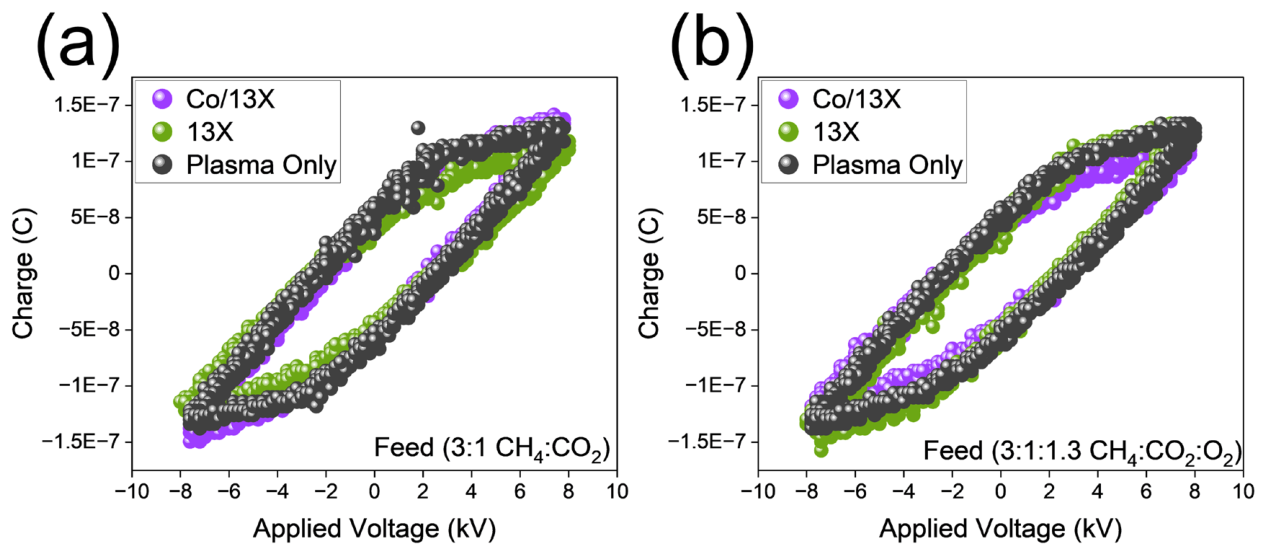
Figure 2.
Methane and carbon dioxide conversion as a function of CH₄:CO₂ feed ratio in the plasma-only (without catalyst) at a total flow rate of 30 sccm, an input power of 10 W, a peak-to-peak voltage of 16 kV, and a frequency of 21.5 kHz.
Figure 2.
Methane and carbon dioxide conversion as a function of CH₄:CO₂ feed ratio in the plasma-only (without catalyst) at a total flow rate of 30 sccm, an input power of 10 W, a peak-to-peak voltage of 16 kV, and a frequency of 21.5 kHz.
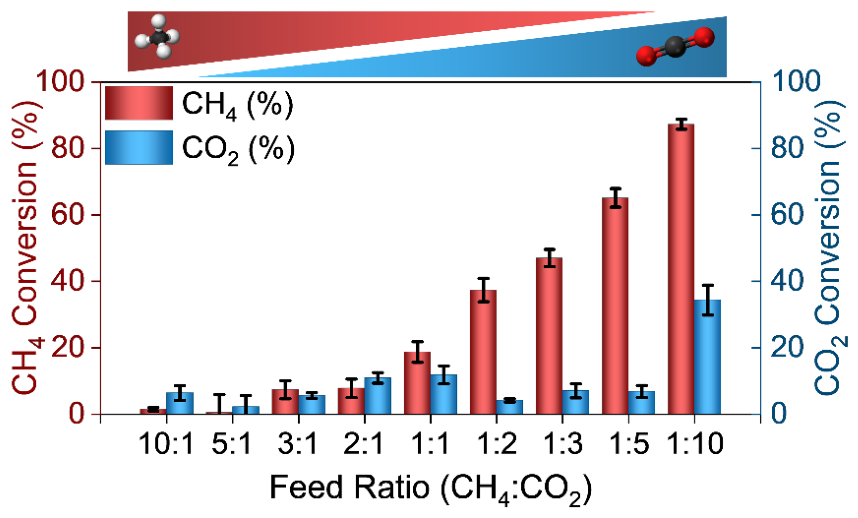
Figure 3.
Global selectivity as a function of CH₄:CO₂ feed ratio in the plasma-only (without catalyst) at a total flow rate of 30 sccm, an input power of 10 W, a peak-to-peak voltage of 16 kV, and a frequency of 21.5 kHz.
Figure 3.
Global selectivity as a function of CH₄:CO₂ feed ratio in the plasma-only (without catalyst) at a total flow rate of 30 sccm, an input power of 10 W, a peak-to-peak voltage of 16 kV, and a frequency of 21.5 kHz.
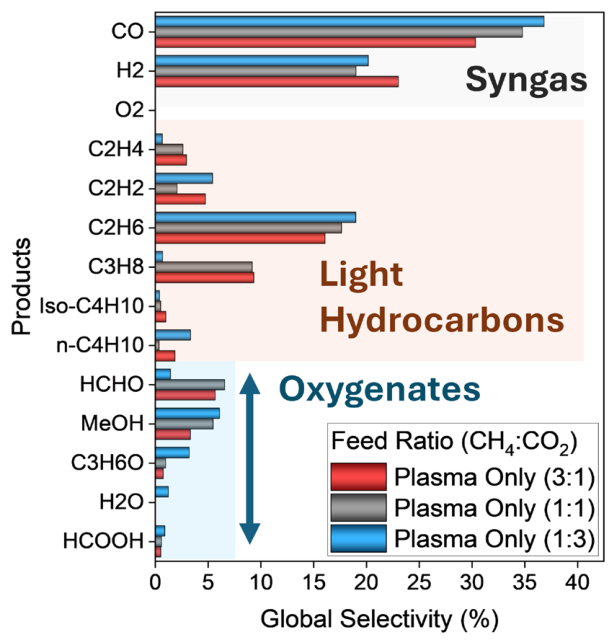
Figure 4.
Methane and carbon dioxide conversion as a function of CH₄:CO₂ feed ratio in the plasma-only, Zeolite 13X and Co/13X at a total flow rate of 30 sccm, an input power of 10 W, a peak-to-peak voltage of 16 kV, and a frequency of 21.5 kHz.
Figure 4.
Methane and carbon dioxide conversion as a function of CH₄:CO₂ feed ratio in the plasma-only, Zeolite 13X and Co/13X at a total flow rate of 30 sccm, an input power of 10 W, a peak-to-peak voltage of 16 kV, and a frequency of 21.5 kHz.
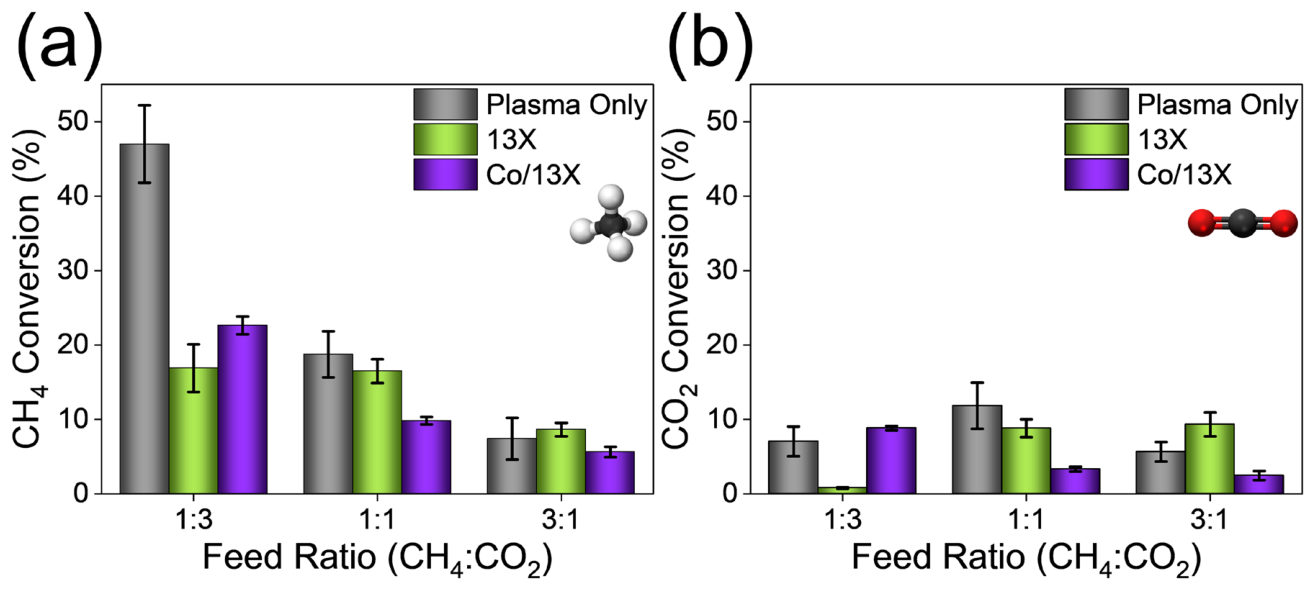
Figure 5.
Global selectivity (%) as a function of CH₄:CO₂ feed ratio in the plasma-only, Zeolite 13X and Co/13X at a total flow rate of 30 sccm, an input power of 10 W, a peak-to-peak voltage of 16 kV, and a frequency of 21.5 kHz.
Figure 5.
Global selectivity (%) as a function of CH₄:CO₂ feed ratio in the plasma-only, Zeolite 13X and Co/13X at a total flow rate of 30 sccm, an input power of 10 W, a peak-to-peak voltage of 16 kV, and a frequency of 21.5 kHz.
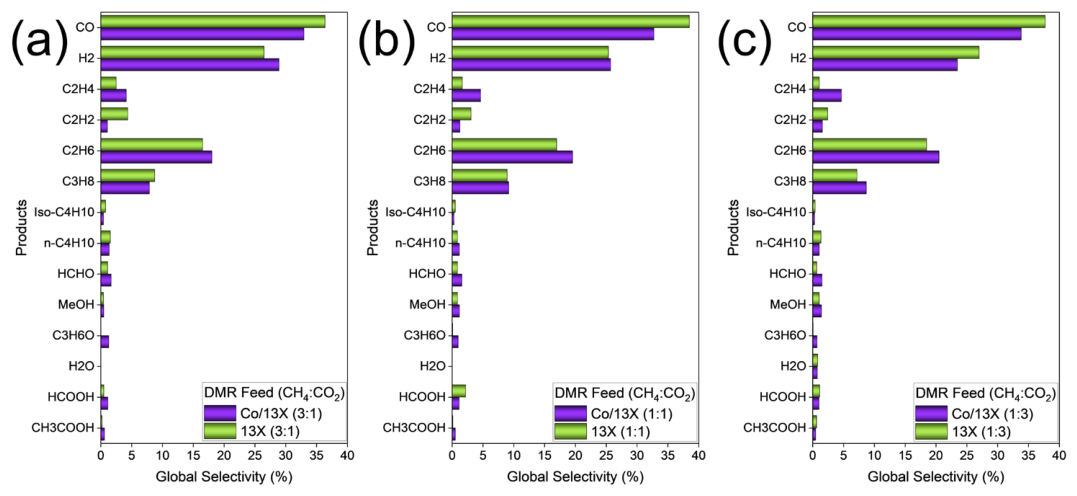
Figure 6.
Global selectivity as a function of oxygen feeding (a) Plasma Only; (b) 13X zeolite; (c) Cobalt/13X catalyst at a total flow rate of 30-40 sccm, an input power of 10 W, a peak-to-peak voltage of 16 kV, and a frequency of 21.5 kHz.
Figure 6.
Global selectivity as a function of oxygen feeding (a) Plasma Only; (b) 13X zeolite; (c) Cobalt/13X catalyst at a total flow rate of 30-40 sccm, an input power of 10 W, a peak-to-peak voltage of 16 kV, and a frequency of 21.5 kHz.
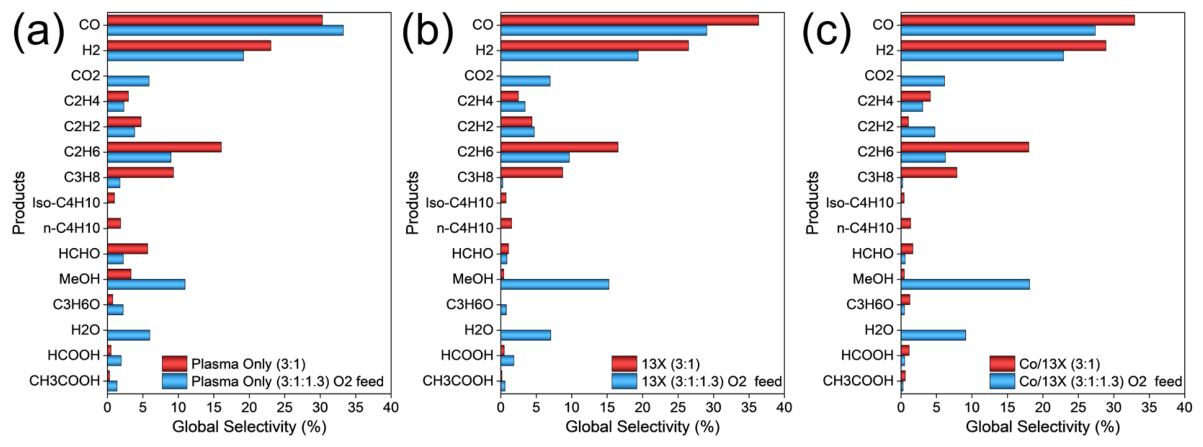
Figure 7.
Methanol molar yield as a function of oxygen addition for plasma only (µmol h-1, no catalyst) and for the 13X and Co/13X packed beds (µmol gcat-1 h-1, 0.1 g catalyst), at a total flow rate of 30-40 sccm, an input power of 10 W, a peak-to-peak voltage of 16 kV and a frequency of 21.5 kHz.
Figure 7.
Methanol molar yield as a function of oxygen addition for plasma only (µmol h-1, no catalyst) and for the 13X and Co/13X packed beds (µmol gcat-1 h-1, 0.1 g catalyst), at a total flow rate of 30-40 sccm, an input power of 10 W, a peak-to-peak voltage of 16 kV and a frequency of 21.5 kHz.
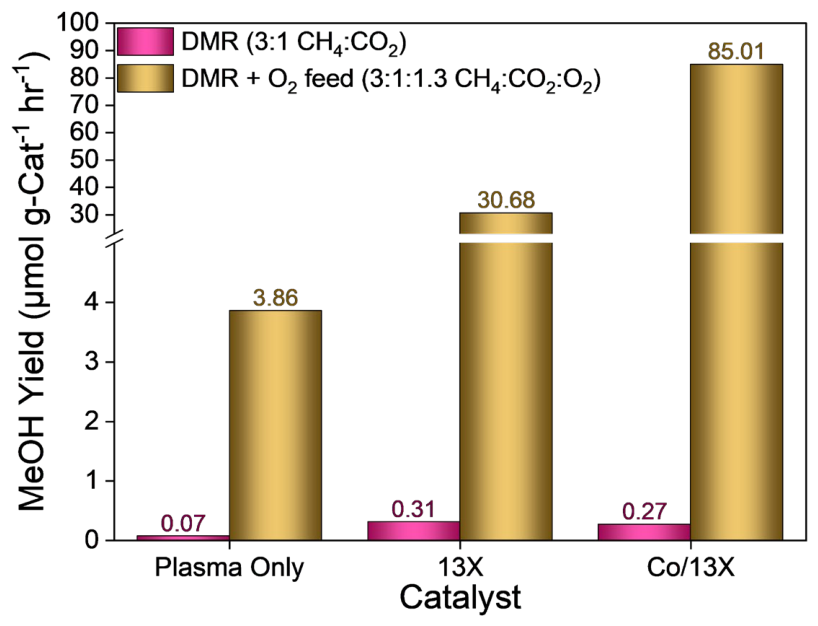
Figure 8.
Comparison of important plasma species via Optical emission spectroscopy (OES) for (a) CH4:CO2 3:1 vs. (b) CH4:CO2:O2 3:1:1.3 oxygen feeding for Plasma only, 13X and Co/13X at a total flow rate of 30-40 sccm, an input power of 10 W, a peak-to-peak voltage of 16 kV, and a frequency of 21.5 kHz.
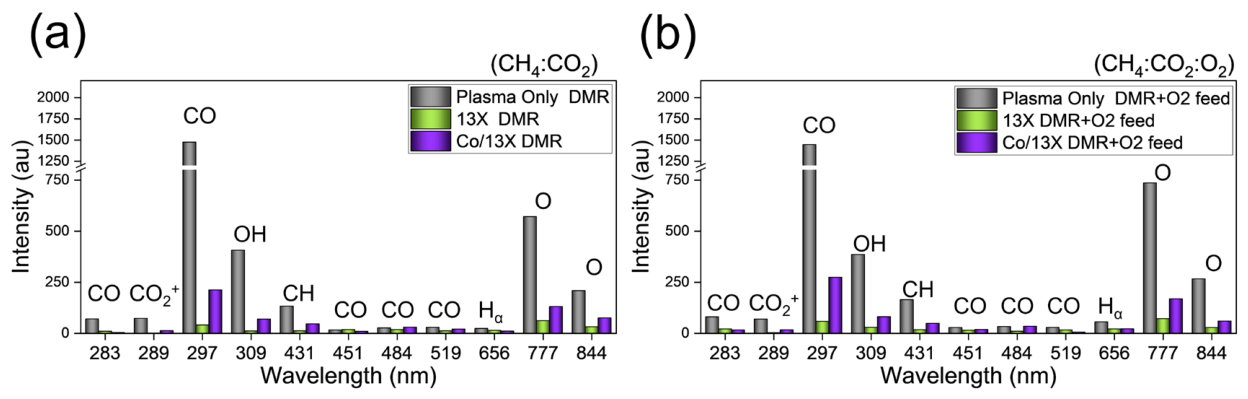
Figure 9.
N2 adsorption-desorption isotherms profile of (a) pristine 13X and Co/13X catalysts and (b) catalysts following plasma exposure under DMR conditions (CH4: CO2 = 3:1) and Oxygen feeded DMR conditions (CH4: CO2: O2 = 3:1:1.3).
Figure 9.
N2 adsorption-desorption isotherms profile of (a) pristine 13X and Co/13X catalysts and (b) catalysts following plasma exposure under DMR conditions (CH4: CO2 = 3:1) and Oxygen feeded DMR conditions (CH4: CO2: O2 = 3:1:1.3).
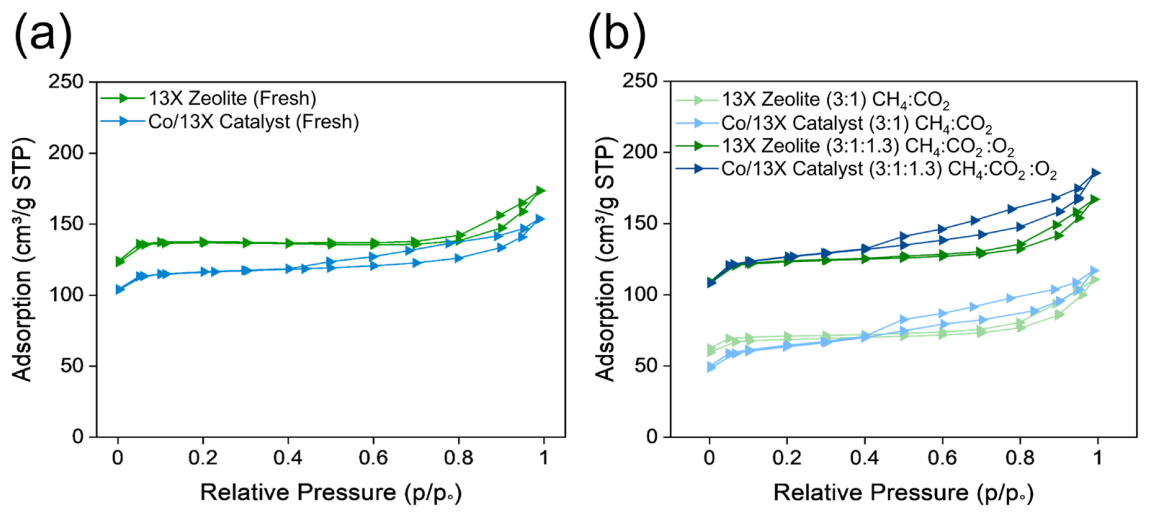
Figure 10.
SEM images of (a) pristine zeolite 13X and (b) Co/13X, and corresponding EDAX elemental analyses of (c) zeolite 13X and (d) Co/13X.
Figure 10.
SEM images of (a) pristine zeolite 13X and (b) Co/13X, and corresponding EDAX elemental analyses of (c) zeolite 13X and (d) Co/13X.
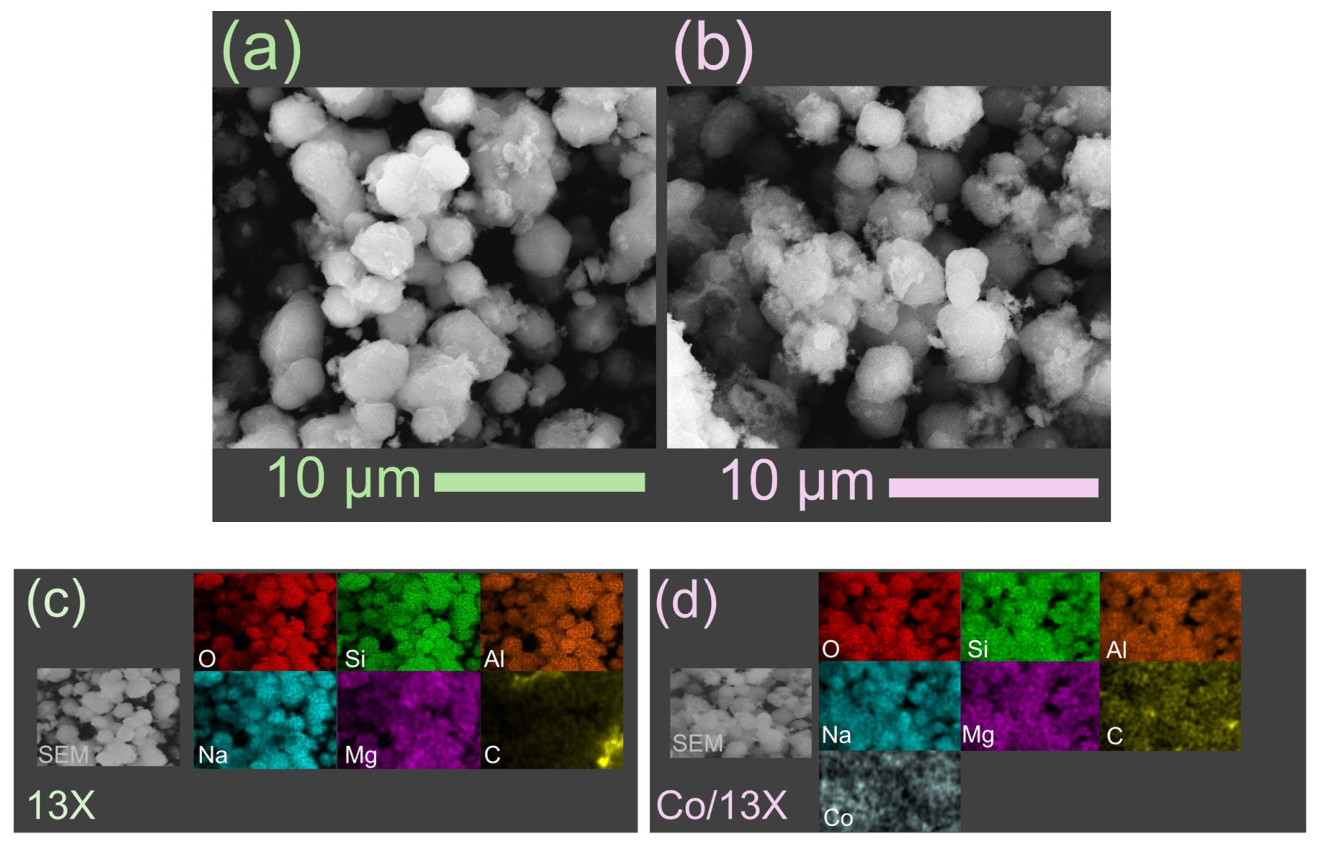
Figure 11.
XRD patterns comparing the structural characteristics of (a) pristine 13X, 13X after conventional DMR treatment (CH4: CO2 = 3:1), and 13X after oxygen-assisted DMR treatment (CH4: CO2: O2 = 3:1:1.3); and (b) Co/13X after conventional without oxygen and oxygen-feed DMR treatment under the same respective feed compositions.
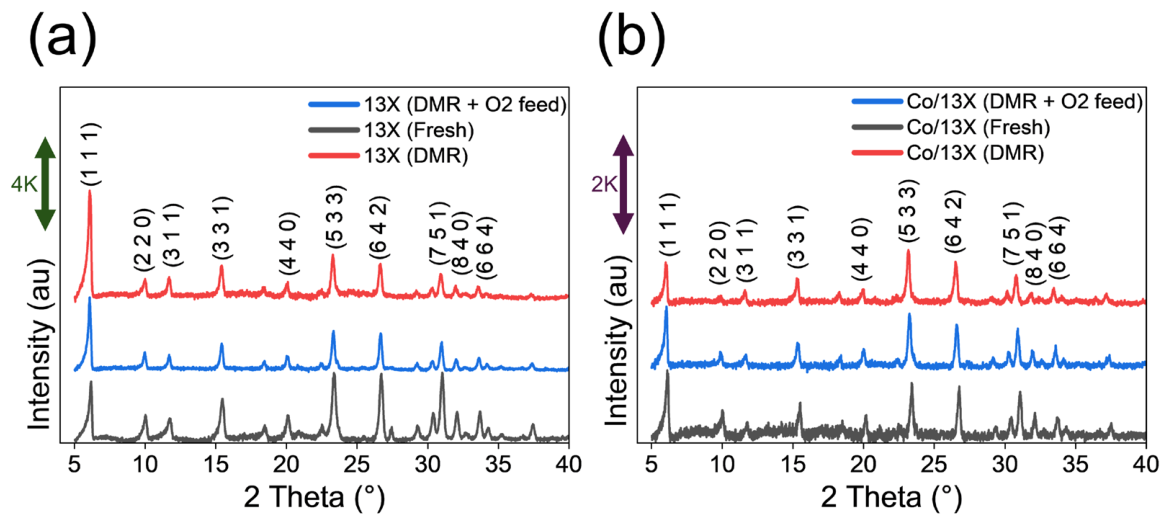
Figure 12.
FTIR spectra of pristine and plasma-treated (a) 13X and (b) Co/13X catalysts following DMR (CH4: CO2 = 3:1) and Oxygen feeded DMR (CH4: CO2: O2 = 3:1:1.3); (a) Wavenumber 450-1200 cm-1; (b) 1250-4500 cm-1.
Figure 12.
FTIR spectra of pristine and plasma-treated (a) 13X and (b) Co/13X catalysts following DMR (CH4: CO2 = 3:1) and Oxygen feeded DMR (CH4: CO2: O2 = 3:1:1.3); (a) Wavenumber 450-1200 cm-1; (b) 1250-4500 cm-1.
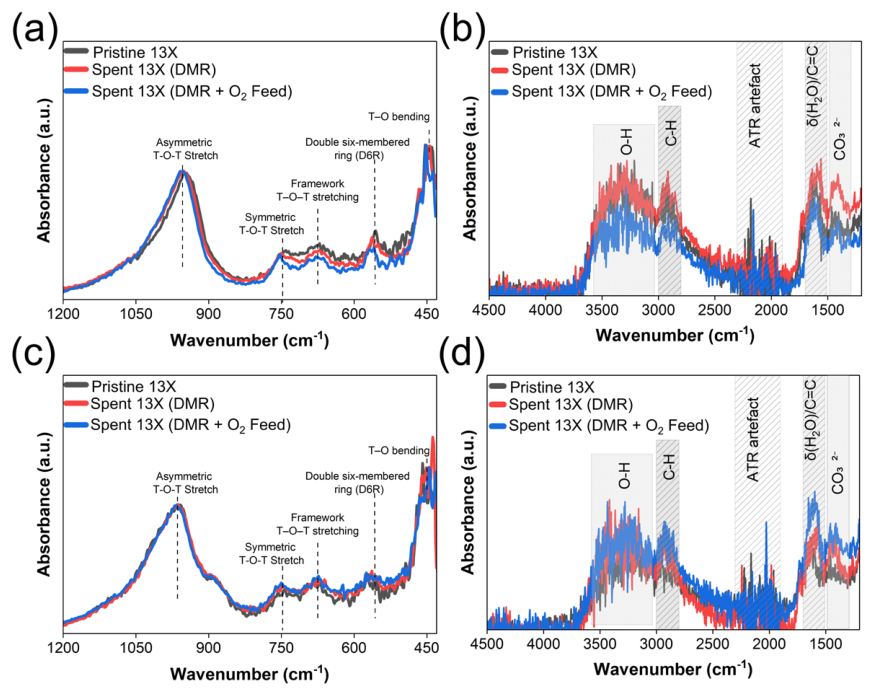
Figure 13.
XPS spectra (Binding Energy eV) of pristine and plasma-treated Co/13X catalysts following DMR (CH4:CO2 = 3:1) and Oxygen seeded DMR (CH4: CO2:O2 = 3:1:1.3); (a,b,c) O1s binding energy, (d,e,f) C1s binding energy; (g,h,i) Co 2p binding energy.
Figure 13.
XPS spectra (Binding Energy eV) of pristine and plasma-treated Co/13X catalysts following DMR (CH4:CO2 = 3:1) and Oxygen seeded DMR (CH4: CO2:O2 = 3:1:1.3); (a,b,c) O1s binding energy, (d,e,f) C1s binding energy; (g,h,i) Co 2p binding energy.
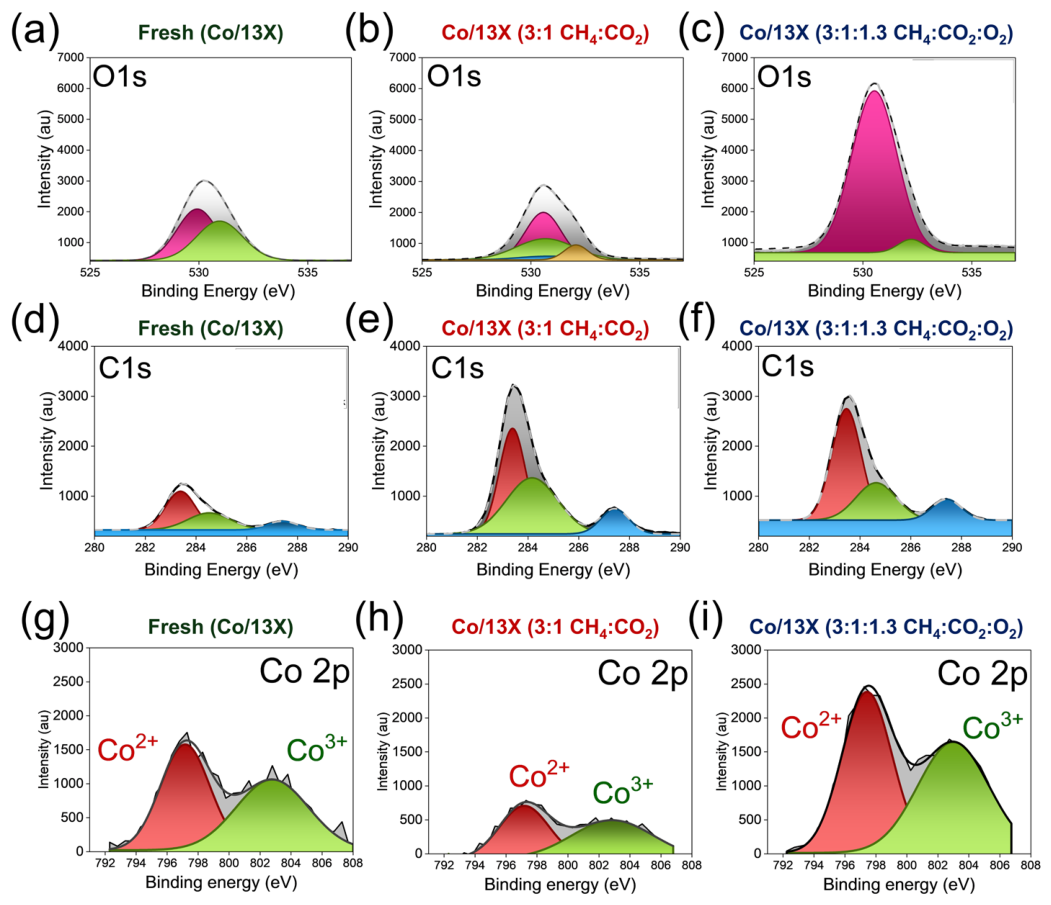
Figure 14.
XPS full surface composition for (a) 13X Vs. (b) Co/13x, comparing fresh (pristine), after plasma DMR (CH4: CO2 = 3:1) and Oxygen added DMR (CH4: CO2: O2 = 3:1:1.3).
Figure 14.
XPS full surface composition for (a) 13X Vs. (b) Co/13x, comparing fresh (pristine), after plasma DMR (CH4: CO2 = 3:1) and Oxygen added DMR (CH4: CO2: O2 = 3:1:1.3).
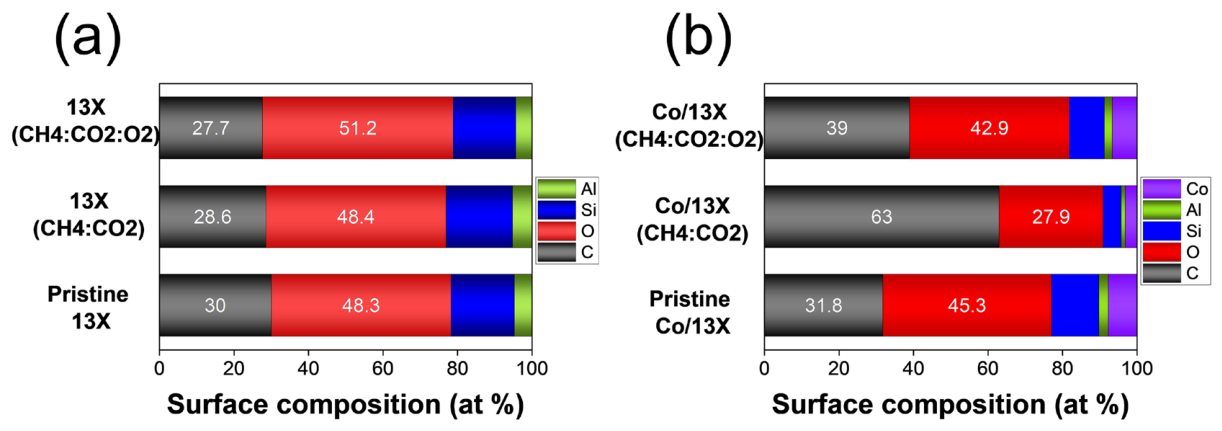
Figure 15.
Methanol energy yield: (a) plasma only (mg kWh-1) as a function of the CH4:CO2 feed ratio; (b) plasma only (mg kWh-1) and the 13X and Co/13X packed beds (mg gcat-1 kWh-1) for DMR at CH4:CO2 = 3:1 and with oxygen co-feeding at CH4:CO2:O2 = 3:1:1.3. Input power 10 W.
Figure 15.
Methanol energy yield: (a) plasma only (mg kWh-1) as a function of the CH4:CO2 feed ratio; (b) plasma only (mg kWh-1) and the 13X and Co/13X packed beds (mg gcat-1 kWh-1) for DMR at CH4:CO2 = 3:1 and with oxygen co-feeding at CH4:CO2:O2 = 3:1:1.3. Input power 10 W.
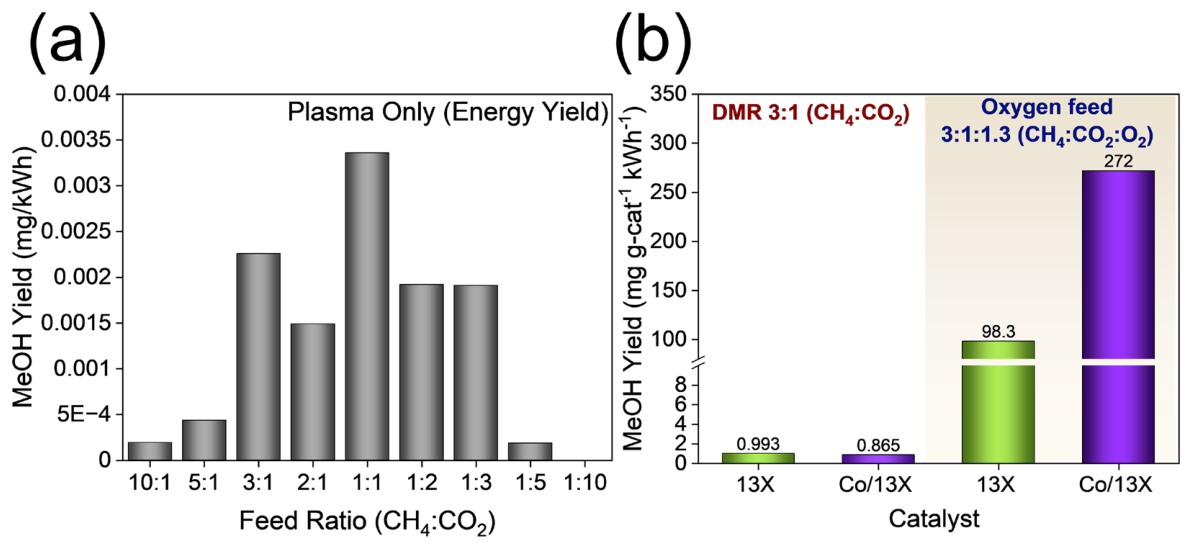
Figure 16.
Plausible Mechanistic pathway for plasma catalytic DRM.
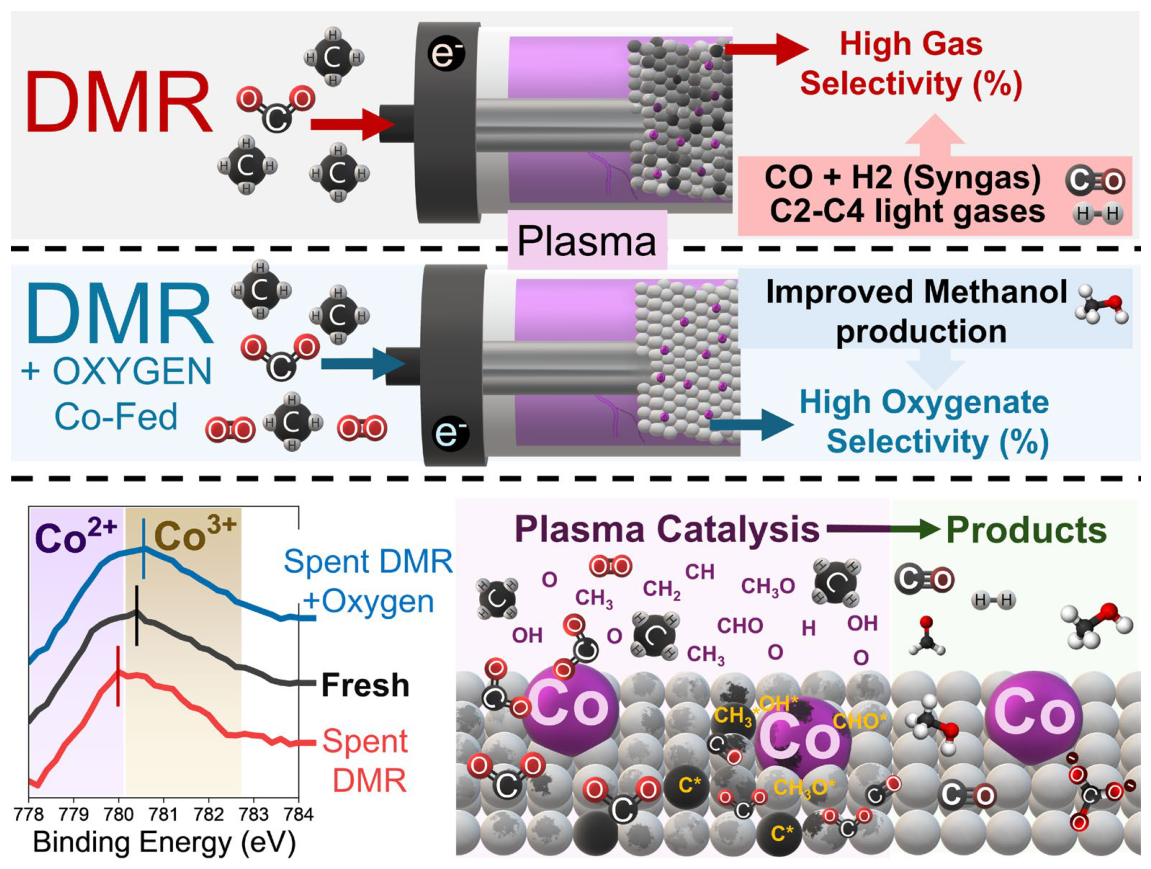
Figure 17.
Schematic of the experimental setup for the plasma-catalytic conversion of CH4 and CO2 with O2.
Figure 17.
Schematic of the experimental setup for the plasma-catalytic conversion of CH4 and CO2 with O2.
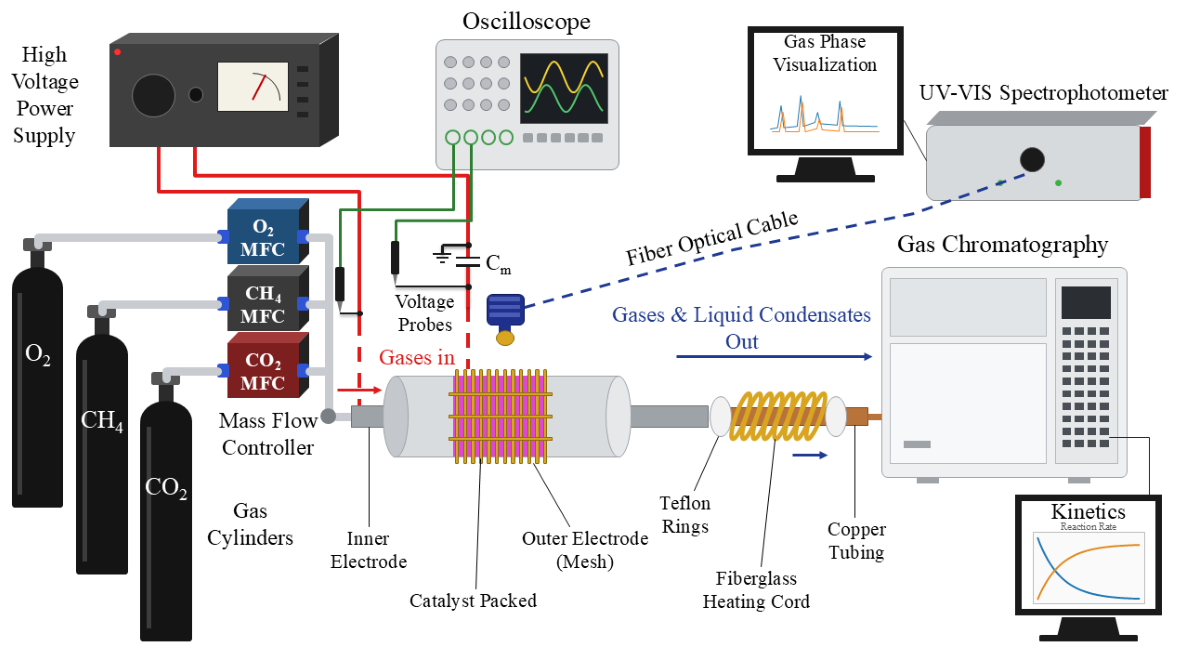

Table 1.
Comparison of the textural properties of pristine and plasma-treated 13X and Co/13X catalysts, including BET surface area, micropore surface area, total pore volume, and average pore size.
Table 1.
Comparison of the textural properties of pristine and plasma-treated 13X and Co/13X catalysts, including BET surface area, micropore surface area, total pore volume, and average pore size.
| Catalyst | Mode | Surface area | ± | Micropore area |
± | Total pore volume |
± | Pore size | ± |
|---|---|---|---|---|---|---|---|---|---|
| m²/g | m²/g | cm³/g | nm | ||||||
| 13X | Fresh/Pristine | 445.55 | 33.31 | 431.27 | 30.80 | 0.249 | 0.02 | 2.24 | 0.05 |
| 13 X |
DMR CH4: CO2 (3:1) |
236.58 | 9.43 | 211.94 | 9.47 | 0.156 | 0.01 | 2.64 | 0.03 |
| 13X |
DMR + O2 CH4: CO2: O2 (3:1:1.3) |
401.88 | 5.15 | 366.07 | 5.13 | 0.235 | 0.00 | 2.34 | 0.02 |
| Co/13X | Fresh/Pristine | 418.74 | 62.09 | 377.56 | 55.26 | 0.241 | 0.03 | 2.31 | 0.04 |
| Co/13X |
DMR CH4: CO2 (3:1) |
236.76 | 45.36 | 156.11 | 30.83 | 0.182 | 0.03 | 3.09 | 0.15 |
| Co/13X |
DMR + O2 CH4: CO2: O2 (3:1:1.3) |
425.99 | 14.63 | 349.84 | 10.25 | 0.268 | 0.01 | 2.52 | 0.00 |
Disclaimer/Publisher’s Note: The statements, opinions and data contained in all publications are solely those of the individual author(s) and contributor(s) and not of MDPI and/or the editor(s). MDPI and/or the editor(s) disclaim responsibility for any injury to people or property resulting from any ideas, methods, instructions or products referred to in the content. |
© 2026 by the authors. Licensee MDPI, Basel, Switzerland. This article is an open access article distributed under the terms and conditions of the Creative Commons Attribution (CC BY) license (http://creativecommons.org/licenses/by/4.0/).
Copyright: This open access article is published under a Creative Commons CC BY 4.0 license, which permit the free download, distribution, and reuse, provided that the author and preprint are cited in any reuse.