

Submitted:
23 November 2026
Posted:
25 November 2026
You are already at the latest version
Abstract
Prime editing installs programmed sequence changes without a double-strand break and without donor DNA, yet the efficiencies published since 2019 differ by more than an order of magnitude between laboratories. This work asks how that spread divides between three sources: the architecture of the editor, the biology of the host cell and the route by which the components enter the target tissue. Quantitative outcomes were extracted from primary reports indexed in PubMed, restricted to studies that state editing frequencies measured by high-throughput sequencing or a defined clinical endpoint. Each record was reduced to two normalised variables, editing efficiency and the ratio of intended product to indel by-product, and the records were grouped by experimental scale. Engineering of the editor and its guide contributes gains of roughly two to eight fold, and these gains are not additive, because several of them act on the same mismatch repair bottleneck. Delivery accounts for the widest dispersion: values in murine liver range from 8 % to 58 % depending on the vector, whereas tissues outside liver and brain remain below 15 %. Product purity varies by a factor of 25 at comparable efficiency, which makes any single efficiency figure uninformative when quoted alone. In the two patients treated with a prime-edited autologous cell product, restored oxidase activity exceeded the proposed threshold by a factor of three.
Keywords:
prime editing
; pegRNA
; mismatch repair
; lipid nanoparticle delivery
1. Introduction
Most alleles that cause inherited disease are point substitutions or insertions and deletions of a few nucleotides rather than losses of whole genes, and this distribution determines which editing tools are useful in the clinic [5]. RNA-guided cleavage by Cas9, described as a dual-RNA dependent endonuclease reaction in 2012 [2], leaves a double-strand break whose repair the experimenter cannot direct. Non-homologous end joining prevails in most somatic cell types, so the intended replacement competes with a spectrum of unintended products, and homology-directed repair is largely confined to dividing cells.
Deaminase-based editors avoid the break. A cytidine deaminase tethered to a catalytically impaired Cas9 converts C·G pairs into T·A within a narrow activity window [3], and a laboratory-evolved adenosine deaminase that accepts DNA extended the reaction to A·T towards G·C [4]. Four of the twelve possible base conversions fall outside both architectures, as do insertions and deletions of any length.
Prime editing covers the remaining classes, and reported efficiencies for one edit type now span from under 2 % to above 50 %. Such dispersion is usually attributed to technical variation between laboratories. The analysis presented here tests a different explanation: that the spread is structured, that it separates cleanly by experimental scale, and that the dominant term has shifted away from the enzyme itself towards the method of delivery.
2. Materials and Methods
2.1. Selection of sources
Primary reports were retrieved from PubMed for the period 2012 to 2026 using the terms prime editing, pegRNA, base editing and genome editing combined with delivery and clinical trial. A record entered the dataset when it appeared in a peer-reviewed journal with a registered DOI and stated a numerical outcome measured by high-throughput amplicon sequencing or by a predefined clinical endpoint. Abstracts, preprints and company statements were excluded, since their values are often revised before formal publication. Sixteen sources qualified, and each is cited once, where its extracted values appear.
2.2. Variables and Their Definition
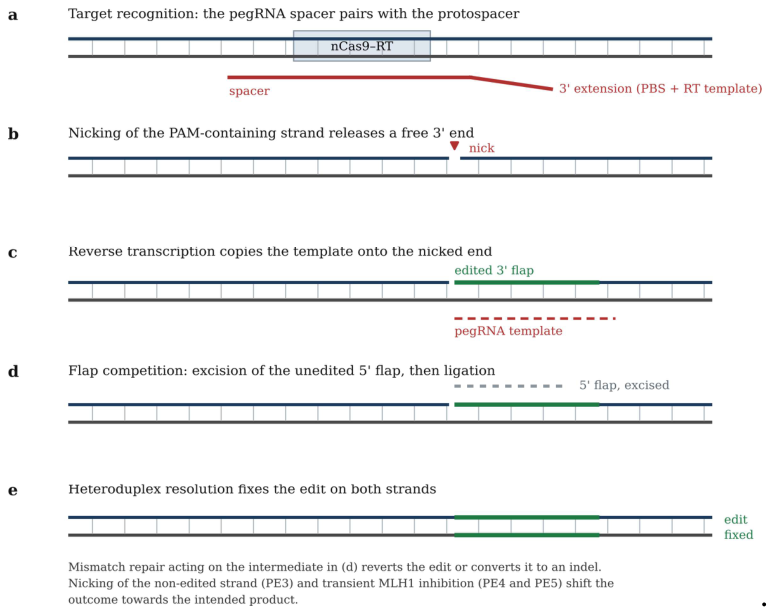
The operational steps of the reaction were taken as defined by the current mechanistic literature and are shown in Figure 1 [6]. Two variables were recorded for every record. With E denoting sequencing reads that carry the intended edit, I reads carrying an insertion or deletion at the target, and N the total aligned reads at the locus,
η = (E / N) × 100 %
R = E / I
Equation (1) gives the editing efficiency as a percentage of alleles, and equation (2) gives the purity of the product as a dimensionless ratio. Where a study reported a fold change instead of an absolute value, it was retained without conversion, because baselines are not comparable across cell lines. No raw sequencing data were reanalysed and no laboratory experiment was performed.
2.3. Grouping
Records were assigned to one of three scales: cultured human cells, where transfection removes any delivery constraint; somatic tissue in mice, where a vector must carry a payload larger than 6 kb; and treated patients. Comparison across scales uses only the direction and magnitude of change.
Figure 1.
Operational steps of the prime editing reaction used to define the variables in section 2.2. The pegRNA 3' extension both primes and templates DNA synthesis.
Figure 1.
Operational steps of the prime editing reaction used to define the variables in section 2.2. The pegRNA 3' extension both primes and templates DNA synthesis.
3. Results
3.1. Gains Obtained at the Level of the Components
Three engineering interventions dominate the cultured-cell records (Table 1). Protecting the 3' terminus of the guide against exonucleolytic trimming raises efficiency three to fourfold across four cell backgrounds, with no rise in off-target activity. Suppressing mismatch repair through transient expression of a dominant-negative MLH1 protein raises it by a mean factor of 7.7, and reshaping the editor adds a further 2.8 on average. Fusion of an RNA-binding domain from the La protein improves every system tested, although no single coefficient has been published for it.
Treating these coefficients as independent predicts a combined gain of 3.5 × 7.7 × 2.8, which is close to 75. Published combinations do not approach that figure. The explanation lies in shared mechanism: guide stabilisation and repair inhibition both act on the survival of the same edited intermediate, so their effects overlap instead of accumulating. Any projection of future efficiency built by multiplying reported fold changes therefore overestimates the attainable result.
Purity behaves differently from efficiency. Taking the original characterisation of the PE3 system in HEK293T cells, where efficiency lies between 20 % and 50 % and the indel burden between 1 % and 10 %, equation (2) is evaluated at both extremes:
Given: E / N = 20 to 50 %; I / N = 1 to 10 %. Formula: R = (E / N) / (I / N).
Substitution: Rmin = 20 / 10 = 2.0; Rmax = 50 / 1 = 50. Result: R varies over a 25-fold range, dimensionless.
An experiment yielding 30 % edited alleles with R near 2 and one yielding 30 % with R near 50 describe incompatible biological situations, although both are quoted in the literature as comparable efficiencies. Reporting equation (1) alone conceals the by-product burden entirely.
3.2. Dispersion Attributable to Delivery
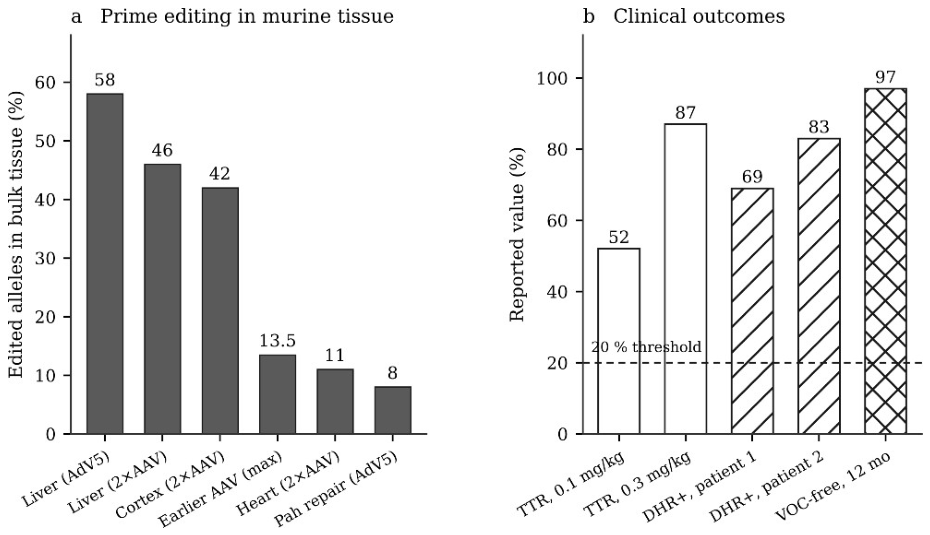
The second group spreads far more widely than the first (Figure 2a). Coding sequence for a nickase fused to a reverse transcriptase exceeds 6.3 kb, above the roughly 4.7 kb that one adeno-associated virus genome accommodates, so the protein is split between two vectors and rejoined by trans-splicing inteins. Optimised vector pairs reach 42 % in mouse cortex and 46 % in liver, against an upper bound of 13.5 % in earlier dual-vector work, while heart remains at 11 %. An unsplit construct carried by adenovirus attains 58 % in liver, yet that report corrected a disease-causing allele in phenylketonuria mice at a mean of only 8 %. That gap within one report isolates the variable: a neutral and a therapeutic locus differ in chromatin context and in the edit itself, not in the delivery system.
Between the lowest and the highest murine liver value the ratio is 7.25, whereas the largest single architectural coefficient of section 3.1 is 7.7 and applies only to cultured cells, where it is measured against a matched baseline.

Table 1.
Outcomes extracted from the sixteen selected reports. Values appear as published; η and R follow equations (1) and (2).
Table 1.
Outcomes extracted from the sixteen selected reports. Values appear as published; η and R follow equations (1) and (2).
| System or agent | Experimental context | Metric | Reported value |
| PE2 and PE3 | HEK293T, several endogenous loci | η; indel burden | 20–50 %; 1–10 % [1] |
| Engineered pegRNA | HeLa, U2OS, K562, primary fibroblasts | fold change in η | 3–4 × [8] |
| PE4, PE5 and PEmax | 191 edits, seven mammalian cell types | mean fold change; change in R | 7.7 ×, 2.0 ×, 2.8 ×; R × 3.4 [7] |
| PE7, La domain fusion | Genome-scale screens, reporter and endogenous loci | direction of change | improvement, no summary value [9] |
| v3em PE-AAV | Mouse cortex, liver, heart | η in bulk tissue | 42 %, 46 %, 11 % [10] |
| Unsplit PE2 in adenovirus | Mouse liver; Pahenu2 correction | η in bulk tissue | 58 %; 8 % mean, 17.3 % max [11] |
| NTLA-2001, Cas9 in lipid nanoparticles | Six patients, hereditary ATTR amyloidosis | serum TTR reduction at day 28 | 52 % and 87 % [12] |
| Bespoke base editor in lipid nanoparticles | One neonate, CPS1 deficiency | clinical response after three doses | higher protein tolerance [13] |
| Exagamglogene autotemcel | 44 patients, sickle cell disease | freedom from severe crises, 12 months | 29 of 30 evaluable, 97 % [14] |
| PM359 | Two patients, p47phox CGD | DHR-positive neutrophils at day 30 | 69 % and 83 % [16] |
3.3. Outcomes in Treated Patients
Clinical records cannot be expressed as η, since the measured quantities are protein concentrations and cell function rather than allele frequencies (Figure 2b). A single infusion of a Cas9 agent in lipid nanoparticles lowered serum transthyretin by 52 % at 0.1 mg per kilogram and by 87 % at 0.3 mg per kilogram within 28 days, establishing dose dependence in human liver. The same formulation supported an individualised therapy for a neonate with a private variant in the carbamoyl phosphate synthetase 1 gene.
Among products manufactured outside the body, disruption of an erythroid enhancer freed 29 of 30 evaluable patients from severe vaso-occlusive crises for at least twelve months. Correction rather than disruption was achieved for the first time with an autologous cell product carrying a repaired NCF1 allele: oxidase-positive neutrophils reached 69 % and 83 % by day 30 in the two treated participants, exceeding by 3.4 to 4.2 fold the threshold of about 20 % proposed as the minimum for benefit (Figure 2b).
Figure 2.
Extracted outcomes by experimental scale. (a) Prime editing in murine tissue, expressed as the percentage of edited alleles in bulk tissue. (b) Clinical endpoints; the metric differs between bars and the broken line marks the 20 % threshold proposed for chronic granulomatous disease.
Figure 2.
Extracted outcomes by experimental scale. (a) Prime editing in murine tissue, expressed as the percentage of edited alleles in bulk tissue. (b) Clinical endpoints; the metric differs between bars and the broken line marks the 20 % threshold proposed for chronic granulomatous disease.
4. Discussion
The grouping in section 2.3 separates the sources of variation more sharply than expected. Within cultured cells the coefficients are bounded and reproducible, because every comparison is made against a matched control in the same cell line. Once a vector is introduced that control disappears, and values depend on dose, serotype, chromatin state and the fraction of cells transduced. Table 1 suggests that the field has largely solved the chemistry and not the logistics.
Two consequences follow. Efficiency quoted without purity permits a 25-fold ambiguity, so equations (1) and (2) belong together in every table, and fold changes from immortalised lines should not be propagated into predictions for tissue.
Regulatory approval of the first CRISPR medicine in December 2023 [15] rested on destruction of a regulatory element, an operation tolerant of imprecision because almost any disruptive indel serves the purpose. Repair of a defined allele is stricter, and the chronic granulomatous disease results show that it can now be met in blood. Durability is a separate question that two participants cannot answer.
Conditioning remains the untouched variable. Myeloablation with busulfan carries risks of infertility and secondary malignancy that no refinement of editing chemistry affects.
Prime editing has not yet been given inside the body of a patient, and the dataset explains why. Agents that reached patients by infusion carry a payload that fits into one messenger RNA, whereas a prime editor with a stabilised guide and a nicking guide forms a larger package. Liver will probably be the first target again, since apolipoprotein E adsorption routes lipid particles to hepatocytes unaided.
5. Conclusion
Variation in prime editing output divides unequally between its possible sources. Component engineering contributes bounded and partly redundant gains of two to eight fold, measurable only against matched baselines in cultured cells. Delivery contributes a spread above sevenfold within one tissue of one species, and this term dominates. Purity varies independently of efficiency by a factor of 25, so the two quantities defined in section 2.2 belong together in every report. The decisive experiments ahead will involve vectors and conditioning regimens, not further modification of the editor.
References
- Anzalone AV, Randolph PB, Davis JR, et al. Search-and-replace genome editing without double-strand breaks or donor DNA. Nature. 2019;576(7785):149–157. [CrossRef]
- Jinek M, Chylinski K, Fonfara I, Hauer M, Doudna JA, Charpentier E. A programmable dual-RNA-guided DNA endonuclease in adaptive bacterial immunity. Science. 2012;337(6096):816–821. [CrossRef]
- Komor AC, Kim YB, Packer MS, Zuris JA, Liu DR. Programmable editing of a target base in genomic DNA without double-stranded DNA cleavage. Nature. 2016;533(7603):420–424. [CrossRef]
- Gaudelli NM, Komor AC, Rees HA, et al. Programmable base editing of A•T to G•C in genomic DNA without DNA cleavage. Nature. 2017;551(7681):464–471. [CrossRef]
- Anzalone AV, Koblan LW, Liu DR. Genome editing with CRISPR–Cas nucleases, base editors, transposases and prime editors. Nature Biotechnology. 2020;38(7):824–844. [CrossRef]
- Chen PJ, Liu DR. Prime editing for precise and highly versatile genome manipulation. Nature Reviews Genetics. 2023;24(3):161–177. [CrossRef]
- Chen PJ, Hussmann JA, Yan J, et al. Enhanced prime editing systems by manipulating cellular determinants of editing outcomes. Cell. 2021;184(22):5635–5652.e29. [CrossRef]
- Nelson JW, Randolph PB, Shen SP, et al. Engineered pegRNAs improve prime editing efficiency. Nature Biotechnology. 2022;40(3):402–410. [CrossRef]
- Yan J, Oyler-Castrillo P, Ravisankar P, et al. Improving prime editing with an endogenous small RNA-binding protein. Nature. 2024;628(8008):639–647. [CrossRef]
- Davis JR, Banskota S, Levy JM, et al. Efficient prime editing in mouse brain, liver and heart with dual AAVs.
- Nature Biotechnology. 2024;42(2):253–264. [CrossRef]
- Böck D, Rothgangl T, Villiger L, et al. In vivo prime editing of a metabolic liver disease in mice. Science Translational Medicine. 2022;14(636):eabl9238. [CrossRef]
- Gillmore JD, Gane E, Taubel J, et al. CRISPR-Cas9 in vivo gene editing for transthyretin amyloidosis. New England Journal of Medicine. 2021;385(6):493–502. [CrossRef]
- Musunuru K, Grandinette SA, Wang X, et al. Patient-specific in vivo gene editing to treat a rare genetic disease.
- New England Journal of Medicine. 2025;392(22):2235–2243. [CrossRef]
- Frangoul H, Locatelli F, Sharma A, et al. Exagamglogene autotemcel for severe sickle cell disease. New England Journal of Medicine. 2024;390(18):1649–1662. [CrossRef]
- U.S. Food and Drug Administration. FDA approves first gene therapies to treat patients with sickle cell disease. FDA News Release, 8 December 2023. https://www.fda.gov/news-events/press-announcements/fda-approves-fir st-gene-therapies-treat-patients-sickle-cell-disease.
- Gori JL, Haddad E, Frangoul H, et al. Prime editing for p47phox-deficient chronic granulomatous disease. New England Journal of Medicine. 2026;394(12):1195–1203. [CrossRef]
Disclaimer/Publisher’s Note: The statements, opinions and data contained in all publications are solely those of the individual author(s) and contributor(s) and not of MDPI and/or the editor(s). MDPI and/or the editor(s) disclaim responsibility for any injury to people or property resulting from any ideas, methods, instructions or products referred to in the content. |
© 2026 by the authors. Licensee MDPI, Basel, Switzerland. This article is an open access article distributed under the terms and conditions of the Creative Commons Attribution (CC BY) license (http://creativecommons.org/licenses/by/4.0/).
Copyright: This open access article is published under a Creative Commons CC BY 4.0 license, which permit the free download, distribution, and reuse, provided that the author and preprint are cited in any reuse.