
Submitted:
22 November 2026
Posted:
25 November 2026
You are already at the latest version
Abstract
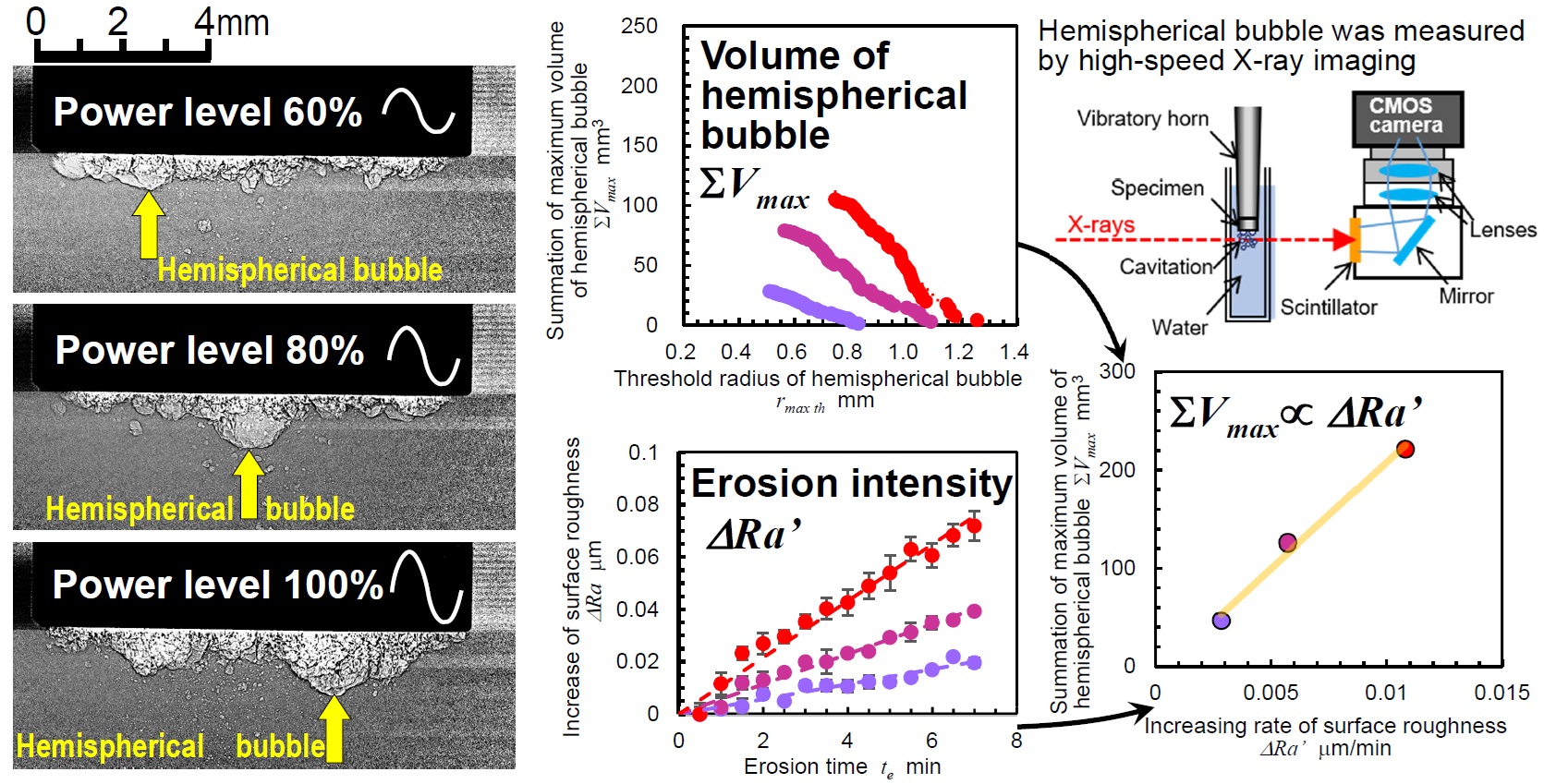
Acoustic cavitation, which is also called as ultrasonic cavitation, induced by ultrasonic vibration has been used to evaluate cavitation erosion resistance of materials, ultrasonic machiningand chemical engineering. It was known that a large impact does not occur with every cycle of ultrasonic vibration, but rather once every few cycles; however, the mechanism behind this remains unclear. Regarding cavitation collapse, a microjet-type collapse—in which spherical bubble generates a microjet in the bubble—is well known; consequently, it has been believed that ultrasonic cavitation also produces microjet-type collapse. In the present paper, to investigate which type of acoustic cavitation generate intense impacts, acoustic cavitation was investigated by high-speed X-ray imaging with synchrotron radiation at SPring-8 whilst varying the oscillation amplitude by changing with power of ultrasonic vibration from 60–100 %. The oscillation amplitude within the range tested was approximately 41–69 μm. The surface roughness of the tip of the vibratory horn was measured to evaluate plastic deformation associated with cavitation erosion. Within the range of vibration amplitudes tested, hemispherical bubbles were observed, and it was found that the volume of these hemispherical bubbles correlated with the amount of plastic deformation.
Keywords:
acoustic cavitation
; ultrasonic vibration
; cavitation erosion
; ultrasonic machining
; X-ray imaging
; synchrotron radiation
Copyright: This open access article is published under a Creative Commons CC BY 4.0 license, which permit the free download, distribution, and reuse, provided that the author and preprint are cited in any reuse.