

Submitted:
21 November 2026
Posted:
25 November 2026
Read the latest preprint version here
Abstract
We theoretically predict a light-induced, wave-like chiral thermoelectric Hall effect associated with a self-induced out-of-equilibrium Barnett effect, capable of driving transverse thermoelectric currents and a periodic oscillating magnetoresistance in a ferromagnetic disk. A circularly polarized chopped laser beam induces an oscillating magnetization via an out-of-equilibrium inverse Faraday effect which, through the Einstein–de Haas effect, causes a uniform rotation of the metallic disk. We show that the symmetry-breaking dynamic coupling between wave-like thermal gradients and the oscillating magnetic field generates a dynamic chiral Thomson effect, exploiting a dynamic framework for thermoelectricity previously developed by the authors and based on chiral nonlinear heat transport induced by a chopped laser beam on rotating conductors. We derive a differential equation for the maxima of the dynamic enhancement of this thermoelectric effect, which we exploit to deduce the dependence on the thermal field of the Barnett magnetic field and of the dynamic Thomson voltage. Within a first-order Wiedemann–Franz approximation, we deduce a magnetoresistance that oscillates periodically in time. Finally, we discuss the technological relevance of the laser-induced periodic oscillating magnetoresistance for a new dynamic approach to thermally driven magnetic storage.
Keywords:
light-induced chiral wave-like thermoelectricity
; light induced chiral heat torque transfer
; light induced chiral dynamic Thomson effect
; light induced periodic oscillating thermal conductivity
; light induced periodic oscillating magnetoresistance
1. Introduction
In this work, exploiting a previous model of the authors on laser-induced nonlinear chiral heat transport on rotating metallic disks [1], we propose a new chiral wave-like approach to thermoelectricity via the light-induced inverse Faraday effect and the Einstein–de Haas effect, based on the Cattaneo–Vernotte law and on the Zel’dovich rotational superradiance effect [2,3,4,5].
The conversion between thermal gradients and charge transport has been a cornerstone of condensed matter physics and energy technologies for over a century [6,7]. While the longitudinal Seebeck and Thomson effects dominate conventional thermoelectric devices, transverse phenomena—such as the anomalous Nernst effect (ANE) and the thermal Hall effect—have attracted renewed interest due to their intimate connection with the quantum geometry of electronic wavefunctions [8,9,10]. In particular, recent discoveries of nonlinear Hall effects and nonlinear chiral thermoelectric (NCTE) transport in non-centrosymmetric crystals (e.g., elemental tellurium and transition metal dichalcogenides) have demonstrated that the Berry curvature dipole and orbital magnetic moments can generate transverse voltages in the absence of external magnetic fields [11,12,13,14,15,16].
Despite these developments, practical thermoelectric efficiency remains severely constrained by irreversible thermodynamic losses, primarily Joule dissipation and parasitic Fourier heat conduction [6]. In standard conductors, the Thomson coefficient quantifies the reversible heat exchange along a current-carrying temperature gradient [6,17]. However, conventional Thomson effects are purely longitudinal and inherently coupled to ohmic losses. Achieving non-dissipative or protected transverse thermoelectric transport under non-equilibrium conditions remains an outstanding challenge in quantum caloritronics. The thermal counterpart of the Hall effect, the Righi–Leduc (thermal Hall) effect, has an anomalous component in ferromagnets that obeys the Wiedemann–Franz law [18,19], reaches thermal Hall coefficients of order 0.1 T−1 in bismuth [20] and is also observed for phonons in insulators [21]; a transverse Thomson effect has recently been observed [17].
We show that irradiating a two-dimensional ferromagnetic micro-disk resonator with a structured, circularly polarized chopped laser beam imparts both dynamic chirality and spatial wave-like phase modulation [22,23]. Under this dynamic drive, time-reversal and spatial-inversion symmetries are broken dynamically, inducing a non-vanishing transverse magneto-Thomson response that channels heat and charge perpendicularly to both the optical wavevector and the effective thermal gradient. The resulting magnetoresistance belongs to the family of anisotropic [24] and non-reciprocal [25,26,27] magnetotransport phenomena, here modulated periodically in time by the chopped laser beam.
2. Dynamic Chiral Thermoelectric Hall Effect via the Oscillating Inverse Faraday Effect
Although many experimental studies in recent years have investigated the inverse Faraday effect and circular dichroism, to the best of our knowledge the thermal effect induced by a circularly polarized chopped laser beam on a ferromagnetic disk freely rotating about its vertical axis of symmetry is still not well known. We analyze this new out-of-equilibrium magneto-optical effect, associated with chiral heat torque transfer on the laser-induced rotating out-of-equilibrium metallic disks, in accordance with a previous wave-like model of chiral nonlinear heat transport on rotating samples, and we show that it causes the generation of a dynamic chiral Thomson effect [1].
We define a gauge-breaking out-of-equilibrium magnetic vector potential , which is an electromagnetic analogue of the thermal flux vector introduced in Ref. [1], by
with the out-of-equilibrium Barnett magnetic field with respect to the environment magnetic field B0, defined by
with m(T) the out-of-equilibrium electron mass induced by the harmonic laser beam on the rotating disk.
We note that this laser-induced out-of-equilibrium magnetic field deviates the heat flux due to the nonlinear dynamic thermal Hall effect induced by rotation, causing, as we will see, a non-Fourier hyperbolic non-reciprocal heat diffusion law.
Since this effective magnetic field is time dependent, there will be a time-dependent electric field induced by rotation and by the chopped laser beam, which we interpret as a dynamic Thomson radial electric field [1]
with ΔV(T,Ω) the rotation-induced oscillating Thomson voltage, proportional to the angular velocity Ω of the rotating conductor by Faraday’s induction law [28]:
Using (4) and the conventional definition of the Seebeck coefficient
we obtain a relation between the Seebeck coefficient and the derivative of the Barnett magnetic field ΔB(T) with respect to the thermal field T:
with
where β(r) is the radially dependent complex-valued wavenumber of the helical thermal field T (Appendix A).
We remark that conventional estimates of the Thomson effect are based on the stationary constant-property model, according to which the performance of thermoelectric devices is limited by Joule dissipation. We therefore follow the general strategy of enhancing the Thomson coefficient, defined by
such that the stationary figure of merit, the conventional parameter quantifying thermoelectric efficiency, depends on the angular velocity Ω of the rotating disk:
where the second equality holds for the electronic contribution under the Wiedemann–Franz law, associated with a maximum cooling effect
Therefore, the out-of-equilibrium figure of merit ZT(T,Ω) is no longer a constant coefficient but a complex-valued field dependent on the time-dependent Thomson coefficient τTH(T,Ω). For a thermal field T∝e−iω't, it can be rewritten as
which is enhanced near the resonant condition associated with Zel’dovich thermal rotational superradiance, ω' = ω − mΩ = 0. Taking the time derivative of (11) we get
The last equation allows the temperature dependence of the Seebeck coefficient S(T,Ω) and of the Thomson coefficient τTH(T,Ω) to be determined in correspondence with magnetic phase transitions, by imposing that the laser-induced dynamic Thomson coefficient has a peak:
Equation (13) can be integrated exactly. Writing it as d(T dS/dT)/dT = 0 one finds T dS/dT = τTH and
so that, by the Kelvin relation (8), imposing Eq. (13) at all temperatures yields a constant Thomson coefficient, i.e., a plateau rather than a peak. A genuine peak is obtained by imposing Eq. (13) at a single temperature T* with d2τTH/dT2 < 0. A simple solution with this property is
with S0 the Seebeck coefficient of the sample at rest and τ the local relaxation time of the rotating conductor, Eqs. (A11)–(A12), so that ω'τ is dimensionless. Equation (15) gives the magneto-Thomson coefficient
which satisfies Eq. (13) at T* = T0/e, where it has a maximum τTH(T*) = S0/(e ω'τ). Choosing T0 = e Tc places the peak at the Curie temperature, in correspondence with the magnetic phase transition (Figure 1). Near T* Eq. (15) coincides to first order with the exact solution (14) having the same S(T*) and τTH(T*). The Thomson coefficient (16) is associated with oscillating thermomagnetic phase transitions and thermal hysteresis loops due to the out-of-equilibrium Barnett field, given by
with S(T) given by (15).
We finally deduce the existence of a periodic oscillating magnetoresistance by assuming that the Joule power density equals the maximum Thomson thermal flux density associated with the differential equation (13), introducing an effective out-of-equilibrium electrical conductivity proportional to the magneto-Seebeck coefficient S(T):
Assuming the Wiedemann–Franz law as a first-order approximation, we deduce the periodic oscillating magnetoresistivity
with L0 the Lorenz number. Its real part can be analyzed to investigate the dependence of local oscillating metal–insulator transitions on the shifted pulsation ω' of the helical thermal fields propagating on the out-of-equilibrium rotating disks.
3. Numerical Estimates
We evaluate Eqs. (15)–(19) for a real, time-dependent temperature modulated by the chopped laser beam,
with the mean temperature of the disk, δT the amplitude of the thermal wave and T0 = e Tc. From Eqs. (18)–(19) and the Wiedemann–Franz law the electrical resistivity and the thermal conductivity read
with and their values at . Near the peak (, ) both oscillate at the frequency ω' of the thermal wave with the same relative amplitude, .
We consider iron (Tc = 1043 K, k0 ≈ 30 W/mK) and nickel (Tc = 627 K, k0 ≈ 65 W/mK) disks held at K, rotating at Ω/2π = 100 Hz and illuminated by a beam chopped at ω/2π = 1 kHz, with δT = 2 and 5 K. The real parts of the resistivity and of the thermal conductivity oscillate by ±0.1–0.24% in Fe and ±0.16–0.4% in Ni (Figure 2), within the resolution of lock-in resistance and photothermal measurements.
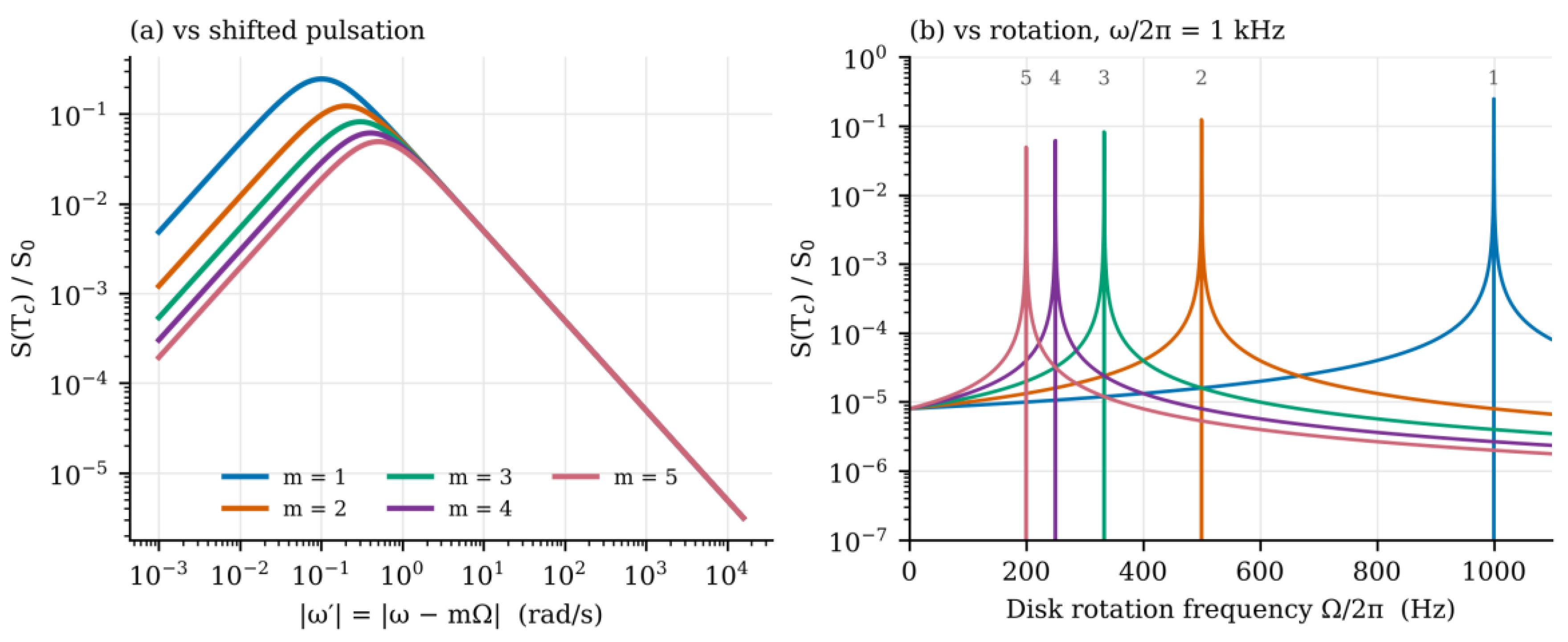
The magnitude of the magneto-Seebeck coefficient is set by ω'τ. Using the local relaxation time of Eq. (A12) with the thermal velocity vT = 2k/(γR) of Ref. [1], one finds ω'τ = A|ω'| + B m2/|ω'|, with and B = k/(γr2). The Seebeck coefficient at Tc is therefore maximal at |ω'| = m (B/A)1/2, where , and decreases as 1/|ω'| far from it (Figure 3). For an iron disk with R = 1 cm, evaluated at r = R/2, the maximum lies at |ω'| ≈ 0.1 m rad/s with S(Tc)/S0 ≈ 0.25/m, i.e., within ≈0.02 m Hz of the Zel’dovich resonances Ω = ω/m; away from them, at Ω/2π = 100 Hz, S(Tc)/S0 ≈ 10−5.
These estimates rely on the conventional Curie–Weiss description of a sample at rest, without rotation and without the chopped laser beam, and therefore require experimental verification under rotation and periodic optical driving. Recent theory of the Curie–Weiss model under time-periodic magnetic fields shows that driving shifts the critical temperature and modifies the susceptibility and the specific heat [29,30], consistently with the dynamic phase transitions predicted for kinetic Ising ferromagnets in oscillating fields [31] and observed in ferromagnetic films [32,33,34]; a large oscillating (ac) magnetoresistance near Tc has also been reported in ferromagnetic oxides [35]. These results support the existence of an oscillating magnetoresistance near the Curie point, to which the present mechanism adds rotation and laser chopping as control parameters.
4. Conclusions
We have extended a previous model of the authors of chiral nonlinear heat transport and wave-like thermoelectricity on ferromagnetic disks at rest exposed to a circularly polarized chopped laser beam, assuming that the disks are induced to rotate by the inverse Faraday effect and the Einstein–de Haas effect. We show that circularly polarized light induces a dynamic tunable chiral Thomson effect which can be maximized to counteract Joule dissipation by tuning the oscillating magnetoresistivity, whose explicit dependence on the thermal field has been deduced in a simple particular case and evaluated numerically for iron and nickel near the Curie temperature, giving a periodic resistivity modulation of a few tenths of a percent at the frequency of the thermal wave. We hope that this new dynamic wave-like approach to chiral thermoelectricity will be investigated experimentally and, if confirmed, might stimulate a new photothermally driven approach to dynamic magnetic storage.
Funding
[DA COMPLETARE: «].
Data Availability Statement
No new data were created or analyzed in this study.
Conflicts of Interest
The authors declare no conflicts of interest.
Appendix A. Helical Thermal Fields on Rotating Disks
In this appendix we show that the thermal fields induced on rotating conductors exposed to a chopped laser beam have helical isothermal wave patterns associated with a new rotational quantized Thomson effect, deducing for a ferromagnetic rotating thin disk the explicit formula of its thermal-field-dependent electromotive forces.
We generalize the local energy balance equation with three terms due, respectively, to the Joule effect wJoule(T), to the Thomson effect wTH(T) associated with the time derivative of the Thomson voltage ΔV, and to the emissivity component of thermal radiation due to a Stefan–Boltzmann-like law wε(T):
with
Taking into account a thermal analogue of the Zel’dovich effect of rotational superradiance [5], the emitted infrared radiation is enhanced when the shifted pulsation ω' = ω − mΩ becomes negative, in correspondence with a change of sign of the Righi–Leduc angular velocity. If confirmed experimentally, this prediction might be exploited to implement a new effective rotational doping of metamaterials with enhanced tunable emissivity. We remark that from (A1) and (A3) it might be possible to confirm the existence of a rotational thermal Doppler effect associated with negative-energy heat transport of thermal waves, recently predicted in Refs. [1,2].
From (A1), applying the divergence to the heat flux vector and imposing the generalized local conservation law, the thermal field satisfies a hyperbolic telegraph equation
with γ and k, respectively, the specific heat and the thermal conductivity of the conductor at rest, and τ the local relaxation time of the rotating conductor.
Writing the two-dimensional Laplacian on the surface of the rotating disk in polar coordinates,
we look for time-harmonic and spatially attenuated solutions of (A3),
T(r,θ,t) = T0 ei[β(r)r+mθ−ω't] (A5)
with the time-dependent Neumann boundary condition
with I0 the average intensity of the laser beam. The wave vector β(r) depends on r and is given by
with
and m the integer associated with the polar component of the thermal field T, determined by the boundary condition (A6). The telegraph equation (A3) can be rewritten as
where
with n an effective local thermal refractive index associated with tunable thermal-wave phase velocities, in contrast with conventional thermal waves, which have constant phase velocity [3,4,36]. Introducing this effective thermal refractive index, the effective local electron relaxation time can be rewritten as
τ(r,ω') = τ0 n2 (A11)
whose explicit expression, assuming a real relaxation time, is
with
This tunable chiral thermal phase velocity vanishes when the Zel’dovich resonant condition ω = mΩ is satisfied, implying that the chiral nonlinear heat flux stops at the border of the disk and enabling a novel rotational dynamic approach to thermal management.
References
- Bei, G.; Li Voti, R. Dynamic Thermal Management, Thermoelectric Vortices and Dynamic Tunable Magnetic Phase Transitions via Dynamic Chiral Thomson Effect on Rotating Conductors Exposed to Chopped Laser Beam. Entropy 2026, 28, 661. [Google Scholar] [CrossRef] [PubMed]
- Bei, G. Anisotropic and Wave Diffusion of Heat and Self-Induced Oscillating Thermomagnetic and Thermoelectric Effects on Rotating Conductors. Ph.D. Thesis, Sapienza University of Rome, Rome, Italy, 2025. Available online: https://hdl.handle.net/20.500.14242/210058.
- Cattaneo, C. Sur une forme de l’équation de la chaleur éliminant le paradoxe d’une propagation instantanée. C. R. Acad. Sci. 1958, 247, 431–433. [Google Scholar]
- Vernotte, P. Les paradoxes de la théorie continue de l’équation de la chaleur. C. R. Acad. Sci. 1958, 246, 3154–3155. [Google Scholar]
- Zel’dovich, Ya.B. Generation of Waves by a Rotating Body. JETP Lett. 1971, 14, 180–181. [Google Scholar]
- Goldsmid, H.J. Introduction to Thermoelectricity, 2nd ed.; Springer: Berlin/Heidelberg, Germany, 2016. [Google Scholar]
- Bauer, G.E.W.; Saitoh, E.; van Wees, B.J. Spin Caloritronics. Nat. Mater. 2012, 11, 391–399. [Google Scholar] [CrossRef] [PubMed]
- Xiao, D.; Chang, M.-C.; Niu, Q. Berry Phase Effects on Electronic Properties. Rev. Mod. Phys. 2010, 82, 1959–2007. [Google Scholar] [CrossRef]
- Nagaosa, N.; Sinova, J.; Onoda, S.; MacDonald, A.H.; Ong, N.P. Anomalous Hall Effect. Rev. Mod. Phys. 2010, 82, 1539–1592. [Google Scholar] [CrossRef]
- Uchida, K.; Takahashi, S.; Harii, K.; Ieda, J.; Koshibae, W.; Ando, K.; Maekawa, S.; Saitoh, E. Observation of the Spin Seebeck Effect. Nature 2008, 455, 778–781. [Google Scholar] [CrossRef] [PubMed]
- Liang, T.; Lin, J.; Gibson, Q.; Kushwaha, S.; et al. Anomalous Nernst Effect in the Dirac Semimetal Cd3As2. Phys. Rev. Lett. 2017, 118, 136601. [Google Scholar] [CrossRef] [PubMed]
- Sodemann, I.; Fu, L. Quantum Nonlinear Hall Effect Induced by Berry Curvature Dipole in Time-Reversal Invariant Materials. Phys. Rev. Lett. 2015, 115, 216806. [Google Scholar] [CrossRef] [PubMed]
- Ma, Q.; Xu, S.-Y.; Shen, H.; MacNeill, D.; Fatemi, V.; et al. Observation of the Nonlinear Hall Effect under Time-Reversal-Symmetric Conditions. Nature 2019, 565, 337–342. [Google Scholar] [CrossRef] [PubMed]
- Morimoto, T.; Nagaosa, N. Chiral Anomaly and Giant Magnetochiral Anisotropy in Noncentrosymmetric Weyl Semimetals. Phys. Rev. Lett. 2016, 117, 146603. [Google Scholar] [CrossRef] [PubMed]
- Yamaguchi, T.; Nakazawa, K.; Yamakage, A. Microscopic Theory of Nonlinear Hall Effect Induced by Electric Field and Temperature Gradient. Phys. Rev. B 2024, 109, 205117. [Google Scholar] [CrossRef]
- Nomoto, T.; Kikkawa, A.; Nakazawa, K.; Yamaguchi, T.; Kagawa, F. Observation of the Nonlinear Chiral Thermoelectric Hall Effect in Tellurium. arXiv 2025, arXiv:2503.08058. [Google Scholar]
- Takahagi, A.; Hirai, T.; Alasli, A.; Park, S.J.; Nagano, H.; Uchida, K. Observation of the Transverse Thomson Effect. Nat. Phys. 2025. [Google Scholar] [CrossRef]
- Onose, Y.; Shiomi, Y.; Tokura, Y. Lorenz number determination of the dissipationless nature of the anomalous Hall effect in itinerant ferromagnets. Phys. Rev. Lett. 2008, 100, 016601. [Google Scholar] [CrossRef] [PubMed]
- Shiomi, Y.; Onose, Y.; Tokura, Y. Effect of scattering on intrinsic anomalous Hall effect investigated by Lorenz ratio. Phys. Rev. B 2010, 81, 054414. [Google Scholar] [CrossRef]
- Kobayashi, W.; Koizumi, Y.; Moritomo, Y. Large thermal Hall coefficient in bismuth. Appl. Phys. Lett. 2012, 100, 011903. [Google Scholar] [CrossRef]
- Strohm, C.; Rikken, G.L.J.A.; Wyder, P. Phenomenological evidence for the phonon Hall effect. Phys. Rev. Lett. 2005, 95, 155901. [Google Scholar] [CrossRef] [PubMed]
- Oka, T.; Kitamura, S. Floquet Engineering of Quantum Materials. Annu. Rev. Condens. Matter Phys. 2019, 10, 387–408. [Google Scholar] [CrossRef]
- McIver, J.W.; Schulte, B.; Stein, F.-U.; Matsuyama, T.; Jotzu, G.; Meier, G.; Cavalleri, A. Light-Induced Anomalous Hall Effect in Graphene. Nat. Phys. 2020, 16, 38–41. [Google Scholar] [CrossRef] [PubMed]
- McGuire, T.R.; Potter, R.I. Anisotropic magnetoresistance in ferromagnetic 3d alloys. IEEE Trans. Magn. 1975, 11, 1018. [Google Scholar] [CrossRef]
- Rikken, G.L.J.A.; Fölling, J.; Wyder, P. Electrical magnetochiral anisotropy. Phys. Rev. Lett. 2001, 87, 236602. [Google Scholar] [CrossRef] [PubMed]
- Tokura, Y.; Nagaosa, N. Nonreciprocal responses from non-centrosymmetric quantum materials. Nat. Commun. 2018, 9, 3740. [Google Scholar] [CrossRef] [PubMed]
- Avci, C.O.; Garello, K.; Ghosh, A.; Gabureac, M.; Alvarado, S.F.; Gambardella, P. Unidirectional spin Hall magnetoresistance in ferromagnet/normal metal bilayers. Nat. Phys. 2015, 11, 570. [Google Scholar] [CrossRef]
- Landau, L.D.; Lifshitz, E.M. Electrodynamics of Continuous Media , 2nd ed.; Course of Theoretical Physics; Pergamon Press: Oxford, UK, 1984; Vol. 8. [Google Scholar]
- Rufeil Fiori, E.; Maes, C.; Vidts, R. Specific heat of the driven Curie–Weiss model. J. Stat. Phys. 2025, arXiv:2409.10198. [Google Scholar] [CrossRef]
- Xu, R.; Khodabandehlou, F.; Maes, C. Critical behavior of the driven Curie–Weiss model. arXiv 2026, arXiv:2607.05130. [Google Scholar]
- Tomé, T.; de Oliveira, M.J. Dynamic phase transition in the kinetic Ising model under a time-dependent oscillating field. Phys. Rev. A 1990, 41, 4251. [Google Scholar] [CrossRef] [PubMed]
- Robb, D.T.; Xu, Y.H.; Hellwig, O.; McCord, J.; Berger, A.; Novotny, M.A.; Rikvold, P.A. Evidence for a dynamic phase transition in [Co/Pt]3 magnetic multilayers. Phys. Rev. B 2008, 78, 134422. [Google Scholar] [CrossRef]
- Riego, P.; Vavassori, P.; Berger, A. Metamagnetic anomalies near dynamic phase transitions. Phys. Rev. Lett. 2017, 118, 117202. [Google Scholar] [CrossRef] [PubMed]
- Marín Ramírez, J.M.; Oblak, E.; Riego, P.; Campillo, G.; Osorio, J.; Arnache, O.; Berger, A. Experimental exploration of dynamic phase transitions and associated metamagnetic fluctuations for materials with different Curie temperatures. Phys. Rev. E 2020, 102, 022804. [Google Scholar] [CrossRef] [PubMed]
- Rebello, A.; Naik, V.B.; Mahendiran, R. Huge ac magnetoresistance in La0.7Sr0.3MnO3 in sub-kilogauss magnetic fields. arXiv 2009, arXiv:0905.0090. [Google Scholar] [CrossRef]
- Jou, D.; Casas-Vázquez, J.; Lebon, G. Extended Irreversible Thermodynamics, 4th ed.; Springer: Berlin/Heidelberg, Germany, 2010. [Google Scholar]
Figure 1.
Normalized magneto-Thomson and magneto-Seebeck coefficients versus temperature, with T0 = e Tc. (a) Thomson coefficient of Eq. (16), with a maximum at T* = Tc (solid), compared with the constant Thomson coefficient of the exact solution (14) (dashed). (b) Seebeck coefficient of Eq. (15) (solid) and of Eq. (14) with the same S(Tc) and (dashed).
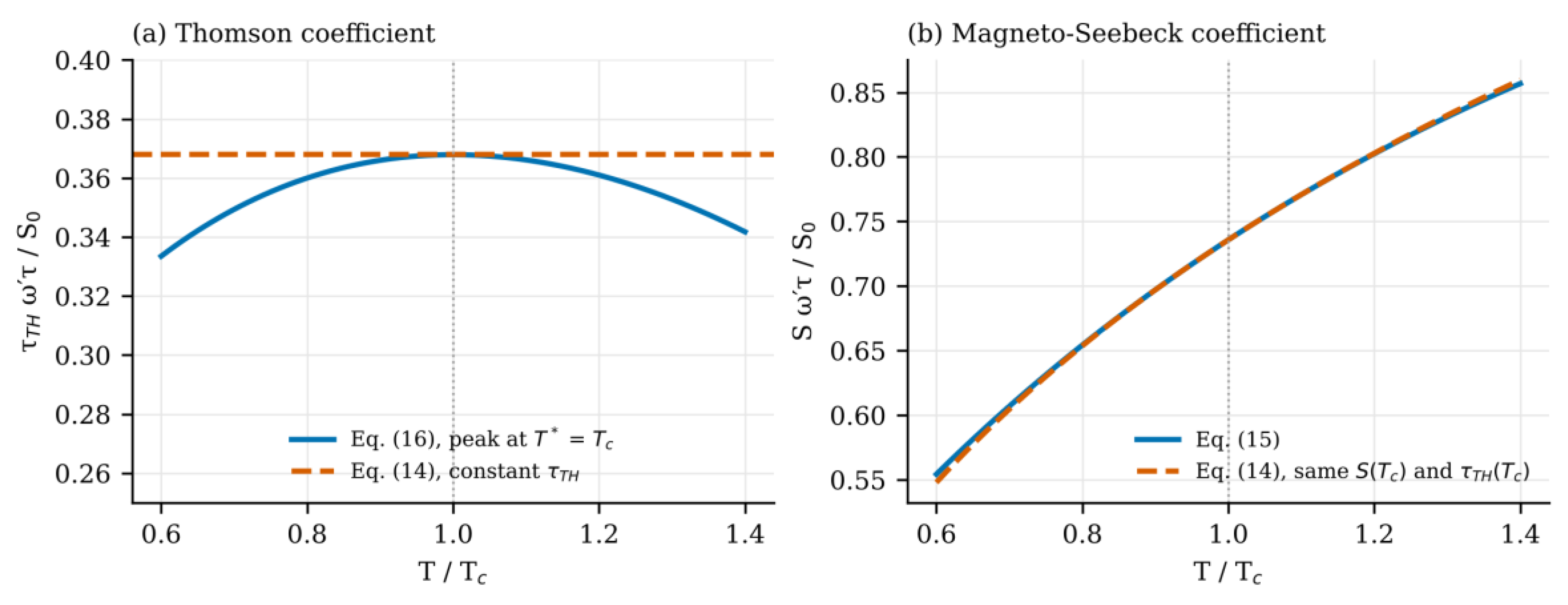
Figure 2.
Real part of the relative variation of (a) the electrical resistivity and (b) the thermal conductivity, Eq. (21), versus the shifted phase , for iron (blue, K) and nickel (orange, K) disks, with Hz, kHz, T0 = e Tc and δT = 2 K (solid) and 5 K (dashed).
Figure 2.
Real part of the relative variation of (a) the electrical resistivity and (b) the thermal conductivity, Eq. (21), versus the shifted phase , for iron (blue, K) and nickel (orange, K) disks, with Hz, kHz, T0 = e Tc and δT = 2 K (solid) and 5 K (dashed).
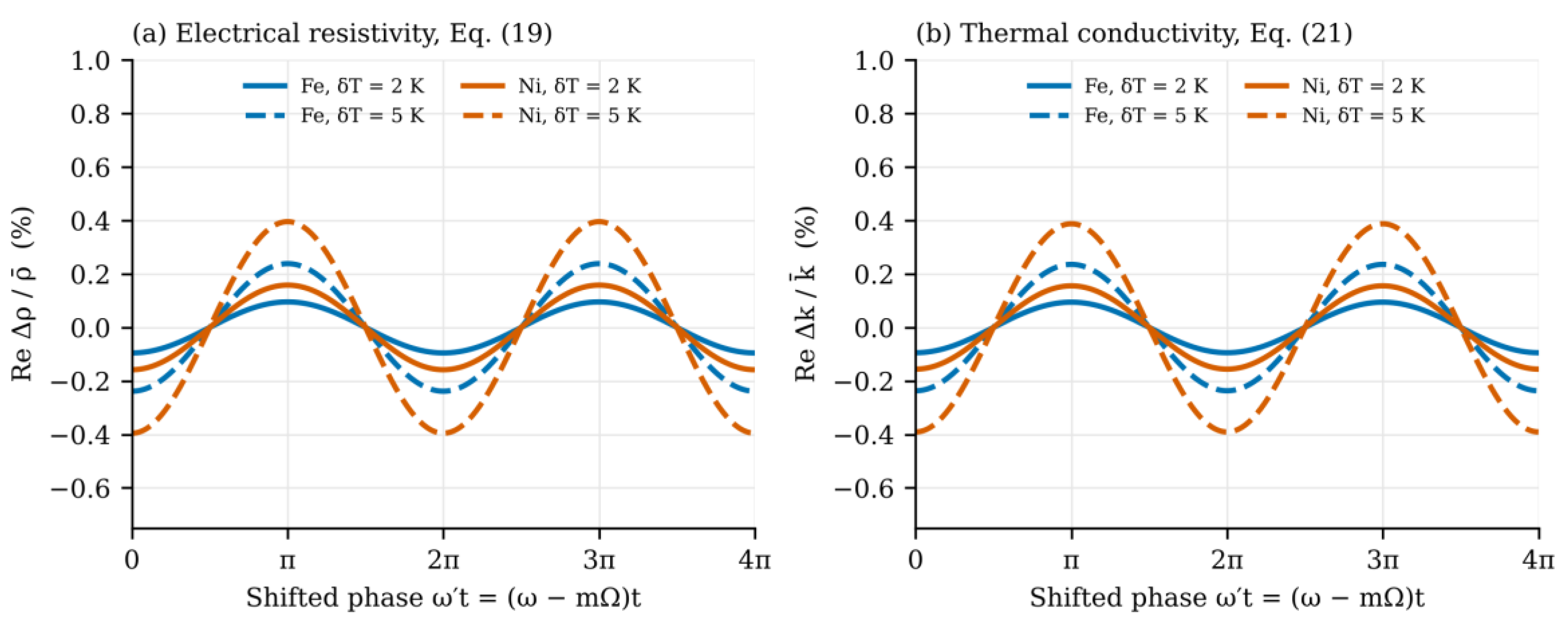
Figure 3.
Magneto-Seebeck coefficient at Tc, normalized to S0, for an iron disk (R = 1 cm, r = R/2) and azimuthal modes m = 1–5. (a) Versus the shifted pulsation . (b) Versus the rotation frequency for kHz: sharp maxima appear next to the Zel’dovich resonances (numbers), where S vanishes exactly.
Figure 3.
Magneto-Seebeck coefficient at Tc, normalized to S0, for an iron disk (R = 1 cm, r = R/2) and azimuthal modes m = 1–5. (a) Versus the shifted pulsation . (b) Versus the rotation frequency for kHz: sharp maxima appear next to the Zel’dovich resonances (numbers), where S vanishes exactly.
Disclaimer/Publisher’s Note: The statements, opinions and data contained in all publications are solely those of the individual author(s) and contributor(s) and not of MDPI and/or the editor(s). MDPI and/or the editor(s) disclaim responsibility for any injury to people or property resulting from any ideas, methods, instructions or products referred to in the content. |
© 2026 by the authors. Licensee MDPI, Basel, Switzerland. This article is an open access article distributed under the terms and conditions of the Creative Commons Attribution (CC BY) license (http://creativecommons.org/licenses/by/4.0/).
Copyright: This open access article is published under a Creative Commons CC BY 4.0 license, which permit the free download, distribution, and reuse, provided that the author and preprint are cited in any reuse.