

Submitted:
23 November 2026
Posted:
24 November 2026
You are already at the latest version
Abstract
MIsCORE-RIUD is a residual-first observational program that treats structured post-model data as an unresolved data layer rather than assigning it to noise or new physics before its organization is tested. Earlier papers established recurrent merger-local population morphology, H1/L1 local common support, connected multiscale paths, intrinsic registration of heterogeneous events onto a common internal progression coordinate, a recurrent state system, a structural GAP, and a frozen transition-rate law. The coordinate is not a cosmetic normalization: equal nominal event time does not guarantee the same internal dynamical stage across heterogeneous mergers. Paper VIII asks what physical evolution underlies that organized population progression and whether it survives from residuals to unsubtracted detector strain and then to source-native general relativity. The RAW bridge was obtained only after a stronger route failed. A blind event-specific RAW/source landmark search did not yield stable population-wide independent landmark recovery, and that negative result is retained. Conditioning only on the already-frozen GAP, a 95-event complete-join RAW audit identifies a multiplicity-corrected L1 20-100 Hz envelope log-jump transition: GAP-minus-PRE median -0.0312953 with studentized Z = 7.2154 and max-T p = 0.0050, and GAP-minus-POST median +0.0244377 with max-T p = 0.0098. The relation extends across a +/-20 ms neighborhood, whereas event-coordinate shuffle does not support unique eventwise GAP binding (best max-T p = 0.8824). The supported RAW statement is therefore a common merger-neighborhood transition, not a point singularity. Source-native numerical relativity provides a second representation change. In an exploratory ten-simulation SXS cohort, the frozen detector-like center-versus-flanks law localizes on the pre-common-horizon side, near AhC-25M. The candidate location was frozen and then reproduced without retuning in five additional SXS simulations: H1-like, L1-like, and joint responses are positive in 5/5. Across the combined SXS15 cohort, a fixed -35,-30,-25,-20,-15M stencil shows coherent acceleration of h22 amplitude growth, h22 frequency growth, binary separation decrease, and infall in 15/15 sources. At the fixed -25M location, the joint detector-like response is associated with h22 amplitude across SXS15 (Spearman rho = 0.7179, permutation p = 0.00347; 12-test Bonferroni bound approximately 0.0417). The supported source interpretation is a reproducible pre-AhC plunge/infall landmark, not equality between GAP and a horizon field. The residual coordinate is projected onto the source-time axis by a frozen two-anchor affine map, MT -> 0M and GAP -> -25M. Independently, 2,976 frozen R40 rows across 96 events yield a common-axis state/rate trajectory and an exact serialized decomposition of the transition hazard. The main state-reorganization transitions occur earlier than GAP, whereas GAP and MT lie predominantly inside the G state while eta, lambda, and p decline through the later high-G interval. The exact producer decomposition reconstructs ETA to machine precision, supporting the interpretation of the frozen generator as an internal-time rate law without requiring pointwise SXS state identity. The GR-side mechanism is tested separately in a controlled Einstein Toolkit binary-black-hole calculation. The producer-native vacuum Ashtekar-Krishnan balance recovers 98.6656% of the observed areal-radius growth over the canonical 0.25-0.50M interval, with 72.4946% from shear and 26.1709% from the 2-zeta term. A fresh local-phase extension maintains percent-level closure through 2M (1-2M trapezoid 99.917%; 0-2M trapezoid 99.151%). A separate same-run Psi4 calculation provides outgoing source-waveform output. A final forward bridge tests whether the source-side construction can survive projection back toward detector space. A B06 190M numerical-relativity branch supports source-to-detector forward generation and R30/R40 extraction robustness, but exact observed-GW150914 identity is not available and a strict full historical replay is not executable under the surviving input-domain contract. A posterior-conditioned GW150914 analogue was therefore frozen independently of observed RAW. Forensic reconstruction then showed that an initial separate-detector comparison used a different operator than the historical R0 quantity and could not be interpreted as an R0 failure. Under the recovered R0 H1/L1 joint operator, a new same-operator forward test gives synthetic R30/R40 landmark positions of 20, 18, and 8 ms at widths 5, 10, and 20 ms, compared with observed positions 4, 14, and 7 ms, corresponding to absolute offsets 16, 4, and 1 ms. Historical R0 parity remains not identifiable because the original HDF5 universe is incomplete; the new result is therefore classified as partial forward positional support, not exact microscopic closure. Taken together, Paper VIII is not merely a GR appendix to RIUD. It unifies the population phenomenon, its residual-space internal-time dynamics, a distinct RAW frequency-activation and spectral-redistribution relation, a replicated pre-AhC source progression, post-AhC dynamical-horizon balance, outgoing radiation, and a limited same-operator forward detector return. These quantities are not algebraically identical. The central result is that representation-specific laws and observables can remain organized by one higher-order merger progression once heterogeneous events are compared through the frozen common coordinate and landmarks.
Keywords:
gravitational waves
; binary black holes
; residual dynamics
; RAW strain
; multiscale flow
; internal time
; structural GAP
; SXS
; plunge
; apparent horizons
; dynamical horizons
; Ashtekar-Krishnan balance
; Einstein Toolkit
; Psi4
; source-to-detector forward modeling
; MIsCORE
; RIUD
Claim Hierarchy at a Glance
Paper VIII deliberately separates established results, replicated source-side results, mechanism results, and unresolved stronger identities. This hierarchy prevents later representation changes from being mistaken for equality claims.
| Level | Paper VIII Statement | Explicit Boundary |
| Established negative | A blind/event-specific RAW landmark route did not yield stable independent population-wide landmark recovery. | The failed route is preserved and is not rewritten as successful free RAW discovery. |
| Established RAW manifestation | Conditioning only on the previously frozen GAP, RAW shows a multiplicity-corrected L1 20–100 Hz envelope transition in the 95-event complete join. | The effect spans a neighborhood; point singularity and unique event-coordinate binding are not established. |
| Established internal-time law | The frozen 96-event, 2976-row R40 generator admits exact serialized ETA reconstruction and a common-axis population trajectory. | GAP is not a state-transition-density peak, and R40 state labels are not asserted to be pointwise SXS source states. |
| Replicated source landmark | Exploratory SXS10 localization placed the detector-like response near AhC-25M; the frozen location reproduced in five additional SXS sources. | The −25M landmark is a population source-side location, not an exact eventwise identity for every observational GAP. |
| Supported source progression | Across SXS15, a fixed local stencil shows coherent acceleration of waveform growth and binary plunge/infall in 15/15 sources. | A unique mathematical change point is not claimed. |
| Quantitative cross-representation support | At the fixed −25M landmark, joint detector-like contrast tracks h22 amplitude across SXS15. | Association does not imply scalar identity or direct microscopic causation. |
| Established GR mechanism | The producer-native vacuum Ashtekar-Krishnan balance reproduces the observed areal-radius growth at percent-level accuracy under the frozen fixed-resolution contract. | The law is established GR theory; the paper tests numerical closure and does not claim a new field equation. |
| Extended GR support | A fresh 0–2M local-phase run retains percent-level balance closure. | The endpoint of the closure regime is not measured, and no continuum extrapolation is claimed. |
| Same-run radiation layer | A separate 50M ETK run produces Psi4 output with contained retarded peaks at r = 15, 30, and 40M. | Complete peak/relaxation at all larger radii is not established by the finite run. |
| Forward detector support | A posterior-conditioned GW150914 analogue evaluated under the recovered R0 H1/L1 operator gives partial positional agreement, strongest at the broader tested scales. | Historical R0 parity, exact microscopic source identity, LOW-to-HIGH closure, and full LOCAL + FLOW forward closure remain unclaimed. |
Evidence Architecture
The paper uses several representations because no single representation can answer all of the physical questions without either discarding structure or imposing an identity that the data do not support.
| Representation | Question | Principal Result | Role |
| Residual/RIUD | Can heterogeneous events be organized by a common progression? | Frozen MAP/MT coordinate, structural GAP, recurrent state system, and R40 generator. | Discovery and formalization layer. |
| R40 common-axis audit | How do state occupancy and rate variables evolve on the frozen source-time projection? | Earlier state reorganization followed by high-G, declining-hazard progression through GAP and MT. | Internal-time-law layer. |
| Blind RAW search | Can RAW independently recover an event-specific landmark without RIUD coordinates? | No stable population-wide landmark. | Negative control against circular rewriting. |
| GAP-conditioned RAW | Does unsubtracted strain change around the frozen structural neighborhood? | Multiplicity-corrected endpoint transition plus independent RAW persistence/spectral organization. | Detector manifestation layer. |
| SXS source-native NR | Where does the detector-like law localize in source time and what source dynamics occupy it? | Replicated AhC-25M location and SXS15 plunge/infall fingerprint. | Source progression layer. |
| Frozen source-time map | Can residual internal progression and SXS source time be displayed on one fixed axis? | MT -> 0M and GAP -> −25M with canonical RIUD support contained in SXS15. | Coordinate bridge. |
| ETK dynamical horizon | Does post-AhC GR horizon growth close quantitatively? | 98.6656% canonical AK balance and percent-level 0–2M extension. | Mechanism layer. |
| ETK Psi4 | Does the controlled source produce an outgoing radiation record? | Same-run Psi4 with contained inner- radius peaks. | Horizon-to-radiation layer. |
| Posterior-conditioned forward projection | Can a source-side analogue be projected to detector space and evaluated with the same recovered operator? | New R0 same-operator positional offsets 16, 4, and 1 ms at 5, 10, and 20 ms widths. | Forward consistency layer. |
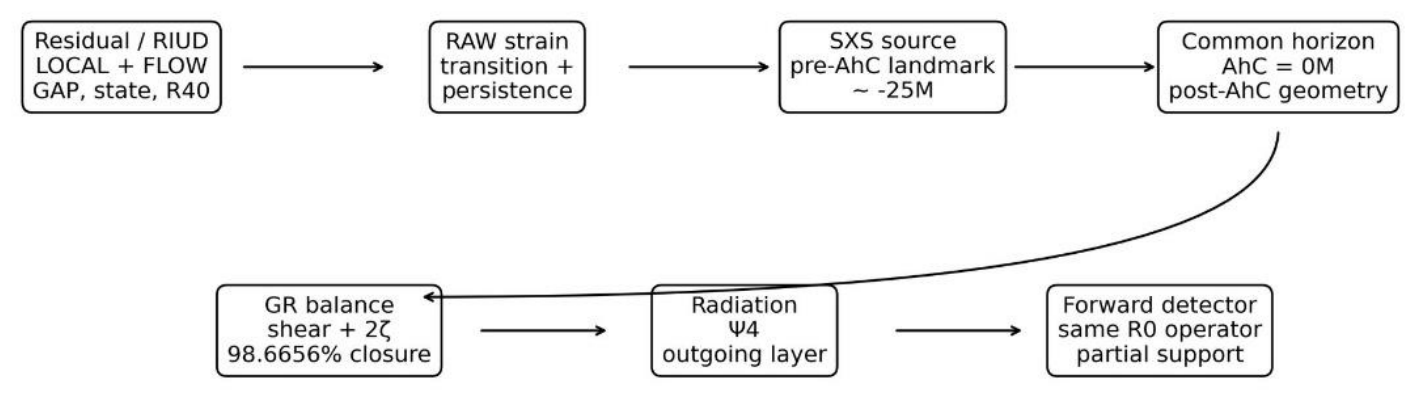
Figure 1.
Cross-representation mechanism architecture used in Paper VIII. The arrows encode an evidential and temporal bridge, not algebraic identity between the quantities in adjacent representations.
Figure 1.
Cross-representation mechanism architecture used in Paper VIII. The arrows encode an evidential and temporal bridge, not algebraic identity between the quantities in adjacent representations.
1. Introduction
The standard coherent gravitational-wave problem and the RIUD problem ask different questions of the same detector network. Conventional inference asks whether H1 and L1 are consistent with a common astrophysical source waveform after detector responses are accounted for, using waveform-based parameter inference or coherent burst reconstruction [12,13,14,15,16,17]. RIUD does not reject that framework. It asks whether a higher-order common object can remain observable even when lower-order detector representations are not identical enough to define the object at the waveform level.
Papers I and II established the first part of that distinction. The observational unit was moved from a whole residual trace to merger-local structure, then to H1/L1 local common support connected across multiple temporal scales. In that representation, the relevant object is not a requirement that every detector-local feature have the same detailed waveform form. It is the conjunction of local common support and connected multiscale flow. This distinction can be summarized as a change in the level at which commonality is defined: the scientific question is not only whether the same signal is present, but whether the same organized change survives.
Papers III through VI then increased the order of the object. Control-native tests narrowed which structures survive null competition. Intrinsic registration placed heterogeneous events on a common progression coordinate. A recurrent population state system, N0 -> A1 -> G <-> AR, emerged together with a structural node-depleted interval termed GAP and a frozen rate law that depends on event-level physical score S and run/age history. Paper VII established the observation principle that motivates the present work: lower-order detector representation can differ while the higher-order object remains stable.
Paper VIII asks whether that principle survives a much larger change of representation. The path is deliberately asymmetric:
Residual discovery -> RAW detector manifestation -> source-native progression -> common-horizon formation -> dynamical-horizon growth -> outgoing radiation -> forward detector projection.
Each arrow asks a different question. The residual layer is where the object was discovered and formalized. RAW asks whether the structure survives without waveform subtraction. SXS asks where the corresponding source progression sits relative to common-horizon formation. The Einstein Toolkit calculation asks whether the post-AhC horizon-growth mechanism closes under an explicit GR balance law. The final forward branch asks whether a source-side realization can produce detector-space landmarks under a frozen operator without using observed RAW to construct the source.
This architecture avoids two opposite errors. The first is to require algebraic identity between quantities that live in different representations. A residual node, a RAW spectral transition, a source-native h22 derivative, horizon shear, and a detector-projected transition are not the same measured scalar. The second is to permit arbitrary narrative association after the fact. Paper VIII therefore retains negative branches, freezes source-side locations before replication, distinguishes historical parity from new same-operator tests, and does not relabel technically unexecutable replays as negative physical results.
The central hypothesis is consequently not that every representation contains an identical feature. It is that a single higher-order merger progression can cast different lower-order projections while preserving temporal organization and physical order. This is the representation-level extension of the principle established in Paper VII.
2. Frozen Observational Starting Point
2.1. The Observational Object Inherited from Papers I–VII
Paper VIII does not redefine the RIUD object. The inherited topology is
N0 -> A1 -> G <-> AR,
S = 0.22030031492055946 z(R) + 0.3457660274266933 z(CHI_A_NORMALIZED),
lambda = exp(eta),
p = 1 − exp(-lambda du).
The canonical frozen coefficient multiplying S is
gamma = 0.3162354634393393.
The exact serialized R40 producer contains 2976 rows across 96 events. A component audit reconstructs the producer contract as
eta = BASE_LOG_RATE + RUN_COMPONENT + AGE_COMPONENT + MEMORY_DELTA_P1 + GAMMA_S.
Within that serialization, MEMORY_DELTA_P1 equals RUN_COMPONENT + AGE_COMPONENT to machine precision, with maximum absolute parity error 1.388 × 10⁻¹⁶. The complete ETA reconstruction agrees with ETA_P1 to maximum absolute error 1.78 × 10⁻¹⁵. Paper VIII treats this producer as a frozen observational generator. It is not re-estimated to improve the source interpretation.
2.2. Intrinsic Registration and GAP Provenance
The common map was not constructed by anchoring GAP and then rediscovering GAP. Event paths were aligned through frozen pairwise path-feature affine relations and a global affine solution. GAP is a downstream structural feature of that map. The canonical latent interval is
0.0182607298884202 < GAP < 0.0198413898273119,
u_GAP = 0.0190510598578661
0.0015806599388917.
GAP is operationally a node-depleted interval. It is not defined as the largest-amplitude feature, a singular physical event, or a required state-switching peak. Event-native depletion exists before population overlay, while the population map reveals that the depletion aligns at a common higher-order coordinate.
This distinction matters for causal interpretation. Registration can move existing event-native structure into a common coordinate, but a claim that it mechanically generates the aligned GAP would require a specific forcing mechanism, such as coordinate-dependent censoring, a GAP-targeted objective, a mask that removes nodes at a fixed latent location, or direct use of GAP as an anchor. Those mechanisms are not part of the frozen map construction.
2.3. MT and the Internal-Time Interpretation
MT is the common internal reference used by the later RIUD progression. GAP and MT are distinct. GAP is a structural node-depleted interval; MT is an internal progression reference. Later source-time work places these two frozen landmarks on a common source axis through the explicit mapping
MT -> 0M, GAP -> −25M.
This map is used as a compact comparison coordinate in Paper VIII. It is not retroactively used to construct the original residual atlas.
2.4. Claim Discipline
Paper VIII separates four levels throughout:
1. residual state and transition-rate dynamics; 2. RAW detector-strain organization; 3. source-native waveform, binary, and horizon progression; 4. local GR dynamical-horizon balance and forward detector projection. The paper tests connections between these levels but does not assume identities such as
RAW transition = Residual GAP as the same measured quantity,
GAP = AhC,
RIUD G = one unique SXS source state,
or
gamma = a parameter-free coefficient derived directly from Einstein’s equations.
These stronger identities are not required for the present cross-representation mechanism claim.
2.5. Frozen Numerical Contract Carried into Paper VIII
The R40 serialization is treated as an input authority rather than a flexible model family. The frozen event-level score is
with
S = 0.22030031492055946 z(R) + 0.3457660274266933 z(χ_A,norm).
R = M_irr,final/(M_irr,1 + M_irr,2), χ_A,norm = (χ_1z − χ_2z)/(|χ_1z| + |χ_2z|).
The event-level physical term enters the frozen generator through γS, with γ = 0.3162354634393393. The transition probability for progression increment du is generated as
λ = exp(η), p = 1 − exp(−λ du).
Paper VIII does not re-fit any of these coefficients. That constraint is central to the logic of the source-side comparison. If a source representation appears more or less compatible with the observational progression, the coefficients are not moved to improve the visual or numerical agreement.
The serialized decomposition is also kept distinct from the earlier GAP-local memory diagnostic. The R40 producer exposes baseline, run/age/history, and physical-score components that reconstruct ETA exactly. The separate historical GAP-memory analysis asks a localization question around the structural boundary. Those two quantities can be physically related at the level of temporal organization, but one is not silently substituted for the other in any exact parity statement.
The full starting contract therefore contains three different kinds of frozen information: a graph/state topology, a population progression coordinate, and an event-conditioned rate generator. Paper VIII uses all three as prior observational structure. None is regenerated from the SXS or ETK mechanism results.
3. RAW Detector-Strain Manifestation
3.1. A Stronger Blind Landmark Route Failed
The first RAW-side objective was deliberately stronger than a GAP-conditioned test. The analysis attempted to recover an event-specific merger-local landmark directly from RAW/source observables without using historical MT, GAP, node, path, or R40 information. Only after such a landmark was independently obtained was it to be compared with the frozen RIUD geometry.
That route did not close. Most events did not provide sufficiently stable local support under the final eventwise contract, and no stable population-wide independent landmark survived. The result is retained as
INDEPENDENT_MT_RECOVERY = NOT_ESTABLISHED.
No missing landmark was imputed from GAP, no event was shifted until it agreed with the residual coordinate, and no failed blind branch was later re-described as a successful discovery. This negative result is methodologically important because it separates independent RAW landmark recovery from the narrower conditional question that follows.
3.2. GAP-Conditioned RAW Transition
After blind landmark recovery failed, the already-frozen GAP was used only as a localization condition. The question became:
Given a pre-existing structural boundary discovered in the residual representation, does unsubtracted detector strain change reproducibly in its neighborhood?
The complete-join RAW endpoint audit contains 95 events and a 48-test detector/band/metric family calibrated with 9999 max-T permutations. The surviving primary effect is an L1 20–100 Hz envelope log-jump transition:
• GAP-minus-PRE median = −0.0312953 • studentized Z = 7.2154 • max-T p = 0.0050 • GAP-minus-POST median = +0.0244377 • max-T p = 0.0098 The relation persists over a +/−20 ms displacement profile. In contrast, event-coordinate shuffle does not support a unique event-specific binding to the exact GAP coordinate; the best max-T p is 0.8824. The correct interpretation is therefore a common merger-neighborhood transition rather than a mathematical point singularity.
The RAW result is important precisely because it is representation-specific. It shows a detector-strain manifestation around the frozen structural neighborhood without requiring the detector observable to be the same scalar that defined GAP in the residual map.
3.3. RAW State and Persistence Organization
Independent RAW-domain analyses provide additional support that the residual object is not merely a subtraction artifact. The strongest R40-linked operator results are not simple amplitude or transition-count measures. Full-axis RAW transition rate gives only weak ordering, while absolute slope and curvature provide stronger but incomplete support. The clearest relation is carried by state persistence and run-age organization.
A raw-only independently reconstructed state system yields run-age ordering with Spearman rho approximately −0.8687 against the frozen R40 organization. A related R6 OPEN_STATE representation gives rho approximately −0.8554, and a G-state weighted run-age summary tracks ETA with rho approximately −0.8452. These results point to temporal persistence and history as the principal RAW-level carrier of the R40 organization.
This matters for the interpretation of memory. The relevant empirical memory is not a claim of direct detection of Christodoulou nonlinear gravitational-wave memory. It is an age/run/history dependence in the effective transition generator. The two should not be conflated.
3.4. RAW Is Not Residual Identity
A strict literal RAW empty-support replay does not reproduce a residual-style exact-zero GAP. Under the historical threshold-1.0 complex-map support audit, RAW empty support occurs in 0/99 events. That result does not negate the transition relation. It shows that the residual and RAW representations do not carry the same object in the same lower-order form.
A separate blind compression bridge gives the same lesson quantitatively. A source/RAW-derived broad predicted residual region overlaps the observed residual GAP region in 89/96 events, but the predicted region is much broader than the residual GAP. The reverse Residual + SXS-to-RAW position-only bridge also gives 89/96 overlap. These results support a relation between representations while rejecting exact measured-quantity identity.
Accordingly:
RAW = Residual as the same measured quantity is rejected.
RAW and Residual as different projections of a common merger progression remain supported.
3.5. Independent RAW Activation and Spectral Organization
A separate frozen RAW-domain activation relation provides a check that the GAP-conditioned endpoint result is not the only RAW evidence in the manuscript. In the exact-join 95-event cohort, the quantity
is negative in 82 events, exactly zero in 3, and positive in 10, with population median −0.0006159055284879235. The trigger is defined from RAW oscillation/zero-crossing activity and the rise time from the RAW envelope. This relation can be evaluated without using the GAP coordinate.
M_det (f_rise − f_trigger).
The corresponding qualitative sequence is
oscillation/zero-crossing activity -> spectral-centroid relaxation -> envelope rise.
A separate RAW-only temporal-discovery branch excluded the historical map, PATH, N0/A1/G/AR labels, W windows, GAP, MT, S, and R50 and recovered eight boundaries and nine temporal regions across 96 events. Related RAW-only state analyses recover descriptive state/flow organization. Because the state construction is independent, the resulting labels are not renamed as historical RIUD states. The scientific use of those branches is narrower: they demonstrate that organized temporal structure exists in unsubtracted strain even when the residual map and state vocabulary are withheld.
A spectral audit around the frozen GAP gives a complementary frequency-domain description. Across H1/L1, the 60–100 Hz fraction decreases, the 100–250 Hz fraction increases, and log(mid/low) rises in approximately 98–100% of events, whereas absolute 60–300 Hz power increases in only about 60%. The supported description is thereforerelative spectral redistribution or hardening, not a universal broadband amplification law.
The activation relation, RAW-only temporal partition, run-age organization, and GAP-conditioned endpoint transition are intentionally left as distinct contracts. Collapsing them into a single timestamp would erase the exact feature of the data that Paper VIII is trying to preserve: the higher-order merger progression can be common even when its lower-order RAW representations are not identical.
3.6. GAP-Associated Memory Change
The corrected GAP-memory analysis uses the frozen global progression coordinate rather than the withdrawn native-delay conversion. Across 96 common events, the post-minus-pre memory contrast is positive in 91 events and negative in 5. The population summary is
| Statistic | Value |
| Mean post-minus-pre contrast | +0.24802386879217775 |
| Median post-minus-pre contrast | +0.18107055419088022 |
| 9999-bootstrap 95% CI | [+0.21230465, +0.28602148] |
| Bootstrap probability of non-positive mean | 0.0001 |
| Approximate post/pre population-mean ratio | 1.69 |
Memory begins to rise before or around the GAP boundary, reaches its highest mean in the corrected binning near bin 19, and remains elevated immediately afterward. This supports a progression-local change in effective history strength. It doesnotidentify a microscopic carrier and it is not a claim of direct Christodoulou gravitational-wave memory detection.
The asymmetry of the RAW evidence is therefore deliberate. A blind event-specific landmark was not recovered. Conditional manifestation around a frozen population-internal structural location was recovered. Independent RAW organization was also recovered without using that location. These are three different facts and are kept separate in the final interpretation.
4. Source-Native SXS Localization
4.1. Exploratory Localization Relative to Common-Horizon Formation
The source-side question was initially open: if the RAW-linked law has a source-time counterpart, does it sit at common apparent-horizon formation or elsewhere in the merger progression?
An exploratory ten-simulation SXS scan evaluated the frozen detector-like center-versus-flanks response relative to the source-native common-horizon time. The strongest response localized on the pre-AhC side, near −23M in the H1-like projection and −26M in the L1-like projection, whereas the same statistic was negative at AhC itself.
This result changed the physical interpretation. The source-side landmark is not best described as GAP = AhC. The candidate location was therefore frozen at
AhC − 25M.
4.2. Frozen Replication in Five Additional SXS Sources
The −25M location was then applied without scan, retuning, or source-specific movement to five additional SXS simulations. H1-like, L1-like, and joint responses are positive in 5/5.
The replication is important because the discovery and confirmation roles are separated:
• SXS10: exploratory source-time localization; • SXS5: frozen-location secondary replication; • SXS15: combined source-physics characterization. The replicated result is a source-time landmark, not an eventwise proof that every observational GAP is microscopically identical to one unique source timestamp.
4.3. SXS15 Plunge/Infall Fingerprint
Across the combined SXS15 cohort, a fixed −35, −30, −25, −20, −15M stencil shows coherent acceleration of several source-native quantities toward AhC. The direction is shared across all 15 sources for the principal fingerprint components:
• h22 amplitude growth strengthens; • h22 frequency rise strengthens; • binary separation decrease accelerates; • radial/infall motion strengthens. The source-side interpretation is therefore a pre-AhC plunge/infall landmark embedded in a broader strong-field progression.
The supported chronology is
pre-AhC plunge/infall landmark -> common-horizon formation -> radiation/remnant evolution.
This is more precise than identifying GAP directly with horizon formation.
4.4. Quantitative RAW-to-Source Association
At the fixed −25M location, the magnitude of the joint detector-like response is associated with h22 amplitude across SXS15:
Spearman rho = 0.7179
permutation p = 0.00347
with a 12-test Bonferroni bound of approximately 0.0417.
This is a cross-representation association, not a statement of direct eventwise causality. It supports the claim that the detector-like transition magnitude and source waveform growth are organized by a common stage of the merger progression.
4.5. Status of the Frozen Physical Score S
The frozen score S retains its original role as an event-level rate-law covariate. It is not promoted to a universal waveform-amplitude predictor. Direct source-side audits do not establish S ordering of h22 amplitude or frequency-slope changes. An exploratory association with separation plunge strength is moderate, but it is not treated as a new source-side law.
This boundary is useful. Paper VIII does not need every frozen empirical term to map one-to-one onto a microscopic source scalar. Its claim is about cross-representation organization and temporal mechanism order.
4.6. SXS Cohort Contract and Baseline Chronology
The source-native analysis uses fifteen distinct SXS binary-black-hole simulations drawn from the SXS numerical-relativity catalog [8]. The exploratory discovery cohort is
SXS:BBH:0180, 0513, 0526, 1144, 1765, 2092, 2497, 2499, 2505, 2506.
The five simulations reserved from the −25M localization step and evaluated only after the location was frozen are
SXS:BBH:0001, 0003, 0006, 0009, 0030.
The purpose of the SXS analysis is not to reproduce observational residuals from first principles. It is to ask two narrower questions: whether the detector-like law has a reproducible source-time location and what physical source evolution occupies that location.
In the original SXS10 mechanism audit, common apparent-horizon formation precedes the h22 amplitude peak in 10/10 simulations, with median AhC-to-peak offset −7.040M. Horizon mass/spin evolution, waveform-derived energy and angular-momentum flux, and remnant relaxation observables are available across the source cohort. This establishes a common-horizon-to-radiation-to-relaxation source regime, but it does not imply that the observational GAP is itself the common-horizon formation event.
The detector-like local law evaluated in the source simulations is
with fixed width 10 ms and δ = 5 ms for the localization analysis. The discovery-cohort source-time scan gives the following contrast between AhC and the frozen candidate location:
D(t) = C(t) − [C(t − δ) + C(t + δ)]/2.
| Anchor | H1-Like Positive | H1 Mean | L1-Like Positive | L1 Mean | Joint Positive | Joint Mean |
| AhC 0M | 2/10 | −3.8067 | 0/10 | −3.1697 | 0/10 | −3.4882 |
| AhC −25M | 10/10 | +6.6355 | 10/10 | +6.6245 | 10/10 | +6.6300 |
Because −25M was selected from this discovery scan, the 10/10 result is not described as independent confirmation. The independent step is the frozen evaluation in the five additional simulations:
| Response | N | Positive | Mean | Median |
| H1-like | 5 | 5 | +6.7173 | +7.1221 |
| L1-like | 5 | 5 | +6.0894 | +4.6403 |
| H1/L1 event mean | 5 | 5 | +6.4033 | +5.8812 |
This separation of discovery and replication is maintained throughout the final manuscript.
4.7. Source Progression Through the Fixed Landmark
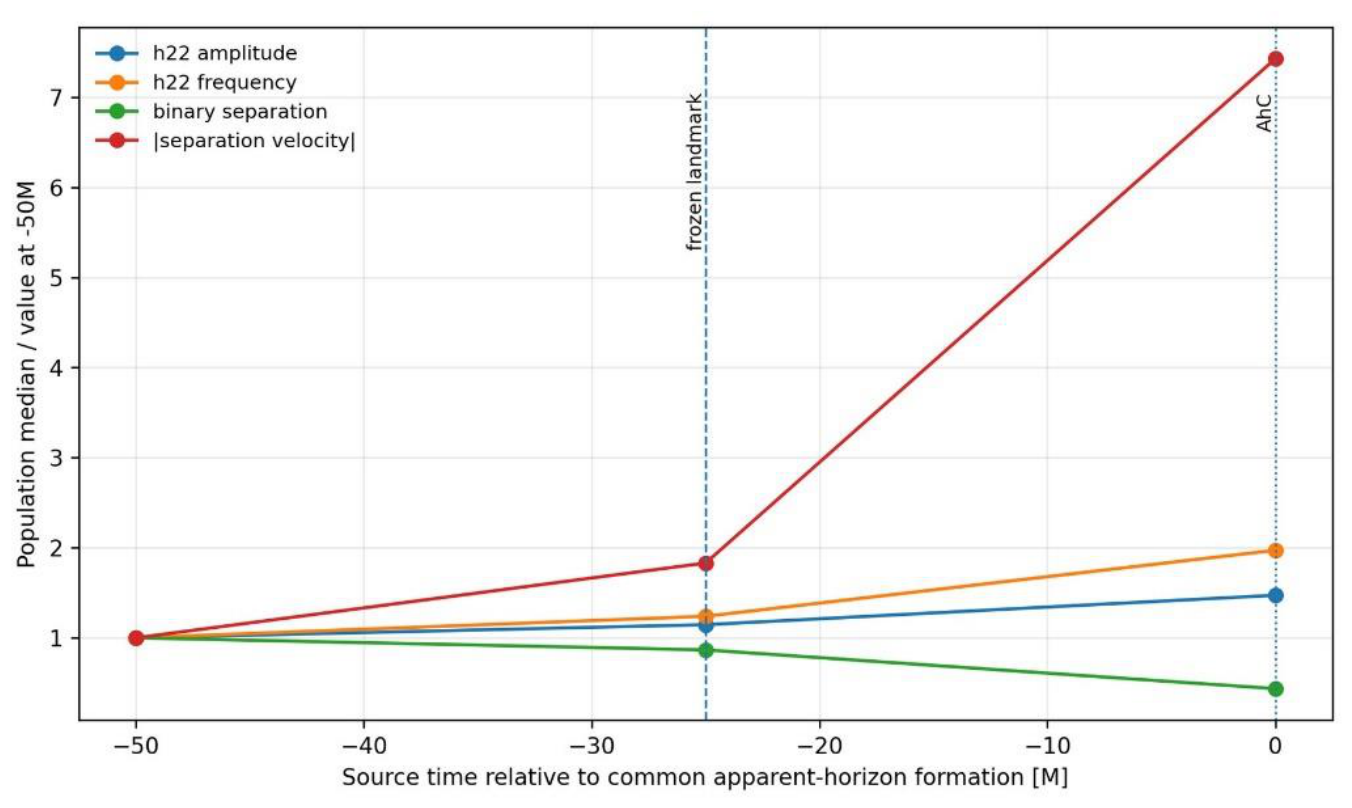
The combined SXS15 cohort supplies the source-native progression around the frozen landmark. Population medians evolve as follows:
| Source Time | Median h22 Amplitude | Median h22 Instantaneous Frequency | Median Separation | Median Separation Velocity |
| −50M | 0.2500 | 0.023673 | 5.368999 | −0.027656 |
| −25M | 0.2865 | 0.029336 | 4.650492 | −0.050619 |
| 0M | 0.3681 | 0.046678 | 2.340579 | −0.205390 |
A fixed local stencil at −35,−30,−25,−20,−15M gives coherent left-to-right slope changes at −25M:
| Quantity | Left Slope | Right Slope | Interpretation | Eventwise Direction |
| h22 amplitude | +0.002029 | +0.002354 | faster amplitude rise | 15/15 |
| h22 instantaneous frequency | +0.000309 | +0.000379 | faster frequency rise | 15/15 |
| binary separation | −0.045634 | −0.050053 | faster separation decrease | 15/15 |
| separation velocity | −0.001787 | −0.001867 | stronger infall | 15/15 |
The main common population behavior at −25M is therefore a pre-common-horizon plunge/infall regime rather than a sharp individual-horizon area event. Individual-horizon areal masses vary little from −50M to −25M, while source waveform and orbital variables accelerate coherently. This is why the final source-side interpretation is adynamical progression landmark, not a unique horizon scalar.
Figure 2.
SXS15 population medians through the frozen pre-AhC source landmark. Each quantity is normalized to its own median at −50M only for display; the underlying values and units remain those reported in the preceding table. The figure visualizes simultaneous waveform growth, increasing frequency, shrinking separation, and strengthening infall toward AhC.
4.8. Full-Support Containment and Frozen Score Boundary
Under the frozen map MT -> 0M and GAP -> −25M, the canonical RIUD support extends to approximately −256.210M to +256.210M on the SXS axis. All fifteen SXS waveform records contain the full mapped interval. Selected median waveform values on that axis are:
| SXS time | Median h22 Amplitude | Median h22 Frequency |
| −256M | 0.1735 | 0.01365 |
| −50M | 0.2500 | 0.02367 |
| −25M | 0.2865 | 0.02934 |
| 0M | 0.3681 | 0.04668 |
After AhC, individual-horizon separation is no longer the relevant two-body coordinate and is not extrapolated into the common-horizon phase.
The exact frozen observational score S was applied to SXS15 without restandardization or coefficient refit. It does not order h22 amplitude or frequency slope changes and does not associate with infall acceleration. An exploratory moderate association is seen with separation plunge strength, defined as minus separation acceleration: Spearman rho = +0.5429 with nominal p = 0.0365, and Kendall tau = +0.352 with p = 0.0743. Because several source response metrics were examined and no multiplicity correction was applied to this S audit, the result remains exploratory. This is consistent with the role of S as a transition/traversal-rate covariate rather than a direct waveform amplitude predictor.
5. The Common Source-Time Axis and the Frozen R40 Law
5.1. Two-Anchor Affine Bridge
The residual internal coordinate and SXS source time are displayed on a common axis through a frozen positive affine map:
MT -> 0M
GAP -> −25M.
This bridge is descriptive and operational. It allows the complete residual support, the R40 generator, and the SXS15 waveform progression to be viewed on one source-time axis. It does not claim that the affine construction alone proves eventwise physical identity.
5.2. Population Trajectory
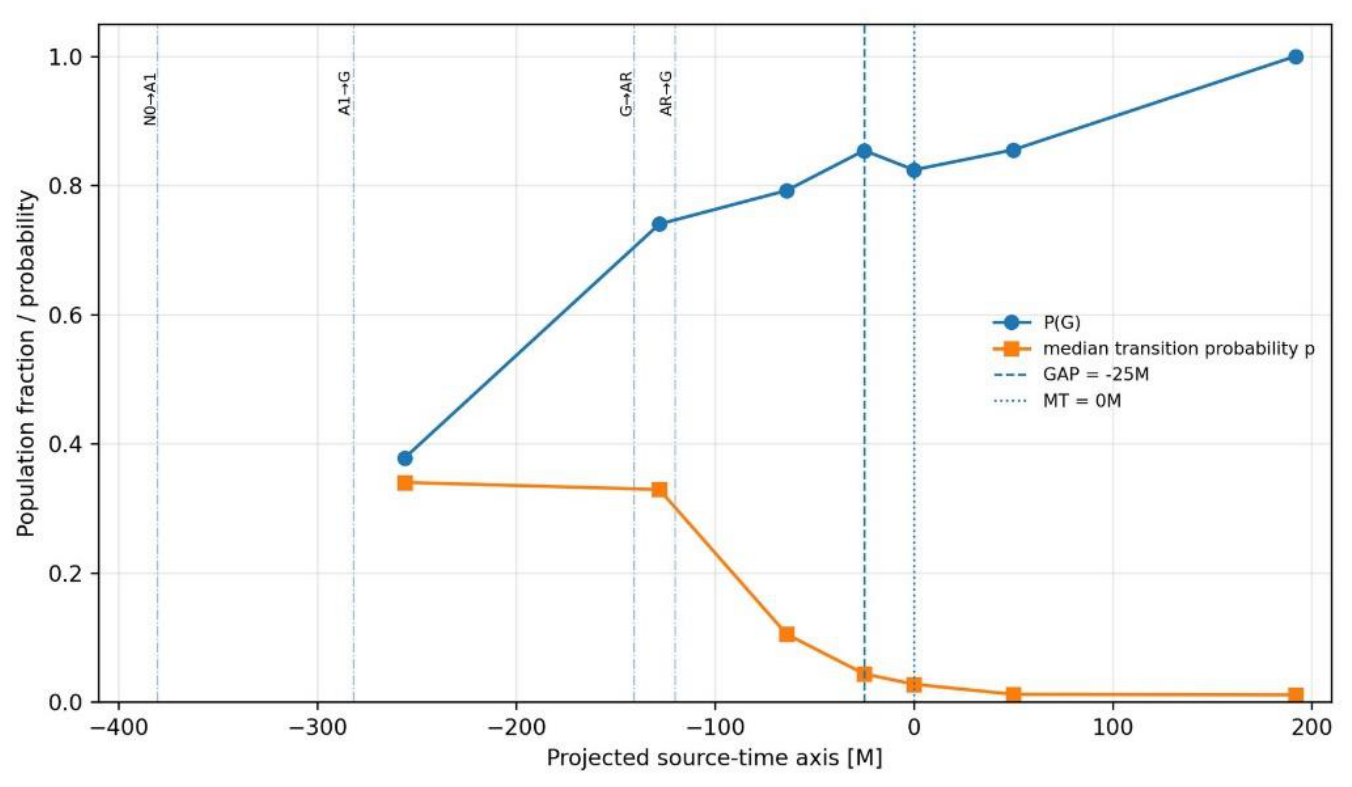
All 2976 frozen R40 rows from 96 events were projected onto the source-time axis with no refit and no anchor scan. Selected population medians are:
| Source-Time Axis | N | P(G) | Median Eta | Median Lambda | Median p |
| −256M | 82 | 0.378 | 2.584 | 13.31 | 0.340 |
| −128M | 96 | 0.740 | 2.547 | 12.77 | 0.329 |
| −64M | 96 | 0.792 | 1.263 | 3.552 | 0.105 |
| −25M | 96 | 0.854 | 0.352 | 1.422 | 0.0435 |
| 0M | 91 | 0.824 | −0.114 | 0.892 | 0.0275 |
| +50M | 83 | 0.855 | −0.961 | 0.382 | 0.0119 |
| +192M | 41 | 1.000 | −1.046 | 0.351 | 0.0109 |
The progression becomes increasingly G-dominated while the frozen transition-rate variables decline toward and beyond GAP/MT.
5.3. State Reorganization Occurs Earlier than GAP
The transition chronology shows that the major state-reorganization events occur well before the −25M GAP location. Median source-axis positions are approximately:
• N0 -> A1: −380.231M, count 95 • A1 -> G: −281.664M, count 96 • G -> AR: −140.517M, count 314 • AR -> G: −119.994M, count 312 At GAP = −25M, only 7 state transitions occur among 89 available trajectories, for a local density of approximately 0.0787. GAP is therefore not a population peak of label switching.
This result separates two forms of organization:
1. state organization, in which the N0-A1-G-AR topology changes labels earlier in the progression; 2. state-internal temporal organization, in which transition hazard continues to evolve after the population is already predominantly in G. The later high-G interval is consequently a natural place for the GAP and MT landmarks to appear without requiring a discrete state change at those coordinates.
5.4. Internal-Time Rate Law
The exact ETA decomposition shows that the frozen generator changes systematically along the internal progression coordinate. The state labels need not switch at GAP for the generator to evolve. In this restricted and explicit sense, R40 behaves as an internal-time rate law.
The physical interpretation remains empirical. Paper VIII does not claim that the full R40 functional form has been derived parameter-free from Einstein’s equations. A direct parameter-free GR derivation remains a stronger and currently unsupported statement.
5.5. Detailed Common-Axis Trajectory
The full 2976-row R40 serialization was projected to the source-time display axis with the frozen event-specific supports, no refit, and no anchor scan. Selected population medians are:
| SXS Axis | N | P(G) | Median Eta | Median Lambda | Median p |
| −256M | 82 | 0.378 | 2.584 | 13.31 | 0.340 |
| −128M | 96 | 0.740 | 2.547 | 12.77 | 0.329 |
| −64M | 96 | 0.792 | 1.263 | 3.552 | 0.105 |
| −25M | 96 | 0.854 | 0.352 | 1.422 | 0.0435 |
| 0M | 91 | 0.824 | −0.114 | 0.892 | 0.0275 |
| +50M | 83 | 0.855 | −0.961 | 0.382 | 0.0119 |
| +192M | 41 | 1.000 | −1.046 | 0.351 | 0.0109 |
The population becomes increasingly G-dominated while the frozen rate variables decline toward and beyond GAP/MT. Because S is event-level, a population-median S value can shift when event composition changes across partially covered source-time cells. The directly time-evolving quantities in this display are therefore eta, lambda, p, and their serialized history/baseline components.
5.6. State-Transition Chronology
Actual state changes were extracted from the frozen rows rather than inferred from smoothed occupancy. The 817 transition rows decompose as:
| Transition | Count | Median Projected Source Time |
| N0 -> A1 | 95 | −380.231M |
| A1 -> G | 96 | −281.664M |
| G -> AR | 314 | −140.517M |
| AR -> G | 312 | −119.994M |
At GAP, only 7 of 89 locally available events contain a state transition under the fixed density-cell audit, corresponding to transition density 0.0787. The main state-reorganization density lies substantially earlier. Consequently, the GAP interpretation in the final paper is not a hidden state switch. GAP lies inside an already organized, predominantly G regime.
A W4-to-GAP diagnostic shows why occupancy alone is insufficient:
| SXS Axis | P(G) | Eta | Lambda | p |
| −64.05M | 0.765 | 2.204 | 9.057 | 0.247 |
| −50M | 0.767 | 1.230 | 3.428 | 0.102 |
| −35M | 0.905 | 0.876 | 2.402 | 0.072 |
| −30M | 0.878 | 0.882 | 2.417 | 0.073 |
| −25M | 0.833 | 0.785 | 2.198 | 0.066 |
| −20M | 0.848 | 0.293 | 1.341 | 0.041 |
The authoritative exact component join uses a slightly different matched-cell aggregation, but the same qualitative result survives: high G occupancy coexists with a declining transition hazard.
5.7. Exact Serialized Component Audit
The exact joined decomposition gives the following selected population medians:
| M | N | P(G) | Eta | Lambda | p |
| −64.053 | 96 | 0.792 | 1.2626 | 3.5516 | 0.1050 |
| −50 | 96 | 0.781 | 0.8195 | 2.2715 | 0.0685 |
| −35 | 96 | 0.917 | 0.3635 | 1.4393 | 0.0440 |
| −25 | 96 | 0.854 | 0.3521 | 1.4224 | 0.0435 |
| 0 | 91 | 0.824 | −0.1145 | 0.8918 | 0.0275 |
| +50 | 83 | 0.855 | −0.9611 | 0.3825 | 0.0119 |
The principal serialized component medians are:
| M | Baseline | Age | Memory Operator | Gamma*S |
| −64.053 | 1.2591 | −0.3178 | +0.0536 | −0.00412 |
| −50 | 0.8031 | −0.3178 | −0.3046 | −0.00412 |
| −35 | 0.3406 | −0.3178 | −0.1620 | −0.00412 |
| −25 | 0.3406 | −0.3178 | −0.3046 | −0.00412 |
| 0 | −0.1014 | −0.3178 | 0 | −0.00675 |
| +50 | −0.8073 | −0.3178 | 0 | −0.01001 |
The full reconstruction agrees with the serialized ETA_P1 field to maximum absolute error 1.78e−15. The exact result supports the statement that the R40 generator is organized by the common progression coordinate and can be reconstructed from its frozen components. It does not mean that the same numerical law has been derived from SXS variables.
Figure 3.
Frozen R40 common-axis trajectory. The G-state population fraction rises while the transition probability declines toward and beyond GAP/MT; the median state-transition locations occur earlier in the progression. This separates state reorganization from the later state-internal hazard evolution.
6. GR-Side Dynamical-Horizon Mechanism
6.1. Why the Mechanism Test Is Separate
The pre-AhC source landmark and the post-AhC horizon-growth mechanism occupy different physical regimes. Before common-horizon formation, there is no common horizon on which to evaluate common-horizon shear or the Ashtekar-Krishnan flux balance. The −25M source landmark must therefore be characterized through binary and waveform progression, whereas the post-AhC mechanism can be tested directly on the common dynamical horizon.
This separation prevents a category error. The absence of a pre-AhC common-horizon shear field does not count against the source-side landmark; that geometric object does not yet exist.
6.2. Canonical Ashtekar-Krishnan Closure
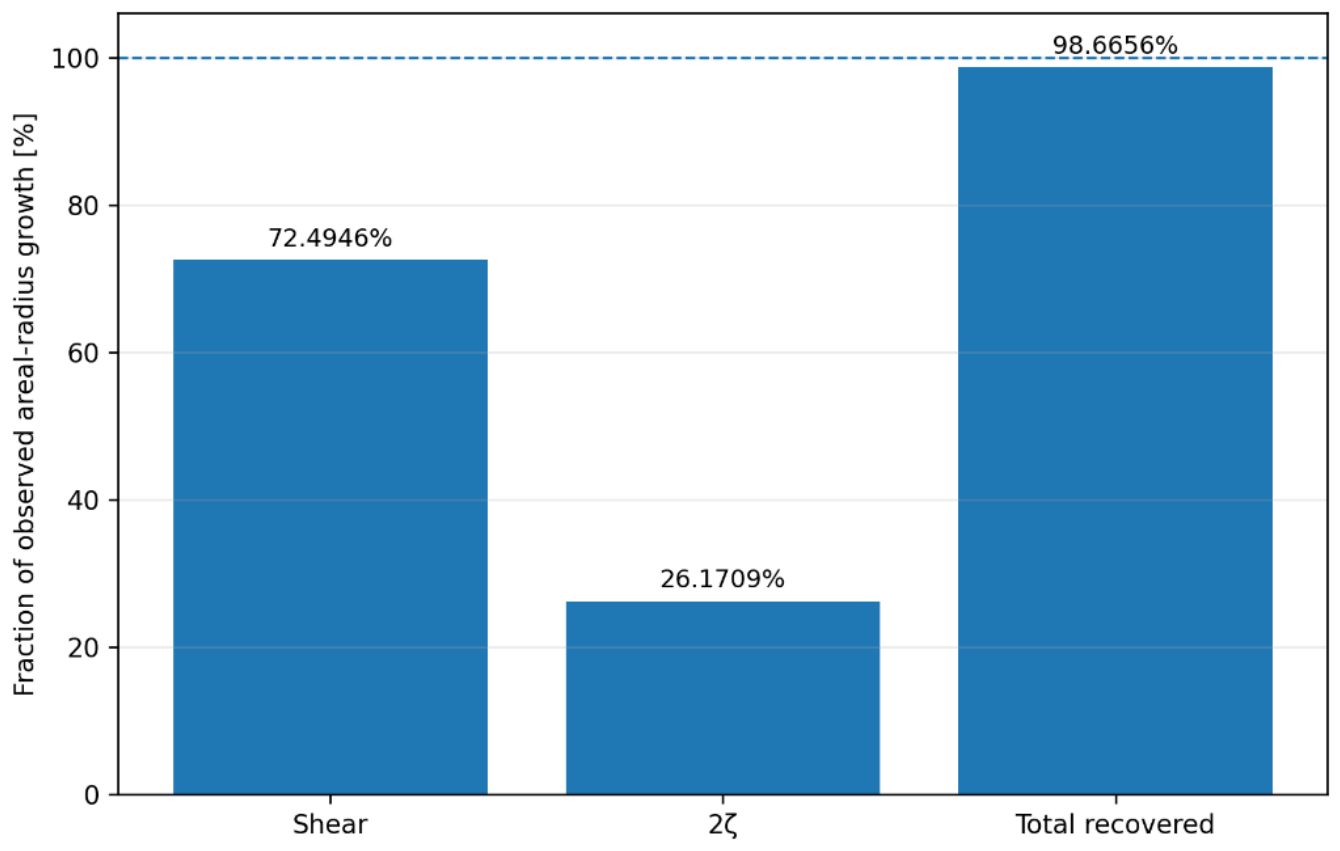
A controlled Einstein Toolkit binary-black-hole calculation evaluates the vacuum dynamical-horizon balance under a frozen producer, surface, normalization, and temporal-integration contract [1,2,3,4,5,6,7]. Over the canonical 0.25–0.50M analysis interval, the observed areal-radius growth is recovered as follows:
| Contribution | Fraction of Observed Growth |
| Shear term | 72.4946% |
| 2-zeta term | 26.1709% |
| Total | 98.6656% |
Figure 4.
Canonical producer-native Ashtekar-Krishnan balance over 0.25–0.50M. Shear and 2-zeta contributions recover 98.6656% of the observed areal-radius growth without empirical rescaling.
Figure 4.
Canonical producer-native Ashtekar-Krishnan balance over 0.25–0.50M. Shear and 2-zeta contributions recover 98.6656% of the observed areal-radius growth without empirical rescaling.
No empirical prefactor tuning or post-hoc field rescaling is applied.
The result tests the numerical realization of an established GR balance law. It does not claim discovery of the Ashtekar-Krishnan law itself.
6.3. Fresh Extension Through 2M
A fresh local-phase extension was executed to test whether the canonical closure is confined to a short cherry-picked interval. The result remains at percent-level accuracy through 2M:
• 1–2M trapezoid recovery = 99.917%
• 0–2M trapezoid recovery = 99.151% The tested interval therefore supports continuing post-AhC dynamical-horizon closure rather than a purely local numerical coincidence.
The remaining numerical boundary is spatial resolution. The canonical and extended results are at fixed N16 spatial resolution and do not constitute a continuum extrapolation.
6.4. Same-Run Psi4 Output
A separate minimal same-run calculation supplies outgoing Psi4. Retarded waveform peaks are contained at the tested inner extraction radii supported by the finite simulation window, including r = 15M, 30M, and 40M. This establishes a source-side chain from common-horizon dynamics to outgoing gravitational radiation within the same controlled evolution.
The resulting post-AhC order is
AhC -> shear + 2-zeta flux -> dynamical-horizon growth -> Psi4/radiation.
Combined with the pre-AhC SXS result, the broader source chronology is
plunge/infall -> AhC -> dynamical-horizon growth -> outgoing radiation/remnant relaxation.
6.5. Dynamical-Horizon Balance Law and Equation-Level Bridge
Let A denote the area of a horizon cross-section. The areal radius and irreducible mass are
R = sqrt[A/(4π)], M_irr = sqrt[A/(16π)] = R/2.
For a spacelike dynamical horizon, the Ashtekar-Krishnan balance law relates the change in areal radius between two cross-sections to matter and gravitational fluxes through the intervening horizon worldtube. In the vacuum calculation used here the matter term vanishes. With G = c = 1, the tested form is
ΔR_pred = (1/8π) ∫_ΔH N_R (σ_ab σ^ab + 2 ζ_a ζ^a) d3V.
The balance law is established general relativity. The scientific test in Paper VIII is whether the source-native geometric fields produced by a controlled merger calculation recover the independently measured horizon growth under one frozen surface, normalization, and integration contract.
Before the full horizon calculation, a reduced Raychaudhuri/shear audit was used only as an equation-level sanity check. A prescribed localized vacuum shear pulse follows
|sigma|2 -> theta -> A -> M_irr
6.6. Why SXS and ETK Are Complementary Rather than Redundant
The SXS cohort and the controlled ETK calculation answer different questions. SXS supplies breadth: multiple source-native binary-black-hole simulations show a common pre-AhC progression and subsequent common-horizon/radiation chronology. ETK supplies depth: a controlled binary is instrumented so that the horizon geometry entering the AK balance can be preserved under an explicit numerical contract.
SXS15 = cross-system source-time recurrence and physical fingerprint.
ETK controlled binary = direct local GR mechanism closure under one fixed-resolution contract.
A population source landmark cannot by itself establish the local horizon balance, and a single exquisitely instrumented horizon calculation cannot by itself establish population recurrence. The two layers are therefore intentionally non-substitutable.
6.7. Exact Recovered Einstein Toolkit Provenance
The canonical dense mechanism benchmark is bound to the recovered historical WSL execution contract rather than to earlier auxiliary reconstruction metadata.
| Item | Frozen Value |
| Executable | ‘/home/mickey/riud-cactus-corrected/exe/cactus_cactus_sim’ |
| Executable SHA-256 | ‘9dfd62b8e9cbd057422e13f1e090c55828985079b07f40f18f3a93083760a12a’ |
| Self report | ‘Cactus 4.20.0; compiled Sep 09 2026 13:21:38’ |
| Original working directory | ‘/home/mickey/riud-cactus-corrected’ |
| Parfile | ‘qc0-b03-dh-0p5-sigma-dense-ah.par’ |
| Parfile SHA-256 | ‘32AD449642C8282D6F9E5F8FF8848AA84B3BA34943E9E44E60F51A20 2C24F547’ |
| QuasiLocalMeasures source-bundle SHA-256 | ‘66A72F982F322F971EBBC9A1249385C8F17388E71DC3854C35A4531A BB77AC57’ |
| ETK release lineage | ET_2025_05, Kruskal |
| Recovery launch | Direct executable invocation, one process |
| Recovery runtime | GCC 15.2.0; GNU Fortran 15.2.0; MPICH/HYDRA 4.3.2 |
The recovery-host compiler and MPI versions are runtime provenance only. They are not retroactively asserted to be the original build toolchain of the preserved executable. Earlier auxiliary Cactus 4.18.0 or Docker/OpenMPI reconstruction records remain part of the forensic history but are superseded as the execution authority for the reproduced dense benchmark.
6.8. Binary, Grid, and Common-Horizon Surface Contract
The mechanism experiment uses a controlled N16-labeled equal-mass puncture configuration. It is a purpose-built mechanism calculation, not a byte-for-byte reconstruction of an astrophysical catalog event.
Key settings are:
| Cactus::cctk_final_time = 0.5 |
| TwoPunctures::par_b = 0.3 |
| TwoPunctures::par_m_plus = 0.453 |
| TwoPunctures::par_m_minus = 0.453 |
| CoordBase::dx = 2.0 |
| CoordBase::dy = 2.0 |
| CoordBase::dz = 2.0 |
| Carpet::max_refinement_levels = 10 |
| Carpet::time_refinement_factors = [1,1,2,4,8,16,32,64,128,256] |
| Carpet::regrid_every = 128 |
| SummationByParts::order = 4 |
| QuasiLocalMeasures::spatial_order = 4 |
| AHFinderDirect interpolation order = 4 |
| QLM interpolation order = 4 |
The canonical common-horizon analysis surface is mapped as AHFinderDirect horizon 3 -> SphericalSurface index 2 -> QuasiLocalMeasures slot 0. A dependent surface 6 existed but is not the canonical analysis surface. The physical evolution runs from 0.00M to 0.50M, while the valid spacelike dynamical-horizon balance uses only the matched surfaces at 0.25, 0.3125, 0.375, 0.4375, and 0.50M. The t = 0 and earlier diagnostic surfaces are excluded from the balance integral.
The canonical surface metric uses producer fields qlm_qtt, qlm_qtp, and qlm_qpp with
and the surface quadrature uses the corresponding positive metric measure multiplied by the source quadrature weight. In the preserved component audit,
and the geometric zeta contraction is emitted asdh_zeta_geo2. The serialized zeta contraction agrees with the squared exported geometric zeta components to machine precision.
det q = q_tt q_pp − q_tp2.
σ_geo2 = dh_3p_sigma2 × dh_lscale_geo2.
The critical reproducibility rule is normalization closure: the same null scaling, horizon normal, worldtube measure, surface identity, and time interval must be used in all balance terms. Earlier exploratory branches showed that mixing determinant-based and geometric boost diagnostics can create large spurious under- or over-recovery.
The custom QuasiLocalMeasures patch consists ofqlm_dh_flux.F90,qlm_dh_finalize.F90,interface.ccl, andparam.ccl. It adds the horizon-local fields and matched-surface bookkeeping required for the balance audit.
6.9. Dense Balance Calculation in Full Detail
Define
F_σ(t_k) = ∫_(S_k) N_R σ_ab σ^ab d2V.
F_ζ(t_k) = ∫_(S_k) N_R 2ζ_a ζ^a d2V.
The five matched surfaces are equally spaced with h = 0.0625M. For either component or their sum,
I_trap5 = h [0.5 F0 + F1 + F2 + F3 + 0.5 F4].
I_Simpson5 = (h/3) [F0 + 4F1 + 2F2 + 4F3 + F4].
The three-surface full-interval trapezoid uses 0.25, 0.375, and 0.50M with spacing H = 0.125M. The independently observed radius change is
ΔR_obs = 0.0011565307450602802.
The canonical dense benchmark is:
| Contribution | Temporal Rule | Predicted Delta R | Fraction of Observed Delta R |
| sigma | 5-surface trapezoid | 8.38422706 × 10⁻⁴ | 72.49463187% |
| sigma | 5-surface Simpson | 8.37092123 × 10⁻⁴ | 72.37958233% |
| sigma | 3-surface full-interval trapezoid | 8.39514290 × 10⁻⁴ | 72.58901624% |
| 2 zeta | 5-surface trapezoid | 3.02674836 × 10⁻⁴ | 26.17092861% |
| 2 zeta | 5-surface Simpson | 3.02659919 × 10⁻⁴ | 26.16963886% |
| 2 zeta | 3-surface full-interval trapezoid | 3.07682535 × 10⁻⁴ | 26.60392183% |
| total | 5-surface trapezoid | 1.14109754 × 10⁻³ | 98.66556048% |
| total | 5-surface Simpson | 1.13975204 × 10⁻³ | 98.54922119% |
| total | 3-surface full-interval trapezoid | 1.14719683 × 10⁻³ | 99.19293807% |
The recovered original executable and original parfile were then used for a fresh 0–0.5M evolution. The same five-surface 0.25–0.50M analysis reproduces sigma trapezoid = 72.4946318678449%, 2-zeta trapezoid = 26.1709286141522%, total trapezoid = 98.6655604819971%, total Simpson = 98.5492211880621%, and total three-point trapezoid = 99.1929380726778%, with the same observed Delta R. The benchmark is therefore reproduced to the reported numerical precision under the preserved executable/parfile pair.
A separate interior-three-point calculation that drops the interval endpoints returns about 49.97% total recovery. This is not a competing full-interval closure estimate because it integrates a different effective time domain. It is retained only as an endpoint-sensitivity diagnostic.
No empirical field scaling or post hoc prefactor adjustment is used. Across the full-interval temporal quadratures, the remaining 0.8–1.45% mismatch is retained as an aggregate fixed-resolution numerical residual. With only one spatial resolution, that remainder is not uniquely assigned to truncation, interpolation, horizon finding, normalization, or continuum physics.
6.10. Extended 0–2M Mechanism Support
The fresh local-phase extension was run because no compatible 1M checkpoint existed. The 0–1M behavior was reproduced and the producer-native balance remains near unity through the second M:
| Interval | Trapezoid Recovery | Simpson Recovery |
| 1.00–1.25M | 99.418% | 99.391% |
| 1.25–1.50M | 99.778% | 99.765% |
| 1.50–1.75M | 99.793% | 99.839% |
| 1.75–2.00M | 101.429% | 101.366% |
| 1.00–2.00M | 99.917% | 99.904% |
| 0.00–2.00M | 99.151% | 99.571% |
Values slightly above 100% are treated as percent-level numerical over-closure, not as physical excess. The extension rejects the idea that the canonical 0.25–0.50M closure is unique to one narrow local window. The endpoint of the closure regime remains unmeasured.
6.11. Same-Run Outgoing Radiation Layer
A separate minimal run,output-50M-minimal-20260910, evolved to 50M and produced 200 Psi4 files. It is distinct from the local-phase dynamical-horizon run and is not used to extend the AK balance. Under the same retarded-time convention, contained waveform peaks are found at:
| Extraction Radius | Retarded Peak Time |
| r = 15M | 7.921875M |
| r = 30M | 9.250000M |
| r = 40M | 9.781250M |
At r >= 50M the 50M evolution ends before a complete peak/relaxation interval is available. The final radiation status is therefore same-run Psi4 output with inner-radius waveform response observed, not complete all-radius asymptotic closure.
7. Source-to-Detector Forward Bridge
The forward branch asks a deliberately narrower question than the residual-to-source analysis: can a source-side numerical-relativity realization be propagated toward detector strain and retain transition-local structure under a frozen operator, without using the observed RAW transition to choose the source or tune the operator? The branch is therefore evaluated as a chain of contracts rather than as a demand for exact microscopic event identity.
7.1. Controlled B06 190M Source-to-Detector Construction
A dedicated 190M B06 numerical-relativity branch was used first because it provides a controlled source realization independent of GW150914-specific source selection. Psi4 was extracted at r30 and r40, integrated to strain, scaled under a frozen 70-solar-mass, 500-Mpc physical convention, projected through a frozen H1/L1 detector response including the detector delay, and sampled at 4096 Hz. The surviving synthetic source record contains 12,181 source rows per extraction and 270 detector-domain samples, corresponding to 65.6168 ms of detector-time support and 52 valid STFT positions under the restricted replay.
The branch supports two statements:
SOURCE_TO_DETECTOR_FORWARD_GENERATION = SUPPORTED
R30_R40_EXTRACTION_ROBUSTNESS = SUPPORTED.
A recoverable R1-style separate-detector script was found:
run_eventwise_full_tf_change_separate.py
with SHA-256
26B9F63F55D39C715E6DE907F7759A04C9C7427F7F039FDA9507A4AFBF76EF45.
Its relevant frozen settings are NPER = 64, HOP = 4, 20–2000 Hz feature support, widths 5/10/20 ms, and a robust flank-change score combining power, phase-motion, and frequency-slope terms. Carrier mixing, explicit frequency mixing, and peak normalization are not part of that recovered operator. Historical parity for the archived R1 universe cannot be established because the original HDF5 population is incomplete: 198 files were expected and only 14 exact SHA matches survive.
The distinction between operator recovery and historical parity is therefore explicit:
OPERATOR_SOURCE = RECOVERED
HISTORICAL_PARITY = UNVERIFIABLE.
The complete historical R1-style replay requires a 4 s input context, global median/MAD normalization, full phase unwrap, and the full candidate domain. The 65.6 ms B06 source record cannot satisfy that full input-domain contract. A hybrid physical-context extension was explored, but the available post-AhC support remains too short for the complete width-20 ms, +100 ms edge requirement. The strict full replay is therefore technically not executable from the surviving B06 source record and is not assigned a negative scientific verdict.
Within the valid restricted domain, r30 and r40 give identical positions at each tested width. H1 gives +21, +18, and +34 ms at widths 5, 10, and 20 ms; L1 gives +11 ms at all three widths. The recovered R1-style output does not contain the separate LOW-to-HIGH/FLOW quantity required to close that stronger claim. The correct B06 verdict is therefore
B06 = PARTIAL_FORWARD_CLOSURE.
7.2. Exact-Source Identity and Eventwise Registration Boundary
B06 is not GW150914. SXS:BBH:0305 is a GW150914-like analogue rather than the unique microscopic realization of the observed event. The B06 controlled binary has its own QC0 configuration and common-horizon clock, whereas SXS:BBH:0305 has a different native source clock. The B06 synthetic GPS epoch of 1e9 is arbitrary and does not provide a physical map to the observed GW150914 four-second record centered at detector GPS 1126259462.4.
No approved exact source-to-observed-event time map exists. Consequently:
GW150914_SOURCE_IDENTITY = NO
DIRECT_SAME_EVENT_COMPARISON = NOT_APPLIED
EVENTWISE_REGISTRATION_STATUS = NOT_IDENTIFIABLE.
7.3. Posterior-Conditioned GW150914 Analogue and Invalidated R1 Comparison
To ask a scientifically valid eventwise forward question without pretending exact source identity, a posterior-conditioned analogue was frozen before observed RAW was opened for comparison. A frozen posterior representative was selected asDEV97_FROZEN_PE_JOINT_MEDOID, row 12864. The predeclared intrinsic source-selection rule then selected SXS:BBH:0305 as the closest completed source realization. The source is posterior-consistent but is not asserted to be the unknown exact source.
The native time-domain source waveform ends approximately 105 ms after merger. Before the observational RAW transition was opened, a deterministic tail amendment based on the final 64 model samples was frozen to satisfy the operator input construction. This amendment belongs to the source-generation contract and is not an optimization against the observed detector result.
An initial separate-detector wrapper produced synthetic H1 landmarks +39/+39/+40 ms and L1 +29/+30/+30 ms at widths 5/10/20 ms. Applied to the observed event under that same new wrapper, it gave H1 −42/−44/+14 ms and L1 −7/−10/+30 ms. Those numbers initially appeared incompatible. Forensic provenance review then showed that the wrapper wasnot the historical R0 producer that generated the archived `EVENTWISE_C_LANDMARKS.csv` quantity.
The apparent mismatch is therefore retained as a failed comparison design, not as evidence against the historical R0 quantity. Comparing a new separate-detector quantity with an archived joint-detector quantity would not be a parity test at all.
7.4. Historical R0 Producer Recovery and Exact Operator Contract
The R0 authority quantity is generated byrun_raw_full_tf_change_landmarks.py. The recovered R0 contract differs materially from the separate-detector wrapper:
| R0 element | Frozen Contract |
| Detector combination | H1/L1 feature summaries combined by equal-weight mean before final C |
| Final score | absolute power change + absolute phase-motion change + absolute frequency-slope change |
| Record clock | 4 s slice midpoint, native domain −2 to +2 s |
| Candidate centers | −100 to +30 ms in 1 ms steps |
| Widths | 5, 10, 20 ms |
| Normalization | per-frequency robust median/MAD with MAD x 1.4826 |
| Edge rule | both flanks must remain inside complete candidate support |
The historical archived GW150914 R0 positions are −9, −2, and −3 ms at widths 5, 10, and 20 ms. The exact original HDF5 universe required for byte-level historical parity is incomplete, so these values remain archived historical targets rather than re-certified fresh outputs.
Accordingly:
HISTORICAL_R0_PARITY = NOT_IDENTIFIABLE.
This does not prevent a new same-operator experiment. It only prevents the new result from being mislabeled as exact historical replay.
7.5. New Same-R0-Operator Forward Test
The new R0 experiment executes the recovered R0 contract on the currently available canonical observed GW150914 H1/L1 record, interpreted under the published GW150914 source and calibration context [12,13,19,20], and on the frozen posterior-conditioned synthetic H1/L1 record. The H1/L1 combination rule, candidate domain, robust normalization, width family, and edge rule are matched between the two current inputs.
| Width | Synthetic R30 | Synthetic R40 | Current Observed R0 | Absolute Offset |
| 5 ms | +20 ms | +20 ms | +4 ms | 16 ms |
| 10 ms | +18 ms | +18 ms | +14 ms | 4 ms |
| 20 ms | +8 ms | +8 ms | +7 ms | 1 ms |
R30 and R40 agree exactly at all widths, preserving extraction-radius robustness in the forward construction. The observed-synthetic offsets decrease from 16 to 4 to 1 ms as the tested width increases. That scale dependence is reported descriptively only; it was not preregistered as a convergence law and is not promoted to a fitted relation.
Figure 5.
New same-R0-operator forward test. The frozen posterior-conditioned synthetic source gives identical R30/R40 landmarks and approaches the current observed R0 position at the broader tested widths. The 16, 4, and 1 ms offsets are descriptive results, not a predeclared convergence law.
Figure 5.
New same-R0-operator forward test. The frozen posterior-conditioned synthetic source gives identical R30/R40 landmarks and approaches the current observed R0 position at the broader tested widths. The 16, 4, and 1 ms offsets are descriptive results, not a predeclared convergence law.
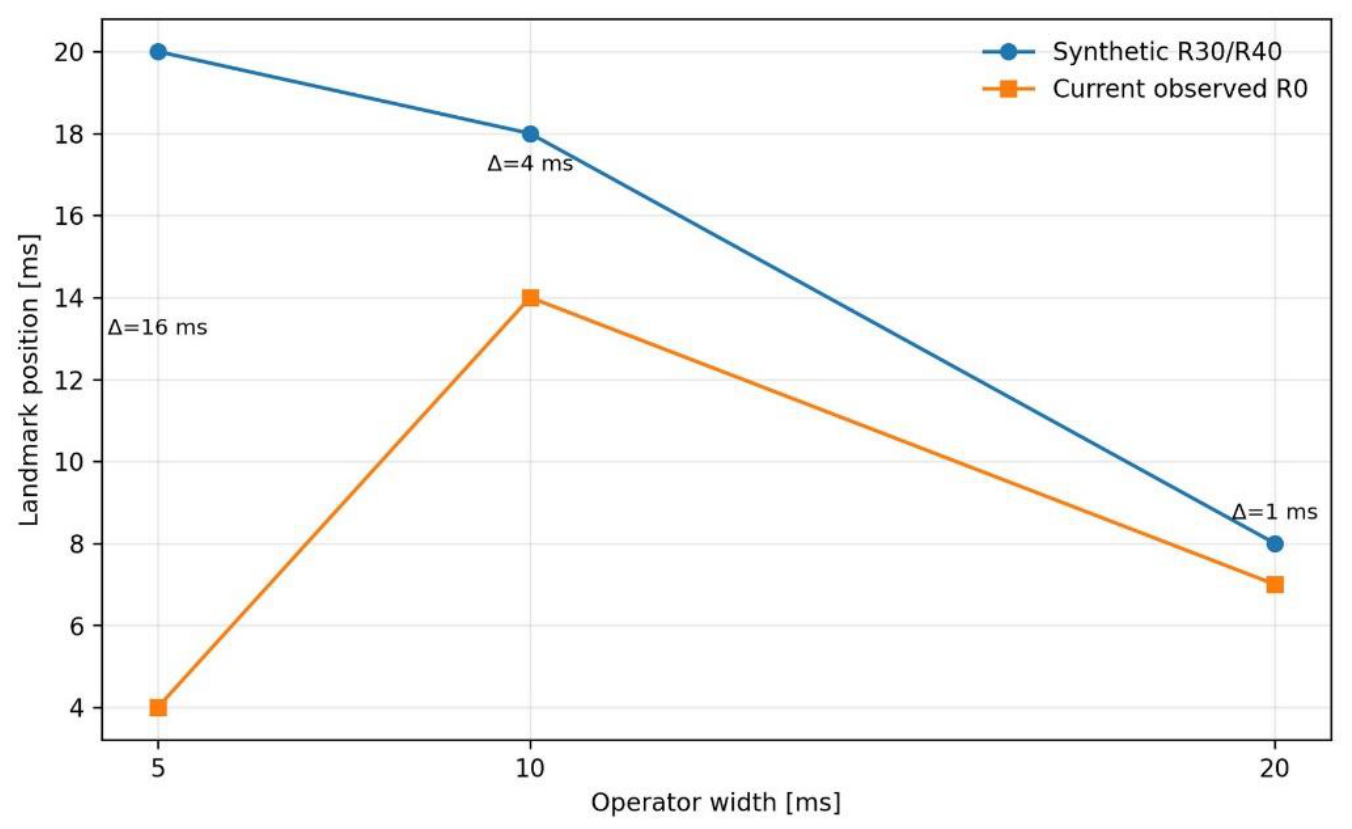
The branch is classified as
NEW_R0_CONTRACT_FORWARD_TEST = EXECUTED
NEW_R0_POSITIONAL_SUPPORT = PARTIAL
FINAL_BRANCH_VERDICT = PARTIAL_FORWARD_SUPPORT.
The result strengthens the source-to-detector bridge because a frozen posterior-conditioned source analogue, passed through the same recovered operator as the current observed record, approaches the observed transition position at the broader tested scales. It does not establish exact microscopic source identity, exact historical R0 parity, LOW-to-HIGH direction closure, or full LOCAL + FLOW closure. The branch is deliberately closed at this point rather than rescued through post hoc metric selection, source reselection, or a new time alignment.
8. Integrated Physical Interpretation
8.1. One Higher-Order Object, Multiple Lower-Order Projections
The central result of Paper VIII is not that every representation contains an identical feature. The representations are demonstrably non-identical. RAW does not reproduce a literal residual empty-support GAP, the source-native variables do not reproduce the exact residual state labels, and the forward detector branch does not produce exact eventwise identity at all scales.
What survives is the higher-order organization:
Residual: recurrent local support, connected multiscale path, intrinsic progression, GAP, state/rate dynamics.
RAW: merger-local transition structure and state-persistence/run-age organization.
SXS: a replicated pre-AhC source landmark embedded in coherent plunge/infall and waveform acceleration.
ETK horizon: percent-level GR balance closure after common-horizon formation.
Forward detector projection: partial same-operator positional support without observed-RAW tuning of the source.
This is the representation principle in its strongest form within the present program: lower-order details can change while a higher-order scientific object survives.
8.2. Why the Object Was Difficult to See in Conventional Analysis
Conventional coherent analyses and RIUD both use H1/L1 commonality, but they define the scientific unit differently. A conventional coherent waveform or coherent-transient analysis asks whether detector responses are consistent with a common source signal under an explicit network response [13,15,16,17]. RIUD asks whether local support and connected multiscale change survive jointly even when lower-order detector-local morphology is not globally identical.
The distinction is therefore not that one framework compares detectors and the other does not. Both do. The distinction is what must be common.
A concise statement is:
Finding the same signal and finding the same change are not equivalent observational questions.
Paper VIII extends that idea beyond H1/L1: finding the same higher-order progression across residual, RAW, SXS, horizon, and forward detector representations does not require those representations to contain the same scalar field or the same detailed waveform feature.
8.3. GAP as a Transition-Local Boundary
GAP is not the peak of state-label switching, not AhC itself, and not an exact RAW empty interval. Its role is more specific. It is a structurally depleted population landmark that lies late in a progression whose major state reorganization occurs earlier and whose transition hazard continues to decline through the high-G regime.
On the source-time axis, the corresponding fixed landmark sits near −25M, inside a coherent pre-AhC plunge/infall acceleration. The natural interpretation is therefore not a point singularity but a transition-local boundary in a broader strong-field progression.
8.4. Mechanism Chain
The combined source chronology can be written as
state organization -> high-G/history-dominated progression -> structural GAP/RAW transition neighborhood -> pre-AhC plunge/infall -> AhC -> shear + 2-zeta dynamical-horizon growth -> Psi4/radiation.
This chain does not claim that each arrow is a scalar equality. It claims temporal and mechanistic compatibility under frozen cross-representation tests.
The post-AhC part is the strongest mechanistic closure because the known GR balance is evaluated directly and closes at approximately 99% under the tested numerical contract. The pre-AhC part is supported through replicated source localization and source-waveform/binary progression rather than through a common-horizon field that does not yet exist.
8.5. What Paper VIII Does Not Need to Claim
Paper VIII does not require:
• a beyond-GR interpretation; • GR falsification; • RAW and residual equality as measured quantities; • GAP = AhC; • a unique microscopic GW150914 source realization; • a parameter-free derivation of the empirical R40 law; • exact detector-forward closure at every scale; • Holdout30 access. These are stronger claims than the evidence architecture requires. The paper instead states the strongest claim directly supported by the frozen results.
9. Negative Results, Boundaries, and Falsification
A research program is easier to evaluate when its failed routes remain visible. Paper VIII therefore preserves the following boundaries.
First, blind event-specific RAW landmark recovery failed to produce a stable population-wide landmark. The successful RAW result is conditional on a previously frozen structural location and must not be rewritten as a free rediscovery.
Second, literal RAW empty-support GAP identity fails. RAW and residual are different representations.
Third, GAP is not a population peak of R40 state transitions. The main state reorganization occurs earlier.
Fourth, the SXS result does not prove a pointwise event-by-event residual-to-source identity. The −25M source landmark is a replicated population-level source location.
Fifth, the empirical R40 law has not been derived parameter-free from the Einstein equations. The GR mechanism closes a horizon-growth process, not the complete reduced-form empirical generator.
Sixth, B06 is not the exact microscopic GW150914 source. The posterior-conditioned analogue is the scientifically valid forward object.
Seventh, exact historical R0 parity is not identifiable from the incomplete surviving HDF5 universe. The same-operator R0 result reported here is a new experiment, not a historical replay.
Eighth, full LOW-to-HIGH and LOCAL + FLOW forward closure remain unresolved in the surviving forward operator outputs.
These boundaries define direct falsification paths. The higher-order object would be weakened if an independent relevant representation change systematically destroyed LOCAL + FLOW/PATH organization; if the intrinsic map were shown by explicit code-level forcing to create the aligned population structure mechanically; if frozen source-side replication at −25M failed under comparable simulations; if the correctly normalized dynamical-horizon balance failed under independent numerical implementations; or if forward projections under the same operator consistently produced incompatible detector-space organization across a broader posterior-conditioned source ensemble.
No such fatal breakpoint is identified in the present corpus.
9.1. Branch Ledger
The final branch ledger is useful because several apparently conflicting numbers in the development history arise from different questions rather than from competing estimates of one quantity.
| Branch | Final Status | Why It Is Not Merged with Another Branch |
| Blind RAW eventwise landmark | NOT_ESTABLISHED | Tests free RAW discovery without RIUD localization. |
| Frozen-GAP RAW endpoint | SUPPORTED | Conditional detector manifestation around a pre- existing structural coordinate. |
| RAW literal empty-support GAP | NOT_SUPPORTED as identity | Tests lower-order representation identity, not transition relation. |
| R40 GAP as state-switching peak | NOT_SUPPORTED | State changes organize earlier; GAP is later within high-G progression. |
| SXS10 −25M localization | DISCOVERY | Candidate selected on this cohort, so not independent replication. |
| SXS5 fixed −25M | REPLICATED | Frozen-location secondary source cohort. |
| SXS15 plunge fingerprint | SUPPORTED | Characterizes source dynamics at/around the replicated location. |
| Frozen S -> source waveform slope law | NOT_OBSERVED | S remains a rate-law covariate, not a direct waveform predictor. |
| ETK canonical AK balance | REPRODUCED | Direct producer-native mechanism benchmark. |
| ETK 0–2M extension | SUPPORTED | Shows closure persists beyond the canonical local interval. |
| B06 full historical operator replay | NOT_EXECUTABLE | Surviving source record cannot satisfy the full original input-domain contract. |
| B06 source-to-detector generation | SUPPORTED | Physical forward generation and R30/R40 robustness are independently testable. |
| B06 = exact GW150914 source | NO | Controlled source and observed event are not the same microscopic realization. |
| Initial separate-detector GW150914 comparison | INVALID FOR R0 INTERPRETATION | Wrong producer quantity relative to historical R0. |
| Historical R0 byte-level parity | NOT_IDENTIFIABLE | Original HDF5 universe is incomplete. |
| New R0 same-operator forward test | PARTIAL_FORWARD_SUPPORT | New, valid same-operator experiment with 16/4/1 ms offsets. |
The purpose of the ledger is not rhetorical caution. It prevents a later successful narrower test from being used to erase an earlier stronger failure, and it prevents an invalid operator comparison from being promoted to a physical negative result.
10. Reproducibility and Provenance
The Paper VIII analysis is built around frozen-contract separation. The principal provenance classes are:
1. prior frozen RIUD map, GAP, state system, R40 producer, S, and gamma; 2. independent RAW branches, including failed blind landmark recovery and GAP-conditioned endpoint tests; 3. SXS10 exploratory localization, SXS5 frozen replication, and SXS15 source characterization; 4. frozen two-anchor source-time bridge; 5. controlled ETK dynamical-horizon calculations and same-run Psi4 output; 6. B06 forward-generation and extraction-radius branches; 7. posterior-conditioned GW150914 analogue construction; 8. recovered historical R0 operator contract and new same-operator forward test. No Holdout30 data are used. No R40 coefficient is refit to improve source-side agreement. No observed RAW result is used to choose the frozen posterior-conditioned source realization. The invalid earlier separate-operator comparison is preserved as history and is not used as evidence for the R0 conclusion.
The canonical compact reproduction archive preserves result tables, frozen constants, replay/audit scripts, source-location records, source-physics summaries, the two-anchor map, R40 internal-time outputs, ETK balance summaries, forward-bridge verdicts, environment notes, and SHA-256 manifests. Large detector RAW files, SXS source files, and full ETK field outputs remain external-data dependencies rather than being silently reconstructed from rounded manuscript values.
11. Discussion
11.1. Residual Is a Discovery Coordinate, Not a Discarded Remainder
RIUD begins from post-model data precisely because the physical identity of the remaining structure is not known. The residual representation is therefore not treated as fundamental spacetime. It is treated as a discovery coordinate in which a higher-order object can be isolated before a physical interpretation is imposed.
Paper VIII shows why that distinction matters. The residual object survives neither by requiring identical lower-order shape in every representation nor by disappearing when waveform subtraction is removed. Instead, its organization can be tracked through RAW persistence, source-native plunge/infall, common-horizon formation, GR flux balance, and a limited forward detector test.
The discovery coordinate is therefore scientifically useful even though it is not the final physical coordinate.
11.2. From Local Common Support to Representation-Level Invariance
The methodological arc of the program can be summarized as a progressive lifting of the observational object:
local residual morphology -> H1/L1 common support -> connected multiscale path -> population dynamics -> intrinsic internal time -> cross-representation physical progression.
At each step, the lower-order object becomes less important than the relation that survives between representations. Paper VIII is the source-mechanism completion of that progression.
11.3. Why Exact Equality Would Be the Wrong Target
Demanding that residual GAP, RAW C(t), h22 growth, horizon shear, and detector-forward landmarks be identical quantities would confuse representation with physics. Different operators can preserve the same ordering or progression while returning different local coordinates and amplitudes.
The appropriate question is therefore whether an invariant organization survives under explicit, frozen changes of representation. The present evidence supports that narrower and more defensible claim.
11.4. Status of the Mechanism Claim
The mechanism claim has two levels.
The first is observational-source correspondence: a residual-derived internal-time structure has a RAW manifestation and a replicated pre-AhC source landmark associated with plunge/infall and waveform growth.
The second is GR-side mechanism closure: after common-horizon formation, shear and 2-zeta flux account for the observed dynamical-horizon growth at approximately 99% under the tested numerical contract, followed by outgoing Psi4 radiation.
The forward detector branch then adds a limited return path from source to detector representation. It is intentionally classified as partial because exact historical parity, exact source identity, and full LOCAL + FLOW closure are not available.
Taken together, the program has moved from an observational object with unknown physical identity to a temporally ordered physical mechanism architecture without rewriting failed intermediate routes.
12. Conclusion
Paper VIII asked what physical evolution lies beneath the merger-local organization first exposed by RIUD and whether that organization survives when the representation is changed repeatedly.
The answer is no longer confined to the residual domain. A blind RAW landmark search failed and remained failed. Yet the already-frozen structural GAP has a multiplicity-controlled RAW transition neighborhood. The strongest RAW-to-R40 correspondence is carried by persistence and run-age organization rather than by simple amplitude or transition counts. In source-native numerical relativity, the detector-like law localizes approximately 25M before common-horizon formation, reproduces at that frozen location in five additional SXS simulations, and lies inside a 15-source acceleration of waveform growth and binary plunge/infall. The frozen R40 generator, projected onto the same source-time axis, shows that major state reorganization occurs earlier while transition hazard declines through the later high-G interval toward GAP and MT.
After common-horizon formation, the known Ashtekar-Krishnan dynamical-horizon balance closes the observed areal-radius growth at approximately 99% without empirical rescaling and remains closed through the tested 0–2M interval. Same-run Psi4 provides outgoing radiation. A final source-to-detector branch supports forward generation and extraction-radius robustness. After forensic recovery of the correct historical R0 operator, a new same-operator GW150914 analogue test yields synthetic-versus-observed landmark offsets of 16, 4, and 1 ms at widths 5, 10, and 20 ms, respectively, and is classified as partial forward positional support.
The result is therefore not an algebraic identity between residual, RAW, source, horizon, and detector-forward variables. It is a higher-order cross-representation organization that survives while the lower-order representation changes.
In compact form:
Residual higher-order object -> RAW transition/persistence -> pre-AhC plunge/infall -> AhC -> shear + 2-zeta horizon growth -> Psi4/radiation -> partial forward detector support.
This is the physical bridge completed by Paper VIII.
Data and Code Availability
The current Paper VIII reproduction lineage preserves compact result tables, frozen constants, replay and audit scripts, the recovered RAW operators, SXS source-location and replication records, SXS15 source-physics summaries, the frozen two-anchor map, R40 internal-time-law outputs, ETK Ashtekar-Krishnan summaries, Psi4 source-output records, forward-bridge verdicts, integrated ledgers, environment notes, and SHA-256 manifests. Large detector RAW records, full SXS waveform/horizon source files, and ETK field outputs are external-data dependencies and are not reconstructed from rounded manuscript values.
Historical parity must be distinguished from new execution. Where the exact historical input universe is incomplete, the paper labels parity as not identifiable and reports new same-operator tests separately.
Author Contributions
Jae-Hyun Min conceived the MIsCORE-RIUD framework, designed the analyses, directed and executed the computational research workflow, interpreted the frozen outputs, reconstructed the execution lineage, and wrote the manuscript.
Funding
No external research funding is declared for this work.
Competing Interests
The author declares no competing interests.
Appendix A. Independent Numerical-Relativity Reproduction Checklist
A clean external mechanism reproduction should record, at minimum, the following items. Exact numerical agreement with the N16 benchmark is appropriate only when the frozen executable/source/parfile contract is intentionally reproduced. A new code or new binary should preserve the geometric law and normalization closure while reporting its own physical and numerical parameters.
1. NR code and exact revision or executable hash. 2. Initial-data family and binary parameters. 3. Evolution formulation, gauge, grid hierarchy, and spatial/temporal order. 4. Apparent-horizon finder and exact common-horizon surface identity. 5. Full evolution interval and separately declared valid dynamical-horizon analysis interval. 6. Surface cadence and exact matched cross-sections entering the balance. 7. Units and mass normalization used for reported times in M. 8. Surface metric q_AB and induced horizon-worldtube three-volume element. 9. Null-normalization and boost convention. 10. Shear contraction sigma_ab sigma^ab. 11. Normal-bundle contraction zeta_a zeta^a. 12. Definition of N_R for the chosen horizon foliation. 13. Explicit matter-flux term; for the present vacuum benchmark it is zero. 14. Surface and horizon-time quadrature, including discrete weights. 15. Observed Delta R and separate sigma/2-zeta predicted contributions. 16. Explicit statement that no empirical rescaling was used. 17. Source, parfile, executable, expected-output, and package-manifest hashes when available. For exact benchmark reproduction of the preserved calculation, evolve 0.00–0.50M and analyze only the matched 0.25, 0.3125, 0.375, 0.4375, and 0.50M surfaces. Do not include t = 0 or earlier diagnostic surfaces in the AK balance interval.
Appendix B. Exact Recovered Benchmark Provenance
| EXACT_DENSE_EXECUTABLE= |
| /home/mickey/riud-cactus-corrected/exe/cactus_cactus_sim |
| EXACT_DENSE_EXECUTABLE_SHA256= |
| 9dfd62b8e9cbd057422e13f1e090c55828985079b07f40f18f3a93083760a12a |
| EXECUTABLE_SELF_REPORT= |
| Cactus 4.20.0; compiled Sep 09 2026 13:21:38 |
| ORIGINAL_WORKING_DIRECTORY= |
| /home/mickey/riud-cactus-corrected |
| PARFILE= |
| qc0-b03-dh-0p5-sigma-dense-ah.par |
| PARFILE_SHA256= |
| 32AD449642C8282D6F9E5F8FF8848AA84B3BA34943E9E44E60F51A202C24F547 |
| EXACT_QLM_SOURCE_SHA256= |
| 66A72F982F322F971EBBC9A1249385C8F17388E71DC3854C35A4531ABB77AC57 |
| ETK_RELEASE = ET_2025_05 |
| ETK_RELEASE_NAME = Kruskal |
| RECOVERY_PROCESS_COUNT = 1 |
| RECOVERY_LAUNCHER = direct executable invocation |
| RECOVERY_RUNTIME_GCC = 15.2.0 |
| RECOVERY_RUNTIME_GFORTRAN = 15.2.0 |
| RECOVERY_RUNTIME_MPI = MPICH/HYDRA 4.3.2 |
| EVOLUTION_INTERVAL = 0.00M -> 0.50M |
| VALID_DH_ANALYSIS_INTERVAL = 0.25M -> 0.50M only |
| REPRODUCTION_VERDICT = EXACT_BENCHMARK_REPRODUCED |
Appendix C. Canonical Producer-Field Contract
The final dense balance is bound to one geometric producer bundle. Surface geometry is represented by qlm_qtt, qlm_qtp, qlm_qpp, the corresponding surface measure, and the induced horizon-worldtube measure. The geometric shear path uses the preserved contractiondh_3p_sigma2 * dh_lscale_geo2. The geometric zeta path usesdh_zeta_geo2, whose serialization was checked against the exported component sum of squares to machine precision.
A code-independent reproduction must not copy a coordinate diagnostic and label it N_R. It must construct the radial lapse consistently with the chosen horizon foliation and use the same null scaling and worldtube normalization in the shear term, zeta term, and observed areal-radius change. This normalization closure is the central geometric contract.
Appendix D. Forward-Replay Operator Contracts
The source-to-detector branch contains two recovered operator families that must not be conflated.
The recovered R1-style separate-detector operator is useful for B06 extraction-radius robustness and restricted-domain source-to-detector diagnostics, but the complete historical input universe required for parity is missing. It uses detector-separated scoring, broader candidate support, and the corresponding separate feature normalization.
The historical R0 authority is the H1/L1 joint producer that generatedEVENTWISE_C_LANDMARKS.csv. Its frozen current-replay contract combines H1/L1 feature summaries before final scoring, uses the 4 s midpoint clock, the −100 to +30 ms candidate grid, widths 5/10/20 ms, per-frequency robust median/MAD normalization, and complete interior flanks. The final GW150914 forward result in this manuscript uses this recovered R0 contract for both the synthetic and current observed records.
The historical R0 archive values and the new same-operator experiment are intentionally labeled separately. HISTORICAL_R0_PARITY = NOT_IDENTIFIABLE does not invalidate the new same-operator comparison, and the new comparison does not retroactively certify the incomplete historical archive.
Appendix E. Final Claim Boundary
The final Paper VIII claim set is intentionally narrower than every scientifically conceivable stronger reduction.
Supported:a residual-derived population internal-time architecture; a frozen structural GAP; exact R40 internal decomposition; merger-neighborhood RAW manifestation; independent RAW temporal/persistence organization; replicated SXS pre-AhC source landmark; coherent SXS15 plunge/infall progression; quantitative RAW-like/source association; percent-level producer-native dynamical-horizon balance; same-run outgoing Psi4 at contained radii; physical source-to-detector generation; extraction-radius robustness; and partial same-R0-operator detector positional support for a frozen posterior-conditioned GW150914 analogue.
Not claimed:a point-singularity GAP; RAW = Residual as the same measured quantity; GAP = AhC; RIUD G = one unique SXS state; exact event-by-event source identity; a parameter-free Einstein-equation derivation of every R40 coefficient; continuum-limit AK closure; all-radius waveform relaxation in the finite 50M run; byte-level historical R0 parity from the incomplete archive; full LOW-to-HIGH or LOCAL + FLOW forward closure; or Holdout30 validation.
The distinction is substantive. Paper VIII closes the cross-representation temporal and mechanism architecture to the level directly supported by the frozen experiments. It does not require every representation to collapse into one microscopic scalar identity.
Preprints.org Submission Notes
Corresponding-author email: [add before submission]
ORCID: [optional; add if applicable]
Data availability/repository link: [add during submission if applicable]
AI-assisted technology disclosure: [complete before submission if applicable under current Preprints.org policy]
References
- Ashtekar; Krishnan, B. Dynamical Horizons: Energy, Angular Momentum, Fluxes, and Balance Laws. Phys. Rev. Lett. 2002, 89, 261101. [Google Scholar] [CrossRef] [PubMed]
- Ashtekar; Krishnan, B. Dynamical horizons and their properties. Phys. Rev. D. 2003, 68, 104030. [Google Scholar] [CrossRef]
- Schnetter, E.; Krishnan, B.; Beyer, F. Introduction to dynamical horizons in numerical relativity. Phys. Rev. D. 2006, 74, 024028. [Google Scholar] [CrossRef]
- Dreyer, O.; Krishnan, B.; Shoemaker, D.; Schnetter, E. Introduction to isolated horizons in numerical relativity. Phys. Rev. D. 2003, 67, 024018. [Google Scholar] [CrossRef]
- Löffler, F. The Einstein Toolkit: A Community Computational Infrastructure for Relativistic Astrophysics. Class. Quantum Grav. 2012, 29, 115001. [Google Scholar] [CrossRef]
- Thornburg, J. A fast apparent-horizon finder for 3-dimensional Cartesian grids in numerical relativity. Class. Quantum Grav. 2004, 21, 743–766. [Google Scholar] [CrossRef]
- Ansorg, M.; Brügmann, B.; Tichy, W. A single-domain spectral method for black hole puncture data. Phys. Rev. D. 2004, 70, 064011. [Google Scholar] [CrossRef]
- Boyle, M. The SXS Collaboration catalog of binary black hole simulations. Class. Quantum Grav. 2019, 36, 195006. [Google Scholar] [CrossRef]
- Gupta, A.; Krishnan, B.; Nielsen, A.B.; Schnetter, E. Dynamics of marginally trapped surfaces in a binary black hole merger: Growth and approach to equilibrium. Phys. Rev. D. 2018, 97, 084028. [Google Scholar] [CrossRef]
- Prasad, V.; Gupta, A.; Bose, S.; Krishnan, B.; Schnetter, E. News from Horizons in Binary Black Hole Mergers. Phys. Rev. Lett. 2020, 125, 121101. [Google Scholar] [CrossRef] [PubMed]
- Prasad, V. Shear at the common dynamical horizon in binary black hole mergers and its imprint in their gravitational radiation. Phys. Rev. D. 2025, 111, 084070. [Google Scholar] [CrossRef]
- Abbott, P.; LIGO Scientific Collaboration and Virgo Collaboration; et al. Observation of Gravitational Waves from a Binary Black Hole Merger. Phys. Rev. Lett. 2016, 116, 061102. [Google Scholar] [CrossRef] [PubMed]
- Abbott, P.; LIGO Scientific Collaboration and Virgo Collaboration; et al. Properties of the Binary Black Hole Merger GW150914. Phys. Rev. Lett. 2016, 116, 241102. [Google Scholar] [CrossRef] [PubMed]
- Abbott, P.; LIGO Scientific Collaboration and Virgo Collaboration; et al. Tests of General Relativity with GW150914. Phys. Rev. Lett. 2016, 116, 221101, Erratum in Phys. Rev. Lett. 2018, 121, 129902. [Google Scholar] [CrossRef] [PubMed]
- Veitch, J. Parameter estimation for compact binaries with ground-based gravitational-wave observations using the LALInference software library. Phys. Rev. D. 2015, 91, 042003. [Google Scholar] [CrossRef]
- Cornish, N.J.; Littenberg, T.B. BayesWave: Bayesian inference for gravitational wave bursts and instrument glitches. Class. Quantum Grav. 2015, 32, 135012. [Google Scholar] [CrossRef]
- Klimenko, S.; et al. Method for detection and reconstruction of gravitational wave transients with networks of advanced detectors. Phys. Rev. D. 2016, 93, 042004. [Google Scholar] [CrossRef]
- Khan, S.; et al. Frequency-domain gravitational waves from nonprecessing black-hole binaries. II. A phenomenological model for the advanced detector era. Phys. Rev. D. 2016, 93, 044007. [Google Scholar] [CrossRef]
- Cahillane, C.; et al. Calibration uncertainty for Advanced LIGO’s first and second observing runs. Phys. Rev. D. 2017, 96, 102001. [Google Scholar] [CrossRef]
- Vallisneri, M.; Kanner, J.; Williams, R.; Weinstein, A.; Stephens, B. The LIGO Open Science Center. J. Phys. Conf. Ser. 2015, 610, 012021. [Google Scholar] [CrossRef]
- Abbott, B.P.; LIGO Scientific Collaboration and Virgo Collaboration; et al. GWTC-1: A Gravitational-Wave Transient Catalog of Compact Binary Mergers Observed by LIGO and Virgo during the First and Second Observing Runs. Phys. Rev. X 2019, 9, 031040. [Google Scholar] [CrossRef]
Disclaimer/Publisher’s Note: The statements, opinions and data contained in all publications are solely those of the individual author(s) and contributor(s) and not of MDPI and/or the editor(s). MDPI and/or the editor(s) disclaim responsibility for any injury to people or property resulting from any ideas, methods, instructions or products referred to in the content. |
© 2026 by the authors. Licensee MDPI, Basel, Switzerland. This article is an open access article distributed under the terms and conditions of the Creative Commons Attribution (CC BY) license (http://creativecommons.org/licenses/by/4.0/).
Copyright: This open access article is published under a Creative Commons CC BY 4.0 license, which permit the free download, distribution, and reuse, provided that the author and preprint are cited in any reuse.