
Submitted:
21 November 2026
Posted:
24 November 2026
You are already at the latest version
Abstract
Background/Objectives: Colloidal oat (Avena sativa) is clinically proven in atopic dermatitis (AD), yet the vehicle makes up more than 90% of an oat moisturizer, and conventional bases rely on surfactants that damage the skin barrier. We hypothesized that oat delivered in a surfactant-free palm oil base (HAMIN™) would heal eczematous lesions faster than oat in a surfactant-containing cream. Methods: Nine oil-in-water creams were prepared without any added surfactant following a 32 full factorial design (oat 1, 1.5 and 2% w/w; HAMIN™ 30, 40 and 50% w/w) and characterized for emulsion type, pH, spreadability, rheology, Fourier-transform infrared (FTIR) spectra and 28-day stability. F2 (1% oat) and F8 (2% oat) in 40% HAMIN™ were then evaluated over 14 days in 2,4-dinitrochlorobenzene (DNCB)-sensitized mice (n = 5 per group) against a marketed oat cream (colloidal oat in a surfactant-containing base), the HAMIN™ base alone and untreated and normal controls. Results: All creams were smooth, shear-thinning oil-in-water emulsions with pH 5.83–6.19. Spreadability (2.23–4.63 cm) was governed mainly by HAMIN™ concentration (p < 0.001). The lead cream remained physically stable for 28 days, although its pH rose to 7.0–7.2. Both oat–HAMIN™ creams fell from severity grade 3 to grade 1 by Day 14, the 2% cream reaching grade 1 two days ahead of the 1% cream. The base alone, without any oat, also reached grade 1, whereas the marketed oat cream and the untreated lesions both remained crusted at grade 3. Conclusions: With the same active ingredient, the surfactant-free base gave the better therapeutic outcome and contributed more to recovery than the oat concentration did. Removing surfactants from the vehicle is therefore a practical way to raise the performance of established topical actives in eczema, which should be confirmed in adequately powered, blinded studies.
Keywords:
atopic dermatitis
; eczema
; colloidal oatmeal
; Avena sativa
; surfactant-free cream
; palm oil base
; HAMIN™
; skin barrier
; factorial design
; DNCB mouse model
1. Introduction
Atopic dermatitis (AD), also termed atopic eczema, is a chronic, relapsing and intensely pruritic inflammatory skin disease. It affects up to 20% of children and 2–8% of adults worldwide, and roughly one-third of cases persist into or begin in adulthood [1,2]. The burden is substantial in Southeast Asia, where symptom prevalence in children is comparable to that of many Western countries and where hot, humid conditions aggravate itch and sweating [3,4,5]. Beyond the skin, chronic itch, disfiguring lesions and sleep disturbance are associated with depression and anxiety in adults with AD [6]. The pathophysiology combines an impaired epidermal barrier with increased transepidermal water loss (TEWL), type 2-skewed immune activation and cutaneous dysbiosis, so that barrier repair and control of inflammation are the two pillars of management [7,8].
Topical corticosteroids remain first-line therapy for flares, with topical calcineurin inhibitors as steroid-sparing alternatives. Long-term corticosteroid use can cause skin atrophy, striae and perioral dermatitis, and fear of these effects reduces adherence, particularly among caregivers of children [1,9]. Regular use of moisturizers is therefore recommended for patients of every severity: emollients restore stratum corneum hydration, reduce TEWL, lengthen remission and lower corticosteroid requirements [10,11,12]. Because moisturizers must be applied generously and repeatedly, their sensory properties largely determine long-term adherence. Oil-in-water (o/w) creams are generally preferred to greasy ointments because they spread easily, absorb quickly and wash off readily [13,14,15].
Colloidal oatmeal, produced by finely grinding whole oat (Avena sativa L.) grain, is one of the best characterized botanical ingredients for dry and itchy skin [16]. Its starches and β-glucans form a protective, water-binding film, its lipids contribute emollience, and its avenanthramides inhibit nuclear factor kappa B (NF-κB) signalling, pro-inflammatory cytokine release and histamine-induced itch [17,18]. Colloidal oat also up-regulates genes involved in epidermal differentiation and tight-junction formation [19] and supports commensal skin bacteria [20]. Clinically, 1% colloidal oatmeal creams have improved AD severity in children, chronic hand eczema and skin barrier function, with a favourable safety profile [21,22,23,24,25]. The efficacy of oat in eczema is therefore well established, and sensitization reported in some children with AD argues against raising its concentration further [26,27]. A different route to better performance is to improve the vehicle that carries it.
In a typical oat moisturizer, the active ingredient makes up about 1% of the product, so the vehicle accounts for more than 90% of what is applied to the skin, often several times a day and over large areas [28,29]. Conventional cream bases rely on emulsifying agents to stabilize the oil and water phases. Surfactants, however, bind to and denature stratum corneum proteins, solubilize the intercellular lipid lamellae and increase transepidermal water loss, so that the skin can be drier after an application than before it [30,31]. The best-documented example is aqueous cream BP, which contains about 1% sodium lauryl sulfate: applied to healthy skin, it thins the stratum corneum and increases water loss [32,33], it impairs barrier function in people with a history of AD [34], and regulators have warned that it can irritate the skin of children with eczema [35]. Parents also frequently report that moisturizers worsen their child’s eczema [36,37]. The same mechanism underlies one of the oldest pieces of clinical advice given to patients with eczema, namely to avoid soaps, bubble baths, shower gels and household detergents and to replace them with soap substitutes. The surfactants in these products extract intercellular lipids, raise skin surface pH and thereby activate serine proteases that degrade corneodesmosomes and filaggrin, deepening the very barrier defect that defines AD [38,39]. It is therefore inconsistent to remove surfactants from the cleanser and then reintroduce them, several times a day, in the leave-on cream that is meant to repair the barrier. Formulation research has concentrated largely on engineering the carrier of the active ingredient, for example vesicular systems such as niosomes [40], while the bulk vehicle that surrounds it has attracted much less attention, even though it is the part of the product that the skin is actually covered with. A vehicle that hydrates and occludes the skin without adding surfactants may allow an established active such as oat to work better on an already damaged barrier.
HAMIN™ is a pharmaceutical and cosmetic base developed in Malaysia from palm oil and palm kernel oil fractions, intended to replace synthetic bases in pharmaceutical and cosmetic products [41]. It has been used to formulate a transdermal testosterone system, a topical anaesthetic cream and insulin suppositories with good tolerability [41,42,43]. In this study, its cream grade (HAMIN™ C, referred to here as HAMIN™) was used to form o/w creams with water and colloidal oat by heating and stirring alone, without any added surfactant or emulsifying agent. A palm-derived, surfactant-free base is attractive for an AD moisturizer because plant lipids can reinforce the lipid barrier [44] and because it removes the main excipient class suspected of aggravating eczematous skin. Previous oat creams have been prepared with conventional emulsifier-based vehicles [45], and, to our knowledge, colloidal oat has not been formulated in a surfactant-free palm oil base, nor has such a cream been compared head-to-head with a marketed oat cream in an AD model.
We hypothesized that delivering colloidal oat in a surfactant-free HAMIN™ base would speed the resolution of eczematous lesions compared with oat delivered in a conventional surfactant-containing cream. This study therefore aimed to (i) develop a surfactant-free oat–HAMIN™ cream using a 32 full factorial design with oat and HAMIN™ concentrations as independent factors; (ii) characterize the formulations for their organoleptic, physicochemical, rheological and spectroscopic properties, together with the 28-day stability of a lead formulation; and (iii) evaluate two selected formulations over 14 days in a 2,4-dinitrochlorobenzene (DNCB)-induced dermatitis model in mice. The comparator was a widely used marketed colloidal oat cream emulsified with a surfactant, so that the same active ingredient was tested in two different vehicles. A group receiving the HAMIN™ base alone, without oat, was included so that the contribution of the surfactant-free vehicle itself could be separated from that of the active ingredient, alongside untreated and normal control animals. The overall workflow is summarized in Figure 1.
2. Materials and Methods
2.1. Materials
Colloidal oatmeal powder (Avena sativa) and 2,4-dinitrochlorobenzene (DNCB, ≥ 99% purity) were purchased from Sigma-Aldrich (St. Louis, MO, USA). HAMIN™ C palm oil cream base was supplied by Oleopharma Sdn. Bhd. (Kuala Lumpur, Malaysia). Methyl paraben and propyl paraben were obtained from R&M Chemicals (Essex, UK), and methylene blue, acetone and olive oil from Systerm (Shah Alam, Selangor, Malaysia). Standard buffer solutions of pH 4.0, 7.0 and 9.0 were used for calibration. All reagents were of analytical or pharmaceutical grade, and distilled water was used throughout. No surfactant or emulsifying agent was used in any formulation. Aveeno® Dermexa Daily Emollient Cream (Johnson & Johnson Sdn. Bhd., Petaling Jaya, Selangor, Malaysia; newer packaging listed under JNTL (Malaysia) Sdn. Bhd., Kenvue) was purchased from Alpro Pharmacy, Malaysia, and served as the marketed comparator in the in vivo study; it is referred to below as the marketed oat cream. Its declared ingredients are water, glycerin, isopropyl myristate, cetyl alcohol, carbomer, Avena sativa (oat) kernel flour, Butyrospermum parkii (shea) butter, dimethicone, potassium cetyl phosphate, caprylyl glycol, p-anisic acid, ethylhexylglycerin and sodium hydroxide. It therefore delivers colloidal oat in an o/w base emulsified with the anionic surfactant potassium cetyl phosphate, supported by cetyl alcohol and carbomer.
2.2. Experimental Design
A two-factor, three-level (32) full factorial design was generated in Minitab® version 19.1.0 (Minitab LLC, State College, PA, USA). The independent variables were the concentrations of colloidal oat (1, 1.5 and 2% w/w) and HAMIN™ (30, 40 and 50% w/w). The paraben preservatives were kept constant, and water made up the balance (Table 1). Each of the nine formulations (F1–F9) was prepared and analysed in triplicate.
2.3. Preparation of the Oat–HAMIN™ Creams
Creams were prepared by the fusion method with modifications [46,47]. Because the lipid content of oat flour promotes clumping and floating of the powder on water, colloidal oatmeal was first de-clumped with a metal spatula and then dispersed in distilled water at room temperature under magnetic stirring to prevent sedimentation of starch granules and protein aggregates. The parabens were dissolved in the aqueous phase at 55 °C. HAMIN™ was melted separately at 55 °C on a hotplate stirrer (LMS-1003, Daihan Labtech, Namyangju, Republic of Korea). The aqueous phase was then incorporated into the melted base under continuous magnetic stirring until a homogeneous emulsion formed, and stirring continued while the cream cooled to room temperature. No surfactant, emulsifying agent or fragrance was added, so the emulsion was formed by the HAMIN™ base, oat and mechanical stirring alone. Ingredients were weighed on an analytical balance (GR-200, A&D, Tokyo, Japan).
For the in vivo study, the formulations at the two oat levels that bracketed the design (1 and 2% oat combined with 30, 40 and 50% HAMIN™, corresponding to F1, F2, F3, F7, F8 and F9) were prepared again as fresh batches. The oil and aqueous phases were each heated to 75 °C in a water bath, and the aqueous phase was added dropwise to the oil phase with continuous manual stirring using a glass rod until a smooth cream without curdling was obtained. The cream was then cooled slowly to room temperature [15]. A placebo cream containing the HAMIN™ base and preservatives without oat (40% HAMIN™) was prepared in the same way to assess the contribution of the surfactant-free base itself.
2.4. Physicochemical Characterization
2.4.1. Organoleptic Properties, Homogeneity and Smear Characteristics
Colour, odour, appearance and texture were examined visually and manually [48]. Homogeneity and grittiness were assessed by pressing a small amount of cream between the thumb and index finger. The after-feel (greasy or non-greasy), stickiness and washability with tap water were judged by spreading a small amount of cream on the skin of the back of the hand [49].
2.4.2. Centrifugation
Samples in plain tubes were centrifuged at 3000 rpm for 30 min (Rotofix 32, Hettich, Tuttlingen, Germany) and inspected for creaming or phase separation [50].
2.4.3. Emulsion Type
The emulsion type was identified by the dye solubility test. A drop of methylene blue was mixed with a small amount of cream on a glass slide and examined macroscopically. A drop of the stained cream was then covered with a cover slip and examined under an optical microscope (Olympus, Tokyo, Japan) at 400× magnification. A uniformly blue continuous phase containing colourless droplets indicated an o/w emulsion [45].
2.4.4. pH
pH was measured at room temperature with a digital pH meter (pH 211, Hanna Instruments, Woonsocket, RI, USA) calibrated with pH 4.0 and 7.0 buffers. The electrode was inserted directly into the cream, and three readings were taken for each formulation.
2.4.5. Spreadability
2.4.6. Rheology
Steady-shear viscosity was measured with a rheometer (R/S+, Brookfield Engineering Laboratories, Middleboro, MA, USA) fitted with a CC14 coaxial cylinder spindle at shear rates of 10–120 s−1 and 25 °C. Shear stress was calculated as the product of viscosity and shear rate.
2.4.7. Fourier-Transform Infrared Spectroscopy
Fourier-transform infrared (FTIR) spectra of colloidal oatmeal, HAMIN™, distilled water, methyl paraben, propyl paraben and the nine creams were recorded in absorbance mode from 4000 to 400 cm−1 (IRAffinity-1, Shimadzu, Kyoto, Japan) to detect any new bands or shifts indicating interactions between components.
2.4.8. Stability Study
F1, which showed the greatest spreadability, was stored in closed containers at room temperature (15–30 °C) for 28 days. Samples were evaluated on Days 0, 7, 14, 21 and 28 using all the tests described in Section 2.4.1, Section 2.4.2, Section 2.4.3, Section 2.4.4, Section 2.4.5, Section 2.4.6 and Section 2.4.7 [52].
2.4.9. Characterization of the Batches Prepared for the In Vivo Study
The fresh batches described in Section 2.3 were examined for appearance, colour and texture. pH was measured after dilution of the cream with distilled water (1:10), and spreadability was determined between two glass slides under a fixed weight and expressed as a spreadability coefficient (g·cm/s) [48]. These values guided the choice of formulations for the animal study.
2.5. In Vivo Evaluation in DNCB-Induced Dermatitis
2.5.1. Ethics and Animals
All procedures were approved by the University Ethics Committee of Management and Science University (ethics code EA-L2-SPH-2023-09-0002, research title “Formulation Development and Characterization of Moisturizer Cream Using Novel Cream Base for the Treatment of Eczema”; approval extended on 13 March 2024 for one year) and were performed in accordance with institutional guidelines for the care and use of laboratory animals. The study is reported following the ARRIVE 2.0 guidelines where applicable [53]. Female white NC/Nga mice (6 to 8 weeks old, 20 to 25 g at the start of the study), a strain widely used to model atopic dermatitis, were obtained from Tatoni Wide Solution (No. 49, Jalan 52B, Selayang Baru, Batu Caves, Selangor 68100, Malaysia) and housed at the MSU Animal Facility, five per cage, with one treatment group per cage. Animals were acclimatized for two days in individually ventilated cages at 22 ± 1 °C and 55 ± 10% relative humidity under a 12 h light/dark cycle, with free access to standard chow and water [54].
2.5.2. Experimental Groups
Animals were randomly allocated to six groups of five mice (n = 5): Group 1, F2 cream (1% oat in 40% HAMIN™); Group 2, F8 cream (2% oat in 40% HAMIN™); Group 3, the marketed oat cream (colloidal oat in a surfactant-containing base); Group 4, the 40% HAMIN™ base alone, without oat (placebo); Group 5, DNCB-induced and left untreated; and CTRL, normal control (no induction, no treatment). The design separates the two variables of interest. Groups 1 and 2 test the effect of oat concentration within the same surfactant-free base; Groups 1 and 2 versus Group 3 test the effect of the vehicle at a comparable oat content; and Group 4 versus Group 5 tests the effect of the surfactant-free base on its own, without any active ingredient.
2.5.3. Induction of Dermatitis and Treatment
On Day 0, the dorsal fur was removed with an electric shaver and the remaining hair with a depilatory cream, which was wiped off with a damp swab. For sensitization, 200 µL of 2% DNCB in acetone/olive oil (3:1, v/v) was applied to the exposed area once daily on Days 1 to 3. Lesions were then elicited and maintained with 150 µL of 0.5% DNCB in the same vehicle, applied on Days 4, 7, 11 and 14 [55,56,57]. Visible lesions had developed in all DNCB-exposed animals by Day 3, and treatment began on Day 4, the day after the final sensitization application. The assigned cream (0.1 g) was applied once daily from Day 4 to Day 14, that is for 11 consecutive days, and was spread evenly over the lesion at the same time each day using a sterile spatula; on elicitation days it was applied after the DNCB dose. Animals were observed for 30 min after each application to limit removal of the cream by grooming, and regrowing hair was removed every few days to keep the test area exposed. The study ended on Day 14.
2.5.4. Evaluation of Skin Lesions
Animals were observed daily, and the dorsal skin of each group was photographed under consistent lighting on Days 1, 2, 3, 4, 5, 6, 8, 10, 12 and 14. Days were counted from the shaving day (Day 0), with DNCB sensitization on Days 1 to 3. Lesion severity was graded from the photographic record of the representative mouse of each group, on a four-point scale applied to erythema, scaling or crusting, and dryness or erosion (0, none; 1, mild; 2, moderate; 3, severe), the reported grade being the most severe of the three signs on that day [58]. Grading was carried out on every photographed day and on Day 0, which was taken as the pre-sensitization baseline. Scratching behaviour, transepidermal water loss and histology were not assessed.
2.6. Statistical Analysis
Physicochemical data are presented as mean ± standard deviation (SD) of three replicates. The effects of oat concentration, HAMIN™ concentration and their interaction on pH and spreadability were assessed by two-way analysis of variance (ANOVA). Changes during storage were assessed by one-way ANOVA followed by Tukey’s honestly significant difference test against Day 0. Because the design was balanced, the ANOVA tables were computed from the replicate means and SDs using SciPy version 1.17 (Python Software Foundation). A p value below 0.05 was considered significant. In vivo severity grades were recorded as a single consensus grade per group at each time point rather than as individual animal scores, so the in vivo findings are reported descriptively, supported by the photographic record, and were not compared statistically.
3. Results
3.1. Preparation and Organoleptic Properties
Although no surfactant or emulsifying agent was added, all nine formulations formed creams. Dispersing de-clumped colloidal oatmeal in water at room temperature under magnetic stirring prevented the floating and clumping observed during preliminary trials. All creams were white, odourless, homogeneous semisolids with a smooth texture, free of grittiness and phase separation (Figure 2 and Table 2). On application they felt greasy but were non-sticky and were easily removed with tap water. The creams containing 50% HAMIN™ (F3, F6 and F9) were slightly firm, whereas the others were soft, indicating that consistency depended mainly on the base content.
3.2. Centrifugal Stability and Emulsion Type
No formulation showed creaming or phase separation after centrifugation (Figure 3A), showing that the surfactant-free HAMIN™ base produced emulsions that withstood accelerated gravitational stress. Methylene blue dispersed uniformly throughout every cream, and microscopy showed colourless dispersed droplets in a blue continuous phase (Figure 3B), confirming that all formulations were o/w emulsions.
3.3. pH and Spreadability
The pH of the creams ranged from 5.83 ± 0.36 (F2) to 6.19 ± 0.18 (F1), which is compatible with topical application (Table 3). Neither oat concentration (F2,18 = 0.39, p = 0.683), HAMIN™ concentration (F2,18 = 0.66, p = 0.528) nor their interaction (F4,18 = 0.57, p = 0.686) significantly affected pH (Table 4 and Figure 4A,B).
Spreadability ranged from 2.23 ± 0.06 cm (F6 and F9) to 4.63 ± 0.06 cm (F1). HAMIN™ concentration was the dominant factor (F2,18 = 4625, p < 0.001): mean spread diameter fell from 4.35 cm at 30% to 3.53 cm at 40% and 2.34 cm at 50% HAMIN™. Oat concentration also had a significant but much smaller effect (F2,18 = 167.8, p < 0.001), with the 1% oat creams spreading further (mean 3.63 cm) than those containing 1.5% (3.27 cm) or 2% oat (3.32 cm). A significant oat × HAMIN™ interaction (F4,18 = 4.52, p = 0.011) reflected the larger advantage of 1% oat at the two lower HAMIN™ levels (Figure 4C,D). The very small replicate SDs inflated the F ratios, so the differences in means are the more informative measure of the size of each effect.
3.4. Rheological Behaviour
All creams were non-Newtonian and shear-thinning: viscosity fell by 85–98% between 10 and 120 s−1 (Table 3 and Figure 5A). Viscosity rose steeply with HAMIN™ content, from 2875–9667 mPa·s at 30% to 10,956–21,981 mPa·s at 40% and 63,515–74,314 mPa·s at 50% HAMIN™ (at 10 s−1), whereas the effect of oat was smaller and less consistent. The shear stress curves (Figure 5B) differed by base level. At 30% HAMIN™, stress was almost independent of shear rate (for F1, 29–38 Pa), which is typical of a soft material with a yield stress. At 40% and especially 50% HAMIN™, stress passed through a maximum at 20–40 s−1 (up to 1456 Pa for F9) and then declined, indicating shear-induced breakdown of the structured lipid network at higher rates.
3.5. FTIR Spectroscopy
The spectrum of colloidal oatmeal (Figure 6a) showed O–H stretching bands at 3759 and 3561 cm−1, N–H stretching at 3275 cm−1, C–H stretching at 2928 and 2857 cm−1, C=O stretching at 1746 cm−1, N–H bending at 1663 cm−1 and C–N stretching at 1339 cm−1, consistent with its carbohydrate, protein, lipid and avenanthramide constituents [18]. HAMIN™ (Figure 6b) showed strong aliphatic C–H stretching bands at approximately 2920 and 2850 cm−1 and an ester carbonyl band near 1735 cm−1, as expected for hydrogenated palm and palm kernel triglycerides. The spectra of the creams (Figure 6f–h) were dominated by the broad O–H stretching (about 3300 cm−1), H–O–H bending (about 1640 cm−1) and librational (below 800 cm−1) bands of water (Figure 6c), with superimposed C–H and C=O bands of the base. No new bands or marked shifts were observed in any formulation, indicating no detectable chemical interaction between oat and the excipients.
3.6. Stability of F1
Over 28 days of storage, F1 remained a white, odourless, smooth and homogeneous o/w cream with unchanged after-feel and no phase separation after centrifugation (Figure 7A,B). FTIR spectra recorded at each time point were superimposable (Figure 7C). pH, however, changed significantly during storage (F4,10 = 12.27, p < 0.001; Table 5 and Figure 8A). It rose from 6.22 ± 0.28 on Day 0 to 7.14 ± 0.24 on Day 7 (p = 0.005) and 7.24 ± 0.16 on Day 14 (p = 0.002), fell to 6.37 ± 0.13 on Day 21 (p = 0.927) and was 7.02 ± 0.30 on Day 28 (p = 0.012). Spreadability also changed (F4,10 = 10.23, p = 0.001), increasing from 4.22 ± 0.17 cm to 4.56 ± 0.10 cm on Day 14 (p = 0.018) and 4.73 ± 0.07 cm on Day 21 (p = 0.001) before returning to 4.36 ± 0.06 cm on Day 28 (p = 0.514) (Figure 8B). Consistent with this, viscosity at 10 s−1 decreased from 2364 mPa·s on Day 0 to 1182 mPa·s on Day 28, although the cream remained shear-thinning at every time point (Figure 8C).
3.7. Selection of Formulations for the In Vivo Study
The fresh batches prepared at 75 °C had a pH of 5.0–5.7 after dilution and spreadability coefficients of 15.33–21.00 g·cm/s (Table 6). In these batches the 2% oat creams were deeper beige and slightly grainy. The 30% HAMIN™ creams (F1 and F7) were slightly watery, and the 50% HAMIN™ creams (F3 and F9) were dense and spread least. The two 40% HAMIN™ creams, F2 (1% oat) and F8 (2% oat), combined a soft, creamy texture with intermediate spreadability (18.67 and 18.33 g·cm/s) and pH values of 5.5 and 5.0, and were therefore selected for the animal study, allowing the two oat levels to be compared in the same base.
3.8. In Vivo Evaluation in DNCB-Induced Dermatitis
The normal control (CTRL) showed no lesion on any day, only the pale shaved skin, its natural pigmentation and the progressive regrowth of hair, and was graded 0 throughout (Figure 9, Figure 10 and Table 7). All five DNCB-exposed groups followed the same induction course. Faint erythema appeared over the shaved field on Day 1 (grade 1), became diffuse and dusky on Day 2, and by Day 3 was confluent and mottled with early scaling and papules (grade 2). On Day 4 every DNCB group had dark red to brown confluent erythema with surface erosion, and all five reached grade 3, which they held through Days 5 and 6 as a dark crust formed. Induction was therefore equivalent across the groups at the point where treatment began, so the divergence that followed can be attributed to the treatment rather than to the lesion.
From Day 8 the groups separated, and the separation followed the vehicle rather than the presence of oat alone. Group 1 (F2, 1% oat in 40% HAMIN™) was the first of the HAMIN™ groups to improve: its crust had dried and lost its exudate by Day 8 and its grade fell to 2, the surface was dry with fine scale and early hair regrowth at Day 10, and by Day 12 the crust had been shed, leaving pale skin with residual fine scale and patchy hair regrowth (grade 2). At Day 14 the lesion was closed, with faint residual erythema and dense hair regrowth, and the grade fell to 1. Group 2 (F8, 2% oat in 40% HAMIN™) passed through a more exudative phase, holding grade 3 at Day 8 when its crust was moist and yellow, but then separated quickly: the crust lifted at Day 10 to expose pink re-epithelializing skin (grade 2), the surface had closed over a single linear scar by Day 12 (grade 1), and at Day 14 the treated area was smooth, scale-free and uniformly covered by regrowing hair, still at grade 1. Both oat–HAMIN™ groups therefore reached grade 1 by the end of treatment, Group 2 two days ahead of Group 1 and with the more uniform hair regrowth and the cleaner surface of the two.
Group 4, which received the 40% HAMIN™ base alone without any oat, recovered on a similar trajectory but more slowly. Its lesion remained crusted and moist at Days 8 and 10 (grade 3), shed its crust between Days 10 and 12 to leave a pale, moist, re-epithelializing surface (grade 2), and by Day 14 was covered by closed pale pink skin bearing only two small residual erosions (grade 1). Group 3, the marketed oat cream, behaved differently despite containing colloidal oat. Its crust dried to a brown, finely speckled surface at Days 8 and 10 (grade 2) and the lesion was still dark red with a central erosion at Day 12 (grade 2), but it did not close: at Day 14 a thick, adherent yellow-brown crust covered the lesion, with surrounding erythema and no hair regrowth over the treated area, and the grade rose to 3. Group 5, DNCB-induced and untreated, never improved. A thick, dark, adherent crust persisted from Day 5 through Day 12, and at Day 14 the lesion was an open wound with a dark eschar and yellow exudate, so that the group was graded 3 from Day 4 to the end of the study.
The grades at Day 14 were therefore 1 for Groups 1, 2 and 4, and 3 for Groups 3 and 5, against 0 for the normal control. The three creams built on the surfactant-free HAMIN™ base all closed the lesion within 14 days, whether or not they contained oat, whereas the marketed oat cream formulated with a surfactant ended the study with a crusted, inflamed lesion that was graded the same as receiving no treatment at all. Within the surfactant-free base, the two oat creams recovered ahead of the base alone: Group 2 reached grade 1 on Day 12, whereas Groups 1 and 4 reached it only on Day 14, and Group 1 had in turn been ahead of Group 4 on Days 8 and 10. The ranking at the end of treatment was therefore Group 2, then Group 1, then Group 4, then Groups 3 and 5.
4. Discussion
The central premise of this work is that the vehicle, which makes up more than 90% of an oat moisturizer, is itself a therapeutic variable in eczema. The HAMIN™ base formed stable, homogeneous o/w creams with water and colloidal oat without any added surfactant, and these creams withstood centrifugation and 28 days of storage without phase separation or any sign of instability. In the absence of a conventional emulsifier, the emulsions are probably stabilized by the crystalline network of the hydrogenated palm fractions, which traps the dispersed phase and raises the viscosity of the continuous phase, together with the swollen starch and β-glucan of oat in the aqueous phase [59]. Avoiding added surfactants removes an excipient class known to extract barrier lipids, denature keratin and increase transepidermal water loss (TEWL) [30,31,32,34], which matters most in AD, where the barrier is already impaired.
The factorial design identified the HAMIN™ base as the main determinant of cream consistency. Raising the base from 30 to 50% reduced the spread diameter by almost half and increased low-shear viscosity more than tenfold. HAMIN™ is rich in high-melting hydrogenated palm and palm kernel fractions [41], and increasing it both enlarges the structured lipid phase and reduces the water content, so particle–particle interactions and resistance to flow increase [60,61]. Oat had a smaller effect: creams with 1% oat spread further than those with 1.5% or 2% oat, which is consistent with the contribution of swollen starch granules and β-glucan to the viscosity of the aqueous phase [59]. The significant interaction shows that oat matters most when the base content is moderate. pH was unaffected by either factor and stayed within a range suitable for skin. From a practical standpoint, high spreadability favours application over large body surface areas, which is common in AD, but an overly fluid cream may feel watery and provide less occlusion. This is consistent with the in vivo batches, in which the 30% HAMIN™ creams were described as slightly watery and the 40% HAMIN™ creams offered the best balance of texture and spreadability.
Shear-thinning behaviour is desirable for topical semisolids because the cream stays in place at rest but thins under the shear of rubbing, then recovers its consistency on the skin [62,63]. Comparable flow behaviour has been reported for other semisolid vehicles developed for topical and transdermal use [64]. The almost constant shear stress of the 30% HAMIN™ creams suggests yield-stress behaviour, whereas the stress maxima seen at 40% and 50% HAMIN™ indicate that their more extensive fat crystal network breaks down under higher shear. Such breakdown may cause drag during rubbing and explains the firm texture of the 50% HAMIN™ creams. The FTIR results showed no new bands or shifts, supporting the physical compatibility of oat with HAMIN™ and the parabens. This conclusion should be interpreted with caution, because the spectra of the creams were dominated by water and the oat bands were masked at 1–2% concentration. Spectra of dried or freeze-dried creams, or difference spectra, would be more sensitive in future studies.
F1 remained physically stable for 28 days, with no phase separation, change in emulsion type or new FTIR bands. Its pH and consistency nevertheless drifted: pH reached 7.0–7.2, and viscosity at low shear fell by about half. Possible causes include the absence of a buffer in the aqueous phase, temperature fluctuation between 15 and 30 °C during storage, and progressive rearrangement of the hydrogenated fat crystal network, which can soften emulsions over time [65,66]. Although pH values up to about 8 are often regarded as acceptable for topical preparations [45], healthy skin surface pH is mildly acidic, and AD skin is typically less acidic than normal skin. A buffered aqueous phase would therefore be preferable. The lower pH values measured in the in vivo batches (5.0–5.7) were obtained after 1:10 dilution and are not directly comparable with direct-insertion readings. Longer studies under controlled conditions according to International Council for Harmonisation (ICH) guidelines, including microbiological quality, are needed, preferably on the formulations selected for in vivo use rather than on F1 alone.
In the DNCB model, which reproduces barrier disruption and type 2-dominated inflammation and is widely used to screen topical treatments for AD [56,67,68], the in vivo results separate the contribution of the active ingredient from that of the vehicle. Groups 1 and 2 received colloidal oat in the surfactant-free HAMIN™ base and Group 3 received colloidal oat in the marketed cream, which is emulsified with the anionic surfactant potassium cetyl phosphate. All three creams contained the same active ingredient, were applied in the same amount, at the same time of day and over the same period, and all five DNCB groups were graded 3 from Day 4 to Day 6, so the lesions were equivalent when treatment began. By Day 14 the two oat–HAMIN™ groups had re-epithelialized and partially regrown hair and were graded 1, whereas the lesion treated with the marketed oat cream still carried a dry, adherent crust over inflamed skin and was graded 3 (Figure 10), the same grade as receiving no treatment at all. This difference is the more striking because the marketed cream is not a poor formulation: besides oat it contains glycerin, shea butter and dimethicone, all of which hydrate or occlude the skin. The most parsimonious explanation for its failure to close the lesion is that its surfactant continuously works against the oat it carries, extracting intercellular lipids, interacting with stratum corneum proteins and raising surface pH on skin whose barrier is already broken [30,31,32,33,34,38,39]. On intact skin such an effect may be tolerated; on an eczematous lesion treated daily for two weeks it is applied exactly where the barrier is least able to withstand it.
Group 4 makes the same point from the opposite direction. This group received the 40% HAMIN™ base with no oat and no other active ingredient, yet its lesion had shed its crust and closed by Day 14, reaching grade 1, while the marketed oat cream remained at grade 3. A vehicle alone therefore outperformed a vehicle plus a clinically proven active, which is difficult to explain by the active ingredient and easy to explain by the base. Two properties of the HAMIN™ base plausibly contribute: the hydrogenated palm and palm kernel fractions form an occlusive lipid film that restores water content and allows the barrier to repair itself [44], and the absence of any added surfactant means that nothing in the formulation actively removes barrier lipids between applications. The comparison of Group 4 with Group 5 confirms that this is a real treatment effect and not spontaneous healing, since the untreated lesions were still crusted open wounds at Day 14.
Adding oat to this base improved the outcome further. Groups 1 and 2 recovered more completely than Group 4, which is consistent with the anti-inflammatory and anti-pruritic activity of avenanthramides, the film-forming and water-binding properties of oat starch and β-glucan, and the up-regulation of epidermal differentiation and tight-junction genes reported for colloidal oat [17,19,23]. Polysaccharides are exploited for the same film-forming, hydrating and wound-healing properties in other topical systems, most extensively chitosan and its derivatives [69]. Within the same base, the 2% oat cream (Group 2) closed the lesion two days ahead of the 1% cream (Group 1), reaching grade 1 on Day 12 against Day 14, and finished with the more uniform hair regrowth and the cleaner surface, suggesting a dose relationship for oat once the vehicle is no longer working against it. The size of that difference was nevertheless small compared with the difference between vehicles, and it has to be weighed against the sensitization to oat proteins reported in some children with AD, which argues against raising the oat concentration indefinitely [26,27]. Taken together, the four treated groups support the central claim of this work: with the same active ingredient, the surfactant-free base produced the better therapeutic outcome, and the base contributed more to that outcome than the difference between 1% and 2% oat. For a product that is applied repeatedly and over large areas, as moisturizers in AD must be, the excipients that make up more than 90% of the formulation are not inert carriers but part of the treatment, a conclusion already drawn for cleansers [31,38,39] and extended here to leave-on creams.
This study has important limitations. Severity was graded retrospectively from the photographic record of one representative mouse per group, using an ordinal visual scale and without blinding, rather than from individual scores of all five animals, so no statistical comparison between groups was possible and the ranking rests on the appearance of the lesions rather than on a measured endpoint. Objective endpoints, such as transepidermal water loss, stratum corneum hydration, scratching counts, skin thickness, histology, serum IgE and cytokine levels, were not measured, and these would be needed to establish the mechanism proposed above. The marketed cream differed from the oat–HAMIN™ creams not only in its surfactant but also in its oil phase, humectants, other excipients and possibly the grade and concentration of oat, so the outcome cannot be attributed to the absence of surfactants alone, however consistent the Group 4 result is with that interpretation. A direct test would compare the same oat concentration in the HAMIN™ base and in an otherwise identical base containing a defined surfactant, with barrier function as the primary endpoint. In addition, the formulations used in vivo were prepared as separate batches by a modified procedure and were characterized by different pH and spreadability methods from the factorial batches, and stability was assessed for F1 only. The parabens used as preservatives are considered safe at the concentrations used in cosmetics [70], but preservative-free or alternative preservative systems may be preferred for sensitive AD skin. Future work should include adequately powered and randomized studies with blinded, per-animal scoring and the objective outcomes listed above, together with in vitro release and skin permeation studies and, ultimately, clinical evaluation. Validated in vitro skin models may reduce animal use in this process [71].
5. Conclusions
A surfactant-free o/w moisturizer cream combining colloidal oat with the palm oil-derived base HAMIN™ was developed using a 32 full factorial design. Without any added emulsifier, all nine formulations were homogeneous, shear-thinning o/w creams with skin-compatible pH and no phase separation under centrifugal stress. HAMIN™ concentration was the main factor controlling spreadability and viscosity, whereas neither factor affected pH. The lead formulation remained physically stable for 28 days, although its pH and viscosity drifted, indicating that buffering and further stability testing are required. Over 14 days of DNCB-induced dermatitis in mice, every cream built on the surfactant-free base closed the lesion and reached grade 1, the two oat–HAMIN™ creams recovering ahead of the base alone and the 2% oat cream reaching grade 1 two days ahead of the 1% cream, whereas a marketed colloidal oat cream formulated with a surfactant ended the study at grade 3, the same grade as untreated lesions. The vehicle therefore contributed more to the therapeutic outcome than the oat concentration did, and a surfactant-containing base appears to offset the benefit of the active ingredient it carries. Replacing surfactant-based vehicles with a surfactant-free palm oil base is thus a practical way to raise the performance of established topical actives in eczema, a conclusion that should now be confirmed in adequately powered, blinded studies with objective barrier and inflammatory endpoints.
Author Contributions
Conceptualization, S.M.M.; methodology, T.J.A., I.S.K., M.S.C., M.K., S.M. and S.M.M.; investigation, S.M.M., T.J.A. and I.S.K.; formal analysis, T.J.A., I.S.K. and S.M.M.; data curation, T.J.A., I.S.K. and S.M.M.; visualization, S.M.M.; writing (original draft preparation), T.J.A., I.S.K. and S.M.M.; writing (review and editing), M.K., S.M., M.S.C. and S.M.M.; supervision, S.M.M.; project administration, S.M.M. All authors have read and agreed to the published version of the manuscript.
Funding
This research was funded by the MSU Translational Research Grant (MTRG) of the Research Management Centre (RMC), Management and Science University, grant number MTRG-001-012023-SPH.
Institutional Review Board Statement
The animal study protocol was approved by the University Ethics Committee of Management and Science University (ethics code EA-L2-SPH-2023-09-0002, research title “Formulation Development and Characterization of Moisturizer Cream Using Novel Cream Base for the Treatment of Eczema”; approval extended on 13 March 2024).
Informed Consent Statement
Not applicable.
Data Availability Statement
The data presented in this study are available from the corresponding author upon reasonable request.
Acknowledgments
The authors thank the School of Pharmacy, Management and Science University, for providing the laboratory facilities, equipment and materials used in this study.
Conflicts of Interest
The authors declare no conflicts of interest.
Abbreviations
The following abbreviations are used in this manuscript:
| AD | Atopic dermatitis |
| ANOVA | Analysis of variance |
| DNCB | 2,4-Dinitrochlorobenzene |
| FTIR | Fourier-transform infrared |
| NF-κB | Nuclear factor kappa B |
| o/w | Oil-in-water |
| SD | Standard deviation |
| TEWL | Transepidermal water loss |
References
- Wollenberg, A.; Barbarot, S.; Bieber, T.; Christen-Zaech, S.; Deleuran, M.; Fink-Wagner, A.; Gieler, U.; Girolomoni, G.; Lau, S.; Muraro, A.; et al. Consensus-based European guidelines for treatment of atopic eczema (atopic dermatitis) in adults and children: Part I. J. Eur. Acad. Dermatol. Venereol. 2018, 32, 657–682. [Google Scholar] [CrossRef]
- Brown, S.J. Atopic eczema. Clin. Med. 2016, 16, 66–69. [Google Scholar] [CrossRef]
- Odhiambo, J.A.; Williams, H.C.; Clayton, T.O.; Robertson, C.F.; Asher, M.I. ISAAC Phase Three Study Group. Global variations in prevalence of eczema symptoms in children from ISAAC Phase Three. J. Allergy Clin. Immunol. 2009, 124, 1251–1258.e23. [Google Scholar] [CrossRef]
- Goh, Y.Y.; Keshavarzi, F.; Chew, Y.L. Prevalence of atopic dermatitis and pattern of drug therapy in Malaysian children. Dermatitis 2018, 29, 151–161. [Google Scholar] [CrossRef]
- Tsai, T.-F.; Rajagopalan, M.; Chu, C.-Y.; Encarnacion, L.; Gerber, R.A.; Santos-Estrella, P.; Llamado, L.J.Q.; Tallman, A.M. Burden of atopic dermatitis in Asia. J. Dermatol. 2019, 46, 825–834. [Google Scholar] [CrossRef]
- Schonmann, Y.; Mansfield, K.E.; Hayes, J.F.; Abuabara, K.; Roberts, A.; Smeeth, L.; Langan, S.M. Atopic eczema in adulthood and risk of depression and anxiety: A population-based cohort study. J. Allergy Clin. Immunol. Pract. 2020, 8, 248–257.e16. [Google Scholar] [CrossRef]
- Nakahara, T.; Kido-Nakahara, M.; Tsuji, G.; Furue, M. Basics and recent advances in the pathophysiology of atopic dermatitis. J. Dermatol. 2021, 48, 130–139. [Google Scholar] [CrossRef]
- Leung, D.Y.M.; Guttman-Yassky, E. Deciphering the complexities of atopic dermatitis: Shifting paradigms in treatment approaches. J. Allergy Clin. Immunol. 2014, 134, 769–779. [Google Scholar] [CrossRef]
- Lee, J.H.; Son, S.W.; Cho, S.H. A comprehensive review of the treatment of atopic eczema. Allergy Asthma Immunol. Res. 2016, 8, 181–190. [Google Scholar] [CrossRef]
- Szczepanowska, J.; Reich, A.; Szepietowski, J.C. Emollients improve treatment results with topical corticosteroids in childhood atopic dermatitis: A randomized comparative study. Pediatr. Allergy Immunol. 2008, 19, 614–618. [Google Scholar] [CrossRef]
- Purnamawati, S.; Indrastuti, N.; Danarti, R.; Saefudin, T. The role of moisturizers in addressing various kinds of dermatitis: A review. Clin. Med. Res. 2017, 15, 75–87. [Google Scholar] [CrossRef]
- Hebert, A.A.; Rippke, F.; Weber, T.M.; Nicol, N.H. Efficacy of nonprescription moisturizers for atopic dermatitis: An updated review of clinical evidence. Am. J. Clin. Dermatol. 2020, 21, 641–655. [Google Scholar] [CrossRef]
- Xu, S.; Kwa, M.; Lohman, M.E.; Evers-Meltzer, R.; Silverberg, J.I. Consumer preferences, product characteristics, and potentially allergenic ingredients in best-selling moisturizers. JAMA Dermatol. 2017, 153, 1099–1105. [Google Scholar] [CrossRef]
- Wakeman, M.P. An open-label forearm-controlled pilot study to assess the effect of a proprietary emollient formulation on objective parameters of skin function of eczema-prone individuals over 14 days. Clin. Cosmet. Investig. Dermatol. 2017, 10, 275–283. [Google Scholar] [CrossRef]
- Mawazi, S.M.; Ann, J.; Othman, N.; Khan, J.; Alolayan, S.O.; Al thagfan, S.S.; Kaleemullah, M. A review of moisturizers; history, preparation, characterization and applications. Cosmetics 2022, 9, 61. [Google Scholar] [CrossRef]
- Kurtz, E.S.; Wallo, W. Colloidal oatmeal: History, chemistry and clinical properties. J. Drugs Dermatol. 2007, 6, 167–170. [Google Scholar]
- Sur, R.; Nigam, A.; Grote, D.; Liebel, F.; Southall, M.D. Avenanthramides, polyphenols from oats, exhibit anti-inflammatory and anti-itch activity. Arch. Dermatol. Res. 2008, 300, 569–574. [Google Scholar] [CrossRef]
- Yang, J.; Ou, B.; Wise, M.L.; Chu, Y. In vitro total antioxidant capacity and anti-inflammatory activity of three common oat-derived avenanthramides. Food Chem. 2014, 160, 338–345. [Google Scholar] [CrossRef]
- Ilnytska, O.; Kaur, S.; Chon, S.; Reynertson, K.A.; Nebus, J.; Garay, M.; Mahmood, K.; Southall, M.D. Colloidal oatmeal (Avena sativa) improves skin barrier through multi-therapy activity. J. Drugs Dermatol. 2016, 15, 684–690. [Google Scholar]
- Liu-Walsh, F.; Tierney, N.K.; Hauschild, J.; Rush, A.K.; Masucci, J.; Leo, G.C.; Capone, K.A. Prebiotic colloidal oat supports the growth of cutaneous commensal bacteria including S. epidermidis and enhances the production of lactic acid. Clin. Cosmet. Investig. Dermatol. 2021, 14, 73–82. [Google Scholar] [CrossRef]
- Lisante, T.A.; Nuñez, C.; Zhang, P. Efficacy and safety of an over-the-counter 1% colloidal oatmeal cream in the management of mild to moderate atopic dermatitis in children: A double-blind, randomized, active-controlled study. J. Dermatol. Treat. 2017, 28, 659–667. [Google Scholar] [CrossRef]
- Sobhan, M.; Hojati, M.; Vafaie, S.Y.; Ahmadimoghaddam, D.; Mohammadi, Y.; Mehrpooya, M. The efficacy of colloidal oatmeal cream 1% as add-on therapy in the management of chronic irritant hand eczema: A double-blind study. Clin. Cosmet. Investig. Dermatol. 2020, 13, 241–251. [Google Scholar] [CrossRef]
- Capone, K.; Kirchner, F.; Klein, S.L.; Tierney, N.K. Effects of colloidal oatmeal topical atopic dermatitis cream on skin microbiome and skin barrier properties. J. Drugs Dermatol. 2020, 19, 524–531. [Google Scholar] [CrossRef]
- Criquet, M.; Roure, R.; Dayan, L.; Nollent, V.; Bertin, C. Safety and efficacy of personal care products containing colloidal oatmeal. Clin. Cosmet. Investig. Dermatol. 2012, 5, 183–193. [Google Scholar] [CrossRef]
- Becker, L.C.; Bergfeld, W.F.; Belsito, D.V.; Hill, R.A.; Klaassen, C.D.; Liebler, D.C.; Marks, J.G., Jr.; Shank, R.C.; Slaga, T.J.; Snyder, P.W.; et al. Safety assessment of Avena sativa (oat)-derived ingredients as used in cosmetics. Int. J. Toxicol. 2019, 38, 23S–47S. [Google Scholar] [CrossRef]
- Goujon-Henry, C.; Hennino, A.; Nicolas, J.F. Do we have to recommend not using oat-containing emollients in children with atopic dermatitis? Allergy 2008, 63, 781–782. [Google Scholar] [CrossRef]
- Vansina, S.; Debilde, D.; Morren, M.-A.; Goossens, A. Sensitizing oat extracts in cosmetic creams: Is there an alternative? Contact Dermat. 2010, 63, 169–171. [Google Scholar] [CrossRef]
- Barnes, T.M.; Mijaljica, D.; Townley, J.P.; Spada, F.; Harrison, I.P. Vehicles for drug delivery and cosmetic moisturizers: Review and comparison. Pharmaceutics 2021, 13, 2012. [Google Scholar] [CrossRef]
- Lodén, M. Role of topical emollients and moisturizers in the treatment of dry skin barrier disorders. Am. J. Clin. Dermatol. 2003, 4, 771–788. [Google Scholar] [CrossRef]
- Ananthapadmanabhan, K.P.; Moore, D.J.; Subramanyan, K.; Misra, M.; Meyer, F. Cleansing without compromise: The impact of cleansers on the skin barrier and the technology of mild cleansing. Dermatol. Ther. 2004, 17, 16–25. [Google Scholar] [CrossRef]
- Törmä, H.; Lindberg, M.; Berne, B. Skin barrier disruption by sodium lauryl sulfate-exposure alters the expressions of involucrin, transglutaminase 1, profilaggrin, and kallikreins during the repair phase in human skin in vivo. J. Investig. Dermatol. 2008, 128, 1212–1219. [Google Scholar] [CrossRef]
- Tsang, M.; Guy, R.H. Effect of Aqueous Cream BP on human stratum corneum in vivo. Br. J. Dermatol. 2010, 163, 954–958. [Google Scholar] [CrossRef]
- Mohammed, D.; Matts, P.J.; Hadgraft, J.; Lane, M.E. Influence of Aqueous Cream BP on corneocyte size, maturity, skin protease activity, protein content and transepidermal water loss. Br. J. Dermatol. 2011, 164, 1304–1310. [Google Scholar] [CrossRef]
- Danby, S.G.; Al-Enezi, T.; Sultan, A.; Chittock, J.; Kennedy, K.; Cork, M.J. The effect of aqueous cream BP on the skin barrier in volunteers with a previous history of atopic dermatitis. Br. J. Dermatol. 2011, 165, 329–334. [Google Scholar] [CrossRef]
- Medicines and Healthcare products Regulatory Agency. Aqueous cream: May cause skin irritation, particularly in children with eczema, possibly due to the sodium lauryl sulfate content. Drug Saf. Update 2013, 6, A1. [Google Scholar]
- Li, Y.; Zheng, H.; Li, Y.; Li, W.; Guo, X.; Lv, Z. Parental knowledge of moisturizers and their application to infants with eczema in Hangzhou, China. Medicine 2020, 99, e20329. [Google Scholar] [CrossRef]
- Hon, K.L.E.; Wang, S.S.; Pong, N.H.; Leung, T.F. The ideal moisturizer: A survey of parental expectations and practice in childhood-onset eczema. J. Dermatol. Treat. 2013, 24, 7–12. [Google Scholar] [CrossRef]
- Cork, M.J.; Danby, S.G.; Vasilopoulos, Y.; Hadgraft, J.; Lane, M.E.; Moustafa, M.; Guy, R.H.; MacGowan, A.L.; Tazi-Ahnini, R.; Ward, S.J. Epidermal barrier dysfunction in atopic dermatitis. J. Investig. Dermatol. 2009, 129, 1892–1908. [Google Scholar] [CrossRef]
- Mijaljica, D.; Spada, F.; Harrison, I.P. Skin cleansing without or with compromise: Soaps and syndets. Molecules 2022, 27, 2010. [Google Scholar] [CrossRef]
- Mawazi, S.M.; Ge, Y.; Widodo, R.T. Niosome preparation techniques and structure-an illustrated review. Pharmaceutics 2025, 17, 67. [Google Scholar] [CrossRef]
- Didi, E.M.H.; Chik, Z.; Noordin, M.I.; Mohamed, Z. In vitro and in vivo evaluation of a novel testosterone transdermal delivery system (TTDS) using palm oil base. Iran. J. Basic Med. Sci. 2015, 18, 1167–1175. [Google Scholar] [CrossRef]
- Khamdiah Khodari, S.N.; Noordin, M.I.; Chan, L.; Chik, Z. In vitro and in vivo evaluation of new topical anaesthetic cream formulated with palm oil base. Curr. Drug Deliv. 2017, 14. [Google Scholar] [CrossRef]
- Nair, S.; Chik, Z.; Noordin, M.I. In vitro characteristics of an insulin suppository developed using palm oil base (HAMIN®) and its hypoglycaemic effect on rabbits. Front. Life Sci. 2015, 8, 256–263. [Google Scholar] [CrossRef]
- Vaughn, A.R.; Clark, A.K.; Sivamani, R.K.; Shi, V.Y. Natural oils for skin-barrier repair: Ancient compounds now backed by modern science. Am. J. Clin. Dermatol. 2018, 19, 103–117. [Google Scholar] [CrossRef]
- Diadora; Cendana, W.; Saragih, A.D.; Martinus, A.R.; Ikhtiari, R. Potential effect of Avena sativa’s cream on skin hydration. In Proceedings of ICHIMAT 2019; SciTePress: Setúbal, Portugal, 2020; pp. 317–324. [Google Scholar] [CrossRef]
- Lalita, C.; Shalini, G. Creams: A review on classification, preparation methods, evaluation and its applications. J. Drug Deliv. Ther. 2019, 9, 661–668. [Google Scholar] [CrossRef]
- Yadav, N.P.; Rai, V.K.; Mishra, N.; Sinha, P.; Bawankule, D.U.; Pal, A.; Tripathi, A.K.; Chanotiya, C.S. A novel approach for development and characterization of effective mosquito repellent cream formulation containing citronella oil. BioMed Res. Int. 2014, 2014, 786084. [Google Scholar] [CrossRef]
- Indriatmoko, D.; Suryani, N.; Rudiana, T.; Kurniah, M. Formulation and physical evaluation of facial cream preparations from ceremai fruit juice (Phyllanthus acidus (L.) Skeels). Pharm. Educ. 2021, 21, 87–92. [Google Scholar] [CrossRef]
- Ijaz, N.; Durrani, A.I.; Rubab, S.; Bahadur, S. Formulation and characterization of Aloe vera gel and tomato powder containing cream. Acta Ecol. Sin. 2022, 42, 34–42. [Google Scholar] [CrossRef]
- Navarro-Pérez, Y.M.; Cedeño-Linares, E.; Norman-Montenegro, O.; Ruz-Sanjuan, V.; Mondeja-Rivera, Y.; Hernández-Monzón, A.M.; González-Bedia, M.M. Prediction of the physical stability and quality of O/W cosmetic emulsions using full factorial design. J. Pharm. Pharmacogn. Res. 2021, 9, 98–112. [Google Scholar] [CrossRef]
- Abdelmonem, R.; Hamed, R.R.; Abdelhalim, S.A.; ElMiligi, M.F.; El-Nabarawi, M.A. Formulation and characterization of cinnarizine targeted aural transfersomal gel for vertigo treatment: A pharmacokinetic study on rabbits. Int. J. Nanomed. 2020, 15, 6211–6223. [Google Scholar] [CrossRef]
- Smaoui, S.; Ben Hlima, H.; Ben Chobba, I.; Kadri, A. Development and stability studies of sunscreen cream formulations containing three photo-protective filters. Arab. J. Chem. 2017, 10, S1216–S1222. [Google Scholar] [CrossRef]
- Percie du Sert, N.; Hurst, V.; Ahluwalia, A.; Alam, S.; Avey, M.T.; Baker, M.; Browne, W.J.; Clark, A.; Cuthill, I.C.; Dirnagl, U.; et al. The ARRIVE guidelines 2.0: Updated guidelines for reporting animal research. PLoS Biol. 2020, 18, e3000410. [Google Scholar] [CrossRef]
- Obernier, J.A.; Baldwin, R.L. Establishing an appropriate period of acclimatization following transportation of laboratory animals. ILAR J. 2006, 47, 364–369. [Google Scholar] [CrossRef]
- Hamad, A.F.; Han, J.; Rather, I.A. Mouse model of DNCB-induced atopic dermatitis. Bangladesh J. Pharmacol. 2017, 12. [Google Scholar] [CrossRef]
- Riedl, R.; Kühn, A.; Rietz, D.; Hebecker, B.; Glowalla, K.-G.; Peltner, L.K.; Jordan, P.M.; Werz, O.; Lorkowski, S.; Wiegand, C.; et al. Establishment and characterization of mild atopic dermatitis in the DNCB-induced mouse model. Int. J. Mol. Sci. 2023, 24, 12325. [Google Scholar] [CrossRef]
- Saarnilehto, M.; Chapman, H.; Savinko, T.; Lindstedt, K.; Lauerma, A.I.; Koivisto, A. Contact sensitizer 2,4-dinitrochlorobenzene is a highly potent human TRPA1 agonist. Allergy 2014, 69, 1424–1427. [Google Scholar] [CrossRef]
- Son, H.L.; Nhi, N.H.M. Ameliorative efficacy of combined betel and tea tree essential oil-incorporated cream on DNCB-induced atopic dermatitis-like symptoms in BALB/c mice. Asian J. Res. Biochem. 2023, 13, 44–56. [Google Scholar] [CrossRef]
- Nguyen, T.T.L.; Mitra, S.; Gilbert, R.G.; Gidley, M.J.; Fox, G.P. Influence of heat treatment on starch structure and physicochemical properties of oats. J. Cereal Sci. 2019, 89, 102805. [Google Scholar] [CrossRef]
- Honary, S.; Chaigani, M.; Majidian, A. The effect of particle properties on the semisolid spreadability of pharmaceutical pastes. Indian J. Pharm. Sci. 2007, 69, 423–426. [Google Scholar] [CrossRef]
- Loo, C.H.; Basri, M.; Ismail, R.; Lau, H.L.N.; Tejo, B.A.; Kanthimathi, M.S.; Hassan, H.A.; Choo, Y.M. Effect of compositions in nanostructured lipid carriers (NLC) on skin hydration and occlusion. Int. J. Nanomed. 2013, 8, 13–22. [Google Scholar] [CrossRef]
- Simões, A.; Miranda, M.; Cardoso, C.; Veiga, F.; Vitorino, C. Rheology by design: A regulatory tutorial for analytical method validation. Pharmaceutics 2020, 12, 820. [Google Scholar] [CrossRef]
- Alam, S.; Algahtani, M.S.; Ahmad, M.Z.; Ahmad, J. Investigation utilizing the HLB concept for the development of moisturizing cream and lotion: In-vitro characterization and stability evaluation. Cosmetics 2020, 7, 43. [Google Scholar] [CrossRef]
- Mawazi, S.M.; Al-Mahmood, S.M.A.; Chatterjee, B.; Hadi, H.A.; Doolaanea, A.A. Carbamazepine gel formulation as a sustained release epilepsy medication for pediatric use. Pharmaceutics 2019, 11, 488. [Google Scholar] [CrossRef]
- Kusmita, L.; Mutmainah, N.F.N.; Sabdono, A.; Trianto, A.; Radjasa, O.K.; Pangestuti, R. Characteristic evaluation of various formulations of anti-aging cream from carotenoid extract of bacterial symbiont Virgibacillus salarius strain 19.PP.Sc1.6. Cosmetics 2021, 8, 120. [Google Scholar] [CrossRef]
- Salehi, N.; Mortazavi, S.M.; Moghimi, H. Investigating the changes in cream properties following topical application and their influence on the product efficiency. Iran. J. Pharm. Res. 2022, 21, e123946. [Google Scholar] [CrossRef]
- Gilhar, A.; Reich, K.; Keren, A.; Kabashima, K.; Steinhoff, M.; Paus, R. Mouse models of atopic dermatitis: A critical reappraisal. Exp. Dermatol. 2021, 30, 319–336. [Google Scholar] [CrossRef]
- Kim, D.; Kobayashi, T.; Nagao, K. Research techniques made simple: Mouse models of atopic dermatitis. J. Investig. Dermatol. 2019, 139, 984–990.e1. [Google Scholar] [CrossRef]
- Mawazi, S.M.; Kumar, M.; Ahmad, N.; Ge, Y.; Mahmood, S. Recent applications of chitosan and its derivatives in antibacterial, anticancer, wound healing, and tissue engineering fields. Polymers 2024, 16, 1351. [Google Scholar] [CrossRef]
- Cherian, P.; Zhu, J.; Bergfeld, W.F.; Belsito, D.V.; Hill, R.A.; Klaassen, C.D.; Liebler, D.C.; Marks, J.G., Jr.; Shank, R.C.; Slaga, T.J.; et al. Amended safety assessment of parabens as used in cosmetics. Int. J. Toxicol. 2020, 39, 5S–97S. [Google Scholar] [CrossRef]
- Löwa, A.; Jevtić, M.; Gorreja, F.; Hedtrich, S. Alternatives to animal testing in basic and preclinical research of atopic dermatitis. Exp. Dermatol. 2018, 27, 476–483. [Google Scholar] [CrossRef]
Figure 1.
Study workflow. (A) Formulation development and physicochemical characterization of the surfactant-free oat–HAMIN™ creams. (B) Design of the 14-day in vivo evaluation in 2,4-dinitrochlorobenzene (DNCB)-sensitized mice, showing the sensitization, elicitation and treatment phases and the days on which photographs and severity grades were recorded.
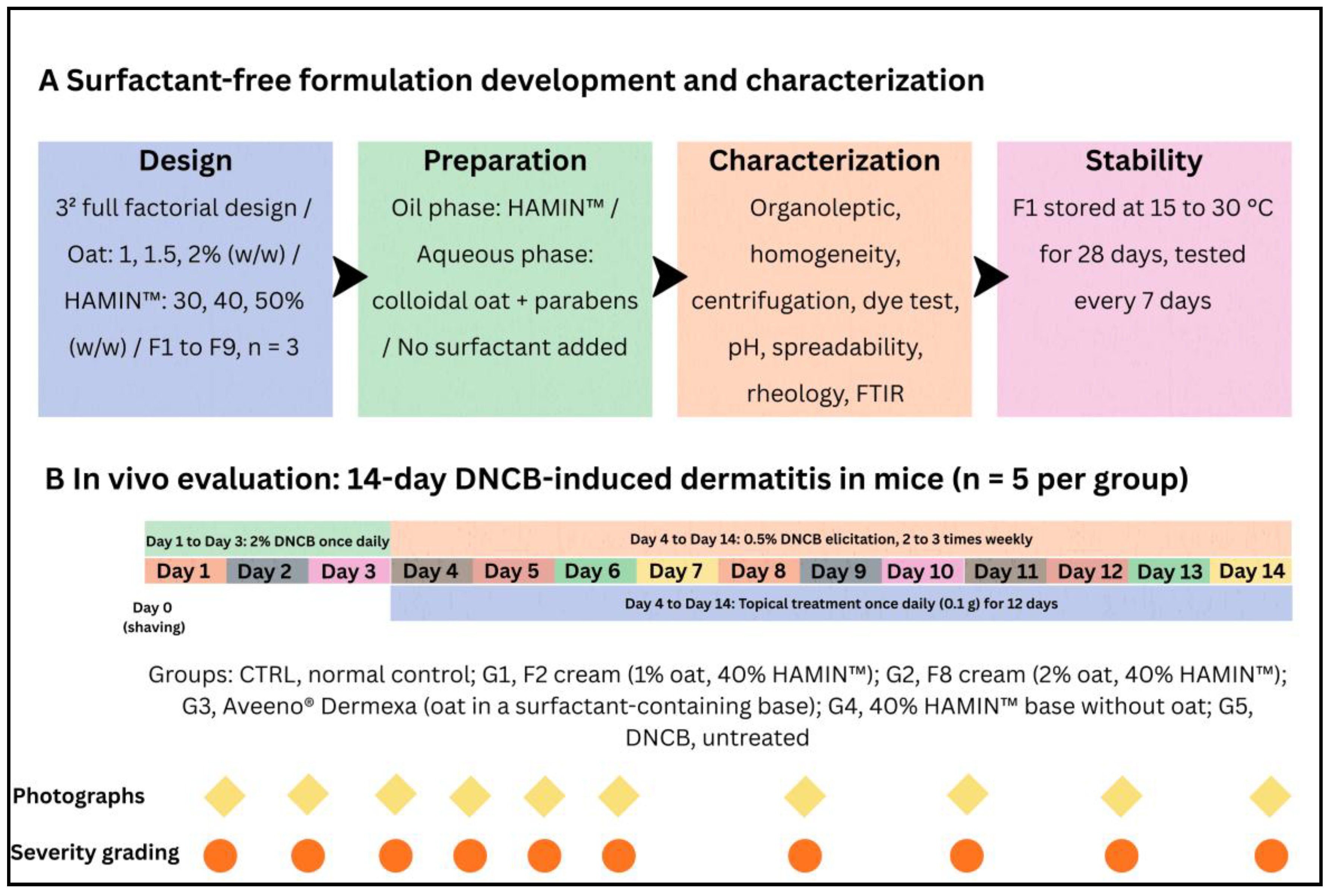
Figure 2.
Appearance of the oat–HAMIN™ creams F1–F9 (three containers per formulation).
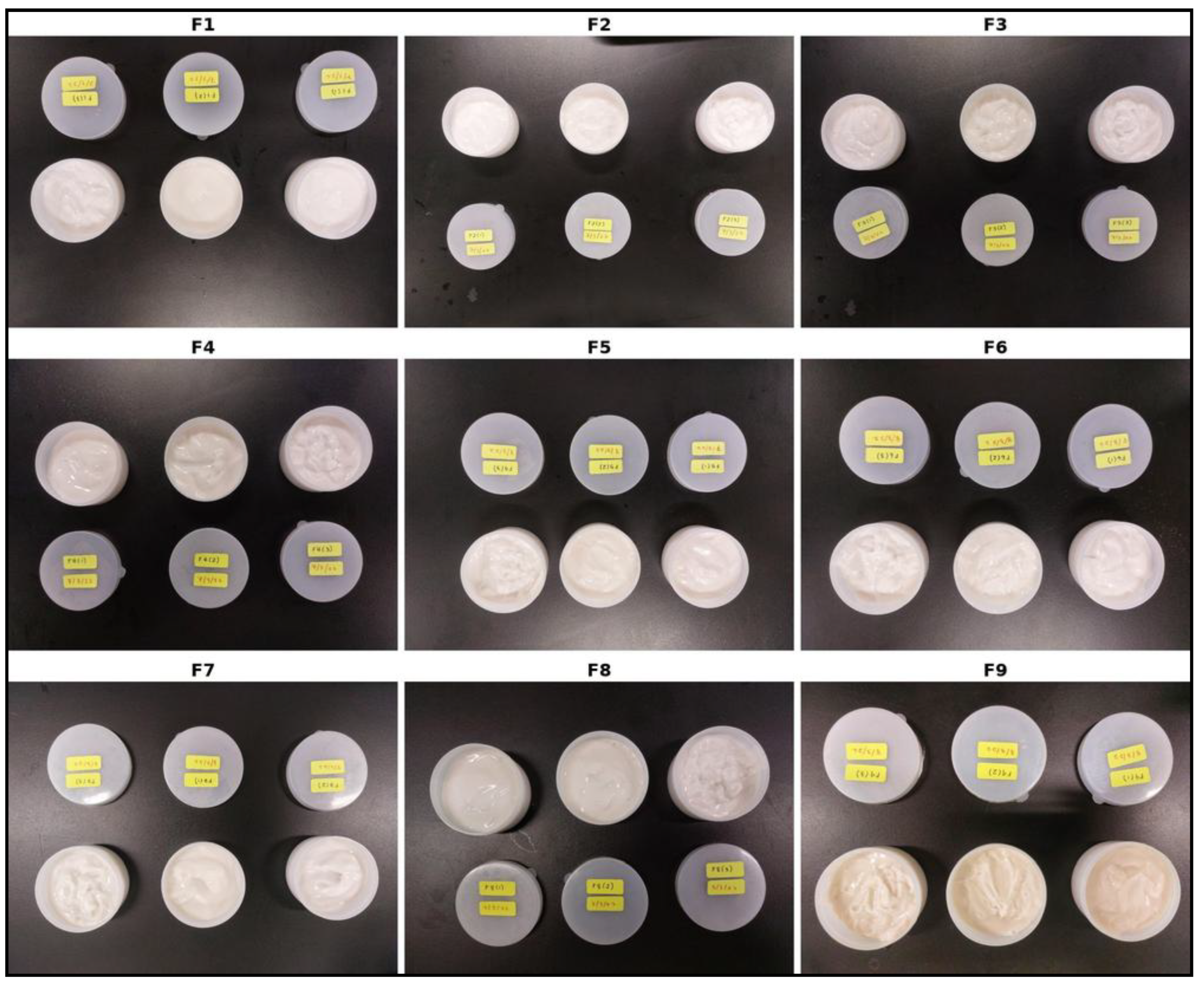
Figure 3.
(A) Formulations F1–F9 after centrifugation at 3000 rpm for 30 min. (B) Optical micrographs (400×) of F1–F9 stained with methylene blue, showing colourless oil droplets dispersed in a blue aqueous continuous phase.
Figure 3.
(A) Formulations F1–F9 after centrifugation at 3000 rpm for 30 min. (B) Optical micrographs (400×) of F1–F9 stained with methylene blue, showing colourless oil droplets dispersed in a blue aqueous continuous phase.
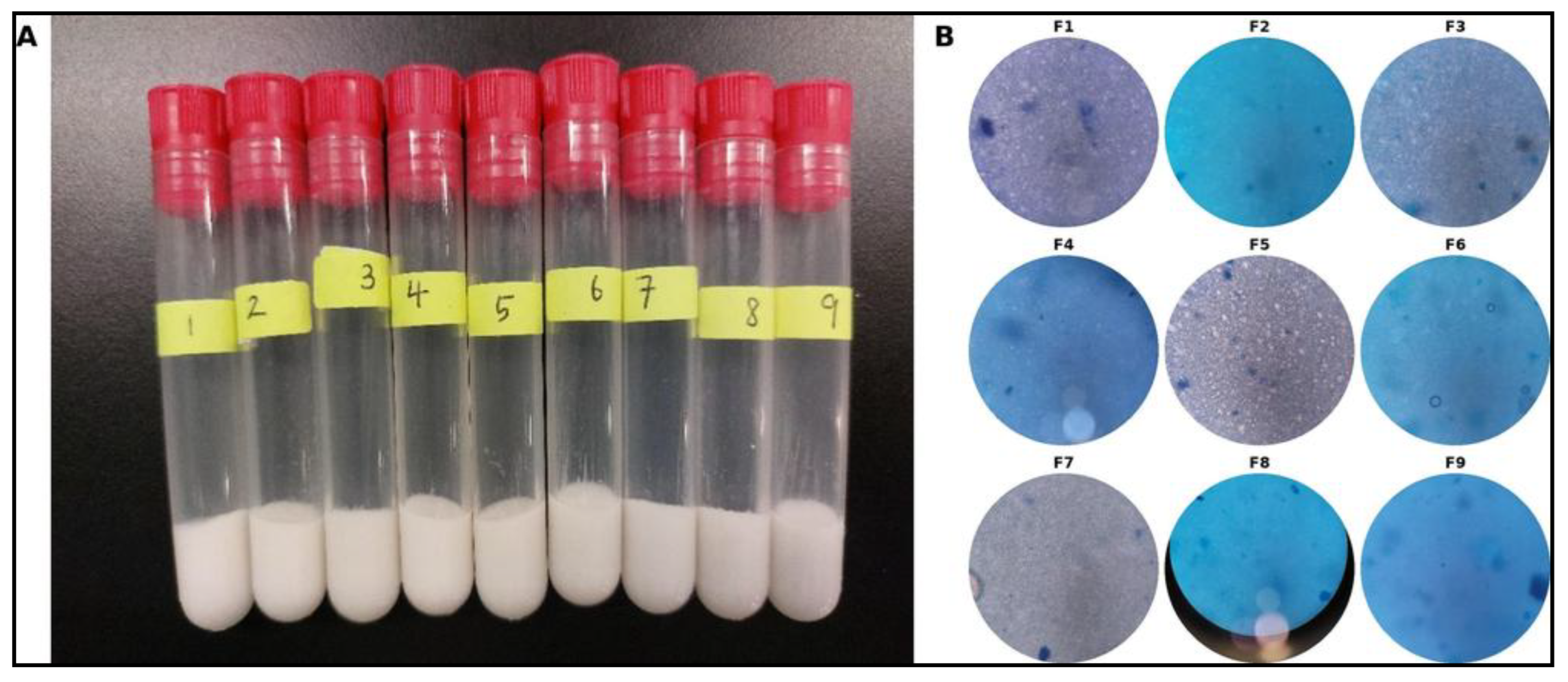
Figure 4.
Effects of oat and HAMIN™ concentrations on (A,B) pH and (C,D) spreadability. (A,C) Main effects plots; the dashed line marks the grand mean. (B,D) Interaction plots (mean ± SD, n = 3).
Figure 4.
Effects of oat and HAMIN™ concentrations on (A,B) pH and (C,D) spreadability. (A,C) Main effects plots; the dashed line marks the grand mean. (B,D) Interaction plots (mean ± SD, n = 3).
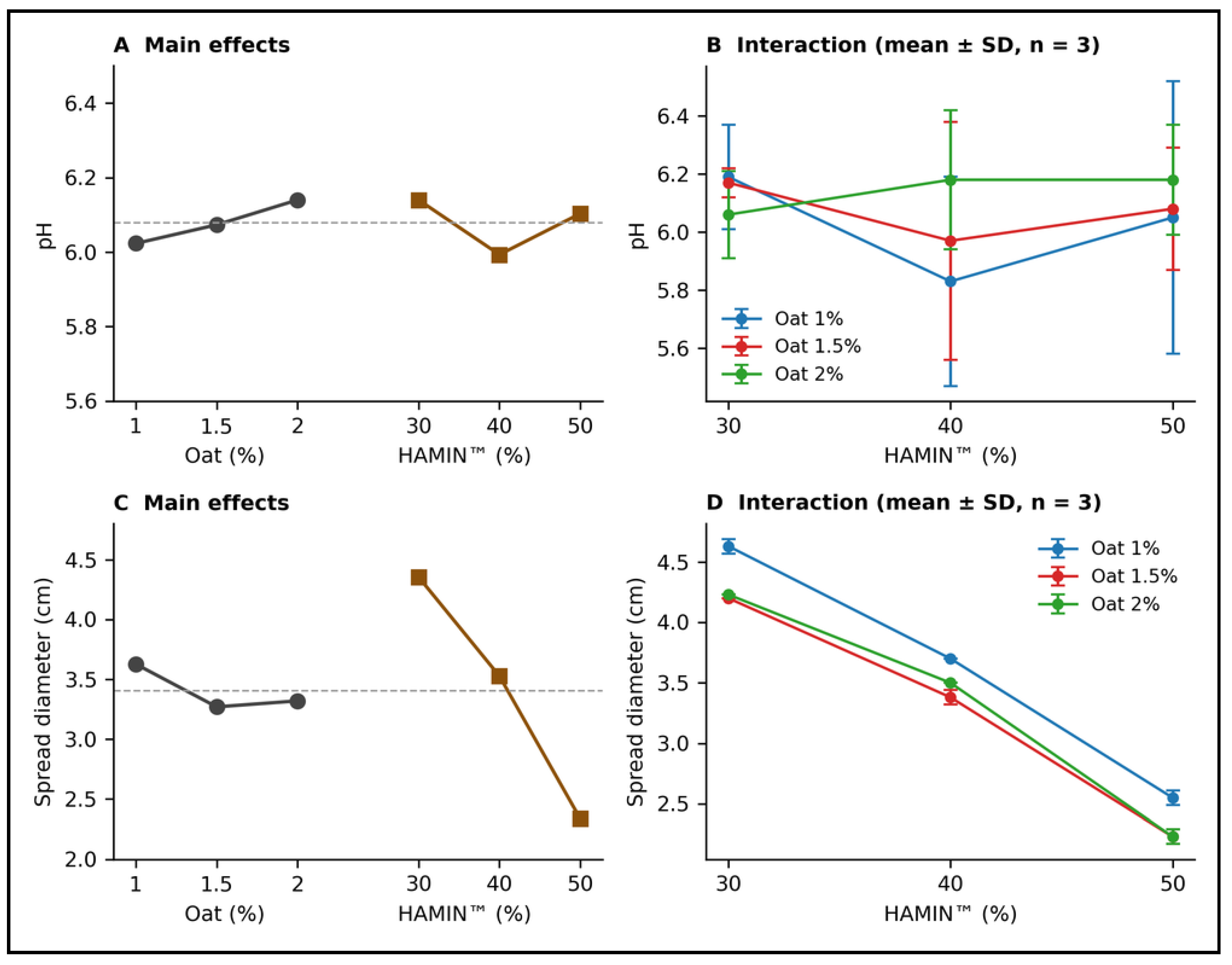
Figure 5.
Flow behaviour of F1–F9. (A) Viscosity versus shear rate (logarithmic axes). (B) Shear stress versus shear rate. Colours denote oat concentration (blue, 1%; red, 1.5%; green, 2%) and symbols denote HAMIN™ concentration (circles, 30%; squares, 40%; triangles, 50%).
Figure 5.
Flow behaviour of F1–F9. (A) Viscosity versus shear rate (logarithmic axes). (B) Shear stress versus shear rate. Colours denote oat concentration (blue, 1%; red, 1.5%; green, 2%) and symbols denote HAMIN™ concentration (circles, 30%; squares, 40%; triangles, 50%).
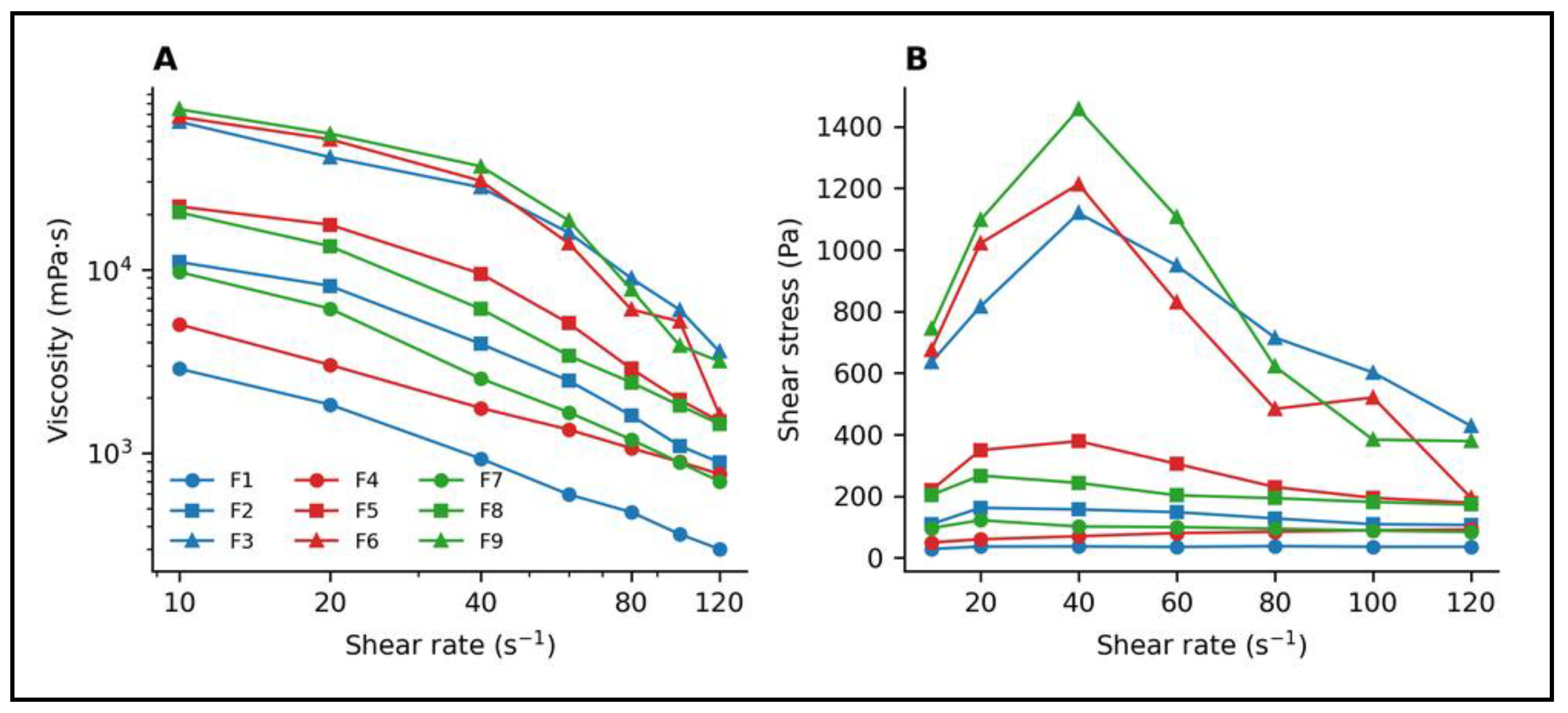
Figure 6.
FTIR spectra of (a) colloidal oatmeal, (b) HAMIN™, (c) distilled water, (d) methyl paraben, (e) propyl paraben and the creams (f) F1, (g) F2 and (h) F8.
Figure 6.
FTIR spectra of (a) colloidal oatmeal, (b) HAMIN™, (c) distilled water, (d) methyl paraben, (e) propyl paraben and the creams (f) F1, (g) F2 and (h) F8.
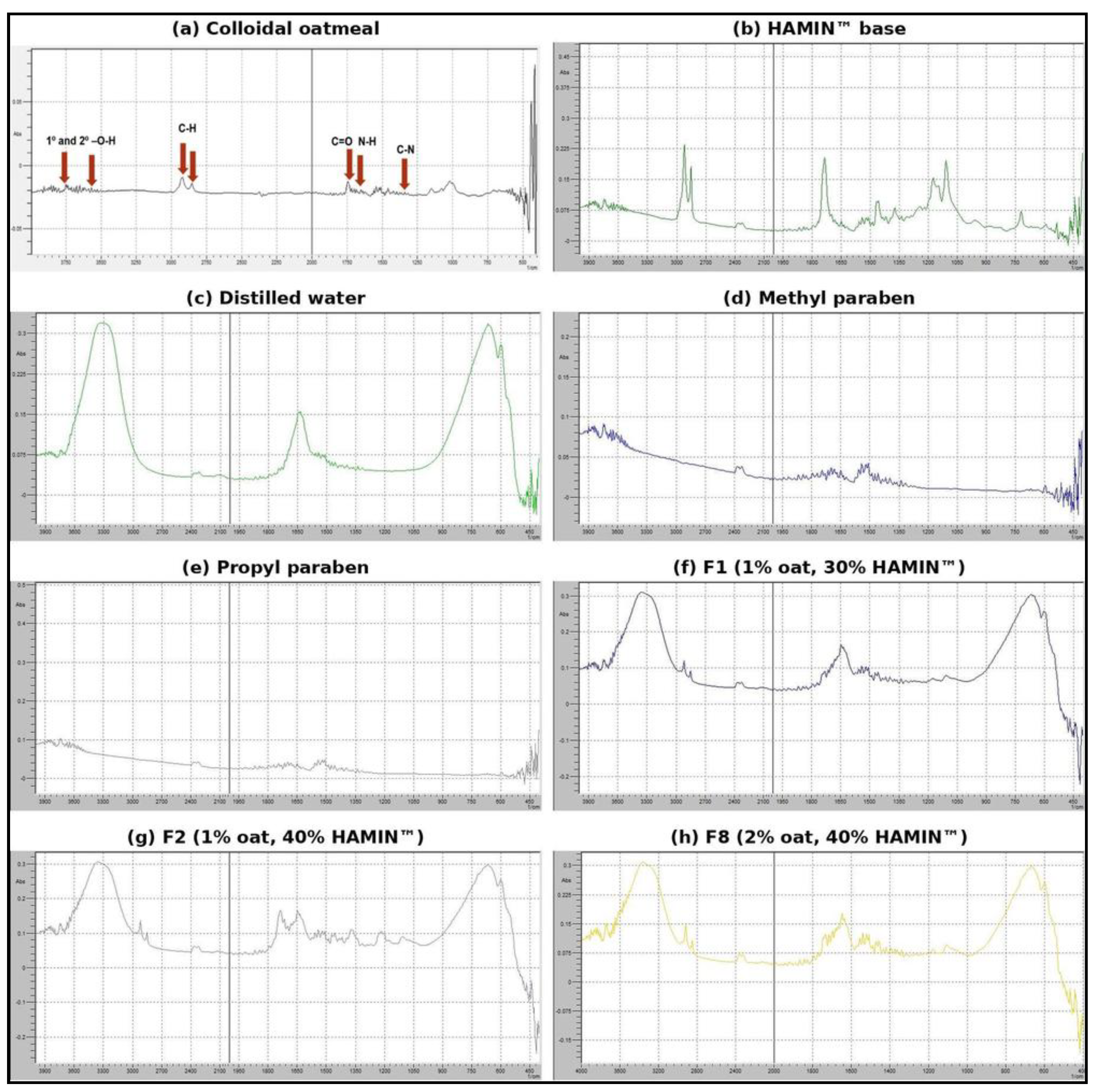
Figure 7.
Stability of F1 during 28 days of storage at 15–30 °C. (A) Appearance. (B) Optical micrographs (400×) after methylene blue staining. (C) FTIR spectra.
Figure 7.
Stability of F1 during 28 days of storage at 15–30 °C. (A) Appearance. (B) Optical micrographs (400×) after methylene blue staining. (C) FTIR spectra.
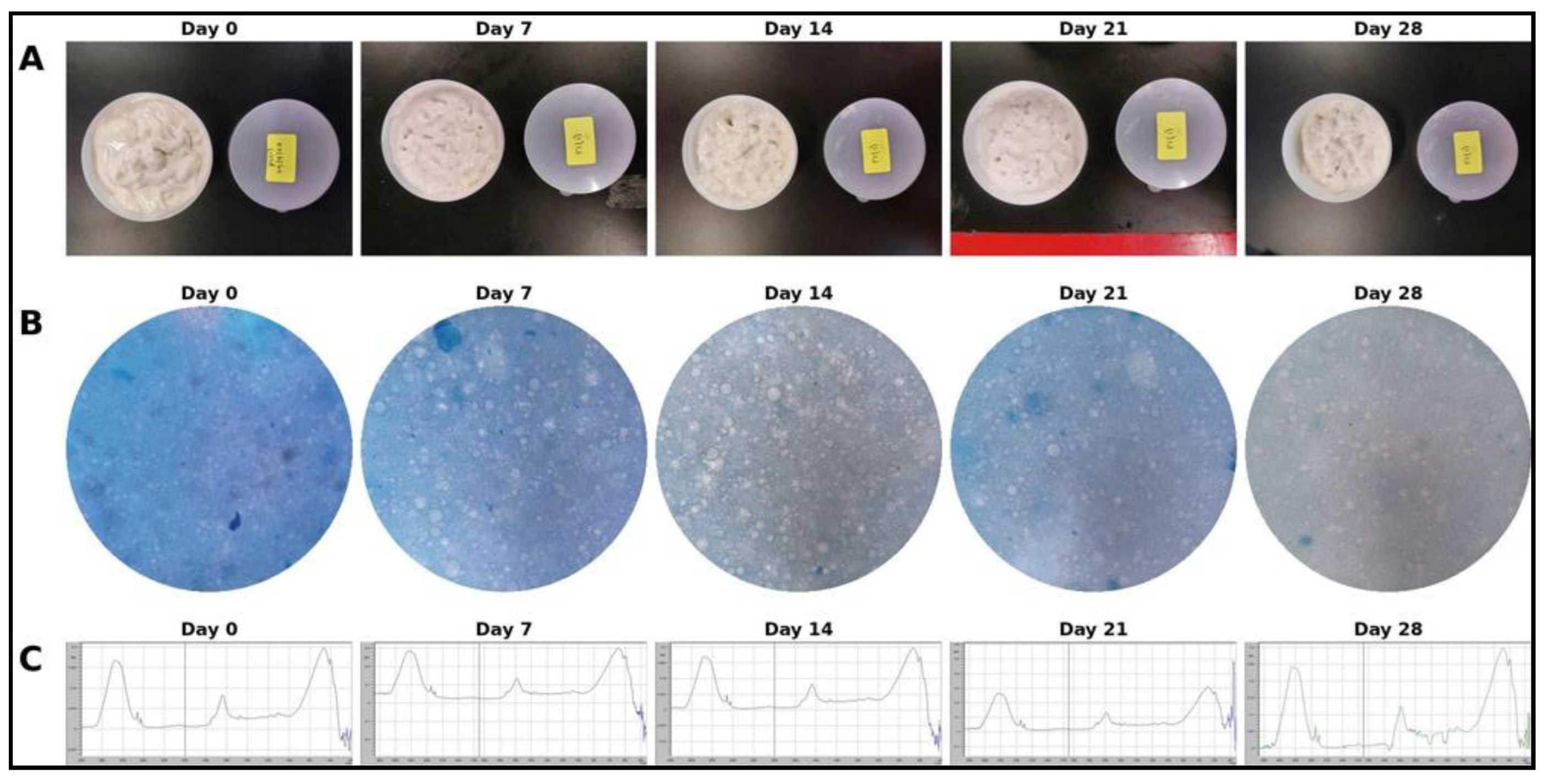
Figure 8.
(A) pH, (B) spreadability and (C) viscosity versus shear rate of F1 during storage (mean ± SD, n = 3). ∗ p < 0.05 and ∗∗ p < 0.01 versus Day 0 (Tukey’s test).
Figure 8.
(A) pH, (B) spreadability and (C) viscosity versus shear rate of F1 during storage (mean ± SD, n = 3). ∗ p < 0.05 and ∗∗ p < 0.01 versus Day 0 (Tukey’s test).
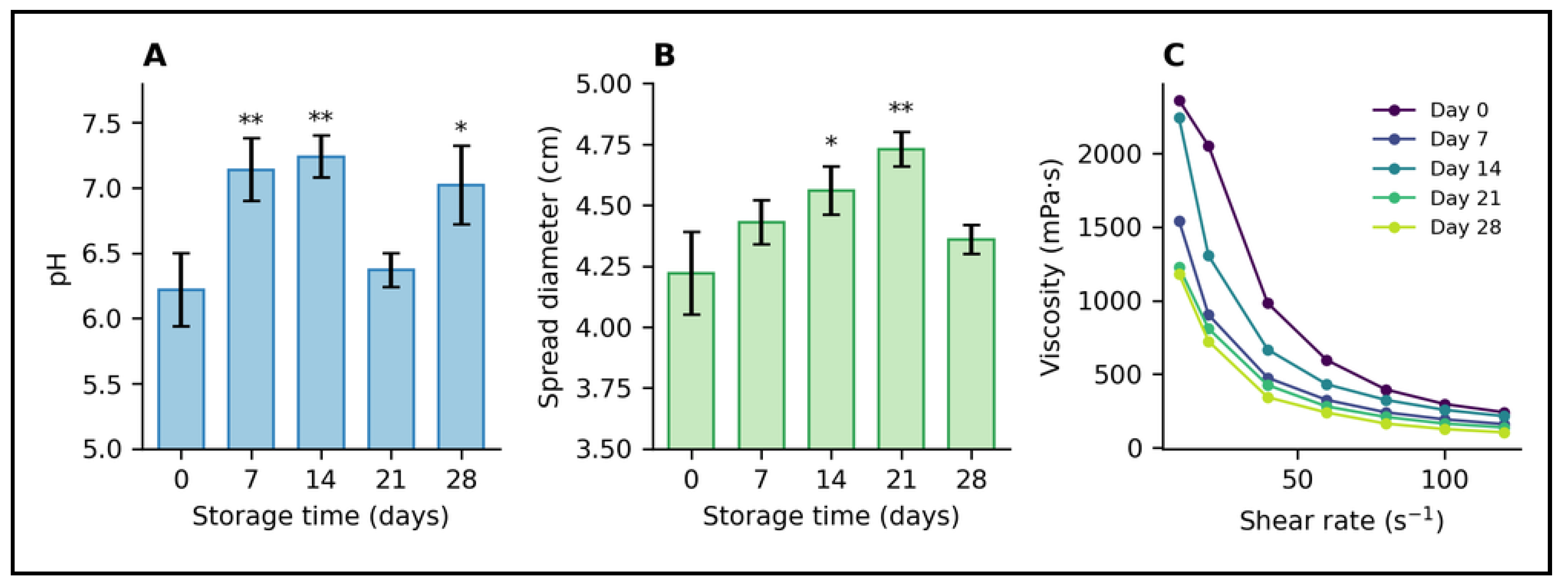
Figure 9.
Severity grade of each group over the 14-day study, graded from the photographic record shown in Figure 10. Points are slightly offset horizontally to avoid overlap.
Figure 9.
Severity grade of each group over the 14-day study, graded from the photographic record shown in Figure 10. Points are slightly offset horizontally to avoid overlap.
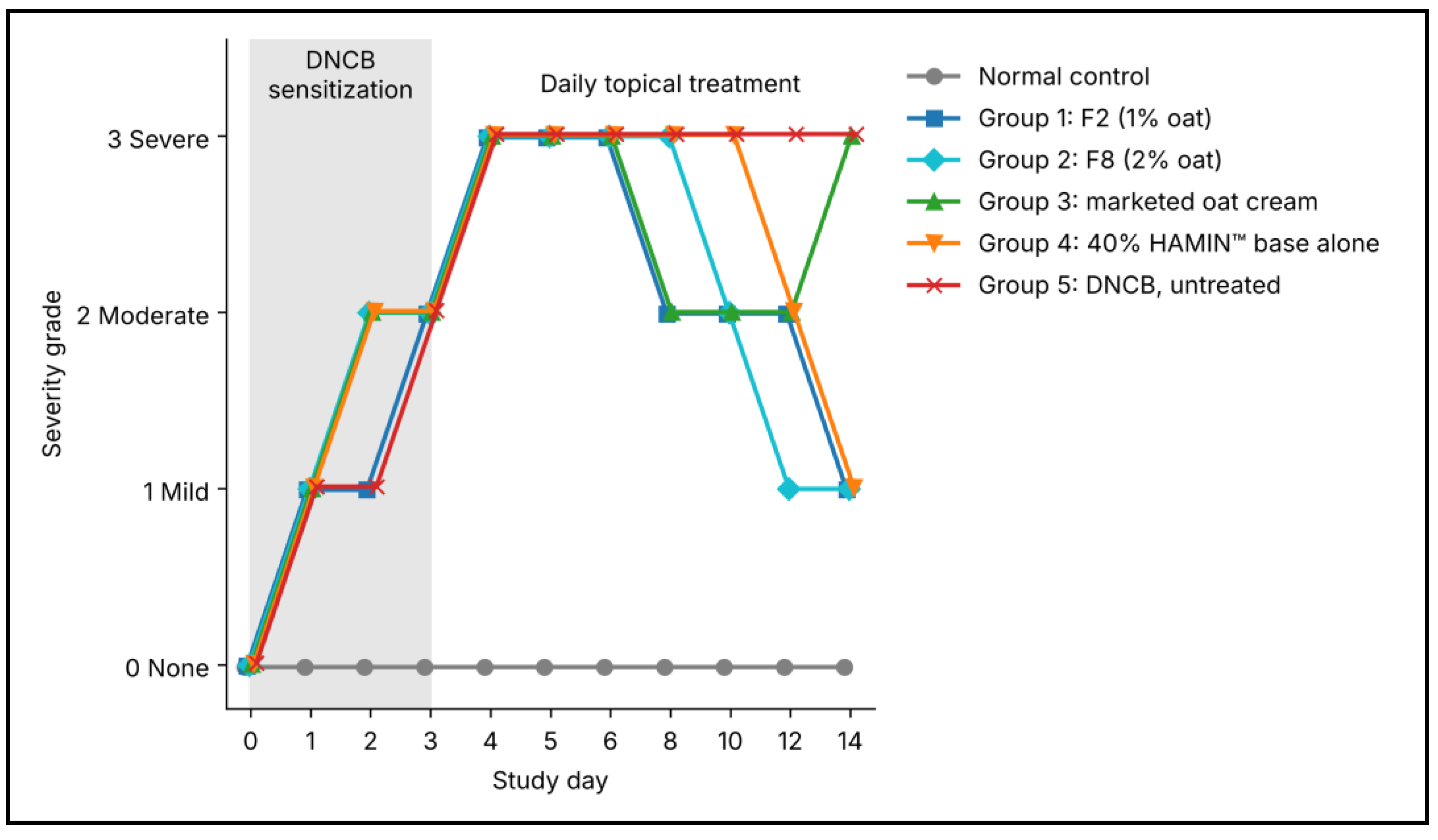
Figure 10.
Macroscopic appearance of the dorsal skin of a representative mouse from each group on Days 1, 2, 3, 4, 5, 6, 8, 10, 12 and 14 of the DNCB-induced dermatitis study. CTRL, normal control (no induction, no treatment); Group 1, F2 cream (1% oat in 40% HAMIN™); Group 2, F8 cream (2% oat in 40% HAMIN™); Group 3, the marketed oat cream (colloidal oat in a surfactant-containing base); Group 4, 40% HAMIN™ base alone, without oat; Group 5, DNCB-induced and untreated. Days are counted from the shaving day (Day 0); sensitization with 2% DNCB was carried out on Days 1 to 3 and treatment was applied once daily from Day 4 to Day 14.
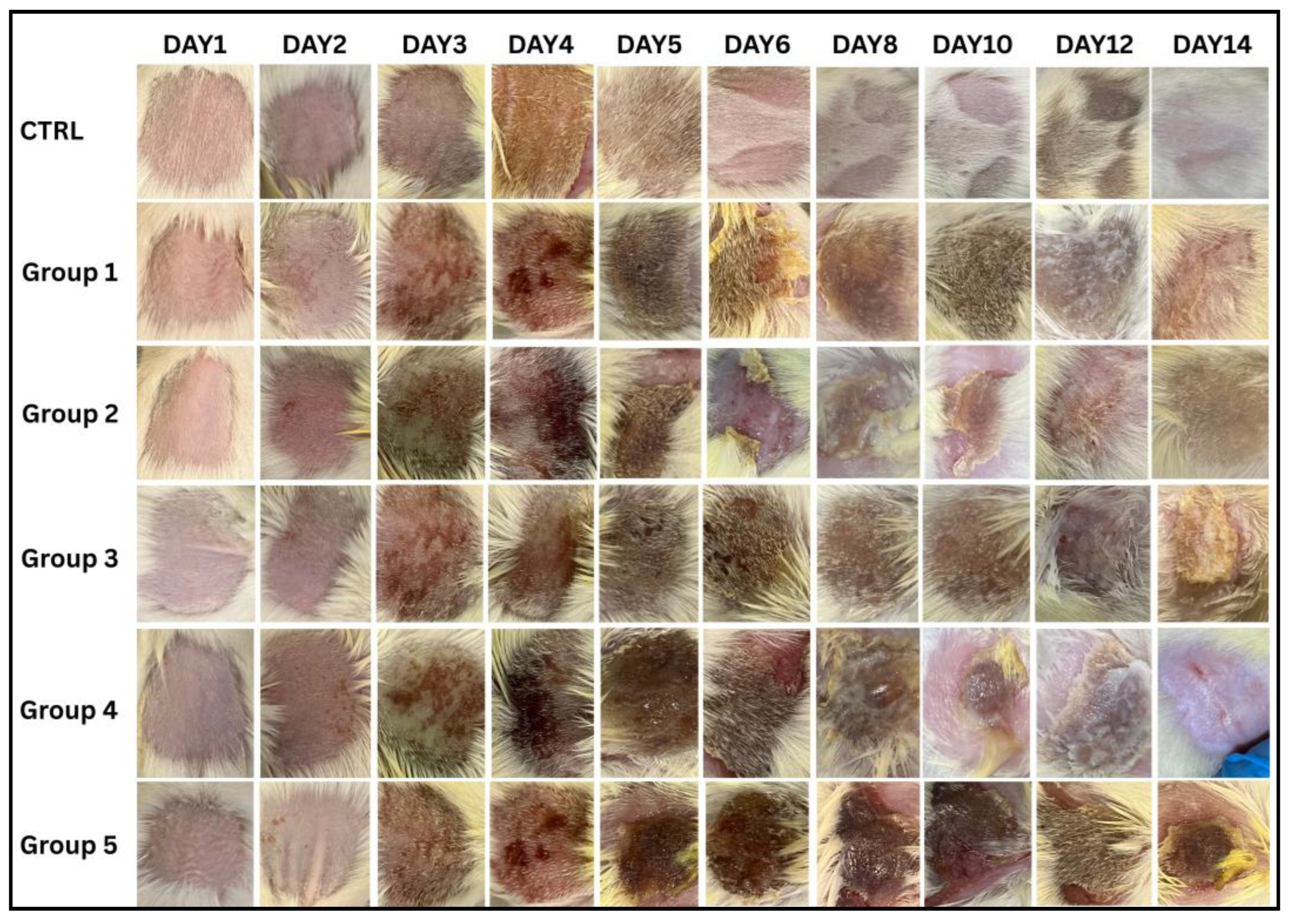

Table 1.
Composition of the oat–HAMIN™ moisturizer creams (% w/w).
| Formulation | Oat | HAMIN™ | Methyl paraben | Propyl paraben | Water |
|---|---|---|---|---|---|
| F1 | 1 | 30 | 0.50 | 0.25 | 68.25 |
| F2 | 1 | 40 | 0.50 | 0.25 | 58.25 |
| F3 | 1 | 50 | 0.50 | 0.25 | 48.25 |
| F4 | 1.5 | 30 | 0.50 | 0.25 | 67.75 |
| F5 | 1.5 | 40 | 0.50 | 0.25 | 57.75 |
| F6 | 1.5 | 50 | 0.50 | 0.25 | 47.75 |
| F7 | 2 | 30 | 0.50 | 0.25 | 67.25 |
| F8 | 2 | 40 | 0.50 | 0.25 | 57.25 |
| F9 | 2 | 50 | 0.50 | 0.25 | 47.25 |
Table 2.
Organoleptic and physical properties of the oat–HAMIN™ creams.
| Parameter | F1, F2, F4, F5, F7, F8 | F3, F6, F9 |
|---|---|---|
| Appearance | Semisolid | Semisolid |
| Colour / odour | White / odourless | White / odourless |
| Texture | Smooth | Smooth |
| Homogeneity | Homogeneous, no grittiness | Homogeneous, no grittiness |
| Type of smear | Greasy | Greasy |
| Stickiness / washability | Non-sticky / washable | Non-sticky / washable |
| Softness | Soft | Slightly firm |
| Emulsion type | o/w | o/w |
| Centrifugation (3000 rpm, 30 min) | No phase separation | No phase separation |
Table 3.
pH, spreadability and viscosity of the oat–HAMIN™ creams. pH and spreadability are mean ± SD (n = 3).
Table 3.
pH, spreadability and viscosity of the oat–HAMIN™ creams. pH and spreadability are mean ± SD (n = 3).
| Code | Oat (%) | HAMIN™ (%) | pH | Spread diameter (cm) | η at 10 s−1 (mPa·s) | η at 120 s−1 (mPa·s) | Decrease (%) |
|---|---|---|---|---|---|---|---|
| F1 | 1 | 30 | 6.19 ± 0.18 | 4.63 ± 0.06 | 2875 | 300 | 89.5 |
| F2 | 1 | 40 | 5.83 ± 0.36 | 3.70 ± 0.00 | 10,956 | 891 | 91.9 |
| F3 | 1 | 50 | 6.05 ± 0.47 | 2.55 ± 0.06 | 63,515 | 3568 | 94.4 |
| F4 | 1.5 | 30 | 6.17 ± 0.05 | 4.20 ± 0.00 | 5017 | 770 | 84.7 |
| F5 | 1.5 | 40 | 5.97 ± 0.41 | 3.38 ± 0.06 | 21,981 | 1491 | 93.2 |
| F6 | 1.5 | 50 | 6.08 ± 0.21 | 2.23 ± 0.06 | 67,496 | 1620 | 97.6 |
| F7 | 2 | 30 | 6.06 ± 0.15 | 4.23 ± 0.00 | 9667 | 703 | 92.7 |
| F8 | 2 | 40 | 6.18 ± 0.24 | 3.50 ± 0.00 | 20,407 | 1441 | 92.9 |
| F9 | 2 | 50 | 6.18 ± 0.19 | 2.23 ± 0.06 | 74,314 | 3158 | 95.8 |
Table 4.
Two-way ANOVA of the effects of oat and HAMIN™ concentrations on pH and spreadability.
| Response | Source | Sum of squares | df | F | p |
|---|---|---|---|---|---|
| pH | Oat | 0.062 | 2 | 0.39 | 0.683 |
| HAMIN™ | 0.105 | 2 | 0.66 | 0.528 | |
| Oat × HAMIN™ | 0.182 | 4 | 0.57 | 0.686 | |
| Error | 1.428 | 18 | |||
| Spreadability | Oat | 0.671 | 2 | 167.8 | < 0.001 |
| HAMIN™ | 18.50 | 2 | 4625 | < 0.001 | |
| Oat × HAMIN™ | 0.036 | 4 | 4.52 | 0.011 | |
| Error | 0.036 | 18 |
Table 5.
pH and spreadability of F1 during storage (mean ± SD, n = 3). p values are from Tukey’s test against Day 0.
Table 5.
pH and spreadability of F1 during storage (mean ± SD, n = 3). p values are from Tukey’s test against Day 0.
| Day | pH | p | Spread diameter (cm) | p |
|---|---|---|---|---|
| 0 | 6.22 ± 0.28 | 4.22 ± 0.17 | ||
| 7 | 7.14 ± 0.24 | 0.005 | 4.43 ± 0.09 | 0.181 |
| 14 | 7.24 ± 0.16 | 0.002 | 4.56 ± 0.10 | 0.018 |
| 21 | 6.37 ± 0.13 | 0.927 | 4.73 ± 0.07 | 0.001 |
| 28 | 7.02 ± 0.30 | 0.012 | 4.36 ± 0.06 | 0.514 |
| One-way ANOVA | F4,10 = 12.27 | < 0.001 | F4,10 = 10.23 | 0.001 |
Table 6.
Characteristics of the batches prepared for the in vivo study.
| Code | Oat (%) | HAMIN™ (%) | Spreadability (g·cm/s) | pH (1:10) | Appearance |
|---|---|---|---|---|---|
| F1 | 1 | 30 | 21.00 | 5.1 | Pale cream colour, smooth, slightly watery |
| F2 | 1 | 40 | 18.67 | 5.5 | Light beige, soft and smooth |
| F3 | 1 | 50 | 17.00 | 5.2 | Pale cream colour, smooth, slightly dense |
| F7 | 2 | 30 | 20.67 | 5.7 | Deeper beige, grainy, slightly watery |
| F8 | 2 | 40 | 18.33 | 5.0 | Deeper beige, creamy, slightly grainy |
| F9 | 2 | 50 | 15.33 | 5.1 | Deeper beige, dense, grainy |
Table 7.
Severity grade of the representative mouse of each group on every day on which the dorsal skin was photographed (0, none; 1, mild; 2, moderate; 3, severe). The grade reflects the most severe of erythema, scaling or crusting, and dryness or erosion. Day 0 is the day of shaving, before sensitization. CTRL, normal control; Group 1, F2 cream (1% oat, 40% HAMIN™); Group 2, F8 cream (2% oat, 40% HAMIN™); Group 3, the marketed oat cream; Group 4, 40% HAMIN™ base without oat; Group 5, DNCB-induced and untreated.
| Day | CTRL | Group 1 | Group 2 | Group 3 | Group 4 | Group 5 |
|---|---|---|---|---|---|---|
| 0 | 0 | 0 | 0 | 0 | 0 | 0 |
| 1 | 0 | 1 | 1 | 1 | 1 | 1 |
| 2 | 0 | 1 | 2 | 2 | 2 | 1 |
| 3 | 0 | 2 | 2 | 2 | 2 | 2 |
| 4 | 0 | 3 | 3 | 3 | 3 | 3 |
| 5 | 0 | 3 | 3 | 3 | 3 | 3 |
| 6 | 0 | 3 | 3 | 3 | 3 | 3 |
| 8 | 0 | 2 | 3 | 2 | 3 | 3 |
| 10 | 0 | 2 | 2 | 2 | 3 | 3 |
| 12 | 0 | 2 | 1 | 2 | 2 | 3 |
| 14 | 0 | 1 | 1 | 3 | 1 | 3 |
Disclaimer/Publisher’s Note: The statements, opinions and data contained in all publications are solely those of the individual author(s) and contributor(s) and not of MDPI and/or the editor(s). MDPI and/or the editor(s) disclaim responsibility for any injury to people or property resulting from any ideas, methods, instructions or products referred to in the content. |
© 2026 by the authors. Licensee MDPI, Basel, Switzerland. This article is an open access article distributed under the terms and conditions of the Creative Commons Attribution (CC BY) license (http://creativecommons.org/licenses/by/4.0/).
Copyright: This open access article is published under a Creative Commons CC BY 4.0 license, which permit the free download, distribution, and reuse, provided that the author and preprint are cited in any reuse.