

Submitted:
20 November 2026
Posted:
24 November 2026
Read the latest preprint version here
Abstract
A controller who knows a preparation label can extract work by choosing a different unitary for each label. How much does this gain change if every output preserves a common subspace that can be measured without disturbing it? We compare sources at the same upper bound on optimal single-copy label discrimination. With four qutrit labels and a degenerate excited doublet, switching among four sector-preserving devices with a setting hidden from both controller and observer exceeds the optimum over all fixed-sector sources, including arbitrary label priors, by Δ/144, where Δ is the excitation energy. At degeneracy the switched source leaves a smaller total excited population. Because it retains population in the upper level, the work advantage vanishes at a doublet splitting of Δ/6 and changes sign beyond it. A calibrated target-population measurement identifies a visibility threshold beyond which even independently switched devices cannot reproduce the outputs. For one more label than the dimension and a nondegenerate ground level in dimensions D ≥ 3, switching improves intermediate work at a fixed guessing budget while preserving the threshold for maximal work.
Keywords:
quantum thermodynamics
; conditional work extraction
; quantum state discrimination
; helstrom discrimination
; hidden switching
; invariant subspaces
; qutrit ensembles
1. One Record, Two Uses
A source draws a label j and prepares a quantum system. On work trials a controller receives j and chooses a unitary rotation. On separate discrimination trials an observer receives only one copy of the system and tries to recover j. The two trials sample the same preparation. We fix an upper limit on the observer’s best success probability. Among sources satisfying that limit, how much more energy can the controller extract with the label than without it?
Suppose one decomposition into two orthogonal subspaces works for every output. Measuring which subspace is occupied then leaves each state unchanged when the outcome is discarded. We call this a fixed sector. A qutrit already permits a line and a plane, with noncommuting states inside the plane. Now suppose the apparatus chooses a different decomposition on each trial, using a setting drawn independently of the label and hidden from both users. The resulting conditional states can retain coherence between a chosen line and its plane even when that coherence cancels in the mean. A controller with the label can rotate a larger conditional eigenvalue into the ground level. The observer is limited by how well all the records can be distinguished with a single measurement.
Figure 1 gives the comparison a physical scale. For degenerate excited levels, among sources with and , the switched qutrit leaves less residual excitation than any fixed-sector source. Each of its component settings, used by itself, has a higher guessing probability and would exceed the permitted budget.
Let be the probability of label j, its normalized state, its weighted state, and the state available without the label. For a positive operator X, is its least residual energy after a unitary, determined by passive spectral rearrangement [1]. One attains it by placing the largest eigenvalue on the lowest energy, the next largest on the next energy, and so on. At a fixed Hamiltonian H, the gain in extractable work from receiving the record is
The initial energy is in both protocols. The blind and informed controllers leave residual energies and , respectively; their difference is the additional extractable work. The observer’s optimal success probability on one copy is , where the positive effects sum to . If is positive semidefinite for every j, then for every receiver [2]. Exhibiting a measurement and such a Y with the same score therefore proves optimality. We write for the maximum of in a preparation class X under . Here P is the score of a specified source and g is a cap on possible sources. Unless we explicitly match priors, each competitor may choose its own p.
In the fixed class one nontrivial projector commutes with every . In the switched class , where each setting has its own common-sector projector and is independent of j. For a prescribed prior p, the three classes of effective tuples obey
where is the fixed-sector class, the label-independent switched class, and the unrestricted class, all at prior p. Neither user has access to the hidden setting.
A block-selective dephasing stage illustrates this preparation constraint. For a projector onto one mode, the channel removes coherence between that mode and its orthogonal complement while allowing noncommuting label states within the latter. A fixed mode split produces a common sector; selecting the split independently on each shot and discarding its setting gives a switched preparation. The preparation within each block may itself depend on z: randomly dephasing a single fixed input ensemble does not generally realize the switched witness constructed below. This is a model of a changing mode split, not an assumed superselection rule. Equation (1) credits only unitary extraction; record preparation and erasure would enter a complete thermodynamic cycle. We also compare the unitary task with an ideal reversible isothermal protocol.
Ergotropy is the maximum energy removable by a unitary [3]. Daemonic ergotropy describes the gain when a measurement record guides the extraction [4,5]. Quantum coherence can contribute to ergotropy [6]; the constraint studied here instead concerns the common invariant subspaces of a whole preparation family. De Oliveira et al. expressed this same conditional-unitary gain as a sum of spectral population differences weighted by the gaps of H [7]. We use this relation to ask how much work is possible after imposing both a guessing cap and a common-sector constraint. Thermodynamics also bounds state discrimination [8], with an accessible-information bound distinct from our single-copy minimum-error constraint.
Disturbance-free operations reveal the classical sectors of a family of states [9]. Set coherence quantifies the obstruction to diagonalizing all outputs in one basis [10]. Classical simulation allows a hidden choice among devices whose outputs commute within each setting [11,12]. A single fixed block allows noncommuting states within a sector and populations in both sectors. Thus our classical switching refers to the inaccessible random setting, not to commuting states within every device; its preparation class is broader than a mixture of commuting devices.
Related work establishes commuting-versus-unrestricted work bounds for binary four-level ensembles [13]. Here the comparison is between a common invariant sector and independently switched sectors. Other work concerns the dimensionality of preparations [14], extraction and certification of work from partially characterized sources [15,16], and thermodynamic advantages or resource witnesses based on work tasks [17,18]. We derive a sharp structural work-capacity bound and construct a hidden-setting source that exceeds it at the same guessing probability. A matched pair further displays opposite rankings of unitary and reversible isothermal record value.
2. A Qutrit Work Comparison
Take with , . The four unit vectors of a regular tetrahedron in may be chosen with for . Their projectors sum to . Consider equal priors and outputs
The target-to-ground rotation maps to the ground state. The two other eigenvalues are equal, so the rotation is work-optimal for every upper splitting. Let q be the final probability of either excited level and t the probability of the upper level. The maximally mixed mean yields zero work to every record-blind rotation. The reduction in residual energy therefore measures the entire work unlocked by the record. At visibility ,
The eigenvalues are along the target and on each orthogonal direction. The effects sum to . Their score equals the trace of , which dominates every by those eigenvalues.
An explicit switching device.
Draw z uniformly from the four vertices. On record emit . Otherwise emit the normalized projection of into the plane perpendicular to . This device preserves its own vertex line. The three planar rays form a trine with squared pairwise overlap . For the emitted projector is . Expanding the three products with and gives the average , exactly Equation (2) at .
Write . Each setting used on its own scores and . Indeed the branch mean is , and its pure records can all be rotated to the ground. The receiver measures the vertex line, then uses the three planar effects on the normalized projected rays . It attains the uniform-prior upper bound . Along the noisy-tetrahedron path, independent switching is possible precisely for ; this endpoint is not chosen by numerical optimization, but by the exact target-fidelity bound proved below and in Section S3 [19].
The fixed-block ceiling.
Over all priors and mixed qutrit preparations with a common invariant sector, the exact ceiling on the interval needed here is
A qutrit block measurement reads a line and a plane. At these work values the leading record directions must span all three dimensions. Reading the sector first gives a lower bound on the guessing score from the records assigned to each sector. One line record and three plane records attain the limiting bound with . Their outputs have rank at most two, so the highest level can be emptied after conditioning. Appendix A derives the bound and gives a matching receiver.
Two comparisons are distinct. At the four-setting source delivers at , whereas the capacity optimized over all fixed-sector sources, with arbitrary priors, is . Appendix B also constructs a specific matched fixed-sector device with the same uniform priors, , and as the switched source. The work difference for this matched pair is ; it is not an optimization over every fixed-sector source subject to those additional matching constraints.
The same record under isothermal control.
Let the Holevo quantity be [20], with in bits. We use the reversible limit of isothermal extraction with coherent control, allowing operations that conserve the total energy of system, bath and work store on average for the specified input [21]. When both protocols end in the same Gibbs state at , the additional average work from the record is
Here . The mean energy cancels. Table 1 gives opposite rankings for the two extraction protocols.
For the two matched devices, the four-setting source yields more unitary work and bit less Holevo information. At , unitary work depends on the total residual population in the excited doublet; entropy is also sensitive to its distribution within that doublet. The switched output spreads its residual population equally between the two levels on every record, whereas three of the fixed outputs place theirs on one level. Appendix B proves the entropy ordering. The reversal separates the two extraction protocols for the specified pair.
The comparison with revealed settings is different. Since Z is independent of the record J, forgetting Z reduces the branch-averaged Holevo information by , where Q is the quantum system [22]. At it also reduces unitary work from to . But each revealed setting has and lies outside the common guessing budget . Forgetting Z therefore reduces work relative to revealing it, even though the resulting source beats every admissible fixed-sector source at the lower distinguishability budget. The mechanism is a competition between the passive-energy mixing premium of the label-blind mean and the corresponding mixing losses conditional on the label. Here these contributions are and , respectively, so their difference is a loss of on discarding Z (Section S2 [19]).
A tunable energy prediction.
At this visibility the four-setting output retains upper-level population . Combining Equations (3) and (4) gives
Equation (6) compares the four-setting source with the optimum over all fixed-sector sources and changes sign at . The Hamiltonian is fixed during each extraction run, whereas the splitting varies between runs; the preparations and guessing score remain unchanged. The ordering reverses because residual upper-level population carries an increasing energy penalty. For the two matched devices in Table 1, the crossing instead occurs at (Appendix B), while their isothermal ordering persists because depends only on the preparations.
The visibility range below the solved ceiling matters for interpreting this crossing. For , take the four weighted states of the fixed saturator in Appendix A at . With use . The new priors are and the same sector is preserved. Every receiver gains the common term . Every passive eigenvalue shifts by the added scalar, and the mean stays . Thus this fixed source has
This explicit competitor matches or exceeds the path work throughout the interval.
For the score lies in Equation (4), so the signed difference from the fixed optimum is
Its slope in is . Together with Equation (7), this proves that the switched-realizable part of the path exceeds the fixed optimum exactly when and . For those splittings the greatest positive excess on the path occurs at . At degeneracy it grows as over a budget interval of width . This gives the small endpoint signal .
The same gap has a complementary guessing-cost interpretation. Since the exact fixed-sector capacity in Equation (4) has slope , a fixed-sector source can reach only when its allowed guessing score is at least
At degeneracy the required relaxation is in single-copy guessing success. This is the marginal discrimination cost of matching the switched work within the solved fixed-sector interval.
3. General-Dimensional Hierarchy and Saturation
There is a reason to use one more record than the dimension. With a nondegenerate ground level the largest possible record-assisted work requires pure conditional outputs and . To see necessity, the passive energy of B is at most the energy of the uniform spectrum, and each normalized output costs at least . Specifically, if sums the i largest eigenvalues, and summation by parts expresses the blind shortfall as . A positive first gap forces at equality. Each occupied output must also fit in the one-dimensional ground space after its rotation. The weighted pure projectors then sum to , the tight-frame condition whose orthogonal decomposability is studied in Refs. [23,24]. With D records a weighted set of pure vectors resolving the identity in D dimensions is an orthonormal basis with equal probabilities. With labels both a source with a common sector and an irreducible simplex can attain the maximum at sufficiently large guessing budgets.
For , and , let
The priors may be optimized separately for each competing source, with one prior shared across every hidden setting of a given source. For every ordered spectrum and every ,
For all three are . The excited levels may coincide. In a qutrit this interval is . The source of Figure 1 exhibits a switching advantage at the lower budget . The general band begins where unrestricted work first saturates.
Three features account for this ordering. First, with a fixed sector the leading record directions have to be distributed as integer counts between orthogonal sectors. Resolving the sectors first helps the observer. Near saturation one optimal fixed source consists of one line record and a simplex on its orthogonal complement, with a small line population in the other records. Second, switching among real block devices can introduce coherences between the line and those simplex directions. The coherences sum to zero in the mean while raising the largest conditional eigenvalues. An adjustment of the line population holds the optimal guessing score exactly at g. Third, at every occupied effective output is pure. Each contributing device must then emit the same ray on that record. The common block of any such device reduces all occupied records. This forces the switched and fixed classes to reach at the same threshold. Appendix C proves all three comparisons. Sections S1 and S2 give quantitative bounds on the gaps. The proved interval has width ; the full activation region may be larger. The fixed work deficit is linear in , while the switched construction recovers a positive quadratic amount (Section S2 [19]). The optimal recovery exponent remains open.
What two task values can miss.
Two task values alone can agree even when target measurements distinguish the sources. For example, at and visibility with degenerate excited levels, the uniform simplex gives . A pure fixed-sector source can match both. Its mean has eigenvalues . The pure conditional states all reach the ground, so the work is . Rotating the two record vectors used to decompose the two-dimensional sector varies their discrimination score continuously while preserving that mean. Appendix C gives the angle and the score. Section S3 extends the construction to . The prior and mean of this competitor are free. The target measurement below uses additional information about the prepared rays.
4. Operational Population Tests
Use a characterized unitary for each label and measure the energy afterwards. Write q for the total probability of excitation and t for the upper-level probability, averaged with the actual prior. These probabilities may be measured even if the chosen rotations are imperfect at extracting work. The energy left by the realized unitary gives a lower bound on the optimized record-assisted work. With calibrated mean and , a fixed-block source at budget g in Equation (4) must satisfy
Indeed the blind passive energy is and the chosen pulses leave . Their difference is achievable with the record and therefore cannot exceed the fixed ceiling. This argument permits arbitrary label priors. Both probabilities come from the same three-outcome readout. At zero splitting and the fixed model requires . The construction gives .
Setting the guessing budget.
One implementation retains an input with probability and replaces it with otherwise. The flag is discarded independently of the uniform label. Since , the dual is feasible for four uniform qutrit inputs and gives . The common replacement contributes for every receiver, so
This bounds the guessing score without implementing the optimal receiver. For ideal tetrahedral inputs ; for imperfect inputs describes the calibrated replacement channel, while the observed populations must be assessed separately. Depolarizing ideal rays at and switching the four block devices realize the same effective states. Testing the switching implementation requires its own guessing upper bound; a two-copy SWAP measurement gives each conditional purity [25]. If all purities are at most u, the largest eigenvalue ℓ of any output obeys . Using the resulting upper bound on ℓ in a scalar guessing witness yields for four uniform labels. At visibility the purity is and the bound is tight.
Ruling out the switching model.
This second test uses four uniformly sampled labels, trusted tetrahedral targets and a setting independent of the label. A pulse mapping to the ground measures as an excitation probability. This observable equals q when those target pulses are used. For a rank-k sector put . The best overlap of a block-diagonal output with its target is at most . Rounding each to the nearest integer therefore costs at most the total infidelity. The sum has distance from an integer for either or 2. In symbols, . Dividing by four gives for every fixed device and, by linearity, every independently switched device. If the sampling prior p is at total-variation distance from uniform, the observed prior-weighted infidelity is bounded below by , since each label contributes a value in . Section S4 gives a fixed-sector counterexample to the uncorrected bound for unequal priors. The four-setting construction attains equality. Extra white noise is itself block preserving. Hence the tetrahedral path belongs to the switching model exactly through .
At zero splitting, throughout , work and guessing exclude every fixed sector although four settings reproduce the states exactly. At equality choose the line side of each split. Its overlaps sum to , so they must round to one in total. Equality in the triangle inequality forbids a negative rounding error alongside the positive errors; the overlap rounded up must equal one. The line is therefore a vertex. On each other label the normalized planar projection uniquely attains overlap . With total weight on vertex j, the fidelity of that label is . The four equal path fidelities force . Their work still excludes a fixed block for . Each device uses noncommuting states within its plane.
For a commuting device, each target fidelity is bounded by its largest overlap with one of three common basis vectors. Two of the four targets must select the same vector; the sum of their overlaps is at most . Their combined infidelity is at least , hence even after mixing commuting devices. Above the boundary, the target readout excludes mixtures of all block devices. With uniform labels the tetrahedral receiver achieves , so a true entails . The two tests therefore require different guessing budgets along the path. Figure 2 shows the crossing of the two criteria as the controls change.
Error and counting statistics.
Let upper-bound the true optimal guessing score. Suppose , with . Let be an upper confidence bound for the dimensionless residual energy after the credited unitaries, including readout and control calibration. A sufficient fixed-block rejection is
Here . The spectral bandwidth bounds the change of passive energy by . For the replacement implementation an upward error in the nominal survival probability and a mean trace-distance channel error cost at most in guessing probability. At the benchmark, the combined systematic and statistical margins must fit inside in units of . Section S4 specifies simultaneous coverage and gives a bounded-outcome alternative based on Hoeffding’s inequality [26].
The benchmark margin makes calibration uncertainties essential to experimental interpretation. For a prospective design at , allowances of for each of the guessing cap, mean-state distance, and excited-outcome readout lead to witness trials for a fixed-sector rejection with nominal conditional power about . A separate two-copy purity calibration for the guessing upper bound alone can require twelve million preparations; the witness trials are therefore only one part of the preparation cost. A target-ray test at higher visibility has a larger margin and can use fewer trials, but also requires its own trusted calibration. Section S4 of the Supplemental Material [19] specifies thresholds, error allocation, and binomial power and size bounds.
For example, at visibility the target infidelity is . Even allowing a calibrated absolute readout bias of , rejecting when at most 44 excited outcomes occur in 900 independent trials gives conditional size and power (bias applied in the adverse direction under each hypothesis). No purity calibration enters this target test.
5. Discussion
At fixed single-copy distinguishability, a common invariant sector constrains the leading record directions available to conditional control. The fixed-sector frontier quantifies this constraint: at the tetrahedral switching boundary, a fixed-sector source requires a higher guessing allowance to match the hidden source’s work. Switching bypasses this sector-allocation restriction without revealing the setting to the controller. In general dimensions it raises intermediate work but leaves the threshold for maximal work unchanged. For two matched qutrit devices, unitary and reversible isothermal protocols rank the value of the record in opposite orders. Thus the guessing score, prior, and mean state do not alone determine record value across extraction protocols.
The switched model assumes independently sampled hidden settings, rather than arbitrary uncontrolled drift. Resolving the small gap calls for calibrated energy readout, control pulses, priors, and guessing bounds. Coherent ergotropy has been measured in a diamond nitrogen-vacancy spin system [27], whose electronic ground-state triplet offers a possible three-level platform [28]. In the axial model of Section S4, the crossing corresponds to a field near 79 G. The purity-based guessing calibration requires substantially more preparations than the witness trials, while implementation, memory, and feedback costs lie outside the unitary-work comparison. The higher-dimensional example likewise shows the value of additional observables: trusted target-ray readout can distinguish source classes that share the two task values .
AI Use Disclosure
During the preparation of this work, the author used OpenAI ChatGPT (GPT-6) and OpenAI Codex to assist with exploring analytical approaches, developing and debugging computational code (including plotting scripts), cross-checking calculations, and language editing. The author critically evaluated the AI-assisted outputs and takes full responsibility for the content, accuracy, and conclusions of this work.
Data Availability Statement
The analytical derivations are given in this article and its Supplemental Material. Selected state constructions, Helstrom primal–dual witnesses, conditional-work identities, and binomial-tail bounds were additionally cross-checked using Python scripts in the public code-only Zenodo archive (version 1.0.4) [29].
Conflicts of Interest
The author declares no competing interests.
Appendix A. Qutrit Fixed-Block Ceiling
Put , and . For the spectrum in Section 2,
We show whenever . Each dominates a rank-one top eigenoperator in a common sector. Their sum has trace and . If S had rank at most two, would give . Thus the line and plane receive either one and three records, or two and two. Let a be the sum of line-leading eigenvalues and Z the trace of the planar leading sum. Then , and .
For n rank-one top operators in one sector, let be their sum. The square-root (pretty good) measurement [30,31] has effects , with the inverse taken on the support of . These effects sum to the support projector. Complete them arbitrarily on its kernel. They score at least on the original records because each record dominates its top operator. The terms before squaring sum to . Cauchy–Schwarz thus gives success at least in that sector. In the plane both eigenvalues are at most b, so . The one/three and two/two scores are consequently at least and , respectively. Here gives the product bound. For the one/three split, (as ), hence and . For two/two one obtains
The square root is a geometric mean of the nonnegative affine factors b and , so this expression is concave in b and its minimum occurs at an endpoint. At and , the excess over is concave in w on . Its endpoint values are for the former and for the latter. This proves the bound. Smaller w already satisfies for .
Appendix B. Matched Fixed-Sector Preparation
Use the same and prepare, with equal probabilities,
The mean is . Again is a receiver, now with dual . Both give . The average largest eigenvalue is and the final excited population is , giving . The optimal upper-level population is , from record zero alone. Thus . In a two-arm implementation the record-dependent pulse in each arm maps its own leading eigenvector to the ground. Both arms allow the same class of unitaries.
For the entropy comparison let be the binary entropy in bits. The switched output has spectrum on every label, so its conditional entropy is . The mean conditional entropy of the matched fixed-sector source is . Since both means are , subtracting either entropy from gives Table 1. Concavity of bounds the latter conditional entropy by . The tangent at bounds by . Consequently
The sign follows analytically for the two specified preparations.
Appendix C. Why the Hierarchy Is Strict in Every Dimension in the Band
Here , , and lies in , with . All optimizations in this appendix allow arbitrary priors. We give the fixed upper bound, exhibit devices on both sides of it, and identify what happens at maximal work.
Counting records.
Let with and . Applying the eigenvalue sum formula of Section 3 to the mean and the weighted records gives : for each i, and . It suffices to consider , since every smaller value already has .
Choose one leading eigenvector per record within a common sector. The sum of its weighted projectors has trace , is bounded by , and . A missing direction would imply , inconsistent with . Thus each sector needs at least one record per dimension, leaving just one extra record to assign. A rank-k sector receives either k or records.
Apply the measurement of Appendix A separately in the two sectors. Its success bound is the sum of over sectors with top-projector sum and record count . This bound is concave in the eigenvalues: its nonlinear terms are geometric means . Allowing each eigenvalue to range over at fixed total can only lower the minimum. A minimum occurs at an extreme point. Two coordinates strictly between the bounds could be shifted oppositely, so the minimizing list has entries b and one .
Put . The lowest possible occurs at and , giving and . With z in the rank-k sector, the two possible bounds divided by b are plus, respectively,
The first remainder increases with k because . The second decreases up to . Comparing their minima uses , since . The first remainder at therefore gives a universal lower bound . This yields the first line of Equation (11) as an upper bound.
Attaining and crossing the bound.
Let , , and let the D unit vectors in Q be the normalized projections of the coordinate vectors perpendicular to their sum. Then and . Put . Use , (here t is the prior of label zero, not the upper-level population in Section 4), and on the ordered basis set
The mean is . At , , all records preserve L. The receiver with effects L and attains the bound given by at . After the best rotations only a total weight remains excited, all on the first excited level. Hence the fixed bound is attained.
For , set , and , taking . Here and , by and . These imply . To realize these records with an independent setting, a base device emits a on label zero and on each other label j. Auxiliary device i emits a except on label i, when it emits . The base preserves L. Each auxiliary device preserves the complement of its occupied plane, which has positive dimension. Give each auxiliary device probability and the remaining probability to the base. The base probability is positive since . Every device uses the same priors . The mixture gives the displayed matrix if . This continuous ratio takes every value from zero to as p goes from zero to .
The increased coherence leaves the guessing score unchanged. Write and take the effects and . They sum to and are positive because . The last inequality follows from and . The operator dominates every record: on the difference has nonnegative diagonal and zero determinant. Each difference annihilates its matching effect, including record zero, so the score is .
Finally let be the larger eigenvalue of . Its characteristic polynomial at is , since
Thus . Each record still has rank at most two. The shifted weight of the first excited level yields extra work above the exact fixed ceiling for every .
Why switching cannot attain maximal work earlier.
At every occupied output is pure and . The effects then sum to and achieve . A uniform simplex attains this score and , with upper witness . Moreover, a convex average that is a rank-one state has every positive-weight summand supported on that same ray. At maximal work every contributing switched setting therefore has to prepare all the effective occupied rays, so its common projector also works for the effective source. The fixed ceiling forbids this below in the band. The maximum exists: the normalized fixed tuples form a compact set by adjoining their common projectors (a finite union over ranks), their convex hull is compact in finite dimension, and imposing the prior simplex and the closed budget constraint preserves compactness. Hence the switched capacity is strictly below there. The fixed construction at attains at every larger cap.
The five-dimensional comparison of Section 3.
Put , . In one plane use the two weighted vectors and ; their outer products sum to . In its three-dimensional complement take four tetrahedral projectors of weight each. These sum to , and their receiver and scalar upper witness give a total guessing contribution . To decide between two weighted states , measuring the positive eigenspace of gives : on the other outcome the receiver guesses . For the plane records the difference has trace and determinant . Thus their contribution is . Setting gives total success . All records are pure and the largest eigenvalue of the mean is b, yielding the stated work.
References
- Pusz, W.; Woronowicz, S. L. Passive states and KMS states for general quantum systems. Commun. Math. Phys. 1978, 58, 273–290. [Google Scholar] [CrossRef]
- Yuen, H. P.; Kennedy, R. S.; Lax, M. Optimum testing of multiple hypotheses in quantum detection theory. IEEE Trans. Inf. Theory 1975, 21, 125–134. [Google Scholar] [CrossRef]
- Allahverdyan, A. E.; Balian, R.; Nieuwenhuizen, Th. M. Maximal work extraction from finite quantum systems. Europhys. Lett. 2004, 67, 565. [Google Scholar] [CrossRef]
- Francica, G.; Goold, J.; Plastina, F.; Paternostro, M. Daemonic ergotropy: enhanced work extraction from quantum correlations. npj Quantum Inf. 3 2017, 12. [Google Scholar]
- Bernards, F.; Kleinmann, M.; Gühne, O.; Paternostro, M. Daemonic ergotropy: generalised measurements and multipartite settings. Entropy 2019, 21, 771. [Google Scholar] [CrossRef] [PubMed]
- Francica, G.; Binder, F. C.; Guarnieri, G.; Mitchison, M. T.; Goold, J.; Plastina, F. Quantum coherence and ergotropy. Phys. Rev. Lett. 2020, 125, 180603. [Google Scholar] [CrossRef] [PubMed]
- de Oliveira, J. G. G., Jr.; Filippetto, M. E. R.; Pinto Silva, T. A. B.; Costa, A. C. S.; Angelo, R. M. The thermodynamic geometry of conditional control. arXiv 2026, arXiv:2607.19177. [Google Scholar]
- Polo-Gómez, J. Thermodynamic bound on quantum state discrimination. Phys. Rev. E 2024, 109, 014119. [Google Scholar] [CrossRef] [PubMed]
- Koashi, M.; Imoto, N. Operations that do not disturb partially known quantum states. Phys. Rev. A 2002, 66, 022318. [Google Scholar] [CrossRef]
- Designolle, S.; Uola, R.; Luoma, K.; Brunner, N. Set coherence: basis-independent quantification of quantum coherence. Phys. Rev. Lett. 2021, 126, 220404. [Google Scholar] [CrossRef] [PubMed]
- Cobucci, G.; Bernal, A.; Renner, M. J.; Tavakoli, A. Operationally classical simulation of quantum states. Nat. Commun. 2026, 17, 1104. [Google Scholar] [CrossRef] [PubMed]
- Li, M.; Jia, Y.; Guo, F.; Dong, H.; Qin, S.; Gao, F. Semidefinite-programming hierarchies for classically simulable state sets. Phys. Rev. A 2026. [Google Scholar] [CrossRef]
- Son, H. When does noncommutativity enhance conditional work extraction? Exact four-level bounds. Preprints.org 2026, version 1. [Google Scholar] [CrossRef]
- Bernal, A.; Cobucci, G.; Renner, M. J.; Tavakoli, A. Absolute dimensionality of quantum ensembles. Phys. Rev. Lett. 2024, 133, 240203. [Google Scholar] [CrossRef] [PubMed]
- Šafránek, D.; Rosa, D.; Binder, F. C. Work extraction from unknown quantum sources. Phys. Rev. Lett. 2023, 130, 210401. [Google Scholar] [CrossRef] [PubMed]
- Pagliaro, E.; Zambrano, L.; Alimuddin, M.; Hamma, A.; Acín, A.; Farina, D. Certifying ergotropy under partial information. Phys. Rev. Lett. 2026, 137, 130401. [Google Scholar] [CrossRef] [PubMed]
- Biswas, T.; Datta, C.; García-Pintos, L. P. Quantum thermodynamic advantage in work extraction from steerable quantum correlations. Phys. Rev. Lett. 2025, 135, 110402. [Google Scholar] [CrossRef] [PubMed]
- Hsieh, C.-Y.; Gessner, M. General quantum resources providing advantages in work-extraction tasks. Phys. Rev. A 2026, 114, 022456. [Google Scholar] [CrossRef]
- See the accompanying Supplemental Material for the dimension-dependent allocation bound, the explicit switched construction, simplex rigidity, calibration, and statistical designs.
- Holevo, A. S. Bounds for the quantity of information transmitted by a quantum communication channel. Probl. Peredachi Inf.;Probl. Inf. Transm. 9 1973, 9(3), 3–11 177–183, English translation. [Google Scholar]
- Skrzypczyk, P.; Short, A. J.; Popescu, S. Work extraction and thermodynamics for individual quantum systems. Nat. Commun. 2014, 5, 4185. [Google Scholar] [CrossRef] [PubMed]
- Lieb, E. H.; Ruskai, M. B. A fundamental property of quantum-mechanical entropy. Phys. Rev. Lett. 1973, 30, 434. [Google Scholar] [CrossRef]
- Needham, T.; Shonkwiler, C. Toric symplectic geometry and full spark frames. Appl. Comput. Harmon. Anal. 2022, 61, 254–287. [Google Scholar] [CrossRef]
- Caine, A.; Needham, T.; Shonkwiler, C. Optimization and the topology of spaces of Parseval frames. SIAM J. Matrix Anal. Appl. 2026, 47, 1375–1399. [Google Scholar] [CrossRef]
- Ekert, A. K.; Moura Alves, C.; Oi, D. K. L.; Horodecki, M.; Horodecki, P.; Kwek, L. C. Direct estimations of linear and nonlinear functionals of a quantum state. Phys. Rev. Lett. 2002, 88, 217901. [Google Scholar] [CrossRef] [PubMed]
- Hoeffding, W. Probability inequalities for sums of bounded random variables. J. Am. Stat. Assoc. 1963, 58, 13–30. [Google Scholar] [CrossRef]
- Niu, Z.; Wu, Y.; Wang, Y.; Rong, X.; Du, J. Experimental investigation of coherent ergotropy in a single spin system. Phys. Rev. Lett. 2024, 133, 180401. [Google Scholar] [CrossRef] [PubMed]
- Doherty, M. W.; Manson, N. B.; Delaney, P.; Jelezko, F.; Wrachtrup, J.; Hollenberg, L. C. L. The nitrogen-vacancy colour centre in diamond. Phys. Rep. 2013, 528, 1–45. [Google Scholar] [CrossRef]
- Son, H. Hidden switching can increase record-assisted work at fixed distinguishability—Reproducibility archive, Zenodo, version 1.0.4 2026. [CrossRef]
- Hausladen, P.; Wootters, W. K. A “pretty good” measurement for distinguishing quantum states. J. Mod. Opt. 1994, 41, 2385–2390. [Google Scholar] [CrossRef]
- Montanaro, A. On the distinguishability of random quantum states. Commun. Math. Phys. 2007, 273, 619–636. [Google Scholar] [CrossRef]
Figure 1.
Four qutrit records at guessing budget and mean state . (a) Residual excitation after the optimal record-dependent rotations. The matched fixed-sector and switched sources have equal priors; the fixed-sector optimum allows arbitrary priors. (b) Work from the switched source minus each fixed-sector benchmark as the upper splitting changes. The solid curve crosses zero at and the dashed curve at . Both panels are analytic predictions. The plotting code was developed with OpenAI Codex assistance.
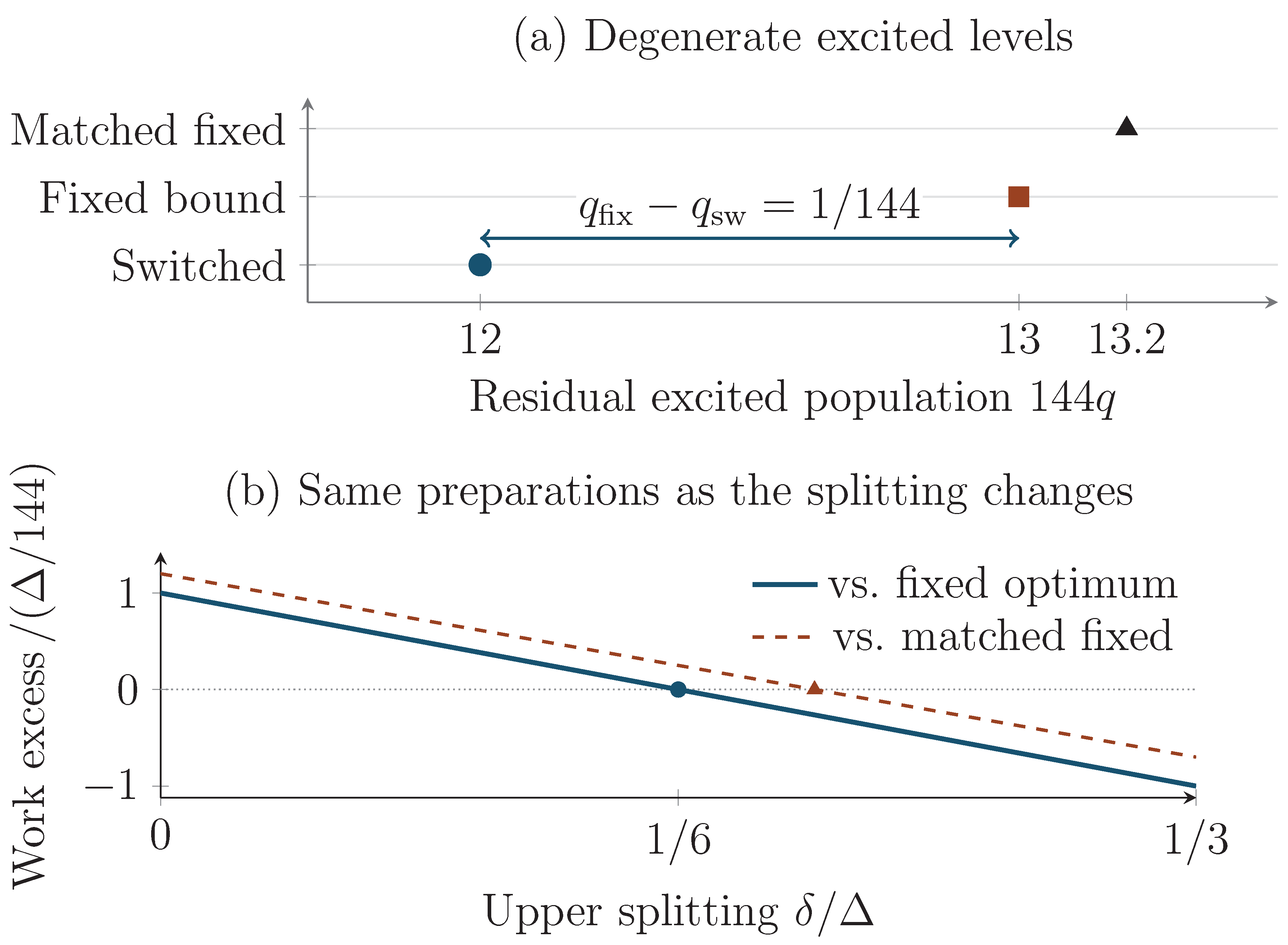
Figure 2.
In the lower shaded wedge (), the noisy tetrahedron beats the fixed work ceiling and admits a switched realization. The solid curve gives equality for this source. The dashed boundary is included on the switched side. The upper shaded region is excluded by target fidelity. The guessing budget follows along the path. The plotting code was developed with OpenAI Codex assistance.
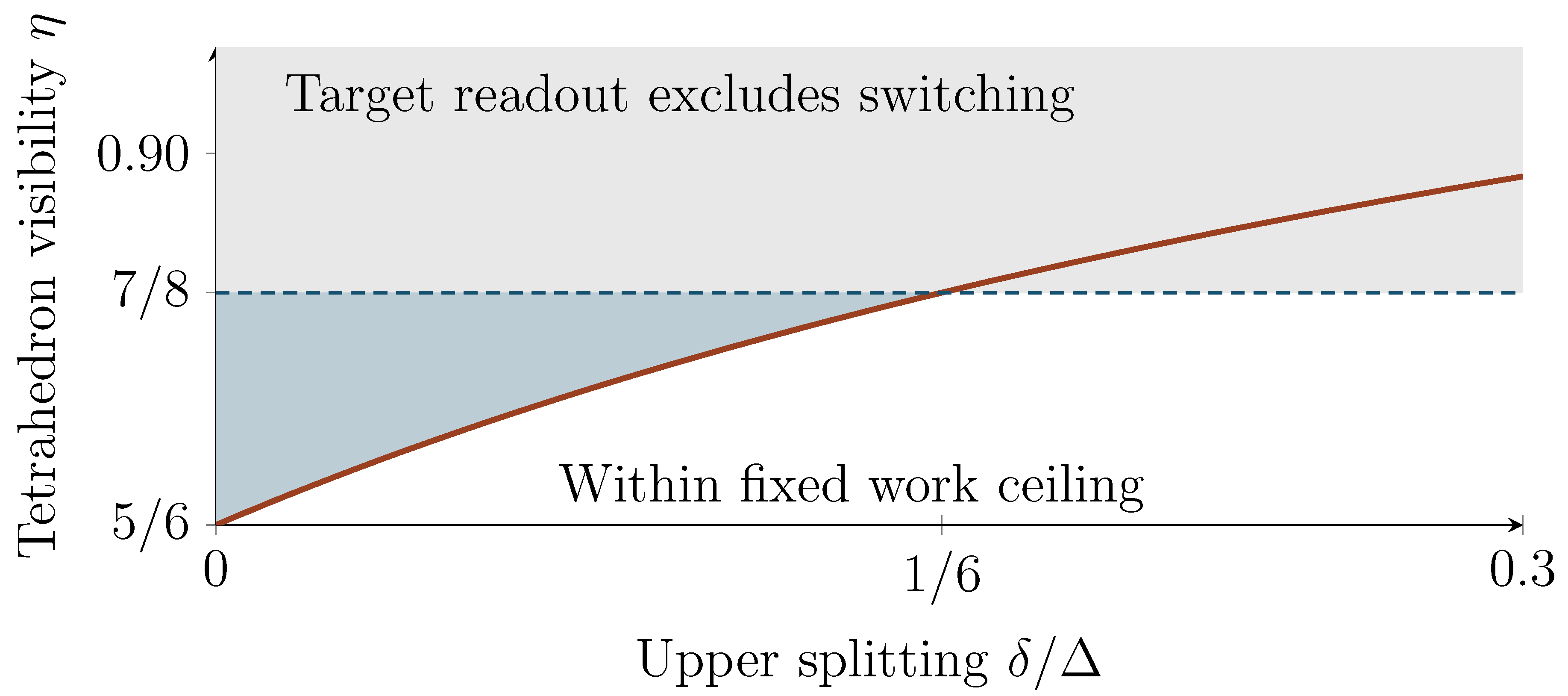

Table 1.
Two sources with uniform priors, and . Holevo information is calculated from the conditional spectra in Appendix B.
Table 1.
Two sources with uniform priors, and . Holevo information is calculated from the conditional spectra in Appendix B.
| Preparation | (bits) | |
| Matched fixed-sector | ||
| Switched (four settings) |
Disclaimer/Publisher’s Note: The statements, opinions and data contained in all publications are solely those of the individual author(s) and contributor(s) and not of MDPI and/or the editor(s). MDPI and/or the editor(s) disclaim responsibility for any injury to people or property resulting from any ideas, methods, instructions or products referred to in the content. |
© 2026 by the authors. Licensee MDPI, Basel, Switzerland. This article is an open access article distributed under the terms and conditions of the Creative Commons Attribution (CC BY) license (http://creativecommons.org/licenses/by/4.0/).
Copyright: This open access article is published under a Creative Commons CC BY 4.0 license, which permit the free download, distribution, and reuse, provided that the author and preprint are cited in any reuse.