

Submitted:
20 November 2026
Posted:
24 November 2026
You are already at the latest version
Abstract
It is sometimes assumed that a body force acting on all of a vehicle's matter would accelerate the vehicle without loading its occupants. We test this assumption quantitatively for a new vector boson coupled to the charge q = B − κL (baryon minus κ times lepton number), using isotope-resolved charge-to-mass ratios for twelve ICRU-44 reference tissues plus water and for six structural materials. A pure baryon coupling (κ = 0) leaves occupants a residual load of 1.3–2.0×10⁻³ of the vehicle's acceleration. Choosing κ to minimize the worst-case residual gives κ* ≈ −0.019 to −0.022 (depending on the structural material) and a residual of 1.06–1.12×10⁻⁴. The floor is set by the body itself: water-rich and fat-rich tissues differ in charge-to-mass ratio by at least 1.9×10⁻⁴ for every κ, so no single composition-coupled force can make occupants weightless; at 10^4 g the internal tissue-to-tissue load is still 1.9 g. A pure B − L coupling is the worst choice (12–18%) because hydrogen carries B − L = 0. We then derive three requirements on the field source: it must be external to the vehicle (momentum conservation); a point source must be at least 2ℓa/g away to keep tidal loads across a cabin of size ℓ below 1 g (40 km for 2 m at 104 g); and, with couplings at the MICROSCOPE limit, an ordinary-matter source would need ~5×1027 kg at 10 m. Only a hidden-sector source with a large dark charge is not directly excluded. The analysis also gives testable signatures: at κ*, polyethylene and platinum would differ in acceleration by 2.3×10⁻³ of the driven acceleration.
Keywords:
equivalence principle
; fifth force
; baryon number
; field propulsion
; occupant load
; tissue composition
1. Introduction
Forces coupled to baryon number were proposed by Lee and Yang [1] and revived in the “fifth force” debate [2]. Torsion balances [3,4,5] and the MICROSCOPE mission [6] now limit long-range couplings to baryon number to in units of the electron charge [7,8]. Propulsion by reaction against an external field or medium (“space coupling”) has been discussed in NASA’s breakthrough-propulsion work [9,10], which also set out the conservation-law requirements such concepts must meet. It is sometimes assumed that such a hypothetical field drive would leave the occupants unloaded, because all matter would be accelerated together.
That statement is only as good as the composition match between vehicle and occupants. We found no paper that computes the residual occupant load from real tissue compositions, optimizes the charge vector to minimize it, or identifies the floor set by the body itself; we searched arXiv, NASA NTRS and Google Scholar up to November 2026, and we make no claim of priority. The calculation is intended as a quantitative check of that assumption; none of the results depend on any particular propulsion concept.
2. Model and Data
We take a new vector field coupled as . For a neutral atom . In a field a body of mass m feels with , so its acceleration per unit field is proportional to the charge-to-mass ratio , the value of per atomic mass unit.
If the vehicle structure (“hull”) is driven at acceleration a, a tissue with ratio must be held by the structure with acceleration , where
The worst-case occupant load is , and minimizes it. The tissue floor is ; it is independent of the hull. Because the optimal hull sits near the middle of the tissue range, the worst-case residual at is about half the floor.
Isotopic abundances are from IUPAC [11] and atomic masses from the 2020 Atomic Mass Evaluation [12]. Tissue mass fractions are those of ICRU Report 44 [13] as tabulated by NIST [14] (adipose, whole blood, cortical bone, brain, breast, eye lens, lung, skeletal muscle, ovary, testis, ICRU-44 soft tissue, four-component soft tissue) plus water. Structural materials are Mg, Al, Ti and Fe (approximating steel), MgO and Al2O3. As a check, the script gives for natural Ti and for Be (). We quote loads per unit vehicle acceleration and, for illustration, at g. All numbers come from one Python script supplied as supplementary material. Use of AI tools. Grok Bot, an AI assistant based on a large language model, was used under the author’s direction to draft and check the analysis code (including the figure), to search the literature and to draft and edit text. The author defined the questions and the model, re-ran the script, checked the tissue compositions against the NIST tables and every number and reference against the cited sources, and takes full responsibility for the content.
3. Results
3.1. Hull–Occupant Residuals
Table 1 and Figure 1 give the worst-case residual for each structural material. The optimal is slightly negative, i.e. : a small push on electrons, in the same direction as that on nucleons, compensates for the low of hydrogen-rich tissue (hydrogen has no nuclear binding, so its mass per nucleon is the largest and its the smallest, while it carries one electron per nucleon). A pure coupling () gives residuals of 0.12–0.18.
3.2. The Tissue Floor
For a pure baryon coupling the tissue-to-tissue spread in is . Its minimum over is , at , and is set by water versus adipose tissue. This floor applies to every force with a single charge vector of the form , whatever the hull. It means an internal differential load of , i.e. 1.9 g at g. A differential load of order 1 g is comparable to that of standing in Earth’s gravity, so at g the floor is not itself a large load; its significance is that exact cancellation is impossible, and it grows in proportion to the acceleration.
3.3. Requirements on the Field Source
Momentum. A static field produced by the vehicle exerts no net force on the vehicle’s own charges: internal forces cancel (Newton’s third law, momentum conservation). A uniform body force therefore needs an external source. The alternative, emitting radiation, gives recoil only at the emitter, and the occupants then feel the full acceleration.
Uniformity. For a point source at distance r the tidal difference across a cabin of size ℓ is . Keeping it below 1 g requires : 40 km for m at g. Keeping it below the tissue floor requires km, independent of a.
Strength. Table 2 gives the source needed for g at 10 m. For a long-range force coupled to B with strength , the number of source charges is . The MICROSCOPE final result [6] ( uncertainty in ) is about 4.8 times tighter than the first results [15] used in [7], so the coupling limit tightens by about 2.2; this strengthens the conclusion. Short-range (Yukawa) limits are read approximately from the composition-independent (inverse-square-law) exclusion plots compiled in [5] and are order-of-magnitude values. Composition-dependent bounds from equivalence-principle tests on a B-coupled force are generally tighter [4,5], so these source requirements are conservative.
With ordinary-matter sources the requirement is therefore excluded outright. Only an external hidden-sector source carrying a large dark charge, which would also take up the recoil momentum, is not directly excluded; this option is speculative and is not modelled here.
4. Testable Signatures
Any force at would accelerate different materials differently in the driven region: relative to the driven acceleration, polyethylene versus Pt differ by , Be versus Ti by , and water versus Ti by . A vehicle driven by a single composition-coupled force would therefore always show a residual of at least with the pattern “fat-rich tissue lags water-rich tissue”, and a pair of accelerometers with polyethylene and Pt proof masses carried on board would read a differential of . This gives a direct, inexpensive test of any proposed drive of this type. Such differences are enormous compared with the – sensitivity of equivalence-principle tests, which is why any such force would have to be absent in ordinary laboratory conditions and present only in a confined, driven region.
5. Limitations
Tissue compositions are reference values; individual variation (body fat, hydration) changes the floor by tens of percent, not by orders of magnitude. Two-charge or spatially shaped schemes are not considered; in principle they could beat the single-charge floor, but they need independent control of two forces. A scalar mediator coupling to mass defect is not treated. The Yukawa limits are approximate.
6. Conclusions
A single composition-coupled body force cannot make a vehicle’s occupants weightless: the best charge vector, , leaves of the acceleration, and differences between body tissues set a floor of . Such a force must come from an external source that is tens of kilometres away to be uniform, and under equivalence-principle limits no ordinary-matter source can be strong enough.
Supplementary Materials
The following supporting information can be downloaded at the website of this paper posted on Preprints.org. The supplementary archive contains crew_null.py, which produces every number, table and figure, its output crew_null.json, and a run log.
Author Contributions
Kenneth Kraus: Conceptualization, Methodology, Software, Formal analysis, Writing – original draft, Writing – review & editing.
Funding
This research did not receive any specific grant from funding agencies in the public, commercial, or not-for-profit sectors.
Data Availability Statement
No new data were generated; all inputs are the cited reference tables, and the code, its output and a run log are provided as supplementary material (MIT license).
Conflicts of Interest
The author declares no known competing financial interests or personal relationships that could have appeared to influence the work reported in this paper.
Use of Artificial Intelligence
During the preparation of this work, the author used Grok Bot (an AI assistant based on a large language model) in order to draft and check analysis code, search the literature, and draft and edit text. After using this tool, the author reviewed and edited the content as needed and takes full responsibility for the content of the published article.
References
- Lee, T.D.; Yang, C.N. Conservation of heavy particles and generalized gauge transformations. Phys. Rev. 1955, 98, 1501. [CrossRef]
- Fischbach, E.; Sudarsky, D.; Szafer, A.; Talmadge, C.; Aronson, S.H. Reanalysis of the Eötvös experiment. Phys. Rev. Lett. 1986, 56, 3–6. [CrossRef]
- Schlamminger, S.; Choi, K.Y.; Wagner, T.A.; Gundlach, J.H.; Adelberger, E.G. Test of the equivalence principle using a rotating torsion balance. Phys. Rev. Lett. 2008, 100, 041101. [CrossRef]
- Wagner, T.A.; Schlamminger, S.; Gundlach, J.H.; Adelberger, E.G. Torsion-balance tests of the weak equivalence principle. Class. Quantum Grav. 2012, 29, 184002. [CrossRef]
- Adelberger, E.G.; Gundlach, J.H.; Heckel, B.R.; Hoedl, S.; Schlamminger, S. Torsion balance experiments: A low-energy frontier of particle physics. Prog. Part. Nucl. Phys. 2009, 62, 102–134. [CrossRef]
- Touboul, P.; et al. MICROSCOPE mission: Final results of the test of the equivalence principle. Phys. Rev. Lett. 2022, 129, 121102. [CrossRef]
- Fayet, P. MICROSCOPE limits for new long-range forces and implications for unified theories. Phys. Rev. D 2018, 97, 055039. [CrossRef]
- Fayet, P. MICROSCOPE limits on the strength of a new force, with comparisons to gravity and electromagnetism. Phys. Rev. D 2019, 99, 055043. [CrossRef]
- Millis, M.G. Exploring the notion of space coupling propulsion. In Proceedings of the Vision-21: Space Travel for the Next Millennium. NASA Lewis Research Center, 1990. NASA NTRS 19910012848.
- Millis, M.G. Challenge to create the space drive. J. Propuls. Power 1997, 13, 577–582. [CrossRef]
- Meija, J.; et al. Isotopic compositions of the elements 2013 (IUPAC Technical Report). Pure Appl. Chem. 2016, 88, 293–306. [CrossRef]
- Wang, M.; Huang, W.J.; Kondev, F.G.; Audi, G.; Naimi, S. The AME 2020 atomic mass evaluation (II). Tables, graphs and references. Chin. Phys. C 2021, 45, 030003. [CrossRef]
- ICRU. Tissue Substitutes in Radiation Dosimetry and Measurement; ICRU Report 44, International Commission on Radiation Units and Measurements: Bethesda, MD, 1989.
- Hubbell, J.H.; Seltzer, S.M. Tables of X-Ray Mass Attenuation Coefficients and Mass Energy-Absorption Coefficients (NIST Standard Reference Database 126), Table 2. National Institute of Standards and Technology, https://physics.nist.gov/PhysRefData/XrayMassCoef/tab2.html (accessed 20 November 2026), 2004.
- Touboul, P.; et al. MICROSCOPE mission: First results of a space test of the equivalence principle. Phys. Rev. Lett. 2017, 119, 231101. [CrossRef]
Figure 1.
Worst-case occupant load per unit driven acceleration against for six structural materials (solid lines), and the tissue-to-tissue floor (dashed; full spread of across tissues). Right axis: equivalent load at g.
Figure 1.
Worst-case occupant load per unit driven acceleration against for six structural materials (solid lines), and the tissue-to-tissue floor (dashed; full spread of across tissues). Right axis: equivalent load at g.
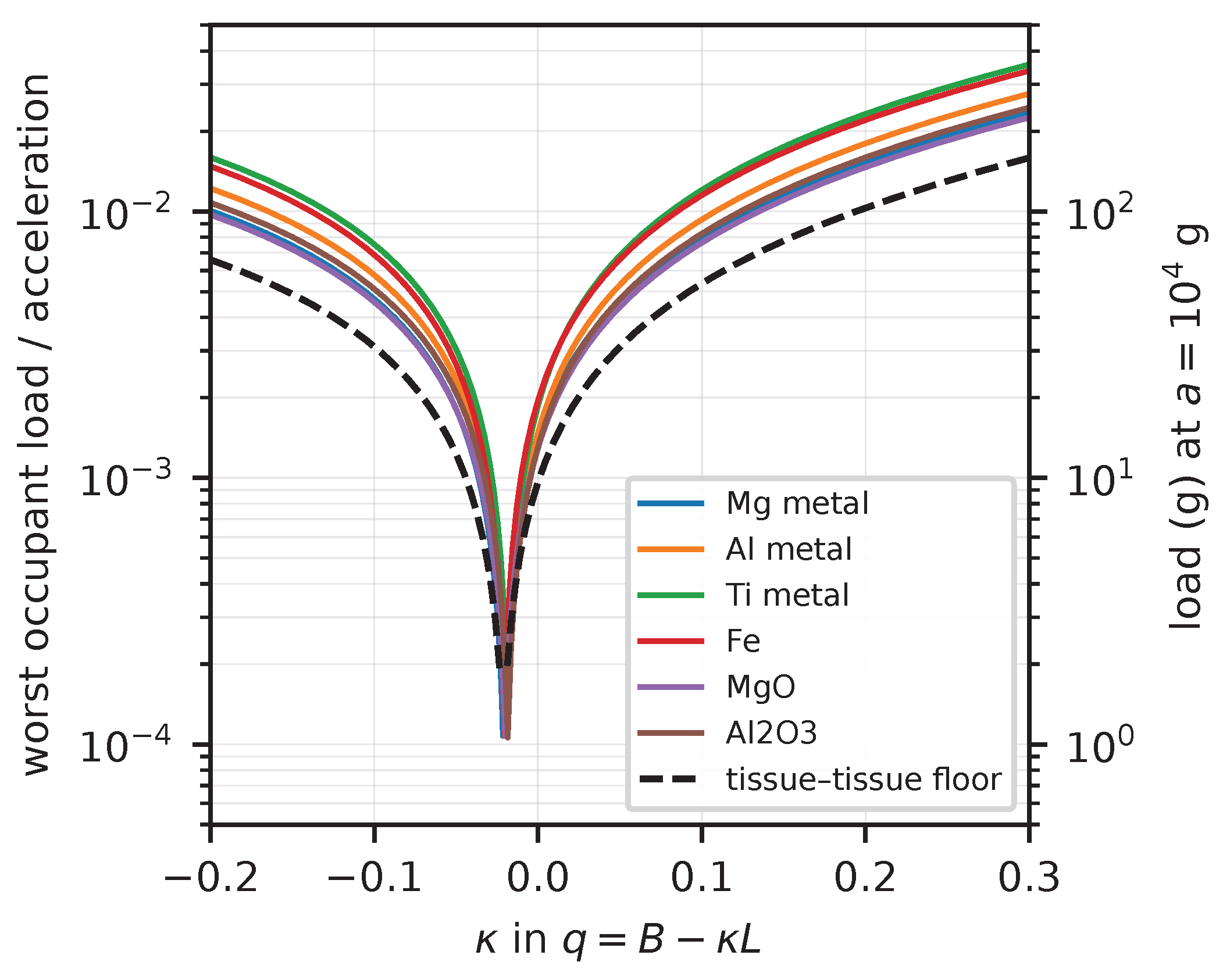

Table 1.
Worst-case occupant load as a fraction of the driven acceleration, over twelve ICRU-44 tissues and water. “Load” is the equivalent load at g.
Table 1.
Worst-case occupant load as a fraction of the driven acceleration, over twelve ICRU-44 tissues and water. “Load” is the equivalent load at g.
| Structure | load (g) | at | load (g) | |||
|---|---|---|---|---|---|---|
| Mg | 14.2 | 1.08 | 0.125 | |||
| Al | 14.8 | 1.12 | 0.145 | |||
| Ti | 18.7 | 1.10 | 0.181 | |||
| Fe | 19.6 | 1.07 | 0.172 | |||
| MgO | 13.0 | 1.07 | 0.121 | |||
| Al2O3 | 13.1 | 1.06 | 0.131 |
Table 2.
Source needed to drive g on ordinary matter. Long-range values at m; Yukawa values at .
| Source | Requirement |
|---|---|
| Long range, ordinary-matter source ( [7]) | nucleons ( kg, Jupiter masses) |
| Yukawa, at m; at m (approx. [5]) | kg ( m); kg ( m) |
| Ordinary gravity (comparison) | kg |
| Hidden-sector source, dark self-coupling (not constrained by equivalence-principle tests) | charges at 10 m; at 40 km |
Disclaimer/Publisher’s Note: The statements, opinions and data contained in all publications are solely those of the individual author(s) and contributor(s) and not of MDPI and/or the editor(s). MDPI and/or the editor(s) disclaim responsibility for any injury to people or property resulting from any ideas, methods, instructions or products referred to in the content. |
© 2026 by the authors. Licensee MDPI, Basel, Switzerland. This article is an open access article distributed under the terms and conditions of the Creative Commons Attribution (CC BY) license (http://creativecommons.org/licenses/by/4.0/).
Copyright: This open access article is published under a Creative Commons CC BY 4.0 license, which permit the free download, distribution, and reuse, provided that the author and preprint are cited in any reuse.