
Submitted:
22 November 2026
Posted:
24 November 2026
You are already at the latest version
Abstract
Little is known about population densities and population dynamics in passerine Afrotropical birds, although these are vital data in ecology and conservation of any avian species. The population density of the Grey-backed Camaroptera was assessed by means of the territory mapping method in a plot (400 ha) composed of man-modified acacia savanna. The plot is situated in Ogongo, Omusati Region, north-central Namibia. The density was much the same in 2012 and 2017 (2.3 and 2.5 p./100 ha respectively). However, after a prolonged drought in 2018-2019, the birds were still absent in October/November 2019; in February/March 2020, only two territo-ries were located; but in April the population density has already reached a level from 2017; in the subsequent months (May/June) the population density has increased by 100%, i.e. 4.3 pairs/100 ha. Most territories were established in a close proximity to ar-tificial water bodies surrounded usually by luxuriant vegetation. Low site tenacity has been evidenced. Ogongo stands therefore prominently as the only known site in the north-central Namibia (Ovamboland) where the species developed a viable population. The highest population density of the species (13.0 pairs / 100 ha) in Namibia was rec-orded in urbanised habitat of Katima Mulilo.
Keywords:
territoriality
; population density
; competition
; habitat
; site tenicity
1. Introduction
Population studies constitute a central theme in animal ecology, especially in regard to species distribution and abundance (Begon 1996, Krebs 2009). In the case of most bird species territoriality play an important role as a regulator of population density (Perrins & Birkhead 1983). The territoriality may exclude certain individuals, usually males, from reproduction, preventing them to establish territory in habits suitable for breeding, i.e., in such places which can provide nesting sites, shelters and sufficient amount of food to rear chicks. In years with favourite weather conditions, birds may usually establish more territories than in years when the weather conditions are not favourable. However important are not only weather conditions prevailing in a current breeding season, but also those proceeding this particular breeding season. In tropical Africa, the amount of rain is most important climatic condition which play a role in this regard. Normal or higher than normal annual rainfall proceeding a breeding season is often conducive for breeding birds, while drought can be detrimental, causing most bird to cease to breed. In this light, it is therefore interesting to know how fast birds recover from unfavourable season.
Although long-term population trends provide crucial information for nature conservationists, there is a lack of programs aimed in monitoring bird population trends in Africa (e.g., Ishong et al. 2022). Palearctic migrant bird species wintering in Africa are, however, regularly monitored on their breeding grounds in Europe (e.g., Bauer & Berthold 1997). Of the 2 477 species occurring in Africa, 276 are globally threatened with extinction because of small and/or declining populations and/or ranges, including 29 critically endangered (Birdlife International 2018). These data are, however, not always based on scientific studies. So, there is an urgent need to monitor bird populations in Africa.
The Grey-backed Camaropetra (GbC) Camaroptera brachyura (Figure 1) is widespread all over Africa south of Sahara, except for the north east and south west arid zones (Ryan 2006). It inhabits dense woody humid vegetation with a preference to edges and clearings, such habitats as rain forest, mangroves, riparian forests, woody savanna, exotic vegetation and gardens, desert oasis and peri-urban woody habitats (Urban et al. 1997). In northern Botswana and northern Namibia, it occurs in Acacia and Mopane savanna, but it is absent from Baikiaea Woodland (Urban et al. 1997, Kopij 2017). Other species of this genus occurring in Africa, the Yellow-browed Camaroptera C. superciliaris, Olive-green Camaroptera C. chloronota and Hartert’s Camaroptera C. harterti occupy only the rainforest zone in central and western Africa (Urban et al. 1997; Ryan 2006).
As many as 16-17 subspecies of the GbC are recognized. They are divided into the green-backed ‘nominate group’ and grey-backed ‘brevicaudata group’. Some authorities treat these groups as separate species, Green backed Camaroptera C. brachyura and Grey-backed Camaroptera C. brevicaudata (Ryan, 2006, Dickinson and Christidis, 2014). The former C. brevicaudata (formerly Grey-backed Camaroptera) is now synonumous with C. brachyura (formerly Green-backed Camaroptera from of south-eastern Africa).
In Namibia, the GbC is widespread in the northern half, especially in the Caprivi Strip, Okavango river valley, Khaudum Game Park, Tsumeb/Grootfontein area, and Kunene river valley. Surprisingly it avoids the most humid north central part of this country (Ovamboland, including the whole Cuvelai Drainage System) which is an mosaic of Acacia and Mopane savanna, which is flooded almost on yearly basis (Figure 2).
In southern Africa, the GbC inhabits dense undergrowth vegetation within the savanna biome, preferring luxuriant vegetation in man-modified places, such as gardens, parks, farmyards etc. It is sedentary in most of its range, but in Namibia birds are suspected to be partially migrant. The GbC is strongly territorial species which advertise territory boundaries with a loud call. It is a solitary nesters, with nests are widely spaced (Dean 2005).
The aim of the study is to: 1) estimate population densities before and after drought; 2) determine the site tenacity; 3) find whether there are any micro-habitat preferences; 4) compare population densities across Namibia and rest Eucalyptus camalduensis of Africa.
2. Materials and Methods
2.1. Study Area
The study area was situated on the UNAM Ogongo campus, Omusati Region, N Namibia. It is located c. 50 km NW of Oshakati, Outapi district, Omusati region, North-Central Namibia (17◦70’S, 15◦310’E). The Cuvelai Drainage System, where the study area is situated, is a unique ecosystem comprising a network of water canals (oshanas), mopane and acacia savannas (Mendesohn et al. 2000, 2009; Mendesohn & Weber 2011). The study area was, however, devoid of these canals, and the natural vegetation comprised acacia savanna composed mainly of Acacia erioloba, A. nilotica, A. fleckii, A. mellifera, Albizia anthelmintica, Dichrostachys cinerea, Colophospermum mopane, Combretum spp., Commiphora spp., Grewia spp., Ficus sycomorus, Boscia albitrunca, Sclerocarya birrea, Terminalia sericea, Zyzyphus mucronata, Hyphaene petersiana (Kangombe 2007). There is only small part of mopane savanna (composed almost entirely of young Colophospermum mopane shrubs) in the north-easter corner of study area. Both savannas are utilized as a pasture for cattle, sheep and goats (Figure 3).
The total surface of the study area was 400 ha. Most of it (70%) constitutes natural acacia savanna, the remaining is converted into yards with buildings (17.5%), arable fields (7.5%), orchards (2.5%) and sport fields (0.5%). There are also numerous exotic trees planted in and around human settlements, such as Kigelia africana, Moringa oleifera, Melia azedarach, Dodonaea viscosa, Eucalyptus camaldulensis. There are several permanent water bodies with standing water, and the area borders with an artificial water canal to the north and an extensive oshana (natural grassy depression filled with water in the rainy season) to the east (Figure 4).
Ogongo has semi-arid climate. The summers are sweltering and partly cloudy; the winters are short, comfortable, and clear (Mendelsohn et al., 2000; Mendelsohn & Weber 2011). In 2019/2020 rainy season (September-April) the total amount of rain in nearby Onguadiva was 702 mm, in the previous rainy season – 388 mm; the long-term annual average is 724 mm (Figure 5) (https://weatherandclimate.com/namibia/oshana/ongwediva). Across the years 2009-2020 the mean annual rainfall shows clear declining tendency.
2.2. Data Collection
Studies were conducted in three different years: 2012, 2017 and 2020. A territory mapping method (Sutherland 1996; Bibby et al. 2012) has been applied to assess the population densities of the GbC breeding in the study plot. Four surveys of the whole area were conducted in 2012 and 2017. In 2019/2020, four surveys of the whole area were conducted in each of three distinguished seasons. i.e., October/November, February/March, April and May/June.
Since the study are was too large to survey the land within one morning day, each total survey consisted 4-5 counts conducted on different days in a fragment of the study area, as to cover the whole study area. All birds seen and heard, especially those singing and showing other territorial or breeding behaviour, were plotted on the map 1 : 5000. A caution was taken to not register the same individuals by noting movements of counted birds in the field and by paying special attention to simultaneously calling birds.
2.3. Data Analysis
At least two records in a clump are required to distinguish an occupied territory (Bibby et al. 2012). Identified territories were mapped with simplified circles on specially prepared map showing all types of habitats. Each identified territory was interpreted as being equivalent to a breeding pair. Population density is expressed as the number of breeding pair per 10 ha.
3. Results
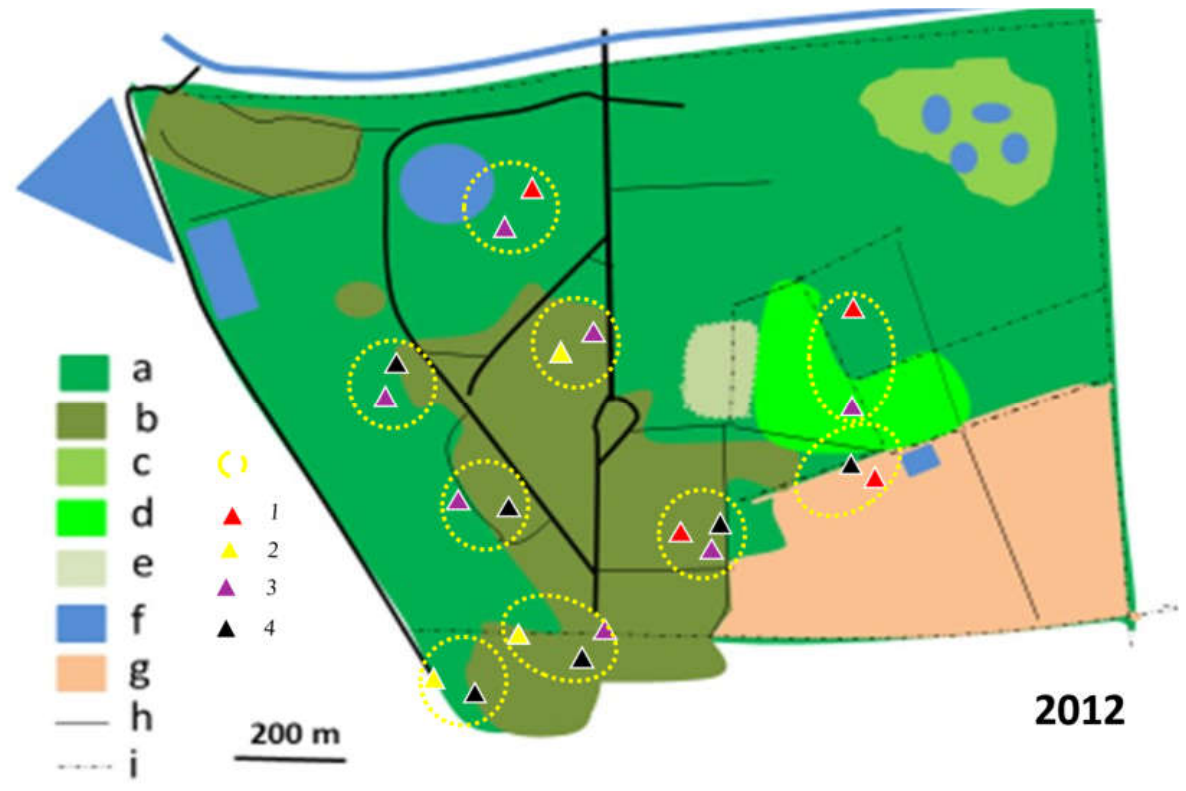
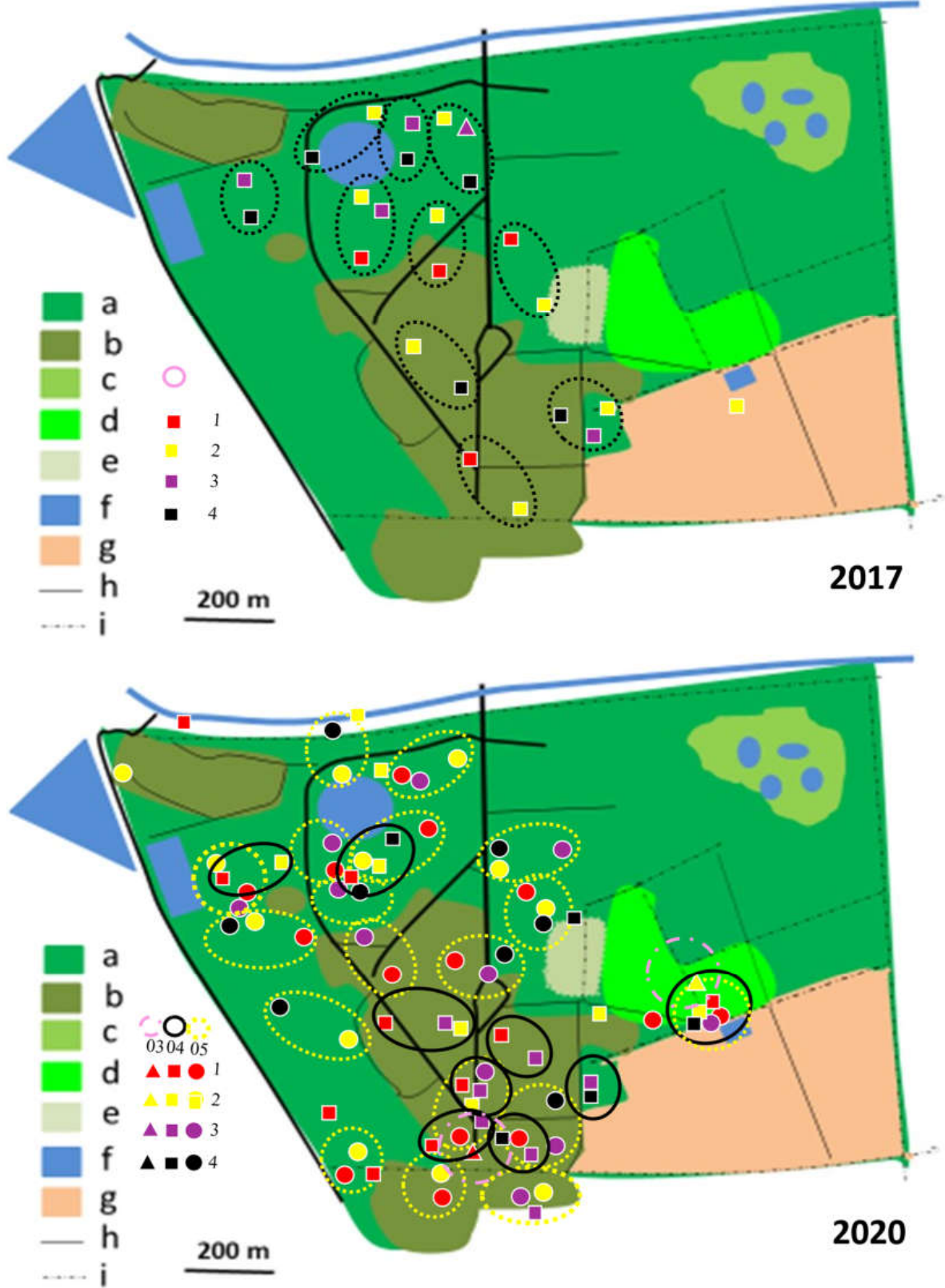
The population density of the Grey-backed Camaroptera in the study plot (400 ha), comprising man-modified acacia savanna, was much the same in 2012 and 2017 (9 breeding pairs in 2012 and 10 breeding pairs in 2017; 2.3 and 2.5 pairs /100 ha respectively). After a prolonged drought in 2018-2019, birds vacated the area. They were still absent in October/November 2019 (Figure 4). In February/March 2020, only two territories were established; but in April the population density has increased to the level from 2017. In the subsequent months (May/June), the population density has further increased reaching 4.3 pairs / 100 ha. It was therefore almost twice as high as in April of this year, and twice as high as in 2017 and 2012 (Figure 4).
Most territories were established in a close proximity to artificial water bodies, surrounded usually by luxuriant vegetation. Territories were, however, not established in a pure acacia savanna nearby, even in places where some water bodies were present. As can be seen in Figure 2, the territory boundaries shifted year after year. The shifting took place even within the same wet season 2019/2020. This suggests that the Grey-backed Camaroptera does not display strong site tenacity.
4. Discussion
The study shows that the GbC is a common and increasing bird species in the study area across the years 2012-2020. However, in the neighbouring mopane savanna in Ogongo Game Park (1000 ha), no pairs were recorded in any of these years (Kopij 2023b). The GbC was not recorded in both acacia and mopane savanna also in other parts of Ogongo area (Kopij 2013a, 2013b, 2014). It was also not recorded in the urbanized habitats of Outapi (Kopij 2019), Onguadiva (Kopij 2021b) and other Ovambo towns (Kopij 2014, 2021a) located within the same Cuvelai Drainage System in north-central Namibia. Also SABAP2 provides no records of the GbC for the entire north-central part of Namibia (Figure 2). The UNAM campus in Ogongo stands therefore prominently as the only known site in the north-central Namibia (Ovamboland) where the species has developed a viable population. This may suggest an expansion of this species into previously unoccupied areas.
The GbC was not recorded in the inner Windhoek (Kopij 2023a), Tsumeb (Kopij 2021d), Grootfontein (Kopij 2021c); Usakos, Karibib, Omaruru and Opuwo (Kopij 2022). Unlike in Ovamboland, the species is, however, known to occur around all these towns (Figure 2), in sites with moisture luxuriant vegetation in/or around some of these towns.
In Namibia, the GbC was find to reach relatively high population densities only in urbanized habitats in the Zambezi Region, NE Namibia, where in Katima Mulilo, 9.3 p./100 ha in 2013/14 and 13.0 p./100 ha in 2015/16 were recorded in a plot 54 ha in surface size (Kopij 2023c). In other parts of the town (a study plot 177 ha in surface size), 16 pairs were found, i.e., 9.0 p./100 ha (Kopij 2020).
Literature data on density of breeding populations of the GbC outside Namibia are available from very small study plots only. Densities given as number of individuals per 1 ha are not suitable to characterize breeding population densities, the census unit should be the number of breeding pairs per 10 ha, or per 100 ha, as a few ha is too small for bird population density to be representative of any habitat (Sutherland 1997, Bibby et al. 2012). Recorded population densities of this type are from Liberia: 4 pairs / 1 ha in coffee plantation and abandoned farm, and 12 pairs / 1 ha in burned montane forest (Urban et al. 1997); Gabon: 3-4 individuals / 1 ha in rain forest (Brosset & Erard 1986); Uganda: 5000 individuals / 1000 ha in a forest strip along Kazinga Channel (Fogden & Fogden 1979).
More often, a relative abundance (in fact dominance value) is calculated for African birds by the means of the point count or line transect methods (Bibby et al. 2012). In most cases, it is the dominance of species in particular site/place, i.e., number of individuals of a given species related to the total number of all individuals of all species recorded in this site/place. In other cases, the frequency of occurrence is calculated, as the percentage of sites where the species was present. For instance, in the forests of the Kibal N.P. in Uganda, the recorded dominance was 4.5% (n = 2,688 individuals of 115 species) (Latja et al. 2016). It was, in general, 9th most common species (out of 691 species), recorded in 84% of 88 sites (Nalwanga et al. (2012).
In W Uganda, population densities were also assessed by means of the point count method. This method is, however, not suitable to calculate population densities (Sutherland 1997, Bibby et al. 2012). Such estimations are de facto indices of a relative abundance, not exact population densities. The relative density was higher in logged (51.6 ind. / 100 ha) than in unlogged forest (31.3 ind./100 ha), although the difference was not statistically significant (Owiunji & Plumptre 1998). Possibly it is because the logged forests provide more dense shrubby layers, which the species seems to prefer.
In Upper Guinea forest zone of E Ghana, the dominance (relative abundance) was calculated as 1.9% (411 individuals of 66 species; Kanghan-Kesse et al. 2007). In Sudan Savanna, Nigeria, Jigawa State, the GbC comprised 5.9% of 8,583 individuals of 134 bird species recorded (Haruna 2024). In a peri-urban landscape in SW Nigeria, it was the 7th most common species (out of 42 species), with a dominance of 1.25% (Ogunsusi & Adetoro 2024), whereas in a forest bordering cacao plantation in SW Nigeria, the recorded dominance was 3.5% (114 ind. of 34 species) (Ogunyemi 2019).
Bird population trends in any local area arise from fluctuations in annual fecundity and survival, and these are determined by changes in local ecological conditions (e.g., Brambilla et al. 2010). In Africa, especially important in this regard is the amount of rainfall (Ishong et al. 2022). This can be see very clearly in the present study, where the precipitation greatly influenced changes in population density. In the Guinea savanna in Nigeria, of 12,569 birds representing resident breeding species captured during ringing programs in the years 2002-2019, 290 were GbC. Over the 18 years they have shown clear increasing trend, with controlling for variable ringing effort, although the mean annual rainfall remained stable in this period (Ishong et al. 2022). It can be therefore assumed that the GbC shows a general increasing tendency over its entire range. In the same site, study demonstrated that the abundance of shrubs and grasses best predicted the abundance of the GbC. As the canopy cover and number of grasses increased, the abundance of GbC also increased. However, the ground cover does not have any significant effects on the abundance of the GbC. It should be pointed out that shrubs not only promote structural heterogeneity, but are also sources of cover and gleaning for the GbC. However, in the Sahel zone of Nigeria, Creswell et al. (2004) comparing relative density in 1993/94 with that in 2001/02 has shown significant decline. This was probably a result of parallel precipitation/vegetation decline in the same time.
5. Conclusion
The GbC is one of the commonest bird species in many countries of sub-Saharan Africa. Like in few other studied sites in Africa, an increase of the GbC population density has been also shown across several year (2012-2020) in a site in northern Namibia. This increase took place despite the fact that over the same period the mean annual rainfall has shown declining tendency and there was a drought in 2017-2019 (Figure 3). After the drought the studied population rapidly recovered. This may exemplify a general population expansion of the species in Namibia and perhaps in other countries in sub-Saharan Africa (as recorded for instance in Nigeria). Further studies in other parts of Namibia and other African countries may confirm this premise.
References
- Bauer, H.-G.; Bethold, P. Die Brutvögel Mitteleuropas. Bestand und Gefährdung; AULA-Verlag, 1997. [Google Scholar]
- Begon, M.; Harper, J.L.; Townsend, C.R. Ecology: Individuals, Populations and Communities, 3rd edition; Blackwell Science, 1996. [Google Scholar]
- Bibby, C.J.; Burgess, N.D.; Hill, D.A. Bird censuses techniques; Academic Press, 2012. [Google Scholar]
- BirdLife International. State of Africa’s birds 2017: Indicators for our changing environment; BirdLife International Africa Partnership, 2018. [Google Scholar]
- Brambilla, M.; Casale, F.; Bergero, V.; Bogliani, G.; Crovetto, G.M.; Falco, R.; Roati, M.; Negri, I. Glorious past, uncertain present, bad future? Assessing effects of land-use changes on habitat suitability for a threatened farmland bird species. Biology Conservation 2010, 143, 2770–2778. [Google Scholar] [CrossRef]
- Brosset, A.; Erard, C. Les Oiseaux des Region Forestieres du Nord-Est du Gabon.; Societe Nationale de Protection de la Nature, 1986; Vol. 1. [Google Scholar]
- Cresswell, W.R.; Wilson, J.M.; Vickery, J.; Jones, P.; Holt, S. Changes in densities of Sahelian bird species in response to recent habitat degradation. Ostrich 2007, 78(2), 247–253. [Google Scholar] [CrossRef]
- Dean, W.R.J. Grey-backed Camaroptera Camaroptera brevicaudata. In Roberts’ Birds of Southern Africa; Hockey, P.A.R., Dean, W.R.J., Ryan, P.G., Maree, S., Eds.; John Voelcker Bird Book Fund, 2005; pp. 56–58. [Google Scholar]
- Dickinson, E.C.; Christidis, L. The Howard and Moore Complete Checklist of the Birds of the World, 4th ed.; Aves Press, 2014; Vol. 2. [Google Scholar]
- Fogden, M.P.L.; Fogden, P.M. The role of fat and protein reservesin the annual cycle of the Grey-backed Camaroptera in Uganda (Aves: Sylviidae). Journal of Zoology, London 1979, 189, 233–258. [Google Scholar] [CrossRef]
- Haruna, D. Effect of seasonal change and anthropogenic activities on the abundance and diversity of birds in a Nigerian protected area. In Book of Proceedings of the 1st Caze International Conference; Federal University Dutse (Nigeria), 2024; pp. 70–75. [Google Scholar]
- Ishong, J.A. Population trends of resident and migrant West African bird species monitored over an 18-year period in central Nigeria. Ostrich 2022, 93:3, 171–186. [Google Scholar] [CrossRef]
- Kangah-Kesse, L.; Attuquayefio, D.; Owusu, E.; Gbogbo, F. Bird Species Diversity and abundance in the Abiriw Sacred Grove in the Eastern Region of Ghana. West African Journal of Applied Ecology 2007, 11(1), 111–118. [Google Scholar]
- Kangombe, F.N. Vegetation description and mapping of Ogongo Agricultural College and the surrounds with the aid of satellite imagery. B.Sc. thesis, University of Pretoria, 2007. [Google Scholar]
- Kopij, G. Seasonal changes in avian assemblages in Kaokoland (Mopane) Savanna in the Ogongo Game Reserve, north-central Namibia. International Science & Technology Journal of Namibia (Windhoek) 2013, 2(1), 44–58. [Google Scholar]
- Kopij, G. Avian Assemblages in Natural and Modified Koakoland (Mopane) Savanna in the Cuvelai Drainage System, North-Central Namibia. Lanioturdus 2013, 46(5), 22–33. [Google Scholar]
- Kopij, G. Avian assemblages in urban habitats in North-Central Namibia. International Science and Technology Journal of Namibia (Windhoek) 2014, 3(1), 64–81. [Google Scholar]
- Kopij, G. Structure of avian assemblages in Zambezian Baikiaea woodlands, northern Namibia. Zoology & Ecology 2017, 27(1), 1–10. [Google Scholar] [CrossRef]
- Kopij, G. Population density and structure of birds breeding in an urban habitat dominated by large baobabs (Adansonia digitata), Northern Namibia. Biosystem Diversity 2019, 27(4), 354–360. [Google Scholar] [CrossRef]
- Kopij, G. Changes in the structure of avian community along a moisture gradient in an urbanized tropical riparian forest. Polish Journal of Ecology 2020, 68(3), 251–262. [Google Scholar] [CrossRef]
- Kopij, G. Avian diversity along a precipitation gradient 2020, southern Africa. Zoodiversity 2021, 55(1), 17–24. [Google Scholar] [CrossRef]
- Kopij, G. Population density and structure of a breeding bird community in a suburban habitat in the Cuvelai drainage system, northern Namibia. Arxius de Miscel·lània Zoològica 2021, 19, 313–320. [Google Scholar] [CrossRef]
- Kopij, G. Structure of avian communities of suburbs of Rundu and Grootfontein, NE Namibia. Berkut 2021, 30(1), 20–24. [Google Scholar]
- Kopij, G. Seasonal changes in the structure of an avian community in an urban habitat in northern Namibia. Biologija 2021, 67(4), 197–204. [Google Scholar] [CrossRef]
- Kopij, G. Avian diversity in urban habitats in the arid zone of Namibia. Lanioturdus 2022, 55(1), 23–27. [Google Scholar]
- Kopij, G. Structure of breeding bird assemblages in the city of Windhoek, Namibia. Arxius de Miscel·lània Zoològica 2023, 21, 19–38. [Google Scholar] [CrossRef]
- Kopij, G. Status, distribution and numbers of birds in the Ogongo Game Park, north-central Namibia. Namibian Journal of Environment 2023, 7B, 9–20. Available online: https://nje.org.na/index.php/nje/article/view/volume7-kopij.
- Kopij, G. The effect of rainfall on the population densities and community structure of birds in an urbanized Zambezi riparian forest. Diversity 2023, 15, 1126. [Google Scholar] [CrossRef]
- Krebs, C.J. Ecology. The Experimental Analysis of Distribution and Abundance, 6th ed.; Pearson Education, 2009. [Google Scholar]
- Latja, P.; Malinga, G.M.; Valtonen, A.; Roininen, H. Recovery of bird communities after selective logging and clear-cutting in Kibale National Park, Uganda. Ostrich 2016, 87(1), 57–65. [Google Scholar] [CrossRef]
- Mendelsohn, J.; Jarvis, A.; Roberts, C.; Robertson, T. Atlas of Namibia. A Portrait of the Land and its People; Sunbird Publishers, 2009. [Google Scholar]
- Mendelsohn, J.; el Obeid, S.; Roberts, C. A profile of north-central Namibia; Gamsberg Macmillan Publishers, 2009. [Google Scholar]
- Mendelsohn, J.; Weber, B. The Cuvelai Basin, its water and people in Angola and Namibia. In Occasional Paper; no. 8. Development Workshop, 2011. [Google Scholar]
- Nalwanga, D.; Byaruhanga, A.; Eaton, M.; Gregory, R.D.; Sheehan, D.K. Bird Population Monitoring Scheme in Uganda: A useful scheme in monitoring trends for Common Bird species; Natura Uganda, 2012. [Google Scholar]
- Ogunsusi, K.; Adetoro, A.A. Land Use Change and Impacts on Avifauna Species in Peri-Urban and Urban Areas of Ode-Irele, Ondo State Southwest Nigeria. Nigerian Journal of Wildlife Management 2024, 8(2), 56–64. [Google Scholar]
- Ogunyemi, O.O.O. Comparative Evaluation of Bird Species Diversity in Different Ecosystems of Akure Forest Reserve, Ondo State. Journal of Researches in Agricultural Sciences 2019, 7(1&2). [Google Scholar]
- Owiunji, I.; Plumptre, A.J. Bird communities in logged and unlogged compartments in Budongo Forest, Uganda. Forest Ecology and Management 1998, 108(1-2), 115–126. [Google Scholar] [CrossRef]
- Perrins, C.R.; Birkhead, T.R. Avian Ecology; Blackie: Glasgow (UK), 1983. [Google Scholar]
- Ryan, P.G. Family Cisticolidae (Cisticolas and allies). In Handbook of Birds of the Word; del Hoyo, J., Elliott, A., Sergatal, J., Eds.; Lynx Edicions, 2006; Vol. 11, pp. 378–490. [Google Scholar]
- Sutherland, W.J. Ecological Census Techniques: A Handbook; Cambridge University Press, 1996. [Google Scholar]
- Urban, E.K.; Fry, C.H.; Keith, S. The Birds of Africa; Academic Press, 1997; Vol. 5. [Google Scholar]
- Turshak, L.G.; Danlami, I.Z.; Chaskda, A.A.; Dami, F.D. Habitat Selection by Gray-Backed Camaroptera (Camaroptera brachyuran) at the Amurum Forest Reserve, Nigeria.
Figure 1.
The Grey-backed Camaroptera (W. Tarboton).
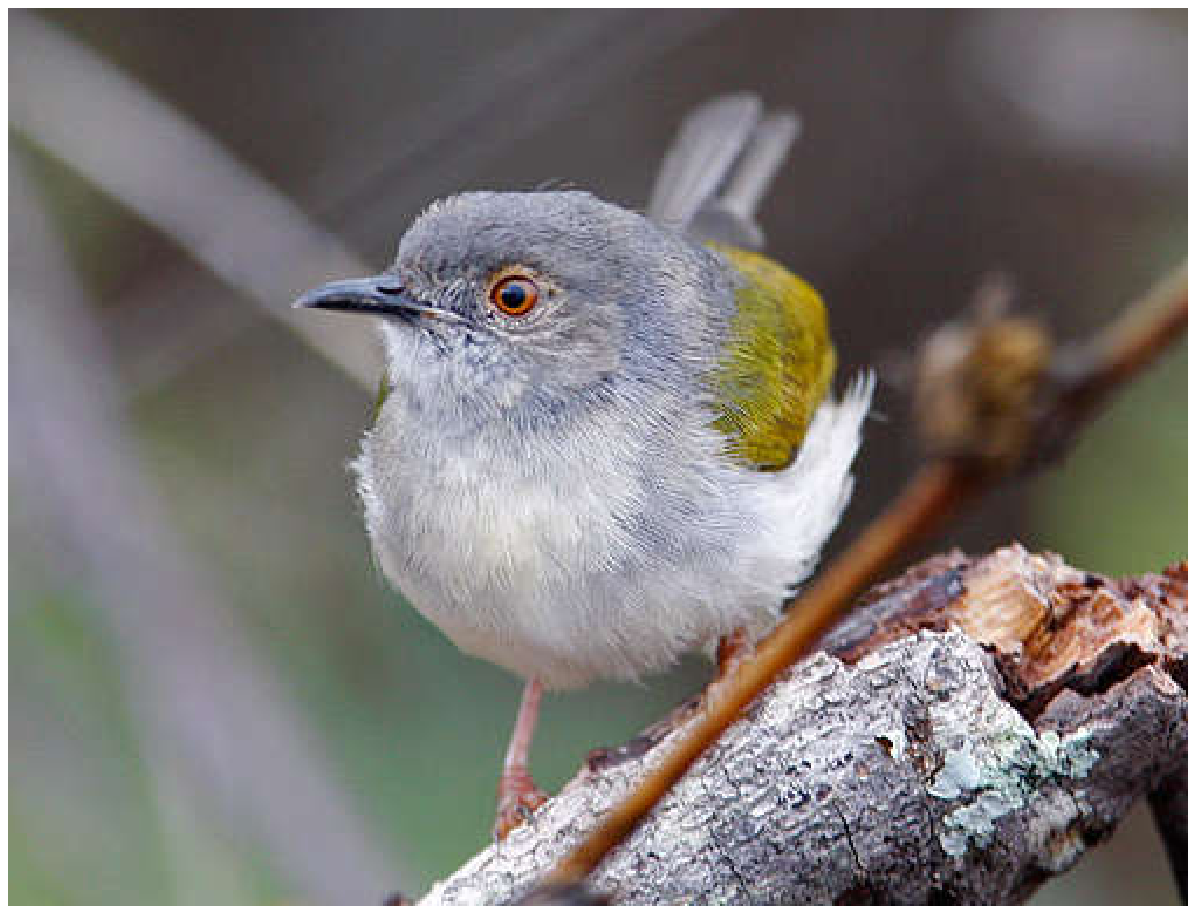
Figure 2.
Distribution of the Grey-backed Camaroptera in northern Namibia according to SABAP2 (https://sabap2.birdmap.africa/species/628).
Figure 2.
Distribution of the Grey-backed Camaroptera in northern Namibia according to SABAP2 (https://sabap2.birdmap.africa/species/628).
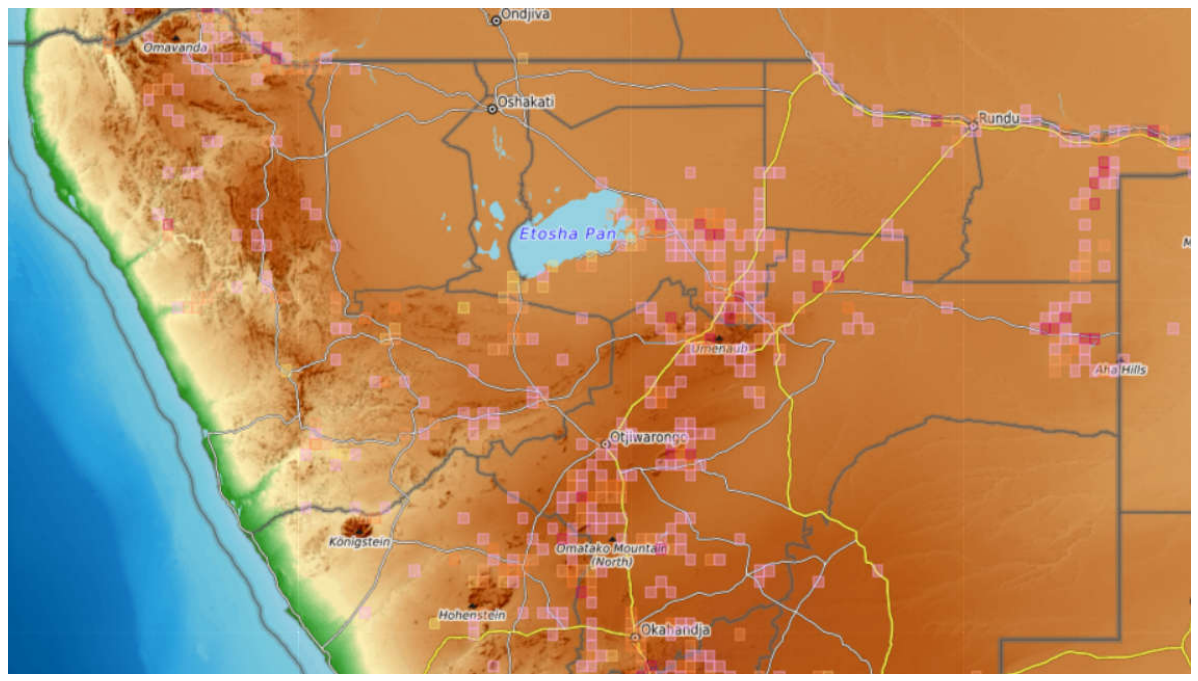
Figure 3.
The habitat of the Grey-backed Camaroptera in Ogongo, characterized by higher than elsewhere density of tree canopies, shrubs and grasses.
Figure 3.
The habitat of the Grey-backed Camaroptera in Ogongo, characterized by higher than elsewhere density of tree canopies, shrubs and grasses.
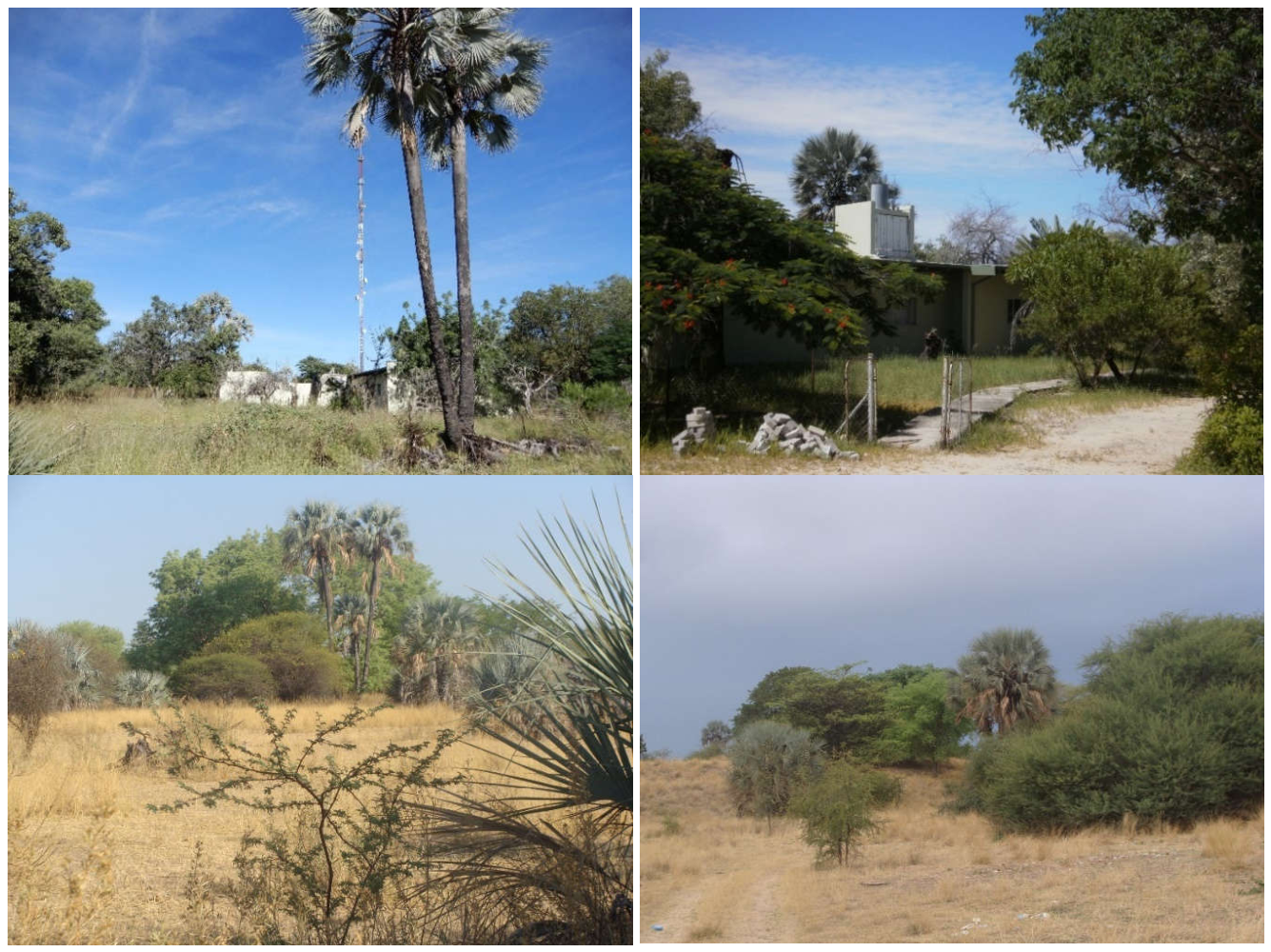
Figure 4.
Year-to-year changes in the amount of rain in wet seasons (September-April) in Onguadiva in 2009-2020.
Figure 4.
Year-to-year changes in the amount of rain in wet seasons (September-April) in Onguadiva in 2009-2020.
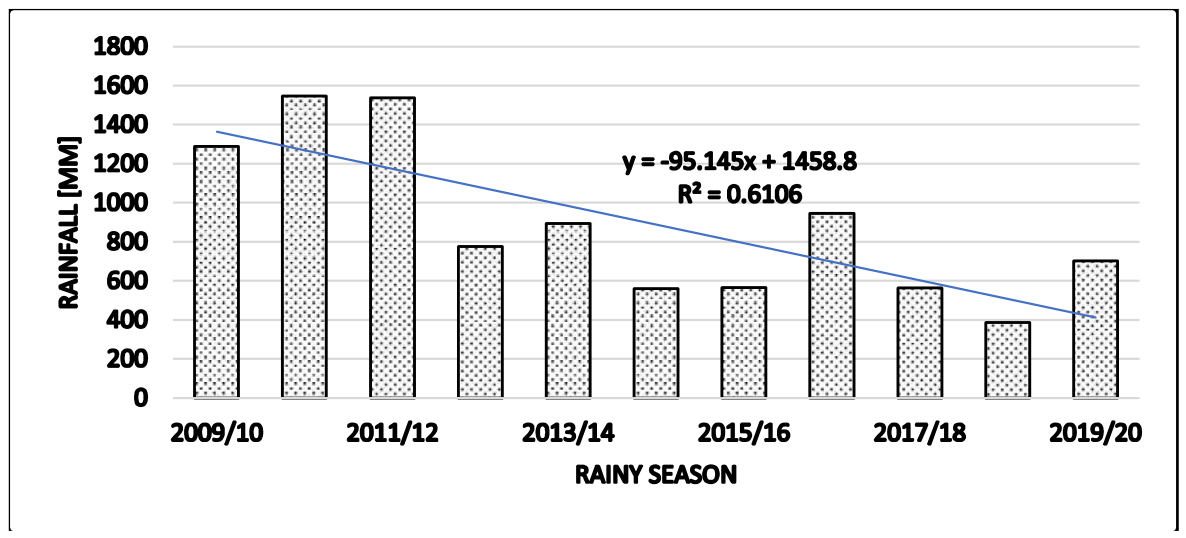
Figure 5.
Distribution of Grey-backed Camaroptera territories in Ogongo in 2012, 2017 and 2020. Explanations: Surveys: 1, 2, 3, 4 – records of birds during survey 1, 2, 3, or 4 in the year 2012 (12) and 2017 (17). In 2020, birds were counted in three seasons: February-March (03), April (04) and May/June (05); in each season four surveys (1, 2, 3, 4) were conducted. Encircled are occupied territories. Habitats (land uses): a – acacia savanna, b – built-up area, c – disturbed acacia savanna, d – orchard, e – sport field, f – water bodies, g – arable ground, h – roads, i – fences.
Disclaimer/Publisher’s Note: The statements, opinions and data contained in all publications are solely those of the individual author(s) and contributor(s) and not of MDPI and/or the editor(s). MDPI and/or the editor(s) disclaim responsibility for any injury to people or property resulting from any ideas, methods, instructions or products referred to in the content. |
© 2026 by the author. Licensee MDPI, Basel, Switzerland. This article is an open access article distributed under the terms and conditions of the Creative Commons Attribution (CC BY) license.
Copyright: This open access article is published under a Creative Commons CC BY 4.0 license, which permit the free download, distribution, and reuse, provided that the author and preprint are cited in any reuse.