

Submitted:
20 November 2026
Posted:
23 November 2026
You are already at the latest version
Abstract
Background: Sleep disturbances are among the most common behavioural concerns reported by parents of young children, but their value as an early marker of later anxiety and internalising problems in United Kingdom (UK) birth cohorts has not been systematically appraised. Earlier reviews pooled studies from many countries (Lam & Lam, 2021), and our companion scoping review found that sleep disturbance more often precedes than follows anxiety in youth (Tripathi et al., 2026; Preprints.org ID: 244572). This review asks how consistent and how robust the preschool evidence is within UK birth cohorts, and it quantifies the strength of the evidence with objective parameters.Methods: Eight Boolean queries were run in PubMed/MEDLINE on 16 November 2026 (292 records; 125 duplicates; 167 screened; 29 full texts). Two reviewers screened and extracted data independently. Risk of bias was appraised with the Joanna Briggs Institute (JBI) critical appraisal checklist for cohort studies. Evidence was synthesised by study role and by age at sleep assessment (infancy, toddlerhood, preschool). Effect estimates were verified against abstracts and open-access full texts, converted to standardised effect sizes, and examined with E-values, confounding-attenuation analysis and effect-direction counts. Formal pooling was attempted only where at least two independent cohorts reported a comparable estimate. This systematic review followed PRISMA 2020 and SWiM guidelines (OSF Registration DOI: 10.17605/OSF.IO/PCV58).Results: Thirteen studies met the criteria: six papers from ALSPAC, two from the Millennium Cohort Study (MCS), one each from the Twins Early Development Study (TEDS), Southampton Women’s Survey (SWS), Growing Up in Scotland (GUS) and an Oxford high/low-risk cohort, and one multi-country individual participant data (IPD) analysis; 16 full-text reports were excluded with reasons. In ALSPAC, each additional point on a 7-item sleep-difficulty score at 3.5 years was associated with persistent high generalised anxiety (OR 1.19, 95% CI 1.13–1.25), acute stress (1.09, 1.02–1.17) and social anxiety (1.07, 1.01–1.13) at 8–13 years, but not specific phobia (1.02, 0.98–1.06). Later-onset bed-sharing (18 months or 3.5 years) was associated with anxiety disorder at age 8 (adjusted OR 2.83, 1.40–5.71; E-value 5.11, 2.15 for the lower limit). Infant bed-sharing at 9 months in MCS was associated with elevated symptom trajectories before adjustment (OR 1.55–1.69) but not after (adjusted OR 0.75–1.39), a 37%–166% attenuation of the log odds. Each additional hour of sleep at 3.5 years was associated with a lower internalising percentile at 5 years (pooled mean difference −1.27, −2.22 to −0.32; standardised d ≈ −0.04). In ALSPAC mediation analyses, sleep quality mediated 11.3% and 14.7% of the association of atopic dermatitis with internalising behaviour at 4 and 7 years. Seven of eight core prospective studies reported adverse associations (exact sign test, two-sided p = 0.07). No exposure–outcome pair had two independent cohorts with comparable estimates, so no new pooled estimate was calculated. Only two studies used diagnostic anxiety outcomes in childhood and 12 of 13 relied on maternal report.Conclusions: Persistent sleep difficulty and bed-sharing that begins after infancy are consistently, but modestly, associated with later anxiety and emotional difficulty in UK cohorts, whereas infancy-only bed-sharing is not associated once family context is accounted for. Effect sizes are small to moderate, concentrated in ALSPAC and MCS, and open to confounding, so causal conclusions are not supported. Certainty of evidence was low or very low for every exposure family. No eligible Irish study was identified in PubMed, and harmonised multi-cohort re-analysis is a research priority.
Keywords:
sleep
; anxiety
; preschool
; infancy
; birth cohort
; United Kingdom
; bed-sharing
; E-value
; systematic review
1. Introduction
1.1. Background
Anxiety disorders are among the earliest-onset and most prevalent psychiatric conditions across the life course, frequently emerging in middle childhood and consolidating into chronic internalising psychopathology during adolescence and young adulthood (Morales-Muñoz et al., 2022; Tseliou et al., 2024). Our companion scoping review of longitudinal cross-lagged studies in children, adolescents and young adults found that the association between sleep disturbance and anxiety is predominantly directional from sleep disruption to later anxiety, rather than purely anxiety-driven insomnia (Tripathi et al., 2026; Preprints.org ID: 244572). A systematic review of seven longitudinal studies likewise reported that early-childhood sleep disorders were associated with anxiety, depression and ADHD in adolescence (Lam & Lam, 2021). The present review therefore does not set out to establish that an association exists. It asks how consistent and how robust the evidence is in UK birth cohorts, and it reports objective parameters (effect sizes, E-values and attenuation after adjustment) that earlier narrative syntheses did not provide.
1.2. Rationale and Empirical Gaps
Gap 1: the developmental window from 6 months to 5 years. Most longitudinal cross-lagged and trajectory studies in developmental psychopathology begin observation in middle childhood (7–10 years) or adolescence (12–16 years), leaving late infancy and preschool age comparatively under-synthesised. Between 6 months and 5 years, sleep undergoes substantial developmental reorganisation, including consolidation of nocturnal sleep, maturation of NREM–REM architecture and refinement of circadian regulation (Lenehan et al., 2023; Reynolds et al., 2023). During this period, prefrontal–amygdala circuits involved in threat processing and emotional regulation also mature. Persistent sleep disturbance and adverse early-life experiences during these sensitive years may therefore influence stress-responsive neural circuits, potentially contributing to enduring differences in threat sensitivity and affective regulation (Gee, 2016). This is a hypothesis about mechanism, and the included studies did not test it.
Gap 2: UK birth cohort evidence and harmonisation. The UK hosts several major population-based birth and developmental cohorts, including the Avon Longitudinal Study of Parents and Children (ALSPAC), the Millennium Cohort Study (MCS), the Twins Early Development Study (TEDS), the Southampton Women’s Survey (SWS), Growing Up in Scotland (GUS), Born in Bradford (BiB) and the Environmental Risk (E-Risk) Longitudinal Twin Study. Existing research has examined sleep trajectories and behavioural outcomes within individual cohorts, particularly ALSPAC (Manitsa et al., 2024), and European cross-cohort IPD analyses have shown that preschool sleep measures can be harmonised with later behavioural and cognitive outcomes (Guerlich et al., 2024). Collaborative initiatives such as the LifeCycle Project–EU Child Cohort Network provide an established framework for harmonising early-life behavioural data across cohorts (Nader et al., 2023). The evidence nevertheless remains distributed across cohort-specific investigations. A focused synthesis of early-childhood sleep dimensions (duration, timing, continuity and difficulties) in relation to distinct anxiety phenotypes, while considering developmental timing, familial adversity and parental mental health, is therefore needed. The Republic of Ireland’s Growing Up in Ireland (GUI) study was included in the search as a secondary arm to map the Irish evidence base.
Gap 3: phenotypic, analytical and informant heterogeneity. Primary cohort studies operationalise early sleep as markedly different phenotypes: global parent-reported sleep difficulties, 24-hour or nocturnal sleep duration, cumulative bedtime regularity, parent–child bed-sharing timing and sleep-disordered breathing (SDB). They also use diverse analytical strategies, including latent class growth analysis, twin modelling, difference-in-differences models and mediation approaches (Gregory et al., 2004; Bonuck et al., 2011, 2012; Kelly et al., 2013; Manitsa et al., 2024), and most rely on maternal report of both sleep and outcome. This heterogeneity complicates comparison and conceals how much of each association survives adjustment for family context.
1.3. Novelty and Contribution
This review differs from earlier syntheses in four ways. First, it is restricted to UK birth cohorts, which share health-visiting, school-entry and deprivation contexts, so that heterogeneity due to national setting is minimised. Second, it disaggregates sleep phenotype and developmental timing, which allows infancy-only and later-onset bed-sharing to be compared directly. Third, it replaces narrative description of effects with verified, standardised parameters: odds ratios and mean differences converted to a common effect-size metric, E-values for sensitivity to unmeasured confounding, and quantified attenuation of effects after adjustment. Fourth, it applies explicit rules for when pooling is and is not defensible, and it reports why formal pooling was not possible for most exposure–outcome pairs, which identifies the data that future multi-cohort analyses must supply.
1.4. Research Questions and Objectives
Primary review question: Within longitudinal birth and early-childhood cohorts in the United Kingdom, do sleep disturbances or suboptimal sleep patterns assessed between 6 months and 5 years of age prospectively predict or mediate subsequent childhood, adolescent or young-adult (to age 25 years) anxiety disorders and emotional or internalising symptoms?
Primary objective: To systematically identify, appraise and synthesise PubMed-indexed prospective longitudinal cohort studies conducted in the UK that examine early-life sleep (6 months to 5 years) in relation to later anxiety or emotional/internalising outcomes.
Secondary objectives: (a) to differentiate findings across sleep phenotypes (sleep duration, bedtime regularity, behavioural sleep difficulties, bed-sharing timing and SDB); (b) to extract objective parameters for each included study and describe them by age at sleep assessment (infancy, 6–18 months; toddlerhood, 18 months–3 years; preschool age, 3–5 years); (c) to quantify robustness, including sensitivity to unmeasured confounding and attenuation after adjustment for maternal mental health and family context; (d) to determine whether formal meta-analytic pooling is defensible for any exposure–outcome pair; and (e) to place the UK findings in an international context (WHO, 2019 guidelines; non-UK cohorts) and map the Irish evidence gap.
2. Methods
2.1. Protocol, Registration and Reporting
This systematic review was designed and reported in accordance with the Preferred Reporting Items for Systematic Reviews and Meta-Analyses (PRISMA) 2020 statement (Page et al., 2021), and the synthesis without meta-analysis components follow the SWiM reporting guideline (Campbell et al., 2020). The protocol and methodological record for this systematic review were formally registered on the Open Science Framework (OSF; Registration ID: pcv58; DOI: https://doi.org/10.17605/OSF.IO/PCV58), while all screening logs, extracted datasets, and Python scripts are archived in the companion OSF project repository (DOI: https://doi.org/10.17605/OSF.IO/GD38U), which also houses the broader scoping-review registration. Specifically, this focused systematic review departs from that broader scoping protocol in three ways: (1) it is restricted to United Kingdom birth cohorts, (2) it applies a formal PECOS eligibility framework, and (3) the developmental age tiers, analytical groupings, and quantitative sensitivity parameters described in Section 2.7 were operationalised for the synthesis after screening.
2.2. Eligibility Criteria (PECOS)
Baseline sleep exposures were stratified into three developmental tiers: infancy (6–18 months; early co-sleeping and settling practices), toddlerhood (18 months–3 years; emerging autonomy and shifts in night waking and bed-sharing) and preschool age (3–5 years; consolidated sleep and prefrontal–limbic maturation).
| Element | Operational definition and scope |
| P: Population | Children in general-population or community birth or early-childhood cohorts in the United Kingdom (England, Scotland, Wales, Northern Ireland). Republic of Ireland cohorts (for example Growing Up in Ireland) were searched as a secondary arm to map evidence gaps and were not included in the synthesis. |
| E: Exposure | Sleep assessed between 6 months and 5 years (inclusive): duration, bedtime regularity or timing, sleep-onset delay, night waking, composite sleep difficulties, bed-sharing location or timing, and sleep-disordered breathing, measured by maternal or carer report, sleep diaries or actigraphy. |
| C: Comparator | Better versus poorer sleep, or earlier versus later bed-sharing, within the same cohort. |
| O: Outcome | Later anxiety symptoms, DSM/ICD anxiety disorder diagnoses, internalising scores or emotional symptoms in childhood, adolescence or young adulthood (to age 25 years), measured with validated instruments (for example DAWBA, SDQ emotional or internalising subscale, Rutter scale, Child Behavior Checklist or structured clinical interviews). |
| S: Study design | Prospective multi-wave longitudinal observational cohorts (at least two assessment waves), twin longitudinal studies and cohort-based IPD analyses, including formal mediation models. Clinical trials and single-wave cross-sectional analyses were excluded. |
| Domain | Inclusion criteria | Exclusion criteria |
| Geographic and cohort setting | Population-based or community-recruited birth or early-childhood cohorts in the United Kingdom. | Cohorts recruited outside the UK (even if co-authored by UK investigators), or non-UK cohorts with similar names (for example the US Department of Defense Millennium Cohort Study). Irish cohorts were appraised descriptively only. |
| Baseline age window | Baseline sleep exposure assessed from 6 months to 5 years of age (inclusive). | Earliest sleep baseline after 5 years of age, in adolescence, or in adulthood (for example UK Biobank). |
| Study design and temporality | Prospective longitudinal observational studies (cohort, twin longitudinal or cohort-based IPD analyses) with at least two timepoints modelling early sleep and later anxiety or emotional outcomes, including formal mediation models. | Single-wave cross-sectional analyses, clinical or hospital intervention trials, case reports, editorials, conference proceedings, protocols without empirical data, and narrative or systematic reviews. |
| Exposure and outcome variables | Exposure: sleep duration, bedtime regularity, night waking, composite sleep difficulties, bed-sharing or sleep-disordered breathing. Outcome: anxiety diagnoses, anxiety symptoms, internalising scores or SDQ emotional symptoms, up to age 25 years. | Studies modelling only the reverse or parental direction (for example maternal antenatal or postnatal mood to infant sleep, or parenting stress) and studies with non-anxiety endpoints only (for example BMI, constipation, psychosis, ADHD or adult-onset depression beyond age 25). |
| Publication and language | Peer-reviewed journal articles in English from database inception to 16 November 2026. | Non-English articles, unpublished dissertations and grey literature, and retracted publications. |
2.2.1. Operationalisation of Outcomes, Exposures and Covariates
To distinguish construct specificity across heterogeneous cohort models, variables were organised into three analytical tiers. First, primary outcomes (dependent variables) comprised validated childhood, adolescent or young-adult (to age 25 years) anxiety diagnoses or symptom trajectories (e.g., DAWBA), internalising scores and SDQ emotional symptoms (SDQ-E), separated analytically from broader composite SDQ total behavioural difficulties. Second, primary exposures (independent variables) comprised sleep dimensions assessed between 6 months and 5 years (inclusive)—composite sleep difficulties, sleep duration, bedtime regularity, developmental timing of parent–child bed-sharing (infancy-only versus later-onset) and sleep-disordered breathing—classified by analytical role (direct predictor, mediator or airway comparator) and baseline age tier. Third, covariates and study-level moderators comprised both participant-level confounders adjusted in primary cohort regressions (maternal perinatal anxiety, depression or distress, socioeconomic deprivation, household crowding, parenting practices, child sex, temperament and somatic conditions) and review-level moderators extracted for synthesis (cohort identity to track sample overlap, informant source, outcome specificity, unadjusted-to-adjusted log-odds attenuation and E-values).
2.3. Information Sources and Search Strategy
The literature search was conducted in PubMed/MEDLINE from database inception to 16 November 2026, without date, publication-type or language restrictions at the query stage. PubMed was the only database. Eight queries (Q1–Q8) were built iteratively to reduce vocabulary blind spots across medical subject headings, cohort names, instrument names, author affiliations and modelling terms. Iterative refinement of a search against known relevant papers is standard practice, but it means that later queries were shaped by earlier results. Queries Q7 and Q8 were added after inspecting the results of Q1–Q6, and all eight queries are reported in full (Supplementary Table S1).
The strategy used four layers. (1) Core MeSH and title/abstract strings combined preschool age, sleep problems, anxiety or internalising symptoms, longitudinal design and UK terms (Q1), with Republic of Ireland terms added in Q2. (2) Named-cohort strings covered ALSPAC, MCS, Born in Bradford, the Wirral Child Health and Development Study, Growing Up in Ireland, TEDS, SWS, the Gateshead Millennium Study and E-Risk (Q3 and Q5). (3) Expanded age-in-months descriptors (36, 48 and 60 months, nursery, reception class) and broader emotional terms (Q4), and affiliation filters ([ad]) to capture studies indexed without cohort names in the abstract (Q6). (4) A supplementary named-cohort query that added Growing Up in Scotland, instrument terms (Strengths and Difficulties, SDQ, Child Behavior Checklist, CBCL, DAWBA) and bedtime terms (Q7), and a modelling-term query (cross-lagged, RI-CLPM, structural equation, latent class, growth curve, mediation, trajectory) (Q8). Q7 was designed to retrieve cohort papers that reported emotional or internalising subscales without using the word anxiety in the title or abstract.
2.4. Study Selection
All 292 records were exported from PubMed in structured CSV and MEDLINE abstract formats and de-duplicated programmatically using PubMed identifiers (PMIDs), with secondary title matching in Python (pandas), giving 167 unique records, all with abstracts. Two reviewers (DT and ST) screened titles and abstracts independently and then assessed full texts independently. Discrepancies were resolved by consensus with a third senior reviewer (YBT). Reasons for full-text exclusion were recorded against the eligibility criteria (Table 2).
2.5. Data Extraction
Data from each included study were extracted independently by two reviewers using a standardised electronic form, with cross-verification by a senior reviewer. Extracted items were study ID, first author and year, PMID and DOI, UK nation or region, cohort, analytic sample size, baseline sleep age and instrument, informant, follow-up age and outcome scale, statistical model and covariates, effect estimates (odds ratios, risk ratios, standardised or unstandardised coefficients, or mean differences with 95% confidence intervals), and temporal direction. Effect estimates were first taken from abstracts and then verified or completed against open-access full texts where available. Where a value could not be verified it was not used in the quantitative synthesis.
2.6. Risk of Bias Appraisal
Methodological quality and risk of bias were appraised independently by two reviewers (DT and ST) with the JBI Critical Appraisal Checklist for Cohort Studies (Moola et al., 2020), which has 11 questions on comparability of groups, validity and reliability of exposure and outcome measurement, identification and handling of confounding, whether participants were free of the outcome at baseline, adequacy and completeness of follow-up, strategies for incomplete follow-up, and statistical analysis. Each question was answered Yes, No, Unclear or Not applicable, and no summed score was calculated. Decision rules for each question and for the overall decision (include, include with caution, exclude from synthesis) were agreed in writing before appraisal began. Agreement between reviewers was calculated (percent agreement and Cohen’s kappa), and disagreements were resolved by discussion with a third senior reviewer (YBT). Item-level answers and consensus decisions are given in Supplementary Table S3. Informant (maternal report versus independent measures) and outcome type (diagnostic anxiety versus total emotional or behavioural difficulties) were recorded as additional appraisal domains.
2.7. Synthesis Methods
2.7.1. Narrative Synthesis
Studies were grouped by the role of sleep in the design: Group A (direct longitudinal models of sleep to anxiety or emotional outcomes, k = 9), Group B (sleep as a mediator between another exposure and emotional outcomes, k = 3) and Group C (sleep-disordered breathing comparator, k = 1). Studies were also mapped to the developmental age tier in which sleep was measured (infancy: 6–18 months; toddlerhood: 18 months–3 years; preschool: 3–5 years). A study that measured sleep at several ages appears in more than one tier. Studies from the same cohort are not independent, so findings are interpreted by cohort as well as by paper.
2.7.2. Effect-Size Standardisation
Odds ratios (OR) and their 95% confidence limits were converted to standardised mean differences (Cohen’s d) using d = ln(OR) × √3/π (Chinn, 2000), with the standard error of ln(OR) derived as (ln upper − ln lower)/3.92. Mean differences in SDQ percentile scores were converted by dividing by 28.9, the standard deviation of a uniform 0–100 percentile scale, which is an approximation. Standardised path coefficients were converted as d = 2β/√(1 − β2) and are shown without confidence intervals when none was reported. Positive values indicate more adverse outcomes with the exposure.
2.7.3. Meta-Analysis Feasibility and Pooling Rules
Random-effects pooling (DerSimonian–Laird, with a prediction interval when k ≥ 3) was to be performed for an exposure–outcome pair only if all of the following were met: (i) at least two independent cohorts (no shared participants) contributed; (ii) the exposure and outcome definitions and the effect metric were comparable; and (iii) the effect estimate and its variance were extractable. Where these were not met, estimates were reported individually and not pooled. Heterogeneity would be summarised with I2 and τ2 when pooling was possible.
2.7.4. Robustness Analyses
Sensitivity to unmeasured confounding was quantified with E-values (VanderWeele & Ding, 2017), computed for the point estimate and for the confidence limit nearest the null, treating odds ratios as risk ratios because the outcomes were uncommon in most studies. The effect of adjustment was quantified as the percentage change in ln(OR) between unadjusted and fully adjusted models, where both were reported.
2.7.5. Effect Direction
For prospective studies that tested a sleep exposure against a later anxiety or emotional outcome, the direction and statistical significance of the main finding were tabulated, and an exact binomial sign test was applied as an exploratory summary. Vote counting ignores effect size and precision and is not independent when studies share a cohort, so it is reported only as a supplement to the standardised estimates.
2.7.6. Reporting Bias and Certainty of Evidence
Because no exposure–outcome pair had more than one independent cohort, funnel plots and tests for small-study effects were not appropriate (Sterne et al., 2011). Reporting bias was assessed qualitatively by considering the single-database search, English-only inclusion, whether studies reported null results for some outcomes or exposures, and whether cohort analyses followed publicly available protocols. Certainty of evidence was rated for each exposure family with the GRADE approach for observational studies (Schünemann et al., 2013). Evidence from observational studies started at low certainty, was rated down for risk of bias, inconsistency, indirectness, imprecision and publication bias, and could be rated up for dose-response or large effects. Two reviewers rated each domain and agreed the ratings by consensus.
3. Results
3.1. Study Selection
The eight PubMed queries generated 292 records: Q1 (#4, n = 21), Q2 (#5, n = 22), Q3 (#17, n = 28), Q4 (#23, n = 90), Q5 (#24, n = 63), Q6 (#25, n = 44), Q7 (#28, n = 18) and Q8 (#29, n = 6). The supplementary query Q7 added 8 unique records beyond the Q1–Q6 union (n = 159), including three eligible UK cohort studies that did not use the word anxiety in their abstracts (Kelly et al., 2013, MCS; Bao et al., 2025, ALSPAC; Marsh et al., 2019, SWS). Q8 added none. After removing 125 duplicates, 167 unique records were screened and 138 were excluded at title and abstract stage. Twenty-nine UK and Irish cohort reports were assessed at full text, 16 were excluded with documented reasons (Table 2), and 13 UK longitudinal studies were included (Figure 1; Table 1).
3.2. Full-Text Exclusions
Of the 29 reports assessed at full text, 16 were excluded (Table 2). Six studied a different outcome: sleep itself, BMI, constipation, self-harm or adult-onset depression. Five examined a reverse or parental direction, including the only Irish report, a Growing Up in Ireland analysis of parenting stress. Two began sleep assessment after age 5 years, and three did not isolate child sleep as an exposure, because they combined lockdown routines or treated sleep only as a covariate in somatic models.

Table 2.
Full-text exclusions with reasons (PRISMA 2020 item 16b).
| No. | Reference (PMID) | Cohort (N) | Category | Specific full-text exclusion reason |
| 1 | Manitsa et al. (2024) PMID 38708717 |
ALSPAC N = 12,962 |
Different outcome | Child night-time sleep duration and timing trajectories (6 months–16 years) are the outcome, predicted by perinatal adversity and maternal postnatal anxiety or depression. No child anxiety outcome. |
| 2 | Barazzetta & Ghislandi (2017) PMID 28364413 |
ALSPAC >14,000 recruited |
Different outcome | Family income, material deprivation and prenatal maternal mental health predict child sleep quality and quantity to age 9 years. No emotional outcome. |
| 3 | Kelly et al. (2016) PMID 27940679 |
MCS | Different outcome | Non-regular bedtimes (3–11 years) predict BMI trajectories (primary outcome). SDQ emotional symptoms are examined only as a correlate of trajectory class. |
| 4 | Joinson et al. (2019) PMID 29748737 |
ALSPAC N = 8,435 |
Different outcome | Lack of a regular sleep routine and emotional problems at 2–3 years predict constipation and soiling classes at 4–10 years, not child anxiety. |
| 5 | Uh et al. (2021) PMID 34130904 |
MCS N = 10,827 |
Different outcome | Childhood sleep and emotional difficulties (5–14 years) are used to classify adolescent self-harm pathways at 14 years. No anxiety outcome. |
| 6 | Greene et al. (2015) PMID 25178397 |
1970 British Cohort Study N = 7,437 |
Different outcome | Severe sleeping difficulties at age 5 years predict treated depression at age 34 years. The outcome is adult-onset, beyond young adulthood (age 25 years), with no childhood or adolescent anxiety or internalising assessment. |
| 7 | Matvienko-Sikar et al. (2018) PMID 28635525 |
Growing Up in Ireland (Republic of Ireland) N = 6,821 dyads |
Reverse or parental direction | Maternal sleep and perinatal factors predict maternal and paternal parenting stress at 9 months postpartum. No child anxiety outcome. Used only to map the Irish evidence base. |
| 8 | O’Connor et al. (2007) PMID 17008033 |
ALSPAC | Reverse or parental direction | Prenatal maternal anxiety and depression predict infant sleep problems at 18 and 30 months. No child anxiety outcome. |
| 9 | Baird et al. (2009) PMID 19413152 |
SWS N = 874 |
Reverse or parental direction | Preconceptional maternal psychological distress (GHQ-12) predicts infant night waking at 6 and 12 months. No child anxiety outcome. |
| 10 | Lahti-Pulkkinen et al. (2019) PMID 30293538 |
Edinburgh pregnancy cohort (Scotland) N = 111 |
Reverse or parental direction | Maternal antenatal daytime sleepiness (Epworth Sleepiness Scale at 17 and 28 weeks) predicts child internalising problems at 2.6–5.7 years. The sleep exposure is maternal, not child, sleep. |
| 11 | Metherell et al. (2026) PMID 41733776 |
1970 British Cohort Study N = 16,585 |
Reverse or parental direction | Childhood mental health (5–16 years) predicts adult sleep duration at age 46 years. |
| 12 | Hoare et al. (2020) PMID 32777059 |
MCS N = 9,369 |
Baseline age | Baseline at age 7 years, outside the 6 months–5 years window. Mental health (7–14 years) predicts adolescent health behaviours, including sleep duration, at 14 years. |
| 13 | Orchard et al. (2020) PMID 32557672 |
ALSPAC N = 5,033 |
Baseline age | Sleep patterns and quality assessed at 15 years predict anxiety and depression at 17, 21 and 24 years. No infancy or preschool baseline. |
| 14 | Lees et al. (2023) PMID 39839582 |
ALSPAC-G2 N = 411 |
Sleep not isolated | Combined COVID-19 lockdown routines (mealtimes and bedtimes) are related to preschool Rutter scores and parental anxiety. Child sleep is not isolated. |
| 15 | Teyhan et al. (2014) PMID 24952709 |
ALSPAC N = 7,250 |
Sleep not isolated | Childhood wheeze and rash predict SDQ internalising problems at 8 years. Sleep disruption is only a covariate and did not mediate the association. |
| 16 | Teyhan et al. (2015) PMID 26266935 |
ALSPAC N = 6,626 |
Sleep not isolated | Childhood eczema and asthma predict teacher-rated SDQ internalising problems at 8 years. Child sleep is included only as a confounder. |
3.3. Characteristics of Included Studies
Analytic samples ranged from 2,576 children (SWS; Marsh et al., 2019) to 16,599 (MCS; Bilgin et al., 2024). Because six papers draw on ALSPAC and two on MCS, the 13 studies are not independent samples, and the evidence rests on six UK cohorts plus one multi-country IPD analysis. The behavioural analyses in the IPD study (Guerlich et al., 2024) pooled ALSPAC (UK) with EDEN and ELFE (France); SWS and INMA (Spain) contributed only to cognitive outcomes. Baseline sleep was assessed between 6 months and 5 years of age, and follow-up extended from age 3 years (Marsh et al., 2019) to age 25 years (Tseliou et al., 2024). Group labels in square brackets are A (direct models), B (mediation) and C (SDB comparator).
3.4. Risk of Bias
Item-level JBI answers and consensus decisions for the 13 included studies are given in Supplementary Table S3[cite: 10]. Appraisal across the 11 JBI cohort checklist items (Q1–Q11) was carried out independently by two reviewers (DT as Reviewer 1 and ST as Reviewer 2), cross-checked by a third senior reviewer (YBT), and finalized by consensus after structured discussion[cite: 10, 11]. Across all 143 item-level judgements (13 studies × 11 items), independent agreement between DT and ST was 138/143 (96.5%, Cohen’s κ = 0.931)[cite: 10, 11]. Consensus item-level counts (Yes / No / Unclear / Not applicable out of k = 13 studies) were: Q1 (same population/sampling frame): 11 / 1 / 1 / 0; Q2 (similar exposure measurement): 13 / 0 / 0 / 0; Q3 (valid/reliable exposure measurement): 1 / 0 / 12 / 0; Q4 (confounders identified): 12 / 1 / 0 / 0; Q5 (strategies to deal with confounders stated): 11 / 1 / 1 / 0; Q6 (free of outcome at baseline): 2 / 3 / 8 / 0; Q7 (valid/reliable outcome measurement): 12 / 0 / 1 / 0; Q8 (follow-up time reported and sufficient): 12 / 1 / 0 / 0; Q9 (follow-up complete / attrition explored): 1 / 1 / 11 / 0; Q10 (strategies for incomplete follow-up used): 1 / 0 / 12 / 0; and Q11 (appropriate statistical analysis): 12 / 1 / 0 / 0[cite: 10, 11]. Following discussion and YBT review, 7 studies were rated ‘Include’ and 6 were rated ‘Include with caution’ (none excluded from synthesis)[cite: 10, 11]. Features that bear directly on interpretation were extracted separately from the checklist[cite: 10]. Sleep was measured by maternal report in 12 of 13 studies (actigraphy was used only in Sheridan et al., 2013), only two studies (UK-01, UK-03) modelled diagnostic anxiety outcomes in childhood, and three (UK-05, UK-11, UK-12) analysed total difficulties[cite: 10]. Validity and reliability of single-item parent-reported exposures such as bed-sharing and bedtime regularity were rarely reported, and retention was often not described in the abstracts[cite: 10]. These features are carried into the certainty of the evidence and are discussed in Section 4.8[cite: 10].
3.5. Synthesis by Analytical Group
Group A: direct longitudinal models (k = 9). Six studies (UK-01, UK-02, UK-03, UK-04, UK-05, UK-07) reported prospective associations between sleep measured from age 3 years (or bed-sharing from 18 months) and later anxiety or emotional and behavioural outcomes. One study (UK-06) found no association between infant bed-sharing and later internalising or externalising trajectories after adjustment. Two studies (UK-08, UK-09) did not test a prospective sleep-to-emotion association: UK-08 described co-developing trajectories, and UK-09 found that sleep problems at 5 years were associated with concurrent anxiety and depression, with limited evidence for early sleep.
- Composite preschool sleep difficulties and anxiety trajectories. In ALSPAC, parent-reported sleep difficulties at 3.5 years were associated with persistent high generalised anxiety, social anxiety and acute stress reaction across ages 8–13 years, but not with persistent specific phobia (Morales-Muñoz et al., 2022). Childhood sleep difficulties were also associated with persistent SDQ emotional-symptom trajectories from 4 to 17 years, which carried higher risk of adult depression and self-harm at 21–25 years (Tseliou et al., 2024). In TEDS, sleep problems at 3–4 years predicted SDQ anxiety at 7 years (β = 0.12, p < .001) after accounting for baseline stability, with 16%–91% of this predictive association attributed to shared environmental factors (Gregory et al., 2004).
- Bedtime regularity and sleep duration. In MCS (N = 10,230), the number of ages (3, 5, 7 years) at which bedtimes were non-regular showed a dose-response relation with age-7 behavioural difficulties (β = 2.10 when non-regular at all three ages), and moving to regular bedtimes was associated with lower scores (β = −1.02 between ages 5 and 7), with teacher ratings supporting mother ratings (Kelly et al., 2013). The outcome was total behavioural difficulties, not anxiety specifically. In the multi-country IPD analysis, each additional hour of sleep at 3.5 years was associated with a lower internalising percentile at age 5 (adjusted MD −1.27; Guerlich et al., 2024), but the pooled estimate is not UK-specific.
- Developmental timing of bed-sharing. Bed-sharing confined to infancy (6 months in ALSPAC) was not significantly associated with anxiety or depression at ages 8 and 13 (Bilgin & Parsons, 2026), and bed-sharing at 9 months in MCS showed no association with symptom trajectories after adjustment (Bilgin et al., 2024). Bed-sharing that began or continued at 18 months or 3.5 years was associated with nearly threefold higher odds of anxiety disorder at age 8 in ALSPAC (aOR 2.83, 95% CI 1.40–5.71, significant after correction for multiple comparisons). The age-13 association (aOR 2.84, 1.14–7.04) did not remain significant after correction. The two studies used different exposures and outcomes, and the association may reflect child or family difficulties that lead to bed-sharing rather than an effect of bed-sharing.
Group B: sleep as mediator (k = 3). Two ALSPAC studies and one SWS study examined sleep as a pathway linking another exposure to emotional or behavioural difficulties. Behavioural sleep disturbance, specifically bedtime refusal and early waking, mediated 6.5%–26.7% of the effect of atopic dermatitis on SDQ difficulties (Bao et al., 2025), whereas total 24-hour sleep duration mediated under 1%. Sleep quality mediated 11.3% and 14.7% of the association between atopic dermatitis and internalising behaviour at 4 and 7 years, while sleep duration and inflammatory markers (IL-6, CRP) did not (Kern et al., 2021). In SWS, reduced sleep at 2–3 years partly mediated the association of household crowding with SDQ difficulties at age 3 (Marsh et al., 2019). These studies show sleep acting as a pathway for somatic and environmental stressors. They do not show that sleep causes anxiety specifically, and two of the three outcomes were total difficulties.
Group C: SDB comparator (k = 1). In ALSPAC (N = 9,140), persistent SDB symptom clusters across 6–69 months predicted problematic behaviour, and the Later Symptom cluster predicted SDQ emotional difficulties at 7 years (aOR 1.65, 95% CI 1.21–2.07 as printed; Bonuck et al., 2012). This supports screening for airway-related sleep disruption alongside behavioural sleep problems.
3.6. Objective Parameter Extraction by Age at Sleep Assessment
Table 3 extracts objective parameters (distinct cohort samples, baseline age, sleep phenotype and instrument, outcome and follow-up, statistical model and quantified effect estimate) across the three age tiers. Studies that measured sleep at several ages appear in more than one tier. Because several papers share cohorts and person-level overlap cannot be determined from published data, sample sizes are given per distinct cohort and are not summed; the earlier practice of adding overlapping samples would overstate the evidence base.
Read descriptively, infancy-only bed-sharing was not associated with later outcomes after adjustment, later-onset bed-sharing was associated with anxiety disorder at age 8, and composite sleep difficulties and bedtime irregularity assessed from age 3 showed consistent but modest associations. This pattern should not be read as a tested developmental gradient. Exposure type, outcome, informant and follow-up length differ between tiers, so age at assessment is confounded with sleep phenotype.
3.7. Quantitative Evidence Synthesis
3.7.1. Standardised Effect Sizes
Sixteen estimates from six included studies had verified effect sizes with 95% confidence intervals and are shown in Table 4 and Figure 2. Standardised effects were small for per-unit sleep-difficulty scores (d = 0.01–0.10), small to moderate for infant bed-sharing before adjustment (d = 0.08–0.29) and for SDB (d = 0.28), and moderate for later-onset bed-sharing (d = 0.57), with wide intervals reflecting few cases. The pooled duration estimate was small (d ≈ −0.04 per additional hour), which is consistent with a modest benefit of longer sleep.
3.7.2. Meta-Analytic Feasibility
Applying the pooling rules in Section 2.7.3, no exposure–outcome pair met all three criteria (Table 5). Each phenotype was represented by a single independent cohort with an extractable estimate, or the contributing studies shared ALSPAC participants, or the exposures and outcomes differed. The one multi-cohort pooled estimate in the evidence base is the published IPD analysis for sleep duration (Guerlich et al., 2024), which pools ALSPAC with two French cohorts and cannot be decomposed into a UK-only estimate from published data. We therefore report that estimate as published and did not compute a new pooled estimate, because pooling non-comparable or overlapping estimates would produce a spuriously precise number.
3.7.3. Robustness: Confounding Attenuation and E-Values
In MCS, bed-sharing at 9 months was associated with membership of elevated symptom trajectories before adjustment (OR 1.55, 95% CI 1.17–2.06, and 1.69, 1.20–2.38). After adjustment for night waking, maternal psychological distress, structured-parenting beliefs, single parenting, breastfeeding, infant temperament and sociodemographic factors, the odds ratios were 0.75 (0.47–1.19) and 1.39 (0.90–2.13). The change in ln(OR) was −166% and −38% for these two classes and −146% for the third class (OR 1.15 to 0.94), so adjustment removed or reversed the association in two of three classes and reduced it by more than a third in the other (Bilgin et al., 2024). Bed-sharers differed from solitary sleepers on night waking (mean 3.45 versus 2.59), maternal distress (1.88 versus 1.67) and structured-parenting beliefs (4.21 versus 4.41), which indicates that bed-sharing was entangled with family context, including reactive bed-sharing in response to infant sleep difficulty.
E-values quantify how strong an unmeasured confounder would need to be. For later-onset bed-sharing and anxiety disorder at age 8, an unmeasured confounder would need to be associated with both bed-sharing and anxiety with risk ratios of at least 5.11 to explain the point estimate and at least 2.15 to move the lower confidence limit to the null. For SDB clusters the corresponding values were 2.69 and 1.71, and for the persistent generalised anxiety association per point of sleep difficulty they were 1.67 and 1.51. Per-unit estimates for sleep difficulty are therefore more easily explained by modest unmeasured confounding than the bed-sharing estimate is, but the bed-sharing estimate rests on few cases and a single cohort.
3.7.4. Effect Direction
Among the eight core prospective studies that tested a sleep exposure against a later anxiety or emotional outcome (UK-01 to UK-07 and UK-13), seven reported a statistically significant adverse association and one (UK-06) reported no association after adjustment. The exact binomial sign test gave a one-sided p of 0.035 and a two-sided p of 0.070. This count is not independent: ALSPAC supplied five of the eight studies. At cohort level, ALSPAC, TEDS and the European IPD analysis (including EDEN and ELFE) reported adverse associations, and MCS reported an adverse association for bedtime regularity and a null association for infant bed-sharing. Three of the eight studies (UK-05, UK-13 and, in part, UK-02) used total behavioural or SDQ-emotional outcomes rather than diagnostic anxiety.
3.8. Reporting Bias and Certainty of Evidence
Funnel plots and tests for small-study effects were not possible because no exposure–outcome pair had more than one independent cohort. Reporting bias therefore rests on qualitative judgement. The search was limited to PubMed and English, and published analyses of cohort data are seldom preregistered, so selective reporting cannot be excluded. Against this, several studies reported null or mixed findings (specific phobia in ALSPAC, the infant bed-sharing null in MCS, the age-13 bed-sharing association after correction), which suggests that results were not reported only when significant. Overall, the risk of reporting bias was judged unclear, and final GRADE certainty ratings in Table 6 were agreed by consensus across DT, ST and YBT.
Certainty of evidence was low for four exposure families and very low for three (Table 6). No family reached moderate certainty, because all evidence is observational, most exposures were parent-reported, outcomes were often total difficulties rather than anxiety, and several families rest on a single cohort.
4. Discussion
4.1. Principal Findings
This review appraises longitudinal evidence from six UK birth cohorts, plus one multi-country IPD analysis, on whether sleep during infancy and preschool age (6 months to 5 years) is associated with later anxiety and emotional difficulties. Together with our companion scoping review (Tripathi et al., 2026; Preprints.org ID: 244572), the findings are consistent with a sleep-to-emotion pathway that is detectable before school entry. Persistent sleep difficulties at 3–4 years, cumulative bedtime irregularity across 3–7 years, shorter sleep at 3.5 years, and bed-sharing that begins or continues after infancy were each associated with later anxiety or emotional and behavioural difficulties, with follow-up to age 25 years in one cohort (Tseliou et al., 2024). Seven of eight core prospective studies reported adverse associations. The objective parameters, however, show that the associations are modest: standardised effects were d = 0.01–0.10 per point of sleep difficulty, d ≈ −0.04 per additional hour of sleep, and d = 0.28–0.57 for SDB and later-onset bed-sharing, with wide intervals for the latter. The evidence rests on few independent cohorts, relies largely on maternal report, and only two studies used diagnostic anxiety outcomes. It supports preschool sleep disturbance as a plausible early marker of later anxiety, not as a demonstrated cause.
4.2. What This Review Adds
- Verification changes the picture for composite sleep difficulty. In ALSPAC, sleep difficulties at 3.5 years were associated with three of four persistent anxiety trajectories (generalised anxiety, acute stress and social anxiety) but not with specific phobia (OR 1.02, 95% CI 0.98–1.06; Morales-Muñoz et al., 2022). Summaries that describe sleep difficulty as a general predictor of all anxiety types overstate the evidence, which supports a phenotype-specific rather than global model.
- The infancy bed-sharing null is conditional on adjustment. In MCS, infant bed-sharing was associated with elevated symptom trajectories before adjustment and not after, and adjustment changed the log odds by −38% to −166% (Bilgin et al., 2024). This quantifies, for the first time in this literature, how much of the apparent association reflects family context.
- Timing contrast within one cohort. Bed-sharing confined to 6 months was not significantly associated with anxiety at 8 or 13 years, whereas later-onset bed-sharing was associated with anxiety at 8 years (aOR 2.83) and had an E-value of 2.15 at its lower confidence limit (Bilgin & Parsons, 2026). This contrast is directly usable in practice but needs replication.
- Quality of sleep carried more of the indirect effect than duration. In ALSPAC mediation analyses, sleep quality mediated 11.3% to 14.7% of the association of atopic dermatitis with internalising behaviour, behavioural sleep disturbance mediated 6.5% to 26.7% of the effect on SDQ difficulties, and sleep duration mediated under 1% (Kern et al., 2021; Bao et al., 2025).
- Pooling was not defensible, and the reasons are informative. No exposure–outcome pair had two independent cohorts with comparable, extractable estimates (Table 5). This identifies a concrete reporting gap: cohort-specific estimates per standard deviation of sleep, with adjusted and unadjusted models, would allow genuine meta-analysis.
4.3. Qualitative Sleep Disturbance and Bedtime Regularity Alongside Total Sleep Duration
Evidence from UK birth cohorts suggests that qualitative dimensions of sleep disturbance and bedtime regularity may be important correlates of childhood emotional and behavioural difficulties, beyond total sleep duration alone. In ALSPAC, Bao et al. (2025) showed that behavioural sleep disturbance, particularly bedtime refusal and early awakenings, mediated 6.5%–26.7% of the association between atopic dermatitis and SDQ outcomes across disease-severity groups, whereas mediation through total 24-hour sleep duration was minimal (under 1%). Similarly, Kern et al. (2021), in the same cohort, reported that sleep quality mediated 11.3% (95% CI 7.0–23.1) of the association between atopic dermatitis and internalising behaviour at 4 years and 14.7% (8.6–40.2) at 7 years, whereas sleep duration was not associated with internalising behaviour at any age. Complementary evidence comes from MCS, where Kelly et al. (2013) found a cumulative association between non-regular bedtimes at ages 3, 5 and 7 years and behavioural difficulties at age 7, and measurable improvement among children whose bedtimes became regular. These mediation estimates concern atopic dermatitis, so they show that sleep disturbance rather than duration carried the indirect effect in that pathway. They do not show that disturbance predicts anxiety more strongly than duration does.
Sleep duration nevertheless remains relevant. The IPD analysis found that each additional hour of sleep at 3.5 years was associated with lower internalising and externalising percentile scores at age 5 (Guerlich et al., 2024), and the Norwegian Mother and Child Cohort Study identified both short sleep duration and frequent night awakenings at 18 months as predictors of later emotional and behavioural problems (Sivertsen et al., 2015). Taken together, sleep quality, behavioural disturbance and bedtime regularity appear to be important dimensions of early-childhood sleep that complement, rather than replace, duration.
Several mechanisms are biologically plausible. Irregular sleep–wake timing and fragmented sleep may impair overnight synaptic homeostasis (Tononi & Cirelli, 2014), alter hypothalamic–pituitary–adrenal (HPA) regulation (Gunnar & Donzella, 2002), and weaken prefrontal regulation of amygdala threat reactivity during a period of rapid limbic circuit development (Gee, 2016; Burghy et al., 2012). None of these pathways was tested in the included studies, and they should be treated as hypotheses.
4.4. International Comparison: WHO Guidelines and International Longitudinal Cohorts
The findings can be interpreted within the World Health Organization (WHO) guidelines on physical activity, sedentary behaviour and sleep for children under five years. These recommend 11–14 hours of good-quality sleep, including naps, for children aged 1–2 years and 10–13 hours for those aged 3–4 years, together with regular sleep and wake times, and they treat sleep as one component of the 24-hour behavioural cycle rather than an isolated determinant of health (WHO, 2019). The relevance of the present findings therefore extends beyond hours of sleep: quality, timing and regularity may also be important dimensions of early emotional development.
Evidence from the Netherlands supports an association between specific early sleep disturbances and later emotional symptoms. In the Generation R Study, Jansen et al. (2011) found that dyssomnia and parental presence at sleep onset in infancy and toddlerhood were associated with anxious or depressive symptoms at 3 years. Short sleep duration, parasomnia and the absence of a set bedtime at 24 months also preceded these symptoms, whereas rhythmicity and co-sleeping did not, and there was little evidence that anxiety or depression preceded later sleep problems. This supports a phenotype-specific interpretation, which is consistent with the ALSPAC finding that sleep difficulty was not associated with specific phobia. By contrast, in the Norwegian cohort, internalising problems at 18 months also predicted later short sleep, indicating a possibly bidirectional relationship (Sivertsen et al., 2021). Evidence on direction is therefore mixed, and the UK studies rarely tested it.
Longitudinal evidence from New Zealand illustrates both the potential importance and the limitations of the association. Taylor et al. (2021) followed 528 children in the Prevention of Overweight in Infancy cohort at 1, 2, 3.5 and 5 years, using actigraphy for sleep, which makes it one of few studies with an objective sleep measure. Sleeping 11–14 hours or having consistent sleep and wake times at 1 year were associated with lower anxiety (mean difference −0.34) and higher resilience (mean difference 0.35), respectively, at 5 years. Comparable associations were not consistently seen at other ages, and few associations were observed for adherence to all three 24-hour guidelines. These findings support the relevance of sleep duration and regularity, but caution against assuming that meeting a sleep recommendation at a single age will improve emotional outcomes.
Australian evidence offers a complementary perspective, although its outcomes are broader than anxiety. In the Longitudinal Study of Australian Children, Quach et al. (2009) followed children from 4–5 to 6–7 years and found that persistent and newly emerging moderate-to-severe sleep problems predicted poorer health-related quality of life, behaviour, language and learning, whereas resolved problems showed intermediate outcomes and cognitive outcomes were unaffected. The study did not examine anxiety disorders. Its contribution is evidence that the persistence and course of sleep problems may be more informative than a single assessment.
The Dunedin Multidisciplinary Health and Development Study in New Zealand extends the evidence into adulthood. Gregory et al. (2005) reported that persistent sleep problems at ages 5, 7 and 9 years predicted anxiety disorders at ages 21 and 26 years (OR 1.60, 95% CI 1.05–2.45) even after adjustment for childhood internalising problems, sex and socioeconomic status, but did not predict adult depressive disorders. This suggests that the longer-term association may be more specific to anxiety than to emotional disorders in general. Sleep assessment began at 5 years, so this study cannot show that earlier sleep disturbance produces adult anxiety, and its observational design does not establish causality. The ALSPAC study by Tseliou et al. (2024) should be read in the same way: it documents the persistence and later consequences of emotional-problem trajectories, in which childhood sleep difficulties were one correlate, and it is not a direct test of whether preschool sleep disturbance causes adult anxiety.
Overall, international findings provide convergent but not uniform support for a relationship between early sleep and emotional development. Differences between studies should not be viewed simply as contradictions. They may reflect variation in age at exposure assessment, sleep phenotype, outcome definition, follow-up duration, measurement method (parent report versus actigraphy) and analytic approach. Early-childhood sleep is best treated as a multidimensional, developmentally changing exposure, in which quality, regularity, timing, persistence and duration may each relate differently to emotional outcomes. The UK cohorts add long follow-up and, in ALSPAC, precise anxiety-specific outcomes, but they do not by themselves show that early sleep disruption leaves a lasting imprint on emotional health. Residual confounding, shared parent–child influences, reciprocal relationships and measurement differences prevent causal conclusions.
4.5. The Bed-Sharing Paradox: Developmental Timing, Family Context and Later Anxiety
The relationship between parent–child bed-sharing and later emotional development appears to depend, at least partly, on the developmental period in which the practice occurs. This may be described as a developmental bed-sharing paradox: bed-sharing during early infancy does not consistently predict adverse emotional outcomes, whereas bed-sharing that begins or persists beyond infancy may identify children at increased risk of later anxiety. Bed-sharing refers specifically to parents and children sleeping on the same surface, whereas co-sleeping is a broader term that also includes room-sharing. This distinction matters when comparing studies.
Two UK birth cohorts illustrate the contrast. In MCS (N = 16,599), Bilgin et al. (2024) found no association between bed-sharing at nine months and co-developing internalising and externalising symptom trajectories after adjustment. In an ALSPAC analysis of 7,077 children, Bilgin and Parsons (2026) examined bed-sharing at six months, 18 months and 3.5 years in relation to clinically assessed anxiety and depression at ages eight and thirteen. Bed-sharing confined to six months was not significantly associated with either outcome. Later-onset bed-sharing at 18 months or 3.5 years was associated with higher odds of anxiety disorder at age eight (adjusted OR 2.83; 95% CI 1.40–5.71), which remained significant after correction for multiple comparisons, whereas the association at age thirteen (adjusted OR 2.84; 95% CI 1.14–7.04) did not. The two studies assessed different exposures and outcomes, and they do not show that early bed-sharing is protective or that later bed-sharing causes anxiety.
The quantitative parameters add an important qualification. In MCS, the unadjusted association of infant bed-sharing with elevated symptom trajectories (OR 1.55–1.69) disappeared after adjustment for night waking, maternal distress and parenting beliefs, and bed-sharers had more night waking and higher maternal distress than solitary sleepers (Bilgin et al., 2024). The “null” finding in infancy is therefore not evidence that bed-sharing and emotional outcomes are unrelated in the raw data. It indicates that the raw association is explained by correlated family circumstances, including reactive bed-sharing in response to infant sleep difficulty. The same logic can be applied to the later-onset ALSPAC finding, which was adjusted for covariates but may still reflect reactive bed-sharing in response to emerging night-time fears or separation difficulty. Its E-value of 2.15 for the lower confidence limit means that a confounder of moderate strength could account for the lower bound of the estimate.
International evidence shows that timing effects are not uniform across settings. In a Brazilian birth cohort, Santos et al. (2017) reported that bed-sharing confined to the first two years and persistent bed-sharing were associated with internalising symptoms at 6 years, whereas bed-sharing that began at 4 years was not, which is the opposite pattern to that observed in ALSPAC for later-onset bed-sharing. Barajas et al. (2011) found no association between bed-sharing at one or more waves between ages 1 and 3 and social skills or hyperactivity at 5 years in a low-income US sample, and Marakovitz et al. (2023) found no association between reactive bed-sharing at age 4 and psychiatric diagnoses at 6 years in a US clinical sample with high anxiety symptoms. On attachment, Mileva-Seitz et al. (2016) found that bed-sharing at 2 months was associated with higher attachment security at 14 months in the Netherlands, whereas Bilgin and Wolke (2022) found no association between bed-sharing in the first 6 months and attachment security in the UK. Reviews emphasise that bed-sharing is heterogeneous in motivation and context (Mileva-Seitz et al., 2017), and bed-sharing has been associated with parental and coparenting distress, which is more severe when it persists beyond the first months (Cortesi et al., 2008; Teti et al., 2016). Taken together, these studies suggest that the meaning of bed-sharing depends on timing, motivation, culture and family circumstances, and that the ALSPAC finding should be treated as a hypothesis for replication in other cohorts, not as a general rule.
One plausible explanation is that the reasons for bed-sharing change with development. In early infancy, bed-sharing may reflect culturally established caregiving, breastfeeding convenience and parental responsiveness, and proximity to caregivers may help regulate infant arousal and distress. These potential benefits should not be assumed to apply uniformly, and the evidence does not establish that bed-sharing improves attachment or long-term emotional regulation. In a systematic review, Baddock et al. (2019) identified differences in infant arousals, sleep architecture, cardiorespiratory regulation and cortisol responses between bed-sharing and cot-sleeping infants, with substantial variation by circumstances and context. Beyond infancy, the reasons become more heterogeneous. Later-onset bed-sharing may reflect emerging separation anxiety, night-time fears, difficulty initiating or maintaining sleep, repeated night waking, parental concern or a reactive response to the child’s distress, and it may also reflect cultural preference or practical circumstances. Persistent or later-onset bed-sharing may therefore be a behavioural marker of underlying child or family difficulties rather than an independent cause. This interpretation is consistent with Sheridan et al. (2013), in which maternal over-involvement in infant settling predicted less optimal sleep at five years and poorer five-year sleep was associated with concurrent anxiety and depression, although there was limited evidence that early sleep problems predicted later adjustment.
At the neurobiological level, social buffering offers a plausible framework for the role of early caregiving proximity. Gunnar and Donzella (2002) reviewed evidence that caregiving relationships influence cortisol regulation and the developing HPA system, and Gee (2016) discussed how parental care contributes to the development and plasticity of frontoamygdala circuitry. Neither source shows that bed-sharing specifically lowers cortisol responses or that its absence compromises HPA development. It is more appropriate to regard caregiver proximity and responsive care as potential contributors to early co-regulation than to attribute a direct neuroendocrine effect to bed-sharing. Similarly, the proposition that parental intervention or continued bed-sharing prevents autonomous self-soothing is not established by longitudinal evidence. Sleep physiology provides another possible but indirect pathway: fragmented or insufficient sleep can interfere with sleep-dependent processes involved in synaptic plasticity, memory consolidation and neural homeostasis (Tononi & Cirelli, 2014), and Burghy et al. (2012) reported longitudinal links between early-life stress, childhood cortisol and later amygdala–ventromedial prefrontal connectivity, with associations to adolescent anxiety symptoms in females. These studies provide a biologically plausible framework, but they do not show that bed-sharing causes night-time fragmentation or alters amygdala–prefrontal connectivity, and such a pathway should be presented as a testable hypothesis.
Overall, the developmental significance of bed-sharing cannot be understood without considering its timing, persistence, motivation and the emotional and sleep characteristics of the child. Early-infant bed-sharing appears largely neutral for later emotional outcomes after adjustment, whereas later-onset bed-sharing may identify a subgroup with increased anxiety risk, and changes in sleeping arrangements in toddlerhood and the preschool years may be an observable indicator of emerging emotional or sleep-regulation difficulties. Studies with repeated assessments of child anxiety, sleep quality, parental responses, family circumstances and physiological stress markers are needed to separate cause, consequence and shared influences. The implication is not to discourage bed-sharing as a universal practice, but to distinguish developmentally appropriate caregiving proximity from persistent or reactive arrangements that may signal difficulties needing attention. This review concerns emotional outcomes only and does not address infant safe-sleep guidance, which should continue to be followed.
4.6. Shared Environment, Maternal Mental Health and Social Determinants
UK birth cohorts caution against interpreting early sleep–anxiety links through a purely biological or single-factor lens. Twin modelling in TEDS attributed 16%–91% of the predictive association between preschool sleep problems (ages 3–4) and age-7 anxiety to shared environmental factors, and the authors concluded that the modest associations are largely accounted for by common psychosocial risk factors (Gregory et al., 2004). In ALSPAC, postnatal maternal depression and anxiety were associated with persistent high anxiety trajectories alongside child sleep difficulty (Morales-Muñoz et al., 2022). Full-text excluded studies in ALSPAC and SWS (Table 2) illuminate these upstream family pathways: prenatal and preconceptional maternal anxiety, depression and distress were associated with infant and toddler sleep disturbance (O’Connor et al., 2007; Baird et al., 2009), maternal postnatal anxiety and depression were examined as predictors of sleep trajectories from infancy to adolescence (Manitsa et al., 2024), and family income and material deprivation were examined in relation to sleep quality and quantity (Barazzetta & Ghislandi, 2017). Household crowding was associated with behavioural difficulties, partly through reduced sleep and maternal stress (Marsh et al., 2019). Preschool sleep disturbance may therefore act both as a proximal correlate of emotional dysregulation and as a pathway through which familial stress, maternal perinatal distress and socioeconomic disadvantage are transmitted to the child.
4.7. Cross-National Implications: The Republic of Ireland Evidence Gap
This review focused on UK birth cohorts (k = 13), but the search also covered the Republic of Ireland’s national cohort, Growing Up in Ireland (GUI). No longitudinal study of preschool sleep predicting child anxiety in an Irish cohort was identified by our search, and the only GUI report reaching full text concerned maternal sleep and parenting stress at 9 months (Matvienko-Sikar et al., 2018; Table 2, no. 7). Because only PubMed was searched, this should be read as an absence of identified evidence, not evidence of absence. Two GUI sleep papers were not among the 167 retrieved records, probably because their abstracts contain no anxiety or emotional terms: a descriptive analysis of sleep patterns and maternal-reported sleep problems at 9 months, 3 years and 5 years (n = 11,112 at 9 months; Hanafin, 2018) and a cluster analysis of infant sleep profiles and maternal health (n = 11,134; Hughes et al., 2015). Both demonstrate that sleep data suitable for harmonised analysis exist in GUI. GUI and MCS have comparable early-childhood waves (infancy, 3 years and 5 years), so parallel cross-national analyses of GUI and MCS would be a concrete next step for Irish and UK child health research.
4.8. Strengths and Limitations
Strengths. The review followed PRISMA 2020 and SWiM reporting, including a full-text exclusion table with reasons (Table 2). Effect estimates were verified against abstracts and open-access full texts, which corrected several statements that rest on abstracts alone (for example, the specific-phobia null in ALSPAC and the composition of the IPD analysis). The search combined cohort-name and instrument-term strings that retrieved eligible cohort papers lacking the word anxiety in their abstracts. Studies were grouped by the role of sleep in the design, sleep phenotypes were disaggregated, and informant, outcome type and confounding were appraised explicitly and quantified with standardised effects, E-values and attenuation analysis.
Limitations. First, PubMed was the only database, and queries Q7 and Q8 were added after inspecting earlier results; the named-cohort strings omitted the 1970 British Cohort Study and the 1958 National Child Development Study, and Q3 and Q5 omitted Growing Up in Scotland, so cohort coverage is incomplete. Grey literature and psychology-only journals may have been missed, and only English-language articles were included. Second, a formal OSF methodology record was registered (DOI: 10.17605/OSF.IO/PCV58), though prospective registration prior to search execution was not completed separately. Third, six of 13 papers draw on ALSPAC and two on MCS, so the studies are not independent. Fourth, no new pooled estimate could be computed, because no exposure–outcome pair met the pooling criteria; standardised effects of different exposure families are shown side by side but are not additive. Fifth, conversions between metrics are approximate (the OR-to-d conversion assumes an underlying logistic distribution, the percentile conversion assumes a uniform scale, and E-values treat odds ratios as risk ratios), and effect estimates were available with confidence intervals for only a subset of studies. Sixth, only two studies used diagnostic anxiety outcomes in childhood; three (Kelly et al., 2013; Bao et al., 2025; Marsh et al., 2019) analysed total difficulties; and two (Gale et al., 2025; Sheridan et al., 2013) did not test a prospective sleep-to-emotion association. Seventh, 12 of 13 studies relied on maternal-reported sleep, introducing potential shared-rater variance (although Kelly et al., 2013 corroborated findings with teacher ratings, and Sheridan et al., 2013 used actigraphy). Eighth, few UK preschool studies have applied random-intercept cross-lagged panel models (RI-CLPM) to separate stable between-family traits from within-child change between ages 2 and 5. Finally, publication bias could not be assessed statistically with so few studies, and certainty of evidence was low or very low for every exposure family (Table 6).
4.9. Implications and Research Agenda
Clinical and policy implications. For NHS health visitors, primary care clinicians and allied child health services, the findings may support brief, non-judgemental enquiry about bedtime regularity, settling difficulty, night waking and bed-sharing that begins or persists after infancy at routine 2-to-4-year developmental checks, as a prompt for supportive conversation. They do not show that changing these behaviours prevents anxiety. A 2026 review of sleep interventions and anxiety in people aged 6–25 years reported improved anxiety in most intervention studies, but it did not examine preschool children, and many studies were small or uncontrolled (Kidwell et al., 2026). Low-cost family support for consistent bedtime routines and positive settling practices is a reasonable candidate for testing in trials before primary school entry. Parents should not be blamed for sleep difficulties that may reflect child temperament, family stress or socioeconomic disadvantage.
Research agenda. (1) A coordinated multi-cohort re-analysis (ALSPAC, MCS, Born in Bradford, GUS and Growing Up in Ireland) using harmonised sleep and SDQ measures, reporting cohort-specific estimates per standard deviation of sleep with adjusted and unadjusted models, would allow the first defensible random-effects meta-analysis. (2) Studies should report E-values or equivalent sensitivity analyses and the effect of adjusting for maternal mental health. (3) Random-intercept cross-lagged or sibling-comparison designs should separate within-child change from stable family differences and test both directions. (4) Multi-informant and objective sleep measures (actigraphy) should be used alongside diagnostic anxiety outcomes. (5) The bed-sharing timing contrast should be replicated in cohorts with early and late measurements, and reasons for bed-sharing should be recorded.
5. Conclusions
In UK birth cohorts, persistent sleep difficulty, irregular bedtimes and bed-sharing that begins after infancy are consistently, but modestly, associated with later anxiety and emotional difficulty, whereas infancy-only bed-sharing is not associated with later outcomes once family context is accounted for. Standardised effects are small to moderate, the evidence is concentrated in ALSPAC and MCS, and most measures rely on maternal report, so the findings support sleep disturbance as an early marker, not as an established cause. The strongest case for further work is a harmonised multi-cohort analysis that supplies comparable, adjusted estimates and separates timing, informant and shared family context.
Supplementary Materials
The following supporting information can be downloaded at the website of this paper posted on Preprints.org.
Funding
No specific external grant funding was received for this systematic review.
Institutional Review Board Statement
Not applicable (secondary synthesis of published, de-identified cohort literature).
Data Availability Statement
The 167-record screening dataset, the Table 1 extraction matrix, the Table 2 full-text exclusion log, the Table 4 effect-size and E-value calculations, the JBI appraisal sheets and consensus (Supplementary Table S3) and the search history logs are archived in the project’s Open Science Framework repository (DOI: 10.17605/OSF.IO/GD38U).
Acknowledgments
During preparation of this manuscript, the authors used Anthropic Claude and Google Gemini for language editing, structural refinement, calculation of derived effect sizes and figure and table formatting assistance. Literature searches, record screening, data extraction and scholarly interpretation were performed and verified by the human authors, who take full responsibility for the content.
Conflicts of Interest
The authors declare no competing financial or non-financial interests.
References
- Baddock, S. A.; Purnell, M. T.; Blair, P. S.; Pease, A. S.; Elder, D. E.; Galland, B. C. The influence of bed-sharing on infant physiology, breastfeeding and behaviour: A systematic review. Sleep Medicine Reviews 43 2019, 106–117. [Google Scholar] [CrossRef]
- Baird, J.; Hill, C. M.; Kendrick, T.; Inskip, H. M. Infant sleep disturbance is associated with preconceptional psychological distress: Findings from the Southampton Women’s Survey. Sleep 2009, 32(4), 566–568. [Google Scholar] [CrossRef]
- Bao, A.; Sockler, P. G.; Eaton, C. K.; Radtke, S.; Spira, A. P.; Wan, J. Mediation of pediatric atopic dermatitis in emotional and behavioral outcomes by sleep disturbance. Annals of Allergy, Asthma & Immunology 2025, 135(4), 434–442. [Google Scholar] [CrossRef]
- Barajas, R. G.; Martin, A.; Brooks-Gunn, J.; Hale, L. Mother–child bed-sharing in toddlerhood and cognitive and behavioral outcomes. Pediatrics 2011, 128(2), e339–e347. [Google Scholar] [CrossRef]
- Barazzetta, M.; Ghislandi, S. Family income and material deprivation: Do they matter for sleep quality and quantity in early life? Evidence from a longitudinal study. Sleep 2017, 40(3), zsw066. [Google Scholar] [CrossRef]
- Bilgin, A.; Parsons, C. E. Is bedsharing beyond infancy associated with childhood and adolescent depression and anxiety? Early Human Development 225 2026, 106704. [Google Scholar] [CrossRef]
- Bilgin, A.; Wolke, D. Bed-sharing in the first 6 months: Associations with infant-mother attachment, infant attention, maternal bonding, and sensitivity at 18 months. Journal of Developmental & Behavioral Pediatrics 2022, 43(1), e9–e19. [Google Scholar] [CrossRef]
- Bilgin, A.; Morales-Muñoz, I.; Winsper, C.; Wolke, D. Associations between bed-sharing in infancy and childhood internalizing and externalizing symptoms. Attachment & Human Development 2024, 26(5), 403–422. [Google Scholar] [CrossRef]
- Bonuck, K. A.; Chervin, R. D.; Cole, T. J.; Emond, A.; Henderson, J.; Xu, L.; Freeman, K. Prevalence and persistence of sleep disordered breathing symptoms in young children: A 6-year population-based cohort study. Sleep 2011, 34(7), 875–884. [Google Scholar] [CrossRef]
- Bonuck, K.; Freeman, K.; Chervin, R. D.; Xu, L. Sleep-disordered breathing in a population-based cohort: Behavioral outcomes at 4 and 7 years. Pediatrics 2012, 129(4), e857–e865. [Google Scholar] [CrossRef]
- Burghy, C. A.; Stodola, D. E.; Ruttle, P. L.; Molloy, E. K.; Armstrong, J. M.; Oler, J. A.; Fox, M. E.; Hayes, A. S.; Kalin, N. H.; Essex, M. J.; Davidson, R. J.; Birn, R. M. Developmental pathways to amygdala-prefrontal function and internalizing symptoms in adolescence. Nature Neuroscience 2012, 15(12), 1736–1741. [Google Scholar] [CrossRef]
- Campbell, M.; McKenzie, J. E.; Sowden, A.; Katikireddi, S. V.; Brennan, S. E.; Ellis, S.; et al. Synthesis without meta-analysis (SWiM) in systematic reviews: Reporting guideline. BMJ 368 2020, l6890. [Google Scholar] [CrossRef]
- Chinn, S. A simple method for converting an odds ratio to effect size for use in meta-analysis. Statistics in Medicine 2000, 19(22), 3127–3131. [Google Scholar] [CrossRef]
- Cortesi, F.; Giannotti, F.; Sebastiani, T.; Vagnoni, C.; Marioni, P. Cosleeping versus solitary sleeping in children with bedtime problems: Child emotional problems and parental distress. Behavioral Sleep Medicine 2008, 6(2), 89–105. [Google Scholar] [CrossRef]
- Gale, E. L.; Cecil, J. E.; Williams, A. J. Trajectory and trend of weight status, emotional wellbeing and sleep from infancy to childhood to adolescence in Scotland: An analysis of Growing Up in Scotland Birth Cohort 1. Pediatric Obesity 2025, 20(11), e70049. [Google Scholar] [CrossRef]
- Gee, D. G. Sensitive periods of emotion regulation: Influences of parental care on frontoamygdala circuitry and plasticity. New Directions for Child and Adolescent Development 2016, 2016(153), 87–110. [Google Scholar] [CrossRef]
- Greene, G.; Gregory, A. M.; Fone, D.; White, J. Childhood sleeping difficulties and depression in adulthood: The 1970 British Cohort Study. Journal of Sleep Research 2015, 24(1), 19–23. [Google Scholar] [CrossRef]
- Gregory, A. M.; Caspi, A.; Eley, T. C.; Moffitt, T. E.; O’Connor, T. G.; Poulton, R. Prospective longitudinal associations between persistent sleep problems in childhood and anxiety and depression disorders in adulthood. Journal of Abnormal Child Psychology 2005, 33(2), 157–163. [Google Scholar] [CrossRef]
- Gregory, A. M.; Eley, T. C.; O’Connor, T. G.; Plomin, R. Etiologies of associations between childhood sleep and behavioral problems in a large twin sample. Journal of the American Academy of Child & Adolescent Psychiatry 2004, 43(6), 744–751. [Google Scholar] [CrossRef]
- Guerlich, K.; Avraam, D.; Cadman, T.; Calas, L.; Charles, M.-A.; Elhakeem, A.; Fernández-Barrés, S.; Guxens, M.; Heude, B.; Ibarluzea, J.; Inskip, H.; Julvez, J.; Lawlor, D. A.; Murcia, M.; Salika, T.; Sunyer, J.; Tafflet, M.; Koletzko, B.; Grote, V.; Plancoulaine, S. Sleep duration in preschool age and later behavioral and cognitive outcomes: An individual participant data meta-analysis in five European cohorts. European Child & Adolescent Psychiatry 2024, 33(1), 167–177. [Google Scholar] [CrossRef]
- Gunnar, M. R.; Donzella, B. Social regulation of the cortisol levels in early human development. Psychoneuroendocrinology 2002, 27(1–2), 199–220. [Google Scholar] [CrossRef]
- Hanafin, S. Sleep patterns and problems in infants and young children in Ireland. Child: Care, Health and Development 2018, 44(3), 470–475. [Google Scholar] [CrossRef]
- Hoare, E.; Werneck, A. O.; Stubbs, B.; Firth, J.; Collins, S.; Corder, K.; van Sluijs, E. M. F. Association of child and adolescent mental health with adolescent health behaviors in the UK Millennium Cohort. JAMA Network Open 2020, 3(8), e2011381. [Google Scholar] [CrossRef]
- Hughes, A.; Gallagher, S.; Hannigan, A. A cluster analysis of reported sleeping patterns of 9-month old infants and the association with maternal health: Results from a population based cohort study. Maternal and Child Health Journal 2015, 19(8), 1881–1889. [Google Scholar] [CrossRef]
- Jansen, P. W.; Saridjan, N. S.; Hofman, A.; Jaddoe, V. W. V.; Verhulst, F. C.; Tiemeier, H. Does disturbed sleeping precede symptoms of anxiety or depression in toddlers? The Generation R Study. Psychosomatic Medicine 2011, 73(3), 242–249. [Google Scholar] [CrossRef]
- Joinson, C.; Grzeda, M. T.; von Gontard, A.; Heron, J. Psychosocial risks for constipation and soiling in primary school children. European Child & Adolescent Psychiatry 2019, 28(2), 203–210. [Google Scholar] [CrossRef]
- Kelly, Y.; Kelly, J.; Sacker, A. Changes in bedtime schedules and behavioral difficulties in 7 year old children. Pediatrics 2013, 132(5), e1184–e1193. [Google Scholar] [CrossRef]
- Kelly, Y.; Patalay, P.; Montgomery, S.; Sacker, A. BMI development and early adolescent psychosocial well-being: UK Millennium Cohort Study. Pediatrics 2016, 138(6), e20160967. [Google Scholar] [CrossRef]
- Kern, C.; Wan, J.; LeWinn, K. Z.; Ramirez, F. D.; Lee, Y.; McCulloch, C. E.; Langan, S. M.; Abuabara, K. Association of atopic dermatitis and mental health outcomes across childhood: A longitudinal cohort study. JAMA Dermatology 2021, 157(10), 1200–1208. [Google Scholar] [CrossRef]
- Kidwell, K. M.; Vrabec, A.; Tully, L. K. Sleep interventions and the prevention of pediatric anxiety: A systematic review. Current Psychiatry Reports 28 2026, 48. [Google Scholar] [CrossRef]
- Lahti-Pulkkinen, M.; Mina, T. H.; Riha, R. L.; Räikkönen, K.; Pesonen, A. K.; Drake, A. J.; Denison, F. C.; Reynolds, R. M. Maternal antenatal daytime sleepiness and child neuropsychiatric and neurocognitive development. Psychological Medicine 2019, 49(12), 2081–2090. [Google Scholar] [CrossRef]
- Lam, L. T.; Lam, M. K. Sleep disorders in early childhood and the development of mental health problems in adolescents: A systematic review of longitudinal and prospective studies. International Journal of Environmental Research and Public Health 2021, 18(22), 11782. [Google Scholar] [CrossRef]
- Lees, V.; Hay, R.; Bould, H.; Kwong, A. S. F.; Major-Smith, D.; Kounali, D.; Pearson, R. M. The impact of routines on emotional and behavioural difficulties in children and on parental anxiety during COVID-19. Frontiers in Child and Adolescent Psychiatry 2 2023, 1114850. [Google Scholar] [CrossRef]
- Lenehan, S. M.; et al. The architecture of early childhood sleep over the first two years. Maternal and Child Health Journal 27 2023, 226–250. [Google Scholar] [CrossRef]
- Manitsa, I.; Gregory, A. M.; Broome, M. R.; Bagshaw, A. P.; Marwaha, S.; Morales-Muñoz, I. Shorter night-time sleep duration and later sleep timing from infancy to adolescence. Journal of Child Psychology and Psychiatry 2024, 65(11), 1513–1525. [Google Scholar] [CrossRef]
- Marakovitz, S. E.; Sheldrick, R. C.; Copeland, W. E.; Restrepo, B.; Hastedt, I.; Carpenter, K. L. H.; McGinnis, E. W.; Egger, H. L. Associations of preschool reactive bed-sharing with sociodemographic factors, sleep disturbance, and psychopathology. Child and Adolescent Psychiatry and Mental Health 17 2023, 62. [Google Scholar] [CrossRef]
- Marsh, R.; Salika, T.; Crozier, S.; Robinson, S.; Cooper, C.; Godfrey, K.; Inskip, H.; Baird, J. The association between crowding within households and behavioural problems in children: Longitudinal data from the Southampton Women’s Survey. Paediatric and Perinatal Epidemiology 2019, 33(3), 195–203. [Google Scholar] [CrossRef]
- Matvienko-Sikar, K.; Murphy, G.; Murphy, M. The role of prenatal, obstetric, and post-partum factors in the parenting stress of mothers and fathers of 9-month old infants. Journal of Psychosomatic Obstetrics & Gynecology 2018, 39(1), 47–55. [Google Scholar] [CrossRef]
- Metherell, T. E.; Ploubidis, G. B.; Moreno-Agostino, D. Associations between early-life mental health and abnormal sleep duration in midlife: Findings from a prospective cohort study in Great Britain. European Journal of Epidemiology 2026, 41(6), 789–798. [Google Scholar] [CrossRef]
- Mileva-Seitz, V. R.; Bakermans-Kranenburg, M. J.; Battaini, C.; Luijk, M. P. C. M. Parent–child bed-sharing: The good, the bad, and the burden of evidence. Sleep Medicine Reviews 32 2017, 4–27. [Google Scholar] [CrossRef]
- Mileva-Seitz, V. R.; Luijk, M. P. C. M.; van IJzendoorn, M. H.; Bakermans-Kranenburg, M. J.; Jaddoe, V. W. V.; Hofman, A.; Verhulst, F. C.; Tiemeier, H. Association between infant nighttime-sleep location and attachment security: No easy verdict. Infant Mental Health Journal 2016, 37(1), 5–16. [Google Scholar] [CrossRef]
- Moola, S.; Munn, Z.; Tufanaru, C.; Aromataris, E.; Sears, K.; Sfetcu, R.; Currie, M.; Qureshi, R.; Mattis, P.; Lisy, K.; Mu, P.-F. Chapter 7: Systematic reviews of etiology and risk. In JBI manual for evidence synthesis; Aromataris, E., Munn, Z., Eds.; JBI, 2020. [Google Scholar] [CrossRef]
- Morales-Muñoz, I.; Hett, D.; Humpston, C.; Mallikarjun, P. K.; Marwaha, S. Anxiety disorders across middle childhood and early adolescence in a UK population-based cohort. JCPP Advances 2022, 2(3), e12089. [Google Scholar] [CrossRef]
- Nader, J. L.; López-Vicente, M.; Julvez, J.; et al. Measures of early-life behavior and later psychopathology in the LifeCycle Project–EU Child Cohort Network: A cohort description. Journal of Epidemiology 2023, 33(6), 321–331. [Google Scholar] [CrossRef]
- O’Connor, T. G.; Caprariello, P.; Blackmore, E. R.; Gregory, A. M.; Glover, V.; Fleming, P. Prenatal mood disturbance predicts sleep problems in infancy and toddlerhood. Early Human Development 2007, 83(7), 451–458. [Google Scholar] [CrossRef]
- Orchard, F.; Gregory, A. M.; Gradisar, M.; Reynolds, S. Self-reported sleep patterns and quality amongst adolescents: Cross-sectional and prospective associations with anxiety and depression. Journal of Child Psychology and Psychiatry 2020, 61(10), 1126–1137. [Google Scholar] [CrossRef]
- Page, M. J.; McKenzie, J. E.; Bossuyt, P. M.; Boutron, I.; Hoffmann, T. C.; Mulrow, C. D.; Shamseer, L.; Tetzlaff, J. M.; Akl, E. A.; Brennan, S. E.; Chou, R.; Glanville, J.; Grimshaw, J. M.; Hróbjartsson, A.; Lalu, M. M.; Li, T.; Loder, E. W.; Mayo-Wilson, E.; McDonald, S.; …; Moher, D. The PRISMA 2020 statement: An updated guideline for reporting systematic reviews. BMJ 372 2021, n71. [Google Scholar] [CrossRef]
- Quach, J.; Hiscock, H.; Canterford, L.; Wake, M. Outcomes of child sleep problems over the school-transition period: Australian population longitudinal study. Pediatrics 2009, 123(5), 1287–1292. [Google Scholar] [CrossRef]
- Reynolds, A. M.; Spaeth, A. M.; Hale, L.; Williamson, A. A.; LeBourgeois, M. K.; Wong, S. D.; Hartstein, L. E.; et al. Pediatric sleep: Current knowledge, gaps, and opportunities for the future. Sleep 2023, 46(7), zsad060. [Google Scholar] [CrossRef]
- Santos, I. S.; Barros, A. J.; Barros, F. C.; Munhoz, T. N.; Da Silva, B. D. P.; Matijasevich, A. Mother-child bed-sharing trajectories and psychiatric disorders at the age of 6 years. Journal of Affective Disorders 208 2017, 163–169. [Google Scholar] [CrossRef]
- Schünemann, H.; Brożek, J.; Guyatt, G.; Oxman, A. (Eds.) GRADE handbook for grading quality of evidence and strength of recommendations; GRADE Working Group, 2013; Available online: https://gdt.gradepro.org/app/handbook/handbook.html.
- Sheridan, A.; Murray, L.; Cooper, P. J.; Evangeli, M.; Byram, V.; Halligan, S. L. A longitudinal study of child sleep in high and low risk families: Relationship to early maternal settling strategies and child psychological functioning. Sleep Medicine 2013, 14(3), 266–273. [Google Scholar] [CrossRef]
- Sivertsen, B.; Harvey, A. G.; Reichborn-Kjennerud, T.; Torgersen, L.; Ystrom, E.; Hysing, M. Later emotional and behavioral problems associated with sleep problems in toddlers: A longitudinal study. JAMA Pediatrics 2015, 169(6), 575–582. [Google Scholar] [CrossRef]
- Sivertsen, B.; Harvey, A. G.; Reichborn-Kjennerud, T.; Ystrom, E.; Hysing, M. Sleep problems and depressive symptoms in toddlers and 8-year-old children: A longitudinal study. Journal of Sleep Research 2021, 30(1), e13150. [Google Scholar] [CrossRef]
- Sterne, J. A. C.; Sutton, A. J.; Ioannidis, J. P. A.; Terrin, N.; Jones, D. R.; Lau, J.; et al. Recommendations for examining and interpreting funnel plot asymmetry in meta-analyses of randomised controlled trials. BMJ 343 2011, d4002. [Google Scholar] [CrossRef]
- Taylor, R. W.; Haszard, J. J.; Healey, D.; Meredith-Jones, K. A.; Taylor, B. J.; Galland, B. C. Adherence to 24-h movement behavior guidelines and psychosocial functioning in young children: A longitudinal analysis. International Journal of Behavioral Nutrition and Physical Activity 18 2021, 110. [Google Scholar] [CrossRef]
- Teti, D. M.; Shimizu, M.; Crosby, B.; Kim, B.-R. Sleep arrangements, parent–infant sleep during the first year, and family functioning. Developmental Psychology 2016, 52(8), 1169–1181. [Google Scholar] [CrossRef]
- Teyhan, A.; Galobardes, B.; Henderson, J. Child allergic symptoms and mental well-being: The role of maternal anxiety and depression. The Journal of Pediatrics 2014, 165(3), 592–599.e5. [Google Scholar] [CrossRef]
- Teyhan, A.; Galobardes, B.; Henderson, J. Child allergic symptoms and well-being at school: Findings from ALSPAC, a UK cohort study. PLoS ONE 2015, 10(8), e0135271. [Google Scholar] [CrossRef]
- Tononi, G.; Cirelli, C. Sleep and the price of plasticity: From synaptic and cellular homeostasis to memory consolidation and integration. Neuron 2014, 81(1), 12–34. [Google Scholar] [CrossRef]
- Tripathi, D.; Tripathi, S.; Tripathi, Y. B. Temporal direction of the association between sleep disturbance and anxiety in children, adolescents and young adults: A scoping review of longitudinal cross-lagged studies. Preprints.org 2026. [Google Scholar]
- Tseliou, F.; Riglin, L.; Thapar, A. K.; Heron, J.; Dennison, C. A.; Armitage, J. M.; Thapar, A.; Rice, F.; Collishaw, S. Childhood correlates and young adult outcomes of trajectories of emotional problems from childhood to adolescence. Psychological Medicine 2024, 54(10), 2504–2514. [Google Scholar] [CrossRef]
- Uh, S.; Dalmaijer, E. S.; Siugzdaite, R.; Ford, T. J.; Astle, D. E. Two pathways to self-harm in adolescence. Journal of the American Academy of Child & Adolescent Psychiatry 2021, 60(12), 1491–1500. [Google Scholar] [CrossRef]
- VanderWeele, T. J.; Ding, P. Sensitivity analysis in observational research: Introducing the E-value. Annals of Internal Medicine 2017, 167(4), 268–274. [Google Scholar] [CrossRef]
- World Health Organization. Guidelines on physical activity, sedentary behaviour and sleep for children under 5 years of age; World Health Organization, 2019; Available online: https://iris.who.int/handle/10665/311664.
Figure 1.
PRISMA 2020 flow diagram of record identification across PubMed Queries Q1–Q8, deduplication, title and abstract screening, full-text assessment (n = 29), full-text exclusions with reasons (Table 2, n = 16) and inclusion of k = 13 UK longitudinal studies (Table 1).
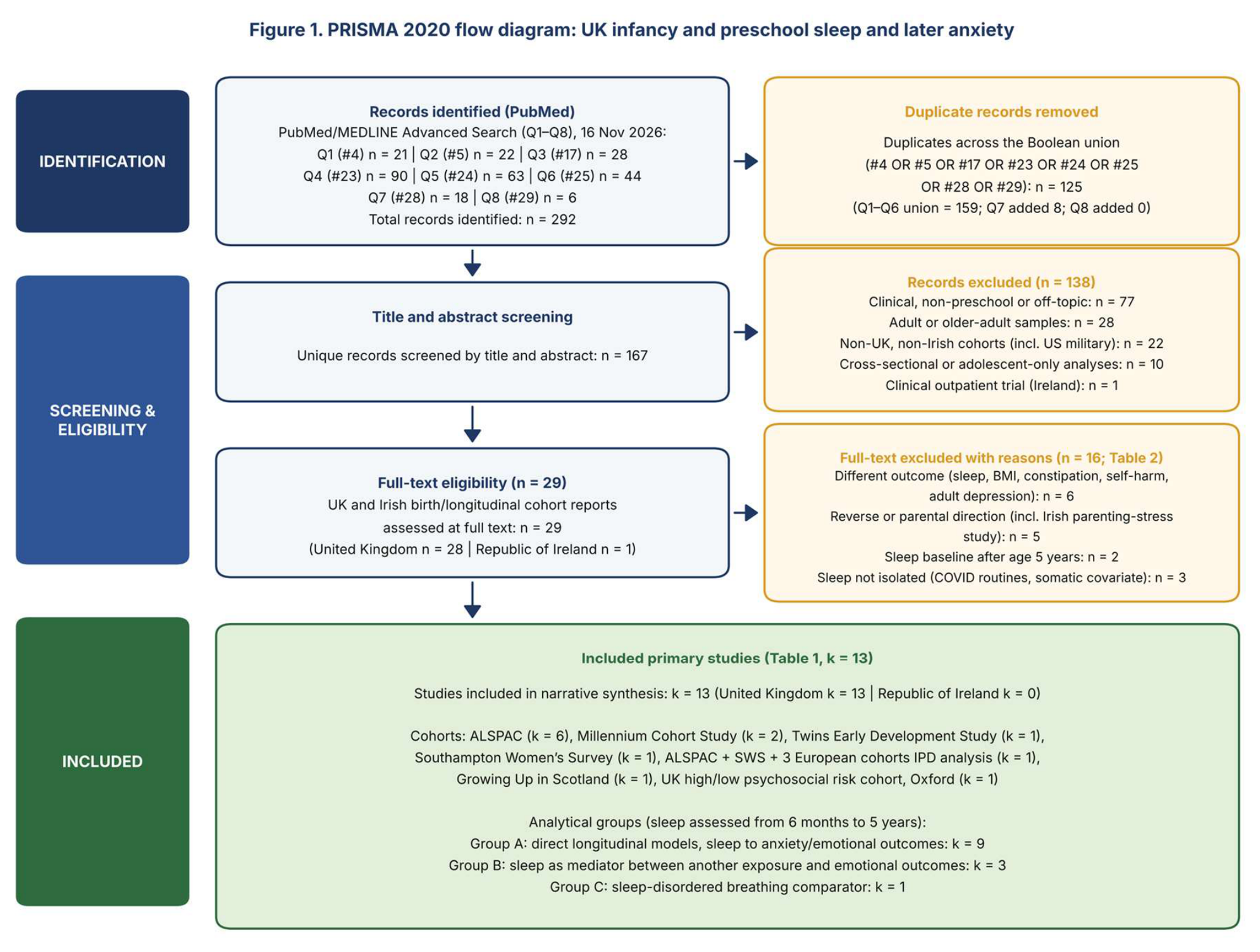
Figure 2.
Standardised effect sizes (Cohen’s d, positive = adverse) of the 16 verified estimates in Table 4, shown without pooling across exposure families. Open circles are unadjusted estimates, filled circles are adjusted estimates, squares are within-age (concurrent) associations. For sleep duration (purple), a negative value indicates fewer problems with longer sleep.
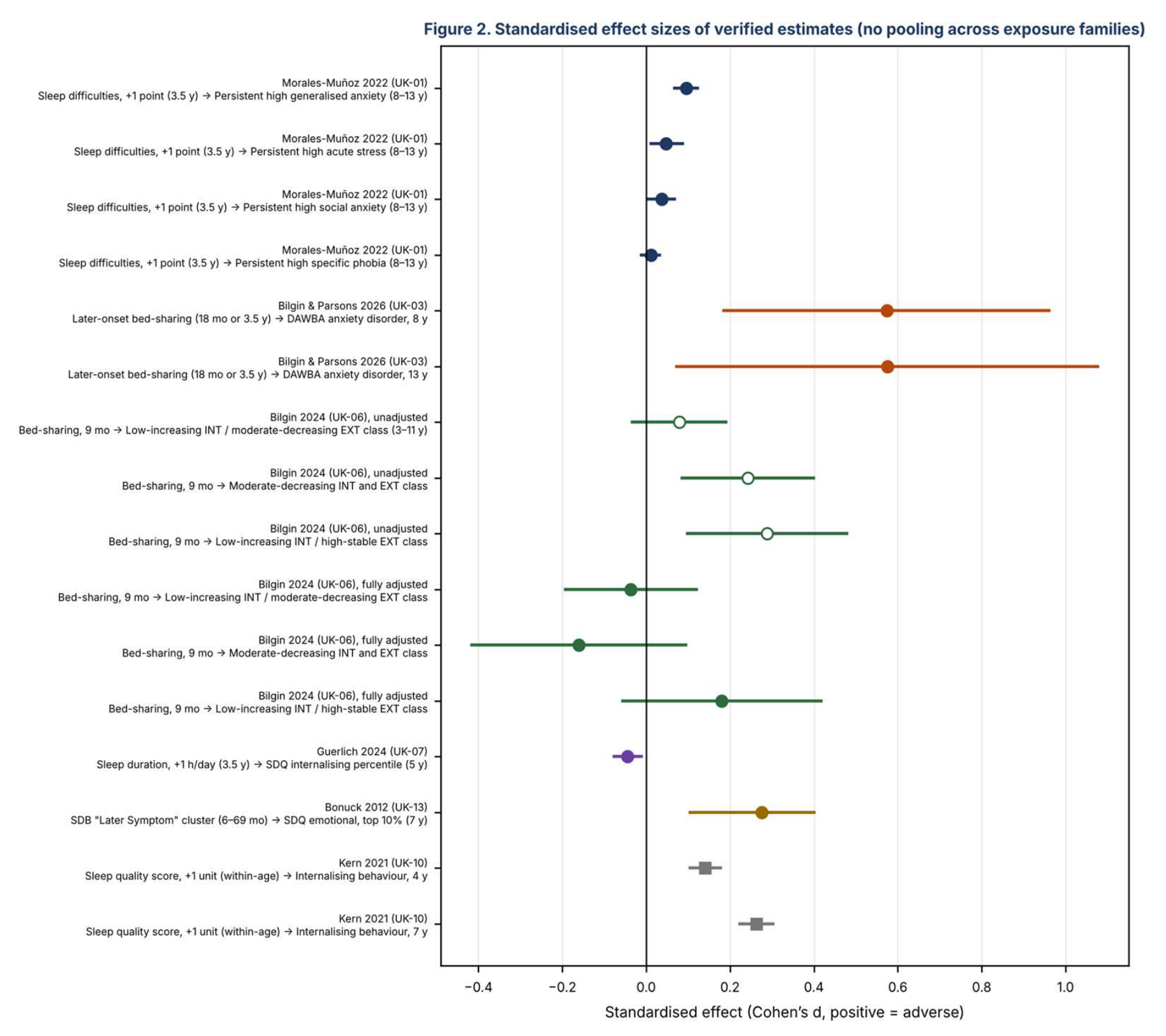
Table 1.
Characteristics of the 13 included studies.
| ID and reference | Cohort (N) | Sleep exposure (age) | Outcome (age) | Model and key findings |
| UK-01 Morales-Muñoz et al. (2022) PMID 37431383 |
ALSPAC (England) N = 8,122 (about 6,100 in risk-factor models) |
3.5 y: parent-reported sleep difficulties (7-item total) | 8, 10, 13 y: DAWBA anxiety symptom trajectories (specific phobia, social, acute stress, generalised) | [A] LCGA plus logistic regression. Per +1 point of sleep difficulty, persistent high generalised anxiety OR 1.19 (1.13–1.25), acute stress 1.09 (1.02–1.17) and social anxiety 1.07 (1.01–1.13); specific phobia 1.02 (0.98–1.06), not significant. High-class sizes: phobia 5.8%, social 3.4%, acute stress 1.9%, generalised 5.4%. |
| UK-02 Tseliou et al. (2024) PMID 38494928 |
ALSPAC (England) N = 8,286 |
Under 4 y: parent-reported sleep difficulties | SDQ-E 4–17 y (7 waves); adult MDD, GAD and self-harm at 21–25 y | [A] LCGA: four SDQ-E trajectories (low 67.0%, decreasing 18.4%, increasing 8.9%, persistent 5.7%). Childhood sleep difficulties were associated with a persistent course. The persistent class had higher adult MDD (RR 2.25, 95% CI 1.49–3.41) and self-harm (RR 1.87, 1.41–2.48). |
| UK-03 Bilgin & Parsons (2026) PMID 42950513 |
ALSPAC (England) N = 7,077 |
6 mo, 18 mo, 3.5 y: maternal-reported bed-sharing | 8 and 13 y: DAWBA anxiety and depressive disorders | [A] Logistic regression with multiple-comparison correction. Later-onset bed-sharing (18 mo or 3.5 y, not 6 mo): anxiety disorder at 8 y, aOR 2.83 (1.40–5.71), significant after correction; at 13 y, aOR 2.84 (1.14–7.04), not significant after correction. Bed-sharing at 6 mo only: no significant association. |
| UK-04 Gregory et al. (2004) PMID 15167091 |
TEDS (England and Wales) >6,000 twin pairs |
3/4 y: parent-reported sleep problems | SDQ anxiety at 3, 4 and 7 y | [A] Twin ACE modelling. Sleep problems at 3/4 y predicted age-7 anxiety (β = 0.12, p < .001) after accounting for stability. Predictive associations were mainly mediated by shared environment (0.16–0.91). |
| UK-05 Kelly et al. (2013) PMID 24127471 |
MCS (UK-wide) N = 10,230 |
3, 5, 7 y: regular versus non-regular bedtimes | 7 y: mother- and teacher-rated SDQ behavioural difficulties (total score) | [A] Cumulative exposure and difference-in-differences models. Mother-rated β = 0.53, 1.04 and 2.10 for non-regular bedtimes at 1, 2 and 3 ages (teacher-rated 0.22, 0.73, 1.85). Moving to regular bedtimes: β = −0.63 (3 to 7 y) and −1.02 (5 to 7 y). |
| UK-06 Bilgin et al. (2024) PMID 39033345 |
MCS (UK-wide) N = 16,599 (8.8% bed-sharers) |
9 mo: bed-sharing in parents’ bed | SDQ internalising and externalising trajectories, 3–11 y (four classes) | [A] Parallel-process LCGA and multinomial regression. Unadjusted OR 1.55 (1.17–2.06) and 1.69 (1.20–2.38) for two elevated classes; after full adjustment 0.75 (0.47–1.19) and 1.39 (0.90–2.13). Bed-sharers had more night waking, higher maternal distress and weaker structured-parenting beliefs. |
| UK-07 Guerlich et al. (2024) PMID 36749392 |
ALSPAC (UK) plus EDEN and ELFE (France), behavioural analyses N = 11,920 |
3.5 y: parent-reported mean daily sleep duration | SDQ internalising and externalising percentiles, 5 y | [A] Two-stage IPD meta-analysis (DataSHIELD, random effects). Per +1 h/day: internalising MD −1.27 (−2.22 to −0.32); externalising MD −2.39 (−3.04 to −1.75). The pooled estimate is not UK-specific. |
| UK-08 Gale et al. (2025) PMID 40799059 |
GUS cohort 1 (Scotland) N = 4,157 |
10 mo–14 y: duration, bedtime, fragmentation, insomnia symptoms | SDQ-E trajectories, 10 mo–14 y | [A] Descriptive trajectory analysis. Sleep fell below recommendations from 8 y and bedtimes became later and more variable at 8–10 y; emotional wellbeing declined at 10–14 y. No sleep-to-emotion association was tested. |
| UK-09 Sheridan et al. (2013) PMID 23337072 |
Oxford high/low-risk cohort (England) | 12 and 18 mo: maternal settling and infant sleep; 5 y: actigraphy and report | 5 y: child anxiety/depression and aggression | [A] Maternal over-involvement in settling predicted less optimal sleep at 5 y. Poorer 5-y sleep was associated with concurrent anxiety/depression and aggression; there was limited evidence that early sleep problems predicted outcomes. |
| UK-10 Kern et al. (2021) PMID 34468686 |
ALSPAC (England) N = 11,181 |
Sleep quality (and duration) as mediators; atopic dermatitis (AD) exposure measured 6 mo–18 y | SDQ-E 4–16 y; SMFQ 10–18 y | [B] Mixed-effects and mediation models. Mild or moderate AD: 29%–84% higher odds of internalising behaviour from 4 y; severe AD: aOR 1.90 (1.14–3.16) and depression aOR 2.38 (1.21–4.72). Sleep quality mediated 11.3% (95% CI 7.0–23.1) at 4 y and 14.7% (8.6–40.2) at 7 y; sleep duration was not associated with internalising behaviour. |
| UK-11 Bao et al. (2025) PMID 40456485 |
ALSPAC (England) Three childhood waves |
Maternal-reported sleep disturbance (bedtime refusal, early waking); 24-h duration | SDQ total difficulties; SMFQ depressive symptoms | [B] Mediation at three timepoints. Sleep disturbance mediated 6.5%–26.7% (SDQ) and 10.9%–14.0% (SMFQ) of the effect of AD; sleep duration mediated under 1%. |
| UK-12 Marsh et al. (2019) PMID 31034663 |
SWS (England) N = 2,576 |
2–3 y: child sleep as mediator of household crowding at 2 y | SDQ total difficulties, 3 y | [B] Linear regression and formal mediation. Crowding: +0.20 SDQ points per 0.2 people per room (95% CI 0.08–0.32), partly mediated by maternal stress, less sleep and strained parent–child interaction. |
| UK-13 Bonuck et al. (2012) PMID 22392181 |
ALSPAC (England) N = 9,140 (4 y); 8,098 (7 y) |
6–69 mo: SDB symptoms (snoring, mouth breathing, witnessed apnoea) | SDQ total and subscales (top 10th percentile), 4 and 7 y | [C] Cluster trajectories and logistic regression (15 confounders). SDB clusters predicted about 20%–100% higher odds of problematic behaviour; the Later Symptom cluster predicted emotional difficulties at 7 y (aOR 1.65, 95% CI 1.21–2.07 as printed). |
Table 3.
Objective parameter extraction by age tier of sleep assessment.
| Age tier and studies | Distinct cohorts and sample sizes (not summed) | Sleep phenotype and assessment | Outcome and follow-up | Model and quantified effect estimate |
| Tier 1: Infancy (6–18 months) k = 4: UK-03, UK-06, UK-09, UK-13 |
MCS (16,599); ALSPAC (7,077–9,140, overlapping samples); Oxford high/low-risk cohort (N not extracted) | Bed-sharing (6, 9 mo); early maternal settling (12, 18 mo); SDB trajectories from 6 mo (parent report; actigraphy only in UK-09 at 5 y) | DAWBA anxiety (8, 13 y); SDQ internalising trajectories (3–11 y); anxiety/depression (5 y); SDQ (4, 7 y) | Infant bed-sharing: unadjusted OR 1.55–1.69 for elevated classes, adjusted OR 0.75–1.39 with all CIs including 1 (UK-06); ALSPAC 6-mo only: not significant (UK-03). Early SDB clusters: about 40%–50% higher odds of behaviour problems at 7 y (UK-13), not specific to emotional outcomes. |
| Tier 2: Toddlerhood (18 months–3 years) k = 4: UK-03, UK-09, UK-12, UK-13 |
ALSPAC (7,077–9,140); SWS (2,576); Oxford high/low-risk cohort | Later-onset bed-sharing (18 mo); toddler sleep duration and adequacy (2–3 y); household crowding as exposure with sleep as mediator; SDB (18, 30 mo) | SDQ total (3 y); anxiety/depression (5 y); DAWBA anxiety (8, 13 y); SDQ (4, 7 y) | Later-onset bed-sharing (18 mo or 3.5 y): aOR 2.83 (1.40–5.71) for anxiety disorder at 8 y (UK-03). Crowding +0.20 SDQ points (0.08–0.32), partly mediated by reduced sleep (UK-12). |
| Tier 3: Preschool age (3–5 years) k = 9: UK-01 to UK-05, UK-07, UK-08, UK-10, UK-11 |
ALSPAC (6,117–11,181); MCS (10,230); TEDS (>6,000 pairs); IPD (ALSPAC, EDEN, ELFE; 11,920); GUS (4,157) | Composite sleep difficulties (3.5 y); bedtime regularity (3, 5, 7 y); daily sleep duration (3.5 y); bedtime refusal and early waking | SDQ-E 3–17 y; SDQ internalising 5 y; DAWBA anxiety 8–13 y; adult MDD/GAD 21–25 y | Consistent adverse direction with modest size: OR 1.07–1.19 per point for three of four persistent anxiety classes (UK-01); β = 0.12 (UK-04); β = 0.53–2.10 for cumulative non-regular bedtimes (UK-05); MD −1.27 percentile points per hour (UK-07); adult MDD RR 2.25 for persistent SDQ-E class (UK-02). UK-08, UK-10 and UK-11 span several ages. |
Table 4.
Verified effect estimates, standardised effect sizes and E-values.
| ID | Study and cohort | Exposure and outcome | Reported estimate (95% CI) | Standardised d (95% CI) | E-value (CI limit) | Design and note |
| A1 | Morales-Muñoz 2022 (UK-01) ALSPAC |
Sleep difficulties, +1 point (3.5 y) → Persistent high generalised anxiety (8–13 y) |
OR 1.19 (1.13–1.25) | 0.10 (0.07 to 0.12) | 1.67 (1.51) | per-unit; adjusted |
| A2 | Morales-Muñoz 2022 (UK-01) ALSPAC |
Sleep difficulties, +1 point (3.5 y) → Persistent high acute stress (8–13 y) |
OR 1.09 (1.02–1.17) | 0.05 (0.01 to 0.09) | 1.40 (1.16) | per-unit; adjusted |
| A3 | Morales-Muñoz 2022 (UK-01) ALSPAC |
Sleep difficulties, +1 point (3.5 y) → Persistent high social anxiety (8–13 y) |
OR 1.07 (1.01–1.13) | 0.04 (0.01 to 0.07) | 1.34 (1.11) | per-unit; adjusted |
| A4 | Morales-Muñoz 2022 (UK-01) ALSPAC |
Sleep difficulties, +1 point (3.5 y) → Persistent high specific phobia (8–13 y) |
OR 1.02 (0.98–1.06) | 0.01 (−0.01 to 0.03) | 1.16 (1.00) | per-unit; adjusted |
| B1 | Bilgin & Parsons 2026 (UK-03) ALSPAC |
Later-onset bed-sharing (18 mo or 3.5 y) → DAWBA anxiety disorder, 8 y |
OR 2.83 (1.40–5.71) | 0.57 (0.19 to 0.96) | 5.11 (2.15) | adjusted; survived correction |
| B2 | Bilgin & Parsons 2026 (UK-03) ALSPAC |
Later-onset bed-sharing (18 mo or 3.5 y) → DAWBA anxiety disorder, 13 y |
OR 2.84 (1.14–7.04) | 0.58 (0.07 to 1.08) | 5.13 (1.54) | adjusted; not significant after correction |
| C1 | Bilgin 2024 (UK-06), unadjusted MCS |
Bed-sharing, 9 mo → Low-increasing INT / moderate-decreasing EXT class (3–11 y) |
OR 1.15 (0.94–1.41) | 0.08 (−0.03 to 0.19) | 1.58 (1.00) | unadjusted |
| C2 | Bilgin 2024 (UK-06), unadjusted MCS |
Bed-sharing, 9 mo → Moderate-decreasing INT and EXT class |
OR 1.55 (1.17–2.06) | 0.24 (0.09 to 0.40) | 2.48 (1.61) | unadjusted |
| C3 | Bilgin 2024 (UK-06), unadjusted MCS |
Bed-sharing, 9 mo → Low-increasing INT / high-stable EXT class |
OR 1.69 (1.20–2.38) | 0.29 (0.10 to 0.48) | 2.77 (1.68) | unadjusted |
| C4 | Bilgin 2024 (UK-06), fully adjusted MCS |
Bed-sharing, 9 mo → Low-increasing INT / moderate-decreasing EXT class |
OR 0.94 (0.70–1.24) | −0.04 (−0.19 to 0.12) | 1.34 (1.00) | fully adjusted |
| C5 | Bilgin 2024 (UK-06), fully adjusted MCS |
Bed-sharing, 9 mo → Moderate-decreasing INT and EXT class |
OR 0.75 (0.47–1.19) | −0.16 (−0.42 to 0.09) | 2.01 (1.00) | fully adjusted |
| C6 | Bilgin 2024 (UK-06), fully adjusted MCS |
Bed-sharing, 9 mo → Low-increasing INT / high-stable EXT class |
OR 1.39 (0.90–2.13) | 0.18 (−0.06 to 0.42) | 2.12 (1.00) | fully adjusted |
| D1 | Guerlich 2024 (UK-07) ALSPAC+EDEN+ELFE |
Sleep duration, +1 h/day (3.5 y) → SDQ internalising percentile (5 y) |
MD −1.27 (−2.22 to −0.32) | −0.04 (−0.08 to −0.01) | n/a | percentile points; pooled IPD |
| E1 | Bonuck 2012 (UK-13) ALSPAC |
SDB “Later Symptom” cluster (6–69 mo) → SDQ emotional, top 10% (7 y) |
OR 1.65 (1.21–2.07) | 0.28 (0.11 to 0.40) | 2.69 (1.71) | CI as printed (asymmetric) |
| F1 | Kern 2021 (UK-10) ALSPAC |
Sleep quality score, +1 unit (within-age) → Internalising behaviour, 4 y |
OR 1.29 (1.21–1.38) | 0.14 (0.11 to 0.18) | 1.90 (1.71) | Concurrent; within-age association |
| F2 | Kern 2021 (UK-10) ALSPAC |
Sleep quality score, +1 unit (within-age) → Internalising behaviour, 7 y |
OR 1.61 (1.50–1.73) | 0.26 (0.22 to 0.30) | 2.60 (2.37) | Concurrent; within-age association |
d = ln(OR) × √3/π; mean differences divided by 28.9 (percentile SD, approximate); positive d is adverse. E-values treat OR as RR; for the SDQ percentile estimate no E-value is shown. Kern et al. (2021) estimates are within-age associations and are not prospective. Bonuck et al. (2012) reported its confidence interval as 1.21–2.07, which is asymmetric on the log scale; it is shown as printed.
Table 5.
Meta-analytic feasibility by exposure family.
| Exposure family | Cohorts with extractable estimates | Independent cohorts | Decision |
| Composite sleep difficulties (3–4 y) to anxiety or emotional outcome | ALSPAC (OR per point, four outcomes); TEDS (standardised β, no CI) | 1 with variance | Not pooled: ALSPAC outcomes are not independent; TEDS has no extractable variance |
| Bedtime regularity (3, 5, 7 y) | MCS (unstandardised β, SDQ total) | 1 | Not pooled |
| Sleep duration, per +1 h at 3.5 y | ALSPAC, EDEN, ELFE already pooled in the IPD analysis | 1 published pooled estimate | Reported as published (MD −1.27); UK-only estimate not extractable |
| Bed-sharing in infancy (6–9 mo) | MCS (adjusted and unadjusted ORs); ALSPAC (6 mo, no OR reported in abstract) | 1 with extractable OR | Not pooled; ALSPAC estimate should be requested from authors |
| Later-onset bed-sharing (18 mo or 3.5 y) | ALSPAC | 1 | Not pooled; replication needed |
| Sleep-disordered breathing (6–69 mo) | ALSPAC | 1 | Not pooled |
| Sleep as mediator (AD, crowding) | ALSPAC (two papers, overlapping); SWS (different exposure) | 1 independent cohort per exposure | Not pooled; mediation proportions reported individually |
Table 6.
Certainty of evidence by exposure family (GRADE, observational evidence).
| Exposure family and outcome | Evidence base | Rated down for | Rated up for | Certainty |
| Composite sleep difficulty (3–4 y) to later anxiety or emotional symptoms | UK-01, UK-02, UK-04 (ALSPAC, TEDS) | Indirectness: specific phobia not associated; SDQ-E is not a diagnostic outcome. Shared environment explained much of the twin association. | None (effects small) | Low |
| Bedtime irregularity (3–7 y) to behavioural difficulties at 7 y | UK-05 (MCS) | Single cohort; outcome is total difficulties, not anxiety. | Dose-response across one to three waves | Low |
| Sleep duration (+1 h at 3.5 y) to internalising percentile at 5 y | UK-07 (ALSPAC, EDEN, ELFE) | Not UK-specific; very small standardised effect (d about −0.04); only about a third of the original sample analysed. | None | Low |
| Infancy bed-sharing (6–9 mo) to later internalising or anxiety | UK-03, UK-06 (ALSPAC, MCS) | Imprecision (adjusted CIs include odds ratios up to 2.1); association adverse before adjustment and null after; different outcomes. | None | Low |
| Later-onset bed-sharing (18 mo or 3.5 y) to anxiety disorder at 8 y | UK-03 (ALSPAC) | Single study; imprecision (CI 1.40–5.71); possible reverse causation; age-13 result not significant after correction. | None | Very low |
| Sleep-disordered breathing (6–69 mo) to SDQ emotional difficulties at 7 y | UK-13 (ALSPAC) | Single cohort; many outcomes tested; confidence interval printed asymmetrically. | None | Very low |
| Sleep as mediator (atopic dermatitis, crowding) to internalising or behavioural difficulties | UK-10, UK-11, UK-12 (ALSPAC, SWS) | Mediation assumptions (no unmeasured mediator–outcome confounding); overlapping ALSPAC samples; total difficulties in two of three studies. | None | Very low |
Disclaimer/Publisher’s Note: The statements, opinions and data contained in all publications are solely those of the individual author(s) and contributor(s) and not of MDPI and/or the editor(s). MDPI and/or the editor(s) disclaim responsibility for any injury to people or property resulting from any ideas, methods, instructions or products referred to in the content. |
© 2026 by the authors. Licensee MDPI, Basel, Switzerland. This article is an open access article distributed under the terms and conditions of the Creative Commons Attribution (CC BY) license (http://creativecommons.org/licenses/by/4.0/).
Copyright: This open access article is published under a Creative Commons CC BY 4.0 license, which permit the free download, distribution, and reuse, provided that the author and preprint are cited in any reuse.