
Submitted:
19 November 2026
Posted:
20 November 2026
You are already at the latest version
Abstract
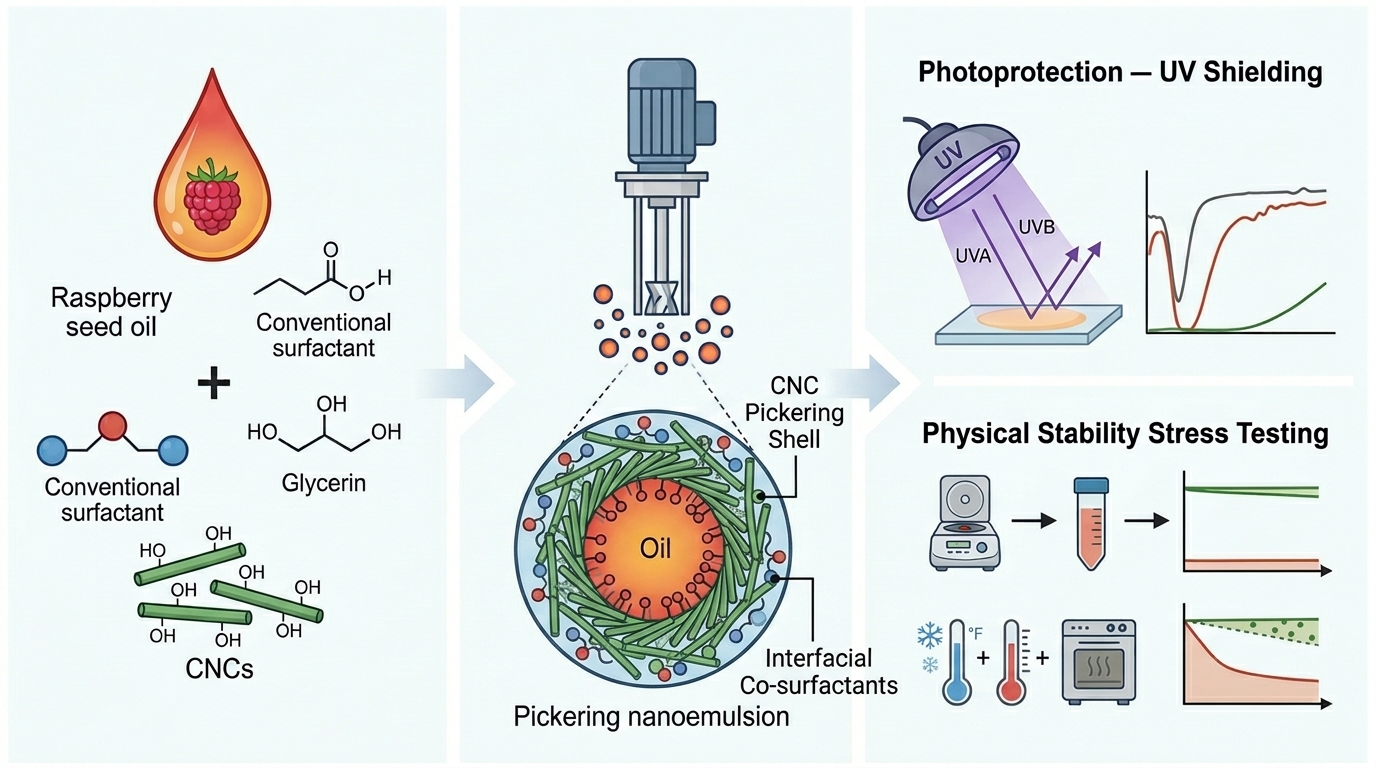
Polysaccharide nanomaterials such as cellulose nanocrystals (CNCs) offer sustainable interfacial stabilization for hydrophobic botanical lipids like raspberry seed oil (RSO). In this study, green oil-in-water Pickering nanoemulsions co-stabilized by CNCs and Tween 80 were formulated and optimized using a factorial experimental design. The effects of RSO, Tween 80, glycerin, and CNC concentrations were systematically evaluated against optical clarity (% transmittance), rheological behavior, pH, stress-induced phase stability, and functional in vitro sun protection factor (SPF). The optimized dispersions exhibited high optical transparency (% transmittance up to 97.75%), confirming nanoscale droplet formation, alongside skin-compatible pH levels (5.61–6.04) and tunable viscosity (192.0–1702.0 mPa·s). Multiple linear regression revealed that RSO significantly enhanced SPF (β = 0.646, p = 0.036), accompanied by a statistically significant synergistic interaction between RSO and CNCs (β = 0.611, p = 0.040; R² = 0.976), achieving a maximum baseline SPF of 6.30 without synthetic UV filters. Stress testing confirmed thermal integrity across heating–cooling cycles, whereas phase separation under mechanical centrifugation and freeze–thaw stress defined clear physical stability boundaries for polysaccharide-stabilized Pickering networks. These findings highlight CNC-assisted Pickering nanoemulsions as effective biopolymer-based carriers for enhancing the stability and photoprotective functionality of botanical bio-oils.
Keywords:
cellulose nanocrystals
; polysaccharide-stabilized Pickering nanoemulsion
; raspberry seed oil
; biopolymer–surfactant co-stabilization
; interfacial stability
; photoprotection
; factorial experimental design
Copyright: This open access article is published under a Creative Commons CC BY 4.0 license, which permit the free download, distribution, and reuse, provided that the author and preprint are cited in any reuse.