

Submitted:
18 November 2026
Posted:
19 November 2026
You are already at the latest version
Abstract
For more than a billion people the daily fast of Ramadan begins at a moment that scripture defines by vision: when a white thread can be told apart from a black one at dawn. We compute this moment from the twilight illuminance and the Adrian visibility model, with its dependence on observer age, and then ask how the sky changes it. Under a clear, moonless, unpolluted sky, threads of 0.3 mm and 1 mm held at 40 cm become distinct at solar depressions of 8° and 12° for a 20-year-old observer and 1–2° later for a 70-year-old. In İstanbul this is 40–60 min before sunrise, against 91 min for the 18° of prayer calendars. A doubling of the twilight brightness moves the threshold by 0.7°–1.5°. Skyglow above about 0.01 lx, or the full and waning gibbous moon, keeps a 1 mm thread distinguishable to a young observer through the hours before dawn; in Ramadan 1448 AH (February–March 2027) this happens on eight of thirty mornings. Thin threads and older eyes are much less sensitive to the night sky. The literal test is therefore a measure of the sky and the observer as much as of the sun.
Keywords:
twilight illuminance
; moonlight
; light pollution
; visibility level
; ageing eye
; human biometeorology
; dawn
1. Introduction
The illuminance of the twilight sky spans six orders of magnitude between sunset and the end of astronomical twilight [1,2,3,4]. Over this range human vision passes from photopic through mesopic to scotopic operation, and many everyday judgements, from reading a road sign to recognising a face, are lost one after another. Few of these judgements carry a timetable. One does.
The Qur’an (al-Baqara 2:187) permits eating and drinking during the nights of Ramadan “until the white thread becomes distinct to you from the black thread of dawn” [5]. The verse sets the start of the fast as a perceptual event. In practice, prayer calendars replace the event by a fixed solar depression angle, most often near 18, the end of astronomical twilight [3]; authorities use values from about 15 to 20 [6]. A substantial observational literature has tried to pin down the angle at which true dawn appears. Naked-eye observers at Tubruq, Libya, placed it near 13.5, and as early as 11.5 in poor visibility [7]; similar values were found in Sinai and Assiut [8]. DSLR photometry in Malaysia gave 14.5–18.5 [9], and a multi-year sky-quality-meter campaign gave about 12–13 [6]. The scatter between campaigns is several degrees, which at mid-latitudes is 15–30 minutes.
These studies measure the glow of dawn on the eastern horizon. Two things have received little attention. First, the literal task of the verse, two threads held in the hand, is a well-posed problem of target visibility that can be solved with the models of lighting engineering [10,11], which rest on the contrast-threshold data of Blackwell [12,13]. Second, any visual criterion responds to the whole night sky, not only to the sun: the moon, skyglow from cities, and the aerosol load all change the light reaching the eye. Because Ramadan follows the lunar month, the moon’s contribution before dawn is not random but runs through a similar sequence every year: absent early in the month, strong around and after the full moon, and absent again at the end.
This paper treats the thread test as a problem in human biometeorology. We compute the solar depression at which the threads become distinct for observers of different ages, and then quantify how that moment depends on twilight brightness, artificial skyglow, the detection criterion and the moon over a real Ramadan.
2. Materials and Methods
2.1. Twilight Illuminance
Horizontal illuminance from scattered sunlight under a clear, moonless sky is taken from the anchor values of the AMS Glossary of Meteorology [1,2,3]: about 495 lx at sunset (range 410–585 lx), lx at 6 depression (2–3.5 lx), lx at 12 and lx at 18. Between anchors, is interpolated linearly in solar elevation h. A floor represents starlight and airglow; for a natural sky we take :
The factor f (default 1) scales the twilight component to represent clearer or more turbid skies (Section 3.2). For solar depressions beyond 18 the twilight term is set to zero. The curve is shown in Figure 1; the kink at 12 comes from the piecewise interpolation.
2.2. Moonlight
The direct illuminance from the moon on a horizontal surface is computed for İstanbul (41.01 N, 28.98 E) with the PyEphem implementation of the lunar ephemeris [14]. The lunar magnitude at phase angle (in degrees) follows Krisciunas and Schaefer [15],
with taken as 180 minus the elongation of the moon from the sun. The illuminance at normal incidence above the atmosphere is lx, where d is the Earth–moon distance and . With an extinction of mag per airmass and the airmass X of Kasten and Young [16], the horizontal illuminance for lunar altitude is
The full moon at 58 altitude gives lx. Moonlight scattered by the sky is neglected, so is a slight underestimate.
2.3. Threads and Visibility Threshold
The white thread has reflectance and the black thread . Both are Lambertian surfaces receiving the horizontal illuminance, , and the black thread is the background. Widths of mm (sewing thread), 1 mm and 3 mm (cord) are viewed at 40 cm, giving angular sizes of 2.6, 8.6 and 25.8 arcmin.
The threshold luminance difference follows the Adrian model [10] for positive contrast and unlimited viewing time,
with Adrian’s three luminance branches (above cd/m2, between 0.00418 and cd/m2, and below cd/m2) and in arcmin. The age factor is
With the threshold corresponds to practically certain detection; gives the 50% laboratory threshold. The visibility level is , and the threads are distinct when . The threshold depression angle is the depression at which VL first reaches 1 on the morning branch.
The Adrian model is defined in photopic luminance, while twilight light is enriched at short wavelengths [4], which favours the rods. As a first estimate we also report thresholds with all luminances multiplied by an effective scotopic-to-photopic ratio .
2.4. Solar Position and the Ramadan Calendar
Solar elevation is computed with the NOAA low-precision ephemeris for the single-day results (24 February 2027) and with PyEphem for the month. Times are Turkish time (TRT, UTC+3), with sunrise at . Ramadan 1448 AH is taken to begin on 8 February 2027, following the astronomical new moon of 6 February 15:56 UT (the actual start depends on crescent sighting). For each morning we scan the night from 00:00 TRT to sunrise in half-minute steps and record the earliest time after which VL stays at or above 1 until sunrise. If VL is at or above 1 from midnight to sunrise, we say that the threads are distinct all night.
3. Results
3.1. Clear, Moonless Sky
Under the reference sky the white thread becomes distinct from the black between 8 and 12 solar depression for thin threads (Table 1, Figure 1 and Figure 2). Thread width matters most. Going from mm to 1 mm lowers the threshold illuminance about 30-fold and moves it about 4 earlier. A 3 mm cord is visible in starlight for observers up to about 57 years old, so for a thick cord the test never marks dawn. Age works in the other direction: a 70-year-old needs 3–6 times more light than a 20-year-old, which costs 1–2 of solar depression, or 5–10 minutes.
The visibility level rises steeply in the last hour before sunrise (Figure 3), so the threshold time is sharply defined even though the threshold illuminance differs by a factor of several between observers. At 18 depression VL is far below 1 for every width under 3 mm and every age. With the rod weighting all thresholds move 0.7–1.8 earlier; for the 1 mm thread they become 13.7 at age 20 and 10.7 at age 70 (68 and 53 min before sunrise).
The detection criterion matters as much as the spectrum. Replacing by the 50% criterion moves the mm thresholds from 8.3 to 9.7 (age 20) and from 7.1 to 8.1 (age 70). For the 1 mm thread at age 20 the shift is larger, from 11.9 to 16.6, because the twilight curve flattens below 12 and a modest change in the required illuminance then costs several degrees.
3.2. Twilight Brightness and Skyglow
Clear-sky twilight illuminance at a given depression varies with aerosol load, humidity and altitude. Scaling the twilight component by a factor f between 0.25 and 4 (Figure 4a) shifts the threshold almost linearly in . Doubling the twilight brightness moves the threshold 0.7 earlier for the mm thread and 0.7–1.5 earlier for the 1 mm thread. The size of the shift is set by the local slope of : about 0.42 decades per degree between 6 and 12, and about 0.19 decades per degree between 12 and 18. Deep in twilight, the same change in sky brightness therefore moves the threshold more than twice as far.
Artificial skyglow acts differently (Figure 4b). As long as stays well below the threshold illuminance it has almost no effect. As it approaches the threshold, the depression angle runs away, and once it exceeds the threshold the threads are distinct all night. For the 1 mm thread this happens at for a 20-year-old and lx for a 70-year-old; for the mm thread it needs about lx and lx. Light-polluted skies flatten the twilight curve and remove its darkest part [4], so under bright city skies a young observer can pass the literal test with a 1 mm thread at any hour.
3.3. Moonlight over Ramadan 1448
Because the fast follows the lunar month, the moon’s contribution before dawn follows a pattern (Figure 5). At the moment of 18 solar depression the moon is above the horizon only from the 12th to the 25th morning of Ramadan 1448 (19 February to 4 March 2027). Its direct illuminance at that moment peaks at lx on the 15th morning, when the moon, just past full (21 February, 02:23 TRT), is low in the west. Around local midnight the full moon stands high and gives up to lx.
For a 20-year-old with a 1 mm thread (threshold lx) the effect is decisive. In the first week the moon has set by midnight and plays no role. From the 8th to the 12th night the waxing gibbous moon keeps the threads distinct after midnight, until 00:42 on the 8th night and 05:52 on the 12th, when it sinks towards the horizon. A dark interval follows, shrinking from six hours to one, and the dawn threshold arrives at its usual time. On mornings 13 to 17 there is no dark interval: the threads are distinct from midnight to sunrise. On mornings 18, 19 and 20 they become distinct at 00:47, 02:32 and 05:10, as the waning moon climbs, and stay so until sunrise; this is about 420, 310 and 150 minutes before sunrise. On the 21st and 22nd mornings moonlight still advances the threshold, by 11 and 5 minutes. Altogether, eight of thirty mornings give a “dawn” earlier than the 18 calendar time, and five of them give no dawn at all.
Older eyes and thinner threads are less affected, but not immune. For the 1 mm thread at age 70 (threshold lx) the high moon makes the threads distinct after midnight on six nights (mornings 11 to 16), until between 02:23 and 06:05. The moon is then too low, a dark interval of 54 minutes or more follows, and the dawn threshold moves by no more than three minutes. For the mm thread at age 20 (threshold lx) even the high full moon is not enough, and moonlight shifts the threshold by less than a minute. On the moonless mornings the thresholds lie 58.5–61 min ( 1 mm, age 20), 48.5–50.5 min ( 1 mm, age 70) and 39–41 min ( mm, age 20) before sunrise, against about 91–93 min for 18.
4. Discussion
4.1. What the Threshold Measures
A fixed depression angle treats dawn as a property of the sun alone. A visual criterion does not. The results above show four quantities that move the moment of visibility by degrees: target size, the observer’s age, the brightness of the twilight sky and the brightness of the night sky behind it. The last enters in a strongly nonlinear way. Moonlight or skyglow has no effect until it nears the threshold illuminance, and then it decides the outcome completely. A young observer with a thread of ordinary thickness, under a bright moon or a bright city sky, passes the test long before any twilight begins.
This bears on the observational literature, where reported dawn angles range from about 12 to 20 [6,7,9]. The horizon glow studied there is a different target from our threads, an extended low-contrast band seen by a dark-adapted eye, but it is subject to the same influences. Campaigns that differ in observer age, moon phase, aerosol load and local skyglow should be expected to disagree by several degrees even if every observation is careful. Recording these four quantities alongside each observation would make the campaigns comparable.
4.2. Literal and Horizon Readings
Classical exegesis did not read the threads literally. In the hadith of ‘Adī ibn Ḥātim [17], the companion put a white and a black thread under his pillow, looked at them through the night and could not tell them apart; he was told that the threads are the darkness of night and the whiteness of day, that is, the band of dawn on the horizon against the dark sky above it. Our calculation is consistent with his experience. Indoors and at night, the illuminance on the threads lies orders of magnitude below the thresholds of Table 1. It also shows the opposite failure: outdoors under a bright moon, or under a modern city sky, a young observer with a 1 mm thread passes the test long before dawn.
4.3. Ageing Observers
Older eyes need more light because of lens yellowing, smaller pupils and greater intraocular scatter, which the Adrian age factor summarises. For a perceptual criterion the onset of the fast is in principle later for an older observer. The older observer is also harder to mislead: in our month the 70-year-old always has a dark interval before dawn, even at full moon. Fixed-angle calendars remove the observer by design.
4.4. Limitations
The twilight curve is a four-anchor clear-sky model, and the factor f is a uniform scaling rather than a radiative-transfer calculation; real aerosol changes also alter the shape of the curve and its colour. The moonlight model omits light scattered by the sky and uses a single extinction coefficient. Clouds are not considered. The Adrian model assumes a uniform background and foveal viewing; at the lowest levels, peripheral rod vision may do better, and the single ratio ignores the change of the twilight spectrum with depression and of lens transmittance with age. The results are for İstanbul; at other latitudes the moonless threshold angles carry over directly and the times scale with the duration of twilight, while the moonlight pattern depends on latitude and season.
5. Conclusions
Read literally, the thread criterion is met at about 8–12 solar depression under a clear, dark, moonless sky, 40–60 minutes before sunrise in İstanbul, and not at the 18 of prayer calendars. Older observers see the distinction 1–2 later. A factor of two in twilight brightness moves the threshold by 0.7–1.5. Moonlight and skyglow have little effect until they approach the threshold illuminance, at about lx for a 1 mm thread and a young observer, and then make the threads distinct all night. In Ramadan 1448 this happens on five mornings and advances the result before the 18 time on three more. A visual dawn criterion is therefore as much a measurement of the sky and the observer as of the sun’s depression, and observational dawn campaigns should report moon phase, skyglow and observer age with each sighting.
Supplementary Materials
The following supporting information can be downloaded at the website of this paper posted on Preprints.org.
Funding
This research received no external funding.
Institutional Review Board Statement
Not applicable.
Informed Consent Statement
Not applicable.
Data Availability Statement
The Python code that produces all results and figures is provided as Supplementary Material.
Acknowledgments
During the preparation of this manuscript the author used Claude (Anthropic), which, under the author’s direction, wrote and ran the Python code for the calculations, designed the figures, and drafted and edited the text. The research question is the author’s; the extension of the analysis to moonlight, skyglow and twilight brightness arose in discussion with Claude. ChatGPT (OpenAI), Jenni AI and Grammarly were also used for calculations, figure design and English-language improvement. The author takes full responsibility for the content of this publication.
Conflicts of Interest
The author declares no conflicts of interest.
References
- American Meteorological Society. Glossary of Meteorology, “Civil twilight”.
- American Meteorological Society. Glossary of Meteorology, “Nautical twilight”.
- American Meteorological Society. Glossary of Meteorology, “Astronomical twilight”.
- Spitschan, M.; Aguirre, G. K.; Brainard, D. H.; Sweeney, A. M. Variation of outdoor illumination as a function of solar elevation and light pollution. Sci. Rep. 2016, 6, 26756. [Google Scholar] [CrossRef] [PubMed]
- The Qur’an. Sūrat Al-Baqara 2, 187.
- Ramza, H.; Sari, Z.; Bunyamin, B.; Saksono, T.; Md Khir, M. H. Towards the compilation of the global twilight pattern. Ulum Islam. 2021, 33(1), 71–83. [Google Scholar] [CrossRef]
- Hassan, A. H.; Abdel-Hadi, Y. A.; Rahoma, U. A.; Issa, I. A. Naked eye estimates of morning prayer at Tubruq of Libya. Al-Hilāl J. Islam. Astron. 2021, 3(2). [Google Scholar] [CrossRef]
- Hassan, A. H.; Issa, I. A.; Mousa, M.; Abdel-Hadi, Y. A. Naked eye determination of the dawn for Sinai and Assiut of Egypt. NRIAG J. Astron. Geophys. 2016, 5, 9–15. [Google Scholar] [CrossRef]
- Bahali, K.; Samian, A. L.; Muslim, N.; Abdul Hamid, N. S. Measuring the sun depression angle of dawn with a DSLR camera. Sains Malays. 2018, 47, 2877–2885. [Google Scholar] [CrossRef]
- Adrian, W. Visibility of targets: model for calculation. Light. Res. Technol. 1989, 21, 181–188. [Google Scholar] [CrossRef]
- Kline, A.; Kline, D.; Kline, T. The Adrian/CIE visibility model: a visibility level calculator and future research. J. Sci. Technol. Light. 2020, 44. [Google Scholar] [CrossRef]
- Blackwell, H. R. Contrast thresholds of the human eye. J. Opt. Soc. Am. 1946, 36, 624–643. [Google Scholar] [CrossRef] [PubMed]
- Crumey, A. Human contrast threshold and astronomical visibility. Mon. Not. R. Astron. Soc. 2014, 442, 2600–2619. [Google Scholar] [CrossRef]
- Rhodes, B. C. ascl:1112.014; PyEphem: astronomical ephemeris for Python, version 4.2. Astrophysics Source Code Library.
- Krisciunas, K.; Schaefer, B. E. A model of the brightness of moonlight. Publ. Astron. Soc. Pac. 1991, 103, 1033–1039. [Google Scholar] [CrossRef]
- Kasten, F.; Young, A. T. Revised optical air mass tables and approximation formula. Appl. Opt. 1989, 28, 4735–4738. [Google Scholar] [CrossRef] [PubMed]
- Ṣaḥīḥ al-Bukhārī, Book of Fasting, no. 1916; see also nos. 4509–4510; Ṣaḥīḥ Muslim 1090; Sunan Abū Dāwūd 2349
Figure 1.
Clear-sky horizontal illuminance versus sun depression angle (solid black), with the threshold illuminances for a mm (red) and 1 mm (blue) thread at ages 20 (thick dashed) and 70 (thin dashed). Dotted green: natural night-sky floor. The thread becomes distinct where the solid curve crosses each dashed line.
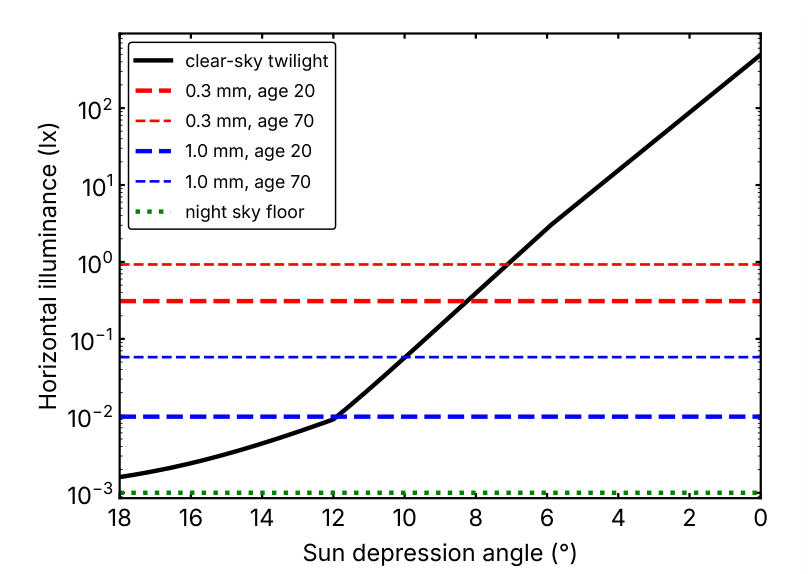
Figure 2.
(a) Illuminance required to distinguish a white thread from a black one at 40 cm versus observer age, for widths of mm (black), 1 mm (red) and 3 mm (blue); dashed green: moonless natural night sky. (b) Corresponding sun depression angle; dashed lines mark 18 and 15. The 3 mm curve is pinned at 18 where the cord is already visible in the night sky.
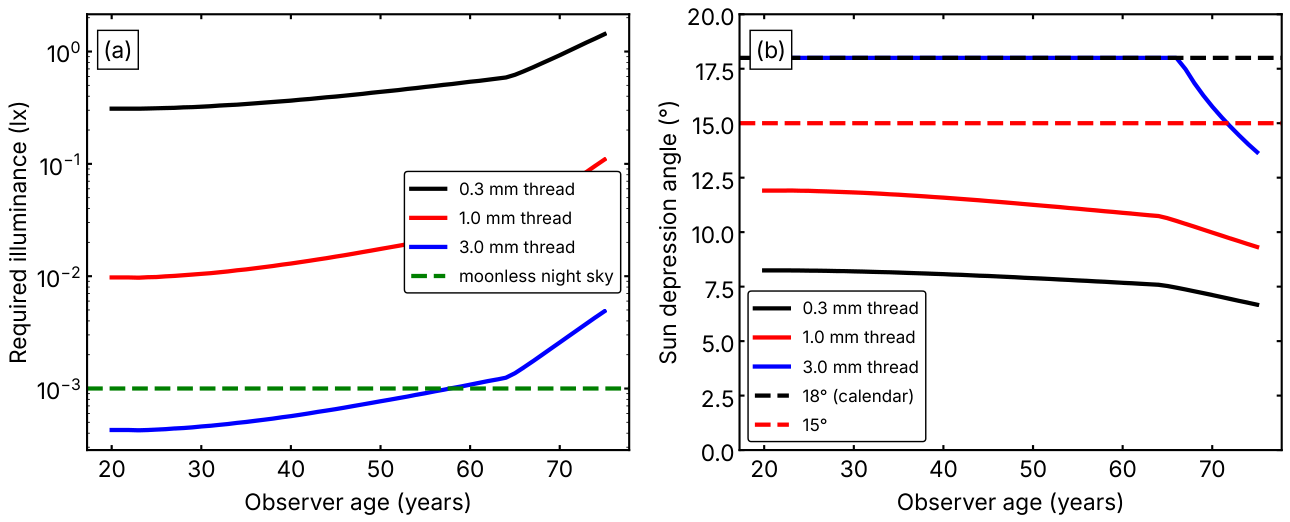
Figure 3.
Visibility level of the white thread against the black versus minutes before sunrise, İstanbul, 24 February 2027, moonlight excluded, for ages 20, 40, 60 and 70. (a) mm thread. (b) 1 mm thread. Dashed black: . Dashed red: 18 depression.
Figure 3.
Visibility level of the white thread against the black versus minutes before sunrise, İstanbul, 24 February 2027, moonlight excluded, for ages 20, 40, 60 and 70. (a) mm thread. (b) 1 mm thread. Dashed black: . Dashed red: 18 depression.
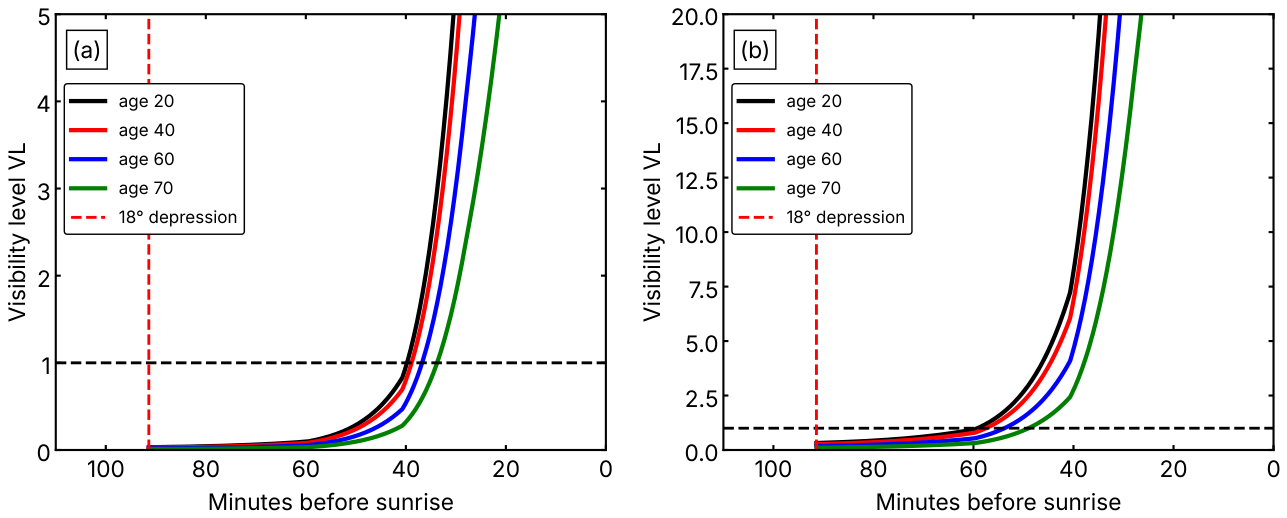
Figure 4.
Sun depression at which the threads become distinct. (a) Versus a factor f multiplying the clear-sky twilight illuminance, representing clearer () or brighter () twilight. (b) Versus the night-sky illuminance floor from starlight, airglow and artificial skyglow; dashed: natural value lx. Curves end where the threads are distinct all night.
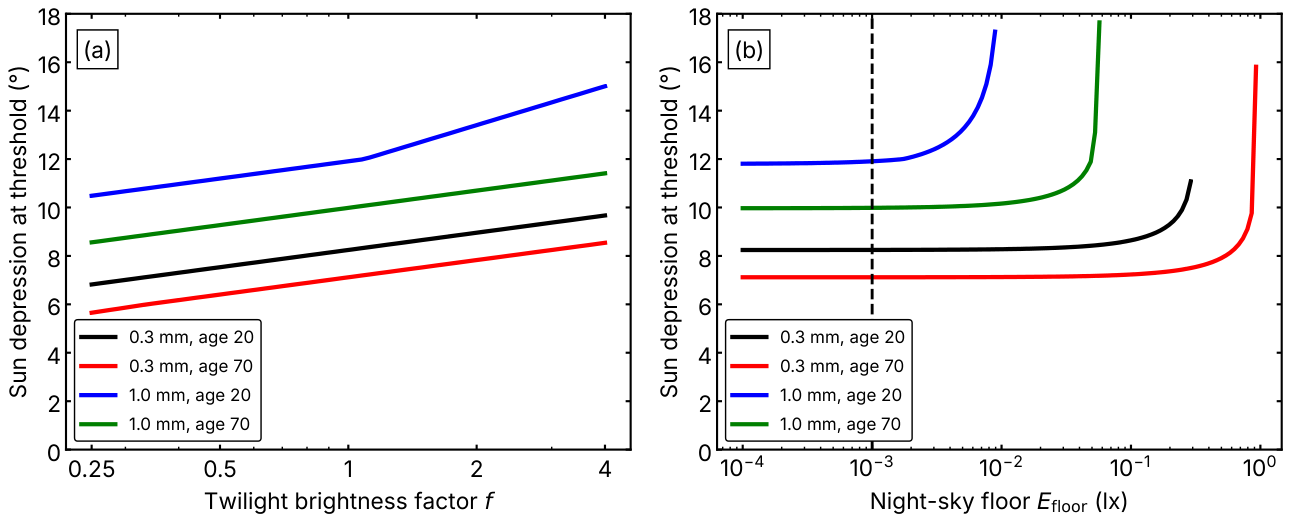
Figure 5.
Moonlight over Ramadan 1448 in İstanbul. (a) Direct horizontal illuminance from the moon at the moment of 18 solar depression (points only on mornings with the moon above the horizon), with the threshold illuminances (dashed; same colours as in (b)). (b) Minutes before sunrise after which the threads stay distinct until sunrise, with moonlight (solid) and without (dashed, largely hidden behind the solid curves), for a 1 mm thread at ages 20 and 70 and a mm thread at age 20. Curves at the top edge: distinct from midnight to sunrise. Dashed green: 18 depression.
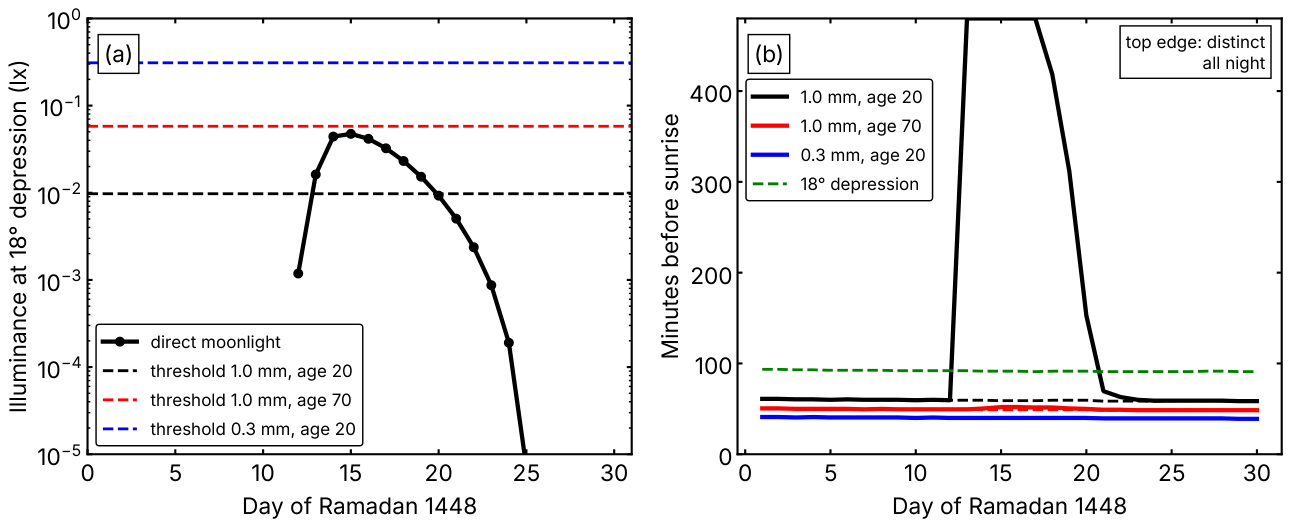

Table 1.
Threshold illuminance, solar depression and time before sunrise at which the white thread becomes distinct from the black. Photopic Adrian model (), clear moonless sky with , threads at 40 cm; İstanbul, 24 February 2027, sunrise 07:46 TRT. At 18 depression the time is 91 min before sunrise (06:15), at 15 it is 76 min (06:31).
| Width (mm) | Age (yr) | (lx) | Depression (°) | Min. before sunrise | Time (TRT) |
|---|---|---|---|---|---|
| 0.3 | 20 | 0.31 | 8.3 | 40 | 07:06 |
| 0.3 | 40 | 0.37 | 8.1 | 39 | 07:07 |
| 0.3 | 60 | 0.54 | 7.7 | 37 | 07:09 |
| 0.3 | 70 | 0.93 | 7.1 | 34 | 07:12 |
| 1.0 | 20 | 0.0097 | 11.9 | 59 | 06:47 |
| 1.0 | 40 | 0.013 | 11.6 | 58 | 06:48 |
| 1.0 | 60 | 0.025 | 10.9 | 54 | 06:52 |
| 1.0 | 70 | 0.058 | 10.0 | 49 | 06:57 |
| 3.0 | 20–57 | visible at night | – | – | |
| 3.0 | 70 | 0.0026 | 15.8 | 80 | 06:26 |
Disclaimer/Publisher’s Note: The statements, opinions and data contained in all publications are solely those of the individual author(s) and contributor(s) and not of MDPI and/or the editor(s). MDPI and/or the editor(s) disclaim responsibility for any injury to people or property resulting from any ideas, methods, instructions or products referred to in the content. |
© 2026 by the authors. Licensee MDPI, Basel, Switzerland. This article is an open access article distributed under the terms and conditions of the Creative Commons Attribution (CC BY) license (http://creativecommons.org/licenses/by/4.0/).
Copyright: This open access article is published under a Creative Commons CC BY 4.0 license, which permit the free download, distribution, and reuse, provided that the author and preprint are cited in any reuse.