

Submitted:
18 November 2026
Posted:
19 November 2026
You are already at the latest version
Abstract
The explicit teaching of critical thinking (CT) provides modest, uneven gains with limited transfer beyond the contexts in which it is taught. The authors argue that part of this difficulty is understanding how the different components involved in CT interact. The dominant frameworks describe CT as a set of cognitive skills, sometimes with dispositions added, without specifying how the components depend on one another. We propose a different framework, a layered model in which CT is an emergent, whole-system capacity: 1) intrapersonal foundations (for example emotion regulation and tolerance for ambiguity), 2) epistemic competencies (for example intellectual humility and open-mindedness), 3) cognitive subskills (for example analysis and inference), and 4) a composite layer at which CT is expressed and observable. The model predicts that weakness in any of the supporting layers will make critical reasoning fragile when stakes are emotional, social or identity-relevant, even when the subskills are intact. This offers a testable explanation for poor transfer and for the gap between demonstrated and authentic critical reasoning. Generative AI can now perform many of the operations that CT instruction and assessment emphasize, making the issue more pressing. Offloading may reduce the practice that builds these layers, and may also produce what we term confidence-by-proxy: mistaking fluent GenAI output for one’s own understanding. The authors outline implications for instruction, assessment and GenAI literacy, and then set out a research agenda. Research should begin with testing layer-specific interventions against skills-only instruction.
Keywords:
critical thinking
; layered model
; cognitive subskills
; executive function
; generative artificial intelligence (GenAI)
Introduction
An Inflection Point
Artificial intelligence is not only a theoretical future consideration; it is here now, shaping how students write, professionals analyze information, and how everyday people interpret claims and arguments. Algorithmically curated content, deepfakes, and fluent AI-generated explanations can complicate judgments about credibility and evidence (Danry et al., 2024; Noels et al., 2024). In modern society, evaluating claims, including one's own, has become increasingly consequential for civic, professional, and personal decision-making (Brisson-Boivin & Johnson, 2024; Kavanagh & Rich, 2018).
The Capacity that Matters Most Right Now
Critical thinking (CT) has long been recognized as an important educational objective (Pithers & Soden, 2000). What has changed is that many operations emphasized in CT curricula and assessments, such as interpreting text, analyzing arguments, drawing inferences, evaluating evidence, and explaining conclusions, can now be generated rapidly and fluently by contemporary GenAI systems (Creely, 2026). If CT education develops only these observable subskills, it risks mistaking performative critical thinking for authentic critical thinking. the field intends to cultivate.
This is not a claim that GenAI possesses critical thinking. Rather, GenAI provides a diagnostic contrast: its ability to reproduce many observable reasoning operations commonly associated with CT highlights that these operations, while necessary, may not be sufficient to define authentic human CT.
Current Understanding is Theoretically Inadequate
The central claim of this paper is that prevailing accounts of CT remain theoretically incomplete when they privilege observable reasoning performance without adequately specifying the intrapersonal and epistemic conditions that make such reasoning reliable across contexts. The longstanding transfer problem therefore may reflect not only instructional limitations but also limitations in how CT has been conceptualized (Perkins et al., 1993). The authors contend that the existing models already contain dispositions, metacognition, and intellectual competencies but insufficiently specify the relationships among their components. Connecting Facione’s (1990) cognitive layer to these intrapersonal and epistemic conditions may minimize the instructional and assessment limitations impacting CT transfer.
Problem Statement: Theory, Not Implementation
A common response to persistent CT difficulties is to call for better instruction, more practice, or more explicit transfer pedagogy (Halpern, 1998; Abrami et al., 2015). Those responses matter, but our argument is more fundamental: a conception of CT centered primarily on cognitive skills is insufficient to explain why capable reasoners often fail to use those skills when evidence is ambiguous, identity-relevant, or emotionally costly.
A Better Way is Possible and Necessary
This paper offers a constructive alternative: a layered model of CT as an emergent, whole-system capacity rather than a checklist of teachable operations. Consistent with broader arguments for human-centered education in the AI era, the model emphasizes metacognitive, adaptive, and self-regulatory capacities alongside technical reasoning skills (Luckin, 2025). The central question is therefore not what GenAI threatens, but what authentic human critical thinking requires.
Research Questions
This paper addresses two related questions:
To what extent do prevailing skills-based theories of critical thinking adequately explain persistent challenges in critical thinking research?
- How does a layered, emergent model of critical thinking provide a more theoretically complete explanation for the development, expression, and failure of authentic critical thinking?
The remainder of this paper reviews how CT has been defined, taught, and assessed, identifies a gap in the existing literature that it cannot explain, and presents the layered model in detail, along with its dependency structure. We will also explain how a new model can address what existing frameworks cannot provide, what the GenAI context reveals, and what needs to change in practice, assessment, and research. Further in the paper, we address limitations and likely objections.
Background and Literature Review
Critical Thinking Defined
For decades, critical thinking (CT) has been regarded as one of the central tenets of education (Pithers & Soden, 2000). Early philosophical work framed CT as a form of reflective judgment grounded in the evaluation of arguments and evidence (Dwyer, Hogan, & Steward, 2014). Pithers and Soden (2000) view critical thinking as a combination of abilities and dispositions used in “identifying a problem and its associated assumptions; clarifying and focusing the problem; and analyzing, understanding and making use of inferences, inductive and deductive logic, as well as judging the validity and reliability of the assumptions, sources of data or information available” (p. 239).
An early theorist of CT, Robert Ennis (1985), defined critical thinking as "reasonable reflective thinking that is focused on deciding what to believe or do" (p. 46). This definition became widely influential in both research and classroom practice. Siegel (1988) argued that critical thinking requires more than reasoning ability alone; it also demands the disposition to be guided by good reasons, linking cognitive competence with intellectual character, what he referred to as critical spirit. A potentially unresolved debate among educators emerged during this period over whether CT is a generalizable, domain-general skill that transfers across contexts or is inherently domain-specific and inseparable from subject-matter expertise. McPeck (1981) argued that critical thinking is largely embedded within disciplinary knowledge and therefore cannot be taught as an abstract, transferable skill independent of subject matter. By contrast, Ennis (1985, 2018) maintained that many reasoning processes, including argument evaluation, logical inference, and evidence appraisal, can be cultivated across domains, even while acknowledging the importance of domain-specific knowledge. Although these perspectives diverge on the question of transfer, they share a common theoretical assumption: both conceptualize critical thinking primarily at the level of cognitive reasoning skills. We argue that this shared assumption has remained largely unexamined. Historical efforts to resolve this disagreement culminated in the Delphi Report, formally titled Critical Thinking: A Statement of Expert Consensus for Purposes of Educational Assessment and Instruction (Facione, 1990). The Delphi Report was the product of a multi-round Delphi method study led by Facione, involving 46 experts in critical thinking drawn from philosophy, psychology, and education, who participated in six rounds of questionnaires designed to converge on a shared definition and framework. The resulting consensus defined critical thinking as:
Purposeful, self-regulatory judgment which results in interpretation, analysis, evaluation, and inference, as well as explanation of the evidential, conceptual, methodological, criteriological, or contextual considerations upon which that judgment is based" (Facione, 1990, p. 3).
Core Cognitive Critical Thinking Skills
The Delphi Report (Facione, 1999) identified six core cognitive skills as central to critical thinking: interpretation, analysis, evaluation, inference, explanation, and self-regulation—alongside a complementary set of dispositions characteristic of the "ideal critical thinker." These dispositions include habitual inquisitiveness, being well informed, trust in reason, open-mindedness, flexibility, fair-mindedness in evaluation, honesty in confronting personal biases, prudence in judgment, willingness to reconsider, clarity about issues, orderliness in addressing complex problems, diligence in seeking relevant information, and persistence in pursuing conclusions that are as precise as the evidence and context permit (Facione, 1990). This dual structure of cognitive skills coupled with intellectual dispositions became the dominant conceptual framework for critical thinking and has shaped much of the subsequent literature on critical thinking instruction, assessment, and curriculum design (Facione, 1990; Facione, 2023; Halpern, 1998, 2014; Paul & Elder, 2012).
Halpern (1998) argued that teaching CT effectively requires attention not only to cognitive skill but to learners' willingness to apply those skills across contexts. Paul and Elder (2012) developed an influential framework emphasizing intellectual standards (clarity, accuracy, precision, relevance, depth, breadth, logic, significance, and fairness) and intellectual virtues (humility, courage, empathy, autonomy, integrity, perseverance, confidence in reason, and fair-mindedness) as necessary conditions for disciplined reasoning. They offered a pointed critique of education systems that fail to cultivate these traits systematically.
Later, a parallel line of scholarship pushed the field toward developmental and metacognitive research. Kuhn (1999) proposed a developmental model in which critical thinking matures through the increasingly sophisticated coordination of evidence, theory, and argument, with metacognitive awareness, the capacity to reflect on and regulate one's own reasoning, as the engine of that progression. Dwyer and colleagues (2014) proposed an integrated framework that situates self-regulatory metacognition and reflective judgment alongside critical thinking skills. Around the same time, work on epistemic cognition began to treat open-mindedness itself as a measurable disposition. For example, Stanovich and West (1997) demonstrated that the tendency to reason independently of prior belief, which they termed actively open-minded thinking, predicts reasoning performance independent of cognitive ability. More recent work by Muis and colleagues (2021) has shown that epistemic emotions and epistemic cognition jointly predict critical thinking about a socio-scientific issue (genetically modified foods).
Even as the field expanded from a narrow skills-only account toward skills-plus-dispositions, it has continued to conceptualize critical thinking as an assemblage of various identifiable components. We refer to this as an additive model, in which critical thinking is treated as a collection of cognitive skills and intellectual dispositions that can, in principle, be specified and taught (Facione, 1990, 2023; Halpern, 1998, 2014; Paul & Elder, 2012). Even the most comprehensive frameworks decompose critical thinking into constituent skills, standards, dispositions, or intellectual virtues rather than conceptualizing it as an emergent capacity arising from hierarchically dependent conditions. The field has likewise never fully resolved the long-standing debate over whether critical thinking is fundamentally domain-general or domain-specific (McPeck, 1981; Ennis, 1985, 2018). We argue that this persistent disagreement reflects a deeper, largely unexamined assumption shared across these perspectives: that critical thinking fundamentally resides at the level of cognitive reasoning skills rather than emerging from the coordinated interaction of intrapersonal foundations, epistemic competencies, and cognitive skills.
Critical Thinking Instruction and Assessment
Following the work of the named CT theorists, instructional approaches have historically placed substantial emphasis on the explicit development of observable cognitive skills and reasoning strategies, including argument analysis, evaluation, inference, problem solving, and metacognitive monitoring (Abrami et al., 2008, 2015; Halpern, 1998). Critical thinking instruction has generally followed several approaches: it may be taught explicitly as a general set of reasoning skills, embedded within disciplinary content, or taught through combinations of explicit and discipline-specific instruction (Abrami et al., 2015; Ennis, 1989). Meta-analytic evidence from Abrami et al. (2008, 2015) suggests that critical thinking can be improved through instruction and that approaches incorporating explicit attention to critical thinking objectives are particularly beneficial.
Instructional approaches to CT have emphasized observable skills, as have many CT assessments. Both the Delphi Report (Facione, 1990) and its most influential downstream instrument, the California Critical Thinking Skills Test (CCTST) developed by Facione and Facione (1992), stand as examples of this. The CCTST, developed by Facione and Facione (1992) through a Delphi consensus, is a standardized, multiple-choice assessment of critical thinking among college students and adults. It consists of 34 items, administered in 45 minutes, and reports scores on analysis, inference, and evaluation subscales (Erwin, 2000). Overall and subscale scores support program evaluation and assessment of instructional outcomes and curricular impact over time (Erwin, 2000).
The CCTST is instructive because it is a well-constructed operationalization of the Delphi consensus definition of critical thinking. The Delphi Report defines critical thinking largely in terms of six cognitive subskills, as the most influential downstream assessment which almost exclusively measures that layer. A companion instrument, the CCTDI (Facione et al., 1994), was developed to measure dispositions such as truth-seeking and open-mindedness. No widely used, validated instrument adequately measures what we describe below as epistemic competencies as active regulatory mechanisms, rather than static self-report traits or intrapersonal foundations at all.
Assessment practices can strongly influence instructional priorities and what students learn to value (Au, 2007), although these effects are also shaped by curriculum expectations, teacher beliefs, and institutional context. When CT assessment concentrates primarily on cognitive subskills, instruction and reinforcement may likewise gravitate toward those subskills, even where programs endorse broader conceptions of CT. This relationship between definition, assessment, and instruction is central to our argument: prevailing assessment traditions may operationalize only part of the broader capacity that authentic CT requires.
The Transfer Problem
Decades of research document that CT skills taught in one context frequently fail to transfer reliably to others (Barnett & Ceci, 2002; Halpern, 1998; Perkins & Salomon, 1992). A student may reason soundly within a structured math or logic classroom and fail to apply comparable rigor to a sociopolitical controversy, a workplace decision, or a claim encountered on social media. The field has largely treated this as an implementation problem, assuming we simply need to teach transfer more explicitly and provide more varied practice contexts. We suggest an alternative explanation: transfer failure may be a symptom of operationalizing an incomplete (or incorrect) theory of CT, rather than a problem of pedagogy alone. Skills may fail to transfer not because they were taught badly, but because true demonstrations of CT do not, in fact, live entirely at the skill level. If that is correct, transfer failure is not evidence of an implementation gap. It is evidence of the field's fundamentally incomplete CT operating model.
Gap Between Performance and Authentic Reasoning
A second, related gap concerns the difference between performatively demonstrating CT skills and authentically exercising them. Strong analytic performance does not necessarily translate into genuine belief revision, open inquiry, or sustained intellectual engagement. Research on motivated reasoning, confirmation bias, and identity-protective cognition suggests that these processes can persist even among individuals with strong analytical abilities (Kunda, 1990; Taber & Lodge, 2006; Kahan et al., 2017; Drummond & Fischhoff, 2017). At the same time, analytical thinking can improve the accuracy of reasoning and support more reflective judgment in many contexts. The issue, therefore, is not that analytic skill is ineffective, but that merely demonstrating such skill alone may be insufficient evidence that CT is being authentically exercised.
The ability to think critically is increasingly important in environments saturated with AI-generated information. Prior to the era of AI, evidence from higher education has long raised concerns about limited gains in complex reasoning for some students, although such findings should not be generalized uniformly across K–16 education (Arum & Roksa, 2011). With the advent of generative AI, a new concern has emerged: when learners outsource substantial portions of their reasoning and writing, the effort devoted to verification, integration, and independent judgment is reduced, thereby decreasing opportunities to learn (Lee et al., 2025).
Performative Critical Thinking
We use the term performative critical thinking to describe reasoning that satisfies visible academic or institutional expectations without reliably reflecting truth-seeking, belief revision, or intellectual engagement. A performative reasoner may produce a technically well-structured argument while selectively evaluating evidence. By contrast, authentic critical thinking refers to sustained inquiry oriented toward understanding, including openness to disconfirming evidence, intellectual humility, and willingness to revise one's position. We propose that this distinction is conceptual and requires empirical validation; the layered model presented later in this paper is intended to specify the conditions under which these two forms of performance may diverge.
Critical Thinking as a Whole-System Capacity
The transfer problem and the performance gap identified above require a different conception of CT. It is our position that CT is not a single skill or a simple bundle of skills, but an emergent capacity arising from the coordinated function of three hierarchically related supporting layers beneath a fourth, composite layer at which CT is expressed and observable. We acknowledge that this is a theoretical proposition whose claim of dependence requires further validation.
We propose that CT is a whole-system capacity that emerges only when individual components function together under the right conditions. That true CT can disappear even when most components remain intact. For example, one cannot locate CT in analysis alone, in inference alone, or in intellectual humility alone, or even in two of the three without the third, and so on. Critical thinking as a composite layer appears at the intersection of all three supporting layers described below, operating together.
This reframing offers a structural hypothesis for two persistent observations: reasoning performance varies across contexts (Perkins & Salomon, 1989; Willingham, 2007), and even technically capable individuals can reason selectively, particularly when motivated or under pressure (Kahan et al., 2017; Stanovich & West, 2008; Starcke & Brand, 2012). In the proposed model, adding isolated skills or dispositions is insufficient if the conditions that coordinate them are unstable. Critical thinking, therefore, can appear robust in structured tasks yet become fragile when emotional, social, or epistemic demands increase.
The Layered Critical Thinking Model
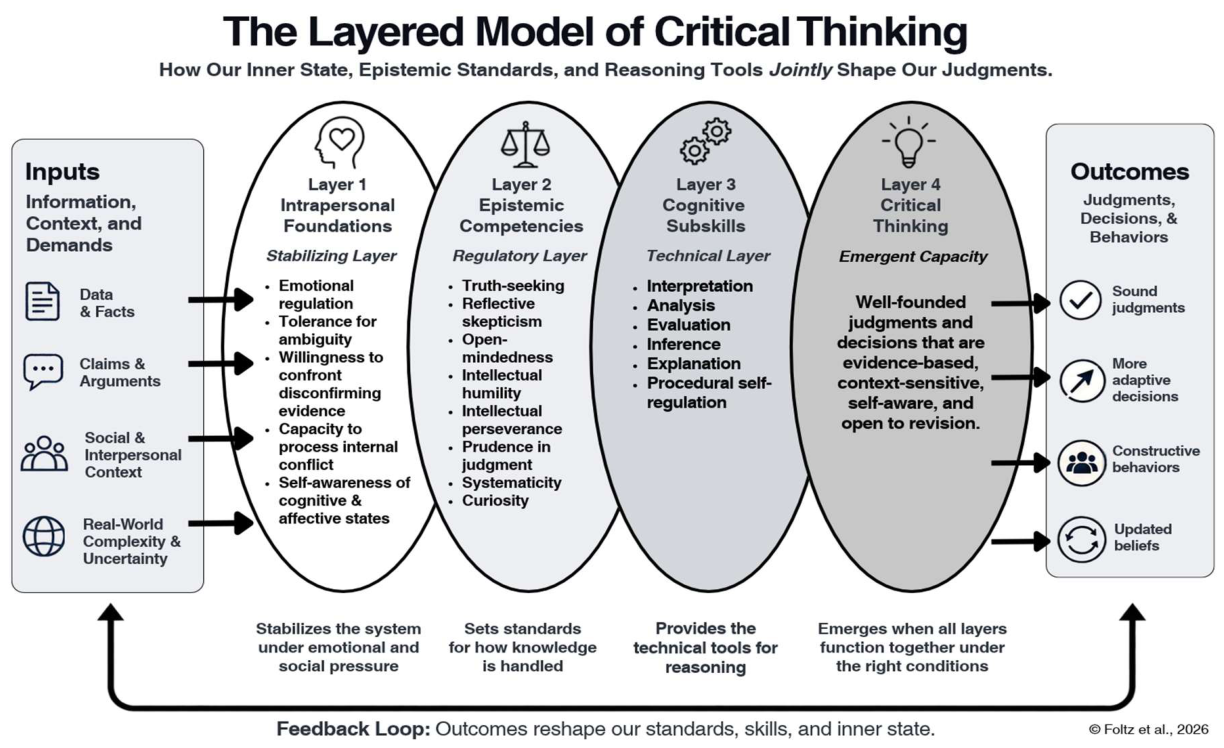
We propose a layered model (Figure 1) in which CT emerges from emotional and self-regulatory stability, through epistemic standards for handling knowledge, to technical reasoning tools, and finally to critical thinking as a composite capacity. Layer 1 is foundational; Layer 4 is the emergent performance produced when the supporting layers function together.
Layer 1: Intrapersonal Foundations (Stabilizing Layer)
At the base of the model sit the inner resources that stabilize the entire system for human thinking when reasoning becomes emotionally charged or socially costly. This is closely tied to the psychology of self-defense and self-affirmation (Sherman & Cohen, 2006). Real-world judgment is shaped by emotional and social processes (Lerner et al., 2015). Challenging or reconsidering deeply held beliefs can involve cognitive dissonance and threats to self-integrity, with possible emotional responses including anxiety, anger, and shame (Sherman & Cohen, 2006). When beliefs are embedded in shared identities and relationships, belief-related change may also be associated with interpersonal strain (Hendricks et al., 2024).
Epistemic regulation may help sustain cognitive performance under emotional pressure, drawing on the broader psychological literature that conceptualizes emotion regulation as an active process whereby individuals modify attention, cognition, and emotional responses rather than as a passive trait. (Gross, 1998). Foundational capacities include:
- Emotional regulation. Managing emotional arousal so attention, working memory, and judgment remain functional under stress or disagreement.
- Tolerance for ambiguity. Staying engaged when answers are unclear, incomplete, or probabilistic, rather than forcing premature certainty.
- Willingness to confront disconfirming evidence. Approaching, rather than avoiding, information that challenges a prior belief or self-concept.
- Capacity to process internal conflict. Holding conflicting ideas, values, or emotions without devolving into defensiveness, denial, or impulsive closure.
- Self-awareness of cognitive and affective states. Recognizing when fatigue, threat, ego involvement, or mood shapes perception and reasoning.
Without these functioning interpersonal foundations, the epistemic competencies built on top are frequently expressed inconsistently or performatively rather than genuinely enacted. Stress and emotional arousal can impair executive control and alter how evidence is evaluated, particularly under cognitively demanding conditions.
Acute stress is known to influence performance on various task outcomes indicative of executive functioning (i.e., the top-down, goal-directed control of cognition and behavior). The most common interpretation of these effects is that stress influences control processes themselves (Shields et al., 2024, p.).
These effects may reduce openness, intellectual humility, and deliberative reasoning, while increasing susceptibility to motivated reasoning or premature closure; however, their extent depends on factors such as the type and intensity of emotion, regulation strategies, the nature of the task, and the wider context (Shields et al., 2024; Shields et al., 2016). As Halpern (2014) also observes, even individuals who know precisely which cognitive strategy a situation calls for often abandon it under emotional or contextual duress. Knowing the right move and being able to make it under pressure require different levels of competency. This suggests these intrapersonal foundations further represent potentially important and testable dependencies in the effective exercise of CT. They are the functional bedrock for everything built above them. They are what allow a person to sustain inquiry, even at the risk of the personal cost of being wrong.
Executive Function and the Intrapersonal Layer
Research on executive function (EF) provides converging evidence that executive control contributes to higher-order reasoning. Executive function encompasses processes that support goal-directed, flexible thought and action, particularly in demanding situations. Influential frameworks distinguish related processes of inhibitory control, working memory (including updating its contents), and cognitive flexibility (shifting between tasks and mental schemas) (Diamond, 2013; Miyake et al., 2000).
Within the proposed model, these processes offer plausible mechanisms for resisting habitual responses, maintaining relevant evidence, and reconsidering interpretations. They may therefore provide control mechanisms that support the intrapersonal layer. However, performance on EF tasks does not, by itself, establish emotional regulation, tolerance of ambiguity, or willingness to question personally important beliefs. The relationship between executive control and these broader intrapersonal capacities requires direct investigation.
Several findings establish EF’s relevance to reasoning and learning. Li et al. (2021) found that performance on a running-memory updating task and an antisaccade inhibition task predicted university students’ critical-thinking test scores after controlling for fluid intelligence and measured thinking dispositions. These findings support a modest association between executive control and CT performance, without establishing the proposed foundational role of the intrapersonal layer.
Zaitchik et al. (2014) found that EF predicted five- to seven-year-olds’ biological reasoning after controlling for age and verbal IQ. Grenell and Carlson (2021) found that EF predicted preschool children’s learning, with stronger associations when information conflicted with prior knowledge. These findings are consistent with executive control supporting the management of conflicting information, but do not directly establish willingness to confront disconfirming evidence.
Executive control is also sensitive to the conditions under which reasoning occurs. Shields et al. (2016) found that acute stress impaired working memory and cognitive flexibility, while its effects on inhibition differed. Cognitive inhibition was impaired, whereas response inhibition improved. Shields et al. (2024) additionally found effects on control-related performance and affective dynamics, but the measured affective changes did not statistically change the performance effects. Doebel’s (2020) account further situates executive control within goals shaped by knowledge, beliefs, norms, and values. Together, these perspectives are consistent with the model’s emphasis on interactions among control, affect, and belief, but do not establish the proposed hierarchical relationship.
Important limits remain. EF does not itself supply epistemic standards or guarantee their impartial application. Its measurement is complicated by task impurity: performance reflects both executive and nonexecutive processes (Miyake et al., 2000). Diamond (2013) also reports narrow transfer from computerized working memory and reasoning training, while noting broader gains from other interventions. This cautions against assuming that improvements in isolated control tasks will generalize to CT; it does not establish that interventions must address every layer. EF research therefore supports the relevance of self-regulatory control to the model, while the foundational placement of the intrapersonal layer remains a hypothesis requiring direct testing.
Layer 2: Epistemic Competencies (Regulatory Layer)
Resting on these intrapersonal foundations are the epistemic competencies (regulatory layer that govern how a person assesses, revises, and integrates knowledge in real, high-stakes situations. They further regulate what counts as a good reason, when those reasons are sufficient, and whether a belief needs to change to keep thinking oriented toward truth rather than toward defending a preferred, already-held conclusion. Core competencies include:
- Truth-seeking. A primary drive to prioritize accuracy and warranted belief over convenience, social acceptance, or self-protection.
- Reflective skepticism. Measured doubt that prompts verification without succumbing to blanket cynicism.
- Open-mindedness. Genuine willingness to consider alternative and opposing perspectives, even those that challenge deeply held beliefs.
- Intellectual humility. Recognition of one's own fallibility and the limits of current knowledge, coupled with readiness to admit and correct mistakes (see Krumrei-Mancuso & Rouse, 2016, for a validated measure of this construct).
- Intellectual perseverance. The capacity to sustain an investigation despite complexity, uncertainty, or slow progress.
- Prudence in judgment. Restraint in forming beliefs and proportional confidence, including willingness to withhold conclusions when evidence is incomplete.
- Systematicity. A preference for organized methodical investigation over opportunistic point-collecting.
- Curiosity. The motivational engine driving genuine understanding and better questions.
This layer depends directly on the interpersonal foundations beneath it; without adequate emotional regulation and tolerance for ambiguity, these competencies may be exercised less consistently under pressure, increasing the likelihood of responses associated with a heightened need for closure, dogmatism, defensiveness, or intolerance of ambiguity. These are related but distinct constructs, and their expression is likely to vary according to individual and contextual factors (Kruglanski & Webster, 1996; Roets & Van Hiel, 2011).
When intact, these epistemic competencies function as active checks and balances on the cognitive subskills above them (discussed in the next section) and determine the conditions under which interpretation, evaluation, and inference are deployed, as well as whether belief formation is genuinely responsive to evidence. For example, two people with comparable analytic skills may nevertheless reason quite differently, partly because of variation in epistemic regulation, as well as differences in prior knowledge, identity, motivation, values, social context, and task interpretation (Stanovich & West, 1997; Toplak et al., 2011).
This stabilizing layer also helps explain the field's well-documented transfer problem, discussed previously. Namely, strengthening analytic technique without strengthening epistemic standards can raise performance on classroom-like tasks while leaving real-world judgment and belief revision largely untouched.
Layer 3: Cognitive Subskills (Technical Layer)
Built on the stabilizing layer of epistemic competencies, this is the layer most CT curricula and assessments currently target, and it contains the core reasoning processes traditionally taught and tested:
- Interpretation. Understanding and clarifying meaning: organizing information, grasping its significance, and accurately representing data or arguments.
- Analysis. Identifying the connections between statements, ideas, questions, and evidence; distinguishing a conclusion from its supporting reasons; identifying an argument's structure.
- Evaluation. Judging the trustworthiness of sources and the strength of claims, including whether evidence is relevant and sufficient for the situation at hand.
- Inference. Drawing logical conclusions from available information, generating hypotheses, and determining the implications of uncertain situations.
- Explanation. Articulating the reasoning process clearly: justifying steps taken, presenting arguments coherently, and communicating why a conclusion is warranted.
- Procedural self-regulation. Monitoring and adjusting reasoning in real time, checking for gaps in logic, slowing down when stakes are high, and changing strategies when initial attempts fail.
While necessary, these cognitive subskills are not sufficient on their own. The same analytic tools can be used for genuine inquiry or for motivated rationalization, particularly when conclusions are identity-relevant or emotionally consequential (Kunda, 1990; Kahan et al., 2017). The proposed epistemic layer is intended to help explain which purpose those tools serve.
Layer 4:Critical Thinking (Composite/Emergent Layer)
At the top of the layered model sits the resulting CT layer, understood not as a fourth independent skill but as the emergent outcome of the three supporting layers operating together. It is the product of all three sub-layers working together in an integrated way–the capacity to make well-founded judgments when information is incomplete, uncertain, or open to competing interpretations. Intrapersonal foundations support sustained engagement under pressure; epistemic competencies regulate how evidence is weighed, and beliefs are revised; cognitive subskills provide the technical operations of interpretation, analysis, evaluation, inference, explanation, and procedural self-regulation. CT, in this view, is a whole-system performance: trainable because its supporting capacities can be strengthened, yet potentially fragile when one or more supporting layers are disrupted. Furthermore, the layers are hierarchically dependent, which is the primary theoretical contribution of this paper.
In sum, CT in the proposed model emerges when the three supporting layers function as a coordinated system rather than as independently accumulated parts. Importantly, this structure generates testable predictions. As an example, interventions focused primarily on cognitive subskills should most clearly improve performance on structured tasks similar to those practiced, consistent with the broader literature on transfer (Barnett & Ceci, 2002; Perkins & Salomon, 1992). The model predicts that interventions that also strengthen epistemic and intrapersonal capacities will better support belief revision, transfer to novel situations, and reasoning under pressure. To our knowledge, this specific layer-targeted prediction has not yet been directly tested and should be treated as a priority for future empirical work.
Discussion
What the Layered Model Explains That Existing Frameworks Cannot
The layered model was developed to address two problems the existing literature has documented but not resolved: why CT so often fails to transfer, and why demonstrated CT frequently diverges from authentic reasoning. The model offers a single structural explanation for both. We present it as a hypothesis, not an established finding.
On transfer, the model proposes that real-world conditions place demands on the intrapersonal and epistemic layers that structured classroom tasks rarely do. When those layers are underdeveloped, reasoning may become fragile under pressure even when the cognitive subskill layer remains intact. If this account is correct, transfer failure is an expected consequence of developing one layer in isolation, rather than evidence of poor implementation alone.
On the performance gap, the model suggests that demonstrated CT in low-stakes, structured settings may not require the epistemic or intrapersonal layers to be fully operational, whereas authentic CT under emotional, social, or identity-relevant conditions likely does. This is consistent with evidence that motivated reasoning, confirmation bias, and identity-protective cognition persist among people with strong analytic ability (Kahan et al., 2017; Kunda, 1990; Taber & Lodge, 2006). The model interprets these findings as reflecting an underdeveloped or disrupted epistemic layer rather than a deficit of cognitive skill. Competing explanations, such as differences in motivation, values, or prior knowledge, remain plausible and should be tested against it.
Taken together, transfer failure and the performance gap may share a common source: CT education built on an incomplete account of what CT requires. That claim is testable. If it holds, interventions that target the epistemic and intrapersonal layers alongside cognitive subskills should produce stronger transfer and more consistent belief revision than skills-only instruction.
What the Generative AI Context Reveals
Generative AI (GenAI) systems can produce outputs associated with aspects of the cognitive subskill layer, including analysis, inference, and explanation, although performance varies across tasks and prompting conditions (Bang et al., 2023; Zaphir et al., 2024). These observable outputs should not, by themselves, be taken as evidence of the broader dispositions involved in human critical thinking. Just as fluency and coherence likewise do not establish epistemic reliability. The findings of Bang et al. (2023) and Liang et al. (2023), taken together, warrant caution when relying on GenAI for evaluative judgment, without implying that it cannot produce successful responses to particular evaluation tasks. Indeed, Zaphir et al. (2024) identify evaluation as one of the skills whose assessed outputs GenAI can emulate. Helal et al. (2025) address a related but distinct issue: how the use of GenAI may strengthen or undermine human critical thinking, depending on factors such as prompt quality, self-regulation, and metacognitive critique, alongside risks including hallucination, automation bias, and dependence on quick solutions.
This is therefore less a threat to critical thinking than a useful clarification of what critical thinking should encompass. If GenAI can increasingly reproduce some cognitive performances that have traditionally been treated as evidence of CT, then developing those subskills alone may be insufficient. The challenge is to cultivate the broader capacities required to determine when, why, and how such cognitive skills should be exercised, including the judgment needed to critically evaluate AI-generated reasoning itself.
The layered model offers a philosophical interpretation of where distinctly human CT may reside: particularly within its epistemic and intrapersonal dimensions. On this view, current GenAI systems can simulate aspects of epistemic reasoning but do not clearly demonstrate the embodied stakes, moral accountability, or identity-implicating belief revision associated with human epistemic agency (Bender et al., 2021; Floridi & Chiriatti, 2020; Shanahan, 2024). This should not be treated as an experimentally established boundary between human and artificial cognition. A key empirical and philosophical challenge is therefore to specify observable criteria, such as persistent belief revision across contexts, accountable, goal-directed judgment, and responsiveness to personal consequences, that could distinguish genuine epistemic agency from increasingly sophisticated simulation.
Current GenAI language models produce outputs based on learned statistical regularities in data; fluent language performance should not, by itself, be equated with human understanding, intention, or accountability (Bender et al., 2021). The comparison, therefore, concerns functional output rather than equivalence between machine generation and human cognition.
The use of generative AI may also change where cognitive effort is invested. Earlier work on internet searches showed that people remember less of information they expect to remain externally accessible (Sparrow et al., 2011) and can misattribute externally retrieved knowledge to their own understanding (Ward, 2021). These findings do not establish that GenAI erodes CT. However, they provide a relevant construct for examining how AI-mediated reasoning affects memory, confidence, and self-monitoring, and the risks of cognitive offloading.
A decade ago, Risko and Gilbert (2016) formally defined cognitive offloading as "the use of physical action to alter the information processing requirements of a task to reduce cognitive demand" (p. 677). In this initial conception, their examples included actions such as writing things down, setting reminders, and using external information stores, all as a means of overcoming the limitations of human cognition. Subsequent research has examined the trade-offs inherent in cognitive offloading, namely the tension between externalizing information and processing to improve immediate cognitive performance at the risk of reducing internal memory, encoding, practice, and ultimately learning.
Today, understanding of cognitive offloading has expanded further still to accommodate the risks associated with human-GenAI work. GenAI is no longer a place to store information, but an external system that can perform the cognitive work itself–work such as summarizing, reasoning, solving, and generating. Emerging evidence suggests that when humans interact with GenAI, they often offload cognitive work to the AI, which in turn reduces their knowledge and skill acquisition and contributes to skill decay (Cash et al., 2026). Cash and colleagues (2026) also suggest, however, that these effects may be mitigated by humans remaining actively engaged, using the GenAI largely as a tutor or collaborator, and not for the cognitive work itself, though it remains unclear if humans are capable of resisting the temptation to let the GenAI perform the cognitive labor in place of doing it themselves.
The consequences of cognitive offloading may extend beyond the relinquishment of the cognitive work itself. A further concern arises when people not only outsource thinking to GenAI, but subsequently experience the AI-generated product as evidence of their own understanding or capability. We propose the term confidence-by-proxy for mistaking fluent GenAI output for one’s own understanding. Related evidence shows that greater confidence in GenAI is associated with lower self-reported critical-thinking effort among knowledge workers, while higher self-confidence is associated with greater effort (Lee et al., 2025). Preliminary experimental work on AI-assisted essay writing has also reported lower neural engagement and weaker ownership or recall in LLM-assisted conditions. However, these findings remain preprint-based and should be interpreted with caution (Kosmyna et al., 2025).
These findings warrant concern but do not support a causal conclusion that GenAI necessarily weakens the intrapersonal foundations of CT. A more defensible interpretation is that GenAI can redistribute cognitive effort and may create conditions for overreliance when users do not actively verify, integrate, or take responsibility for the reasoning it generates. These are not merely practical inconveniences. They are mechanisms through which particular patterns of GenAI reliance may reduce immediate cognitive effort or limit opportunities to practice independent reasoning and self-regulation. Current evidence remains preliminary and does not establish that the use of GenAI produces a lasting erosion of these capacities (Lee et al., 2025; Gerlich, 2025).
In sum, the GenAI environment may not only expose limitations in existing CT frameworks but, under some patterns of use, amplify them. If education emphasizes cognitive subskills without also developing independent judgment, epistemic agency, and self-regulatory capacity, students may have fewer opportunities to practice the forms of reasoning that GenAI can readily support or partially perform on their behalf.
What Needs to Change in Practice
If critical thinking is a whole-system capacity, teaching only the cognitive subskill layer is not merely insufficient; it is counterproductive; it produces exactly the conditions for performative CT while giving the appearance of developing the real thing.
Developing the epistemic layer requires conditions in which students genuinely grapple with competing truth claims, revise beliefs in response to evidence, and practice intellectual humility as a living, repeatedly exercised skill rather than an abstract virtue listed on a syllabus. Developing the intrapersonal layer requires conditions in which students encounter real uncertainty, emotional difficulty, and identity-adjacent challenges, and are supported in staying engaged rather than withdrawing.
Original thinking, productive struggle, and visible belief revision should be explicitly valued over correct answers and confident-sounding performance alone. In an AI-saturated learning environment, this also means teaching students to engage with GenAI tools without offloading the cognitive labor that produces lasting learning and more skillful thinking. The operative question is not whether students use GenAI, but whether their use of it merely produces outputs associated with the cognitive layer, while offloading the very cognitive work through which those capabilities are developed, and leaves the epistemic and intrapersonal layers dormant. This points toward GenAI literacy as its own instructional target rather than an afterthought, explicitly teaching students to interrogate AI-generated output, understand how prompting shapes what a model returns, and treat GenAI as a tool to steward rather than an oracle to defer to (Walter, 2024).
Recommendations consistent with this reframing include:
- Recognizing and rewarding original thinking. Classrooms that explicitly acknowledge novel observations, hypotheses, or syntheses, rather than rewarding only accuracy and reproduction of established knowledge, signal that intellectual contribution matters alongside correctness, supporting deeper engagement and intellectual risk-taking (Beghetto & Kaufman, 2014; Sawyer, 2024).
- Encouraging constructive challenges to authority. Normalizing respectful questioning of instructors, textbooks, and established claims helps learners build epistemic independence by evaluating ideas on their merits rather than automatically deferring to perceived expertise (Freire, 1970; Paul & Elder, 2012).
- Cultivating metacognitive awareness directly. Reflective writing and self-questioning prompts (Tanner, 2012; Flavell, 1979; Zimmerman, 2002).
- Structuring learning around inquiry and perspective-taking. Structured dialogue, argument mapping, and perspective-taking exercises strengthen reasoning about disagreement and ambiguity, and align with research on collaborative argumentation (Kuhn, 2010; Mercer & Littleton, 2007).
- Normalizing intellectual flexibility and belief revision. Classroom norms that value reflection and revision can support epistemic development by signaling that changing one's mind in response to evidence is an intellectually productive practice(Greene et al., 2016).
- Elevating questions as intellectual contributions in their own right. Inquiry-based pedagogies situate learning in scaffolded investigations of complex problems and phenomena, encouraging learners to engage actively in problem-solving and knowledge building. (Hmelo-Silver et al., 2007)
- Creating genuine opportunities for knowledge construction. Inquiry-based and problem-based learning, interdisciplinary work, and student-led research position learners as active participants in constructing understanding rather than passive recipients of it (Bruner, 1961; Sawyer, 2024).
What Needs to Change in Assessment
Current CT assessments emphasize the cognitive subskill layer, which is also the layer most readily approximated by AI-generated performance. Because assessment can shape curricular emphasis and instructional practice (Au, 2007), assessment reform is critical to distinguishing authentic CT from performances that merely resemble it. Effective CT measurement should move beyond measuring cognitive subskills to capture the epistemic and intrapersonal capacities that enable individuals to exercise those skills thoughtfully, independently, and with agency. This raises an important question: whether performance-based assessment, longitudinal observation, and structured tasks that introduce ethically appropriate and consistently applied epistemic uncertainty or cognitive-emotional challenge can capture aspects of CT that self-report measures may miss. Such approaches may require careful validation to establish reliability, fairness, and construct validity, alongside clear ethical safeguards, for example, using standardized time constraints, ambiguous evidence, competing claims, or low-stakes uncertainty rather than inducing undue psychological distress (Shavelson et al., 2019; Zlatkin-Troitschanskaia et al., 2019).
AI-assisted scoring may help evaluate observable reasoning products, but it cannot by itself establish whether a respondent genuinely revised a belief or exercised intellectual humility.
Directions for Future Research
The layered model raises a broader set of questions about how CT develops, how its layers interact, how they can be measured and developed, and how these processes may be impacted by a world increasingly mediated by GenAI tools and resources. Several priorities for future research follow from these questions:
- Test Layer-Specific Interventions. Interventions targeting the epistemic and intrapersonal layers should demonstrate greater real-world transfer than interventions targeting the cognitive subskill layer alone, a prediction that, to our knowledge, has not yet been directly tested in a design that isolates layer-specific effects (Tiruneh et al., 2023).
- Measure All Three Supporting Layers. Future studies should measure all three supporting layers simultaneously, rather than using cognitive-subskill performance as a proxy for CT as a whole.
- Study Development Over Time. Longitudinal research is needed to understand how the layers develop over time. Whether there are developmentally sensitive windows during which intervention at a specific layer is most effective, while acknowledging the genuine tension between the time such research requires and the pace of change in the GenAI landscape it is meant to inform.
- Examine Cross-Cultural Validity. Cross-cultural research is particularly important. The intrapersonal foundations layer and the model's underlying account of emotional regulation and belief revision currently reflect a predominantly Western psychological tradition, and researchers should be cautious about presenting it as culturally universal without directly testing that assumption.
- Investigate AI’s Impact on Lower Layers. Research is urgently needed to identify the specific mechanisms by which the use of GenAI erodes the lower layers. The confidence issue (i.e., confidence-by-proxy) described earlier is included here as a theoretically motivated hypothesis, not an empirically established mechanism–a distinction that future studies can explore.
- Expand the Model to include Social Dimensions. Finally, research is needed on the social and interpersonal dimensions of critical thinking that the present model does not yet fully incorporate.
Limitations and Alternative Interpretations
Every theoretical model has boundaries and limitations. This section identifies what the layered model does not yet explain and engages directly with the objections we consider most likely to be raised against its core claims.
Limitations
The layered model is, at this stage, a theoretical one, though it is grounded in the existing literature rather than empirically validated as an integrated model. The proposed dependency structure between layers, namely the claim that intrapersonal foundations must be in place for epistemic competencies to function reliably, which must in turn be in place for cognitive subskills to serve genuine inquiry rather than rationalization, has not yet been directly demonstrated through controlled research. Moreover, as a theoretical contribution, the model raises important questions that require further theoretical development, empirical investigation, measurement and assessment, and examination across developmental, cultural, and increasingly AI-mediated contexts. A more structural limitation concerns the social and interpersonal dimension of CT. As formulated here, the model treats CT largely as an intrapersonal act, something that happens within a single reasoner. However, critical thinking that cannot be expressed, shared, or defended in a social context raises a genuine question about whether it is fully functional CT. The barriers documented in applied work on this topic are instructive here. Classic social psychology research by Asch (1956) demonstrated that individuals will frequently abandon accurate private judgments to align with an incorrect group consensus, and group conformity, peer pressure, and fear of interpersonal conflict can discourage people from voicing reflective skepticism or challenging authority even when their private reasoning is sound. Whether this social vulnerability is best understood as a failure mode of the intrapersonal layer under social pressure, or as evidence that the model needs an explicit fourth structural layer that addresses interpersonal expression and the defense of reasoning, remains genuinely unresolved. It as such, rather than being resolved prematurely. We consider this one of the most important open structural questions raised by the present model.
Cultural variation is likewise not yet adequately addressed. The intrapersonal foundations layer, in particular, may manifest differently across cultural contexts, including norms around emotional expression, deference to authority, collective versus individual belief revision, and tolerance for public uncertainty, in ways the current model does not yet capture. We therefore urge caution when presenting what may be a predominantly Western conception of emotional regulation and belief revision, and refrain from positioning it as a culturally universal account of human and CT.
Conclusion
This paper answers a persistent and, we think, genuinely troubling question: Why does CT resist development despite decades of sustained, well-intentioned educational effort? In response, we have pursued two related inquiries: First, we have attempted to diagnose the theoretical limitations of current skill-based conceptions of CT, and second, we have proposed a more comprehensive account of what CT actually is and what its development requires. Together, these inquiries provide a theoretically grounded explanation for why efforts to develop CT too often fall short, paired with a framework for understanding what a more complete development may require. Education has historically treated critical thinking as something taught by breaking it into parts and systematically delivering those parts, one skill and one disposition at a time. The layered model suggests why that approach will always fall short of its aim. A whole-system capacity cannot be built by accumulating components, however carefully each component is taught. In an AI-saturated world, the cognitive subskill layer is increasingly automated, which means an education system that develops only that layer is not developing distinctly human critical thinking. Developing a capacity that artificial intelligence can already perform faster, and in narrow respects, more consistently. What remains distinctly and durably human is the capacity to seek truth under real pressure, to revise a belief in the face of disconfirming evidence that costs something to accept, and to sustain genuine inquiry when the personal price of being wrong feels high. These capacities reside in the layers of education that have been most consistently neglected.
The layered model does not solve the problem of critical thinking education. It reframes the problem in a way that makes genuine solutions possible for the first time. Until the field accepts that critical thinking is a whole-system capacity rather than a bundle of teachable, testable parts, educational efforts will continue to produce the appearance of critical thinking rather than its practice. That distinction between the appearance of thinking and the thing itself has never mattered more than it does right now. The quality of our minds is the quality of our lives. We live in a world of algorithms and influencers. Mind sovereignty, the ability to truly develop and own our mind space, may be one of the most important ways we maintain our humanity.
Acknowledgments
The authors thank Jamie Valenzuela-Mumau, Russell L. Brand, Jordan Loewen-Colón, and Michelle Ament for their contributions, feedback, and support.
References
- Abrami, P. C.; Bernard, R. M.; Borokhovski, E.; Waddington, D. I.; Wade, C. A.; Persson, T. Strategies for teaching students to think critically: A meta-analysis. Rev. Educ. Res. 2015, 85(2), 275–314. [Google Scholar] [CrossRef]
- Abrami, P. C.; Bernard, R. M.; Borokhovski, E.; Wade, C. A.; Surkes, M. A.; Tamim, R.; Zhang, D. Instructional interventions affecting critical thinking skills and dispositions: A stage 1 meta-analysis. Rev. Educ. Res. 2008, 78(4), 1102–1134. [Google Scholar] [CrossRef]
- Arum, R.; Roksa, J. Limited learning on college campuses. Society 2011, 48(3), 203–207. [Google Scholar] [CrossRef]
- Asch, S. E. Studies of independence and conformity: A minority of one against a unanimous majority. Psychol. Monogr. 1956, 70(9), 1–70. [Google Scholar] [CrossRef]
- Au, W. High-stakes testing and curricular control: A qualitative metasynthesis. Educ. Res. 2007, 36(5), 258–267. [Google Scholar] [CrossRef]
- Barnett, S. M.; Ceci, S. J. When and where do we apply what we learn? A taxonomy for far transfer. Psychol. Bull. 2002, 128(4), 612–637. [Google Scholar] [CrossRef] [PubMed]
- Beghetto, R. A.; Kaufman, J. C. Classroom contexts for creativity. High Abil. Stud. 2014, 25(1), 53–69. [Google Scholar] [CrossRef]
- Bender, E. M.; Gebru, T.; McMillan-Major, A.; Shmitchell, S. On the dangers of stochastic parrots: Can language models be too big? In Proceedings of the 2021 ACM Conference on Fairness, Accountability, and Transparency, 2021; Association for Computing Machinery; pp. 610–623. [Google Scholar] [CrossRef]
- Best, J. R.; Miller, P. H.; Naglieri, J. A. Relations between executive function and academic achievement from ages 5 to 17 in a large, representative national sample. Learn. Individ. Differ. 2011, 21(4), 327–336. [Google Scholar] [CrossRef] [PubMed]
- Brisson-Boivin, K.; Johnson, M. 2024. Digital media literacy as a precondition for engaged digital citizenship (Policy Brief No. 10). Centre for International Governance Innovation (CIGI). Available online: https://www.cigionline.org/static/documents/FoT_PB_no.10.pdf.
- Bruner, J. S. The act of discovery. Harv. Educ. Rev. 1961, 31, 21–32. [Google Scholar]
- Cash, T. N.; Kelly, M. O.; Macnamara, B. N.; Risko, E. F. Is AI making us stupid? Trends Cogn. Sci. 2026, 12. [Google Scholar] [CrossRef] [PubMed]
- Cash, T. N.; Kelly, M. O.; Macnamara, B. N.; Risko, E. F. Is AI making us stupid? Trends Cogn. Sci. 2026, 30(8), 673–675. [Google Scholar] [CrossRef] [PubMed]
- Creely, E. Thinking with the Machine: Generative AI, Cognitive Processes, Writing Practices and Human Agency in Education. Preprint 2026. [Google Scholar] [CrossRef]
- Danry, V.; Pataranutaporn, P.; Groh, M.; Epstein, Z.; Maes, P. Deceptive AI systems that give explanations are more convincing than honest AI systems and can amplify belief in misinformation. arXiv 2024. [Google Scholar] [CrossRef]
- Davies, M.; Barnett, R. (Eds.) The Palgrave handbook of critical thinking in higher education; Palgrave Macmillan, 2015. [Google Scholar]
- Diamond, A. Executive functions. Annu. Rev. Psychol. 2013, 64, 135–168. [Google Scholar] [CrossRef] [PubMed]
- Diamond, A.; Ling, D.S. Conclusions about interventions, programs, and approaches for improving executive functions that appear justified and those that, despite much hype, do not. Dev. Cogn. Neurosci. 2016, 18, 34–48. [Google Scholar] [CrossRef] [PubMed]
- Doebel, S. Rethinking executive function and its development. Perspect. Psychol. Sci. 2020, 15(4), 942–956. [Google Scholar] [CrossRef] [PubMed]
- Dwyer, C. P.; Hogan, M. J.; Stewart, I. An integrated critical thinking framework for the 21st century. Think. Ski. Creat. 2014, 12, 43–52. [Google Scholar] [CrossRef]
- Ennis, R. H. A logical basis for measuring critical thinking skills. Educ. Leadersh. 1985, 43(2), 44–48. [Google Scholar]
- Ennis, R. H. Critical thinking and subject specificity: Clarification and needed research. Educ. Res. 1989, 18(3), 4–10. [Google Scholar] [CrossRef]
- Ennis, R. H. Critical thinking across the curriculum: A vision. Topoi 2018, 37(1), 165–184. [Google Scholar] [CrossRef]
- Erwin, T.D. The NPEC sourcebook on assessment. In Definitions and assessment methods for critical thinking, problem solving, and writing; National Postsecondary Education Cooperative, 2000; Volume 1. [Google Scholar]
- Facione, N. C.; Facione, P. A.; Sanchez, C. A. Critical thinking disposition as a measure of competent clinical judgment: The development of the California Critical Thinking Disposition Inventory. J. Nurs. Educ. 1994, 33(8), 345–350. [Google Scholar] [CrossRef] [PubMed]
- Facione, P. A. Critical thinking: A statement of expert consensus for purposes of educational assessment and instruction (The Delphi Report); American Philosophical Association, 1990; Available online: https://files.eric.ed.gov/fulltext/ED315423.pdf.
- Facione, P. A.; Facione, N. C. The California Critical Thinking Skills Test; California Academic Press, 1992. [Google Scholar]
- Facione, P.A. Critical thinking: What is it and why it counts (2023 update). Insight Assessment 2023. [Google Scholar]
- Flavell, J. H. Metacognition and cognitive monitoring: A new area of cognitive-developmental inquiry. Am. Psychol. 1979, 34(10), 906–911. [Google Scholar] [CrossRef]
- Freire, P. Pedagogy of the oppressed; Herder and Herder, 1970. [Google Scholar]
- Friedman, N. P.; Miyake, A. The relations among inhibition and interference control functions: A latent-variable analysis. J. Exp. Psychol. General. 2004, 133(1), 101–135. [Google Scholar] [CrossRef] [PubMed]
- Friedman, N. P.; Miyake, A. Unity and diversity of executive functions: Individual differences as a window on cognitive structure. Cortex 2017, 86, 186–204. [Google Scholar] [CrossRef] [PubMed]
- Greene, J. A.; Sandoval, W. A.; Bråten, I. (Eds.) Handbook of epistemic cognition; Routledge, 2016. [Google Scholar]
- Grenell, A.; Carlson, S. M. Individual differences in executive function and learning: The role of knowledge type and conflict with prior knowledge. J. Exp. Child Psychol. 2021, 206, 105079. [Google Scholar] [CrossRef] [PubMed]
- Gross, J. J. The emerging field of emotion regulation: An integrative review. Rev. General. Psychol. 1998, 2(3), 271–299. [Google Scholar] [CrossRef]
- Halpern, D. F. Teaching critical thinking for transfer across domains: Dispositions, skills, structure training, and metacognitive monitoring. Am. Psychol. 1998, 53(4), 449–455. [Google Scholar] [CrossRef] [PubMed]
- Halpern, D. F. Thought and knowledge: An introduction to critical thinking, 5th ed.; Psychology Press, 2014. [Google Scholar]
- Hendricks, W.; Olawale, B. E.; Saddiq, K. An investigation of high school preservice teachers’ self-efficacy in teaching mathematics. Educ. Sci. 2024, 14(11), 1262. [Google Scholar] [CrossRef]
- Hitchcock, D. Critical thinking as an educational ideal. In On reasoning and argument: Essays in informal logic and on critical thinking; Springer International Publishing: Cham, 2017; pp. 477–497. [Google Scholar]
- Hmelo-Silver, C. E.; Duncan, R. G.; Chinn, C. A. Scaffolding and achievement in problem-based and inquiry learning: A response to Kirschner, Sweller, and Clark (2006). Educ. Psychol. 2007, 42(2), 99–107. [Google Scholar] [CrossRef]
- Kahan, D. M.; Peters, E.; Dawson, E. C.; Slovic, P. Motivated numeracy and enlightened self-government. Behav. Public Policy 2017, 1(1), 54–86. [Google Scholar] [CrossRef]
- Karr, J. E.; Areshenkoff, C. N.; Rast, P.; Hofer, S. M.; Iverson, G. L.; Garcia-Barrera, M. A. The unity and diversity of executive functions: A systematic review and re-analysis of latent variable studies. Psychol. Bull. 2017, 144(11), 1147–1185. [Google Scholar] [CrossRef] [PubMed]
- Kavanagh, J.; Rich, M. D. Truth decay: An initial exploration of the diminishing role of facts and analysis in American public life; RAND Corporation, 2018; Available online: https://www.rand.org/pubs/research_reports/RR2314.html.
- Kosmyna, N.; Hauptmann, E.; Yuan, Y. T.; Situ, J.; Liao, X. H.; Beresnitzky, A. V.; Braunstein, I.; Maes, P. Your brain on ChatGPT: Accumulation of cognitive debt when using an AI assistant for essay writing task. arXiv 2025, arXiv:2506.088724, 206. [Google Scholar]
- Kuhn, D. A developmental model of critical thinking. Educ. Res. 1999, 28(2), 16–26, 46. [Google Scholar] [CrossRef]
- Kuhn, D. Metacognitive development. Curr. Dir. Psychol. Sci. 2000, 9(5), 178–181. [Google Scholar] [CrossRef]
- Kunda, Z. The case for motivated reasoning. Psychol. Bull. 1990, 108(3), 480–498. [Google Scholar] [CrossRef] [PubMed]
- Lee, H. P.; Sarkar, A.; Tankelevitch, L.; Drosos, I.; Rintel, S.; Banks, R.; Wilson, N. The impact of generative AI on critical thinking: Self-reported reductions in cognitive effort and confidence effects from a survey of knowledge workers. In Proceedings of the 2025 CHI Conference on Human Factors in Computing Systems, 2025; ACM; pp. 1–22. [Google Scholar]
- Li, S.; Ren, X.; Schweizer, K.; Brinthaupt, T. M.; Wang, T. Executive functions as predictors of critical thinking: Behavioral and neural evidence. Learn. Instr. 2021, 71, 101376. [Google Scholar] [CrossRef]
- Luckin, R. Nurturing human intelligence in the age of AI: Rethinking education for the future. Dev. Learn. Organ. An. Int. J. 2025, 39(1), 1–4. [Google Scholar] [CrossRef]
- McPeck, J. E. Critical thinking and education; Routledge, 2016; (updated). [Google Scholar]
- Mercer, N.; Littleton, K. Dialogue and the development of children’s thinking: A sociocultural approach; Routledge, 2007. [Google Scholar]
- Miyake, A.; Friedman, N. P.; Emerson, M. J.; Witzki, A. H.; Howerter, A.; Wager, T. D. The unity and diversity of executive functions and their contributions to complex “frontal lobe” tasks: A latent variable analysis. Cogn. Psychol. 2000, 41(1), 49–100. [Google Scholar] [CrossRef] [PubMed]
- Muis, K. R.; Chevrier, M.; Denton, C. A.; Losenno, K. M. Epistemic emotions and epistemic cognition predict critical thinking about socio-scientific issues. Front. Educ. 2021, 6, 669908. [Google Scholar] [CrossRef]
- Noels, S.; Rogiers, A.; Buyl, M.; De Bie, T. Persuasion with large language models: A survey of empirical evidence, study methodologies, and ethical implications. arXiv 2024, arXiv:2411.06837v2. [Google Scholar] [CrossRef]
- Paul, R.; Elder, L. Critical thinking: Tools for taking charge of your learning and your life, 3rd ed.; Pearson, 2012. [Google Scholar]
- Perkins, D. N.; Salomon, G. Are cognitive skills context-bound? Educ. Res. 1989, 18(1), 16–25. [Google Scholar] [CrossRef]
- Perkins, D. N.; Salomon, G. Transfer of learning. In International encyclopedia of education, 2nd ed.; Husén, T., Postlethwaite, T. N., Eds.; Pergamon Press, 1992; Vol. 11, pp. 6452–6457. [Google Scholar]
- Perkins, D. N.; Jay, E.; Tishman, S. Beyond abilities: A dispositional theory of thinking. Merrill-Palmer Q. 1993, 39(1), 1–21. [Google Scholar]
- Pithers, R. T.; Soden, R. Critical thinking in education: A review. Educ. Res. 2000, 42(3), 237–249. [Google Scholar] [CrossRef]
- Risko, E. F.; Gilbert, S. J. Cognitive offloading. Trends Cogn. Sci. 2016, 20(9), 676–688. [Google Scholar] [CrossRef] [PubMed]
- Roebers, C. M. Executive function and metacognition: Towards a unifying framework of cognitive self-regulation. Dev. Rev. 2017, 45, 31–51. [Google Scholar] [CrossRef]
- Roebers, C. M.; Spiess, M. The development of metacognitive monitoring and control in second graders: A short-term longitudinal study. J. Cogn. Dev. 2017, 18(1), 110–128. [Google Scholar] [CrossRef]
- Rosales, K. P.; Wong, E. H.; Looney, L. The Psychometric Structure of Executive Functions: A Satisfactory Measurement Model? An Examination Using Meta-Analysis and Network Modeling. Behav. Sci. 2023, 13(12), 1003. [Google Scholar] [CrossRef] [PubMed]
- Sawyer, R. K. Explaining creativity: The science of human innovation; Oxford University Press, 2024. [Google Scholar]
- Sherman, D. K.; Cohen, G. L. The psychology of self-defense: Self-affirmation theory. In Advances in experimental social psychology; Zanna, M. P., Ed.; Elsevier Academic Press, 2006; Vol. 38, pp. 183–242. [Google Scholar] [CrossRef]
- Shields, G. S.; Hunter, C. L.; Trudell, E. V.; Gray, Z. J.; Perkins, B. C.; Patterson, E. G.; Zalenski, P. K. Acute stress influences the emotional foundations of executive control: Distinct effects on control-related affective and cognitive processes. Abstr. From Psychoneuroendocrinology 2024, 162, 106942. [Google Scholar] [CrossRef] [PubMed]
- Siegel, H. Educating reason: Rationality, critical thinking and education; 1988. [Google Scholar]
- Sparrow, B.; Liu, J.; Wegner, D. M. Google effects on memory: Cognitive consequences of having information at our fingertips. Science 2011, 333(6043), 776–778. [Google Scholar] [CrossRef] [PubMed]
- Stanovich, K. E.; West, R. F. Reasoning independently of prior belief and individual differences in actively open-minded thinking. J. Educ. Psychol. 1997, 89(2), 342–357. [Google Scholar] [CrossRef]
- Stanovich, K. E.; West, R. F. On the relative independence of thinking biases and cognitive ability. J. Personal. Soc. Psychol. 2008, 94(4), 672–695. [Google Scholar] [CrossRef] [PubMed]
- Starcke, K.; Brand, M. Decision making under stress: A selective review. Neurosci. Biobehav. Rev. 2012, 36(4), 1228–1248. [Google Scholar] [CrossRef] [PubMed]
- Taber, C. S.; Lodge, M. Motivated skepticism in the evaluation of political beliefs. Am. J. Political Sci. 2006, 50(3), 755–769. [Google Scholar] [CrossRef]
- Tanner, K.D. Promoting student metacognition. CBE Life Sci. Educ. 2012, 11(2), 113–120. [Google Scholar] [CrossRef] [PubMed]
- Tiruneh, D. T.; De Cock, M.; Spector, J. M.; Gu, X.; Elen, J. Toward a systematic and model-based approach to design learning environments for critical thinking. In Learning, design, and technology: An International compendium of theory, research, practice, and policy; Springer International Publishing: Cham, 2023; pp. 955–991. [Google Scholar]
- VandenBos, Gary R. APA dictionary of psychology; American Psychological Association, 2007. [Google Scholar]
- Walter, Y. Embracing the future of artificial intelligence in the classroom: The relevance of AI literacy, prompt engineering, and critical thinking in modern education. Int. J. Educ. Technol. High. Educ. 2024, 21(1), 15. [Google Scholar] [CrossRef]
- Ward, A. F. People mistake the internet’s knowledge for their own. Proc. Natl. Acad. Sci. 2021, 118(43), e2105061118. [Google Scholar] [CrossRef] [PubMed]
- Willingham, D. T. Critical thinking: Why is it so hard to teach? Am. Educ. 2007, 31(2), 8–19. [Google Scholar]
- Wu, M.; Was, C. A. The relationship between executive functions and metacognition in college students. J. Intell. 2023, 11(12), 220. [Google Scholar] [CrossRef] [PubMed]
- Zaitchik, D.; Iqbal, Y.; Carey, S. The effect of executive function on biological reasoning in young children: An individual differences study. Child Dev. 2014, 85(1), 160–175. [Google Scholar] [CrossRef] [PubMed]
- Zelazo, P. D. Executive function: Reflection, iterative reprocessing, complexity, and the developing brain. Dev. Rev. 2015, 38, 55–68. [Google Scholar] [CrossRef]
- Zelazo, P. D.; Frye, D. Cognitive complexity and control. In Language structure, discourse and the access to consciousness; 1997; pp. 113–153. [Google Scholar]
- Zimmerman, B. J. Becoming a self-regulated learner: An overview. Theory Into Pract. 2002, 41(2), 64–70. [Google Scholar] [CrossRef]
Disclaimer/Publisher’s Note: The statements, opinions and data contained in all publications are solely those of the individual author(s) and contributor(s) and not of MDPI and/or the editor(s). MDPI and/or the editor(s) disclaim responsibility for any injury to people or property resulting from any ideas, methods, instructions or products referred to in the content. |
© 2026 by the authors. Licensee MDPI, Basel, Switzerland. This article is an open access article distributed under the terms and conditions of the Creative Commons Attribution (CC BY) license (http://creativecommons.org/licenses/by/4.0/).
Copyright: This open access article is published under a Creative Commons CC BY 4.0 license, which permit the free download, distribution, and reuse, provided that the author and preprint are cited in any reuse.