

Submitted:
18 November 2026
Posted:
19 November 2026
You are already at the latest version
Abstract
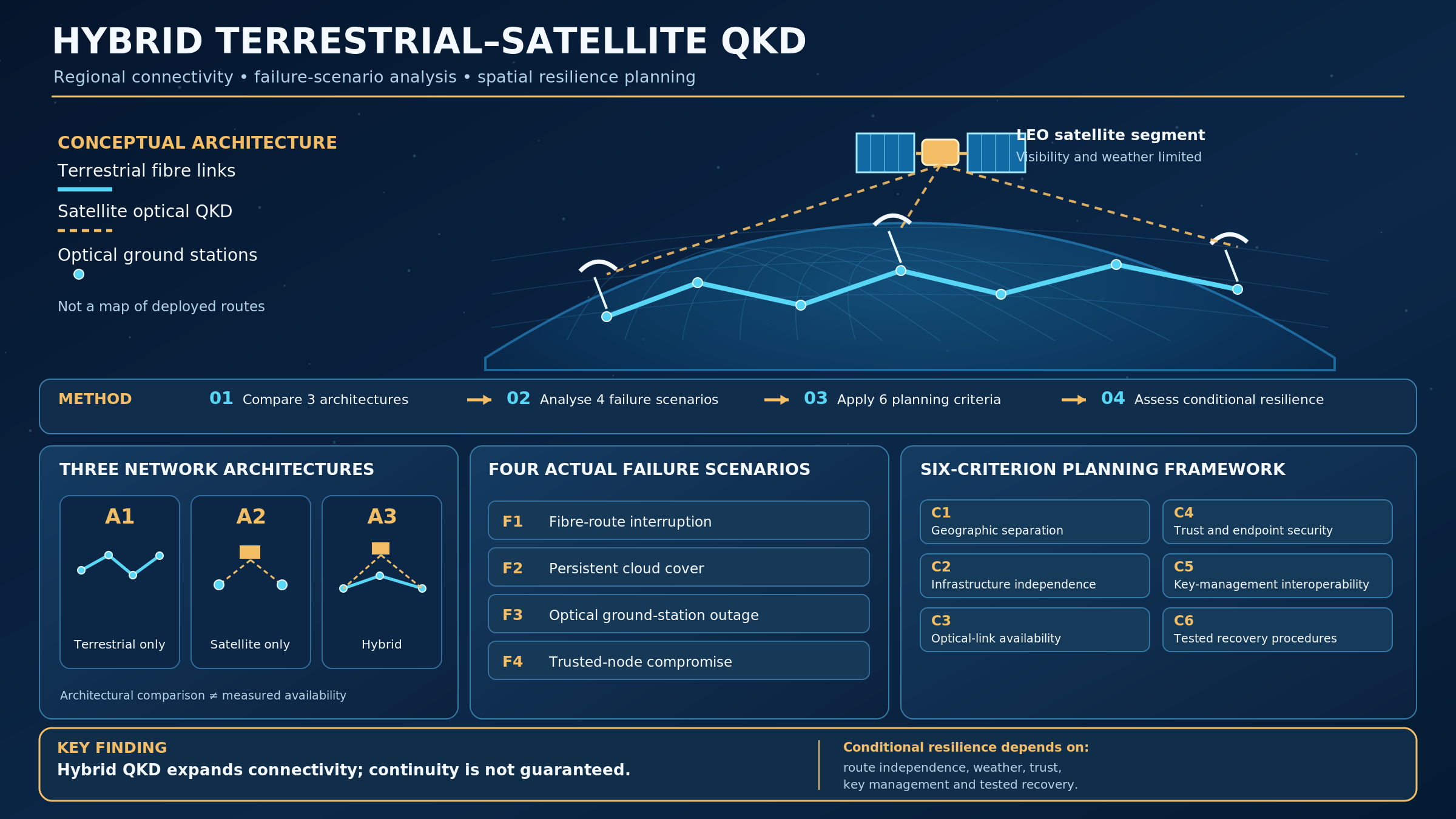
This study investigates how integrated terrestrial and satellite quantum key distribution (QKD) architectures may support territorial communication connectivity and regional security in Europe. A structured qualitative comparison considers terrestrial-only, satellite-dependent and hybrid configurations under four disruption scenarios: fibre interruption, persistent optical weather unavailability, optical ground-station failure and trusted-node compromise. Evidence is drawn from peer-reviewed QKD security analyses, terrestrial field networks, satellite-channel studies and space-to-ground demonstrations, with European programme documents used solely for policy and project context. The analysis distinguishes physical connectivity from authenticated, policy-compliant key delivery and identifies six spatial and operational planning criteria: geographic diversity, infrastructure independence, optical availability, trust security, key-management interoperability and tested recovery procedures. Hybridisation offers conditional alternative pathways but cannot itself guarantee continuous service or remove shared trust dependencies. The proposed framework is conceptual; no field measurements, reliability percentages or operational deployment claims are inferred. The contribution is a transparent planning method and an explicit agenda for future quantitative validation.
Keywords:
satellite quantum key distribution
; EuroQCI
; EAGLE-1
; optical ground stations
; hybrid quantum networks
; territorial connectivity
; regional resilience
Copyright: This open access article is published under a Creative Commons CC BY 4.0 license, which permit the free download, distribution, and reuse, provided that the author and preprint are cited in any reuse.