

Submitted:
18 November 2026
Posted:
19 November 2026
You are already at the latest version
Abstract
Journalism has undergone rapid technological, institutional, discursive and economic changes in recent decades, leading to growing use of quantifiable audience metrics (QAMs) in its work design and the subsequent tension in its normative structure as a truth-seeking public service vs. a market logic focused on commercial performance. We argue that journalism is undergoing organizational anomie—a sense of deregulation and disintegration in its normative structure, which in turn influences journalists’ identity and status anxiety (SA). In a qualitative design, we interviewed twelve Norwegian journalists, exploring their perceptions of their working environment, journalism’s normative structure, and their self-identity and anxieties related to their work. Through reflexive thematic analysis, we generated four themes, indicating a prevalent perception of organizational anomie and experience of SA. Our informants perceived normative confusion in journalism, experiencing the domination of market-driven rationality in determining news content and delivery forms, alongside a diminished emphasis on the traditional ideal of journalism’s truth-seeking mission. SA emerged through heightened competitiveness, constant performance evaluation based on QAMs, and job insecurity. Organizational anomie fosters SA, fundamentally reconfiguring journalists’ sense of professional autonomy, identity, evaluative practices of their work quality, and subsequently their SA.
Keywords:
Journalism
; normative structure
; organizational anomie
; status anxiety
; quantitative metrics
; identity
1. Introduction
Journalism as a profession has been highly exposed to rapid changes over the past few decades. These changes include technological advances such as social media (Fenton 2011; Kristensen 2023; McGregor 2019), neoliberal policies and the commercialisation of the news industry (Fenton 2011), the dominance of economic rationality in journalism (Hamilton 2004; Nielsen 2019), quantifying quality through metrics and algorithm (Christin 2018, 2020; Meijer 2005), and broader sociopolitical discourses surrounding the post-truth society and concerns with misinformation and fake news (Corner 2017; Harsin 2014, 2015). Together, these developments shape journalists’ experiences of their working environment and their perceptions of the profession’s normative structure.
Technological advances, particularly the internet and social media, have fundamentally transformed how humans communicate information with each other, reshaping how journalists work, produce news content, interact with audience, and examine their productivity (Fenton 2011). The changes have been far reaching such that journalists now look to social media to justify their own meta-narratives, as they can use embedded social media posts to reflect their own thoughts without criticizing public figures directly (McGregor 2019).
In addition, the political and economic landscape has also changed in the last few decades with implications for news industry and journalists. Journalism is influenced by neoliberalism, a political and economic ideology and agenda based on capitalist economic rationality, deregulated market and privatization (Venugopal 2015), which has turn news into a commodity rather than a public service (Jackson 2009). Hence, the media and news industry have changed into a for-profit business in which the expected utility, profitability, and commercial benchmarks such as audience engagement, clicks, shares, revenue and commercial viability significantly influence which stories and news get published (Hamilton 2004; Hanitzsch and Mellado 2011; Nielsen 2019). With labour market deregulation and big mergers, we witness large layoffs as well as the homogenization and centralisation of the performance assessment through algorithmic management (Christin 2020; Kreft, Boguszewicz-Kreft, and Fydrych 2025; Winseck 2008).
The dominant economic rationality in journalism places increased emphasis on competitiveness and meritocracy, placing great value on achievement in comparison and competition with one’s peers, which in turn strongly determines journalists perceived status (Gill 2015; Scott and Marshall 2009). As an interview study conducted by Hartley (2013) shows, online journalists’ self-perception is rooted in an individualistic and competitive ideology. The emerging online journalist sees themselves as someone with fewer sources and less knowledge compared to newspaper journalists. Within the institutional environment, managers send constant reminders about journalists’ metrics and performance, leading to journalists’ self-policing their practice on institutional quantifiable metrics performance index (Bunce 2019).
Finally, shifts in sociopolitical discourse—characterised by claims of a post-truth society, the rise of “alternative facts,” fake news, disinformation, conspiracy theories, sensationalist content, and the growing influence of non-editorial platforms and organisations—have further transformed the media environment and journalism work (Harsin 2014, 2015; Wardle and Derakhshan 2017, 2018). Such discourse not only challenges the legitimacy of the news content but also destabilises the function of journalists’ professional roles, creating confusion about the normative ideals of journalism and the responsibility of the journalists that should guide the journalism practice. For instance, Nagle (2017) shows how fringe internet subcultures such as 4chan trolls and Tumblr communities erode mainstream media’s gatekeeping role through memes, irony, and non-editorial content and platforms, thereby challenging journalistic norms and contributing to post-truth discourse.
Such technological, political, economic, and discursive changes over the recent decades have led to two major issues in journalism: the increasing use of Quantifiable Audience Metrics (QAMs) in work design, and the tension between journalism’s professional logic as a truth-seeking public service and the market logic focused on audience metrices, competition and commercial performance. QAMs refer to measures that make the professional judgements in an organization measurable, comparable and contestable, shaping how employees approach their work and influencing their identity, evaluation practices, and status (Sauder and Espeland 2009). QAMs in journalism include measuring news performance in terms of attention per news, likes, shares, and views, which are reshaping journalism’s feedback mechanisms.
Furthermore, changes in journalism have blurred the line between the traditional truth-seeking role in the public interest and the profit-driven focus on commercial performance (Fenton 2011; Hamilton 2004; Jackson 2009). Journalists have traditionally relied on ideals like impartiality and neutrality (Boesman and Costera Meijer 2018), as well as professional instincts and tacit knowledge (i.e., “journalistic gut feeling[s]”) (Kristensen 2023; Schultz 2007). However, with the rise of QAMs and economic rationality, these ideals are now seemingly being discarded for what is perceived as “quantified evidence of content success and individual performance” (Kristensen 2023:991 also see Christin, 2018, 2020). Furthermore, as Meijer (2005) highlights, “qualitative values [are being] sacrificed at the expense of quantitative values” (p.32). Hence, there is a confusion in normative structure of journalism work.
Both changes in journalism’s organizational design including domination of QAMs and normative confusion affect not only the content and types of news journalists produce but also their identity and status concerns. QAMs type of feedback determines which type of information is more newsworthy and shareworthy. Accordingly, journalists have to strategically and continually calculate the costs and benefits of their performance to maximise material and symbolic rewards and correspond their work with organizational norms of measurable outcomes (Christin 2020; Fengler and Ruß-Mohl 2008). On the other hand, online journalists—i.e., those who primarily work with/on digital platforms as opposed to traditional “newspaper journalists”—develop a different professional identity and produce different types of content (Hartley 2013; Singer 1997; Tofalvy 2021). For instance, online journalists see themselves more of information-providers (“gatekeepers”)–explaining the information already out in the world–rather than choosing what stories to tell and “communication of information”, while newspaper journalists describe themselves as “investigative” or “interpretive” (Hartley 2013:584). Finally, there is a persistent worry and job insecurity among journalists and the performance assessment leads to increasing anxiety among them regarding their performance (Kreft et al. 2025; Winseck 2008).
Relying on social theories (Durkheim 1997, 2005; Messner and Rosenfeld 2001; Teymoori and Mataji 2025), we argue that such changes in journalism organizational environment and work design create organizational anomie—i.e., the domination of QAMs and confusion of normative structure are indications of deregulation and disintegration of journalism institutions. Organizational anomie influence identity and psychological wellbeing of journalists. The increased emphasis on competition and meritocratic beliefs in journalism work design and domination of QAMs might lead to heightened concern with one’s status, creating status anxiety (SA) among journalists.
Hence, we propose that the two terms–organizational anomie and SA–are key to understanding journalists lived experiences in an ever-changing profession. In what follows, we outline major theories of anomie and explore its extension to organizational contexts such as the media. We then discuss SA and explain whether and in what ways organizational anomie may create SA among journalists. Finally, we present our qualitative interview study examining organizational anomie and SA among Norwegian journalists.
Anomie
Anomie in literature can be understood from four distinct but interrelated perspectives. First, from a Durkheimian (1997, 2005) perspective, anomie arises when the changes taking place in society is in a very fast pace that the regulatory apparatus in society are not able to properly account for those changes, thereby losing its ability to regulate individual behaviors. Applying Durkheim’s original theory of anomie in the American context, Merton (1938, 1968) denotes anomie as a discrepancy between cultural ideals, as imbedded in American dreams, and the legitimate means to achieve those ideals. Accordingly, it is the clash between ideals and standards of excellence and means to achieve those ideals in society that creates deregulation in society.
Moreover, studying anomie in the context of rising crime in the US, Messner and Rosenfeld (2001) proposed Institutional Anomie Theory (IAT), arguing that anomie results from shifts in key societal institutions, specifically the domination of economic rationality within normative institutions such as education, culture, family, and religion, undermining their capacity to properly regulate social actors’ behaviours effectively. According to IAT, in an anomic context, normative institutions prioritize instead economic goals and rationality such as wealth accumulation, individual benefits, and competition (Groß et al., 2018; Messner & Rosenfeld, 2001). Finally, from a social psychological perspective, Teymoori and colleagues (2017) conceptualize anomie as a collectively shared perception of deregulation and disintegration in society, such that both the regulatory apparatus in society such as leadership and policies and the social fabric such as interpersonal trust and moral standards are perceived to be breaking down.
All four major approaches to anomie consider it as a state of society characterised by the breakdown of the regulatory capacity of the normative structure of society (Durkheim 1997, 2005; Merton 1938, 1968; Messner and Rosenfeld 2001; Teymoori et al. 2016, 2017). The rise of anomie in society has significant consequences for individuals, including psychological consequences such as hopelessness, helplessness, and, in extreme cases, suicide (Durkheim 2005; Teymoori et al. 2017). At the social level, anomie leads to increased authoritarian tendencies (Neerdaels et al. 2026; Neerdaels and Teymoori 2026) and competitive and marketized mentality (Groß, Hövermann, and Messner 2018).
Anomie can also emerge at institutional and organizational levels (Messner and Rosenfeld 2001). However, organizational anomie has received limited attention empirically as well as within social and organizational psychology (Johnson and Duberley 2011; Syre et al. 2025). A few existing studies have examined how organizational changes result in anomie in normative institutions, such as care work (Syre et al. 2025), higher education sector (Caruana, Ramaseshan, and Ewing 2000; Litlere and Teymoori 2026), and school system (Groß et al. 2018; Yarim and Çelik 2021). Nevertheless, research on organizational anomie in normative institutions is at its nascent stage, and there is a need to focus on the manifestation of anomie in diverse normative institutions like journalism. To the best of our knowledge, no study has yet examined organizational anomie in journalism—a gap that this study aims to address.
For several theoretical reasons, we believe that media and journalism organizations exhibit organizational anomie. Firstly, journalism has experienced rapid technological, social, political, and discursive shifts over the past few decades, leading to domination of QAMs as measures of quality and confusion in its normative structure, reflecting anomie from a Durkheimian (1997, 2005) and IAT (Messner and Rosenfeld 2001) perspectives. Moreover, the growing instrumental rationality in media, with marketized ideals of excellence and success may not only conflict with journalists’ own standards and normative ideals of good journalism, but also hard to achieve for many journalists, creating organizational anomie from a Mertonian (1938, 1968) perspective. Finally, the combination of economic rationality and normative confusion fosters a perception of a deregulated and disintegrated organizational environment, markers of organizational anomie from a social psychological perspective (Litlere and Teymoori 2026; Syre et al. 2025).
Despite the theoretical reasons for existence of anomie in journalism, there is not much empirical work about organizational anomie, especially from the perspective of journalists. In addition, potential organizational anomie can have a range of negative outcomes. At the organizational level, it often results in a sense of dissatisfaction with the organization and a damaged identity (Litlere and Teymoori 2026). Individually, it can cause mental and physical stress (Syre et al. 2025) as well as feelings of hopelessness and anxiety about the future (Yarim and Çelik 2021). One specific form of anxiety that may emerge is SA, which relates to concerns about one’s social standing within a hierarchical organization. While SA has been extensively studied in sociology, it remains relatively underexplored within organizational research, especially in relation to organizational anomie.
Organizational anomie and SA
SA refers to the persistent worry about one’s social standing and ability to meet societal and organizational standards of excellence (de Botton 2004). It involves self-evaluation relative to others, concerns about how one’s social status is perceived, preoccupations with matters of status, and constant anxiety about one’s social position. Several factors suggest that journalists may experience high SA, potentially stemming from organizational anomie.
First, journalism and media operate in highly meritocratic and competitive environments, where individuals are engaged in a continuous struggle to survive or advance within social and professional hierarchies. SA commonly arises in such competitive, hierarchical settings where success and recognition are closely tied to status (Gill 2015).
Second, QAMs establish objective criteria for comparison and success, quantifying journalistic achievements through metrics like follower counts and shareworthy articles (Sauder and Espeland 2009). These metrics have also fostered the emergence of celebrity journalists, especially through social media platforms. According to Olausson (2018), the current media landscape encourages individualism, with journalists actively engaging in self-promotion—functioning as a process of “celebrification.” Celebrification as a form “expression of the self” (Marshall 2010:35). Hence organizational anomie in the form of domination of QAMs as a measure of quality introduced new forms of quantifiable feedback, personal branding, and shifting the focus from institutional authority to individual performance and visibility (McEnnis, 2023), which is very likely to create a sense of SA among journalists.
Finally, given the rising precarity of journalism workforce and increasing competition, individuals might shift into survival mode, experiencing persistent anxiety as they try to preserve their status and security. In qualitative studies on anomie, Yarim and Celik (2021) and Litlere and Teymoori (2026) found widespread sense of uncertainty and anxiety regarding one’s social and personal future. QAMs also induce a sense of job-insecurity because one’s social standing depends on constant evaluation of one’s performance (Zamith 2018). Constant evaluation and competition creates a working environment in which employees are highly concerned with their social standing, leading to SA. Altogether, we argue that organizational anomie may instigate a sense of SA.
The current study
The current qualitative interview study aims to investigate how Norwegian journalists perceive the normative structure in their working environment (organizational anomie) and how that may lead to SA among journalists. We will examine how journalists perceive their working environment and media organization. Furthermore, we turn to investigating how journalists make sense of their own identity (self-identity), and whether this perception potentially breeds SA. Thus, we present the following research questions:
1. How do journalists perceive their working environment and media organization’s normative structure and whether and in what ways these perceptions can be characterized in anomic terms?
2. Whether and in what ways do the perceived organizational anomie have implications for journalists’ experience of SA?.
2. Materials and Methods
Research methodology
The current study applies a qualitative research design using semi-structured interviews for data collection (Brinkmann and Kvale 2015) and Reflexive Thematic Analysis (RTA) for textual data analysis (Braun and Clarke 2021). This approach has been previously used in other studies exploring organizational anomie (Litlere and Teymoori 2026; Syre et al. 2025) and fits the exploratory nature of relatively novel scientific constructs.
Participants
The main inclusion criterion was that participants must have experience working as employees in established media organisations or as regular freelancers in journalism. Thus, the study included journalists currently work in the field, and those who have recently left or transitioned to other careers.
To recruit participants, we primarily contacted individual journalists using their publicly available contact information on various social media platforms. Moreover, we used snowball method as well, recruiting through already established social networks, acquaintances, and referrals. No monetary or gift incentives were offered during recruitment. We recruited 12 journalists (Table 1), with eight recruited through snowball method and four through direct contacts. We aimed to ensure diversity in gender, employment-type and experiences in our sample to better understand how journalists’ experience their working environment.
Interview Procedure
Our interview guide consisted of 20 questions, along with several sub-questions, all carefully designed to capture journalists working experiences and address our two main research questions. To accommodate participants preferences, we conducted a mixture of physical and digital interviews. All interviews took place between January and March 2026.
Ethical considerations
Prior to conducting our study, we received approval for our privacy protection measures and study materials from SIKT (reference number: 624994). In addition, we processed information shared by our participants confidentially and anonymously. Before each interview, we gave participants the relevant information and consent form explaining the use of data, our data protection measures, and anonymization of the text and obtained their explicit consent for their participation.
Data analysis
We have first transcribed the interviews manually through clean, edited transcription method. Using RTA (Braun & Clarke, 2021), our analysis strategy followed six phases to capture the multifaceted meaning patterns in our data. We first familiarized ourselves with the data (phase 1) and then coded (phase 2), using latent inductive way of coding (Braun & Clarke, 2021). The first interview was coded collaboratively by all three members of the research team, and the remaining interviews were coded by the first two authors.
Latent coding involves a more interpretive approach, in contrast to semantic coding that focuses on the surface meaning of the text (Braun & Clarke, 2021). In our coding strategy, our existing theoretical knowledge shapes our perspective and the way of thinking about the subject matter, leading us to lean towards latent coding. In addition, the nature of our subject matter (e.g., status, comparison with colleagues) was a bit sensitive to our participants, and as a result they sometimes responded to our questions rather implicitly. People are normally uneasy discussing their mental health issues at work, including their SA (Gill 2015; Haslam et al. 2005). Although latent coding carries the risk of bias in interpretation, we deemed it necessary and appropriate for analysing workplace experiences such as perceived organizational anomie and SA.
Thereafter, we generated and revised themes based on the codes and the materials (phase 3 and 4). We continuously revisited and redefined themes to ensure we capture the multifaced meaning and find our answers to our research questions. Afterwards, we named and defined the themes and ensured that they were distinct and properly representing the texts and meaning patterns in the textual materials (phase 5) and finalized our findings section (phase 6).
Reflexivity of the research group
The authors have background in social and organizational psychology that shape their understanding of the subject matter. Furthermore, we reached out to our social networks, which naturally means some familiarity (in varying degree) to some of the participants. However, an entirely professional manner was present in all interviews. Given the nature of our topic, a negativity bias was likely present that may have caused a shift of focus to the negative aspects of the journalists’ working conditions. To try to counteract this bias, to the best of our abilities, we kept the questions open and non-conductive, letting the journalists formulate their own lived experiences. We have kept a reflective journal throughout the process to ensure the quality of the choices and interpretations we made throughout the whole process from interviews to theme generations and interpretations.
3. Results
For our findings, we have developed four themes and 13 sub-themes, as shown in the thematic map (Figure 1), with definitions for each theme and sub-theme provided in Table 2. Two themes were generated to address organizational anomie: (1) the changing nature of news, (2) news based on the audiences’ metrics. Whereas the last two themes were generated to address SA: (3) aim high and don’t look down, and (4) the precarious nature of temporary positions in journalism.
3.1. Q1. The Perceived Working Environment in Terms of Normative Structure and Anomie
3.1.1. Theme 1: The Changing Nature of News
Participants highlighted the rapid technological and organizational changes over the past few decades, noting that these shifts have significantly altered the types and content of news journalists produce. They expressed a variety of perceived anxieties, challenges, and animosities tied to the rapidly changing landscape of journalism.
Firstly, journalists have to fight to obtain and retain audiences’ attention, especially on emerging social media platforms, such as TikTok and Instagram Reels, characterized by short-form content and in audiovisual format, hence there is the rising demand to make the news short but effective, to tell the story in under 30 seconds. The reason for that is a broad variety of news sources and the competition for audience attention: “We face very significant fundamental challenges in terms of competition for people’s time” (Lily). The attention problem is multi-faceted, as people often refrain from consuming content which is too protracted: “It [Our relationship to our audience] is a bit of an identity-crisis. You can’t be too idealistic in how you think. Most want short-video format nowadays” (Steve). The new digital ecosystem of short-format content also brings forth cultural challenges, as journalists have to battle between their fields’ self-perceived values–such as truth-telling and nuance–in a landscape consisting of temporal constraints that limit the ability for depth and complexity. As Steve explains:
There is a limit, I think, where you end up dumbifying the content too much. Where you make it too available.... You move away from what journalism is supposed to be. About making the world a better place, or at least making people more informed about how the world is.
The majority of interviewees explained how the introduction of new digital platforms requires more to master; more to do. Visual media, podcast, and social media have tasked journalists with more technical work: “technology is advancing rapidly and journalism as a field is trying to keep up with it instead of clarifying the conditions of why they are there” (David). With the rapid implementation of new platforms and new tasks and skills, journalists have not necessarily been given more resources to handle them, forcing them to divert hours once dedicated to “pure journalistic work” to other tasks:
Suddenly you are tasked with making a podcast-episode or publishing more online. It’s fun, but at the same time you get less and less time left. It is difficult to understand where the ‘pure journalistic time’ is going when we are supposed to be a modern paper who publishes auditory and visual stories alongside all we already do. (Karen)
Another threat to journalism work is Artificial Intelligence (AI). For our informants, AI makes their work efficient, but compromises audience trust. Initially, AI can be a useful tool to uphold certain journalistic standards (e.g., good punctuation and correcting mistakes), improve efficiency and productivity, and ease some of journalists’ workload. One important value in journalism that kept being voiced was orthography: “Good journalistic work is... good language. You can get far with good language skills. I read a lot of spelling mistakes in other media outlets, and it does something [negative] with the trust” (Kristian). Hence, with AI “the task of being more precise has become a bit easier” (Kristian). Some others view AI very positively since it can “simplify and automate some processes within journalism to enable them to deliver more information more quickly” (Hedwig). However, our informants also expressed negative view of AI, with some expressing concerns that it can threaten other journalistic values: “The problem is that AI oftentimes compromises our credibility and ability to verify the information, and thus in a sense the whole concept of editor-controlled media” (Lily). Accordingly, the use of AI can lead to the loss of audience trust: “We are losing the trust of the people and the audience [due to AI], and you can tell that by [reading] the comment section” (Evelyn). Moreover, some informants worried how AI might eventually hijack their jobs, increasing their job insecurity:
AI is directly threatening certain journalist jobs such as summarizing articles, which used to be written by media-students or newcomers. It gives less space for people to enter the field, but is also pressing already established people out… Take [media organization] as an example, only three years ago they were 40-60 employees, now only 4-5 permanent employees left. The entire newsroom is peeled, so now it’s just a bunch of freelancers and AI. (Diego)
In short, our informants believe that the nature of news is changing because of on-demand short content, adapting the new for new digital platforms, and AI. Similarly, heavy reliance on new digital tools changes the values and integrity of journalism work, especially when our informants discuss feedback-mechanisms, including QAMs.
3.1.2. Theme 2: News Based on the Audiences’ Metrics
Our informants highlighted how QAMs have become essential in determining what is newsworthy to report. They formulated this as a challenge, noting that although they strive to uphold certain core journalistic values, it is the audience metrics and market demands that actively shapes how and what information is conveyed.
The digitalization of news allows for an unprecedented accessibility of feedback from the audience. There is now a two-way street communication between journalists and audience. Whereas print-journalism has traditionally been a one-way street, with journalists deciding what news to present to their audience, the digitalized news landscape enables the audience to play an active role in shaping the news content and its delivery in unprecedented ways: “We have to publish what people read... [the audience is] extremely involved in what is reported.... We have to report on what gets enough viewers and clicks, and content that engages” (Kristian). Audience dictates the news delivery format too, even if it contradicts the journalists’ own wishes:
Most people want short-video format now. I’m kind of against it. It would be cooler if we didn’t have to do that, but you have to be pragmatic. It is an industry that is audience-driven, and if you don’t listen to the people who give you a livelihood, it unfortunately becomes very difficult. (Steve)
Although journalists “get both criticism and positive feedback on the things they write” (Bob), the feedback format in social media and online forums does not allow for in-depth exploration and debate. Moreover, the audience demand may turn into a value and expectation, in which case the journalist may lose its independent and critical inquiry. Interestingly, the strength of bidirectional communication seems to be stronger for local newspaper than national ones, as “there is an expectation that local newspapers are supposed to be participating in local events” (Kristin). Being only responsive to expectations and demands may lead to a confirmation bias and loss of critical inquiry:
It is a weird thing that local journalists experience more than other journalists, a demand that you are to only write positive texts about your place. I remember one time we were writing a critical piece on a local cooperation, and when I was out in the field as a journalist I met a lot of people who were angry at our newspaper. (Karen)
One consequence of the bidirectional communication is that journalists are now left to handle more stressors in their everyday work: “One has to learn to weed away the negative [feedback]” (Evelyn). The stressors might even include hateful and intimidating e-mails: “We get some hate e-mails. That is a part of the job, and I do not know anybody who is offended by getting death threats and such” (Guri). The issue our informants identified was that two-way communication with audiences is shaped less by rational, open discourse and more by a marketized logic of supply and demand, fulfilling audience expectations or vested interests, exposing journalists to threats and violence.
Audience engagement, measured through QAMs, increasing determines what is newsworthy. If a story fails to attract attention and clicks, it gets ignored, rejected, or discarded. That is, it must get clicks or hit the bin. Because QAMs are crucial for sales and advertising revenue, they have become the key governing principle in shaping both news content and its delivery format: “Within the editorial team it seems that monetary demands are to a greater extent controlling what work gets done” (David). Hence, QAMs determine how to formulate the story: “I know of a colleague who was told to rewrite her titles and preambles because she had a low amount of viewership, even though she wrote good articles” (Kristin). Better QAMs have been equated with what constitutes good journalism: “You can produce poor journalism that gets read a lot and be considered skilled” (David). The media organization’s management focus excessively on QAMs as a performance indicator: “He (my boss) is a very big fan of sensationalist news-headlines that generate clicks. I wish we didn’t have such a big focus on clicks and subscribers, but rather had more focus on good journalism–and hope that that in itself generates sales” (Kristin).
In addition to a quantitative aspect, the speed of which news has to be delivered was also discussed by the informants, stating how the journalists want depth, but media organizations want it fast. Our informants widely reject such content production and view it as a move towards lower quality, fast-paced sensationalist news: “It [Journalism] is a field that is plagued by the demand of having to deliver news first and as quickly as possible, rather than control for quality” (Kristian). The demand to be first out with news–at the expense of quality-control–is deeply engraved in the field of journalism: “There is a saying in our profession. First we are first, then we are best. And that is something I’ve felt in my body, both physically and mentally that that is the standard at work” (Kristian). Journalists face pressure not only to be first to publish but also to meet daily quotas: “…we are told to deliver two articles a day, which limits the time you can spend on each case” (Kristin). In some cases, the focus has shifted towards publication of much shorter stories but more often: “You write a lot of short news stories, maybe 10 to 20 stories a day” (Stian).
Audience metrics and contemporary cultural trend (e.g., celebrification) shape journalists’ self-perception and professional identity. These factors may also create status differences within journalism, generating SA for individual journalists.
3.2. Q2: Organizational Environments’ Implications for SA
3.2.1. Theme 3: Aim High and Don’t Look Down
According to our informants, status within organization and beyond plays a major role in journalists’ professional identities. Most informants note that status varies across editorial teams, job title, and employment type. Most importantly, however, there is a tendency among journalists to aspire to become public personas, akin to that of celebrities.
Although the field of journalism was deemed high-status by most of the informants, it was made clear that it is not as good as it used to be. With the heavy increase of un-editor-controlled media, the perceived usefulness of editor-controlled media by society seemingly decreases: “There isn’t as big of a feeling that it [journalism] is an important sector to have anymore” (Diego). Another reason for loss of status in journalism was believed to be connected to lack of credibility: “…the status of journalism has declined in recent years due to less trust in mainstream news” (Stian). One reason for the declining trust in editorial-news may be because the media organisations themselves do not adequately work on rebuilding their status:
I don’t feel like media organisations are able to take them [the audience] seriously–the people who have lost their trust in us.... Probably because they are so little exposed to them.... people who work in media and journalism live in an echo chamber. (Stian)
The loss of confidence in the eye of public seems to contradict the increasing focus to audience metrics, but the shift from taking public interests into account rather than their metrics may be one reason for the perceived decline of their status: “they [journalists in 70s and 80s] were more respected because they only wrote in the newspaper, only wrote long, good pieces. While now it is more about who on the desk can get the most views” (Steve). Delivering it fast and frequently limits the ability to write in-depth news stories as Steve juxtaposes the romanticised investigative journalism of the past, with today’s QAMs-based journalism.
Using QAMs as performance indicators has contributed to emergence of celebrity journalists, suggesting that work design has normalized a tendency that it is realistic to try to be famous. Journalists are continuously encouraged to self-improve and climb the work hierarchy through visibility, using diverse platforms, and fame: “people are drawn to journalism because journalists are often famous. Or rather, there has been a shift in that journalists have become public figures in a way” (David). This tendency seems to be stronger amongst early career journalists, perhaps due to being socialized in contemporary cultural trends: “As a student, you perhaps go into it with a sort of naivety, and you think you’re going to become a show-host or that you’re going to make a name for yourself and work in the industry” (Evelyn). Being famous gives his status that is appealing to journalists that need visibility: “I have had situations in social settings where I’ve said my name and people have become star-struck..., that is very exciting, because it’s a reminder that you work for a newspaper people actually read” (Karen). Hence, the greater one’s visibility and fame, the higher one’s status and many more journalists aspire to achieve it.
Another prominent sign of status in journalism is the hierarchy at the media organization. According to our informants, editorial teams possess a certain status rank affiliated with their perceived societal value. More often than not, investigative journalism and foreign affairs were perceived as at the top of the hierarchy, with cultural journalism at the bottom: “In my organization I feel that we in the culture editorial team are at the bottom of the hierarchy in a way, while the cool people work in foreign affairs for example, or in politics/economy” (Isabel). Some informants even viewed cultural journalism as becoming irrelevant in the field: “There is almost no cultural journalism left. There are some here and there, but one has a feeling it is a dying breed of journalism” (Karen). On the other hand, investigative journalism has been idealized, especially in early career journalists, perhaps due to being closely aligned with the core values of journalism: “Those cases when you go around the street asking bypassers empty questions, I don’t really like that. But if we go back to it [investigative journalism], it is about the values..., about making the world a better place” (Steve). Some informants even saw investigative journalism as a counterweight to fast-paced news: “I think there is an appetite for depth [in investigative journalism] as a counterweight to the fast-paced and AI-generated news” (Karen).
Another reason for high status of investigative journalists is that one must obtain a certain organizational status before being allowed to work on bigger stories, such as investigative journalism: “As a temporary employee I can’t take up too much space. I can’t demand, let’s say that I want to spend 3 weeks or 4-5 weeks on a long case. Those who are permanently employed do more of those longer cases” (Isabel). Finally, conducting investigative journalism is seen as an honor for a news-organisation, hence holding a high status: “It [investigative journalism] is an honor for our editorial.... It is a way for us to uphold our dignity and honor as a newspaper” (David). Doing investigative journalism may not be economically sustainable in the short run, hence symbolizes a stable economic status in news organisation: “And I experience that, when reading other commercial [news channels], that good investigative cases are used as surplus projects, decorating oneself with proof of ownership” (David).
Due to a competitive working-environment, journalists often find their perceived work-identity tied to their ability to out-perform their peers and that they are in constant competition with colleagues. There are different mechanisms and conditions that sustain and promote competitive cultures. For instance, some media outlets display journalists’ QAMs and compare to their colleagues: “At [previous employer] we had a big screen in the office where there was a continuous top-list over what has gotten the most clicks... Everyone had access to the list and could click on it and see who has written what” (Stian). In some cases, the results of QAMs are communicated to the journalists is a form of performance feedback in a ranking order for peer comparison:
We get an excel-report at the end of every week regarding how well our articles did: how many sales it got, how many readers. And at the bottom there is a list over which articles got the most clicks: as you can see here my colleague had an article this week with 3500 readers. (Kristin)
For our informants, the measurements of performance were not perceived as entirely and inherently bad, although many noted the indirect consequences of such practice. In effect, however, QAMs are being used for intraorganizational competition: “We [colleagues] are competitors, some will think. So, for example, they might take a case you were supposed to write, or do not necessarily invite you to lunch” (Guri). Hence, despite being a sociable working environment, “it can feel a bit difficult at times because you sense a form of competition” (Evelyn). Constant social comparison facilitated by visible lists and spreadsheets fuels the competitive working environment and such constant monitory, clear quantitative indicators for individual’s performance and peer comparison can cause SA, as one is constantly made aware of one’s work status (according to performance) compared to one’s peers. This is especially consequential for early career journalists as they compete for fewer permanent job-opportunities.
3.2.2. Theme 4: The Precarious Nature of Temporary Positions in Journalism
Our informants indicated a change in journalism labor market, with the growing scarcity of the permanent jobs and the precarious nature of temporary positions in journalism for early career journalists. The temporary workers (including those working “vikariat” or as on-call substitutes) often has short term contract, facing instability and insecurity for their career path. They have also less autonomy in the types of work they do, and less influence in their working conditions and environment.
As a temporary journalist, one is regularly reminded to know one’s place, often through subtle delegation of specific work tasks and instances of social exclusion. These actions serve as constant reminders of one’s position in the organizational hierarchy: “During last launch, only permanent employees were invited to the restaurant, and the event the following day” (Steve). The differential treatment is especially salient in the task delegation: “[The boss] didn’t want to give dull tasks to the permanent employees because it made them unpopular, so it was usually us, the temporary employees, that took the hit” (Isabel). Early career journalists expressed a feeling of exclusion despite carrying a significant portion of the work tasks.
The early career journalists have to move between different organizations and contracts until, if ever, they secure a more stable position. Several informants expressed high level of anxiety associated with being in constant trial periods, a constant worry of always having to perform and justify one’s position in the organisation to obtain a renewed short-term contract or ideally a permanent position. Early career journalists thought that “there is an inflation of journalist-graduates..., making it very very difficult to get a permanent job” (Isabel). There has been also a significant reduction in the number of permanent positions, making “it… pretty hopeless as a new, young journalist to get a full-time job” (Bob). Given the competition for the few remaining permanent positions, early career journalists must be very strategic in their skill sets, job market demands, and types of journalistic works that can gain them visibility.
The early career journalists and journalists with temporary contracts describe their situation as being stuck in temporary-limbo as moving between one short term contract to another, one may not be able to plan long term, leading to feelings of learned hopelessness and pessimism about ever being permanently employed. In Norway, one is entitled to permanent employment after working three consecutive years as a temporary employee for an organization (Arbeidsmiljøloven, 2005, § 14-9). However, media organizations have a well-known way of getting around this law to avoid hiring permanently:
There is much of what is called “lufting” that when you have worked there and reached the limit of one-and-a-half year or two, then you got to leave. Because if not you would be entitled to a full-time job, and they do not want that. So, you’ll have to find something else to do for a few months, then you can come back and start from scratch. (Isabel)
It is noteworthy that all informants currently employed in temporary positions expressed views on “lufting”, even when they were not asked about it. The general sentiment is extremely negative: “It [lufting] is very stupid and it happens relatively often” (Stian). Early career journalists know that this legal loophole will be used to deny them permanent position: “I actually expect it 100% [to be “luftet”]... I want to work here as long as possible, but if I get that far I probably will have to leave sometime next year” (Steve). Originally implemented as a measure to protect the rights of workers with temporary contracts, Arbeidsmiljøloven (2005) §14-9 is paradoxically breeding job-insecurity with those occupying these positions. Although media organizations’ ability to continuously offer temporary contracts is giving “foot-in-the-door” opportunities to early career journalists, it does so at the expense of long-term employment prospect, thereby creating job-insecurity and SA.
4. Discussion
The objective of our study was to examine Norwegian journalists’ lived experiences of their working environment, and professional self-identity, investigating whether their experiences point to the presence of organizational anomie within journalism, and if this organizational anomie leads to SA.
Our informants expressed working for an industry undergoing rapid and significant changes in its work design, and well as norms and values. The experiences show that the transition to digital news platforms and more visual and short story format have changed the way they do journalism work and have to compete for audiences’ attention. Similar to the growing quantification trend in work design (Sauder and Espeland 2009) and previous studies on journalism (Christin 2018, 2020; Zamith 2018), for our informants the work design of journalism is dominated by extreme quantification, the QAMs, creating normative confusion about values of journalism in which the commercial interests, economic rationality, and attention economy may compromise the normative ideals of journalism as a truth seeking public service. Our informants expressed a worry that the industry has become too reliant on audiences’ demands and metrics and the extent QAMs dictate their work.
Fundamental changes in contemporary journalism have also had implications for the journalists perceived professional self-identity and status. The informants described a decline in journalism’s status, which they attributed to the perceived distancing of journalistic practice from its traditional truth-seeking mission and to a work design increasingly centered on marketized values and audience metrics as measures of journalistic quality.
Journalists in temporary positions and at early career stages described an organizational hierarchy that neither supports nor values the growing temporary workforce. Consistent with scholarship on precarity and insecurity in journalism workforce (Kreft et al. 2025; Winseck 2008), our informants reported anxiety arising from repeated trial periods and a sense of being trapped in temporary limbo. Consequently, their professional self-identity and perceived status were shaped not only by a marketized organizational work design, but also by uncertainty regarding their position within the organizational hierarchy and their long-term prospects in the profession.
Our findings largely support the existing literature on the transformation of journalism under digitalization, commercialization, and metric-driven management. Consistent with research on social media, QAMs, and the increasing dominance of economic rationality in news work (Christin 2018, 2020; Fenton 2011; Hamilton 2004; Kristensen 2023; Nielsen 2019), our informants described a working environment in which audience attention, speed, and measurable performance increasingly shape both the journalistic content and its delivery forms. This appeared to weaken traditional professional ideals such as truth-seeking, depth, and substantive storytelling, echoing Meijer’s (2005) argument that qualitative values are increasingly sacrificed for quantitative ones. These organizational and structural changes change journalistic subjectivity and identity(Hartley 2013; Singer 1997).
Our findings indicate the existence of organizational anomie. Consistent with a Durkheimian (2005) perspective, rapid technological and organizational changes appear to have weakened the normative clarity of journalistic work and what counts as “good journalism” in an environment structured by metrics, competition, and commercial visibility. The domination of economic rationality through excessive quantification such as QAMs, increasing competition, increasing efficiency, and normalizing market-oriented measures of success in journalism can be seen as sign of anomie from IAT approach (Messner & Rosenfeld, 2001). From a Mertonian (1938, 1968) perspective, the findings indicate a tension between professional ideals—such as producing nuanced, truthful, and socially valuable journalism—and the institutional means, which not only limit the achievement of these ideals but also promote conflicting, market-oriented ideals of success. Overall, we believe that journalism in Norway is experiencing deregulation, disintegration and normative confusion, markers of anomie (Teymoori et al. 2017).
Furthermore, our findings suggest that perceived organizational anomie may contribute to SA. Journalists’ work design encourages constant quantification of work performances and constant peer comparison, a tendency to evaluate one’s standing relative to others. The workplace hierarchies, QAMs, and shifting standards of journalistic excellence on quantified and marketized terms form the matter of status for organizational journalism. Competition for visibility and job opportunities heighten concerns about maintaining status within the profession. Our findings show that normative confusion, market-driven work structures, and precarious employment are interconnected conditions through which SA can arise among journalists.
This study makes a theoretical contribution by extending anomie theory from the societal to the organizational level. Similar to previous studies that show the existence of anomie in healthcare (Syre et al. 2025) and education (Litlere and Teymoori 2026; Yarim and Çelik 2021), we provide evidence of its existence in journalism and its relevance for studies examining organizational environment and its influence on workers. Social psychological studies on anomie at societal level often do not take the economic dimension of anomie into account (Neerdaels et al. 2026; Neerdaels and Teymoori 2026; Teymoori et al. 2016, 2017). The current study shows that such dimension cannot be ignored given the growing prominence of economic rationality in organizational context. Additionally, the study links organizational anomie to SA, suggesting that an anomic work environment can heighten journalists’ concerns about rank, recognition, visibility, job security, and market-based ideals of success, all of which create SA among journalists.
There are several limitations in our study that can be addressed in future research. One notable limitation is the age distribution of the participants, who were mostly younger and therefore often less experienced employees, who may have little lived experiences of the changes journalism has undergone in recent decades. Additionally, the study was conducted in Norway, a country characterized by relatively good labour laws and economic compensation and publicly owned broadcasting, which may limit the generalizability to other contexts with different sociopolitical systems. We suggest that future research explore how more senior journalists have experienced changes in the media landscape, and also investigating the connection between the organizational anomie and SA in countries with different social, economic and political conditions than Norway.
In conclusion, the study broadens the understanding of a profession that has been undergoing rapid changes in the past decades. We provide much-needed empirical evidence for both the presence of organizational anomie and lived experiences of SA among journalists. We hope that future studies examine organizational anomie not only in journalism but also in other normative institutions such as culture, religion, education, and politics and further examine the link with SA.
Author Contributions
Conceptualization, A.T.; methodology, A.T., M.B., R.S.S.; recruitment and data collection, M.B., R.S.S.; data curation, M.B., R.S.S.; formal analysis, M.B., R.S.S.; writing—original draft preparation, M.B., R.S.S., A.T.; writing—review and editing, A.T., M.B., R.S.S.; visualization, M.B., R.S.S.; supervision, A.T.
Funding
This research received no external funding.
Institutional Review Board Statement
The study was conducted in accordance with the Declaration of Helsinki, and approved by Kunnskapssektorens tjenesteleverandør (SIKT, Service Provider for the Knowledge Sector, reference number: 624994, 16.01.2026).
Informed Consent Statement
Informed consent was obtained from all subjects involved in the study.
Data Availability Statement
An anonymized version of the interview transcript can be made available for research purposes.
Conflicts of Interest
The authors declare no conflicts of interest.
References
- Arbeidsmiljøloven. Lov om arbeidsmiljø, arbeidstid og stillingsvern mv. (Arbeidsmiljøloven). 2005. Available online: https://lovdata.no/dokument/NL/lov/2005-06-17-62.
- Boesman, J.; Costera Meijer, I. Nothing but the Facts?: Exploring the discursive space for storytelling and truth-seeking in journalism. Journalism Practice 2018, 12(8), 997–1007. [Google Scholar] [CrossRef]
- Braun, V.; Clarke, V. Thematic Analysis: A Practical Guide; Sage, 2021. [Google Scholar]
- Brinkmann, S.; Kvale, S. Interviews: Learning the craft of qualitative research interviewing; Sage Publications, 2015. [Google Scholar]
- Bunce, M. Management and resistance in the digital newsroom. Journalism 2019, 20(7), 890–905. [Google Scholar] [CrossRef]
- Caruana, A.; Ramaseshan, B.; Ewing, M. T. The effect of anomie on academic dishonesty among university students. International Journal of Educational Management 2000, 14(1), 23–30. [Google Scholar] [CrossRef]
- Christin, A. Counting Clicks: Quantification and Variation in Web Journalism in the United States and France1. American Journal of Sociology 2018, 123(5), 1382–1415. [Google Scholar] [CrossRef]
- Christin, A. Metrics at Work: Journalism and the Contested Meaning of Algorithms; Princeton University Press, 2020. [Google Scholar] [CrossRef]
- Corner, J. Fake news, post-truth and media–political change. Media, Culture & Society 2017, 39(7), 1100–1107. [Google Scholar] [CrossRef]
- de Botton, A. Status Anxiety; Pantheon Books, 2004. [Google Scholar]
- Durkheim, E. The Division of Labor in Society; Free Press, 1997. [Google Scholar]
- Durkheim, E. Suicide: A Study in Sociology; Routledge, 2005. [Google Scholar]
- Fengler, S.; Ruß-Mohl, S. Journalists and the information-attention markets: Towards an economic theory of journalism. Journalism 2008, 9(6), 667–690. [Google Scholar] [CrossRef]
- Fenton, N. Deregulation or democracy? New media, news, neoliberalism and the public interest. Continuum 2011, 25(1), 63–72. [Google Scholar] [CrossRef]
- Gill, M. J. Elite identity and status anxiety: An interpretative phenomenological analysis of management consultants. Organization 2015, 22(3), 306–325. [Google Scholar] [CrossRef]
- Groß, E. M.; Hövermann, A.; Messner, S. F. Marketized Mentality, Competitive/Egoistic School Culture, and Delinquent Attitudes and Behavior: An Application of Institutional Anomie Theory. Criminology 2018, 56(2), 333–369. [Google Scholar] [CrossRef]
- Hamilton, J. T. All the News That’s Fit to Sell: How the Market Transforms Information into News; Princeton University Press, 2004. [Google Scholar] [CrossRef]
- Hanitzsch, T.; Mellado, C. What Shapes the News around the World? How Journalists in Eighteen Countries Perceive Influences on Their Work. The International Journal of Press/Politics 2011, 16(3), 404–426. [Google Scholar] [CrossRef]
- Harsin, J. Public argument in the new media ecology: Implications of temporality, spatiality, and cognition. Journal of Argumentation in Context 2014, 3(1), 7–34. [Google Scholar] [CrossRef]
- Harsin, J. Regimes of Posttruth, Postpolitics, and Attention Economies. Communication, Culture & Critique 2015, 8(2), 327–333. [Google Scholar] [CrossRef]
- Hartley, J. M. The Online Journalist Between Ideals and Audiences: Towards a (more) audience-driven and source-detached journalism? Journalism Practice 2013, 7(5), 572–587. [Google Scholar] [CrossRef]
- Haslam, C.; Atkinson, S.; Brown, S. S.; Haslam, R. A. Anxiety and depression in the workplace: Effects on the individual and organisation (a focus group investigation). Journal of Affective Disorders 2005, 88(2), 209–215. [Google Scholar] [CrossRef] [PubMed]
- Jackson, P. T. News as a Contested Commodity: A Clash of Capitalist and Journalistic Imperatives. Journal of Mass Media Ethics 2009, 24(2–3), 146–163. [Google Scholar] [CrossRef]
- Johnson, P.; Duberley, J. Anomie and culture management: Reappraising Durkheim. Organization 2011, 18(4), 563–584. [Google Scholar] [CrossRef]
- Kreft, J.; Boguszewicz-Kreft, M.; Fydrych, M. (Lost) Pride and Prejudice. Journalistic Identity Negotiation Versus the Automation of Content. Journalism Practice 2025, 19(8), 1659–1682. [Google Scholar] [CrossRef]
- Kristensen, L. M. Audience Metrics: Operationalizing News Value for the Digital Newsroom. Journalism Practice 2023, 17(5), 991–1008. [Google Scholar] [CrossRef]
- Litlere, E.; Teymoori, A. Anomie in Academia: The Perceived Normative Structure of Higher Education Among Staff and Students. Education Sciences 2026, 16(3), 497. [Google Scholar] [CrossRef]
- Marshall, P. D. The promotion and presentation of the self: Celebrity as marker of presentational media. Celebrity Studies 2010, 1(1), 35–48. [Google Scholar] [CrossRef]
- McGregor, S. C. Social media as public opinion: How journalists use social media to represent public opinion. Journalism 2019, 20(8), 1070–1086. [Google Scholar] [CrossRef]
- Meijer, I. C. Impact or Content?: Ratings vs Quality in Public Broadcasting. European Journal of Communication 2005, 20(1), 27–53. [Google Scholar] [CrossRef]
- Merton, R. K. Social Structure and Anomie. American Sociological Review 1938, 3(5), 672–682. [Google Scholar] [CrossRef]
- Merton, R. K. Social theory and social structure; Simon and Schuster, 1968. [Google Scholar]
- Messner, S. F.; Rosenfeld, R. Crime and the American dream; Wadsworth, 2001. [Google Scholar]
- Nagle, A. Kill all normies: Online culture wars from 4chan and Tumblr to Trump and the alt-right; Simon and Schuster, 2017. [Google Scholar]
- Neerdaels, J.; Teymoori, A. Getting Involved in a Society Breaking Down: The Link between Anomie and (Non)Normative Political Actions; British Journal of Social Psychology, 2026. [Google Scholar]
- Neerdaels, J.; Teymoori, A.; Tröster, C.; Van Quaquebeke, N. When lack of control leads to uncertainty: Explaining the effect of anomie on support for authoritarianism. Journal of Personality and Social Psychology 2026, 130(1), 57–76. [Google Scholar] [CrossRef] [PubMed]
- Nielsen, R. K. Economic Contexts of Journalism. In The Handbook of Journalism Studies, 2nd ed.; Routledge, 2019; pp. 324–340. [Google Scholar]
- Olausson, U. The Celebrified Journalist: Journalistic self-promotion and branding in celebrity constructions on Twitter. Journalism Studies 2018, 19(16), 2379–2399. [Google Scholar] [CrossRef]
- Sauder, M.; Espeland, W. N. The Discipline of Rankings: Tight Coupling and Organizational Change. American Sociological Review 2009, 74(1), 63–82. [Google Scholar] [CrossRef]
- Schultz, I. The Journalistic Gut Feeling: Journalistic doxa, news habitus and orthodox news values. Journalism Practice 2007, 1(2), 190–207. [Google Scholar] [CrossRef]
- Scott, J.; Marshall, G. A dictionary of sociology; Oxford University Press, 2009. [Google Scholar]
- Singer, J. B. Still Guarding the Gate?: The Newspaper Journalist’s Role in an On-line World. Convergence 1997, 3(1), 72–89. [Google Scholar] [CrossRef]
- Syre, R.; Berntzen, S.; Haukeland, J.; Teymoori, A. Organisational Anomie: A Qualitative Study on Homecare Workers’ Experiences of Work and Organisational Normative Structure. Journal of Community & Applied Social Psychology 2025, 35(1), e70027. [Google Scholar] [CrossRef]
- Teymoori, A.; Bastian, B.; Jetten, J. Towards a Psychological Analysis of Anomie. Political Psychology 2017, 38(6), 1009–1023. [Google Scholar] [CrossRef]
- Teymoori, A.; Jetten, J.; Bastian, B.; Ariyanto, A.; Autin, F.; Ayub, N.; Badea, C.; Besta, T.; Butera, F.; Costa-Lopes, R.; Cui, L.; Fantini, C.; Finchilescu, G.; Gaertner, L.; Gollwitzer, M.; Gómez, Á.; González, R.; Hong, Y. Y.; Jensen, D. H.; Wohl, M. Revisiting the Measurement of Anomie. PLoS ONE 2016, 11(7), e0158370. [Google Scholar] [CrossRef] [PubMed]
- Teymoori, A.; Mataji, A. Is it possible to form a rational identity? A critical reading of Habermas’ account of social identity. Philosophy & Social Criticism 2025, 1–22. [Google Scholar] [CrossRef]
- Tofalvy, T. ‘We have never been part of the journalistic profession’: Self-perceptions and professionalization of online journalists in the early era of Hungarian digital media. Media History 2021, 27(3), 381–402. [Google Scholar] [CrossRef]
- Venugopal, R. Neoliberalism as concept. Economy and Society 2015, 44(2), 165–187. [Google Scholar] [CrossRef]
- Wardle, C.; Derakhshan, H. Information disorder: Toward an interdisciplinary framework for research and policymaking; Council of Europe, 2017. [Google Scholar]
- Wardle, C.; Derakhshan, H. Thinking about ‘information disorder’: Formats of misinformation, disinformation, and mal-information. Journalism, ‘Fake News’ & Disinformation 2018, 43–54. [Google Scholar]
- Winseck, D. The State of Media Ownership and Media Markets: Competition or Concentration and Why Should We Care? Sociology Compass 2008, 2(1), 34–47. [Google Scholar] [CrossRef]
- Yarim, M. A.; Çelik, S. Organizational Anomie: A Qualitative Research on Educational Institutions. Open Journal for Educational Research 2021, 5(2), 161–176. [Google Scholar] [CrossRef]
- Zamith, R. Quantified Audiences in News Production: A synthesis and research agenda. Digital Journalism 2018, 6(4), 418–435. [Google Scholar] [CrossRef]
Figure 1.
Thematic map of findings.
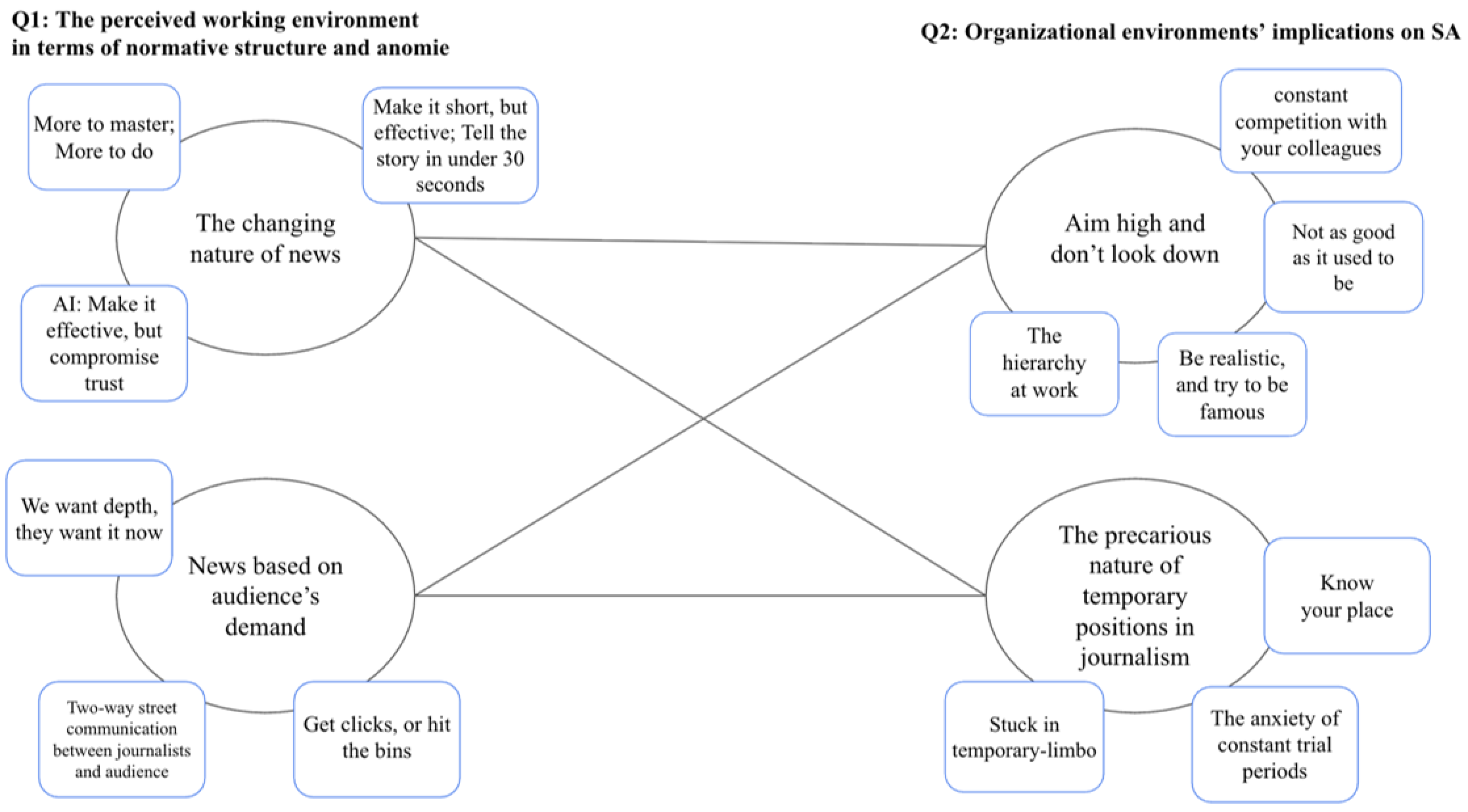

Table 1.
Table of participants.
| Informant | Age | Gender | Employed (yes/no) | Employment | Type of Contract | Experience (Years) |
| Steve* | 20-29 | Man | Yes | Part-time | Freelance | 4 |
| Kristian | 20-29 | Man | Yes | Part-time | Temporary (On-call substitute) | 1.5 |
| Bob | 20-29 | Man | Yes | Full-time | Permanent | 2 |
| Guri | 20-29 | Woman | Yes | Part-time | Temporary (Vikariat) | 4 |
| Kristin | 20-29 | Woman | Yes | Full-time | Permanent | 6 |
| David | 20-29 | Man | Yes | Part-time | Temporary (Vikariat) | 1.5 |
| Karen | 30-39 | Woman | Yes | Full-time | Permanent | 8 |
| Isabel | 20-29 | Woman | Yes | Part-time | Temporary (Vikariat) | 2 |
| Evelyn | 20-29 | Woman | Yes | Part-time | Temporary (On-call substitute) | 2 |
| Diego | 30-39 | Man | No | - | Freelance | 14 |
| Hedwig | 30-39 | Woman | Yes | Full-time | Permanent | 6 |
| Stian | 30-39 | Man | No | - | Temporary (Vikariat) | 2.5 |
*He works both as a Chief editorial for a volunteer driven media outlet, and as a freelancer with regular work for an established news organisation.
Table 2.
Overview and definitions of themes and subthemes.
| RQ | Themes | Subthemes | Definition |
|
Q1. The perceived working environment in terms of normative structure and organizational anomie |
The changing nature of news | Journalism has undergone several rapid changes during the last decades that has changed the type of news produced by journalists. | |
| Make it short but effective: Tell the story under 30 seconds | The attention economy as well as the rise of short-format platforms (e.g., social media) demand short and fast paced news-delivery. | ||
| More to master; More to do | The journalists are expected to master more news formats, across different digital platforms, which means gaining more skills and knowledge beyond conventional journalism. | ||
| AI: Make it efficient, but compromise trust | AI serves as a useful tool regarding increasing efficiency, but lowers audiences’ trust due to epistemic distrust in AI’s content. | ||
| News based on audience’s metrics | QAMs have become crucial in making decisions what news gets published | ||
| Two-way street communication between journalists and audience | The accessibility of feedback from the audience makes conveying news a reciprocal process, as well as exposing journalists to new stressors such as hate-mail. | ||
| Get clicks or hit the bin | QAMs determines what’s newsworthy. If a journalist’s story doesn’t attract attention and clicks, it gets ignored, rejected, or discarded. | ||
|
We want depth, they want it now |
The audience and news organizations demand fast-paced news, while journalists want to emphasise high quality investigated news | ||
|
Q2: Organizational environments’ implications for SA |
Aim high and don’t look down | The new organizational realities in the field of journalism have broad implications on one’s perceived status, both within and between organizations as well as in society. | |
| Be realistic and try to be famous | QAMs and increased public personas can give certain journalists high status akin to that of celebrities. | ||
| Not as good as it used to be | Journalism is perceived as a high-status occupation, but the current media landscape slightly weakens this state. | ||
|
The hierarchy at work |
There is different status within the organization with investigative- and foreign affairs journalism on the top, and culture and sports journalism on the bottom. | ||
|
Constant competition with your colleagues |
Journalism is a very competitive field, where journalists routinely have their performances compared to their colleagues, through QAMs and other means. | ||
|
The precarious nature of temporary positions in journalism |
Early career journalists get mostly temporary positions, differing greatly in types of tasks and environments they get from those of permanent employees. | ||
|
Know your place |
The temporary employees have little influence on their working environments, and are constantly reminded of their “place” in the organization. | ||
| The anxiety of constant trial periods | Journalists with temporary contracts, which are typically for six months to a year, experience persistent anxiety tied to job-insecurity. | ||
|
Stuck in temporary limbo |
Journalists on temporary contracts can get stuck in “temporary-limbo”, where the dwindling hope of a way out creates a feeling of learned hopelessness and pessimism. |
Disclaimer/Publisher’s Note: The statements, opinions and data contained in all publications are solely those of the individual author(s) and contributor(s) and not of MDPI and/or the editor(s). MDPI and/or the editor(s) disclaim responsibility for any injury to people or property resulting from any ideas, methods, instructions or products referred to in the content. |
© 2026 by the authors. Licensee MDPI, Basel, Switzerland. This article is an open access article distributed under the terms and conditions of the Creative Commons Attribution (CC BY) license (http://creativecommons.org/licenses/by/4.0/).
Copyright: This open access article is published under a Creative Commons CC BY 4.0 license, which permit the free download, distribution, and reuse, provided that the author and preprint are cited in any reuse.