
Submitted:
17 November 2026
Posted:
18 November 2026
You are already at the latest version
Abstract
Electric vehicles, electronic devices, and energy storage devices are indispensable in daily life and rely on lithium-ion batteries (LIBs), creating a rising demand and increasing supply chain constraints for Co, Li, Ni, and Mn critical metals (CMs). Since LIBs have a limited service life, rapidly increasing demand has generated a huge amount of spent LIBs (S-LIBs). This drives the need for cost-effective and eco-friendly recycling technologies to manage LIB waste. Electrode materials recycling is gaining popularity because of the significant value of critical metals and the presence of harmful materials. In LIB cell production, materials cost 72%. The most expensive part is cathode materials. At the plant scale, LIB waste recycling has not yet matured and remains suboptimal due to high temperature requirements and low recovery rates.
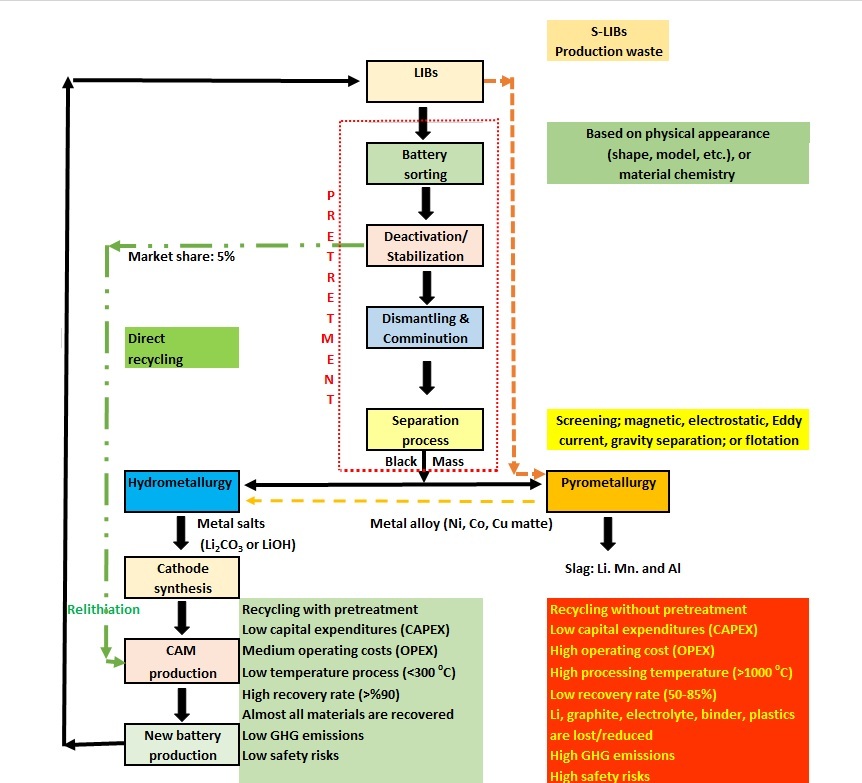
Optimal industrial pretreatment yields higher material recovery rates (>90%) at lower temperatures (>300 oC), flexibly, efficiently, economically, and environmentally. A crucial step in LIBs recycling is the pretreatment of S-LIBs before separation. This manuscript comprehensively reviews the fundamentals, challenges, research progress, and perspectives of the state-of-the-art LIB pretreatment methods. Chemical, physical, and cryogenic discharge methods are compared. Al-foil removal by NaOH, binder elimination by solvents, heat treatment, mechanical, mechanochemical activation, shearing-enhanced mechanical exfoliation, ultrasonic treatement, flotation, and cryogenic milling are covered in detail. In LIB pretreatment, it seems that combination of cryogenic discharge and grinding pretreatment has a high efficiency and safety with low processing time at high cost. Between 2000 and 2022, Li prices increased about 48, Cu 6, Co 4, and Al 2 times, respectively. Environmental assessment and economic viability evaluation of LIB manufacturing and market are also discussed. Developments in emerging markets are highlighted. Currently, the LIB market is dominated by China. Europe has little contribution to the battery supply chain. But it produces 25% of the world’s EV LIBs. Recently, in Europe and the Middle East, Poland and Turkey are new key players and emerging manufacturers of LIBs. There are also serious investments in EV LIB production capacity in the USA.
Keywords:
LIB recycling
; pretreatment
; discharge
; environmental evaluation
; economic evaluation
Copyright: This open access article is published under a Creative Commons CC BY 4.0 license, which permit the free download, distribution, and reuse, provided that the author and preprint are cited in any reuse.