

Submitted:
16 November 2026
Posted:
18 November 2026
You are already at the latest version
Abstract
Orchestrated Objective Reduction (Orch OR) proposes that consciousness arises from quantum coherence in microtubules, terminated by the gravitational collapse of the orchestrated superposition of tubulin states, with timescale \(\tau \approx \frac{\hbar}{E_g}\) is present and is the base for the orchestrated superposition, and orchestration could not happen without it. Anaesthesia, on the standard defence, does not change \(E_g\). Anaesthesia therefore cannot destroy the orchestrated superposition via \(E_g\). If the loss of consciousness is then explained by loss of orchestration alone, \(E_g\) is explanatorily redundant in the anaesthesia case: the element essential for consciousness remains present, yet consciousness is gone. We propose an alternative, the model \(\Omega_C\), defined as an immanent consciousness field hypothesised to couple to microtubule electromagnetic fields, activates virtual photons into real biophotons that carry information through microtubules acting as optical waveguides. Anaesthetics are hypothesised to detune the microtubule optical waveguide mechanism (MOWM) by changing the local dielectric constant, shifting the refractive index \(n = \sqrt{\varepsilon\mu}\), and increasing leakage and dephasing. This yields a falsifiable test: if consciousness is lost while optical coherence remains unchanged, the model is wrong. The experiment tests not the existence of \(\Omega_C\) itself, but whether anaesthesia disrupts the functional bridge between \(\Omega_C\) and microtubules.
Keywords:
Orch OR
; microtubules
; coherent electromagnetic field
; immanent consciousness
1. Introduction
In the framework proposed by Hameroff and Penrose, consciousness is regarded as a temporal phenomenon: “Consciousness has often been argued to be a sequence of discrete moments. William James described the “specious present, the short duration of which we are immediately and incessantly sensible” (though James was vague about duration, and also described a continual ‘stream of consciousness’). The “perceptual moment” theory of Stroud described consciousness as a series of discrete events, like sequential frames of a movie (modern film and video present 24 to 72 frames per second, 24 to 72 Hertz, ‘Hz’). Consciousness is also seen as sequences of discrete events in Buddhism, trained meditators describing distinct “flickerings” in their experience of pure undifferentiated awareness [1].
Furthermore, within their framework, quantum superposition is regarded as a phenomenon occurring in space-time: “In the DP scheme for OR, the superposition reduces to one of the alternatives in a timescale τ that can be estimated (for a superposition of two states each of which is assumed to be taken to be stationary on its own) according to the formula . An important point to make about τ, however, is that it represents merely a kind of average time for the state reduction to take place. It is very much like a half-life in a radioactive decay. The actual time of decay in each individual state-reduction event, according to DP (in its current form), is taken to be a random process. Such an event would involve the entire (normally entangled) state, and would stretch across all the superposed material that is involved in the calculation of EG. According to DP (in its current form), the actual time of decay in a particular state-reduction event occurs simultaneously (in effect) over the entire state involved in the superposition, and it is taken to follow the formula on the average (in a way similar to radioactive decay). Here is Dirac’s form of Planck’s constant h and EG is the gravitational self-energy of the difference between the two (stationary) mass distributions of the superposition. (For a superposition for which each mass distribution is a rigid translation of the other, EG is the energy it would cost to displace one component of the superposition in the gravitational field of the other, in moving it from coincidence to the quantum-displaced location” [1]. A key strength of the Orch-OR model of consciousness is that it anchors consciousness in gravity — the only field that is universally pervasive throughout the cosmos. All biological and physical systems, from macromolecular assemblies to galactic structures, are coupled through the gravitational field. In this sense, the Orch-OR model implicitly suggests a form of panpsychism in which the universe itself possesses the fundamental properties from which biological consciousness emerges.
A principal limitation of the Orch OR model is that it postulates that consciousness emerges when gravity acts upon neuronal microtubules, without providing an explanation for how a gravitational interaction could give rise to subjective experience. From a biological perspective, microtubules are not merely structural scaffolds. They are dynamic cytoskeletal polymers that regulate intracellular transport, synaptic plasticity, and the organization of signalling cascades essential for neuronal function. The Orch OR model does not clarify how a gravitational field couples to these biological processes to produce a conscious state.
2. Bio-Photons as Information’s Carrier Between Consciousness and Microtubule
The aim of this article is therefore twofold. First, to evaluate the empirical basis of Orch OR with respect to gravitational collapse and microtubule coherence. Second, to reframe the Orch OR model within a broader theoretical architecture, in which the dynamic quantum vacuum field DQV, as the carrier of gravity [2], is proposed as a biophysical interface. In this proposed framework, DQV serves as the intermediary that transduces information from the immanent consciousness field to the microtubule network of the brain. The model proposes that consciousness constitutes a complex energy field which interacts with microtubules via pilot photons. In this framework, consciousness is interpreted as an excitation of the energy field.
The DQV and consciousness are interwoven such that the propagation of the consciousness photon induces a corresponding motion of the bio-photon within DQV, which serves as a reservoir of virtual photons [3]. Upon absorption of an energy impulse, the virtual photon transitions from a latent to a manifest state. Energized by the impulse originating from the consciousness photon, the resulting bio-photon propagates through the microtubule with either left-handed or right-handed spin. In the DQV model, photons are interpreted as excitations of and possess intrinsic spin [4,5]. As the photon traverses the microtubule, it assumes one of two distinct spin states, thereby transmitting information via a binary code. This is consistent with the widely accepted premise that biological systems operate on the basis of binary coding [6,7,8].
Immanent consciousness
A virtual photon of DQV receives an energy kick from field and becomes real biophoton that moves through the microtubule, see Figure 1.
Stage 1: virtual photons rest in the field.
Stage 2: the field activates a virtual photon.
Stage 3: the activated biophoton carries information through the microtubule optical waveguide mechanism (MOWM).
model provides an explicit model of how consciousness act on microtubule that the original Orch-OR model does not contain. In Orch-OR, the conscious moment corresponds to objective reduction (OR). In the model, OR corresponds to the moment of phase transfer from to DQV carried by the biophoton spin acting on microtubule.
Hameroff proposed that loss of consciousness under general anaesthesia does not result primarily from synaptic suppression, but from the action of anaesthetics on quantum London dispersion forces within non-polar hydrophobic pockets of dendritic proteins — the same sites postulated to support consciousness [9]. In the model, this mechanism is reframed. General anesthetics do not abolish consciousness by suppressing neuronal firing, but by decoupling the consciousness field from the DQV microtubule substrate via biochemical alteration of the MOWM. At the biochemical level, anaesthetic molecules — in accordance with the Meyer-Overton correlation — bind to hydrophobic pockets in tubulin dimers formed by non-polar residues such as tryptophan and phenylalanine. This interaction is classical: London dispersion forces within the hydrophobic core. At the quantum biological level, binding increases the local relative permittivity , and the lattice polarizability α. The microtubule interior, which in the physiological state functions as a low-loss cavity for bio-photon propagation (), is converted into a high-loss medium (). Consequently, bio-photon transition is quenched, and coherent information transfer ceases. The field itself remains present — consciousness as such is not annihilated — but its functional connection to the biological substrate is severed. Subjective experience is thus decoupled from microtubule computation.
In conclusion, the Orch OR model establishes a direct link between gravity and consciousness, which represents an ad hoc assumption. In the Orch OR model, consciousness is posited to emerge from the coupling of the gravitational field with microtubule dynamics. The brain, however, remains immersed in the same gravitational field before and after the administration of anaesthesia, with the gravitational force acting on microtubules remaining effectively unchanged. The disappearance of consciousness under anaesthesia therefore cannot be attributed to a failure of Objective Reduction, as anaesthetic molecules do not alter the mass distribution and thus do not modify the gravitational self-energy or the reduction timescale . Rather, in the model , consciousness vanishes because binary bio-photon transmission, within the MOWM is quenched. Consequently, gravitationally-induced OR is not plausible as the mechanism of anaesthetic loss of consciousness, see Figure 2.
On the International Space Station, orbiting at 400–408 km above the Earth's surface, the gravitational acceleration is , compared to . Gravity diminishes for 12% and astronauts remain fully conscious. The Moon has only 16.5 % of Earth’s gravity and astronauts remain fully conscious. This is difficult to reconcile with a model in which consciousness is generated by a gravitational interaction with microtubules. If consciousness were a product of gravity acting in DQV, one would expect some dependence of conscious states on the magnitude of the external gravitational environment.
It is important to note that Orch OR refers to gravitational self-energy of the tubulin superposition itself, not directly to Newtonian . In DQV there is no "self-gravity" vs "external gravity". There is only one thing: diminished energy density of DQV:
- -
- External from Earth: Earth diminishes dynamic quantum vacuum around it.
- -
- Internal from tubulin superposition: tubulin in superposition diminishes dynamic quantum vacuum around it.
Both are the same physical process in DQV - a local lowering of ( = Planck energy density of DQV). Therefore, in our model the distinction that Orch OR makes between and does not exist. If consciousness were generated by diminished (what Penrose calls gravity), then it should depend on both external and internal diminished . This observation raises a significant conceptual difficulty for the Orch OR model. In Orch OR, consciousness is postulated to arise from the interaction of gravity with microtubules via objective reduction. The model does not clarify how this proposed gravitational mechanism would remain stable and functionally identical under extreme variations in gravitational strength, or how the same discrete conscious moments could be produced when the gravitational interaction is considerably weaker. Furthermore, if consciousness were dependent on a specific threshold of gravitational self-energy as proposed, one would expect a measurable modulation of conscious states with altitude. No such modulation is observed.
Max Planck would not have endorsed the view that consciousness is a byproduct of gravity-microtubule interaction. He would appreciate model. His ontological position is unambiguous: "I regard consciousness as fundamental. I regard matter as derivative from consciousness. We cannot get behind consciousness. Everything that we talk about, everything that we regard as existing, postulates consciousness [10]. Across diverse cultural traditions, consciousness is not treated as a late derivative of matter, but as primordial and immanent: prior to, and present within, all manifestation. Contemporary science can and should develop models that take this heritage seriously, not as myth to be discarded, but as a metaphysical hypothesis with heuristic and explanatory value for the science of consciousness [11].
3. Experimental Status of Orch OR Model and Model
By I mean a consciousness field hypothesised to couple to microtubule electromagnetic fields; this paper tests only the observable correlate of that coupling — whether optical coherence changes with consciousness state — and does not claim to test as first-person subjectivity itself.
The concept of gravitational self-energy , as formulated by Penrose to define the collapse time does not by itself constitute a dynamical theory. It provides a lifetime criterion, but it does not predict a specific dynamical process by which that criterion could be tested independently. In a microtubule, this limitation is decisive. There is no independent experimental procedure to measure the gravitational self-energy of a tubulin superposition at the scale of conformational displacement, and to isolate that contribution from environmental decoherence. The quantity therefore cannot be extracted from a biological measurement.
The situation is different for the Diósi-Penrose model, which does provide a concrete dynamic. The simplest, parameter-free version of Diósi-Penrose dynamics, which would render testable via spontaneous radiation, has been strongly constrained by experiment. As noted by Derakhshani et al. [12], this version predicts spontaneous radiation that should have been observed. The Gran Sasso underground experiment [13] did not observe it. That result excludes, at 95% confidence level, the natural combination of Diósi's white-noise dynamics with Penrose's mass-density resolution.
Penrose's original lifetime criterion, , which does not by itself predict spontaneous radiation or a concrete dynamic, remains without an independent experimental test in a biological context. It therefore cannot serve as an empirical foundation for a model of consciousness in microtubules.
The Orchestrated Objective Reduction (Orch OR) model rests on a specific proposal by Penrose: that quantum superposition cannot be maintained indefinitely when the superposed states correspond to significantly different distributions of mass in spacetime. At a critical threshold, the superposition is resolved by an objective, gravitationally induced reduction.
Penrose expressed this idea as a lifetime criterion. A superposition with gravitational self-energy is expected to persist for a time on the order of before it reduces. The larger the mass displacement, the larger , and the shorter the lifetime.
In Orch OR, this criterion is applied to microtubules. The superposition is assumed to be between different conformations of tubulin proteins. When a sufficient number of tubulins are in superposition, reaches the threshold for objective reduction, and a conscious moment is said to occur.
It is essential to distinguish this criterion from a dynamical collapse model. Penrose's proposal, in its original form, does not specify the dynamical process by which reduction occurs. It does not provide an equation of motion for the wavefunction, nor does it predict a secondary observable, such as radiation, that could be measured independently of the collapse itself.
Diósi proposed such a dynamic. In the Diósi-Penrose model, the gravitational field is treated as a source of stochastic noise that continuously drives the wavefunction toward localization. In this formulation, the collapse process is not silent: it predicts spontaneous radiation emitted as charged particles are stochastically accelerated by the gravitational noise.
This difference is decisive for empirical evaluation. The Diósi-Penrose model can be tested because it predicts radiation. Penrose's original criterion, taken alone, cannot be tested in the same way, because it predicts only a lifetime, not an independent signal.
Fröhlich (1968) showed that biological systems under metabolic pumping can form long-range coherent vibrations, a Bose-like condensation of coherent modes in the Hz range [14]. Such coherent longitudinal electric vibrations have been proposed to be sustained in microtubules. Since the 1970s, Popp and collaborators have demonstrated that living cells emit ultra-weak coherent biophotons originating from DNA, with characteristic photon statistics [15,16]. The experimental findings of Fröhlich on long-range coherent electric vibrations and Popp et al. on coherent biophoton emission confirm that in awakened states consciousness acts actively on microtubules via coherent electromagnetic fields, whereas under anaesthesia this bridge is disrupted. Living on orbital stations and travelling on the Moon in the Apollo missions also confirms that gravity does not affect consciousness and that Penrose's "self-gravity" cannot exist as a separate entity in the universal cosmic gravitational field.
Quantum superposition coherence in microtubules is an unproven hypothesis. It has never been demonstrated experimentally. No experiment has shown a microtubule in a quantum superposition sustained at physiological temperature for the duration required for consciousness. What has been demonstrated is classical coherence: synchronized oscillations, resonances, and electromagnetic field coherence. These are real phenomena. They do not constitute evidence for quantum superposition coherence.
Orch OR, as formulated by Hameroff and Penrose, requires a superposition sustained for 10 to 100 ms [1]. Tegmark estimated decoherence times far below this [17]. Hagan, Hameroff and Tuszynski proposed corrected times, but even if accepted, a gap of three to four orders of magnitude remains [18].
We therefore do not retain quantum superposition coherence in microtubules as the mechanism of consciousness. In the framework proposed here, it is replaced by the consciousness energy kick. Bandyopadhyay and collaborators have reported resonances in microtubules in the MHz to THz range. These demonstrate ordered, collective dynamics. Resonance is not evidence for quantum superposition. A classical system can resonate. To demonstrate quantum superposition, an experiment must show interference, entanglement, or a superposition-dependent observable that cannot be explained by classical oscillations.
In the model proposed here, consciousness is not produced by a sustained superposition in microtubules. Consciousness is proposed as an excitation of the field. When this field enters a synchronous, phase-locked waving regime, it produces a coherent, syntropic energy injection into DQV, as defined in Eq. (16).
This is not a random thermal kick. It is a coherent energy kick from the consciousness field. It promotes a virtual photon of the DQV to a real, observable bio-photon with a given spin. The bio-photon then propagates through the microtubule with left-handed or right-handed spin, transmitting information via a binary code.
In this model, objective reduction corresponds to the moment of phase transfer from to DQV, carried by the bio-photon spin acting on the microtubule. No sustained quantum superposition in microtubules is required for this mechanism. What is required is a coherent field, a coherent electromagnetic field in neural tissue that can receive the kick, and a microtubule that can function as a low-loss waveguide for bio-photon propagation. The brain generates a coherent endogenous electromagnetic field, produced by synchronized neuronal activity. We propose that this field may act as an organizing factor that maintains long-range order in neural tissue. The consciousness energy kick would then occur within an already ordered background, not in isolation in a thermal environment.
This must be distinguished clearly. Coherence of the electromagnetic field is classical coherence. It is not, by itself, evidence for quantum superposition coherence, and it does not extend the decoherence time. In this framework, the coherent electromagnetic field is treated not as proof of quantum coherence, but as a candidate intermediary that could couple the proposed consciousness field to the microtubule substrate via DQV.
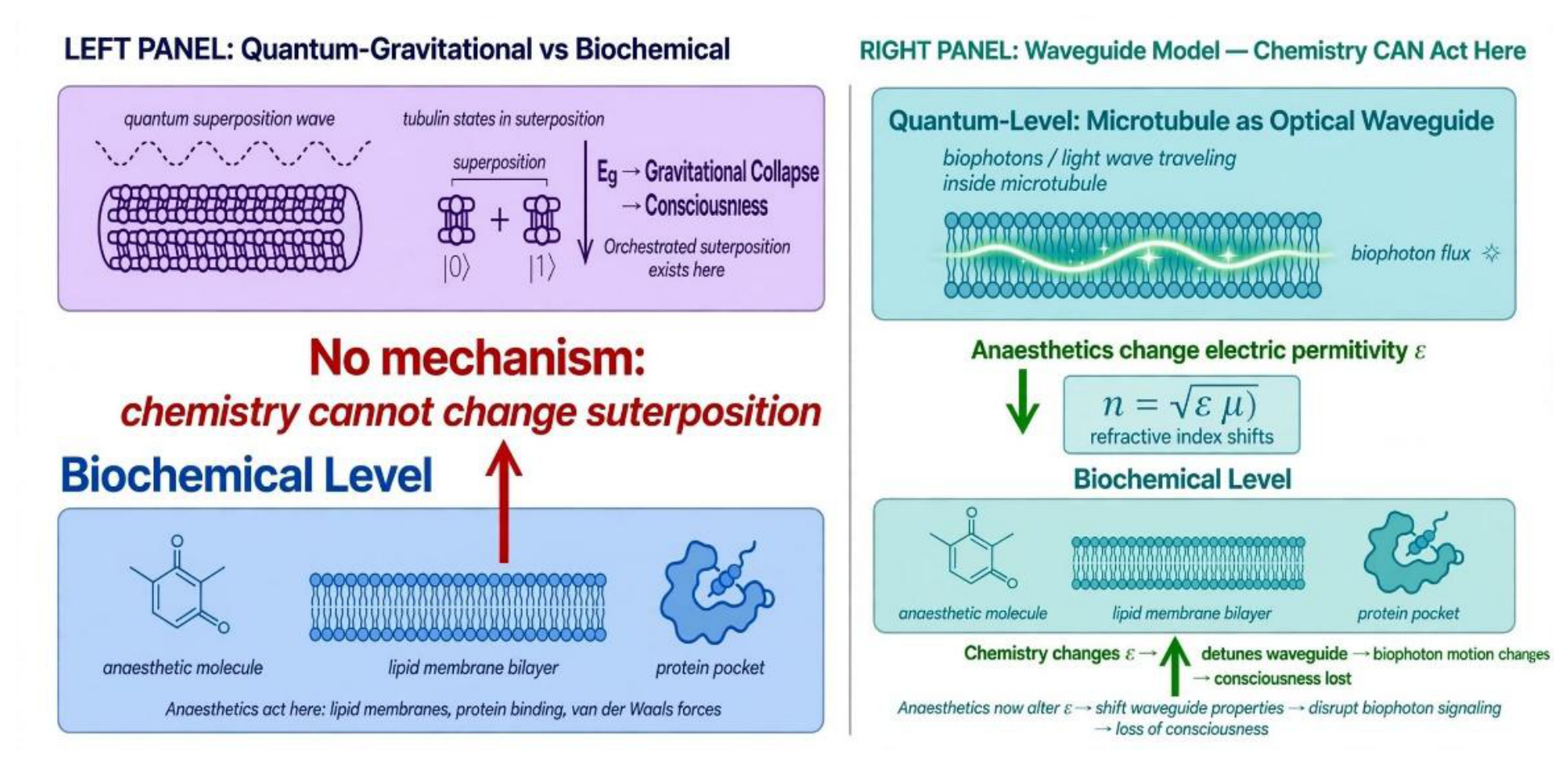
The ontological gap of Orchestrated Objective Reduction (Orch OR) is that anaesthetics act at the biochemical level, while the orchestrated superposition exists at the quantum-gravitational level. A chemical anaesthetic therefore cannot disturb the orchestrated superposition itself, which is of another ontological level than the biochemistry of anaesthetics, see Figure 3.
The model is ontologically consistent. Anaesthetics change the refractive index inside the microtubule, by changing the local electric permittivity. This detunes the MOWM and breaks the biophoton bridge between microtubules and consciousness. The causal chain is continuous: Anaesthetic → Δ → → microtubule waveguide mechanism detuning → disruption of bio-photon signalling → loss of consciousness.
4. Proposal for an Anaesthesia Experiment with Mice
The most serious defence of Orch OR against the anaesthesia objection is that anaesthetics need not change . On this defence, anaesthetics act on orchestration, not on collapse. By binding to hydrophobic pockets in tubulin, they damp the collective dipole oscillations of aromatic residues, prevent a coherent superposition from building up to the critical threshold, and therefore prevent objective reduction. No collapse, no conscious moment. The microtubule remains, the mass remains, but the orchestration is lost.
This defence is fair, but it is fatal to the theory in its original form. If orchestration is doing all the work, then is no longer explanatory. The theory collapses into "coherence matters", which is exactly our model — but without a mechanism for how coherence is lost. We provide that mechanism: refractive index / dielectric detuning. In the original Penrose formulation, was meant to do explanatory work: it set the collapse time , and that time was meant to set the tempo of consciousness. Once the defence is accepted, becomes a background condition rather than a cause. The real causal question shifts to a different question: what sustains coherence, and what destroys it?
That is a question Orch OR does not answer. It invokes orchestration, but it does not specify the physical channel through which orchestration is maintained or lost. It does not predict how much anaesthetic is required to destroy coherence, which optical or dielectric parameter changes, or what measurable signal should disappear when consciousness disappears.
The model answers that question directly. Coherence is sustained by guided bio-photon / exciton transport in the microtubule. Anaesthetic binding changes local polarizability and dielectric constant , shifts the refractive index , detunes the MOWM, and increases leakage and dephasing. The coherent channel is broken before any gravitational threshold is reached. Washout restores , restores the mode, and restores consciousness.
In the model, consciousness doesn't come from gravity collapsing a superposition. It comes from coherence staying alive long enough to travel — bio-photons / excitons moving in a guided, phase-preserved way along the microtubule. Anaesthesia breaks that cable, without breaking the microtubule itself.
This moves the debate from metaphysics to measurement. If Orch OR is right in its Orch-first form, consciousness should track the ability to build a coherent superposition, with no necessary optical signature. If the model is right, loss of consciousness under anaesthesia should be accompanied by a measurable loss of optical coherence: a change in bio-photon emission, a shortening of tryptophan fluorescence lifetime, and a change in microtubule light scattering. That difference is testable.
The model is falsified if a clinical dose of propofol / isoflurane abolishes consciousness in vivo but produces no measurable change in fluorescence lifetime, bio-photon emission, or change in refractive index, while leaving microtubules intact. It is supported if the optical coherence loss tracks anaesthetic potency and reverses on washout. This means that a highly potent anaesthetic should produce the same loss of fluorescence lifetime and the same change in refractive at a substantially lower concentration than a weakly potent one, with the in vitro dose-response ranking matching the clinical potency ranking. It also means that the effect must be a tuning effect rather than damage: upon removal of the anaesthetic, dielectric constant, refractive index and bio-photon emission must return toward baseline while the microtubule remains polymerized. If the effect required non-clinical concentrations, failed to follow potency, or persisted after washout, the model would not be describing anaesthesia, but only non-specific disruption of the sample.
The proposed experiment is not designed to demonstrate the existence of itself. It tests the coupling hypothesis: that anaesthesia disrupts the functional bridge between and microtubules. A positive result — loss of optical coherence tracking loss of consciousness, with reversibility on washout — would therefore constitute evidence for disruption of microtubule coupling, not a direct proof of . Conversely, a null result would falsify the proposed coupling mechanism, while leaving the ontological status of to individual research methodology.
model predicts a classical optical change in brain tissue during anaesthesia that can be measured directly. Near-infrared spectroscopy (NIRS) measures the reduced scattering coefficient , which depends directly on refractive index contrast in tissue. If anaesthetics change inside microtubules, must change.
In humans, this signal is attenuated by scalp and skull. In mice, a thinned-skull or cranial window preparation allows direct optical access to the cortex. The mouse experiment therefore provides the decisive test: direct measurement in the brain itself.
Hypothesis: Loss of consciousness under general anaesthesia in mice is accompanied by a measurable change in the reduced scattering coefficient in the cortex, reflecting a change in refractive index in microtubule-rich brain tissue, which reverses upon return of consciousness.
Animals: C57BL/6J mice, male and female, 8-12 weeks old, 20-30 g body weight.
Sample size: 12 mice per experimental group for the main isoflurane experiment
5. Conclusions
In conclusion, Orch OR leaves explanatory redundant under anaesthesia. The element that, in the Orch OR model, is essential for producing consciousness remains present, yet consciousness is gone. The model replaces it with a testable mechanism: anaesthesia detunes microtubule optical coupling. The experiment proposed here tests that coupling, not the existence of itself.
References
- Hameroff, S.; Penrose, R. Consciousness in the universe: a review of the 'Orch OR' theory. Phys. Life Rev. 2014, 11(1), 39–78. [Google Scholar] [CrossRef] [PubMed]
- Fiscaletti, D.; Sorli, A. Quantum Relativity: Variable Energy Density of Quantum Vacuum as the Origin of Mass, Gravity and the Quantum Behaviour. Ukr. J. Phys. 2018, Vol. 63(No. 7). [Google Scholar] [CrossRef]
- Fiscaletti, D.; Sorli, A. A three-dimensional non-local quantum vacuum as the origin of photons. Ukr. J. Phys. 2020, 65(2), 106–119. Available online: https://jnas.nbuv.gov.ua/article/UJRN-0001127939. [CrossRef]
- Dragoman, D. On the photon-classical electromagnetic field relationship. Ann. N Y Acad. Sci. 2025, 1549(1), 11–21. [Google Scholar] [CrossRef] [PubMed]
- RUO PENG WANG, THE SPINOR FIELD THEORY OF THE PHOTON. Romanian Rep. Phys. 2014, Vol. 66(No. 2), P. 319–335. Available online: https://rrp.nipne.ro/2014_66_2/A7.pdf.
- Petoukhov, S. V. The degeneracy of the genetic code and Hadamard matrices. Symmetry Cult. Sci. 2008, 19(2-3), 129–142. Available online: https://arxiv.org/pdf/0802.3366v2.
- Jenuwein, T.; Allis, C. D. Translating the histone code. Science 2001, 293(5532), 1074–1080. [Google Scholar] [CrossRef] [PubMed]
- Turner, B. M. Cellular memory and the histone code. Cell 2002, 111(3), 285–291. [Google Scholar] [CrossRef] [PubMed]
- Hameroff, S.R. The entwined mysteries of anesthesia and consciousness: Is there a common underlying mechanism? Anesthesiology 2006, 105(2), 400–412. Available online: https://journalpsyche.org/articles/0xc12a.pdf. [PubMed]
- Planck, M. Interview in The Observer, 25 January 1931. Cited in: Planck, M. Das Weltbild der neuen Physik (1929) and W. Hebbel, Max Planck: Leben und Werk. Available online: https://www.newspapers.com/article/the-observer-the-observer-sunday-janua/121386587/.
- Šorli, Amrit Srečko. Testing Orch OR and Waveguide Models of Consciousness: Anaesthesia, Coherence and the Microtubule, MDPI preprint (2026). Available online: https://www.preprints.org/manuscript/202609.1574.
- Derakhshani, Maaneli; Diósi, Lajos; Laubenstein, Matthias; Piscicchia, Kristian; Curceanu, Catalina. At the crossroad of the search for spontaneous radiation and the Orch OR consciousness theory. Phys. Life Rev. 2022, 42, 8–14. [Google Scholar] [CrossRef] [PubMed]
- Curceanu, Catalina; et al. Did the Gran Sasso Experiment Rule Out the Diósi-Penrose Theory? Musing on the 2021 Result and the Present Experimental Status. 2026. Available online: https://arxiv.org/abs/2610.35608.
- Fröhlich, H. Long-range coherence and energy storage in biological systems. Int. J. Quantum Chem. 1968, 2, 641–649. Available online: https://garfield.library.upenn.edu/classics1988/A1988N102400001.pdf. [CrossRef]
- Popp, F.A.; Nagl, W.; Li, K.H.; et al. Biophoton emission. Cell Biophys. 1984, 6, 33–52. [Google Scholar] [CrossRef] [PubMed]
- Popp, F.A. Properties of biophotons and their theoretical implications. Indian J. Exp. Biol. 2003, 41(5), 391–402. Available online: https://nopr.niscpr.res.in/bitstream/123456789/17031/1/IJEB%2041%285%29%20391-402.pdf. [PubMed]
- Tegmark, M. Importance of quantum decoherence in brain processes. Phys. Rev. E 2000, 61, 4194–4206. [Google Scholar] [CrossRef] [PubMed]
- Hagan, S.; Hameroff, S.R.; Tuszynski, J.A. Quantum computation in brain microtubules: Decoherence and biological feasibility. Phys. Rev. A 2002, 65, 042301. [Google Scholar] [CrossRef] [PubMed]
Figure 1.
Biophotons as information carriers.
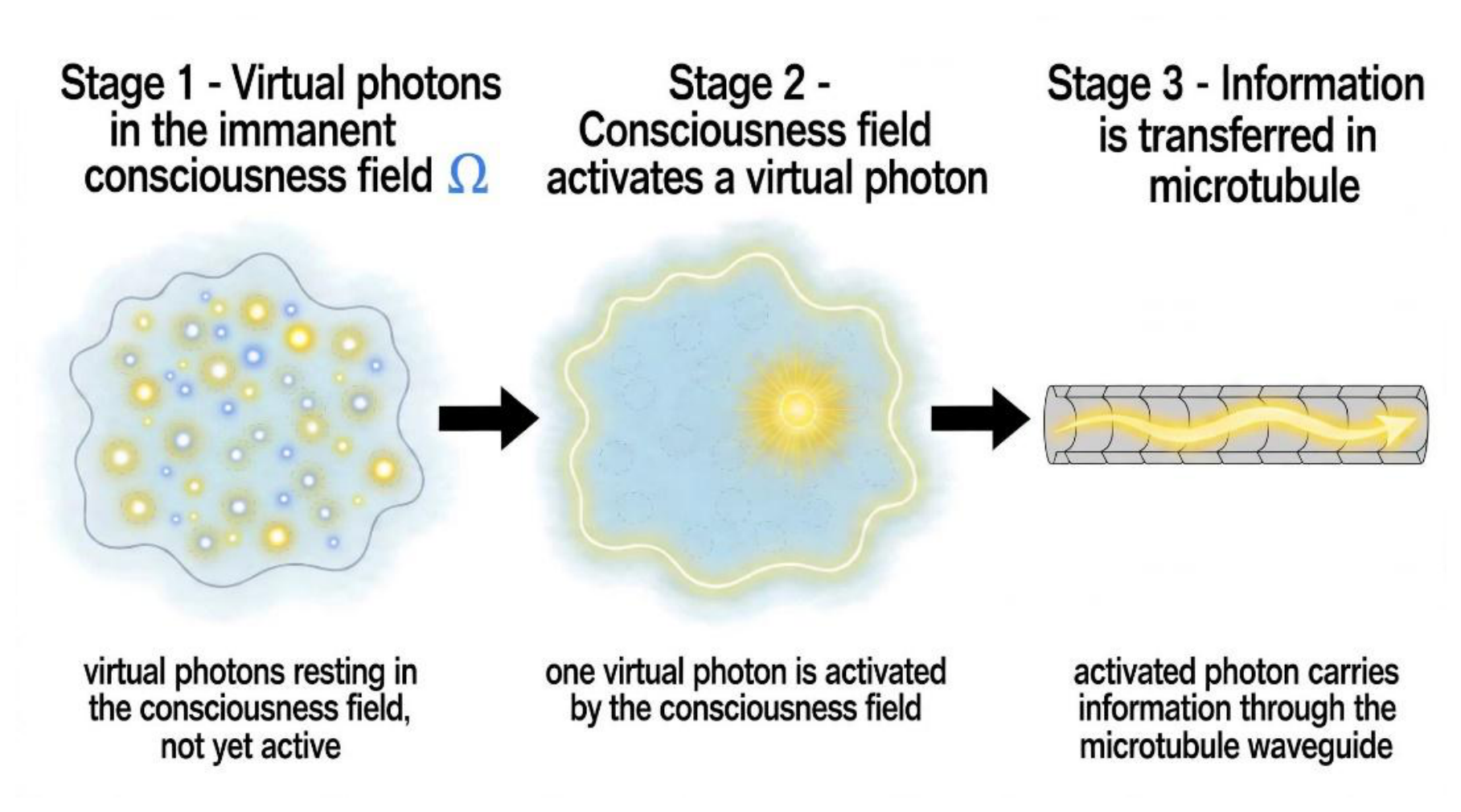
Figure 2.
Disappearance of consciousness in anaesthesia: Orch OR model versus model.
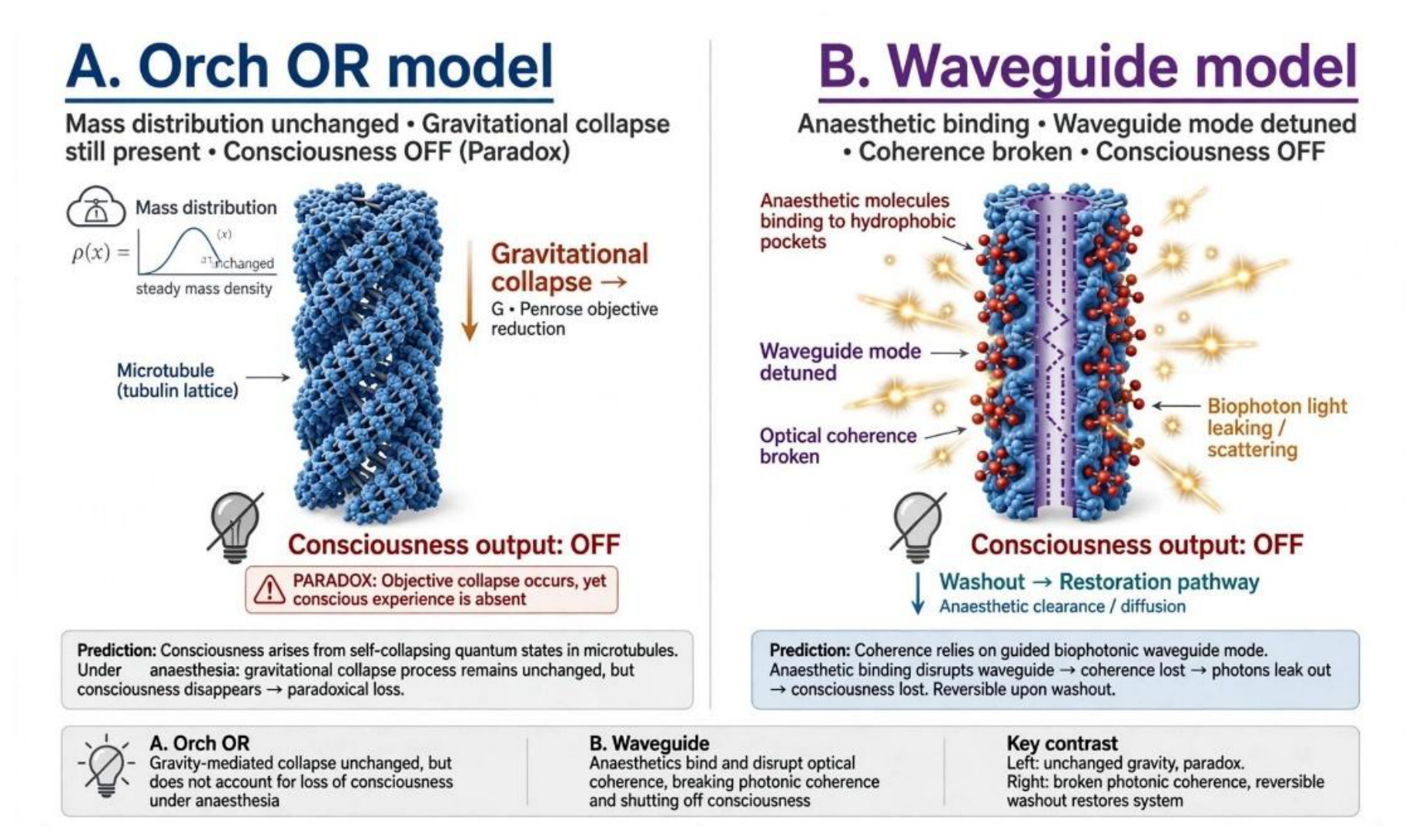
Figure 3.
Anaesthetics cannot influence superposition and can influence refractive index.
Disclaimer/Publisher’s Note: The statements, opinions and data contained in all publications are solely those of the individual author(s) and contributor(s) and not of MDPI and/or the editor(s). MDPI and/or the editor(s) disclaim responsibility for any injury to people or property resulting from any ideas, methods, instructions or products referred to in the content. |
© 2026 by the authors. Licensee MDPI, Basel, Switzerland. This article is an open access article distributed under the terms and conditions of the Creative Commons Attribution (CC BY) license (http://creativecommons.org/licenses/by/4.0/).
Copyright: This open access article is published under a Creative Commons CC BY 4.0 license, which permit the free download, distribution, and reuse, provided that the author and preprint are cited in any reuse.