

Submitted:
17 November 2026
Posted:
18 November 2026
You are already at the latest version
Abstract
The genetic diversity present in plant genetic resources (PGR) is essential for plant breeding; however, its effective use requires robust evaluation methods. Preliminary evaluation is an initial step in identifying promising genotypes among numerous accessions, but its practice varies widely. In this perspective article, we propose an improved approach to preliminary evaluation, recommending assessment of approximately 20 plants per genetically heterogeneous accession, with the option to reduce this number for uniform accessions or increase it when the objective is to identify rare alleles/phenotypes. We also propose the use of simplified experimental designs, the conduct of evaluations in one or preferably two environments, and the use of species-specific descriptors. This approach acknowledges practical limitations, such as resource availability and the large number of accessions. Our perspective aims to contribute to the standardization of preliminary evaluation and improve the identification of valuable PGR for subsequent detailed assessments, thereby supporting more efficient pre-breeding and plant breeding efforts. These recommendations provide a pragmatic framework for better harnessing PGR diversity in plant breeding while optimizing resource use.
Keywords:
experimental design
; genetic diversity
; germplasm evaluation
; plant genetic resources
; pre-breeding
1. Introduction
Genetic diversity is fundamental to crop improvement, enabling breeders to develop cultivars that can meet the challenges posed by climate change and ensure global food security (Bhartiya et al., 2024; Balconi et al., 2024; Vaccino et al., 2024; Defacio et al., 2025). This diversity is accessed and utilized through Plant Genetic Resources (PGR), which encompass the genetic material of plants with actual or potential value for food and agriculture (Prochnow et al., 2025). PGR include a wide range of materials, such as newly developed and obsolete cultivars, farmers’ cultivars (landraces), crop wild relatives, breeding and research materials, and special genetic stocks (Salgotra & Chauhan, 2023).
Effective utilization of PGR by plant breeders requires comprehensive knowledge, documentation, and information on their genetic variability. Pre-breeding serves as a critical bridge between PGR and plant breeding programs by identifying desirable genes or traits within PGR and transferring them into intermediate genotypes through crosses and backcrosses with elite genotypes (cultivars, inbred lines, etc.) (Anđelković et al., 2020; Sunitha et al., 2024; Sohi et al., 2025).
Characterization and evaluation are essential methods for understanding the potential of PGR and identifying genotypes with superior traits, as well as for assessing phenotypic variability (Di Pasquale et al., 2024; Kaur et al., 2026). These activities provide valuable information for crop improvement (Ortiz, 1997) and enable the effective use and conservation of genetic resources, which is particularly important in the context of climate change (Esquinas-Alcázar, 2005). Furthermore, research on characterization and evaluation is essential to ensure the conservation of genetic resources for many species of agricultural interest, especially in the face of climate change.
Characterization and evaluation represent the initial stages of plant pre-breeding, serving to identify and describe desirable traits in PGR. These activities are integral to the operations of genebanks, which also include germplasm acquisition, collection, conservation, storage, regeneration, and multiplication (FAO, 2025). Characterization focuses on traits governed by one or a few genes—typically those with high heritability and consistent expression across environments—and may involve morphological, physiological, biochemical, genetic, cytogenetic, or reproductive characteristics (Mondini et al., 2009; FAO, 2014; Govindaraj et al., 2015; Paiva et al., 2019). Evaluation, in contrast, targets agronomically important traits that are typically controlled by many genes, have low heritability, and are strongly influenced by environmental factors. Traits commonly assessed include yield, phenology, and responses to biotic and abiotic stresses. Robust evaluation is crucial for accelerating the use of PGR in crop breeding programs (Gangopadhyay et al., 2019), as limited or low-quality evaluation data can significantly hinder the effective utilization of these resources. Although characterization and evaluation are conceptually distinct, in practice, both activities are often conducted simultaneously.
Evaluation can be divided into preliminary and subsequent (advanced or complementary) stages (Esquinas-Alcázar & Gulick, 1983; CIP et al., 1991; IBPGR, 1991; IBPGR & ICRISAT, 1992, 1993; IPGRI, 2000). Preliminary evaluation typically involves assessing a large number of accessions for basic agronomic traits—such as vernalization requirements, fruit maturation time, plant height, germination percentage, tillering, flowering and maturity time, number and size of fruits, seed size, 100-seed weight, and initial responses to biotic and abiotic factors (Smith & Duvick, 1989; Priyadarshan, 2019). Accessions identified as having greater potential are then subjected to subsequent evaluations, which involve replicated experiments and, ideally, multiple environments (Nass, 2001). It is important to note that preliminary evaluation is generally conducted within genebanks, distinguishing it from the initial evaluations performed by plant breeders in their breeding programs.
There are at least three interpretations of preliminary evaluation. The first involves collecting data using a limited set of additional descriptors deemed appropriate for a given species, as outlined in descriptor lists published by organizations such as the International Board for Plant Genetic Resources (IBPGR) and the International Plant Genetic Resources Institute (IPGRI) (e.g., IBPGR 1981, 1982, 1983, 1985a, 1985b, 1985c, 1985d, 1986, 1989, 1990, 1991; IPGRI, 1995b). The second interpretation focuses on sample size, particularly the evaluation of only one or a few plants per accession. For example, Haus et al. (2021) evaluated a USDA bean germplasm collection for resistance to Fusarium root rot and Fusarium wilt using single replicates of 248 accessions, demonstrating the use of minimal replication in genetic resource evaluation. The third interpretation considers preliminary evaluation in terms of experimental procedures, especially the absence of formal experimental designs and evaluations across multiple environments (e.g., Nass, 2001). These interpretations may overlap, depending on the researcher’s approach.
The choice among these interpretations has significant implications for pre-breeding and, by extension, plant breeding, as it affects the identification and selection of promising genotypes, decisions regarding further evaluation, and the efficient allocation of resources. Therefore, we propose a reassessment of the concept of preliminary evaluation for PGR. Specifically, we recommend that preliminary evaluation should: (a) assess a minimum number of plants per accession; (b) employ simple experimental designs, such as lattice or augmented block designs; (c) be conducted in at least one environment, with two environments being preferable; and (d) utilize descriptors specifically recommended for the preliminary evaluation of each species.
It should be noted that, in preliminary evaluation, the number of plants assessed influences the representation of genetic variability within an accession but does not necessarily ensure the detection of all traits of interest. The expression and observation of a trait depend on its genetic architecture and, in some cases, on specific environmental conditions.
This perspective article acknowledges the practical constraints faced by genebank curators and researchers, including large numbers of accessions and limited financial, land, and labor resources. Our recommendations aim to inform and support decision-making regarding which accessions should be prioritized for subsequent evaluation.
2. Rationales for Redefining Preliminary Evaluation
2.1. Minimum Number of Plants per Accession
An accession corresponds to a representative sample of an individual or a population, distinguished and uniquely identified; in other words, it represents an individual record in a genebank (Salomão et al., 2019).
Defining a minimum number of plants for the preliminary evaluation of PGR accessions is a challenge, given the diversity of crop species and the genetic constitution of the conserved materials. An accession may correspond to a heterogeneous population (e.g., landraces), a homogeneous population, or a single genotype (e.g., accessions of vegetatively propagated species). In the first case, the number of plants evaluated should be sufficient to represent the genetic variability within the accession. In the other cases, fewer plants may be sufficient, particularly because greater genetic uniformity is expected.
Recommendations regarding the number of plants per accession for characterization, preliminary evaluation, or subsequent evaluation vary among species. For maize (Zea mays L.), at least 20 plants per accession are recommended (IPGRI, 2000). For yam (Dioscorea spp.), quinoa (Chenopodium quinoa Willd.), sorghum (Sorghum bicolor (L.) Moench), and tomatoes (Solanum spp.), at least 10 plants are recommended (IBPGR & ICRISAT, 1993a,b; IPGRI, 1996, 1997; Bioversity International et al., 2013). For peppers (Capsicum spp.), 10 to 30 plants are recommended (IPGRI, 1995a), whereas for coconut (Cocos nucifera L.), the recommended number ranges from 10 to 50 plants (IPGRI, 1995b). In addition to the reproductive system and propagation method, the number of plants per accession may also depend on the crop cycle and the time required for production to stabilize.
Our theoretical basis for determining the minimum number of plants per accession in preliminary evaluation is the gametic sampling model proposed by Marshall & Brown (1975). According to this model, the probability (P) that a sample contains at least one copy of an allele with frequency p is given by:
where k represents the effective number of independent allele draws. For n diploid plants, k is approximately 2n in allogamous species, assuming independent contributions from the two gametes of each plant, whereas k is approximately n in autogamous species under complete inbreeding, as the two alleles within each plant are identical.
It is important to emphasize that the model proposed by Marshall & Brown (1975) allows the probability of including at least one copy of a given allele in the sample to be estimated, rather than the probability of detecting the phenotype associated with that allele. The presence of an allele does not necessarily result in the expression or observation of the corresponding trait, whose manifestation may depend, for example, on its dominance, penetrance, and other factors. Therefore, this model is used here as a theoretical reference for estimating the probability of sampling at least one copy of a given allele within an accession, rather than as a direct predictor of phenotypic detectability. Estimating the probability of observing specific traits, particularly those controlled by recessive alleles or influenced by multiple genes, would require additional probability models.
We understand that the lower the frequency of an allele in the population or the higher the desired probability of capturing it, the greater the number of plants required to represent it in the sample. For example, for an allele with a frequency of p = 0.05, increasing the capture probability from 95% to 99% raises the required number of gametes from approximately 59 to 90. For an allele with p = 0.01, achieving a 95% probability requires approximately 300 gametes. Based on this relationship, we adopted a 95% probability of capturing alleles with frequencies equal to or greater than 5% as a reference criterion, corresponding to approximately 59 randomly sampled gametes. Under this criterion, the sample size is equivalent to approximately 30 plants in allogamous species, in which the gametes from each plant can be considered approximately independent sampling contributions, and up to 59 plants in autogamous species, in which high homozygosity reduces the independence between the two gametes from the same plant.
Although the model was originally developed to guide population sampling during germplasm collection, we propose its use as a theoretical reference for determining the number of plants per accession in preliminary evaluation. We acknowledge, however, that sample size should consider the genetic constitution of the accession and the reproductive and propagation characteristics of the species. In this regard, we propose evaluating approximately 20 plants per accession as a general reference for seed-propagated species, particularly for accessions exhibiting genetic variability, with the possibility of reducing this number for uniform accessions and vegetatively propagated species. We recognize that this number may be considerably higher when the objective is to identify rare alleles/phenotypes.
This proposal considers that the recommendations of 10 to 30 plants found in descriptor lists for most crops may not ensure the capture, with a 95% probability, of alleles with frequencies equal to or greater than 5% in genetically heterogeneous accessions. For example, for an allele with p = 0.05, the capture probability is approximately 64% and 87% with 10 and 20 plants, respectively, in allogamous species. In autogamous species, these probabilities are approximately 40% and 64%, respectively (Table 1). Therefore, we consider the recommendation of 20 plants to represent a compromise between the representativeness of genetic variability and the operational and financial feasibility of genebanks, rather than a guarantee that the allelic diversity of accessions will be represented.
Conversely, the number of plants required for a given allele frequency and desired probability can be obtained by rearranging the model as , rounded up (Table 2). In allogamous species, 20 plants reach a 95% probability only for alleles with p ≥ 0.10, whereas alleles with p = 0.05 require approximately 30 plants and those with p = 0.01 require approximately 150. Table 2 allows users to adjust the number of plants to their risk tolerance and to the expected prevalence of the target allele.
2.2. Adoption of Simplified Experimental Designs
The variation in the traits recorded during evaluation is described in terms of means and variances; therefore, the use of experimental designs is recommended to increase data reliability (Sousa et al., 2009). In the initial stages of evaluation, the number of accessions studied tends to be high (IPGRI, 2001). Consequently, conducting experiments with many replications becomes challenging due to the limitations frequently faced by genebanks, such as the availability of financial resources, experimental area, and labor, in addition to the large number of treatments to be evaluated. In this context, it becomes necessary to adopt experimental designs other than those most used (e.g., randomized complete block designs). These designs should maintain experimental precision while allowing the evaluation of many accessions with lower resource requirements. Several assessments have investigated the use of simplified designs or their comparison with complete designs, both in plant breeding and in PGR evaluation (Sousa et al., 2000; Souza et al., 2006; Venugopalan et al., 2008; Peternelli et al., 2009; Gangopadhyay et al., 2010). Hence, our proposal for preliminary evaluation encompasses the adoption of incomplete block designs: (a) lattice designs and (b) augmented block designs.
In general, lattice designs are incomplete block designs developed to evaluate a large number of treatments in small and relatively homogeneous blocks, providing an effective means of controlling experimental error (Singh et al., 2021). Lattice designs can be classified as balanced or partially balanced. A balanced square lattice is defined as an experimental design in which v = k2 treatments are distributed among b = r × k blocks, each containing k plots, with k being smaller than v, such that any two treatments occur together in a block exactly once throughout the experiment; its balance condition requires r = k + 1 replications (Ramalho et al., 2012). Although the balanced square lattice is efficient, its balance condition requires the use of all r = k + 1 replications, which may result in a large number of replications, depending on the number of treatments. In this context, the balanced square lattice design may not be feasible under the conditions commonly encountered in genebanks. Partially balanced lattice designs, which use only some of the replications, are therefore a more realistic alternative, and we use the partially balanced square lattice below to illustrate their principle.
The partially balanced square lattice design is obtained from the balanced lattice, using only some of the r = k + 1 replications, while maintaining the v = k2 treatments distributed among b = r × k blocks, each containing k plots; this design is termed partially balanced because not all pairs of treatments occur together in the same block (Ramalho et al., 2012; Pimentel-Gomes, 2022). For example, in a partially balanced square lattice experiment with 169 (v) accessions, 13 (k) plots per block and 26 (b) blocks (13 blocks per replication) are used when two replications (r) are adopted (Figure 1). In this example, considering our recommendation of 20 plants per accession, each plot consists of 10 plants. This design requires fewer replications than a balanced square lattice for the same number of accessions, which makes it more compatible with genebank constraints. However, square lattices require v = k2 accessions, a condition that genebank collections will rarely meet. For arbitrary numbers of accessions, we therefore recommend alpha-lattice designs (or row-column designs) as the practical default, with the square lattice in Figure 1 serving as a didactic example of the underlying principle.
Another possibility for conducting the preliminary evaluation is the adoption of augmented block designs. We consider that this design, although widely used by plant breeders, may also be suitable for conducting preliminary evaluation. The augmented block design was proposed by Walter Theodore Federer to allow the evaluation of many genotypes without the need for replication of the regular treatments (Ramalho et al., 2012). The main rationale for adopting augmented block designs is that, in most cases, plant breeders have many treatments but sufficient seed quantities only to establish a single plot per treatment (IPGRI, 2001; Haines, 2021).
In augmented block designs, treatments may appear only once in the experiment, being referred to as regular treatments (progenies, inbred lines, etc.), or once in each experimental block, being referred to as common treatments, replicated treatments, or checks (Santos et al., 2002; Ramalho et al., 2012). Since regular treatments are not replicated, common treatments are used to estimate the experimental error mean square and enable the adjustment of the means of regular treatments (Singh et al., 2021).
The choice among the experimental designs presented should consider seed availability and the number of accessions to be evaluated. Lattice designs may be preferable when sufficient seed quantities are available to establish replicated plots for each accession. In contrast, augmented block designs may be more appropriate when seed availability is limited or when a very large number of accessions must be evaluated, as they allow the inclusion of numerous unreplicated regular treatments while maintaining replicated common treatments for experimental error estimation.
2.3. Minimum Number of Environments
The phenotype (P) results from the combined effects of genotype (G), environment (E), and, when present, genotype × environment interaction (G × E). The environment comprises all non-genetic factors that affect plant growth and development (Borém et al., 2021). These factors include soil type and fertility, climatic characteristics (temperature, rainfall distribution, etc.), sowing method, plant density, among others (Cabrera & Salazar, 2002).
The selection of genotypes with good adaptation and high productivity across different environments is one of the basic objectives of plant breeding; however, this selection may be hindered by the presence of G × E (Bueno et al., 2006). This interaction reflects differences in the relative performance of genotypes grown in different environments (Priyadarshan, 2019).
For preliminary evaluation, we recommend conducting experiments in at least one environment. This allows an initial evaluation of the accessions but does not enable the estimation of G × E.
Ideally, two environments should be used to better understand the expression of this interaction among accessions. The two environments may correspond to different combinations of location × growing season/year × management. Additionally, we consider that protected environments, irrigation regimes, or inoculation conditions may be treated as distinct environments. Although we acknowledge that two environments are not sufficient to investigate G × E comprehensively, their use allows a preliminary estimate of this interaction and reduces the risk of systematically misclassifying accessions (Khazaei & Ortiz, 2026). Furthermore, the use of two environments favors the evaluation of traits that are decisive and affected by G × E when selecting accessions with satisfactory performance (e.g., yield, phenology, responses to abiotic stresses, etc.).
When evaluating accessions across two environments, particularly under augmented block designs where regular accessions are unreplicated, maintaining a consistent set of common checks (and, when feasible, a subset of shared accessions) across sites or seasons is essential to ensure genetic connectivity and enable reliable estimation of environmental and G × E effects. Furthermore, recording minimum environmental metadata (including sowing date, soil properties, temperature and rainfall summaries, irrigation and fertilization regimes, and major pest or disease outbreaks) is critical for interpreting phenotypic differences and enhancing the long-term utility of genebank records.
In this context, we consider that preliminary evaluation, although it allows genebank curators and other researchers to obtain information about the most promising accessions and the occurrence of G × E, should not be used as a criterion for discarding accessions with unsatisfactory agronomic performance. This is because the conservation of genetic variability must be ensured, particularly in the face of climate change. However, the need to conserve these genetic resources does not preclude the discarding of accessions based on other curatorial decisions, such as the identification of duplicates, the correction of misidentifications etc.
2.4. Descriptor List
Descriptors can be understood as traits or variables used to describe and document an accession. Regarding the descriptors to be used in the preliminary evaluation of accessions, we consider that the descriptor lists developed for each crop should be adopted, as they are compiled and proposed by recognized institutions, such as IBPGR and others.
3. Implications for Plant Pre-Breeding and Breeding
The objective of pre-breeding is to transfer useful genes into a genetic background in which they can be more readily used by plant breeders (Rangel et al., 2006). Several reasons justify pre-breeding: (a) useful alleles may be absent from current cultivars or cultivated species but present in landraces, crop wild relatives, or other genetic resources; (b) the direct introgression of genes from genetic resources into elite cultivars, without eliminating those linked to undesirable traits, may compromise favorable gene combinations; (c) pre-breeding enables the development of intermediate genotypes with unique traits and functionalities that distinguish them from current cultivars; (d) when the objective is to incorporate quality-related traits, such as increased protein or oil content, current cultivars may exhibit limited genetic variability, making it necessary to explore plant genetic resources (PGR) (Fávero et al., 2008); (e) pre-breeding can be used to develop new base populations for subsequent use in plant breeding; (f) it can also contribute to the identification of heterotic patterns (e.g., in maize); and (g) it enables the incorporation of new traits into adapted genetic materials; (h) enables exotic germplasm to be adapted to a target region through one or two backcrosses with adapted materials; (i) collections or populations derived from crosses between accessions can also be improved through intrapopulation breeding, with the aim of developing superior open-pollinated cultivars (e.g., in outcrossing species such as maize) (Nass & Paterniani, 2000a,b); (j) pre-breeding enables the exploitation of genetic variability present in crop wild relatives (Sharma et al., 2013); (k) it can bring the performance of PGR closer, to some extent, to that of elite genotypes (Meyenberg et al., 2025); (l) it can help reduce the genetic uniformity of crops by broadening their genetic base and incorporating a wider range of genetic variation to improve yield, resistance to pests and diseases, and other traits; and (m) pre-breeding is essential because current cultivars often have a narrow genetic base (Sohi et al., 2025).
In this context, the implications of preliminary evaluation for pre-breeding and, indirectly, for plant breeding become evident. Preliminary evaluation provides initial information about accessions, helping to identify materials with potentially useful traits. This information can guide decisions regarding which accessions should undergo subsequent evaluations, particularly when the number of accessions maintained in genebanks is large and available resources are limited.
As discussed in Section 2, preliminary evaluation should consider a minimum number of plants per accession. We recommend 20 plants as a practical reference that may provide a partial representation of genetic variability within an accession.
Simplified experimental designs, such as lattice and augmented block designs, should also be employed, as they allow many accessions to be evaluated. Conducting experiments in at least one environment, preferably two, also contributes to obtaining information on accession performance and the possible occurrence of G × E. Taken together, these procedures can increase the reliability of the information obtained and support the identification of promising accessions.
Once accessions with desirable traits have been identified, they can be considered potential donor parents in crosses with elite genotypes (e.g., current cultivars). Through pre-breeding, desirable alleles can be transferred into genetic backgrounds that are more suitable for their use in plant breeding programs. The resulting intermediate genotypes can subsequently be used to broaden the genetic base of breeding populations, develop new base populations, or provide materials for the development of improved cultivars.
We emphasize that the absence of superior agronomic performance during preliminary evaluation should not be interpreted as evidence that an accession has no genetic value. Accessions may contain alleles of interest for traits that were not included in the preliminary evaluation or whose expression depends on specific environmental conditions. Therefore, preliminary evaluation should be regarded as a tool for identifying and prioritizing accessions for subsequent evaluations, rather than as a definitive selection filter.
4. Modern Tools to Support Preliminary Evaluation of PGR
Modern tools can complement preliminary evaluation and improve the identification of promising PGR accessions. Strategies such as the Focused Identification of Germplasm Strategy (FIGS), together with genomic, phenomic, and enviromic approaches, can provide additional information on genetic diversity, phenotypic variation, and environmental adaptation. Furthermore, the use of databases facilitates the integration, documentation, and sharing of characterization and evaluation data, supporting decision-making in genebanks and subsequent pre-breeding activities.
5. Conclusions
Preliminary evaluation is an important initial step in identifying promising plant genetic resource accessions for subsequent use in pre-breeding and plant breeding. We propose a more standardized approach to conducting preliminary evaluation activities, based on the evaluation of approximately 20 plants when the accession is seed-propagated and genetically heterogeneous. This number may be lower for uniform accessions or higher when the aim is to identify rare alleles/phenotypes. The approach also involves the adoption of simplified experimental designs, such as lattice and augmented block designs, and the conduct of evaluations in at least one environment, preferably two. Species-specific descriptors should also be used to ensure the relevance of the traits evaluated.
These recommendations provide a practical framework rather than a universal protocol, as procedures may vary according to the species and the genetic constitution of the accessions. Preliminary evaluation should support the prioritization of accessions for further investigations, rather than their definitive discard, except when other curatorial decisions are involved, such as the identification of duplicate accessions.
By improving the reliability of initial evaluation, this approach may facilitate the identification and subsequent use of valuable genetic resources for effective pre-breeding, contributing to broadening the genetic base of crops.
Author Contributions
Lohan S. Soares: Conceptualization; investigation; writing—original draft. Rodomiro Ortiz: Supervision; writing—review & editing. All authors read and approved the final version of the manuscript.
Conflicts of Interest
The authors declare no conflicts of interest.
Abbreviations
PGR, Plant Genetic Resources; IBPGR, International Board for Plant Genetic Resources; IPGRI, International Plant Genetic Resources Institute; USDA, United States Department of Agriculture
References
- Anđelković, V., Cvejić, S., Jocić, S., Kondić-Špika, A., Marjanović Jeromela, A., Mikić, S., Prodanović, S., Radanović, A., Savić Ivanov, M., Trkulja, D., & Miladinović, D. (2020). Use of plant genetic resources in crop improvement–Example of Serbia. Genetic Resources and Crop Evolution, 67, 1935–1948. [CrossRef]
- Balconi, C., Galaretto, A., Malvar, R. A., Nicolas, S. D., Redaelli, R., Andjelkovic, V., Revilla, P., Bauland, C., Gouesnard, B., Butron, A., Torri, A., Barata, A. M., Kravic, N., Combes, V., Mendes-Moreira, P., Murariu, D., Šarčević, H., Schierscher-Viret, B., Vincent, M., ... Goritschnig, S. (2024). Genetic and phenotypic evaluation of European maize landraces as a tool for conservation and valorization of agrobiodiversity. Biology, 13(6), 454. [CrossRef]
- Bhartiya, A., Aditya, J. P., Gupta, S., Rajesh, V., Nataraj, V., Kant, L., & Joshi, H. (2024). Utilising soybean [Glycine max (L.) Merr.] wild and untapped genetic resources through pre-breeding: Challenges and opportunities. Plant Breeding, 143(5), 629–649. [CrossRef]
- Bioversity International, Fundación PROINPA, Instituto Nacional de Innovación Agropecuaria y Forestal, IFAD, & FAO. (2013). Descriptors for quinoa (Chenopodium quinoa Willd.) and wild relatives. https://hdl.handle.net/10568/69165.
- Borém, A., Miranda, G. V., & Fritsche-Neto, R. (2021). Melhoramento de plantas (8th ed.). Oficina de Textos.
- Bueno, L. C. S., Mendes, A. N. G., & Carvalho, S. P. (2006). Melhoramento genético de plantas: princípios e procedimentos (2nd ed.). Editora UFLA.
- Cabrera, F. A. V., & Salazar, E. I. E. (2002). Mejoramiento genético de plantas. Universidad Nacional de Colombia.
- CIP, Asian Vegetable Research and Development Center (AVRDC), & IBPGR. (1991). Descriptors for sweet potato. IBPGR. https://hdl.handle.net/10568/72951.
- Defacio, R. A., Paz, N. M., Schlater, A. R., Ferrer, M. E., & Bramardi, S. J. (2025). Agro-morphological and molecular characterization of Argentine maize (Zea mays L.) landraces of ‘Cristalino Colorado’ race. Genetic Resources, 6(12), 14–25. [CrossRef]
- Di Pasquale, G. M., Stagnati, L., Lezzi, A., Lanubile, A., Marocco, A., Rossi, G., & Busconi, M. (2024). Morphological and genetic characterization of maize landraces adapted to marginal hills in north-west Italy. Plants, 13(7), 1030. [CrossRef]
- Esquinas-Alcázar, J. (2005). Protecting crop genetic diversity for food security: Political, ethical and technical challenges. Nature Reviews Genetics, 6, 946–953. [CrossRef]
- Esquinas-Alcázar, J., & Gulick, P. J. (1983). Genetic resources of Cucurbitaceae. IBPGR. https://hdl.handle.net/10568/104810.
- Fávero, A. P., Lopes, M. A., & Faleiro, F. G. (2008). Estado da arte do pré-melhoramento de espécies vegetais. In F. G. Faleiro, A. L. Farias Neto, & W. Q. Ribeiro Junior (Eds.), Pré-melhoramento, melhoramento e pós-melhoramento: estratégias e desafios (pp. 29–42). Embrapa Cerrados. Embrapa Informação Tecnológica. https://www.embrapa.br/busca-de-publicacoes/-/publicacao/562158/pre-melhoramento-melhoramento-e-pos-melhoramento-estrategias-e-desafios.
- Food and Agriculture Organization of the United Nations. (2014). Genebank standards for plant genetic resources for food and agriculture (Rev. ed.). FAO. https://www.fao.org/3/i3704e/i3704e.pdf.
- Food and Agriculture Organization of the United Nations. (2025). The third report on the state of the world’s plant genetic resources for food and agriculture. FAO. [CrossRef]
- Gangopadhyay, K. K., Mahajan, R. K., Prasad, R., Kumar, G., Meena, B. L., Kar, R., Gambhir, R., & Mishra, S. K. (2010). Relative efficiency of experimental designs in evaluation of plant genetic resources. Indian Journal of Plant Genetic Resources, 23(2), 164–167.
- Gangopadhyay, K. K., Tripathi, K., & Kumari, P. (2019). Characterization and evaluation of plant genetic resources. In A. Pandey, A. K. Koul, S. R. Jacob, K. Gupta, V. Tyagi, L. Arya, S. Bansal, E. V. Malhotra, V. Gupta, & K. Singh (Eds.), Training manual on plant genetic resources management and utilization (pp. 95–99). CAAST, ICAR, IARI, NBPGR.
- Govindaraj, M., Vetriventhan, M., & Srinivasan, M. (2015). Importance of genetic diversity assessment in crop plants and its recent advances: An overview of its analytical perspectives. Genetics Research International, 2015, 431487. [CrossRef]
- Haines, L. M. (2021). Augmented block designs for unreplicated trials. Journal of Agricultural, Biological and Environmental Statistics, 26, 409–427. [CrossRef]
- Haus, M. J., Pierz, L. D., Jacobs, J. L., Wiersma, A. T., Awale, H. E., Chilvers, M. I., Buell, C. R., & Cichy, K. E. (2021). Preliminary evaluation of wild bean (Phaseolus spp.) germplasm for resistance to Fusarium cuneirostrum and Fusarium oxysporum. Crop Science, 61, 3264–3274. [CrossRef]
- IBPGR & ICRISAT. (1992). Descriptors for groundnut. IBPGR; ICRISAT. https://hdl.handle.net/10568/72881.
- IBPGR & ICRISAT. (1993a). Descriptors for pigeonpea [Cajanus cajan (L.) Millsp.]. IBPGR; ICRISAT. https://hdl.handle.net/10568/72915.
- IBPGR & ICRISAT. (1993b). Descriptors for sorghum [Sorghum bicolor (L.) Moenchl.]. IBPGR; ICRISAT. https://hdl.handle.net/10568/72941.
- IBPGR. (1981). Almond descriptors (Rev. ed.). IBPGR. https://hdl.handle.net/10568/104209.
- IBPGR. (1982). Lima bean descriptors. IBPGR. https://hdl.handle.net/10568/91220.
- IBPGR. (1983). Kodo millet descriptors. IBPGR. https://hdl.handle.net/10568/73434.
- IBPGR. (1985a). Descriptor list for faba bean. IBPGR.
- IBPGR. (1985b). Sunflower descriptors. IBPGR. https://hdl.handle.net/10568/73432.
- IBPGR. (1985c). Descriptors for rye and triticale. IBPGR. https://hdl.handle.net/10568/73431.
- IBPGR. (1985d). Descriptors for Vigna mungo and V. radiata. IBPGR. https://hdl.handle.net/10568/73425.
- IBPGR. (1986). Cashew descriptors. IBPGR. https://hdl.handle.net/10568/73433.
- IBPGR. (1989). Descriptors for oilpalm. IBPGR. https://hdl.handle.net/10568/73445.
- IBPGR. (1990). Descriptors for eggplant. IBPGR. https://hdl.handle.net/10568/72874.
- IBPGR. (1991). Descriptors for pineapple. IBPGR. https://hdl.handle.net/10568/73446.
- IPGRI. (1995a). Descriptors for Capsicum (Capsicum spp.). IPGRI. https://hdl.handle.net/10568/72851.
- IPGRI. (1995b). Descriptors for coconut (Cocos nucifera L.). IPGRI. https://hdl.handle.net/10568/72868.
- IPGRI. (1996). Descriptors for tomato (Solanum spp.). IPGRI. https://hdl.handle.net/10568/73041.
- IPGRI. (1997). Descriptors for yam (Dioscorea spp.). IPGRI. https://hdl.handle.net/10568/72777.
- IPGRI. (2000). Descritores para o milho. IPGRI. https://hdl.handle.net/10568/104113.
- IPGRI. (2001). The design and analysis of evaluation trials of genetic resources collections: A guide for genebank managers (IPGRI Technical Bulletin No. 4). IPGRI. https://hdl.handle.net/10568/105364.
- Kaur, G., Singh, T. P., Ghai, M., Kapoor, R., Sharma, P., Oberoi, H., & Toor, A. (2026). Elucidating molecular and morpho-agronomic diversity of napier grass (Pennisetum purpureum) germplasm lines. Range Management and Agroforestry, 47(1), 151–160. [CrossRef]
- Khazaei, H., & Ortiz, R. (2026). Rethinking phenotypic evaluation in plant genetic resources: Environmental mismatch as a hidden source of bias. Plant Genetic Resources: Characterization and Utilization, 1–5. [CrossRef]
- Marshall, D. R., & Brown, A. H. D. (1975). Optimum sampling strategy in genetic conservation. In O. H. Frankel & J. G. Hawkes (Eds.), Crop genetic resources for today and tomorrow (pp. 53–80). Cambridge University Press.
- Meyenberg, C., Thorwarth, P., Spiller, M., Kollers, S., Reif, J. C., & Longin, C. F. H. (2025). Insights into a genomics-based pre-breeding program in wheat. Crop Science, 65, e70125. [CrossRef]
- Mondini, L., Noorani, A., & Pagnotta, M. A. (2009). Assessing plant genetic diversity by molecular tools. Diversity, 1(1), 19–35. [CrossRef]
- Nass, L. L. (2001). Utilização de recursos genéticos vegetais no melhoramento. In L. L. Nass, A. C. C. Valois, I. S. Melo, & M. C. Valadares-Inglis (Eds.), Recursos genéticos e melhoramento: plantas (pp. 29–56). Fundação MT.
- Nass, L. L., & Paterniani, E. (2000a). Perspectivas para o pré-melhoramento de milho. In C. V. Udry & W. Duarte (Eds.), Uma história brasileira do milho: o valor dos recursos genéticos (pp. 43–64). Paralelo 15.
- Nass, L. L., & Paterniani, E. (2000b). Pre-breeding: A link between genetic resources and maize breeding. Scientia Agricola, 57(3), 581–587. [CrossRef]
- Ortiz, R. (1997). Morphological variation in Musa germplasm. Genetic Resources and Crop Evolution, 44, 393–404. [CrossRef]
- Paiva, S. R., Teixeira, F. F., Ramos, S. R. R., Machado, C. F., Mazzocato, A. C., Lameira, A. O., Leite, D. L., Castro, A. C. R., Mello, S. C. M., Silva, J. B. T., & Azevedo, V. C. R. (2019). Caracterização de recursos genéticos. In S. R. Paiva, M. S. M. Albuquerque, N. A. Salomão, S. C. B. R. José, & J. R. Moreira (Eds.), Recursos genéticos: o produtor pergunta, a Embrapa responde (pp. 109–130). Embrapa. https://www.embrapa.br/busca-de-publicacoes/-/publicacao/1111833/recursos-geneticos-o-produtor-pergunta-a-embrapa-responde.
- Peternelli, L. A., Souza, E. F. M., Barbosa, M. H. P., & Carvalho, M. P. (2009). Delineamentos aumentados no melhoramento de plantas em condições de restrições de recursos. (In Portuguese, with English abstract.) Ciência Rural, 39(9), 2425–2430. [CrossRef]
- Pimentel-Gomes, F. (2022). Curso de estatística experimental (15th ed.). FEALQ.
- Priyadarshan, P. M. (2019). Plant breeding: Classical to modern. Springer Nature Singapore.
- Prochnow, L., Sánchez-Sevilla, J. F., Dubbini, M., Kopka, A., Höfer, M., Amaya, I., Mezzetti, B., & Castillejo, C. (2025). Regulatory landscape for plant genetic resources: Germplasm conservation and plant variety rights in the berry sector in Europe. Genetic Resources and Crop Evolution, 72, 10111–10137. [CrossRef]
- Ramalho, M. A. P., Ferreira, D. F., & Oliveira, A. C. (2012). Experimentação em genética e melhoramento de plantas (3rd ed.). Editora UFLA.
- Rangel, P. H. N., Brondani, C., Ferreira, M. E., Rangel, P. N., & Brondani, R. P. V. (2006). Utilização da espécie silvestre Oryza glumaepatula no pré-melhoramento do arroz. In M. A. Lopes, A. P. Fávero, M. A. J. F. Ferreira, & F. G. Faleiro (Eds.), Curso internacional de pré-melhoramento de plantas (pp. 94–98). Embrapa.
- Salgotra, R. K., & Chauhan, B. S. (2023). Genetic diversity, conservation, and utilization of plant genetic resources. Genes, 14(1), 174. [CrossRef]
- Salomão, A. N., Santos, I. R. I., José, S. C. B. R., Walter, B. M. T., Albuquerque, M. S. M., Gimenes, M. A., Teixeira, F. F., Castro, C. S. P., Mazzocato, A. C., & Goedert, C. O. (2019). Princípios e conceitos sobre recursos genéticos. In S. R. Paiva, M. S. M. Albuquerque, N. A. Salomão, S. C. B. R. José, & J. R. Moreira (Eds.), Recursos genéticos: o produtor pergunta, a Embrapa responde (pp. 19–38). Embrapa. https://www.embrapa.br/busca-de-publicacoes/-/publicacao/1111833/recursos-geneticos-o-produtor-pergunta-a-embrapa-responde.
- Santos, A. H., Bearzoti, E., Ferreira, D. F., & Silva Filho, J. L. (2002). Simulation of mixed models in augmented block design. Scientia Agricola, 59(3), 483–489. [CrossRef]
- Sharma, S., Upadhyaya, H. D., Varshney, R. K., & Gowda, C. L. L. (2013). Pre-breeding for diversification of primary gene pool and genetic enhancement of grain legumes. Frontiers in Plant Science, 4, Article 309. [CrossRef]
- Singh, D. P., Singh, A. K., & Singh, A. (2021). Plant breeding and cultivar development. Academic Press.
- Smith, J. C. S., & Duvick, D. N. (1989). Germplasm collections and the private plant breeder. In A. H. D. Brown, O. H. Frankel, D. R. Marshall, & J. T. Williams (Eds.), The use of plant genetic resources (pp. 17–31). Cambridge University Press.
- Sohi, A., Dogra, B. S., Dhiman, S., Pathania, R., Chaudhary, A., Singathiya, P., Ranga, A. D., & Kumari, A. (2025). Pre-breeding approaches towards vegetable improvement: A review. Plant Science Today, 12(1), 1–11. [CrossRef]
- Sousa, E. A., Geraldi, I. O., & Ramalho, M. A. P. (2000). Alternativas experimentais na avaliação de famílias em programas de melhoramento genético do feijoeiro. (In Portuguese, with English abstract.) Pesquisa Agropecuária Brasileira, 35(9), 1765–1771. [CrossRef]
- Sousa, N. R., Nascimento Filho, F. J., & Souza, A. G. C. (2009). Caracterização, avaliação e documentação de recursos genéticos de espécies amazônicas. In A. Borém, M. T. G. Lopes, & C. R. Clement (Eds.), Domesticação e melhoramento: espécies amazônicas (pp. 89–100). Universidade Federal de Viçosa.
- Souza, E. F. M., Peternelli, L. A., & Barbosa, M. H. P. (2006). Designs and model effects definitions in the initial stage of a plant breeding program. Pesquisa Agropecuária Brasileira, 41(3), 369–375. [CrossRef]
- Sunitha, N. C., Prathibha, M. D., Thribhuvan, R., Lokeshkumar, B. M., Basavaraj, P. S., Lohithaswa, H. C., & Anilkumar, C. (2024). Focused identification of germplasm strategy (FIGS): A strategic approach for trait-enhanced pre-breeding. Genetic Resources and Crop Evolution, 71, 1–16. [CrossRef]
- Vaccino, P., Antonetti, M., Balconi, C., Brandolini, A., Cappellozza, S., Caputo, A. R., Carboni, A., Caruso, M., Copetta, A., de Dato, G., De Vita, P., Fascella, G., Ferretti, L., Ficcadenti, N., Fusani, P., Gardiman, M., Giovannini, D., Giovinazzi, J., Iori, A., ... Verde, I. (2024). Plant genetic resources for food and agriculture: The role and contribution of CREA (Italy) within the National Program RGV-FAO. Agronomy, 14(6), 1263. [CrossRef]
- Venugopalan, R., Swamy, K. R. M., & Chandraprakash, M. K. (2008). Augmented BIB design –An alternative statistical design in germplasm evaluation trials. Journal of Horticultural Sciences, 3(1), 84–88. [CrossRef]
Figure 1.
Layout of a 13 × 13 lattice design (v = 169 treatments, k = 13 plots per incomplete block, r = 2 replications). Replication 1 shows the sequential arrangement of treatments within incomplete blocks, whereas replication 2 shows the transposed arrangement of the treatments from replication 1.
Figure 1.
Layout of a 13 × 13 lattice design (v = 169 treatments, k = 13 plots per incomplete block, r = 2 replications). Replication 1 shows the sequential arrangement of treatments within incomplete blocks, whereas replication 2 shows the transposed arrangement of the treatments from replication 1.
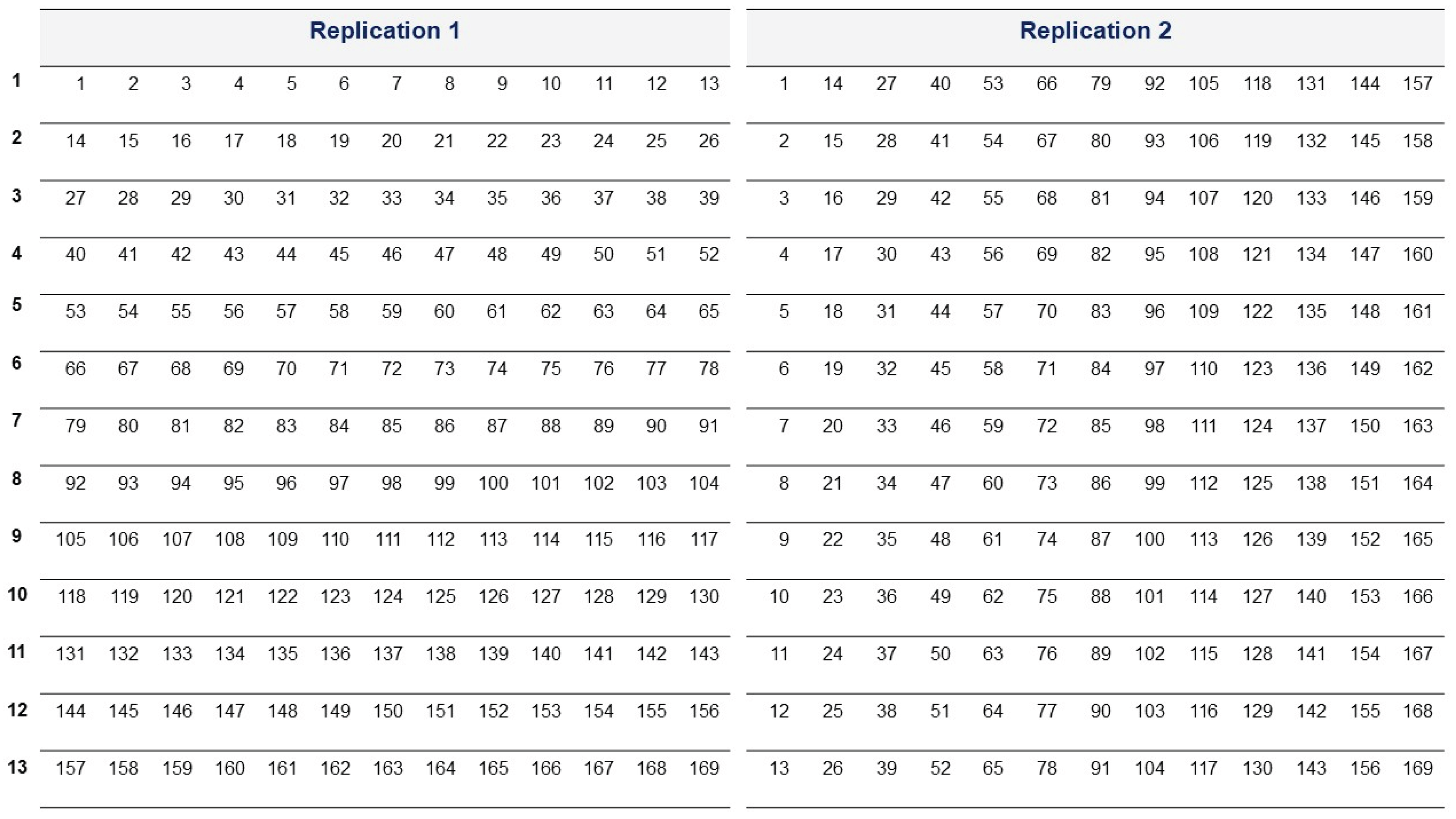

Table 1.
Probability (%) of including at least one copy of an allele with frequency p in a sample of n plants, according to P = 1 − (1 − p)k, where k represents the effective number of independent allele draws: k = 2n in allogamous species and k = n in autogamous species under complete inbreeding (Marshall & Brown, 1975). These probabilities refer to the genetic presence of the allele in the sample and do not represent the probability of observing the associated phenotype.
Table 1.
Probability (%) of including at least one copy of an allele with frequency p in a sample of n plants, according to P = 1 − (1 − p)k, where k represents the effective number of independent allele draws: k = 2n in allogamous species and k = n in autogamous species under complete inbreeding (Marshall & Brown, 1975). These probabilities refer to the genetic presence of the allele in the sample and do not represent the probability of observing the associated phenotype.
| Number of plants (n)a | Allogamous species (p =0.05) | Allogamous species (p =0.01) | Value of k | Autogamous species (p =0.05) | Autogamous species (p =0.01) | Value of k |
| 10 | 64.2 | 18.2 | 20 | 40.1 | 9.6 | 10 |
| 20 | 87.1 | 33.1 | 40 | 64.2 | 18.2 | 20 |
| 30 | 95.4 | 45.3 | 60 | 78.5 | 26.0 | 30 |
| 59 | 99.8 | 69.5 | 118 | 95.2 | 44.7 | 59 |
aValues calculated by the authors and rounded to one decimal place.
Table 2.
Minimum number of plants (n) required to include at least one copy of an allele with frequency p with probability P, obtained by rearranging the model as , rounded up. in allogamous species and n = k in autogamous species under complete inbreeding (based Marshall & Brown, 1975). These values refer to the genetic presence of the allele in the sample and do not represent the probability of observing the associated phenotype.
Table 2.
Minimum number of plants (n) required to include at least one copy of an allele with frequency p with probability P, obtained by rearranging the model as , rounded up. in allogamous species and n = k in autogamous species under complete inbreeding (based Marshall & Brown, 1975). These values refer to the genetic presence of the allele in the sample and do not represent the probability of observing the associated phenotype.
| Desired probability (P)a | Allele frequency (p) | k required | n allogamous species | n autogamous species (n = k) |
|---|---|---|---|---|
| 90% | 0.10 | 22 | 11 | 22 |
| 0.05 | 45 | 23 | 45 | |
| 0.02 | 114 | 57 | 114 | |
| 0.01 | 230 | 115 | 230 | |
| 95% | 0.10 | 29 | 15 | 29 |
| 0.05 | 59 | 30 | 59 | |
| 0.02 | 149 | 75 | 149 | |
| 0.01 | 299 | 150 | 299 | |
| 99% | 0.10 | 44 | 22 | 44 |
| 0.05 | 90 | 45 | 90 | |
| 0.02 | 228 | 114 | 228 | |
| 0.01 | 459 | 230 | 459 |
a Values calculated by the authors and rounded up to the next integer.
Disclaimer/Publisher’s Note: The statements, opinions and data contained in all publications are solely those of the individual author(s) and contributor(s) and not of MDPI and/or the editor(s). MDPI and/or the editor(s) disclaim responsibility for any injury to people or property resulting from any ideas, methods, instructions or products referred to in the content. |
© 2026 by the authors. Licensee MDPI, Basel, Switzerland. This article is an open access article distributed under the terms and conditions of the Creative Commons Attribution (CC BY) license.
Copyright: This open access article is published under a Creative Commons CC BY 4.0 license, which permit the free download, distribution, and reuse, provided that the author and preprint are cited in any reuse.