
Submitted:
16 November 2026
Posted:
18 November 2026
You are already at the latest version
Abstract
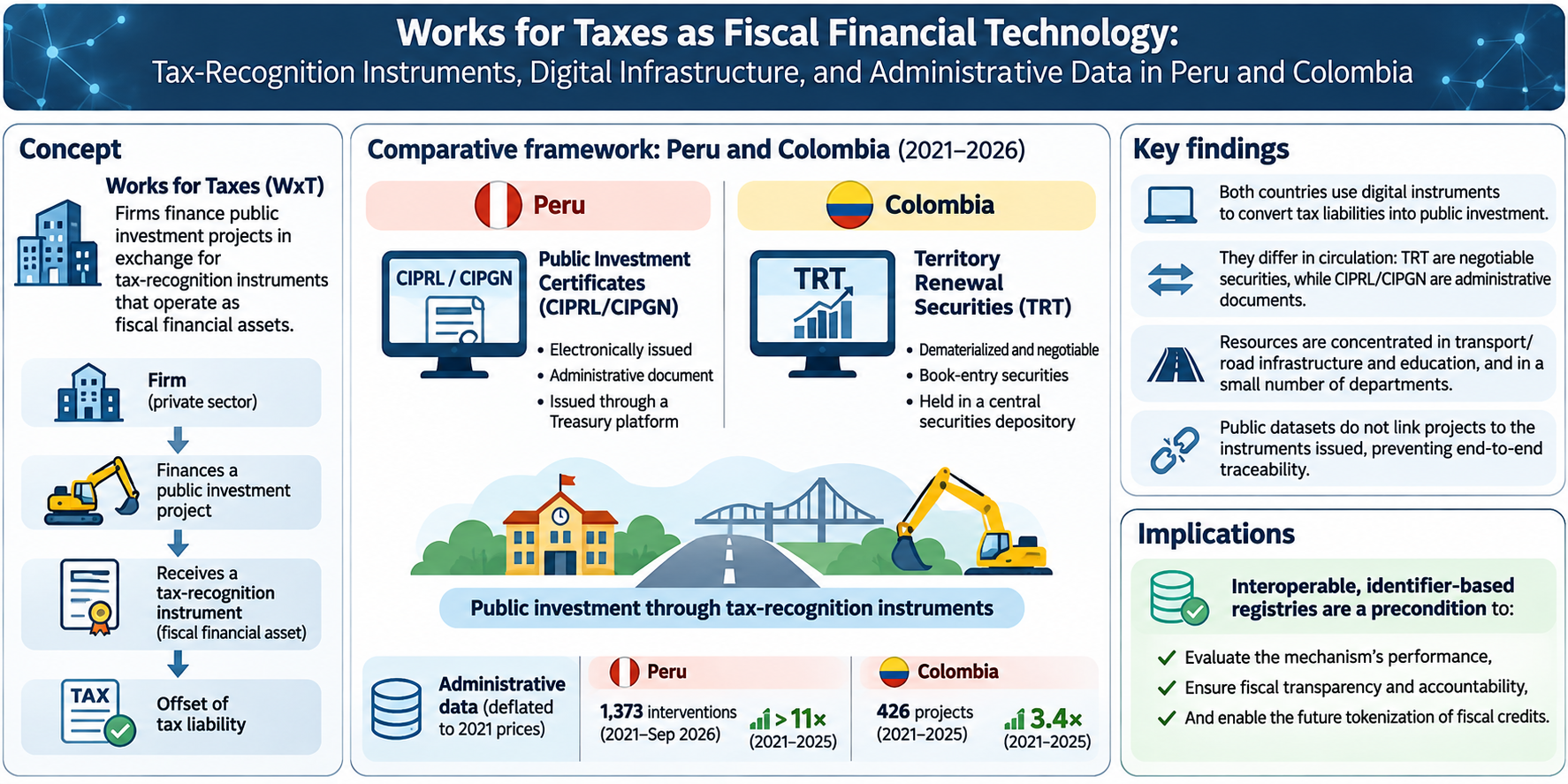
Works for Taxes allows firms to finance public investment projects in exchange for tax-recognition instruments that operate as fiscal financial assets. This study compares the legal and institutional configuration of Works for Taxes in Peru and Colombia during 2021–2026, focusing on the design and digital infrastructure of these instruments: Peru’s electronically issued public investment certificates (CIPRL/CIPGN) and Colombia’s dematerialized, negotiable Territory Renewal Securities (TRT). A legal-documentary comparative design, structured around six analytical categories, was combined with a descriptive analysis of administrative records: 1373 Peruvian interventions awarded between 2021 and September 2026 and 426 Colombian project records for 2021–2025, with values deflated to constant 2021 prices. Both countries convert tax liabilities into public investment through instruments that are already digital, but they differ in how far those instruments can circulate: TRT are book-entry securities held in a central securities depository, whereas CIPRL/CIPGN are administrative documents issued through a Treasury platform. In real terms, Peruvian award amounts rose more than elevenfold between 2021 and 2025, mostly after 2024, while Colombian reported values grew 3.4 times. In both countries, resources were concentrated in transport or road infrastructure and education and in a small number of departments. Neither public dataset links projects to the instruments issued to recognize them, which prevents end-to-end traceability from tax liability to delivered asset. Interoperable, identifier-based registries are therefore a precondition both for evaluating the mechanism and for any future tokenization of fiscal credits.
Keywords:
works for taxes
; tax-credit instruments
; fiscal technology
; dematerialized securities
; RegTech
; GovTech
; tax expenditures
; public investment
; Peru
; Colombia
1. Introduction
Closing infrastructure and service gaps is a persistent challenge for Latin American governments, particularly at the subnational level, where investment needs often exceed the technical and budgetary capacity of the entities responsible for executing projects. In Peru, the infrastructure gap for 2016–2025 was estimated at approximately USD 160 billion, and regional and local governments historically spent well below their capital budgets [1]. Works for Taxes (in Spanish, Obras por Impuestos, OxI) emerged in this context. Created in Peru by Law No. 29230 of 2008 [2], the mechanism allows private firms to finance, and in some cases execute, prioritized public projects and to recover the amount invested through instruments applied against their tax liabilities. Colombia adopted its own version in 2016 and expanded it in 2019 [3,4].
What distinguishes Works for Taxes from conventional public–private partnerships is the way the state pays. Instead of budget outlays or user fees, the state remunerates the investor with tax-recognition instruments [5]. Economically, the mechanism is a tax expenditure: public spending delivered through the tax system [6,7]. Legally and operationally, the instruments are financial assets with an issuer, a registry, conditions of use and, in some cases, transferability. In Peru, the Ministry of Economy and Finance (MEF) issues Regional and Local Public Investment Certificates (CIPRL) and National Government Public Investment Certificates (CIPGN), electronically since May 2020 [8]; since 2024 these certificates have been negotiable in all cases [9]. In Colombia, the agreement option remunerates taxpayers with Territory Renewal Securities (TRT), which are negotiable, fractionable and recorded by book entry in a central securities depository [10,11]. Works for Taxes therefore sits at the intersection of public finance and financial technology: it depends on the digital issuance, registration, transfer and settlement of fiscal claims against the tax administration.
The FinTech literature has concentrated on payments, lending, digital assets and market infrastructure [12], on the use of technology for regulatory monitoring and compliance (RegTech) [13], and, in the public sector, on digital transformation [14], distributed ledgers for government registries [15] and the tokenization of government bonds [16]. Fiscal instruments that circulate among the Treasury, the tax administration and private firms have received far less attention. Studies of Works for Taxes have addressed its rationale and early performance in Peru [1], tax-administration control [17], the Colombian conflict-zone regime [18] and dispute resolution [19]. To the best of the authors’ knowledge, no study has compared the two countries by linking the legal design of their instruments, the digital infrastructure through which those instruments are issued and circulate, and the administrative data available to monitor the mechanism.
Recent reforms make this question timely. In Peru, Law No. 31735 of 2023 raised the share of income tax payments that certificates may cover to 80% and allowed their use against other taxes [20], rules implemented by Supreme Decree No. 011-2024-EF and in force since May 2024 [9]; Law No. 32460 of 2025 extended the mechanism to operation and maintenance and introduced “Services for Taxes” [21]; and Supreme Decree No. 038-2026-EF approved new implementing regulations [22]. In Colombia, the Agencia de Renovación del Territorio (ART) and the Departamento Nacional de Planeación (DNP) issued version 6 of the Operational Manual in August 2026 [23], while the conditions governing TRT derive from Decree 1147 of 2020 [11], and Law 2277 of 2022, implemented by Decree 1458 of 2023, broadened the territories eligible for the mechanism [24,25].
Accordingly, the study addresses three research questions. RQ1: How do the legal and institutional configurations of Works for Taxes in Peru and Colombia differ in terms of legal nature, institutional structure, private participation, project cycle and oversight? RQ2: How do the legal design and digital infrastructure of the tax-recognition instruments (CIPRL/CIPGN and TRT) shape their issuance, transferability and traceability? RQ3: What do the available administrative records reveal about the evolution and the sectoral and territorial distribution of the mechanism in 2021–2025/2026, and what are the limits of comparing them?
The study makes three contributions. First, it provides a comparative legal–institutional matrix built on six predefined categories. Second, it characterizes tax-recognition instruments as fiscal financial infrastructure, distinguishing digital issuance, registration and transferability, and identifies the absence of a public link between projects and instruments as the main traceability gap. Third, it offers harmonized descriptive evidence, expressed in constant prices, that states explicitly which indicators can and cannot be compared across countries. Section 2 presents the theoretical framework; Section 3 describes the materials and methods; Section 4 reports the results; Section 5 discusses them, including their limitations; and Section 6 concludes.
2. Theoretical Framework and Literature Review
2.1. Works for Taxes as a Tax Expenditure and an Alternative Procurement Route
The concept of tax expenditure describes government spending carried out through departures from a benchmark tax system rather than through direct appropriations [6]. Because such spending appears as reduced revenue rather than as an outlay, its cost is less visible to legislators and citizens, it tends to escape annual budget scrutiny and it can be used more than equivalent direct spending would be [26]. International practice therefore recommends that tax expenditures be measured and reported alongside the budget [7]. Works for Taxes fits this description, with one particular feature: the forgone revenue is not a permanent deduction but a credit that matures when the project is received and the instrument is used. In Peru, the value of the certificates is charged to the resources of the public entity that signed the agreement, including future transfers such as mining canon revenues [1]. The mechanism thus advances investment against future subnational resources whose effects, in canon-receiving regions, have been shown to be heterogeneous [27].
From a procurement perspective, the literature on public–private partnerships warns that private financing changes the timing of public payments and the allocation of risks, but does not by itself reduce the intertemporal cost to the state [5]. Applied to Works for Taxes, this means that faster execution, documented in preliminary comparisons of Peruvian projects [1], has to be weighed against the fiscal cost reflected in the instruments issued. That cost can be observed only if the instruments are recorded and published.
2.2. Multilevel Governance and Territorial Justice
Works for Taxes redistributes decision-making among national agencies, subnational governments and firms. Hooghe and Marks distinguish general-purpose, nested jurisdictions (Type I) from task-specific, flexible arrangements (Type II) [28]. The distinction is useful here: the Peruvian mechanism operates mainly through general-purpose regional and local governments, whereas the Colombian mechanism is coordinated by a national agency with a territorial mandate tied to conflict-affected areas.
Distributive questions follow from this design. The notion of territorial justice, formulated by Davies as the allocation of resources among areas in proportion to their needs [29], was developed by Harvey into a broader account of how spatial allocation can reproduce or correct inequality [30], connects with Rawls’s principle that inequalities are acceptable only if they benefit the least advantaged [31], and has been reformulated as spatial justice [32]. Empirical work in Latin America documents persistent interregional disparities in public spending [33] and links infrastructure to income inequality [34]. For Works for Taxes, the risk is specific: when firms select projects, investment may cluster where the firms operate rather than where needs are greatest [1]. Colombia addresses this risk ex ante by restricting projects to prioritized territories (ZOMAC and PDET), whereas Peru relies on entity prioritization and on caps for each issuing entity. Whether either design produces a needs-responsive distribution is an empirical question that requires needs indicators, which the administrative records analyzed here do not contain.
2.3. Tax-Recognition Instruments as Digital Fiscal Infrastructure
FinTech research maps how digital technologies change the issuance, holding, transfer and settlement of financial claims [12]. Three properties of tax-recognition instruments can be examined from this perspective: (i) issuance, whether on paper or electronically; (ii) registration, whether in an administrative registry kept by the issuer or in market infrastructure such as a central securities depository; and (iii) transferability, whether the instrument is non-negotiable, negotiable among private parties, or tradable on a secondary market. A fourth property, traceability, refers to whether each instrument can be linked to the project, agreement and taxpayer that originated it, and to its use against specific tax liabilities.
Three strands of literature give these properties analytical weight. RegTech research argues that regulators should move from digitizing paper processes to data-driven, near-real-time supervision [13]. Public-sector research stresses that digital transformation means redesigning processes and services, not only digitizing documents [14]. Work on distributed ledgers in government identifies certificates and registries as plausible use cases, while warning that the benefits depend on governance and institutional design [15]. Evidence on tokenized government bonds suggests efficiency gains in settlement and liquidity, conditional on regulatory clarity and scalable infrastructure [16]. Together, these strands suggest that a fiscal instrument issued electronically but not linked to project data has been digitized without being transformed.
2.4. Previous Studies on Works for Taxes
The literature on Works for Taxes is small and mostly descriptive. An International Finance Corporation note attributes the Peruvian mechanism’s performance to the alignment of public and private incentives, reports preliminary reductions in execution times, and identifies limitations such as the concentration of projects near financing firms and the high liquidity required of participants [1]. Ortiz Basauri shows that the Peruvian tax administration had no specific control over the tax benefits associated with the mechanism and proposes preventive, concurrent and subsequent controls [17]. Lasso Silva et al. find that research on Colombia’s conflict-affected-zone regime, which includes Works for Taxes, is predominantly qualitative and descriptive [18]. Tapia Benavente examines dispute resolution and dispute boards in the Peruvian regulation [19]. None of these studies compares the two countries’ instruments or examines their digital infrastructure, which is the gap this article addresses.
2.5. Analytical Framework
Building on these strands, the study models Works for Taxes as a four-stage cycle (Figure 1): legal authorization, award or enrollment, execution and delivery, and tax recognition and circulation. Each stage generates its own records. The first three are partially observable in public administrative data, whereas the fourth, the issuance and use of instruments, is recorded in registries that are not linked to project data in the sources available to the public. This framework guided both the legal comparison and the treatment of the quantitative indicators, which were classified according to the stage they represent.
3. Materials and Methods
3.1. Design and Scope
The study used a qualitative, legal-documentary comparative design with descriptive, analytical and comparative scope, complemented by a descriptive analysis of secondary quantitative data. The unit of analysis was the legal–institutional model of Works for Taxes in each country, understood as the set of statutory provisions, actors, powers, procedures and instruments that govern the mechanism. The temporal scope covered the rules in force between 2021 and 2026; earlier provisions were consulted when necessary to explain the origin of the current rules. Administrative records were analyzed for 2021–2025 in both countries and, for Peru only, through 22 September 2026.
3.2. Documentary Corpus
The corpus comprised three groups of sources. The first included primary legal sources: statutes, implementing regulations and binding administrative acts in both countries [2,3,4,8,11,20,21,22]. The second included institutional documents: operational manuals, guidance from the tax administrations, rulings by the Colombian tax authority on TRT, and the statistical databases of the competent agencies [10,23,35,36,37,38]. The third included academic literature on tax expenditures, public–private partnerships, multilevel governance, territorial justice, FinTech and digital government, and Works for Taxes. Documents were included if they were thematically relevant, of verifiable provenance and in force (or, for repealed rules, necessary to explain regulatory change). Duplicates and records without identifiable origin or coverage period were excluded. News reports were not used as evidence of legal content or results.
3.3. Administrative Data
For Peru, all figures come from a single source: ProInversión’s list of interventions under implementation and completed under Works for Taxes (2009–2026), updated to 22 September 2026 [39]. Interventions awarded between 2021 and 2026 were selected by award year, yielding 1373 records identified by their unique investment code (CUI). The MEF awards database, updated to 31 August 2026 [40], was consulted only to interpret variable definitions and exclusion rules; it was not merged with the ProInversión list, so the two cut-off dates are never combined in a single figure.
For Colombia, the source was the ART preliminary results file for Works for Taxes 2018–2025 [41]. The file was obtained directly from the ART for research purposes; it is a preliminary database that the agency had not published as open data at the time of the analysis. Records for 2021–2025 were selected using the file’s year field, yielding 426 records with no duplicate project codes (BPIN): 320 under the trust option and 106 under the agreement option. The file contains no records for 2026 and no variables on physical progress, delivery dates or TRT issued.
In both datasets, original category labels were preserved and amounts were kept in local currency. Peruvian values are expressed in millions of soles (PEN). Colombian values are expressed in billions of pesos (COP) using the short scale, that is, thousands of millions (109); COP 3375.88 billion therefore equals approximately COP 3.38 trillion.
3.4. Analytical Procedure
The analysis proceeded in three stages. First, the regulatory evolution of each model was reconstructed, identifying the provisions that govern its tax nature, investment recognition and the powers of participating entities. Second, both models were compared using six predefined categories: (1) legal and tax nature; (2) institutional structure; (3) access requirements and private participation; (4) project cycle and territorial targeting; (5) tax-recognition instrument and its digital infrastructure; and (6) monitoring, oversight and data transparency. For each category, regulatory provisions were distinguished from practices documented in the available evidence. Third, the administrative records were analyzed descriptively. Each indicator was classified according to the cycle stage it represents (Figure 1); counts, totals and shares were computed; and concentration was summarized with three-unit concentration ratios (CR3), that is, the share of the total value held by the three largest sectors or departments in each country.
To remove the effect of inflation, annual values for 2021–2025 were converted to constant 2021 prices using year-end consumer price index variations: for Peru, the Lima Metropolitan Area index (8.46% in 2022, 3.24% in 2023, 1.97% in 2024 and 1.51% in 2025) [42,43]; for Colombia, the national index (13.12%, 9.28%, 5.20% and 5.10%, respectively) [44]. Cumulative inflation over the period was 15.90% in Peru and 36.68% in Colombia. Because year-end rather than annual-average variations were used, the real series are approximations suitable for describing trends, not for precise valuation.
3.5. Comparability and Validity Safeguards
Cross-country comparisons were made only where the definition, reference period and coverage of an indicator corresponded sufficiently; otherwise, results are reported separately for each country. Monetary magnitudes were not converted into ratios between countries, because the Peruvian variable records award amounts while the Colombian variable records a generic project or initiative value. Changes over time were compared through indices (2021 = 100) calculated within each country.
Two sources of bias were addressed explicitly. First, the MEF’s methodological notes state that its awards records exclude withdrawn awards and terminated agreements [40]. If the ProInversión list follows the same rule, older cohorts are more likely to have lost records through withdrawal or termination, which would overstate growth. The Peruvian series is therefore interpreted as the evolution of the surviving awarded portfolio, not of all award procedures. Second, the Colombian file is preliminary and may be revised. Because the study involves neither primary data collection nor a counterfactual design, no causal claims are made about efficiency, construction quality or social outcomes.
4. Results
4.1. Comparative Legal–Institutional Configuration
Table 1 summarizes the comparison across the six categories. Both regimes convert part of a firm’s income tax liability into financing for public investment, but they do so through different legal structures. Peru has a single mechanism, governed by Law No. 29230 and its 2026 regulations, in which the firm finances (and usually contracts the execution of) a project prioritized by a public entity and recovers the investment through a certificate. Colombia has two options. Under the trust option, the taxpayer directs part of its income tax to a fiduciary account linked to an approved project. Under the agreement option, the taxpayer executes a project with its own resources and is remunerated with TRT once the project has been received to the satisfaction of the competent national entity [3,4,11].
The institutional architectures also differ. In Peru, executing entities belong to every level of government, and public universities and other authorized entities are also included; the MEF regulates the mechanism and issues certificates, ProInversión promotes it and provides technical assistance, and private supervisory entities monitor execution [22]. In Colombia, the ART manages the project bank and enrollment, the competent national entities assess feasibility, and the DNP co-issues the Operational Manual, whose procedures are binding [11,23]. The territorial logic differs accordingly: Colombian projects must benefit prioritized territories (ZOMAC and PDET municipalities, a scope that Law 2277 of 2022 extended to Amazon departments with fewer than 85,000 inhabitants and to Buenaventura [24,25]), whereas the Peruvian mechanism has nationwide scope and is limited mainly by the issuance caps of each entity.
4.2. Tax-Recognition Instruments and Their Digital Infrastructure
Table 2 compares the instruments according to the properties defined in Section 2.3. Both are already digital at issuance, but they rest on different infrastructures. Since 18 May 2020, CIPRL and CIPGN have been issued electronically by the Treasury through an MEF platform, and physical certificates had to be exchanged for electronic ones that kept their validity and negotiability conditions [8]. The legal regime of the certificates has evolved toward greater transferability. The original text of Law No. 29230 defined the CIPRL as non-negotiable and valid for ten years [2]; by 2018, certificates were described as saleable to other firms and as accruing an annual 2% revaluation on the unused balance [1]; and Supreme Decree No. 011-2024-EF made them negotiable in all cases, removing the restriction that applied when the financing firm was also the executor of the works [9]. The tax administration still keeps separate payment codes for negotiable and non-negotiable certificates [37]. Under Law No. 31735, certificates may be applied against income tax payments up to 80% of the income tax calculated in the previous year’s annual return and, since May 2024, against other taxes administered by SUNAT whose revenue accrues to the Treasury [9,20]; the same law provides that the Treasury recognizes the accumulated inflation of the previous twelve months as an additional amount, instead of the fixed 2% revaluation described in 2018 [20].
TRT, in contrast, are securities. Colombian regulations define them as negotiable instruments recorded by book entry in a central securities depository, which may be fractioned and used by their legitimate holder to pay up to 50% of income tax [10,38]. The Colombian tax authority has stated that TRT are negotiable on the secondary securities market [38]. In FinTech terms, TRT are already dematerialized securities that circulate through market infrastructure, whereas CIPRL/CIPGN are electronically issued administrative documents whose circulation depends on Treasury and tax-administration procedures. Neither country publishes, in the sources analyzed, a dataset that links each instrument to the project that originated it.
4.3. Administrative Records for Peru
ProInversión’s records identify 1373 interventions awarded between 2021 and 22 September 2026, with a cumulative award value of PEN 19,339.35 million (Table 3). This figure corresponds to award amounts and should not be read as investment executed or certificates issued. Award amounts were modest in 2021–2023 (PEN 342–507 million per year) and rose sharply from 2024: 118 interventions worth PEN 4033.02 million were awarded in 2024 and 477 worth PEN 4932.85 million in 2025, a nominal increase of 22.31%. In constant 2021 prices, the 2025 amount was 11.5 times the 2021 amount (Figure 2). The partial 2026 figure (670 interventions, PEN 9155.61 million through 22 September) already exceeds the 2025 total, although it is not a year-end value.
By sector, transportation accounts for the largest share of the awarded amount (27.10%), followed by education (19.75%) and health (14.52%); together, these three functions account for 61.38% of the total (Table 4). The pattern differs when interventions are counted instead of amounts: health has the most records (326), ahead of transportation (288) and education (164), which indicates smaller average amounts in health. Geographically, Cusco (13.81%), Arequipa (13.26%) and Áncash (8.20%) received the largest amounts, and the three departments together account for 35.26% of the national total (Table 5). Regional governments account for 55.63% of the awarded amount, district governments for 25.14%, provincial governments for 10.87%, national government entities for 7.83% and universities for 0.52% (Table 6).
The administrative status recorded at the cut-off date shows that a large share of the portfolio remains in early or intermediate stages (Table 7; Figure 3): 309 interventions were in physical implementation, 278 in technical file preparation, 262 awarded and 259 with a signed agreement, whereas 66 were received, 42 settled and 28 completed. These categories describe administrative situations at a single date; they are not a completion rate. Finally, investment projects account for 88.89% of the awarded amount, investments in optimization, marginal expansion, rehabilitation and replacement (IOARR) for 10.87%, and operation and maintenance activities for 0.24% (Table 8).
4.4. Administrative Records for Colombia
The ART file contains 426 records for 2021–2025, with a reported aggregate value of COP 3375.88 billion (Table 9). The number of records rose from 39 in 2021 to 119 in 2025, and the reported value rose from COP 241.39 billion to COP 1128.24 billion. In constant 2021 prices, the 2025 value was 3.4 times the 2021 value. Of the 426 records, 320 correspond to the trust option and 106 to the agreement option. These values describe projects or initiatives recorded in the file; they do not show completed works or services delivered.
Road infrastructure has the largest share of the reported value (35.80%), followed by education (32.72%) and energy (9.51%); together, these three categories account for 78.03% of the total (Table 10). Original categories were preserved, so “Education”, “Education – ICBF” and “Education – Work” are reported separately. Antioquia (26.17%), Arauca (13.99%) and Valle del Cauca (6.59%) received the largest values, and these three departments account for 46.76% of the total (Table 11). By territorial label, 189 records (31.16% of the value) are classified exactly as “ZOMAC – NON-PDET”, and the remaining 237 records (68.84%) carry PDET, mixed or other labels (Table 12).
4.5. Cross-Country Descriptive Comparison
Table 13 sets out the series that can be compared within each country. Both expanded during 2021–2025, but along different paths. Colombia grew steadily, with a real compound annual growth rate of 36.0%. Peru remained flat until 2023 and then grew abruptly, so its real compound annual growth rate (84.3%) mostly reflects the jump in 2024 (Figure 2). In line with Section 3.5, the absolute amounts are not compared across countries: the Peruvian variable is an award amount and the Colombian variable a generic reported value.
Table 14 records the comparability of each dimension. Identifiers, year, sector and territory exist in both datasets but with different definitions; progress is recorded only in Peru; and neither dataset contains information on the tax-recognition instruments. Table 15 summarizes concentration within each country. Colombia shows higher sectoral and territorial concentration than Peru, consistent with its territorially targeted design, although the two ratios are calculated over different periods and classifications and should be read as within-country descriptions. Figure 4 shows the same pattern for the ten departments with the largest values in each country.
5. Discussion
Regarding RQ1, the results show that Works for Taxes is not a single legal model but a family of arrangements that share the logic of a tax expenditure [6,26]. The Peruvian model is decentralized and general-purpose: it operates through regional and local governments, which account for more than 90% of the awarded amount (Table 6), and has nationwide territorial scope. The Colombian model is nationally coordinated and task-specific, organized around an agency with a mandate for conflict-affected territories. In Hooghe and Marks’s terms, the Peruvian model resembles Type I multilevel governance and the Colombian model resembles Type II [28]. This difference matters for accountability, because responsibility for project selection lies with elected subnational authorities in Peru and with national technical bodies in Colombia.
Regarding RQ2, the most important difference concerns the instruments. TRT are dematerialized securities held in a central depository, fractionable and negotiable on the secondary market [10,38]. This design lets a firm that cannot use its tax credit transfer it, enables price formation and places the instrument within existing securities-market supervision. CIPRL/CIPGN are electronically issued administrative documents [8]; although they have been negotiable in all cases since 2024 [9], their circulation runs through the Treasury and the tax administration rather than through securities-market infrastructure. In the terms of the digital transformation literature, both countries have digitized their instruments [14], but only Colombia has connected them to financial-market infrastructure. Neither has tokenized them, and the evidence does not support the claim that tokenization would by itself improve the mechanism: the gains reported for tokenized government bonds depend on regulatory clarity and scalable infrastructure [16], and distributed-ledger registries raise governance questions of their own [15].
The traceability gap is more pressing than the choice of technology. In neither country do the public datasets link a project identifier (CUI or BPIN) to the instruments issued, their holders and their use against specific taxes. Without that link, it is impossible to observe the full cycle from tax liability to delivered asset, to measure the fiscal cost of the mechanism as a tax expenditure [7] or to verify that recognition matches execution, a weakness already noted for the Peruvian tax administration [17]. From a RegTech perspective [13], a minimum data architecture would include a shared identifier for each project–instrument pair, open machine-readable publication of instruments issued, transferred and used, and automated checks of the applicable caps. Such an architecture could be implemented with conventional databases; a distributed ledger would be justified only if multiple independent parties needed to update a shared registry without a trusted central operator.
Regarding RQ3, the Peruvian portfolio grew more than elevenfold in real terms between 2021 and 2025, with the increase concentrated after 2024. The timing coincides with reforms that made certificates more useful to firms, notably the higher cap and the broader range of taxes against which certificates can be applied under Law No. 31735, in force since May 2024 [9,20], but the design of this study does not allow the growth to be attributed to those reforms. Part of the observed increase may also reflect the survivorship of more recent awards (Section 3.5). Colombian growth was steadier, and real values more than tripled.
The sectoral pattern is consistent across time and countries. Transport or road infrastructure and education dominate in both, as they did in Peru’s first decade, when transport and education accounted for 35% and 23% of the investment [1]. The territorial pattern raises questions of territorial justice [29,30,32]. In Peru, the departments with the largest amounts (Cusco, Arequipa and Áncash) are regions with significant extractive activity, which fits the earlier observation that projects cluster near financing firms [1] and the role of canon resources in subnational finance [27]. In Colombia, concentration is higher even though eligibility is restricted to prioritized territories, with Antioquia alone accounting for more than a quarter of the value. Whether either distribution responds to need cannot be determined from these data. Doing so would require per-capita values and gap indicators, as in studies of interregional spending disparities [33] and of the relationship between infrastructure and inequality [34].
5.1. Limitations
The study has five limitations. First, the Peruvian and Colombian monetary variables refer to different stages (award and reported value), so their absolute magnitudes cannot be compared. Second, the Peruvian list may exclude withdrawn awards and terminated agreements, which could overstate growth. Third, the Colombian file is preliminary, contains no data for 2026 and has no variables on execution or TRT issued. Fourth, the deflation uses year-end inflation and is therefore approximate. Fifth, no data on instruments issued, transferred or used were available, so the analysis of instruments is legal and institutional rather than quantitative. Future research should obtain project-level data linked to CIPRL/CIPGN and TRT records, analyze secondary-market transactions in TRT, and combine per-capita investment with territorial gap indicators to assess distributive outcomes.
6. Conclusions
Works for Taxes in Peru and Colombia shares a single economic logic, the conversion of tax liabilities into public investment, but is implemented through different legal and institutional configurations. Peru operates a decentralized mechanism with nationwide scope, recently extended to operation, maintenance and services, whereas Colombia combines a trust option and an agreement option within a nationally coordinated framework targeted at conflict-affected territories.
The tax-recognition instruments are the point at which the mechanism becomes a matter of financial technology. Both countries issue them digitally, but only Colombia’s TRT are dematerialized securities that circulate through market infrastructure. Peru’s CIPRL/CIPGN remain electronically issued administrative documents. In neither country do public data link instruments to projects, and this gap, rather than the absence of advanced technologies, is the main obstacle to transparency, cost measurement and evaluation.
The administrative records show an expansion of the mechanism in both countries during 2021–2025, abrupt in Peru after 2024 and steady in Colombia, with concentration in transport or roads and education and in a small number of departments. These records describe award or registration activity, not completed works or social benefits.
Three policy implications follow. First, both countries should publish interoperable, machine-readable data that link project identifiers to the instruments issued and to their use against taxes. Second, the fiscal cost of the mechanism should be reported as a tax expenditure in budget documents. Third, any move toward tokenized fiscal credits should be preceded by this data foundation and assessed against the governance conditions identified in the literature.
Author Contributions
Conceptualization, J.L.C.C., E.A.V.J. and C.R.M.; methodology, J.A.V.O., L.F.G.G. and J.S.A.; validation, A.C.R., C.R.M. and L.F.G.G.; formal analysis, J.L.C.C. and E.A.V.J.; investigation, J.L.C.C., E.A.V.J. and J.A.V.O.; resources, J.L.C.C.; data curation, J.S.A. and E.A.V.J.; writing—original draft preparation, J.S.A.; writing—review and editing, J.L.C.C., E.A.V.J., J.A.V.O., L.F.G.G., J.S.A., A.C.R. and C.R.M.; visualization, E.A.V.J.; supervision, J.L.C.C.; project administration, J.L.C.C. and C.R.M.; funding acquisition, J.L.C.C. All authors have read and agreed to the published version of the manuscript.
Funding
This research received no external funding.
Institutional Review Board Statement
Not applicable. The study did not involve humans or animals.
Informed Consent Statement
Not applicable.
Data Availability Statement
The Peruvian data are publicly available from ProInversión at https://www.investinperu.pe/que-es-obras-por-impuestos/proyectos-concluidos-y-adjudicados/ (accessed on 22 September 2026). The Colombian data come from a preliminary file of the Agencia de Renovación del Territorio. Because this file is preliminary and unpublished, the authors are not authorized to redistribute it; it may be requested from the ART. The processed tables derived from both datasets are available from the corresponding author upon reasonable request.
Conflicts of Interest
The authors declare no conflicts of interest.
Abbreviations
The following abbreviations are used in this manuscript:
| ART | Agencia de Renovación del Territorio (Territory Renewal Agency, Colombia) |
| BPIN | Código del Banco de Programas y Proyectos de Inversión Nacional (Colombian project code) |
| CIPGN | Certificado de Inversión Pública Gobierno Nacional (National Government Public Investment Certificate) |
| CIPRL | Certificado de Inversión Pública Regional y Local (Regional and Local Public Investment Certificate) |
| CR3 | Three-unit concentration ratio |
| CUI | Código Único de Inversiones (Peruvian unique investment code) |
| DIAN | Dirección de Impuestos y Aduanas Nacionales (Colombian tax authority) |
| DNP | Departamento Nacional de Planeación (National Planning Department, Colombia) |
| IOARR | Investments in optimization, marginal expansion, rehabilitation and replacement |
| MEF | Ministerio de Economía y Finanzas (Ministry of Economy and Finance, Peru) |
| PDET | Programas de Desarrollo con Enfoque Territorial (Territorially Focused Development Programs) |
| SUNAT | Superintendencia Nacional de Aduanas y de Administración Tributaria (Peruvian tax authority) |
| TRT | Títulos para la Renovación del Territorio (Territory Renewal Securities) |
| ZOMAC | Zonas Más Afectadas por el Conflicto Armado (Areas Most Affected by the Armed Conflict) |
References
- Del Carpio Ponce, P.E. Peru’s Works for Taxes Scheme: An Innovative Solution to Accelerate Private Provision of Infrastructure Investment; International Finance Corporation: Washington, DC, USA, 2018; Available online: https://documents.worldbank.org/en/publication/documents-reports/documentdetail/163871532527022459 (accessed on 27 October 2026).
- Congreso de la República del Perú. Ley N.º 29230, Ley que Impulsa la Inversión Pública Regional y Local con Participación del Sector Privado. In Diario Oficial El Peruano; 20 May 2008. [Google Scholar]
- Congreso de Colombia. Ley 1819 de 2016, por Medio de la Cual se Adopta una Reforma Tributaria Estructural. 2016, Diario Oficial No. 50.101. [Google Scholar]
- Congreso de Colombia. Ley 2010 de 2019, por Medio de la Cual se Adoptan Normas para la Promoción del Crecimiento Económico. 2019, Diario Oficial No. 51.179. [Google Scholar]
- Engel, E.; Fischer, R.D.; Galetovic, A. The Economics of Public-Private Partnerships: A Basic Guide; Cambridge University Press: Cambridge, UK, 2014. [Google Scholar]
- Surrey, S.S.; McDaniel, P.R. Tax Expenditures; Harvard University Press: Cambridge, MA, USA, 1985. [Google Scholar]
- OECD. Tax Expenditures in OECD Countries; OECD Publishing: Paris, France, 2010. [Google Scholar] [CrossRef]
- Ministerio de Economía y Finanzas del Perú. Resolución Directoral N.º 003-2020-EF/52.06: Disposiciones para la Emisión Electrónica de los CIPRL, CIPGN y Documentos Cancelatorios. Communiqué of 13 May 2020. Available online: https://www.mef.gob.pe/es/notas-de-prensa-y-comunicados/6392-comunicado-13 (accessed on 27 October 2026).
- Ministerio de Economía y Finanzas del Perú. Decreto Supremo N.º 011-2024-EF, que Modifica el Reglamento de la Ley N.º 29230. In Diario Oficial El Peruano; February 2024. [Google Scholar]
- Dirección de Impuestos y Aduanas Nacionales. Oficio N.º 1225 [907961], Obras por Impuestos: Títulos para la Renovación del Territorio. 10 August 2021. Available online: https://www.cijuf.org.co/node/22474 (accessed on 27 October 2026).
- Presidencia de la República de Colombia. Decreto 1147 de 2020, por el Cual se Reglamenta la Opción del Mecanismo de Obras por Impuestos del Artículo 800-1 del Estatuto Tributario. 18 August 2020. Available online: https://normograma.dian.gov.co/dian/compilacion/docs/decreto_1147_2020.htm (accessed on 27 October 2026).
- Gomber, P.; Kauffman, R.J.; Parker, C.; Weber, B.W. On the Fintech Revolution: Interpreting the Forces of Innovation, Disruption, and Transformation in Financial Services. J. Manag. Inf. Syst. 2018, 35, 220–265. [Google Scholar] [CrossRef]
- Arner, D.W.; Barberis, J.N.; Buckley, R.P. FinTech, RegTech, and the Reconceptualization of Financial Regulation. Northwest. J. Int. Law Bus. 2017, 37, 371–414. [Google Scholar]
- Mergel, I.; Edelmann, N.; Haug, N. Defining Digital Transformation: Results from Expert Interviews. Gov. Inf. Q. 2019, 36, 101385. [Google Scholar] [CrossRef]
- Ølnes, S.; Ubacht, J.; Janssen, M. Blockchain in Government: Benefits and Implications of Distributed Ledger Technology for Information Sharing. Gov. Inf. Q. 2017, 34, 355–364. [Google Scholar] [CrossRef]
- Aldasoro, I.; Cornelli, G.; Frost, J.; Koo Wilkens, P.; Lewrick, U.; Shreeti, V. Tokenisation of Government Bonds: Assessment and Roadmap; BIS Bulletin No. 107; Bank for International Settlements: Basel, Switzerland, 2025. [Google Scholar]
- Ortiz Basauri, C.E. Control de la Superintendencia Nacional de Aduanas y Administración Tributaria en Obras por Impuestos, 2019. Quipukamayoc 2021, 29, 17–24. [Google Scholar] [CrossRef]
- Lasso Silva, E.R.; Rojas Álvarez, S.P.; Pinzón Sierra, D.F. Aproximación al Estado del Arte de las ZOMAC en Colombia. Punto Vista 2020, 11, 49–62. [Google Scholar] [CrossRef]
- Tapia Benavente, C. Una Revisión de la Regulación de Obras por Impuestos en Materia de Solución de Controversias y Dispute Boards. IUS ET VERITAS 2023, 66, 78–89. [Google Scholar] [CrossRef]
- Congreso de la República del Perú. Ley N.º 31735, Ley que Modifica la Ley N.º 29230. In Diario Oficial El Peruano; May 2023. [Google Scholar]
- Congreso de la República del Perú. Ley N.º 32460, Ley que Modifica la Ley 29230 a Fin de Ampliar el Desarrollo del Mecanismo de Obras por Impuestos. D. Of. El Peru. 2025. [Google Scholar]
- Ministerio de Economía y Finanzas del Perú. Decreto Supremo N.º 038-2026-EF, que Aprueba el Reglamento de la Ley N.º 29230. Diario Oficial El Peruano. 13 March 2026. Available online: https://www.gob.pe/institucion/mef/normas-legales/7895406-038-2026-ef (accessed on 27 October 2026).
- Agencia de Renovación del Territorio; Departamento Nacional de Planeación. Manual Operativo Obras por Impuestos, Version 6; ART: Bogotá, Colombia, 2026. Available online: https://www.renovacionterritorio.gov.co/obras-por-impuestos/manual-operativo-obras-por-impuestos (accessed on 27 October 2026).
- Congreso de Colombia. Ley 2277 de 2022, por Medio de la Cual se Adopta una Reforma Tributaria para la Igualdad y la Justicia Social. 2022, Diario Oficial No. 52.247. [Google Scholar]
- Ministerio de Hacienda y Crédito Público de Colombia. Decreto 1458 de 2023, por el Cual se Reglamentan los Parágrafos 2 y 3 del Artículo 800-1 del Estatuto Tributario. 2023. [Google Scholar]
- Burman, L.E.; Phaup, M. Tax Expenditures, the Size and Efficiency of Government, and Implications for Budget Reform. Tax. Policy Econ. 2012, 26, 93–124. [Google Scholar] [CrossRef]
- Aragón, F.M.; Winkler, H. The Long-Term Impact of a Resource-Based Fiscal Windfall: Evidence from the Peruvian Canon. Resour. Policy 2023, 87, 104305. [Google Scholar] [CrossRef]
- Hooghe, L.; Marks, G. Unraveling the Central State, but How? Types of Multi-Level Governance. Am. Political Sci. Rev. 2003, 97, 233–243. [Google Scholar] [CrossRef]
- Davies, B. Social Needs and Resources in Local Services; Michael Joseph: London, UK, 1968. [Google Scholar]
- Harvey, D. Social Justice and the City; Edward Arnold: London, UK, 1973. [Google Scholar]
- Rawls, J. A Theory of Justice; Harvard University Press: Cambridge, MA, USA, 1971. [Google Scholar]
- Soja, E.W. Seeking Spatial Justice; University of Minnesota Press: Minneapolis, MN, USA, 2010. [Google Scholar]
- Bertoni, E.; Elacqua, G.; Marotta, L.; Martínez, M.; Santos, H.; Soares, S. Is School Funding Unequal in Latin America? A Cross-Country Analysis of Interregional Disparities in Public Spending. Comp. Educ. Rev. 2023, 67, 100–122. [Google Scholar] [CrossRef]
- Medeiros, V.; Ribeiro, R.S.M.; do Amaral, P.V.M. Infrastructure and Income Inequality: An Application to the Brazilian Case Using Hierarchical Spatial Autoregressive Models. J. Reg. Sci. 2022, 62, 1467–1486. [Google Scholar] [CrossRef]
- Agencia de Renovación del Territorio. Obras por Impuestos. Available online: https://www.renovacionterritorio.gov.co/obras-por-impuestos (accessed on 27 October 2026).
- Agencia de Renovación del Territorio. Opción Convenio: Obras por Impuestos. Available online: https://www.renovacionterritorio.gov.co/obras-por-impuestos/opcion-convenio (accessed on 27 October 2026).
- Superintendencia Nacional de Aduanas y de Administración Tributaria. Operatividad del Pago con CIPRL y CIPGN. Orientación SUNAT. Available online: https://orientacion.sunat.gob.pe/node/456 (accessed on 27 October 2026).
- Dirección de Impuestos y Aduanas Nacionales. Oficio N.º 5972 de 2023 (Concepto 1085 de 17 de Octubre de 2023): Títulos para la Renovación del Territorio. Available online: https://normograma.dian.gov.co/dian/compilacion/docs/oficio_dian_5972_2023.htm (accessed on 27 October 2026).
- Agencia de Promoción de la Inversión Privada (ProInversión). Relación de las Intervenciones en Ejecución y Concluidas Mediante la Modalidad de Obras por Impuestos (2009–2026) [Database, updated 22 September 2026]. 22 September 2026. Available online: https://www.investinperu.pe/que-es-obras-por-impuestos/proyectos-concluidos-y-adjudicados/.
- Ministerio de Economía y Finanzas del Perú. Base de Adjudicaciones de Obras por Impuestos [Database, cut-off 31 August 2026]. Available online: https://mef.gob.pe/es/obras-por-impuestos/estadisticas (accessed on 22 September 2026).
- Agencia de Renovación del Territorio. Base de Resultados de Obras por Impuestos 2018–2025: Preliminar [Unpublished Excel Database]; ART: Bogotá, Colombia, 2026. [Google Scholar]
- Instituto Nacional de Estadística e Informática. Informe Técnico: Variación de los Indicadores de Precios de la Economía, Diciembre 2023; INEI: Lima, Peru, 2024. [Google Scholar]
- Banco Central de Reserva del Perú. Memoria 2025; BCRP: Lima, Peru, 2026; Available online: https://www.bcrp.gob.pe/docs/Publicaciones/Memoria/2025/memoria-bcrp-2025-4.pdf (accessed on 27 October 2026).
- Departamento Administrativo Nacional de Estadística. Índice de Precios al Consumidor (IPC): Diciembre de 2025. In Boletín Técnico; DANE: Bogotá, Colombia, 2026. [Google Scholar]
Figure 1.
Analytical framework: the four-stage cycle of Works for Taxes and the records each stage generates. Source: Prepared by the authors.
Figure 1.
Analytical framework: the four-stage cycle of Works for Taxes and the records each stage generates. Source: Prepared by the authors.
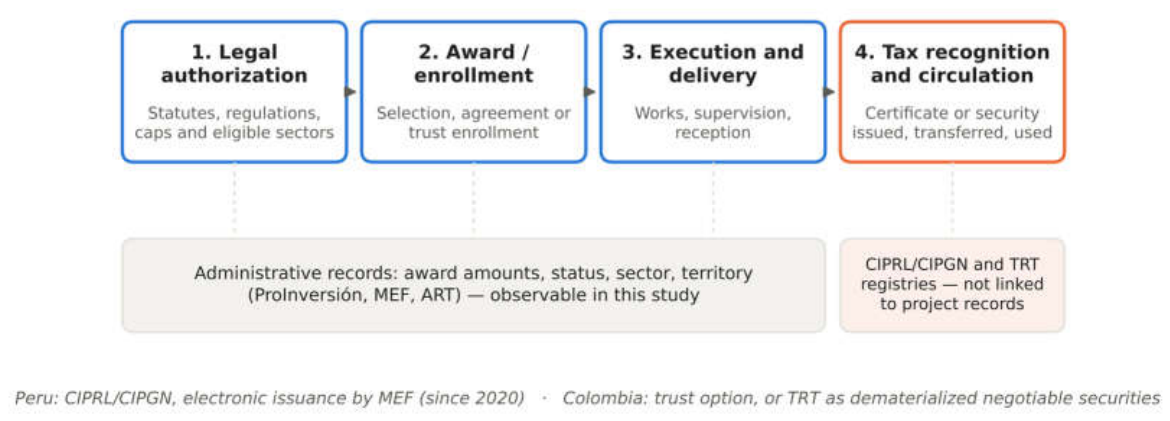
Figure 2.
Evolution of the Works for Taxes portfolio by country, 2021–2025, in nominal terms and at constant 2021 prices (index, 2021 = 100). Each panel uses its own scale; absolute amounts are not comparable across countries. Source: Authors’ calculations based on [39,41,42,43,44].
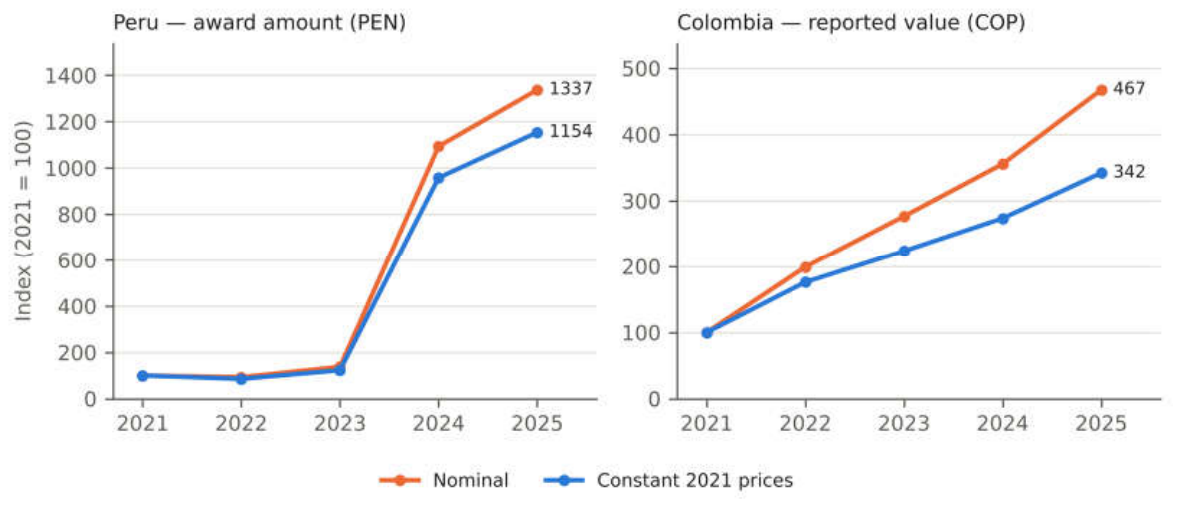
Figure 3.
Peru: interventions awarded in 2021–2026 by administrative status as of 22 September 2026. The bars describe a single date; they are not a completion rate. Source: [39].
Figure 3.
Peru: interventions awarded in 2021–2026 by administrative status as of 22 September 2026. The bars describe a single date; they are not a completion rate. Source: [39].
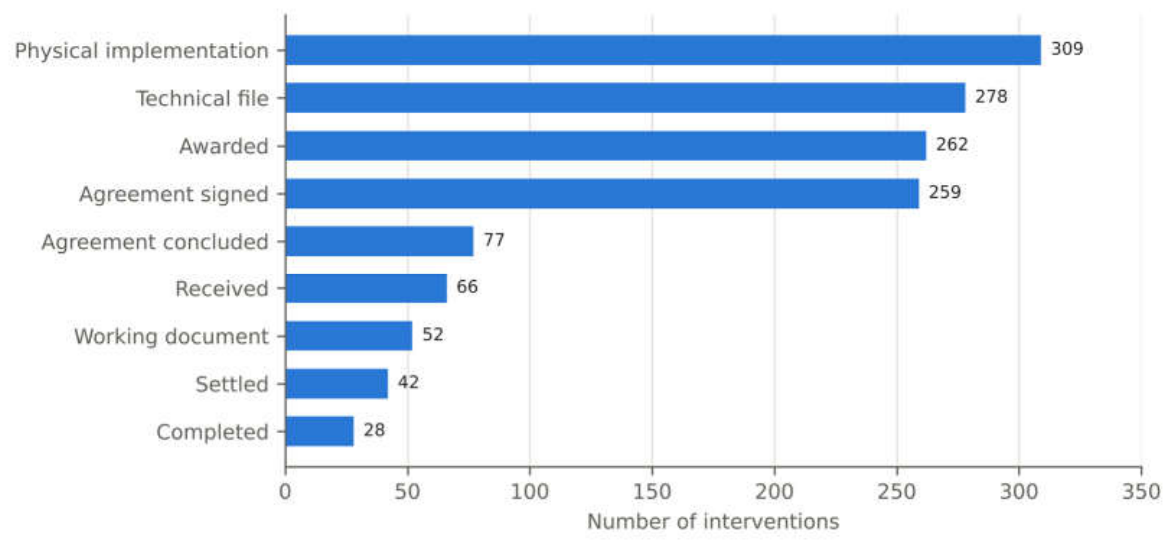
Figure 4.
Ten departments with the largest values in each country, as a share of the national total (Peru: award amounts, 2021–2026; Colombia: reported values, 2021–2025). Shares are not per capita and do not indicate needs. Source: [39,41].
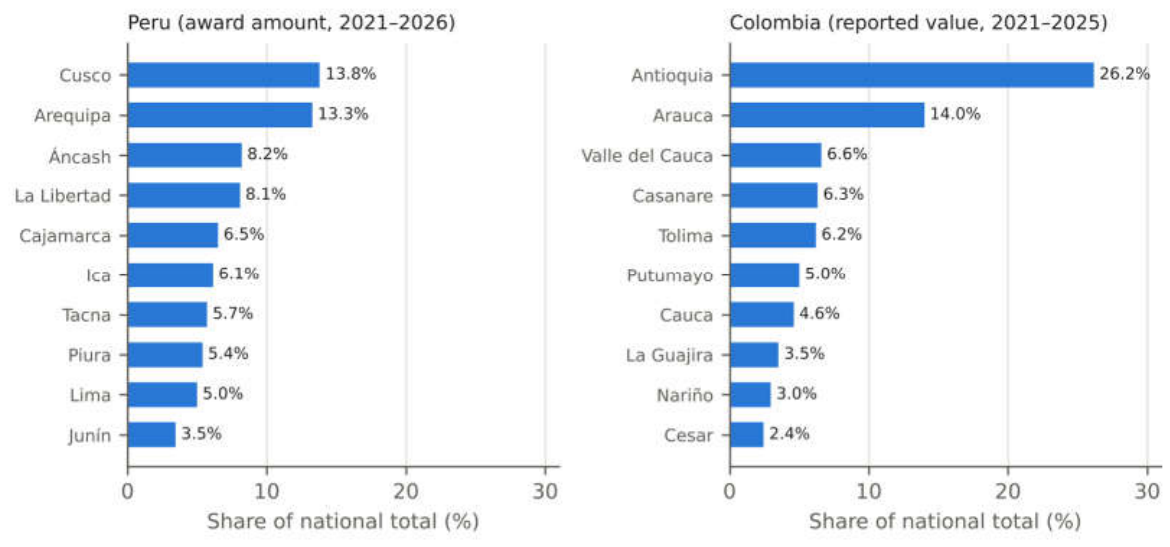

Table 1.
Comparative legal–institutional matrix of Works for Taxes in Peru and Colombia.
| Category | Peru | Colombia |
| 1. Legal and tax nature | Single mechanism (Law No. 29230; regulations approved by Supreme Decree No. 038-2026-EF). The firm finances and contracts the execution of a prioritized project; the investment is recognized through CIPRL/CIPGN applied against income tax payments (up to 80% of the previous year’s income tax) and, since May 2024, other taxes administered by SUNAT. | Two options. Trust (art. 238, Law 1819 of 2016): part of the income tax is directed to a fiduciary account for an approved project. Agreement (art. 800-1, Tax Statute; Law 2010 of 2019): the taxpayer executes the project and is remunerated with TRT. |
| 2. Institutional structure | Executing entities at the national, regional and local levels, public universities and other authorized entities; MEF (regulation, certificates); ProInversión (promotion and assistance); private supervisory entities. | ART (project bank and enrollment); competent national entities (feasibility and receipt); DNP (co-issues the binding Operational Manual); Ministry of Finance and DIAN (TRT issuance and tax use). |
| 3. Access and private participation | Income taxpayers, individually or in consortia, selected through a public process governed by the principles of freedom of participation and equal treatment. | Income taxpayers that meet the requirements; under the agreement option, expression of interest, verification of requirements and selection, according to the Operational Manual. |
| 4. Project cycle and territorial targeting | Prioritization by the entity, selection, investment agreement, technical file, execution, receipt and certificate issuance; since Law No. 32460, also operation, maintenance and “Services for Taxes”. Nationwide scope, limited by entity issuance caps. | Project bank, feasibility, enrollment or selection, trust or agreement, execution, delivery to satisfaction and TRT issuance (agreement option). Restricted to prioritized territories: ZOMAC and PDET municipalities and, since Law 2277 of 2022 (Decree 1458 of 2023), Amazon departments with fewer than 85,000 inhabitants and, under specific conditions, Buenaventura. |
| 5. Instrument and digital infrastructure | CIPRL/CIPGN: administrative documents issued electronically by the Treasury (since 2020); negotiable in all cases since 2024 (see Table 2). | TRT: negotiable, fractionable securities recorded by book entry in a central securities depository; no instrument under the trust option (see Table 2). |
| 6. Monitoring, oversight and data | MEF awards database and ProInversión intervention list with administrative status; no public link between projects and certificates. | ART project bank and preliminary results file; no status, delivery or TRT variables in the file analyzed; procedures defined in the Operational Manual. |
Table 2.
Tax-recognition instruments as fiscal financial infrastructure.
| Property | Peru: CIPRL/CIPGN | Colombia: TRT (agreement option) |
| Issuer | Ministry of Economy and Finance (Treasury) | Ministry of Finance, under Law 2010 of 2019 |
| Issuance | Electronic, through a Treasury platform, since 18 May 2020 | Dematerialized; issued after the project is received to satisfaction |
| Registration | Administrative registry of the issuer | Book entry in a central securities depository |
| Transferability | Non-negotiable in the original 2008 text; negotiable in all cases since Supreme Decree No. 011-2024-EF | Negotiable and fractionable; tradable on the secondary market |
| Use against taxes | Up to 80% of the previous year’s income tax; since May 2024, also other taxes administered by SUNAT | Up to 50% of income tax |
| Validity and value adjustment | Ten years; accumulated twelve-month inflation recognized (Law No. 31735) | Determined by the issuance conditions regulated by Decree 1147 of 2020 |
| Link to project data in public sources | Not available | Not available |
Table 3.
Peru: interventions awarded by year, 2021–2026.
| Award year | Interventions | Amount (PEN million) | Amount, constant 2021 prices (PEN million) | Share of amount (%) |
| 2021 | 38 | 368.88 | 368.88 | 1.91 |
| 2022 | 48 | 342.24 | 315.54 | 1.77 |
| 2023 | 22 | 506.76 | 452.57 | 2.62 |
| 2024 | 118 | 4033.02 | 3532.16 | 20.85 |
| 2025 | 477 | 4932.85 | 4255.97 | 25.51 |
| 2026 (partial) | 670 | 9155.61 | — | 47.34 |
| Total | 1373 | 19,339.35 | — | 100.00 |
Table 4.
Peru: awarded amount by function, 2021–2026.
| Function | Interventions | Amount (PEN million) | Share of amount (%) |
| Transportation | 288 | 5241.56 | 27.10 |
| Education | 164 | 3820.18 | 19.75 |
| Health | 326 | 2808.95 | 14.52 |
| Public order and security | 112 | 2181.84 | 11.28 |
| Planning, management and contingency reserve | 155 | 1940.36 | 10.03 |
| Sanitation | 84 | 1302.62 | 6.74 |
| Culture and sports | 116 | 706.41 | 3.65 |
| Environment | 33 | 414.51 | 2.14 |
| Housing and urban development | 42 | 307.49 | 1.59 |
| Agriculture | 21 | 271.00 | 1.40 |
| Trade | 13 | 117.51 | 0.61 |
| Communications | 2 | 57.82 | 0.30 |
| Justice | 3 | 54.81 | 0.28 |
| Social protection | 4 | 42.00 | 0.22 |
| Tourism | 3 | 38.66 | 0.20 |
| Energy | 7 | 33.64 | 0.17 |
| Total | 1373 | 19,339.35 | 100.00 |
Note: Functions follow the original classification. Shares are rounded to two decimals. Source: [39].
Table 5.
Peru: ten departments with the largest awarded amounts, 2021–2026.
| Department | Interventions | Amount (PEN million) | Share of national total (%) |
| Cusco | 167 | 2670.22 | 13.81 |
| Arequipa | 188 | 2564.42 | 13.26 |
| Áncash | 36 | 1585.01 | 8.20 |
| La Libertad | 119 | 1561.23 | 8.07 |
| Cajamarca | 115 | 1256.29 | 6.50 |
| Ica | 57 | 1187.37 | 6.14 |
| Tacna | 54 | 1103.52 | 5.71 |
| Piura | 67 | 1041.00 | 5.38 |
| Lima | 144 | 965.84 | 4.99 |
| Junín | 31 | 667.76 | 3.45 |
Note: Departments ranked by amount. Values are not per capita and do not indicate needs. Source: [39].
Table 6.
Peru: awarded amount by level of public entity, 2021–2026.
| Level | Interventions | Amount (PEN million) | Share of amount (%) |
| Regional government | 543 | 10,758.45 | 55.63 |
| District local government | 618 | 4862.60 | 25.14 |
| Provincial local government | 177 | 2102.51 | 10.87 |
| National government | 29 | 1514.33 | 7.83 |
| Public universities | 6 | 101.46 | 0.52 |
| Total | 1373 | 19,339.35 | 100.00 |
Note: Levels as recorded in the database. Source: [39].
Table 7.
Peru: administrative status of interventions awarded in 2021–2026, as of 22 September 2026.
Table 7.
Peru: administrative status of interventions awarded in 2021–2026, as of 22 September 2026.
| Recorded status | Interventions | Amount (PEN million) | Share of records (%) |
| Physical implementation | 309 | 4621.74 | 22.51 |
| Technical file | 278 | 5840.39 | 20.25 |
| Awarded | 262 | 2968.83 | 19.08 |
| Agreement signed | 259 | 3929.44 | 18.86 |
| Agreement concluded | 77 | 542.55 | 5.61 |
| Received | 66 | 439.58 | 4.81 |
| Working document | 52 | 614.13 | 3.79 |
| Settled | 42 | 216.06 | 3.06 |
| Completed | 28 | 166.63 | 2.04 |
| Total | 1373 | 19,339.35 | 100.00 |
Note: A snapshot at a single date; not a completion rate or a sequence of transitions. “Agreement concluded” does not mean that the asset is operational. Source: [39].
Table 8.
Peru: awarded amount by type of intervention, 2021–2026.
| Type of intervention | Interventions | Amount (PEN million) | Share of amount (%) |
| Investment project | 998 | 17,190.86 | 88.89 |
| IOARR | 359 | 2102.48 | 10.87 |
| Operation and/or maintenance activities | 16 | 46.01 | 0.24 |
| Total | 1373 | 19,339.35 | 100.00 |
Note: Awards correspond to different regulatory periods; the categories are not attributable to the 2026 regulations. Source: [39].
Table 9.
Colombia: project records and reported value by year, 2021–2025.
| Year | Records | Value (COP billion) | Value, constant 2021 prices (COP billion) | Share of value (%) |
| 2021 | 39 | 241.39 | 241.39 | 7.15 |
| 2022 | 63 | 480.81 | 425.04 | 14.24 |
| 2023 | 91 | 667.23 | 539.75 | 19.76 |
| 2024 | 114 | 858.22 | 659.94 | 25.42 |
| 2025 | 119 | 1128.24 | 825.47 | 33.42 |
| Total | 426 | 3375.88 | 2691.60 | 100.00 |
Table 10.
Colombia: reported value by sector, 2021–2025.
| Original sector | Records | Value (COP billion) | Share of value (%) |
| Road infrastructure | 93 | 1208.44 | 35.80 |
| Education | 196 | 1104.49 | 32.72 |
| Energy | 47 | 321.18 | 9.51 |
| Drinking water and basic sanitation | 25 | 272.40 | 8.07 |
| Education – ICBF | 25 | 147.47 | 4.37 |
| Risk management | 15 | 145.42 | 4.31 |
| Payments for environmental services | 9 | 80.98 | 2.40 |
| Information and communications technology | 3 | 43.17 | 1.28 |
| Education – Work | 3 | 38.56 | 1.14 |
| Health | 7 | 5.95 | 0.18 |
| Mining and energy | 2 | 4.26 | 0.13 |
| Sports | 1 | 3.56 | 0.11 |
| Total | 426 | 3375.88 | 100.00 |
Note: Original categories preserved; the three education categories are not merged. Source: [41].
Table 11.
Colombia: ten departments with the largest reported values, 2021–2025.
| Department | Records | Value (COP billion) | Share of total value (%) |
| Antioquia | 65 | 883.58 | 26.17 |
| Arauca | 26 | 472.26 | 13.99 |
| Valle del Cauca | 24 | 222.55 | 6.59 |
| Casanare | 26 | 213.42 | 6.32 |
| Tolima | 53 | 209.35 | 6.20 |
| Putumayo | 21 | 169.50 | 5.02 |
| Cauca | 21 | 155.23 | 4.60 |
| La Guajira | 15 | 118.71 | 3.52 |
| Nariño | 12 | 100.01 | 2.96 |
| Cesar | 13 | 82.54 | 2.44 |
Note: Shares are calculated over the total value of the 426 records (COP 3375.88 billion). Source: [41].
Table 12.
Colombia: reported value by territorial classification, 2021–2025.
| Classification in the database | Records | Value (COP billion) | Share of value (%) |
| PDET, mixed or other labels | 237 | 2323.83 | 68.84 |
| ZOMAC – NON-PDET (exact label) | 189 | 1052.06 | 31.16 |
| Total | 426 | 3375.88 | 100.00 |
Note: Only records whose label matches “ZOMAC – NON-PDET” exactly are classified in that category; the rest should not all be read as PDET. Source: [41].
Table 13.
Annual series by country, 2021–2025: nominal and real indices (2021 = 100).
| Year | Colombia: records | Colombia: real index | Peru: interventions | Peru: real index |
| 2021 | 39 | 100.0 | 38 | 100.0 |
| 2022 | 63 | 176.1 | 48 | 85.5 |
| 2023 | 91 | 223.6 | 22 | 122.7 |
| 2024 | 114 | 273.4 | 118 | 957.5 |
| 2025 | 119 | 342.0 | 477 | 1153.8 |
| Total / real CAGR | 426 | 36.0% | 703 | 84.3% |
Table 14.
Indicator comparability matrix.
| Dimension | Colombia (ART file) | Peru (ProInversión list) | Comparable? |
| Identifier | BPIN | CUI | No (different systems) |
| Year | Record year, 2021–2025 | Award year, 2021–2026 | Partially |
| Value | Project or initiative value | Award amount | No (different stages) |
| Sector | Sector (12 categories) | Function (16 categories) | After harmonization |
| Territory | Department, municipality, ZOMAC/PDET label | Department, province, district | Department level |
| Modality | Trust or agreement | Type of intervention and government level | No |
| Progress | Not recorded | Administrative status | No |
| Tax-recognition instruments | Not recorded | Not recorded | No data |
| 2026 coverage | No observations | 670 partial records | No |
Table 15.
Within-country concentration of value.
| Indicator | Peru (2021–2026) | Colombia (2021–2025) |
| Share of the three largest sectors or functions (CR3) | 61.38% | 78.03% |
| Share of the three largest departments (CR3) | 35.26% | 46.76% |
| Share of the largest department | 13.81% (Cusco) | 26.17% (Antioquia) |
Disclaimer/Publisher’s Note: The statements, opinions and data contained in all publications are solely those of the individual author(s) and contributor(s) and not of MDPI and/or the editor(s). MDPI and/or the editor(s) disclaim responsibility for any injury to people or property resulting from any ideas, methods, instructions or products referred to in the content. |
© 2026 by the authors. Licensee MDPI, Basel, Switzerland. This article is an open access article distributed under the terms and conditions of the Creative Commons Attribution (CC BY) license.
Copyright: This open access article is published under a Creative Commons CC BY 4.0 license, which permit the free download, distribution, and reuse, provided that the author and preprint are cited in any reuse.